During the Cold War era Sweden adhered to a foreign policy based on the principle of non-alignment during peacetime with the purpose of remaining neutral in the event of war. Although Sweden must be considered to be a small state on the periphery of Europe, it played a very active role in international politics. Sweden's participation in the political and humanitarian activities of the United Nations as well as its role as peace negotiator in such conflicts as the Congo crisis, various Palestinian–Israeli episodes, and the Iraq–Iran war gave Sweden a strong international standing. During the entire Cold War period Sweden used its position as a well-armed and economically sound neutral to criticise both sides and to defend the rights of small nations (most notably Hungary, Czechoslovakia and Vietnam). Sweden was often considered to be a role model and a champion of the rights of small nations by many developing countries. With strong support on the home front, or at least with no open opposition, such dynamic personalities as Dag Hammarsköld and Olof Palme actively participated in Sweden's name in the international arena. Much has been written about Sweden's foreign policy during the Cold War and as new archival material becomes available, continued research and interest are assured.
Interestingly, there is very little written about Sweden's foreign policy during the interwar years even though the similarities with the Cold War period are striking. Sweden was free from alliances and a declared neutral, and gave full support to the League of Nations, participating in the League's political, economic and humanitarian activities. To a large extent Sweden's actions in the international arena were associated with the defence of the rights of small states. If Sweden's Cold War foreign policy had its roots in the period between the two world wars, why has there been so little research on foreign policy during the interwar years? Two contributing factors come to mind. First, with the move in the 1960s towards social history, interest in political history declined. During this period research on the development of the welfare state and its consequences took precedence. Second, the few historians who considered the subject of foreign policy during the interwar period suggested that there was a consensus on policy among the political parties and general support among the population. Two of Sweden's most well-known historians, Herbert Tingsten and Eric Lönnroth, adhered to this view.Footnote 1 This in turn supported the trend that research should be directed towards domestic politics and their relationship to social welfare issues rather than international relations.Footnote 2
The limited amount of research on Swedish foreign policy between the two world wars, combined with the fact that Sweden played an active role in the international arena during the period, suggests that more work needs to be done. Only with a better understanding of how Swedish foreign policy developed during this period will we be able to judge how it affected Sweden's position during the Second World War and the Cold War era. The specific purpose of this article is to develop an analytical tool for the study of the development of Swedish foreign policy. Using various theoretical constructions developed during the Cold War period for the study of the foreign policies of small states, I shall attempt to combine them into a model that can be used to study the actions of small states during the interwar period. Much of the theorising on small states in international relations after the Second World War was undertaken in order to develop predictive models of state actions in international relations. Although the model may prove useful in other contexts, the purpose of its development here is limited to the historical analysis of Swedish foreign policy during a particular time period, roughly speaking 1919–39. An attempt to test the usefulness of the model will also be undertaken using a case study, Sweden's reaction to the so-called Mosul crisis of 1924–5.Footnote 3
Research on international relations
A great deal of the research on international politics has centred on the development of various models that attempt to explain how the international arena functioned. Although interest in the study of international relations began in the aftermath of the First World War, it was not until after the Second World War that scientific study became common.Footnote 4 The theoretical discussions concerning international relations can be grouped into three broad categories: those supporting the anarchy model, research centred on the world society model and theories related to a world systems model.Footnote 5
Hans J. Morgenthau presented the anarchy model in its classic form in 1949. This model, which still retains a prominent position in the study of international relations, has as its basic premise that there is essentially no system which can describe how international relations function. Instead, anarchy presides among sovereign states in the international arena, where each state first reacts after confrontation with another state. Security issues dominate international politics and in the chaotic world of the international arena, choices for individual countries are limited. Countries can choose to support the status quo or to follow an expansive foreign policy. However, only the great powers have the possibility of actually choosing a course of action. Other states have much less freedom of choice and must always consider the actions of the great powers. Since the international system is dominated by a limited number of powerful states, how these states pursue foreign policy influences the entire international system.Footnote 6
The classic anarchy model has undergone significant modifications. Instead of placing the individual state at the centre of an analysis of international relations, there is a move towards working with the entire international system as a unit of analysis. On this level other non-state actors can enter into the analysis and states need not be considered as autonomous in relation to the rest of society. Furthermore, it is recognised that states can have goals other than power politics in international relations. They can, for example, have welfare as a goal. Despite the fact that the classic model has undergone important changes, the idea that system is essentially in a state of anarchy remains.Footnote 7
During the 1970s the world society model – an alternative interpretation of how international relations functioned – was introduced. The development of the new theory came about in reaction, both normative and scientific, to the anarchy model. Emphasis is placed on the international system, which is considered as constituting a complex network made up of various actors. The role of the sovereign state is played down, as is the distinction between domestic and foreign policy.Footnote 8
In contrast to the more loosely connected network of relations of the world society model, the so-called world system model is structurally more rigid. More emphasis is also placed on the role played by individual states in international affairs. Although the influence of Marxism is clearly visible, many of those contributing to the development of the model are non-Marxists.Footnote 9 The basis for the model is that the actions of individual states in the field of international relations are limited by a capitalistic world economy. The structure of the system of relations is thus vertical, as opposed to the horizontal structure of the anarchy model.Footnote 10
Theoretical developments within the field of international relations have resulted in a shift of emphasis regarding the objects of study. The anarchy model, developed within the realistic tradition, tended to analyse international relations by considering the foreign policies of the great powers. Attempts at developing alternative models resulted in a broader perspective that included other types of actors in the international arena, not just powerful sovereign states. In connection with these trends, interest turned towards the smaller states and how they fitted into the bigger picture. From the late 1950s until the late 1970s research in this sub-field of international relations studies attempted to determine if the foreign policies of small states had any common characteristics and what this might mean for our understanding of how international relations worked.Footnote 11
Research on small states
In a summary of the research results on small states in international relations, Amstrup found that much of the research centred on the definition of size.Footnote 12 Although no consensus was ever reached on this issue, Sweden during the interwar period was by most measurable variables a small state. With a population of just over 6 million in 1930, Sweden was still a sparsely settled (15.2 inhabitants per square kilometre) rural country with 68.5 per cent of the population living in the countryside.Footnote 13 Industry and commerce accounted for 55 per cent of the gross national product (GNP) in 1930, while agriculture contributed only 13 per cent.Footnote 14 Although Sweden might be considered to be a regional military power in comparison with its Nordic and Baltic neighbours, the country was by European standards a minor power. Only about 10 per cent of the budget in 1934/5 was spent on the military.Footnote 15 Within the international community and in particular the League of Nations Sweden was considered to be a small state belonging to what was generally termed the group of ex-neutrals.Footnote 16 Diplomatic correspondence and other documents related to Swedish foreign policy clearly indicate that Swedish diplomats, politicians and foreign office personnel considered Sweden to be a small state.Footnote 17
In another survey of research on small states, Huldt summarises results in the seven following categories.
1. Small states tend to behave in an anti-balance manner. When the balance of power in international relations is threatened, the major powers try to support the weaker side in a conflict so as to maintain the balance of power. Small states, on the other hand, tend to side with what they consider the stronger, winning side and often desert an ally who is deemed weak, since they can not afford to be on the losing side.
2. The foreign policy of small states has a short-term and geographically limited perspective in comparison with the major powers, whose foreign policy decisions are global and long-term.
3. Small states have a legalistic-moralistic attitude towards international affairs and support the use of international rules of law. Huldt points out that a legalistic-moralistic attitude in international relations not only is adopted for idealistic reasons but also represents a realistic foreign policy alternative, since small states cannot afford to behave immorally.
4. International organisations, in particular the League of Nations and the United Nations, are very important for small states, since it is through these organisations that acceptable international rules of law can be adopted.
5. Small states often function as mediators in international conflicts. Since small states generally do not have a direct interest in a crisis involving one or more major powers, they make good arbitrators.
6. The foreign-policy decisions of small states are more often than not related to security questions. Small states can choose to join a defence alliance or remain neutral.
7. A small state is more vulnerable and has fewer alternatives than a major power. Here Huldt summarises research on small states that does not fit into the above categories, including the way in which the character of the international system and the amount of economic resources available to small states restrict their foreign policy options.Footnote 18
Huldt's survey of research provides a starting point for further discussion on the behaviour of small states in international politics. First, the seven points presented by Huldt provide only a rough guide to how small states behave, and lack any general validity. It becomes clear with a closer look at the descriptions of the behaviour of small states that several of the points are dependent on the situation in which a particular small state finds itself. For example, the first four points – anti-balance behaviour, short-term and geographically limited goals, a legalistic-moralistic attitude and faith in international organisations – depend on whether or not the state in question perceives an external threat. If the state feels threatened then the immediate goal would be to side with a partner who could offer protection. On the other hand, if no threat is perceived, then the small state can afford to adopt a legalistic or moral attitude and support long-term solutions offered by international organisations. The presence of an external threat to the existence of a small state is thus a critical factor in considering the options open to small states. That small states often act as mediators in international conflicts does not directly tell us anything about which foreign policy strategy a small state chooses, except in the sense that it supports the idea that small states tend to promote international rules of law. The idea that small states are vulnerable and must choose between joining an alliance or remaining neutral provides insights into the way in which military and economic variables limit strategy options. The last two points assume that a small state is essentially a weak state that only has defensive options, yet small states have pursued an aggressive, expansive foreign policy and not only against other small states (for example, Serbia's confrontation with the Ottoman Empire during the First Balkan War in 1912–1913).Footnote 19
The foreign policy of small states
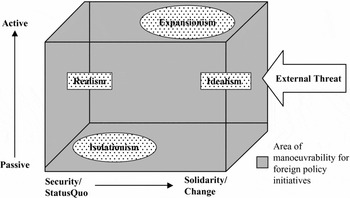
Depending on the situation and how a small state perceives the structure of the international arena and its position there, a small state can base its foreign policy on one of four strategic options: realism, isolationism, idealism or expansionism. A small state can choose to follow a foreign policy that always places security first. This favours an anti-balance behaviour, siding with what is deemed the stronger side in any conflict, and is based on the perception that the very existence of the country is at stake. Isolationism is an extreme form of realism where a country more or less withdraws as an active player from the international arena and passively follows developments there. The rationale for isolationism is to avoid being drawn into any conflict. Foreign policies based on idealism, on the other hand, strive to fulfil a specific goal or set of goals by relying on international rules of law to provide protection. Expansionism in turn reflects a foreign policy that actively attempts to increase a state's role in the international arena in order to fulfil particular goals.
Foreign policy alternatives in response to an external threat.

The foreign-policy alternatives available to small states are influenced by the extent to which they are forced to deal with any threat to their existence. The intensity of a threat determines to a large degree the area of manoeuvrability for foreign-policy initiatives (see Figure 1). Foreign-policy options are severely limited if an external threat is immediate and perceived to constitute a real danger. Choices must be made quickly in order to avert a catastrophe. This situation calls for an active policy based on a realistic judgement of the options available. If the threat does not call for immediate action then more options apply. In order to preserve the security of the state, its leaders may choose an isolationistic strategy based on maintaining the status quo in the international sphere, remaining passive in the hope that the threat will diminish or disappear. If an external threat is conceived in vague terms, such as avoiding a new world war, or is considered to be a threat only in the long run, such as the breakdown of the dominate economic system, a small state has many more options. It can support changes in the international arena that promote the security of small nations (for example, supporting such international organisations as The League of Nations or the International Court at The Hague). With an idealistic strategy and a distant external threat not only can small states provide support for organisations promoting peace, they can also actively participate in such efforts.
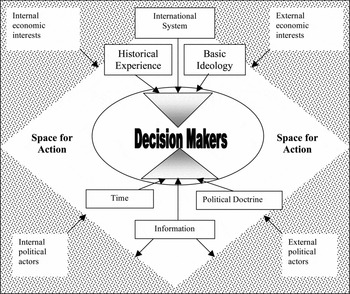
Factors influencing foreign policy decisions.

Any analysis of the foreign-policy alternatives of small states must take into account not only those factors which determine the options open to such states but also those factors which influence the choice of policy (see Figure 2). The decisions of foreign-policy makers are influenced not only by the international system but also by a number of other factors that restrict their scope for action. While a relatively small number of elected officials and professional diplomats may formulate a country's foreign policy, the choices they make are directly or indirectly influenced by ideological, political and economic circumstances. Domestic economic actors such as companies and corporations, trade organisations and unions are fully capable of influencing foreign-policy decisions. International economic interests in the form of transnational corporations and international trade organisations may also have an impact on policy decisions, although they rarely directly influence decision makers. Domestic political organisations often have a more direct impact on foreign policy. Government bodies such as parliament or committees working on defence or foreign relations generally can influence policymaking. Political parties, popular movements and various special-interest organisations may also limit the range of options, although their influence is often limited to specific issues rather than general policy. International organisations also may influence foreign-policy decision making either directly or indirectly. Transnational or international labour organisations can, for example, stop or restrict imports and exports or try to influence public opinion by calling for a boycott of certain products. Environmental groups or organisations promoting peace often lobby governments and try to influence public opinion to support their causes, as well as participating in demonstrations aimed at stopping government activities thought to be conflict with their goals.
Decision makers thus must take into consideration various domestic and international economic and political factors when formulating foreign policy. Adherence to a particular ideology – for example liberalism, conservatism, social democracy or socialism – influences and often limits the foreign-policy alternatives open to a particular decision maker.Footnote 20
Cognitive and normative factors which determine a decision maker's perception of reality also influence the decision-making process. Certain fundamental conceptions – for example how the international system works or the significance historical events – provide the basis for the decision maker's view of the world. These perceptions are internalised by the individual and form what has been termed a ‘belief system’. A belief system serves two primary functions. First it functions as a filter or prism, determining what types of information will be processed. Second, a belief system determines how this information is to be interpreted.Footnote 21 The belief system of the decision maker influences foreign-policy formulation in a manner similar to that of ideological preference, although analytically they may be kept apart. The basic difference is that a belief system consists of, in our case, unarticulated conceptions of how foreign policy is determined. Ideology, on the other hand, consists of an explicit articulated system of concepts that relate to particular political issues.Footnote 22 One of the functions of ideology is to influence the belief system of the decision maker in order to create or maintain circumstances related to specific political goals.Footnote 23
Related to ideology, but once again analytically separate, is what may be termed political doctrine.Footnote 24 Brodin, who has studied official foreign policy doctrines during the Cold War era, defined a political doctrine as a public account of the government's interpretation and conception of the international system and the role of their own country in that system presented by an official representative of the foreign-policy decision-making collective. In relation to belief systems, however, they differ. If we consider that a belief system is influenced by ideological preference, that is, that ideology helps to form the system, we may consider a political doctrine to be the combined results of the decision makers’ belief systems. In any given situation the accepted political doctrine is the outcome of the belief systems of the decision makers. Political doctrines set limits on foreign-policy makers and tend to remain valid for longer periods.
Another factor which affects decision making is the time available to those formulating a country's foreign policy. Long-term goals may very well be the result of a process of in-depth discussion resulting in a general consensus, in which case there is little pressure on the decision makers. If, on the other hand, a crisis develops which requires immediate action and threatens the country, then the time factor becomes more important. Decision makers will have little time to evaluate their options, making the decision-making process more risky. The importance of the time factor will vary depending on the situation.
Another aspect which clearly has an influence on decision makers is the amount and quality of the information they receive. Reports from embassies and consulates, intelligence gathering, newspapers and many other formal and informal sources provide the basis for making foreign-policy decisions. Such information affects several components in the model and also can be thought of as a factor limiting the space of action available to decision makers. For example, information or a lack of information on the seriousness of a threat will influence not only the decision-making process but also how we interpret a state's actions in the international arena.
By combining a theory dealing with the role of small states in international relations with assumptions about what influences those actually formulating foreign policy, we obtain an analytical tool which is actor-oriented but also takes into consideration structural factors. The guiding principle in the construction of this model has been to include variables that can be tested empirically. Certain elements are thus left out. For example, personal traits of the decision-makers clearly play a role. However, it is often difficult to judge what influence psychological factors or personal relationships may have on decisions taken by those involved in the formulation of foreign policy. The model is constructed so as to analyse specific incidents. Such incidents, however, do not occur in isolation. At any one particular time a state is involved in numerous activities related to foreign policy. Whether or not such a model will prove useful in analysing a small state's foreign policy over a longer period remains to be seen.
The Mosul conflict 1924–1925
During the First World War British policy in the Middle East centred on supporting various groups seeking emancipation from Ottoman rule. Among those who received support – or at least encouragement – were Arab nationalists, and when the British captured Baghdad in March 1917 General Stanley Maude, the British commander, announced that Britain intended to return to Iraq control of some of its own affairs.Footnote 25 In 1916, under the Sykes-Picot Agreement, Britain and France set out their policy concerning the Middle East after the conclusion of the war. France was to retain control over Syria and Britain Iraq. Before the war the British-controlled Turkish Petroleum Company held concession rights in the Mosul district in northern present-day Iraq. Under the Sykes-Picot Agreement Mosul was to come under French control. However, in 1919 the French relinquished their claims to Mosul for a 25 per cent share of the Turkish Petroleum Company.Footnote 26
The British took Mosul in early November 1918, a couple of days after the armistice was signed between Turkey and the Allied forces. At the 1919 Paris peace conference Iraq was formally placed under British control as a Class A mandate.Footnote 27 Once Arab nationalists realised that they were not going to be able to create an Arab state, fighting broke out in 1920 in both Syria and Iraq. Both revolts were put down after bloody fighting. The Iraqi revolt was costly for Britain and there was pressure at home to reduce costs in the mandate. The solution was to replace the military regime with a provisional Arab government with British advisors. Supreme authority, however, was still retained by the British high commissioner. At a conference in Cairo in 1921 the British created a constitutional monarchy in Iraq headed by King Faisal.Footnote 28
At the same time fighting resumed in Turkey as Greek troops, supported by the British, invaded. However, Mustafa Kemal led a resistance movement that successfully stopped the invasion and, after long negotiations, the Treaty of Lausanne was signed in 1923, and Turkey was recognised as an independent state. According to the Treaty of Sevres, negotiated in 1920 between the Allies and the Ottoman Sultan, Mosul was to be part of an autonomous Kurdish state. However, once Kemal came to power and regained control over the Kurdish areas in eastern Turkey, the plan for a Kurdish state fell through. The British attempted to create an autonomous Kurdish province but failed. Mosul and other Kurdish areas in the north became a part of Iraq. The belief that Mosul province, to which Turkey also laid claim, contained large oil deposits influenced the British decision to include the province in Iraq. In order not to delay the Treaty of Lausanne as a whole, Britain and Turkey agreed that the problem should be resolved through direct negotiation. If a solution could not be reached within nine months, the dispute would be turned over to the Council of the League of Nations.Footnote 29
Since no agreement was reached within the stipulated time, Britain requested that the Council decide, and on 30 August 1924 the matter was discussed for the first time by the Council of the League of Nations,Footnote 30 which at this time included, in addition to the four permanent members, Sweden, Brazil, Uruguay and Spain.Footnote 31 Turkey, which was not a member of the League, was given assurances that it would be given the same rights as Britain at the hearing. After both countries had presented their viewpoints and arguments, the Council asked them to honour the stipulations of the Treaty of Lausanne requiring that they do nothing to change the present state of affairs and that they agree to accept any decision the Council might eventually make. Britain agreed and, after some hesitation, so did Turkey. Sweden's prime minister Hjalmar Branting, who was part of Sweden's delegation to the League, was appointed rapporteur.Footnote 32 At Branting's suggestion the Council decided to send a commission to the region to determine the sentiments of the local population. After consulting with the governments of Iraq, Turkey and Britain, the commission was to recommend a solution.Footnote 33
As discussions in Geneva continued, several incidents involving Turkey and Britain occurred along the border of Mosul province. While Britain and Turkey had both agreed to maintain the status quo, their interpretations as to where the border was situated differed; the Turkish and British borders overlapped, creating a zone of contention. On 9 October the British government demanded that all Turkish troops withdraw north of the British demarcation line within forty-eight hours, threatening military action if their demands were not met. Turkey appealed to the Council to determine the location of the border. At a meeting in Brussels Branting suggested that a temporary demarcation line be drawn somewhere between the British and Turkish lines, which were 25 km apart at the widest point. Since the Turkish and British borders were drawn with no consideration of the lie of the land, Branting proposed that the border follow natural formations, such as mountain crests and rivers.Footnote 34 On 29 October 1924 the Council accepted Branting's demarcation line. Shortly after the Brussels meeting Branting was taken ill and his place as Sweden's representative on the Council and as rapporteur in the Mosul conflict was taken by Östen Undén.Footnote 35
With the immediate border problem addressed, the commission could begin its work. It comprised a Swedish diplomat, a Belgian soldier, and a Hungarian geographer and former prime minister. Appointment to the commission was based mainly on the principle that its members, either personally or as representatives of their countries, had no interest in the disputed area and were not dependent on any of the parties. The Swedish representative, Carl Einar af Wirsén, was chosen as chairman. Af Wirsén, the Swedish diplomatic representative in Bucharest, Belgrade and Athens, believed that the political, economic, geographic and ethnic situations were so complicated that finding an acceptable solution would be almost impossible, and did not want to be involved. Only at Branting's and the government's insistence did he reluctantly agree.Footnote 36
After visiting the region and meeting various interest groups, the commission concluded that if elections were to be held a neutral military presence would be necessary to keep order,Footnote 37 and therefore recommended that the border question should not be decided by a referendum.Footnote 38
Although the Kurds represented by far the largest group, the ethnic mix in the region was so complicated that the commission ruled out any possibility of drawing a border along ethnic lines.Footnote 39 It also rejected any arguments based on historical references, accepting that Mosul had been formally a part of the Ottoman Empire, but pointing out that the pashas of Baghdad had ruled the province.Footnote 40 The British argued that the border they proposed was strategically best suited to defend the new state of Iraq; the commission agreed, but thought that the Brussels line, as well as other alternatives, was also viable.Footnote 41
After travelling throughout the province and meeting with most interested parties, the commission found that the local population was not particularly enthusiastic about being part of either Turkey or Iraq.Footnote 42 After taking into consideration the history of the region, its ethnic composition, strategic considerations and economic conditions, the commission proposed the Brussels demarcation line as the permanent border, provided that two conditions were met. First, the British mandate in Iraq should be extended to twenty-five years and, second, guarantees should be given to the large Kurdish population, for example that the Kurdish language be accepted as an official language and that Kurds would be allowed to take part in the administration of Iraq. If such guarantees were not provided by the time the Anglo-Iraqi treaty of 1924 expired (the treaty had reduced the British mandate period from twenty years to four), than the majority of the local population would prefer to be ruled by Turkey rather than Iraq.Footnote 43
According to commission's proposal, most of the province would become a part of Iraq. However, it left the Council to determine the importance of political and legal considerations.Footnote 44 If the Council found that political and legal arguments weighed heavier than the commission's arguments, then the latter suggested a division along the Little Zeb River. This would put the town of Mosul and about half of the province under Turkish rule.Footnote 45 Britain criticised the commission's report on the grounds that it went beyond what the British considered to be its mandate – to collect geographic and ethnographic data and not draw any conclusions of a political nature.Footnote 46 Turkey, on the other hand, found an opening in the fact that the Commission declined to consider legal arguments.Footnote 47
The Swedish proposal
During August 1925 the Swedish Foreign Office discussed what position the Swedish delegation should take on the Mosul question in the upcoming Council meeting.Footnote 48 The Swedish delegation was directed to work towards finding a solution as quickly as possible that would satisfy the interests of the local population as well as providing the basis for maintaining a lasting peace in the region.Footnote 49 Although the commission's report indicated that it was not possible to find a solution based on the interests of the various ethnic groups and that economic interests suggested that the Mosul region should become a part of Iraq, Undén was critical of this proposal. He argued instead for its alternative proposal placing the border along the Little Zeb River. With this as a starting point the Swedish Foreign Office worked out an alternative proposal. Both parts of the region were to be demilitarised or, if that was not feasible, the number of troops stationed in each area regulated. An agreement would be reached guaranteeing that the exchange of goods between the regions would not be restricted. The rights of the various minority groups would be guaranteed and the no demands would be made on Britain to prolong its mandate over Iraq.Footnote 50
It was thought that the Swedish proposal had a good chance of being accepted. Turkish ‘national honour’ would be redeemed with the acquisition of the town of Mosul and the British would obtain a viable strategic border (i.e. a demilitarised zone) without having to invest in a lengthening of the Iraqi mandate. Undén was aware that the Swedish solution was far from ideal, but argued that the major drawbacks – in the economic sphere and with regard to the location of various minority groups – also presented problems as regards the commission's other proposals.Footnote 51
At the League of Nations Council meeting in September the question of Mosul began with both Britain and Turkey presenting their final arguments in support of their respective positions. Undén, as the designated rapporteur, suggested that a smaller committee should consider the question before the Council made its decision. The Council agreed and a three-member committee, consisting of Undén, the Spanish representative and the representative from Uruguay, was created.Footnote 52 The committee met several times during the next few days and Undén tried to convince the other two members that the Swedish plan was best suited for creating a solution to the border problem that would lead to peaceful relations between Turkey and the new state of Iraq. Undén had difficulty in bringing about a constructive discussion. He felt that the other committee members were avoiding the key issue and were more concerned about Turkey's position regarding the role of the Council as mediator. Turkey now claimed that the Council did not have the power to decide the question without the consent of both parties and that any resolution on the subject required a unanimous vote. Although this was a reversal of the previous year's agreement, Turkey produced in support of its case legal arguments that introduced some uncertainty as to how the voting procedures of the Council were to be interpreted. Britain responded by stating that unless Turkey, as previously agreed, accepted the Council's ruling as binding, then Britain also would not accept the Council's decision as binding. The Council ignored these declarations.Footnote 53
In order to avoid further delays Undén proposed that the question once again be discussed by the entire Council. At the Council meeting of 17 September 1925 it became clear that a majority of the Council supported the commission's first proposal (that the entire region become part of Iraq), while a minority supported the Swedish plan. A unanimous vote was thus not possible and the Council was undecided as to whether or not it was necessary. The Council asked the International Court at The Hague for a ruling on its powers under the Treaty of Lausanne and the League covenant. After the meeting, Undén provided all the Council members with details of the Swedish compromise plan, and he and the Swedish delegation began trying to convince the British and Turkish delegations as well as the other Council members that the Swedish plan provided the best solution to the border problem.Footnote 54
On 21 November 1925 the International Court ruled that a unanimous decision was necessary, that the votes of Britain and Turkey were not to be counted, and that the decision reached would be binding.Footnote 55 Turkey, however, refused to accept that the Council's ruling was binding, claiming that the latter's role was only that of a mediator.Footnote 56 Undén was still not able to persuade the other two committee members to support the Swedish plan, and it was decided that the committee members would present their viewpoints to the other Council members at the next Council meeting on December 9. Undén met again with all of the Council members and with the British and Turkish delegations, but received support only from Brazil and Japan.Footnote 57
On 14 December Undén and the president of the Council met in secret. The president pointed out how important it was for the League of Nations that the Council came to a decision on the Mosul question, and asked Undén to reconsider his position. While Undén continued to push for the Swedish alternative plan, pointing out that two other Council members supported it, he did promise to consider his options, since he did not want the Council's handling of the problem to end in a fiasco.Footnote 58
The following day Undén informed the Brazilian and Japanese representatives that Sweden would support the majority solution in the Council. However, he demanded that, for the present, the Council should only declare in principle that the Brussels line suggested by the commission should become the border between Iraq and Turkey. If within six months Britain fulfilled the conditions set out by the commission, then the Council should make its decision definite.Footnote 59
On 16 December 1925 the Council of the League of Nations decided unanimously in favour of the commission's main solution. The province of Mosul was to become a part of the new state of Iraq with the permanent border drawn along the Brussels line. Britain was ordered to negotiate a new treaty with Iraq that would increase its mandate period to twenty-five years and guarantee that the commission's recommendations regarding commercial transactions and the protection of minority groups would be followed. This was to be carried out within six months, and if it met with the approval of the Council, the Council would ratify its decision of December 16.Footnote 60
The Turkish delegation was not present at the Council meeting; the Turkish government declared that the country maintained sovereignty over the Mosul region and that this could not be changed without Turkey's consent. Turkey thus refused to accept the Council's ruling. Britain and Turkey once again began direct negotiations, and a few months later, on 5 June 1926, they came to an agreement. The Brussels line became the permanent border between Turkey and Iraq.Footnote 61
Sweden's role in the Mosul conflict
Referring to Figure 1, it becomes clear that Sweden was carrying out an active foreign policy based on solidarity with and support of the League of Nations. Sweden was not directly threatened and as such had a great deal of room to manoeuvre with regard to foreign-policy alternatives. Sweden had, in a few short years, moved from an isolationist foreign policy based on neutrality during the First World War to a policy that promoted the country's active involvement in the international arena. The realistic approach taken during the war had been replaced by idealistic foreign policy placing the security of the state in the hands of an international organisation that it hoped would maintain peace through negotiation and disarmament.
The decisions made by Branting, Undén and their colleagues in the government and Foreign Office were not only influenced by the fact that the country was not threatened; those making the decisions were also not under pressure to act in a particular manner or to act quickly. Nothing in the available source material suggests that economic interests, whether domestic or international, played a significant role in determining foreign policy. Sweden had no direct economic interests in the disputed area and, although trade with Britain was important, it did not influence relations between the two countries with regard to the Mosul conflict.Footnote 62
After an intensive debate on whether or not Sweden should join the League of Nations, support for the League among the various political parties and political interest groups as well as the general population was all but unanimous.Footnote 63 Sweden's participation in the activities of the League of Nations thus was not an issue in domestic politics. Indeed, most party programmes did not even mention the League or, if they did, it was in conjunction with the ongoing debate on disarmament and Sweden's defence capabilities.Footnote 64 From the very outset it became the practice that Sweden's delegation to the League of Nations would include not only representatives of the government but also representatives of the major opposition parties.Footnote 65
Only in the case of the question of the Åland Islands did domestic politics play a significant role with regard to the League. Ever since Sweden lost Finland to Russia in 1809, the question of whether the Åland Islands belonged to Sweden or were a part of Finland remained unsettled. The Swedish-speaking population of Åland wished to become part of Sweden. Finland resisted and the matter was sent to the League of Nations. A commission appointed by the Council determined that Åland Islands were part of Finland but proposed that the islands should not be fortified and that the certain guarantees for the population be given. Led by Branting, the Swedish delegation to the League refused to admit that Finnish sovereignty had been proved. In the end, however, both accepted the decision of the League.Footnote 66 Although the political establishment including the press in Sweden actively supported Sweden's position, interest among the general populace was not as strong. Swedish foreign-policy makers may have been unhappy with the outcome, but there was never any serious suggestion that Sweden should withdraw from the League. The case of the Åland Islands dispute clearly indicates that domestic issues did not influence foreign-policy decision making in the first years of the 1920s.
There was little or no pressure on Sweden throughout its involvement in the Mosul question. Neither Britain, Turkey or other interested parties such as France and the United States (both had interests in Iraq's oil) exerted any undue pressure on those Swedish diplomats involved in the process. No such diplomatic activities with regard to the Mosul dispute are found in the Swedish sources. Only in the case of the choice of af Wirsén to head the inquiry commission was there some discussion among the British. Since af Wirsén had earlier been stationed in Turkey, it was felt that he might be too sympathetic to the Turkish position.Footnote 67 However, once the commission began its work there was no attempt by outside political actors to try to influence Sweden or the Swedish delegates working on the Mosul question.
After the debate on whether or not Sweden should join the League of Nations, a general consensus developed within the Swedish Foreign Office. Although it is not possible to determine what belief systems were in existence during the first half of the 1920s without considering in detail the relevant writings of those involved, their actions in foreign-policy decision making indicate that they were influenced by the events of the First World War. Furthermore, few questioned the view that international relations needed to be controlled by such organisations as the League of Nations. Although Swedish social democrats may have been ideologically more inclined to seek international solutions, Swedish liberals and conservatives were not ideologically opposed to such solutions. This too gave those Swedish diplomats involved in the Mosul affair room to manoeuvre.
Although the Swedish delegation to Geneva was a bipartisan group, two individuals stand out, Hjalmar Branting and Östen Undén. In essence it was these two men who formulated Swedish policy and decided on which course of action to take. Branting's role has already been discussed above. His agreement to function as rapporteur put Sweden in a position to influence developments. Branting not only proposed the Brussels borderline, but also suggested that an inquiry commission be sent to the region. Once Branting fell ill and could not continue, Undén took over and continued to be very active.
The commission was to present its report to the League's Council in September 1925. In July Undén contacted af Wirsén regarding the commission's report. Undén pointed out to af Wirsén that it was particularly important that the commission come up with a positive solution. He stressed that the report should be backed by a united commission and that the commission should avoid delaying the report, since both these factors would result in difficulties for the League and in particular the Council. He further suggested that if they could not agree, they should offer two alternative solutions; even if this were to delay the final decision it was, according to Undén, a better course of action.Footnote 68 It is interesting that Undén should contact af Wirsén at this stage. The commission was to work independently without outside interference. There is nothing in the source material to indicate that Undén's conversation with af Wirsén became public. In the light of what follows, it is clear that Undén was trying to influence af Wirsén even if he did not propose a specific solution.Footnote 69
Once the commission's report had become public, the Swedish Foreign Office began in early August 1925 to work on its alternative plan. The Swedish ambassador in Constantinople reported that the Turkish arguments would centre on the legal question, that is, those aspects that the commission left to the Council to decide.Footnote 70 Information was also received from the embassy in London that the British were considering giving Iraq expert help but would not directly administer the country if the Council accepted the commission's report. The costs of the Iraq mandate were high, and the government deemed it unlikely that it could continue the mandate for twenty-five years in the face of negative public opinion.Footnote 71 Through these diplomatic reports, which provided support for the Swedish plan, Sweden's representatives in Geneva were provided with valuable information about the plans of the Turkish and British governments. Indeed, judging from the amount of correspondence from Constantinople, London, Paris and other Swedish legations to the Foreign Office, Sweden's delegates in Geneva received up-to-date information on an almost daily basis.
Another factor which influences and often limits foreign-policy decision making is a country's official political doctrine. In an important speech on Sweden's foreign policy, Östen Undén outlined the government's position on the League of Nations and on the issue of the protection of minorities. The maintenance of peace was the fundamental principle on which Swedish foreign policy was based. The overriding goal was to prevent war and to insist that all notions that warfare was a natural component of international relations were wrong. To accomplish this, an international organisation which guaranteed that international rules of law would be followed was needed. Although Undén agreed that the League of Nations in its present form was not yet such an organisation, it was the only viable option available. Only through membership and co-operation in the League could war be avoided.Footnote 72
Disarmament and obligatory arbitration for the resolution of conflicts were the two most important aspects of the League's work according to Undén. Disarmament would reduce the impact of international crises. Although obligatory arbitration infringed the right of a state to self-determination, it increased security, since conflicts could be resolved without resort to arms. Sweden's membership of the League also affected its policy of strict neutrality, in that the member states were asked to penalise any country that refused to accept arbitration or to abide by the Council's decision. Sweden accepted that economic sanctions were in principle obligatory, but interpreted any military sanctions imposed by the League as non-binding.Footnote 73 In other words, Sweden's official position was to support and participate in the League of Nations. It was thought that the League's work in the social and economic spheres was a stabilising factor in world politics and constituted an important step towards maintaining world peace. In particular Undén stressed the importance of legally protecting the rights of minority groups in order to avoid ethnic controversies which often sparked larger international conflicts.Footnote 74 During the Mosul conflict, the actions of Branting, Undén and others did not contradict Sweden's official foreign policy in any way.
The analysis of Sweden's role in the so called Mosul crisis in 1924–5 supports the contention that the foreign policies of small states may be treated separately within the field of international relations. Although research on the role of small states in international relations does not receive as much attention today as it did some forty to fifty years ago, earlier theoretical approaches provide a good starting point for developing a useful analytical model for the historical study of the foreign policy of small states. Sweden, clearly a small state in the early 1920s, developed a foreign policy that took this fact into consideration. From the perspective of the options opened to small states in the international arena in the aftermath of the First World War, Sweden's actions in the Mosul crisis are completely understandable.