Introduction
The prevalence of dementia and chronic illnesses is significant and rising to the extent that the World Health Organization recently declared a public health emergency to support family caregivers, improve access to palliative care services, and reduce suffering at the end of life (EOL) (World Health Organization [WHO] 2021). Supportive care programs such as palliative and hospice care may benefit persons with dementia (PWD) and their family caregivers, given its holistic approach focusing on optimizing quality of life and role in minimizing nonbeneficial treatments and hospitalizations near the EOL (Ashbourne et al. Reference Ashbourne, Boscart and Meyer2021; Teno et al. Reference Teno, Gozalo and Trivedi2018).
Dementia is a progressive, terminal condition that affects the memory, behavioral and physical functioning of individuals (Melis et al. Reference Melis, Haaksma and Muniz-Terrera2019). Although circumstances vary, many dementia caregivers often experience intense feelings of subjective burden when caring for PWD that can increase the risk of hospitalization and institutionalization of PWD under their care (Ashbourne et al. Reference Ashbourne, Boscart and Meyer2021; Graessel et al. Reference Graessel, Berth and Lichte2014; Kasper et al. Reference Kasper, Freedman and Spillman2015; Wolff et al. Reference Wolff, Mulcahy and Roth2018b). Subjective burdens, defined as “a person’s subjective evaluation of feeling burdened” (Pendergrass et al. Reference Pendergrass, Malnis and Graf2018, p. 2), may arise from a range of life circumstances such as socioeconomic status characteristics, being overloaded with responsibilities, and having personal conflicts (e.g., family, job, and social) and from intrapsychic (emotional) strains that can lead to high levels of stress that affect the caregiver and PWD bidirectionally (Pearlin et al. Reference Pearlin, Mullan and Semple1990). There are more than 6 million PWD receiving assistance from family caregivers in the United States, placing the responsibility for the health and well-being of PWD squarely on the shoulders of family caregivers in the home (Alzheimer’s Association 2021). Family caregivers are individuals such as spouses, partners, adult children, other relatives, friends, or neighbors who provide care based on a personal, rather than paid, relationship with the PWD (Committee on Family Caregiving for Older Adults 2016). Older adults with dementia typically receive care from spouses and adult daughters (Kasper et al. Reference Kasper, Freedman and Spillman2015; Kumar et al. Reference Kumar, Ankuda and Aldridge2020), averaging more than 30 hours per week for up to 4 years or more (Wolff et al. Reference Wolff, Mulcahy and Huang2018a). However, family caregivers rarely receive any financial assistance or other support to meet the needs of PWD near the EOL, despite providing more than double the number of hours of care per week compared to caregivers of those with other serious illnesses (Ornstein et al. Reference Ornstein, Kelley and Bollens-Lund2017; Porock et al. Reference Porock, Bakk and Sullivan2015). These experiences may exacerbate subjective feelings of burden among caregivers that can be further compounded by other family responsibilities, or by their own physical and emotional health concerns (Pristavec and Pruchno Reference Pristavec2019). Thus, the demands of dementia caregiving can have profound effects on family caregivers’ quality of life, rates of anxiety and depression, and ability to care for themselves (Centers for Disease Control and Prevention [CDC] 2019; Graessel et al. Reference Graessel, Berth and Lichte2014). Consequently, PWD are more likely to have unmet care needs at the EOL, and caregivers are more likely to become overwhelmed in their role (Beach et al. Reference Beach, Schulz and Friedman2020; Graessel et al. Reference Graessel, Berth and Lichte2014; Riffin et al. Reference Riffin, Van Ness and Wolff2019).
PWD also require more help than those without the condition, often resulting in high levels of subjective caregiving burdens, more frequent transitions between health-care settings, and fragmented care (Leniz et al. Reference Leniz, Higginson and Stewart2019; Teno et al. Reference Teno, Gozalo and Trivedi2018; Vick et al. Reference Vick, Ornstein and Szanton2019). Although PWD and their caregivers often prefer in-home care for the PWD through the EOL, and the proportion of PWD who remain at home through the EOL is increasing, this typically requires the presence of a willing and able caregiver and ideally the support of in-home hospice care (Ornstein et al. Reference Ornstein, Kelley and Bollens-Lund2017; Teno et al. Reference Teno, Gozalo and Trivedi2018). Without this essential support, caregivers may reach their “tipping point,” when they realize that they can no longer care for their loved one at home, which can lead to hospitalizations and other undesired health-care transitions for PWD (Saragosa et al. Reference Saragosa, Jeffs and Okrainec2021). Transitions in care are stressful for PWD and may accelerate physical and cognitive decline. Therefore, there is a clear need to develop approaches to reduce hospitalizations of PWD as much as possible to facilitate early transitions to supportive care services such as palliative and hospice care, which can improve EOL care outcomes, reduce caregiving burdens, and decrease unplanned hospitalizations near the EOL (Institute of Medicine [IOM] 2015; Wright et al. Reference Wright, Youens and Moorin2018). However, there is insufficient research investigating the unique needs of dementia caregivers such as how caregiving burdens drive overnight hospitalization and hospice use near the EOL (Cagle et al. Reference Cagle, Lee and Ornstein2020; Hirschman and Hodgson Reference Hirschman and Hodgson2018; Romo et al. Reference Romo, Carpenter and Buck2019). Identification of potentially modifiable risks for undesired care transitions may aid the development of new approaches to reduce caregiver burdens that simultaneously address unmet needs of PWD and improve access to hospice care services for PWD who are nearing the EOL.
The purpose of this study is to better understand potential relationships between subjective caregiver burdens and overnight hospitalization incidence and number of overnight hospitalizations and hospice use in the last year of life. The study is guided by the following research questions: (1) what is the relationship between subjective caregiver burden and (a) overnight hospitalizations (incidence and frequency) and (b) hospice utilization among deceased PWD, and (2) what are the differences in overnight hospitalizations (incidence and frequency) between PWD who either live or die within a year?
Methods
This is a cross-sectional, secondary data analysis of the National Health and Aging Trends Study (NHATS) linked to the National Study of Caregiving (NSOC). This study received human subject approval from the university institutional review board (#MODCR00005076).
Data sets
NHATS is an annual national survey of 12,427 Medicare beneficiaries sampled from the Medicare enrollment file who are aged 65+ and residing in the contiguous United States (2011 to current) (Montaquila et al. Reference Montaquila, Freedman and Edwards2012). NHATS is a collection of data around key content areas in the domains of health conditions, mobility and physical function, cognitive capacity (including dementia), self-care capacity and participation in valued activities, and items related to social determinants of health to further understanding of aging and disability trends among older adults residing in the community. The NSOC, which complements NHATS, interviews up to 5 family caregivers of a subset of NHATS research respondents at 3 time points (2011, 2015, and 2017) on a range of topics related to caregiving activities including positive and negative aspects of caregiving, intensity and duration of caregiving, health and well-being, and socioeconomic items. There are 3,305 NHATS respondents with a primary caregiver represented across the 3 time points in the NSOC. The NHATS/NSOC studies are conducted at the Johns Hopkins University and are sponsored by a grant from the National Institutes of Aging (NIA) (NIA U01AG32947). Our method for preprocessing and linking the NHATS to the NSOC data sets longitudinally, including SAS coding statements, is published elsewhere (Sullivan et al. Reference SS, CS and de Rosa2022).
Theoretical framework
The caregiver stress model developed by Pearlin et al. (Reference Pearlin, Mullan and Semple1990) guides this study. The model identifies and describes caregiving background and context components, such as socioeconomic status, as well as specific stressors and strains that contribute to the overall experience of caregiver burden. The caregiver stress model is made up of the following domains: background and context (e.g., sociodemographics), primary stressors (e.g., caregiver overload), secondary role strains (e.g., family and employment caregiving conflicts), secondary intrapsychic strains (e.g., global and situational), caregiver outcomes (not considered in this analysis), and mediators (e.g., coping and social support).
In addition, Lazarus and Folkman’s (Reference Lazarus and Folkman1984) transactional stress model emphasizes that the perception of stress is relative to the caregiver’s cognitive appraisal of the current situation and capacity to fulfill its demands (Pendergrass et al. Reference Pendergrass, Malnis and Graf2018). Together, these models comprise the conceptual basis for the Burden Scale for Family Caregivers (BSFC), a psychometrically valid and reliable instrument that measures multiple aspects of subjective caregiver burden that can increase the risk of institutionalization of older adults with dementia (Graessel et al. Reference Graessel, Berth and Lichte2014; Pendergrass et al. Reference Pendergrass, Malnis and Graf2018).
The BSFC includes items that operationalize the assessment of caregiver emotional, physical, personal, and social stressors (Graessel et al. Reference Graessel, Berth and Lichte2014; Pendergrass et al. Reference Pendergrass, Malnis and Graf2018) and was therefore used to guide the selection of specific NHATS and NSOC items indicating caregiver burden. Although the BSFC is not completely or directly replicated in NHATS/NSOC items (prohibiting our ability to calculate a measure of caregiver burden), conceptual similarities allowed a crosswalk between like questions based on the content expertise of the authors. For example, the BSFC item “I often feel physically exhausted” closely approximates the NSOC item “you are exhausted when you go to bed at night.”
Population
Sample
While NHATS collects longitudinal data annually, it does not enroll new respondents in every round, so the lower age limit for continuing respondents increases as the sample ages. To ensure the representation of person aged 65+, the data were limited to NHATS respondents and their primary caregivers who enrolled in round 5 (2015), when the second NHATS cohort was enrolled. NHATS respondents were linked to their primary caregiver who responded to the NSOC II (2015) in dyads as NHATS round 5 also aligns with the NSOC II (2015).
Persons living with dementia
Individual NHATS respondents were identified as having either 1 = probable, 2 = possible, or 3 = no dementia based on a valid and reliable Eight-item Informant Interview to Differentiate Aging and Dementia (AD8) score using the SAS coding statements provided by the principal investigators of NHATS (Kasper and Freedman Reference Kasper and Freedman2020; Kasper et al. Reference Kasper, Freedman and Spillman2013). Respondents with either a probable or possible dementia classification as indicated by the AD8, i.e., PWD, were included in the study. NHATS participants with “no dementia” were excluded.
The AD8 instrument assesses memory, temporal orientation, judgment, and function and assigns a “cutoff” point to estimate dementia status. The AD8 instrument has good to excellent internal consistency (α = 0.84), interrater reliability (kappa = 0.67), intraclass correlation coefficient of 0.80, and discrimination (area under the curve = 0.92) (Galvin et al. Reference Galvin, Roe and Xiong2006). Moreover, factor analysis of the cognitive domains of NHATS tests has the following factor loadings: memory (range 0.738–0.804), orientation (range 0.633–0.640), and executive functioning (0.494) (Kasper et al. Reference Kasper, Freedman and Spillman2013).
Alive/not alive
PWD who died between the 2015 and the 2016 follow-up survey (rounds 5 and 6), identified by the presence of a last month of life (LML) interview in round 6, were considered to be “not alive” in the present study. PWD who did not have an LML interview were considered to be “alive.” The LML interview is administered when an NHATS respondent has died between rounds of data collection. The LML interview is conducted with proxy representatives (typically a family member) who report the experience (quality of EOL care and daily activities) of the NHATS respondent during their LML.
Caregivers
Paid or unpaid primary family caregivers were defined as the person providing the greatest number of hours of care to the PWD in the month preceding the NSOC interview, which is consistent with previously published research (Pristavec et al. Reference Pristavec and Luth2020).
Outcome variables
Predictor variables were collected from round 5 (2015) and outcomes (overnight hospitalization, frequency of overnight hospitalizations, and hospice use) were identified in round 6 (2016) to capture EOL care transitions in the subpopulation of decedents (i.e., NHATS rounds 5 and 6 linked to NSOC data 2015–2016).
Overnight hospital stays
Care transitions to the hospital were defined as an overnight hospital stay within the previous 12 months (yes/no).
Number of overnight hospital stays
The number of (separate) overnight hospital stays was coded as follows: 0 = no overnight hospital stays; 1 = 1 overnight hospital stay; 2 = 2 overnight hospital stays; 3 = 3 overnight hospital stays; or 4 = ≥4 overnight hospital stays. The number of overnight hospital stays was chosen to determine if there was a relationship between the frequency of separate hospitalizations and subjective caregiver burden items in the year prior to death.
Hospice utilization
Hospice utilization (yes/no) was selected from a derived variable available in the NHATS data set to determine possible correlates at the EOL.
Predictor variables
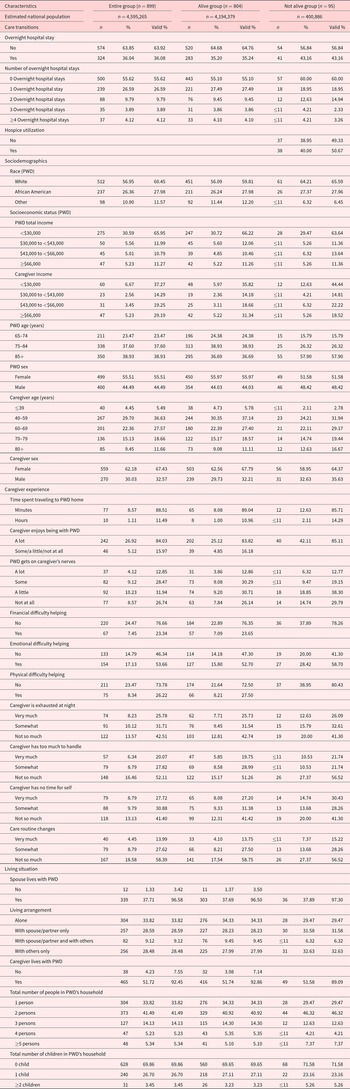
Subjective caregiver burden variable selection was guided by the caregiver stress model and the BSFC questionnaire. Subjective caregiver burden predictor variables included NHATS and NSOC items representing a combination of PWD and caregiver sociodemographics (PWD age, sex, race, and socioeconomic status, and caregiver age, sex, and socioeconomic status) and PWD living situation. Table 1 provides a detailed description of the variable categories and frequencies.
Frequencies of care transitions, sociodemographics, and subjective caregiver burden

Note: PWD, persons with dementia.
Some data columns were collapsed or not reported in accordance with the data use agreement due to frequency ≤11. Overnight hospital stays and the number of overnight hospital stays are recorded as separate questions in the NHATS study and therefore have different response rates.
PWD race
Race categories were grouped as white, African American, and others due to the relatively small frequency of racial subgroups and those reporting 2 or more races.
Age and sex
Three 10-year incremental age categories were created (65–74 through 80+ years) for PWD. Five 10-year incremental age categories were created (≤39 through 80+ years) for caregivers. PWD and caregivers’ sex was binary (male/female).
Socioeconomic status
Socioeconomic status of the PWD or caregiver was indicated by 4 incremental income categories (e.g., 1 = less than $30,000 through 4 = ≥$66,000) based on their respective total income.
PWD living situation
The living situation of the PWD included whether the PWD lives alone, with a spouse/partner only, with a spouse/partner and with others, or with others only, if the caregiver lives with the PWD, the number of children in the household, and the total number of people residing in the household.
Subjective caregiver burden
In addition to sociodemographic and living situation items, subjective caregiver burden also included questions directly related to the caregiver experience: the amount of time the caregiver spends driving to or from home to care for the PWD; how much the caregiver enjoys being with the PWD; how often the PWD gets on the caregiver’s nerves; whether caregiving poses financial, physical, or emotional challenges; to what extent the caregiver reports being exhausted at night, having more to do than they can handle, having no time for themselves; and how often the PWD’s care routine changes.
Analytic approach
The present study uses univariable logistic regression to determine the relationship between hospice utilization (yes/no) and each of the aforementioned predictors. Logistic regression with contrasts was used to determine the relationship between overnight hospital stay (yes/no) and each of the aforementioned predictors in each of the 2 PWD groups (alive/not alive) and to compare the relationships between the predictor variable and overnight hospital stay between the 2 groups by including the interaction term between the predictor variable and a group variable denoting whether the PWD lived or died in round 6.
Proportional odds (PO) regression with contrasts was used to examine the relationship between the ordinal outcome variable “number of hospital stays” and each of the aforementioned predictors in each of the 2 PWD groups and compare the relationships between the predictor variable and “number of hospital stays” between the 2 groups by including the interaction term between the predictor variable and a group variable denoting whether the PWD lived or died in round 6.
If an omnibus test for the effect of a categorical predictor with more than 2 levels were significant, multiple pairwise comparisons between a reference group and the other groups were performed with Bonferroni correction to decide if a pairwise comparison was significant. A p-value of an omnibus test <0.05 was considered statistically significant. All analyses were performed with SAS version 9.4 (SAS Institute Inc., Cary, NC, USA 2013). When using SAS PROC LOGISTIC with “clogit” link function to perform PO regression analyses, probabilities modeled are cumulated over the lower ordered values.
Results
There were 899 PWD in the sample linked to their primary caregiver and a subset of 95 PWD decedents. PWD were primarily White (60.45%), aged 85+ (38.93%), and female (55.51%) with an annual income <$30,000 (65.95%) (Table 1). Caregivers were primarily ≤59 years old (42.12%) and female (67.43%) with an annual income ≥$30,000 (62.73%) (caregiver race is not available). Subjective caregiver burden items were significantly associated with the incidence and frequency of overnight hospital stays between both subgroups (PWD who were either alive or not alive in round 6) and with hospice utilization. PWD age was a significant predictor of overnight hospital stays and frequency, and younger PWD decedents were more likely to experience frequent hospitalizations. More than two-thirds of caregivers reported that they did not have financial difficulty helping (76.66%) or physical difficulty helping the PWD (73.78%). Just under half reported having emotional difficulty helping the PWD (46.34%) and having too much to handle (very much or somewhat) (47.89%). Caregivers reported having no time for themselves “very much” (27.72%), “somewhat” (30.88%), or “not so much” (41.4%) (Table 1).
Overnight hospital stays
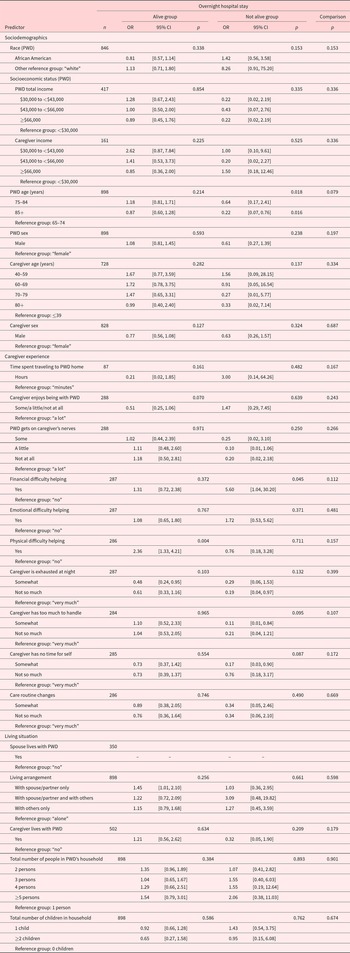
PWD who were alive in round 6 were 2.36 times more likely to experience an overnight hospital stay when their caregiver reported having physical difficulty helping the PWD compared to PWD whose caregivers did not have physical difficulty helping (p = 0.004, odds ratio [OR] = 2.36, 95% confidence interval [CI] = 1.33, 4.21).
Decedents aged 65–74 were 4.55 times more likely to experience an overnight hospital stay compared to those aged 85+ (p = 0.016, OR = 1/0.22 = 4.55, 95% CI = 1/0.76, 1/0.07 = 1.32, 14.29). (Note: the odds ratio is reversed to emphasize the group at highest risk, i.e., decedents aged 65–74 is associated with higher risk vs. decedents aged 85+ of being associated with lower risk [p = 0.016, OR = 0.22, 95% CI = 0.07, 0.76].) This relationship between age and an overnight hospital stay was not significant among PWD who were alive in round 6 (p = 0.214), but it was significant among PWD who were not alive (p = 0.018). There was a trend toward statistical significance in the relationship between groups (alive and not alive) (p = 0.079) (Table 2). Decedents with caregivers who reported having financial difficulty helping were 5.6 times more likely to experience an overnight hospital stay compared to decedents whose caregivers did not have financial difficulty helping (p = 0.045, OR = 5.6, 95% CI = 1.04, 30.20) (Table 2). There were no significant differences detected between groups (alive and not alive) on whether the PWD experienced an overnight hospital stay (Table 2).
Results of analyses of logistic regression of overnight hospital stay on sociodemographics and subjective caregiver burden (sample: PWD)

Note: PWD, persons with dementia; OR, odds ratio; CI, confidence interval.
Comparison of the relationship between a predictor and overnight hospital stay in the alive group and that in the not alive group.
Number of overnight hospital stays
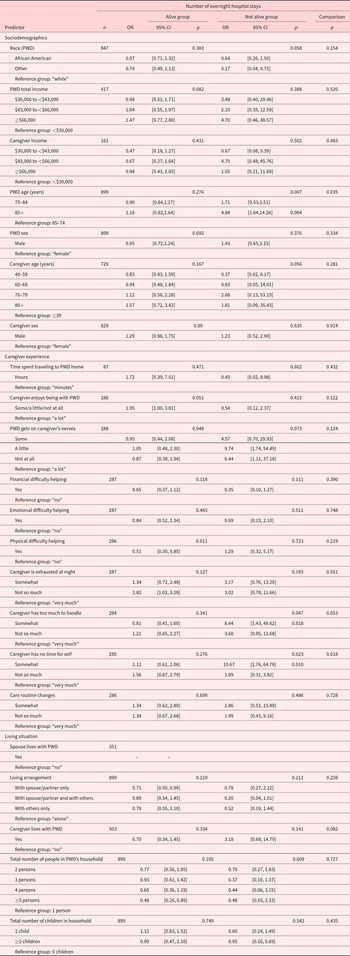
Living PWD whose caregiver reported physical difficulty helping were 1.96 times more likely to experience one or more overnight hospital stays compared to PWD whose caregiver did not have physical difficulty helping (p = 0.011, OR = 1/0.51 = 1.96, 95% CI = 1/0.85, 1/0.3 = 1.18, 3.33) (Table 3). (Note: the odds ratio is reversed to emphasize the group at highest risk, i.e., having difficulty helping is associated with higher risk vs. no difficulty helping being associated with lower risk [p = 0.011, OR = 0.51, 95% CI = 0.30, 0.85]).
Results of analyses of proportional odds regression of number of overnight hospital stays on sociodemographics and subjective caregiver burden (sample: PWD)

Note: PWD, persons with dementia; OR, odds ratio; CI, confidence interval.
Number of overnight hospital stays categorized as follows: 0, no overnight hospital stays; 1, 1 overnight hospital stay; 2, 2 overnight hospital stays; 3, 3 overnight hospital stays; and 4, ≥4 overnight hospital stays. Probabilities modeled are cumulated over the lower ordered values.
Comparison of the relationship between a predictor and categorized number of overnight hospital stays in the alive group and that in the not alive group.
Decedents aged 65–74 were 4.84 times more likely to experience one or more overnight hospital stays compared to those aged 85+ (p = 0.004, OR = 4.84, 95% CI = 1.64, 14.26). The relationship between age and frequency of hospitalizations was not significant among PWD who were alive in round 6 (p = 0.276), but it was significant among PWD who were not alive (p = 0.007). There was a statistically significant difference in this relationship between groups (alive and not alive) (p = 0.035) (Table 3).
Decedents whose caregiver agreed “very much” to having “too much to handle” were 8.44 times more likely to experience one or more overnight hospital stays compared to those whose caregivers reported “somewhat” (p = 0.018, OR = 8.44, 95% CI = 1.43, 49.62). Moreover, decedents whose caregiver agreed “very much” that they have “no time” for themselves were 10.67 times more likely to have more frequent overnight hospital stays compared to those whose caregivers responded “somewhat” (p = 0.010, OR = 10.67, 95% CI = 1.76, 64.78). This relationship was not significant among PWD who were alive in round 6 (p = 0.276), but it was significant among PWD who were not alive (p = 0.023). A statistically significant difference in the frequency of overnight hospital stays between groups (alive and not alive) was detected when the caregiver reported having no time for themselves (p = 0.018) (Table 3). There was a trend toward statistical significance between groups (alive and not alive) on the number of overnight hospital stays among caregivers reporting having too much to handle (p = 0.053) and whether the caregiver lived with the PWD (p = 0.082) (Table 3).
Hospice utilization
PWD decedents whose caregiver had emotional difficulty helping were 5.89 times more likely to utilize hospice compared to those whose caregiver did not have emotional difficulty helping (p = 0.017, OR = 5.89, 95% CI = 1.38, 25.23) (Table 4).
Results of analyses of univariable logistic regression of hospice on sociodemographics and subjective caregiver burden (sample: not alive PWD)

Note: PWD, persons with dementia; OR, odds ratio; CI, confidence interval.
Discussion
Subjective caregiver burdens were significantly related to PWD overnight hospital stay incidence and frequency and hospice utilization. The age of the PWD who were not alive was associated with overnight hospitalizations, suggesting that the effect of age of the PWD on overnight hospitalizations differs depending on whether a PWD is in their last year of life. Younger PWD decedents in our study were more likely to experience an overnight hospital stay compared to older decedents, and the number of their overnight hospitalizations differed depending on whether the PWD was in their last year of life or not, which makes an interesting contribution to the literature. In contrast to our findings, a recent systematic review found that older age was associated with hospitalization of PWD, but the authors did not investigate EOL (Shepherd et al. Reference Shepherd, Livingston and Chan2019). While Williamson et al. (Reference Williamson, Evans and Cripps2021) found a relationship between PWD age and emergency department use near the EOL, the strength of evidence across studies was low. Although additional research into the relationship between age and PWD care transitions nearing the EOL is warranted, our study has important clinical implications to consider in regard to the value of promoting early access to community-based palliative care services for younger PWD as a means of reducing hospitalizations in the final months of life (Wright et al. Reference Wright, Youens and Moorin2018).
When their caregivers reported having no time for themselves, there was a significant difference between PWD alive and not alive groups on overnight hospitalizations, suggesting that caregiver burdens influencing overnight hospitalizations differ depending on whether a PWD is in their last year of life. Furthermore, among PWD who were alive in round 6, the primary driver of overnight hospital stay incidence and frequency occurs when caregivers feel that helping the PWD was physically difficult, but among decedents, physical difficulty caring for the PWD was not associated with any of the transition outcomes. Rather, decedents experienced overnight hospital stay incidence when their caregivers reported having financial difficulties (Table 2) or overnight hospital stay frequency when they were personally or socially burdened by their role (i.e., “too much to handle” and “no time for self”) (Table 3). Caregivers who had emotional difficulty helping were more likely to access hospice care for the PWD at the EOL than those who did not have emotional difficulty (Table 4).
The findings of this study underscore the impact of EOL caregiving burdens on PWD outcomes and support the notion that the need for constant supervision and care of the PWD at the expense of the caregivers’ own physical and mental health may become a “tipping point” for dementia caregivers when they realize they can no longer care for the PWD at home (Sadak et al. Reference Sadak, Foster Zdon and Ishado2017; Saragosa et al. Reference Saragosa, Jeffs and Okrainec2021). Indeed, caregiving burdens are high among dementia caregivers, particularly as the PWD nears the EOL (Nguyen et al. Reference Nguyen, Haupt and Duan2022; Ornstein et al. Reference Ornstein, Kelley and Bollens-Lund2017; Vick et al. Reference Vick, Ornstein and Szanton2019), which can lead to undesired hospitalizations. However, surprisingly few studies investigate the link between subjective caregiver burdens of PWD and care transitions (Amjad et al. Reference Amjad, Mulcahy and Kasper2021; Shepherd et al. Reference Shepherd, Livingston and Chan2019; Williamson et al. Reference Williamson, Evans and Cripps2021), and there is a scarcity of literature investigating dementia caregiver burden on EOL care transitions (Amjad et al. Reference Amjad, Mulcahy and Kasper2021; Shepherd et al. Reference Shepherd, Livingston and Chan2019). Thus, the findings of this study make a significant contribution in helping further our understanding of the subjective needs of dementia caregivers that may influence PWD care transitions, particularly through the EOL experience (Amjad et al. Reference Amjad, Mulcahy and Kasper2021; Shepherd et al. Reference Shepherd, Livingston and Chan2019; Vick et al. Reference Vick, Ornstein and Szanton2019; Williamson et al. Reference Williamson, Evans and Cripps2021).
In the United States, there is a downward trend in the proportion of deaths occurring in hospitals and a concomitant increase in the proportion of deaths in home and community settings (Teno et al. Reference Teno, Gozalo and Trivedi2018). In our study, only 51% of decedents utilized hospice care. It is possible that PWD in our study were not eligible, may not have been aware that they were eligible, may have declined hospice services, or faced other unknown barriers to care. Nevertheless, appropriately timed referrals to supportive care services could alleviate the very stressors leading to the incidence of hospitalization by meeting the emotional needs of dementia caregivers (LaValley Reference LaValley2017) and helping reduce subjective caregiving burdens (Amjad et al. Reference Amjad, Mulcahy and Kasper2021; Lindt et al. Reference Lindt, van Berkel and Mulder2020). Yet, it is important to note that reliance on family caregivers to meet EOL care needs could intensify caregiving burdens particularly when caregivers have unmet training and support needs (Cross et al. Reference Cross, Kaufman and Taylor2020). This concern is particularly relevant in the present study where decedents were much more likely to experience hospitalizations when their caregiver reported having too much to handle or having no time for themselves. Policy-level barriers may also prevent caregivers from accessing supportive care services including the shortage of community-based palliative care programs under current reimbursement models in the United States. Consequently, many PWD do not qualify for supportive care programs until the very EOL (LaValley Reference LaValley2017), or when they do access hospice care early, they risk being discharged, and caregivers risk losing this essential support (Luth et al. Reference Luth, Russell and Xu2021; Wladkowski et al. Reference Wladkowski, Wallace and Gibson2020).
Notably, many subjective caregiver burden items analyzed in this study were not associated with hospitalization or hospice use among PWD. However, several key caregiver burden items stand out as potentially modifiable risk factors for reducing caregiver burdens, reducing overnight hospitalizations, and improving access to hospice care services for PWD approaching the EOL. Personalizing supportive care interventions may help facilitate positive perspectives on caregiving and improve care outcomes of older adults with advanced serious illness (Pristavec et al. Reference Pristavec and Luth2020; Pristavec and Pruchno Reference Pristavec2019). It is also possible that many dementia caregivers may not perceive caregiving tasks and responsibilities negatively and instead may hold positive perceptions of their role despite the high burdens of care (Cross et al. Reference Cross, Garip and Sheffield2018).
This study has several limitations. First, NHATS does not account for the cause of death, so it is possible that some respondents experienced sudden death and did not have the opportunity to enroll in hospice care or that hospice utilization was not identified in the LML survey. Second, the presence of other caregivers may have an impact on overnight hospitalizations and hospice utilization that could not be determined by limiting our study to the primary caregiver. Third, although we hoped to weight the study data in accordance with NHATS guidelines, survey weights are provided by the round in which respondent data were collected. Since we studied the relationships between predictors in round 5 and outcomes in round 6, it was not possible to apply survey weights for this analysis. Moreover, the sample size of the decedents was small, it was not possible to fit a multivariable model due to missing values, and we cannot draw conclusions of causality given the study design. The strengths of this analysis are that it uses a national data sample and the prospective design of the NHATS study reduces recall bias. However, the small sample available within this national data sample underscores the challenges of conducting research in this important area.
This study identified PWD age and subjective caregiver burden factors associated with overnight hospitalization incidence and frequency of PWD who were alive/not alive and subjective care burden factors associated with hospice utilization in a national data set of older adults linked to their primary caregivers in dyads, which is an understudied area (Cagle et al. Reference Cagle, Lee and Ornstein2020; Hirschman and Hodgson Reference Hirschman and Hodgson2018). Future longitudinal analyses linking caregiving burden to Medicare data for PWD such as health-care encounters, health assessment, and date of death may provide additional insights into patterns of EOL care transitions. This information may aid in the development of personalized approaches to avoid overnight hospitalizations and improve timely access to supportive care services, when desired, by PWD and their care partners.
In summary, this is one of the first studies to explore the relationship between subjective caregiver burden and care transitions (overnight hospital stay and hospice use) among PWD near the EOL. Our findings suggest that caregivers who are physically, financially, personally, and socially burdened from caregiving need additional resources and support to reduce the burden of care and subsequent undesirable care transitions for PWD, particularly among those nearing the EOL. Systemic approaches at the policy and health system level that aim to address unmet needs contributing to the burdens of dementia caregivers could make a significant contribution to the reduction of undesired care transitions near the EOL and could potentially promote early access to community-based supportive care services.
Conflicts of interest
The authors have no known conflict of interest to disclose.