Introduction
The Atlantic Forest hosts c. 60% of Brazil’s biodiversity and nearly 30% of Neotropical bird species (Sick & Barruel Reference Sick and Barruel1984). Despite its rich biodiversity (Rezende et al. Reference Rezende, Scarano, Assad, Joly, Metzger and Strassburg2018), only 28% of the original vegetation remains. The ongoing deforestation is driven by commodities production, agriculture and forest fires (Diniz et al. Reference Diniz, Coelho, Sánchez-Cuervo and Loyola2022), leading to local population extinctions, biodiversity loss and negative impacts on ecological functions (Duarte et al. Reference Duarte, Santos, Cornelissen, Ribeiro and Paglia2018).
Global declines of species, habitat loss and disruption of ecological functionality call for more precise ecological understanding. Functional traits of species offer better predictors of ecological patterns than classic diversity indexes (i.e., solely, richness, abundance and taxonomic diversity; Bello et al. Reference Bello, Carmona, Dias, Götzenberger, Moretti and Berg2021, Mariano-Neto & Santos Reference Mariano-Neto and Santos2023). Analysing species’ unique characteristics can reveal their roles in ecosystem functioning (Carmona et al. Reference Carmona, Guerrero, Morales, Oñate and Peco2017), aiding understanding of how the extinction of specific functional groups impacts the functionality of whole ecosystems (Mazel et al. Reference Mazel, Pennell, Cadotte, Diaz, Dalla Riva and Grenyer2018). Human modifications of landscapes lead to changes in species composition, yet there is no consensus on how functional diversity (FD) can persist in such settings (Riemann et al. Reference Riemann, Ndriantsoa, Rödel and Glos2017). Exploring relationships between habitat loss and FD can provide valuable insights into the mechanisms driving changes in FD that can impact ecosystem processes (Bello et al. Reference Bello, Carmona, Dias, Götzenberger, Moretti and Berg2021, Mariano-Neto & Santos Reference Mariano-Neto and Santos2023).
Several metrics of FD, including functional richness, evenness, divergence and dispersion, have been proposed to enhance our understanding of how environmental changes impact communities and ecosystem services (Mason et al. Reference Mason, Mouillot, Lee and Wilson2005, Laliberté & Legendre Reference Laliberté and Legendre2010). Both functional richness and functional evenness have been highlighted as potential indicators of biological control provided by birds (Barbaro et al. Reference Barbaro, Giffard, Charbonnier, van Halder and Brockerhoff2014). Evidence suggests that bird insectivory often rises with increasing functional richness and functional evenness, underscoring the complementarity of many functional traits (Barbaro et al. Reference Barbaro, Rusch, Muiruri, Gravellier, Thiery and Castagneyrol2017).
Birds encompass a broad range of functional traits, including morphological, physiological and phenological characteristics that affect species’ fitness, growth rates, reproduction and survival (Violle et al. Reference Violle, Navas, Vile, Kazakou, Fortunel and Hummel2007). These traits are sensitive to diverse environmental changes (Alexander et al. Reference Alexander, Ehlers Smith, Ehlers Smith and Downs2019), rendering birds as significant models for assessing changes in landscape, ecosystem functioning and FD (Bregman et al. Reference Bregman, Lees, MacGregor, Darski, de Moura and Aleixo2016, Prescott et al. Reference Prescott, Gilroy, Haugaasen, Medina Uribe, Foster and Edwards2016). Moreover, birds perform key ecological functions such as seed dispersal, pollination, nutrient cycling, soil formation and control of arthropod populations (Sekercioglu Reference Sekercioglu2006).
In the mosaic of habitats that currently characterizes the Atlantic Forest, beta FD can provide insights into how functional traits change during transitions between habitats (Villéger et al. Reference Villéger, Mason and Mouillot2008). This variation results in both turnover processes, representing dissimilarity in species compositions along environmental gradients (Baselga Reference Baselga2010), and nestedness, which includes subsets of the original community (Pollock et al. Reference Pollock, Jones, Tarwater, Nishikawa and Brawn2020). Therefore, human-modified landscapes might reveal functionally nested communities and low redundancy, potentially increasing the susceptibility of persistence functions within these communities to rapid decline (Almeida-Gomes et al. Reference Almeida-Gomes, Vieira, Rocha and Melo2019). A notable gap exists regarding comprehensive studies of bird beta FD, notably in terms of our understanding of ecological responses to human impacts and environmental changes. Addressing these knowledge gaps is essential for a better understanding of the ecological functions performed by tropical birds and for defining conservation and management strategies in tropical environments.
In this study, we investigated how landscape influences the FD of insectivorous birds in the Brazilian Atlantic Forest, exploring correlations between types of environments (pasture, native forest and marsh), forest cover and the FD and species composition of birds. Our hypothesis is that anthropogenic environments such as pastures together with the loss of native forest cover modify the filtering of functional characteristics amongst insectivorous birds within the Atlantic Forest. We predicted that FD would be influenced by species turnover and nestedness across different environment types. Disturbed environments may benefit generalists, leading to greater influences on nestedness and reduced biodiversity (Karp et al. Reference Karp, Rominger, Zook, Ranganathan, Ehrlich and Daily2012), whereas the contribution of turnover would be more pronounced in heterogeneous environments (Arroyo-Rodríguez et al. Reference Arroyo-Rodríguez, Rös, Escobar, Melo, Santos and Tabarelli2013). We also predicted that higher relict native vegetation cover would positively influence both insectivorous bird composition and FD due to increased habitat complexity (Morelli et al. Reference Morelli, Benedetti, Perna and Santolini2018).
Methods
Study sites
The study was conducted within the ecological corridor of the Cantareira-Mantiqueira region (CMR; Fig. 1), where long-term ecological research has been conducted since 2014. The CMR is situated in the south-eastern part of the Atlantic Forest, characterized by dense rainforest that covers c. 700 000 ha. The elevation ranges from 700 to 1250 m above sea level (Tonetti et al. Reference Tonetti, Rego, De Luca, Develey, Schunck and Silveira2017), connecting two large blocks of rainforest: Cantareira State Park and Serra da Mantiqueira State Park (Boscolo et al. Reference Boscolo, Tokumoto, Ferreira, Ribeiro and dos Santos2017).
Landscapes where soundscape data were collected using autonomous audio recorders within the Long-Term Ecological Research of Ecological Corridor Cantareira-Mantiqueira (LTER CCM or PELD CCM), São Paulo, Brazil, between October 2016 and January 2017 (Gaspar et al. Reference Gaspar, Scarpelli, Oliveira, Alves, Gomes and Wolf2023).

The region comprises diverse landscape mosaics with a wide range of forest losses and great heterogeneity of land use. Most of the forest remnants are fewer than 100 ha in area and isolated, composed of second-growth forests in early to medium stages of succession (Ribeiro et al. Reference Ribeiro, Metzger, Martensen, Ponzoni and Hirota2009). These forest remnants are surrounded by multiple land-use systems, including several agroecosystems, such as pastures, small-scale agriculture, forestry, regenerating forests and urban areas (Barros et al. Reference Barros, Martello, Peres, Pizo and Ribeiro2019a). The regional climate is classified as Cwa according to the Köppen classification, indicating a humid subtropical climate with dry winters and hot summers (Alcarde Alvares et al. Reference Alcarde Alvares, Stape, Sentelhas, Gonçalves and Sparovek2013).
Selection of landscapes
We analysed data from 22 landscape sites within the CMR (Fig. 1). Forest cover data were at the 2-km diameter scale, following prior research on bird responses to landscape structure (Barros et al. Reference Barros, Peres, Pizo and Ribeiro2019b, Adorno et al. Reference Adorno, Barros, Cezar Ribeiro, da Silva and Hasui2021), and in these areas native forest cover ranged from 1% to 97% within a 1–km radius around each site’s centroid. In each site, we sampled three habitat types (forests, pastures for cattle raising and marshes) located c. 100 m apart. Forest sampling points were at least 50 m away from the forest edge (Scarpelli et al. Reference Scarpelli, Ribeiro and Teixeira2021, Gaspar et al. Reference Gaspar, Scarpelli, Oliveira, Alves, Gomes and Wolf2023).
Sound records and bird data
We collected sound data from all three environments across the 22 sites (65 sampling points) over a total of 90 days. Each environment was sampled for 30 days before transitioning to the next type within the same site. Sampling occurred from October 2016 to January 2017, with forests sampled in October–November, marshes sampled in November–December and pastures sampled in December–January, coinciding with the Southern Hemisphere’s breeding season for most birds (Develey & Peres Reference Develey and Peres2000). To reduce the effects of space and time inherent in such macroecological work, data were collected within a single reproductive season (i.e., from October 2016 to January 2017), and the buffer scale was a 1-km radius.
We used 22 Song Meter Digital Field Recorders (SM3; Wildlife Acoustics, Inc., MA, USA), each with two omnidirectional microphones (20 Hz–20 kHz frequency range), configured at a 44.1-kHz sampling rate in 16-bit mono mode, attached 1.5 m above the ground at the landscape centre (Gaspar et al. Reference Gaspar, Scarpelli, Oliveira, Alves, Gomes and Wolf2023).
We selected recordings (Gaspar et al. Reference Gaspar, Scarpelli, Oliveira, Alves, Gomes and Wolf2023) as follows. First, we chose five 25-min files during peak bird activity (05.00–08.00) per day, totalling 9151 files containing 228 775 min of data. We then randomly extracted 2 min from each file, resulting in 18 594 min of data. These minutes were then divided into nine random 300-min packages (2700 min total), categorized by environment. After this, bird experts identified species occurrences every minute, resulting in 10 437 vocalizations: 9437 at the species level, 192 at the genus level and 808 distant or doubtful calls (excluded). Each species was catalogued once per minute, regardless of the number of vocalizations in the recording.
Bird selection and traits
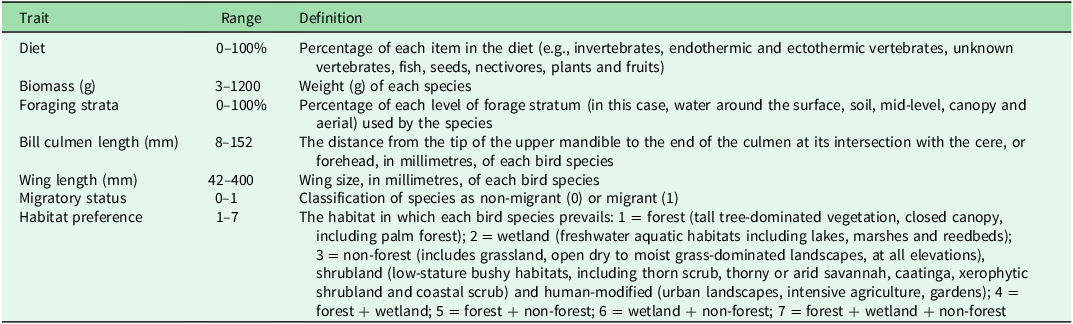
Bird species were categorized based on traits of diet, biomass, bill and wing length, foraging environmental strata, migratory status and habitat preference (Table S1). We considered bird species the diets of which consisted of ≥60% invertebrates (Wilman et al. Reference Wilman, Belmaker, Simpson, de la Rosa, Rivadeneira and Jetz2014). Bird total wing length affects the ability to withstand habitat loss and fragmentation (Desrochers 2010, Rodrigues et al. Reference Rodrigues, Hasui, Assis, Pena, Muylaert and Tonetti2019). Migratory strategies are closely linked to the potential for long-distance movements (Somenzari et al. Reference Somenzari, do Amaral, Cueto, Guaraldo, Jahn and Lima2018), thereby enabling the colonization of isolated habitats (Barbosa et al. Reference Barbosa, Rodewald, Ribeiro and Jahn2020). Diet composition and foraging strata provide insights into species’ niche occupancy and their approaches to resource acquisition (Petchey & Gaston Reference Petchey and Gaston2006), including the specific ecosystem function of controlling arthropod populations (Sekercioglu Reference Sekercioglu2012). Additionally, bill length is associated with the ability to capture food and utilize various habitats and microhabitats (Table 1; Rodrigues et al. Reference Rodrigues, Hasui, Assis, Pena, Muylaert and Tonetti2019). Wing length (mm) and bill culmen length (mm) were obtained from Tobias et al. (Reference Tobias, Sheard, Pigot, Devenish, Yang and Sayol2022), whereas migratory status and habitat preference were derived from Somenzari et al. (Reference Somenzari, do Amaral, Cueto, Guaraldo, Jahn and Lima2018) and IUCN (2022).
Bird traits used to calculate functional diversity metrics (see Wilman et al. Reference Wilman, Belmaker, Simpson, de la Rosa, Rivadeneira and Jetz2014, Melo et al. Reference Melo, Sanches, Silva Filho and Piratelli2022).

Functional diversity and beta functional diversity
To address our first prediction, we first sum the records of each species obtained across all sites for each environment (i.e., 22 for grasslands, 21 for marshes and 22 for forests). This sum was then used to conduct an analysis of multisite beta FD across three different types of environments, considering the total presence/absence of species in each environment type (see Appendix S1). In the pairwise beta FD analysis, the total number of records was considered rather than the sum of all records per environment type. The Jaccard index was used, decomposing beta FD into two components: turnover and nestedness (Appendix S2). Turnover indicates the substitution of species and traits between sites, whereas nestedness represents differences in species and trait assemblages due to species filtering, creating subsamples from a regional species pool (Baselga & Orme Reference Baselga and Orme2012, Mouillot et al. Reference Mouillot, Graham, Villéger, Mason and Bellwood2013). To perform these calculations, we utilized two betapart package functions (functional.beta.multi and functional.beta.pair) in the R software (R Core Team 2022).
To test our second prediction, we used the following steps (Laliberté & Legendre Reference Laliberté and Legendre2010, Melo et al. Reference Melo, Sanches, Silva Filho and Piratelli2022). We first determined the functional distance between each species pair using Gower’s distance (Appendix S2; Pavoine et al. Reference Pavoine, Vallet, Dufour, Gachet and Daniel2009). The resulting matrix was subjected to a principal coordinate analysis (Figs S1 & S2; Paradis & Schliep Reference Paradis and Schliep2019), as the construction of a functional space requires a dissimilarity matrix. Subsequently, the first three axes were used to calculate the FD of the communities (i.e., functional richness, uniformity, divergence and dispersion; Melo et al. Reference Melo, Sanches, Silva Filho and Piratelli2022), as the greatest total variation is explained by these axes (Table S2; Gower Reference Gower1966, Legendre & Legendre Reference Legendre and Legendre1998, Legendre & Birks Reference Legendre, Birks, Birks, Lotter, Juggins and Smol2012). The dbFD function in the FD package (Laliberté & Legendre Reference Laliberté and Legendre2010) was used to calculate FD.
After we calculated the four diversity indices and recognizing the importance of spatial considerations (Fortin & Dale Reference Fortin and Dale2005), we assessed spatial autocorrelation using the ape package and potential collinearity with a variance inflation factor test using the usdm package. We then formulated candidate models for further analysis and conducted model selection through a comparison of competing models (Appendix S3 & Table S3).
To account for spatial structure, we employed generalized linear mixed models (GLMM; Zuur et al. Reference Zuur, Ieno, Walker, Saveliev and Smith2009), incorporating landscape ID as a random factor (Table S3). Our response variables included functional richness, functional divergence, functional evenness and functional dispersion, whereas our explanatory variables encompassed forest cover percentage, environmental type (i.e., forest, pasture, marsh) and their combinations (Table S5). When spatial autocorrelation was detected in the residuals of the global model, we introduced latitude and longitude as covariates (Brooks et al. Reference Brooks, Kristensen, van Benthem, Magnusson, Berg and Nielsen2017). Subsequently, we subjected the global models to Moran’s I tests and analysis of variance (ANOVA) to conduct a thorough evaluation of model similarities. If similarity was confirmed (p > 0.05), we proceeded with further analyses using the residuals.
The Akaike information criterion corrected for small samples (AICc) for model selection was used to understand the variation in FD. We created four comprehensive models for each FD index, assessing effects of forest cover, environment type and their interactions whilst accounting for the random effect. Models with ΔAICc < 2.0 were considered equally plausible for explaining the observed patterns (Burnham & Anderson Reference Burnham and Anderson2004). Additionally, we calculated model averages for equally plausible models to identify the best-fitting one. We also computed the weight of evidence (wAIC) for each competing model, representing the sum of weights amongst models in which the variable appears (Barbosa et al. Reference Barbosa, Knogge, Develey, Jenkins and Uezu2017).
Results
A total of 201 bird species were recorded within the landscapes; 108 species representing 34 families and 11 orders were assigned as arthropod-consuming species. Some species were found within specific landscapes (16 exclusive to pastures, 10 exclusive to forests and 9 exclusive to marshes; see Table S4). The partition analysis for each environment type (i.e., the analysis that considered the sum of all sites within each environmental type – multiple-site functional dissimilarities) indicated that 54.6% (0.063/0.116) of the variation in beta FD was explained by the turnover component and 45.4% (0.052/0.116) of the variation in beta FD was explained by the nestedness component (Fig. 2a). The distance matrices from the pairwise analysis (pairwise functional dissimilarities) highlighted the relationship amongst all sites within each environmental type and functional beta FD (Fig. 2b & Appendix S4).
(a) Relationship between multiple-site functional dissimilarities in Ecological Corridor Cantareira-Mantiqueira, São Paulo, Brazil, considering pasturelands, marshes and forests. (b) Pairwise functional dissimilarities within each site in pastures, marshes and forests.

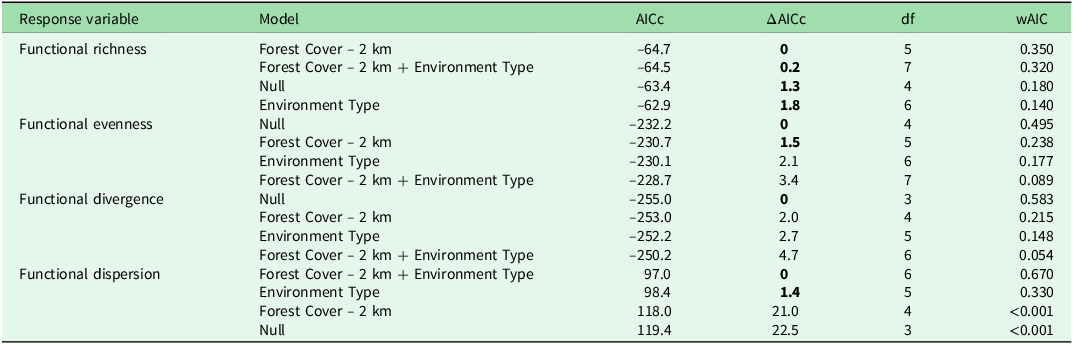
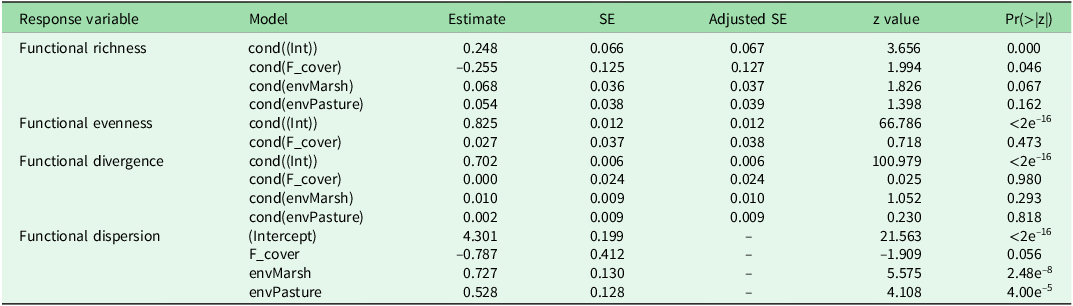
Forest Cover (M1) was the predictor variable that best explained the values found for functional richness (wAIC = 0.35; AIC = –64.7; Table 2). However, the Forest Cover + Environment Type (M3) and Environment Type (M2) models were also plausible in helping to explain the observed patterns (wAIC = 0.32 and 0.18; respectively; Table 2). When determining the full model average, forest cover percentage was the only variable to explain the non-random variation in functional richness, establishing a negative relationship (pM1 = 0.046; Fig. 3 & Table 3).
Performance of generalized linear mixed models of insectivorous bird functional diversity using Akaike’s information criterion corrected for small sample sizes (AICc) on multiple regression. For the best models (ΔAICc < 2.0; in bold), AICc was used (Burnham & Anderson Reference Burnham and Anderson2004) as well as ΔAIC and weight of evidence (wAIC).

Graphs generated for the best generalized linear mixed models. (a) Influence of forest cover on functional richness. (b) Influence of forest cover and environment type on functional dispersion.

Full model-averaged parameter estimates and significance values for models of insectivorous birds’ functional diversity with cumulative Akaike information criterion corrected for small sample sizes (AICc) weights summed to 0.95, calculated by multiplying the estimates for individual models that contain parameters by their weights. Relative importance is the sum of the AICc weights across these models.

SE = standard error.
The best model suggested by the GLMMs for functional dispersion was the combined effects of native forest cover and type of environment (wAIC = 0.67; Table 2). The Null (M0) and Forest Cover (M1) models were plausible explanations for both functional evenness (for M0, wAIC = 0.495; for M1, wAIC = 0.238; Table 2) and functional divergence (for M0, wAIC = 0.583; for M1, wAIC = 0.215; Table 2).
Discussion
Our data support the first prediction of the effects of environment type on beta FD; there was a nested effect within pastures and a turnover effect in marshes (Fig. 4). Moreover, both turnover (45.4%) and nestedness (54.6%) contributed in comparable proportions within forest communities (Fig. 2a). Contrary to our second prediction (Fig. 4), the percentage of native forest cover exhibited a negative relationship with functional richness and dispersion (Fig. 3 & Table 2). No effect of forest cover on functional divergence and functional evenness was detected (p > 0.05; Fig. 3 & Tables 2 & 3). Although some sites may have been small enough to have edge effects and thus influence neighbouring sites in our data, species typical of each studied environment were predominantly recorded in their characteristic habitat, so we consider that this limitation was minimized (e.g., Appendix S1).
Main results in relation to our two hypotheses. (H1) The partitioning of beta functional diversity for the three types of environments. (H2) The effects of forest cover and type of environment on functional richness and functional dispersion.

Beta functional diversity: effects of turnover and nestedness
We found a specific pattern of beta FD in each environment type (Fig. 2). Bird communities were more nested in the pasturelands, whereas a more pronounced turnover effect was observed in marsh sites, and both turnover and nesting effects were detected in forested areas. The massive presence of second-growth forests in early to medium stages of succession could potentially explain these outcomes in forests (Ribeiro et al. Reference Ribeiro, Metzger, Martensen, Ponzoni and Hirota2009). As ecological succession advances, generalist species might be replaced by specialists through directional turnover (Blake & Loiselle Reference Blake and Loiselle2001). Additionally, the age of secondary forests influences the recovery of specialist forest species (Acevedo-Charry & Aide Reference Acevedo-Charry and Aide2019). The speed at which species composition recovers and the resurgence of forest specialists across diverse successional stages could also be related to their enhanced dispersal capacity (Dobrovolski et al. Reference Dobrovolski, Melo, Cassemiro and Diniz-Filho2012). This ability is intrinsically linked to certain traits considered in our study, such as wing size and migratory strategy (Rodrigues et al. Reference Rodrigues, Hasui, Assis, Pena, Muylaert and Tonetti2019).
The higher degree of functional nestedness observed in pastures can be attributed to a non-random process of species loss, potentially influenced by factors such as variations in species sensitivity to prevalent environmental disturbances. These outcomes are contrasted with previous findings (Dias et al. Reference Dias, Gianuca, Vizentin-Bugoni, Gonçalves, Bencke and Bastazini2017, Barros et al. Reference Barros, Martello, Peres, Pizo and Ribeiro2019a) and are probably related to the specific functional traits of social behaviour and clutch size addressed in those studies and to the local pastures differing in intensity of livestock disturbance. The selection of functional traits probably does play a central role in determining the functional metrics (Petchey & Gaston Reference Petchey and Gaston2006).
Our results also indicated a pronounced turnover effect in the functional beta FD within marsh environments. Distinct environmental conditions potentially act as environmental filters in marshes, resulting in the selective survival of habitat-specialist species such as Donacobius atricapilla. Thus, the observed changes in the functional composition of marsh-dwelling birds are explicable by functional substitution rather than loss of FD. This process leads to functional convergence within the studied communities (Logez et al. Reference Logez, Pont and Ferreira2010).
Forest cover percentage and functional diversity
Functional traits represent environmental tolerance; reduced values of functional richness suggest the absence of some specialists under specific conditions, such as habitat constraints on species with highly specific fundamental niches (i.e., the functional space used by a species in a theoretical framework without any competition or another limitation condition; Odum & Barrett Reference Odum and Barret1971, Mason et al. Reference Mason, Mouillot, Lee and Wilson2005). Species characterized as specialists are more susceptible to population declines related to environmental changes (Moritz & Agudo Reference Moritz and Agudo2013). This may lead to a reduction in communities’ ability to tolerate environmental fluctuations due to compensatory interactions among co-occurring species (Tilman Reference Tilman1996). Lower values of functional richness also suggest that an amount of the available resources within each environment remains underutilized (Mason et al. Reference Mason, Mouillot, Lee and Wilson2005); this would lead to reduced nutrient cycling and productivity loss (Petchey & Gaston Reference Petchey and Gaston2006).
The relationship between increase in forest cover and decline in functional richness (Fig. 3), which has been previously reported (Morante-Filho et al. Reference Morante-Filho, Faria, Mariano-Neto and Rhodes2015, Matuoka et al. Reference Matuoka, Benchimol and Morante-Filho2020), is closely related to patterns of species composition; forest and non-forest species exhibit diverse responses to anthropogenic disturbances (Bregman et al. Reference Bregman, Lees, MacGregor, Darski, de Moura and Aleixo2016) according to their distinct traits and sensitivities to human-induced disturbances (Gardner et al. Reference Gardner, Barlow, Chazdon, Ewers, Harvey and Peres2009, Clavel et al. Reference Clavel, Julliard and Devictor2011). These patterns may be linked to the diminished number of resources in second-growth forests in early to medium stages of succession (Metzger et al. Reference Metzger, Martensen, Dixo, Bernacci, Ribeiro and Teixeira2009), aligning with the characteristics of our study area. Furthermore, the adjacent pasturelands may also increase the proliferation of non-forest species (Morante-Filho et al. Reference Morante-Filho, Arroyo-Rodríguez and Faria2016).
We found that some generalist species with a greater ability to disperse to be located farther from the centroid of a specific functional space; this may indicate that these species have unique characteristics or distinct behaviours (Laliberté & Legendre Reference Laliberté and Legendre2010). This aligns with our observation of the reduction in functional dispersion with increased forest cover (Fig. 3). The evident decline in functional dispersion values observed in marsh and pasture environments compared to forests could be related to the retention of taxa with traits indicating low dispersion capacity coupled with an influx of highly vagile taxa (Bregman et al. Reference Bregman, Lees, MacGregor, Darski, de Moura and Aleixo2016). Moreover, the presence of secondary forests may have influenced the observed patterns in FD.
Caution is warranted when interpreting these findings considering the diverse functional responses in forest and non-forest birds (Matuoka et al. Reference Matuoka, Benchimol and Morante-Filho2020). Furthermore, the autonomous recorders also have limitations, such as the inability to obtain information on species abundance. Although all data for this study were collected during the rainy season, sampling habitats in different months could have introduced some noise in the data related to the reduction in the intensity of reproductive activities such as courtship and territory defence, including vocalizations.
These findings imply that the influence of forest cover on FD is specific to the different functional groups within the community and could potentially be influenced by the early stages of succession characterizing these regional forest fragments (Johnstone et al. Reference Johnstone, Allen, Franklin, Frelich, Harvey and Higuera2016, Thorn et al. Reference Thorn, Chao, Bernhardt-Römermann, Chen, Georgiev and Heibl2020). Notably, the paucity of suitable microhabitats in these early stages can act as environmental filters for specialist forest birds (Santos Junior et al. Reference Santos Junior, Marques, Lima and dos Anjos2016), delaying ecological succession. The arrival of insectivorous specialists would increase the population control of herbivorous arthropods, improving the quality of the environment through greater biomass input (Melo et al. Reference Melo, Silva and Piratelli2020), thus ensuring the stability of key ecological interactions and ecosystem services (Sekercioglu Reference Sekercioglu2012).
Conclusions
There are two significant implications of these results for future research. First, increased species dispersion within a functional space does not necessarily correlate with heightened functional divergence and evenness. Relying solely on functional dispersion and richness might lead to imprecise conclusions regarding higher FD in deforested sites and an assumed improvement in ecosystem functioning within these environments. Thus, we strongly advocate for the utilization of diverse functional indices in forthcoming studies, enabling a more comprehensive evaluation of the effects of anthropogenic disturbance on biodiversity.
Second, deforested landscapes may contain fewer available niches for forest species whilst providing new opportunities for non-forest species. Consequently, the behaviour of forest communities, vertical structuring of habitats and environmental heterogeneity in deforested settings (Melo et al. Reference Melo, Sanches, Silva Filho and Piratelli2022) could be substantially disrupted, potentially leading to a lack of true compensatory dynamics within the functional framework (De Coster et al. Reference De Coster, Banks-Leite and Metzger2015, dos Anjos et al. Reference Bochio, Medeiros, Almeida, Lindsey and Calsavara2019). Furthermore, the intricate vertical structural complexity of habitats and the accessibility of resources could potentially be compromised due to the current stage of ecological succession observed in the studied sites.
Our data highlight the importance of considering habitat quality and ecological successional stages in conservation efforts. Human-impacted landscapes generally tend towards homogenization, massively suppressing continuous vegetation and/or restricting it to small second-growth fragments. Therefore, an appropriate conservation strategy is the protection of large old and well-connected patches of native vegetation, leading to maintenance of the FD of birds.
Investigation of the long-term dynamics of FD in response to environmental changes is desirable, and we also encourage comparative studies across different forest types from different successional stages.
Supplementary material
To view supplementary material for this article, please visit https://doi.org/10.1017/S0376892924000080.
Acknowledgements
We sincerely appreciate all comments and suggestions provided by colleagues at the Laboratory of Ecology and Conservation (LECO/UFSCar).
Financial support
EC-M thanks the National Council for Scientific and Technological Development (CNPq; 130483/2021-4) for providing financial support and the Graduate Program in Ecology and Natural Resources (PPGERN) at Universidade Federal de São Carlos (UFSCar) for technical support. We thank the São Paulo Research Foundation (FAPESP) for supporting the ‘Biodiversity in the Anthropocene: a synthesis of agricultural expansion effects on the Cerrado and Atlantic Forest’ (22/10760-1) project. MCR thanks FAPESP (processes #2013/50421-2; #2020/01779-5; #2021/08534-0; #2021/10195-0; #2022/10760-1) and CNPq (processes #442147/2020-1; #402765/2021-4; #313016/2021-6; #440145/2022-8; #316032/2023-9) for their financial support. AJP thanks the São Paulo Research Foundation for supporting the poster presentation at the II Ornithological Congress of the Americas – 2023 (#2023/06510-2). LPG thanks the Coordination for the Improvement of Social Demand Program (CAPES processes #88882.434132/2019; #88887.513964/2020-00).
Competing interests
The authors declare none.
Ethical standards
None.