In the United States (US), there are ~15,600 nursing homes, in which ~1.35 million older adults (ie, those aged ≥65 years) reside on any given day. Reference Harris-Kojetin, Sengupta, Lendon, Rome, Valverde and Caffrey1 Infections are a particular concern among this group, with an estimated 1.1–2.7 million infections occurring among nursing-home residents annually. 2 Furthermore, 380,000 nursing home residents die due to these infections each year. 2
Older adults are also particularly susceptible to the adverse side effects of antibiotics due to altered pharmacokinetics, and polypharmacy. Reference Faulkner, Cox and Williamson3–Reference Rogers, Mody, Chenoweth, Kaufman and Saint6 Furthermore, inappropriate and/or overuse of antibiotics leads to increased incidence of multidrug-resistant organisms (MDROs) and Clostridioides difficile infections, which are contagious. Reference Bernatz, Safdar, Hetzel and Anderson7–9 Therefore, overuse of antibiotics not only increases the risk of adverse outcomes for those receiving the medication but also increases the risk of transmission of MDROs and C. difficile to others. Reference Freedberg, Salmasian, Cohen, Abrams and Larson10 This overuse is particularly problematic because older adults are also particularly vulnerable to these infections; they represent 50% of C. difficile cases and 80% of related deaths. Reference Shorr, Zilberberg, Wang, Baser and Yu11 As such, antibiotic use in older nursing-home residents at the end of life may reduce quality of life, prolong the dying process, and incur unnecessary costs with little or no benefit to the resident. Reference D’Agata and Mitchell12,Reference Ford, Fraser, Davis and Kodish13
More than half of nursing-home residents have dementia, which increases their susceptibility to infections and makes diagnosing infections difficult. Reference Seitz, Purandare and Conn14,15 Reasons dementia increases susceptibility include reduced immunity; risk of becoming bed-bound, which can increase vulnerability to pressure ulcers; and risk of difficulty in eating or drinking, which can contribute to aspiration pneumonia. Reference El Chakhtoura, Bonomo and Jump16,Reference Mitchell, Teno and Kiely17 Also, when older adults get infections, they may not experience the common physical symptoms; instead, they may exhibit additional signs that overlap with increased cognitive decline such as confusion and/or agitation. Reference Gavazzi and Krause18 Therefore, clinicians are challenged to diagnose infections in all elderly nursing-home residents but especially those with severe cognitive decline who may have difficulty communicating symptoms. Reference Beckett, Harbarth and Huttner19–Reference van der Steen, Di Giulio and Giunco21 Inappropriate antibiotic use may be common in this population. Reference Parsons22–Reference Sloane, Zimmerman and Reed24
Given the urgent threat of antibiotic resistance and the resulting push for antibiotic stewardship, antibiotic use is expected to be lower in populations unlikely to benefit from them, for example, at the end of life and with advanced cognitive impairment. 9 However, almost one-third of hospice patients receive antibiotics in the last week of life. Reference Albrecht, McGregor, Fromme, Bearden and Furuno25 In general, 40%–75% of antibiotic use is unnecessary in this setting, Reference Nicolle, Bentley, Garibaldi, Neuhaus and Smith26,27 and the initiation of antibiotics in nursing homes often occurs without documented bacterial infection. Reference Albrecht, McGregor, Fromme, Bearden and Furuno25
There are efforts to decrease inappropriate antibiotic use by increasing stewardship in nursing homes and other settings because this is a global priority and a matter of national security. 9,28,29 In the United States, the Centers for Medicare & Medicaid Services (CMS) now require nursing homes to have an antibiotic stewardship program as part of their infection control program. 30 In 2015, the Centers for Disease Control and Prevention issued guidance for antibiotic stewardship programs in long-term care settings. 27 This guidance includes providing leadership support and accountability for the stewardship program, trained staff, prescribing policies, monitoring and reporting antibiotic use, and educational resources for staff. In 2016, the Infectious Diseases Society of America (IDSA) and the Society for Healthcare Epidemiology of America (SHEA) specified similar guidelines for implementing antibiotic stewardship. 28,Reference Barlam, Cosgrove and Abbo31
Given the recent increased focus on antibiotic stewardship, we have described changes in antibiotics use within a nationally representative sample of US nursing homes from April 2012 through December 2016. Specifically, we assessed whether the 1-day prevalence of antibiotic use has changed over this time horizon, as well as the magnitude and direction of any changes. Furthermore, we sought to determine whether 1-day prevalence of antibiotic use changed among several populations of interest: those with Alzheimer’s disease and related dementias (ADRD), with and without advanced cognitive impairment (ACI), and those with potentially bacterial infectious disease diagnoses likely to be treated by antibiotics: active multidrug-resistant organism (MDRO) infection, pneumonia, septicemia or urinary tract infections (UTIs).
Methods
This retrospective, repeated cross-sectional study describes trends in antibiotic use among residents of a nationally representative sample of US nursing homes from 2012 through 2016. This study underwent full human-subjects review by the institutional review boards of Columbia University Medical Center and RAND Corporation and was deemed minimal risk due to the use of existing databases and stringent data security processes.
Data source
We used the Minimum Data Set (MDS) version 3.0, which contains detailed snapshots of resident health characteristics and demographics. 32 MDS assessments are required for all residents of CMS-certified nursing homes. Therefore, the MDS includes characteristics of all residents in 97.5% of US nursing homes. Reference Harris-Kojetin, Sengupta, Lendon, Rome, Valverde and Caffrey1 Because these data inform reimbursement eligibility and quality assurance, federal regulations require a registered nurse to coordinate and approve data collection. 33 In a national evaluation, MDS infection and dementia diagnoses variables used in this study all had very good to excellent reliability (ie, agreement between nurse researchers) and validity (ie, between nurse researchers and facility nurses), except “other infections,” which had moderate validity. Reference Saliba and Buchanan34 Notably, the antibiotic use variable has not been evaluated. Reference Saliba and Buchanan34
Study sample
A 10% random sample of all US nursing homes in the MDS was selected with assessments in April 2012 (2Q12) and ending in December 2016. The time horizon and variables included were intended to capture a period representing consistently defined variables of interest and the most recent data availability and to account for likely changes to policy and practice well before Reference Liu, Herzig and Dick35 and after new guidance publications. Nursing homes with the lowest (5%) assessment counts were excluded (ie, 68 or fewer assessments over the time horizon), because these had high uncertainty in antibiotic prevalence (84 nursing homes). Furthermore, we excluded nursing homes with the greatest proportion (99th percentile) of assessments missing the antibiotics use item (15 nursing homes). We included MDS clinical assessments recorded at regular intervals (ie, at least every 92 days), which were quarterly and annual assessments rather than triggered by specific health-related events. 32 Therefore, we avoided some antibiotic use recorded on admissions assessments, which may represent antibiotics prescribed elsewhere. We removed individuals who had ever had a diagnosis of tuberculosis (MDS item I2200, 0.1% of assessments) from our aggregate measures because they may be on long-term antibiotics appropriately.
Outcomes
The outcome was a 1-day prevalence of antibiotics use. Using MDS item N0410F, which counts the number of days with antibiotic use in the last 7 days, 33 we identified that a resident had an active antibiotics prescription on day 4 of the 7-day retrospective window (ie, if a resident had 4 or more days of antibiotic use during that 7-day window). Thus, we were able to create a binary indicator of antibiotic use on day 4 for each assessment (conducted each quarter) and a 1-day prevalence for each quarter. Notably, the antibiotics variable might include prescriptions that may have been written elsewhere (ie, in a hospital), but as stated above, excluding admissions assessments to removes antibiotic prescriptions from other settings as much as possible from these data.
To test the robustness of our outcome definition, we compared using any antibiotic use in the 7-day retrospective period (ie, representing a 7-day quarterly prevalence) rather than day 4 of this period (representing a 1-day quarterly prevalence). Given our previously published work, the latter may be conceptually easier to understand. Reference Herzig, Dick and Sorbero5
Populations of interest
Resident populations of interest were those with ADRD (with and without ACI) and those with infections for which antibiotics may have been prescribed. These populations, described below, were separately defined but were not mutually exclusive.
Infection status
Regarding infection status, we were interested in MDS assessments recording the following: MDRO infection (MDS item I1700), pneumonia (MDS item I2000), septicemia (MDS item I2100) or UTI (MDS item I2300). These non–mutually exclusive diagnoses are recorded on MDS assessments when two conditions are met: (1) the infection has been diagnosed by an advanced care provider in the last 60 days and (2) had “a direct relationship to the resident’s current functional status, cognitive status, mood or behavior, medical treatments, nursing monitoring, or risk of death during the 7-day retrospective period.” 33 The only exception is UTI, which has a retrospective window of 30 days rather than 7 days for active symptoms, and the UTI diagnosis must follow evidence-based criteria, such as McGeer, National Healthcare Safety Network (NHSN), or Loeb, that include clinical symptoms (ie, asymptomatic bacteriuria is not included). 33 Furthermore, because these variables are not mutually exclusive, we created indicators for residents with any of these aforementioned infections or wound infection (I2500) or foot infection (M1040a), and another variable indicating any infection except UTI. We also created an indicator for none of these aforementioned infections, which we assume means no bacterial infection.
Alzheimer’s disease and related dementias (ADRD) and advanced cognitive impairment (ACI)
Residents were considered to have ADRD if they had 2 assessments recording diagnosis of Alzheimer’s disease (MDS variable I4200) and/or related dementias (MDS variable I4800). Among these individuals with an ADRD diagnosis, we defined ACI as having a Cognitive Function Scale (CFS) score of 4 (ie, greatest impairment) on 2 or more assessments. Reference Thomas, Dosa, Wysocki and Mor36,Reference Mitchell, Miller, Teno, Davis and Shaffer37 We assumed that both ADRD and ACI were permanent once diagnosed. Reference Mitchell, Teno and Kiely17,Reference Mitchell, Miller, Teno, Davis and Shaffer37 Thus, a resident was considered to have ADRD from the first positive assessment forward. Similarly, a resident was considered to have ACI on all assessments after these criteria were first met.
Data analysis
The unit of analysis was the resident assessment. We began by describing the sample characteristics, including the prevalence of conditions of interest for each year from 2012 through 2016. We described trends in the prevalence of antibiotic use overall and among each condition for each quarter 2Q12–4Q16. Conversely, we also described the proportion of assessments with the conditions of interest, given antibiotic use.
To assess the trends in antibiotic use for 2012–2016, we regressed antibiotic use measure on calendar-year indicators, adjusting for seasonality (ie, 12 calendar-month indicators), with robust standard errors clustered at the nursing-home level. Where monotonic yearly trends existed, we report the adjusted odds ratios (AORs) of antibiotic use in 2016 compared to 2012. Because we were interested in overall trends in antibiotic use, regression models were not adjusted for individual or facility characteristics. Given that the proportion of assessments with certain infections, given antibiotics, changed during the time horizon, we created similar multivariable logistic regression models stratified by each condition of interest (ie, cognitive status, infection status and regardless of the status of either) to examine whether the changes in ADRD prevalence, with and without ACI, may be driving some of the observed trends. We applied a 2-sided t test with α = .05. All analyses were conducted in Stata MP version 15 software (StataCorp, College Station, TX). 38
Results
Sample description
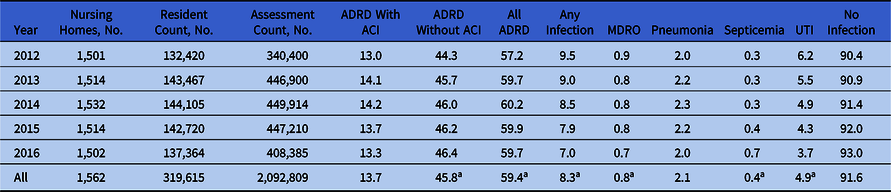
In our sample, there were 2,092,809 assessments from 319,615 nursing-home residents in 1,562 nursing homes (Table 1). For all years, approximately one-third of these quarterly and annual assessments with a documented infection also recorded use of antibiotics (Table 1).
Sample Description and Proportion of Assessments with Conditions of Interest from a 10% Random Sample of U.S. Nursing Homes’ Minimum Data Set 3.0 Assessments

Note. ADRD, Alzheimer’s disease or related dementia; ACI, advanced cognitive impairment; MDRO, multidrug-resistant infection; UTI, urinary tract infection; No Infection, means no indication of bacterial infection.
a Difference in 2012 vs 2016 statistically significant at α = .05 (logistics regression adjusted for seasonality and nursing home cluster standard errors); Represents a 10% random sample of CMS-certified US nursing home assessments,
Sample is from April 1, 2012, to November 30, 2016.
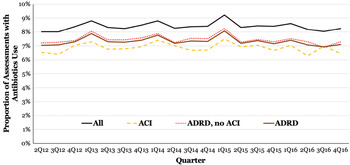
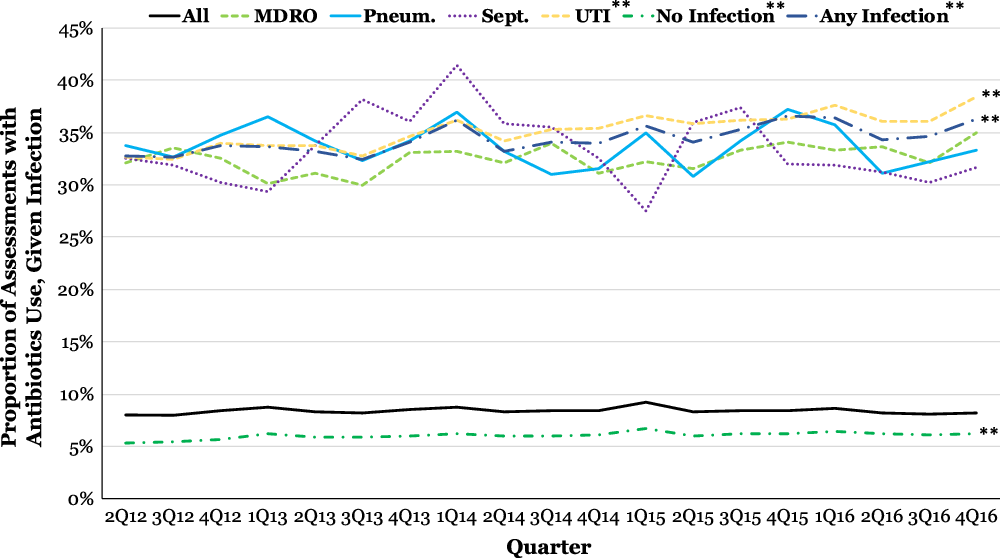
Overall, the mean 1-day prevalence rate of antibiotic use in these nursing homes was 8.4%. We present the 1-day prevalence of antibiotic use by quarter during this time horizon for each cognitive impairment status (Fig. 1) and infectious disease status (Fig. 2), respectively. Antibiotic use was seasonal (ie, higher in January than in March–December, data not shown), especially when studying populations by cognitive status.
Proportion of nursing home resident assessments* with 1-day antibiotic use, among all assessments, and those with ADRD, with and without ACI.

Proportion of nursing home resident assessments* with one-day antibiotic use among all assessments, those with common infectious diseases and those with no infectious diseases. *Minimum Data Set quarterly and annual assessments, conducted from April 1–November 30, 2016, from a random 10% sample of CMS-certified US nursing homes. **Significant change from 2012 to 2016, adjusted for seasonality. Note. “All” represents all resident assessments regardless of infection status. UTI, urinary tract infection; MDRO, multidrug-resistant infection.

Trends in antibiotics use
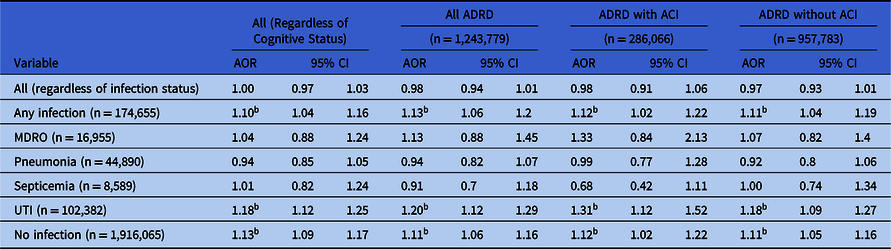
Adjusting for seasonality through the calendar month in which the assessment occurred, use of antibiotics was not different in 2012 versus 2016 among long-term nursing home residents (AOR, 1.00; 95% CI, 0.97–1.03) (Table 2). We observed a relatively consistent increase in coefficients from 2012 to 2016 for specific conditions of interest. We report AORs for 2016 (using 2012 as the reference). Adjusted odds of antibiotic use increased among assessments with any infection (AOR, 1.10; 95% CI, 1.04–1.16), UTI (AOR, 1.18; 95% CI, 1.12–1.25), and no infection (AOR, 1.13; 95% CI, 1.09–1.17). These trends persisted across all nursing-home residents, nursing-home residents with ADRD, and nursing-home residents with ADRD with ACI (Table 2). Results were robust to variation in the definitions of antibiotic use (ie, antibiotics recorded on 1-day versus any in 7-day retrospective period). Notably, assessments recording septicemia increased in 4Q15 through 2016 (Table 1), but the proportion of assessments recording antibiotics use, given septicemia, was the same between 2012 and 2016. Conversely, the proportion of assessments with no infection recorded, given antibiotics use, increased over the time horizon (AOR, 1.44; 95% CI, 1.37–1.5). Simultaneously, given antibiotics use, there was a steady decline in assessments recording UTI (AOR, 0.56; 95% CI, 1.37–1.5), while assessments with any other infection likely to be treated with antibiotics did not change (Appendices A and B online).
Change in 1-Day Antibiotic Use Among Conditions of Interest in the Minimum Data Set 3.0 Assessments Comparing 2012 Versus 2016 a
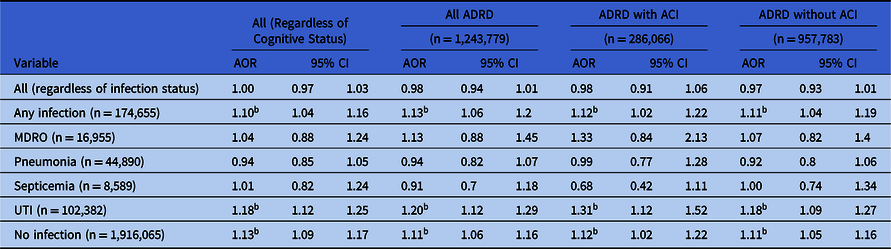
Note. AORs, adjusted odds ratios; CI, confidence interval; “All” represents all quarterly and annual resident assessments; ADRD, Alzheimer’s disease or related dementia; ACI, advanced cognitive impairment; MDRO, multidrug-resistant infection; UTI, urinary tract infection.
a Adjusted for seasonality (calendar month) and nursing home cluster standard errors. Represents a 10% random sample of CMS-certified US nursing home assessments, 2012 includes April 1, 2012, to December 31, 2012, and 2016 includes January 1, 2016, to November 30, 2016, according to consistently defined variables and data availability. We report adjusted odds ratios (AORs) corresponding to the 2016 year indicator (ref: 2012) given relatively consistent monotonic trends in year indicator coefficients during the time horizon.
b Statistically significant at α = .05.
Discussion
We present evidence that the overall odds of antibiotic use among long-term residents in 2016 did not change relative to 2012. This finding is similar to what was observed in outpatient settings, where antibiotics use among older adults in the United States did not change from 2011 to 2014. Reference Kabbani, Palms, Bartoces, Stone and Hicks39 Notably, the 8.4% overall 1-day prevalence of antibiotic use among nursing-home residents was similar to that reported in older studies. Reference Daneman, Gruneir and Newman40–Reference Warren, Palumbo, Fitterman and Speedie42
Given the nature of these data, we focused on trends rather than prevalence. We could not use these data to determine whether antibiotic use was inappropriate, which is a limitation of this study. An MDS assessment may have indicated a course of antibiotics appropriately ongoing for a nursing-home resident with no remaining clinical symptoms (thus recorded as having no infection).
Conversely, an assessment may show that the resident still has signs and symptoms of a resolving infection (ie, “active” diagnosis) after an appropriate antibiotics course is completed. In part, this may explain observed prevalence of antibiotics use among assessments showing these conditions, which may be lower than expected. The prevalence in antibiotics use among assessments showing UTI (34.9%) is particularly notable considering the misalignment of retrospective periods between this infection and antibiotics (30 vs 7-day, respectively), while all other infection diagnoses examined have a 7-day retrospective (eg, pneumonia). Furthermore, there is potential misalignment in the way antibiotics and infections are recorded in the MDS because the antibiotics variable includes prescriptions that may have been written elsewhere (ie, in a hospital), whereas infection diagnoses must be active and directly observed by nursing-home staff to be recorded. However, this is an assessment of trends. Because we chose a time frame when the variables of interest were consistently defined, our analysis is appropriate to establish trends in antibiotic use.
However, trends in how antibiotics use appears in the MDS is notable for 2 reasons. First, we observed a declining proportion of assessments showing UTI diagnosis, potentially explained by the following: (1) The MDS manual changed to mention following evidence-based diagnosis criteria rather than listing specific criteria, making it possible that more strict criteria (ie, McGeer vs Loeb) were increasingly used over the time horizon. (2) Overall sophistication of electronic medical records (EMR) used in nursing homes increased during 2014–2017. Reference Alexander, Madsen, Deroche, Alexander and Miller43 EMR can disallow recorded diagnoses not meeting predetermined criteria, potentially resulting in fewer diagnoses. (3) Symptoms of infection needed to diagnose UTI under these evidence-based criteria are not possible to determine in the growing population of those with advanced cognitive impairment. Second, among assessments showing antibiotics use, the proportion of assessments with no potentially bacterial infection is rising by roughly the same amount UTI is declining (while the proportion with other infection types are unchanged). Thus, an increasing proportion of residents with cognitive impairment (Appendix C online) may prevent the application of evidence-based diagnosis criteria described above because impaired residents are unable to communicate their symptoms.
However, considering that much antibiotic use in nursing homes was previously shown to be inappropriate, Reference Nicolle, Bentley, Garibaldi, Neuhaus and Smith26 we detected no change in the overall odds of antibiotic use, and a greater proportion of assessments with antibiotics use showed no infection diagnosis, our results likely indicate that inappropriate antibiotic use persists, despite national focus on antibiotic stewardship during the time horizon. 27,30,Reference Barlam, Cosgrove and Abbo31 In particular, the increasing rates of antibiotic use among those who have ADRD with ACI, with any infection, UTI, and no infection is concerning. Those with ACI and an infection are more likely to be at the end of life, Reference Mitchell, Teno and Kiely17 and if so, they are unlikely to receive a benefit from antibiotics use. 9 Given our results, the ACI population may still be a key population in which to promote stewardship efforts, starting by identifying the drivers of antibiotic use among these nursing-home residents to ensure evidence-based stewardship. This effort may include education for the residents’ families and providers that infection is to be expected as a terminal complication of ACI itself and that treatment will not address the underlying problem—the ACI.
Also, more diagnoses of septicemia appeared in 4Q15 to the end of the study time horizon, though antibiotic usage among these cases in nursing homes was similar. 44 Medicare’s definition of this condition changed in February 2016, Reference Barbash, Kahn and Thompson45 likely related to the “radical” change in diagnostic criteria put forth by the Third International Consensus Definitions for Sepsis and Septic Shock. Reference Pinson46 Furthermore, the new definition was causing confusion in hospitals, affecting their payments as of 3Q15. Reference Frieden47 Perhaps hospitals were less likely to accept or readmit nursing home residents with septicemia afterward.
In addition to those discussed above, certain limitations to these analyses were unavoidable given the nature of the MDS data. To our knowledge, the MDS antibiotics variable has not been evaluated for validity and reliability. Reference Saliba and Buchanan34 Furthermore, we cannot ascertain from these data the purpose for which antibiotics were prescribed, nor can we determine drug class, defined daily doses, therapy days, or courses. Thus, trends in antibiotic use on regular assessments as snapshots of resident health may indicate changes in the duration of antibiotic use. Although this limits our ability to determine appropriateness compared to medical record data, for example, we are able to assess trends 2012–2016 among a randomly selected, national sample using these data.
In conclusion, the adjusted odds of antibiotic use among long-term residents in 2016 compared to 2012 did not change overall, but the proportion of assessments with antibiotics showing no infections increased. Although we cannot determine whether antibiotic use is inappropriate, our results suggest that it may be necessary to refocus efforts regarding antibiotic stewardship in nursing homes. This holds especially among those with ACI and ADRD for whom antibiotics use was significantly higher in 2016 relative to 2012.
Supplementary material
To view supplementary material for this article, please visit https://doi.org/10.1017/ice.2020.422
Acknowledgments
We are grateful to Mark Sorbero for his assistance with data management and Michelle Kilgallen and Deb Burdsall for sharing their expertise regarding the Minimum Data Set.
Financial support
This work was supported by The National Institutes of Nursing Research (grant no. NR013687 and NR013687-06S1). The funding source of this study had no role in the study’s design, conduct, or reporting.
Conflicts of interest
The authors have no potential conflict of interest to report.