Introduction
The COVID-19 pandemic has exacerbated poverty in various contexts due to adverse spillover effects on the economy and labour markets, while exposing the fragility or resilience of national social protection systems in absorbing the shocks and protecting the population against unprecedented risks and challenges (World Bank, 2020; ILO, 2021a). The pandemic has negatively affected economic activities, disproportionately impacting those facing intersectional deprivations, including women, migrants, informal workers and other ‘outsiders’ of the formal labour market who have borne the bulk of the crisis due to pre-existing inequalities (Béland et al., Reference Béland, Cantillon, Hick and Moreira2021; ILO, 2021a). The outbreak has also reinforced gender gaps due to increased unpaid care work and negative impacts on female-dominated economic sectors, which have been hit hard by the crisis (Dugarova, Reference Dugarova2020; ILO, 2021b; Kabeer et al., Reference Kabeer, Razavi and van der Meulen Rodgers2021).
Against this backdrop, the study focuses on comparing policy capabilities of Russia and Finland to address intensified social and economic insecurity in the wake of the COVID-19 crisis by examining its challenges and impacts, as well as socio-economic policy measures enacted in response to the crisis from its onset in March 2020 until November 2021. It is asked how the respective governments responded to the crisis in comparison to one another in terms of social protection and labour market policy interventions. How (well) has the pre-existing welfare system prepared the two countries to cope with the socio-economic impacts of the coronavirus crisis? How effectively has each country addressed these challenges in comparative terms? What accounts for the varied approaches and responses adopted, and what explains the differential effects? These countries represent an interesting case for comparison. Despite being neighbouring nations that share a long border and a centuries-long history, they developed different polity and welfare models, which has become particularly apparent during the pandemic with varying scale and scope of policy responses. In Esping-Andersen’s (1990, 1999) typology of ‘welfare regimes’, Finland represents a social-democratic model with a comprehensive social security system that entails generous welfare transfers and social services. It also has a strong commitment to gender equality which is translated into policies that promote shared parenting, support female employment and provide quality public childcare within a dual-earner breadwinner model, thereby exhibiting a high degree of de-familialisation. Russia exemplifies a hybrid model with an embedded principle of universalism and widespread categorical social rights on the one hand and means-tested social support to selected vulnerable groups on the other hand. A mix of policy arrangements is also seen in relation to gender considerations, with pro-natalist social benefits and lack of paid paternity leave on the one side of the policy agenda, and publicly funded childcare and professional (re-)training for women during childcare leave on the other side.
While literature on COVID-19 impacts and policy responses in welfare states is growing (Cook and Twigg, Reference Cook and Twigg2020; Béland et al., Reference Béland, Cantillon, Hick and Moreira2021, Reference Béland, Dinan, Rocco and Waddan2022; Cantillon et al., Reference Cantillon, Seeleib-Kaiser and van der Veen2021; Greve et al., Reference Greve, Blomquist, Hvinden and van Gerven2021; Soon et al., Reference Soon, Chou and Shi2021; Choi et al., Reference Choi, Kühner and Shi2022; Ellison et al., Reference Ellison, Blomqvist and Fleckenstein2022; Yerkes et al., Reference Yerkes, Remery, André, Salin, Hakovirta and van Gerven2022), Russia remains understudied and hardly any research has conducted a systematic comparison of policy interventions in Russia and Finland in this context, including through an overlooked gender lens. This article thus aims to fill a gap in this research area. In conducting the examination of pandemic responses, the study applies the ‘welfare polity’ framework (Cook and Titterton, this themed section), with an emphasis on policy capabilities and institutional capacity, as well as financial resources allocated to address COVID-19-induced socio-economic challenges. As an emerging theoretical argument in this regard suggests, the nature and relative performance of policy responses in times of crisis are likely to be shaped by existing policy legacy, institutional capacity, and fiscal space to implement policies (Béland et al., Reference Béland, Cantillon, Hick and Moreira2021; Cook and Titterton, this themed section). While there could be new policy instruments, decision-makers in a state of emergency like the COVID-19 pandemic are likely to apply proven or at least familiar policy approaches aligned with their welfare model (Cantillon et al., Reference Cantillon, Seeleib-Kaiser and van der Veen2021; Greve et al., Reference Greve, Blomquist, Hvinden and van Gerven2021; Soon et al., Reference Soon, Chou and Shi2021; Ellison et al., Reference Ellison, Blomqvist and Fleckenstein2022), and integrate a gender lens that is appropriate for its normative framework. To understand policy responses and corresponding budget spending of Russian and Finnish welfare states, the study has analysed quantitative and qualitative data drawn from the Federal Service for State Statistics (Rosstat) and Statistics Finland, official public documents and governments’ portals associated with the COVID-19 pandemic, as well as relevant internationally comparable indicators. Clarification and validation of some data has been obtained directly from Kela, the Social Insurance Institution of Finland, and the Finnish Institute for Health and Welfare (THL).
Based on this analysis, the author finds that the anti-crisis response by the Russian and Finnish governments has been multi-faceted with a range of temporary emergency measures across social protection and labour market policy spectrum. Yet, within this spectrum each country has focused on specific policy areas and population groups that fall within its pre-pandemic priorities. The Russian government primarily concentrated on supporting families with children in line with its demographic concerns and persistent poverty to protect them against hardships and acute deprivations. In contrast to Russia, Finland has largely prioritised workers, including those with care responsibilities, as well as small and medium-sized enterprises (SMEs) aimed at protecting employment and supporting incomes during economic inactivity in the context of declining working-age population and unsustainable labour supply over the longer term. In line with these findings, three key observations are made: (i) the anti-crisis response by the two governments has led to somewhat differential effects on the groups in question; (ii) policy support has fallen short of gender equality considerations in both countries despite varying normative and policy frameworks; and (iii) the policy choice made by Russia and Finland reflects their pre-existing socio-economic priorities and approaches.
The article is organised as follows. Firstly, it provides a short overview of key socio-economic trends, including a gender lens, in Russia and Finland before and during the pandemic. Then policy responses to the crisis in the two countries are examined, followed by a discussion of the effects of these policy interventions. The concluding section provides synthesising insights and final reflections.
Key trends in Russia and Finland before and during the COVID-19 crisis
The pre-COVID-19 socio-economic situation in Russia and Finland
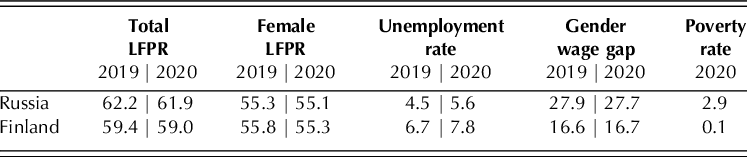
Before the COVID-19 crisis hit, Russia’s socio-economic situation was characterised by stability in the labour market amid persistent working poverty and growing informality in the context of economic downturn and unfavourable demographic shifts. Despite high labour force participation and low unemployment that reached its historical minimum (Table 1), most people living below the subsistence level had been employed in poor quality and low-paying jobs, and a fifth of the employed were engaged in the informal sector.Footnote 1 Low living standards had been particularly widespread among families with children who account for 82 per cent of those living in poverty (Interfax, 2021). Many families had relied on social transfers as a major source of income support that accounted for 18.9 per cent of household income. Such social provision largely entailed means-tested social assistance including cash and in-kind benefits, which despite low generosity had been vital for low-income households. Poverty in Russia as in many other countries is feminised due to women’s lower participation in the workforce and lower wages that result from occupational and sectoral segregation in the labour market and conservative social norms about gendered divisions of labour. To reduce poverty and promote employment among the working-age population, the Russian government had implemented a range of active labour market interventions and enhanced social protection for low-income households, including through its flagship conditional cash transfer programme ‘Social Contract’. It also continued the Maternity Capital, the country’s largest pro-natalist social assistance programme that serves to support families with children and encourage childbirth, aiming to address the country’s demographic deficit. These hybrid and somewhat fragmented policy efforts however have been insufficient to improve the living standards of the population at large and had limited sustained impact on poverty levels. Family support measures have also reinforced the essentialisation of women that defines women’s essence in terms of biologically based capacities, thereby treating women as natural caregivers and undermining their participation in the economy. The lack of legal provision for paid paternity leave and men’s low uptake of childcare leave further aggravates the unbalanced distribution of unpaid care and household work.
Key socio-economic indicators in Russia and Finland in 2019 and 2020 (per cent)

Source. ILOSTAT for labour force participation rates (LFPR) and unemployment rates (https://ilostat.ilo.org), Rosstat and Eurostat (https://ec.europa.eu/eurostat) for gender wage gaps, World Bank for poverty rates (pip.worldbank.org). Note. LFPR here refers to the share of population aged 15 and older. Poverty rates refer to the share of population living in households with consumption or income below the US$5.5 PPP poverty line as internationally comparable measurement. When using national poverty measurement, in 2020 the poverty rate in Russia was 12.1 per cent (Rosstat) and the at-risk-of-poverty rate in Finland was 12.2 per cent (Eurostat).
Similar to Russia, pre-pandemic Finland enjoyed high labour force participation and reached its lowest unemployment level over the past decade (Table 1), but the driving factors that underpinned this positive development were different than those in Russia. The low unemployment was primarily supported by five-year-long consecutive economic growth coupled with policy reforms including enhanced work incentives that contributed to a marked increase in employment (OECD, 2020a). Such fairly low labour market insecurity reflected extensive welfare support provided by the Finnish state with the purpose of ensuring decent employment in the context of the country’s declining working-age population. However, the economic growth benefits had not been distributed equally in Finland. This is manifested in stubbornly high long-term unemployment and a high risk of poverty for workers in non-standard employment and non-EU immigrants. In contrast to Russia, Finland has a well-established policy legacy to support female employment and redistribution of unpaid care work. Nonetheless, existing policy mechanisms remain insufficient to achieve de facto gender equality, particularly in the areas of equal pay and reconciliation of parenting and employment. Segregation in the labour market and lower-skilled and part-time jobs often taken by women underpin the persistent gender wage gap. Furthermore, the Finnish homecare allowance system incentivises women to stay at home to care for child(ren) (OECD, 2020b), whereas the taking of paid parental leave by fathers is systematically low, with on average only one in four making use of this entitlement (BBC, 2020).
Impacts of the COVID-19 crisis in Russia and Finland
The COVID-19 pandemic caused the multidimensional crisis – from health and education to the economy and labour market – that shaped the unprecedented scope of the policy challenge for the governments. As of November 2021, Russia registered 6 per cent of the population infected with the coronavirus (Johns Hopkins University and Medicine, 2021a), whereas excess mortality reached nearly 50 per cent (Giattino et al., Reference Giattino, Ritchie, Roser, Ortiz-Ospina and Hasell2021). To contain the spread of the pandemic at the outset, at the end of March 2020 the government introduced a mandatory nationwide self-isolation regime lasting for a total of 1.5 months, with full lockdowns and stay-at-home orders being implemented at the discretion of regional and local authorities throughout the multiple COVID-19 waves (BBC, 2021). The outbreak destabilised Russia’s labour market by reversing declining unemployment and leading to job and income losses. In early 2021, the official unemployment rate increased to 5.7 per cent, which does not necessarily take into account informal workers, labour migrants, as well as those who were suspended from work but had not officially registered as unemployed. In April 2020, an estimated 15 million jobs were lost because of COVID-19 restrictions, and migrants accounted for 75 per cent of those who lost their jobs during the pandemic (IEP, 2020). Amid the disruption of economic activities, real incomes decreased further amid growing consumer prices,Footnote 2 intensifying economic insecurity and feminisation of poverty. In October 2020, 13.5 per cent of the population were estimated to live below the minimum subsistence level (RBC, 2020), an increase by 1.2 percentage points compared to the pre-pandemic level. Sectors such as hospitality where female workers account for 74 per cent of employment have been hit particularly hard by the crisis. Closure of schools and preschools for nearly three months, along with extension of school holidays, increased women’s unpaid care and domestic workload, which included homeschooling as a new task on top of existing responsibilities.
Compared to Russia, Finland has a lower infection rate, with 3 per cent of the population detected with COVID-19 in November 2021 (Johns Hopkins University and Medicine, 2021b) and lower excess mortality of 15 per cent (Giattino et al., Reference Giattino, Ritchie, Roser, Ortiz-Ospina and Hasell2021), but the impacts on the economy and labour market have been similarly negative. Having announced a state of emergency in mid-March 2020, the Finnish government enacted a three-weeks long partial lockdown and other regional and local restrictions to slow the spread of the virus. Despite these measures, the pandemic has plunged Finland into its deepest recession since the early 1990s (OECD, 2020b). The number of temporarily or permanently laid off workers accounted for 15 per cent of the population by August 2020, leading to a steep rise in unemployment. The share of unemployed jobseekers in 2020 was nearly 4 percentage points higher than a year earlier (Finnish Government, 2020a). As a consequence of economic downturn and job losses, the scale and scope of social security recipients has widened, notably in relation to basic means-tested social assistance and unemployment allowances. For example, the number of beneficiaries of unemployment allowances or labour market subsidies increased by 19 per cent between 2019 and 2020 and included new recipients such as self-employed (Kela, 2021). Furthermore, the operations of schools and daycare centres in Finland were limited for a period of two months, forcing many parents and women in particular, similar to Russia, to be torn between work, unpaid care, and children’s home-based education (Finnish Government, 2020b).
Socio-economic policy responses to the COVID-19 crisis in Russia and Finland
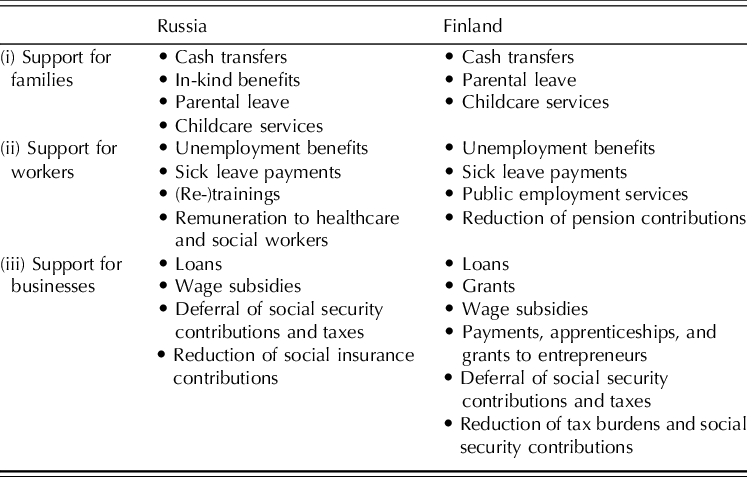
The analysis of anti-crisis socio-economic policy measures enacted by Russia and Finland suggests that the governments’ efforts have mainly targeted three population groups, albeit with differing priorities and spending: (i) families with children as well as working parents, (ii) workers that are mainly employed in the formal sector, and (iii) small and medium-sized enterprises that have been most affected by the crisis (Table 2). In 2020, the overall budget for COVID-19 related measures accounted for 2.7 per cent of GDP in Russia (Russian Government, 2021) and 3.6 per cent in Finland (Ministry of Finance, 2020), with corresponding allocations for priority categories as will be shown below.Footnote 3
Summary of policy responses to the COVID-19 crisis in Russia and Finland in 2020

(i) Support for families
In line with its priority to support households amid deteriorating living standards, the Russian government offered social assistance to all families with children regardless of their employment status and income level. It included a range of monthly, one-off and lump-sum cash transfers that varied between US$ 65 and US$ 160 for different age categories of children.Footnote 4 Several measures have specifically supported working parents, including new monthly unemployment benefits (US$ 40) and provision of on-demand classes for children. In addition, one-time lump sum payments (US$ 130) were provided to all pensioners. The Russian government’s commitment to supporting households was reflected in the financial resources allocated for this purpose. In 2020, the amount spent specifically on these pandemic-related payments to families with children constituted around US$ 8.2 billion or 0.6 per cent of GDP (TASS, 2021), whereas the total amount spent on support to families and children, including regular pre-COVID-19 benefits and pandemic-related payments, amounted to US$ 21.6 billion or 1.5 per cent of GDP (Accounts Chamber of the Russian Federation, 2020).
Similar to Russia, Finland has also supported families with children, with particular emphasis on working parents with care responsibilities. Notably, the government introduced special parental leave arrangements and monthly childcare benefits for employed and unemployed parents, while keeping schools and care centres largely open. In terms of financial allocations, the Finnish government’s budget on family benefits alone amounted to EUR 1.6 billion or 0.7 per cent of GDP in 2020 (Ministry of Finance, 2020). Finland’s total spending on supporting families with children amounted to EUR 7.3 billion or 3 per cent of GDP in 2020 (THL, 2022).
(ii) Support for workers
Apart from families with children, the Russian government provided some support to employees affected by the COVID-19 crisis. Key policy interventions here included increased monthly unemployment benefits and sick leave payments (US$ 160), and professional (re-)trainings for unemployed. A dedicated effort was made to support all healthcare workers – of whom 80 per cent are women – through lump-sum cash payments (between US$ 200 and US$ 1,000). In terms of resource allocations, in 2020 the Russian government spent a total of US$ 7 billion or 0.5 per cent of GDP on sick leave payments, of which nearly half, estimated US$ 3.4 billion, was associated with COVID-19. Remuneration to healthcare and social workers amounted to around US$ 3.4 billion or 0.2 per cent of GDP, and estimated US$ 1.4 billion or 0.1 per cent of GDP was spent on unemployment benefits (Accounts Chamber of the Russian Federation, 2020). In contrast to social protection measures, labour market interventions received limited funding of only US$ 97 million. Such budget allocations imply that, compared to households, workers have been of lesser priority for the Russian government.
In contrast to Russia, support for workers and their incomes had been of primary importance for the Finnish government during the pandemic. Notably, Finland strengthened its temporary layoff scheme, increased monthly unemployment benefits (from EUR 300 to 500) which were also offered to entrepreneurs and self-employed for the first time, extended access to public employment services, and reduced earnings-related pension contributions by employers and self-employed. Finland is in fact among the few countries that had fully compensated labour income lost due to COVID-19 through a sickness allowance on account of an infectious disease for the entire period of absence from work, self-isolation or quarantine.Footnote 5 In terms of financing, the Finnish government spent EUR 5.3 billion or 2.2 per cent of GDP on unemployment benefits and EUR 3.3 billion or 1.4 per cent of GDP on sick leave payments in 2020 (THL, 2022).
(iii) Support for businesses
The aid provided by the Russian government to businesses primarily focused on the most affected small and medium-sized enterprises to support their payroll and operating costs. Key measures included state loans, wage subsidies, deferral of social security contributions and taxes, and reduction of social insurance contributions. In contrast to employees in the formal sector, however, workers in the informal economy, as well as labour migrants, many being from Central Asia, had been largely overlooked by the state and were offered mere exemption from payments of patents (work permits) and their automatic extension (Russian Duma, Reference Duma2020). Overall, financial support to small and medium enterprises, entrepreneurs and self-employed was rather modest and had not been commensurate with the negative economic impacts they experienced. The total estimated spending on this amounted to around US$ 1.7 billion or 0.1 per cent of GDP in 2020. It included US$ 1.4 billion on subsidies for small and medium entrepreneurs, US$ 200 million to support microcredit organisations, US$ 100 million on subsidised credits to help eligible businesses pay wages to employees, and US$ 22 million on tax refund to self-employed (Accounts Chamber of the Russian Federation, 2020).
Compared to Russia, Finland provided substantial aid to businesses through extra loans and grants, with earmarked funding to hard-hit sectors, and reduced tax burdens and social security contributions. Efforts were also made to support entrepreneurs through lump-sum payments (EUR 2,000), apprenticeships and startup grants. Such support was reflected in budget allocations. In 2020, Finland adopted aid plans totalling around EUR 5 billion or 2.1 per cent of GDP to finance grants, equity injections, selective tax advantages, and subsidised loans (EC, 2020a, 2020b). This included state budget allocations of EUR 1.6 billion or 0.6 per cent of GDP to specifically support SMEs and EUR 250 million or 0.1 per cent of GDP to help self-employed (Ministry of Finance, 2020).
The nature of socio-economic measures enacted by Russia and Finland in response to the COVID-19 crisis points to three key observations. Firstly, the policy measures implemented by the two governments have led to somewhat differential effects on the groups under examination. Notably, Russia’s support to households helped contain poverty rise among families with children. As of July 2020, 26 million families with children up to sixteen years old received COVID-related family benefits in Russia (RIA, 2020), accounting for nearly 95 per cent of the total number of such families. In this regard, the maximum cushioning effect of compensatory social assistance was found among families with children between three and seven years old, for whom the poverty level decreased from 32 to 24 per cent (HSE, 2021). Yet, the Russian government’s longer-term national development goal of reducing poverty by half is unlikely to be achieved through short-term transfers alone, without guaranteeing good quality jobs with adequate income supported by economic growth and effective social policies both horizontally in terms of coverage and vertically with higher payment levels. Regarding policy effects in Finland, available data show that around 538 thousand families were provided with child benefits in 2020 (Kela, 2021), and nearly 311 thousand households, accounting for 8.4 per cent of the population, received social assistance as last-resort financial support to cover basic needs (THL, 2021). Yet, the share of households with difficulties in making ends meet slightly increased by 0.5 percentage points reaching 7.3 per cent in 2020.
With regard to workers, despite efforts to relieve their economic hardships and the relatively generous support by the Finnish government, the adopted measures have been insufficient to protect the workforce in the context of increased vulnerability. At its peak in 2020, the unemployment rate reached 6.4 per cent in Russia and 10.9 per cent in Finland, exceeding pre-pandemic levels. The hardest hit sectors suffered the largest losses in jobs and real wages, with nearly 1.78 million lost jobs and up to a 10.8 per cent decline in wages in Russia (World Bank, 2021). In Finland, the crisis exposed social security disparities between well-protected workers and labour market outsiders. Only temporarily or permanently laid off workers who are members of unemployment insurance funds could benefit from unemployment benefits, whereas non-fund members were only entitled to labour market subsidies or basic unemployment allowances. An estimated 25 per cent of temporarily laid-off workers and 15 per cent of employees such as those working part-time did not qualify for earnings-related unemployment benefits, thereby being left without adequate replacement income during the crisis (OECD, 2021). Such support also excluded the long-term unemployed who had been in the disadvantaged situation before the crisis and were not eligible for COVID-19 related unemployment and sick leave benefits. In fact, only 12 per cent of the total employed population or around 294,600 workers received a sickness allowance in 2020 (Kela, 2021). Finland’s prioritisation of workers with relatively generous treatment of insurance covered employees can reinforce socio-economic inequalities and exacerbate poverty. Those at the highest risk also include immigrants, low-skilled young people and persons with disabilities who experienced challenges prior to the pandemic.
In relation to businesses, while the support provided by the Russian and Finnish governments enabled some enterprises to escape bankruptcies, it had a limited impact on the labour market and could not withstand the falling demand. Although in Russia an estimated 5.4 million jobs were rescued through loan agreements and 4 million workers claimed to benefit from wage subsidies (Russian Government, 2021), economic activities declined across the country. The overall profit of business fell by 67 per cent – the worst indicator over the past sixteen years (Gazeta, 2020), and around 1.6 million or only 19.8 per cent of all SMEs and self-employed received government support in 2020 (TASS, 2020). In Finland, despite its substantial support to businesses, the coverage was also relatively modest, with 63,300 micro-, small- and medium sized enterprises or just 28 per cent of all MSMEs having received subsidies in 2020.
Secondly, the policy responses have not been sufficiently gender-responsive in view of the disproportionate impacts of the crisis on female-dominated sectors, increased unpaid care work, and the surge in domestic violence across the board. Both countries have supported pre-existing gender relations in line with their normative frameworks and state ideologies, which in the case of Russia has reinforced the patriarchic structure of society (Dugarova, Reference Dugarova2019). Notably, the support provided to working parents, and mothers in particular, through family and child benefits in Russia and paid parental leave arrangements in Finland has not been commensurate with the amount of unpaid care and domestic workload that has predominantly fallen on women, especially during school and childcare closure (Mesiäislehto et al., Reference Mesiäislehto, Elomäki, Närvi, Simanainen, Sutela and Räsänen2022; Yerkes et al., Reference Yerkes, Remery, André, Salin, Hakovirta and van Gerven2022). In 2020, mothers took 90 per cent of all maternity, paternity and parental leave days in Finland, whereas out of nearly 42,000 recipients of child home allowances, only 6 per cent were male (Kela, 2021). This points to the persistently unequal intra-household distribution of unpaid care work, thereby constraining women’s participation in the economy. In fact, between 2019 and 2020 the unemployment rate of women increased in both countries, from 4.4 to 5.7 per cent in Russia and from 6.2 to 7.5 per cent in Finland.
Furthermore, despite their contribution to income support, social benefits tend to essentialise women as natural care providers and affect their participation in the economy. Labour market measures, including (re-)training programmes for women during childcare leave and financial support for entrepreneurship, tend to produce limited impact on advancing women’s position in the labour market. For example, in 2020, nearly 35,000 women in Russia completed professional (re-)trainings, including 19,500 on three-year maternity leave, but such trainings as well as entrepreneurial activities have been narrowed down to small-scale and low-paid jobs. While the remuneration of healthcare workers in Russia was a welcomed measure, the pay scale at which it was distributed exposed wage discrimination due to hierarchical structures. In Finland, despite relatively high female employment, women are disproportionately engaged in part-time and low-income sectors amid persistent occupation segregation which contributes to persistent gender wage disparities (Finnish Government, 2020a). Overall, both states have distributed to working mothers through social assistance, social insurance and childcare support, but this policy choice is likely to have been driven by economic and demographic objectives.
Thirdly, Russia and Finland have made the policy choice based on their pre-existing socio-economic priorities and shaped by established policy approaches. Russia prioritised families with children through social assistance which responds to Russia’s demographic concerns and household poverty, thereby aiming to alleviate destitution via pro-natalist income support. The ongoing demographic dynamic in the country would not only reduce the supply of the workforce needed for economic growth but would also diminish the tax base for the social protection system, including the provision of health and care services. While Finland has also provided substantial support to families, its policy response has largely prioritised workers and SMEs through social insurance and labour market interventions. This policy focus has served to protect employment, buffer against income losses, and avoid mass bankruptcy during economic inactivity amid declining and ageing working-age population and jeopardised labour supply and productivity over the longer term. In view of Finland’s demographic challenges, the burden of increasing pension and health care expenditures is placed on a smaller group of employed workers, while the scope for economic growth through labour inputs is likely to diminish due to the COVID-19 impacts. Financial viability of the Finnish welfare state requires high employment in order to contribute to public finances but staggering unemployment prospects, coupled with pre-existing unfavourable labour market conditions for young workers and immigrants who have the potential to increase labour supply, pose serious concerns (OECD, 2020b).
The policy priorities by the Russian and Finnish governments have been reflected in public spending and COVID-19 budget allocations. The overall pandemic budget of the Russian government that served to address the socio-economic impacts of the COVID-19 crisis constituted US$ 39.2 billion or 2.7 per cent of GDP in 2020 (Russian Government, 2021). Within this budget, support to families with children (0.6 per cent of GDP) accounted for the second largest expenditure category, whereas SMEs and workforce who lost their jobs due to COVID-19 were most underfunded (0.1 per cent of GDP per each category). By contrast, within Finland’s overall 2020 budget on COVID-19 related measures with estimated EUR 8.6 billon or 3.6 per cent of GDP, a major share was spent to support workers’ economic security through unemployment benefits (1.6 per cent of GDP) and financial aid to SMEs and self-employed (0.7 per cent of GDP), as well as family benefits including for working parents (0.7 per cent of GDP) (Ministry of Finance, 2020).
What then accounts for the varied responses and approaches adopted by the Russian and Finnish governments and the results achieved so far in addressing the COVID-19 crisis? In line with the ‘welfare polity’ framework, it is suggested that such policy responses reflect the countries’ policy capabilities, institutional capacities and financial resources to tackle challenges caused by the pandemic. In fact, the governments have largely leveraged existing policy legacy, approaches and instruments, while introducing some new elements to reinforce support to prioritised segments of society within their welfare models. In this regard, Russia’s focus on families with children, including those in the low-income segment, is consistent with its hybrid welfare model with an embedded principle of universalism and widespread categorical social rights on the one hand and means-tested social support to selected vulnerable groups on the other hand. Finland’s approach to supporting the population, particularly workers, has been aligned with its system of welfare provision that entails a high degree of universal entitlements to social benefits and services and its strong emphasis on employment. In line with this, the Finnish government has relied on established policy mechanisms such as the temporary layoff scheme, without compromising the universality and generosity of its social provision, while temporarily expanding the coverage for new working-age population groups like self-employed and freelancers.
Among the key reasons that explain Russia’s and Finland’s differential policy responses and relative outcomes are the organisation and financing of social security. Compared to Russia, Finland has a well-established social insurance institution which has helped workers and small and medium-sized businesses cushion the most drastic effects of the pandemic. As is the case with other economically advanced European welfare states, Finland features a strong link between gainful employment and social insurance, which entails well-regulated terms of employment, decent wages, and joint financing of social insurance between the state, employers and employees. Notably, in 2020 the Finnish state’s financial contribution to social insurance accounted for 9 per cent of GDP, municipalities funded 7.3 per cent of GDP, employers provided 9.2 per cent of GDP, and employees contributed 4.8 per cent of GDP (THL, 2022). Russia, despite various post-Soviet reforms, still has not developed an effective and adequately financed social insurance system. In 2020, financing by the federal budget accounted for only 3 per cent of GDP and employers’ share constituted 5.6 per cent of GDP, without any contribution from employees (Social Insurance Fund of the Russian Federation, 2020). Such model is largely attributed to the legacy of the Soviet system with the state’s paternalistic approach to social protection and low incomes of the population (Roik, Reference Roik2017). Within this approach, the state served multiple roles as an owner of the means of production, the main and only employer, and a provider of social protection. Contributions to social insurance were paid by state enterprises with no participation of workers in co-financing. This has obstructed the formation of solid financial mechanisms for social insurance in the context of persistently low-paid workforce and inability of the Russian state to adequately fulfil its social guarantees, as evidenced by persistent poverty and low quality of jobs and social services. The situation is further exacerbated by growing informality, which creates challenges in accessing social insurance and extending its coverage. It not only leaves a large share of working population outside the remit but also constrains the state’s ability to collect taxes and payroll contributions, thereby undermining the financial viability of social insurance and the social protection system more broadly.
In addition to contrasting institutional arrangements, another major factor accounting for the varied responses by Russia and Finland is governments’ total social spending. In 2020, Finland’s overall expenditure on social protection amounted to EUR 75.6 billion or 32 per cent of GDP, which ranks it among the highest spending countries, including in times of the pandemic (Kela, 2021). By contrast, Russia spent US$ 207.8 billion or 14.2 per cent of GDP on social protection in 2020 (Russian Ministry of Finance, 2021), which is well below the level of advanced welfare states. Nonetheless, it is noteworthy that as far as the 2020 budget is concerned, neither of the two governments implemented austerity measures. In fact, in both contexts there has been an increase in social expenditure from the pre-pandemic level in 2019, which accounted for 30 per cent and 11.8 per cent of GDP, respectively.
Conclusions
Russia and Finland have faced the unprecedented scope and scale of challenges caused by the COVID-19 crisis which has intensified economic and social insecurity in both countries, as seen in growing unemployment and persistent poverty with disproportionate gendered effects, due to declined economic activities, lost jobs and reduced incomes including in female-dominated sectors. In addressing these shared challenges however, the respective governments have undertaken diverse socio-economic policy measures that prioritised different segments of society with corresponding financial allocations. Such divergent policy choice reflects pre-pandemic national socio-economic priorities, while largely leveraging established policy legacy, institutions, and tools within their welfare models. In this regard, Russia focused on supporting households through pro-natalist social assistance amid declining population and persistent poverty, whereas Finland placed emphasis on protecting workers and businesses via social insurance and labour market interventions in the context of shrinking working-age population and labour supply. Yet, despite various measures and dedicated spending, the policy response has not sufficiently compensated for the deterioration of living standards. Most of the policy arrangements in both countries have been temporary and near-term aimed at addressing the state of emergency which may not counteract the long-term risks arising from the socio-economic fallout of the crisis. The most vulnerable groups, including informal workers in Russia and long-term unemployed in Finland, have been largely neglected by policymakers at the time when it was most needed.
These findings raise a broader issue of what accounts for the relative outcomes of policy responses in times of crisis such as the COVID-19 pandemic. Longer-term implications of the crisis are yet to fully unfold, and current policy measures still need to prove their effectiveness beyond the emergency response towards recovery. Nonetheless, the comparative analysis of Russia’s and Finland’s socio-economic performance thus far seems to suggest that pre-established comprehensive social security institutions, generous public spending, and gender-responsive policies – as in the case of Finland – have been key to mitigating the most drastic impacts of the crisis. This conclusion also sheds light on the interlinkage between women’s leadership in times of pandemic and better development outcomes, pointing to the important role of policy legacy, democratic governance structures and well-financed welfare systems in the society that elected a woman leader and has gender-balanced political participation. In line with the ‘welfare polity’ framework and based on the evidence provided in the article, it is suggested that improving policy capabilities, institutional capacities, and fiscal space can contribute to a more effective policy response and recovery in the COVID-19 era and beyond, while better protecting the population against future risks and challenges.
Acknowledgements
The author is very grateful to Professor Linda Cook and Professor Michael Titterton for valuable guidance and helpful feedback and to three anonymous reviewers for useful comments.