Introduction
Schizophrenia is a chronic, debilitating mental disorder that affects about 1% of the population. The aetiology of schizophrenia is not fully understood, but several aetiological hypotheses have been put forward that focus on genetics, neurotransmitter abnormalities and impaired neurodevelopment (Tandon et al. Reference Tandon, Keshavan and Nasrallah2008). A wide variety of environmental insults have been investigated, such as viral infection during pregnancy. These factors have been comprehensively reviewed by Brown (Reference Brown2011).
There is accumulating evidence that schizophrenia may be due to inflammatory insults, and several studies indicate alterations in the innate immune system in schizophrenia including increased chemokines (e.g. CCL 11), acute-phase proteins (e.g. C-reactive protein, CRP) and cytokines (Strous & Shoenfeld, Reference Strous and Shoenfeld2006). Cytokines are a large family of intracellular signalling molecules involved in immune cell activity and the inflammatory response. Some cytokines, such as interleukin (IL)-6, IL-8 and tumour necrosis factor (TNF)-α, are pro-inflammatory whereas others dampen the immune response, and in general there is a ‘cytokine balance’ between pro- and anti-inflammatory cytokines in the body (Commins et al. Reference Commins, Borish and Steinke2010). With regard to cytokine abnormalities in schizophrenia, results are often contradictory. However, increased plasma IL-2 and IL-6 are well-replicated findings. A systematic review conducted by Potvin et al. (Reference Potvin, Stip, Sepehry, Gendron, Bah and Kouassi2008) reported in vivo increases of IL-1 receptor antagonist (IL-1RA), soluble IL-2 receptor (sIL-2R) and IL-6, and in vitro increases of IL-2. These alterations in IL-6 and IL-1RA were not related to antipsychotic medications, suggesting that they are linked to the physiopathology of the disease, or to as yet uncharacterized phenotypic traits of the disorder (Potvin et al. Reference Potvin, Stip, Sepehry, Gendron, Bah and Kouassi2008).
With regard to environmental exposures and schizophrenia, several studies suggest that children exposed to early trauma are at greater risk of later experiencing psychotic symptoms (Read et al. Reference Read, van Os, Morrison and Ross2005; Morgan & Fisher, Reference Morgan and Fisher2007). In addition, genetically high-risk adoptees are significantly more sensitive than genetically low-risk adoptees to adverse rearing patterns in adoptive families, highlighting the complicated gene–environment interaction observed in schizophrenia (Tienari et al. Reference Tienari, Wynne, Sorri, Lahti, Läksy, Moring, Naarala, Nieminen and Wahlberg2004). In relation to physical and sexual abuse, there seems to be a cumulative effect whereby the more trauma a person is exposed to, the greater the risk of psychosis/schizophrenia later on (Janssen et al. Reference Janssen, Krabbendam, Bak, Hanssen, Volleberg, de Graaf and van Os2004; Shevlin et al. Reference Shevlin, Dorahy and Adamson2007). A recently published, longitudinal prospective follow-up study assessed more than 800 children exposed to the 1983 Australian bushfires. Children exposed to the bushfire alone did not have increased risk of psychosis. However, exposure to multiple traumas was positively associated with the development of psychotic symptoms, and these children had higher rates of dysfunctional parenting, drug and alcohol misuse, emotional and behavioural disturbance and childhood adversity (Galletly et al. Reference Galletly, van Hooff and McFarlane2011).
Some authors relate childhood trauma to abnormal cortisol levels and a disrupted hypothalamic–pituitary–adrenal (HPA) axis, which is responsible for the body's response to stress (Braehler et al. Reference Braehler, Holowka, Brunet, Beaulieu, Baptista, Debruille, Walker and King2005). More recently, studies suggest inflammatory alterations in those exposed to early trauma, including increased CRP in depressed adults with a history of childhood maltreatment and a greater inflammatory response to acute psychological stress when compared with controls (Pace et al. Reference Pace, Mletzko, Alagbe, Musselman, Nemeroff, Miller and Heim2006; Danese et al. Reference Danese, Moffitt, Pariante, Ambler, Poulton and Caspi2008). In healthy individuals with a history of childhood maltreatment, there is evidence for increased IL-6 release in response to psychological stress (Carpenter et al. Reference Carpenter, Gawuga, Tyrka, Lee, Anderson and Price2010).
We hypothesize in this study that schizophrenia patients only demonstrate a pro-inflammatory phenotype if they have experienced childhood trauma.
Subject population
Following ethical approval, 40 patients with schizophrenia aged between 18 and 65 years were recruited from psychiatric out-patient clinics and the in-patient ward at Cork University Hospital. All patients satisfied DSM-IV criteria for the diagnosis of schizophrenia based on a structured clinical interview (APA, 1994). Forty healthy controls were recruited from staff members at Cork University Hospital and University College Cork. Each participant gave fully informed written consent, and there was no financial reward for participation. Participants with inflammatory diseases, coeliac disease, lactose intolerance, or immunodeficiency, and those who had undergone any abdominal surgery, with the exception of hernia repair and appendectomy, were excluded. Each subject had a structured interview with a trained psychiatrist and donated 20 ml of venous blood (between 09:00 and 12:00 h). Details recorded on all participants included current health status, body mass index (BMI), and medical/psychiatric history, including current medication and family history.
Questionnaires and psychiatric rating scales
In the schizophrenia cohort, symptoms were rated by a psychiatrist according to the Positive and Negative Symptom Scale (PANSS). This 30-item scale measures positive and negative symptoms, their differential, which is termed the composite score, and general psychopathology symptoms. The total score of the PANSS can be used to assess illness severity (Kay et al. Reference Kay, Fiszbein and Opler1987; Leucht et al. Reference Leucht, Kane, Kissling, Hamann, Etschel and Engel2005; Opler et al. Reference Opler, Yang, Caleo and Alberti2007). To assess co-morbid depression, the Calgary Depression Scale for Schizophrenia (CDSS) was also completed. This is an observer-rated scale, and a cut-off ⩾6 indicates concurrent depression (Addington et al. Reference Addington, Addington, Maticka-Tyndale and Joyce1992, Reference Addington, Addington, Maticka-Tyndale and Joyce1993). All study participants completed the short version of the Childhood Trauma Questionnaire (CTQ), which is an eight-item, self-report questionnaire that identifies the presence or absence of childhood traumatic events, including (1) death of a family member or close friend in childhood, (2) parental separation, (3) exposure to physical abuse, (4) exposure to sexual abuse, (5) exposure to violence, (6) significant illness or injury in childhood, (7) traumatic events in adulthood, and (8) obstetric complications (Bernstein et al. Reference Bernstein, Fink, Handelsman, Foote, Lovejoy, Wenzel, Sapareto and Ruggiero1994). According to this scale, questions 1–5 relate specifically to psychological trauma in childhood. It is worth noting that retrospective self-reports are not completely accurate and are influenced by several factors such as forgetting, biases and repression of memories. However, this leads to an under- rather than an overestimation according to Hardt & Rutter (Reference Hardt and Rutter2004), and the CTQ has proven validity and reliability for detecting childhood traumatic events (Bernstein et al. Reference Bernstein, Fink, Handelsman, Foote, Lovejoy, Wenzel, Sapareto and Ruggiero1994).
Plasma isolation and enzyme-linked immunosorbent assay (ELISA)
Whole blood (15 ml of the 20 ml collected) was added to an equal volume of Histopaque 1077 (Sigma, USA) in a sterile 50 ml tube and centrifuged at 400 g for 30 min at room temperature. Plasma on the upper layer was transferred to a separate tube and stored at −80°C for future use. Pro-inflammatory cytokine IL-1β, IL-6, IL-8 and TNF-α measurement in plasma was carried out using the Meso Scale Discovery (MSD) 4-plex Human Pro-inflammatory kit II. ELISA plates were analysed using the Sector 2400 imager from MSD (USA). This is an ultra-sensitive method that has a detection limit of 0.3, 0.3, 1.0 and 0.3 pg/ml for IL-1β, IL-6, IL-8 and TNF-α respectively (O'Brien et al. Reference O'Brien, Scully, Scott and Dinan2006).
Statistical analysis
Data are expressed as mean±standard error of the mean (s.e.m.). Before analysis, the data were examined for normality using the Kolmogorov–Smirnov test. Comparisons were made using the Student t test and one-way analysis of variance (ANOVA), with Bonferroni post-hoc tests and correlation with Pearson's product-moment correlation coefficient and the χ2 test where appropriate. Differences were considered significant at p<0.05. All statistical analysis was carried out using GraphPad Prism for Windows, version 5 (GraphPad, USA).
Results
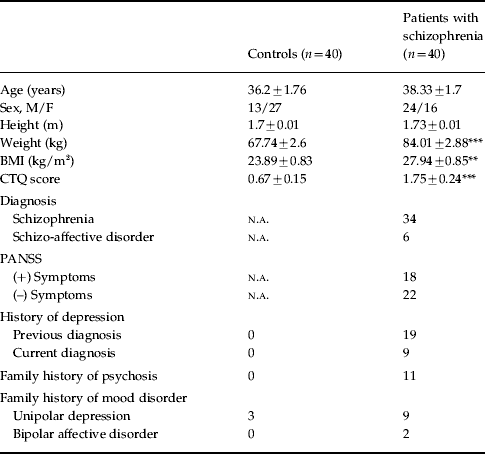
Patient demographics (see Table 1)
In the schizophrenia cohort, we recruited 40 patients (24 males, 16 females), with a mean age of 38±1.7 years, weight 84.01±2.88 kg and BMI 27.94±0.85 kg/m2. According to the DSM-IV, 34 had a diagnosis of schizophrenia and six had a diagnosis of schizo-affective disorder (APA, 1994). Using the total score on the PANSS, 20 patients had mild, 13 patients moderate and seven patients severe illness severity. According to the composite PANSS score, 22 patients had predominantly negative and 18 patients had predominantly positive symptoms. A positive history of depression was recorded in 22 schizophrenia subjects (19 patients self-reported previous depression and nine scored positive for current depression according to the CDSS). There was a positive family history of psychosis in 11 participants, a positive family history of unipolar mood disorder in nine participants, and a positive family history of bipolar affective disorder (BPAD) in two participants. With regard to medications in the schizophrenia group, one patient was prescribed an antidepressant alone. In the remaining 39 patients, 26 were taking one antipsychotic, 12 two antipsychotics, and one was taking a combination of three antipsychotics. The total numbers of individual antipsychotics were: (18) clozapine; (nine) olanzapine; (eight) risperidone; (four) amisulpride, haloperidol; (three) fluphenazine; (two) aripiprazole, quetiapine; and (one) sulpiride, sertindole, trifluoperazine. In this group, 11 patients were also prescribed antidepressants, four patients were prescribed mood stabilizers, and 10 patients were prescribed benzodiazepines. In the control group (n=40), there were 27 females and 13 males, with a mean age of 36.2±1.76 years, weight 67.74±2.6 kg and BMI 23.89±0.83 kg/m2. None of the control subjects had a current or previous psychiatric diagnosis, none had a positive family history of psychosis and three had a positive family history of unipolar depression.
Demographic data

M, Male; F, female; BMI, body mass index; n.a., not applicable; CTQ, Childhood Trauma Questionnaire; PANSS, Positive and Negative Symptom Scale.
** p<0.01, *** p<0.001.
No significant difference was found between the schizophrenia and control groups in terms of age (Table 1). Patients with schizophrenia had significantly increased weight (p<0.001) and, as a result, an increased BMI (p=0.0026) when compared with controls.
Cytokine results (Fig. 1)
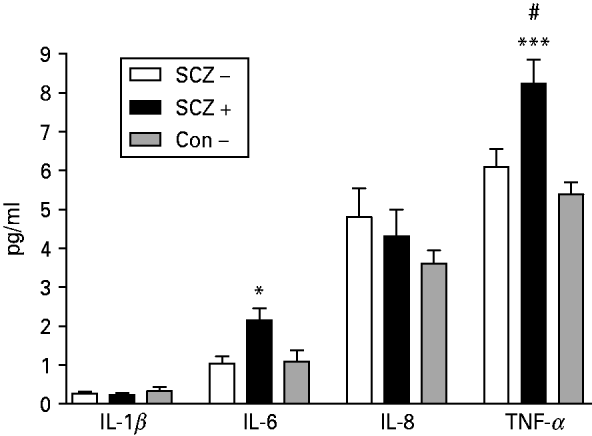
Patients in the schizophrenia group reported on average more childhood traumatic events than control subjects (schizophrenia 1.75±0.24 versus control 0.67±0.15, p<0.001). As questions 1–5 of the CTQ relate specifically to psychological trauma in childhood, a comparison was performed using patient samples who responded yes to any of questions 1–5 (SCZ+ 24 patients) versus subjects with no history of trauma within the schizophrenia group (SCZ− 16 patients) and the control group (Con− 32 controls). Of the 24 schizophrenia patients with a positive history of childhood trauma, a total of 17 (more than two-thirds) had a history of depression (eight of these were currently depressed). Of the 16 non-abused schizophrenia patients, five (less than one-third) had a history of depression (of whom one was currently depressed).
Plots of cytokines interleukin (IL)-1β, IL-6, IL-8 and tumour necrosis factor (TNF)-α in schizophrenia patients with a history of childhood trauma (SCZ+), and in schizophrenia patients (SCZ−) and controls (Con−) with no history of childhood trauma. * p<0.05, *** p<0.001 SCZ+ versus Con−. # p<0.05, SCZ+ versus SCZ−.

Using one-way ANOVA with a Bonferroni post-hoc test, the results were non-significant for IL-1β (SCZ+ 0.237±0.043, SCZ− 0.264±0.046, Con− 0.329±0.103; F=0.355, df=143, p=0.702) and IL-8 (SCZ+ 4.313±0.685, SCZ− 4.817±0.725, Con− 3.614±0.331; F=1.177, df=143, p=0.311). However, there were significantly increased levels of both IL-6 (SCZ+ 2.149±0.318, SCZ− 1.048±0.172, Con− 1.092±0.296; F=4.258, df=143, p<0.05) and TNF-α (SCZ+ 8.248±0.601, SCZ− 6.088±0.465, Con− 3.614±0.331; F=11.41, df=143, p<0.001) in schizophrenia patients with a positive history of childhood trauma compared with control samples with no history of childhood trauma. There were also increased levels of TNF-α in schizophrenia patients positive for childhood trauma versus those negative for childhood trauma (SCZ+ 8.248±0.601, SCZ− 6.088±0.465; F=11.41, df=143, p<0.05; see Fig. 1). Using the χ2 test, there was a significant association between cytokine level and extent of childhood trauma for TNF-α, with a greater number of traumatic exposures correlating with higher cytokine response (χ2=20.27, df=10, p<0.05).
Within the schizophrenia group as a whole, using Pearson's product-moment correlation coefficient, there was no significant correlation between cytokine levels and psychopathology, based on the total score of PANSS, the composite score of PANSS and the CDSS score reflecting overall illness severity, the presence of predominant positive or negative symptoms and the presence of current depression respectively.
The effects of BMI were analysed within the schizophrenia group, specifically looking at those with a BMI <25 kg/m2 (n=13) versus those with a BMI >25 kg/m2 (n=27). The results were non-significant for all cytokines measured, including IL-1β (F=1.189, df=78, p=0.813), IL-6 (F=5.276, df=78, p=0.232), IL-8 (F=1.034, df=78, p=0.160) and TNF-α (F=1.417, df=78, p=0.199).
Discussion
In this study, we found increased levels of the pro-inflammatory markers IL-6 and TNF-α only in schizophrenia patients with a positive history of childhood trauma. Despite robust data indicating childhood maltreatment or trauma as a risk factor for schizophrenia, the biological mechanisms by which early traumatic events increase the risk of subsequent psychopathology are not fully understood. We could speculate that early trauma brings about epigenetic changes that lead to a pro-inflammatory phenotype in adulthood.
To date, there is evidence to suggest that child abuse causes long-lasting alterations in the HPA axis, hippocampal function and dopaminergic neurotransmitter systems, all of which are implicated in psychosis (Cicchetti & Walker, Reference Cicchetti and Walker2001; Read et al. Reference Read, Perry, Moskowitz and Connolly2001). One study reported that childhood abuse diminished cortisol response, which was amplified with increasing age and independent of other variables including psychiatric illness (Carpenter et al. Reference Carpenter, Tyrka, Ross, Khoury, Anderson and Price2009). There are several studies on childhood trauma and depression that link trauma with altered HPA axis activity, in addition to immune activation and alterations in hippocampal volume (Heim et al. Reference Heim, Mletzko, Purselle, Musselman and Nemeroff2008a , Reference Heim, Newport, Mletzko, Miller and Nemeroff b ). Studies in animals have shown that disrupted maternal care in infancy has chronic deleterious effects on the HPA axis and also the mesolimbic dopamine system, and in humans poor parental care in childhood is associated with higher levels of salivary cortisol in response to psychological stress and also increased ventral striatum dopamine release (Liu et al. Reference Liu, Diorio, Tannenbaum, Caldji, Francis, Freedman, Sharma, Pearson, Plotsky and Meaney1997; Hall et al. Reference Hall, Wilkinson, Humby and Robbins1999). Taken together, these results suggest that disrupted care in childhood is associated with HPA axis dysfunction and hyper-reactivity of the dopamine system. Pathological effects of stress on the hippocampus may be related to an increase in cortisol and a decrease in brain-derived neurotrophic factor (BDNF) (Bremner, Reference Bremner2005; Galletly et al. Reference Galletly, van Hooff and McFarlane2011). Such hippocampal abnormalities, HPA axis disruptions and low levels of BNDF have also been described in schizophrenia, which might suggest that trauma increases the risk of psychosis in vulnerable individuals by altering brain structure and function. Recent studies by Mondelli et al. (Reference Mondelli, Dazzan, Hepgul, Di Forti, Aas, D'Albenzio, Di Nicola, Fisher, Handley, Marques, Morgan, Navari, Taylor, Papadopoulos, Aitchinson, Murray and Pariante2009, Reference Mondelli, Cattaneo, Belvederi Murri, Di Forti, Handley, Hepgul, Miorelli, Navari, Papadopoulos, Aitchinson, Morgan, Murray, Dazzan and Pariante2011) reported that, in first-episode psychosis, childhood trauma and adult stress are partly responsible for down-regulation of BDNF expression. They also reported hyperactivity of the HPA axis in first-episode psychosis, but found that factors other than stress resulted in these abnormalities.
Other evidence also suggests increased levels of inflammatory biomarkers in those exposed to childhood trauma. In rodents, acute stress is associated with increased IL-6 activity (LeMay et al. Reference LeMay, Vander and Kluger1990; Zhou et al. Reference Zhou, Kusnecov, Shurin, Depaoli and Rabin1993). Animal studies linking early life stress with alterations in inflammation in adulthood have been published, including a study that showed that early life stress by maternal separation in rats resulted in increased pro-inflammatory cytokine release, in addition to altered HPA axis activity (O'Mahony et al. Reference O'Mahony, Marchesi, Scully, Codling, Ceolho, Quigley, Cryan and Dinan2009). Studies examining depressed adults with a history of childhood maltreatment also suggest significantly increased inflammatory markers such as CRP, and greater inflammatory response compared with non-depressed controls in response to acute psychological stress (Pace et al. Reference Pace, Mletzko, Alagbe, Musselman, Nemeroff, Miller and Heim2006; Danese et al. Reference Danese, Moffitt, Pariante, Ambler, Poulton and Caspi2008). In healthy individuals, a history of childhood maltreatment correlated higher scores on the CTQ with higher IL-6 release in response to psychological stress, further supporting the evidence for alterations in inflammatory responses in those who have a history of childhood maltreatment (Carpenter et al. Reference Carpenter, Gawuga, Tyrka, Lee, Anderson and Price2010). Because IL-6 is a potent activator of the HPA axis (Žarković et al. Reference Žarković, Ignjatović, Dajak, Ćirić, Beleslin, Savić, Stojković, Bulat and Trbojević2008), it is possible that the HPA axis disturbances in schizophrenia are brought about by pro-inflammatory cytokines. Exactly how childhood trauma generates a pro-inflammatory phenotype is unclear but may be related to stress-induced priming of microglia, which, when exposed to subsequent pro-inflammatory stimuli, may become activated and result in potentiated pro-inflammatory responses (Frank et al. Reference Frank, Baratta, Sprunger, Watkins and Maier2007; Sparkman & Johnson, Reference Sparkman and Johnson2008).
Of note, in this study, patients with schizophrenia had higher weight and consequently higher BMI than controls. Previous studies have reported an association between early-life stress and obesity, and also a relationship between BMI and stress-induced cytokine response (Brydon et al. Reference Brydon, Wright, O'Donnell, Zachary, Wardle and Steptoe2008; Boynton-Jarrett et al. Reference Boynton-Jarrett, Fargnoli, Suglia, Zuckerman and Wright2010). Obesity itself is accompanied by low-grade inflammation, and adipocytes are a source of IL-6, CRP and serum amyloid A (SAA) (Kvasnicka et al. Reference Kvasnicka, Kvasnicka, Ceska and Vrablik2003). However, in the current study, comparison of schizophrenia patients with a BMI <25 kg/m2 with those with a BMI >25 kg/m2 did not yield significant differences in levels of IL-1β, IL-6, IL-8 or TNF-α. It is also worth noting that depression was over-represented in the subgroup of patients with childhood trauma. It is well established that depression is also associated with a pro-inflammatory state (Dantzer et al. Reference Dantzer, O'Connor, Freund, Johnson and Kelley2008; Leonard & Myint, Reference Leonard and Myint2009), and hence may be partially responsible for the inflammatory load seen in childhood trauma patients. However, studies of non-depressed adults with a history of childhood trauma indicate greater IL-6 release in response to psychological stress (Carpenter et al. Reference Carpenter, Gawuga, Tyrka, Lee, Anderson and Price2010), suggesting that childhood trauma influences pro-inflammatory cytokines independent of depression.
Important limitations in this study include the lack of medication-free patients, as psychotropic medications are known to have an influence on cytokine levels (Maes et al. Reference Maes, Delange, Ranjan, Meltzer, Desnyder, Cooremans and Scharpe1997). Of the 40 control subjects recruited, eight had a positive history of childhood trauma. A larger sample size, including more controls with a history of childhood trauma, would also have been an informative comparison group. In general, more studies investigating the link between trauma and inflammation are required, particularly in patients with psychiatric illness, where epigenetic mechanisms may be generating a pro-inflammatory phenotype.
Acknowledgements
The Alimentary Pharmabiotic Centre is a Centre for Science, Engineering and Technology (CSET) funded by Science Foundation Ireland (SFI), through the Irish Government's National Development Plan. The authors and their work were supported by SFI and GlaxoSmithKline through grant 07/CE/B1368.
Declaration of Interest
None.