


Non-technical Summary
The Cranbrook Paleontological site in British Columbia (Canada), famous for its exceptionally preserved soft-bodied invertebrate fossils such as Anomalocaris and Tuzoia, along with abundant trilobite beds, offers a unique opportunity to better understand ancient seafloor ecosystems, when animal diversity exploded during the Cambrian period. A fieldwork study in 2015 uncovered a variety of other kinds of fossils—trace fossils—that, instead of preserving the body remains of animals, reveal the behavior of these organisms. In this site, two distinct groups of trace fossils can be determined: arthropod-produced tracks and worm-like structures, such as simple trails on the seafloor surface and shallow U-shaped burrows. Intriguing large-sized finger-like structures, filled with fragmented trilobite plates, are also a common component of this site. Trilobite pieces and sandy sediment occur within most burrows that are preserved within a fine mud-rich matrix, indicating a dynamic seafloor environment: a calm, relatively stable setting where animals thrived was interrupted by episodic flows that transported and trapped coarser materials inside open burrows. Our findings give us a new glimpse into the life of burrowing animals during the Cambrian, a critical period in the history of life on planet Earth.
Introduction
Although earlier understood as formed in distal marine anoxic environments and essentially lacking bioturbation, a different view of Burgess Shale-type deposits has been emerging due to the documentation of a variety of trace fossils formed under different environmental and taphonomic conditions (Allison and Brett, Reference Allison and Brett1995; Powell et al., Reference Powell, Johnston and Collom2003; Zhang et al., Reference Zhang, Bergström, Bromley and Hou2007; Wang et al., Reference Wang, Lin, Zhao and Orr2009; Mángano, Reference Mángano2011; Mángano et al., Reference Mángano, Bromley, Harper, Nielsen, Smith and Vinther2012, Reference Mángano, Hawkes and Caron2019; Saleh et al., Reference Saleh, Qi, Buatois, Mángano, Paz, Vaucher, Zheng, Hou, Gabbott and Ma2022). Our understanding of the variability in preservational conditions and paleoenvironmental framework of trace fossils in Burgess Shale-type deposits may provide valuable information on limiting factors in the overall distribution of fossil Lagerstätten. Therefore, detailed documentation of the ichnotaxonomic composition and integration with the associated sedimentary facies is essential to develop this line of ichnologic research in Burgess Shale-type deposits.
The Cranbrook Lagerstätte in the lower Cambrian Eager Formation of British Columbia in western Canada (Fig. 1) provides a new record of trace fossils in Burgess Shale-type deposits (Caron et al., Reference Caron, Webster, Briggs, Pari, Santucci, Mángano, Izquierdo-López, Streng and Gaines2023). Their documentation offers valuable clues to benthic life and environmental controls during deposition, therefore contributing to our picture of the taphonomy and ecology of Cambrian fossil Lagerstätten. This paper aims to: (1) document the trace fossils from the Cranbrook Lagerstätte, (2) evaluate environmental constraints and taphonomic controls, and (3) provide comparisons with other Burgess Shale-type ichnofaunas to better frame the Cranbrook ichnocoenoses.
Location and stratigraphy of the studied succession. (1) Cranbrook Lagerstätte fossil locality in relation to other Burgess Shale-type localities in the Canadian Rocky Mountains. (2) Approximate locations of fossiliferous sites within the Cranbrook area as defined by Schofield (Reference Schofield1922). (3) Simplified stratigraphic section of the lower Cambrian units in the Cranbrook area with the approximate stratigraphic position of the Cranbrook Lagerstätte (star). Undefined positions of lithostratigraphic boundaries (?). Shaded gray regions indicate potential unconformities. Vertical scale is arbitrary and nonlinear, and relative thicknesses of lithostratigraphic units are distorted. Modified from Caron et al. (Reference Caron, Webster, Briggs, Pari, Santucci, Mángano, Izquierdo-López, Streng and Gaines2023). (4) Field image excavation trench from the 2015 Royal Ontario Museum-led expedition at fossil site B. Photo by M.G.M.

Geological setting
The up to 2,600 m thick succession of the Eager Formation in the Cranbrook area consists of shale and siltstone, with subordinate carbonate beds (Schofield, Reference Schofield1922). This unit accumulated in a structurally active, fault-controlled basin along the northern margin of Laurentia, referred to as the Eager Trough (Rice, Reference Rice1937; Larson and Price, Reference Larson and Price2006). The succession is partially exposed and has no contact with the underlying or overlying units around Cranbrook. The age of the Eager Formation is Cambrian Stage 4 and Dyeran Stage of Laurentia based on the formally named Bonnia–Olenellus biozone (Briggs and Mount, Reference Briggs and Mount1982; Conway Morris, Reference Conway Morris1979; Palmer and Repina, Reference Palmer and Repina1993; Palmer, Reference Palmer1998). Recently, a middle Dyeran age has been suggested for the Eager Formation on the basis of the stratigraphic co-occurrence of the trilobites Wanneria cranbrookense Webster, Reference Webster and Caron2024 and Elliptocephala walcotti Lieberman, Reference Lieberman1999 (Webster and Caron, Reference Webster and Caron2024). Nevertheless, a species-level trilobite zone remains to be defined.
The Eager Formation in this area is host to the Cranbrook Lagerstätte (c. 514–509 Ma, Middle Dyeran Stage), representing one of North America’s oldest Burgess Shale-type deposits that, although discovered over a century ago, has only recently received close attention (Caron et al., Reference Caron, Webster, Briggs, Pari, Santucci, Mángano, Izquierdo-López, Streng and Gaines2023; Webster and Caron, Reference Webster and Caron2024). In 2015, a 2.65 m thick claystone-dominated interval was analyzed in detail at “Site B” (Webster, Reference Webster2015; Caron et al., Reference Caron, Webster, Briggs, Pari, Santucci, Mángano, Izquierdo-López, Streng and Gaines2023; Webster and Caron, Reference Webster and Caron2024). Olenelloid trilobites (e.g., Olenellus Hall in Billings, Reference Billings and Palaeozoic Fossils1861) are the most common body fossils in this interval, but a very low-diversity assemblage of soft-bodied fossils has also been recovered, consisting mostly of Tuzoia Walcott, Reference Walcott1912 and, more rarely, appendages of Anomalocaris Whiteaves, Reference Whiteaves1892. Sponges, hyoliths, and brachiopods are usually rare. Microbially induced sedimentary structures (MISS), algae, and cyanobacteria are also common locally, the MISS including pustules and wavy-crinkly lamination. This claystone is intercalated with thin laminae to very thin beds of normally graded, very fine-grained sandstone and coarse-grained siltstone with rarely preserved current-ripple cross-lamination (Fig. 2.1). These layers commonly display disarticulated skeletal debris at the base, including trilobite cephala and, less commonly, fragments of Tuzoia carapaces (Caron et al., Reference Caron, Webster, Briggs, Pari, Santucci, Mángano, Izquierdo-López, Streng and Gaines2023).
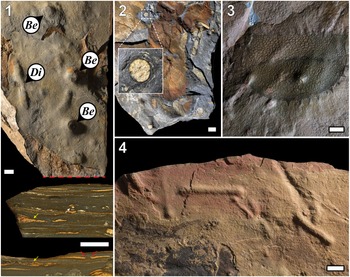
Trace fossils and physical sedimentary structures in the Diplocraterion isp. Ichnocoenosis. (1) General bedding-plane view of Bergaueria isp. (Be) and Diplocraterion isp. (Di) and close-ups of polished cross section showing typical claystone with thin intercalations of coarser grains in thin and discontinuous laminae displaying starved ripples and associated cross-lamination (yellow arrows), passively filled burrows (white arrow), and ruptured laminae of fine-grained sand (red arrows). RBCM.EH2015.013.0301. (2) Bedding-plane view of slab RBCM.EH2015.013.0304 with close-up of Diplocraterion isp. with fine-grained sand fill. (3) Bedding-plane view of slab ROMIP 66862 displaying Diplocraterion isp. with fine-grained sand fill in incidental association with a Tuzoia carapace. Notice deformation of Tuzoia-bearing laminae by the overprinting burrow. (4) Bedding-plane view of slab RBCM.EH2015.013.0309 displaying stick-like individuals. Notice common individuals having slightly broader ends. All scale bars = 10 mm.

Whereas part of the claystone may have been deposited by suspension fallout, low-energy, dilute flows were also significant processes during deposition. The abundance of articulated trilobite material also supports limited transport capacity judging from the presence of autochthonous to parautochthonous assemblages (Webster and Caron, Reference Webster and Caron2024). Normally graded deposits were most likely accumulated from low-density turbidity currents. This is further supported by scarce starved asymmetric ripples (Fig. 2.1). In some cases, energy was high enough to transport very fine sand grains, scouring the sea bottom and reworking skeletal material (Caron et al., Reference Caron, Webster, Briggs, Pari, Santucci, Mángano, Izquierdo-López, Streng and Gaines2023), hinting at the presence of bottom currents. The absence of oscillatory flow-related structures indicates sedimentation below the storm-wave base. The presence of algae and cyanobacteria, however, suggests deposition within the photic zone and, therefore, a shelf scenario (i.e., between the storm-wave base and the slope break) is the most likely environmental setting.
Materials and methods
Material
Twenty-three slabs containing trace fossils collected from Locality B during the 2015 excavation, including the specimens found in situ within the measured section and specimens found as talus at the site, were examined under a binocular stereo microscope and photographed using a Nikon Z7 with a 100 mm macro lens and a polarizing filter at the University of Saskatchewan. To maximize the depth of field for individuals with significant three-dimensional surfaces, a series of digital images was taken and then rendered into a single composite image using Helicon Focus (https://www.heliconsoft.com).
Morphometric data
The size measurements were made using mechanical calipers or extracted from in-field digital photos using the open-access ImageJ software (https://imagej.net).
Terminology
The definitions of the main types of biogenic sedimentary structures follow those of Buatois and Mángano (Reference Buatois and Mángano2011) in which “track” refers to an impression left by an individual locomotory appendage, while “trackway” consists of a series of tracks. “Trails” are continuous grooves produced during locomotion, which differ from the more permanent structures known as “burrows.” In terms of stratinomic classification, we adhere to the terminology established by Seilacher (Reference Seilacher1964a). To describe the morphologic elements of ichnotaxa, we follow the terminology of classic ichnotaxonomic papers (e.g., Seilacher, Reference Seilacher, Crimes and Harper1977; Jensen, Reference Jensen1997). We also employ terminology used by Fürsich (Reference Fürsich1974) for Diplocraterion Torell, Reference Torell1870 and that of Uchman and Hanken (Reference Uchman and Hanken2013) and Laing et al. (Reference Laing, Buatois, Mángano, Narbonne and Gougeon2018) for Gyrolithes de Saporta, Reference de Saporta1884.
Repositories and institutional abbreviations
Collection of trace fossil slabs was performed by the Royal Ontario Museum under a Land Act license of occupation (#405166). Specimens are now housed at the Royal British Columbia Museum (RBCM) in Victoria, Canada, as well as at the Royal Ontario Museum-Invertebrate Paleontology (ROMIP) in Toronto, Canada.
Systematic ichnology
Studied material
Eleven ichnotaxa (Bergaueria isp., Cochlichnus isp., Diplichnites cf. D. gouldi [Gevers in Gevers et al., Reference Gevers, Frakes, Edwards and Marzolf1971], Diplocraterion isp., ?Gyrolithes isp., Helmithoidichnites tenuis Fitch, Reference Fitch1850 , Helminthopsis cf. H. tenuis Książkiewicz, Reference Książkiewicz1968, Palaeophycus tubularis Hall, Reference Hall1847, Rusophycus isp., Teichichnus cf. T. rectus Seilacher, Reference Seilacher, Schindewolf and Seilacher1955, and Treptichnus cf. T. pedum [Seilacher, Reference Seilacher, Schindewolf and Seilacher1955]) and three forms left in open nomenclature (aligned vertical burrows, finger-like structures, and rosary-like structures).
Ichnogenus Bergaueria Prantl, Reference Prantl1945
Type ichnospecies
Bergaueria perata Prantl, Reference Prantl1945 from the “Chrustenice beds” of the Letná Formation (Darriwilian, Middle Ordovician), central Bohemia, Czech Republic.
Bergaueria isp.
Materials
One single slab (RBCM.EH2015.013.0301) containing five specimens and two possible additional smaller specimens. Although this ichnotaxon is relatively rare, it occurs locally at relatively high density.
Description
Plug-shaped, hemispherical, smooth-walled burrows. The two largest and best-preserved specimens present a gentle central depression, with the largest measuring 18 mm in diameter at the base, while others vary from 8.0 to 14.8 mm. Likewise, length is highly variable within specimens in the same slab, with the largest one reaching 5.2 mm. Burrow fill is composed of very fine-grained sand. Preserved in positive hyporelief.
Remarks
Bergaueria is distinct from the other four currently accepted plug-shaped ichnogenera, Conostichus Lesquereux, Reference Lesquereux1876, Conichnus Männil, Reference Männil and Hecker1966, Dolopichnus Alpert and Moore, Reference Alpert and Moore1975, and Astropolichnus Crimes and Anderson, Reference Crimes and Anderson1985 by its morphology (i.e., conical in Conostichus and Conichnus; cylindrical in Dolopichnus and Astropolichnus), and diminutive or absent ornaments or apical enlargement (Pemberton et al., Reference Pemberton, Frey and Bromley1988). Classification at ichnospecies rank is not possible due to poor preservation. However, the presence of a central depression suggests B. perata, but lack of cross-section views does not allow distinction from B. langi (Hallam, Reference Hallam1960) (which has thick lining). Furthermore, B. perata differs from B. hemisphaerica Crimes et al., Reference Crimes, Legg, Marcos, Arboleya, Crimes and Harper1977 solely on the basis of the central depression (but see Jensen, Reference Jensen2003). Bergaueria is typically considered to be the resting (cubichnion) or permanent or semi-permanent (domichnion) dwelling burrows of tube-dwelling cnidarians (e.g., actiniarians, ceriantharians, pennatulaceans) that can be either suspension feeders or passive predators (Seilacher, Reference Seilacher, Imbrie and Newell1964b; Schäfer, Reference Schäfer1972; Alpert, Reference Alpert1973; Pemberton et al., Reference Pemberton, Frey and Bromley1988; Bromley, Reference Bromley1996; Seilacher-Drexler and Seilacher, Reference Seilacher-Drexler and Seilacher1999). More recently, the possibility of a sponge origin for similar traces has been raised (Gingras et al., Reference Gingras, Dashtgard, MacEachern and Pemberton2008; Dashtgard and Gingras, Reference Dashtgard, Gingras, Knaust and Bromley2012).
Ichnogenus Cochlichnus Hitchcock, Reference Hitchcock1858
Type ichnospecies
Cochlichnus anguineus Hitchcock, Reference Hitchcock1858 from the Turners Falls Formation (Lower Jurassic), Massachusetts, United States.
Cochlichnus isp.
Subhorizontal burrows from the Cranbrook Lagerstätte. (1) Sinusoidal burrow assigned to Cochlichnus isp. RBCM.EH2015.013.0308A. (2, 3) Straight burrows assigned to Palaeophycus tubularis. (2) Small specimen with narrow termination. Note the compaction structures deforming the sediment outside the burrow boundary. RBCM.EH2015.013.0310. (3) Large specimen with dark surface and exhibiting fine-grained sand fill. RBCM.EH2015.013.0314B. (4) Strongly curving causative tube of Teichichnus cf. T. rectus with stacked laminae on the lower part. Field image and explanatory drawing. (5) Modular elements of the small specimen assigned to Treptichnus cf. T. pedum. Field image. All scale bars = 10 mm.

Materials
Two slabs with part and counterpart (RBCM.EH2015.013.0303A–B, .0308A–B) containing one specimen per slab and an uncollected specimen recorded in the field. The two specimens collected are from the –86 and –123 cm stratigraphic layers.
Description
Simple, small, unbranched, horizontal, sinusoidal trails. Amplitude is 11–12 mm. Preserved segments are very short, with a maximum length of approximately 70 mm. Width is constant throughout the course of the structure and similar in the two recovered specimens (widths of 4.2 and 4.7 mm, respectively). Measured wavelength (λ) is 21.4–29.0 mm. The infill is massive and structureless, composed of very fine-grained sand. Preserved as full relief.
Remarks
The regular sinusoidal course of these specimens suggests affinity to the second-order meanders of graphoglyptids such as Cosmorhaphe Fuchs, Reference Fuchs1895, Belorhaphe Fuchs, Reference Fuchs1895, and Protopaleodictyon Książkiewicz, Reference Książkiewicz, Crimes and Harper1970 (Gougeon et al., Reference Gougeon, Mángano, Buatois, Narbonne, Laing and Paz2025), to which we add Paleomeandron Peruzzi, Reference Peruzzi1880. Cochlichnus can be distinguished by its lack of branching (versus branching in Protopaleodictyon), smooth turns (versus angular turns in Belorhaphe and quadrate in Paleomeandron) (Buatois and Mángano, Reference Buatois and Mángano1993a). Moreover, preservation as full relief sets Cranbrook specimens apart from any graphoglyptid, as the latter occur exclusively as hyporeliefs.
Recently, Gougeon et al. (Reference Gougeon, Mángano, Buatois, Narbonne, Laing and Paz2025) acknowledged five distinct ichnospecies of Cochlichnus, differentiated by their wavelength/amplitude ratios (λ/2A) and ornamentation (i.e., lateral markings, annulations). Smooth-walled specimens suggest affinity to Cochlichnus anguineus or Cochlichnus gracilis Vialov, Reference Vialov1979. However, incomplete preservation of the structure prevents a definitive ichnospecies assignment. Cochlichnus is interpreted as a grazing trail (pascichnion) (Fillion and Pickerill, Reference Fillion and Pickerill1990; Buatois and Mángano, Reference Buatois and Mángano1993a). Annelids and nematodes have been longstanding potential producers for Cochlichnus (Elliott, Reference Elliott1984; Metz, Reference Metz1998; Jensen, Reference Jensen2003).
Ichnogenus Diplichnites Dawson, Reference Dawson1873
Type ichnospecies
Diplichnites aenigma Dawson, Reference Dawson1873 from the San Angelo Formation at Buzzard Peak (Carboniferous), Cedar Mountain, British Columbia, Canada.
Diplichnites cf. D. gouldi (Gevers in Gevers et al., Reference Gevers, Frakes, Edwards and Marzolf1971)
Trace fossils in slab RBCM.EH2015.013.0307A. (1) General bedding-plane view showing trace fossils associated with microbial texture (MISS); (2) Line drawing of arthropod trackway assigned to Diplichnites cf. D. gouldi (red), additional unclassified imprints (blue), ?Gyrolithes isp. (pink), and Rusophycus isp. (green). (3) Detail showing surface microbially induced pustules in proximity with Diplichnites cf. D. gouldi. (4) Close-up of ?Gyrolithes isp. (5) Close-up of Rusophycus isp. All scale bars = 10 mm.

Materials
One slab with part and counterpart (RBCM.EH2015.013.0307A–B) containing one single specimen and an uncollected specimen recorded in the field, representing two stratigraphic levels (–49 and –90 cm).
Description
This ichnotaxon consists of two parallel series of similar tracks, with three series of narrow, tear-shaped imprints tapering and oriented perpendicular to the trackway axis. Imprints are 3–10 mm long and spaced ~2.4–5.3 mm apart. The trackway course is mostly straight and consists of up to 14 tracks. External and internal widths are somewhat constant (~27.3–29.7 mm and ~11.8–13.1 mm, respectively) until one terminal part, in which they are greatly reduced (17.1–20.1 mm and 7.8–11.2 mm). Preserved as both negative epirelief and positive hyporelief.
Remarks
This ichnotaxon differs from other similar arthropod trackway ichnotaxa in its absence of chevron imprints (e.g., Dendroidichnites Demathieu, Gand, and Toutin-Morin, Reference Demathieu, Gand and Toutin-Morin1992; Permichnium Guthörl, Reference Guthörl1934), lack of overlapping grooves (e.g., Stiallia Smith, Reference Smith1909), and uneven number of imprints per series (e.g., Mirandaichnum Aceñolaza, Reference Aceñolaza1978). Diplichnites gouldi is very similar to Diplopodichnus biformis Brady, Reference Brady1947, and they commonly intergrade with one another, the former being distinguishable by its absence of grooves (Buatois et al., Reference Buatois, Mángano, Maples and Lanier1998a, Reference Buatois, Mangano, Maples and Lanierb). Diplichnites is considered a marine or continental arthropod locomotion trace (repichnion) (Machalski and Machalska, Reference Machalski and Machalska1994; Mángano et al., Reference Mángano, Buatois, West and Maples2002).
Although similar types of Cambrian trackways, such as D. gouldi, have been broadly attributed to trilobites (Seilacher, Reference Seilacher, Schindewolf and Seilacher1955), other arthropods have been recognized as potential producers of trackways in Cambrian Burgess Shale-type deposits, albeit with a much greater number of imprints (up to 25) (Minter et al., Reference Minter, Mángano and Caron2012, table S1). The number of imprints (14) in the Cranbrook deposit, as well as abundant trilobite remains (e.g., Olenellus Hall in Billings, Reference Billings and Palaeozoic Fossils1861; Wanneria Walcott, Reference Walcott1910), which have a comparable number of body segments, combined with the lack of evidence of any other preserved arthropods with walking limbs, suggest that such trackways might have been produced by trilobites.
Ichnogenus Diplocraterion Torell, Reference Torell1870
Type ichnospecies
Diplocraterion parallelum Torell, Reference Torell1870 from Lugnås (Cambrian), Västergötland, Sweden.
Diplocraterion isp.
Trace fossils in slab RBCM.EH2015.013.0297A. (1) General bedding-plane view showing trace fossils in the Diplocraterion isp. Ichnocoenosis. (2) Close-up of aligned vertical burrows with fine-grained infilled circular apertures. (3) Close-up of Diplocraterion isp. (Di). Finger-like structure detailed in Figure 7.1. All scale bars = 10 mm.

Materials
Five slabs with part and counterpart (RBCM.EH2015.013.0297A–B, .0299A–B, .0303A–B, 0307A–B, .0308A–B) and seven single slabs (ROMIP 66862, RBCM.EH2015.013.0298, .0301, .0304, .0305, .0309, .0317) containing at least 86 specimens, as well as scattered specimens in uncollected samples. This ichnotaxon is particularly abundant at some stratigraphic levels (–25 and –64 cm), as well as in some slabs collected from talus.
Description
Vertical, U-shaped, spreiten burrows. Expressed on bedding planes as two circular to subcircular apertures or as stick-like structures with slightly broader ends (Fig. 2.2–2.4). The width (diameter) of apertures is about 1.2–5.3 mm, while the stick-like structures are 2.3–4.8 mm wide and 15.8–42.9 mm long. Distance between paired apertures is 9–14 mm. Burrows normally do not cross the slabs, but two depth measurements in relatively compacted sediments provide a range of 7.4 and 16.8 mm, suggesting shallow penetration. Burrow fill is variable, ranging from silt to upper fine-grained sand. Preserved as full-relief structures, commonly as protuberances on bedding planes (both bases and tops), seen as burrow openings connected by the spreiten.
Remarks
Diplocraterion is very similar to Arenicolites Salter, Reference Salter1857, distinguished by its vertical spreiten. Although on some specimens the lack of connective structures between arms in bedding-plane view is suggestive of Arenicolites, they represent the uppermost part of Diplocraterion above the spreiten. The lack of cross-section views prevents assigning Diplocraterion isp. to any ichnospecies. Diplocraterion is commonly interpreted as a dwelling structure (domichnion) of a suspension-feeding animal (Seilacher, Reference Seilacher1967; Fürsich, Reference Fürsich1974). Protrusive and retrusive spreiten represent gradual adjustments because of the animal’s growth or in response to vertical accretion/erosion of the substrate (equilibrichnion) (Goldring, Reference Goldring1962; Bromley, Reference Bromley1996; Buatois and Mángano, Reference Mángano2011). Diverse invertebrate taxa have been suggested as producers of Diplocraterion, small euarthropods and polychaetes among the most relevant (Goldring, Reference Goldring1962; Seilacher, Reference Seilacher, Imbrie and Newell1964b, Reference Seilacher1967; Schäfer, Reference Schäfer1972; Pemberton and Frey, Reference Pemberton, Frey and Curran1984; Cornish, Reference Cornish1986; Gingras et al., Reference Gingras, Pemberton, Saunders and Clifton1999, Reference Gingras, Pemberton and Saunders2001, Reference Gingras, Dashtgard, MacEachern and Pemberton2008).
Ichnogenus Gyrolithes de Saporta, Reference de Saporta1884
Type ichnospecies
Gyrolithes davreuxi de Saporta, Reference de Saporta1884 from the Smectite “Craie glauconieuse” (Campanian, Upper Cretaceous), Liège Province, Belgium.
?Gyrolithes isp.
Figure 4.1, 4.2, 4.4
Materials
One slab with part and counterpart (RBCM.EH2015.013.0307A–B) from the –90 cm stratigraphic level containing at least three specimens.
Description
Unbranched, vertically oriented, circular helical burrows. Specimens consist of a flattened spiraling tube exhibiting only one whorl of the spiral with a dextral coiling pattern. Trochospiral shape and vertical position are inferred from the level change in the sediment and from a circular structure in the middle of the specimens (shaft). Whorl radius (R) ranges from 2.2 to 2.7 mm, burrow radii (r) range from 1.8 to 2.2 mm, and adaxial ratio parameter (k) ranges from 0.409 to 0.407. R was measured from the middle of the burrow (sensu Uchman and Hanken, Reference Uchman and Hanken2013), and the k value was r/R (sensu Laing et al., Reference Laing, Buatois, Mángano, Narbonne and Gougeon2018). Height between whorls (h) and related ratios were not measured since no cross-sectional view was available. However, the shaft of a single specimen could be vertically tracked on both sides of the slab, revealing at least 3.9 mm of penetration. Burrow fill is the same as the host rock. Preserved as full-relief structures, partially visible on bedding-plane view.
Remarks
Few ichnotaxa are like the upright spiraled Gyrolithes, and even fewer during the Cambrian, where a few other cork-screwed forms appear (e.g., Helicodromites Berger, Reference Berger1957), distinguishing all of them from Gyrolithes by their horizontal to oblique orientation. Furthermore, Gyrolithes is separated from similar vertical cork-screwed continental ichnotaxa by its lack of contact between coils (versus Ichnogyrus Bown and Kraus, Reference Bown and Kraus1983) and lack of additional architectural elements (versus Daimonhelix Barbour, Reference Barbour1892) (Uchman and Hanken, Reference Uchman and Hanken2013; Laing et al., Reference Laing, Buatois, Mángano, Narbonne and Gougeon2018).
Recent reviews of the ichnogenus by Uchman and Hanken (Reference Uchman and Hanken2013), Laing et al. (Reference Laing, Buatois, Mángano, Narbonne and Gougeon2018), and De Renzi and Mayoral (Reference De Renzi and Mayoral2024) highlight morphometric parameters (independent of size) as relevant ichnotaxobases for Gyrolithes ichnospecies. The measured k value falls into the range of G. polonicus Fedonkin, Reference Fedonkin1981 (k = 0.39–0.50) and G. lorcaensis Uchman and Hanken, Reference Uchman and Hanken2013 (k = 0.38–0.50), and just outside of the newly described G. scintillus Laing et al., Reference Laing, Buatois, Mángano, Narbonne and Gougeon2018 (k = 0.11–0.40). Because of the limited material and the poor preservation, Cranbrook specimens cannot be ascribed to any of the existing ichnospecies.
Gyrolithes is considered a multipurpose burrow, serving different functions within mainly three ethologies: as feeding traces of deposit feeders, profiting from nutrient-rich areas (fodinichnion) (Netto et al., Reference Netto, Buatois, Mángano and Balistieri2007; Gingras et al., Reference Gingras, Dashtgard, MacEachern and Pemberton2008); as permanent domiciles or as an in-sediment anchor (domichnion) (Gernant, Reference Gernant1972; Gingras et al., Reference Gingras, Dashtgard, MacEachern and Pemberton2008); and as bacterial farming burrows (agrichnion) (Netto et al., Reference Netto, Buatois, Mángano and Balistieri2007; Seilacher, Reference Seilacher2007; Laing et al., Reference Laing, Buatois, Mángano, Narbonne and Gougeon2018). Nevertheless, Cambrian Gyrolithes ethology may differ from Mesozoic–Cenozoic representatives given its shallower nature, smaller size, and open-marine distribution (Netto et al., Reference Netto, Buatois, Mángano and Balistieri2007).
Gyrolithes specimens from the late Mesozoic to the present have been interpreted mostly as produced by decapods (Kennedy, Reference Kennedy1967; Gernant, Reference Gernant1972; Bromley and Frey, Reference Bromley and Frey1974; Grimm and Föllmi, Reference Grimm and FöIlmi1994). By contrast, those recorded in older strata, predating the diversification of this group, were most likely produced by coelomate vermiform organisms (Jensen, Reference Jensen1997; Laing et al., Reference Laing, Buatois, Mángano, Narbonne and Gougeon2018). Comparisons with modern equivalents have led to enteropneusts (van der Horst, Reference van der Horst1934, Reference van der Horst1940; Gingras et al., Reference Gingras, Pemberton, Saunders and Clifton1999) and polychaetes (Howard and Frey, Reference Howard and Frey1975; Powell, Reference Powell1977) as possible Cambrian tracemakers.
Ichnogenus Helminthoidichnites Fitch, Reference Fitch1850
Type ichnospecies
Helminthoidichnites tenuis Fitch, Reference Fitch1850 from the ‘Hudson River Group’ (Ordovician) at the Taconic and Middle Granville, New York State, United States.
Helminthoidichnites tenuis Fitch, Reference Fitch1850
Simple horizontal trails and other associated trace fossils in the Helminthoidichnites tenuis ichnocoenosis. (1) Slab RBCM.EH2015.013.0281B displaying simple horizontal trails assigned to Helminthopsis cf. H. tenuis (Hs) and Helminthoidichnites tenuis (Ht) in incidental association with Tuzoia sp. carapace. Notice minute mounds overcrossing or in proximity of Helminthopsis cf. H. tenuis. (2) Slab RBCM.EH2015.013.0300B displaying Rosary-like structures. Notice the isolated lower left aperture of similar size with fine-grained sand fill. All scale bars = 10 mm.

Materials
Four slabs with part and counterpart (RBCM.EH2015.013.0281A–B, .0300A–B, .0303A–B, .0307A–B) containing multiple specimens and several recordings in the field in uncollected samples. This ichnotaxon is common across the stratigraphic section but typically occurs with low density (–33, –64, and –90 cm) and as talus material.
Description
Horizontal, small, thin, unbranched, straight to slightly curved, simple trails lacking meanders or self-overcrossing. Measured specimens are 0.9–2.6 mm wide, and the maximum recorded length was 59.6 mm. Burrow fill is identical to the host rock. Overlap among specimens has been observed. Preserved as positive or negative hyporeliefs.
Remarks
Other simple trails common in the Cambrian are Gordia Emmons, Reference Emmons1844 and Helminthopsis Heer, Reference Heer1877. Helminthoidichnites tenuis is distinguishable by the lack of systematic meandering (versus meandering in Helminthopsis) (Hofmann and Patel, Reference Hofmann and Patel1989; Buatois and Mángano, Reference Buatois and Mángano1993a; Buatois et al., Reference Buatois, Mángano, Maples and Lanier1998a) and lack of self-overcrossing (versus self-overcrossing in Gordia) (Fillion and Pickerill, Reference Fillion and Pickerill1990; Pickerill and Peel, Reference Pickerill and Peel1990). Overall, H. tenuis represents a random movement in a straight-to-curved trajectory within the sand–mud interface. Helminthoidichnites tenuis is regarded as a grazing trace (pascichnion) possibly produced by vermiform animals or small arthropods (Buatois and Mángano, Reference Buatois and Mángano1993a; Buatois et al., Reference Buatois, Mángano, Maples and Lanier1998a).
Ichnogenus Helminthopsis Heer, Reference Heer1877
Type ichnospecies
Helminthopsis hieroglyphica Wetzel and Bromley, Reference Wetzel and Bromley1996 from the Ruchberg series (Paleocene–Eocene), eastern Switzerland.
Helminthopsis cf. H. tenuis Książkiewicz, Reference Książkiewicz1968
Materials
One slab with part and counterpart (RBCM.EH2015.013.0281A–B) containing a single specimen associated with a Tuzoia carapace.
Description
Simple, unbranched trace fossils displaying an irregularly meandering course with U-shaped turns. Horseshoe-like turns are not present. Measured specimen has a maximum burrow course length of 57.3 mm, whereas the straight-line distance between ends reaches 38.1 mm. The height and width of the large loop are, respectively, 11.8 and 31.6 mm. The height and width of small loops are 6.8 and 3.1 mm, respectively. Burrow fill is the same as the host rock. Preserved as epireliefs and hyporeliefs.
Remarks
Helminthopsis differs from related ichnogenera such as Palaeophycus Hall, Reference Hall1847 and Macaronichnus Clifton and Thompson, Reference Clifton and Thompson1978 in the lack of lining. Another similar ichnogenus is Gordia, which is easily differentiated from Helminthopsis by its self-overcrossing and lack of meanders (Wetzel and Bromley, Reference Wetzel and Bromley1996). Irregular low-amplitude windings and U-shaped turns suggest assignment to Helminthopsis tenuis, and lack of straight segments and horseshoe-like turns argues against Helminthopsis hieroglyphica and Helminthopsis abeli Książkiewicz, Reference Książkiewicz1977, respectively. However, limited material does not allow classification at ichnospecies rank. Helminthopsis is regarded as grazing trails (pascichnia) (Buatois et al., Reference Buatois, Mángano, Maples and Lanier1998a). Potential producers are deposit-feeding organisms, such as polychaetes, small arthropods, and nematodes (Książkiewicz, Reference Książkiewicz1977; Fillion and Pickerill, Reference Fillion and Pickerill1990; Buatois and Mángano, Reference Buatois and Mángano1993a; Buatois et al., Reference Buatois, Mángano, Maples and Lanier1998a).
Ichnogenus Palaeophycus Hall, Reference Hall1847
Type ichnospecies
Palaeophycus tubularis Hall, Reference Hall1847
Palaeophycus tubularis Hall, Reference Hall1847
Holotype
NYSM 241/1, 241/2, 241/3, 241/4 from the “Calciferous Sandstone” at the Mohawk Valley (Lower Ordovician), Beekmantown, New York State, United States.
Materials
Two slabs with part and counterpart (RBCM.EH2015.013.0313A–B, .0314A–B) and five single slabs (RBCM.EH2015.013.0310, .0315–.0318) containing eight specimens seen on bedding-plane preservation and multiple additional specimens seen in cross section. Palaeophycus tubularis occurs in abundance but in low density throughout the succession, being more common in the lowermost stratigraphic interval of the succession.
Description
Straight to curved and sinuous, cylindrical to subcylindrical, thinly lined, horizontal to subhorizontal unbranched burrows. The burrow margin locally shows a rough reddish surface (Fig. 3.2) or a smooth dark red surface (Fig. 3.3). Overlap among specimens was observed in one instance. Burrows have a constant width but are variable between individuals (6.4–10.5 mm). The maximum length recorded is 67.8 mm. Burrow fill is structureless and like the host rock or slightly coarser (upper fine-grained sand). Preserved as full-relief structures on internal surfaces.
Remarks
Palaeophycus is distinguished from Planolites Nicholson, Reference Nicholson1873 by its lined walls and passive fill (Pemberton and Frey, Reference Pemberton and Frey1982; Keighley and Pickerill, Reference Keighley and Pickerill1995). Specimens from the Cranbrook locality are assigned to Palaeophycus tubularis, given its thin, smooth walls (versus thick-walled P. heberti [de Saporta, Reference de Saporta1872]) with a lack of ornamentation (versus striated in P. alternatus Pemberton and Frey, Reference Pemberton and Frey1982, P. ferrovitatus Hofmann, Reference Hofmann1983, P. striatus Hall, Reference Hall1852, and P. sulcatus [Miller and Dyer, Reference Miller and Dyer1878]) and lack of annulated lining (versus annulated in P. alternatus, and P. annulatus Bauve, Reference Bauve1987) (Pemberton and Frey, Reference Pemberton and Frey1982; Buckman, Reference Buckman1995). Palaeophycus is considered a dwelling structure (domichnion) produced by a predator or suspension-feeding vermiform animal (Pemberton and Frey, Reference Pemberton and Frey1982).
Ichnogenus Rusophycus Hall, Reference Hall1852
Type ichnospecies
Rusophycus biloba Hall, Reference Hall1852 from the Clinton Group (Silurian), New York State, United States.
Rusophycus isp.
Materials
One slab (RBCM.EH2015.013.0307A) containing a single specimen at –90 cm in the succession.
Description
Short bilobed burrow with an irregular outline. The median furrow is pronounced, separating the two lobes from each other constantly along the axis. Ridges are thin, closely spaced, and bear poorly preserved scratch marks. Length is about 7.1 mm and width 5.2 mm. Lobes are equal in width (~2.5 mm), but one of them is noticeably shorter than the other (5.3 versus 7.1 mm). Preserved as positive hyporelief.
Remarks
Rusophycus has frequently been recorded in transition with Cruziana d’Orbigny, Reference d’Orbigny, Bertrand and Levrault1842, and their synonymy has been proposed (e.g., Seilacher, Reference Seilacher, Crimes and Harper1970). However, given the morphological difference and the contrasting ethological meanings, they continue to be regarded as separate ichnotaxa (Bromley, Reference Bromley1996; Mángano et al., Reference Mángano, Buatois, West and Maples2002). Rusophycus is a resting trace (cubichnion) of an arthropod (Seilacher, Reference Seilacher1963; Bromley and Asgaard, Reference Bromley and Asgaard1979), although feeding, dwelling, and protection are some of the other activities that may have been involved (see Jensen, Reference Jensen1997; Seilacher, Reference Seilacher2007). Trilobites, which are common in the Cranbrook Lagerstätte (Webster and Caron, Reference Webster and Caron2024), have been typically regarded as producers (Dawson, Reference Dawson1864; Seilacher, Reference Seilacher1959; Crimes, Reference Crimes1970). However, other kinds of arthropods cannot be discarded as potential producers (see Donovan, Reference Donovan2010 and references therein).
Ichnogenus Teichichnus Seilacher, Reference Seilacher, Schindewolf and Seilacher1955
Type ichnospecies
Teichichnus rectus Seilacher, Reference Seilacher, Schindewolf and Seilacher1955 from the Jutana Formation (Cambrian) at the Salt Range, Pakistan.
Teichichnus cf. T. rectus Seilacher, Reference Seilacher, Schindewolf and Seilacher1955
Materials
One uncollected specimen.
Description
Horizontal causative burrow having vertical spreiten. Burrow fill is structureless and has coarser material than matrix (fine-grained sand). In bedding-plane view, spreite is in a staircase-like pattern just below the causative tube. Length is about 37 mm and width is 6 mm. Causative tube is ~16 mm long. Preserved as full relief.
Remarks
On bedding-plane view, this ichnotaxon could be easily confused with Palaeophycus. However, the stacked laminae on the lower part of the tube unmistakably indicate spreiten, and therefore, this specimen is included in Teichichnus. This ichnogenus can intergrade with Diplocraterion and Phycodes Richter, Reference Richter1850 (Corner and Fjalstad, Reference Corner and Fjalstad1993; Knaust, Reference Knaust2018). Nevertheless, the Cranbrook specimen differs from these two ichnogenera in its arcuate architecture (versus U-shaped in Diplocraterion) and the lack of fan-shaped bundles (versus bundles in Phycodes). Although the strong sinuosity could suggest T. patens Schlirf, Reference Schlirf2000, the defining branching is absent. Furthermore, the lack of double spreite eliminates T. duplex Schlirf and Bromley, Reference Schlirf and Bromley2007 as well. From the four ichnospecies of Teichichnus currently accepted, the Cranbrook specimen falls roughly into the broad definition of T. rectus. However, T. zigzag Frey and Bromley, Reference Frey and Bromley1985 cannot be wholly left out as a possibility since there is no cross-sectional view available to appreciate the details of the stacked laminae pattern.
Recently, a review of this ichnogenus argued for a dwelling behavior (domichnion) instead of a feeding behavior (fodinichnion) on the basis of the co-occurrence of protrusive and retrusive spreiten (Knaust, Reference Knaust2018). Since fodinichnia includes dwelling and feeding behaviors, we keep the traditional ethologic category of fodinichnia for this ichnotaxon. However, the vertically oriented retrusive spreiten is also evidence of a gradual adjustment as a response to substrate aggradation, which would categorize Teichichnus as equilibrichnion, which in neither case is mutually exclusive with domichnion or fodinichnion (Corner and Fjalstad, Reference Corner and Fjalstad1993). A diverse array of vermiform producers (e.g., echiurans, polychaetes, sipunculids) have been suggested as producers of Teichichnus (Corner and Fjalstad, Reference Corner and Fjalstad1993; Knaust, Reference Knaust2018). Although this could be the case for the Cranbrook specimen, a small arthropod cannot be ruled out as a potential producer (Goldring, Reference Goldring1985; Schlirf and Bromley, Reference Schlirf and Bromley2007).
Ichnogenus Treptichnus Miller, Reference Miller1889
Type ichnospecies
Treptichnus bifurcus Miller, Reference Miller1889 from the Mansfield Formation (Gzhelian, Carboniferous), Indiana, United States.
Treptichnus cf. T. pedum (Seilacher, Reference Seilacher, Schindewolf and Seilacher1955)
Materials
One uncollected specimen.
Description
Subhorizontal burrow consisting of three consecutive modular segments that are slightly separated, showing branches on the same side. The first segment is bean-shaped, while the other consecutive two are straight and oval-shaped. Each has an average of 0.1 mm wide and 0.3 mm long.
Remarks
The ichnospecies Treptichnus pedum has a major biostratigraphic significance due to its role in defining the Ediacaran–Cambrian transition. Its previous assignment to Phycodes, along with later proposed placements in Trichophycus Miller and Dyer, Reference Miller and Dyer1878 and Manykodes Dzik, Reference Dzik2005, has created ichnotaxonomic confusion (see Buatois, Reference Buatois2018; Gougeon et al., Reference Gougeon, Mángano, Buatois, Narbonne, Laing and Paz2025). Currently, Treptichnus is recognized as a distinct ichnotaxon comprising horizontal burrows with systematic vertical probing. Unlike Phycodes, Treptichnus lacks overlapping bundles of branches (Osgood, Reference Osgood1970; Fillion and Pickerill, Reference Fillion and Pickerill1990; Gougeon et al., Reference Gougeon, Mángano, Buatois, Narbonne, Laing and Paz2025) and does not exhibit the striae and vertical spreiten found in Trichophycus (Jensen, Reference Jensen1997; Mángano and Buatois, Reference Mángano and Buatois2011; Bayet-Goll et al., Reference Bayet-Goll, Uchman, Daraei and De Carvalho2021). Furthermore, the designation of Manykodes is no longer considered valid (Buatois, Reference Buatois2018).
Branches occurring on the same side of the central burrow suggest an affinity with T. pedum (Seilacher, Reference Seilacher, Schindewolf and Seilacher1955; Buatois and Mángano, Reference Buatois and Mángano1993b; Jensen, Reference Jensen1997). However, the short length of the sole specimen at Cranbrook prevents proper ichnotaxonomic placement. Treptichnus represents a systematic feeding trace (fodinichnion, sensu Seilacher and Hemleben, Reference Seilacher and Hemleben1966), although there is no consensus on the feeding mode (i.e., detritus feeder, deposit feeder, predator, undermat miner). Marine Treptichnus, like all treptichnids, has been considered produced by priapulid or priapulid-like scalidophorans (Vannier et al., Reference Vannier, Calandra, Gaillard and Żylińska2010; Kesidis et al., Reference Kesidis, Slater, Jensen and Budd2019; Turk et al., Reference Turk, Pulsipher, Mocke, Laflamme and Darroch2024).
Aligned vertical burrows
Materials
Two slabs (RBCM.EH2015.013.0297A, .0300A) containing a specimen each, one located at the –33 cm in the succession and the other one as talus material.
Description
Vertically oriented burrows expressed on bedding planes as aligned circular apertures (between three and four per specimen). The width of apertures is about 1.5–3.0 mm. Distance between apertures is approximately equal and about four to five times the diameter of each aperture, ranging from 5.6 to 14.4 mm. Burrow fill is structureless and has coarser-grained material than matrix (fine-grained sand). The recorded specimens are preserved only as full-relief structures.
Remarks
The rectilinear alignment of apertures is suggestive of open horizontal burrow systems with serial vertical probing or chambers that are usually ascribed to Ctenopholeus Seilacher and Hemleben, Reference Seilacher and Hemleben1966, Saerichnites Billings, Reference Billings1866, and Treptichnus. A recent review by Gougeon et al. (Reference Gougeon, Mángano, Buatois, Narbonne, Laing and Paz2025) provided a new combination (Saerichnites kutcheri) regarding Ctenopholeus as a junior synonym of Saerichnites, a view endorsed here. Saerichnites is a three-dimensional structure defined by a basal horizontal burrow that connects vertical elements (Crimes and Anderson, Reference Crimes and Anderson1985; Uchman, Reference Uchman1995; Fürsich et al., Reference Fürsich, Pandey, Kashyab and Wilmsen2006), setting it apart from the modular nature of Treptichnus. Saerichnites abruptus Billings, Reference Billings1866 and Treptichnus pollardi Buatois and Mángano, Reference Buatois and Mángano1993b display a comparable arrangement in bedding-plane views, consisting of two parallel rows of circular apertures; this arrangement contrasts with the structures documented at Cranbrook. Saerichnites kutcheri, with a single row of connected burrows, is the most likely placement. However, the limited count of aligned apertures, the lack of additional specimens, and the insufficient knowledge of the three-dimensional architecture impede a proper ichnotaxonomic placement.
Finger-like structures
Figures 5.1, 7, 8.1
Finger-like structures from the Cranbrook Lagerstätte with sclerites (1–3) and as negative relief (4), with composite explanatory drawing based on part and counterpart of the slabs. (1) Individual with sclerites densely and evenly packed throughout the structure with a finger-like termination. Notice the dominance of longer elements. RBCM.EH2015.013.0305. (2) Individual with large and small sclerites. Notice how the size of the sclerites changes drastically along the surface. RBCM.EH2015.013.0297A. (3) Individual with very small and fragmented sclerites within a layered lined wall. RBCM.EH2015.013.0299A. (4) Three specimens preserved as undertraces. Notice the parallel arrangement of the structures. RBCM.EH2015.013.0302. All scale bars = 10 mm.

Slab RBCM.EH2015.013.0312A with the largest finger-like structure found from the Cranbrook Lagerstätte. (1) Specimen with rounded sclerites densely packed along the structure. (2) Cross section showing carbonaceous fragments with internal wavy-crinkly lamination. All scale bars = 10 mm.

Materials
Seven slabs with part and counterpart (RR039A–B, RBCM.EH2015.013.0297A–B, .0299A–B, .0303A–B, .0306A–B, .0311A–B, .0312A–B) and three slabs (RBCM.EH2015.013.0298, .0302, .0305, .0318) containing 22 specimens, as well as some additional specimens in uncollected samples. These finger-like burrows typically appear in proximity, being present throughout the upper part of the section (–25 to –101 cm) and in talus material.
Description
These structures consist of rod-like or finger-like structures with or without termination. They vary significantly in size, with a width of 6–19 mm. The longest burrow measured is 145 mm long. Most of them contain aggregates of disarticulated trilobite sclerites with a moderate degree of fragmentation. Different types of sclerites occur in different proportions between specimens, with some having a clear dominance of long fragments like pleural and librigenal spines (Fig. 7). A unique case bears mostly rounded elements (i.e., cranidia and hypostomes; Fig. 8.1). In addition, some specimens are filled by fine-grained sand or silt in the absence of sclerites. The content is also variable within specimens, bearing sclerites mainly at the terminal part (Fig. 8.1) or scattered along the burrow (Fig. 7.1–7.3).
The wall consists of a thin dust film of silt, creating a well-defined sharp boundary, in some cases generating a fine ridge. Locally, this lined wall may be layered and widened along the length of the burrow (Fig. 7.3) or results in funnel-like openings at its end. The lined wall is typically missing or shadowed by large sclerite fragments. In these cases, the structures are noticeable due to a neat change in sediment size, color, and mineralogy, contrasting the filling with the holding matrix. All specimens are highly compressed, commonly crossing laminae (Fig. 8.1), and recognizable solely in bedding-plane view. Preserved mainly as full-relief structures on internal surfaces and commonly parallel to one another (Fig. 7.4).
Remarks
These structures resemble the ribbon-like, elongate aggregates, which have been interpreted elsewhere as coprolites or gut contents of endobenthic predators (e.g., Vannier and Chen, Reference Vannier and Chen2005). However, the structures in the Cranbrook Lagerstätte are mucus-lined, passively infilled dwelling structures (domichnion). Large full-relief structures infilled with disarticulated body fossils have been described as Rejkovicichnus Mikuláš, Kordule, and Szabad, Reference Mikuláš, Kordule and Szabad1996 in the Barrandian area (see also Mikuláš et al., Reference Mikuláš, Fatka and Szabad2012). However, the structures described here do not display a meniscate-like pattern of the bioclasts, Teichichnus-like morphology, or a significant three-dimensional shape. Conversely, these resemble passively filled Palaeophycus, also common in this site and rarely coeval with the FLS; however, features such as the layered wall do not entirely fit with this ichnogenus.
A few structures of similar size have been described from Burgess Shale-type deposits and are interpreted as dwelling structures in association with priapulid worms (Zhang et al., Reference Zhang, Hou and Bergström2006; Huang et al., Reference Huang, Chen, Zhu and Zhao2014). However, these are considered organic-lined tubes rather than true ichnofossils (Mángano and Buatois, Reference Mángano, Buatois, Mángano and Buatois2016). Apart from the sclerite component, FLS are similar in outline to the open, lined, cylindric-shaped, and strongly compressed burrows described by Zhang et al. (Reference Zhang, Hou and Bergström2006). However, FLS would also be consistent in the mode of construction of thick organic-lined tubes often found in Cambrian enteropneusts (e.g., Caron et al., Reference Caron, Morris and Cameron2013; Nanglu et al., Reference Nanglu, Caron, Conway Morris and Cameron2016). These structures were likely produced by large macrofaunal vermiform organisms.
Rosary-like structures
Materials
One slab with part and counterpart (RBCM.EH2015.013.0300A–B) containing a single specimen, located at the –33 cm in the succession.
Description
Minute spherical elements of ~0.8 mm diameter and evenly separated by 1–1.5 mm. Additional similar-sized elements occur farther apart, including two circular internal surfaces, with fine-grained sand fill. Elements are arranged in a curved line, close to a square-shaped cluster. Elements are horizontally connected by a narrow string in two instances. Preserved as full relief.
Remarks
Beads connected with strings have been traditionally ascribed to Hormosiroidea Schaffer, Reference Schaffer1928, although currently it has been regarded as junior synonym of Halimedides Lorenz von Liburnau, Reference Lorenz von Liburnau1902 (Uchman, Reference Uchman1999). However, each of the ichnospecies assigned to Hormosiroidea needs to be assessed on a case-by-case basis (Uchman, Reference Uchman1999; Gaillard and Olivero, Reference Gaillard and Olivero2009; Gougeon et al., Reference Gougeon, Mángano, Buatois, Narbonne, Laing and Paz2025). The arrangement of these structures is different from the normally straight to winding Halimedides. Notably, they resemble the rosary-like structures from Stanley Glacier described by Mángano (Reference Mángano2011). Scant preservation of the connecting tubes and the lack of more specimens prevent a proper ichnotaxonomic placement.
The Cranbrook ichnofauna
Some ichnotaxa are commonly associated and display recurrence through the studied stratigraphic interval, supporting the identification of two broad ichnocoenoses, namely the Helminthoidichnites tenuis and the Diplocraterion isp. ichnocoenoses (i.e., assemblages in Caron et al., Reference Caron, Webster, Briggs, Pari, Santucci, Mángano, Izquierdo-López, Streng and Gaines2023). The Helminthoidichnites tenuis ichnocoenosis displays the more extensive spatial distribution and consists of Helminthoidichnites tenuis, Helminthopsis cf. H. tenuis, Palaeophycus tubularis, and Diplichnites cf. D. gouldi. This ichnocoenosis is dominated by trails and shallow burrows, with rare trackways (occurring in at least two stratigraphic levels that display microbially induced sedimentary structures; see discussion on the preservation window that follows). Ethologically, the Helminthoidichnites tenuis ichnocoenosis consists predominantly of grazing trails, with some participation of dwelling and locomotion traces. It records the activities of epibenthic and shallow-tier endobenthic vermiform producers of different potential affinities and, secondarily, arthropods.
The Diplocraterion isp. ichnocoenosis consists of Diplocraterion isp., P. tubularis, and the FLS. The localized nature of this ichnocoenosis, commonly associated with horizons hosting abundant mineralized body fossils, suggests distinct environmental conditions (see Discussion that follows). This ichnocoenosis comprises dwelling burrows produced by a shallow-tier endobenthos. Other ichnotaxa (e.g., Bergaueria isp., Teichichnus cf. T. rectus, Treptichnus cf. T. pedum) are rare and difficult to allocate to a particular ichnocoenosis. Last, miscellaneous biogenic structures also happen in a scant manner; however, in most instances, incompleteness or poor preservation prevents a proper systematic placement (Supplemental Data).
The intensity of bioturbation in cross section is low. Bioturbation Index (BI) of Taylor and Goldring (Reference Taylor and Goldring1993) is typically 0–1 (less than 5% biogenic disruption), only reaching 2 (6 to 30% biogenic disruption) very locally. The Bedding Plane Bioturbation Index (BPBI) of Miller and Smail (Reference Miller and Smail1997) cannot be assessed accurately due to the restricted exposure of bedding surfaces. However, a BPBI value of 2 (less than 10% of the bioturbated area) has been measured in the few large slabs collected. No well-developed tiering structure is apparent as most ichnocoenoses are dominated by poorly penetrative trace fossils. Several simple trails (e.g., Helminthoidichnites tenuis) and some sand-infilled burrows (e.g., Diplocraterion isp.) are associated with carapaces of Tuzoia (Figs. 2.3, 7.1). However, these trails are not confined to the carapaces, and these trace fossil–carapace associations are most likely incidental.
Discussion
Finger-like structures (FLS)
These structures have a resemblance to the early Cambrian elongate, ribbon-like aggregates of the Maotianshan Shale examined by Vannier and Chen (Reference Vannier and Chen2005) and interpreted as coprolites, and to the “rare structures filled with pyrite” or the “compacted parallel-sided burrows containing skeletal debris” briefly described, yet unfigured, by Conway Morris (Reference Conway Morris1979) and Rudkin (Reference Rudkin1992) from the Burgess Shale Formation.
Ribbon-like aggregates are occasionally recorded in the literature as gut content or coprolites (e.g., Conway Morris, Reference Conway Morris1979; Babcock and Robison, Reference Babcock and Robison1988). However, specimens at Cranbrook Lagerstätte bear some morphologic and biostratinomic features that strongly suggest a trace-fossil origin. First, the invariable, very sharp, straight outline that may be locally disrupted by protruding sclerites or displaying subparallel laminae is suggestive of a complex wall structure and incompatible with a coprolite origin. These sclerites are interpreted as part of the filling of the structure that was displaced during the compaction processes. Likewise, other prominent differences between the Cranbrook FLS and previously published elongated aggregates include: (1) sclerites in FLS are disarticulated and commonly quite fragmented, indicating a history of mechanical breakdown, (2) size and type of sediment grains (e.g., sclerites, sand grains) vary among specimens, (3) orientation of sclerites is quite variable, and (4) FLS are commonly slightly oblique to the bedding plane, indicating penetration in the substrate. In addition, fecal remains would likely be disintegrated or at least partially disaggregated before burial by a turbidity current (Babcock and Robison, Reference Babcock and Robison1988). All in all, the existing models of elongated aggregates as defecation remains do not align with the fine morphology of the FLS observed at Cranbrook Lagerstätte.
Specimens carrying highly disarticulated and fragmented bioclasts point toward stronger currents active in this environment capable of disarticulation and transport of skeletal fragments, later trapped in open burrows by passive advection (see Ichnologic evidence of sediment bypass below). For bypass and trapping, these burrows must have been open, long, and J-shaped or U-shaped. The structures in the Cranbrook Lagerstätte would then represent passively filled burrows in a firm, compacted substrate. The variable particle size, type, and shape of the sclerites composing the infill most likely reflect changes in the competence of the flow as well as the availability of shell material. Accordingly, the most densely packed specimens would be connected to overlying hash layers produced by slightly erosive currents (see Caron et al., Reference Caron, Webster, Briggs, Pari, Santucci, Mángano, Izquierdo-López, Streng and Gaines2023).
Although passive filling by advection during a tractive current may explain the larger size of the infill grains, it does not explain the considerable degree of fragmentation of some sclerites (not entirely consistent with deposition from low-energy currents). This hints toward a potential secondary biogenic process at play. Given these uncertainties and the need for a larger sample to fully characterize these structures, no formal ichnotaxonomic assessment is provided. Instead, we maintain them in open nomenclature, awaiting a detailed and systematic study of similar trace fossils in other Cambrian deposits that may offer the possibility to unveil the behavioral and taphonomic constraints behind these linear aggregates.
The preservation window: microbial mats and associated delicate structures
Cambrian marine deposits commonly contain arthropod trackways (e.g., Cruziana, Dimorphichnus, Protichnites) within the so-called Diplichnites ichnoguild (Buatois and Mángano, Reference Buatois and Mángano2012a). However, arthropod trackways are very rare in this succession, with only two stratigraphic levels (–49 and –90 cm) displaying specimens of Diplichnites. Nevertheless, the relative scarcity of trackways most likely reflects the paucity of well-preserved bedding planes as trackways are preserved only as semireliefs (i.e., positive hyporeliefs or negative epireliefs) on bedding surfaces. In addition, surface and near-surface traces typically have a lower preservation potential (Seilacher, Reference Seilacher and Basan1978; Jensen et al., Reference Jensen, Droser and Gehling2005) and may have been wiped out in the erosional phase of turbidity currents.
Microbial biofilms as sediment stabilizers (matgrounds) have been increasingly well documented in the literature (e.g., Gerdes et al., Reference Gerdes, Krumbein, Reineck, Krumbein, Paterson and Stal1994; Seilacher, Reference Seilacher1999; Gerdes, Reference Gerdes, Schieber, Bose, Erickson, Banerjee, Sarkar, Altermann and Catuneanu2007; Noffke, Reference Noffke2010) as well as their role as preservation enhancers of body and trace fossils (Gehling, Reference Gehling1999; Seilacher, Reference Seilacher2008). Notably, the two levels containing trackways display locally MISS. The association of MISS with superbly preserved, poorly penetrative trackways and surficial trails is common in other Cambrian assemblages elsewhere (Bailey et al., Reference Bailey, Corsetti, Bottjer and Marenco2006; Collette et al., Reference Collette, Hagadorn and Lacelle2010; Buatois and Mángano, Reference Buatois and Mángano2012a; Buatois et al., Reference Buatois, Narbonne, Mángano, Carmona and Myrow2014; Davis et al., Reference Davis, Hagadorn and Dott2019), and it has been used to support the role of microbially bound surfaces as mediators in the preservation of subsuperficial traces (Seilacher, Reference Seilacher2008; Buatois and Mángano, Reference Buatois and Mángano2012b; Buatois et al., Reference Buatois, Narbonne, Mángano, Carmona and Myrow2014).
MISS associated with resting traces and trackways are known to happen in more proximal settings during the Cambrian, being quite common in intertidal flats, where long trails and tracks of large vagile animals reflect exploitation of the microbial mats in a growingly heterogeneous environment (MacNaughton et al., Reference MacNaughton, Cole, Dalrymple, Braddy, Briggs and Lukie2002; Seilacher, Reference Seilacher2008; Getty and Hagadorn, Reference Getty and Hagadorn2009; Hagadorn et al., Reference Hagadorn, Collette and Belt2011; Buatois and Mángano, Reference Buatois and Mángano2012a; Davis et al., Reference Davis, Hagadorn and Dott2019). In the Cranbrook site, the absence of specialized undermat miners (e.g., Oldhamia, Pilichnus) suggests limited development of MISS and specialized grazing strategies.
Despite the scant surfaces retrieved from Cranbrook, direct associations of MISS and arthropod trackways point toward an open preservational window in distal shelf settings during the early Cambrian. This is further evidenced by the coeval preservation of other minute detailed structures, such as ?Gyrolithes and Rusophycus, which are not found anywhere else in the section. The existence of minute-scale arthropod resting traces (i.e., Rusophycus isp.) reinforces the preservation potential of even the smallest arthropods in matgrounds. Notably, ?Gyrolithes isp. in direct association with microbial matgrounds strengthens the view of this and other corkscrew-shaped ichnogenera as potential agrichnion, in which the spiral morphology serves as an optimal shape for farming bacteria in ideal redox conditions created by matground sealing effect (Felder, Reference Felder2001; Poschmann, Reference Poschmann2015; Laing et al., Reference Laing, Buatois, Mángano, Narbonne and Gougeon2018).
The trace fossil–matground associations in Cranbrook Lagerstätte resemble the patchy distribution of microbial mats that is typical of Cambrian shallow-marine settings (Bailey et al., Reference Bailey, Corsetti, Bottjer and Marenco2006; Buatois and Mángano, Reference Buatois and Mángano2012b) rather than the more widespread matgrounds of deep-marine settings (Buatois and Mángano, Reference Buatois and Mángano2003; Buatois et al., Reference Buatois, Mángano, Paz, Minter and Zhou2025). Reduced ichnodiversity in a mud-dominated environment is consistent with a delayed colonization of distal shelf settings (below storm-wave base).
Ichnologic evidence of sediment bypass
Caron et al. (Reference Caron, Webster, Briggs, Pari, Santucci, Mángano, Izquierdo-López, Streng and Gaines2023) and Webster and Caron (Reference Webster and Caron2024) noted the presence of weak currents supported by disarticulated and reworked trilobite sclerites. Ichnologic evidence presented herein endorses this view and further suggests the presence of stronger currents able to transport small-sized sclerites. Burrows are consistently passively filled with sediment ranging from silt to fine-grained sand or bioclasts, revealing bypassing of coarser-grained materials. Low-energy conditions compatible with the Helminthoidichnites tenuis ichnocoenosis were recurrently interrupted by turbidity currents and other traction currents, enabling the development of the Diplocraterion isp. ichnocoenosis. The various specimens of FLS tend to display variability in grain size (e.g., very fine-grained sand) and type of bioclasts (e.g., cranidia), suggesting flows of different energy and transport competence. Burrows commonly show massive fills, but in some cases, a faint lamination is apparent. Some bedding planes show elongated burrows ascribed to various ichnotaxa occurring parallelly oriented, suggesting rheotaxis.
This indicates a setting characterized by fluctuations in hydrodynamic conditions, where two broad scenarios are continuously in play: (1) a tranquil setting with very low-energy currents, as demonstrated by trilobite-rich levels that show minimal disarticulation and local displacement; and (2) a more dynamic setting marked by episodic, stronger, and more competent currents, leading to scant erosion of the sediment floor and bypass surfaces.
Well-defined burrow boundaries suggest cohesive substrates close to or at the sediment surface. The trapping effect probably took place on stiffground surfaces (Wetzel and Uchman, Reference Wetzel, Uchman, Schieber, Zimmerle and Sethi1998; Lettley et al., Reference Lettley, Gingras, Pearson, Pemberton, MacEachern, Bann, Gingras and Pemberton2007) since burrows are embedded in a mud substrate loose enough to require lined walls but compact enough to record fine morphological definition. The Diplocraterion isp. ichnocoenosis then represents substrate-controlled surfaces analogous to the Glossifungites ichnofacies on omission surfaces (MacEachern et al., Reference MacEachern, Bann, Gingras, Zonneveld, Dashtgard, and Pemberton, Knaust and Bromley2012). In addition, this environmental setting could generate a biased preservation toward open dwelling structures since those are more susceptible to filling from above (Savrda, Reference Savrda and Miller2007), and the potential action of bottom currents may have eroded the most superficial traces.
Comparisons with trace-fossil assemblages in other Burgess Shale-type deposits and controlling factors
Matching many Burgess Shale-type deposits (e.g., Stanley Glacier, Raymond Quarry), the Cranbrook Lagerstätte is host to low- to moderate-diversity trace-fossil assemblages, reflecting the dominance of a soft-bodied biota that barely modified the primary sedimentary fabric, indicating an in situ benthic community dominated by feeding and dwelling structures, with the local record of vagile epibenthic animals.
The Helminthoidichnites tenuis ichnocoenosis shows similarities with other Burgess Shale-type ichnofaunas (e.g., assemblage I in Mángano, Reference Mángano2011) in their small-sized trace fossils and shallow penetration, although impoverished in ichnodiversity and density, with a dominance of simple horizontal grazing trails representing activities of small macrofauna and meiofauna. The low-density, low-diversity Helminthoidichnites tenuis ichnocoenosis was controlled by rapid burial rates, which shortened the colonization window. Re-opening of the colonization window promoted by recurrent erosion and bypass has been suggested as an alternative taphonomic pathway when carapaces may be exhumed becoming available for shallow colonization (Mángano et al., Reference Mángano, Hawkes and Caron2019).
Unlike many other Cambrian Lagerstätte (e.g., Sirius Passet, Raymond Quarry), minute horizontal trace fossils (e.g., Helminthoidichnites, Helminthopsis) are not directly associated with non-biomineralized carapaces, despite their large availability. Incidental associations can occur; interestingly, the only case of Helminthopsis cf. H. tenuis occurs in conjunction with Tuzoia, as happens in other Burgess Shale-type localities. Nonetheless, this association is most likely the result of carapaces as mediators in trace-fossil preservation in low-density and low-ichnodiversity assemblages (i.e., taphonomic shielding hypothesis sensu Mángano et al., Reference Mángano, Hawkes and Caron2019). Moreover, pellet-infilled (e.g., Alcyonidiopsis) and branching structures (e.g., Multina-like, Pilichnus-like), which have been regularly recorded in non-biomineralized carapaces in other Burgess Shale-type deposits (Zhang et al., Reference Zhang, Bergström, Bromley and Hou2007; Wang et al., Reference Wang, Lin, Zhao and Orr2009; Mángano et al., Reference Mángano, Bromley, Harper, Nielsen, Smith and Vinther2012, Reference Mángano, Hawkes and Caron2019; Mikuláš et al., Reference Mikuláš, Fatka and Szabad2012), are virtually absent in Cranbrook.
The Diplocraterion isp. ichnocoenosis favors comparisons with U-shaped burrows from Raymond Quarry. The preservation mode is also similar, with vertical tubes filled with shelly fragments, although finer-grained, contrasting infills have also been observed (M.G. Mángano, personal observation, 2015). Notably, these levels do not co-occur with non-mineralized taxa (see Allison and Brett, Reference Allison and Brett1995). Large trace fossils with deeper penetration occurring at Cranbrook Lagerstätte may be compared with those from Marble Canyon (Caron et al., Reference Caron, Gaines, Aria, Mángano and Streng2014). However, the latter display more complex morphologies and form dense ichnocoenoses not associated with erosion and bypass.
A low level of bioturbation intensity allows the preservation of the primary fabric and is evidence of environmental stress. Even when oxygen depletion is often invoked as a prerequisite or an important factor for the preservation of Burgess Shale-type deposits worldwide (Conway Morris, Reference Conway Morris1979; Allison, Reference Allison1988; Butterfield, Reference Butterfield1995; Gaines and Droser, Reference Gaines, Droser and Corsetti2002, Reference Gaines and Droser2010; Gaines et al., Reference Gaines, Droser, Orr, Garson, Hammarlund, Qi and Canfield2012), it may have played a secondary role as an environmental control at Cranbrook Lagerstätte, given the presence of large-sized burrows and relatively deep penetration of substrates of these structures. Moreover, it is difficult to discriminate between oxygen and substrate controls (Buatois and Mángano, Reference Mángano2011; Savrda, Reference Savrda and Miller2007). Particularly in the case of Burgess Shale-type deposits, a very low diversity of trace fossils may reflect either dysaerobic conditions or a soupy substrate. However, in the case of Cranbrook, moderate diversity in stiff substrates suggests a contrasting scenario where the sediment rate was higher, not allowing multiple colonization events and full exploration of the surfaces. Dysaerobic conditions and a shallow redox discontinuity surface may be inferred for the layers having the Helminthoidichnites tenuis ichnocoenosis.
In addition, hydrodynamic energy may have played a significant role in ichnodiversity and trace-fossil distribution; dwelling structures with connection with the sediment–water interface locally occur in moderate-density, low-diversity suites (e.g., FLS, Diplocraterion isp.). The alignment of FLS in parallel suggests rheotactic behavior in response to periodically increased surface streamflow. In addition, these higher-energy episodic flows transported larger-sized grains that infilled the burrows, enhancing their visibility (elite traces fossils sensu Bromley, Reference Bromley1996) and preferential preservation potential while obliterating superficial tiers.
Collected body-fossil evidence at Cranbrook further supports a community with noticeable scarcity of epibenthic organisms (sensu Caron et al., Reference Caron, Webster, Briggs, Pari, Santucci, Mángano, Izquierdo-López, Streng and Gaines2023). This general impoverishment suggests an environment that is not conducive to widespread benthic colonization. An interplay of a high sedimentation rate and frequent and punctuated erosive flows would impede larval recruitment and the full development of epifaunal communities.
Conclusions
Eleven ichnotaxa and three additional trace fossils left in open nomenclature have been recorded at the lower Cambrian Cranbrook Lagerstätte. Two ichnocoenoses have been identified. The Helminthoidichnites tenuis ichnocoenosis is dominated by trails (Helmithoidichnites tenuis, Helminthopsis cf. H. tenuis, Cochlichnus isp.) with subordinate presence of shallow burrows (?Gyrolithes isp.), arthropod trackways (Diplichnites cf. D. gouldi), and one resting trace (Rusophycus isp.). The Diplocraterion isp. ichnocoenosis consists of paucispecific suites of large domichnial structures (Diplocraterion isp., Palaeophycus tubularis, aligned vertical burrows, and FLS). The other trace fossils (Teichichnus isp., Treptichnus cf. T. pedum, and rosary-like structures) are rare and not associated with any other ichnotaxa, preventing placing them in any ichnocoenosis.
Microbial mats are localized, but their presence is evident from the occurrence of pustules and wavy–crinkly lamination, which are regarded as MISS. Direct association of grazing trails and microbial mats indicative of a matground ecology has not been identified. However, preservation of small and detailed subsuperficial trace fossils may have been enhanced by microbial activity, suggesting that this preservational window was still open in distal shelf settings during the late early Cambrian.
Simple, minute horizontal trails are incidentally associated with non-mineralized carapaces. However, unlike many other Cambrian Lagerstätten, these trails do not form high-density, high-diversity ichnocoenoses.
The FLS filled with sclerites are distinct from similar-looking aggregates previously described in Cambrian localities and indicate significant sediment bypass and trapping of transported grains. However, specimens displaying fragmented sclerites cannot be fully explained by low-energy currents, suggesting a potential biological interaction with the skeletal material.
Ichnocoenoses at Cranbrook Lagerstätte exhibit diverse modes of occurrence and indicate substrate type and sedimentation rate as common ecological control factors, rendering oxygen depletion a secondary control. This is further supported by the presence of large-sized burrows with deeper penetration of the substrate. Recent research in Burgess Shale-type deposits continues to challenge the long-held assumption of an overall lack of bioturbation due to anoxia.
Acknowledgments
We thank A. Żylińska and an anonymous reviewer for their positive feedback. Permit to collect fossils by the ROM-led research team in 2015 was obtained under a Land Act license of occupation (#405166) to J.-B.C from the then Ministry of Forests, Lands and Natural Resource Operations approved by the Province of British Columbia Government; special thanks are due to E. Deom from the Fossil Management Office for facilitating the permit application. We thank the fieldwork volunteers M. Akrami, C. Bell, D. George, D. Nordby, and J. Moysiuk for valuable assistance. F. Katay (regional geologist) and B. Robison (TerraLogic Exploration) are thanked for their logistical support. Special thanks also go to P. Fenton (ROM) for his logistical assistance and to M. Akrami (ROM) for her help with collections. Fieldwork expenses were covered by various internal grants from ROM, including the Peer Review Research Grant, Fieldwork Grant, Casual Salary Grant, and Restricted Curatorial Funds. In addition, this research received support from a Natural Sciences and Engineering Research Council Discovery Grant for M.G.M. (311727) and J.-B.C. (341944). M.G.M. also acknowledges support from the George J. McLeod Enhancement Chair in Geology. L.A. Buatois and G. Santucci provided valuable feedback on the manuscript. A.C.G. thanks A. Wetzel, R. Gougeon, C. Meyer, A. Rindsberg, D. Muñoz, and M. Paz for fruitful discussions during ICHNIA 2024. Attendance at this conference was made possible with the financial support of travel grants from the International Ichnological Association (IIA) and the Society for Sedimentary Geology (SEMP).
Competing interests
The authors declare none.