Introduction
Obesity is defined as abnormal or excessive accumulation of fat which can present a risk to a person’s health; a body mass index of 30 or more is defined as obese. 1 The prevalence of obesity has increased, and it is predicted that it will eventually become a bigger cause of cancer than tobacco. It is therefore important for the future Radiotherapy and Oncology workforce to have a good understanding of obesity and weight management to enable support and education of their service users. 2 In addition to cancer, obesity can also be associated with additional health complications, such as an increased risk of developing type 2 diabetes, high blood pressure and high cholesterol. These factors contribute to an increased risk of developing coronary heart disease and having a stroke. 3 Through appropriate support and management of individuals experiencing obesity, it is possible that these risks can be reduced. Through early intervention such conditions could be prevented, potentially reducing mortality rates and improving quality of life (QOL). Whilst specialist support is required in obesity and weight management, all health professionals have a role to educate service users about overall health and wellbeing. Therefore, utilising the making every contact count initiative (MECC) and weight management, including diet and physical activity, should be included in discussions between health professionals and service users. 4
Studies have shown that those living with and beyond cancer, and those close to them, think that lifestyle advice from their medical team would be beneficial, helpful and encouraging. Reference Williams, Wood, Collins and Callister5 In a survey of individuals with cancer in the United States, 80% were interested in receiving advice on health promotion. Reference Demark-Wahnefried, Peterson, McBride, Lipkus and Clipp6 A separate qualitative study was conducted in the United Kingdom highlighting that individuals living with and beyond cancer were actively trying to seek advice on diet. Reference Murphy and Girot7 Despite these studies clearly highlighting that individuals living with and beyond cancer seek better advice, fewer than half of cancer specialists in the United Kingdom routinely discuss physical activity with their service users. 8 These statistics highlight the current gap in patient information, showing that there are improvements required in the care that we provide.
There is a lack of research to identify the knowledge of the links between cancer and obesity amongst therapeutic radiographers; however, the Public Health England paper ‘healthy conversations and the Allied Health Professions’ states that therapeutic radiographers are well placed to deliver health promotion due to the strong rapport that they are able to build with service users. 9 Therapeutic radiographers work closely with individuals with cancer, often seeing them daily and therefore are generally able to develop a good rapport. This therapeutic relationship makes therapeutic radiographers well placed to have healthy conversations, including weight management conversations to help improve knowledge and to support service users to ultimately work towards improving their QOL in the long term. Additionally, advanced practice radiographers could play a role in providing support to patients living with and beyond cancer, working towards providing better holistic care for individuals.
Aim
The aim of this study was to explore student therapeutic radiographers’ understanding of obesity and cancer and to identify if student therapeutic radiographers believe that radiographers should have a role within weight management. This study is of importance as this adds some evidence to an area with a very limited evidence base, and this study can also inform curriculum design.
Literature Review
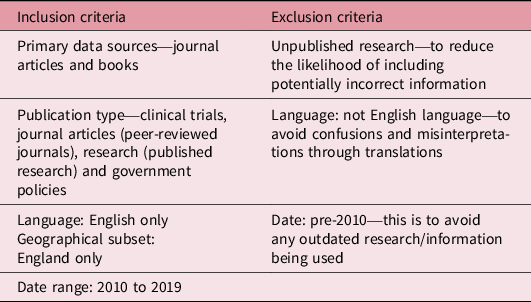
A literature search was conducted using CINAHL and MEDLINE databases, with the use of inclusion and exclusion criteria to help ensure effective filtration of literature (Table 1).
Inclusion and exclusion criteria for literature review

Obesity can be a result of a complex condition, not only related to consuming more calories than are used during a normal metabolism, but can be due to psychological-related condition, chemical imbalance or steroids during treatment.
Redeker et al. Reference Redeker, Wardle, Wilder, Hiom and Miles10 looked at the public’s awareness of cancer risk factors and found that there were high levels of awareness regarding smoking and the development of cancer, but a lack of awareness of alcohol, obesity and old age. It was also found that those who were most in need of making lifestyle changes were less likely to be aware of ways to reduce their risk of developing cancer. Suggesting that people struggle to understand what measures should be taken to reduce the risks of cancer. By improving general knowledge and awareness, it encourages discussions and therefore helping people to live healthier lifestyles.
Furthermore, Koutoukidis et al. Reference Koutoukidis, Lopes, Fisher, Williams, Croker and Beeken11 carried out a qualitative study which looked at the perspective of health professionals in relation to giving advice on weight management to cancer survivors. The results show that many allied health professionals (AHPs) do not feel comfortable talking about obesity during consultations, highlighting that obesity is still considered a taboo topic. The study found that service users felt that they do not receive enough support or advice on healthy lifestyle and weight management; this factor, combined with AHP staff lacking confidence, shows issues with our current healthcare system, which must be address in order for improvements to be implemented.
Similar findings are echoed in Demark-Wahnefried et al.’s Reference Demark-Wahnefried, Peterson, McBride, Lipkus and Clipp6 research study, which looked at a cancer patient’s perspective of receiving public health advice. The findings showed service users would welcome advice on health promotion and lifestyle but felt as though it was not given out enough, suggesting a need for improved communication to ensure that the needs of service users are met. Furthermore, Cancer Research UK 12 has evidence to show that maintaining a healthy lifestyle post-cancer treatment can reduce the chances of recurrence; therefore, this is something that we should emphasise more as it would form a part of the patient’s long-term recovery. However, the current body of research looking at cancer service users and healthy lifestyles is very limited; therefore, further research is required to identify common themes and patterns.
A further study looking at the weight bias revealed that healthcare professionals (HCPs) stereotype obese people with being ‘lazy’, ‘stupid’ and ‘demotivated’. A limitation of the study was that a lot of people did not fully complete the survey, potentially since they did not want their professionalism to be associated with them having negative assumptions. Reference Schwartz, Chambliss, Brownell, Blair and Billington13 The study suggests that HCPs having these stereotypes means that there is potentially a lack of understanding of the difficulties that obese service users may face in relation to maintain a healthy weight.
Methods
A questionnaire was created to assess student therapeutic radiographers’ understanding of obesity and cancer and their role in weight management (Appendix I). As the study involved human subjects, ethical approval was obtained from the Universities Ethical Approval Committee. Factors taken into consideration when creating the questionnaire included the practicality of it, as it enables groups to be targets and managing the question format. Additionally, using an online questionnaire enabled easy distribution via email, aiding with the data collection process—this was an important element as it ensured that the most amount of responses were collected, especially as students were spanned across the United Kingdom. Getting an optimum response rate was essential to ensure a rich data set, allowing for more accurate conclusions to be made by anomalies being identified more easily. 14
The Cancer Awareness Measure (CAM) is a recognised tool used nationally, particularly for studies looking at awareness, and therefore it was used to help form the questionnaire questions. The CAM helped ensure the questions were focused on monitoring awareness levels, as well as identifying information needs. 15 The questionnaire was piloted to minimise any uncertainties around any of the questions. This was achieved through a group of 10 qualified therapeutic radiographers who were asked to complete the questionnaire and highlight any areas for development. No modifications were requested; however, the pilot was used to identify completion time.
All students that were studying on the Radiotherapy and Oncology programme at the time of the study (December 2019–February 2020) were invited to participate. This includes students from year 1, 2 and 3 of the BSc course and year 1 and 2 students on the pre-registration MSc course. All students received a generic email and information sheet inviting them to participate in the study, and this was sent out through the virtual learning platform.
A second email was sent using the same method 4 weeks later to gain the maximum amount of responses. A retrospective sample size calculation was carried out to show that the response rate (n = 57) gave a 90% confidence level, with a 9% margin of error. Responses were analysed, and data were used to form graphs for interpretation.
The two important ethical issues to adhere to when conducting a survey are confidentiality and informed consent. The participants were fully informed about the aims of the survey, and consent to participate in the survey was obtained and recorded. All data were kept anonymised to maintain confidentiality. All participants were informed that they had the right to withdraw from the study at any point, and consent was obtained from each participant.
Participants were also made aware that by completing the questionnaire, they were giving consent for their answers to be used as part of the study. This aspect was explained in the participant consent form. Participants were also ensured that their responses would remain anonymous. This was achieved through avoidance of collecting any personal information about the participant.
Results
Eighty-eight per cent of responses (n = 50) were from BSc students and 12% (n = 7) from MSc students. Their placement locations spanned across the United Kingdom.
Some of the data were separated into BSc and MSc responses to help identify whether the degree classification was a contributing factor to level of confidence or understanding.
Guidance and Training
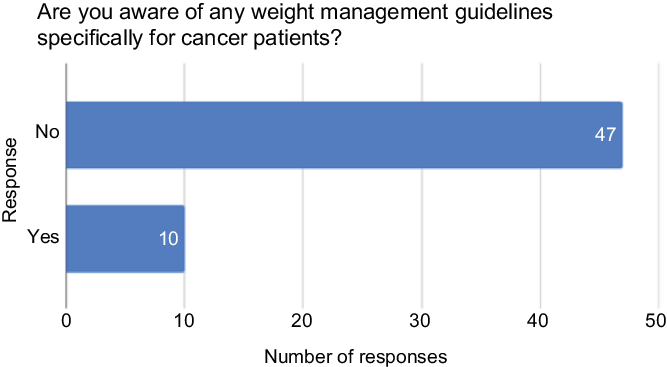
Awareness of guidelines was suboptimal, with 82% (n = 47) of respondents unaware of any guidelines (Figure 1). Only 10 students said ‘yes’ to being aware of guidelines; however, no specific guidelines were named, but participants did make references to maintaining weight and going to the dietitian to prevent weight loss. This is an important factor when delivering radiotherapy as contour changes can add complications to the treatment plan. This suggests that although some students were aware of weight management guidelines from a radiotherapy treatment perspective, they were unaware of broader public health-related guidelines. The lack of guidelines, that can used to equip students and staff with the correct knowledge and therefore help them structure healthy weight conversations accordingly, contributes to the lack of knowledge amongst students and therefore could also be a contributing factor to explaining why students may be unlikely to discuss weight management with service users.
Awarenss of weight management guidelines.

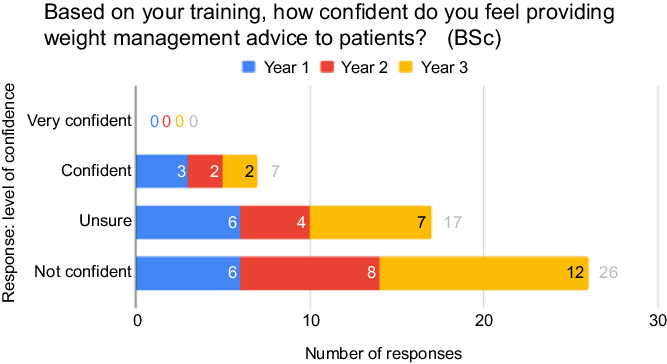
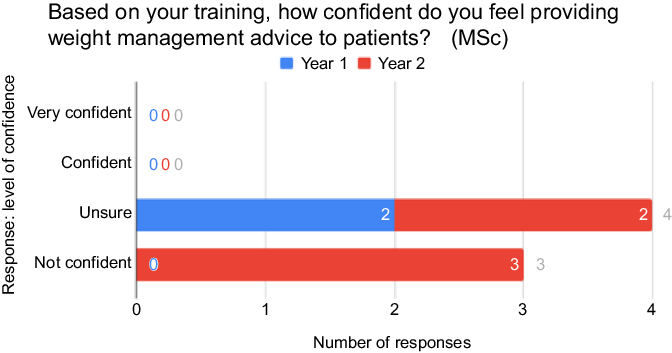
Similar findings have been found in other studies; Mclean et al.’s Reference Mclean, Charlesworth, May and Pollard16 study looked at brief public health interventions and advice (BPHIA) used amongst healthcare students. Although this research does not solely look at weight management, it suggests that the issues exist beyond weight management alone, as students feel that they should be delivering BPHIA but a lack of guidance prevents them from doing so. The study concluded that more teaching on public health topics is required. Figures 2 and 3 show student’s confidence levels, showing that most students lack confidence when providing weight management advice. The two figures were separated into BSc and MSc responses to identify whether the degree level was a contributing factor to their understanding. However, the data highlight that irrespective of the year group or degree level, the level of confidence did not vary. This implies that this might not be an issue just with confidence. Usually, we see that students’ general confidence increases across the course as a result of time spent in a clinical environment, resulting in continuous growth and experience, and MSc students are often more confident at the start of the programme anyway. This could be down to the lack of guidelines, making it difficult for students to feel comfortable when discussing weight. However, this could also suggest that there is a need for further improvements within the education and training.
‘No training was provided for students regarding weight management and cancer, hence I have no confidence in mentioning this topic to service users’
BSc students’ confidence levels on providing weight management advice.

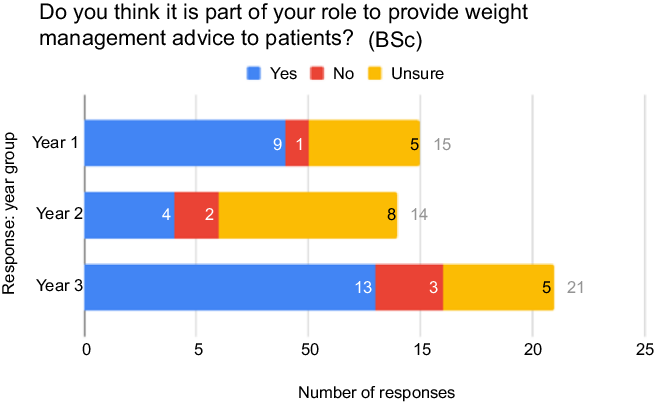
BSc students’ perspective on whether they have a role within weight management.

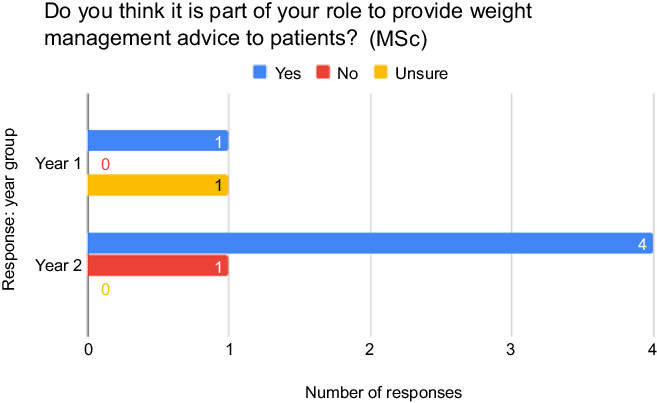
Figures 4 and 5 look at whether students believe they have a role in weight management and the study shows that despite the lack of confidence amongst the students, 54% agreed that providing weight management advice should be a part of a therapeutic radiographers’ role, 22% were unsure, with only 12% disagreeing with weight management advice being a part of their role. Additionally, those who did not agree with weight management being a part of a therapeutic radiographer’s role would be less likely to give advice overall. This barrier could be counteracted by educating professionals to make them more aware of the research that shows service users want more access to lifestyle advice.
MSc students’ confidence levels on providing weight management advice.

MSc students’ perspective on whether they have a role within weight management.

The findings show that students in this population lack confidence when giving weight management advice, but this is not solely due to lack of training and guidelines. There is an element of uncertainty as weight management advice is not routinely given to service users; therefore, students are unable to gain experience, leading to lower levels of confidence or competence. However, students do believe that the role of a therapeutic radiographer should encompass weight management discussions, but the current low levels of confidence means that they are less likely to give advice once qualified because they would be more inclined to stay within their comfort zone and aspects, such as weight management, are forgotten about throughout the pathway. By ensuring better guidelines are in place and that they are relevant to students, it can help improve their confidence and the likelihood of them delivering healthy weight conversations with service users.
Education
The ‘Public Health content within Pre-Registration Curricular for Allied Health Professions’ provides guidance to Higher Education Institutions (HEIs) to review and develop their course content to ensure that AHP students can develop their public health knowledge and understanding. 9 Therefore, this shows that HEIs are being encouraged to encompass public health within their teaching. The guidance also mentions how learners should be encouraged to demonstrate leadership and act as change agents to influence learning in practice within the current workforce; therefore, this suggests that there is also a need for behavioural changes amongst students, as well as staff members, to work towards implementing this change.
Barriers to giving service users advice was also explored in the study, and the most mentioned barrier was a ‘lack of confidence’, mentioned by 64·9% (n = 37) of respondents. Lack of confidence is a common theme that is highlighted throughout the data and therefore is a factor that must be addressed. And 63·2% (n = 36) of respondents also identified a ‘lack of time’ as a barrier. These findings are comparable with Williams et al. Reference Williams, Wood, Collins and Callister5 who found that HCPs identified a lack of times as a barrier to providing lifestyle advice. Perhaps this suggest that there is a need to have more specialist workers within departments who will be able to dedicate more time to provide advice to service users. Furthermore, despite Williams et al.’s study looking at qualified professionals, it still showed that there was a lack of confidence amongst these professionals when giving lifestyle advice, suggesting that there is a missing element within the training aspect for both students and fully qualified members of staff. Other barriers that were identified in this study were lack of clear guidelines (57·9%) and not being the right person to give advice (52·6%).
‘Feel like dieticians may be the best AHP to discuss weight management’
The obesity ‘healthy needs assessment’ states that the role of a multidisciplinary team can help service users make both cognitive and behavioural changes by combining a range of interventions to ensure effectiveness. 17 Therefore, by potentially having therapeutic radiographers, working alongside dieticians to have healthy weight conversations can help achieve the common goal of providing the best healthcare possible. Healthy weight questions could also be included in holistic needs assessments to better identify which service users would most benefit from more in-depth advice to better guide them. However, it must be considered that some centres might refer service users to additional support services, such as Macmillan for holistic needs assessments; therefore, a multidisciplinary approach would be required to ensure that all services work well together to ensure the needs of service users are met. Therapeutic radiographers often build good rapport with service users as they tend to see them daily, potentially making it easier for them to have open discussions with service users about topics that may be considered sensitive, such as weight. Whilst ‘healthy conversations’ might be the role of all radiographers, the role of advanced practice radiographers could be significant in weight management. These roles can be included in the end of treatment review of radiographers, who might be well placed to support service users with such complex discussions due to the advanced skill set demonstrated within these roles.
Students also commented on qualified staff members often not giving weight management advice, potentially contributing to the reason why students lack confidence, and also suggesting that staff themselves also need training in weight management so that they are better prepared to have these conversations. It was interesting to see that this student commented on their perception of the staffs’ confidence as this provides an insight into the lack of weight management conversations being carried out by therapeutic radiographers as a whole.
Continual Professional Development (CPD)
To overcome such barriers, a focus on public health continual professional development CPD work could be required. Despite the health and care professions council (HCPC) standards of proficiency mentioning the importance of understanding the need for promotion of health in relation to healthy living, the guidelines to support this being implemented in practice are not in place. Interestingly, the Royal College of Nursing has a bigger emphasis on public health CPD, therefore, better equipping the nursing profession with the skills required to openly have public health conversations. 18 However, other AHPs should have better Public Health CPD opportunities, so that the likelihood of all service users receiving potentially life-changing information can increase. By encouraging CPD work amongst therapeutic radiographers, it can help improve knowledge and confidence.
The current literature focused on CPD amongst HCPs, in relation to public health, is very limited. However, Bennetts et al. Reference Bennetts, Elliston and Maconachie19 looked at the CPD for the multi-professional public health workforce within the United Kingdom and found that if an anagogical approach is adopted for public health CPD, it will help to better equip practitioners; therefore, perhaps this is the approach that our current healthcare system should be looking into.
‘I haven’t seen any radiographers giving advice on weight management or talk about obesity with a patient. I feel that radiographers don’t feel confident talking about these issues. Probably need some extra training or clear guidelines how to go about the obesity issue’
The findings of this study correlate with Koutoukidis et al.’s Reference Koutoukidis, Lopes, Fisher, Williams, Croker and Beeken11 qualitative study which found that AHPs lack confidence when talking about obesity. Obesity is still considered to be a taboo topic, potentially explaining why many AHPs do not actively involve themselves in healthy weight conversations and therefore they prevent themselves from building their experience and confidence. McLean et al. Reference Mclean, Charlesworth, May and Pollard16 carried out a study which looked into building confidence and competence in the future AHP workforce and the study reported that there was a clear gap in knowledge surrounding BPHIA. The study’s findings showed that in addition to the delivery of public health content in an academic setting, students want more focused teaching on how to deliver BPHIA. McLean et al.’s study also identifies the lack of confidence amongst students to be related to limited opportunities to practice and deliver BPHIA, and these findings are echoed in the findings of this study. HEIs and clinical placement sites also play a role within education provision. The Council of Deans has provided a consensus which recommends that prevention and public health to be threaded throughout curricula rather than a stand-alone module. 20 In addition to the pre-registration curricula, post-registration curricula could also address some issues around confidence and knowledge related to public health. Opportunities to include public health education, with post-registration masters level programmes and advanced practice programmes, could further equip the current workforce with the knowledge and confidence to support these discussions, linking to the role of advanced practice radiographers working towards providing holistic care by supporting individuals with their specific needs.
Students were also asked when they believe the best time would be to encourage obese radiotherapy service users to lose weight and 47% (n = 27) believe that it should be done a month before treatment. However, the weight loss process should be considered a lifestyle change, as the aim of weight management is to promote a healthy way of living in the long term, especially because cancer service users are now living longer and obesity is identified as a factor that can increase the chances of reoccurrence. 12 Weight loss and management is an ongoing process; therefore, this would make it difficult for service users if they were to start their weight loss journey before their radiotherapy treatment. This is because, ideally for reproducible daily radiotherapy treatment, the same weight should be maintained throughout. However, radiotherapy advances, such as the use of ‘plan of the day’, can enable contour changes to be considered. Plan of the day is already used in practice, particularly for gynaecological and urology tumours; therefore, there is potential for the same technique to be adapted to account for any weight loss that service users might experience. 21
Also, we need to ensure that service users are receiving the right nutrients to maintain their health during treatment. 22 Therefore, using common diets to help encourage weight management before and during treatment would perhaps not be appropriate, unless more research goes into creating appropriate diet plans for cancer service users undergoing radiotherapy to help service users management weight and maintain nutrition. This also highlights the importance of HCPs working together to utilise their expertise, so that the patient receives the best support.
Limitations
One limitation of this study is that the sample population are only representative of one UK higher education institution and the findings may therefore not be representative of all Radiotherapy and Oncology students within the United Kingdom. Additionally, only student therapeutic radiographers’ perspective was explored, and the perspective of qualified therapeutic radiographers and advanced practitioners would vary. However, the findings do provide a small contribution to a relatively unexplored, but important area of practice. Additionally, the margin of error was broader than expected due to the limited time available for the completion of this study, and this is shown by the retrospective sample size calculation. Furthermore, limited responses were received in response to the open questions, limiting the conclusions that can be drawn. A continuation of this project to explore through more in-depth methods such as focus groups or one-to-one interviews may add further knowledge to this topic area.
Conclusion
This study provides a contribution to the literature on a topic where the evidence base is limited., It is important to focus on student therapeutic radiographers understanding of weight management as this study population represent the future workforce and are able to provide in-depth understanding of what public health-related skills are being developed with the current course structures.
The findings suggest that there is a behaviour change that is required, amongst both students and staff members, so that HCPs are more inclined to have healthy weight management discussions. Perhaps more specialist roles need to be developed, so that healthy weight management discussions can become a norm.
The study highlighted three of the most common barriers: a lack of time, lack of clear guidelines and lack of confidence. These barriers could potentially be addressed by improving education and training, making it easier for therapeutic radiographers to openly discuss weight management with service users. The findings of this study are supported by other research studies that have been carried out and mentioned throughout; however, this body of evidence is still relatively small and therefore additional research may be required to understand these findings in a greater depth.
Acknowledgements
The authors thank all participants that completed the questionnaire and Dr Rebecca Beeken for the help and support with the questionnaire design.
Financial Support
This research received no specific grant from any funding agency, commercial or not-for-profit sectors.
Conflicts of Interest
None.
Appendix I Questionnaire
Questionnaire has been designed to be completed by therapeutic radiotherapy students to see what their understanding of obesity is like. It will also explore the students’ perceptions on providing weight management advice. The Cancer Awareness Measure has been used to help form some questions in this questionnaire.
What course are you studying?……………………
What year of study are you in? …………………….
How much do you agree that each of these can increase a person’s chance of developing cancer?

Are you aware of any weight management guidelines specifically for cancer service users?
Yes
No
(If answered yes to previous Q) Please list all the guidelines and information that you are aware of.
……………………………………
……………………………………
Do you think it is part of your role to provide weight management advice to service users?
Yes
No
Unsure
Based on the training you have had, how confident do you feel on providing weight management advice to service users?
Very confident
Confident
Unsure
Not confident
If you had a patient with obesity undergoing radiotherapy treatment, when do you think the optimal timing would be to mention weight loss?
A month before treatment
During radiotherapy treatment
As soon as radiotherapy treatment is completed
A month after completion
Which of the following methods would you feel most comfortable in giving weight management information to service users?
Face to face
Leaflet or booklet
Website
Other (please state) …………………………
Are any of the following barriers to giving your service users advice? Please select all that apply.
Lack of time
Lack of patient interest
Not being the right person to give advice
Service users too frail or unwell
Seeming to blame the patient
Lack of clear guidelines
Cultural differences or beliefs
Not confidence it would affect cancer outcomes
Thinking the advice would not change behaviour
None of the above
Other (please state)…………………………….
Please add any further comments that are relevant to this survey
Appendix II Participation Information
You are being invited to participate in a research study titled ‘Obesity and cancer: Student therapeutic radiographers’ role in weight management’. This is a dissertation study and is being done by Manmeet Kaur from the Department of Health and Wellbeing at Sheffield Hallam University and project is being supervised by Laura Charlesworth.
The study aims to look at the understanding of student therapeutic radiographers (TRs) on obesity and cancer links. The survey aims gather data about whether student TR believe they have a role within promoting weight management. All responses will remain anonymous and data will be analysed.
The survey should take around 5 minutes to complete.
Further details, including information about data protection, are included in the participant information sheet that has been attached to this email—please look through this before completing the survey.
If you are interested in taking part, please read the participant information sheet and keep a copy before starting the survey. If you have any questions, please email me at b7003343@my.shu.ac.uk.
Your participation is entirely voluntary, and you can withdraw at any time.
Thank you!
By clicking the ‘submit’ button, you are consenting to participate in this study (as described in the participant consent form below). You are also acknowledging that the results might be published in a journal, professional publication or conference.