INTRODUCTION
An appropriate decision-making process between patients and physicians is an essential component of all medical practice. However, although the patient's decision-making capacity (competency) should be guaranteed in the informed consent process, (Appelbaum, Reference Appelbaum2007) this ability may not be evaluated in routine practice, and overestimating patients' capacity is considered to be a problem. (Lepping, Reference Lepping2011)
Cancer patients often face several important decision-making issues; for example, the choice of treatments, such as surgery, chemotherapy, radiotherapy, and palliative therapy, which may influence both their survival and quality of life. Some previous studies have reported that many cancer patients are asked to make difficult decisions under distressing circumstances. (Clark, Wray, & Ashton, Reference Clark, Wray and Ashton2001; Knowles, Liberto, Baker, Ruskin, & Raskin, Reference Knowles, Liberto and Baker1994; Tamburini, Buccheri, Brunelli, & Ferrigno, Reference Tamburini, Buccheri and Brunelli2000) In addition, many studies have shown that cancer has a serious psychiatric impact on patients that renders them incapable of making a medical decision. For example, previous studies indicated that more than half of the cancer patients suffer from psychiatric disorders, the most common being adjustment disorders, major depression, and delirium. (Derogatis et al., Reference Derogatis, Morrow and Fetting1983) (Lawlor et al., Reference Lawlor, Gagnon and Mancini2000; Minagawa, Uchitomi, Yamawaki, & Ishitani, Reference Minagawa, Uchitomi and Yamawaki1996)
Although competency is a legal concept and can only be determined by a judge, psychiatrists are often asked to assess patients' competency in oncology practice. (Akechi et al., Reference Akechi, Nakano and Akizuki2003) Based on this background, we began using the Structured Interview for Competency and Incompetency Assessment Testing and Ranking Inventory (SICIATRI) (Tomoda et al., Reference Tomoda, Yasumiya and Sumiyama1997), a structured interview that assesses patients' competency, in our psychiatric consultation. Since we have learned some important lessons from our clinical activities, we are reporting our experiences of the usefulness of the SICIATRI for assessing the competency of Japanese cancer patients.
MATERIALS AND METHODS
Structured Interview for Competency and Incompetency Assessment Testing and Ranking Inventory (SICIATRI)
The SICIATRI was originally developed in Japan to measure patients' competency to obtain informed consent. (Tomoda et al., Reference Tomoda, Yasumiya and Sumiyama1997) It mainly focuses on psychiatric patients; however, its validity and reliability for physically ill Japanese patients have also been confirmed. (Tomoda et al., Reference Tomoda, Yasumiya and Sumiyama1997)
The SICIATRI consists of several items: (1) Understands that he/she has a right to decide; (2) Evidences his/her choice; (3) Does not waive responsibility; (4) Understands the expected benefits; (5) Understands the expected risks; (6) Understands the alternative treatments; (7) Understands the risks expected from no treatment; (8) Understands the benefits expected from no treatment; (9) Wants to get better; (10) Psychological determinants do not exist; and (11) Insight. Each part is scored according to the patient's responses, and the patient is finally rated as one of five different levels of competency (Levels 0–4). Level 0 is considered to be the most impaired status of a patient's competency, whereas Level 4 suggests that the patient is fully competent. The interview form and administration methods of the SICIATRI can be downloaded (http://www.institute-of-mental-health.jp/right.html). After the necessary training sessions, medical staff other than psychiatrists can also conduct the interview.
Because our experience demonstrated that a non-negligible number of referred cancer patients should have been evaluated for their competency (Akechi et al., Reference Akechi, Nakano and Akizuki2003), we began using the SICIATRI in April 2011 in our routine psychiatric consultation when assessment of patients' competency should be needed.
To examine the usefulness of the SICIATRI, we reviewed all psychiatric consultations referred to the Department of Psychiatry and Division of Palliative Care and Psycho-oncology at Nagoya City University Hospital from April 2011 to March 2012. A computerized database was used to identify the cancer patients referred to these divisions. Finally, we identified the referred cancer patients who were administered the SICIATRI, and the relevant data including the detailed reason for consultation and the outcomes of the SICIATRI and neuropsychological tests (if available) were extracted from patients' records. After obtaining these data, the potential problems of administering the SICIATRI to Japanese cancer patients and proposals for its modification were discussed among the trained psycho-oncologists (T.A., T.O., M.U.).
This study was approved by the Institutional Review Board and Ethics Committee of Nagoya City University Graduate School of Medical Sciences, Japan. Since this was a retrospective study using a data set obtained during routine clinical practice, written consent from the patients was not obtained. However, we disclosed information about this study via the hospital web site and stated that patients could refuse to participate in the study, according to the ethical guidelines for epidemiological studies clinical studies developed by the Japanese Ministry of Health, Labour and Welfare (http://www.mhlw.go.jp/general/seido/kousei/i-kenkyu/ekigaku/0504sisin.html).
Several items of personal information have been modified in the following cases to preserve the patients' anonymity.
RESULTS
Patient Demographic and Medical Characteristics
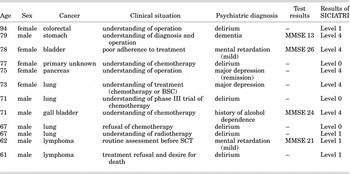
Among the 433 cancer patients referred during the study period, 12 (2.8%) were administered the SICIATRI in several clinical settings and all of the administration were conducted without big problems. Patient characteristics are shown in Table 1. All patients were 60 years or older, and their mean age was 73 (SD = 9).
Characteristics of 12 cases receiving competency assessment interview

MMSE: mini-mental state examination, BSC: best supportive care, SCT: stem cell transplantation
Purpose of Competency Evaluation and Psychiatric Diagnosis
The most common purpose was to check patients' understanding of the anti-cancer treatment proposed by oncologists (67%), followed by their refusal to undergo the recommended treatment (25%).
Regarding psychiatric diagnosis, six (50%) of the 12 patients were diagnosed with delirium. Two patients (17%) were diagnosed with major depression and another two (17%) were mental retardation. Four patients were administered the Mini-Mental State Examination (MMSE; a score of 23 or less suggests existence of cognitive impairment) to check their cognitive function, and their scores were variable, as shown in Table 1.
Outcome of Competency Evaluation
Regarding levels of competency, three patients (25%) were judged as Level 0 (the most impaired status of a patient's competency), four (33%) as Level 1, and five (42%) as Level 4 (fully competent). Among the six patients diagnosed with delirium, three were judged as Level 0 and three as Level 1. Among the two patients with mild mental retardation, one was judged as Level 1 and one as Level 4. Among the two patients diagnosed with major depression (one in a current episode and the other in remission), both were judged as Level 4 (fully competent). Interestingly, a patient diagnosed with moderate dementia and cognitive impairment (MMSE 13) was judged as Level 4 (fully competent).
Potential Issues Concerning Administration of SICIATRI to Japanese Cancer Patients
Most patients could be easily administered the SICIATRI in actual clinical settings. However, because our discussions yielded some ideas with regard to 5 modifications of the SICIATRI when administered to Japanese cancer patients, we would like to recommend these modifications to the original SICIATRI based on our experiences: (1) Because the item, “Understands that he/she has a right to decide,” is self-evident for most cancer patients, it can often be omitted. (2) The item, “Does not waive responsibility” (“Do you think that someone else should decide to accept or refuse the treatment [admission, or other procedures against which competency is to be measured] for you?”; “Because you cannot decide for yourself, do you want your doctor or family members to decide for you?”), should often be considered from the Japanese cultural perspective. It has been reported that elderly Japanese people do not always weigh individual autonomy or right during decision making. Our previous study suggested that elderly patients are likely to value the traditional paternalistic attitude of physicians, and not all patients want to be actively involved in decision-making and prefer the physicians' paternalistic approach. (Akechi et al., Reference Akechi, Miyashita and Morita2012) Thus, because a patient's waiver does not necessarily imply his/her incompetence in Japanese culture, we should carefully consider it when a patient waives responsibility. (3) Since, in actual clinical practice, physicians sometimes omit explanations of alternative treatments and the benefits expected from no treatment, whether patients were informed of these items by physicians often needs to be checked directly. (4) The item, “Wants to get better,” is not understood by many incurable cancer patients. Paraphrases, such as “Wants symptoms to be alleviated,” are sometimes useful. (5) Lastly, regarding the item, “Insight,” although the manual says “The patient should be assessed as ‘complete insight,’ if he/she can recall the diagnosis they were told and explain what it was,” some names of cancer diagnoses are difficult for them to recall completely (e.g., malignant fibrous histiocytoma and acute promyelocytic leukemia). Since this item essentially tests a patient's recognition of the life-threatening nature of cancer and not the name of the diagnosis, when a patient can state that his/her disease is “cancer” or describe its life-threatening nature, the item is rated as “3” (moderate insight) and not “2” (between no insight and moderate insight).
DISCUSSION
To the best of our knowledge, this is the first report about the clinical utility of a competency assessment tool for cancer patients in Japan. Our experience suggests that the SICIATRI is a useful tool for various clinical situations that require evaluation of a cancer patient's competency. Especially, since a patient's competency cannot be judged from a psychiatric diagnosis or psychological test battery (e.g., MMSE), (Akechi et al., Reference Akechi, Nakano and Akizuki2003; Sessums, Zembrzuska, & Jackson, Reference Sessums, Zembrzuska and Jackson2011) specific instruments that focus on decision-making capacity, such as the SICIATRI, are essential for evaluating patients' capacity.
Despite the potential usefulness of the SICIATRI, we have proposed 5 modifications for its use with Japanese cancer patients based on our experience, which are summarized in the result section. Kitamura et al. have compared the components of the SICIATRI to those of the MacArthur Competence Assessment Tool for Clinical Research (MacCAT-T) that is often used for evaluation of patients' capacity in Western countries and suggest that some components of the SICIATRI including “Understands that he/she has a right to decide”, “Does not waive responsibility”, and “Wants to get better” are not involved in the MacCAT-T although other components are almost same in these two instruments.(Kitamura & Kitamura, Reference Kitamura and Kitamura2012) They suggest that these differences are partly caused by culture, especially with regard to individual autonomy. When taken with our findings, our one proposed modification (“Understands that he/she has a right to decide” can be often omitted because this is self-evident for most cancer patients) may reflect the westernization of the Japanese culture while one other proposal (a patient's waiver does not necessarily imply his/her incompetence) can be associated with traditional Japanese culture. Especially from a cross-cultural perspective a paternalistic approach between a patient and physician is still acceptable and even preferred by many Japanese elderly patients, (Akechi et al., Reference Akechi, Miyashita and Morita2012; Ruhnke et al., Reference Ruhnke, Wilson and Akamatsu2000) we should carefully consider a patient's passive decision-making style and not consider his/her waiving responsibility as a lack of competence. This is consistent with our previous findings obtained from the study investigating concepts relevant to a good death among elderly cancer patients. (Akechi et al., Reference Akechi, Miyashita and Morita2012) To be more precise, our study has suggested that some elderly patients value the traditional paternalistic attitude of physician, “omakase (leaving the decisions to a medical expert)”, and that not all patients want to be actively involved in decision-making. Thus, our proposed modification of the SICIATRI may reflect rapid, but partial change of recent Japanese culture.
The present findings are very limited because our case series is seriously flawed by many methodological weaknesses including many types of bias resulting from systematic and random errors. However, our experience indicates that the SICIATRI is a promising instrument that should be evaluated in further well-designed clinical investigations in Japanese clinical oncology settings. We are now conducting a study to investigate the prevalence of incompetency and its associated factors using the SICIATRI.
Acknowledgements
This study was supported in part by a Grant-in-Aid for Scientific Research from the Japanese Ministry of Education, Culture, Sports, Science and Technology and a Grant-in-Aid for Cancer Research from the Japanese Ministry of Health, Labour and Welfare.