Introduction
In dry ecosystems, seeds and seedlings have the highest mortality rates and are therefore considered the most vulnerable stages of the plant's life cycle (Steenbergh and Lowe, Reference Steenbergh and Lowe1969; Godínez-Álvarez et al., Reference Godínez-Álvarez, Valverde and Ortegas-Baes2003; Godínez-Álvarez and Valiente-Banuet, Reference Godínez-Álvarez and Valiente-Banuet2004). Increasing survival at these early stages is crucial, so there are several ‘strategies’ that can increase offspring survival. For example, species with seed dormancy (in particular physical or physiological dormancy) that can remain in soil seed banks can survive despite temporarily unstable rainfall patterns in arid and semi-arid ecosystems (Whitford, Reference Whitford2002) and thus germinate in time and under conditions suitable for seedling establishment (Mandujano et al., Reference Mandujano, Golubov and Montaña1997; Duncan et al., Reference Duncan, Schultz, Good, Lewandrowski and Cook2019). However, the main problem with the formation of soil seed banks is high seed predation (Valiente-Banuet and Ezcurra, Reference Valiente-Banuet and Ezcurra1991; Guo et al., Reference Guo, Rundel and Goodall1999; Godínez-Álvarez and Valiente-Banuet, Reference Godínez-Álvarez and Valiente-Banuet2004) that may increase with the time remaining in the soil (Bowers, Reference Bowers2000; Méndez et al., Reference Méndez, Durán, Olmsted and Oyama2004).
An alternative to soil seed banks is serotiny, which is an aerial seed bank (Lamont and Enright, Reference Lamont and Enright2000), and which has the additional advantage of protecting seeds in structures less accessible to soil-dwelling animals or that may reduce the attack of predators (Rodríguez-Ortega et al., Reference Rodríguez-Ortega, Franco and Mandujano2006; Lamont et al., Reference Lamont, Hanley, Groom and He2016; Lamont et al., Reference Lamont and Enright2020). Serotiny is considered a delayed dispersal mechanism due to the retention of mature seeds in mother plant structures for more than 1 year (Lamont, Reference Lamont1991; Peters et al., Reference Peters, Martorell and Ezcurra2009; Lamont et al., Reference Lamont and Enright2020). This characteristic has been observed in approximately 1345 species of different fire-prone ecosystems from different continents (Lamont et al., Reference Lamont, Pausas, He, Witkowski and Hanley2020), including dry, Mediterranean and temperate ecosystems. As such, serotiny appears to be a trait with different origins which enables the successful survival of plant populations that possess it. Serotiny in a broad sense is recognized as a bet-hedging mechanism. It enables the extension of dispersal time, protects against fire, drought and heat and, may serve to conceal the fruits from some species of granivores (Lamont et al., Reference Lamont, Pausas, He, Witkowski and Hanley2020), and reduces seedling competition during establishment (Martínez-Berdeja, Reference Martínez-Berdeja2014) by regulating the amount of seeds dispersed as a result of the amount and frequency of rainfall (Ellner and Shmida, Reference Ellner and Shmida1981; Martínez-Berdeja et al., Reference Martínez-Berdeja, Ezcurra and Sanders2015).
Despite serotiny mostly occurring in fire-prone ecosystems (Lamont et al., Reference Lamont, Pausas, He, Witkowski and Hanley2020), it is also found in Cactaceae species inhabiting North American deserts such as the Mojave and Sonora (Martínez-Berdeja et al., Reference Martínez-Berdeja, Ezcurra and Sanders2015). Approximately 24 cactus species with mature seed retention have been reported so far (Barrios et al., Reference Barrios, Sánchez, Flores and Jurado2020), although according to Peters et al. (Reference Peters, Martorell and Ezcurra2009), the work of Bravo-Hollis and Sánchez-Mejorada (Reference Bravo-Hollis and Sánchez-Mejorada1991) notes 25 species where some degree of seed retention is shown. Seed retention in cacti has been observed in tubercles axils in several Mammillaria species (Rodríguez-Ortega and Franco, Reference Rodríguez-Ortega and Franco2001; Rodríguez-Ortega et al., Reference Rodríguez-Ortega, Franco and Mandujano2006; Peters et al., Reference Peters, Martorell and Ezcurra2009), in chained fruits in Cylindropuntia (Martínez-Berdeja et al., Reference Martínez-Berdeja, Ezcurra and Sanders2015), in the apex of stems, dry fruits and cephalia of several genera including Echinocactus (Chamberland, Reference Chamberland1997), Melocactus (Bravo-Hollis and Sánchez-Mejorada, Reference Bravo-Hollis and Sánchez-Mejorada1991), Geohintonia, Pelecyphora, Ariocarpus (Anderson et al., Reference Anderson, Arias-Montes and Taylor1994) and Sclerocactus (Earle, Reference Earle1980). However, to our knowledge there is little prior work on the role of seed retention in population dynamics of the cactus species where it has been observed (Barrios et al., Reference Barrios, Sánchez, Flores and Jurado2020). So far, the only studies in cacti addressing various aspects of serotiny ecology (e.g. impact on population dynamics, percentage of retained fruits, fruit expulsion, germination, photoblastism and viability of retained seeds) have focused on four Mammillaria species (M. solisioides, M. napina, M. hernandezii and M. pectinifera) (Rodríguez-Ortega et al., Reference Rodríguez-Ortega, Franco and Mandujano2006; Valverde and Zavala-Hurtado, Reference Valverde and Zavala-Hurtado2006; Peters et al., Reference Peters, Martorell and Ezcurra2009, Reference Peters, Martorell and Ezcurra2011; Santini and Martorell, Reference Santini and Martorell2013). In these studies, it was observed that seed retention is not complete and can vary between 0 and 80% and retained seeds exhibit dormancy and positive photoblastism, and that they are able to survive for periods of up to 8 years. In addition, the release of a portion of seeds only occurs after the death of the mother plant (Rodríguez-Ortega et al., Reference Rodríguez-Ortega, Franco and Mandujano2006). Prior studies also note that seed retention may have a small influence on population growth rate; however, longer-term studies may reveal a specific role for seed retention in population dynamics (Valverde and Zavala-Hurtado, Reference Valverde and Zavala-Hurtado2006; Peters et al., Reference Peters, Martorell and Ezcurra2011).
In the Melocactus genus, several species have been observed with seed retention in the cephalium. Fruit retention in this genus has been reported in M. curvispinus in populations from Veracruz, Mexico (Bravo-Hollis and Sánchez-Mejorada, Reference Bravo-Hollis and Sánchez-Mejorada1991) and in M. ernestii in Brazil (Romão et al., Reference Romão, Hughes, Vieira and Fontes2007). In Cuba, there are 11 Melocactus species (Majure et al., unpublished) that inhabit scrubland coastal terraces (four species), inland thorny xeromorphic thicket on serpentine, conglomerate or volcanic rock (six species), and exposed limestone rocky cliff (one species). Seedlings have been observed growing on cephalia of M. holguinensis (Leyva and Riverón-Giró, Reference Leyva and Riverón-Giró2011), M. curvispinus and M. nagyi (García-González et al., Reference García-González, Riverón-Giró, González-Ramírez, Escalona Domenech, Hernández and Palacio2016), and M. matanzanus (Barrios, pers. obs.), which implies that seed retention in the cephalium occurs. Retained seeds have also been observed in M. evae, M. harlowii, M. acunae and M. radoczii, which are species distributed in southeastern Cuba (Barrios, pers. obs.). This evidence indicates that seed retention in the cephalium of Melocactus might be a widespread phenomenon in the genus, although its ecological value is unknown.
The Melocactus cephalium is a structure with densely packed spines and trichomes present at the top of adult individuals. It is a non-photosynthetic stem with thin epidermis that lacks stomata which have reproductive function (Mauseth, Reference Mauseth1989). The cephalium protects sexual structures (e.g. buds, flowers and fruits) and contributes to attracting pollinators (Taylor, Reference Taylor1991). Although other functions have not been mentioned in the cephalium of the Melocactus, the report of seed retention might lead to the discovery of new ecological functions.
The goals of our work were to investigate (1) if there are seeds hidden in the cephalium of Melocactus matanzanus and (2) if there are, determine whether or not these seeds maintain their viability. We expect to find high numbers of seeds of different ages in the cephalium of M. matanzanus, and in correspondence with previous studies in Mammillaria, we expect to find a high percentage of viable seeds with positive photoblastism, which is essential to prevent seeds from germinating in the cephalium. We also discuss possible advantages of seed retention in the cephalium and the potential of this structure as a dispersal unit (diaspore) after the death of individuals.
Materials and methods
Study area
Tres Ceibas de Clavellinas is located 6 km to the northwest of Matanzas city (23°05′N, 81° 38′W) and has an area of 40,600 ha. The landscape is formed by low hills (<200 m) over a setting of Mesozoic metamorphosed serpentinites, present in the nucleus of an anticlinal with highly eroded Cretaceous carbonate. Soils are predominantly brown-reddish, ferromagnesian and fersialitic over ultrabasic saturated rock, and the ground texture is generally clay and rocky (Robledo, Reference Robledo1999). The climate is seasonal with 5–6 months of drought and annual precipitation of 1400 and 1800 mm; medium temperature is of 24°C (Borhidi, Reference Borhidi1996). Three plant communities are present in the area: thorny xeromorphic serpentine thicket in which the individuals of M. matanzanus inhabit, thorny xeromorphic serpentine thicket with Pinus caribaea and gallery forest. The flora of Tres Ceibas de Clavellinas comprised about 150 species, 36 of them are endemic to Cuba (Robledo, Reference Robledo1999).
The species
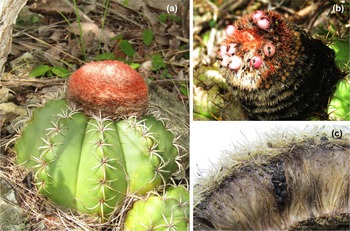
M. matanzanus León is a globose cactus considered Critically Endangered (González-Torres et al., Reference González-Torres, Palmarola, González-Oliva, Bécquer, Testé and Barrios2016) with a height of 7–9 cm and a diameter of 8–12 cm. The species has 6–8 visible areoles per rib with 1–1.5 cm long yellowish-white spines, of which the radial ones number from 7 to 8, and a central spine. The adults develop one cephalium per individual. The cephalia are usually 2–5 cm tall and 4–6 cm wide, and are densely covered with reddish-coloured spines protruding from a mass of white wool-like trichomes (Fig. 1a). In older cephalia, the lower layers turn greyish brown. Sometimes during the rainy period (May–October), seedlings may grow on older cephalia (Fig. 1b). The flowers are 1.5–1.7 cm long, embedded in the cephalium, and the pale pink claviform fruits are 1–1.5 cm long and 0.7 cm in diameter (León, Reference León1934), usually protruding up to 0.5 cm from the cephalium (Fig. 1b). The flowering season extends from February to July, and the fruiting season from April to August (Barrios, pers. obs.).
M. matanzanus: (a) young adult individual with cephalium; (b) old adult individual with 9 fruits and almost 30 seedlings growing on the cephalium and (c) part of a slice of the cephalium showing 8 seeds retained from one fruit.

Although individuals of M. matanzanus can die at any time of the year, the highest number of dead individuals has been observed from May to October, probably associated with fungal attacks during the rainy season. At this time, dead adult individuals generally have the cephalium attached to the dry body. The tissues of the photosynthetic stem, except for the spines, generally rot with the summer rain and decay quickly in about 2–3 months, while the cephalium lasts without losing its integrity up to at least a year (Barrios, pers. obs.). The report of a new colony of M. matanzanus of 410 adult individuals in Tres Ceibas de Clavellinas counted 80 dead individuals (19.5%) (Mesa-Medina, unpublished).
Collection, measurement and counting of seeds
In February 2018, six cephalia of M. matanzanus were collected and kept for 2 months in paper bags in a cool place until the beginning of the experiments. With the exception of one cephalium that was collected from a dried individual with ribs still attached, which denotes a recent death, all remaining cephalia were collected from the ground with no other remains of the individuals visible. Although the time of death of the individuals the cephalia belonged to is unknown, we assume it occurred in the previous rainy season, about 5–8 months before the beginning of the experiment. Accordingly, the six collected cephalia might have seeds of the last reproductive season. Cephalia were collected from dead individuals only because removing this structure from a living plant can kill the individual, which is currently Critically Endangered (González-Torres et al., Reference González-Torres, Palmarola, González-Oliva, Bécquer, Testé and Barrios2016). We revisited the population in June of the same year and collected 10 fresh fruits from different individuals with the purpose of counting the seeds.
We measured the length and diameter of each cephalium and cut 1 cm thick slices perpendicular to the plant axis at different distances from the apex to the base of the cephalium (Fig. 1c). As the species cephalium growth is seasonal, each slice should correspond to 1–2 years of growth with seeds from a maximum of up to 2 years (Barrios, pers. obs.). The minimum number of slices into which a cephalium was divided was three, and the maximum was four. The slices starting from the apex (S1) to the base (S4) of the cephalium were as follows: S1: 0–1.0 cm (seeds ≤ 2 years old), S2: 1.01–2.0 cm (2 years < seeds ≤ 4 years old), S3: 2.01–3.0 cm (4 years < seeds ≤ 6 years old) and S4: >3.01 cm (seeds >6 years old). In cephalia of over 3 cm tall, the S4 slice is up to 1.7 cm in width. For each cephalium, the number of seeds in each slice was recorded. The total number of seeds recorded in each cephalium was divided by the mean number of seeds per fruit to estimate the number of fruits retained by each individual during its lifetime. During the dissection of the cephalia, several seeds fell without knowing which slice they belonged to; as such these seeds were included in the total count of retained seeds but were not used in the germination experiments.
Seed germination experiments
Seeds from the six individuals were mixed according to the corresponding cephalium slice (S1–S4), and seeds from each slice were considered different treatments. Each treatment consisted of seven replicates of 30 seeds sown on plates (80 × 15 mm) with two filter paper discs moistened with distilled water. The plates were placed in chambers (FRIOCEL 111L, Germany) with 8 h daily light with white fluorescent lamps (40 μmol m−2 s−1; 400–700 nm) and an alternating temperature of 25/30°C (12 h at 25°C, 8 h at the higher temperature and 4 h transition between temperatures). Before sowing, seeds were disinfected according to the following protocol: 1 min in 0.2% sodium lauryl sulphate detergent solution, distilled water rinse, 1 min in 95% alcohol, distilled water rinse, 5 min in 1% hypochlorite, distilled water rinse, 1 min in 95% alcohol and a final distilled water rinse.
Three other replicates per treatment were placed under similar conditions of substrate, humidity and temperature and covered with two sheets of aluminium foil (total darkness). Each replicate consisted of 30 seeds with the exception of the youngest seed treatment (10 seeds) because not enough were obtained. Seed germination in the light was recorded daily for 28 d, and on the last day for the dark treatments. Germination was defined as radicle emergence and a cut test (Baskin and Baskin, Reference Baskin and Baskin2014) was performed on seeds that did not germinate (in both light conditions) at the end of the experiment on day 28.
To assess germination, three indices were measured: (1) T min, which is the minimum time required for the seeds to start germination; (2) mean germination time (MGT), which is an index of germination speed (Soltani et al., Reference Soltani, Ghaderi-Far, Baskin and Baskin2015) (in days) and (3) Germination % (G), which refers to the seed germination percentage at the end of the experiment (at 28 d). MGT was calculated according to Ranal et al. (Reference Ranal, Santana, Resende and Mendes-Rodrigues2009) as follows:
 $${\rm MGT} = \displaystyle{{\mathop \sum \nolimits^ n_i\cdot t_i} \over {\mathop \sum \nolimits^ n_i}}$$
where n i is the number of seeds germinated at time i, and t i is the time from the start of the experiment to the ith observation.
Data analyses
We calculated the mean and standard deviation of germination indexes as measures of central tendency and variation. The effect of seed age (cephalium slices: S1–S4) was assessed on the three germination indexes (T min, MGT and G). The T min and MGT were analysed with generalised linear mixed models, assuming a gamma error structure and using the inverse link function, but the G index was analysed assuming a binomial error distribution and using the logit link function. We assessed any significant effect of slices with a post hoc DGC test (Di Rienzo et al., Reference Di Rienzo, Casanoves, Balzarini, Gonzalez, Tablada and Robledo2015).
Results
M. matanzanus cephalia had an average height of 3.6 ± 0.9 cm and a diameter of 4.9 ± 0.4 cm and contained between 181 and 2022 seeds. The number of seeds per fruit varied from 6 to 28 (17.5 ± 6.9), so the estimate of total fruits retained in the studied sample ranged from 10 to 115 (Table 1).
Measurements of the cephalium of M. matanzanus, number of seeds collected in each slice and estimate of retained fruit

Drops refers to seeds that were dropped during the division of the cephalium and their corresponding slice could not be identified. Retained fruits were estimated from 17.5 seeds per fruit.
S1, cephalium slice from apex to 1 cm; S2, 1.1–2 cm; S3, 2.1–3 cm; S4: >3.1 cm from apex.
Seeds did not germinate in the dark. In the light, the germination behaved similarly and started during the first week (T min) for all slices (Table 2). The only index that showed differences between cephalium slices was the final germination percentage (G). Slice S3 had a lower final germination percentage (G) than the other slices. Seeds that were exposed to light and did not germinate had 60–76% viability, while those exposed to dark conditions had 55–85% viability (Table 3).
Germination rates in M. matanzanus seeds 28 d after sowing in the light

The values represent the mean with standard deviation in parentheses. Different letters indicate statistical differences between means (p ≤ 0.05).
T min, germination initiation time; MGT, mean germination time; G, final germination percentage.
Percentage viability of M. matanzanus seeds that did not germinate 28 d after sowing in the light and in the dark, according to the cut test

Discussion
Our results confirm the study hypothesis that the cephalium of M. matanzanus is a structure that retains large numbers of seeds of different ages, with high percentages of positive photoblastic seeds. Therefore, the presence of germinated seedlings on the cephalium of some individuals observed in the wild (Fig. 1b) may only occur in the most exposed seeds retained in the cephalium. The photoblastic response in M. matanzanus seeds is consistent with the presence of photoblastic seeds in all Melocactus species studied so far (see Arias and Lemus, Reference Arias and Lemus1984; Rebouças and Santos, Reference Rebouças and Santos2007; Flores et al., Reference Flores, Jurado, Chapa-Vargas, Ceroni-Stuva, Dávila-Aranda, Galíndez, Gurvich, León-Lobos, Ordóñez, Ortega-Baes, Ramírez-Bullón, Sandoval, Seal, Ullian and Pritchard2011; Meiado et al., Reference Meiado, Rojas-Aréchiga, Siqueira-Filhos and Leal2016). Photoblastism is a physiological trait that is of great importance in seed survival and in the formation of seed banks in the soil (Pons, Reference Pons1991; Thompson et al., Reference Thompson, Band and Hodgson1993, Reference Thompson, Jalili, Hodgson, Hamzeh'ee, Asri, Shaw, Shirvany, Yazdani, Khoshnevis, Zarrinkamar, Ghahramani and Safavi2001).
Moreover, several studies have demonstrated the viability of Melocactus seeds after more than 1 year of storage (e.g. Faife and Toledo, Reference Faife and Toledo2007; Dos Santos et al., Reference Dos Santos, Hassemer and Meiado2018) and up to 7 years in M. bahiensis (Da Silva et al., Reference Da Silva, Amariz and Kiill2018). In M. matanzanus, the seeds of S4 may be at least 6 years old, and this estimate does not include the time (unknown) that the cephalium remained in the soil before we collected it. Therefore, M. matanzanus would have a permanent, long-term seed bank according to Thompson et al. (Reference Thompson, Bakker and Bekker1997) hosted in the cephalium. Furthermore, although the germination percentage obtained in our study was lower than that reported for other species of this genus (see Rebouças and Santos, Reference Rebouças and Santos2007; Flores et al., Reference Flores, Jurado, Chapa-Vargas, Ceroni-Stuva, Dávila-Aranda, Galíndez, Gurvich, León-Lobos, Ordóñez, Ortega-Baes, Ramírez-Bullón, Sandoval, Seal, Ullian and Pritchard2011; Meiado et al., Reference Meiado, Rojas-Aréchiga, Siqueira-Filhos and Leal2016), it was similar for freshly collected (14.67–29.33%) and 7-year-old seeds (8–18%) of M. bahiensis (Da Silva et al., Reference Da Silva, Amariz and Kiill2018). It was also similar to the germination percentage of seeds of M. sergipensis (9%) stored at room temperature for 13 months (Dos Santos et al., Reference Dos Santos, Hassemer and Meiado2018). The high dormancy percentages in the lots corresponding to cephalium slices where M. matanzanus seeds were collected could be an intrinsic characteristic of the species, although a study on freshly collected seeds is needed to confirm this.
Although the degree of serotiny (seed fraction retained per plant) of M. matanzanus cannot be determined using the data from the present study, it is expected to be medium to low. According to Lamont and Enright (Reference Lamont and Enright2000), species are rarely completely serotinous. Seeds found in the cephalia of M. matanzanus could correspond to 40% (10 fruits) of a fruiting season, or to 4.6 (115 fruits) fruiting events – the species can produce up to 25 fruits per season (Barrios, pers. obs.). Romão et al. (Reference Romão, Hughes, Vieira and Fontes2007) observed in M. ernestii a seed retention of 29.73% in one season and Rodríguez-Ortega et al. (Reference Rodríguez-Ortega, Franco and Mandujano2006) found a wide variation among individuals ranging from 0 to 80% of seeds retained in M. solisioides, from 0 to 39% in M. napina and from 0 to 25% in M. hernandezii.
Considering our study, there are at least nine reports of Melocactus species, from various countries, where seeds are retained in the cephalia. This includes eight species of Cuba [M. holguinensis (Leyva and Riverón-Giró, Reference Leyva and Riverón-Giró2011); M. curvispinus and M. nagyi (García-González et al., Reference García-González, Riverón-Giró, González-Ramírez, Escalona Domenech, Hernández and Palacio2016), M. matanzanus (this study); M. evae, M. harlowii, M. acunae and M. radoczii (Barrios, pers. obs.)], M. curvispinus from Mexico (Bravo-Hollis and Sánchez-Mejorada, Reference Bravo-Hollis and Sánchez-Mejorada1991) and M. ernestii from Brazil (Romão et al., Reference Romão, Hughes, Vieira and Fontes2007). This evidence could indicate that seed retention is more widespread in this genus than previously thought. It also points to the cephalium not only as a structure that serves to protect the sexual structures (buds, flowers and fruits) and to attract pollinators (Taylor, Reference Taylor1991) but that it also protects the seeds and that can function as a diaspore after the death of the individual. These two last roles may be essential for the maintenance of Melocactus populations.
Melocactus seeds are dispersed by birds (Taylor, Reference Taylor1991; Romão et al., Reference Romão, Hughes, Vieira and Fontes2007), lizards (Casado and Soriano, Reference Casado and Soriano2010; Fonseca et al., Reference Fonseca, Funch and Borba2012; Lasso and Barrientos, Reference Lasso and Barrientos2015) and ants (Romão et al., Reference Romão, Hughes, Vieira and Fontes2007; Fonseca et al., Reference Fonseca, Funch and Borba2012). Of these three groups, birds presumably disperse seeds over longer distances (Taylor, Reference Taylor1991). However, the morphology, structure and lightness of the Melocactus cephalium suggest that it could safely transport seeds, after the death of individuals, even over long distances. The cephalium can be moved by gentle winds due to its low weight and round or cylindrical shape (depending on longevity) or be carried by seasonal water streams or runoff during heavy rains, or even by sea in Melocactus coastal species.
Although the present study constitutes a first approach to the importance of seed retention in the cephalium of M. matanzanus, several questions remain to be answered. How much does a cephalium grow in a year? What percentage of the seeds produced in a year are retained in the cephalium? How long do seeds remain viable in the cephalium? How long does the cephalium structural integrity last? How far, depending on the characteristics of the terrain, can a cephalium be transported by the elements? How long does the buoyancy of the cephalium last? What is the role of cephalium seed retention in the population dynamics of this species? We hope that these questions, and new ones that arise along the way, may shed more light on the importance of this trait in Melocactus.
Acknowledgements
We are grateful for the support provided by the workers of the Reserva Ecológica Tres Ceibas de Clavellinas, and especially to Carlos González for accessing the area and locating the colonies of M. matanzanus, and to Hany Lemus-Barrios for counting the seeds. Too we thank Ana C. González for her review of the English version of the manuscript.
Financial support
This study was funded for field and laboratory work by the National Botanical Garden, the Institute of Ecology and Systematics, and Planta! – Plantlife Conservation Society (without grant number) and National Cuban Project ‘Un enfoque paisajístico para la conservación de ecosistemas montañosos amenazados’.
Conflicts of interest
The authors declare none.