1. Introduction
This paper investigates a certain interpretive asymmetry between subject and object positions in Colloquial Singapore English (henceforth, CSE), an English-lexified contact variety which has evolved with a constant Sinitic/Malay substratum in the multilingual endogenous contact ecology in Singapore. It is widely acknowledged in the literature (see Platt &Weber Reference Platt and Weber1980; Alsagoff & Ho Reference Alsagoff, Ho and Foley1998; Bao Reference Bao2001; Tan Reference Tan, Deterding, Ling and Brown2003, Reference Tan2007, Reference Tan, Lawrence, Rubdy and Alsagoff2009; Sato Reference Sato2011; Sato & Kim Reference Sato2012 and references cited therein) that CSE makes extensive use of pro-drop/topic-drop. Here, however, I provide new evidence from this variety showing that null objects differ from null subjects in a minute but systematic way with respect to their possible semantic interpretations. Specifically, the former exhibit sloppy/quantificational interpretations as well as strict/E-type interpretations whereas the latter only permit strict/E-type interpretations; see Section 3.1 for a full discussion on E-type and quantificational interpretations.
Recent work on the syntax and semantics of null arguments in East Asian languages such as Japanese and Korean (Oku Reference Oku1998; Kim Reference Kim1999; Saito Reference Saito2007; Takahashi Reference Takahashi2007, Reference Takahashi2008a, Reference Takahashi, Miyagawa and Saitob, Reference Takahashi2010) propose that the sloppy/quantificational reading of a null argument is derived by copying an overt antecedent argument in a full-fledged clause, onto the null argument position in an elliptical clause at LF (the LF-Copy Theory). Following their detailed comparative study on argument ellipsis in Japanese and Turkish, Şener & Takahashi (Reference Şener and Takahashi2010) and Takahashi (Reference Takahashi2010) further hypothesize that the LF-Copy process is blocked by the presence of ϕ-agreement (the Anti-Agreement Hypothesis). I propose that this hypothesis be extended to account for the subject–object asymmetry in CSE, on the basis of the new observation that the principal substrate languages of this variety (i.e. Mandarin, Cantonese, Hokkien and Malay) exhibit the same subject–object asymmetry with CSE, with regard to sloppy/quantificational interpretations. The proposed analysis suggests that the Sinitic languages involve the abstract process of subject agreement in the narrow syntactic computation, an observation which receives independent empirical support from the so-called blocking effect on long-distance anaphora caused by intervening first/second person pronouns (Y.-H. Huang Reference Huang1984; Tang Reference Tang1985, Reference Tang1989; H. Pan Reference Pan, Cole, James Huang and Hermon2000; Miyagawa Reference Miyagawa2010). I maintain that this abstract agreement system in the Chinese languages was transferred into CSE, reinforced by the grammar of standard varieties of English which possess the same architectural system of agreement.
This paper has several implications for the comparative syntax of argument ellipsis and for theories of contact genesis. First, my results in this paper lend new support to the claim made by Miyagawa (Reference Miyagawa2010, Reference Miyagawa, Aelbrecht, Haegeman and Nye2012, Reference Miyagawa2013) that apparently morphologically impoverished Chinese languages do possess the same computational process of agreement as English and other ‘agreement-based’ languages, despite the lack of overt morphological manifestations. Second, the subject–object asymmetry in CSE provides further evidence in favor of the general substratist explanation for the grammatical development of CSE, which has already been amply motivated in the existing literature on this contact variety (Platt & Weber Reference Platt and Weber1980; Platt & Ho Reference Platt and Ho1989; Bao Reference Bao2001, Reference Bao2005; Bao & Lye Reference Bao2005; Lee, Ling & Nomoto Reference Lee, Ling and Nomoto2009; see also many other references cited therein).
2. The historical background of cse and its contact ecology
Colloquial Singapore English, intimately known as Singlish, is the English-lexified basilect/low-prestige variety spoken in Singapore by native Singaporeans on an everyday basis. It is termed a New English (Kachru Reference Kachru, Quirk and Widdowson1985, Pakir Reference Pakir1991) in the sense that it is a non-native variety of the English language, and has been indigenized in the community where it is spoken and understood. Today, CSE is acquired by children as their mother tongue (Kwan-Terry Reference Kwan-Terry1986, Reference Kwan-Terry, Dechert and Raupach1989; Gupta Reference Gupta and Kwan-Terry1991, Reference Gupta1994) despite the continued sociolinguistic stigma commonly associated with this variety in the Singapore society as a whole. Colloquial Singapore English is a contact language because its grammatical system has evolved in the dynamic endogenous multilingual contact ecology of Singapore; that is, CSE has arisen and developed in contact communities where the languages of the indigenous population have been used together with it (Platt Reference Platt1975; Chaudenson Reference Chaudenson and Valdman1977; Ansaldo Reference Ansaldo and Lim2004, Reference Ansaldo2009a, b). Due to its constant presence in this environment, CSE naturally exhibits linguistic influences at all levels of its grammar/lexicon from more than one local language, including (various dialects of) English, Malay, Hokkien, Cantonese, Teochew, Mandarin, and, to a lesser extent, Tamil. However, the language policies in Singapore in the second half of the 20th century have made Mandarin influences on CSE more pronounced, as in the recent contact ecology of Hong Kong (see L. Lim Reference Lim, Siebers and Hoffmann2009 and Alsagoff Reference Alsagoff, Low and Hashim2012 for an extensive discussion on this point).
When it comes to actual linguistic significance of the primary substrate language(s) of CSE, researchers are split into roughly three positions. The first position, held by Gupta (Reference Gupta and Foley1998), Low & Brown (Reference Low and Brown2005) and Deterding (Reference Deterding2007), argues that the vernacular varieties of Malay, in particular, Bazaar Malay and Baba Malay, are the two principal substrates of CSE, with the southern varieties of Chinese being relatively less significant secondary substrates. Bazaar Malay, a Malay-lexified contact variety with a Hokkien substratum, was widely used in the Malay Peninsula and the Indonesian archipelago and played an important role as the de facto lingua franca for the purposes of inter-ethnic communication (Aye Reference Aye2005, Bao & Aye Reference Bao and Aye2010). Baba Malay is the mother tongue of the Peranakan community in the Straits Settlements, which developed as the result of the unique blend of Hokkien and Malay (Shellabear Reference Shellabear1913, Pakir Reference Pakir1986, Thurgood Reference Thurgood1998, Ansaldo, Lim & Mufwene Reference Ansaldo, Lim, Mufwene, Ansaldo, Matthews and Lim2007). Peranakan Chinese were the first group of migrants in Singapore who switched to English as a home/business language. Thus, their ability to speak English facilitated their socio-economic status in Singapore and allowed them to play a role as intermediaries. Given the history of Bazaar Malay/Baba Malay briefly sketched above, it is reasonable to hypothesize that these varieties have left linguistic influences on CSE during its embryonic stage.
The second position on the origin and development of CSE – which is held by the vast majority of CSE researchers (Bao & Wee Reference Bao and Wee1999; Bao Reference Bao2001, Reference Bao2005; Lee et al. Reference Lee, Ling and Nomoto2009; Bao & Aye 2010, and many other works cited therein) – claim that southern Chinese languages – Hokkien and Cantonese – and Singaporean Mandarin have left the strongest influences on the grammatical development of CSE. This Sinitic substratist position is natural in light of the historical fact that early Chinese settlers to Singapore spoke one or the other of these varieties. It is also in conformity with the sheer numerical dominance of ethnic Chinese people vis-à-vis Malay and Indian people documented in Kwok (Reference Kwok and Pan1998). According to Kwok (Reference Kwok and Pan1998: 200), in 1840, 50.0% of the entire population of Singapore then was of Chinese descent, compared to Malay (37.3%), and Indian (9.5%). In 1980, the Chinese dominance had accelerated further, with Chinese (76.9%) as opposed to Malay (14.6%) and Indian (6.4%), a distributional trend which holds true in the current Singapore demographics. The Sinitic hypothesis does not claim that influences from Malay are completely absent in CSE. The traits from the vernacular varieties of Malay can be observed at several different areas of grammar, including lexical borrowings (makan ‘to eat’ and jalan-jalan ‘to walk’), reduplication for emphasis (e.g. You go take the small-small one ah ‘Retrieve the smaller item’), and the so-called adversative kena-passive construction (e.g. John kena caught by police ‘John was adversely affected by being caught by the police’; see Bao & Wee Reference Bao and Wee1999 and C. Kim & Sato Reference Kim and Sato2012). However, given the compelling overall Sinitic influences on CSE, which indeed has much linguistic and socio-historical support, the currently dominant view in the field seems to be that the influence from Malay on CSE is much less significant by comparison and perhaps only made a negligible contribution to the development of CSE grammar.
The Malay and Sinitic substrate hypotheses do not exhaust the analytic possibilities regarding the genesis/development of CSE. Of course, it could have developed under communicative pressures from both language types. Ansaldo (Reference Ansaldo and Lim2004, Reference Ansaldo2009a, Reference Ansaldob) has recently proposed a more eclectic approach (see also Mufwene Reference Mufwene2001, Reference Mufwene2008; Schneider Reference Schneider2007) whereby ‘contact language formation is the result of typological alignments in the multilingual ecology in which contact takes place’ (Ansaldo Reference Ansaldo2009b: 145). According to this approach, innovative features in a contact variety are more likely to be selected than others as a result of grammatical congruence among adstrate languages which independently possess these features, rather than as a result of exclusive influence from just one language. This congruence-based model seems particularly suited for the analysis of the indigenized varieties of English such as CSE. For example, topic prominence in CSE (Alsagoff & Ho Reference Alsagoff, Ho and Foley1998) is commonly assumed to have originated from Sinitic languages (Bao & Lye Reference Bao2005). However, it is also well known that the vernacular varieties of Malay are topic-prominent languages (Poedjosoedarmo Reference Poedjosoedarmo and Brown2000). Bao & Aye (Reference Bao and Aye2010) present considerable evidence from bare conditional constructions that topic structures in Bazaar Malay are identical to those in Mandarin; see also S. Lim (Reference Lim and Steinhauer1988) for evidence that topic prominence is a structural characteristic of Baba Malay.
Two remarks are in order here before we proceed to investigate argument ellipsis in CSE in the following section. First, I remain intentionally vague with regard to which theoretical position among the three hypotheses to adopt as an analytic framework for CSE. For this reason, when I attempt a substratist explanation for any aspect of argument ellipsis in CSE below, I will endeavor to produce relevant data on argument ellipsis both from Chinese languages (Mandarin, Hokkien and Cantonese) and from Malay. As we will see in Section 5, both language types exhibit exactly the same syntactic and semantic properties with regard to this phenomenon (e.g. the subject–object asymmetry with regard to sloppy/quantificational readings and the impossibility of adjunct ellipsis). This result thus indicates that the congruence-based model mentioned above is a descriptively adequate model simulating the development of CSE. However, we will see in the same section that there is some other area of the grammar – the blocking effect on long-distance anaphors – where the Sinitic languages exhibit behavior different from Malay. Second, recall from the exposition above that it is Bazaar Malay and Baba Malay which are hypothesized to have played a role in the emergence of CSE grammar. In this paper, however, I produce data from the standard variety of Malay as used by ethnically Malay native speakers in Singapore to assess substratal influences on CSE from Malay. The reason is that both Bazaar Malay and Baba Malay are almost extinct/out of use, making it almost impossible for me to collect complex data from these varieties to bear on argument ellipsis in CSE.
3. Argument ellipsis in CSE
As stated in Section 1 above, CSE allows liberal omission of arguments, including subjects, direct objects and possessors, as shown in (1a–c). (The symbol e stands for an empty argument.)
(1)
(a) After e get some sickness, e can't help it.
‘After one falls ill, one can't help it.’
(b) I never try e before.
‘I have never tried it before.’
(c) e Head very pain!
‘My head is very painful.’
(CSE; Tan Reference Tan, Deterding, Ling and Brown2003: 1 exx (1a, b))
A standard analysis of the topic-drop phenomenon in East Asian languages such as Japanese, Korean and Chinese has been that the empty argument slots are occupied by empty pronominals/pro (Kuroda Reference Kuroda1965, Ohso Reference Ohso1976, J. Huang Reference Huang1984, Hoji Reference Hoji1985, Saito Reference Saito1985). Importantly, however, certain interpretive asymmetries between null subjects and null objects in CSE discussed below show that this traditional analysis is far from satisfactory.
3.1 Sloppy/quantificational interpretations under argument ellipsis in CSE
This section provides new data showing that in CSE, null subjects behave differently from null objects with respect to the availability of sloppy/quantificational interpretations. This subject–object asymmetry cannot be accounted for by the pronominal analysis of null arguments.
Suppose that the null object construction in (2b) is preceded by the sentence in (2a) and that the null object in (2b) is somehow anaphoric to the overt object in (2a).
(2)
(a) David like his school. (CSE)
(b) John also like e. (OK strict; OK sloppy)
(c) John also like it. (OK strict; * sloppy)
The null object in (2b) can refer either to David's school (the strict interpretation) or to John's school (the sloppy interpretation). Given the plausible heuristic that the structure and function of empty pronouns exactly mirrors that of their overt counterparts, the strict reading in (2b) can be easily accommodated by the pro in the empty direct object position. This is because the overt pronoun it in (2c) yields such a reading. Now, the problem with this analysis is that if the null object in (2b) were unanimously represented by an empty pronoun, then the sloppy reading would be mysterious. This is so because the overt pronoun in (2c) only permits the strict interpretation.
A similar argument against the pronominal analysis can be made on the basis of what Takahashi (Reference Takahashi2008a, Reference Takahashi, Miyagawa and Saitob) calls the E-type vs. quantificational interpretations of null arguments. To illustrate, consider examples (3a–c):
(3)
(a) David like three students in the class. (CSE)
(b) John also like e. (OK E-type; OK quantificational)
(c) John also like them. (OK E-type; * quantificational)
Limiting our attention to the context where the null object in (3b) is anaphoric to the overt object in (3a), the sentence in (3b) has two different interpretations. One interpretation is that John likes those three students whom David also likes. Under this interpretation, the set of the three students from the class whom John likes is the same as the set of the three students from the same class whom David likes. Takahashi (Reference Takahashi2008a, Reference Takahashi, Miyagawa and Saitob) calls this reading the E-type reading because the null object here functions semantically as the so-called E-type pronoun (Evans Reference Evans1980). (As an E-type pronoun, the null object in question behaves as an unbound anaphoric pronoun which is semantically related to an indefinite nominal expression as its linguistic antecedent, but is not in a syntactically legitimate position to act as a variable bound by the antecedent, as in If someone breaks in, he will steal the jewelry.) The other interpretation of (3) is that the set of three students in the class whom John likes can be different from the set of three students in the class whom David likes. For example, the sentence in (3b) under this reading is true in the context where David likes his students, namely, Tom, Jeff and Mary, whereas John likes his students Tom, Jeff and Susan. However, the same context renders the sentence in (3b) false under the E-type reading.
Now, if null objects in CSE were uniformly identified as pro, we would erroneously predict that (3b) should only allow the E-type reading because the example in (3c), with the overt pronoun them in direct object position, only allows the E-type reading. This observation shows, then, that in addition to the pro-drop strategy, we need something else to fully account for the full range of interpretations actually available to null objects in CSE.
Let us now turn to elliptic subjects in CSE and see how they behave with respect to the two diagnostics for argument ellipsis discussed above. Example (4b) illustrates a null subject construction.Footnote 2
(4)
(a) David say [his mother speak Teochew]. (CSE)
(b) Wait lah, John say [e speak Hokkien]. (OK strict; * sloppy)
As can be seen in (4b), in contrast with the null object, the null subject only allows the strict interpretation. That is, (4b) can mean that John says that David's mother speaks Hokkien (the strict reading) but cannot mean that John says that John's mother speaks Hokkien (the sloppy reading). The same interpretive restriction on subjects emerges with respect to the other quantificational interpretation. Example (5b) illustrates a null subject construction in CSE.
(5)
(a) Three students came to see David for consultation.
(b) ?e came to see John, too! (OK E-type; * quantificational) (CSE)
The null subject in (5b) must refer back to the same set of three students who came to see David (the E-type reading). It does not allow the interpretation where the set of three students who came to see David can be different from the set of three students who came to see John (the quantificational reading).
3.2 Subject–object asymmetries in CSE and V-stranding VP-ellipsis
One might suspect that the subject–object asymmetry illustrated above in CSE could be analyzed differently without necessarily invoking the process of argument ellipsis. Thus, the cases which appear to involve ellipsis of direct objects in CSE might actually involve what has been called V-stranding VP-ellipsis (J. Huang Reference Huang and Freidin1991, Otani & Whitman Reference Otani and Whitman1991, Goldberg Reference Goldberg2005, Rouveret Reference Rouveret2012). According to this analysis, the main verb is left as a remnant due to overt V-to-T raising followed by VP-ellipsis. This derivation thus gives the surface appearance of object ellipsis. In languages such as English, VP-ellipsis yields a sloppy interpretation with direct objects, as shown in (6b).
(6)
(a) John will invite his wife to the party. (Standard English)
(b) Tom will [VPe], too. (OK strict; OK sloppy)
Consequently, the subject–object asymmetry in CSE could be explained away by this analysis because direct objects, but not subjects, are included within the ellipsis site.Footnote 3
Two empirical arguments below show, however, that the V-stranding VP-ellipsis analysis is not transportable to null argument constructions in CSE. One is concerned with the availability of argument ellipsis in CSE despite the non-identity of the two verbs in the full-fledged and elliptical clauses. The other argument is concerned with the interpretation of manner adverbials within the argument ellipsis site, discovered by Oku (Reference Oku1998: 170–172). To show how these arguments work, consider examples (7a, b) and (8a, b).Footnote 4
(7)
(a) John like his teacher. (CSE)
(b) Hmm… but Tom dislike e. (OK strict; OK sloppy)
(8)
(a) John can [VP solve that syntax problem quickly].
(b) But Mary cannot solve e leh! (CSE)
‘Mary cannot solve that syntax problem.’
≠‘Mary cannot solve that syntax problem quickly.’
It has been argued at length (Goldberg Reference Goldberg2005, Rouveret Reference Rouveret2012) that VP-ellipsis occurs in V-stranding languages such as Irish and Hebrew only when the verb in the antecedent full-fledged clause is strictly identical to the verb in the subsequent elliptical clause. As shown in (7a, b), however, in CSE, the verbs in the two otherwise structurally parallel sentences can be different (i.e. like vs. dislike), but nonetheless the null object construction in (7b) can yield the sloppy interpretation (i.e. Tom hates Tom's teacher). Turning to the examples in (8a, b), the antecedent clause in (8a) contains the manner adverb quickly within the VP. Suppose that the null object construction in (8b) were derived through overt V-to-T raising followed by VP-ellipsis. Then we would predict that this sentence should have the reading where Mary cannot solve that syntax problem quickly. This is because the adverb quickly is included within the VP-ellipsis site. Indeed, this reading is possible under VP-ellipsis in English, as shown in (9).
(9) Bill washed the car carefully, but John didn't [VPe].
‘John didn't wash the car carefully.’
(Standard English; Oku Reference Oku1998: 171–172)
The only interpretation available in (8b), however, is that Mary cannot solve that syntax problem. Based on these arguments, I conclude that the topic-drop phenomenon in CSE cannot be analyzed through V-stranding VP-ellipsis but instead must be treated as a genuine instance of argument ellipsis.
3.3 Argument ellipsis in CSE: An interim summary
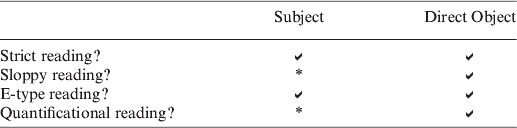
In this section, I have shown that there is a curious asymmetry between subject and object positions in CSE with regard to the availability of sloppy/quantificational interpretations of null arguments. Specifically, null objects exhibit these readings whereas null subjects do not. I have further provided empirical evidence showing that this interpretive asymmetry cannot be analyzed in terms of V-stranding VP-ellipsis. Table 1 summarizes the asymmetry in question.
Interpretive asymmetry in CSE between null subjects and null objects.

Table 1 raises two important questions. One question is what grammatical mechanism gives rise to sloppy/quantificational interpretations. The other question is why this mechanism is blocked from targeting the subject position in CSE. In the following section, I review one theory regarding the origin of these interpretations, originally proposed by Oku (Reference Oku1998) and developed by Saito (Reference Saito2007), Takahashi (Reference Takahashi2007, Reference Takahashi2008a, Reference Takahashi, Miyagawa and Saitob, Reference Takahashi2010) and Şener & Takahashi (Reference Şener and Takahashi2010).
4. Argument ellipsis, LF-Copy Theory and the Anti-Agreement Hypothesis
Adopting Saito's (Reference Saito2007) minimalist re-working of Oku's (Reference Oku1998) LF-Copy Theory, Şener & Takahashi (Reference Şener and Takahashi2010) and Takahashi (Reference Takahashi2010) propose that the LF-Copy process is blocked by the presence of ϕ-agreement. In this section, I propose that the subject–object asymmetry in CSE can be best analyzed as a further empirical consequence of this Anti-Agreement Hypothesis.
4.1 Şener & Takahashi's (Reference Şener and Takahashi2010) Anti-Agreement Hypothesis
Oku (Reference Oku1998) proposes that the sloppy interpretation of a null argument in Japanese is the by-product of the LF-Copy process, whereby an overt argument is copied at LF from the full-fledged clause onto the corresponding empty argument slot in the elliptical clause. To illustrate how this theory works, consider a null object construction in Japanese shown in (10b).Footnote 5
(10)
(a) Taroo-wa zibun-no tegami-o suteta. (Japanese)
Taro-nom self-gen letter-acc discarded
‘Lit. Taro discarded self's letter.’
(b) Hanako-mo e suteta. (OK strict; OKsloppy)
Hanako-also discarded
‘Lit. Hanako also discarded e.’
The missing object in (10b) can be interpreted as either Taro's letter (the strict reading) or Hanako's letter (the sloppy reading). Oku proposes that the sloppy reading here arises due to LF-Copy. The LF representation for the example in (10b) under this reading is shown in (11).
(11)

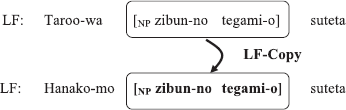
In this representation, the NP zibun-no tegami-o ‘self's letter-acc’ is copied onto the object position of the elliptical sentence in (10b) from the overt object position of the antecedent clause in (10a). The sloppy reading obtains, according to Oku, when the first object is copied without its reference being fixed and then being bound to the subject Hanako in the subsequent clause after the copying operation.
Takahashi (Reference Takahashi2008a, b) suggests that Oku's analysis also derives the quantificational interpretation for quantified empty arguments in Japanese. Example (12b) illustrates a case in point.
(12)
(a) Taroo-wa san-nin-no sensei-o sonkeisiteiru.
Taro-top three-cl-gen teacher-acc respect
‘Taro respects three teachers.’
(b) Hanako-mo e sonkeisiteiru. (OK E-type; OK quantificational)
Hanako-also respect
‘Lit. Hanako respects e, too.’ (Japanese; Şener & Takahashi Reference Şener and Takahashi2010: 81–82)
Example (12b) allows both E-type and quantificational readings. Within the LF-Copy theory, (12b) has the LF representation shown in (13) under the quantificational reading.
(13)
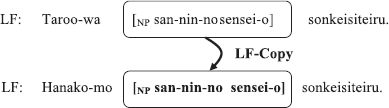
In this representation, the quantified expression san-nin-no sensei-o ‘three teachers-acc’ is copied onto the missing object position from the corresponding overt object position in the antecedent clause. As a result, it is not surprising that the understood object quantified in (12b) behaves independently of its antecedent quantifier with respect to quantification.
The same analysis applies to the sloppy and quantificational readings for null subjects in Japanese. Oku (Reference Oku1998: 164–165) was the first to point out that the null subject exhibits the sloppy reading in this language. Example (14b) illustrates this observation.
(14)
(a) Mary-wa [zibun-no teian-ga saiyo-sare-ru-to] omotteiru.
Mary-top self-gen proposal-nom accept-pv-pres-comp think
‘Lit. Mary thinks that self's proposal will be accepted.’
(b) John-mo [ e saiyo-sare-ru-to] omotteiru. (OK strict; OK sloppy)
John-also accept-pv-pres-comp think
‘Lit. John also thinks that e will be accepted.’ (Japanese; Oku Reference Oku1998: 165)
Şener & Takahashi (Reference Şener and Takahashi2010) show that the null subject in Japanese also allows the quantificational interpretation. This observation is illustrated in (15b).
(15)
(a) San-nin-no onnanoko-ga Taroo-ni ai-ni kita.
three-cl-gen girl-nom Taro-dat see-to came
‘Three girls came to see Taro.’
(b) e Ken-ni-mo ai-ni kita. (OK E-type; OK quantificational)
Ken-dat-also see-to came
‘Lit. e came to see Ken, too.’ (Japanese; Şener & Takahashi Reference Takahashi2010: 84)
With this review of the LF-Copy Theory of the sloppy/quantificational readings in place, Şener & Takahashi (Reference Şener and Takahashi2010) conduct a comparison of the syntax of Japanese and Turkish with respect to argument ellipsis. Their central observation is that in Turkish, both subjects and objects can be elided, as in Japanese, but only null objects exhibit sloppy/quantificational readings; null subjects only allow strict/E-type readings. Examples (16)–(19) illustrate this observation.
(16)
(a) Can [pro anne-si]-ni eleştir-di.
John his mother-3sg-acc criticize-past
‘John criticized his mother.’
(b) Mete-yse e öv-dü. (OK strict; OK sloppy)
Mete-however praise-past
‘Lit. Mete, however, praised e.’ (Turkish; Şener & Takahashi Reference Şener and Takahashi2010: 87)
(17)
(a) Can üç hırsız yakala-dı.
John three burglar catch-past
‘John caught three burglars.’
(b) Filiz-se e sorgula-dı. (OKE-type; OK quantificational)
Phylis-however interrogate-past
‘Lit. Phylis, however, interrogated e.’ (Turkish; Şener & Takahashi Reference Şener and Takahashi2010: 88)
(18)
(a) Can [[pro oğl-u] İngilizce öğren-iyor diye] bil-iyor.
John his son-3sg English learn-pres comp know-pres
‘John knows that his son learns English.’
(b) Filiz-se [ e Fransızca öğren-iyor diye] bil-iyor. (OK strict; * sloppy)
Phylis-however French learn-pres comp know-pres
‘Lit. Phylis, however, knows that e learns French.’ (Turkish; Şener & Takahashi Reference Şener and Takahashi2010: 91)
(19)
(a) Üç öğretmen Can-ı eleştir-di.
three teacher John-acc criticize-past
‘Three teachers criticized John.’
(b) e Filiz-i-yse öv-dü. (OK E-type; * quantificational)
Phylis-acc-however praise-past
‘Lit. e praised Phylis, however.’ (Turkish; Şener & Takahashi Reference Şener and Takahashi2010: 91)
Şener & Takahashi (Reference Şener and Takahashi2010) and Takahashi (Reference Takahashi2010) propose that the typological difference between Japanese and Turkish illustrated above is derived from the presence vs. absence of ϕ-agreement. Chomsky (Reference Chomsky, Martin, Michaels and Uriagereka2000) maintains that the uninterpretable ϕ-features of a functional head (either T or v) enter into an Agree relation with the matching interpretable ϕ-features of the closest DP with an uninterpretable Case feature. This step is shown in (20a), where F1 enters into an Agree relation with DP1. Suppose now that after this operation, DP1 in (20a) is copied onto the elliptic subject position in (20b). The derivation crashes at this point because the Case feature of DP1 has already been checked and erased in the antecedent clause, before the LF-Copy operation takes place. Consequently, the uninterpretable ϕ-features of F2 remain unchecked. This step is shown in (20c).
(20)
(a) … F1{ϕ} … DP1{ϕ, Case} …
(b) … F2{ϕ}… …
(c) *… F2{ϕ}… DP1{ϕ, Case} …
In this way, the LF-Copy process is blocked in Turkish for null subjects. Examples (21a, b) show that this language exhibits ϕ-agreement in subject positions, but not in object positions.
(21)
(a) (Ben) bu makale-yi yavaşyavaş oku-yacağ-ım.
I this article-acc slowly read-fut-1sg
‘I will read this article slowly.’
(b) (Biz) her hafta sinema-ya gid-er-iz.
we every week movies-dat go-aor-1pl
‘We go to the movies every week.’ (Turkish; Şener & Takahashi Reference Şener and Takahashi2010: 86)
On the other hand, it is traditionally assumed in the literature on Japanese syntax (Fukui Reference Fukui1986, Kuroda Reference Kuroda1988) that Japanese lacks ϕ-agreement altogether.Footnote 6 As a result, a null subject can be recovered through LF-Copy without causing the derivation to crash. The present analysis also explains why direct objects can be LF-Copied both in Japanese and Turkish. These languages lack ϕ-agreement in such a position. Şener & Takahashi provide further supporting evidence for this Anti-Agreement Hypothesis of argument ellipsis from certain adjunct clauses and exceptional case-marking constructions in Turkish. Specifically, they observe that the null subject does not require ϕ-agreement in these constructions and it is precisely in these contexts that the null subject allows sloppy/quantificational interpretations: see Section 6.1 below for actual data and more detailed discussions. This observation clearly shows that ϕ-agreement is indeed the controlling factor for LF-Copy in Turkish vis-à-vis Japanese.Footnote 7
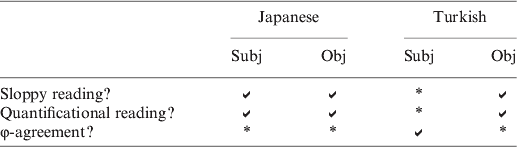
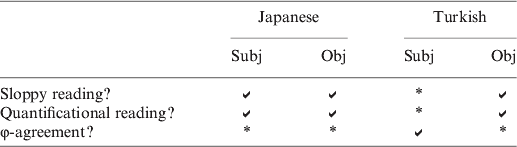
Table 2 summarizes the typological difference between Japanese and Turkish with respect to sloppy/quantificational interpretations, with special attention to subject ϕ-agreement.
Difference between Japanese and Turkish in the interpretation of null arguments.
4.2 Argument ellipsis in CSE and the Anti-Agreement Hypothesis
In the previous section, I reviewed the LF-Copy analysis of sloppy/quantificational readings developed by Oku (Reference Oku1998) and further elaborated by Şener & Takahashi (Reference Şener and Takahashi2010). Here, I propose that this hypothesis can be extended to derive the subject–object asymmetry in CSE.
It is a matter of considerable controversy in the literature whether CSE exhibits syntactic agreement as its lexifier – English – does. Consider a typical exchange in CSE shown in (22). In this exchange, Speakers A and B are discussing Charles Dickens' novel Great Expectations.
(22) B: And how the benefactor appear in the first and last part …
A: He was confused already. He was like part of the upper class but …
B: Mmm …
A: At the brink of it.
A: Ya.
B: Just, it's very sad.
(CSE; Wee & Ansaldo Reference Ansaldo and Lim2004: 65)
In (22), Speaker B's first utterance does not manifest third person present singular subject agreement (i.e. appear instead of appears). The later utterances by the same speaker, however, do show correct copula agreement. Given this inconsistency in surface morphological manifestations of agreement, it seems safe to conclude at the current point of the development of CSE grammar that the apparent free variation of agreement marking is a natural outcome of ongoing grammatical competition between various substrate languages (Hokkien, Cantonese, Mandarin and/or Malay, with no morphologically manifested agreement) and the superstrate/lexifier language (English, with morphologically forced agreement). Thus, Wee & Ansaldo (Reference Wee and Lim2004: 66) observe that the morphological realization of verb–subject agreement in CSE remains essentially sporadic rather than rule-governed; as such, it has not yet stabilized to the extent that one can tell with any certainty whether its manifestation is diagnosed as due to strictly grammatical factors, as in standard varieties of English, or sociolinguistic variables.
The important point to note here, however, is that the subject–object interpretive asymmetry discussed in Section 2 above remains irrespective of whether or not a verb exhibits morphological agreement with its local subject. To prove this point, consider examples (23a, b). Note that (23a) is minimally different from (4b), repeated here as (23b), in that the verb in the former registers overt agreement morphology.Footnote 8
(23)
(a) Wait lah, John say [e speaks Hokkien]. (OK strict; * sloppy)
(b) Wait lah, John say [e speak Hokkien]. (OK strict; * sloppy) (=4b)
This observation suggests that surface morphological manifestations of agreement are an irrelevant factor in controlling the availability of sloppy/quantificational interpretations in CSE.
5. A substratist explanation of the subject–object asymmetry in CSE
In this section, I provide a formal substratist explanation for the subject–object asymmetry in CSE. I first provide new evidence that all the major local languages in the contact ecology of Singapore also independently exhibit such an asymmetry. I argue that this typologically congruent system has undergone a systemic transfer into the developing grammar of CSE. I formalize this transfer in terms of the abstract agreement at T. The proposed analysis lends support to the recent claim by Miyagawa (Reference Miyagawa2010, Reference Miyagawa, Aelbrecht, Haegeman and Nye2012, Reference Miyagawa2013) that Chinese languages possess the computational process of agreement just like overt agreement languages such as English, despite the lack of overt morphological realizations.
5.1 Substratal effects on argument ellipsis in CSE from Sinitic and Malay
Given the Sinitic substrate hypothesis reviewed in Section 2 above, which has received compelling linguistic and socio-historical support, it is natural to expect that the Chinese languages in the Singaporean contact environment (Hokkien, Cantonese and Mandarin) should have served as primary substrates for CSE with respect to argument ellipsis. As is well-known (J. Huang Reference Huang1984, Yip & Matthew Reference Yip and Matthews2007), these languages allow liberal omission of arguments, just like CSE. More importantly, they exhibit the same subject–object asymmetry with respect to the sloppy/quantificational readings that we observed in CSE. This point is illustrated below in (24)–(27) from Mandarin, in (28)–(31) from Cantonese and in (32)–(35) from Hokkien.
(24)
(a) Zhangsan kanjian-le ta-de mama. (Mandarin)
Zhangsan see-perf he-mod mother
‘Zhangsan saw his mother.’
(b) Lisi ye kanjian-le e. (OK strict; OK sloppy)
Lisi also see-perf
‘Lit. Lisi also saw e.’
(25)
(a) Zhangsan xihuan san wei laoshi. (Mandarin)
Zhangsan like three cl teacher
‘Zhangsan likes three teachers.’
(b) Lisi ye xihuan e. (OK E-type; OK quantificational)
Lisi also like
‘Lit. Lisi also likes e.’
(26)
(a) Zhangsan shuo [ziji de haizi mei na qian].
Zhangsan say self mod child neg take money
‘Zhangsan said that his child did not take money.’
(b) Lisi ye shuo [ e mei na qian]. (OK strict; * sloppy)
Lisi also say neg take money
‘Lit. Lisi also said that e did not take money.’ (Mandarin; Takahashi Reference Takahashi, Miyagawa and Saito2008b: 415)
(27)
(a) San wei nü sheng lai jian Zhangsan. (Mandarin)
three cl girl come see Zhangsan
‘Three girls came to see Zhangsan.’
(b) e ye lai jian Lisi. (OK E-type; * quantificational)
also come see Lisi
‘Lit. e also came to see Lisi.’
(28)
(a) Zoengsaam tai dou heoi aamaa. (Cantonese)
Zhangsan see perf his mother
‘Zhangsan saw his mother.’
(b) Leisei dou tai dou e laa. (OK strict; OK sloppy)
Lisi also see perf sfp
‘Lit. Lisi also saw e.’
(29)
(a) Zoengsaam zungji saam go lou si. (Cantonese)
Zhangsan like three cl teacher
‘Zhangsan likes three teachers.’
(b) Leisei dou zungji e. (OK E-type; OK quantificational)
Lisi also like
‘Lit. Lisi also likes e.’
(30)
(a) Zoengsaam waa [zigei ge zaijyu mou lo cin]. (Cantonese)
Zhangsan say self mod child neg take money
‘Zhangsan said that his child did not take money.’
(b) Lisi dou waa [ e mou lo cin]. (OK strict; * sloppy)
Lisi also said neg take money
‘Lit. Lisi also said that e did not take money.’
(31)
(a) Saam go jyuzai lai gin Zoengsaam. (Cantonese)
three cl girl come see Zhangsan
‘Three girls came to see Zhangsan.’
(b) e dou lai gin leisei. (OK E-type; * quantificational)
also come see Lisi
‘Lit. e also came to see Lisi.’
(32)
(a) Zhangsan kua-dio yi-eh mama. (Hokkien)
Zhangsan see-perf his mother
‘Zhangsan saw his mother.’
(b) Lisi ah-si kua-dio e. (OK strict; OK sloppy)
Lisi also see-perf
‘Lit. Lisi also saw e.’
(33)
(a) Zhangsan suka sah eh sen-sih. (Hokkien)
Zhangsan like three cl teacher
‘Zhangsan likes three teachers.’
(b) Lisi ah-si suka e. (OK E-type; OK quantificational)
Lisi also like
‘Lit. Lisi also likes e.’
(34)
(a) Zhangsan gong [ga-ki eh kia bo gia lui]. (Hokkien)
Zhangsan say self mod child neg take money
‘Zhangsan said that his child did not take money.’
(b) Lisi ah-si gong [e bo gia lui]. (OK strict; * sloppy)
Lisi also said neg take money
‘Lit. Lisi also said that e did not take money.’
(35)
(a) Sah eh za-bor lai kua Zhangsan. (Hokkien)
three cl girl come see Zhangsan
‘Three girls came to see Zhangsan.’
(b) e ah-si lai kua Lisi. (OK E-type; * quantificational)
also come see Lisi
‘Lit. e also came to see Lisi.’
The examples in (24)–(35) suggest that the asymmetry in CSE arises as a robust substratal effect from the Chinese varieties. Now, recall from Section 2 that there is another possibility suggested in the literature regarding the emergence of innovative grammatical features of CSE – the Malay substrate hypothesis. Examples (36)–(39) below from Singapore Malay (see Section 2) show that this variety also shows the subject–object asymmetry just like CSE and the Sinitic substrates.
(36)
(a) Siti suka Baba-nya. (Singapore Malay)
Siti like father-3sg
‘Siti likes her father.’
(b) Tapi Salima benci e. (OK strict; OK sloppy)
but Salim hate
‘Lit. Salima hates e.’
(37)
(a) Siti suka tiga guru. (Singapore Malay)
Siti like three teacher
‘Siti likes three teachers.’
(b) Salima suka e juga. (OK E-type; OK quantificational)
Salima like also
‘Lit. Salima also likes e.’
(38)
(a) Siti berkata [anak-nya boleh menari]. (Singapore Malay)
Siti say child-3sg can dance
‘Siti said that her child can dance.’
(b) Salima berkata [e boleh menyanyi]. (OK strict; * sloppy)
Salima say can sing
‘Lit. Salima said that e can sing.’
(39)
(a) Tiga pelajar datang berjumpa saya. (Singapore Malay)
three student come see 1sg
‘Three students came to see me.’
(b) ?e datang berjumpa saya juga! (OK E-type; * quantificational)
come see 1sg also
‘Lit. e also came to see me!’
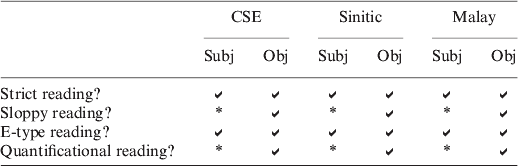
Our investigation thus far in this section shows that there is a perfect grammatical congruence between two principal substrates of CSE – Sinitic and Malay. Table 3 summarizes this congruence. Results in this table strongly support the eclectic model of contact language formation proposed by Mufwene (Reference Mufwene2001, Reference Mufwene2008), Ansaldo (Reference Ansaldo and Lim2004, Reference Ansaldo2009a, b) and Schneider (Reference Schneider2007).
Subject–object asymmetry in null arguments in CSE, Sinitic and Malay.

The question now is: What is the underlying grammatical system that has been transferred from Chinese/Malay into CSE grammar? More specifically, assuming the LF-Copy theory of sloppy/quantificational interpretations for null arguments, what blocks this process from targeting the subject position (the shaded cells in Table 3)? I answer these questions in the next section.
5.2 Strong Uniformity and the role of abstract agreement in contact genesis
I propose that the subject–object asymmetry arises in CSE as the result of underlying syntactic congruence between two ostensibly different typological languages (English vs. Chinese) in terms of abstract syntactic agreement. I further suggest that the resultant asymmetry has been further reinforced and stabilized as the robust pattern in CSE grammar thanks to Malay grammar, which imposes a similar restriction on the semantics of null arguments. Suppose that CSE has inherited the underlying agreement system from its lexifier language – English – such that subjects must always enter into an Agree relation, whereas objects do not, whether or not this process is morphologically transparent.Footnote 9 Although this superstratist position seems sufficient to account for the asymmetry under investigation, it goes against the Sinitic substrate hypothesis, which maintains that CSE has essentially instantiated the grammar of Sinitic substrate languages filtered through English morphosyntax (Bao Reference Bao2005). After all, there are only a few alleged areas (overt wh-fronting; see Bao Reference Bao2001 and Sato Reference Sato2013) where the syntax of CSE has received non-trivial influences from the grammar of standard varieties of English. Indeed, the vast majority of contact-induced changes in CSE can be easily traced back to Sinitic substratal influences. Hence, it is hard to see why Standard English would have influenced just a few grammatical patterns, much less the abstract syntactic agreement system, when many other areas of CSE grammar (for example, copula deletion, topic prominence, bare conditionals, radical pro-drop, wh-in-situ/particle wh-fronting, discourse particles, got-existential constructions, the Chinese-like tense/aspect system, the semantics of bare nominals, to name a few; see the references cited in Section 2) clearly exhibit substratal effects from indigenous Chinese varieties, as shown in an ever-growing body of work on its grammar.
Let us thus hypothesize that the transfer of the abstract T–subject agreement system from English survives the grammatical competition/selection process into CSE, because the Sinitic substrate languages in fact have the same computational process of agreement that English has. According to this hypothesis, the Chinese languages possess the agreement system for subject positions at Ts. Accordingly, the LF-Copy process is blocked from targeting the subject position in CSE because of the T–subject agreement in the manner shown earlier in (20a–c). More specifically, the functional category T seeks a matching DP with an uninterpretable Case feature in its search domain to have its uninterpretable ϕ-features checked and erased. The DP then moves to [Spec, T] to check the EPP-feature of the same T. When this DP is later copied at LF onto the empty subject position of the subsequent elliptical clause with another T, it can no longer participate into any Agree relation with the T because the Case feature of the DP, which would activate it for Agree, has already been checked in the antecedent clause before LF-Copy takes place. This hypothetical derivation then crashes because the uninterpretable ϕ-features of the T in the elliptical clause remain unchecked. This derivational failure will not occur with the LF-Copy of the direct object from a full-fledged clause onto the empty object position. This is because CSE does not have any agreement relation between the verb and its direct object.
The idea that ϕ-features are active in Sinitic languages, even though there is no morphological evidence of such an activity, has been actively pursued by recent work of Miyagawa (Miyagawa Reference Miyagawa2010, Reference Miyagawa, Aelbrecht, Haegeman and Nye2012, Reference Miyagawa2013). It is often casually assumed that some languages, like English, have agreement, whereas other languages, like Japanese, do not. Miyagawa (Reference Miyagawa2010) suggests that this superficial observation is misguided and argues instead that all languages have agreement in some form, with their manifestations being subject to cross-linguistic variation. This position is well-articulated in what he calls Strong Uniformity (see also Chomsky Reference Chomsky and Kenstowicz2001: 2). This principle is defined in (40).
(40) Strong Uniformity
All languages share the same set of grammatical features, and every language overtly manifests these features.
(Miyagawa Reference Miyagawa, Aelbrecht, Haegeman and Nye2012: 12)
As a part of his endeavor to explore the explanatory potentials of the Strong Uniformity thesis, Miyagawa (Reference Miyagawa2010: 49–50) argues that Mandarin possesses person agreement under T. His empirical evidence for this position is concerned with the so-called blocking effect on the long-distance construal of reflexives caused by the presence of an intervening subject with person features different in value from those of the higher subject (Y.-H. Huang Reference Huang1984; Tang Reference Tang1985, Reference Tang1989; H. Pan Reference Pan, Cole, James Huang and Hermon2000). Consider Mandarin examples (41a, b), which serve to illustrate this effect:
(41)
(a) Zhangsani zhidao Lisij dui zijii/j mei xinxin.
Zhangsan know Lisi to self neg confidence
‘Lit. Zhangsan knows Lisi has no confidence in self.’
(b) Zhangsani juede {woj/nij} dui ziji*i/j mei xinxin.
Zhangsan think 1sg/2sg to self neg confidence
‘Lit. Zhangsan thinks {I/you} have no confidence in self.’ (Mandarin; H. Pan Reference Pan, Cole, James Huang and Hermon2000: 280)
In (41a), the long-distance reflexive ziji ‘self’ can be bound to either the local embedded subject Lisi or the non-local matrix subject Zhangsan. The example in (41b) shows, however, that the long-distance construal becomes impossible when the local, embedded subject is switched to the first/second person pronouns (i.e. wo ‘I’ and ni ‘you’); that is to say, only the local binding of the reflexive is possible in this example. Miyagawa (Reference Miyagawa2010: 50) interprets this contrast as evidence that Chinese has person agreement at T once we adopt the analysis (see Battistella Reference Battistella1989 and Cole, Hermon & Sung 1990, inter alia) whereby the binding of a reflexive in Chinese involves successive-cyclic LF-movement of the reflexive to a T position to receive the value of its person feature. According to this analysis, the long-distance construal in (41a) is obtained as follows. The reflexive ziji ‘self’ first moves to the embedded T in order to receive the [third person] value. The reflexive further moves to the matrix T to receive the same person feature value. Both local and long-distance construals of ziji are grammatical in (41a) because the person features it picked up through LF movement do not clash in value. In (41b), on the other hand, for the long-distance construal to obtain, ziji ‘self’ must first undergo LF-movement to the embedded T to receive the [first/second person] values and then move further to the matrix T to receive the [third person] value. The resulting representation crashes because of the conflicting person values the reflexive picked up on its way up to the matrix T position. This is why the long-distance construal is blocked in (41b). The contrast between (41a) and (41b), therefore, indicates that T in Chinese does possess the abstract person agreement at T, despite the lack of overt morphological manifestations of the agreement. Note that Japanese does not exhibit the blocking effect, as shown in (42), where zibun ‘self’ may be bound to the embedded first/second person subjects (i.e. watasi ‘I’/anata ‘you’) as well as to the matrix third person subject Taro. This pattern therefore suggests that Japanese does not possses person agreement at T (however, see Footnote footnote 6 above for an important qualification of this point).
(42) Taroo-wa {watasi-ga/anata-ga} zibun-no syasin-o totta-to itta.
Taro-nom 1sg-nom/1pl-nom self-gen picture-acc took-comp said
‘Lit. Taro said that {I/you} took self's picture.’ (Japanese; Miyagawa Reference Miyagawa2010: 50, with a minor modification)
Now, it is important to see whether the other major substrate language in the contact community for CSE – Malay – also exhibits person agreement in the form of the blocking effect. Cole & Hermon (Reference Cole and Hermon2005: 630) observe that Singapore Malay behaves differently from Chinese in this regard. That is, the reflexive-like expression diri-nya ‘self-3sg’ fails to manifest the relevant effect in Malay. This observation is illustrated in (43).
(43) Aminahi tahu {saya/anda} memberi Sitij buku tentang diri-nyai/j.
Aminah know 1sg/2sg buy Siti book about self-3sg
‘Lit. Aminah knew {I/you} gave Siti a book about self.’ (Singapore Malay; Cole & Hermon Reference Cole and Hermon2005: 630, with a minor modification)
In this example, diri-nya ‘self-3sg’ can refer to the matrix subject Aminah (as well as to the closest DP Siti) despite the fact that the first/second person subjects, saya ‘I’/anda ‘you’, intervene between the reflexive and the matrix subject. Cole and Hermon suggest that diri-nya is underspecified in the lexicon with respect to the features [αanaphor] and [αpronominal] and hence that it can occur in the syntactic environments accessible for both reflexives and pronouns. They further suggest that the apparent long-distance binding shown in (43) is not due to the LF head movement of diri-nya because its multi-morphemic status prevents it from undergoing such movement as mono-morphemic reflexives such as ziji ‘self’ in Chinese.
Although it goes beyond the limited scope of this paper to develop a full theory of the subject–object asymmetry in Malay, I suggest a brief outline of such a theory informed by my ongoing study of Javanese argument ellipsis (Sato, to appear), which also exhibits the same asymmetry. Sato (to appear) essentially proposes that the LF-Copy for an empty subject position in Javanese is blocked by the active voice nasal prefix under the v head (Cole, Jonczyk & Lilly 1999; Sato Reference Sato2010, Reference Sato2012), which he hypothesizes to serve the same computational function as ϕ-agreement in Turkish and Chinese in blocking LF-Copy. Some examples of the nasal prefix are shown in (44a, b).
(44)
(a) Mary {maca/*waca} buku kuwi. (Javanese)
Mary av.read/read book dem
‘Mary read this book.’
(b) Kowe {nukokke/*tuku} ibu-mu kembang.
2sg av.buy/buy mother-2sg flower
‘You bought your mother a flower.’
This theory can be straightforwardly extended to the subject–object asymmetry in Malay, given that, like Javanese, this language also exhibits a similar distribution of the active voice prefix. Cole & Hermon (Reference Cole and Hermon1998) thus observe that most transitive verbs in Malay occur with the optional active voice prefix meng-, as illustrated in (45a, b).
(45)
(a) Guru itu akan (men)-denda Fatimah.
teacher dem fut av-punish Fatimah
‘The teacher will punish Fatimah.’
(b) Ali (mem)-beri Fatimah hadiah untuk hari lahir-nya.
Ali av-give Fatimah present for day birth-3sg
‘Ali gave Fatimah a present for her birthday.’ (Singapore Malay; Cole & Hermon Reference Cole and Hermon1998: 231)
Note that this analysis, in turn, provides indirect support for Miyagawa's Strong Uniformity thesis that all languages manifest agreement in some fashion: Malay, upon closer scrutiny, shows agreement in the form of voice morphology at v. See Sato (to appear) for further consequences of this conclusion.
Given the present Sinitic hypothesis regarding the transfer of the ϕ-agreement at T from the Chinese languages into CSE, we expect to see syntactic phenomena where this agreement system is active in the contact variety.Footnote 10 Indeed, pronominal Case inflections and VP-ellipsis in CSE provide independent evidence in favor of the agreement system. First, recall that, within Chomsky's (Reference Chomsky, Martin, Michaels and Uriagereka2000) recent assumption, the Case feature of a DP (Goal) is checked/valued through Agree with a higher functional head (probe) – either T or v – which carries uninterpretable ϕ-features. Restricting our attention to English, the Case feature is realized as nominative if the probe is a finite T and accusative if the probe is a transitive v head. Given this assumption, our present transfer model predicts that CSE should also manifest this Case inflection just like its lexifier. Examples (46a, b) show that this prediction is indeed borne out.Footnote 11
(46)
(a) {He/*Him} like Cindy a lot.
(b) Cindy like {*he/him} meh?
(CSE; Sato Reference Sato2011: 359)
Second, Lobeck (Reference Lobeck, Carter, DéChaine, Philip and Sherer1990) and Saito & Murasugi (Reference Saito, Murasugi, Ormazabal and Tenny1990) propose that functional heads such as [+tensed] T can license ellipsis of their complement only when they enter into a Spec–Head agreement with its specifier; see Fukui & Speas (Reference Fukui, Speas, Fukui, Rapoport and Sagey1986) for a complete taxonomy of agreeing and non-agreeing functional categories. This proposal is illustrated by the contrast in (47a, b):
(47)
(a) Sam [vp likes soccer] and Mary [t does] [vpe ], too. (Standard English)
(b) *I consider Sam to [vp like soccer], and you believe Mary to [vpe ] as well.
The construction in (47a) allows VP-ellipsis because the finite T there permits the deletion of its VP-complement due to its agreement with the subject DP whereas (47b) does not because the non-finite T does not agree with the subject DP. Given this generalization, our present analysis predicts that VP-ellipsis should be available with a finite T in CSE as well because of the abstract Spec–T agreement, whether it is manifested in visible verbal inflections or not. This prediction is indeed confirmed by CSE examples such as (48a, b).
(48)
(a) Sunadi [vp play soccer] and Peter also [t {can, does, may}] [vpe]. (CSE)
‘Sunadi plays soccer and Peter {can, does, may} too.’
(b) Sunadi [vp play soccer] and Peter also [t {have, got}] [vpe].
‘Sunadi plays soccer and Peter has also played soccer, too.’
In (48a), VP-ellipsis is licensed by finite auxiliaries such as can, does and may, as in Standard English. The example in (48b) with VP-ellipsis shows that the same deletion operation is possible in CSE even though there is no overt agreement inflection on T heads. Under Lobeck/Saito & Murasugi's generalization, the availability of VP-ellipsis here argues for the existence of the abstract Spec–T agreement in CSE.
To summarize, a feasible reconstruction – which is consistent with all the empirical facts observed thus far, and with the compelling evidence in the literature for the general substratist position on CSE grammar – is the following: on one hand, the CSE grammar has developed the abstract subject–T agreement driven out of grammatical pressures from Sinitic and English which possess the same system. On the other hand, the CSE grammar has developed argument ellipsis as substratal effects from Chinese and Malay because the superstrate/lexifier language – English – does not possess this grammatical characteristic. This phenomenon, however, exhibits the subject–object asymmetry with respect to sloppy/quantificational interpretations in CSE. Even though the grammatical reasons for this asymmetry differ between Chinese and Malay (subject–T agreement in Chinese vs. voice agreement in Malay), the epiphenomenal surface congruence has already sufficed for this asymmetry to be stabilized in CSE.
5.3 The ellipsis of non-nominal arguments in CSE
I conclude this section by pointing out one important prediction made by the proposed analysis of the subject–object asymmetry in CSE. Recall that our analysis suggests that subjects do not exhibit sloppy/quantificational interpretations because of syntactically active ϕ-agreement in this position, unlike direct objects which do not participate in such agreement. We are thus led to predict that the ellipsis of indirect objects/PP arguments required by ditransitive verbs, for example, should also be able to permit these interpretations.Footnote 12 Examples (49)–(50) show that this prediction is indeed confirmed in CSE.Footnote 13
(49)
(a) John fax the report to his boss already. (CSE)
(b) But Bill email the report e hor. (OK strict; OK sloppy)
(50)
(a) John fax the report to three secretaries already. (CSE)
(b) But Bill email the report e hor. (OK E-type; OK quantificational)
The example in (49b) involves the omission of the indirect PP argument selected by the ditransitive verb email. This elliptic object allows both strict and sloppy readings. Similarly, the elided quantified PP object in (50b) allows both E-type and quantificational readings.
6. Implications of the analysis and residual issues on argument ellipsis
In this paper, I have proposed a new analysis of the hitherto unnoticed subject–object asymmetry in argument ellipsis in CSE following the general spirit of the substratist explanation for this variety. The CSE data discussed above contrast clearly with the Turkish data in that they show that the surface presence or absence of agreement makes no difference. In other words, abstract syntactic agreement is independent from overt morphological agreement. This theoretical position also has an important implication for theories of genesis/development of contact language grammars.Footnote 14 It is widely observed in descriptions of many contact languages that overt agreement inflection, if any, is in flux, unstable or marginal and is subject to considerable speaker variation; see Labov (Reference Labov, Mufwene, Rickford, Bailey and Baugh1998) and Patrick (Reference Patrick, Kortmann, Schneider, Upton, Mesthrie and Burridge2004) for evidence from African-American Vernacular English and Jamaican Creole English, respectively. To the extent that my analysis of the asymmetric argument ellipsis pattern in CSE holds, it suggests that such instability is simply a superficial phenomenon only linked to the PF manifestation of the underlying agreement process in the narrow syntactic computation.
In this section, I briefly discuss two residual issues with our Anti-Agreement analysis of argument ellipsis in CSE and explore some possible ways to solve them.Footnote 15
6.1 The relation between agreement and Agree: Hindi, Bangla and Basque
Under our current analysis, the contrast between Turkish and CSE indicates that overt agreement does not always establish a one-to-one relation with syntactic agreement, or Agree in Chomsky's (Reference Chomsky, Martin, Michaels and Uriagereka2000) terminology. More concretely, Turkish represents a case where the correlation between overt agreement and Agree is transparent. Thus, as noted in Section 4.1, Şener & Takahashi (Reference Şener and Takahashi2010) observe that in Turkish, empty subjects can exhibit sloppy readings precisely in syntactic contexts where subjects do not show ϕ-agreement. They mention two such contexts – adjunct clauses and Exceptional Case-Marking constructions – and observe that the null subject does allow this reading, as shown in (51b) and (52b).
(51)
(a) Can [[pro oğl-u] İngilizce öğren-ince] sevin-di.
John his son-3sg.poss English learn-because be.pleased-pres.perf
‘John is pleased because his son has learned English.’
(b) Filiz-se [e Fransızca öğren-ince] sevin-di. (OK strict; OK sloppy)
Phylis-however French learn-because be.pleased-pres.perf
‘Lit. Phylis, however, is pleased because e has learned French.’ (Turkish; Şener & Takahashi Reference Şener and Takahashi2010: 95)
(52)
(a) Pelin [[pro yeğen-i]-ni lise-ye başla-yacak] san-ıyor.
Pelin her niece-3sg-acc high school-dat start-fut think-pres
‘Pelin thinks that her niece will start high school.’
(b) Suzan-se [e ilkokul-a başla-yacak] san-ıyor.
Suzan-however grade school-dat start-fut think-pres
‘Lit. Suzan, however, thinks that e will start grade school.’ (Turkish; Şener & Takahashi Reference Şener and Takahashi2010: 96)
The examples in (51)–(52) confirm the correlation between the surface presence/absence of ϕ-agreement and the possibility of argument ellipsis in Turkish. On the other hand, CSE represents a rather opaque case where the presence or absence of overt agreement does not correlate with Agree. Of course, both scenarios are compatible with the Anti-Agreement Hypothesis originally proposed by Şener & Takahashi (Reference Şener and Takahashi2010) and developed here for CSE, in the sense that both languages employ the computational mechanism of Agree for subject positions; it just so happens that Turkish has overt person and number morphology to manifest this underlying operation. An anonymous JL referee points out that the type of languages which would be incompatible with this hypothesis, then, would be one where argument ellipsis is freely permitted with the presence of overt agreement. Simpson, Choudhury & Menon (Reference Simpson, Choudhury and Menon2013) observe that two South Asian languages – Bangla and Hindi – pose a problem for this hypothesis because they show that argument ellipsis is available under contexts of overt agreement. I illustrate Simpson et al.'s point with examples in (53)–(56) from Hindi.Footnote 16
(53)
(a) Ram apini gaRi bechega.
Ram self's car sell.fut.masc
‘Ram will sell his car.’
(b) Raj-bhi e bechega. (OK strict; OK sloppy)
Raj-also sell.fut.masc
‘Lit. Raj will also sell e.’ (Hindi; Simpson et al. Reference Simpson, Choudhury and Menon2013: 16)
(54)
(a) Ram-ne apni gaRi bechi.
Ram-erg self's car sell.past.fem
‘Ram sold his car.’
(b) Raj-ne-bhi e bechi. (OK strict; OK sloppy)
Raj-erg-also sell.past.fem
‘Lit. Raj also sold e.’ (Hindi; Simpson et al. Reference Simpson, Choudhury and Menon2013: 16)
(55)
(a) Ram sochta hai uski beti-ne Italian paRha hai.
Ram think.pres cop.pres his daughter-erg Italian studied.masc cop.pres.3sg
‘Ram thinks his daughter studied Italian.
(b) Raj-bhi sochta hai e Italian paRha hai. (OK strict; * sloppy)
Raj-also think.pres cop.pres Italian studied cop.pres.3sg
‘Lit. Raj also thinks e studied Italian.’ (Hindi; Simpson et al. Reference Simpson, Choudhury and Menon2013: 17)
(56)
(a) Ram sochta hai uski beti Italian paRh-rahi hai.
Ram think.pres cop.pres his daughter Italian studied-pres.fem cop.pres. 3sg
‘Ram thinks his daughter is studying Italian.’
(b) Raj-bhi sochta hai e Italian paRh-rahi hai. (OK strict; * sloppy)
Raj-also think.pres cop.pres Italian studied-pres.fem cop. pres. 3sg
‘Lit. Raj also thinks e is studying Italian.’ (Hindi; Simpson et al. Reference Simpson, Choudhury and Menon2013: 16–17)
The examples in (53b) and (54b) illustrate that the null object allows sloppy interpretations, whether or not a verb exhibits overt morphological agreement with the direct object. The examples in (55b) and (56b), on the other hand, illustrate that the null subject does not allow sloppy interpretations, whether or not a verb exhibits overt morphological agreement with the subject. The availability of sloppy interpretations in (54b), then, presents a case against the Anti-Agreement Hypothesis.
Takahashi (Reference Takahashi2007, Reference Takahashi2010) also considers Basque as another language which would go against the predictions of the Anti-Agreement Hypothesis (see also Duguine Reference Duguine and Biberauer2008 for similar examples). Basque has both subject and object agreement (Ortiz de Urbina 1989), but Takahashi observes that in this language, a null object exhibits sloppy interpretations despite the fact that it manifests verb–object agreement. This point is shown in (57b) below. The example in (58b), on the other hand, shows that a null subject does not exhibit sloppy interpretations, a pattern consistent with the Anti-Agreement Hypothesis.
(57)
(a) Jon-ek bere ama ikusi zuen.
Jon-erg his mother see aux
‘John saw his mother.’
(b) Peru-k aldiz ez zuen e ikusi. (OK strict; OK sloppy)
Peru-erg however neg aux see
‘Lit. However, Peru did not see e.’(Basque; Takahashi Reference Takahashi2007: 6)
(58)
(a) Jon-ek esan du [bere ama-k Miren ikusi duela].
Jon-erg say aux his mother-erg Miren see aux
‘John says his mother has seen Miren.
(b) Peru-k esan du [e Arantza ikusi duela]. (OK strict; * sloppy)
Peru-erg say aux Arantza see aux
‘Lit. Peru says e has seen Arantza.’ (Basque; Takahashi Reference Takahashi2007: 6)
Takahashi (Reference Takahashi2010: 42) speculates that this subject–object asymmetry may be accommodated if Basque relies on the V-stranding VP-ellipsis for the apparent instances of argument ellipsis (see Section 3.2 above). Since direct objects, but not subjects, will be included within the VP-ellipsis site, the asymmetry exhibited in (57)–(58) falls out naturally from this analysis. However, Simpson et al. (Reference Simpson, Choudhury and Menon2013) argue against this alternative analysis in Hindi and Bangla, with compelling evidence based on non-identity of elliptic and antecedent verbs and the inability of VP-level adjuncts to be included in interpretations of argument ellipsis (see examples (7)–(8) above).
Notice crucially that this argument from Hindi/Bangla and Basque against the Anti-Agreement Hypothesis holds only if we adopt Chomsky's (Reference Chomsky, Martin, Michaels and Uriagereka2000) technical assumption about Agree. As we saw in Section 4.1, this hypothesis maintains that LF-Copy is blocked for a null subject position in Turkish because the uninterpretable ϕ-features of the T in the elliptical clause remain unchecked. This is, in turn, attributed to the fact that the uninterpretable Case feature of the copied DP has already been checked and erased in the derivation of the antecedent full-fledged clause. The underlying assumption in this analysis is the activation condition from Chomsky (Reference Chomsky, Martin, Michaels and Uriagereka2000), which states for our current purposes that the uninterpretable Case feature of the DP subject makes it possible for it to enter into an Agree relation with T. However, it is not clear whether this process must always be tied with an uninterpretable Case feature of a probe. Thus, in his modified version of Chomsky's (Reference Chomsky, Martin, Michaels and Uriagereka2000) theory of Agree, Bhatt (Reference Bhatt2005) proposes that Case is to be dissociated from Agree based on agreement facts in Hindi. According to Bhatt's version, the Agree operation can permit a goal DP to delete the uninterpretable ϕ-feature of functional heads different from the one from which it has its structural Case assigned. Under this view, the mere presence of agreement under Ts in Hindi does not block the derivation for a null subject construction in this language because Case is not the result of the computational reflex of Agree.
Chomsky's assumption that Case checking is invariably tied to ϕ-agreement has been disputed for some time also by several linguists in Japanese linguistics, who attempt to dissociate the link between the two phenomena. Thus, Fukui (Reference Fukui1986) and Kuroda (Reference Kuroda1988) argue that Japanese lacks ϕ-agreement (see Miyagawa (Reference Miyagawa2010, Reference Miyagawa, Aelbrecht, Haegeman and Nye2012, Reference Miyagawa2013), though, for the opposing view; see also Footnote footnote 6 above), but this language does have overt case morphology. Indeed, Fukui & Takano (Reference Fukui and Takano1998) propose that accusative case is an inherent case linked to the argument structure of verbs involved, whereas Saito (Reference Saito1985) claims that nominative case is assigned to any element immediately dominated by TPs. This line of research, therefore, further indicates that the Case system may have nothing to do with the agreement system, contrary to Chomsky's (Reference Chomsky, Martin, Michaels and Uriagereka2000) theory of Agree.
Needless to say, it remains to be seen what the proper approach is for Case assignment/checking within vP domains. I leave this important issue for future research.
6.2 Subject–object asymmetry in argument ellipsis and Agree
There is by now a growing literature on argument ellipsis across languages. Empirical studies on this phenomenon in typologically different languages, including Japanese (Oku Reference Oku1998; Takahashi Reference Takahashi2008a, Reference Takahashi, Miyagawa and Saitob, Reference Takahashi2010), Korean (Takahashi Reference Takahashi2007), Chinese (J. Huang Reference Huang and Freidin1991, Cheng Reference Cheng, Otaki, Takeyasu and Tanigawa2012), Turkish (Şener & Takahashi Reference Şener and Takahashi2010), Hindi/Bangla/Malayalam (Simpson et al. Reference Simpson, Choudhury and Menon2013), Javanese (Sato, to appear) and Basque (Takahashi Reference Takahashi2007, Reference Takahashi2010; Duguine Reference Duguine and Biberauer2008), have revealed a cross-linguistically stable generalization which has the form of an implication, as shown in (59):
(59) If a language L has subject ellipsis, then L also has object ellipsis.
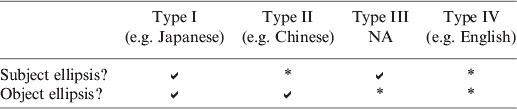
Japanese and Korean have subject and object ellipsis. The other languages mentioned above all have object ellipsis, but lack subject ellipsis. Languages such as English have neither subject nor object ellipsis. As far as I know, however, there is no language which has subject ellipsis but lacks object ellipsis. Table 4 will make this implication clearer.
Subject–object asymmetry as cross-linguistic implicational generalization.

Assuming that every language has this property predicated by the implication mentioned above, as our current understanding of argument ellipsis permits, the issue remains whether such a robust cross-linguistic asymmetry does not falsify the Anti-Agreement Hypothesis. Recall from Section 4.1 that this hypothesis crucially relies on the technical mechanism of Agree as outlined by Chomsky (Reference Chomsky, Martin, Michaels and Uriagereka2000), whereby two functional heads T and v are uniformly probes for Case assignment and agreement for subjects and direct objects, respectively. Given this uniformity assumption, the Anti-Agreement Hypothesis would predict a total symmetry between subjects and objects with respect to argument ellipsis. One could, of course, simply stipulate that languages with this asymmetry lack abstract agreement for object positions, but there does not seem to be any principled reason why a language cannot show this ellipsis in subject position but not in direct object position. I believe that an ultimate answer to this question is related to my speculation in the previous subsection. If we follow our conjecture in Section 6.1 above and Miyagawa's Strong Uniformity principle shown in (40) above, it is actually the subject–object asymmetry (as exhibited in CSE) that is predicted to be the norm in languages with argument ellipsis under the Anti-Agreement Hypothesis. To see why, let us hypothesize that subject DPs must enter into an Agree relation with an appropriate functional head in all languages, unlike non-subject elements within VPs whose Case property does not necessarily depend on this relation, as we speculated in Section 6.1. It follows, then, that an empty subject can never yield sloppy/quantificational interpretations for the by now familiar reason: the Case feature of the overt subject DP has been checked and erased by Agree, and hence cannot act as a new probe for a functional head in the subsequent elliptical clause. This hypothesis thus accounts for two notable facts in Table 4: (i) why there is no Type III language, and (ii) why many languages with argument ellipsis allow elliptic objects but not elliptic subjects. Now, the question is why there are Type I languages such as Japanese and Korean which do allow elliptic arguments in both subject and object positions. Miyagawa (Reference Miyagawa, Aelbrecht, Haegeman and Nye2012, Reference Miyagawa2013) argues that Japanese has ϕ-agreement but it appears under C heads. I suspect that this agreement does not block the LF-Copy process from targeting the subject position in the specifier of T precisely because of this ‘high’ locus of such agreement; see Footnote footnote 6 above. It is possible that the same analysis might hold for Korean, but this is an important issue to be left for future investigations.
7. Conclusion
I began this paper with a hitherto unnoticed asymmetry between subjects and direct objects in CSE with respect to the availability of sloppy/quantificational interpretations of empty arguments; that is, empty direct objects, but not empty subjects, can exhibit these interpretations. I have then developed a new analysis of this asymmetry drawing on recent works on argument ellipsis in languages like Japanese and on the general substratist explanation for innovative features of CSE grammar. More specifically, the asymmetry arises because of the abstract T–subject agreement in CSE, a grammatical system transferred into CSE based on mutual congruence between the lexifier language – Standard English – and the Sinitic substrates of CSE – Mandarin, Cantonese and Hokkien. This pattern was further strengthened in CSE under communicative pressures from Malay, which exhibits exactly the same interpretive asymmetry thanks to the dyadic voice agreement system. I have presented independent evidence, based on Case inflections and VP-ellipsis in CSE, in favor of the view that this variety has subject agreement whether it is morpho-phonetically manifested or not.
There are several important implications of our proposed analysis of CSE for proper theories of contact linguistics and of argument ellipsis across languages. As a minor point, the results in this paper add further empirical support for the general feasibility of the substratist approach to contact phenomena in CSE, which has been amply motivated in the literature on this variety. The implications, however, go beyond this single variety. My analysis suggests that the frequently cited apparent instability of agreement inflections in pidgin/creole varieties is indeed illusory and only linked to the surface manifestation of the underlying subject agreement process in syntactic computation, which is arguably universal across languages including contact languages. Furthermore, our analysis has two non-trivial consequences for the relation between Case and agreement. One is that, to the extent that our analysis holds, there is no inherent link between the agreement process and Case within the VP region, such as accusative Case. The other is that the position where agreement manifests itself is also subject to parametric variation (e.g. it appears under T in languages such as CSE and Chinese whereas it appears under C in languages such as Japanese and, arguably, Korean). These results, then, support a version of Miyagawa's (Reference Miyagawa2010, Reference Miyagawa, Aelbrecht, Haegeman and Nye2012, Reference Miyagawa2013) Strong Uniformity thesis that all languages have the same set of grammatical features in some fashion.
All in all, it is clear from the above that the phenomenon of argument ellipsis presents a never-ending series of important questions for current syntactic theory. I hope to have demonstrated in this paper that a seemingly straightforward analysis of the subject–object asymmetry in CSE, upon a closer cross-linguistic examination, has quite profound implications for the outline of a possibly universal theory of argument ellipsis when applied to many other languages with this grammatical characteristic, as well as many challenging questions worthy of further cross-linguistic investigation, including those briefly touched on in Section 6.