INTRODUCTION
Traditional land use in the Ethiopian highlands has failed to cope with increasing demand for food, feed and fibre. Land degradation, in combination with intermittent drought and declining soil fertility, is the major cause of low crop yield and food insecurity in the Ethiopian highlands. Estimates vary considerably but direct losses of productivity from land degradation are at least 3% of the agriculture gross domestic product of Ethiopia, while the loss of agricultural value during 2000–2010 was estimated to be $7 billion (Berry, Reference Berry2003). Exploitative traditional land use, aggravated by erosion, poor land management and increasing population, commonly led to nutrient mining and poor soil water holding capacity, particularly in fields far away from homesteads (Amede and Taboge, Reference Amede, Taboge and Bationo2007). Moreover, very low levels of agricultural inputs, shortage of labour for agricultural production and conservation, and competing demands on crop and vegetative biomass for food, animal feed and soil fertility replenishment substantially reduced land and water productivity (Amede et al., Reference Amede, Descheemaeker, Peden and Rooyen2009).
In the southern Ethiopian highlands, farmers tend to deliberately create fertile spots around homesteads. This is particularly pronounced in farming systems where food security is dependent on perennial food and cash crops such as banana and coffee and where theft and free grazing are problematic. The homestead plots are favoured for application of household refuse, manure and night soils, but are also enriched by nutrients coming from the outfields in the form of feed and mulch (Amede et al., Reference Amede, Belachew and Geta2001). This results in a soil fertility gradient from homesteads to the outfields across farms and landscape (Amede and Taboge, Reference Amede, Taboge and Bationo2007; Elias et al., Reference Elias, Morse and Belshaw1998). Accordingly, crop yields are higher in the plots closest to the houses. For instance, enset (Enset ventricosum) yields in outfields have been found to be 70% lower than those grown in homesteads (Amede and Taboge, Reference Amede, Taboge and Bationo2007), and in a study from the same site, Elias et al. (Reference Elias, Morse and Belshaw1998) found that there was a positive nitrogen (N) and phosphorus (P) balance in the homesteads, compared to a strong negative balance in the outfields. The same trend was observed in a banana-based system in Uganda (Bekunda, Reference Bekunda1999) and in western Kenya (Vanlauwe et al., Reference Vanlauwe, Tittonell and Mukalama2007). However, soil fertility decline and the associated decrease in crop yield in the outfields could not be explained solely by nutrient deficiency, since outfields rarely respond to fertilizer applications (Vanlauwe et al., Reference Vanlauwe, Tittonell and Mukalama2007) and crop yields do not also necessarily correlate with plant nutrient contents (Amede and Taboge, Reference Amede, Taboge and Bationo2007).
In the same way that soil fertility declines, soil water content decreases from homesteads to the outfields, and spatial differences in soil water availability related to slope positions contribute to variable millet yields (Rockstrom and de Rouw, Reference Rockstrom and de Rouw1997). Despite relatively high average rainfall in the research area (1350 mm) and a seven-month growing period, crop water productivity (crop yield per unit of water depleted) is extremely low.
Despite lower productivity, outfields in the Ethiopian Highlands remain the largest arable land area for most farmers and they account for the largest share of total production (Elias et al., Reference Elias, Morse and Belshaw1998). Hence, any attempt to increase household food production and income in this region should focus on interventions that increase outfield productivity. Water productivity of these farms could be substantially increased by improving soil water infiltration and integrated water and nutrient management.
In this study, we tested the effects of small water harvesting pits, known as zai pits, which are commonly reported to increase crop yields in dry regions where low rainfall limits productivity (Abayomi et al., Reference Abayomi, Fadayomi, Babatola and Tian2001; Roose et al., Reference Roose, Kabore and Guenat1999). Zai pits are traditional practices developed in Burkina Fasso and commonly used in the Sudano-Sahelian areas for rehabilitating eroded and completely crusted fields, where the infiltration is too low to sustain vegetation (Roose et al., Reference Roose, Kabore and Guenat1999). Zai pits typically comprise holes dug during the dry season and then filled with one or two handfuls of dry dung (corresponding to 1–3 t ha−1 of dry organic matter). These are then seeded with approximately a dozen cereal seeds after the first storms. The pits combine water harvesting and targeted application of organic amendments (Fatondji et al., Reference Fatondji, Martius, Bielders, Vlek, Bationo, Gerard and Bationo2007). They have been shown to alleviate the adverse effects of dry spells (Hassen, Reference Hassen, Reij, Scoones and Toulmin1996). In these studies, zai pits have been found to result in a 3- to 4-fold increases in grain yield of millet compared to flat planting, mainly as a consequence of in situ water conservation (Fatondji et al., Reference Fatondji, Martius, Bielders, Vlek, Bationo, Gerard and Bationo2007). The innovative feature of our study was to ascertain the effect of zai in a region with relatively high rainfall and sloping landscapes.
The principal objectives of this study were to: (i) evaluate the effect of zai pits along with fertilizer application on crop yield of potatoes and beans; (ii) evaluate the effects of these interventions on crop water productivity; and (iii) assess farmers' perception of the cause of land degradation in the outfields and their response to zai.
MATERIALS AND METHODS
Characteristics of the study area
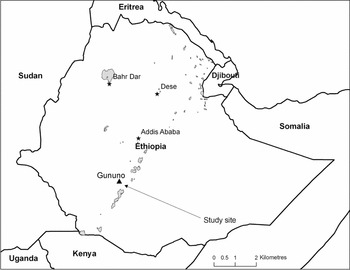
The research sites are located at Gegecho and Offa villages of Gununo, South-Western Ethiopian highlands (37°39′E, 6°56′N) (Figure 1). This area is one of the most densely populated districts in the country, with more than 400 people per km2. Farm sizes typically range from 0.35 to 0.6 ha for a family of seven (Amede and Delve, Reference Amede and Delve2008). Most farms are located on hillsides with slopes ranging from 5% to 23%. Households tend to be located up slopes with the outfields located close to the valley bottoms.
Location map of the research sites in Gununo, Ethiopia.

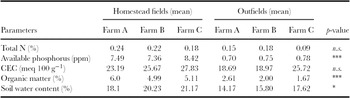
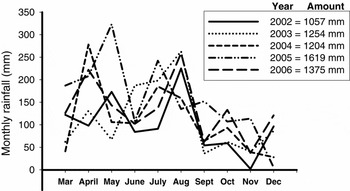
The area has a bimodal mean annual rainfall of 1300 mm, an average temperature of 19.5 °C and an altitude range of 1880–1960 m asl. The small rainy season (belg) extends from March to June while the main rainy season (meher) extends from July to the end of October (Figure 2). The months of July and August receive the highest rainfall and cause significant soil loss, mainly in the outfields. The dominant soils are deep Eutric Nitisols (Amede et al., Reference Amede, Belachew and Geta2001). These soils are dominated by kaolinitic minerals, which are inherently low in N and P (Table 1).
Soil nutrient status and soil water content of homesteads and outfields farms in Gununo, Ethiopia (n = 5 samples from within the field).

n.s. = not significant, * and *** significantly different at p ≤ 0.05 and p ≤ 0.001 between homestead and outfields.
Monthly rainfall during the growing season (March to October) in Gununo, Ethiopia.

Mixed crop-livestock systems dominate where farmers cultivate small quantities of a large number of crops including enset, cereals, root crops and vegetables in different combinations. Like most farming systems in the East African highlands, the homestead and midfields (i.e. fields located between the homestead and the outfields) are mostly occupied by enset, coffee, taro and sweet potato (Ipomea batatas). The outfields are typically used for growing cereals, sweet potato, potato (Solanum tuberosum) and beans (Phaseolus vulgaris). The major cereals (in terms of area and household consumption) are maize (Zea mays) and teff (Eragrostis abyssinica). Farmers also cultivate sorghum (Sorghum bicolor) and wheat (Triticum aestivum) to a limited extent. The most widespread cropping pattern in the outfields is to alternate maize in the belg with sweet potato or teff in the maher (Elias et al., Reference Elias, Morse and Belshaw1998). The first season crops are planted in March and harvested in June or early July, and the second season crops are planted in July or August and harvested in October or November.
Survey with farmers
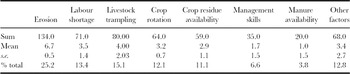
After consultative meetings with the community to understand major constraints of farmers, formal and informal surveys were conducted to establish the perception of farmers on the causes and effects of soil fertility decline in the outfields and to learn their views about the new intervention, zai. A formal survey with two rounds of questionnaire use was conducted between June and October 2004 with 20 key informants who the community identified as being ‘good farmers' and are farming slope fields. Interviews were conducted by trained research officers who spoke the local language. The results from the first survey, conducted in mid August, produced local criteria for identifying degraded fields. During the second survey, conducted in the third week of October, 2005, we identified 8 out of 32 local indicators that farmers considered to be very important, using pair-wise analysis methods (Table 2).
Farmers ranking of potential causes of land degradation of outfields, using pair wise comparison in Gununo, Ethiopia (n = 20).

Experimental designs
In consultation with the key informants three representative farms, belonging to the informants and representing degraded fields in the community were identified. The three farms (Farms A, B and C) faced each other across the V-shape valley, and were used to evaluate the effects of zai pits in combination with manure and different levels of N application on potato and beans. Farm B and C were neighbouring farms and belonged to brothers. The experimental plots, labelled as degraded outfields, were located about 60 m from the homestead fields, commonly bordering grazing land. On 20 February 2005, shortly before the beginning of the short rainy season, soil samples were collected from the homestead and outfields of the three farms (A, B, C) and analysed for nitrogen (N), phosphorus (P), cation exchange capacity (CEC) and organic matter (OM) using the nutrient analysis procedures described below.
About 1 kg of soil samples were collected per spot from above 20 cm soil depth, in five replicates per farm. Soil samples were oven dried to constant weight, then ground to pass through a 1.0 mm sieve and analysed for total NPK by Kjeldahl digestion with concentrated sulphuric acid (Anderson and Ingram, Reference Anderson and Ingram1993). N, P, CEC and OM were measured in the laboratory of the International Livestock Research Institute using standard procedures. Soil water content was measured from the top 30 cm of the soil using gravimetric methods during a dry spell, three weeks after rain. The soil nutrient and water content nutrient from three representative farms is presented in Table 1.
N was reported to be the major limiting nutrient affecting crop production in the outfields of this area (Elias et al., Reference Elias, Morse and Belshaw1998) and therefore was included in the experiment. A randomized block design with four replications and nine plots per replication, with a plot size of 9 m2 was used. The treatments were a combination of the following treatments: (i) zai or flat planting, (ii) with or with out manure and (iii) 0, 30 or 60 kg N ha−1. The control treatments were those without zai and without manure. There were 1.5 m wide gangways between replications. The experiment was protected with 2 m of border crops, which were also separated by 2 m of gangways.
In the Sahel, the zai consists of digging holes during the dry season (30 cm diameter, 15 cm deep) then filling them with one or two handfuls of dry dung (Roose et al., 1993). In 2004, we set a preliminary experiment to evaluate the effects of zai pits, following the designs from the Sahel (Abayomi et al., Reference Abayomi, Fadayomi, Babatola and Tian2001; Roose et al., Reference Roose, Kabore and Guenat1999). However, the pits were filled by soil and sediments in one day of torrential rain (data not shown). Following this experience, we opted for zai pits with a larger diameter of 50 cm and depth 45 cm. We created wider and deeper zai pits to capture the runoff and minimize the erosion effects. About 1.5 kg of low quality stall manure, which is equivalent to about 5.8 t ha−1 collected from a heap, was thoroughly mixed with the soil and returned to the pits. The same amount of manure was broadcast for the flat planting. N was applied in the form of urea. Tri super phosphate (TSP) was applied to provide 30 kg ha−1 of P across all treatments during planting, reflecting the low-input farming practices of the system. We also put two rows of soil bunds above the experimental plots to protect them from erosion.
In 2005, six seed tubers were planted in each zai pit, three weeks after the incorporation of the manure. This corresponded to a seed rate of about 1.1 t ha−1. Equal number of tubers was planted in the flat fields fertilized with manure. Urea treatment was applied three weeks after planting. The field was kept weed free by hand. The plants were harvested following physiological maturity.
In 2006, the experiment was repeated with beans on the same old zai pits with the application of urea at a similar rate of 0, 30 and 60 kg N ha−1 and a basal dressing with 30 kg TSP. A bean variety, Omo-95, was planted in the zai pits and flat plots at a seed rate of 50 kg ha−1 on 16 March 2006. The beans were harvested on 23 June 2006. The soil nutrient and soil water content of zai and flat plots were measured following the methods described above.
One major concern of adoption of zai is the labour cost. Labour cost to prepare the zai pits was calculated after considering the number of pits per ha and the number of man days per pit. Labour cost and farm gate price in 2006 (7 birr day−1 and 500 birr t−1 potato, respectively), were used to calculate costs and benefits (in 2006 1 US$ = 8.4 Ethiopian birr). All other costs of inputs were the same for the zai pits and the flat fields. In all cases, although the farmers provided their land and labour, the experiments were controlled by researchers.
Establishing water productivity
Crop water productivity (CWP) of the various treatments was calculated after simulation of climatic data using New LocClim (FAO, 2005) and CropWat model (FAO, 1998). The crop coefficient (Kc) was estimated as a ratio of crop evapotranspiration (ETc, mm day−1) and reference evapotranspiration (ETo) (FAO, 1998). Water productivity of control and treatment plots was calculated by dividing grain or tuber yield per total amount of water used per respective crop and treatment. Dry weight of potato (22%) was used to calculate CWP.
Statistical differences among treatments were determined through analysis of variance with ranks and the Tukey test using Sigma stat (Jandel Scientific, 1994).
RESULTS
Soil fertility gradients
There was a significant difference in P, OM and soil water content (SWC) between homesteads and outfields of the respective farms. The P and organic matter contents of homestead plots were at least three times higher than the outfields (Table 1). Farm C had lower contents of N and OM than Farms A and B. In addition, SWC also varied across soil fertility gradients and farms. At the time of measurement, the SWC of the outfields was on average 5% less than in the homesteads (Table 1). Although there was a higher N content and CEC in homestead plots compared to outfields, the difference between these fields was not significant.
Farmer's perceptions
Out of the 32 potential causes of land degradation (data not presented), 8 were identified by the farmers to be the most important in facilitating outfield degradation. Based on the results of the pair-wise analysis of the most important eight constraints, the major causes of land degradation, according to priority order (from most important to least important) were: soil erosion, livestock trampling, labour shortage to construct soil conservation bunds and transport manure during the growing season, limited crop rotation in the outfields, and shortage of manure and other biomass to fertilize the outfields (Table 2). However, farmers recognized the detrimental effect of erosion on land quality as problem number one. Potentially, these factors have induced preferential management of homestead fields over outfields.
Effects of zai pits and N levels on crop yield
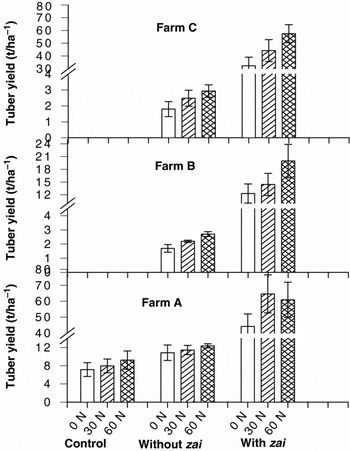
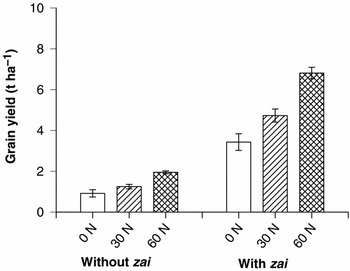
There was significant difference among the three farms in response to the zai pit treatments and fertilizer application (p ≤ 0.05) (Figure 3). Farm A was much more productive than the other two farms, both in the zai pits and the controls. Potato yield was significantly higher in zai pits than those planted in flat fields. In fact, in Farms B and C, tuber yield of control plots was approaching zero and was not measurable because of stunted plants that failed to produce tubers. The yield advantage of the zai system was about 5-fold in Farm A while it was about 20-fold in Farm C. The effect of different levels of N on tuber yield was pronounced, mainly through the zai pits. Significantly high potato tuber yield was obtained from the zai with 60 kg N ha−1 followed by 30 kg N ha−1 in Farms B and C. There was no significant difference in yield between 30 kg N ha−1 and 60 kg N ha−1 on Farm A (Figure 3). Similarly, bean yield from the zai pits was about 2.5 times greater than that from flat planting (Figure 4). The effect of N application on beans grain yield was significant in both zai and flat planting.
Effects of direct application or incorporation of biomass to a zai plot on tuber yield of potato, 2005. Error bars indicate standard error of difference between means (n = 4).

Effects of different levels of nitrogen on grain yields of beans with or without zai pits, 2006. Error bars indicate standard error of difference between means (n = 4).

In addition to crop yield, soil moisture content of the zai pits was significantly higher (p < 0.01) than that of flat planting (Figure 5). The difference in some plots was up to 10%. However, we did not find differences in nutrient content (N, P and CEC) between zai pits and flat plots, with N content in the soil being less than 1% and organic matter being less than 1.8% in both treatments.
Organic matter and soil water content within and outside zai pits, 2005. Error bars indicate s.d. (n = 4).

By growing potato in about 3925 pits ha−1, the farm income produced by zai pits was up to 20-times higher than the labour costs required to prepare them (data not shown). Hence, it was economical to use the zai pits for cultivating potatoes on the degraded farms.
Effects of zaion crop water productivity (CWP)
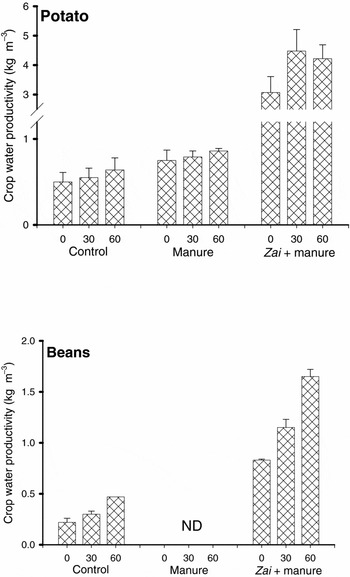
There was a significant correlation between water productivity and crop yield (R = 0.98). However, the actual productivity varied with both crop type and treatment. Water productivity was the highest with potato, up to 13.2 kg of produce per cubic metre of water used. The highest increase in water productivity was obtained from the zai pits, ranging from 260 to 620% compared to the control. The benefit of N application on CWP was in the range of 5–40% for potato and 135–265% for beans (Figure 6). The effect of N application on CWP was significantly higher than the control (p ≤ 0.05) both in potato and beans, with higher returns at a rate of 60 kg ha−1. However, the large difference in water productivity between potato and beans under zai pits is also partly due to the higher moisture content of potato tubers than bean seeds.
Crop water productivity of potato (a) and beans (b) under control or zai treatments in Gununo, Ethiopia. ND indicates no data collected.

DISCUSSION
In contrast to conventional wisdom, this study reveals that the major constraint of the outfields is not nutrient deficiency per se but rather low soil water holding capacity, which hinders crop growth and efficient utilization of available nutrients. Conventional wisdom suggests that crop water requirements could be easily satisfied in highland rain-fed systems where rainfall supply exceeds evapotranspiration demands. This wisdom, together with the nutrient balance studies of 1990s, forced researchers to believe that yield differences between homestead fields and outfields in the East African highlands was strongly associated with differences in soil nutrient status. Some of the most comprehensive studies on this subject emerged from Stoorvogel and Smaling (Reference Stoorvogel and Smaling1990) for sub-Saharan countries (a continental study), Smaling et al. (Reference Smaling, Stoorvogel and Windmeijer1993) for the Kisii district of Kenya and Elias et al. (Reference Elias, Morse and Belshaw1998) for Southern Ethiopia. Stoorvogel and Smaling (Reference Stoorvogel and Smaling1990) suggested that an analysis of nutrient inputs and outputs could indicate whether the soil fertility is being maintained, improved or degraded. The results of these and other studies suggested nutrient depletion to be a major problem of outfields in this region. These studies also suggested that degradation of the outfields was associated with limited financial capacity of farmers to buy chemical fertilizers to maintain soil fertility (Elias et al., Reference Elias, Morse and Belshaw1998; Smaling et al., Reference Smaling, Stoorvogel and Windmeijer1993). Similarly, Amede and Taboge (Reference Amede, Taboge and Bationo2007) in a recent study reported a 70% yield reduction in the local food crop enset when grown in outfields. However, the plant nutrient content of the enset plants grown in the outfields was much higher than plants grown in homesteads, indicating a reduced utilization of these plant nutrients (Amede and Taboge, Reference Amede, Taboge and Bationo2007). Moreover, application of chemical fertilizers alone to these degraded farms did not increase crop yield to the expected levels (Figure 3). Vanlauwe et al. (Reference Vanlauwe, Aihou, Houngnandan, Diels, Sanginga and Merckx2001) also reported that the return from chemical fertilizers in degraded plots was much lower than the return from fertile soils implying to an additional limiting factors affecting crop production in these systems.
Erosion was also an important negative contributor to the nutrient balance of the outfields in these areas (Amede et al., Reference Amede, Belachew and Geta2001; Elias et al., Reference Elias, Morse and Belshaw1998) as also confirmed by local farmers (Table 1). It facilitates the removal of soil organic matter, reducing the water holding capacity of the soil substantially through reduced porosity, poor water infiltration and increased run-off (Bossio et al., Reference Bossio, William, Geheb, Van Lynden, Mati and Molden2007). These factors contributed to the decline in soil quality of outfields, which became shallower, with very high soil density and low organic matter content to capture and store water in the root zone, particularly in farms on steep slopes. All of these soil parameters are indicative of water-stressed outfields.
While there was a significant difference in soil water content of zai and flat planted plots, we did not find differences in organic matter content within and outside the zai pits (Figure 5) because of the longer period required for soil organic matter build-up. Crop water productivity was much higher in potato than in beans (Figure 6), indicating genetic differences in water use efficiency between these crop species. Though application of manure increased potato yield by about 50%, potato yield from zai was significantly higher (by a factor of 5) (p ≤ 0.001) than from application of low quality manure combined with N in the form of urea. Water productivity has also tripled with zai interventions without any considerable change in nutrient status of the soils (data not shown). Hence, we consider that the yield gains from zai pits were strongly associated with improved soil water availability at the critical growth stages rather than increased nutrient supply. It also suggests that higher soil water content in the zai pits was due more to physical conservation of water by the pits than contributions made by the manure. Zai pits were also found to improve the water productivity of millets in the Sahel by a factor of 2 (Fatondji et al., Reference Fatondji, Martius, Bielders, Vlek, Bationo, Gerard and Bationo2007). In the same way, experiments conducted with traditional zai system for restoring a degraded Entisol in Burkina Faso showed that the highest production of grain (11 times the control) and straw (5 times the control) in zai pits was achieved mainly with a combination of organic amendment and mineral fertilizers (Roose and Barthès, Reference Roose and Barthès2001). These added benefits are caused by direct interactions among conserved water, decomposing organic matter and fertilizer-N leading to improved synchrony between supply of and demand for available N (Vanlauwe et al., Reference Vanlauwe, Aihou, Houngnandan, Diels, Sanginga and Merckx2001) and soil water.
The effect of N application on crop yield significantly increased in zai pits, particularly at higher application rates, possibly due to minimized washing-away effects of erosion. Although an increase in soil organic mater content through incorporation of green manures was possible (Buerkert et al., Reference Buerkert, Bationo and Dossa2000) the benefits could be undermined by the high annual soil loss, which is between 35 and 80 t ha−1 for Gununo, depending on the season (SCRP, 1996) unless soil and water conservation structures (e.g. zai pits) are adopted by farmers.
As farms in these areas contain heterogeneous fields with different soil fertility status (Table 1) and slopes, these soil and water management interventions should be targeted within this heterogeneity. Hence, the labour-intensive interventions like zai should target the most affected outfields, particularly where other management options fail to bring impact. These interventions were economically viable. Moreover, labour shortage is not a major constraint for the majority of these households (Amede and Delve, Reference Amede and Delve2008), particularly since digging of the zai holes should be done during the dry period when farmers can invest their spare time (Fatondji et al., Reference Fatondji, Martius, Bielders, Vlek, Bationo, Gerard and Bationo2007). However, these interventions may not be appropriate for every farm or system though it could target farm niches. For instance, the level of adoption of zai could be low in plain fields where runoff is minimal and soil water infiltration is relatively high.
CONCLUSION
Very small land holdings (<0.5 ha for a family of seven) and occasional drought are considered as the major causes of food insecurity in SSA. However, food insecurity in these farming systems is also associated with low productivity of outfields, which cover more than 65% of the total crop land. Results from this work suggested that household food production could be substantially increased by improved trapping of water and nutrients using zai pits in these outfields. They could be used to capture water and increase recharge of upslope and degraded watersheds. These interventions are equally effective in high rainfall, high slope areas, where soil water infiltration is reduced by slope, soil organic matter is low and hardpans are created due to erosion and improper livestock management. However, the scarcity of manure presents a constraint to the use of the zai technology unless biomass production for organic fertilization is promoted as an important intervention.
Acknowledgments
We would like to thank Drs Don Peden and Matthew MacCartney for their valuable comments on the manuscript and the farmers for their committed engagement. The data was generated while the first author was staff of the African Highlands Initiative and TSBF-CIAT. We acknowledged the support of the staff of Areka research centre during data collection.