Congenital heart disease (CHD) affects about one percent of all newborns and comprises one third of all congenital anomalies. Reference van der Linde, Konings and Slager1 With the advent of open-heart surgery and contemporary cardiology care, the majority of patients survive to adulthood, leading to rapidly growing cohorts of young adults with CHD. Reference Marelli, Miller, Marino, Jefferson and Newburger2,Reference Moons, Lore Bobijn, Werner Budts, Belmans and Gewillig3 Even with optimal care, these patients are not cured, but remain at increased risk of elevated morbidity and mortality. Reference Diller, Kempny and Alonso-Gonzalez4,Reference Greutmann, Tobler and Kovacs5
Studies in infants and children with CHD found an increased risk of altered brain development, perioperative brain injury Reference Claessens, Kelly, Counsell and Benders6 and neurodevelopment disorders including social interaction difficulties, language disorders, inattentive and impulsive behaviour, as well as motor and visuomotor difficulties and cognitive dysfunctions such as problems in executive functioning. Reference Calderon and Bellinger7–Reference Tyagi, Austin, Stygall, Deanfield, Cullen and Newman9 These neuropsychological deficits can restrict educational achievements, employability, and quality of life. Reference Bellinger, Newburger, Wypij, Kuban, duPlessis and Rappaport10 Although there are indications that impairments may persist into adolescence, Reference Bellinger and Newburger11–Reference von Rhein, Scheer, Loenneker, Huber, Knirsch and Latal13 only few studies have examined whether neurocognitive functioning is also affected in young adults with CHD. Reference Daliento, Mapelli and Russo14–Reference Utens, Verhulst and Erdman17 A recent meta-analysis Reference Mills, McCusker, Tennyson and Hanna12 emphasised general negative effects of a CHD on cognitive outcomes such as executive functioning, processing speed, attention, memory, psychomotor abilities, and literacy and numeracy. In a recent comprehensive review, Reference Keir, Ebert and Kovacs18 the authors concluded that “(…) attention and executive functions are the most commonly affected areas of cognitive performance” (p. 1679).
The current study set out to assess the full spectrum of neurocognitive functioning including general intellectual and executive function, memory, attention, and processing speed in a population of young adults with different types of CHD. Based on previous research, we hypothesise that executive function, attention, and processing speed may be particularly affected. Moreover, we predict that the complexity of CHD is associated with the degree of impairment.
Methods
Patients
CHD group
Patients were recruited from previous study cohorts on quality of life in young adults with CHD. Reference von Rhein, Scheer, Loenneker, Huber, Knirsch and Latal13,Reference Rometsch, Greutmann and Latal19 Of 191 eligible patients contacted by letter, phone, or E-mail, 68 (36%) agreed to participate. Non-patients did either not respond to our request (n = 59, 31%) or refused participation (n = 64, 33%). All patients were fluent in German language and had no congenital or acquired neurological disorder or a genetic syndrome affecting intellectual development. One patient had to be excluded after being tested because the cardiac diagnosis (cardiomyopathy) did not represent a CHD. Thus, the final sample comprised 67 patients with different types of CHD. See Table S1 in the supplementary material for a detailed list.
Control group
The participants of the control group consisted of healthy peers of patients (n = 41, 75%) or were recruited from personal contacts of the study team (n = 14, 25%). Peers of patients included friends, classmates, and siblings. All healthy controls (n = 55) were group matched to the CHD group for gender, age, and parental education (i.e., socio-economic status), as carefully as possible. Sample characteristics are reported in Table 1.
Sample characteristics

CHD: congenital heart disease; IQR: interquartile range; SES: socio-economic status, ranges from 2 (lowest) to 12 (highest) and reflects parental education.
* p-values are two-tailed.
** n = 62.
*** n = 51.
Procedures
The recruitment of this cross-sectional cohort study took place between October 2016 and October 2018. All patients underwent a standardised neuropsychological examination. The neuropsychological assessment took place at the Neuropsychology Unit of the University Hospital Zurich. The duration of the whole examination was approximately 3 hours. The study was approved by the Ethical Committee of the Canton of Zurich, Switzerland, and written informed consent was obtained from all study patients.
Measures
All patients completed a questionnaire collecting data on demographic, socio-economic, and medical conditions. Parental socio-economic status was estimated using a six-point scale based on the mean of maternal and paternal education. Reference Largo, Pfister, Kundu, Lipp and Due20 Possible socio-economic status values ranged from 2 (lowest) to 12 (highest). Educational level of the patients was measured by the number of years of school attendance until completion of an initial education with a higher value representing a higher education. Medical data were retrieved from medical records, and CHD complexity was classified into simple, moderate, and severe according to Warnes et al. Reference Warnes, Liberthson and Danielson21
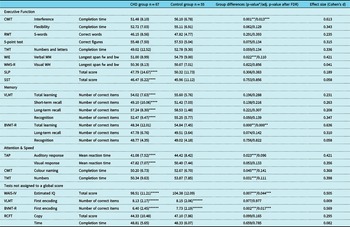
Language-associated, visual, and practical functions were tested with clinical screenings. Reference Schnider22 We tested neuropsychological outcome with a wide range of standardised neuropsychological procedures. Intelligence quotient was assessed using the short form of the Wechsler Adults Intelligence Scale, Fourth Edition. Reference Petermann23 This short form consists of the vocabulary and the matrix reasoning subtests and has been validated as estimating the full-scale intelligence quotient. Reference Daseking, Petermann and Waldmann24 Verbal memory functions were assessed with the German version of the Auditory Verbal Learning and Memory Test. Reference Tombaugh25 We used total words correctly recalled after the first trial, total learning over five repetitions, number of correct short- and long-term recalled words, and corrected recognition as outcome measures. Visual memory was assessed with the Brief Visuospatial Memory Test-Revised. Reference Benedict26 As for verbal memory, we used total learned figures after the first exposure, total learning as well as long-term retrieval and corrected recognition as outcome measures. We tested attention and speed with the divided attention subtest (reaction time to visual and auditory presented stimuli) of the Test of Attentional Performance Reference Zimmermann and Fimm27 and numbers subtest of the Trail Making Test, Reference Tombaugh28 which provides information on the graphomotor processing speed (completion time connecting numbers). Visual motor and visual perceptive skills were assessed with the Rey Complex Figure Test. Reference Meyers and Meyers29 We used total completion time and the scored points as outcome variables. We evaluated executive functions using verbal (Regensburger Wortflüssigkeits-Test) Reference Aschenbrenner, Tucha and Lange30 and non-verbal (Five-Point-Test) Reference Haid, Martl, Schubert, Wenzl, Kofler and Saltuari31 fluency tasks and used correct words or figures produced as outcome measure. The Colour-Word Interference Test from the Delis–Kaplan Executive Function System Reference Delis, Kaplan and Kramer32 provides information on processing speed, interference, and cognitive flexibility by completion time on each trial. The numbers and letters subtest from the Trail Making Test Reference Tombaugh28 provides information on graphomotor flexibility (completion time connecting numbers and letters). Furthermore, we applied the digit span task (longest forward and backward span) from the Wechsler Adult Intelligence Scale Reference Tewes, Neubauer and von Alster33 to assess verbal working memory. Visual working memory was assessed with the Wechsler Memory Scale Reference Härting, Markowitsch, Neufeld, Calabrese, Deisinger and Kessler34 (longest forward and backward span). We used total scored points of the “Standardised Link’s Probe” Reference Metzler35 to asses constructive solution behaviour. The global score of the Stop Signal Task Reference Verbruggen, Logan and Stevens36 was used to measure response inhibition. All scores were compared against the normative values of the respective test manuals. The resulting t-scores were used for subsequent analysis, whereby values t = 50 +/− 10 represents normal range.
In addition to these task-based neuropsychological procedures, participants had to complete the German version of the Behaviour Rating Inventory of Executive Function – Adult Version. Reference Roth and Gioia37 This is a 75-items clinical questionnaire capturing self-reported executive dysfunctions in adult’s everyday behaviour. The Behaviour Rating Inventory of Executive Function – Adult Version provides a Global Executive Composite and two index scores. The Behavioural Regulation Index (“I tap my fingers or bounce my legs,” “I have angry outburst”) reflects the ability to maintain regulatory control of one’s behaviour and emotional responses and is composed of the Inhibit, Shift, Emotional Control, and Self-Monitor subscales. The Metacognition Index (“I need to be reminded to begin a task even when I am willing,” “I get overwhelmed by large tasks”) captures the individual’s ability to initiate activity and generate and plan problem-solving ideas, to sustain working memory and to organize the required material and environment. It is composed of the subscales Initiate, Working Memory, Plan/Organise, Task Monitor, and Organisation of Materials. Behaviour Rating Inventory of Executive Function – Adult Version questionnaires of three patients had to be excluded due to incomplete answers. We also excluded data of one control subject because of a strong outlier (> 1 SD of the mean of the control group). This resulted in a sample of n = 95 completed self-reported Behaviour Rating Inventory of Executive Function – Adult Version data (n = 49 CHD group; n = 46 control group).
Statistical analysis
To examine differences in demographic variables and individual tests between CHD and control group, we applied t-tests for independent samples. Furthermore, we used Pearson Chi-Square to analyse group differences in frequencies. To correct for multiple testing, False Discovery Rate was used to calculate the adjusted p-values (Benjamini–Hochberg Method). Reference Benjamini and Hochberg38 To describe the extent of the group differences, we calculated effect sizes using Cohen’s d. Whereas d = 0.2 reflects small, d = 0.5 reflects moderate, and d = 0.8 reflects strong effects. Reference Cohen39 Effects of d > 0.42 assumed to be as clinical relevant. Reference Ferguson and Kazdin40 The individual tests were summarised into the global scores Executive Function, Memory, and Attention & Speed for further analysis (see Table 2). T-scores of all individual tests were averaged across all tasks of each global score. To analyse group differences of the global scores and the Behaviour Rating Inventory of Executive Function indices between the CHD and the control group or between the CHD complexities and the control group, analyses of variances with Tukey’s post-test were calculated. P-values < 0.05 (two-tailed) were considered significant. We used IBM SPSS 25 statistical software for Windows.
Neuropsychological performance of the CHD and control group and assignment of all tests to the corresponding global score. If not otherwise stated, Mean t-scores and SD are reported

Global scores consist of the averaged t-scores.
Effect size d = 0.02 (small), 0.05 (medium), .8 (strong); d > 0.42 as cut-off for clinical relevance.
BVMT-R: brief visuospatial memory test-revised; CHD: congenital heart disease; CWIT: colour-word interference test; FDR: false discovery rate; IQ: intelligence quotient; RCFT: REY complex figure test; RWT: Regensburger wortflüssigkeits-test; SLP: standardised link’s probe; SST: stop signal task; TAP: test of attentional performance; TMT: Trail Making Test; VLMT: verbal learning and memory test; WAIS-IV: Wechsler Adults Intelligence Scale, Fourth Edition; WIE: Wechsler intelligenztest für erwachsene; WM: working memory (fw: forward, bw: backward); WMS-R: Wechsler memory scale.
* p-values are two-tailed.
** p < 0.001.
*** p < 0.05.
**** Sample size n = 66.
***** Sample size n = 65.
****** Number of correct words/figures recalled after the first trial, reported are raw scores since no t-scores exist for these variables.
Results
Group characteristics
Comparison of baseline characteristics of the participating and non-participating patients revealed no significant difference (see Table S2 in supplementary material). The final sample consisted of 67 young adults with CHD and 55 gender-, age-, and parental-socio-economic status-matched healthy controls (see Table 1 for demographic variables). The control group (M = 15.06, SD =1.89) had more education than the CHD group (Mean = 14.18, SD = 2.07) (t (120) = −2.414, p = 0.017). Eighteen patients (27%) had a simple, 33 (49%) a moderate, and 16 (24%) a severe CHD. Gender was equally distributed between patients with simple, moderate, and severe complexity, and there was no difference in parental socio-economic status between the groups. However, there were significant educational differences between patients with severe CHD (Mean = 12.84; SD = 1.48) and moderate CHD (Mean = 14.67; SD = 2.13) on one hand, and the control group (Mean = 15.06; SD = 1.89) on the other hand (both p < 0.05). Thirty-nine patients (58%) had undergone at least one surgical repair procedure on cardiopulmonary bypass (heart–lung machine) and nine patients (13%) two or more surgeries on cardiopulmonary bypass.
Neuropsychological outcome
For all patients, language, language-associated, visual, and practical performance was unaffected. Table 2 summarises the findings of neuropsychological outcomes. Mean estimated intelligence quotient was significantly lower in the CHD than the control group. Also, the CHD group showed a lower performance in visual memory (total learned figures after the first exposure and after three trials), verbal working memory (forward and backward span), auditory divided attention (reaction time), processing speed (colour naming, connecting numbers), and visuo-verbal interference inhibition. After correction for multiple testing, effects for visual first encoding and learning and interference inhibition remained significant. Effect sizes were small to medium for most tasks. Although T-scores were in the normal range, the rate of patients who performed more than 1 SD below the comparison mean (i.e., range for clinically relevant impairments) was higher in the CHD group than in the control group (short-term verbal recall 16.7 versus 3.6%, p = 0.021; total visual learning 23.9 versus 3.6%, p =0.002; long term visual recall 11.9 versus 1.8% p = 0.033; estimated intelligence quotient 12.3 versus 1.8%, p = 0.038).
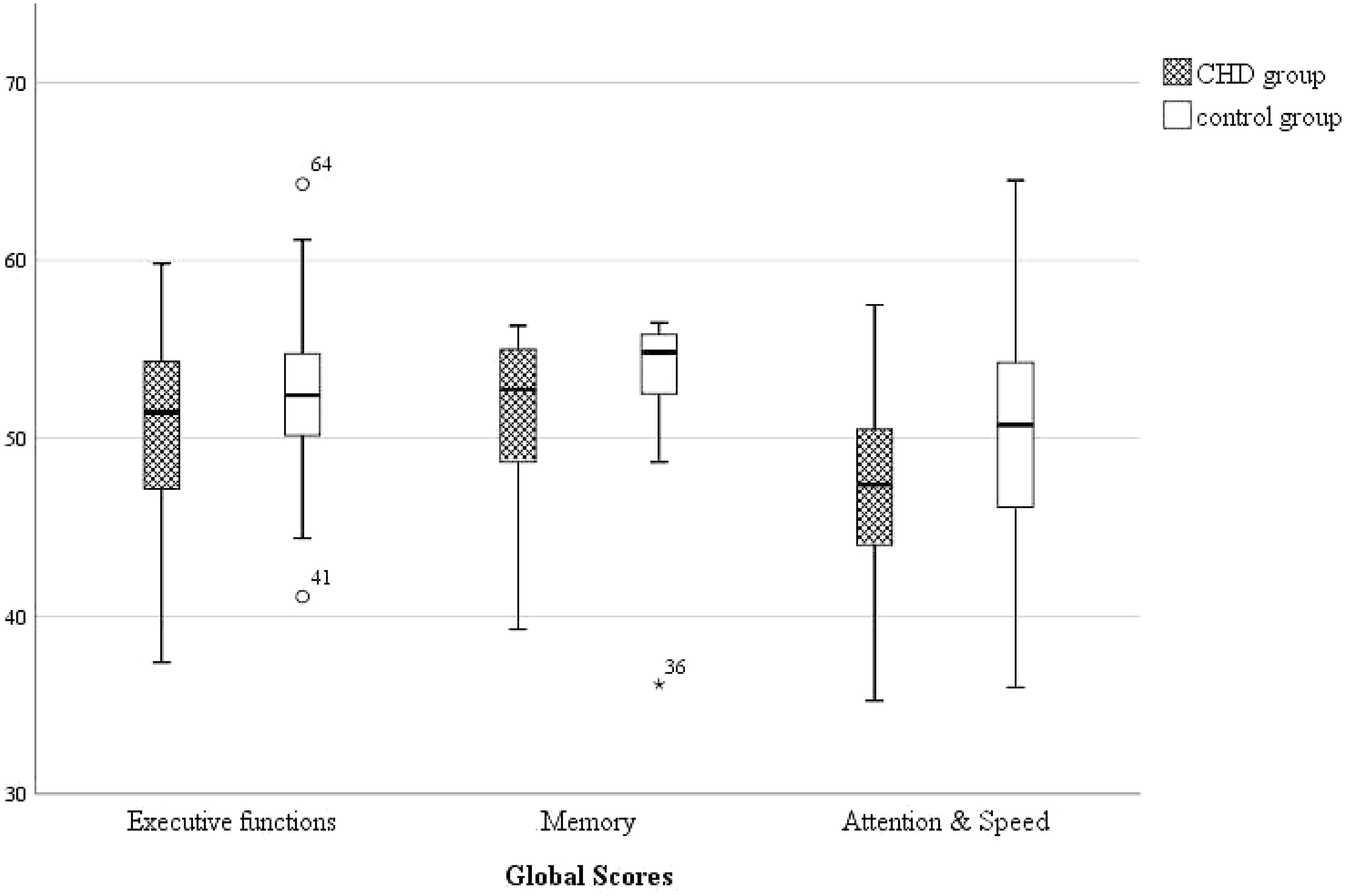
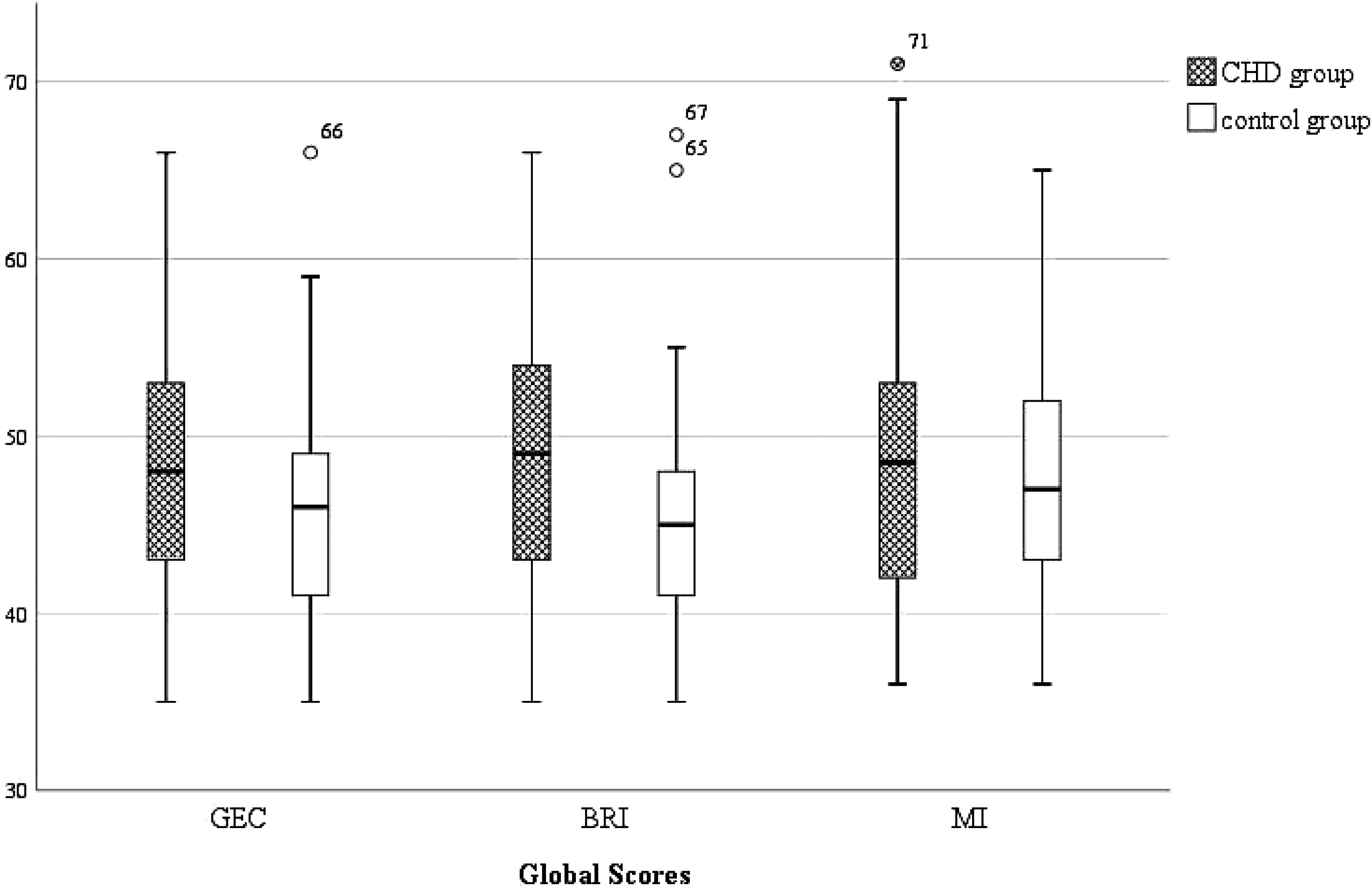
To analyse whether the CHD group differed from the control group in the three global scores and the Behaviour Rating Inventory of Executive Function indices, analyses of variance were calculated. Mean t-scores of all global scores and the Behaviour Rating Inventory of Executive Function indices are summarised in Table 3, and Figures 1 and 2 present a graphical overview of the data. We found significant group differences for global Executive Function (F (1) = 5.713, p = 0.018), Memory (F (1) = 10.569, p = 0.001), and Attention & Speed (F (1) =9.945, p = 0.002) between the CHD and control group. For the Behaviour Rating Inventory of Executive Function indices, we found significant group differences only for the Behaviour Regulation Index (F (1) = 5.015, p = 0.027), with the CHD group scoring higher, indicating higher self-reported executive function impairments in this domain of everyday behaviour. There were no group differences for Global Executive Composite (F (1) = 2.873, p = 0.093) and Metacognition Index (F (1) = 0.898, p = 0.346).
Mean t-scores and SD of the computed global scores and the Behaviour Rating Inventory of Executive Function indices for the control group and the CHD group including CHD complexities

For the Behaviour Rating Inventory of Executive Function indices, higher scores correspond to poorer self-reported executive functions.
BRI: behaviour regulation index; BRIEF: behaviour rating inventory of executive function; CHD: congenital heart disease; GEC: global executive composite; MI: metacognition index.
* n = 54.
** n = 65.
*** n = 17.
Overall, scores were within the normal range for both CHD and control group. Five patients (2.45%) and one control participant (0.46%) reached clinically relevant values of > 65 (Global Executive Composite: two patients versus no control; Behaviour Regulation Index: three patients versus no control; Metacognition Index: two patients versus one control).
Global scores comparison for the CHD and the control group. ° indicates a mild outlier (>1.5 x IQR), * indicates an extreme outlier (>3 x IQR). Y-axis represents T-scores (clinical cut-off at –1 SD = 40).

Comparison of dimensions of the BRIEF-A questionnaire for the CHD and the control group. Higher scores correspond to poorer self-reported executive functions. ° indicates a mild outlier (>1.5 x IQR). Y-axis represents T-scores (clinical cut-off at –1 SD = 40). BRI: Behaviour Regulation Index; GEC: Global Executive Composite; MI: Metacognition Index.

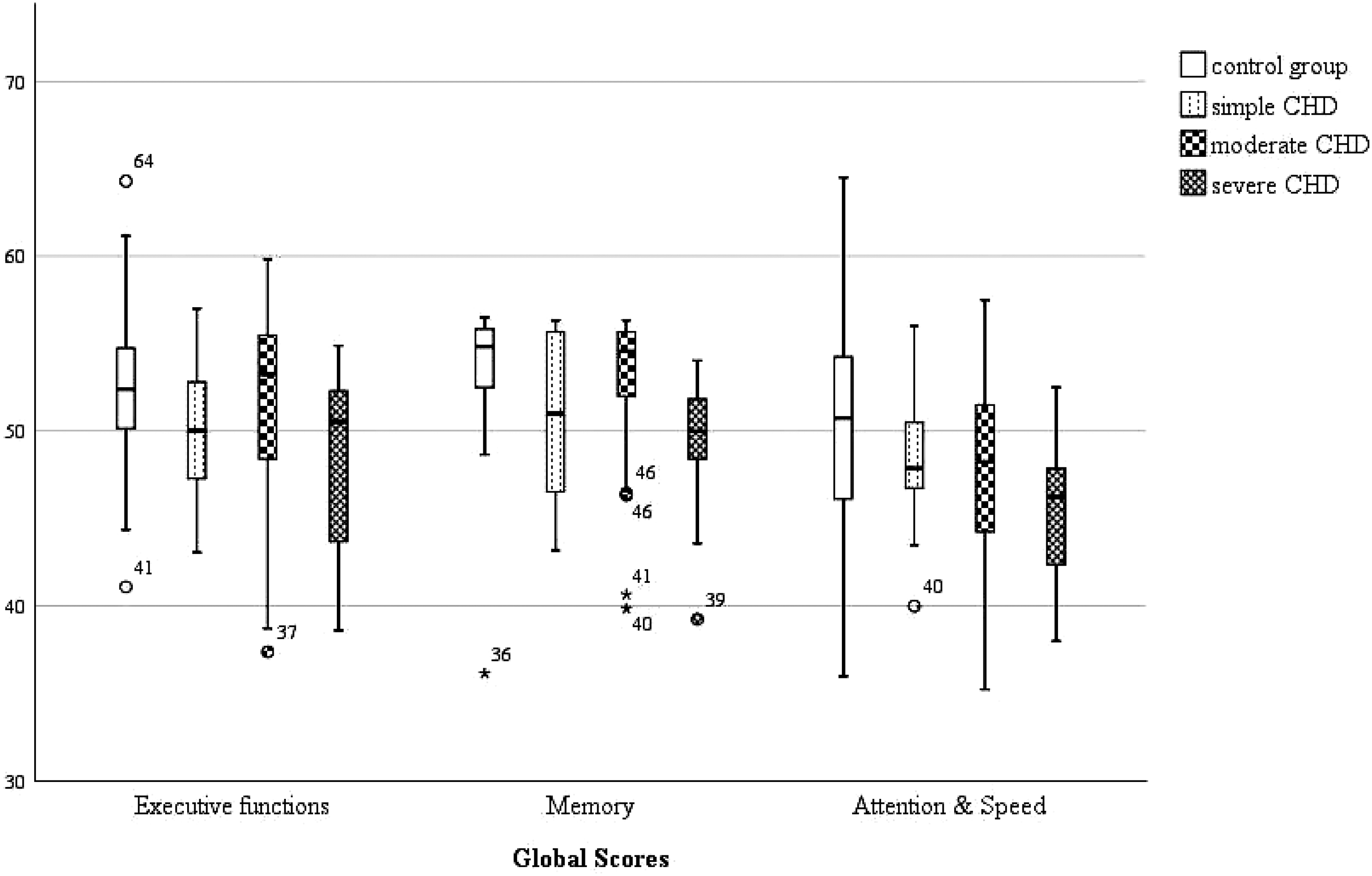
Global scores comparison for the CHD complexities and the control group. ° indicates a mild outlier (>1.5 x IQR), * indicates an extreme outlier (>3 x IQR). Y-axis represents T-scores (clinical cut-off at –1 SD = 40).

Impact of CHD complexity on neuropsychological outcome
We found significant differences for all global scores: Executive Function (F (3) = 3.887, p = 0.011), Memory (F (3) = 6.565, p < 0.001), and Attention & Speed (F (3) = 4.214, p = 0.007). Figure 3 illustrates that the control group performed best and patients with severe CHD complexity performed worst in all three global scores. A Tukey post-hoc test revealed that performance for global Executive Function was statistically significantly lower for patients with severe CHD complexity (47.87 ± 5.63 t-scores, p = 0.009) than for the control group (52.43 ± 4.09 t-scores). For global Memory score, Tukey post-hoc analyses showed poorer scores for simple (50.67 ± 4.72 t-scores, p = 0.019) and severe (49.44 ± 3.88 t-scores, p = 0.001) CHD compared with the control group (53.79 ± 3.16 t-scores) on the one hand, and severe (49.44 ± 3.88 t-scores, p = 0.034) compared with moderate (52.76 ± 4.40 t-scores) CHD on the other hand. For global Attention & Speed, severe CHD (45.58 ± 4.09 t-scores, p = 0.009) differed significantly from the control group (50.34 ± 5.58 t-scores). None of the other groups differed significantly from each other. Nevertheless, even patients with a simple CHD showed also clinically relevant deficits compared with controls in all global scores (Executive Function: d = 0.500; Memory: d = 0.776; Attention & Speed: d = 0.443) assuming effects of d > .42 as clinically relevant. Reference Ferguson and Kazdin40 No group differences were found for the Behaviour Rating Inventory of Executive Function – Adult Version indices (Global Executive Composite F (3) = 1.353, p = 0.262; Behaviour Regulation Index F (3) = 1.872, p = 0.140; Metacognition Index F (3) = 0.751, p = 0.525).
Discussion
In this cross-sectional cohort study, we report lower cognitive functioning in multiple domains in young adults with CHD in comparison to gender-, age-, and parental-socio-economic-status-matched healthy controls. Patients with severe CHD complexity were most affected. For a better understanding of affected functions, we created global scores for the domains of Executive Functions, Memory, and Attention & Speed. The CHD group scored poorer in all three global scores compared with the control group. Even though the mean test results of the CHD group in our sample were within the normal range, the number of patients scoring above the cut-off for clinically relevant impairments was larger than that of the control group. Our findings expand results from existing studies on young adults with CHD by three important aspects. First, previous studies reported impairments in executive functioning, problems with memory or attention in cohorts with either smaller sample sizes or secondly, in patients with specific types of CHD. For example, Daliento et al Reference Daliento, Mapelli and Russo14 included only patients with Tetralogy of Fallot, and Kasmi et al Reference Kasmi, Calderon and Montreuil41 assessed neurocognitive outcomes in adults with dextro-transposition of the great arteries. Other investigators studied either only male patients Reference Eide, Skjærven, Irgens, Bjerkedal and Øyen15 or included a large proportion of patients with a neurological comorbidity. Reference Ilardi, Ono, McCartney, Book and Stringer42 Third, our findings are more specific than those of previous studies using only intelligence scales as cognitive assessment Reference Eide, Skjærven, Irgens, Bjerkedal and Øyen15–Reference Utens, Verhulst and Erdman17 or questionnaire data of the Behaviour Rating Inventory of Executive Function – Adult Version to assess executive functioning. Reference Løvstad, Sigurdardottir and Andersson43 The association we found between the CHD complexity and the level of impairment in neurocognitive functioning confirms findings by other researchers examining adults with CHD. Reference Ilardi, Ono, McCartney, Book and Stringer42,Reference Klouda, Franklin, Saraf, Parekh and Schwartz44 Importantly, however, also patients with simple CHD showed difficulties in the three cognitive domains, even if their performance was not statistically different from that of the control group.
When looking at the results in more detail, we identified lower performances in visual memory, verbal working memory, divided attention, processing speed, interference control, and estimated intelligence quotient. Although effect sizes were small to medium, they suggest probability of clinical relevance. Even though it is difficult to draw a precise comparison between studies in children and adults with CHD (e.g., for methodological reasons), it is apparent that certain functional deficits persist into adolescence and adulthood. Reference Mills, McCusker, Tennyson and Hanna12 The most notable indication of such a persistence can be found in executive functions. Reference Calderon and Bellinger7 Apart from these findings, our results also provide indication of deficits that become only apparent with increasing age, particularly memory impairments. There is little evidence of memory deficits in children with a CHD. Reference Tyagi, Austin, Stygall, Deanfield, Cullen and Newman9 As the demands of different life stages change, the associated cognitive deficits also tend to emerge at different developmental stages. Whereas executive dysfunctions and attention deficits seem to appear already during childhood, memory problems may only become evident in early adulthood. Reference Keir, Ebert and Kovacs18
Beside group differences in objective neuropsychological performance, the CHD group differed from the control group also in the self-reported executive function abilities in everyday life. The CHD group reached higher scores compared with the control group in the Behaviour Regulation Index, indicating higher self-reported executive functional impairments in this domain. We also note that only five patients (2.50%) and one control participant (0.46%) reached clinically relevant scores. This finding indicates that our study sample has a relatively high self-perceived executive function level in everyday life.
Overall, the CHD group performed worse in neuropsychological testing, but the differences we found were not clinically relevant for most patients. This may be due to the fact that the study population is a high functioning population. This assumption is supported by a relatively high educational level among the CHD group. Furthermore, the examined population was relatively young and still at the height of their cognitive capacities.
A recent publication Reference Bagge, Henderson, Laursen, Adelborg, Olsen and Madsen45 showed that the CHD population might be at increased risk for early-onset dementia, in particular those patients with CHD of severe complexity. Whether neurocognitive (dys-)functioning in young adults with CHD is associated with the onset of early dementia requires long-term follow-up. Reportedly, patients with a CHD have also an increased risk for vascular cerebral injuries which become more prevalent with ageing. Reference Marelli, Miller, Marino, Jefferson and Newburger2 Whether subclinical neurocognitive disability at young adult age predicts a greater susceptibility of adverse outcomes in case of later cerebrovascular events requires long-term follow-up studies of cohorts as presented in our study.
In conclusion, young adults with CHD, particularly those with severe CHD complexity, may require special attention by health care professionals, as impaired neuropsychological functions can restrict educational achievement and employability. More specifically, executive deficits may impact patients’ ability to set targets, plan actions and self-control as impulse control and emotion regulation. Memory problems can restrict academic achievements, and attention deficits can influence the ability to maintain efficiently a full working day. To identify, monitor, and treat potential difficulties in neurocognitive functioning with aging, one may consider neuropsychological assessment as a routine clinical procedure.
Limitations
It must be considered that the response rate of 36% of the eligible patients is rather low. A reason for this low rate could be that the current study required a much more intensive examination including 3 hours of neuropsychological testing than the previous studies, for example, the one by Rometsch and colleagues, Reference Rometsch, Greutmann and Latal19 which was a questionnaire study. However, participating and non-participating patients did not differ in sample characteristics like age, sex, and CHD complexity. The studied samples of patients with CHD and healthy controls were highly educated with 14 and 15 years of schooling, respectively. Note that, according to the Swiss educational system, regular schooling encompasses a period of 12 years. On average, patients with severe CHD complexity attended this obligatory school period only. Therefore, generalisability to the population at large is limited, and the high cognitive performance may not reflect the actual neurocognitive performance of all young adults with a CHD. We included patients with different types of CHD, which increases heterogeneity of the study group and may have impacted statistical power. Accordingly, sample sizes were too small for subgroup analyses of specific CHD types (e.g., transposition of the great arteries). Finally, our study was a single centre study and, strictly speaking, the validity of the findings is restricted to a regional cohort.
Conclusion
The findings of this study indicate lower neurocognitive functioning in young adults with CHD, particularly for patients with a CHD of severe complexity. Importantly, for the majority of the CHD group, the measurable cognitive impairments are not clinically relevant. Whether sub-clinical neurocognitive dysfunction, as found in this study, translates into adverse long-term outcomes or predisposes to early-onset neurodegenerative decline requires careful prospective longitudinal follow-up studies.
Supplementary material
To view supplementary material for this article, please visit https://doi.org/10.1017/S1047951121002705.
Acknowledgements
The authors wish to sincerely thank all the patients and controls who participated in our study. They also thank W.K. for helping with the classification of the congenital heart diseases, and N.N. and M.E. for helpful discussions as part of our research team.
Financial support
This work was supported by the Swiss Heart Foundation, the Mäxi Foundation, and the Olga-Mayenfisch Foundation.
Conflicts of interest
None.
Ethical standards
The authors assert that all procedures contributing to this work comply with the ethical standards approved by the ethics committee of the Canton of Zurich and all the participants gave written informed consent prior to participation, in accordance with the Declaration of Helsinki.