Introduction
Termite colony foundation is a critical event and takes place after the swarming flights, when alates disperse from the natal nest and form monogamous pairs to establish a nest (Nutting, Reference Nutting, Krishna and Weesner1969; Nalepa and Jones, Reference Nalepa and Jones1991). Colony foundation success depends on several intrinsic and extrinsic factors (Chouvenc et al., Reference Chouvenc, Basille, Li and Su2014; Kusaka and Matsuura, Reference Kusaka and Matsuura2018; Chouvenc, Reference Chouvenc2019), and reproductives may spend energy in activities such as nest building, offspring production and initial parental care (Nutting, Reference Nutting, Krishna and Weesner1969). Termite colonies go through several developmental stages. The first stage, referred to as ‘incipient colony’, lasts around seven months and is marked by the first oviposition cycle (Chouvenc and Su, Reference Chouvenc and Su2014), followed by the ergonomic phase, in which colonies increase the production of sterile castes (Oster and Wilson, Reference Oster and Wilson1978). Oviposition rate in termites might be affected by different factors. For instance, incipient colonies tend to cease egg production during some months when the primary reproductives are still responsible for brood care, as detailed below. Moreover, field samplings have shown that weather fluctuations impact egg production, which is interrupted during colder months (Weesner, Reference Weesner, Krishna and Weesner1969; Nozaki and Matsuura, Reference Nozaki and Matsuura2021).
A successful oviposition and progeny differentiation during earlier stages of a termite colony is crucial for its development and subsequent spread (Chouvenc and Su, Reference Chouvenc and Su2014). Such dynamics, therefore, deserve attention among invasive species of economic interest (e.g. families Rhinotermitidae and Kalotermitidae) (Evans, Reference Evans2021). Egg-laying has been well studied within subterranean species (Rhinotermitidae) from temperate regions, in which the first oviposition cycle occurs within 30–70 days after pairing (table S1), followed by a period of reproductive inactivity, referred to as lag phase, that lasts from 4 to 6 months (Weesner, Reference Weesner, Krishna and Weesner1969; Raina et al., Reference Raina, Park and Florane2003; Ghesini and Marini, Reference Ghesini and Marini2009; Maekawa et al., Reference Maekawa, Ishitani, Gotoh, Cornette and Miura2010; Janowiecki, Reference Janowiecki2012; Brossette et al., Reference Brossette, Bagnères, Millot, Blanchard, Dupont and Lucas2017). Within drywood species (Kalotermitidae), the oviposition dynamic at earlier developmental stages has been poorly studied and restricted to few species (McMahan, Reference McMahan1962; Wilkinson, Reference Wilkinson1962; Lenz, Reference Lenz1987; Scheffrahn et al., Reference Scheffrahn, Su, Krecek, Van Liempt, Maharajh and Wheeler1998). Queens of C. brevis reared in subtropical areas lay eggs during the first 6 months after colony foundation and go through a lag phase that lasts 3 months (McMahan, Reference McMahan1962). Within Rhinotermitidae, parental care towards the first brood is pointed as a reason for the reproductives to cease oviposition during the first months of the colony, which is only resumed when a suitable number of workers differentiate to assist the next generation of the brood (Nutting, Reference Nutting, Krishna and Weesner1969; Nalepa and Jones, Reference Nalepa and Jones1991; Maekawa et al., Reference Maekawa, Ishitani, Gotoh, Cornette and Miura2010). Equivalent reports on the oviposition dynamics for colonies of subterranean and drywood species distributed in the Neotropical region are unknown.
The major pest species Coptotermes gestroi (Rhinotermitidae) and Cryptotermes brevis (Kalotermitidae) are native from Southeast Asia and Coastal Chile and Peru, respectively. However, both species have been introduced in several countries, including Brazil (Li et al., Reference Li, Fujisaki and Su2013). In São Paulo state, for example, C. gestroi and C. brevis are the main wood pests and show a relevant economic impact (Fontes and Milano, Reference Fontes and Milano2002; Romagnano and Nahuz, Reference Romagnano and Nahuz2006). The ecological habits differ greatly between these species, since C. gestroi has a well-established nest, separated from foraging sites, while C. brevis spends the entire life cycle of the colony in a single piece of wood, which serves as both shelter and food source (Korb and Thorne, Reference Korb, Thorne, Rubenstein and Abbot2017). Reproductive aspects also vary greatly, as C. gestroi queens show a notorious egg-laying rate (Costa-Leonardo, Reference Costa-Leonardo2002) whereas those of C. brevis display extremely low oviposition rates, which therefore impact the colony population in different ways (McMahan, Reference McMahan1962; Costa-Leonardo, Reference Costa-Leonardo2002).
Due to the cryptical habit of termites, sampling and studying reproductive individuals is challenging, resulting in knowledge gaps about their reproductive biology. Laboratory rearing systems is thus a suitable way to evaluate colony development and access the reproductive status of the royal couple (Costa-Leonardo and Barsotti, Reference Costa-Leonardo and Barsotti1998, Reference Costa-Leonardo and Barsotti2001; Laranjo et al., Reference Laranjo, da Silva and Costa-Leonardo2019; Costa-Leonardo et al., Reference Costa-Leonardo, Janei and da Silva2022; da Silva and Costa-Leonardo, Reference da Silva and Costa-Leonardo2022, Reference da Silva and Costa-Leonardo2023a, Reference da Silva and Costa-Leonardo2023b). Here, colonies of C. gestroi and C. brevis were reared and kept under laboratory conditions in Southeast Brazil and monitored over 9 months to evaluate their development and egg-laying dynamic of the queen. Our main goal was to evaluate if queens of these termite species based on the Neotropical region stop laying eggs following a first oviposition cycle, similar to what has been reported for termite species from temperate areas. Assuming the pest status and invasive success of both the species (Evans, Reference Evans2021), a better understanding of their reproductive activity during earlier developmental stages of the colony is crucial to evaluate breeding strategies and spread patterns.
Material and methods
Termites
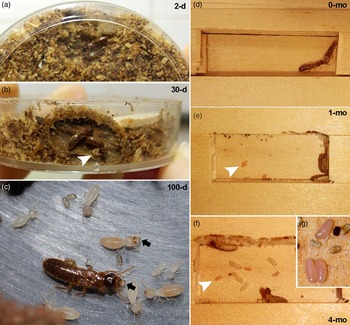
Coptotermes gestroi (Wasmann, 1896): Alates were collected during dispersal flights in the city of Rio Claro, SP, Brazil (22°23′S, 47°31′W). Sex of dealates was determined by the presence of the genital plate in the females, and the initial wet mass of each individual was measured. Alates were then paired in 6 cm Petri dishes containing decayed and moistened Pinus sp. sawdust (figs 1A–C), and kept in the dark at 25 °C.
Incipient colonies of Coptotermes gestroi (A, B and C) and Cryptotermes brevis (D, E and F) reared under laboratory conditions. (A) Recently founded colony containing the royal couple. (B) 30-day colony with eggs organised into a pile (white arrowhead). (C) 100-day colony showing the queen, larvae and workers of C. gestroi. Black arrows indicate eggs being carried. (D) Recently founded colony. (E) 1-month colony containing eggs (white arrowhead). (F) 4-month colonies highlighting the royal couple, eggs and progeny. (G) Detail of the pinkish eggs (earlier developmental stages).

Cryptotermes brevis (Walker, 1853): Alates were collected during swarming flights of laboratory colonies at the São Paulo State University, Rio Claro, SP, Brazil (22°23′S, 47°32′W). Dealates were sexed based on the stylus present in the ninth sternite of males. The initial wet mass of each individual was measured, and male–female pairs were placed in colonies made of Pinus sp. tongue blades (adapted from McMahan, Reference McMahan1962). For this purpose, tongue blades of different lengths were attached to each other using a non-toxic glue, leaving a central chamber where termites were placed. Such a chamber was then covered with a glass slide held by rubber bands (figs 1D–F). The total wood volume for each colony was 24.28 cm3, indicating an abundant amount of food for the paired reproductives (Korb and Lenz, Reference Korb and Lenz2004). Wooden termitaries were individually placed in plastic containers and kept in the dark at 25 °C.
Egg-laying dynamic and colony development
Coptotermes gestroi: Five colonies were randomly sampled at 2, 10, 20, 30, 50, 80, 100, 120, 150, 180, 200, 220, 250 and 270 days after foundation, totalizing 9 months (adapted from Raina et al., Reference Raina, Park and Florane2003). These colonies are hereafter termed according to their age (i.e. 10-, 20-, 30-day colonies). Total eggs and progeny (larvae, workers and soldiers), if present, were counted, fixed in FAA (absolute alcohol, glacial acetic acid, 40% formaldehyde, in the ratio 3:1:1) for 24 h and transferred to 80% alcohol. Larval instars were recognised according to Barsotti and Costa-Leonardo (Reference Barsotti and Costa-Leonardo2005). The final wet mass of the reproductives was measured for each sampling period.
Cryptotermes brevis: Given the extremely low egg-laying rate of the referred species, five colonies were randomly sampled per month during the 9-month period (adapted from McMahan, Reference McMahan1962). These colonies are hereafter referred according to their age (i.e. 1-, 2-, 3-month colonies). The number of eggs laid and progeny (larvae and pseudergates) were also counted, fixed in FAA for 24 h and transferred to 80% alcohol. Aiming to discriminate the larval instars and pseudergates of C. brevis, the following measurements were extracted from the progeny and compared among individuals: maximum head width (MHW), pronotum width (PW), pronotum length (PL) and tibia length (TL). Finally, the final wet mass of the reproductives was measured.
Embryo development
Assuming the necessary hatching period (see Results section), the presence of eggs themselves could not be used to infer egg-laying activity. It occurs because queens could cease oviposition but there would still be remaining eggs at later developmental stages. Thus, eggs sampled from all colonies of C. gestroi and C. brevis were analysed under Zeiss Discovery V8 stereomicroscope aiming to classify their developmental stages (Matsuura and Kobayashi, Reference Matsuura and Kobayashi2007).
Statistical analyses
Variation in the number of eggs, larvae, workers and soldiers of C. gestroi over the 9-month period was calculated using ANOVA (one-way) followed by Tukey's test or Kruskal–Wallis followed by a Student–Newman–Keuls (SNK) comparison test according to data distribution. For C. brevis, in turn, variation in the number of eggs, larvae and pseudergates among samplings were evaluated only performing a Kruskal–Wallis + SNK comparison test. The morphometrical data extracted from the progeny of C. brevis were submitted to a principal component analysis (PCA). The scores of PC1 and PC2 were analysed using ANOVA (one-way) followed by Tukey's test. Furthermore, changes in queen and king wet mass over the sampling period were compared using a paired t-test.
All data were analysed using the software R (version 4.1.0) and images were generated using GraphPad Prism 9.3.1.
Results
Coptotermes gestroi
The royal couple performed tandem behaviour right after their introduction into the Petri dishes and quickly started to excavate a chamber. Egg-laying took place around 5 days and eggs were always stuck together into a single pile. Oviposition rate varied over the 270-day period, with all colonies showing a significantly higher number of eggs when compared to 10-day colonies (P < 0.0001, ANOVA), in which oviposition had just started (fig. 2A). The first peak of eggs was reported among 50-day colonies, with mean values of 17.8 ± 1.6 eggs per colony. After a period of egg-laying reduction from 80 to 180 days, oviposition increased again, reaching a second peak among 220-day colonies, with mean values of 15.4 ± 0.7 eggs per colony. It is interesting to note that eggs were reported during the whole sampling period (fig. 2A).
Colony development in C. gestroi, with mean number ± SE of (A) eggs, (B) larvae, (C) workers and (D) soldiers sampled over the 270-day sampling period. Different letters mean statistical differences (ANOVA + Tukey's HSD test).

Eggs hatched between 50 and 60 days and larvae number remained similar (fig. 2B), but showing a slight reduction within 270-day colonies (P = 0.0228, ANOVA). Larvae comprised two instars, moulting into workers in the interval between 70 and 80 days, as 80-day colonies already showed both larvae and workers. Worker number increased significantly from 80- to 270-day samplings (P < 0.0001, ANOVA), agreeing with the slight decrease in larva number over time. At the end of the samplings (270-day colonies), workers comprised the most abundant caste (fig. 2C). Workers moulted into pre-soldiers between 90 and 100 days (not shown) and soldiers were firstly reported among 120-day colonies, but certainly differentiated from pre-soldiers before that. Such a caste was always in a low number, as expected, but increased slightly within 250-day colonies (P = 0.0246, Kruskal–Wallis), with mean values of 2.2 ± 0.4 per colony (fig. 2D).
Number of eggs at different developmental stages varied among sampling colonies and periods. The latest stage V was firstly reported among 50-day colonies, right before larval eclosion (fig. 2A and 3A), and was reported in all the following samplings, suggesting a constant progeny production (figs 3A–B). Interestingly, eggs at early development (stage I) were reported among all samplings, indicating that oviposition did not cease over the 9-month period (figs 3A–B). It therefore agrees with the occurrence of eggs in all colonies (fig. 2A).
(A and B) Developmental stage of the eggs sampled from the C. gestroi colonies (mean ± SE). Note that stage I eggs (the earliest stage) were present over the whole 270-day sampling, suggesting that oviposition was uninterrupted.

The wet mass of reproductives fluctuated over the period. Among queens, the initial and final wet mass differed significantly from 2- to 80-day colonies (fig. 4A). During the following samplings, wet mass did not vary until 250-day, in which queens started to show a significant loss of the wet mass (fig. 4A). For kings, wet mass started to increase significantly among 20-day colonies, following a similar pattern observed in C. gestroi queens, with no wet mass change from 120- to 220-day, but with significant loss among 250- and 270-day colonies (fig. 4B).
Comparison between initial and final wet mass (mean ± SE) of C. gestroi queens (A) and kings (B) over the 270-day period. *P < 0.05, **P < 0.01, ***P < 0.001. Samplings without asterisks did not show statistical difference (paired t-test).

Cryptotermes brevis
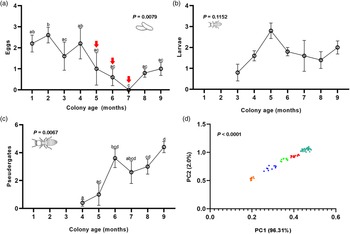
After their introduction into the wooden termitaries, reproductives took about 6 days to start excavating the wood. Oviposition started about 20 days later, with a mean number of 2 ± 0.44 eggs among 1-month colonies. During the 9-month sampling period, egg-laying rate remained extremely low, with the highest value observed among 2-month colonies (3.8 ± 0.37 eggs per colony) (fig. 5A), being significantly higher when compared to all other samplings, except for 1- and 3-month colonies (P 2-mo/1-mo = 0.1895; P 2-mo/3-mo = 0.5002, Kruskal–Wallis + SNK). Notably, eggs reduced in number after the 4-month sampling and were completely absent among 7-month colonies. Oviposition resumed in the following month, without statistical difference until the end of the samplings (fig. 5A). Eggs ranged from pink to white, according to their developmental stages, and were never kept together into piles.
Colony development in C. brevis, with mean number ± SE of (A) eggs, (B) larvae and (C) pseudergates over the 9-month sampling period. Red arrows indicate the period in which egg-laying ceased. Different letters mean statistical differences (Kruskal–Wallis + SNK comparison test). Samplings without asterisks did not show statistical significance. (D) PCA analysis showing morphometrical differences among the instars (ANOVA + Tukey's HSD test). First instar larvae = orange, second instar larvae = blue, third instar larvae = green, first instar pseudergates = red, second instar pseudergates = cyan.

Eggs hatched right before the third month, with an increasing number of larvae in the subsequent samplings (fig. 5B). However, the number of larvae decreased, although not significantly, after the sixth month (P = 0.1152, Kruskal–Wallis), corresponding to the period in which egg-laying showed the lowest values. Early-instar pseudergates, in turn, were firstly reported among 4-month-old colonies and differentiated after three larval instars (figs 5B–C). Pseudergate number increased until the ninth month, with slight fluctuations, comprising the most abundant caste of the colonies at this time (fig. 5C). Our PCA analysis significantly separated all three larval instars, as well as two pseudergate instars (P < 0.0001, ANOVA; fig. 5D). The first component (PC1) explained 96.31% of the variance, followed by the second component (PC2), with 2% of the variation. ANOVA performed on the scores of PC1 and PC2 evidenced morphometric differences among all larval and pseudergate instars (P < 0.01, Tukey's test). Soldiers were not observed over the 9-month period.
Concerning embryo development, egg stages I and II, the earliest stages, were absent from 5- to 7-month samplings, in accordance with the decreasing number of eggs. Only stages IV and V (the last developmental stage before eclosion) were reported amongst colonies during the referred period, indicating that queens ceased oviposition during this 3-month interval (fig. 6). Such an assumption is supported by the presence of earlier developmental stage eggs in 8-month colonies, in which the oviposition resumed (figs 5A and 6).
Developmental stage of the eggs sampled from the C. brevis colonies (mean ± SE). Red arrows indicate the 3-month interval in which queens ceased oviposition. Note the absence of earlier developmental stages in these samplings.

During the whole sampling, the wet mass of the queens did not vary (fig. 7A). For kings, with exception of 4-month old males (P = 0.02036, paired t-test), the wet mass did not change either (fig. 7B).
Comparison between initial and final wet mass (mean ± SE) of C. brevis queens (A) and kings (B) over the 9-month period. *P < 0.05. Samplings without asterisks did not show statistical difference (paired t-test).

Discussion
Here we evaluated the egg-laying dynamics in two major pest termite species with different ecological habits. Such colonies were reared under laboratory conditions and monitored over a 9-month period. While C. gestroi did not cease oviposition over the whole sampling, C. brevis showed a 3-month interval without laying eggs. We suggest, based on the following discussion in the light of previous studies, that these oviposition dynamics reflect reproductive strategies of the sampled species after colony foundation.
Coptotermes gestroi
Oviposition persisted over the 270-day period, given the presence of eggs, but especially those at earlier developmental stages. Thus, eggs were laid even in the presence of the first brood, which depend on the parental care provided by reproductives (Nutting, Reference Nutting, Krishna and Weesner1969; Chouvenc, Reference Chouvenc2022). Previous reports on Rhinotermitidae from temperate areas indicate that termite queens lay eggs during 30–70 days after pairing, followed by a period of reproductive inactivity that ranges from 4 to 6 months (table S1). Queens cease oviposition when the first larvae emerge and reproductives usually invest energy in parental care rather than reproduction (Nutting, Reference Nutting, Krishna and Weesner1969). When workers differentiate and their number reaches a threshold, oviposition resumes (Maekawa et al., Reference Maekawa, Ishitani, Gotoh, Cornette and Miura2010). At this time, biparental care shifts irreversibly towards alloparental care, in which workers assist the brood (Chouvenc, Reference Chouvenc2022). The occurrence of these dependent instars, therefore, seemed not to be a limiting factor for C. gestroi queens to continue laying eggs.
The uninterrupted oviposition was a striking feature in our analysis, without equivalent results for other studied subterranean species (table S1). One could argue that rearing conditions could impact physiological responses of the reproductives and, therefore, the oviposition dynamic. Nevertheless, it does not seem to be the case for our analysis on C. gestroi, as we discuss in the light of previous studies. The first oviposition cycle in Rhinotermitidae species (Coptotermes and Reticulitermes) from temperate areas was evaluated under a variety of rearing systems (i.e. using different container sizes, substrate composition and temperature), but always showed a pattern in respect to the oviposition dynamics, comprising the first egg-laying cycle followed by several months of reproductive inactivity (Raina et al., Reference Raina, Park and Florane2003; Ghesini and Marini, Reference Ghesini and Marini2009; Maekawa et al., Reference Maekawa, Ishitani, Gotoh, Cornette and Miura2010; Janowiecki, Reference Janowiecki2012; Brossette et al., Reference Brossette, Bagnères, Millot, Blanchard, Dupont and Lucas2017). Thus, rearing conditions do not impact the egg-laying dynamic, although they influence the number of eggs and progeny (Ghesini and Marini, Reference Ghesini and Marini2009; Maekawa et al., Reference Maekawa, Ishitani, Gotoh, Cornette and Miura2010; Janowiecki, Reference Janowiecki2012; Brossette et al., Reference Brossette, Bagnères, Millot, Blanchard, Dupont and Lucas2017). Based on this, we suggest that our C. gestroi reproductives do not go through a lag phase, but spend energy in both the activities (egg-laying and parental care), respecting their energetic reserves, as discussed below. In this way, queens may adjust the number of eggs laid while caring for the brood aiming to reach a suitable number of alloparents. Subterranean termite species show high mortality during the founding period (King and Spink, Reference King and Spink1974; Higa, Reference Higa1981; Kitade et al., Reference Kitade, Hayashi, Kikuchi and Kawarasaki2004). Even when colonies survive, death of larvae and workers are high in Coptotermes formosanus, indicating that the first brood has a short life expectancy (King and Spink, Reference King and Spink1974; Higa, Reference Higa1981). At the end of the 270-day sampling, the survival rate of our colonies was about 65%, all of them containing several eggs, larvae, workers and soldiers. Thus, we suggest that the strategy adopted by C. gestroi may reduce the probability of the colony failure during earlier developmental stages.
It is possible that the lag phase that usually follows the first oviposition cycle is under endogenous control rather than triggered by the presence of an offspring and its number. It was already stated that circadian rhythms play a major role in regulating oviposition cycles in ants and fruit flies (Sheeba et al., Reference Sheeba, Chandrashekaran, Amitabh and Sharma2001; Kipyatkov, Reference Kipyatkov and Kipyatkov2006; Kuroki et al., Reference Kuroki, Tagawa and Nakamura2018; Shaw et al., Reference Shaw, Fountain and Wijnen2018). Furthermore, the physiology of termite reproductives changes due to endogenous signals rather than controlled lab conditions (Li et al., Reference Li, Zhou, Huang and Huang2021). Beyond the lag phase, in which reproductives stop egg-laying to support the first brood (Nutting, Reference Nutting, Krishna and Weesner1969; Raina et al., Reference Raina, Park and Florane2003; Maekawa et al., Reference Maekawa, Ishitani, Gotoh, Cornette and Miura2010), weather fluctuations are known to impact oviposition and other termite reproductive events (Nutting, Reference Nutting, Krishna and Weesner1969; Li et al., Reference Li, Zhou, Huang and Huang2021; Nozaki and Matsuura, Reference Nozaki and Matsuura2021). We do not have sufficient evidence to infer that our colonies of C. gestroi, whose oviposition was uninterrupted, display such a behaviour in response, among other factors, to weather conditions offered by the Neotropical region. However, it was already pointed out that Neotropical termitids lay eggs all year round and suitable weather conditions may be related to this (Fernandes et al., Reference Fernandes, Czepak, Veloso, Fontes and Berti Filho1998; Torales and Coronel, Reference Torales and Coronel2004; Etcheverry et al., Reference Etcheverry, Godoy and Torales2010; Laffont et al., Reference Laffont, Coronel, Godoy and Torales2012; Annoni et al., Reference Annoni, Coronel and Laffont2013). Future studies comparing the oviposition dynamics of C. gestroi between natural and introduced areas would be valuable to evaluate if there are other mechanisms underlying this strategy, especially given that C. gestroi was introduced in Southeast Brazil around 100 years ago and is well established in this region (Fontes and Milano, Reference Fontes and Milano2002).
Wet mass of the C. gestroi reproductives varied over time and corroborates data for the same species reared under other conditions (Chouvenc, Reference Chouvenc2022), increasing significantly until 50-day post-foundation (gaining weight phase), but decreasing from 50 to 100 days (losing weight phase), and remained equal or lower to their initial wet mass in the following samplings (stagnant weight phase). The increase in wet mass over the first 50 days coincides with the reabsorption of environmental water and inflation of the hindgut due to the replication of flagellate mutualists (Shimada et al., Reference Shimada, Lo, Kitade, Wakui and Maekawa2013; Inagaki et al., Reference Inagaki, Yanagihara, Fuchikawa and Matsuura2020; Velenovsky et al., Reference Velenovsky, Gile, Su and Chouvenc2021). Subsequently, wet mass loss among 50–100-day reproductives is probably due to the emergence of the offspring, which are provided with mutualistic gut loads and salivary secretions from the reproductives through proctodeal and stomodeal trophallaxis, respectively (Nalepa, Reference Nalepa2015; Brossette et al., Reference Brossette, Meunier, Dupont, Bagnères and Lucas2019; Velenovsky et al., Reference Velenovsky, Gile, Su and Chouvenc2021). Moreover, reproductives also deplete their nutritional reserves to produce eggs and assist the first brood (Zhang et al., Reference Zhang, Ren, Chu, Guan, Yang, Liu, Zhang, Ge and Huang2021; Chouvenc, Reference Chouvenc2022), which therefore impact their wet mass. Although the similar values in the following samplings, probably due to differentiation and support of alloparents, both queens and kings from 250- and 270-day colonies lost significant wet mass. Queens and kings of Reticulitermes chinensis reared at 25 °C lose wet mass around 7.5-month post-foundation, a likely dehydration in response to colonies entering the winter season. It was suggested by the authors, as well as discussed above, that endogenous signs predominate over the controlled rearing conditions (Li et al., Reference Li, Zhou, Huang and Huang2021). Such an assumption may be applied for C. gestroi colonies studied here, since the last samplings (250- and 270-day) occurred in May, when external temperature oscillates greatly.
Cryptotermes brevis
Based on our results, queens of C. brevis sampled in southeast Brazil lay eggs until the fifth month after colony foundation and cease such an activity during a 3-month period. It therefore agrees with the 3-month lag phase found for the same species sampled in Hawaii (McMahan, Reference McMahan1962). Egg-laying took about 20 days to start, similar to that reported for other kalotermitids such as Kalotermes flavicollis and Cryptotermes havilandi (Grassé and Noirot, Reference Grassé and Noirot1958; Wilkinson, Reference Wilkinson1962). Queens of C. brevis, as well as of other drywood termites, are known for laying extremely low amounts of eggs (McMahan, Reference McMahan1962; Wilkinson, Reference Wilkinson1962; Noirot, Reference Noirot and Engels1990; Scheffrahn et al., Reference Scheffrahn, Su, Krecek, Van Liempt, Maharajh and Wheeler1998), resulting in colonies comprising a few hundred individuals (Korb and Thorne, Reference Korb, Thorne, Rubenstein and Abbot2017). Even so, C. brevis queens sampled here ceased oviposition during a 3-month period after the eclosion of the first larvae, probably to care for the first brood, despite its low number (McMahan, Reference McMahan1962; Steward, Reference Steward1983; Lenz, Reference Lenz1987).
It is suggested that C. brevis reproductives rarely feed and must nourish the first brood by depleting their body reserves (Lenz, Reference Lenz1987). Nevertheless, we observed faecal pellets on our C. brevis termitaries before the eggs hatched, suggesting that reproductives fed on nest wood. It is interesting to note that we offered wood termitaries of 24.28 cm3, corresponding to an abundant amount of food (Korb and Lenz, Reference Korb and Lenz2004), against those of 2.62 cm3 from the pioneer study of McMahan (Reference McMahan1962). Even so, the egg-laying dynamics were quite similar, suggesting that the different rearing conditions did not influence the 3-month lag phase. As discussed above, such a dynamic within drywood species may also be controlled by endogenous signals whereas egg number and progeny may reflect rearing conditions, in this case, the avoidance of intraspecific competition and pre-existence of a nuptial chamber (McMahan, Reference McMahan1962; Scheffrahn et al., Reference Scheffrahn, Su, Krecek, Van Liempt, Maharajh and Wheeler1998).
Egg-laying resumed among 8-month colonies, 3 months after queens ceased oviposition. Our morphometrical analysis suggests the differentiation of at least two pseudergate instars, referred to as fourth+ nymphal instar by McMahan (Reference McMahan1962), and three larval instars, in accordance with data for Cryptotermes spp. (Korb and Katrantzis, Reference Korb and Katrantzis2004; Cesar et al., Reference Cesar, Giacometti, Costa-Leonardo and Casarin2019). The increasing number of larvae among 9-month colonies, following the resumed egg-laying, indicates that another generation of brood had developed, probably supported by nestmates. Brood care performed by alloparents of drywood species has been discussed by several studies (LaFage and Nutting, Reference LaFage, Nutting and Brian1978; Steward, Reference Steward1983; Crosland et al., Reference Crosland, Traniello and Scheffrahn2004; Nalepa, Reference Nalepa2015, Reference Nalepa2016).
With the exception of 4-month-old kings, we did not observe a difference between the initial and final wet mass of C. brevis reproductives. Assuming that mass gain during the initial stages of the colony is partially attributed to environmental water resorption, it seems plausible that C. brevis do not gain significant wet mass, given that colonies are founded under low moisture levels, around 7–12% (Haigh et al., Reference Haigh, Hassan and Hayes2022). Similar to other termite species, neonates of drywood termites must rely on the parents to receive protozoan loads by feeding on hindgut fluids (Nalepa, Reference Nalepa2016). Even so, the relation between wood consumption (assumed due to the occurrence of faecal pellets) and gut protozoa duplication remains to be explored for C. brevis, as well as its impact on wet mass.
Conclusions
Our scientific outcomes indicated contrasting colony demography between C. gestroi and C. brevis. Such features were not likely to be influenced by rearing conditions and seem to be controlled by endogenous signals, reflecting on different post-colony foundation reproductive strategies. The uninterrupted oviposition performed by C. gestroi queens was remarkable, differing from that reported for subterranean species from temperate areas, with absence of the well-known period of reproductive inactivity that follows the first oviposition cycle. The concomitant production of eggs and the parental care towards the first brood would reflect the capacity of the royal couple in investing energy in different reproductive tasks and are likely to reduce the chances of the colony failure during earlier developmental stages. The long-term impact of such a dynamic remains to be explored, given that laboratory colonies of C. formosanus and Reticulitermes flavipes kept for longer periods than ours show distinct oviposition cycles with intervening lag phases (Raina et al., Reference Raina, Park and Florane2003; Janowiecki, Reference Janowiecki2012). C. brevis queens, on the other hand, ceased oviposition during a 3-month period, when the royal couple cared for the first brood until the differentiation of alloparents. With exception to C. gestroi, such a dynamic is in accordance with that of most termite studies sampled so far.
Acknowledgements
This study was financed in part by the Coordenação de Aperfeiçoamento de Pessoal de Nível Superior – Brasil (CAPES) – Finance Code 001 and Conselho Nacional de Desenvolvimento Tecnológico – CNPq (grant number 305539/2014-0).
Supplementary material
The supplementary material for this article can be found at https://doi.org/10.1017/S0007485323000421.
Competing interests
None.