Introduction
Nasal septal haematomas and nasal septal abscesses are rare and are defined as collections of blood or pus under the mucoperichondrium and/or periosteum of the nasal septum.Reference Nwosu and Nnadede1 The main aetiology for nasal septal haematoma is trauma, whilst the majority of nasal septal abscesses are thought to arise from infected nasal septal haematomas.Reference Alshaikh and Lo2 Other rare causes of nasal septal abscess include infections from the paranasal sinuses, oral cavity or orbits.Reference Beck3–Reference Lee and Leem5 Spontaneous nasal septal abscesses have also been reported.Reference Li, Tao and Shi6 The rate of nasal septal haematoma and nasal septal abscess was reported to be 0.9 per cent in a large case series of 2500 nasal trauma cases in children.Reference Zielnik-Jurkiewicz, Olszewska-Sosińska and Rapiejko7 Main symptoms include nasal obstruction, pain and discharge; clinical examination may reveal a unilateral or bilateral septal swelling.Reference Canty and Berkowitz8, Reference Jalaludin9
Management of a nasal septal collection requires prompt diagnosis and adequate surgical drainage, often in conjunction with antibiotics.Reference Sayin, Yazici, Abakay, Saygan and Gunes10, Reference Sogebi and Oyewole11 Complications can arise due to delayed or inadequate treatment leading to severe functional and cosmetic sequelae, septal perforation, nasal bridge (saddle nosed) deformity or spread of the infection to the orbit or intracranially.Reference Jalaludin9, Reference Sayin, Yazici, Abakay, Saygan and Gunes10, Reference Chukuezi12–Reference Ambrus, Eavey, Baker, Wilson and Kelly15
Nasal septal haematomas and nasal septal abscesses are rare and are considered in patients presenting with acute nasal blockage and septal swelling, particularly in cases of nasal trauma. Other symptoms include fever, facial pain and rhinorrhoea.Reference Kopacheva-Barsova and Arsova16 Early diagnosis and prompt drainage is imperative to minimise the risk of local and distant complications.Reference Canty and Berkowitz8, Reference Ambrus, Eavey, Baker, Wilson and Kelly15 Significant delays in presentation can have potentially life-threatening complications including intra-cranial infectionReference Chukuezi12 due to the retrograde venous drainage of the nose.Reference Varshney, Malhotra, Gupta, Gairola and Kaur17
Surgical techniques include needle aspiration, incision and drainage with or without nasal packing, surgical drains and quilting sutures.Reference Nwosu and Nnadede1, Reference Canty and Berkowitz8–Reference Ambrus, Eavey, Baker, Wilson and Kelly15, Reference Dispenza, Saraniti, Dispenza, Caramanna and Salzano18–Reference Kryger and Dommerby20 There is a paucity of evidence regarding the optimal management of nasal septal haematomas and nasal septal abscesses, reflected by the absence of established treatment guidelines. Given the rarity of nasal septal haematomas or nasal septal abscesses, the evidence base is largely limited to case reports and small series. There is scope to summate data from individual studies to further characterise this condition, management strategies and treatment outcome. The aim of this review is to report the different types of treatment and reported outcomes within the literature in order identify a stronger evidence base for managing nasal septal haematomas and nasal septal abscesses.
Methods
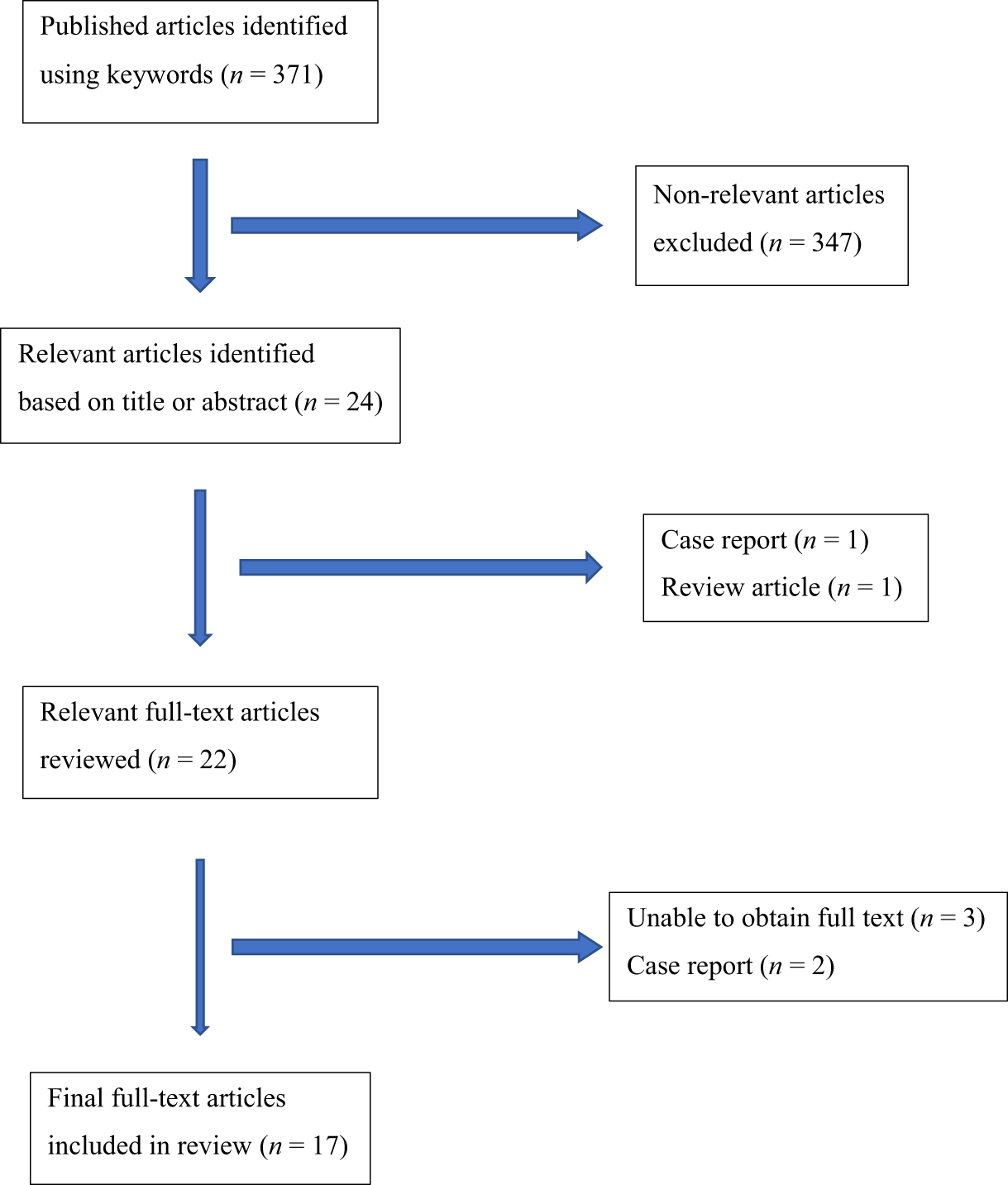
The systematic review was reported as per the Preferred Reporting Items for Systematic Review and Meta-Analyses ‘PRISMA’ guidelines (see Figure 1).
Preferred Reporting Items for Systematic Review and Meta-Analyses ‘PRISMA’ flow diagram showing the selection process.

Eligibility criteria
All original studies reporting outcomes on patients (paediatric and adult) treated for nasal septal haematoma or nasal septal abscess. Articles not available in the English language and review articles were excluded alongside case reports (due to a high risk of bias).
Information sources
A systematic review of the databases Embase, PubMed, Cochrane Central Register of Controlled Trials (CENTRAL) and CINAHL from inception up to 31 July 2023 was performed. The search terms (septal abscess) OR (septal haematoma) OR (septal hematoma) OR (septal collection) OR (septal seroma) were used across all search fields.
Study records and data items
Titles and abstracts from the initial search were independently screened by two authors (RJ and WJ). Full text for articles identified as potentially relevant was reviewed to assess for eligibility. Data were extracted by both authors to check for accuracy and collated using a standardised data-collection proforma. The reference sections of all original articles were hand-searched to identify other potentially relevant articles. The process undertaken is presented in Figure 1. Data were collected on the following variables: study details, patient demographics, aetiology of haematoma/abscess, antibiotic use, management information (anaesthetic, intervention, use of packing/drains/quilting sutures), complications and outcomes.
Risk of bias
A modified Murad tool was used to assess quality of all studies included in the review.Reference Murad, Sultan, Haffar and Bazerbachi21 The maximum quality score a study could have was 5 as per our modified Murad tool.
Data Synthesis
Quantitative synthesis of data from individual studies was performed if there was similarity in study methods and outcome assessment. Otherwise, we did a formal narrative synthesis on outcomes of individual studies and discussed relationship between study methods and outcomes.
Results
General demographics
Seventeen studies (see Table 1) were included in this review: two prospective observational cohort studiesReference Nwosu and Nnadede1, Reference Chukuezi12 and 15 retrospective observational cohort studies.Reference Canty and Berkowitz8–Reference Sogebi and Oyewole11, Reference Ahmed, Ashfaq and Shabbir13–Reference Ambrus, Eavey, Baker, Wilson and Kelly15, Reference Dispenza, Saraniti, Dispenza, Caramanna and Salzano18–Reference Kryger and Dommerby20 Management of nasal septal haematomas and nasal septal abscesses were reported in 10 studies, six studies reported only nasal septal abscess cases, whilst one study only reported a nasal septal haematoma case. Overall, the studies included 503 patients:192 patients (38.2 per cent) with nasal septal haematoma and 292 patients (58.1 per cent) with nasal septal abscess. In one study, the proportion of nasal septal haematomas and nasal septal abscesses was unclear accounting for the remaining 19 patients (3.8 per cent).
Study characteristics, method of drainage and outcomes

Retro = retrospective; Pro = prospective; A = aspiration; I+D = incision and drainage.
Twelve studies provided exact numbers of patients grouped as either paediatric (191 patients) or adult (97 patients). Four studies did not mention the distribution of paediatric and adult patients within their studies (totalling 215 patients). The commonest aetiology of nasal septal haematoma or nasal septal abscess occurred in 293 of 503 (58.3 per cent) patients. Other causes included idiopathic (58 of 503, 11.5 per cent), vestibulitis/furuncle (5 of 503, 1.0 per cent), sinus/upper respiratory tract infection (3 of 503, 0.6 per cent), iatrogenic (3 of 503, 0.6 per cent), diabetes (3 of 503, 0.6 per cent) and there was no mention of an aetiology for 138 of 503 (27.4 per cent) patients.
Use of antibiotics
Ten studies used antibiotics in all patients, including five studies treating nasal septal haematoma and nasal septal abscess patients, and five studies of nasal septal abscess cases only.Reference Canty and Berkowitz8–Reference Sogebi and Oyewole11, Reference Tavares, Neves, Angélico, Voegels and Butugan14, Reference Ambrus, Eavey, Baker, Wilson and Kelly15 Three additional studies used antibiotics in selected cases most commonly in the presence of abscesses.Reference Chukuezi12, Reference Kryger and Dommerby20, Reference Ali, Zavala, Chinnadurai and Roby22 Ali et al.,Reference Ali, Zavala, Chinnadurai and Roby22 described the management of nasal septal haematoma patients, and identified 7 of 13 with an abscess at the time of drainage; these patients were given antibiotics, whilst those with haematomas alone were not.
Chukuezi et al.Reference Chukuezi12 used antibiotics based on culture and sensitivity results from evacuated septal material; however, it is unclear if or when empirical antibiotics were administered. In their series, four patients developed brain abscesses which the authors attributed to delays presenting to hospital and not through antibiotic use.Reference Chukuezi12
Tavares et al.Reference Tavares, Neves, Angélico, Voegels and Butugan14 recommended a first dose of intravenous (IV) antibiotic prior to incision and drainage in a series of nasal septal haematoma (n = 1) and nasal septal abscesses (n = 29) with Cefalotine (8 g), a first-generation cephalosporin antibiotic, prescribed most frequently and continued 3–5 days post-drainage followed by oral antibiotics for 7–10 days. Sayin et al.Reference Sayin, Yazici, Abakay, Saygan and Gunes10 gave IV ampicillin–sulbactam (± metronidazole in cases of nasal septal abscess), followed by oral antibiotics on discharge totalling 10 days for nasal septal haematoma and 14 days for nasal septal abscess. Both Canty et al.Reference Canty and Berkowitz8 and Ambrus et al.Reference Ambrus, Eavey, Baker, Wilson and Kelly15 used a variety of antibiotic combinations. Canty et al.Reference Canty and Berkowitz8 often favoured IV floxacillin (± additional oral or intravenous antibiotic) or oral amoxicillin in patients with nasal septal haematoma and nasal septal abscess. Ambrus et al.Reference Ambrus, Eavey, Baker, Wilson and Kelly15 commonly used intravenous oxacillin or ampicillin, whilst being the only study to use intramuscular antibiotics (intramuscular benzathine) in patients with nasal septal abscess. Studies by Ngo et al.,Reference Ngo, Luong, Le, Nguyen and Tran23 Chen et al.Reference Cheng, Wu, Shih, Wang, Chen and Lin24 and Wasilewska et al.Reference Wasilewska and Zawadzka‐Głos25 used broad-spectrum empirical antibiotics such as co-amoxiclav, second-generation cephalosporins, metronidazole or clindamycin with culture and sensitivity determining final antibiotic choice in patients with nasal septal abscessReference Ngo, Luong, Le, Nguyen and Tran23, Reference Cheng, Wu, Shih, Wang, Chen and Lin24 or nasal septal haematoma and nasal septal abscess.Reference Wasilewska and Zawadzka‐Głos25
In the five studies that administered antibiotics in all cases of nasal septal haematoma, none reported progression to nasal septal abscess, supporting the potential for antibiotics being protective against the development of nasal septal abscess.Reference Canty and Berkowitz8, Reference Sayin, Yazici, Abakay, Saygan and Gunes10, Reference Sogebi and Oyewole11, Reference Tavares, Neves, Angélico, Voegels and Butugan14, Reference Wasilewska and Zawadzka‐Głos25 In the Kryger et al. study,Reference Kryger and Dommerby20 one patient initially presenting with nasal septal haematoma progressed to nasal septal abscess. This was drained and treated with antibiotics, however, it is unclear whether this patient had started antibiotics on initial presentation prior to progression to nasal septal abscess.Reference Kryger and Dommerby20 No study evaluated routine antibiotics in nasal septal haematomas to prevent abscess formation, however, one study reported a single case of nasal septal haematoma which developed into nasal septal abscess when initial antibiotics were not given.Reference Kryger and Dommerby20
Treatment and use of anaesthetic
All 17 studies used incision and drainage as the definitive treatment for nasal septal haematoma or nasal septal abscess (n = 503). No studies reported aspiration of the septal collection as a definitive surgical intervention. Three studies performed pre-operative needle aspiration to confirm the diagnosis prior to incision and drainage.Reference Nwosu and Nnadede1, Reference Sayin, Yazici, Abakay, Saygan and Gunes10, Reference Ngo, Luong, Le, Nguyen and Tran23
Incision and drainage were performed under general anaesthetic (GA) in (241 of 503 patients, 47.9 per cent) and under local anaesthetic (LA) in (65 of 503 patients, 12.9 per cent). In six studies totalling 197 of 503 (39.2 per cent) patients, the type of anaesthetic was not clearly stated. Ahmed et al.Reference Ahmed, Ashfaq and Shabbir13 and Ngo et al.Reference Ngo, Luong, Le, Nguyen and Tran23 both performed drainage almost exclusively under LA in a population of adults. Several authors specifically recommended drainage under GA within the paediatric population.Reference Canty and Berkowitz8, Reference Tavares, Neves, Angélico, Voegels and Butugan14 The only study to use sedation was by Jalaludin et al.Reference Jalaludin9 who used pethidine and promethazine (Phenergan) injections, however, the proportion and age of patients given sedation was not stated.
Method of drainage, use of drains, sutures and packs
Several studies outlined the type of incision made, including hemi-transfixion,Reference Sayin, Yazici, Abakay, Saygan and Gunes10 J-shaped incision,Reference Sogebi and Oyewole11 extended modified Killian incision,Reference Ngo, Luong, Le, Nguyen and Tran23 inferior incisionReference Cheng, Wu, Shih, Wang, Chen and Lin24 or a vertical incision over area of maximum fluctuance and washout.Reference Nwosu and Nnadede1 Tavares et al.Reference Tavares, Neves, Angélico, Voegels and Butugan14 recommend using bilateral mucosal incisions in the presence of bilateral septal swellings, however, they did not report any further details of their drainage technique. The remaining studies did not describe the operative techniques for surgical drainage in detail. For studies including both nasal septal haematoma and nasal septal abscess patients, no study described a different surgical drainage technique utilised based on the type of collection found intra-operatively.
A surgical drain was used in 10 studies,Reference Nwosu and Nnadede1, Reference Canty and Berkowitz8, Reference Sayin, Yazici, Abakay, Saygan and Gunes10, Reference Chukuezi12, Reference Tavares, Neves, Angélico, Voegels and Butugan14, Reference Ambrus, Eavey, Baker, Wilson and Kelly15, Reference Alvarez, Osorio, De Diego, Prim, De La Torre and Gavilan19, Reference Ali, Zavala, Chinnadurai and Roby22–Reference Cheng, Wu, Shih, Wang, Chen and Lin24 with eight using a Penrose drain which was removed 2–3 days post-drainage. An established pattern for using a drain was not identified with its use for both nasal septal haematoma and nasal septal abscess. In Canty et al.,Reference Canty and Berkowitz8 a Penrose drain was used in only 4 of 20 patients, without explanation for its use in selected cases. Two of these cases (50 per cent) were re-collected with the author concluding that a drain was not beneficial.Reference Canty and Berkowitz8 Ali et al.Reference Ali, Zavala, Chinnadurai and Roby22 identified two re-collections in patients that had Penrose drains and splints placed following drainage. Both were re-drained with a Penrose drain and splints being used again.Reference Ali, Zavala, Chinnadurai and Roby22 Other studies using Penrose drains in 531 and 16Reference Alvarez, Osorio, De Diego, Prim, De La Torre and Gavilan19 patients, respectively, reported no re-collections, whilst Sayin et al.Reference Sayin, Yazici, Abakay, Saygan and Gunes10 had two re-collections amongst 68 patients (2.9 per cent). Chukuezi et al.Reference Chukuezi12 described using a drainage tube which was removed 3–4 days post-drainage, but no further details on the specific type of tube and the authors reported no re-collections.
The types of nasal packing used following surgical drainage include Merocel packs,Reference Dispenza, Saraniti, Dispenza, Caramanna and Salzano18, Reference Ngo, Luong, Le, Nguyen and Tran23 simple gauze,Reference Chukuezi12 finger cots,Reference Ambrus, Eavey, Baker, Wilson and Kelly15 internal nasal splints,Reference Sayin, Yazici, Abakay, Saygan and Gunes10, Reference Ali, Zavala, Chinnadurai and Roby22 antibiotic laden gauze with or without VaselineReference Nwosu and Nnadede1, Reference Sogebi and Oyewole11 and povidone-impregnated gauze.Reference Ngo, Luong, Le, Nguyen and Tran23 No studies used absorbable nasal packing, and the packing material was removed 2–7 days after insertion. Several studies used nasal packing, but failed to state the type.Reference Canty and Berkowitz8, Reference Alvarez, Osorio, De Diego, Prim, De La Torre and Gavilan19, Reference Kryger and Dommerby20, Reference Cheng, Wu, Shih, Wang, Chen and Lin24 Nasal packing was commonly used alongside a septal drain.Reference Canty and Berkowitz8, Reference Sayin, Yazici, Abakay, Saygan and Gunes10, Reference Chukuezi12, Reference Ambrus, Eavey, Baker, Wilson and Kelly15, Reference Ali, Zavala, Chinnadurai and Roby22–Reference Cheng, Wu, Shih, Wang, Chen and Lin24 All 10 studies that placed a drain concurrently used nasal splints or packing. Two studies used intranasal packing without a drain.Reference Dispenza, Saraniti, Dispenza, Caramanna and Salzano18, Reference Kryger and Dommerby20
Septal quilting sutures were described in two studies.Reference Sayin, Yazici, Abakay, Saygan and Gunes10, Reference Ahmed, Ashfaq and Shabbir13 Ahmed et al.Reference Ahmed, Ashfaq and Shabbir13 detailed their technique of a continuous quilting suture using absorbable 3.0 dyed vicryl without nasal packing and highlighted the importance of keeping at least a 1-cm gap between suture points to avoid iatrogenic septal perforation. Sayin et al.Reference Sayin, Yazici, Abakay, Saygan and Gunes10 used absorbable suture material to quilt the septum alongside nasal splints, although the suture material was not mentioned.
Re-collection, complications, follow up
Across all studies 18 of 503 (3.6 per cent) septal collections required repeat drainage (4 haematomas, 6 abscesses, 8 haematoma or abscess). The highest rate of re-collection occurred in the Tavares et al.Reference Tavares, Neves, Angélico, Voegels and Butugan14 study involving 7 of 30 (23.3 per cent) cases. Of note 13 of 30 (43.3 per cent) drainages were performed in the emergency room (and assumed to be under LA); of these, 93.4 per cent of patients in their cohort had a septal abscess drained at the time.Reference Tavares, Neves, Angélico, Voegels and Butugan14 On the other hand, Ambrus et al.Reference Ambrus, Eavey, Baker, Wilson and Kelly15 described the success of LA drainage which was used in 10 patients without any re-collection or complications.
Complications from septal collections included palatal abscess,Reference Tavares, Neves, Angélico, Voegels and Butugan14 intranasal synechiae,Reference Tavares, Neves, Angélico, Voegels and Butugan14 facial and orbital cellulitis,Reference Sogebi and Oyewole11, Reference Tavares, Neves, Angélico, Voegels and Butugan14 septal perforation,Reference Jalaludin9, Reference Tavares, Neves, Angélico, Voegels and Butugan14 saddle nose deformityReference Jalaludin9, Reference Ahmed, Ashfaq and Shabbir13–Reference Ambrus, Eavey, Baker, Wilson and Kelly15, Reference Cheng, Wu, Shih, Wang, Chen and Lin24 and nasal deformityReference Jalaludin9, Reference Chukuezi12, Reference Ambrus, Eavey, Baker, Wilson and Kelly15, Reference Wasilewska and Zawadzka‐Głos25 Other studies divided complications into minor and major sequalae.Reference Sayin, Yazici, Abakay, Saygan and Gunes10, Reference Alvarez, Osorio, De Diego, Prim, De La Torre and Gavilan19 Significant intracranial complications were rare (six cases).Reference Sogebi and Oyewole11, Reference Chukuezi12, Reference Tavares, Neves, Angélico, Voegels and Butugan14 Two studies reported individual cases of frontal empyema.Reference Sogebi and Oyewole11, Reference Tavares, Neves, Angélico, Voegels and Butugan14 Chukezi et al.Reference Chukuezi12 reported four cases of brain abscess secondary to nasal septal abscess (including one case of cavernous sinus thrombosis) resulting in three deaths. Importantly these patients had significantly delayed presentations to hospital, ranging from 3 to 4 weeks from the onset of symptoms.Reference Chukuezi12
Other studies reported similar complication rates between patients with nasal septal haematoma and nasal septal abscess.Reference Sayin, Yazici, Abakay, Saygan and Gunes10 Canty et al.Reference Canty and Berkowitz8 reported a higher rate of cartilage necrosis in patients with nasal septal abscess, whilst Ahmed et al.Reference Ahmed, Ashfaq and Shabbir13 reported saddle nose deformity in all nasal septal abscess cases, albeit the number of which is not clear. Most studies reporting patients with nasal septal haematoma and nasal septal abscess described collective complications across both cohorts making it challenging to ascertain the effect that the type of septal collection had on the subsequent complication.Reference Sayin, Yazici, Abakay, Saygan and Gunes10, Reference Chukuezi12, Reference Tavares, Neves, Angélico, Voegels and Butugan14, Reference Alvarez, Osorio, De Diego, Prim, De La Torre and Gavilan19, Reference Kryger and Dommerby20
Several authors reported reducing nasal fractures (when present) at the time of septal drainage.Reference Sayin, Yazici, Abakay, Saygan and Gunes10, Reference Dispenza, Saraniti, Dispenza, Caramanna and Salzano18–Reference Kryger and Dommerby20 Removal of necrotic cartilage and re-implantation at the time of drainage was also described.Reference Sayin, Yazici, Abakay, Saygan and Gunes10, Reference Dispenza, Saraniti, Dispenza, Caramanna and Salzano18 Sayin et al.Reference Sayin, Yazici, Abakay, Saygan and Gunes10 excised necrotic areas of cartilage and re-implanted residual septal cartilage to the defective area with 61.7 per cent of patients developing minor or major sequelae, although rates of septal perforation were not reported. Dispenza et al.Reference Dispenza, Saraniti, Dispenza, Caramanna and Salzano18 described two techniques to repair areas of necrotic cartilage, the first using homologous cartilage obtained from a cartilage bank (used in three cases), whilst the second, called the mosaic technique, utilised multiple small fragments of residual septal cartilage fixed with fibrin glue (used in four cases). Overall, no septal perforations were reported,Reference Dispenza, Saraniti, Dispenza, Caramanna and Salzano18 therefore immediate repair of necrotic septal cartilage may have a role in preventing septal perforation.
The length of follow up varied between studies. Ali et al.Reference Ali, Zavala, Chinnadurai and Roby22 had a short median follow up of one month but reported that seven patients developed long-term sequelae. Dispenza et al.Reference Dispenza, Saraniti, Dispenza, Caramanna and Salzano18 reported long-term results at 5- and 10-year follow-up periods; they reported normal development of the face and nasal pyramid in their cohort of seven paediatric patients treated for traumatic septal abscesses.
Across the 17 articles the median quality score (interquartile range) was 1.5 (0–4), indicating the studies were generally of low quality (Table 2)
Modified Murad tool – quality assessment applied to studies within literature review

Discussion
This review sought to characterise management strategies of nasal septal haematomas and nasal septal abscesses, and their influence on outcomes. Several studies stress the importance of early diagnosis and drainage of nasal septal haematomas and nasal septal abscesses to avoid complications and long-term sequalae.Reference Chukuezi12, Reference Kryger and Dommerby20 Nasal septal abscesses often present later than nasal septal haematomas.Reference Chukuezi12, Reference Kryger and Dommerby20 Delays in surgical intervention may lead to progression from nasal septal haematoma to nasal septal abscess, as highlighted by Canty et al.,Reference Canty and Berkowitz8 who reported five cases of missed nasal septal collection later re-presenting with nasal septal abscess in 4 of 5 patients. Prompt diagnosis, early surgical drainage and administration of broad-spectrum antibiotics in nasal septal abscesses are essential to avoid significant intracranial complications that can lead to death.Reference Chukuezi12
Within the literature, antibiotics were commonly reported to have been used in nasal septal abscesses and nasal septal haematomas.Reference Canty and Berkowitz8–Reference Chukuezi12, Reference Tavares, Neves, Angélico, Voegels and Butugan14, Reference Kryger and Dommerby20 These were often commenced empirically using broad-spectrum antibiotics to cover commonly associated organisms including Streptococcus species, Haemophilus influenza and Staphylococcus aureus Reference Dispenza, Saraniti, Dispenza, Caramanna and Salzano18, Reference Mooney and Rimmey26 and adjusted based on culture and sensitivity results.Reference Sogebi and Oyewole11 Samples sent to microbiology were obtained by pre-drainage aspiration to confirm the diagnosis of septal collection or were obtained intra-operatively.Reference Ngo, Luong, Le, Nguyen and Tran23, Reference Cheng, Wu, Shih, Wang, Chen and Lin24The current literature does not identify any significant evidence as to whether antibiotics are protective in preventing nasal septal haematomas progressing to nasal septal abscesses. Sogebi et al.Reference Sogebi and Oyewole11 identified risk factors significantly associated with complications from nasal septal collections. These included age > 45 years, presence of a co-morbidity, longer duration before presentation, presence of an abscess, and a culture-positive aspirate.Reference Sogebi and Oyewole11 Therefore, nasal septal abscesses should be aggressively treated through early surgical drainage and antibiotics to minimise potential complications.
Due to the heterogeneity of data, it is unclear whether GA is superior to LA drainage. Rates of re-collection and complications related to the anaesthetic technique are confounded by other variables such as presence of abscess and drainage technique. Incision and drainage under GA within sterile theatre conditions was generally favoured,Reference Nwosu and Nnadede1, Reference Canty and Berkowitz8, Reference Sayin, Yazici, Abakay, Saygan and Gunes10, Reference Alvarez, Osorio, De Diego, Prim, De La Torre and Gavilan19, Reference Kryger and Dommerby20 although LA drainage in the emergency room or theatre has also been successfully utilised.Reference Ahmed, Ashfaq and Shabbir13, Reference Ambrus, Eavey, Baker, Wilson and Kelly15 Factors such as patient age affected the method of anaesthesia with GA favoured in paediatric cases.Reference Canty and Berkowitz8, Reference Tavares, Neves, Angélico, Voegels and Butugan14 Series that describe LA drainage originated from Vietnam,Reference Ngo, Luong, Le, Nguyen and Tran23 Malaysia,Reference Jalaludin9 Pakistan,Reference Ahmed, Ashfaq and Shabbir13 Nigeria,Reference Chukuezi12 BrazilReference Tavares, Neves, Angélico, Voegels and Butugan14 and USA.Reference Ambrus, Eavey, Baker, Wilson and Kelly15 The choice of LA drainage may be influenced by accessibility of healthcare resources such as theatres, general anaesthesia or even the higher costs incurred by patients for GA drainage. Although a direct quantitative comparison between GA and LA was not done, we recommend GA drainage where possible as this is better tolerated by patients and allows comprehensive drainage and washout.
Quilting nasal sutures, nasal drains and nasal packing/splints on their own or in conjunction with one another have been described in the literature to reduce nasal re-collections. Of seven studies that reported cases of re-collection, six used either a Penrose drain or nasal packing alone or a Penrose drain in conjunction with nasal packing.Reference Canty and Berkowitz8, Reference Sayin, Yazici, Abakay, Saygan and Gunes10, Reference Tavares, Neves, Angélico, Voegels and Butugan14, Reference Ambrus, Eavey, Baker, Wilson and Kelly15, Reference Kryger and Dommerby20, Reference Ali, Zavala, Chinnadurai and Roby22 Sayin et al.Reference Sayin, Yazici, Abakay, Saygan and Gunes10 used a Penrose drain, nasal splints and septal suturing but still reported two cases of re-collection. Penrose drains work by allowing free drainage through an open wound.Reference Durai, Mownah and Ng27 However, this may be counterproductive to reducing anatomical dead space between the septal mucosa or mucoperichondrium and underlying septal cartilage to stop re-collections. Quilting sutures of the nasal septum are commonly used in septoplasty surgery to prevent post-operative haematoma and bleeding.Reference Hari, Marnane and Wormald28 Ahmed et al.Reference Ahmed, Ashfaq and Shabbir13 advocated continuous quilting sutures without additional nasal packing, with no cases of re-collection (a recommendation echoed by Canty et al.).Reference Canty and Berkowitz8 Septal quilting sutures appear to be effective at reducing anatomical dead space around the septum and consequently the chance of re-collection.
Rates of re-collection following drainage of abscesses are generally low (3.6 per cent across the literature). Tavares et al.Reference Tavares, Neves, Angélico, Voegels and Butugan14 reported a particularly high rate of re-collection (43.3 per cent) with their cohort that consisted almost exclusively of nasal septal abscess cases. Canty et al.Reference Canty and Berkowitz8 also noted re-collections particularly in patients with nasal septal abscess. Furthermore, in the Tavares et al.Reference Tavares, Neves, Angélico, Voegels and Butugan14 series half of drainages were performed in the emergency room raising potential contributing factors including environmental sterility, equipment availability and the use of local anaesthesia. Particularly in cases of nasal septal abscess, which may have a higher tendency for re-collection, it would be prudent to take all steps to ensure an optimal drainage (i.e. within a sterile theatre environment, with good lighting and under GA).
This is the first review of its kind known to us to report the existing literature on the management and outcomes of nasal septal haematomas and nasal septal abscesses. Most studies were retrospective in nature and were limited by incomplete data sets and small sample sizes. Several studies reported outcomes of nasal septal haematoma and nasal septal abscess patients as a single cohort,Reference Nwosu and Nnadede1, Reference Canty and Berkowitz8, Reference Sayin, Yazici, Abakay, Saygan and Gunes10–Reference Chukuezi12, Reference Kryger and Dommerby20 which restricted the assessment of outcomes for these two different entities and did not allow for direct comparison. There remains a paucity of evidence within the literature regarding aspects of managing septal collections. The following issues remain: (1) whether antibiotic use in nasal septal haematomas is protective against the formation of nasal septal abscesses; (2) the optimum antibiotic strategy for nasal septal haematoma and/or nasal septal abscess (including use of IV antibiotics, prophylactic antibiotics in the absence of abscess and length of course of antibiotic); (3) whether GA or LA drainage are equally effective; and (4) optimum post-drainage techniques that minimise re-collection which may include quilting suture, drains and packing.
In an era of increasing collaborative research a multicentre prospective study assessing the techniques and outcomes of patients treated for nasal septal haematoma and nasal septal abscess would form large data sets reflecting the current practices and effects on outcomes. This approach with respect to the management of nasal septal haematomas and nasal septal abscesses may help to shed light on areas of equipoise and potentially inform recommendations for the ideal management of these conditions.
• Standard management for nasal septal haematomas and nasal septal abscesses involves the use of incision and drainage under general anaesthetic with low rates of re-collection
• Described surgical techniques includes the use of quilting sutures, drains and non-absorbable nasal packing
• Broad spectrum antibiotics are used in the management of nasal septal abscesses and some patients with nasal septal haematomas are given prophylactic antibiotics to prevent infection and abscess formation
• Evidence-based management for nasal septal abscesses and nasal septal haematomas is weak
• Few studies stratify outcomes, short- and long-term morbidity in patients with nasal septal abscesses and haematomas based on specific treatment modalities to identify optimal management strategies
Conclusion
Nasal septal haematomas and nasal septal abscesses are rare, but delays and inadequate treatment can lead to significant local and distant complications. Early drainage is recommended to reduce both early and late sequalae. There remains a lack of high-quality evidence regarding optimum management. Future prospective multicentre studies would help to strengthen the evidence base for managing nasal septal collections.