INTRODUCTION
The responses of species to different habitat changes can be measured through ecological (e.g. abundance, persistence, dispersal, reproductive rate) or genetic parameters (e.g. inbreeding, genetic variability, genetic structure) (Eckert et al. Reference ECKERT, ECKERT and HALL2010, Hamrick & Murawski Reference HAMRICK and MURAWSKI1990, Jackson & Fahrig Reference JACKSON and FAHRIG2014, Jin et al. Reference JIN, TIANHUA and BAO-RONG2003, Loveless Reference LOVELESS1992, Storz & Beaumont Reference STORZ and BEAUMONT2002). In anthropogenic landscapes, habitat loss can facilitate the development of two or more isolated populations, reduce population size or even eliminate populations or species, thus increasing the possibility of inbreeding and loss of genetic variability (Aguirre-Planter et al. Reference AGUIRRE-PLANTER, FURNIER and EGUIARTE2000, Frankham et al. Reference FRANKHAM, BALLOU and BRISCOE2002, Keyghobadi Reference KEYGHOBADI2007). In contrast, other species, known as synanthropic species, can be favoured by human-induced habitat changes (Bozek et al. Reference BOZEK, PRANGE and GEHRT2007, Frankham et al. Reference FRANKHAM, BALLOU and BRISCOE2002, Keyghobadi Reference KEYGHOBADI2007).
Genetic studies of the Virginia opossum, Didelphis virginiana, have shown that this species can maintain considerable genetic interchange among subpopulations that are highly divided or separated by long distances (Hennessy et al. Reference HENNESSY, TSAI, BEASLEY, BEATTY, ZOLLNER and RHODES2015); low genetic structure was observed in a population inhabiting a fragmented agricultural ecosystem in north-central Indiana, USA (Beatty et al. Reference BEATTY, BEASLEY, DHARMARAJAN and RHODES2012). There is limited information regarding the genetics of D. virginiana in Mexico, and the relationship between genetic structure and habitat disturbance has not yet been evaluated. The objective of our study was to examine the genetic diversity of the Virginia opossum inhabiting areas with differing levels of anthropogenic disturbance. To achieve this, separate sampling sites with low, moderate and high levels of disturbance were examined. Once distinct sampling sites were recognized, the effect of the level of disturbance on genetic diversity was tested. Virginia opossum populations that inhabited moderately disturbed areas were expected to have higher genetic diversity compared with those inhabiting areas with low and high levels of disturbance. This prediction is based on previous studies, which report that areas with natural and anthropogenic resources facilitate the establishment and survival of D. virginiana (Beatty et al. Reference BEATTY, BEASLEY and RHODES2014, Kanda et al. Reference KANDA, FULLER, SIEVERT and KELLOGG2009, Wright et al. Reference WRIGHT, BURT and JACKSON2012). Lower genetic diversity is expected in both low- and high-disturbance areas because, in the former, resources are limited by intra- and interspecific competition (Begon et al. Reference BEGON, TOWNSEND and HARPER2006), while in habitats subject to a high degree of disturbance, the increase of mortality of individuals by humans and domestic animals (e.g. dogs), or by lack of suitable habitat and resources, reduces the population size and favours inbreeding and loss of genetic diversity.
METHODS
Study species
The Virginia opossum Didelphis virginiana (Kerr 1792) is a synanthropic species, which is widely distributed from Central America to North America (Ceballos & Oliva Reference CEBALLOS and OLIVA2005). Biological attributes of D. virginiana make it insensitive to and even favoured by anthropogenic disturbance (Beatty et al. Reference BEATTY, BEASLEY, DHARMARAJAN and RHODES2012, Reference BEATTY, BEASLEY and RHODES2014; Kanda et al. Reference KANDA, FULLER, SIEVERT and KELLOGG2009, Markovchick-Nicholls et al. Reference MARKOVCHICK-NICHOLLS, REGAN, DEUTSCHMAN, WIDYANATA, MARTIN, NOREKE and HUNT2007, Wright et al. Reference WRIGHT, BURT and JACKSON2012), among which are its promiscuous and nomadic behaviour, high reproduction rate, short lifespan (1–2 y), lack of stable social bonds and relatively large home range (50–250 ha), together with a high degree of adaptability to human activities (Beasley et al. Reference BEASLEY, BEATTY, OLSON and RHODES2010, Beatty et al. Reference BEATTY, BEASLEY, DHARMARAJAN and RHODES2012, Reference BEATTY, BEASLEY and RHODES2014; Bozek et al. Reference BOZEK, PRANGE and GEHRT2007, Hennessy et al. Reference HENNESSY, TSAI, BEASLEY, BEATTY, ZOLLNER and RHODES2015, Kanda et al. Reference KANDA, FULLER, SIEVERT and KELLOGG2009).
Study area and sampling sites
< tex − math/ > < tex − math/ > < tex − math/ > We conducted the study in the Highlands and the Central Depression regions of the state of Chiapas, in south-east Mexico (Figure 1). The Highlands are a mountain range composed mostly of marine limestone, with extrusions of volcanic rock on the higher peaks. The mean altitudinal range is between 2100 and 2500 m asl, with a few higher peaks (2900 m asl) (Breedlove Reference BREEDLOVE and Graham1973). The region has a ‘temperate climate’ (Cw) (García Reference GARCÍA1973), with a mean monthly temperature ranging from 12ºC to 18ºC and a mean annual rainfall of 1200 mm, falling predominantly during the wet season between June and October (García Reference GARCÍA1973). The vegetation mainly consists of different successional states of pine-oak forest (González-Espinosa et al. Reference GONZÁLEZ-ESPINOSA, RAMÍREZ-MARCIAL, MÉNDEZ-DEWAR, GALINDO-JAIMES, GOLICHER, González-Espinosa, Ramírez-Marcial and Ruiz-Montoya2005, Ramírez-Marcial et al. Reference RAMÍREZ-MARCIAL, GONZÁLEZ-ESPINOSA and WILLIAMS-LINERA2001). In contrast, the Central Depression, our second study area, presents a comparatively warmer climate, a long dry season (from November to May) and monsoon rain from June to October (García Reference GARCÍA1973). Mean annual rainfall is 856 mm and mean annual temperature is 20–29°C (García Reference GARCÍA1973, Rocha-Loredo et al. Reference ROCHA-LOREDO, RAMÍREZ-MARCIAL and GONZÁLEZ-ESPINOSA2010). The natural vegetation is composed primarily of low deciduous forest (González-Espinosa et al. Reference GONZÁLEZ-ESPINOSA, RAMÍREZ-MARCIAL, MÉNDEZ-DEWAR, GALINDO-JAIMES, GOLICHER, González-Espinosa, Ramírez-Marcial and Ruiz-Montoya2005, Ramírez-Marcial et al. Reference RAMÍREZ-MARCIAL, GONZÁLEZ-ESPINOSA and WILLIAMS-LINERA2001). Each study area is characterized by different types of land use, such as agriculture, grassland and human settlements, which have led to significant loss of original habitat.
Sampling sites in the Central Depression (Depression) (left), in the Highlands (Highlands) (right) in the state of Chiapas, Mexico, for the capture and collection of tissue from Didelphis virginiana; and an example of landscape composition, presented by the type of vegetation and land use at one low disturbance site (L1) (below). The dashed lines represent each cardinal point where the traps were located. CP = Corral de Piedra Hill, HU = Huitepec wildlife reserve, MO = Moxviquil wildlife reserve, AG = El Aguaje, SI = San Isidro Las Huertas, K36 = km 36 of the Tuxtla Gutiérrez–San Cristóbal de Las Casas (SCLC) highway, MC = municipal cemetery, SC = sports centre, EC = El Colegio de la Frontera Sur, CH = Coquelexquitzán Hill, K12 = La Cañada (km 12 on the Tuxtla Gutiérrez–SCLC highway, LP = La Pera, Berriozábal, RP = Rancho Perseverancia farm, RS = Rancho al Sol farm, TM = Tecnológico de Monterrey University Campus, PO = Parque del Oriente public park, PJ = Parque Joyo Mayu (PJ) public park, TR = Tecnológico Regional Campus. FO= Forest without incidence of human activities, PA = Productive activities, UA= urban areas.

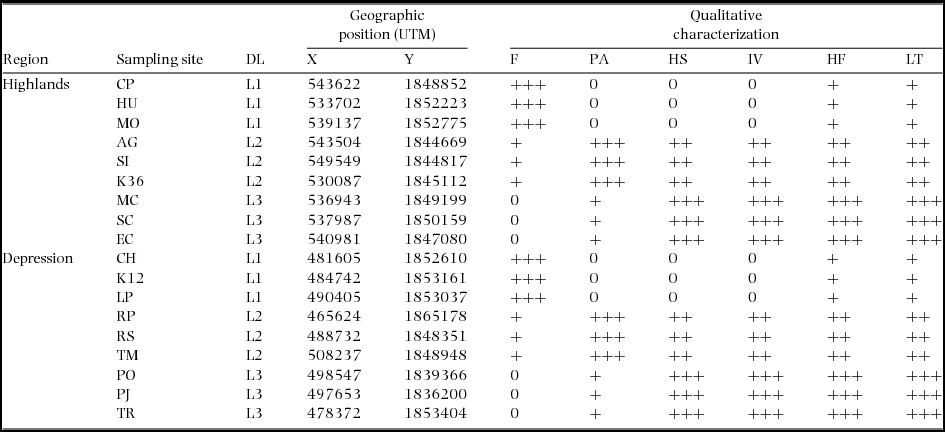
In order to evaluate whether there is an association between the level of disturbance and the diversity and genetic structure of the Virginia opossum, sampling sites within both study areas were selected according to the level of anthropogenic disturbance. Habitat composition differed significantly (e.g. vegetation type, percentage of forest cover, land use) for each level of disturbance. All sampling sites were separated by geographic barriers such as roads or human settlements, and with a distance between them ranging from 2.8 to 45.6 km (Table 1). The disturbance level was assessed at each site based on general observations of vegetation type and clear evidence of anthropogenic disturbance (Table 1). A visual type classification was carried out using the satellite raster images from 2008 and 2011 for the Highlands and the Central Depression areas, respectively, using the ArcGIS 9.3 © software. Each site was classified as: (1) Low disturbance (L1): sites that contained relatively continuous forest (> 10 ha) and with a predominantly continuous forest matrix, based on fieldwork (on site assessment) and satellite-image interpretation; these sites had little or no influence from anthropogenic activities or with vegetation undergoing a process of natural regeneration due to the cessation of human activities during at least the last 15 y (approximately determined by the diameter at breast height of a small sample of trees > 5 m height). (2) Intermediate disturbance (L2): included sites with some type of agricultural activity, with or without patches of vegetation in an incipient successional state (fallow land with secondary growth vegetation, tree < 5 m) and with a matrix of predominantly secondary vegetation; (3) High disturbance (L3): consisted of sites that displayed clear evidence of anthropogenic disturbance such as human settlements that included leisure, labour, educational and transportation activities; original vegetation had been replaced by introduced or ornamental vegetation. The high disturbance category was characterized mainly by an urban matrix. Three sampling sites were selected for each disturbance type (Table 1). The percentage of total area covered by the predominant matrix was calculated for each sampling site, which had to be greater than the area covered by fragments of other land uses; they corresponded to a low, intermediate or high level of disturbance. Sampling sites that represented the same level of disturbance were pooled and considered as an analysis unit.
Geographic position and qualitative characterization of sampling sites for capture of Didelphis virginiana in The Highlands (Highlands) and the Central Depression (Depression) in Chiapas, Mexico. CP = Corral de Piedra Hill, HU = Huitepec wildlife reserve, MO = Moxviquil wildlife reserve, AG = El Aguaje, SI = San Isidro Las Huertas, K36 = km 36 of the Tuxtla Gutiérrez–San Cristóbal de Las Casas (SCLC) highway, MC = municipal cemetery, SC = sports centre, EC = El Colegio de la Frontera Sur, CH = Coquelexquitzán Hill, K12 = La Cañada (Km 12 on the Tuxtla Gutiérrez–SCLC highway, LP = La Pera, Berriozábal, RP = Rancho Perseverancia farm, RS = Rancho al Sol farm, TM = Tecnológico de Monterrey University Campus, PO = Parque del Oriente public park, PJ = Parque Joyo Mayu (PJ) public park, TR = Tecnológico Regional Campus. DL = disturbance level, L1 = low disturbance, L2 = intermediate disturbance, L3 = high disturbance, F = forest, PA = productive activities (agriculture), HS = human settlements, IV = introduced vegetation, HF = habitat fragmentation, LT = level of habitat transformation, 0 = absent, + = low, ++ = intermediate, +++ = high.
The sampling sites for the Highlands region, corresponding to the L1 disturbance classification, were Corral de Piedra Hill (CP), Huitepec wildlife reserve (HU) and Moxviquil wildlife reserve (MO). The L2 sampling sites were located in the villages of El Aguaje (AG), San Isidro Las Huertas (SI) and at km 36 of the Tuxtla Gutiérrez–San Cristóbal de Las Casas (SCLC) highway (K36). Finally, the municipal cemetery (MC), sports centre (SC) and El Colegio de la Frontera Sur (EC), all in the city of San Cristóbal de Las Casas, constituted the L3 sampling sites (Figure 1). For the Central Depression region, sampling of the least disturbed environments (L1) was conducted at Coquelexquitzán Hill (CH), La Cañada (km 12 on the Tuxtla Gutiérrez–SCLC highway; K12) and at La Pera, Berriozábal (LP). L2 sites were sampled at Rancho Perseverancia (RP) and Rancho al Sol (RS) farms and at the Tecnológico de Monterrey University Campus, in the city of Tuxtla Gutiérrez (TM). The L3 sampling sites were Parque del Oriente (PO) and Parque Joyo Mayu (PJ) public parks, and the Tecnológico Regional Univeristy Campus (TR), all within the city of Tuxtla Gutiérrez (Figure 1).
The sampling design included 18 sites: two regions (the Highlands and Central Depression) × three levels of anthropogenic disturbance (low, medium, high) × three replicates. Trapping was performed using 48 Tomahawk traps (15.2 × 15.2 × 48.2 cm) that were baited with sardines and distributed radially (Figure 1). Sampling was conducted throughout the dry season and the start of the rainy season, from March to June 2011 and 2012. Each trap was separated by 20 m and monitored over a period of four consecutive nights (Lambert et al. Reference LAMBERT, MALCOLM and ZIMMERMAN2005) (Figure 1). A tissue sample was taken from the ear of each captured individual, stored in 90% ethanol and refrigerated at −4°C until processed for genetic analysis. Sampling and techniques used are in compliance with guidelines published by the American Society of Mammalogists for use of wild mammals in research (Gannon et al. Reference GANNON and SIKERS2007) and with the corresponding collection permits (Num. SGPA/DGVS/01364/11, Mexico).
Genetic analysis
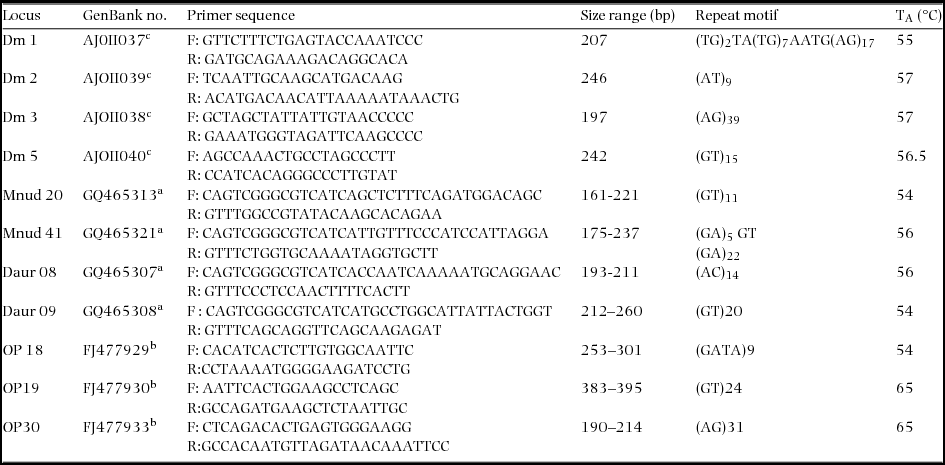
Total DNA was obtained from each tissue sample by means of the phenol-chloroform-alcohol-isoamilic method (Hamilton et al. Reference HAMILTON, PINCUS, DI FIORE and FLEISCHER1999). We essayed five microsatellite loci reported by Lavergne et al. (Reference LAVERGNE, DOUADY and CATZEFLIS1998); only four microsatellites were positive during amplification. In order to increase the genetic markers we tested six microsatellites developed for Didelphis aurita, a species closely related to the Virginia opossum (Dias et al. Reference DIAS, AMATO, CUNHA, DESALLE, PAGLIA, PETERSON and FONSECA2009, Ramírez-Pulido et al. Reference RAMÍREZ-PULIDO, ARROYO-CABRALES and CASTRO-CAMPILLO2005). Twelve microsatellite loci were successfully amplified from our D. virginiana samples: Dm 1, Dm 2, Dm 3 and Dm 5 (Lavergne et al. Reference LAVERGNE, DOUADY and CATZEFLIS1998), OP18, OP19, OP28 and OP30 developed for Didelphis virginiana (Fike et al. Reference FIKE, BEASLEY and RHODES2009) and Mnud 20, Mnud 41, Daur 08 and Daur 09 developed for Caluromys philander, Didelphis aurita and Metachirus nudicaudatus (Dias et al. Reference DIAS, AMATO, CUNHA, DESALLE, PAGLIA, PETERSON and FONSECA2009) (Appendix 1). Amplification was conducted using a Polymerase Chain Reaction (PCR) with a master mix (mastermix, PROMEGA), in a MJ mini Gradient Thermo Cycler and a BIO-RAD Personal Thermal Cycler. Amplification conditions were consistent with Dias et al. (Reference DIAS, AMATO, CUNHA, DESALLE, PAGLIA, PETERSON and FONSECA2009), Fike et al. (Reference FIKE, BEASLEY and RHODES2009) and Lavergne et al. (Reference LAVERGNE, DOUADY and CATZEFLIS1998) with the exception of the aligning temperature (TA) that was modified in 9 of the 12 markers (Dm 1 = 54°C, Dm 2 = 49°C, Dm 3 = 52°C, OP18 = 55.5°C, OP19 = 57°C, OP28 = 58°C, OP30 = 5°C, Mnud 20 = 51°C and Daur 08 = 52°C). The amplifications were visualized using electrophoresis with 6% polyacrylamide gels and 100bp ladder as control (PROMEGA), dyed with ethidium bromide and observed under ultraviolet light with the 1D Image Analysis Software v. 3.6 to record genotype per locus per individual.
Genetic diversity was measured by the number of observed alleles (N a), observed heterozygosity (H o), expected heterozygosity (H e), percentage of polymorphic loci and inbreeding coefficient (F IS), which were estimated for each disturbance level in the Highlands and Central Depression regions using the software GenAlEx v. 6.4 (Peakall & Smouse Reference PEAKALL and SMOUSE2006). Hardy–Weinberg equilibrium (HWE) was evaluated per locus and was based on the grouping of individuals by disturbance levels, using a combination of independent probabilities test (Sokal & Rohlf Reference SOKAL and ROHLF2003). The significance of F IS (inbreeding coefficient) was calculated with a chi-square test (χ2) as: χ2 = NF 2, where N is number of individuals in the evaluated sample and with one degree of freedom (Hedrick Reference HEDRICK2000).
To identify the amount of genetic structure, we used the Wright F’s statistics calculated with AMOVA and implemented in Arlequin v. 3.1 (Excoffier & Lischer Reference EXCOFFIER and LISCHER2010). AMOVA analyses produce estimates of genetic variance components at different levels of hierarchical subdivision, providing ϕ-statistics, analogue to Wright F’s statistics that are tested using a permutational approach (Excoffier et al. Reference EXCOFFIER, SMOUSE and QUATTRO1992). The significance of F ST was calculated with a chi-square test (χ2) as: χ2 = 2NF ST, where N is population size, F ST the genetic differentiation over subpopulations; there is one degree of freedom (Hedrick Reference HEDRICK2000).
The presence of null alleles was determined using the program Micro-Checker v. 2.2.3 (Van Oosterhout et al. Reference VAN OOSTERHOUT, HUTCHINSON, WILLIS and SHIPLEY2004). Allelic and genotype frequencies were corrected using the 95% confidence level and 1000 repetitions (Chakraborty et al. Reference CHAKRABORTY, DE ANDRADE, DAIGER and BUDOWLE1992). The corrected F ST was estimated considering null alleles and the Cavalli–Sforza genetic distance (Cavalli-Sforza & Edwards Reference CAVALLI-SFORZA and EDWARDS1967), using the ENA (D c ENA), that exclude null alleles, and INA, (D c INA), that include null alleles, correction method with the program Free-NA (Chapuis & Estoup Reference CHAPUIS and ESTOUP2007). In addition, dendrograms were obtained using the program PHYLIP v. 3.69 based on the estimated Cavalli–Sforza genetic distance. In addition to these traditional measures of genetic structure, we performed Bayesian clustering analysis with the software STRUCTURE 2.2.3 (Falush et al. Reference FALUSH, STEPHENS and PRITCHARD2003, Pritchard et al. Reference PRITCHARD, STEPHENS and DONNELLY2000) to infer the most likely number of genetic clusters (K). The analysis was performed without prior information, encompassing a number of clusters from 1 to 10, a burn-in length of 50000 and 100000 Markov chains Monte Carlo (MCMC) generations. For each value of K, we ran 10 replicates to capture variance in the log-likelihood metric among runs. The most probable number of clusters was chosen based on the ∆K method (Evanno et al. Reference EVANNO, REGNAUT and GOUDET2005). Based on the most probable number of clusters, we then assigned individuals to a cluster if they had a Q-value ≥ 0.7 for a corresponding cluster; individuals with a Q-value ≤ 0.7 were classified as unknown (Chiappero et al. Reference CHIAPPERO, PANZETTA-DUTARI, GÓMEZ, CASTILLO, POLOP and GARDENAL2011, Hennessy et al. Reference HENNESSY, TSAI, BEASLEY, BEATTY, ZOLLNER and RHODES2015).
Finally, to assess whether different levels of disturbance correspond to different populations, we performed a simple Mantel test between the Nei genetic distance and the geographic distance and between the F ST genetic differentiation value and geographic distance, using the ZT software (Bonnet & Van de Peer Reference BONNET and VAN DE PEER2002).
RESULTS
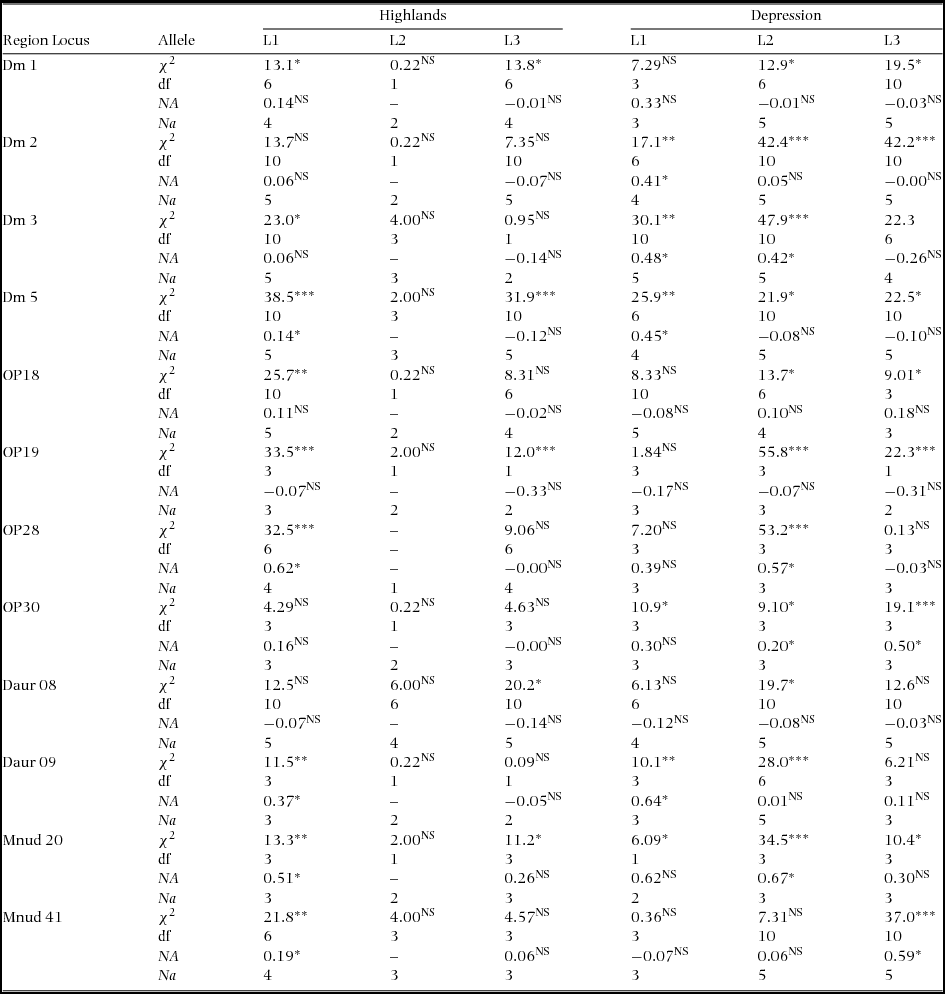
A total of 117 samples were obtained from all the sites. Didelphis virginiana individuals were captured at all disturbance levels in both the Highlands and the Central Depression regions. The HWE (χ2 tests) detected significant deviation for three loci (Dm 2, OP30 and Daur 08) from individuals captured at low-disturbance sites in the Highlands region (Table 2). All loci from individuals sampled at the intermediate-disturbance sites and seven loci from the high-disturbance site (Dm 2, Dm 3, OP18, OP28, OP30, Daur 09 and Mnud 41) fell outside HWE (Table 2). Opossums inhabiting sites located in the Central Depression demonstrated various HWE deviations according to level of disturbance; in individuals from low-disturbance sites deviations were evident in six loci (Dm 1, OP18, OP19, OP28, Daur 08, Mnud 41), one locus for those found at intermediate-disturbance sites (Mnud 41) and three loci from high-disturbance sites (OP28, Daur 08 and Daur 09) (Table 2). Polymorphism was 100% for all disturbance levels, with the exception of the intermediate disturbance site in the Highlands (91.7%). In both regions, allele frequencies varied according to level of disturbance; however there were ≤50% common alleles among all disturbance levels.
Statistical chi-square (χ2) for testing Hardy–Weinberg, frequency of null alleles (NA) and number of alleles observed (na) for each locus according to disturbance level in populations of Didelphis virginiana in the Highlands (Highlands) and the Central Depression (Depression) regions of Chiapas, Mexico. L1 = low disturbance, L2 = intermediate disturbance, L3 = high disturbance, df = degrees of freedom, – = not analysed due to insufficient data. * = P < 0.05, ** = P < 0.01, *** = P < 0.001, NS = non significant.
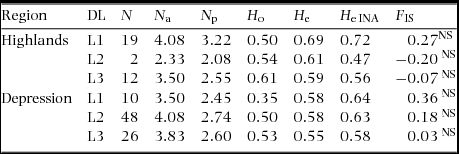
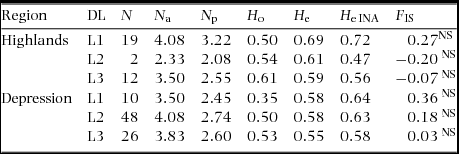
Null alleles were detected for different loci and for different disturbance levels in both study regions, although no one locus showed null alleles for all sampling sites (Table 2). Also, expected heterozygosity (H e INA) was not significantly different (χ2 = 0.013, P = 0.999, df = 5) to that obtained without considering null alleles (Table 3). The mean number of observed alleles, without null alleles, ranged between 2.33 and 4.08 (Table 3). The average observed heterozygosity (with or without null alleles) was not significantly different among opossums from different disturbance levels from the Highlands (0.50–0.61). In the Central Depression, the lowest observed heterozygosity value was observed at the lowest-disturbance sites (0.35 versus 0.50–0.53; Table 3). Inbreeding coefficient (F IS) ranged from −0.20 to 0.36 at intermediate disturbance sites in the Highlands and low disturbance sites in the Central Depression. Negative F IS values were found for individuals from intermediate and high disturbance sites in the Highlands, while positive values were from the remaining study sites, suggesting excess and deficit of heterozygotes, respectively. However, none of the F IS values was significantly different from zero (Table 3).
Genetic diversity values of Didelphis virginiana for different levels of disturbance (DL) in the Highlands (Highlands) and the Central Depression (Depression) regions of Chiapas, Mexico. L1 = low disturbance, L2 = intermediate disturbance, L3 = high disturbance, N = sample size, N a = observed number of alleles, N p = private alleles, H o = observed heterozygosity, H e = expected heterozygosity, H e INA = expected heterozygosity including null alleles, F IS = Inbreeding coefficient = (H e–H o)/H e = 1–(H o/H e). NS = non-significant.
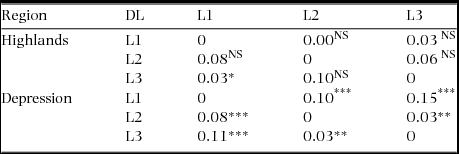
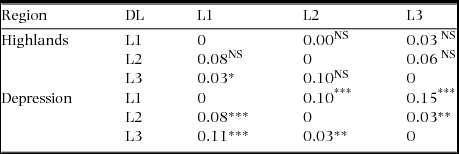
The AMOVA results showed that 2.51% of total genetic variation was distributed between regions and 97.5% within regions, with very similar proportions estimated among disturbance levels (4.15% of variation among and 95.9% within disturbance levels). Genetic structure results showed low F ST values when considering disturbance levels within (F ST = 0.05, P = 0.039) and between regions (F ST = 0.02, P = 0.03). Genetic differentiation observed among disturbance levels was lower in the Highlands than in the Central Depression (Table 4). Furthermore, pairwise comparison showed genetic differentiation between opossums from low- and high-disturbance sites in the Highlands while all pairwise comparisons were significant for the Central Depression region, with and without null alleles (Table 4). The values of F ST ENA and F ST INA calculated with the ENA (excluding null alleles) and INA (considering null alleles) methods were both F ST = 0.05 (P = 0.039).
Genetic differentiation of Didelphis virginiana over a disturbance gradient (DL) in the Highlands (Highlands) and the Central Depression (Depression) regions of Chiapas, Mexico. Values based on F ST below the diagonal, above the diagonal using INA. L1 = low disturbance, L2 = intermediate disturbance and L3 = high disturbance. * = P < 0.05, ** = P < 0.01, *** = P < 0.001, NS = non-significant.
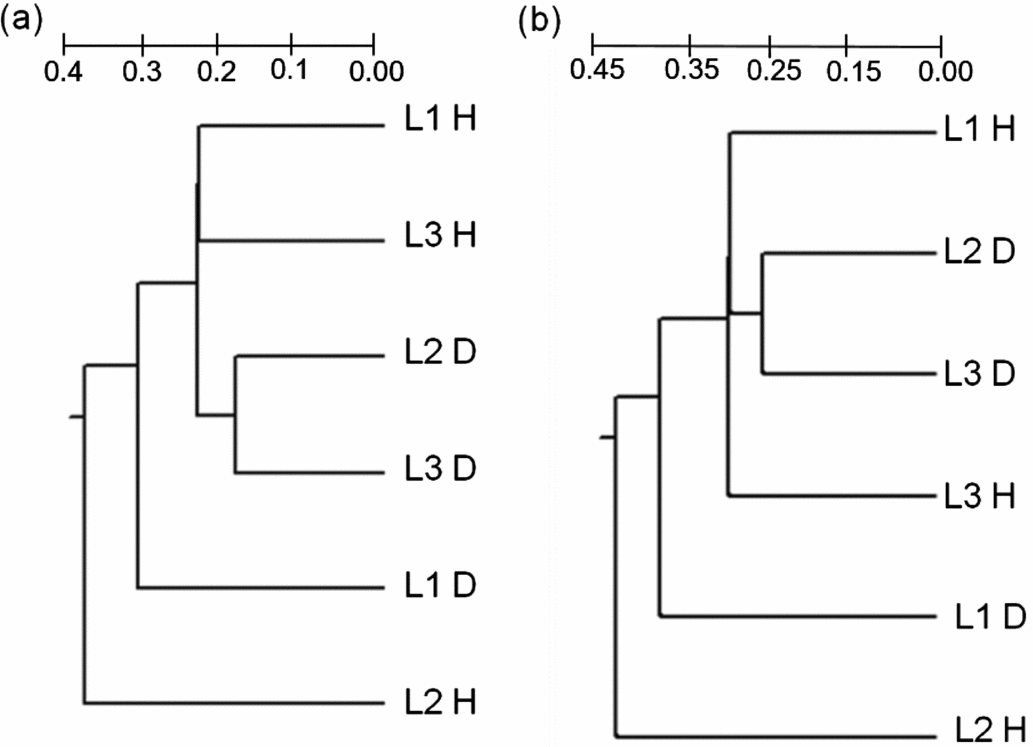
Genetic distances when excluding null alleles (D c ENA) indicated the lowest genetic differentiation between intermediate- and high-disturbance sites in the Central Depression (0.18), while the highest differentiation was found between intermediate-disturbance sites in the Highlands and low-disturbance sites in the Central Depression (0.39) (Figure 2a). If null allele incidence (D c INA) is considered, then genetic distances are preserved; the lowest genetic distance was between intermediate-disturbance sites and those from high-disturbance sites in the Central Depression (0.21). The highest genetic distance was observed in intermediate-disturbance sites from the Highlands and low-disturbance sites from the Central Depression (0.44) (Figure 2b).
Dendrogram based on Cavalli-Sforza genetic distances (Cavalli-Sforza & Edwards Reference CAVALLI-SFORZA and EDWARDS1967) of Didelphis virginiana in the Highlands (H) and the Central Depression (D), Chiapas, Mexico. ENA method (D c ENA), excluding null alleles (a); INA method (Dc INA), including null alleles (b). L1 = low disturbance, L2 = intermediate disturbance, L3 = high disturbance.
STRUCTURE results showed that the most probable number of genetic clusters was K = 2, which we named Cluster A and Cluster B, respectively, and where 36% of individuals were assigned to Cluster A and 49% to Cluster B (Figure 3). Finally, the Mantel test was not significant in any of the comparisons, genetic distances vs. geographic distance (R = 0.38, P = 0.07) and genetic differentiation vs. geographic distance (R = 0.046, P = 0.47).
Bayesian clustering analysis performed with STRUCTURE for Didelphis virginiana individuals from the Highlands and Central Depression of Chiapas, Mexico (K = 2). L1 H = low disturbance in the Highlands, L2 H = intermediate disturbance in the Highlands, L3 H = high disturbance in the Highlands, L1 D = low disturbance in Central Depression, L2 D = intermediate disturbance in Central Depression, L3 D = high disturbance in Central Depression.
DISCUSSION
In the present study we evaluated the relationship between genetic structure and habitat disturbance for Virginia opossums from two regions in southern Mexico: the Highlands and Central Depression. Contrary to our hypothesis that Virginia opossums inhabiting moderately disturbed areas would have higher genetic diversity, we found that genetic diversity was moderate and independent of the level of disturbance. The Mantel test did not show evidence of a correlation between genetic differentiation and geographic distances, nor between genetic distances and geographic distances, indicating that genetic structure cannot be attributed to the geographic distance between the sampling sites. This result is consistent with Hennessy et al. (Reference HENNESSY, TSAI, BEASLEY, BEATTY, ZOLLNER and RHODES2015), who used molecular markers to determine gene flow and connectivity in Virginia opossums of Indiana; their results showed evidence of a panmictic population despite different geographic barriers in the studied landscape.
The overall genetic structure in our D. virginiana study sites was low but significant (F ST = 0.05) among levels of disturbance. Beatty et al. (Reference BEATTY, BEASLEY, DHARMARAJAN and RHODES2012) also reported low genetic structure (F ST = 0.005) in a population of this species inhabiting a fragmented agricultural ecosystem in Indiana. The low genetic structure observed for Virginia opossums in southern Mexico could be attributed to low genetic drift and significant gene flow among subpopulations, despite the distances and geographical barriers present (Hedrick Reference HEDRICK2000). Ecological and behavioural attributes of the Virginia opossum allow this species to disperse long distances and survive in environments affected by anthropogenic activities, which likely reduced levels of genetic differentiation among the studied disturbance levels (Beatty et al. Reference BEATTY, BEASLEY, DHARMARAJAN and RHODES2012, Cabello Reference CABELLO2006, Markovchick-Nicholls et al. Reference MARKOVCHICK-NICHOLLS, REGAN, DEUTSCHMAN, WIDYANATA, MARTIN, NOREKE and HUNT2007, Orjuela & Jiménez Reference ORJUELA and JIMÉNEZ2004).
Null alleles showed no significant influence on heterozygosity, therefore only values obtained without null alleles are taken into consideration when discussing the results. The average genetic diversity found in our studied population (alleles/locus = 3.55, H o = 0.50, H e = 0.60) are below values reported in other studies. Beatty et al. (Reference BEATTY, BEASLEY, DHARMARAJAN and RHODES2012), using 13 microsatellite markers, reported an average of 10.5 alleles per locus, 0.80 of H o and 0.78 of H e, in a population of Virginia opossums inhabiting a fragmented agricultural ecosystem of Indiana. Beasley et al. (Reference BEASLEY, BEATTY, OLSON and RHODES2010) evaluated the patterns of paternity in D. virginiana in a fragmented landscape in northern Indiana with 10 microsatellites; they reported a mean heterozygosity of H o = 0.796 and H e = 0.793. Recently, Cruz-Salazar et al. (Reference CRUZ-SALAZAR, RUIZ-MONTOYA, NAVARRETE-GUTIÉRREZ, ESPINOZA-MEDINILLA, VÁZQUEZ-DOMÍNGUEZ and VÁZQUEZ2014) studied the nuclear genetic diversity of D. marsupialis and D. virginiana from south-east Mexico with seven microsatellites, reporting a mean heterozygosity of H o = 0.58. The low genetic diversity we found may be related to our technical limitations for recording alleles that differed in one or two base pairs (bp), resulting in a possible under-estimation of genetic diversity. In addition, our results may be biased due to the reduced detection of genetic variation when using markers designed for other species.
Assuming an adequate recording of alleles, the lower genetic diversity found in the Virginia opossum population of in southern Mexico when compared with those in Indiana, could suggest that the southern Mexican population is better adapted to their environmental conditions than the Indiana populations (Beasley et al. Reference BEASLEY, BEATTY, OLSON and RHODES2010, Beatty et al. Reference BEATTY, BEASLEY, DHARMARAJAN and RHODES2012). For instance, Kanda et al. (Reference KANDA, FULLER, SIEVERT and KELLOGG2009) suggest that the Virginia opossum is dependent on anthropogenic resources in areas beyond their historical distributional limit, such that populations found further south than in the study of Kanda et al. (Reference KANDA, FULLER, SIEVERT and KELLOGG2009) show mixed results, exploiting both anthropogenic and natural habitats (Beatty et al. Reference BEATTY, BEASLEY and RHODES2014). Therefore, our results suggest that the low diversity found in the southern Mexican population might be reflecting local adaptation processes to a landscape composed of a mosaic of natural and anthropogenic habitats.
The effect of disturbance on genetic diversity has been studied in other mammals. For example, three species of primates (Microcebus spp.) from Madagascar showed decreased genetic diversity and high genetic differentiation as a result of habitat fragmentation by anthropogenic activities (Olivieri et al. Reference OLIVIERI, SOUSA, CHIKHI and RADESPIEL2008). Chiappero et al. (Reference CHIAPPERO, PANZETTA-DUTARI, GÓMEZ, CASTILLO, POLOP and GARDENAL2011) studied the genetic structure of rodent populations (Calomys musculinus) in urban and rural areas in Argentina to evaluate the influence of human activities on their genetic structure. The authors found intermediate levels of genetic diversity across loci (H S = 0.75 in urban and 0.80 in rural areas), and higher genetic differentiation among rodents of urban areas compared with those inhabiting rural areas. This was not evident for the Virginia opossum populations in the Highlands and Central Depression of Chiapas. Our inbreeding coefficient results did not differ significantly from zero, suggesting sufficient random mating and gene flow through areas with different habitat types and degrees of disturbance.
We observed low levels of genetic differentiation between opossums found in the Highlands and Central Depression regions, despite the significant geographic distance separating these sampling sites, which should limit migration (46 km). Such low genetic differentiation could be associated with the low evolutionary rate of marsupials (Hutchison & Templeton Reference HUTCHISON and TEMPLETON1999, Jansa & Voss Reference JANSA and VOSS2000, Steiner & Catzeflis Reference STEINER and CATZEFLIS2004). However, we presume that there has not been sufficient time for the effects of isolation, due to habitat fragmentation and land-use changes, to cause significant genetic structure changes at the scale we evaluated. That is, we cannot discount the possibility that the low genetic structure found is attributable to the scale used in the sampling design. Therefore, to ensure the detection of different populations and the effects of disturbance on genetic diversity for this species, a study on a larger spatial scale is needed (Jackson & Fahrig Reference JACKSON and FAHRIG2014).
The Bayesian analyses showed that the genetic structure of the studied organisms did not depend on the disturbance level. This could be associated with the ability of D. virginiana to substitute the resources it commonly uses for those that are available, in this case anthropogenetically generated resources (Begon et al. Reference BEGON, TOWNSEND and HARPER2006, Bozek et al. Reference BOZEK, PRANGE and GEHRT2007), which together with its dispersal capacity and the large home range, results in a homogeneous genetic population (Eckert et al. Reference ECKERT, ECKERT and HALL2010, Hennessy et al. Reference HENNESSY, TSAI, BEASLEY, BEATTY, ZOLLNER and RHODES2015).
We can conclude that the genetic diversity of D. virginiana in the study areas is not a direct consequence of human activity. However, it is necessary to work on a larger spatial scale, including more populations of D. virginiana, in order to further evaluate the relationship between disturbance and genetic structure and, particularly, the functional connectivity throughout the fragmented landscape. The Virginia opossum is undoubtedly an interesting study case that comprises a common and generalist species, yet a species that belongs to a rather small group of marsupials present in Mexico, which perform diverse key functions in the ecosystems it inhabits. Hence, our results provide an important contribution for exploring the impact of human disturbance on the genetic diversity of a common and generalist species like the Virginia opossum.
ACKNOWLEDGEMENTS
We would like to thank Jorge Bolaños Citalán, Eugenia Sántiz López, Alfonso Ortiz Moreno, Wenceslao Bonifaz and Trinidad Alejandro Guillén Díaz for their support in the field. We are also grateful to Maricela García Bautista, María Teresa Pérez Gómez, Nancy del Rocío Morales Ruíz and Quevin Hernández Flores for their help during the laboratory analysis. This study is partial fulfilment of the doctoral dissertation of BCS in ECOSUR (CONACyT-Grant number 175336).
Characterization of 12 polymorphic microsatellite loci used to determine the genetic diversity and structure of Didelphis virginiana in the Highlands and Central Depression in Chiapas, Mexico. TA = annealing temperature, bp = basepair length. a = Dias et al. (Reference DIAS, AMATO, CUNHA, DESALLE, PAGLIA, PETERSON and FONSECA2009), b = Fike et al. (Reference FIKE, BEASLEY and RHODES2009), c = Lavergne et al. (Reference LAVERGNE, DOUADY and CATZEFLIS1998).