Introduction
Many reforms to the UK's tax-benefit system announced by the Conservative–Liberal Democrat coalition from 2010 were underpinned by the aim of ‘making work pay’. A key target group of these reforms were lone mothers, who currently head 23 per cent of all UK families with dependent children (Office for National Statistics, 2015). This is partly because 41 per cent of lone mothers are not in paid employment, compared to 33 per cent of lone fathers (Office for National Statistics, 2011) and 28 per cent of mothers living with a partner (Office for National Statistics, 2013). Furthermore, of those lone mothers who do work, 58 per cent are in low-paying sectors, while 57 per cent work fewer than thirty hours a week (Harkness and Skipp, Reference Harkness and Skipp2013). Lone parents also face some of the weakest incentives of all family types to start and progress in work. They not only tend to have low earnings potential, but are more likely than individuals in one- and two-earner couples, and single people without children, to receive generous out-of-work support and face the overlapping withdrawal of multiple means-tested benefits as earnings rise (Adam and Browne, Reference Adam and Browne2010).
Lone mothers’ employment behaviour is of course shaped by a range of factors, from culturally and socially situated ideas about ‘good’ mothering (Duncan and Edwards, Reference Duncan and Edwards1999) and ‘good enough’ care for their children (Williams, Reference Williams2004), to the availability of local jobs, childcare and transport (Rafferty and Wiggan, Reference Rafferty and Wiggan2011). Nevertheless, research shows the perceived financial benefits and penalties of working created by the tax-benefit system can influence lone parents’ employment decisions and be of overriding concern to many (Lister, Reference Lister1999; Bell et al., Reference Bell, Finch, La Valle, Sainsbury and Skinner2005; Wiggan, Reference Wiggan2005).
This article aims to illustrate financial work incentives and incomes for two hypothetical lone mothers under the Coalition government's reforms to direct taxes and cash benefits. It builds on recent studies which use micro-simulation models based on representative samples of actual lone parents to measure the likely impacts of the reforms on work incentives and incomes (for example, Browne, Reference Browne2012; Adam and Browne, Reference Adam and Browne2013; Adam and Phillips, Reference Adam and Phillips2013; De Agostini and Brewer, Reference De Agostini and Brewer2013; Reed et al., Reference Reed, Elson and Himmelweit2013; Brewer and De Agostini, Reference Brewer and De Agostini2015). In micro-simulation-based studies, the impacts of the Coalition's reforms are shown to the extent they affect the lone parents contained in the relevant dataset. In contrast, hypothetical lone mothers can be assigned any set of characteristics. By varying one characteristic at a time while holding all others constant, we are able to test whether the Coalition's reforms have the potential to deliver on its promise to make work pay for lone mothers under a range of different circumstances relevant to different groups of lone parents (Immervoll et al., Reference Immervoll, Marianna and D'Ercole2004). In particular, the analysis illustrates how the hypothetical lone mothers’ tax burdens and benefit entitlements vary with small increments in their labour supply. This can expose the presence of certain ‘thresholds’, in terms of working hours and/or earnings, from which the financial returns to increasing labour supply start to diminish as a result of the design of the Coalition's tax-benefit system (Berger et al., Reference Berger, Borsenberger, Immervoll, Lumen, Scholtus and De Vos2001).
While Brewer et al. (Reference Brewer, Browne, Jin and Callan2012a, b), Hirsch (Reference Hirsch2012), Pareliussen (Reference Pareliussen2013) and Ghelani and Stidle (Reference Ghelani and Stidle2014) have also examined the impacts of the Coalition's flagship make work pay reform, Universal Credit, on one or more hypothetical lone mother(s), this article extends such work in three main ways. First, it includes all changes to direct in-work taxes and cash benefits announced by the Coalition in addition to Universal Credit, including important changes to support for Council Tax and income tax. Second, it compares the hypothetical lone mothers’ incentives under the Coalition's reform package with the incentives they could have expected if the previous Labour government's tax-benefit system had instead continued, with amounts adjusted for inflation. Third, the article situates the findings within their broader context. It describes the policy context by comparing welfare-to-work reforms and the discourses behind them under Labour and the Coalition, and concludes by discussing what the findings might mean in practice for lone mothers given broader economic and policy changes.
The article shows that while the Coalition's make work pay agenda substantially improves the constructed lone mothers’ financial incentives to work in mini-jobs of fewer than sixteen hours a week, their incentives to work longer are weak, and in some cases are weaker than under Labour. In addition, total net incomes when working in sixteen hours plus jobs are, for the most part, lower than under Labour. Moreover, the financial returns to progressing in work begin to diminish once hours exceed just six at average wage and nine at minimum wage, and virtually disappear for the lone mother with childcare costs when working hours fall outside of the school day.
The next section charts the development of lone parent welfare-to-work measures since 1997. The methods are reported in the third section, followed by the results in the fourth. The article concludes by discussing the potential implications of the results for lone mothers within their broader context.
Lone parent welfare-to-work reforms
Whereas the previous Conservative government had been ambivalent towards lone mothers’ participation in paid work (Lewis, Reference Lewis1998; Lister, Reference Lister and Kingfisher2002), governments since 1997 have made lone parents a key target group of welfare-to-work reform. This partly reflects an international trend towards activation policies designed to equip, encourage and compel lone parents to enter and progress in paid employment (Morel et al., Reference Morel, Palier, Palme, Morel, Palier and Palme2012). It also reflects the influence of neo-liberal ideology and American-style workfarism (Slater, Reference Slater2012), a consensus that ‘work is good for you’ (for example, DWP, 2007: 23; Freud, Reference Freud2011), and a shared commitment to ending child poverty. Despite these continuities, there have been important shifts in the discourses and emphasis of, lone parent welfare-to-work policies from the New Labour government to the Coalition.
New Labour (1997–2010)
As part of an agenda to modernise the Labour party by distancing it from the ‘tax-and-redistribute’ image of ‘old’ Labour governments, New Labour's welfare-to-work discourse suggested irresponsible attitudes and behaviours, exacerbated by dependency on state benefits, were partly to blame for worklessness (Driver and Martell, Reference Driver, Martell, Ray and Sayer1999; Deacon, Reference Deacon2003). Yet, without abandoning social democratic principles altogether, its discourse emphasised that worklessness was also a problem of inequality. It argued that poor attitudes and behaviours among the workless were simply mechanisms for coping with the structural barriers they faced in accessing the same employment and education opportunities as other groups in society (Deacon, Reference Deacon2003).
In line with this discourse, New Labour sought, on the one hand, to increase employment supports in order to address some of the structural barriers lone parents faced in accessing employment opportunities. It introduced the New Deal for Lone Parents (subsumed into the Flexible New Deal in 2009), which offered personalised guidance and practical support in finding and sustaining work. It also implemented various measures to help lone parents balance work with caring responsibilities and improve the affordability and availability of childcare.
On the other hand, Labour's understanding of worklessness as partially rooted in behavioural factors underpinned a number of benefit reforms designed to influence and regulate lone parents’ behaviour in favour of starting and progressing in work. Labour sought to encourage lone parent employment by making it pay. It introduced a National Minimum Wage and reduced in-work taxes for low and average earners. However, its flagship make work pay reform was Working Families Tax Credit (replaced by the Working Tax Credit in 2003). This was available to lone parents working sixteen hours or more a week, with a bonus at thirty hours. In contrast to the previous Conservative government's Family Credit, it was more generous, was withdrawn more slowly over a higher earnings threshold and included a subsidy worth up to 80 per cent of childcare costs by the time Labour left office.
However, as the number of policy supports in place increased, Labour saw a progressive strengthening of the work-related conditions attached to lone parents’ benefit receipt as increasingly necessary and justified for regulating their employment behaviour. This culminated with the introduction of Lone Parent Obligations in 2008. For the first time, lone parents were required to move from Income Support on to Jobseeker's Allowance and be available for work once their youngest child reached a certain age, which Labour intended to gradually reduce from twelve to seven years. There were, however, certain ‘flexibilities’ for lone parents (Haux, Reference Haux2012; Whitworth and Griggs, Reference Whitworth and Griggs2013). For instance, subject to a minimum availability requirement of sixteen hours, lone parents with a child under thirteen could restrict their work availability to normal school hours, while those with older children could restrict theirs according to their caring responsibilities. These flexibilities applied to all lone parents irrespective of the availability of local jobs at the required hours (see Kennedy, Reference Kennedy2010, for an overview of all flexibilities).
Despite missed targets, Labour oversaw a rise in lone parent employment from 45 to 57 per cent (Haux, Reference Haux, Holden, Kilkey and Ramia2011; Waldfogel, Reference Waldfogel2011). While much of this was down to a strong economy and changes in the characteristics of both lone parents and the labour market (Gregg et al., Reference Gregg, Harkness and Macmillan2006; Millar, Reference Millar and Chant, H2010), evidence shows the first wave of reforms (1998–2003) alone led to a four to five percentage point increase in lone parent employment, with Working Families Tax Credit the main driver behind this gain. In particular, the reforms improved job retention during the initial transition into lone parenthood and helped to mitigate some of the negative impacts of this transition on incomes (Gregg et al., Reference Gregg, Harkness and Smith2009).
However, Brewer et al. (Reference Brewer, Duncan, Shephard and Suárez2006) found Working Families Tax Credit would have increased lone parent employment by an additional two percentage points had it not been for simultaneous increases in cash benefits for families with children, irrespective of employment. As part of its child poverty reduction strategy, Labour introduced a generous Child Tax Credit and substantial increases in Child Benefit and allowances for children within Council Tax Benefit and Housing Benefit. Furthermore, while the availability of Working Families Tax Credit at sixteen hours increased the proportion of lone parents in sixteen hours plus jobs, it also led to a reduction in average hours among full-timers (Gregg et al., Reference Gregg, Harkness and Smith2009). Nevertheless, Labour's overall reforms did raise incomes for working lone parents by between 4 and 11 per cent, and for non-working lone parents by between 6 and 18 per cent, depending on the measure used (Adam and Browne, Reference Adam and Browne2010).
Conservative–Liberal Democrat Coalition (2010–15)
In contrast to Labour, the Coalition's welfare-to-work discourse has largely downplayed broader economic and social structural explanations for worklessness. Under the influence of Conservative ideology and the Centre for Social Justice, the Coalition's rhetoric has instead closely followed the moral underclass discourse of conservative thinkers during the 1980s (Daguerre and Etherington, Reference Daguerre and Etherington2014). According to this discourse, while worklessness is rooted in behavioural factors, state benefits and the dependency they foster are ultimately to blame. The claim is that by allowing and promoting benefit dependency over participation in paid work, overgenerous and lenient benefits have created an ‘underclass’ of welfare claimants who lack the proper work ethic of mainstream society (Murray, Reference Murray1990). A prominent example of this discourse is found in Iain Duncan Smith's speech to the 2011 Conservative party conference:
To each person it [Labour's tax-benefit system] said: ‘you're financially better off out of work, better off playing the system’. They knew too many British people were on benefits living unproductive lives . . . A growing underclass was establishing itself, shut away, dysfunctional and too often violent.
A conception of ‘fairness’ has further underpinned the Coalition's critique of welfare dependency. The Coalition argues, on the one hand, that reducing welfare dependency is about delivering ‘fairness’ to claimants. This argument is based on a portrayal of welfare claimants as victims of the benefits system. The Coalition claims that by failing to make work pay, a wasteful and complex benefits system under Labour, comprising different out-of-work and in-work benefits with varying withdrawal rates, has served to ‘trap’ many claimants in inactivity and poverty (Hayton and McEnhill, Reference Hayton, McEnhill, Atkins, Finlayson, Martin and Turnbull2014).
On the other hand, the Coalition argues that reducing welfare dependency is also about ‘fairness’ for taxpayers. It argues Labour afforded non-working individuals a number of ‘advantages’ over those in work, namely a lax benefits system that failed to adequately mirror life in the workplace (Daguerre and Etherington, Reference Daguerre and Etherington2014) and excessive increases in out-of-work benefits despite slow wage growth following the 2008 global financial crisis (Osborne, Reference Osborne2012). The Coalition labels these apparent advantages as ‘unfair’ by portraying non-working individuals as less morally upright than ‘hardworking taxpayers’ who are ‘doing the right thing’ by working and paying into the system (Daguerre and Etherington, Reference Daguerre and Etherington2014; Hayton and McEnhill, Reference Hayton, McEnhill, Atkins, Finlayson, Martin and Turnbull2014).
To this, the Coalition adds that reducing welfare dependency is also about ‘fairness’ for future generations. It argues that cutting the welfare bill to tackle the public sector deficit, which stood at £155 billion in 2010 (Hansard, 2010), is not only economically prudent for securing future growth, but morally right for preventing the transmission of this debt to subsequent generations (Hayton and McEnhill, Reference Hayton, McEnhill, Atkins, Finlayson, Martin and Turnbull2014).
In line with this discourse, the Coalition has implemented a number of benefit reforms designed to influence claimants’ behaviour by encouraging employment while making it more difficult to remain inactive. Most notably, it has drastically cut the benefits attached to worklessness on the assumption this will steer claimants into work. Year-on-year, Child Benefit and levels of out-of-work support for Council Tax and housing costs have been frozen or increased either in line with a lower measure of inflation than under Labour, or by 1 per cent only. In addition, funding for Council Tax support has been cut by 10 per cent. Indeed, tax-benefit spending is projected to be £16.7 billion lower in 2015–16 than it would have otherwise been (Hood and Phillips, Reference Hood and Phillips2015). This is despite falling tax revenues following substantial increases in the point at which income tax becomes payable, as pledged by the Liberal Democrats.
Yet the centrepiece of the Coalition's make work pay agenda is Universal Credit, which should be available in all UK Jobcentres by February 2016 (DWP, 2015). Universal Credit merges several out-of-work and in-work benefits, namely Child Tax Credit, Housing Benefit, income-based Jobseeker's Allowance, income-related Employment and Support Allowance, Income Support and Working Tax Credit. Under Universal Credit, a lone mother's maximum entitlement comprises her standard allowance and elements for the first child and subsequent children, as well as additions for housing and any disabilities or caring responsibilities. For consistency, the Coalition has reformed support for Council Tax to use the same calculation of maximum entitlement. Like Working Tax Credit, Universal Credit also contains a childcare subsidy which is set to increase from 70 to 85 per cent of childcare costs from April 2016.
Despite estimated implementation costs of £1.8 billion, the Coalition expects Universal Credit to deliver total net savings to government of £5.3 billion over twelve years (National Audit Office, 2014). It also expects annual savings thereafter of £2.7 billion as a result of higher employment and reduced administration costs, error, fraud and overpayments (National Audit Office, 2013).
According to the Coalition, Universal Credit will make even small amounts of work pay. This is firstly because Universal Credit removes the 100 per cent withdrawal rate for out-of-work benefits and replaces it with a lower one. Under Labour, a lone mother lost £1 of her out-of-work benefits for every £1 she earned over an earnings disregard of just £20 a week. In contrast, Universal Credit has a withdrawal rate of 65 per cent on net income. This means she loses 65 pence of her Universal Credit per £1 of net earnings gained after National Insurance and income tax. Universal Credit also extends childcare subsidies to lone parents working fewer than sixteen hours, who previously received no such help since Working Tax Credit was not available to them (DWP, 2010b).
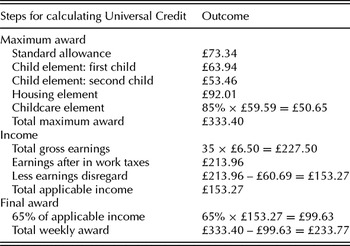
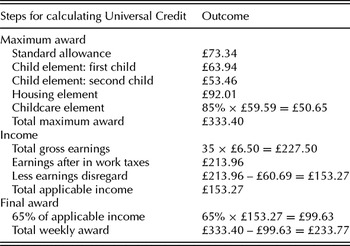
The Coalition claims it will also pay to work longer and earn more under Universal Credit, as its single rate of withdrawal is lower than the combined rate by which Housing Benefit and tax credits were withdrawn under Labour. This means claimants should keep more of their money as they progress in work (DWP, 2010b). Under Labour, the combined withdrawal of Housing Benefit and tax credits meant a working lone mother potentially lost 90 pence to benefit withdrawal and in-work taxes of every additional £1 she earned from working longer or for higher pay. Under Universal Credit however, she potentially loses 76 pence of every additional £1 earned to benefit withdrawal and taxes. Appendix 1 gives a worked example of how Universal Credit is calculated for one of the lone mothers included in the analysis.
In addition to making work pay, the Coalition has intensified the behavioural conditions attached to lone parents’ benefit receipt. Lone Parent Obligations have been extended to those with a child aged five or six, delivering estimated net savings to the Exchequer of £250 million by March 2015 (DWP, 2011). Furthermore, eleven out of twelve of the lone parent flexibilities in Labour's Jobseeker's Allowance are either no longer legally binding, or are narrower in scope under Universal Credit. For example, Universal Credit regulations do not explicitly state that lone parents with a child aged five to thirteen can still restrict their work availability to school hours even if no such jobs are available. Meanwhile, those with older children can no longer restrict their work availability according to their caring responsibilities unless jobs are available at the required hours (Gingerbread, 2013).
A further change to conditionality under Universal Credit is that working lone parents will continue to be subject to it until they are earning the equivalent of the National Minimum Wage multiplied by the number of hours they are expected to be available for work (Kennedy and McInnes, Reference Kennedy and McInnes2013). In 2015–16 prices, this is equivalent to £130 a week for those with a youngest child aged five to twelve years assuming a school-hours job of twenty hours a week. For lone parents with older children who are unable to find work at the hours they require to suit their caring responsibilities, the threshold is £227.50, assuming a thirty-five hour job. Any lone mother failing to reach these thresholds could have part of her Universal Credit award sanctioned for a minimum of four weeks up to a maximum of three years, depending on the nature of the offence and any previous non-compliance.
Correspondingly, the Coalition has placed less emphasis than Labour on improving employment supports to help address some of the broader economic and social structural barriers to lone parents’ employment. The exception is its Work Programme, which replaced Labour's Flexible New Deal but seeks to offer lone parents the same personalised employment support. The main difference is that it incorporates a greater role for non-state providers and market mechanisms (Rees et al., Reference Rees, Whitworth and Carter2014), which the Coalition claims will deliver comparable employment outcomes to the Flexible New Deal at a 2 per cent lower cost (Lupton, Reference Lupton2015).
In summary, welfare-to-work policy discourse since 2010 has shifted further towards one which blames worklessness primarily on behavioural failings, exacerbated by welfare dependency. The Coalition has reinforced this critique of dependency by portraying it as unfair on welfare claimants and taxpayers, and unaffordable in the current economic climate. In line with this discourse, it has relied primarily on reforming the tax-benefit system in order to make work pay and intensifying the conditions attached to benefit receipt in order to activate lone parents.
The remainder of this article examines whether the Coalition's tax-benefit reforms could make work pay for lone mothers. Existing projections based on representative data on actual lone parents show that the reforms are likely to reduce average incentives for non-working lone parents to start work, and have a negligible impact on lone parent employment rates. At the same time, average incentives for those who are already working to increase their earnings are projected to increase, potentially leading to a 7 per cent increase in total hours worked by lone parents and a 5 per cent increase in their aggregate earnings (Adam and Browne, Reference Adam and Browne2013; Adam and Phillips, Reference Adam and Phillips2013). The article builds on these projections by using hypothetical lone mothers to show how the impacts of the reforms on a lone mother's work incentives potentially vary according to her specific characteristics. This is to expose whether the reforms have the potential to deliver on the Coalition's promise of making work pay for lone mothers under a range of different circumstances relevant to different groups of lone mothers. In particular, the analysis shows how tax burdens and benefit entitlements can vary with small increments in a lone mother's labour supply in order to highlight potential ‘anomalies’ in the Coalition's reform agenda, whereby taking on additional hours beyond a certain point results in no, or only slight, income gains (Berger et al., Reference Berger, Borsenberger, Immervoll, Lumen, Scholtus and De Vos2001).
Methods
The analysis compares two hypothetical lone mothers’ incentives under two different scenarios. The first scenario includes all changes to taxes and benefits implemented by the Coalition up to April 2015, in addition to Universal CreditFootnote 1. Including Universal Credit in the first scenario gives a more encompassing illustration of how the Coalition sought to regulate and control lone parents’ employment behaviour through the design of its tax-benefit policies, as well as how effective its make work pay agenda could be for lone parents. For the same reasons, the analysis ignores any transitional protection, which is additional income to top up an individual's Universal Credit during the initial transition, and assumes Universal Credit covers 85 per cent of childcare costs as planned from April 2016, by which time it will be available nationwide.
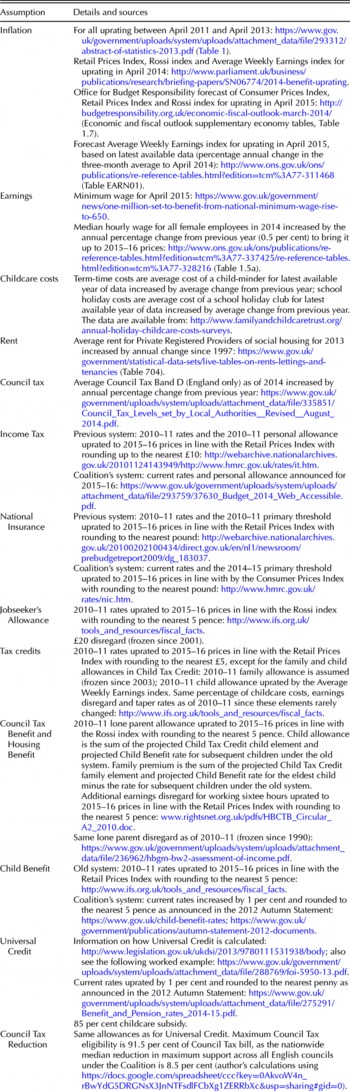
The second scenario is the tax-benefit system as at April 2010 under Labour. Benefits included are Child Benefit, Child Tax Credit, Council Tax Benefit, Housing Benefit, Income Support, Jobseeker's Allowance and Working Tax Credit. For comparability, taxes and benefits under both scenarios have been adjusted to bring them in line with 2015–16 prices according to relevant convention or statute, using either historic or projected rates of inflation (Appendix 2).
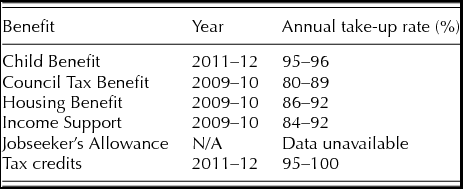
Because the analysis is based on two hypothetical biographies, the results are not statistically representative of the UK lone mother population at large and cannot capture its full heterogeneity (Meyer et al., Reference Meyer, Bridgen and Riedmüller2007). Using hypothetical biographies also means formal rules and laws have to be followed even though non-take up (Table 1) can affect real-life incentives (Atkinson and Marlier, Reference Atkinson and Marlier2009; Bradshaw, Reference Bradshaw, Kamerman, Phipps and Ben-Arieh2010). The analysis therefore does not summarise actual work incentives for the lone parent population under the Coalition. Rather, it shows how the Coalition's tax-benefit instruments potentially affect work incentives according to a lone parent's particular characteristics.
Percentage of lone parents who claim the benefits they are entitled to by benefit type
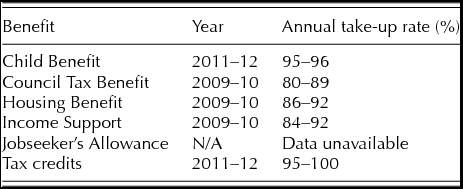
Notes: Data for Jobseeker's Allowance take-up rates are not available due to small sample sizes. Child Benefit take-up rates are for all families with children.
Sources: Department for Work and Pensions (2012); Her Majesty's Revenue and Customs (2013).
The two biographies are:
• Katherine, who has two children. For thirty-eight weeks of the year, she pays £8.36 to a child-minder for every hour she works outside of normal school hours during term-time. During school holidays, she pays £4.72 to a holiday club for every hour worked (Appendix 2). Calculations are based on average weekly childcare costs across the year.
• Rosie, who has one child and does not pay for childcare.
The biographies differ in two main respects. They firstly differ in relation to the number of children they have in order to reflect the situations of the majority of lone mothers in the UK today. Like 30 per cent of lone parents, Katherine has two children, and like 58 per cent, Rosie has one child (Office for National Statistics, 2015). Secondly, whereas Katherine pays for childcare, Rosie does not. This is to illustrate how incentives under the reforms potentially vary according to whether or not work incurs childcare costs, as a survey recently showed one-quarter of lone parents do not work and one-third work under thirty-five hours because they cannot afford the childcare (Borg and Stocks, Reference Borg and Stocks2013). Accordingly, Katherine, like 60 per cent of working lone mothers in the UK, pays for formal childcare. On the other hand, Rosie pays no childcare costs, as 40 per cent of working lone mothers said in a recent survey they do not require childcare (Maplethorpe et al., Reference Maplethorpe, Chanfreau, Philo and Tait2010). This is presumably because their children are either in school or old enough to no longer require supervision.
The analysis also calculates the biographies’ incomes and incentives under a range of working hours to help identify potential ‘anomalies’ in the Coalition's tax-benefit system, whereby taking on additional hours of work results in no, or only slight, income gains (Berger et al., Reference Berger, Borsenberger, Immervoll, Lumen, Scholtus and De Vos2001). In addition, their incentives are measured under two different rates of hourly pay: the National Minimum Wage to reflect the concentration of lone parents in low-paying jobs, and the median hourly wage for all female employees in the UK to reflect the Coalition's aim of helping people progress to higher pay (see for example, DWP, 2010a).
To isolate the influence of number of children, childcare costs, labour supply and hourly wage on the biographies’ incentives and incomes, the analysis assumes they pay the same Council Tax and housing costs. These rates, in addition to Katherine's childcare costs, derive from national averages (Appendix 2). Housing costs are based on average rates in the social-rented sector to reflect that almost two-thirds of lone parents rent, and that of these, 70 per cent are in social housing (Maplethorpe et al., Reference Maplethorpe, Chanfreau, Philo and Tait2010). The analysis further assumes both biographies are over twenty-five as the most recent available data show that 88 per cent of lone mothers are twenty-five years or older (Office for National Statistics, 2003). Because the focus is on the income incentives to work created by the tax-benefit system, it is assumed the biographies do not have savings or receive child maintenance. While these factors can affect a lone parent's financial work incentives, the added complexity and specificity of such assumptions would only take the biographies further from the situations of real lone mothers (Heikkilä and Kuivalainen, Reference Heikkilä and Kuivalainen2002).
The analysis measures two types of financial work incentive. The first, the incentive to be in paid work, is measured by the biographies’ participation tax rates:
 \begin{equation*}
1 - \frac{\begin{array}{l}{\rm take\; home\; income\; in\; work\; after\; benefits,\ taxes\; and\; childcare\; costs }\\
\quad {\rm minus\; out\hbox{-}of\hbox{-}work\; income\; from\; benefits}\end{array}}{{{\rm total\; gross\; earnings}}}
\end{equation*}
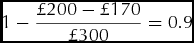
To illustrate: a lone mother with total gross earnings of £300 takes home £200 after benefit withdrawal, taxes and childcare costs. This compares to benefits when out of work of £170. The lone mother's participation tax rate is therefore:
 \begin{equation*}
1 - \frac{{{\rm{\pound}}200 - {\rm{\pound}}170}}{{{\rm{\pound}}300}} = 0.9
\end{equation*}
In other words, she loses 90 per cent of her total gross earnings to benefit withdrawal, taxes and childcare costs. High participation tax rates therefore indicate weak incentives to be in employment.
The second, the incentive to take on additional hours when in work, is measured by the biographies’ effective marginal tax rates:
 \begin{equation*}
1 - \frac{\begin{array}{l}{\rm change\; in\; take\; home\; income\; from\; taking\; on}\\
\quad {\rm additional\; hours}\end{array}}{{\rm change\; in\; gross\; earnings\; from\; taking\; on\; additional\; hours}}
\end{equation*}
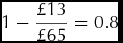
To illustrate: a lone mother in a minimum wage job of £6.50 an hour increases her hours by ten a week, giving additional gross earnings of £65. However, her take-home income increases by just £13. Her effective marginal tax rate is therefore:
 \begin{equation*}
1 - \frac{{{\rm{\pound}}13}}{{{\rm{\pound}}65}} = 0.8
\end{equation*}
This means she loses 80 per cent of the extra earnings gained from taking on ten additional hours of work to benefit withdrawal, increasing tax liabilities and/or additional childcare costs. High effective marginal tax rates thus indicate weak incentives to take on additional hours.
Results
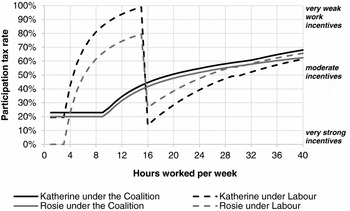
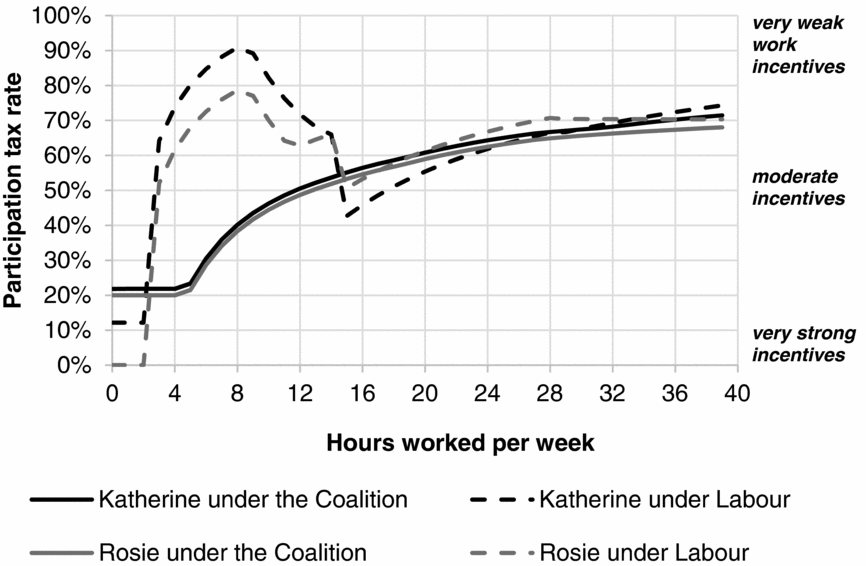
To give a measure of the biographies’ financial incentives to be in paid work, Figure 1 shows their participation tax rates (PTRs) under Labour and the Coalition according to hours worked in a minimum wage job. Figure 2 shows the same as for Figure 1 but for an average wage job. In both figures, the solid lines represent the biographies’ PTRs under the Coalition, while the dashed lines represent their PTRs under Labour. The further the lines sit above the horizontal axis at 0 per cent, the higher their PTRs, and so the weaker their incentives to be in paid work. Conversely, the closer the lines sit to the horizontal axis, the stronger their financial incentives to work.
Participation tax rates in a minimum wage job (£6.50 an hour) under Labour and the Coalition Note: The participation tax rate measures the incentive to be in paid work and is measured by: 1 − [(take home income when in work − out of work income from benefits) ÷ total gross earnings]. Katherine has two children and pays for childcare; Rosie has one child and does not pay for childcare. Source: Own calculations (Appendix 2).

Participation tax rates in an average wage job (£10.42 an hour) under Labour and the Coalition Note: The participation tax rate measures the incentive to be in paid work and is measured by: 1 − [(take home income when in work − out of work income from benefits) ÷ total gross earnings]. Katherine has two children and pays for childcare; Rosie has one child and does not pay for childcare. Source: Own calculations (Appendix 2).
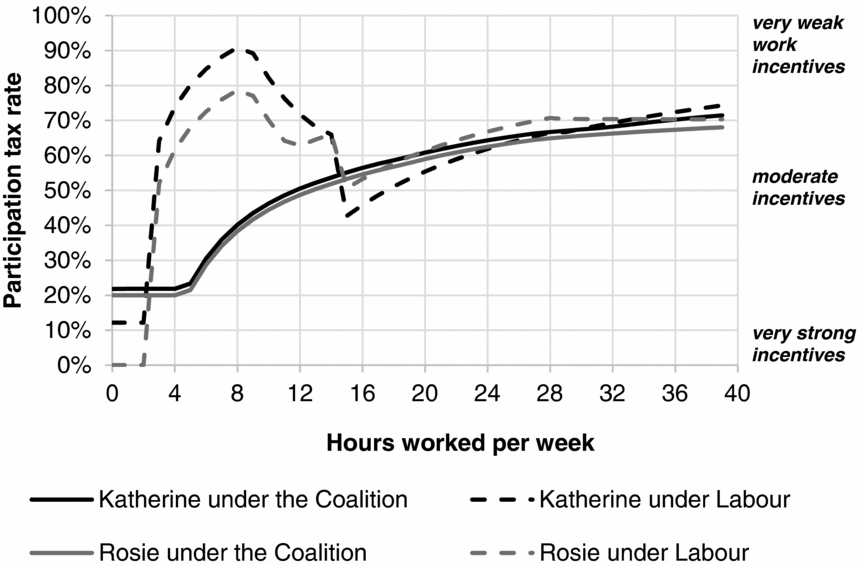
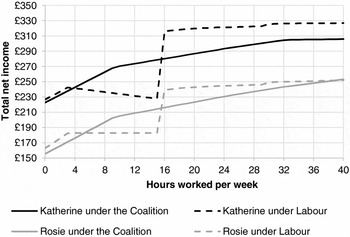
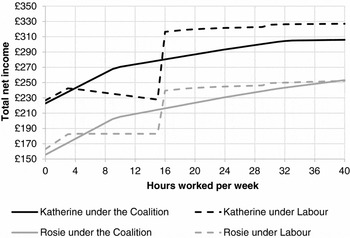
Figure 3 gives the biographies’ budget constraints when in a minimum wage job, while Figure 4 gives their budget constraints in an average wage one. A budget constraint plots hours worked against income from earnings and benefits net of any taxes and childcare costs to illustrate how an individual's income varies according to hourly increments in his or her labour supply. The slope of the budget constraint therefore gives a measure of the biographies’ effective marginal tax rates (EMTRs), which provide a measure of the incentives to take on additional hours of work. A positive gradient indicates net income is increasing with each additional hour of work taken on. Consequently, the steeper the positive gradient, the more the biographies keep of an increase in earnings from working longer. Steep positive gradients correspondingly indicate low EMTRs and therefore strong incentives to increase labour supply.
Total weekly net income in a minimum wage job (£6.50 an hour) under Labour and the Coalition Note: Total net income is all income from benefits and/or earnings after deductions for rent, Council Tax and any childcare costs, National Insurance contributions and income tax. Katherine has two children and pays for childcare; Rosie has one child and does not pay for childcare. Source: Own calculations (Appendix 2).

Total weekly net income in an average wage job (£10.42 an hour) under Labour and the Coalition Note: Total net income is all income from benefits and/or earnings after deductions for rent, Council Tax and any childcare costs, National Insurance contributions and income tax. Katherine has two children and pays for childcare; Rosie has one child and does not pay for childcare. Source: Own calculations (Appendix 2).

The figures illustrate the biographies’ incentives to work in a mini-job of four to fifteen hours improve substantially and become strong under the Coalition (Figures 1 and 2). Total net incomes when in a mini-job have also increased significantly (Figures 3 and 4). For instance, Katherine's PTR at fifteen hours for a minimum wage job has fallen from 99 per cent under Labour to 43 per cent under the Coalition (black lines in Figure 1). This means she keeps an extra 56 percentage points of her earnings from working this long under the Coalition. In addition, her total net income has increased from £228 under Labour to £279 under the Coalition (black lines in Figure 3), which is an income gain of £51. Similarly, Rosie's PTR at fifteen hours for a minimum wage job has fallen from 79 to 40 per cent (grey lines in Figure 1), meaning she keeps an extra 39 percentage points of her earnings while her income has risen from £183 to £214 (grey lines in Figure 3), which is a gain of £31.
Stronger incentives to work in a mini-job result from Universal Credit's lower withdrawal rate compared to the Income Support and Jobseeker's Allowance it replaces, as well as the extension of childcare subsidies to those working fewer than sixteen hours. Katherine's work incentives and net income between four and fifteen hours have therefore improved the most since she pays for childcare but Rosie does not. A more generous element for Katherine's second child in Universal Credit compared to Labour's Child Tax Credit, equivalent to £5.86 in 2015–16 prices, also explains why Katherine's income when out of work or in a mini-job has improved to a greater extent than for Rosie.
On the other hand, the biographies’ incentives to work fewer than four hours have weakened slightly under the Coalition. This is because whereas Labour's Council Tax Benefit disregarded some earnings before it started to be withdrawn, the Coalition's new system of support for Council Tax does not disregard any earnings before it starts to be reduced by 20 pence for every £1 earned. Nevertheless, because support for Council Tax is the only benefit that starts to be withdrawn when working under four hours, the biographies’ incentives under the Coalition remain very strong in absolute terms (solid lines in Figures 1 and 2).
While the Coalition's proposed tax-benefit reforms clearly give strong incentives for the biographies to work in short-hours jobs, the impacts on their incentives to work in a job longer than sixteen hours are more mixed. Compared to under Labour, incentives to work sixteen hours plus under the Coalition are at best marginally stronger, and at worst substantially weaker.
The drop in incentives to be in paid work is sharpest at exactly sixteen hours due to the removal of Labour's Working Tax Credit. For instance, for a minimum wage job, Katherine's PTR has risen from 14 per cent under Labour to 45 per cent under the Coalition. This means she loses 31 percentage points more of her earnings under the Coalition than before when taking a 16 hour minimum wage job (black lines in Figure 1). Correspondingly, her total net income has fallen from £316 to £280, which is a decrease of £36 (black lines in Figure 3). Meanwhile, Rosie's PTR for a sixteen hour minimum wage job has risen from 26 to 42 per cent, indicating she loses 16 percentage points more of her earnings to benefits withdrawal and taxes under Coalition measures (grey lines in Figure 1). In addition, her total net income has fallen from £240 to £216, which is a drop of £24 (grey lines in Figure 3). PTRs for a sixteen hour job at average wage have also increased under the Coalition, but to a smaller degree: namely, 12 percentage points for Katherine and 2 percentage points for Rosie (Figure 2). This is because Labour's Working Tax Credit gave exceptionally strong incentives to take a minimum wage job. Its generous earnings disregard, in combination with low earnings, meant the biographies kept most, if not all, of their maximum entitlement to tax credits. They were, however, still better off in absolute terms under Labour when in a sixteen hours plus job that paid the average rather than minimum wage (Figures 3 and 4).
While incentives to take a job of sixteen hours or slightly longer are far weaker and incomes far lower under the Coalition's reforms than before, there are smaller changes in incentives and incomes at longer hours of work. Figures 1 to 4 show a gradual narrowing of the gap in PTRs and incomes between Labour and the Coalition as working hours go up. This is partly down to above-indexation increases in the earnings threshold at which income tax becomes payable under the Coalition. These mean the biographies start paying tax at thirty-two rather than at twenty-four hours in a minimum wage job, and at twenty instead of fifteen hours in an average wage one. They also lose £10.55 less of their earnings to tax in 2015–16 prices when they do start paying it.
Smaller changes in incentives and incomes at longer working hours are also down to Universal Credit. Although Universal Credit removes Working Tax Credit and the income boost it gave at sixteen hours, its lower withdrawal rate relative to Housing Benefit and tax credits in combination means the Coalition gives similar, if not slightly better, incentives and incomes than Labour the more hours the biographies work beyond sixteen. For example, in 2015–16 prices, Katherine's income under Labour from Housing Benefit and tax credits when in an average wage job fell by £69.10 when she increased her hours from sixteen to forty in contrast, her income from Universal Credit falls by £50.60.
Another notable feature of Figures 3 and 4 is that Katherine's income when in a sixteen hours plus job has fallen to a greater extent under the Coalition than for Rosie. For instance, for a forty hour job at minimum wage, Katherine's total net income has fallen from £327 under Labour to £306 under the Coalition, representing an income loss of £21 (black lines in Figure 3). Conversely, Rosie's income has decreased by just 98 pence (grey lines in Figure 3). The difference between the biographies is explained by lower elements for subsequent children under the Coalition's benefits compared to Labour's benefits, which affect Katherine because she has two children. Elements for subsequent children in Child Benefit are £2.50 lower under the Coalition in 2015–16 prices, while those in Universal Credit and support for Council Tax are £10.34 lower than in Labour's Housing Benefit and Council Tax Benefit.
In terms of the biographies incentives’ to take on additional hours when they already have jobs, Figures 3 and 4 show an overall improvement from Labour to the Coalition. This is shown by the fact the biographies’ budget constraints are, for the most part, more positive sloping under the Coalition than under Labour. Universal Credit's lower withdrawal rate relative to the pound-for-pound withdrawal of the out-of-work benefits it replaces, together with the availability of help with childcare costs at all working hours, have improved the biographies’ incentives to increase their hours beyond a few up to fifteen a week. At the same time, Universal Credit's lower withdrawal rate compared to Housing Benefit and tax credits combined, in conjunction with its higher childcare subsidy compared to Working Tax Credit, have increased the biographies’ incentives to take on additional hours beyond sixteen a week.
Yet the problem with the Coalition's welfare reform agenda is that in absolute terms, the biographies’ incentives to work beyond just a small number of hours a week remain inadequate. PTRs at minimum wage under the Coalition start to exceed 50 per cent above twenty hours work for Katherine and twenty-two for Rosie, indicating they lose more than half of their total earnings to benefit withdrawal, taxes and/or childcare costs (solid lines in Figure 1). PTRs at average wage begin to surpass 50 per cent once hours exceed just twelve for Katherine and fourteen for Rosie (solid lines in Figure 2).
Moreover, the incentives for the biographies when they are already in work to take on additional hours beyond just nine at minimum wage and six at average wage remain weak in absolute terms under the Coalition. Their budget constraints from these points start to flatten, indicating only small income gains from each additional hour of work taken on beyond these hours (solid lines in Figures 3 and 4). This is mainly because these are the hours from which Universal Credit starts to be withdrawn. The combined withdrawal of Universal Credit and support for Council Tax gives EMTRs of 72 per cent for Rosie and 75 per cent for Katherine due to her childcare costs. This means the biographies lose between 72 and 75 pence of every additional £1 they earn from working beyond six hours at average wage and nine at minimum wage. EMTRs then rise by an additional 3 per cent when National Insurance becomes payable from twenty-five hours at minimum wage and sixteen at average wage. They rise by a further 6 per cent when the biographies start paying income tax from thirty-three hours at minimum wage and twenty-one at average wage. Because she pays for childcare, EMTRs for Katherine from thirty-three hours are exceptionally high. This is because the analysis assumes that by working thirty-three hours or longer, Katherine would be working outside of normal school hours and so would start paying for childcare during term-time. As a result, her EMTRs from 33 hours onwards jump up to 98 per cent at minimum wage and 87 per cent at average wage, suggesting there are virtually no incentives for her to progress up to full-time work under the Coalition's policies.
Conclusion
Since the 1990s, ‘make work pay’ measures have been a key policy lever for getting more lone parents into work and earning more. While Labour sought to make work pay mainly by increasing in-work benefits, the Coalition has instead focused on cutting out-of-work support and simplifying the benefits systems to help lone parents keep more of their earnings. This has been underpinned by a discourse which claims an apparently overgenerous and complicated benefits system under Labour not only created worklessness by eroding the ‘work habit’, but was ‘unfair’ on both welfare claimants and taxpayers and no longer affordable given deficit reduction plans.
Yet for the two hypothetical lone mothers in this analysis, while incentives to work in a mini-job of fewer than sixteen hours have improved, incentives to work longer appear weak, if not weaker than under Labour. In fact, the financial returns to progressing in work begin to diminish once hours exceed just six at average wage and nine at minimum wage, the hours from which the Coalition's flagship make work pay reform, Universal Credit, starts to be withdrawn. This suggests Universal Credit's withdrawal rate may be set too high to make more than only small amounts of work pay.
On the other hand, the introduction of in-work conditionality until lone parents are working ‘enough’ hours is likely to push many into working longer even if it does not pay (Whitworth and Griggs, Reference Whitworth and Griggs2013). Although Labour similarly used conditionality to push certain lone parents into jobs of sixteen hours, the analysis shows these jobs paid for the hypothetical lone mothers through Working Tax Credit. In contrast, the Coalition's overriding goal of reducing benefit dependency means tougher conditionality will potentially push lone parents into working beyond the point of financial returns.
Yet the abilities of lone parents to meet increased demands and expectations are likely to be undermined by broader policy and economic changes. Early evidence suggests the Coalition's Work Programme is not meeting lone parents’ specific needs, and they are a third less likely than other groups to find work through it (Dewar, Reference Dewar2012; Whitworth, Reference Whitworth2013). In addition, spending on early intervention, education and childcare fell by a quarter between 2009–10 and 2012–13 (Stewart and Obolenskaya, Reference Stewart and Obolenskaya2015), while 37 per cent of local authorities have reported cuts to provision of after-school clubs and 44 per cent have reported reductions in breakfast clubs (Wintour, Reference Wintour2013). Furthermore, lone parent underemployment, measured by total hours worked as a percentage of preferred hours of work, rose by 51 per cent between 2007 and 2012 throughout the recession (Tinsley, Reference Tinsley2014). In summary, whereas Labour's welfare-to-work reforms helped to raise lone parent employment and incomes, diminishing financial returns to working beyond a short number of hours under the Coalition, in conjunction with tougher conditionality and reduced employment supports, could have the opposite effect, especially given the rise in short hours and insecure forms of employment following the recession.
Acknowledgements
This work was undertaken as part of doctoral research funded by an Economic and Social Research Council 1+3 Studentship Award. I am extremely grateful to my supervisors, Professor Traute Meyer and Professor Ann Berrington, for their support and constructive feedback, and to the journal editors and three anonymous referees for their valuable comments on an earlier draft of this work.
Appendix 1 Example Universal Credit calculation for Katherine assuming she works 35 hours a week at minimum wage (£6.50 per hour)
Example calculation of Katherine's weekly Universal Credit award when working thirty-five hours at minimum wage
Appendix 2 Details of the assumptions made in the simulations
Details of the assumptions made in the simulations