1. Introduction
Over the past few years there has been a dispute in the literature regarding the Von Neumann entropy. It turns out that each contribution to this dispute (Shenker Reference Shenker1999; Henderson 2001; Hemmo Reference Hemmo2003) addressed a different special case. In this paper we generalize the discussion and examine the full matrix of possibilities that are relevant for the evaluation and understanding of Von Neumann's argument.
Von Neumann (Reference Von Neumann[1932] 1955, Chapter 5; subsequent references to Von Neumann are to this work) wanted to understand the origin of the irreversibility of the measurement process in quantum mechanics. He proposed to do so by establishing a conceptual link between a quantum measurement and thermodynamic processes:
It is desirable to utilize the thermodynamical method of analysis, because it alone makes it possible for us to understand correctly the difference between [the measurement transformation] 1 and [Schrödinger's unitary transformation] 2, into which reversibility questions obviously enter. (358)
His argument relies on a thought experiment which we examine in detail in this paper. The conclusion he draws from this thought experiment is that the quantum mechanical quantity
 $S_{VN}=-k\mathrm{Tr}\,(\rho \mathrm{log}\,\rho) $
(the so-called Von Neumann entropy) is the counterpart of thermodynamic entropy. Although Von Neumann's argument was elaborated and refined (for example, by Peres Reference Peres1993, Chapter 9), it is the only argument available so far for the idea that the Von Neumann entropy is “genuine entropy, fully equivalent to that of standard thermodynamics” (Peres Reference Peres1993, 270). All other arguments of which we are aware refer to it at one point or another or simply assume its conclusions.
Over the past few years there has been a dispute in the literature concerning whether or not Von Neumann's argument establishes its claim (see Shenker Reference Shenker1999 and Henderson Reference Henderson2003). In this paper we argue that Von Neumann's argument does not establish the desired conceptual linkage between
 $\mathrm{Tr}\,(\rho \mathrm{log}\,\rho) $
and thermodynamic entropy
 $(1/ T) \int pdV$
.
In order to clarify the subtleties of Von Neumann's argument we distinguish between the cases of a gas consisting of a single molecule, finitely many molecules, and infinitely many molecules, and examine Von Neumann's thought experiment in each of these cases. It turns out to be of crucial importance to keep these cases apart in order to understand Von Neumann's thought experiment. There are significantly different implications of the experiment with respect to Von Neumann's argument in each of the above cases.
In addition, it turns out that there are significant differences between the accounts of the experiment given by collapse and no collapse interpretations of quantum mechanics with respect to Von Neumann's argument. The argument fails for all such interpretations, albeit in different ways that originate from the different implications of such interpretations with respect to the behavior of the quantum state in measurement.
The paper is structured as follows. In Section 2 we give a brief overview of Von Neumann's thought experiment. We then (Section 3) examine the thought experiment in the case of a gas consisting of a single particle. We make a distinction between approaches that attempt to make a linkage between the Von Neumann entropy and thermodynamic entropy (Section 3.1) and approaches that attempt to draw a linkage between the Von Neumann entropy and Shannon information (Section 3.2). In Section 4 we examine the thought experiment in the case of a gas consisting of finitely many particles. In Section 5 we consider very roughly the limit of infinitely many particles. Section 6 is the conclusion.
2. Von Neumann's Argument
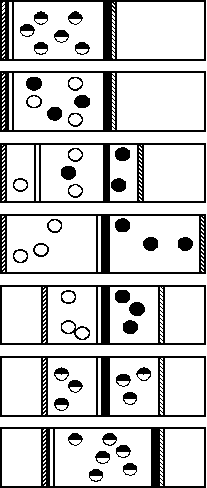
Von Neumann considers the following setup (see Figure 1). An ideal gas is prepared in a mixture of eigenstates of spin in some direction, e.g., a mixture of up and down eigenstates in the z direction of spin-
 $\frac{1}{2}$
particles (this case is illustrated in stage 2 of Figure 1; stage 1 is discussed below). Von Neumann proposes to conceive of the gas as an Einstein gas, in which the molecules are taken to be macroscopic boxes, each of which contains a spin degree of freedom.Footnote 1 This idea has two implications. One is that in such a gas there is no interaction between the spin and the position degrees of freedom (unless one ‘opens’ the boxes and manipulates them according to their contents). Another is that, due to the large mass of the boxes, the position degrees of freedom of the gas may be taken to be classical and represented by a quantum mechanical mixture (rather than by a pure state).
Von Neumann's thought experiment. Stage 1 of the experiment is the top diagram, followed by stage 2 below, and so on. Black or white ‘balls’ represent particles in the up or down eigenstates of z-spin. Half-black and half-white ‘balls’ represent particles in the ‘up’ eigenstate of x-spin.

Since Von Neumann wanted to find a linkage between a quantum measurement and thermodynamic processes, it is important to think about the preparation of stage 2 (Figure 1) as consisting of a quantum mechanical (non-selective) measurement, e.g., in our case a z-spin measurement of spin-
 $\frac{1}{2}$
particles all of which have been prepared in, say, the up eigenstate in the x direction.Footnote 2 (In Von Neumann's original presentation of the experiment the spin measurement is supposed to be carried out by means of an external device other than the position of the particles; see below.)
At stages 3 and 4 the particles are separated (reversibly) by a semipermeable partition according to the measurements’ outcomes, in such a way that by the end of stage 4 their spins get correlated to their positions. The coupling between the spin and position is brought about by ‘opening’ the boxes and sending the particles either to the right, if the z-spin is up, or to the left, if the z-spin is down.
Peres (Reference Peres1993, Chapter 9) presents a slightly different version of the experiment in which stage 2 in Figure 1 does not take place. Instead, at stage 1 the particles are prepared in the x-up eigenstate and the z-spin measurement consists solely in coupling the z-spin to the position of the particles as for example in a Stern-Gerlach experiment. The container itself with its semipermeable device is considered to be the z-spin measuring device.
Let us compare the changes in the Von Neumann entropy during stages 1–4 in the two versions (Von Neumann's and Peres's). In Von Neumann's version, the Von Neumann entropy at stage 2 is already positive, and since a separation of orthogonal states is entropy conserving (as Von Neumann proved, 370–376), the Von Neumann entropy does not change until stage 4 is completed.
In Peres's version the Von Neumann entropy increases during the direct transition from stage 1 to 4, as the spin states of the particles become (increasingly) mixed. This can be understood in information theoretic terms, since the amount of information about the spins of the particles available to the experimenter decreases. Although Von Neumann proved that entropy does not change during the spatial separation of the orthogonal spin states, there is no contradiction between the two versions. In Peres's version, stage 2 does not exist: the initial spin state of the gas is pure and not a mixture of orthogonal spin states. In this sense, the two versions describe different experiments.
At stage 5 the gas is isothermally and quasi-statically compressed so that its total volume returns to its original volume V while the pressure in both sides of the container becomes equal. Note that to do so one has to know (i.e., measure), before the compression, the relative number of particles at each side; in the subsequent sections we shall see that this measurement has important implications with respect to Von Neumann's argument. Nevertheless, Von Neumann himself does not mention this measurement, and we shall see in Section 5 why this is so.
Due to the compression at stage 5 the thermodynamic entropy of the gas decreases by
 $(1/ T) \int pdV$
(according to the ideal gas law). At stage 6 the spin state is brought back to the x-up eigenstate. Finally, at stage 7, the partition separating the compartments is removed, so that the system returns to its initial state. A thermodynamic cycle is thereby completed. According to Von Neumann, the transitions at stages 6 and 7 can be carried out unitarily and hence involve neither a change of a thermodynamic cycle nor of the Von Neumann entropy.Footnote 3
Von Neumann's argument, based on this thought experiment, is essentially arithmetic. He takes the system (of gas, measuring device and heat reservoir) to be isolated. Since the quantum mechanical states of the gas at stages 1 and 7 are identical, the entropies at these stages must be equal. Therefore all entropy changes during the experiment must add up to zero. And so, since at stage 5 the thermodynamic entropy of the gas decreases, increases of entropy (that add up to exactly the same amount) must take place at some other stages of the experiment. Von Neumann proves that the transformation from stage 2 to stage 4, i.e., the separation of the orthogonal spin states (by means of semipermeable partitions), does not change the entropy of the gas;Footnote 4 he also proves that the transformations from stage 5 to stage 7 are entropy conserving. He concludes by elimination that the increase in entropy takes place during the spin measurement by which the mixture in stage 2 has been prepared, and moreover he argues that the quantity
 $S_{VN}=-k\mathrm{Tr}\,(\rho \mathrm{log}\,\rho) $
changes by this measurement by exactly the required amount. Von Neumann deduces that this quantity is the quantum mechanical counterpart of thermodynamic entropy.Footnote 5 He then goes on to conclude that quantum mechanical measurement is dissipative by
 $\Delta S_{VN}$
. This, he believes, is the origin of the irreversibility of the measurement transformation in quantum mechanics. We now turn to examining Von Neumann's argument in more detail.
3. Single Particle
In this section we consider Von Neumann's argument in the case of a gas consisting of a single particle.Footnote 6 We explore the different roles played by thermodynamic entropy and the Shannon information theoretic entropy in this argument. We focus on Von Neumann's version of the experiment; our conclusions hold for Peres’ version as well.
The main point we wish to make in this section is that Von Neumann's argument does not establish a conceptual linkage between
 $\mathrm{Tr}\,\rho \mathrm{ln}\,\rho $
and the thermodynamic quantity
 $(1/ T) \int pdV$
(or
 $dQ/ T$
) in the case of a single particle gas since, in this case, the latter quantity remains (ideally) constant throughout the experiment; in particular it does not change at the compression stage 5. Let us see this in some detail.
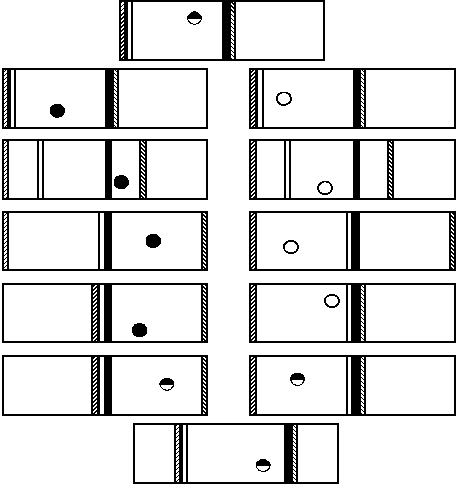
A particle P is prepared in a pure spin-up eigenstate in the x direction (see Figure 2). In the general case both the position and the spin degrees of freedom of P may be in mixed states. The total quantum state of P (spin plus coarse grained position, henceforth location: Left or Right) plus measuring instrument M (in which we include the heat reservoir and other elements of the environmentFootnote 7) is

where |+x〉P is the up eigenstate in the x direction of P and
 $\rho (L) _{P}$
is the density matrix describing the position of P, and in particular indicating that it is at the left hand side of the container. |Ready〉M is the ready state of M. In the literature (Peres Reference Peres1993, Chapter 9; Henderson Reference Henderson2003),
 $\rho (L) _{P}$
is often referred to as a Gibbs state,
 $e^{-\beta H}/ Z$
; the detailed nature of the mixture is immaterial for our arguments below. We assume that at stage 1 there is no interaction between the spin and the position of the particle. At this stage the Von Neumann entropy of the spin degree of freedom is obviously zero.
Von Neumann's argument for a single particle.

After the spin measurement the z-spin of P becomes entangled with the pointer states of M. The state at stage 2 isFootnote 8

where the |+z〉P and |−z〉P are, respectively, the up and down z-spin eigenstates, and |+〉M and |−〉M are the corresponding pointer states of M. The reduced state of P, tracing out the measuring device, becomes (in real cases only approximately):

This state has the form of a classical mixture, which in some interpretations of quantum mechanics may be taken to describe our ignorance of the z-spin of P. The Von Neumann entropy of the spin degree of freedom is now positive. At stage 4, after the spatial separation, the reduced state of P remains mixed, and is given by

where L and R indicate the left and right hand side compartments of the container at which the particle may be located.Footnote 9 A correlation between the z-spin and the location of P is thereby created.
Next, from stage 4 to stage 5, an isothermal compression is performed, in which the total volume available to the particle (left hand side plus right hand side of the partition) returns to its original volume V, while the pressure on both sides becomes the same and equal to
 $NkT/ V$
(by the ideal gas law). Recall that in the context of Von Neumann's argument it is necessary to consider the change in thermodynamic entropy
 $(1/ T) \int pdV$
at the compression stage, since the whole point in Von Neumann's argument is to establish a connection between quantum mechanics and thermodynamics.Footnote 10
In order to carry out a quasi static compression one has to know in advance at which compartment, L or R, the particle is located. Standard quantum mechanics only gives probabilities for finding the particle at L or at R on measurement of its location. Therefore we have to carry out a measurement of the location of the particle prior to the compression. As we shall now see, the key issue here is the physical significance of this measurement with regard to entropy changes.
As we saw above, Von Neumann's motivation in this argument was to establish a direct linkage between
 $\mathrm{Tr}\,\rho \mathrm{ln}\,\rho $
and thermodynamic entropy. We show in Section 3.1 that Von Neumann's argument does not establish such a link in the case of a single particle gas. Alternatively one might argue that Von Neumann's argument could be saved by taking into account the change in the Shannon information during the location measurement prior to the compression. Naturally, this idea supposes that the Shannon information is, or has a strong connection to, thermodynamic entropy; we examine this idea in Section 3.2.
3.1. Thermodynamic Entropy
The location measurement prior to the compression has no effect on the thermodynamic entropy of the gas. We reiterate that here we refer to the thermodynamic entropy and not to
 $\mathrm{Tr}\,\rho \mathrm{ln}\,\rho $
since the purpose of the argument is to establish a linkage between the two quantities. Regarding the Von Neumann entropy, the effect of the location measurement on it is different in collapse and no collapse interpretations of quantum mechanics. In collapse theories the quantum state collapses toFootnote 11

(each of which states is pure in the spin degree of freedom), depending on where the particle goes (to L or R). In no collapse theories the quantum state becomes

(in which the spin degree of freedom is in a mixed state, although effectively the state experienced by the observer has the form of one or the other states in (5)). However, this difference is immaterial as far as the assessment of the connection between
 $\mathrm{Tr}\,\rho \mathrm{ln}\,\rho $
and thermodynamic entropy is concerned, as we now show.
Consider the compression itself. In the case of a single particle, bringing the gas back to its original volume while attaining uniform pressure throughout the container, can only be achieved by compressing the empty side against vacuum to volume
 $V=0$
and keeping the non empty side (for example L in expression (5)) untouched. Since no work is involved in compressing against vacuum, the thermodynamic entropy does not change. Therefore, whatever changes occur in
 $\mathrm{Tr}\,\rho \mathrm{ln}\,\rho $
during the experiment, they cannot be taken to compensate for
 $(1/ T) \int pdV$
, since the latter is null throughout the experiment. For this reason, Von Neumann's argument does not establish a direct connection between
 $\mathrm{Tr}\,\rho \mathrm{ln}\,\rho $
and the thermodynamic entropy (in both collapse and no collapse quantum theories) in the case of a single particle.Footnote 12
The subsequent stages of the experiment have no effect on the above argument. From stage 5 onwards, until stage 7 (in which the gas returns to its initial state), it is in principle possible to carry out all the operations without entropy changes (e.g., unitarily). Alternatively (as Von Neumann says) one may measure the x-spin of the particle repeatedly until the result x-spin-up is obtained. In either way the state of the gas at stage 6 becomes essentially identical to the initial state:

The transition to stage 7 is obtained by merely displacing the container to the right. In Von Neumann's version of the experiment, the measuring device need also be returned to its initial ready state. One can do that unitarily.
3.2. Information Theoretic Entropy
In subjectivist approaches to statistical mechanics entropy quantifies our knowledge regarding the gas, using, e.g., the Shannon information.Footnote 13 These approaches are applied under the presupposition that thermodynamical systems are essentially mechanical systems consisting of particles; and that the Shannon information more appropriately captures the entropic features of such systems. For the moment we do not take a stand regarding the question whether or not these approaches are conceptually warranted, since we wish to examine whether Von Neumann's argument establishes a linkage between
 $\mathrm{Tr}\,\rho \mathrm{ln}\,\rho $
and the Shannon information, regardless of whether or not one accepts subjectivism in statistical mechanics. Furthermore, the subjectivist approach might seem relevant to Von Neumann's own discussion of his thought experiment since Von Neumann himself mentions Szilard's (Reference Szilard1929) paper on Maxwell's Demon (see Von Neumann, 400), a work which is often interpreted by appealing to the Shannon information.
In subjectivist approaches one ought to understand Von Neumann's argument as an attempt to establish a linkage between the Shannon information and the Von Neumann entropy. Let us reconsider Von Neumann's thought experiment in the framework of these approaches, in the case of a single particle.
The Shannon information
 $\sum_{i}p_{i}\mathrm{ln}\,p_{i}$
gained in the location measurement just prior to the compression is exactly equal to ln 2, and this is interpreted, in subjectivist approaches, as equivalent to a decrease in entropy of
 $-\mathrm{ln}\,2$
. And so it seems as if arithmetically the increase in the Shannon information exactly compensates for the information lost at the spin measurement, given by the increase of
 $\mathrm{Tr}\,\rho \mathrm{ln}\,\rho $
. However, the interpretation of this arithmetic result is different in collapse and in no collapse quantum theories.
In collapse theories, using the Shannon information in this way encounters the following dilemma: Either the Shannon information and the Von Neumann entropy are conceptually distinct or not. If they are conceptually distinct (as argued by Peres Reference Peres1993, 280),Footnote 14 then we have to take into account in the total entropy balance the changes of both the Von Neumann entropy and the Shannon information. As a result of the location measurement the Von Neumann entropy decreases back to its original value (see expression (5) above), and so the total change in Von Neumann entropy plus Shannon information following the location measurement at stage 5 is 2 ln 2, which is greater than the increase in the Von Neumann entropy following the spin measurement at stage 2. In this case Von Neumann's argument fails arithmetically.
On the other hand, in this experiment the gas is prepared in orthogonal spin or location states, and therefore one may identify the Shannon information and the Von Neumann entropy (despite the argument of Peres Reference Peres1993, 280). In this case we consider the change in the Von Neumann entropy and in the Shannon information as a single change of −ln 2, and so the arithmetic comes out right. However, this would mean that one has to presuppose, independently of Von Neumann's thought experiment, that the Shannon information and the Von Neumann entropy represent one and the same quantity (or that they are interchangeable). But then, obviously, Von Neumann's thought experiment could not be taken as establishing this linkage. Thus, in a collapse theory in the case of a single particle, on either horn of the dilemma Von Neumann's argument cannot be taken to establish a connection between
 $\mathrm{Tr}\,\rho \mathrm{ln}\,\rho $
and the Shannon information.
Let us now consider no collapse theories, e.g., hidden variable theories and many worlds theories. In all of these theories the analysis of Von Neumann's argument is essentially the same since the behavior of the quantum state in these theories is the same: the (reduced) quantum state following the location measurement is given by expression (5′) above.Footnote 15 This immediately implies that the Von Neumann entropy does not change following the location measurement (by contrast to collapse theories). Therefore, prior to the compression the net change in the Von Neumann entropy (spin measurement, spatial separation and location measurement) is ln 2.
However, relative to each component of the mixture, the observer acquires information, and this acquisition is expressed by the change in the Shannon information. Thus, in the case of a single particle Von Neumann's argument establishes a linkage between
 $\mathrm{Tr}\,\rho \mathrm{ln}\,\rho $
and the Shannon information in no collapse theories.
However there are two points that need be stressed here. First, Von Neumann's linkage between the Shannon information and
 $\mathrm{Tr}\,\rho \mathrm{ln}\,\rho $
is limited to the case of a system prepared in orthogonal quantum states. For non orthogonal states the two quantities are provably distinct (see Peres Reference Peres1993, 280). The second point is more general and concerns the significance of the Shannon information as corresponding to entropy, since a linkage between the Shannon information and thermodynamic entropy has not been established. One of the main problems in the subjectivist approaches to classical statistical mechanics is that the choice of the uniform probability measure seems to be unjustified. Relying on ignorance and the principle of indifference is notoriously not enough (see e.g., Sklar Reference Sklar1993, Guttmann Reference Guttmann1999). Moreover, to the extent that the Shannon information underwrites the thermodynamic entropy, it does so via statistical mechanics. As is well known, statistical mechanics is time symmetric: while predicting entropy increases towards the future, it also retrodicts that entropy increases towards the past, in contrast to thermodynamics. This is one of the open problems in the foundations of statistical mechanics. Hence, the link between the Shannon information and
 $\mathrm{Tr}\,\rho \mathrm{ln}\,\rho $
cannot lead to an explanation of the time asymmetry of the quantum measurement, which was the original aim of Von Neumann's thought experiment.
To sum up, recall Von Neumann's original motivation in proposing this thought experiment. Von Neumann wanted to make use of the thermodynamic arrow of time in order to explain the irreversible behavior of the quantum state in a measurement (Von Neumann's process 1). Therefore, although in some no collapse approaches to quantum mechanics it may be possible to establish a linkage between the Shannon information and the Von Neumann entropy, it is also not clear whether and how such a linkage will explain what Von Neumann wanted it to explain in the first place; that is, the irreversibility of the measurement interactions in quantum mechanics.
4. Finitely Many Particles
In this section we analyse Von Neumann's experiment in the case of a gas consisting of finitely many distinguishable particles.Footnote 16 In order to make the analysis precise we begin with a quantitative discussion of the case of a two particles gas (Section 4.1) and then proceed to discuss what happens as the number of particles increases (Section 4.2). (The case of infinitely many particles is discussed in Section 5.)
4.1. A Two Particles Gas
At stage 1 the quantum state of the two particles gas, suppressing the measuring devices, is

where |+x+x〉〈+x+x| is a projection onto the up eigenstates of spin in the x direction for both particles of the gas.
At stage 2 the z-spin of each particle is measured, and there are four possible outcomes of the measurements, each with probability
 $\frac{1}{4}$
. After the z-spin measurement the reduced state of the gas becomes

The particles are then sent to the L and R compartments, z-spin + to L and z-spin − to R (for brevity this is omitted in our description). By the end of stage 4 the Von Neumann entropy
 $\mathrm{Tr}\,\rho \mathrm{ln}\,\rho $
has increased by
 $-\sum_{n=1}^{4}\frac{1}{4}\mathrm{ln}\,\frac{1}{4}=2\mathrm{ln}\,2$
(see Von Neumann, 378).Footnote 17
In order to perform a quasi-static compression a measurement of the location (L or R) of the particles is necessary. We only need to measure the relative populations in the two compartments. We emphasise again that in the case of finitely many particles (including the single particle case) measuring the relative distribution of the particles over the L and R compartments is absolutely necessary in order to carry out the compression in a quasi static way. This measurement may involve a change in the Von Neumann entropy (see below) but it may be carried out in such a way that no change in the thermodynamic entropy will take place. For example, we can measure the relative frequency directly by weighing compartments L and R, which is, in thermodynamics, a reversible and entropy conserving process. (We comment on the Shannon information below.)
Let us examine how the Von Neumann entropy changes following this measurement. As we saw in the previous section, the question of whether and how the Von Neumann entropy changes following this measurement is answered differently in collapse and no collapse interpretations of quantum mechanics.
We begin with collapse theories. In such theories a measurement brings about a change in the quantum state of the system in the form of a collapse. This change is manifested (among other things) by a change in the Von Neumann entropy. Since in order to perform a quasi static compression all we need is the relative populations at L and R only, and not the locations of the individual spins, the Von Neumann entropy decreases as a result of the location measurement by
 $2\cdot \frac{1}{4}\mathrm{ln}\,\frac{1}{4}+\frac{1}{2}\mathrm{ln}\,\frac{1}{2}=\frac{3}{2}\mathrm{ln}\,2$
. The total entropy balance so far (by the end of stage 4) in collapse theories is
 $\frac{1}{2}\mathrm{ln}\,2$
.Footnote 18
We now turn to stages 1–4 in no collapse theories. In these theories the Von Neumann entropy remains unchanged during the location measurement. Therefore the total entropy balance so far (by the end of stage 4) is 2 ln 2.Footnote 19
Consider now the compression stage (in both collapse and no collapse theories). The change in thermodynamic entropy of the gas as a result of the compression depends on the distribution of the particles over the L and R compartments. As we already argued in Section 3, all the interpretations of quantum mechanics agree on the probabilities for each distribution and on the (effective) distribution. In particular, all the interpretations agree that on each trial of the experiment exactly one of the possible distributions occurs.Footnote 20 Therefore, the actions one must take as well as the changes in thermodynamic entropy in the compression stage are interpretation independent.
In the case of a gas consisting of two particles there are two different possible distributions. One is that both particles are in L or both in R. In these cases the compression is carried out against vacuum, no work is invested, and the change in thermodynamic entropy is null (as in the single particle case). The total entropy balance so far is unchanged (for both collapse and no collapse theories), and since there are no further entropy changes in the experiment, Von Neumann's argument fails arithmetically. Furthermore, in this case, Von Neumann's argument cannot establish a connection between the thermodynamic entropy and
 $\mathrm{Tr}\,\rho \mathrm{ln}\,\rho $
since the thermodynamic entropy does not change at all.
Consider now the second possible distribution of the particles, in which one particle is in L and the other is in R. In this case, the thermodynamic entropy decreases according to the ideal gas law
 $PV=NkT$
, by
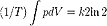 $(1/ T) \int pdV=k2\mathrm{ln}\,2$
. The total entropy balance so far is this. In collapse theories it is negative:Footnote 21
 $-\frac{3}{2}\mathrm{ln}\,2$
; and in no collapse theories: null. Thus in collapse theories Von Neumann's argument fails arithmetically. In no collapse theories the arithmetics comes out right only in the special case of equidistribution (1:1). However, Von Neumann's argument fails since equidistribution does not cover all the possible cases.Footnote 22
Can we save Von Neumann's argument by adding the change in the Shannon information following the location measurement? We don't want to take a stand as to whether or not, conceptually, there is a thermodynamic entropic cost associated with measurement via the Shannon information. In any case we shall now show that taking it into account will not save the arithmetics of Von Neumann's argument.
In principle, the Shannon information is supposed to replace the thermodynamic entropy in subjectivist approaches to classical statistical mechanics. To obtain a perfect replacement one has to measure the location of the particles before the compression such that the information gained by this measurement will enable a dissipationless compression. In the case of two particles the minimum information we need to obtain is location within sub-compartments of volume which is equal to
 $\frac{1}{2}$
the volume of the L and R compartments. The calculation of the change in the Shannon information depends on the permutations we allow between or within the sub-compartments. However in all possible calculations the arithmetics does not come out right, namely, the total entropy balance is never null.Footnote 23
4.2. Many Particles
Let us now consider whether an increase of the number of particles N in the gas can save Von Neumann's argument. In general, the initial quantum state of an ideal gas consisting of N spins will be the N-tensor product of the state of a single particle:

Following the spin measurements at stage 2 the Von Neumann entropy increases by
 $N\mathrm{ln}\,2$
. It is a combinatorial fact that as we increase N (assuming that the measurements are independent of each other) the laws of large numbers imply that it is highly probable that the distribution of the particles over the L and R compartments approaches the quantum mechanical probability. And for a large enough N, this means that the particles will be equidistributed over the L and R compartments with high probability.Footnote 24 Obviously, assuming that as a matter of fact the particles are equidistributed, there is no need to measure the locations of the particles before compressing the gas, and therefore the entropy changes will be the same in collapse and no collapse theories.Footnote 25 The decrease of thermodynamic entropy at the compression will on average be approximately
 $N\mathrm{ln}\,2$
, and this might be taken to imply that Von Neumann's argument goes through as an approximation.Footnote 26
However, since Von Neumann's argument is meant to establish a conceptual identity between the quantum mechanical entropy and thermodynamic entropy, we think that such an implication is mistaken. Strictly speaking, no matter how large N may be, as long as it is finite, the net change of entropy throughout the experiment will not be exactly zero. Since equidistribution is not the only possible distribution, in principle one cannot dispense with the location measurement before the compression. In quantum mechanics this is manifested by the fact that for any finite N the gas will not be in an equidistribution eigenstate of the corresponding relative frequency operator, and so a measurement of the relative frequencies will necessarily change the quantum state of the gas. Therefore, for any finite N calculations will yield results which are qualitatively similar to the ones in the case of two particles. Von Neumann's argument will fail for exactly the same reasons.Footnote 27
5. Infinitely Many Particles
One perhaps could argue that the above approximation (for the N particles gas) might be taken to support Von Neumann's argument for conceptual identity, provided that the argument holds exactly at the infinite limit.Footnote 28 There are two distinct ways in which one could analyze the case of infinitely many particles, taking into account that a measurement is a physical operation which takes place in time. One way is a sort of intuitive account, in which one imagines a time series of identical experiments, such that as time goes to infinity the laws of large numbers imply that the relative frequencies of the outcomes of the experiments approach the theoretical probabilities. In the other way of thinking about measuring infinitely many particles one imagines that all the measurements are completed and that the outcomes are all present at a given time. These two accounts are radically different: while in the first account at any given time one considers the physical state of the gas as it approaches the limit, on the second account one considers the physical state of the gas at the limit. In these two accounts the physical quantities which are being measured may not be identical. More specifically, whereas in the first account we measure individual quantities of each of the particles separately and only then count the relative frequencies, in the second account we measure relative frequencies directly. In an important sense the first account seems to be much more physical and realistic than the second, since from a physical point of view we have no way of actually realising an infinite sample that is given at a time. However, for the purpose of examining Von Neumann's conceptual argument it might be crucial (as we said above) to see whether the argument holds exactly, even only as a mathematical abstraction, at the infinite limit. This is the reason why we consider the second account of the infinite case.
In the light of these considerations, let us now set, extremely roughly, Von Neumann's argument in the case of infinite gases. The first account of the infinite gas above is a straightforward generalization of the cases of finite but very large gases in which we take the limit of infinitely many particles:

If we allow thinking about the infinite case in this way then the spin state of the gas at stage 2 and up to the end of stage 4 will be a mixture of spin z eigenstates; this is the case for any finite number of measurements we carry out on our way to the infinite limit. Relying on the laws of large numbers, one may say that as N increases the net changes in entropy throughout the experiment get closer and closer to zero (for the reasons we spelled out at the end of the previous section). Prima facie this seems to support Von Neumann's argument.
However, in our opinion extending this reasoning to the infinite limit is misleading. A measurement is a physical operation and therefore if we measure the spins one by one, the infinite limit is never reached. And the total entropy balance throughout the experiment will not be exactly, but only approximately zero. Therefore it seems to us that this first account of infinitely many particles is insufficient in order to support Von Neumann's conceptual argument for the identity of the Von Neumann entropy and thermodynamic entropy. For this purpose one has to consider the behavior of entropies at the infinite limit, and then at the limit demonstrate that the decrease in thermodynamic entropy is exactly compensated by the increase in the Von Neumann entropy. And to do so one has to construe the infinite system in a way that will not involve a process which is infinite in time, and that is therefore never completed at a finite time.
Let us then examine Von Neumann's argument in the second account of infinite gases. In this account, the quantum state of the sample is not as in (10) but rather

and the quantity we measure at stage 2 of the experiment is the infinite relative frequency observable of the gas.Footnote 29 The eigenvalues of the relative frequency observable are, roughly speaking, percentages of the populations at the L and R compartments. At stage 1 the quantum state of the spin part is an eigenstate of the relative frequency observable with an eigenvalue corresponding to all the spins being in an x-up eigenstate. By the end of stage 4 the particles are distributed over the L and R compartments according to their spins and the measurement of the relative frequencies has already been carried out. According to quantum mechanics the system is now in an eigenstate of the relative frequency observable.
In order to see in which eigenstate the system ends up we appeal to a theorem proved by Hartle (Reference Hartle1968) (see also Ochs Reference Ochs1979) about the behavior of infinite relative frequency operators in quantum mechanics. According to Hartle's theorem, the state of the infinite gas is the eigenstate of the relative frequency operator corresponding to an eigenvalue which is equal to the quantum mechanical Born probability. In Von Neumann's experiment this means that the gas is in a state of exact equidistribution between the L and R compartments. It then follows that Hartle's theorem implies that at the infinite limit there is no need to measure before the compression the relative frequencies in order to know with certainty that they are equal to the quantum mechanical probabilities (unlike the finite case). Therefore, arithmetically Von Neumann's argument goes through at the infinite limit.Footnote 30
6. Conclusion
We saw that Von Neumann's argument goes through only at the limit of infinitely many particles (in the second account) where we measure the relative frequency in an infinite collection of particles. But this case is not physical. Von Neumann's argument does not hold for a very large or even enormous number of particles, and not as the number of particles approaches infinity, but only at the limit of an infinite number of particles. However, real physical systems are finite. This means that Von Neumann's argument does not establish a conceptual identity between the Von Neumann entropy and thermodynamic entropy of physical systems. Identities of physical properties mean that the two quantities refer to the same magnitude in the world. We have shown that for finite gases this identity of reference does not hold, and in the infinite case where the argument does hold (arithmetically) the system in question is not physical. The fact that the behavior of the two quantities coincides approximately for a very large number of particles is not enough, because in any ensemble of finite gases there are systems in which the identity will not be true. This means that in a real experiment the Von Neumann entropy is not identical with the thermodynamic entropy.
To understand our objection it might be helpful to distinguish between two ways in which infinitely many particles are used in statistical physics: as an ensemble and as a collection (see Peres's (Reference Peres1993, 25 n.1; 59 n.9) distinction between ensembles and assemblies). An ensemble is an abstract representation of probabilities pertaining to a single actual system. Therefore, all its members undergo the same interactions and manipulations with differences stemming only from different initial conditions, or in some quantum mechanical theories also from probabilistic laws. In Von Neumann's thought experiment the ensemble should consist of infinitely many containers each of which contains the same number of particles. For example, an ensemble representing a single particle in a container consists of infinitely many containers each of which contains a single particle. In each such container the compression is carried out against vacuum according to the particle's position, and therefore it results in no change of thermodynamic entropy. The ensemble average of the change in thermodynamic entropy is therefore zero in this case.
A collection, on the other hand, is a composite system, the elements of which have some common important features, e.g., some external constraints. In our discussion, a collection is a gas consisting of finitely or infinitely many particles in a single container. As we have shown the changes of entropy in a collection of particles depend on its physical features. The right way to treat collections in statistical mechanics is by considering an ensemble of collections. In Von Neumann's thought experiment, the ensembles consist of infinitely many containers, each of which contains some collection of particles either finite (in the physical case) or infinite (in the non physical case). We distinguished between three collections: one consisting of a single particle, another consisting of finitely many particles and the third one is an infinite collection. Each such collections may be described by a suitable ensemble which represents probabilistic considerations regarding the distribution of properties within the collection.Footnote 31 The infinite case in which Von Neumann's argument goes through is an infinite collection, and this case is not physical.