


Introduction
What does it mean for an animal to live a good life? While access to food, water, shelter and good health forms the foundation of welfare, an animal’s subjective mental state and affective experiences (i.e. feelings) are equally vital. Encapsulating modern animal welfare thinking is the Five Domains model (Mellor et al. Reference Mellor, Beausoleil, Littlewood, McLean, McGreevy, Jones and Wilkins2020), a framework that highlights not only the importance of an animal’s nutrition, environment and health (Domains 1–3), but also their behavioural interactions (Domain 4) and overall mental state (Domain 5).
In particular, the fourth domain (behavioural interactions), focuses on animals’ interactions with their environment, other animals, and humans; and how these shape their affective states and welfare (Mellor et al. Reference Mellor, Beausoleil, Littlewood, McLean, McGreevy, Jones and Wilkins2020). In animals’ interactions with the environment, having opportunities to express agency-related behaviours (i.e. meaningful and goal-directed behaviours), such as exploration, promote positive affective states; and with other animals, positive interactions that reaffirm social bonds similarly support positive affective states (Mellor et al. Reference Mellor, Beausoleil, Littlewood, McLean, McGreevy, Jones and Wilkins2020). For animals in captivity, these interactions are often shaped by their caregivers’ decisions, emphasising the critical role of people (Hemsworth et al. Reference Hemsworth, Sherwen, Coleman, Appleby, Olsson and Galindo2018). The fourth domain also describes direct human-animal interactions, characterised by human attributes such as attitude, voice, aptitude, and handling/control, which shape animals’ affective states (Mellor et al. Reference Mellor, Beausoleil, Littlewood, McLean, McGreevy, Jones and Wilkins2020). Given the popularity of companion dog ownership and wide variation in caregiving practices (Philpotts et al. Reference Philpotts, Blackwell, Dillon, Tipton and Rooney2024a), greater attention should be given to the influence of human behaviour on dog welfare.
Human behaviour change (HBC) science offers a theory-driven approach for understanding and influencing behaviour, and has been successfully applied across various fields, including animal welfare, public health, and environmental sustainability (Glanville et al. Reference Glanville, Abraham and Coleman2020; Albarracín et al. Reference Albarracín, Fayaz-Farkhad and Granados Samayoa2024). A popular behaviour change framework is the Capability, Opportunity, Motivation and Behaviour (COM-B) model. It identifies three key components of behaviour: Capability (an individual’s psychological and/or physical capacity to perform the behaviour); Opportunity (external physical or social factors that facilitate or prevent the behaviour); and Motivation (automatic or reflective processes that drive behaviour) (Michie et al. Reference Michie, van Stralen and West2011). A key strength of the COM-B model lies in its direct applicability to behaviour change intervention design. It forms the core of the Behaviour Change Wheel (BCW), which systematically links Capability, Opportunity and Motivation to nine intervention functions and seven policy categories, offering a structured framework for developing behaviour change interventions (Michie et al. Reference Michie, Atkins and West2014). According to the COM-B model, for a behaviour to occur, individuals must possess sufficient Capability and Opportunity to engage in the behaviour, as well as a strong Motivation to perform the behaviour that exceeds competing behaviours (Michie et al. Reference Michie, Atkins and West2014). Accordingly, effective behaviour change requires identifying and targeting relevant behavioural components through their associated interventions. The use of COM-B and the BCW for behaviour change has been popular and widely applied across various contexts. For example, within the sustainability sector, the framework has been used to design interventions to promote recycling behaviour (Allison et al. Reference Allison, Purkiss, Lorencatto, Miodownik and Michie2022), while within the animal welfare sector, it has been successful in influencing owner behaviour to increase playtime with cats (Delgado et al. Reference Delgado, Marcinkiewicz, Rhodes and Ellis2025), as well as to reduce obesity in dogs (Webb et al. Reference Webb, Molina, Sheridan, du Plessis, Brown, Abraham, Morton and McKay2025). Within the health sector, the framework has also been used to develop interventions to promote physical activity and reduce obesity rates in humans (Alageel et al. Reference Alageel, Alsukait, Alharbi, Bilal, Aldakhil and Altwaijri2025; Cuoto et al. Reference Couto, Morgado, Pereira, Vitorino, Bento, Alves, Duarte-Mendes and Cid2025). Collectively, these examples demonstrate the robustness of the COM-B framework across diverse domains, highlighting its value as a foundation for behaviour change work. In this present research, the COM-B model offers a well-established framework for understanding the behavioural components of owners’ engagement in caregiving practices aimed at enhancing dog welfare.
In Singapore, dog ownership is on the rise, with a 30% increase between 2019 and 2025 and approximately 91,000 licensed dogs to date (Lee Reference Lee2025), highlighting the growing importance of safeguarding dog welfare. As one of the world’s most densely populated and economically driven cities (Cho & Križnik Reference Cho, Križnik and Križnik2017), Singapore presents unique challenges to dog caregiving. These include space constraints (Woo Reference Woo2024) and long working hours (Leu et al. Reference Leu, Rebello, Sargent, Kelly and Banwell2023), which may limit dog owners’ ability to prioritise welfare-enhancing care for their dog. Despite these constraints, alongside the growing popularity of dog ownership, research on dog welfare in Singapore remains limited. Existing studies on companion dogs have primarily focused on human health-related outcomes, such as the psychological and physical benefits of dog ownership, or on animal-assisted interventions (Muckle & Lasikiewicz Reference Muckle and Lasikiewicz2017; Goh et al. Reference Goh, Tan, Syn, Tan, Low, Foo, Fung, Hoong and Pang2020; Tan et al. Reference Tan, Fung, Tan, Low, Syn, Goh and Pang2021). To address this gap, the present study aims to adopt the COM-B model to investigate the influence of Capability, Opportunity and Motivation on dog owners’ engagement in welfare-enhancing practices.
Materials and methods
Data collection
Ethical approval was obtained from the Royal (Dick) School of Veterinary Studies Human Ethical Review Committee (HERC; 2025-031). An online survey was created using Microsoft Forms® (Version 6.0) and administered from 30 May to 13 June 2025. The survey targeted Singaporean dog owners and was disseminated via seven dog-focused groups on Facebook (comprising of between 1,800 to 62,000 members each), as well as through friends and family using a snowball sampling approach. A total of 240 responses were collected.
Prior to obtaining ethical approval, the survey was piloted from 7 to 14 May 2025 with 15 respondents, which included six animal welfare and human psychology experts. The pilot aimed to clarify ambiguous questions, test completion time, and ensure scientific soundness.
Survey design
The survey, available in File A (see Supplementary material), consisted of 56 questions, divided into three sections: Demographic Information (Section A); Dog Caregiving Practices (Section B); and Self-reported Capability, Opportunity and Motivation (Section C).
The survey took approximately 10 min to complete. On the opening page, participants were briefed on their participation, assured of anonymity, and confirmed informed consent prior to starting.
Section A: Demographic information
This section consisted of five questions on participants’ gender, age, number of years owning dogs, highest education level, and type of housing lived in.
Section B: Dog caregiving practices
This section consisted of 20 statements assessing respondents’ caregiving practices towards their dog, in the context of their dog’s interaction with the environment, other animals and humans. These statements aligned with the fourth domain (behavioural interactions) outlined by Mellor et al. (Reference Mellor, Beausoleil, Littlewood, McLean, McGreevy, Jones and Wilkins2020). A mix of positively (welfare-enhancing) and negatively framed (welfare-compromising) statements was used to minimise acquiescence bias, which is the tendency for respondents to agree regardless of content (Jackson & Messick Reference Jackson and Messick1958).
To capture the diversity of real-life caregiving practices among dog owners, the statements were carefully curated to represent a range of agency types and human attributes in producing different affective outcomes, as described in the fourth domain. In addition to Mellor et al. (Reference Mellor, Beausoleil, Littlewood, McLean, McGreevy, Jones and Wilkins2020), relevant literature was consulted to inform statement development. For instance, a statement on the agency of exploration, “I allow my dog to sniff freely on walks”, was informed by evidence from Duranton and Horowitz (Reference Duranton and Horowitz2019) on the welfare benefits of sniffing. Similarly, a statement on owner handling, “I train my dog by using more of what they like (e.g. treats, praise) than what they don’t like (e.g. leash corrections, hitting)”, was guided by findings from Hiby et al. (Reference Hiby, Rooney and Bradshaw2004) on the benefits of rewards-based over punishment-based training. Refer to File B (see Supplementary material) for the full list caregiving practices.
Participants rated the extent to which each statement reflected their or their dog’s situation on a five-point Likert scale (1 = not at all like me/my dog’s situation, 2 = slightly like me/my dog’s situation, 3 = moderately like me/my dog’s situation, 4 = very much like me/my dog’s situation, 5 = exactly like me/my dog’s situation).
Section C: Self-reported Capability, Opportunity and Motivation
This section consisted of 31 statements evaluating dog owners’ self-reported Capability, Opportunity and Motivation to engage in welfare-enhancing practices (Table 1). The statements were adapted from Naydani et al. (Reference Naydani, Jessiman and Jarvis2025), a research tool designed to identify farmers’ Capability, Opportunity and Motivation to engage in practices that aligned with One Health (WHO 2026) principles, encompassing farm animal welfare, farmer well-being and environmental conservation. Given the breadth of topics covered by the original tool, only statements relevant to companion animal welfare were selected for this study. To supplement the statements, additional statements were developed by SL and reviewed by LJ and CN. The survey incorporated a mix of positively and negatively framed statements to help offset the possibility of acquiescence bias.
List of statements posed in the online survey assessing participants’ Capability, Opportunity and Motivation in dog care, with indication of whether each statement was positively (+) or negatively (‒) framed

Table 1. Long description
The table is organized into five columns: Component, Sub-component, S / N (Statement Number), Statement, and Frame (positive + or negative -).
1. Capability
- Psychological Capability: Includes 6 statements. Examples: ‘I know how to ensure my dog has a good life’ (+) and ‘I do not know what to do to meet my dog’s behavioural needs’ (-).
- Physical Capability: Includes 3 statements, all negatively framed, regarding how physical health affects dog care, such as difficulty providing varied opportunities.
2. Opportunity
- Physical Opportunity: Includes 5 statements regarding resources like money, time, and energy. Example: ‘I have access to all the resources I need to take good care of my dog’ (+).
- Social Opportunity: Includes 5 statements regarding social support and pressure. Example: ‘I have other people who help me to improve the life of my dog’ (+).
3. Motivation
- Automatic Motivation: Includes 6 statements regarding emotional connection and feelings. Example: ‘I feel good when my dog is doing well’ (+).
- Reflective Motivation: Includes 6 statements regarding personal responsibility and identity. Example: ‘The well-being of my dog is one of the most important things in my life’ (+).
Asterisks indicate statements adapted from Naydani et al. 2025.
* Statements were adapted from Naydani et al. (Reference Naydani, Jessiman and Jarvis2025).
S/N: Statement number.
Participants rated their agreement with each statement on a five-point Likert scale (1 = strongly disagree, 2 = disagree, 3 = neutral, 4 = agree, 5 = strongly agree).
Statistical analysis
Data preparation
For the section on Dog Caregiving Practices (Section B), responses to statements that were positively framed (i.e. welfare-enhancing practices) were coded in order from 1 (not at all like my/my dog’s situation) to 5 (exactly like me/my dog’s situation). For statements that were negatively framed (i.e. welfare-compromising practices), the coding was reversed. A coding guide is provided in File C (see Supplementary material), detailing how the statements were coded.
For each respondent, the codes from 20 caregiving practices were summed to create a single Welfare Score, with a higher score indicating greater engagement in welfare-enhancing practices (and a lower score indicating lower engagement). As there were 20 statements coded between 1 to 5, the possible score for a respondent ranged from 20 (minimum) to 100 (maximum).
Similarly, for the section on self-reported Capability, Opportunity and Motivation (Section C), responses to statements that were positively framed (i.e. reflects perceptions that enhance dog welfare) were coded in order from 1 (strongly disagree) to 5 (strongly agree). For statements that were negatively framed (i.e. reflects perceptions that compromise dog welfare), the coding was reversed. The coding guide provided in File C (Supplementary material) details how the statements were coded.
Reliability analysis
To assess the internal consistency of the 20-statement Welfare Score, as well as the separate Capability, Opportunity, and Motivation item sets, Cronbach’s alpha was calculated using SPSS® (Version 30).
Descriptive statistics
Descriptive statistics were generated in Microsoft Excel® (Version 16.98) to provide an overview of respondents by gender, age, highest education level, housing type, and years of experience owning a dog. Descriptive statistics for Welfare Score (median, quartiles, minimum, and maximum) were also calculated, alongside relative frequencies of Likert-scale responses on Dog Caregiving Practices (Section B) and self-reported Capability, Opportunity, and Motivation (Section C).
Principal Component Analyses (PCA)
Using Minitab® (Version 22), Principal Component Analyses (PCA) were performed on all Capability-related statements to derive a single first principal component (PC1) score for each respondent, representing their Capability. This process was repeated with statements on Opportunity, and then Motivation. The analysis produced three PC1 scores for each respondent; one for each COM-B component, which served as predictor variables in the subsequent analysis.
PCA is a statistical tool used to reduce a large number of variables (which, in this study, were the statements) into fewer principal components, while retaining as much of the original data information as possible (James et al. Reference James, Witten, Hastie and Tibshirani2021). The first principal component (PC1) represents the single component that explains the largest proportion of variance within each dataset. Although additional components could be extracted (e.g. PC2, PC3 and so on), only the first component was used in this study, as a single composite variable was sufficient to represent each COM-B component (Capability, Opportunity and Motivation). Eigenvalues of PC1 were checked to ensure they were greater than 1, a cut-off used for principal components that sufficiently explains variation in the data (Abdi & Williams Reference Abdi and Williams2010). A confirmatory PCA approach was used, rather than an exploratory one, as the pre-determined COM-B statements were intentionally grouped for separate analyses, rather than being analysed without prior assumptions about relationships between variables (Boateng et al. Reference Boateng, Neilands, Frongillo, Melgar-Quiñonez and Young2018). Capability, Opportunity and Motivation statement items were selected a priori from a validated COM-B/Theoretical Domains Framework (TDF) item bank (Naydani et al. Reference Naydani, Jessiman and Jarvis2025) and grouped according to their established theoretical classification. PCA was subsequently applied within each predefined domain to generate a parsimonious summary measure, reducing the number of correlated variables, for use in subsequent analyses.
Main analysis: Effect of COM-B components on Welfare Score
Next, a General Linear Model (GLM), using the regression function on Minitab® (Version 22), was performed to investigate the relationship between respondents’ engagement in welfare-enhancing practices (represented by Welfare Scores) and their Capability, Opportunity and Motivation (represented by their corresponding PC1 scores). The GLM fitted Welfare Score as the response variable, and the three PC1, including all two-way interactions, as predictor variables. Diagnostic plots were examined to assess suitability of model assumptions, including normality of residuals and homoscedasticity. Inspection of the plots indicated no major violation of these assumptions. Statistical significance was assessed at α = 0.05.
PC1 loadings
For COM-B components that significantly predicted Welfare Scores in the GLM, PCA loadings of each statement were extracted for interpretation. In PCA, loadings indicate how strongly each variable (in this study, each statement) contributed to the principal component, with higher absolute values reflecting greater contribution. Statements with loadings above 0.30 were interpreted, as this threshold indicated a meaningful contribution to the component (Comrey & Lee Reference Comrey and Lee2013).
Results
Demographic information
Of the 240 respondents, most were female (n = 185; 77.1%), educated to degree level (n = 187; 78%), lived in high-rise apartments, i.e. HDB/government flats and condominium/private apartments (n = 194; 80.8%), and had more than 5 years of experience owning dogs (n = 146; 60.9%) (Table 2). Respondents were mostly aged either between 26–35 years (n = 108; 45%) or 36–60 years (n = 100; 41.7%). Overall, the sample broadly reflected Singapore’s national housing profile (95.1% living in high-rise apartments) and age distribution (63% aged 20–64) (Singapore Department of Statistics 2024a,b). However, females and highly educated individuals were overrepresented relative to the national population, with women comprising 51% nationally and degree holders comprising 37% (Singapore Department of Statistics 2024b,c).
Demographic information of respondents (n = 240), showing the number and proportion of respondents by gender, age, highest education level, type of housing and years of experience owning a dog

Table 2. Long description
The table contains four columns: Category, Level, Number of respondents, and Proportion of respondents.
* Gender: Female (185, 77.1 percent), Male (53, 22.1 percent), Prefer not to say (2, 0.8 percent).
* Age: 25 years and below (18, 7.5 percent), 26 to 35 years (108, 45.0 percent), 36 to 60 years (100, 41.7 percent), 61 years and above (14, 5.8 percent).
* Highest education level: Doctorate P h D (2, 0.8 percent), Master’s degree (43, 17.9 percent), Bachelor’s degree (142, 59.2 percent), Tertiary education (45, 18.8 percent), Secondary education (8, 3.3 percent).
* Type of housing: H D B super 1 or government flat (126, 52.5 percent), Condominium or private apartment (68, 28.3 percent), Landed property (46, 19.2 percent).
* Years of experience owning a dog: Less than 1 year (12, 5.0 percent), 1 to 5 years (82, 34.2 percent), 6 to 10 years (46, 19.2 percent), More than 10 years (100, 41.7 percent).
Welfare Scores
Of the possible Welfare Scores ranging between 20 and 100, the lowest and highest respondent scored 45 and 96, respectively. The median Welfare Score was 71, with the first and third quartiles at 66 and 77, respectively.
Likert-scale responses
Dog caregiving practices (Section B)
Likert-scale responses on Dog caregiving practices (Section B) showed a clear trend towards higher ratings. The most frequently selected rating was 5 (33%), followed by 4 (27%), 3 (20%), 2 (11%), and 1 (9%). All ratings presented in this section and hereafter have been adjusted for reverse coding, such that higher ratings reflect greater engagement in welfare-enhancing caregiving practices, and lower ratings indicate the opposite.
Self-reported Capability, Opportunity and Motivation (Section C)
Responses on Capability were fairly evenly split between ratings of 4 (43%) and 5 (39%), with lower proportion for ratings of 3 (11%), 2 (5%) and 1 (2%). For Opportunity, responses were mainly clustered around ratings of 4 (41%) and 3 (22%), with ratings of 2 and 5 both at 16%, and rating of 1 at 5%. Motivation was predominantly rated 5 (52%), followed by 4 (36%), 3 (8%), 2 (3%), 1 (1%).
Reliability analysis
The 20-item Welfare Score demonstrated borderline acceptable internal consistency (Cronbach’s α = 0.70; Tavakol & Dennick Reference Tavakol and Dennick2011), reflecting the diverse range of caregiving practices included in the composite. These items were intentionally compiled from multiple sources to capture a broad spectrum of welfare-influencing practices. As such, the composite is better considered a relative, formative index rather than a unidimensional scale, and high internal consistency was not necessarily expected.
Each of the Capability, Opportunity, and Motivation item sets demonstrated acceptable internal consistency (Capability α = 0.77; Opportunity α = 0.71; Motivation α = 0.72), supporting their use as coherent constructs in subsequent analyses.
Principal Component Analysis (PCA)
Eigenvalues of PC1 derived from separate PCA of Capability, Opportunity, and Motivation statements were 3.28, 3.23, and 4.32, respectively. All eigenvalues exceeded 1, indicating that the principal components sufficiently explained variation in the data (Abdi & Williams Reference Abdi and Williams2010). The proportion of variance explained by PC1 in each analysis was 36.5, 32.3 and 36% for Capability, Opportunity, and Motivation statements, respectively, indicating that PC1 captured a substantial portion of the variation in each set of statements.
Main analysis: Effect of COM-B components on Welfare Score
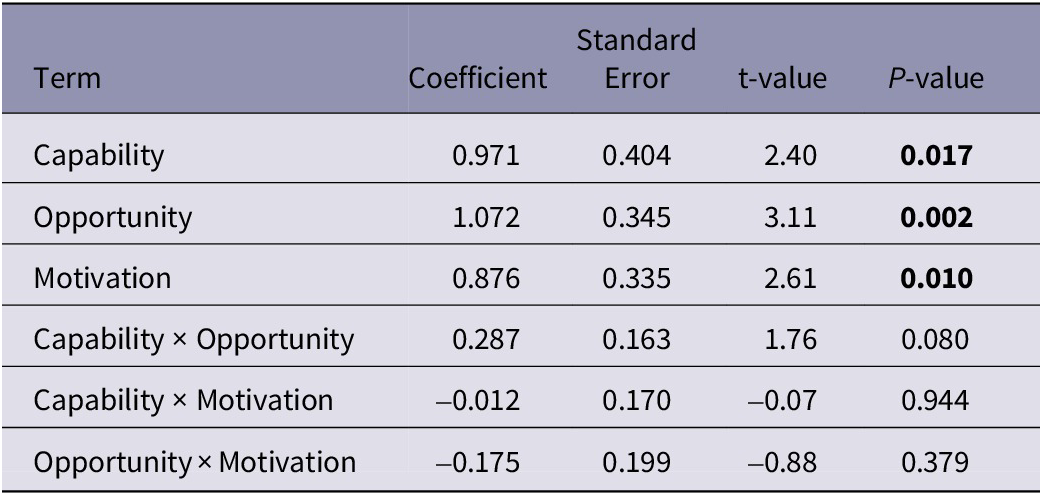
The GLM model, predicting Welfare Score from the PC1 scores of Capability, Opportunity and Motivation, including all two-way interactions, revealed a significant overall effect (F6,233 = 19.62, adjusted R2 = 31.86%; P < 0.001) (Table 3). Significant positive main effects were observed for Opportunity (F1,233 = 9.67; P = 0.002, partial η² = 0.040), Motivation (F1,233 = 6.82; P = 0.010, partial η² = 0.028), and Capability (F1,233 = 5.77; P = 0.017, partial η² = 0.024). Opportunity showed the largest effect size, followed by Capability and then Motivation. Although each COM-B component (Capability, Opportunity and Motivation) demonstrated only a small individual effect, together they produced a large overall effect (f² = 0.505), supporting the theory that the COM-B components work jointly, rather than independently, to drive dog welfare-enhancing behaviours. No significant effects were observed for any of the interaction terms (P > 0.05).
Output of the Generalised Linear Model (GLM) analysis with Capability, Opportunity, Motivation and all two-way interactions as predictor terms, and Welfare Score (a measure of dog owners’ engagement in welfare-enhancing practices) as the response variable. P-values in bold indicate a significant finding.

Table 3. Long description
The table consists of five columns: Term, Coefficient, Standard Error, t-value, and P-value.
* Capability: Coefficient 0.971, Standard Error 0.404, t-value 2.40, P-value 0.017.
* Opportunity: Coefficient 1.072, Standard Error 0.345, t-value 3.11, P-value 0.002.
* Motivation: Coefficient 0.876, Standard Error 0.335, t-value 2.61, P-value 0.010.
* Capability multiplied by Opportunity: Coefficient 0.287, Standard Error 0.163, t-value 1.76, P-value 0.080.
* Capability multiplied by Motivation: Coefficient minus 0.012, Standard Error 0.170, t-value minus 0.07, P-value 0.944.
* Opportunity multiplied by Motivation: Coefficient minus 0.175, Standard Error 0.199, t-value minus 0.88, P-value 0.379.
The first three terms (Capability, Opportunity, and Motivation) show statistically significant positive correlations with the Welfare Score, as indicated by P-values less than 0.05.
PC1 loadings
As all three COM-B components were significant predictors of Welfare Score, loadings from the PCA on Capability, Opportunity and Motivation were examined to investigate the statements contributing most strongly to each component. Following Comrey and Lee (Reference Comrey and Lee2013), statements with loadings above 0.30 were considered to indicate a meaningful contribution to the component. This threshold was met by five out of nine Capability statements, comprising two statements relating to psychological capability and three relating to physical capability (Table 4). Within the Opportunity component, PC1 loadings above 0.30 were observed for six out of ten statements, comprising five statements relating to social opportunity and one relating to physical opportunity. For the Motivation component, four out of 12 statements demonstrated loadings that exceeded the threshold, comprising one statement relating to automatic motivation and three relating to reflective motivation.
First principal component (PC1) loadings for each statement extracted from the Principal Component Analysis (PCA) on Capability, Opportunity and Motivation item sets. Loadings greater than 0.30, considered to indicate a meaningful contribution to the component, are shown in bold. Higher absolute loading values indicate a greater contribution to the component

Table 4. Long description
The table contains five columns: S / N, Component, Sub-component, Statement, and Loading (P C 1). Loadings greater than 0.30 are highlighted as significant.
Capability Component:
* Psychological Capability: Includes 6 statements. Significant loadings are ‘I know how to ensure my dog has a good life’ (0.387) and ‘I do not know how to optimise the well-being of my dog’ (0.375).
* Physical Capability: Includes 3 statements, all significant: ‘My physical health makes it difficult for me to take good care of my dog’ (0.354), ‘ …provide varied opportunities’ (0.398), and ‘ …ensure slow and careful introductions’ (0.374).
Opportunity Component:
* Physical Opportunity: Includes 5 statements, all significant: ‘I have enough time’ (0.394), ‘I have enough energy’ (0.423), ‘I have access to all the resources’ (0.397), ‘ …too expensive’ (0.364), and ‘I find it difficult to prioritise’ (0.390).
* Social Opportunity: Includes 5 statements. Only ‘My friends and family support me’ (0.342) is significant.
Motivation Component:
* Automatic Motivation: Includes 6 statements. Only ‘I feel good when my dog is doing well’ (0.352) is significant.
* Reflective Motivation: Includes 6 statements. Significant loadings are ‘It is in my nature to want to take good care of my dog’ (0.374), ‘I spend time thinking of ways to best care for my dog’ (0.309), and ‘The well-being of my dog is one of the most important things in my life’ (0.390).
S/N: Statement number.
Discussion
This study achieved its aim of using the COM-B model to investigate the influence of Capability, Opportunity and Motivation on dog owners’ engagement in welfare-enhancing practices. The findings revealed that all three COM-B components (Capability, Opportunity and Motivation) were significant positive predictors of Welfare Score, which served as a measure of engagement in welfare-enhancing practices. Opportunity showed the largest effect size, followed by Capability and Motivation. None of the two-way interaction terms significantly predicted Welfare Score. Descriptive analyses also revealed that respondents were moderately engaged in welfare-enhancing practices, and that respondents perceived themselves as highly capable (Capability), having fair opportunities (Opportunity) and being strongly motivated (Motivation) to engage in these practices for their dog.
Welfare Scores
The distribution of Welfare Scores was slightly positively skewed (median = 71, first quartile = 66, third quartile = 77, out of possible scores = 20–100), suggesting that respondents were moderately engaged in welfare-enhancing practices. Given the self-selecting nature of the sample, respondents were likely more interested in dog welfare than the broader dog-owning population. Despite this, engagement remained only moderate, even among this more welfare-oriented group. This suggests gaps in current ownership practices and indicates considerable scope for improvement, which is likely to be even greater in the wider dog-owning population.
Welfare Scores demonstrated substantial variation (range = 45–96, out of possible scores = 20–100), highlighting considerable differences in levels of engagement in welfare-enhancing practices between individuals. This variability is consistent with findings from studies in Australia, New Zealand and the UK, which have also found significant differences in dog care practices between groups of owners (Howell et al. Reference Howell, Mornement and Bennett2016; Forrest et al. Reference Forrest, Awawdeh, Pearson and Waran2023; Philpotts et al. Reference Philpotts, Blackwell, Dillon, Tipton and Rooney2024a). The variation in care practices highlights the heterogeneity of dog owners and may suggest the need for more tailored approaches to improve dog care.
Main findings: Effect of COM-B components on Welfare Score
Capability
Capability was identified as a significant positive predictor of Welfare Score, indicating that respondents with higher Capability (reflected through their PC1 scores) were more engaged in welfare-enhancing practices (reflected through their Welfare Scores). Within the COM-B framework, Capability comprises two aspects: psychological capability, reflecting respondents’ knowledge of dog welfare in this context; and physical capability, reflecting respondents’ physical ability to engage in practices that enhanced their dog’s welfare. Examination of PC1 loadings showed that both aspects of Capability had a balanced representation of strongly loaded statements, suggesting that respondents’ Capability reflected both psychological and physical components rather than being dominated by either.
Taken together, the significant positive association between Capability and Welfare Score, along with the balanced representation of both psychological and physical aspects of Capability, lends support to the validity of respondents’ self-assessments of their knowledge and physical functioning. More importantly, it suggests that respondents’ understanding of good dog care is accurate. If their understandings were misinformed, a null or inverse relationship between Capability and Welfare Score might be expected, indicating that respondents believe they know how to provide welfare-enhancing care but do not correctly identify or engage in practices that truly enhance welfare.
The apparent accuracy of respondents’ self-assessed Capability lends credibility to the high levels of Capability reported in this study (82% of responses rated 4 or 5). The results indicate that Singaporean dog owners mostly perceive themselves as, and likely are, highly capable in providing welfare-enhancing care for their dogs. However, despite respondents being highly capable, they were only moderately engaged in welfare-enhancing practices with their dog. This aligns with the COM-B framework in suggesting that Capability alone may not be sufficient to drive behaviour, and that Opportunity and Motivation may also be important contributors (Michie et al. Reference Michie, van Stralen and West2011).
Opportunity
Opportunity was also identified as a significant positive predictor of Welfare Score, indicating that respondents with greater Opportunity were more engaged in welfare-enhancing practices. Opportunity exhibited the strongest effect size among the three COM-B components, indicating that variation in Opportunity among respondents most strongly influenced differences in engagement in welfare-enhancing practices. This suggests that Opportunity may represent the most important constraint on behaviour in this sample and could be a key target for future interventions, with the largest behavioural gains.
Self-perceived Opportunity was observed to be fair (63% of responses rated 3 or 4), compared with the higher levels reported for Capability and Motivation. According to the COM-B model, Opportunity encompasses physical opportunity, referring to environmental factors that might limit an individual to perform a behaviour (e.g. time and money); and social opportunity, referring to the social environment that might shape behaviour (e.g. peer influence and social norms) (Michie et al. Reference Michie, van Stralen and West2011). Examination of the PC1 loadings showed that statements relating to physical opportunity more strongly represented the Opportunity component compared to statements relating to social opportunity. This suggests that respondents’ self-perceived Opportunity was more strongly characterised by physical constraints, such as available time, resources and finances, rather than social influences. This interpretation, coupled with the relatively lower Opportunity ratings, may reflect contextual physical constraints in Singapore, such as long working hours (Leu et al. Reference Leu, Rebello, Sargent, Kelly and Banwell2023), high-density living, limited space (Woo Reference Woo2024), and strict leash laws (e.g. requirements under the Animals and Birds [Licensing and Control of Cats and Dogs] Rules 2024). These conditions may reduce physical opportunity by limiting owners’ time available for welfare-enhancing care (Rehn & Keeling Reference Rehn and Keeling2011) and restricting opportunities for exploration and enrichment, which can be influenced by space availability and freedom to roam (Normando et al. Reference Normando, Contiero, Marchesini and Ricci2014; Foltin & Ganslosser Reference Foltin and Ganslosser2021). Although social opportunity appeared less prominent within the Opportunity component, contextual limitations in Singapore, such as cultural and religious norms, may limit dogs’ integration into communities (See 2015), potentially also reducing social opportunity.
Motivation
Motivation was also identified as a significant positive predictor of Welfare Score, indicating that respondents with stronger Motivation were more engaged in welfare-enhancing practices. As described in the COM-B model, Motivation includes automatic motivation, referring to automatic processes that are innate (e.g. emotions or habit processing) and reflective motivation, referring to reflective processes that involve conscious thinking (e.g. decision-making and planning; Michie et al. Reference Michie, van Stralen and West2011). Examination of the PC1 loadings showed that statements relating to reflective motivation more strongly represented the Motivation component compared to statements relating to automatic motivation. This suggests that respondents’ self-perceived Motivation was more strongly characterised by conscious beliefs about the benefits of providing good welfare (reflective motivation), rather than affective bonding or emotional attachment with their dog (automatic motivation). This pattern may reflect the broader socio-cultural context of Singapore as a pragmatically oriented society (Somjee & Somjee Reference Somjee, Somjee, Somjee and Somjee1995). In this context, behaviour may be relatively more influenced by reflective rather affective processes, which may help to explain the stronger representation of reflective motivation within the Motivation component.
Self-reported Motivation was very high, with the majority of responses (88%) rated between 4 and 5. This finding is unsurprising given the self-selecting nature of the sample. Individuals with greater interest in dog welfare were likely more inclined to participate, which could have contributed to the observed high levels of Motivation. However, despite this high Motivation, respondents were only moderately engaged in welfare-enhancing practices with their dog. This, again, aligns with the COM-B framework in suggesting that Motivation alone may be insufficient to drive behaviour if the other components are blocked.
Overall, these findings show that all three COM-B components (Capability, Opportunity and Motivation) had a significant influence on engagement in welfare-enhancing practices, with Opportunity demonstrating the strongest effect size. The dominant role of Opportunity is further reflected in the distribution of responses across the sample. Despite respondents having high levels of Capability and Motivation, Welfare Scores remained only moderate, alongside relatively lower levels of Opportunity. This suggests that constrained Opportunity may have limited the translation of high Capability and Motivation into actual welfare-enhancing practices.
Comparison with existing literature
Consistent with this study’s findings, other COM-B-based research has also demonstrated that Capability, Opportunity and Motivation collectively predict welfare-oriented behaviour. For example, Ma and McLeod (Reference Ma and McLeod2023) identified psychological capability (e.g. awareness of benefits) as the strongest predictor of cat containment behaviour among Australian cat owners, alongside weaker but significant effects of motivation and physical opportunity (e.g. living in an apartment and renting). Similarly, another study examining cat containment behaviour in New Zealand found that all three COM-B components significantly predicted owners’ ability to contain their cats (Chamberlain et al. Reference Chamberlain, McLeod and Hine2024). Beyond companion animal welfare, Farrell et al. (Reference Farrell, Benson, McKernan, Regan, Burrell and Dean2023) also found that farmers’ reduction in preventative antibiotic use in dairy cows was significantly predicted by awareness regarding the risks of antimicrobial resistance (reflecting psychological capability), perceived social pressure from consumers or authorities (reflecting social opportunity), and professional identity (reflecting Motivation).
Support for the present findings was also found in studies which did not explicitly draw on the COM-B model. For instance, Grigg and Kogan (Reference Grigg and Kogan2019) found that, owners in the US with greater knowledge on cat welfare (reflecting psychological capability) were associated with owning cats with fewer behaviour problems and were less aversive in response to their cats’ misbehaviour, both of which were indicative of improved welfare. Owners with a stronger human-animal bond (reflecting Motivation) were also associated with owning cats with fewer behaviour problems. Similarly, Do et al. (Reference Do, Nguyen, Nguyen and Tran2026) found that pet owners in Vietnam with greater pet welfare knowledge (reflecting psychological capability) and more positive attitudes towards pet care (reflecting Motivation) were associated with engaging in more welfare-oriented pet care behaviours.
However, not all studies have reported consistent findings regarding the influence of the COM-B components. For example, in an Indonesian-based study, Muthoifin et al. (Reference Muthoifin, Afiyah, Nuha and Yuldarrahman2026) found that pet owners’ emotional attachment (reflecting automatic motivation) did not significantly predict pet welfare; unlike the present study, where Motivation significantly predicted welfare-oriented behaviour. This discrepancy may reflect differences in the way constructs were operationalised. For instance, while the present study assessed welfare using the fourth domain (behavioural interactions) of the Five Domains model, Muthoifin et al. (Reference Muthoifin, Afiyah, Nuha and Yuldarrahman2026) drew on the Five Freedoms framework, which included nutrition, environment and physical health alongside behaviour. This suggests that differences in how constructs are conceptualised may need to be considered when interpreting associations between COM-B components and animal welfare outcomes.
Overall, the present findings align closely with the broader literature, highlighting the importance of Capability, Opportunity and Motivation in influencing welfare-oriented behaviour and providing support for the COM-B model as a framework to understand and influence owner behaviour to improve animal welfare.
Applying the Behaviour Change Wheel (BCW)
A key strength of the COM-B model lies in its direct application to intervention design through the Behaviour Change Wheel (BCW) (Michie et al. Reference Michie, van Stralen and West2011). Developed from a synthesis of 19 existing behaviour change frameworks, the BCW is a revised framework that aims to take on a more systematic and comprehensive approach in intervention design. It addresses common shortcomings in previous models, particularly the tendency to design interventions without first identifying underlying causes of behaviour (Johnston & Dixon Reference Johnston and Dixon2008). The BCW places COM-B at its core, and links its three behavioural components (Capability, Opportunity and Motivation) to nine intervention functions (education, persuasion, incentivisation, coercion, training, restriction, environmental restructuring, modelling and enablement) and seven policy categories (communication, guidelines, fiscal, regulation, legislation, environmental/social planning, service provision).
The findings of this study suggest that promoting welfare-enhancing behaviours among dog owners requires addressing all three COM-B components: Capability, Opportunity and Motivation. Therefore, BCW-informed strategies should incorporate a combination of intervention functions and policy categories targeting these components. In Singapore, current efforts to improve pet dog welfare have predominantly focused on education through various campaigns, events, talks and workshops led by authorities and animal welfare groups (Chained Dog Awareness Singapore [CDAS] 2023; Animal and Veterinary Services [AVS] 2025; Society for the Prevention of Cruelty to Animals [SPCA] 2025). This emphasis on education reflects the broader tendency in behaviour change practice to prioritise knowledge-based approaches (Glanville et al. Reference Glanville, Abraham and Coleman2020). However, the findings of this study, alongside evidence that targeting Capability alone may be insufficient to change behaviour (Cornish et al. Reference Cornish, Jamieson, Raubenheimer and McGreevy2019; Philpotts et al. Reference Philpotts, Blackwell, Dillon and Rooney2024b), highlight the need to also address Opportunity and Motivation through broader intervention approaches. In particular, Opportunity showed the strongest effect size in predicting engagement in welfare-enhancing practices, suggesting that prioritising interventions that target physical and/or social opportunity may offer the greatest potential for behavioural gains, with physical opportunity representing a particularly promising target given its greater contribution to the PC1 loadings. Within Singapore, the policy categories, namely guidelines and legislation, such as the Code of Animal Welfare (NParks 2017) and the Singapore Animals and Birds Act (1965), operate alongside educational initiatives. While these frameworks establish minimum standards of care for animals and focus on preventing unnecessary suffering, they are less comprehensive compared with welfare approaches seen in other jurisdictions. For example, Scotland’s Animal Health and Welfare (Scotland) Act (2006) places a duty on owners to promote welfare, while countries such as Austria, Germany, the Netherlands and Sweden specify requirements relating to housing conditions, time alone, and outdoor exercise, reflecting the heightened status for companion animals within these societies (Andersen et al. Reference Andersen, Meyer, Forkman, Nielsen and Sandøe2021).
Overall, the findings of this study point towards the need for a holistic approach to improving dog welfare in Singapore by targeting Capability, Opportunity and Motivation. Once appropriate intervention functions and policy categories are identified, specific behaviour change techniques (BCT) can be developed (Michie et al. Reference Michie, van Stralen and West2011) and evaluated using the Affordability, Practicality, Effectiveness, Acceptability, Side-effects, and Equity (APEASE) criteria (Michie et al. Reference Michie, Atkins and West2014) to ensures that chosen interventions are contextually appropriate and effective.
Study limitations and future directions
As this study utilised a self-selected sample, respondents may be skewed towards more welfare-conscious perspectives compared to the broader dog-owning population, potentially limiting generalisability. The study’s reliance on self-reported data may also have introduced response biases, social desirability bias (e.g. Paulhus Reference Paulhus1984) and acquiescence bias (e.g. Jackson & Messick Reference Jackson and Messick1958), despite efforts to reduce bias in the study design. The relatively low internal consistency of the Welfare Score highlights the multidimensional nature of caregiving practices and underscores the need to develop better targeted and holistic welfare measurement scales in future work. Additionally, statements on Capability, Opportunity and Motivation may have been too broad, failing to capture the complexity of lived dog ownership experiences. Future studies could explore behavioural determinants in greater depth using more detailed frameworks, such as the Theoretical Domains Framework (TDF) (Cane et al. Reference Cane, O’Connor and Michie2012).
Animal welfare implications and Conclusion
In conclusion, this study demonstrated that Singaporean dog owners’ Capability, Opportunity and Motivation significantly and positively predicted their engagement in welfare-enhancing practices with their dog. Opportunity showed the strongest effect size, highlighting its potential as a key target for intervention alongside the need for a comprehensive approach given the significance of all three COM-B components. This study also provided a baseline understanding of Singapore dog owners’ caregiving practices, characterised by moderate engagement in welfare-enhancing practices, high Capability, fair Opportunity, and strong Motivation.
As a novel application of HBC to promoting dog welfare in Singapore, this research provides a foundation for further research to refine welfare assessment scales and further investigate behavioural determinants in dog care. Building on the insights gained here, future research can guide evidence-based intervention design and policy formulation to strengthen dog welfare at a national level.
Supplementary material
The supplementary material for this article can be found at http://doi.org/10.1017/awf.2026.10111.
Data availability statement
Anonymised survey data used in this study are openly available in Open Science Framework at http://doi.org/10.17605/OSF.IO/9F62H, reference number 9f62h.
Acknowledgements
The authors would like to thank researchers at The Royal (Dick) School of Veterinary Studies, University of Edinburgh, and Scotland’s Rural College (SRUC) for their valuable input during the conceptualisation of the survey questionnaire, in particular Dr Amy Miele, Dr Laura Dixon, Dr Michelle Reeves, Dr Miguel Somarriba Soley, Dr Vincent Bombail. The authors also extend their gratitude to colleagues, friends and family who contributed to the refinement of the survey questionnaire to ensure it was easy to read, interpret, and answer for general dog owners. This research was conducted as the dissertation component of the lead author’s MSc in Applied Animal Behaviour and Animal Welfare at the University of Edinburgh, under the supervision of the second and third authors. The lead author’s participation in the MSc programme was funded by the Animal and Veterinary Services (AVS), National Parks Board, Singapore.
Competing interests
None.




 Open access

