Depression and anxiety are currently the most common mental health problems worldwide (Institute for Health Metrics and Evaluation, 2020). These conditions increase personal and social costs, such as functional disability, health care use, and sick leave (Organization for Economic Cooperation and Development, 2014; Whiteford et al., Reference Whiteford, Degenhardt, Rehm, Baxter, Ferrari, Erskine, Charlson, Norman, Flaxman, Johns, Burstein, Murray and Vos2013), and these worsen as the syndrome does. In this situation, certain strategies, such as prevention and optimization of health resources, are key and, since primary care centers are the first line of care in many health systems around the world, it might be a good target for the implementation of these policies.
Regarding prevention, one way to improve it could be to identify variables that may be associated with symptom severity, so that risk can be assessed and early action can be taken. On this matter, sociodemographic features have sometimes been found to be related to emotional symptoms. For example, two recent articles studied anxiety and depression during the COVID–19 pandemic in Spanish-speaking samples and found that both a lower level of education (< 12 years) and being unemployed were related to a higher proportion (Muñoz-Navarro, Cano Vindel, et al., Reference Muñoz-Navarro, Cano Vindel, Schmitz, Cabello and Fernández-Berrocal2021) and severity (Domínguez-Rodríguez et al., Reference Domínguez-Rodríguez, Herdoiza-Arroyo, Martínez Arriaga, Bautista Valerio, Mateu Mollá, de la Rosa-Gómez, Farfallini, Hernández Jiménez, Esquivel Santoveña, Ramírez-Martínez, Castellanos Vargas, Arzola-Sánchez, Arenas-Landgrave and Martínez-Luna2022) of emotional disorders. Muñoz-Navarro, Cano Vindel, et al. (Reference Muñoz-Navarro, Cano Vindel, Schmitz, Cabello and Fernández-Berrocal2021) further found that marital status and sex were only related to depression and anxiety, respectively, and that the lowest age range (18–25) was associated with a higher proportion of emotional disorders, whereas Domínguez-Rodríguez et al. (Reference Domínguez-Rodríguez, Herdoiza-Arroyo, Martínez Arriaga, Bautista Valerio, Mateu Mollá, de la Rosa-Gómez, Farfallini, Hernández Jiménez, Esquivel Santoveña, Ramírez-Martínez, Castellanos Vargas, Arzola-Sánchez, Arenas-Landgrave and Martínez-Luna2022) observed a significant relationship of sex with both types of symptoms and that age was directly proportional to the severity of anxiety and inversely proportional to depression. During the same time period, an Arabian study on generalized anxiety disorder (Aljurbua et al., Reference Aljurbua, Selaihem, Alomari and Alrashoud2021) found that younger age and being unemployed correlated with greater severity of the disorder, while sex showed no association with it. Rogers et al. (Reference Rogers, Short, Robles, Bakhshaie, Viana, Schmidt, Garza, Ochoa-Pérez, Lemaire, Bogiaizian, Medvedeva and Zvolensky2018) studied Spanish speakers too, who were recruited from a culturally-specific American medical center, and they associated greater severity of depression with being divorced and lower educational level (< 12 years), but found no relationship with age, employment, or sex. Nevertheless, as far as we know, only a few studies have investigated sociodemographic features associated with emotional symptom severity in general population in primary care settings, as it is more common for these relationships to be studied in samples with somatic diseases. Runkewitz et al. (Reference Runkewitz, Kirchmann and Strauss2006) studied primary care attenders and found that being female, being between 41 and 50 years old, and being divorced were associated with higher levels of anxiety, and of these variables, only sex was related to greater depression; educational level and employment status were not related to any of the pathologies. Milanović et al. (Reference Milanović, Erjavec, Poljičanin, Vrabec and Brečić2015) observed associations between lower educational level, being unemployed, never having been married, and older age with higher depression scores. In addition, Bener et al. (Reference Bener, Ghuloum and Abou-Saleh2012) found that these socio-demographic features could be differentially associated with anxiety and depression in men and women, with the latter having more severe symptoms. As can be seen, the results are often divergent, which could be due to the heterogeneity of the samples and the way the variables are coded.
Quality of life has also been related to anxiety and depression. A systematic review of longitudinal studies, conducted by Hohls et al. (Reference Hohls, König, Quirke and Hajek2021), suggests that there may be a bidirectional relationship between quality of life and emotional problems (i.e., either could be predictive of the other). Furthermore, some studies in primary care have found that poorer quality of life may correlate with greater severity of anxiety (Ramsawh & Chavira, Reference Ramsawh and Chavira2016; Revicki et al., Reference Revicki, Brandenburg, Matza, Hornbrook and Feeny2008).
Research also suggests that people with mood and anxiety disorders share certain maladaptive emotion-regulation strategies or processes that make them vulnerable to them (Sloan et al., Reference Sloan, Hall, Moulding, Bryce, Mildred and Staiger2017), such as repetitive negative thinking, negative metacognitive beliefs, expressive suppression, or attentional and interpretational biases regarding one’s own body sensations. Rumination and worry are the most studied forms of repetitive negative thinking. Rumination can be defined as a maladaptive pattern of response to distress, which consists of repetitive and passive thinking about the emotional symptoms, their causes, and consequences, not to actively seek a solution, but to gain insight about them; in contrast, worry focuses on future events perceived as uncertain and to some extent controllable, what generates a motivation to anticipate them (Lyubomirsky et al., Reference Lyubomirsky, Layous, Chancellor and Nelson2015). Although rumination is typically associated with depression, and worry with anxiety, several studies show that both strategies are related to some extent to the two emotional problems (Aldao et al., Reference Aldao, Nolen-Hoeksema and Schweizer2010; McEvoy et al., Reference McEvoy, Watson, Watkins and Nathan2013; Rickerby et al., Reference Rickerby, Krug, Fuller-Tyszkiewicz, Forte, Davenport, Chayadi and Kiropoulos2022; Taylor & Snyder, Reference Taylor and Snyder2021; Yapan et al., Reference Yapan, Türkçapar and Boysan2022). Furthermore, Wells (Reference Wells2009) proposed that these forms of response are a consequence of a larger construct called metacognition, understood as the set of cognitive elements that control, observe, and evaluate one’s own thinking. This relationship has been supported by a recent meta-analysis (Cano-López et al., Reference Cano-López, García-Sancho, Fernández-Castilla and Salguero2022) and metacognitions have proven to be a cross-cutting predictor in many pathologies, including major depression and generalized anxiety disorder (Anderson et al., Reference Anderson, Capobianco, Fisher, Reeves, Heal, Faija, Gaffney and Wells2019; Sun et al., Reference Sun, Zhu and So2017). Likewise, other studies suggest that problems in attentional control (Hsu et al., Reference Hsu, Beard, Rifkin, Dillon, Pizzagalli and Björgvinsson2015) and biases related to the interpretation of emotion-eliciting events (Hirsch et al., Reference Hirsch, Meeten, Krahé and Reeder2016) also contribute to the development, maintenance, and worsening of emotional disorders. Other common emotional regulation strategies that have been found to be related to both depression and anxiety symptoms (Dryman & Heimberg, Reference Dryman and Heimberg2018; Yapan et al., Reference Yapan, Türkçapar and Boysan2022) are cognitive reappraisal (i.e., changing how a situation is interpreted to change its emotional impact) and expressive suppression (i.e., inhibiting the behavioral expression of emotion; Gross & John, Reference Gross and John2003), the latter normally considered maladaptive. Moreover, evidence of the transdiagnostic nature of these variables is the effectiveness of therapies that address them on both disorders (Carlucci et al., Reference Carlucci, Saggino and Balsamo2021; Newby et al., Reference Newby, McKinnon, Kuyken, Gilbody and Dalgleish2015). Only a few studies have investigated the relationship between any of these strategies and emotional symptoms with primary care patients, and they show an association of rumination with depression (Riihimäki et al., Reference Riihimäki, Vuorilehto, Jylhä and Isometsä2016; Talavera et al., Reference Talavera, Paulus, Garza, Ochoa-Perez, Lemaire, Valdivieso, Bogiaizian, Robles, Bakhshaie, Manning, Walker, Businelle and Zvolensky2018). In addition, Corpas et al. (Reference Corpas, Moriana, Venceslá and Gálvez-Lara2023) found that, although each type of symptoms had a stronger association with a specific cognitive process, rumination, worry, and metacognition were associated with both emotional disorders.
On the other hand, in relation to health resources, the burden of care present in primary care and other links in healthcare systems, as well as the excessive prescription of psychotropic drugs, highlight the need for greater investment, as well as the need to optimize the existing resources. In this regard, some authors suggest that those patients with severe symptoms should directly be referred to receive specialized interventions, while those with mild to moderate symptoms could be treated in primary care (Firth et al., Reference Firth, Barkham and Kellett2015; National Institute for Health and Care Excellence, 2011). Therefore, accurately making this severe/nonsevere classification, as well as accelerating the assessment process, could be key. The variables described here could be used to categorize the severity of patients’ symptoms through a mathematical model. Previous research has attempted to make practical use of statistical methods to identify certain variables related to the mental health status of primary care patients. The largest work in this area has been the Predict study (King, Bottomley, et al., Reference King, Bottomley, Bellón-Saameño, Torres-González, Švab, Rifel, Maaroos, Aluoja, Geerlings, Xavier, Carraça, Vicente, Saldivia and Nazareth2011; King, Marston, et al., Reference King, Marston, Švab, Maaroos, Geerlings, Xavier, Benjamin, Torres-Gonzalez, Bellon-Saameno, Rotar, Aluoja, Saldivia, Correa and Nazareth2011; King et al., Reference King, Walker, Levy, Bottomley, Royston, Weich, Bellón-Saameño, Moreno, Švab, Rotar, Rifel, Maaroos, Aluoja, Kalda, Neeleman, Geerlings, Xavier, Carraça, Gonçalves-Pereira and Nazareth2008), which examined variables related to depression, anxiety, and alcohol and opioid abuse in primary care settings in different countries and developed algorithms to predict the onset of these disorders over the next 12 months.
The present study has two aims: (1) Identifying some variables associated with depression and anxiety symptom severity, both separately and jointly, in primary care users and (2) exemplifying how those transdiagnostic variables might be used to develop a model to categorize patients’ severity.
Method
Participants and Setting
In this cross-sectional study, we used preintervention raw data from a randomized clinical trial that assessed the effectiveness of transdiagnostic therapy for emotional disorders in primary care (Cano-Vindel et al., Reference Cano-Vindel, Muñoz-Navarro, Moriana, Ruiz-Rodríguez, Medrano and González-Blanch2022). Participants were recruited from 22 primary care centers from eight different regions in Spain (Andalusia, Basque Region, Cantabria, Castilla–La Mancha, Galicia, Madrid, Navarra, and Valencia). All adult patients consulting in primary care for symptoms indicating a depressive, anxiety, or somatization disorder were invited to participate by their general practitioners (GPs) and gave informed consent. Before being randomized to the different experimental groups in the clinical trial, participants were scheduled for an appointment with a clinical psychologist who, through their medical records and a clinical interview assessment, checked the suitability of their profile for the study. They were excluded if they had a history of recent suicide attempt, had been diagnosed with an eating disorder, had a history of alcohol or substance abuse or any other severe mental disorder diagnosed, or were already receiving psychological treatment. In total, 1,704 participants were recruited.
Ethical Approval and Data Availability
The clinical trial whose data is used here (Cano-Vindel et al., Reference Cano-Vindel, Muñoz-Navarro, Moriana, Ruiz-Rodríguez, Medrano and González-Blanch2022) was approved by the National Scientific Research Ethics Committee in Spain (EUDRACT: 2013–001955–11) and conducted in accordance with the Declaration of Helsinki. The data and study materials can be obtained from the authors under reasonable requirement.
Outcomes Measurement
Emotional Symptoms
Depressive and anxiety symptomatology was respectively evaluated with the Patient Health Questionnaire’s nine-item Depression subscale (PHQ–9; Kroenke et al., Reference Kroenke, Spitzer and Williams2001) and seven-item Generalized Anxiety Disorder subscale (GAD–7; Spitzer et al., Reference Spitzer, Kroenke, Williams and Löwe2006), both of which are based on criteria from the Diagnostic and statistical manual of mental disorders (4th Ed.; DSM–IV; American Psychiatric Association, 1994). Cut-off points on these two subscales for mild, moderate, and severe symptoms are 5, 10, and 15, respectively (Kroenke et al., Reference Kroenke, Spitzer, Williams and Löwe2010). These subscales have been validated in Spanish primary care patients (Muñoz-Navarro, Cano-Vindel, Medrano, et al., Reference Muñoz-Navarro, Cano-Vindel, Medrano, Schmitz, Ruiz-Rodríguez, Abellán-Maeso, Font-Payeras and Hermosilla-Pasamar2017; Muñoz-Navarro, Cano-Vindel, Moriana, et al., Reference Muñoz-Navarro, Cano-Vindel, Moriana, Medrano, Ruiz-Rodríguez, Agüero-Gento, Rodríguez-Enríquez, Pizà and Ramírez-Manent2017) and obtained good internal consistency in this study (α = .868 for Patient Health Questionnaire’s 9–item depression subscale [PHQ–9]; α = .860 for the Patient Health Questionnaire’s 7–item Generalized Anxiety Disorder subscale [GAD–7]).
Quality of Life
The World Health Organization Quality of Life Instrument–Brief version (WHOQOL–BREF; The World Health Organization Quality of Life Group, 1998) was used to assess physical, psychological, social, and environmental areas of quality of life (QoL); higher scores indicate a better QoL. This instrument has been validated in Spain, showing a Cronbach’s alpha > .7 for all subscales except the social one, which has yielded conflicting results (α = .58–.75; Lucas-Carrasco, Reference Lucas-Carrasco2012; Rocha et al., Reference Rocha, Power, Bushnell and Fleck2012), maybe because it only consists of three items, what may affect the score. The internal consistency of these subscales in this study was: Cronbach’s alphaphysical = .770, Cronbach’s alphapsychological = .791, Cronbach’s alphasocial = .686, Cronbach’s alphaenvironmental = .741.
Cognitive Processes
Rumination. The Ruminative Responses Scale (RRS; Nolen-Hoeksema & Morrow, Reference Nolen-Hoeksema and Morrow1991) was developed to measure rumination in depressed mood. In this case, only the Brooding subscale was used (RRS–B), which assesses how often does the person have certain self-reproach thoughts when they are sad, discouraged, or depressed (e.g., “What have I done to deserve this?”, “Why cannot I control things better?”). It has been validated in Spanish primary care (Muñoz-Navarro, Medrano, et al., Reference Muñoz-Navarro, Cano Vindel, Schmitz, Cabello and Fernández-Berrocal2021) and obtained an acceptable internal consistency in this sample (α = .792).
Pathological Worry. The Penn State Worry Questionnaire (PSWQ; Meyer et al., Reference Meyer, Miller, Metzger and Borkovec1990) assesses how habitual are certain uncontrollable and generalized worry thoughts for the person (e.g., “My worries overwhelm me”, “I am always worrying about something”). We used its abbreviated version (PSWQ–A; Crittendon & Hopko, Reference Crittendon and Hopko2006), that showed good psychometric properties in Spanish primary care (Muñoz-Navarro, Medrano, et al., Reference Muñoz-Navarro, Medrano, González-Blanch, Carpallo-González, Olave, Iruarrizaga, Ruiz-Rodríguez, Moriana and Cano-Vindel2021), and excellent internal consistency in the present sample (α = .900).
Cognitive Biases. The Inventory of Cognitive Activity in Anxiety Disorders (IACTA) was originally developed by Cano-Vindel (Reference Cano-Vindel2001) to measure anxiety-related attentional and interpretational distortions following Eysenck’s (Reference Eysenck2000) four-factor theory. We used its abbreviated Panic version (IACTA–PB), validated in primary care (Muñoz-Navarro, Medrano, et al., Reference Muñoz-Navarro, Medrano, González-Blanch, Carpallo-González, Olave, Iruarrizaga, Ruiz-Rodríguez, Moriana and Cano-Vindel2021) and which showed good internal consistency for our sample (α = .874), to evaluate how often participants focus on their physiological symptoms and/or misinterpret them (e.g., “I attach great importance to the physical discomfort caused by anxiety”, “I think I tend to confuse my anxiety symptoms […] with other more serious problems that scare me […]”).
Metacognitions. The Metacognitions Questionnaire (MCQ; Cartwright-Hatton & Wells, Reference Cartwright-Hatton and Wells1997) measures beliefs about one’s own thinking processes. We used its six-item Negative Beliefs subscale (MCQ–NB), also validated in primary care (Muñoz-Navarro, Medrano, et al., Reference Muñoz-Navarro, Medrano, González-Blanch, Carpallo-González, Olave, Iruarrizaga, Ruiz-Rodríguez, Moriana and Cano-Vindel2021) and which obtained good internal consistency in this study (α = .819), to assess how uncontrollable and/or dangerous the person perceives their own worries (e.g., “I cannot ignore my worrying thoughts”, “My worrying could make me go mad”).
Emotion Regulation. An abbreviated 10–item version of the Emotion Regulation Questionnaire (ERQ; Gross & John, Reference Gross and John2003) that has been validated in a Spanish population (Cabello et al., Reference Cabello, Salguero, Fernández-Berrocal and Gross2013) was used to assess, separately, reappraisal (ERQ–R; e.g., “When I’m faced with a stressful situation, I make myself think about it in a way that helps me stay calm”) and suppression (ERQ–S; e.g., “I keep my emotions to myself”) emotion-regulation strategies. Both subscales obtained a good internal consistency in this sample (αreappraisal = .826, αsuppression = .760).
Sociodemographic Features
Data on sex, age, civil status, education level, employment status, and family income were gathered through an ad hoc questionnaire.
Statistical Methods
We conducted a binomial logistic regression (BLR) model using IBM SPSS Statistics (Version 28) to identify significant predictors of the severity of emotional symptoms, and exemplify the development of a simplified model for practical use. Logistic regression is a widely used analysis in areas such as epidemiology and economics to create models using a broad number of heterogeneous variables, and it is appreciated for its flexibility and predictive capability. The great value of logistic regression is that it creates an equation with estimated coefficients from the variables introduced, which classifies each case in one dependent category or the other. The BLR equation would be
 $$ b(x)=\frac{1}{1+{e}^{-Z}}, $$
where b(x) in this study is the probability of severe emotional symptomatology for a particular case (x), and Z = β0 + β1x 1 + β2x 2 + …, β n being the estimated coefficient for each independent variable (β0 = model constant’s value) and xn the case’s score in each of them. The result ranges from 0 to 1; values up to .5 would indicate a tendency to not have severe emotional symptoms, whereas a score above .5 would point to a severe syndrome.
First, we used box-and-whisker plots and standardised scores (z) to check the database for univariate error outliers (Aguinis et al., Reference Aguinis, Gottfredson and Joo2013). Multivariate outliers were not checked because the large sample size led us to assume the normality of the distributions according to the central limit theorem (Field, Reference Field2009). Then we screened which variables were significantly associated with PHQ–9 and GAD–7 scores, separately, using r correlations and one-way ANOVA tests, with Bonferroni’s and Games-Howell’s post hoc comparisons. Those variables that were related to both types of symptoms were used to form the transdiagnostic model.
Next, we created a dependent categorical variable for the emotional symptom severity level, classifying the participants into two groups similar in the number of subjects, based on the PHQ subscales’ cut-off points (Kroenke et al., Reference Kroenke, Spitzer, Williams and Löwe2010): Severe (PHQ–9 or GAD–7 ≥ 15; n = 858)Footnote 1 or not severe (PHQ–9 and GAD–7 < 15; n = 846). We conducted a forward stepwise BLR according to the log-likelihood ratios with the variables that were significantly associated with both symptom scales. Then a direct BLR with the enter method was performed to test different combinations of the associated variables, trying to shape a model that was as simple as possible. To assess the models’ performance and goodness of fit, we observed the omnibus and Hosmer–Lemeshow tests and looked for a McFadden’s ρ2 above .2, because this value would indicate a satisfactory effect size (Hensher & Johnson, Reference Hensher and Johnson1981); since this statistic is not given by SPSS, it was manually calculated:
 $$ {\unicode{x03C1}}^2=1-\frac{\mathrm{LL}\left(\mathrm{b}\right)}{\mathrm{LL}(0)} $$
where LL(b) is the log-likelihood ratio for the final model, and LL(0) is the log-likelihood ratio for the constant-only model. We tested linearity of the logit using the Box–Tidwell approach (i.e., adding the interactions of each continuous independent variable with its natural logarithm to the model; Tabachnick & Fidell, Reference Tabachnick and Fidell2014); multicollinearity was checked with the correlation matrix (|r| ≥ .7) and collinearity diagnostics (the latter available in SPSS linear regression; tolerance ≤ .1); and residuals were examined to detect the most distant outliers (|z| ≥ 3.29) in case it was necessary to treat them because of a bad fit of the model. Finally, we used EPIDAT 3.1 software (developed by the Epidemiology Service of the Department of Health of the Regional Government of Galicia, Spain; Hervada Vidal et al., Reference Hervada Vidal, Santiago Pérez, Vázquez Fernández, Castillo Salgado, Loyola Elizondo and Silva Ayçaguer2004) to calculate different diagnostic precision indices, mainly sensitivity (percentage of cases that correctly tested “positive” or “severe”), specificity (percentage of cases that correctly tested “negative” or “not severe”), positive likelihood ratio (LR+; probability of a true positive divided by the probability of a false positive), and negative likelihood ratio (LR–; probability of a false negative divided by the probability of a true negative). The receiver operating characteristic (ROC) curve (an index and graphic representation of the relation between sensitivity and specificity) was estimated with SPSS.
Results
Error Outliers, Sample Descriptives, and Independent-Sample Tests
Box-and-whisker plots showed that family income, the Physical and Environmental subscales of the WHOQOL–BREF, and the PSWQ–A had outliers; however, none of them had some absolute z score (|z|) ≥ 3.29 (Tabachnick & Fidell, Reference Tabachnick and Fidell2014). Atypical values were considered not as error outliers but as values of interest.
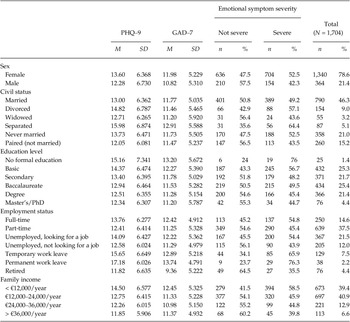
Tables 1 and 2 show the information on the qualitative and quantitative variables by symptom severity. Most participants were women (78.63%), almost a half were married (46.3%), and more than an 80% had family incomes ≤ €24,000 per year. Most participants had part-time jobs (37.5%) or were unemployed (33.5%), and a few people had no formal education (1.4%) or had a master’s/PhD (4.4%). Age ranged from 16 to 80, with a mean of 43.55 years old (SD = 12.299). Missing values did not exceed .35% for any variable.
Information on Qualitative Variables

Information on Quantitative Variables

Note. ERQ–R and ERQ–S = Emotion Regulation Questionnaire–Reappraisal and Suppression subscales; GAD–7 = 7–item Generalized Anxiety Disorder subscale (from the Patient Health Questionnaire); IACTA–PB = Inventory of Cognitive Activity in Anxiety Disorders–Panic brief version; MCQ–NB = Metacognitions Questionnaire–Negative Beliefs subscale; PHQ–9 = Patient Health Questionnaire (9–item Depression subscale); PSWQ–A = Penn State Worry Questionnaire–Abbreviated version; RRS–B = Ruminative Responses Scale–Brooding subscale; WHOQOL–BREF = World Health Organization Quality of Life Instrument–Brief version.
Tables 3 and 4 show results from the correlation and ANOVA tests. Age was not correlated to PHQ–9 (r = –.019, p ≥ .05), and civil status (F[5, 302.164] = 1.067, p = .378) and education level (F[5] = 2.135, p = .059) were not associated with GAD–7, thus they were excluded from the transdiagnostic model. Being female was significantly associated with higher scores on both depression and anxiety. Moreover, according to post hoc contrasts, being divorced or separated, having no formal education or only basic education, and being on temporary or permanent sick leave were significantly associated with higher scores on the PHQ–9; a family income level of less than €12,000/year was associated with higher scores on both emotional scales; and being retired was associated with lower anxiety (p < .05). On the other hand, all clinical variables correlated significantly with both emotional subscales. The physical and psychological scales of the WHOQOL and the questionnaires related to repetitive negative thinking (Rumination Responses Scale–Brooding subscale [RRS–B]; Metacognitions Questionnaire–Negative Beliefs subscale [MCQ–NB]; and Penn State Worry Questionnaire–Abbreviated version [PSWQ–A]), obtained the highest correlations with both types of symptomatology, while the subscales of reappraisal and suppression strategies showed the smallest (but significant) correlations. Considering these results, all variables except age, civil status, and education level were entered into the regression model.
Correlations (r) between Quantitative Independent Variables and PHQ–9 and GAD–7 Scores

Note. *p < .05. **p < .001.
One-way ANOVA Tests

Note. a Fixed-effect sizes.b Welch’s test. c This is the between-group df; within-group df = 302.164.
* p < .05.
Binomial Logistic Regression Modelling, Predictive Equation, and Precision Tests
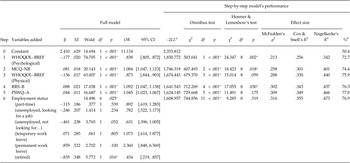
Results of the forward stepwise BLR (Table 5) showed that the most associated variables were (in order): Psychological QoL, metacognitions, physical QoL, rumination, worry, and employment status. The model (Step 6) showed a good fit, Hosmer–Lemeshow’s χ2(8, N = 1,698) = 9.285, p = .319, and was statistically significant, omnibus’ χ2(11, N = 1,698) = 744.856, p < .001, indicating that it was able to distinguish between patients with severe and nonsevere symptoms, correctly classifying 76.9% of cases, with a satisfactory effect size, ρ2 = .316.
Forward, Stepwise, Binomial Logistic Regression’s Results (N = 1,698)

Note. a –2(log-likelihood ratio). b Percentage of cases correctly classified.
* p < .05.
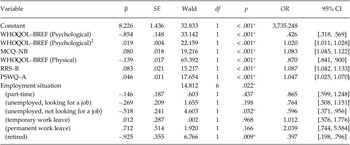
The Box–Tidwell method indicated, nevertheless, that the WHOQOL–BREF’s Psychological subscale had no linear relation with the logit (see Table A1 in Supplementary material), thus we decided to add the square of the independent variable to the model to capture the nonlinearity. Furthermore, neither the correlation matrix nor the tolerance values showed any sign of multicollinearity (Table A2). The adjustment of the model (Table 6) kept the good fit, Hosmer–Lemeshow’s χ2(8, N = 1,698) = 7.094, p = .526; and its significance, omnibus’ χ2(12, N = 1,698) = 767.645, p < .001; but improved the effect size, ρ2 = .326, and the percentage of cases correctly classified, 77.6% (Figure A1 shows the classification plot). Residuals indicated only 5 outliers (|z| ≥ 3.29); however, they were not treated because the model already showed good fit.
Adjusted Model’s Terms (Enter Method) (N = 1,698)

Note. MCQ–NB = Metacognitions Questionnaire–Negative Beliefs subscale; PSWQ–A = Penn State Worry Questionnaire–Abbreviated version; RRS–B = Ruminative Responses Scale–Brooding subscale; WHOQOL–BREF = World Health Organization Quality of Life Instrument–Brief version.
* p < .05.
Next, we tried different combinations with the variables in the model to find the one that, showing statistical significance (omnibus’ p < .05), good fit (Hosmer–Lemeshow’s p ≥ .05), and sufficient effect size (ρ2 > .2), correctly classified the highest percentage of cases (Table A3). The simplified equation with the best performance was that composed of RRS–B and the WHOQOL–BREF’s Psychological subscale, which showed significance, omnibus’ χ2(3, N = 1,703) = 612.040, p < .001; good fit, Hosmer–Lemeshow’s χ2(8, N = 1,703) = 2.082, p = .978; a correctly classified case percentage of 75.0%; and a ρ2 = .259. Table 7 shows the terms’ features and Figure A2 the classification plot.
Simplified Model’s Terms (Enter Method) (N = 1,703)

Note. *p < .05.
Placing the simplified model’s coefficients into the BLR equation (Equation 1), one would have:
 $$ b(x)=\frac{1}{1+{e}^{-\left(7.447-.871{x}_1+.017{x}_1^2+.160{x}_2\right)}}, $$
where x 1 = WHOQOL–BREF’s Psychological subscale total score and x 2 = RRS–B total score. Just to illustrate its use, we randomly selected two subjects from the sample (Participants 877 and 953) and used their subscales scores to know their classification into the severe or not-severe categories with the equation (both cases were correctly classified):
 $$ {\displaystyle \begin{array}{l}\mathrm{Participant}\;877:b(x)=\frac{1}{1+{e}^{-\left(7.447-.871\cdot 15+.017\cdot {15}^2+.160\cdot 13\right)}}\\ {}\hskip1em \approx .571\;\mathrm{Severe}\left(>.5\right)\end{array}} $$
 $$ {\displaystyle \begin{array}{l}\mathrm{Participant}\;953:b(x)=\frac{1}{1+{e}^{-\left(7.447-.871\cdot 17+.017\cdot {17}^2+.160\cdot 7\right)}}\\ {}\hskip1em \approx .209\;\mathrm{Not}\ \mathrm{severe}\left(\le .5\right)\end{array}} $$
Finally, diagnostic precision tests through EPIDAT and ROC analysis showed that both models (adjusted and simplified) did not differ much (see Table A4). Both obtained fair likelihood ratios (LR+ between 2 and 5, LR– between .2 and .5; Aznar-Oroval et al., Reference Aznar-Oroval, Mancheño-Alvaro, García-Lozano and Sánchez-Yepes2013) and good area-under-the-curve (AUC) values (AUCadjusted = .857, AUCsimplified = .822). Figure 1 compares both ROC curves.
ROC Curves (Adjusted vs. Simplified Model)

Discussion
This study had the goal of identifying variables associated with depression and anxiety symptom severity and exemplifying their potential use in clinical assessment through a logistic regression model.
The regression model agrees with the results of previous research in that they indicate the value of brooding rumination, pathological worry, and negative metacognitions on uncontrollability or danger as predictors of symptom severity (Corpas et al., Reference Corpas, Moriana, Venceslá and Gálvez-Lara2023; Sun et al., Reference Sun, Zhu and So2017; Taylor & Snyder, Reference Taylor and Snyder2021): The higher the score on these subscales, the higher the severity of the emotional syndrome (odds ratio [OR] > 1; see Table 6). These outcomes are also in line with the fact that transdiagnostic therapies that include techniques to reduce repetitive negative thinking and restructure metacognitive beliefs are effective in reducing depression and anxiety symptomatology (Carlucci et al., Reference Carlucci, Saggino and Balsamo2021; Newby et al., Reference Newby, McKinnon, Kuyken, Gilbody and Dalgleish2015). Measures of emotion-regulation strategies were automatically excluded from the stepwise BLR, showing clearly a nonsignificant contribution to explain symptom severity. This is not surprising since, despite being significantly associated with the two emotional scales, the size of the relationship was low for suppression (r < .3) and very low for reappraisal (r < .1); nevertheless, the associations follow the results of previous research (Dryman & Heimberg, Reference Dryman and Heimberg2018; Yapan et al., Reference Yapan, Türkçapar and Boysan2022), showing an inverse relationship for reappraisal and a direct relationship for suppression (the greater the use of these strategies, the milder or more severe the symptoms, respectively; see Table 3). The same occurred with panic-related cognitive biases: Despite the fact that participants with more severe symptoms in both scales had significantly higher scores on the IACTA–PB, this association was not strong enough, compared to those of other independent variables introduced in the model.
Likewise, psychological and physical QoL stood among the most contributing predictors in the adjusted model, too: The higher the QoL in these areas, the lower the severity (OR < 1); however, even though environmental and social QoL were significantly associated with symptom severity according to the independence test, they were not significant predictors compared with the others in the model. In the case of social QoL, this could be related to the questionable reliability of the subscale (as we reported in the Outcomes Measurement section), what might be due to the fact that social QoL was evaluated with only three items. In addition, both environmental and social areas showed the lowest correlations among the WHOQOL–BREF subscales (see Table 3).
Regarding the sociodemographic features, in line with previous research (Aljurbua et al., Reference Aljurbua, Selaihem, Alomari and Alrashoud2021; Domínguez-Rodríguez et al., Reference Domínguez-Rodríguez, Herdoiza-Arroyo, Martínez Arriaga, Bautista Valerio, Mateu Mollá, de la Rosa-Gómez, Farfallini, Hernández Jiménez, Esquivel Santoveña, Ramírez-Martínez, Castellanos Vargas, Arzola-Sánchez, Arenas-Landgrave and Martínez-Luna2022; Milanović et al., Reference Milanović, Erjavec, Poljičanin, Vrabec and Brečić2015; Muñoz-Navarro, Cano-Vindel, et al., Reference Muñoz-Navarro, Cano Vindel, Schmitz, Cabello and Fernández-Berrocal2021), employment status also proved to be a contributing predictor; specifically, only being retired or unemployed and not looking for a job showed significance (p < .05), such that being in either of these situations correlated with lower severity (OR < 1). This could be due to the fact that such unemployment situations may be associated with a lower level of stress. On the other hand, although sex and family income showed significant associations with both the PHQ–9 and the GAD–7, these were small, especially in the case of sex, not even explaining 1% of the variance of the dependent variables (ω2 < .01; see Table 4), which may explain why they were not included in the final model. Furthermore, consistent with Bener et al. (Reference Bener, Ghuloum and Abou-Saleh2012), being female correlated with greater symptom severity in both pathologies (see Tables 1 and 4). According to Maji (Reference Maji2018), this outcome may be explained not just by psychosocial variables, such as women’s differential attachment and relational patterns, but also by macro-systemic issues that foment power dynamics that benefit men, leading to a feeling of powerlessness that make women more vulnerable to emotional disorders. ANOVA tests also showed that marital status and educational level were not related to anxiety and, in general, the significant associations found with emotional symptoms were low, ω2 [.001, .030], with employment status, which was eventually included in the final model (Table 6), showing the strongest association. Similarly, according to Pearson’s test, age only correlated inversely and significantly with GAD–7 score, that is, lower ages were associated with higher anxiety, although this correlation was quite small (r = –.089, p < .001). These results contrast with those of other authors (e.g., Milanović et al., Reference Milanović, Erjavec, Poljičanin, Vrabec and Brečić2015; Runkewitz et al., Reference Runkewitz, Kirchmann and Strauss2006), however, the heterogeneity present in previous literature could be explained by the diversity of the samples investigated, the way the categorical variables were coded, and the instruments used to screen emotional symptoms, what may have also affected the resulting severity scores (Cameron et al., Reference Cameron, Cardy, Crawford, Du Toit, Hay, Lawton, Mitchell, Sharma, Shivaprasad, Winning and Reid2011).
Finally, our outcomes showed that rumination and psychological QoL were sufficiently associated with symptom severity to construct a simplified equation whose performance slightly differed from the original one. The resultant model exhibited good fit and a satisfactory effect size, losing only 2.6 percentage points of the cases correctly classified by the adjusted model. Moreover, the RRS–B and WHOQOL–BREF’s Psychological QoL scales add up to 11 items, reducing by 5 those used to measure depression (PHQ–9) and anxiety (GAD–7).
This work has attempted to show how transdiagnostic variables related to depression and anxiety, two commonly comorbid syndromes, could be used to assess the severity of these conditions using a statistical model, in this case a logistic regression model. With the incorporation of psychologists in primary care, as is currently taking place in some areas of Spain, this type of models could be used to determine more accurately the severity of the emotional disorder and choose the most appropriate treatment accordingly, optimizing resources and, perhaps, alleviating waiting lists. According to the stepped-care strategies proposed by some organizations (National Institute for Health and Care Excellence, 2011), patients classified as mild or moderate could be treated in their primary care centers with lower intensity therapies and even, as other authors have proposed in recent years (Cordero-Andrés et al., Reference Cordero-Andrés, González-Blanch, Umaran-Alfageme, Muñoz-Navarro, Ruíz-Rodríguez, Medrano, Hernández-de Hita, Pérez-Poo and Cano-Vindel2017), with transdiagnostic approaches to create homogeneous therapy groups that treat several people with emotional disorders at the same time and, therefore, reduce costs; while patients whose symptomatology is severe according to the aforementioned models, could be directly referred to specialized mental health care, with more specific and (with adequate investment in staff) more intensive interventions, that is, with less time between therapy sessions (e.g., weekly sessions of cognitive-behavioral therapy combined with specific medication that is regularly supervised). Of course, the patient referral made in primary care would depend on a model similar to the one proposed here, but it would need to be improved increasing the sample and introducing more emotional regulation strategies that are known to influence emotional symptomatology (Sloan et al., Reference Sloan, Hall, Moulding, Bryce, Mildred and Staiger2017). Additionally, if the results of a structured and standardised clinical interview were used as dependent variables, thus overcoming the limitations of self-report questionnaires, the measure of emotional disorders would be richer and more accurate.
This study has certain limitations. On the one hand, our sample did not include children or adults over age 80, and we had only a few participants who represented extreme ages; the majority was between 20 and 66 years old. In addition, more than 78% were women, so men were underrepresented, even if this is the reality in primary care. Last, our sample did not include people with a cognitive disability or other mental disorders (e.g., comorbid substance abuse or psychotic symptoms).
On the other hand, we artificially created the dependent variable by adding PHQ–9 and GAD–7 scores, with the purpose of having a transdiagnostic measure. Moreover, as we mentioned above, the self-administered nature of the questionnaires makes them less reliable than clinical interviews. It must be also noted that the IACTA is a little known and not widely used instrument, but that has been validated previously (Muñoz-Navarro, Medrano, et al., Reference Muñoz-Navarro, Medrano, González-Blanch, Carpallo-González, Olave, Iruarrizaga, Ruiz-Rodríguez, Moriana and Cano-Vindel2021) and, within this sample, showed a good internal consistency; whereas the WHOQOL’s Social subscale has shown a questionable internal consistency in this study (α < .7). Furthermore, the ERQ subscales have not been tested in primary care, though they presented good internal consistency here.
Finally, the regression model did not include interactions between its terms, which could have enriched the results by finding stronger predictors than the independent areas alone, but it would have made their interpretation more difficult as well (infringing the principle of parsimony). Additionally, using a cross-sectional design prevented the identification of causal relationships between independent and dependent variables, which could have provided valuable information.
The results of this study confirm previous findings about variables such as negative repetitive thinking, negative metacognitions, and some emotion-regulation strategies being associated with the severity of emotional disorders. The logistic regression also suggests that metacognition, worry, and (especially) rumination, are strongly associated with symptom severity, along with psychological and physical QoL areas and work status.
These results show the potential importance of work status, and QoL being considered in clinical evaluations and reaffirm the assumption that rumination, worry, and metacognition are key elements to include in any transdiagnostic therapy aimed at dealing with emotional disorders. Furthermore, the simplified model developed here shows the feasibility of using statistics to improve primary care assessment: Equations, algorithms, or computer programs, which are based only on the data and depend less on a subjective perspective, can help clinicians reduce evaluation time and decide the best treatment option, thus preventing emotional problems from becoming disorders.
Supplementary Material
To view supplementary material for this article, please visit http://doi.org/10.1017/SJP.2023.23.