

Introduction
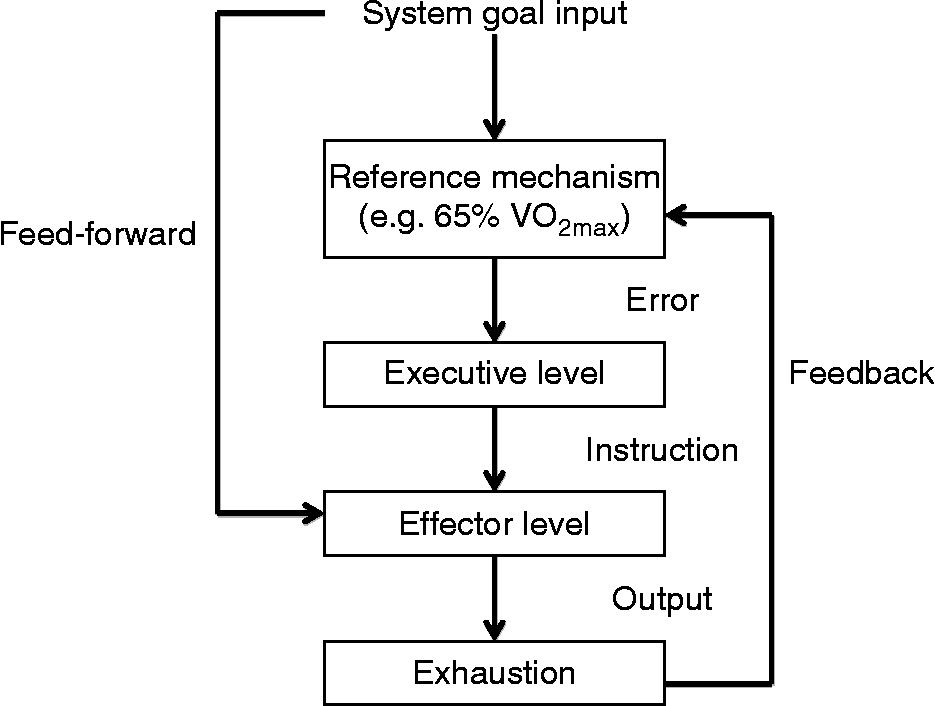
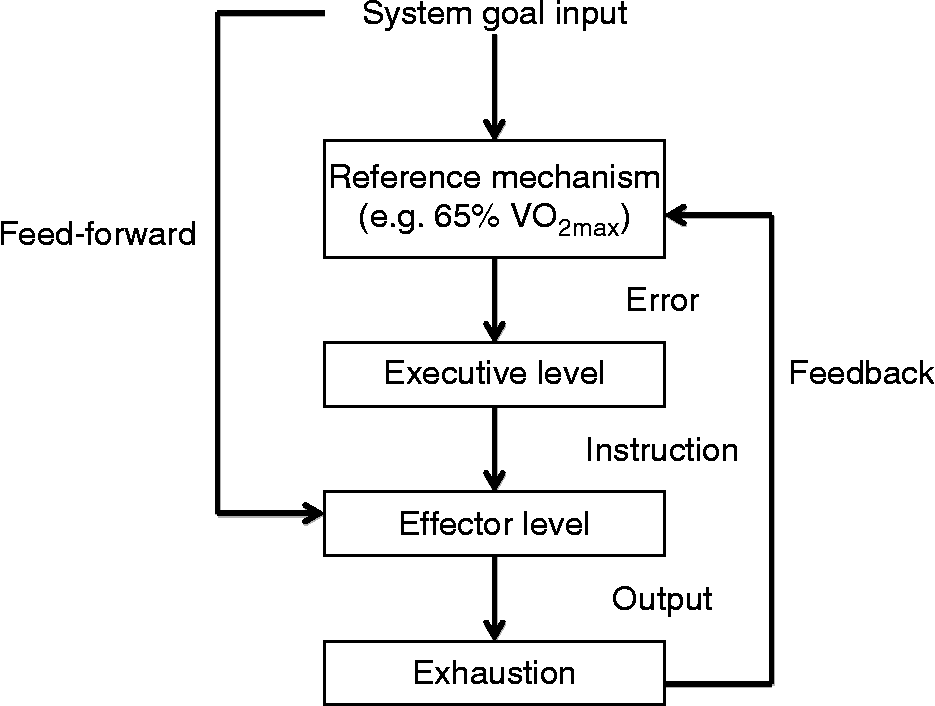
The fundamental tenets of exercise physiology are to describe energy transformations during physical work and make predictions about physical performance under different conditions. Historically, the most popular method to observe such responses during exercise has been the constant load or fixed-intensity protocol. The constant load model is essentially derived from the understanding that human exercise capacity is limited by the delivery and utilization of energyReference Hill and Lupton1, Reference Taylor, Buskirk and Henschel2. The determination of the apparent physiological limit is normally the result of the maximum oxygen consumption (VO2max) or peak power output test. The resultant value of this test is then used as a reference point in a subsequent experimental trial to anchor the exercise load at a given percentage of the VO2max (e.g. 65% VO2max)Reference Edwards, Knuttgen, Vogel and Poortmans3, Reference Noakes and St Clair Gibson4, which is maintained until there is a reduction in the prescribed power output when exercise is terminated and the subject is assumed to have reached the point of voluntary fatigue. This model of exercise physiology is akin to the closed loop control system originally described by SchmidtReference Schmidt5 (see Fig. 1). In this model, there is input about the system goal which might be, for example, the maintenance of exercise at 65% VO2max. The overall achievement is the total time to ‘exhaustion’. The reference mechanism then samples the possible physiological limit to exhaustion in order to determine how much capacity is available, which is then relayed as feedback. The reference mechanism undertakes comparisons of the values between the actual level of energy expenditure and the overall energy expenditure goal. This difference or error is given to the executive level in order to provide information that potentially reduces the error to zero. The effector is then engaged to produce the necessary adjustments until such time when the executive level shuts off the effector level. This is the moment of exercise termination, as the effector mechanism is unable to produce the required movements or the amount of muscle contraction that would sustain the expected power at the reference level.
A schematic depicting the feedback and feed-forward models of motor control as originally described by SchmidtReference Schmidt5 and adapted here as a model representing the differences between the constant load (feedback) and self-regulated (feedback–feed-forward) protocols used in exercise physiology. Schematic redrawn and adapted from SchmidtReference Schmidt5 (p. 142)
However, very seldom do humans undertake exercise that is maintained at a constant reference level or load for the entirety of the bout, especially during competition. During more real-life situations, the intensity of the exercise is likely to be more variable as individuals respond according to the requirements of the performance at any given momentReference Palmer, Hawley, Dennis and Noakes6. In order for the variable intensity to be advantageous, individuals must also anticipate the requirements of the exerciseReference Ulmer7.
An alternative to the feedback model, also described by SchmidtReference Schmidt5, relies on feed-forward control so that information is sent in advance to prompt the system. In this case, a feed-forward system can ‘(a) ready the effector level for the arrival of future commands for action or (b) ready (or preset) reference systems to ‘expect’ a certain signal. All of these actions can be seen as anticipatory or preparatory, as they occur prior to the commands for the action and well before feedback from the action itself’Reference Schmidt5 (p. 146). This anticipatory model is a system, which allows for input to have direct action further down the control system (see Fig. 1). Although these feedback and feed-forward models are traditionally associated with motor control discourse, they are also applicable to more general exercise performance. The concept of pacing during exercise performance would require feedback and feed-forward processes in order to achieve an outcome within the individual's capacity.
The purpose of this review is to highlight and describe the constant and self-regulated (paced) models of exercise physiology by considering the feedback and feed-forward control systems, which individually can lead to contrasting findings and interpretations with respect to understanding the physiological mechanisms in the regulation of exercise performance.
Exercise regulation or limitation?
The two competing models can also be thought of as representing either the limitations of human physiology (constant load model) or the regulation of exercise performance (self-regulated or self-paced model). In the constant load model, the individual reaches a point where he or she is unable to match the required power output that has been predetermined by the experimenter. There is no opportunity under these constraints for the individual to adjust their intensity according to the feedback or make anticipatory adjustments. In contrast, in the self-regulated model, other factors or inputs even before an exercise commences can be taken into account in order to establish the initial pace. These factors could include the expected distance or duration of the exercise bout, previous experience, motivation and a number of other physiological, psychological and environmental factors. By accounting for these variations, the individual is able to respond by either increasing or decreasing their exercise intensity and regulate exercise according to the feedback and feed-forward control. By removing this ability from the individual, the constant load model has produced what has been described as the ‘brainless model of human exercise performance’Reference Noakes8. Thus, the classical model of exercise physiology is restrictive in its broad application in understanding human performance. In fact, the textbook understanding of the physiology of control systems has a description of this on these lines: ‘… some movements of the body occur so rapidly that there is not enough time for nerve signals to travel from the peripheral parts of the body all the way to the brain and then back to the periphery again to control the movement. Therefore, the brain uses a principle called feed-forward control to cause required muscle contractions’Reference Guyton and Hall9 (p. 9). Although this is accepted wisdom in mainstream physiology and neuroscience, exercise physiologists seldom consider it as an alternative model explaining the regulation of fatigue during exercise. In this model, there is continuous integrated feedback from all systems so that motor unit recruitment is adjusted in anticipation rather than at the point of physiological limits, ensuring that the physiological limit is never reachedReference Noakes and Marino10.
Thermodynamics and exercise
The fundamental premise underpinning any biological process is its relationship with the laws governing thermodynamics; laws which are regarded as inviolate. Therefore, it is worth considering the relationship between the constant load and self-regulated models of exercise physiology and the laws of thermodynamics. The first law of thermodynamics states that energy cannot be created or destroyed, while the second law extends this to include a direction towards randomness or disorder, a quantitative measure termed entropy Reference Brooks, Fahey and Baldwin11, Reference Eddington12. That is, during physical work, entropy accumulates in the system which then dissipates in the form of waste heat, thereby reducing the state of order in the original system, expressed asReference Koch and Britton13:

where dS is the change in entropy, δQ is the heat added to the system and T is temperature. In generic terms, this equation can be expressed as:

Direct comparisons between the constant load and self-regulated models using the thermodynamic entropy equation cannot be made, as in the former the energy usage is constant and can be easily quantified, whereas in the latter the energy usage is variable. In constant load exercise, there is increased efficiency as the extent of randomness or variability is restricted as the biological system is overridden by a predetermined externally imposed load, which cannot be altered. Rather, energy transformations in the constant load model continue at a set rate until exercise halts when muscle force output can no longer be maintained at the prescribed levelReference Edwards, Knuttgen, Vogel and Poortmans3. This results in increased efficiency (less entropy) in constant load exercise but higher variability in power output (higher entropy) during self-regulated exercise. The underlying assumption in exercise bioenergetics is that energy transformations continue at a rate approaching a loss of homeostasis and eventually cellular catastrophe if left unchecked. Therefore, muscle contraction terminates because there is a simultaneous loss of energy, excitation/activation and force leading to catastrophic cellular eventsReference Edwards, Knuttgen, Vogel and Poortmans3. A reversal of this has been termed hysteresis, or a point when there is recovery of excitation but no ability to increase the force output until excitation – contraction – coupling is completely restoredReference Edwards, Knuttgen, Vogel and Poortmans3, Reference Noakes, St Clair Gibson and Lambert14. Thus, there is a distinction to be considered: either the constant load model which is underpinned by the assumption that exercise terminates due to a loss of homeostasis and a biological system approaching catastrophe, or the self-paced model which is inherently less efficient but which allows for the preservation of cellular homeostasis by regulating exercise intensity/power output.
Constant load exercise reduces the system's capacity to utilize the full extent of variability in the biological signal. For example, any changes, however small, in either cadence, power output or speed, will induce a significant change in the perceived effort and heart rate responseReference Pandolf and Noble15. In constant load exercise where there is no change in any given parameter such as cadence, power or speed, a response by the individual can never be performed unless it is the termination of exercise. Thus, the availability of sensory cues from the central (heart rate, VO2, respiratory rate, ventilation) and peripheral sources (lactate, pH, core and skin temperature, energy availability) which might alter exercise intensity cannot be a determinant of performance in constant load exercise other than for the eventual voluntary termination of exercise.
Open versus closed loop exercise
St Clair Gibson and NoakesReference St Clair Gibson and Noakes16 have discussed in detail the variability of response during exercise of undetermined duration or distance (open loop) to that of set duration or distance (closed loop). The common observation in open loop exercise is that exercise terminates voluntarily when predetermined criteria are achieved. Conversely, in closed loop trials, there is almost an immediate reduction in power output and muscle recruitment upon commencing exercise, suggesting the existence of neural inhibitory command processesReference Amann, Eldridge, Lovering, Stickland, Pegelow and Dempsey17, Reference Kay, Marino, Cannon, St Clair Gibson, Lambert and Noakes18. This difference in regulation demonstrates the inherent importance of variability in the biological system, for in tightly controlled energy expenditure, as is the case during constant load exercise, sensory cues cannot be fully integrated to provide a more appropriate response to the given task. As evidence for the inherent biological variation as opposed to the technical error that accompanies measurement with an apparatus, in repeated maximal exercise testing the results can vary up to 90% due to biological variation. In contrast, technical error can account for less than 10% of the variation for the same set of resultsReference Katch, Sady and Freedson19. Accordingly, the coefficient of variation for exercise time in repeated submaximal constant load exercise can range from 2.8 to 31.4%Reference McLellan, Cheung and Jacobs20. Comparatively, self-regulated exercise such as time trials shows low variability and high repeatability, with the coefficient of variation ranging from about 1% for short-to-medium duration trials to about 2.4% for longer duration trialsReference Hickey, Costill, McConell, Widrick and Tanaka21, Reference Schabort, Hawley, Hopkins, Mujika and Noakes22.
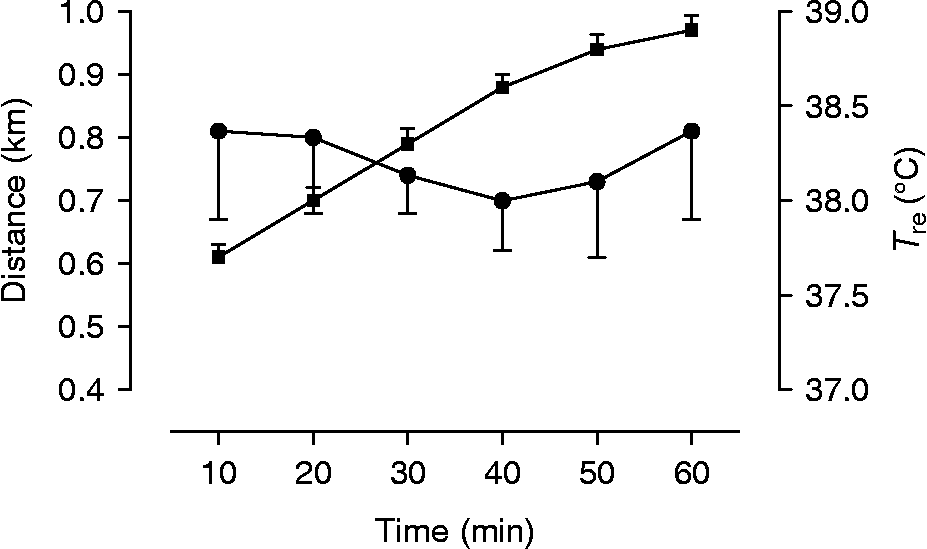
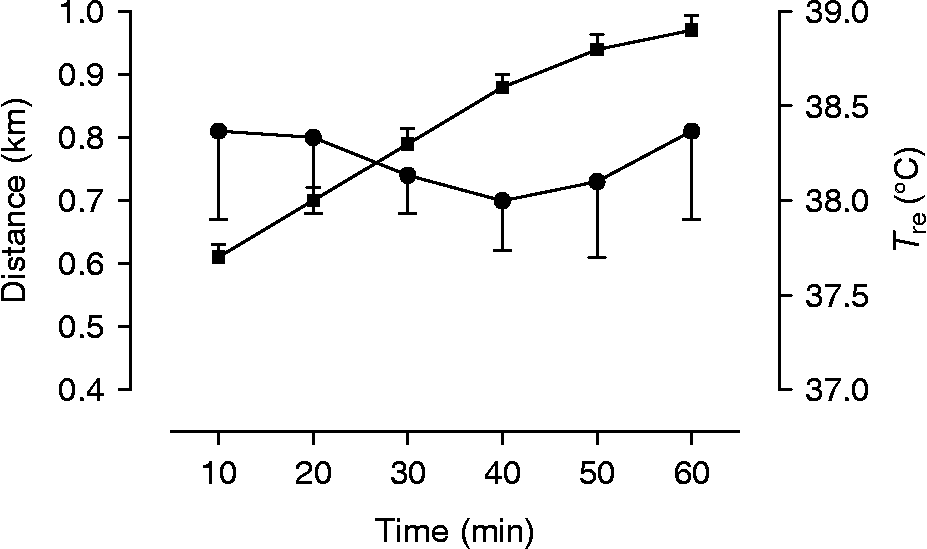
The influence of the inherent biological variability becomes apparent during times of elevated thermal strain. During both runningReference Marino, Lambert and Noakes23 and cyclingReference Tucker, Rauch, Harley and Noakes24–Reference Périard, Cramer, Chapman, Caillaud and Thompson26 in hot conditions, there is a clear reduction in power output well before high levels of core temperature are observed. These findings indicate that there is a reduction in skeletal muscle recruitment well before high thermal loads are achieved (Fig. 2). Furthermore, there is a clear increase in muscle recruitment when thermal strain is highest during the trial. These observations provide evidence that motor output is regulated via feedback and feed-forward control mechanisms, the purpose of which is to provide a reserve for increases in power output even when physiological strain is at its relative highest. The precise mechanism which acts to reduce the muscle recruitment by forecasting the thermal limit remains unknown, but a complex intelligent system acting to preserve homeostasis is possibleReference St Clair Gibson and Noakes16.
Showing the distance (km) covered in 1 min (left ordinate, ●) and the rectal temperature (T re) response (right ordinate, ■) at the same time point. Note the reduction in distance achieved when T re was increasing and the re-establishment of distance achieved when T re was at its highest. Data are redrawn from Kay et al.Reference Kay, Marino, Cannon, St Clair Gibson, Lambert and Noakes18 and Marino et al.Reference Marino, Cannon and Kay25
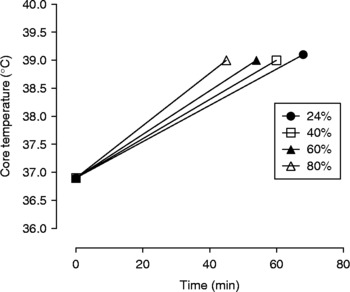
In contrast, this phenomenon cannot be observed during open loop exercise where the termination of exercise coincides with the apparent physiological limit. In Fig. 3, exercise set at 70% VO2max in ambient temperature of ≈ 30°C at differing relative humidity (24–80%) produced different, albeit linear exercise durations, but all terminating at an apparent physiological limit of ≈ 39°C core temperatureReference Maughan, Otani and Watson27. The only conclusion that can be drawn from these data is that there is a critical limiting core temperature which terminates exercise. Conversely, the study by Tucker et al. Reference Tucker, Rauch, Harley and Noakes24 underscores the importance of feed-forward control in the regulation of exercise. During 20 km time trials, both power output and integrated electromyographic (iEMG) activity of the vastus lateralis were reduced in hot (31°C) compared with cool (15°C) ambient temperatures despite the lack of difference in either rectal temperature, heart rate or the rating of perceived exertion. Therefore, the reduction in efferent command occurred well in advance of any critical physiological limit. Although this study indirectly quantified the level of efferent (iEMG) regulation during exercise, the phenomenon of anticipatory regulation in hot conditions was shown previously in African and Caucasian runners matched for peak treadmill running velocity (PTV)Reference Marino, Lambert and Noakes23. After an initial 30 min of running at 70% of PTV in hot conditions (35°C), both groups achieved identical rectal temperatures of 38.4°C. When the subsequent 8 km performance run commenced, the running speed of the heavier Caucasians was immediately reduced compared with the African runners, who maintained their running speed. At the end of the performance run, both groups of runners achieved rectal temperatures of ≈ 39.3°C. The early reduction in running speed can only be attributed to an anticipatory strategy which controls the work-rate by regulating the recruitment and de-recruitment of motor units during exercise, which essentially limits the rate of rise in core temperature; for without the availability of this mechanism, the ability to complete the performance run would not be possible due to the attainment of a lethal hyperpyrexia.
The magnitude of core temperature response during exercise at 70% of maximum oxygen consumption under the same ambient temperature ( ≈ 30°C) but at varying relative humidity (rh). Note the reduced exercise duration as rh increases, albeit with exercise termination, at similar core temperatures. Data are redrawn from Maughan et al. Reference Maughan, Otani and Watson27

The anticipatory regulation of exercise is not only observed when there are differences in ambient temperatures, but also when there are significant differences in the availability of inspired air. In the novel studies of Amann et al. Reference Amann, Eldridge, Lovering, Stickland, Pegelow and Dempsey17, Reference Amann and Dempsey28, Reference Amann, Romer, Subudhi, Pegelow and Dempsey29 in which the effect of different arterial oxygen content was examined during the performance in 5 km cycling time trials, in each instance ranging from hypoxia to hyperoxia, the subjects decreased their power output and iEMG within the first 400 m of the trial. In fact, in each of the inspirate conditions, the subjects commenced the 5 km time trial by activating less than 40% of their available musculature. The authors' main conclusion from one of these studies was that feedback from the fatiguing muscle during different levels of inspired oxygen reduces central motor output to the working muscles ‘in order to prevent excessive development of peripheral muscle fatigue beyond a critical threshold or sensory tolerance limit’Reference Amann, Eldridge, Lovering, Stickland, Pegelow and Dempsey17 (p. 950). However, it is unclear how the authors arrived at this conclusion without accounting for the almost immediate reductions in power output and iEMG when the skeletal muscle could not have been excessively fatigued. In fact, the return of both power output and iEMG to pre-exercise values or above in all but the hypoxic condition strongly suggests that the reduction in efferent command was due to an anticipatory mechanism which is typical of a pacing strategy observed in all forms of self-regulated exercise. An ‘endspurt’ is more likely to disprove that central motor output is regulated by feedback from the fatiguing skeletal muscles, for a mechanism acting solely in response to sensory feedback could not forecast the extent of fatigue likely to occur at the ‘endspurt’Reference Noakes and Marino30. Finally, neither the immediate reduction in power output or iEMG, nor the appearance of an ‘endspurt’ regardless of the ambient conditions could be observed during constant load exercise. Therefore, the way in which exercise is regulated rather than limited is highly dependent on the protocol that is employed.
One reason why constant load exercise has become the popular method of investigation is that constant energy transformations produce stark differences when interventions are applied. For example, the common observation when comparing exercise in hot and cool conditions is a reduced time to exhaustion in accordance with the energy transformations that are ‘ramped up’ to deal with the increased strain placed on the various systemsReference Nielsen, Hales, Strange, Christensen, Warberg and Saltin31–Reference González-Alonso, Teller, Anderson, Jensen, Hyldig and Nielsen33. For example, when comparing the effects of restricted fluid intake during exercise in the heat, there is a clear and unequivocal increase in cardiac output and heart rate along with reductions in stroke volume with restricted intake of fluidReference González-Alonso, Calbert and Nielsen34, Reference González-Alonso, Calbert and Nielsen35; however, exercise duration ( ≈ 135 min) among subjects who were hydrated and dehydrated was the same. This indicates that the cardiovascular system, although significantly under strain, is able to cope with reduced fluid intake and subjects can exercise for a long period without the additional fluids. Similarly, in ambient temperatures of 40 and 20 °C, muscle glycogenolysis and lactate accumulation during constant load exercise were higher in the heatReference Febbraio, Snow, Stathis, Hargreaves and Carey36 and reduced when the rise in body temperature was attenuatedReference Febbraio, Snow, Stathis, Hargreaves and Carey37, Reference MacDougall, Reddan, Layton and Dempsey38. Thus, constant load exercise is indeed useful when the measurement of the sensitivity of a physiological response is of primary interest. However, in self-regulated exercise, plasma lactate accumulation is lower in heat stress compared with cool conditions, because the exercise intensity is internally regulated rather than being externally drivenReference Marino, Mbambo, Kortekaas, Wilson, Lambert and Noakes39.
Conclusions
During exercise heat stress in the laboratory, humans normally terminate exercise when they attain a core temperature of ≈ 39.5°CReference González-Alonso, Teller, Anderson, Jensen, Hyldig and Nielsen33. The assumption is that increased thermal and cardiovascular strain will lead to reduced exercise performance, rather than adopting the view that the increased physiological ‘strain’ is a response mitigating the physiological requirements of the task under more severe conditions. The latter view would be a substantially different approach to the understanding of exercise physiology. Recent studiesReference Kay and Marino40–Reference Tatterson, Hahn, Martin and Febbraio42 utilizing self-regulated protocols have produced results that are at odds with the typical findings from conventional constant load exercise. In these studies, the authors generally conclude that exercise is regulated in a way that helps avoid cellular catastrophe by anticipating the energy requirements, so that the exercise bout is completed rather than prematurely terminated. For example, a closed loop treadmill performance run or a cycling trial will result in a longer completion time in the heat so that the terminal rectal temperature is not the limiting factor per se Reference Tucker, Rauch, Harley and Noakes24, Reference Marino, Kay and Serwach43; whereas the usual outcome in open loop exercise is a shorter time for achieving a given terminal core temperatureReference González-Alonso, Teller, Anderson, Jensen, Hyldig and Nielsen33. These results are highly dependent on the organism's variability and the capacity to use a feed-forward system to achieve an outcome and avoid premature fatigue before task completion. These findings indicate that energy transformations during exercise are variable and allow for self-regulation so that feed-forward or anticipatory regulation becomes a critical signal, cellular catastrophe is avoided and homeostasis is preserved. UlmerReference Ulmer7 showed that it is possible to take into account the length of time required to complete the task, which is perhaps why power output and skeletal muscle recruitment in self-paced trials are reduced almost immediately in the exercise bout, only to return to near-optimal values during the ‘endspurt’Reference Amann, Eldridge, Lovering, Stickland, Pegelow and Dempsey17, Reference Kay, Marino, Cannon, St Clair Gibson, Lambert and Noakes18.
The collective evidence from conventional constant load versus self-regulated exercise studies suggests that energy transformations are indeed different, so that the inherent biological variability accounts for the different results achieved by the two experimental paradigms.