


Introduction
Depression is a mental disorder that causes clinically significant suffering and/or impairment in social, professional, economic and other important areas of an individual’s life, and is the main cause of suicide in more severe cases(1–4). The prevalence of depression in 2015 was estimated to be 4·4 % globally, with a higher prevalence among those between 55 and 77 years of age. Women appear to be more affected (7·5 %) than men (5·5 %)(5). Among those over 60 years old, depression occurs in 7·0 % of the general older population(6). According to the Global Burden of Disease, Injuries, and Risk Factors – GBD survey, depression is among the top three causes of disability(7). There has been a significant increase in the global burden of disease in years lived with disabilities (YLDs) in the past 20 years due to depressive disorders. In 1990, depression occupied the fourth position, moving to the third in 2007 with an increase of 33·4 %, and remained in the third position between 2007 and 2017; however, it has increased by 14·3 %(Reference James, Abate and Abate8). Moreover, as many people with depressive symptoms are undiagnosed, the prevalence of depressive disorders is probably higher than reported(4).
Mental disorders are among the main problems in public health, and mood disorders are diseases with higher costs to health systems worldwide(Reference Chisholm, Sweeny and Sheehan2,Reference Olesen, Gustavsson and Svensson3,Reference DiLuca and Olesen9,Reference Knapp and Wong10) . According to the Mental Health Atlas of the World Health Organization (WHO), low- and middle-income countries spend less than $1 per year per capita in the treatment and prevention of mental disorders, compared with an average of >$80 in high-income countries, owing to socioeconomic issues(11). Therefore, there is an urgent need to identify the modifiable risk factors associated with the aetiology of depression, helping with the treatment and prevention of this disorder, especially in low- and middle-income countries(Reference Whiteford, Ferrari and Degenhardt12,13) .
Depression is a complex disease triggered by the interaction between social, psychological and biological factors(4,Reference Li, D’Arcy and Meng14) . In older adults, depression can be triggered by a series of factors such as limitations in daily activities, cognition, mobility and social changes such as retirement, social isolation and relocation to long-term institutions(Reference Andrade, Wu and Lebrão15). Among the biological factors, genetic predisposition, neurotransmitter and neuroendocrine system imbalance, functional and structural brain anatomy, and cognition are the most studied mechanisms(Reference Kaltenboeck and Harmer16,Reference Otte, Gold and Penninx17) . Recently, nutritional factors have shown an important relationship with the evolution, prevention and treatment of mental disorders(Reference Lai, Hiles and Bisquera18). The association between VitD and depression has emerged in scientific scenarios, and this nutrient seems to be relevant in the prevention of depressive symptom development. However, the mechanism by which VitD exerts its effects remains unclear(Reference Camargo, Dalmagro and Rikel19,Reference Fedotova, Dudnichenko and Kruzliak20) .
Many clinical trials have been conducted to investigate the potential therapeutic effect of VitD on patients with depression, but the results remain inconclusive due to methodological issues(Reference Spedding21). VitD is a fat-soluble vitamin that is present in two forms: VitD2 (ergosterol) and VitD3 (cholecalciferol). It is obtained from diet, supplementation and sun exposure(Reference Bikle22,Reference Jäpelt and Jakobsen23) . VitD has a well-established role in mineral bone metabolism, but its effects are not restricted to bone health and are also important in maintaining many biological processes, such as the regulation of gene expression, cell proliferation and differentiation, and immune system regulation(Reference Johnson and Mohn24–Reference Umar, Sastry and Chouchane26). In the central nervous system (CNS), the presence of nuclear (vitamin D receptor, VDR) and membrane (protein disulphide isomerase family A member 3, PDIA3) receptors for VitD and some enzymes (cytochrome P450 family enzymes CYP27a1, CYP27b1 and CYP24a1) responsible for converting its active form has raised the hypothesis that VitD may be involved in the pathophysiology of depression(Reference Berridge27–Reference Landel, Stephan and Cui31).
Low serum VitD concentrations [25-hydroxycholecalciferol, 25(OH)D] have been considered a public health problem worldwide, especially in the elderly(Reference Palacios and Gonzalez32). For older adults, the prevalence of 25(OH)D deficiency (<50 nmol/l or <20 ng/ml) was 36 % in the United States(Reference Ganji, Zhang and Tangpricha33), 19 % in Canada(Reference Whiting, Langlois and Vatanparast34), 36 % in China(35 and 4–89 % in European countries(Reference Palacios and Gonzalez32). In low- and middle-income countries, the prevalence was approximately 41 % for older adults in Brazil(Reference Pereira-Santos, Santos and Carvalho36), 91 % in India(Reference Marwaha, Tandon and Garg37) and 46 % in Guatemala(Reference Sud, Montenegro-Bethancourt and Bermúdez38). However, different cut-off points have been suggested, and a single value to define VitD deficiency or insufficiency has been debated(Reference Bouillon39). Moreover, the establishment of desirable serum VitD concentrations is based on bone health to maintain mineral and skeletal homoeostasis(Reference Bouillon39,Reference Sempos, Heijboer and Bikle40) .
It is important to mention that VitD levels via skin synthesis and intestinal absorption are influenced by various factors such as skin pigmentation, latitude, season, age, obesity and inflammatory bowel diseases, among others(Reference Arabi, El Rassi and El-Hajj Fuleihan41–Reference Amrein, Scherkl and Hoffmann43). Due to reduced sun exposure, decreased skin synthesis and dietary intake, and intestinal malabsorption, the elderly are among the top risk groups for VitD deficiency(Reference Arabi, El Rassi and El-Hajj Fuleihan41,Reference Cesari, Incalzi and Zamboni44) . They also present significant complications related to low VitD concentrations (<20 ng/ml), such as the risk of fractures due to fragility and bone loss, which contribute to age-related muscle weakness and sarcopenia(Reference Kesby, Eyles and Burne28,Reference Amrein, Scherkl and Hoffmann43,Reference Holick45,Reference Luo, Quan and Lin46) . In addition, VitD concentrations <20 ng/ml have been associated with an increased risk of all-cause mortality(Reference Dudenkov, Mara and Petterson47).
In this review, we aimed to update the role of VitD in depression, discussing the metabolism of VitD, its mechanism of action in the brain and the main evidence of pre-clinical, clinical and observational studies, especially those involving older adults, a population risk for both conditions, in an attempt to highlight the potential preventive and therapeutic effects of this nutrient. Also, we aimed to suggest future directions for new studies. To this end, we conducted a systematic search for articles published until 30 April 30 2021. The databases used were PubMed, Scopus, Embase, Science Direct and Web of Science (details are presented in the supplementary material).
Vitamin D: synthesis and metabolism
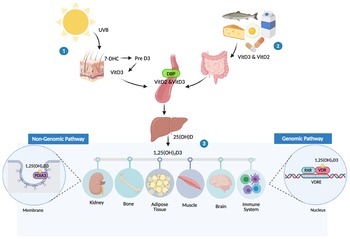
The synthesis of VitD (Fig. 1) by epidermal epithelial cells begins when the exposure to ultraviolet B radiation (UVB, 290–315 nm) promotes the non-enzymatic transformation of 7-dehydrocholesterol (7-DHC or pro-VitD) in pre-VitD3(Reference Tian and Holick48,Reference Bikle and Christakos49) . A photolytic break forms a secosteroid molecule, which then undergoes an isomerisation reaction induced by heat to transform it into VitD3 (or cholecalciferol), a process that takes about 8 h(Reference Tian and Holick48–Reference Wacker and Holick50). Keratinocytes are the main cells of the epidermis that have the enzymatic machinery to metabolise VitD in its active form and express the vitamin D receptor (VDR)(Reference Bikle22,Reference Bouillon, Marcocci and Carmeliet51) . In contrast, the synthesis of the active form of VitD from either food or supplementation begins with incorporation into micelles and absorption through the enterocyte membrane by apical membrane transporters or by passive diffusion(Reference Reboul52). A fraction of VitD is incorporated into the chylomicrons, which are transported to the lymphatic system and then to the venous system by vitamin D binding protein (DBP)(Reference Wacker and Holick50). The other fraction is incorporated into adipose tissue and skeletal muscles(Reference Gil, Plaza-Diaz and Mesa53).
Vitamin D synthesis, metabolism and target tissue actions. (1) The synthesis of VitD from sunlight initiates in the skin when 7-DHC is converted in pre-VitD3 and then VitD3 [25(OH)D3 or cholecalciferol] and is carried by DBP through blood circulation. (Reference Chisholm, Sweeny and Sheehan2) The VitD from dietary intake (VitD2/ergocalciferol and D3/cholecalciferol) is absorbed in the small intestine and packed into chylomicrons to reach the systemic circulation. Both VitD3 and VitD2 are also transported through blood circulation by DBP to the liver, where they are converted to 25-hydroxyvitamin D [calcidiol or 25(OH)D] by the action of 25-hydroxylases. (3) 25(OH)D coupled to DBP is transported to the target organs such as kidney, bones, adipose tissue, muscle and brain, and cells such as in the immune system containing the enzyme 1-α-hydroxylase, which convert 25(OH)D to 1,25-dihydroxyvitamin D [calcitriol or 1,25(OH)2D3], the active form of VitD. VitD act through both genomic and non-genomic pathways. In the genomic pathway, VitD active form enters the nucleus linked to the VDR where it binds to the RXR and then binds to the VDRE, resulting in modulation of target gene expression. In the non-genomic pathway, the VitD active form binds to the PDIA3 and starts signalling cascades, including the activation of phospholipase A2 activating protein (PLAA), phospholipase A2 (PLA2), phospholipase C (PLC) and opening Ca2+ channels that results in the activation of secondary messengers. This figure was made using BioRender (license: YN235V4QZA)

Both VitD2 and VitD3 are transported in the blood by DBP and must undergo activation through two consecutive enzymatic hydroxylation reactions in the liver and kidneys. In the liver, VitD2 and VitD3 are converted into 25-hydroxyvitamin D (calcidiol or 25(OH)D) by the action of 25-hydroxylases (cytochrome P450 enzymes group, CYP2R1 or CYP27A1)(Reference Holick54–Reference Wacker and Holick56). The 25(OH)D coupled with DBP is transported to various tissues with cells containing the enzyme 1-α-hydroxylase (CYP27B1), as in the kidney, where it converts 25(OH)D to 1,25-dihydroxyvitamin D (calcitriol or 1,25(OH)2D3), the active form of VitD(Reference Holick54–Reference Wacker and Holick56).
The conversion of 1,25(OH)2D3 in the kidney is regulated by several factors, including circulating concentrations of parathyroid hormone (PTH) in the parathyroid glands, serum phosphorus, calcium, fibroblast growth factor 23 (FGF-23) in the bone and its self-regulation. 1,25(OH)2D3 decreases its own synthesis by negative feedback; it decreases the secretion of parathyroid hormone and increases the expression of 24-hydroxylase(Reference Holick57). This self-regulation by the expression of 24-hydroxylase is found in most tissues and is essential for the catabolism of 25(OH)D and 1,25(OH)2D3(Reference Bikle, Patzek and Wang58).
The biological effects of 1,25(OH)2D3 are largely mediated by VDR, which is expressed in almost all human cells(Reference Bouillon, Carmeliet and Verlinden59,Reference Haussler, Jurutka and Mizwicki60) . The VDR belongs to a subfamily of nuclear receptors, which contains two sites for ligand binding called the genomic pocket (VDR-GP), which binds in a bowl-like configuration for gene transcription, and the alternative pocket (VDR-AP), which connects in a planar-like configuration for quick responses(Reference Haussler, Jurutka and Mizwicki60). When VDR-GP binds to 1,25(OH)2D3, it enters the cell nucleus and binds to the retinoid X receptor (RXR). This complex then binds to the vitamin D responsive element (VDRE) in the promoter regions of the target genes by recruiting co-activator or co-repressor complexes that regulate the transcription of genes either positively or negatively(Reference Gil, Plaza-Diaz and Mesa53,Reference Haussler, Jurutka and Mizwicki60) . The other suggested VitD receptor is PDIA3, also known as endoplasmic reticulum protein (ERp60, ERp57 and Grp58) or VitD membrane-associated rapid-response steroid-binding protein (1,25-MARRS)(Reference Chen, Olivares-Navarrete and Wang61). PDIA3 is present in caveolae (lipid rafts) and is linked to the rapid responses of 1,25(OH)2D3 by activating signalling cascades, where it physically interacts with downstream mediators(Reference Chen, Olivares-Navarrete and Wang61,Reference Boyan, Chen and Schwartz62) , including the activation of phospholipase A2 activating protein (PLAA), phospholipase A2 (PLA2), phospholipase C (PLC) and opening Ca2+ channels that result in the activation of secondary messengers(Reference Zmijewski and Carlberg63). PDIA3 is involved in the function of immune and musculoskeletal systems as well as mammary gland growth and development, and participates in the intestinal uptake of calcium and phosphate(Reference Zmijewski and Carlberg63). PDIA3 also mediates the effect of 1,25(OH)2D3 on the regulation of osteoblasts and chondrocytes(Reference Doroudi, Plaisance and Boyan64).
Vitamin D: mechanism of action in the brain
The first evidence of the role of VitD in brain function began with autoradiographic findings of the presence of VDR in the brain tissue of laboratory animals(Reference Stumpf, Sar and Clark65). VDR is found in neurons and glial cells in most regions of the brain, including the cortex (temporal, frontal, parietal and cingulate); deep grey matter (thalamus, basal ganglia, hypothalamus, hippocampus and amygdala); cerebellum, nuclei of the brain stem and substantia nigra (an area abundant in dopaminergic neurons); spinal cord; and ventricular system(Reference DeLuca, Kimball and Kolasinski66). In addition, an alternative mechanism was observed in post-mortem human brain tissue samples. It was demonstrated that 1,25(OH)2D3 can be activated locally through the expression of the enzyme 1α-hydroxylase, which is classically expressed in the kidney and is responsible for catalysing the conversion of 25(OH)D into 1,25(OH)2D3, showing that both forms (VitD and 25(OH)D) can pass through the blood–brain barrier(Reference Eyles, Smith and Kinobe67,Reference Pardridge, Sakiyama and Coty68) .
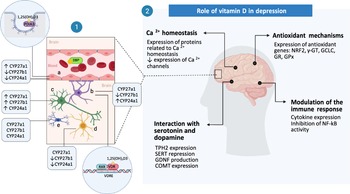
It has been proposed that within the neurovascular unit, the machinery for conversion of both VitD forms involves the cytochrome P450 family enzymes CYP27a1, CYP27b1 and CYP24a1 which are expressed in neurons, and CYP27a1 which is expressed in all neural cell types and is highly expressed in endothelial cells(Reference Landel, Stephan and Cui31). The active form of VitD triggers genomic actions associated with VDR or non-genomic actions related to PDIA3, which is expressed in small amounts in extra-cerebral tissues such as the liver and kidney. On the other hand, PDIA3 is highly expressed in the brain and appears to be the main brain receptor for VitD in neural tissue (Fig. 2).
The role of vitamin D in depression. (1) In the brain, both active and inactive VitD is carried through blood circulation binding to DBP and can permeate the blood–brain barrier. All brain cells (endothelial cells (A), astrocytes (B), neurons (C), oligodendrocytes (D) and microglia (E)) have the machinery to transform VitD. VitD is turned into 25(OH)D by CYP27a1 in endothelial cells and neurons, and it is metabolized to 1,25(OH)2D3 by CYP27b1 in neurons or microglia. All brain cells can express VDR, but it is highly expressed by astrocytes. When it enters the cell, 1,25(OH)2D3 can bind to VDR, and then to the RXR in the nucleus. The complex VDR–RXR binds to the VDRE and initiates gene transcription or can be inactivated when in excess by CYP24a1. All brain cells can express PDIA3, but it is highly expressed in endothelial cells where 1,25(OH)2D3 can bind it, and PDIA3 physically interacts with downstream mediators to initiate rapid responses and induce signalling cascades. (2) VitD regulates the expression of many processes related to depression. It maintains Ca2+ homoeostasis, activates the expression of many antioxidant genes, regulates the formation of serotonin and dopamine, and reduces inflammation by reducing the expression of inflammatory cytokines. TPH2, tryptophan hydroxylase 2; SERT, serotonin reuptake transporter; GDNF, glial cell-derived neurotrophic factor; COMT, catechol-O-methyltransferase; NRF2, nuclear factor-erythroid-2-related factor 2; γ-GT, γ-glutamyl transpeptidase; GCLC, glutamate-cysteine ligase; GR, glutathione reductase; GPx, glutathione peroxidase; NF-κB, nuclear factor-kappa B. This figure was made using BioRender (license: FB235V4MBD)

VitD is known as a neurosteroid because of its important role in the CNS in processes related to cell differentiation, production and release of neurotrophic factors, synthesis of neurotransmitters, intracellular calcium homoeostasis, influence on the redox state, function and metabolism of neuronal cells and cognition (Fig. 2)(Reference Mayne and Burne29,Reference Eyles, Feron and Cui69) . The active form of VitD stimulates the synthesis of nerve growth factor (NGF) which acts on cholinergic neurons, and positively regulates the synthesis of neurotrophic factors derived from the glial cell line (GDNF), which acts on dopaminergic neurons, and neurotrophin 3 (NT-3), which is key to neuronal promotion, survival, differentiation and plasticity(Reference DeLuca, Kimball and Kolasinski66). Due to its involvement in several brain functions, observational studies in humans subjects have linked low serum VitD concentrations with some brain disorders such as schizophrenia, failure in synaptic plasticity related to learning and memory, cognitive decline and mood disorders(Reference Berridge27,Reference Mayne and Burne29,Reference Cui, Gooch and Petty70) .
Vitamin D and depressive symptoms: evidence from pre-clinical and clinical studies
Pre-clinical studies
Depression is a multifactorial disease, which makes it challenging to identify the precise biological mechanisms that link VitD to depression. However, some hypotheses have been proposed based on the experimental research data. Calcium homoeostasis, glutamatergic/GABAergic and monoaminergic system modulation, influence on circadian rhythm, anti-inflammatory properties and redox balance modulation are among the most investigated mechanisms.
The homoeostasis of intracellular and extracellular calcium (Ca2+) is an important factor responsible for driving the onset of depression, which links VitD with the development of depressive symptoms because of its interaction with excitatory synapses(Reference Berridge27). The imbalance in intracellular Ca2+ is caused by an elevation in glutamate and by activation of the phosphoinositide signalling pathway that generates inositol triphosphate (IP3) which releases Ca2+ from internal stores(Reference Berridge27,Reference Warsh, Andreopoulos and Li71,Reference Yuan, Kiselyov and Shin72) . The elevation of Ca2+ can affect both ionotropic (N-methyl-d-aspartate) and metabotropic (mGluR) receptors(Reference Kandel, Schwartz and Jessell73). This change in neural activity drives excitatory neurons and is responsible for the decline in the activity and the number of GABAergic inhibitory neurons, as well as modulation of the activity of other neurotransmitter systems, including the inhibition of the serotonergic system and the release of norepinephrine and dopamine(Reference Croarkin, Levinson and Daskalakis74). However, 1,25(OH)2D can act in this pathway by inducing the expression of proteins related to the maintenance of Ca2+ homoeostasis, such as calbindin, parvalbumin, Na+/Ca2+ exchanger (NCX1) and pump Ca2+-ATPase (PMCA). It also regulates Ca2+ concentrations by reducing the expression of the CaV1·2 calcium channel(Reference Berridge27,Reference Bivona, Agnello and Bellia75) .
Concerning other neurotransmitter systems, it has been proposed that depression could result from a deficiency of serotonin (5-HT) in the synaptic cleft(Reference Domínguez-López, Howell and Gobbi76–Reference Ogawa, Fujii and Koga78). 5-HT is derived from the essential amino acid tryptophan. To produce 5-HT in the brain, tryptophan must first be transported across the blood–brain barrier and then metabolised by the enzyme tryptophan hydroxylase 2 (TPH2). VDR activation by 1,25(OH)2D3 can induce the expression of the TPH2 gene in serotonergic neurons(Reference Kaneko, Sabir and Dussik79,Reference Patrick and Ames80) . In addition, 1,25(OH)2D3 could act in the repression of the serotonin reuptake transporter (SERT or 5-HTT), and the mitochondrial enzyme responsible for 5-HT catabolism, monoamine oxidase-A, resulting in potentiated serotonergic transmission(Reference Sabir, Haussler and Mallick81).
In the dopaminergic system, VitD is involved in the maturation of dopaminergic neurons. VDR is present in the nucleus of positive neurons for tyrosine hydroxylase (TH), and can stimulate glial cell line-derived neurotrophic factor (GDNF) in dopaminergic neurons(Reference Cui, Pelekanos and Liu82). VDR also modulates metabolism through the genomic regulation of catechol-O-methyl transferase (COMT) expression, a key enzyme involved in dopamine turnover(Reference Cui, Pelekanos and Liu82,Reference Cui, Pertile and Liu83) . In addition, in a rat model of depression, VitD appears to produce therapeutic effects comparable to antidepressant drugs such as fluoxetine, improving anhedonia-like symptoms, probably by regulating the effect of dopamine-related actions on the nucleus accumbens(Reference Sedaghat, Yousefian and Vafaei84).
From a chronobiological perspective, a growing body of evidence suggests that VitD participates in the mechanisms orchestrating the circadian rhythm, suggesting that hypovitaminosis D might play a role in sleep disorders(Reference McCarty, Reddy and Keigley85). VitD has been associated with the regulation and maintenance of optimal sleep(Reference Mosavat, Smyth and Arabiat86). The mediating role of VitD in the circadian rhythm is supported by studies demonstrating the association between lower concentrations of VitD and sleep(Reference Jones, Redmond and Fulford87,Reference Muscogiuri, Barrea and Scannapieco88) . In addition, a circadian oscillation pattern can be equally observed in plasma 1,25(OH)2D3 concentration and DBP, which corroborates the association between VitD and the circadian system(Reference Jones, Redmond and Fulford87).
Because sunlight partially regulates the synthesis of VitD and is the main zeitgeber in the regulation of the circadian rhythm, it is conceivable that VitD might contribute to the transduction of signs regulating it(Reference Lucock, Jones and Martin89,Reference Romano, Muscogiuri and Di Benedetto90) . The suprachiasmatic nucleus (SCN) is a hypothalamic structure found directly above the optic chiasm, and its strategic anatomical position allows prompt central response to sunlight stimuli through the retina. SCN is the main oscillator, which accounts for the control of circadian rhythms by regulating several body functions during a 24-h cycle, sending peripheral signals through neurohumoral mechanisms(Reference Dibner, Schibler and Albrecht91). For this reason, the authors postulated that VitD is likely involved in the regulation of the sleep/wake rhythm(Reference Romano, Muscogiuri and Di Benedetto90).
Melatonin is a neurohormone involved in the regulation of mammalian circadian rhythms and sleep. It is released in response to darkness and is synthesised by the pineal gland(Reference Stehle, von Gall and Korf92). Its synthesis occurs from the metabolism of serotonin(Reference Zhao, Yu and Shen93), which, in turn, is also regulated by VitD. Along with VDR, 1,25(OH)2D triggers the central expression of TPH2, the gene responsible for encoding the enzyme catalysing the conversion of tryptophan into 5-hydroxytryptophan, which is then metabolised into serotonin and subsequently as melatonin(Reference Eyles, Smith and Kinobe67,Reference Kaneko, Sabir and Dussik79) . Therefore, it is thought that the combination of deficits in serum VitD levels and circadian rhythm impairments could induce a robust increase in depressive symptoms and/or act as an interplay variable in the pathophysiology of major depressive disorder.
Regarding anti-inflammatory pathways, it is also relevant to point out that both melatonin and VitD mediate the mitochondrial function in homoeostasis, such as down-regulating mechanistic target of rapamycin (mTOR), inducible nitric oxide synthase (iNOS) and nuclear factor kappa B (NF-κB) pathways, and up-regulating Sirtuin-1 (SIRT-1) and adenosine monophosphate-activated protein kinase (AMPK) pathways, which are critical mechanisms to avoid anomalous inflammatory responses related to oxidative stress and apoptosis(Reference Mocayar Marón, Ferder and Reiter94).
Pro-inflammatory cytokines, interleukins and other inflammatory markers, such as prostaglandins and acute-phase C-reactive protein, have been implicated to play role in the pathophysiology of depression(Reference Berk, Williams and Jacka95–Reference Ticinesi, Meschi and Lauretani97). Inflammation leads to increased blood–brain barrier permeability, allowing easier entry of inflammatory molecules into the CNS(Reference Lee and Giuliani98). At a cellular level, it has been observed that tumour necrosis factor α (TNF-α) can induce glutamate release by activated microglia in vitro, leading to excitotoxic damage to neurons(Reference Takeuchi, Jin and Wang99). Some cytokines can directly increase enzymatic activity for converting tryptophan to kynurenine and decreasing the production of serotonin(Reference Capuron, Ravaud and Gualde100–Reference Zhang, Terreni and De Simoni102). Considering that macrophages, dendritic cells and activated B and T lymphocytes express 1α-hydroxylase and VDR, VitD could act by modulating the immune response and regulating cytokine expression(Reference Ticinesi, Meschi and Lauretani97,Reference Calton, Keane and Newsholme103) . Moreover, it was demonstrated that the activity of NF-κB, a transcription factor involved in the synthesis of pro-inflammatory cytokines, was inhibited by 1,25(OH)2D3, which helps to maintain the balance of T-helper (Th) cells, inhibiting the production of Th1 and Th17 cytokines and increasing Th2 cytokine synthesis(Reference Bivona, Agnello and Bellia75).
Interestingly, Boontanrart et al. (2016) reported that activated microglia were associated with an increased expression of VitD receptor and Cyp27b1, which encodes the 1α-hydroxylase enzyme for converting 25(OH)D into its active form, thereby enhancing their responsiveness to 25(OH)D. Moreover, activated microglia exposed to 25(OH)D had reduced expression of pro-inflammatory cytokines, interleukin (IL)-6, IL-12 and TNF-α, and increased expression of IL-10. The decrease in pro-inflammatory cytokines was dependent on IL-10 induction of suppressor of cytokine signalling-3 (SOCS3). Therefore, 25(OH)D increases the expression of IL-10, creating a feedback loop via SOCS3 which reduces the pro-inflammatory immune response by activated microglia and probably protects the CNS from damage(Reference Boontanrart, Hall and Spanier104). In agreement with these findings, Lee et al. (2020) showed that VitD signalling in neurons elicits an anti-inflammatory state in microglia. Moreover, the partial deletion of VDR in neurons during early life exacerbates CNS autoimmunity in adult mice. Therefore, by changing the immune response of microglia, VitD may be an interesting mechanism for avoiding a prolonged inflammatory state in the CNS(Reference Lee, Selhorst and Lampe105).
In addition, VDR activation stimulates the expression of many antioxidant genes, such as the nuclear factor erythroid-2 (NRF2), γ-glutamyl transpeptidase (γ-GT), glutamate-cysteine ligase (GCLC), glutathione reductase (GR) and glutathione peroxidase (GPx)(Reference Berridge27). VitD negatively regulates the expression of iNOS in monocyte-derived cells, and increases the activity of γ-GT, an important enzyme in the glutathione pathway(Reference Garcion, Sindji and Leblondel106,Reference Garcion, Sindji and Montero-Menei107) . Reinforcing the modulation of oxidative stress as a mechanism associated with the antidepressant-like effect of VitD, repeated administration of this compound (2·5, 7·5 and 25 µg/kg for 7 d) prevented depressive-like behavior and brain oxidative stress induced by chronic administration of corticosterone (21 d) in male and female mice(Reference Camargo, Dalmagro and Platt108,Reference da Silva Souza, da Rosa and Neis109) . It has been demonstrated that reactive oxygen species (ROS) trigger a variety of molecular cascades that increase the permeability of the blood–brain barrier, allowing inflammatory cytokines to enter the CNS(Reference Neurauter, Schrocksnadel and Scholl-Burgi110). Moreover, it has been well established that inflammation and oxidative stress, which mutually amplify each other, play an important role in the pathophysiology of depression and can be a target for therapeutic strategies(Reference Lindqvist, Dhabhar and James111).
Clinical studies
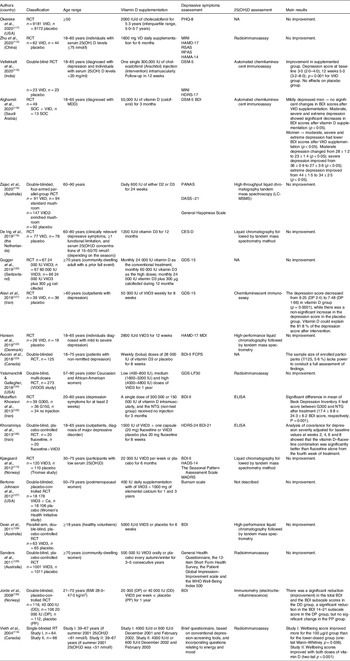
Nineteen randomised clinical trials using VitD supplementation for depressive symptoms in adults were published up to 2020 (Table 1). Nine studies were double-blinded, and twelve included individuals aged >65 years. Most of the studies were conducted in high-income countries (13/19). Seven studies were conducted with community-dwelling, healthy volunteers or individuals with no specification, and three studies only with VitD-deficient individuals(Reference Zhu, Zhang and Wang112–Reference Vieth, Kimball and Hu114). Six included only individuals with the diagnosis of depression, and two with individuals with VitD deficiency and diagnosed depression(Reference Vellekkatt, Menon and Rajappa115,Reference de Koning, Lips and Penninx116) . Considering only the studies that included individuals with a diagnosis of depression (with or without VitD deficiency), 4/8 presented improvement in depressive symptoms after VitD supplementation.
Vitamin D supplementation and depression/depressive symptoms: clinical trials with older adults

NA, not assessed; RCT, randomised controlled trial; VitD, vitamin D; PHQ-8, patient health questionnaire depression scale; MINI, mini-international neuropsychiatric interview; HAMD-17, Hamilton depression rating scale-17; RSAS, revised social anhedonia scale; RPAS, revised physical anhedonia scale; HAMA-14, Hamilton anxiety rating scale-14; HDRS-17, Hamilton depression rating scale-17; BDI, Beck depression inventory; PANAS, positive and negative affect schedule; DASS-21, 21-item depression; CES-D, Center for Epidemiological Studies Depression; GDS-15, 15-item geriatric depression scale; MDI, major depression inventory; BDI-II, Beck depression inventory-II; FCPS, Fawcett–Clark pleasure capacity scale; GDS-LF30, long form 30-item GDS; HDRS-24, Hamilton depression rating scale-24; BDI-21, Beck depression inventory-21; HADS-14, hospital anxiety and depression scale; MADRS, Montgomery–sberg depression rating scale.
Seven (7/19) studies reported an improvement in depressive symptoms after VitD supplementation, eleven reported no improvement and one study lacked the power to assess due to sampling size(Reference Aucoin, Cooley and Anand123). Considering the studies that observed depressive symptom improvement, five of seven were conducted with individuals with depression, and one of these (1/7) reported individuals with concomitant depression and VitD deficiency. VitD doses ranged from 600 to 300 000 IU, and the majority (6/7) used VitD doses above the dietary reference intake (DRI) (> 4000 IU/d). VitD doses of 600–4000 IU were used on a daily basis; 20 000–50 000 IU were used weekly; and the effect of a single dose of 150 000–300 000 IU was evaluated.
Compared with the seven studies with positive results, the eleven studies that did not report improvements tended to use lower VitD doses (<4000 IU) and longer periods (from 6 months to 5 years of supplementation). Of the eleven negative studies, only four used higher doses: Sanders et al. (2011) used a single dose of 500 000 IU in the winter for 3–5 years; Dean et al. (2011) used 5000 IU/d for 6 weeks; Kjægaard et al. (2012) used 20 000 IU/week for 6 months; and Gugger et al. (2019) used 24 000 IU or 60 000 IU for 12 months(Reference Kjærgaard, Waterloo and Wang113,Reference Gugger, Marzel and Orav120,Reference Dean, Bellgrove and Hall128,Reference Sanders, Stuart and Williamson129) . The age range was higher in the studies that did not observe any improvement in depressive symptoms (individuals >70 years).
Two meta-analyses have shown controversial results in clinical trials with VitD supplementation. Spedding et al. (2014) showed that VitD supplementation (daily doses of ≥800 IU) could have an effect comparable to that of antidepressants in depressive symptoms(Reference Spedding21). Due to the methodological variability of the studies, the other meta-analysis conducted by Gowda et al. (2015) showed results that did not support this hypothesis(Reference Gowda, Mutowo and Smith131). In addition, a 5-year follow-up study found no potential effect of VitD on the incidence of depression(Reference Okereke, Reynolds and Mischoulon117). Comparing the findings of the published meta-analysis with the studies searched in the present review, we observed that studies that did not observe improvements in depressive symptoms were conducted with older people with no diagnosis of depression, with lower VitD doses and for longer periods of follow-up. On the contrary, studies with positive results were conducted with younger populations with a diagnosis of depression and higher VitD doses for short periods of follow-up.
Key points of pre-clinical and clinical studies
Pre-clinical studies have pointed to the potential and possible effect of vitD on depression. However, despite a considerable number of clinical studies, it has not yet been possible to prove whether VitD can prevent or be used as an adjuvant treatment in depression. The data remain controversial. In addition, it is not possible yet to define which doses/amount of vitamin D would be most appropriate for depression.
Vitamin D and depressive symptoms: evidence from observational studies
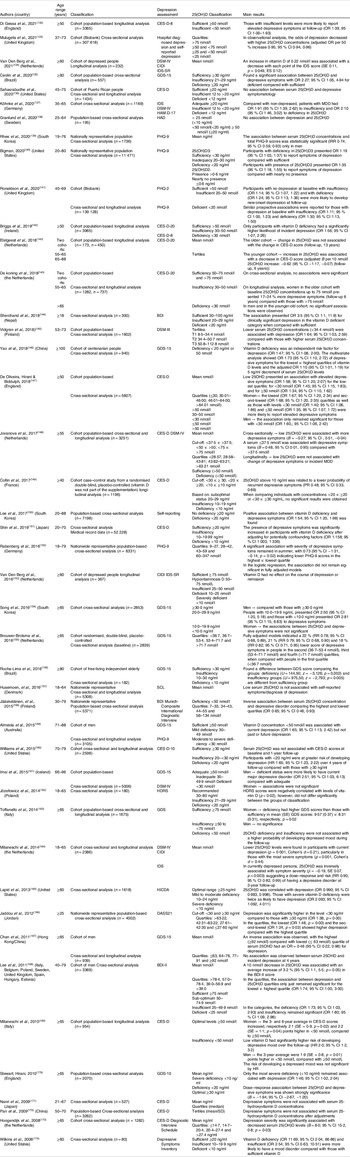
Table 2 summarises the information from forty-four observational studies that investigated the relationship between VitD and depression/depressive symptoms in both adults and older adults since 2006.
Vitamin D supplementation and depression/depressive symptoms: observational studies with older adults

95 % CI, 95% confidence interval; OR, odds ratio; SE, standard error; ES, effect size; IRR, incidence rate ratio; B, unstandardised beta; RR, relative risk; 25(OH)D, 25-hydroxycholecalciferol; 25(OH)D2, 25-hydroxyvitamin D2; 25(OH)D2, 25-hydroxyvitamin D3; DSM-IV, diagnostic and statistical manual of mental disorders; CIDI, composite international diagnostic interview; IDS-SR, self-report version of the inventory of depressive symptoms; GDS-15, geriatric depression scale with 15 items; CES-D, Center for Epidemiologic Studies Depression scale; HAM-D-17, Hamilton depression rating scale-17 items; HAD, hospital anxiety and depression scale; PHQ-9, patient health questionnaire-9; BDI, Beck depression inventory; CIDI, composite international diagnostic interview; IDS-SR, inventory of depressive symptoms – self-report; SCL, symptom checklist; HDRS, Hamilton depression rating scale; HICDA, hospital international classification of disease adaptation; DASS21, depression anxiety stress scale.
From over 15 years of research published, we observed that most studies included a mixed population with adults and older adults (27/44), were composed of people from cohort studies (27/44) and high-income economies countries (38/44), and used screening scales of depressive symptoms (37/44). The majority of studies performed a cross-sectional (27/44), followed by both a cross-sectional and longitudinal (10/44), and, finally, a longitudinal analysis (7/44). Considering the studies that included only older adults (≥60 years, 17/44), most were composed of people from a cohort (14/17) and performed a cross-sectional (10/17), followed by both a cross-sectional and longitudinal (4/17) and, finally, a longitudinal analysis (3/17). Moreover, only three studies were performed in low- or middle-income countries. This is an important issue because, according to the Mental Health Action Plan 2013–2030, there is an imbalance between research in high- and low/middle-income countries that needs to be corrected to ensure that they have appropriate cultural and economic strategies to respond to mental health needs and priorities(13). One of their main goals is to strengthen information systems, evidence and research on mental health, and it suggests the development of more studies from low/middle-income countries.
It is difficult to compare the main differences between the studies because each study was different in terms of the method used to analyse data, the cut-off point for the classification of serum VitD concentrations and the screening for depressive symptoms or diagnosis for depression. However, an increasing number of studies have found an association between VitD and both depressive symptoms (32/44) and depression (7/44), specifically in those with cross-sectional analyses (24/44 and 7/44, respectively). Considering the studies in which researchers stratified the analysis by sex (7/44), the association was divergent because some authors(Reference de Oliveira, Hirani and Biddulph147,Reference Milaneschi, Shardell and Corsi169) found an association in both sexes, while other studies found an association for women(Reference Toffanello, Sergi and Veronese163,Reference de Koning, Elstgeest and Comijs175) or men(Reference Rhee, Lee and Ahn139,Reference Song, Kim and Rhee154,Reference Imai, Halldorsson and Eiriksdottir161) . In studies that included both adults and older adults, only five (5/27) reported no association(Reference Sahasrabudhe, Lee and Scott136,Reference Granlund, Ramnemark and Andersson138,Reference Husemoen, Ebstrup and Mortensen157,Reference Nanri, Mizoue and Matsushita171,Reference Pan, Lu and Franco172) .
Among the studies that exclusively analysed data of older adults, those that performed a cross-sectional analysis (10/17) found an association between VitD and either depression(Reference Imai, Halldorsson and Eiriksdottir161,Reference Hoogendijk, Lips and Dik173) or depressive symptoms(Reference Ceolin, Matsuo and Confortin135,Reference Yao, Fu and Zhang146,Reference Song, Kim and Rhee154–Reference Rocha-Lima, Custódio and Moreira156,Reference Lapid, Cha and Takahashi165,Reference Stewart and Hirani170,Reference Wilkins, Sheline and Roe174) , but two studies that stratified the analysis by sex found an association only for men(Reference Song, Kim and Rhee154,Reference Imai, Halldorsson and Eiriksdottir161) . In studies that performed either longitudinal or cross-sectional and longitudinal analyses combined, the results are controversial. In the longitudinal analysis, one(Reference van den Berg, Marijnissen and van den Brink153) did not find any effect of VitD on the course of depression or remission, while another found a decrease in the score of depression with an increase in VitD(Reference va, n den Berg, Hegeman and van den Brink134), and another(Reference Milaneschi, Shardell and Corsi169) found an increase in depression score for a low level of VitD at 3 and 6 years follow-up in women and 3 years follow-up for men. In the cross-sectional and longitudinal combined analysis, some found a cross-sectional but not longitudinal association(Reference Almeida, Hankey and Yeap159,Reference Chan, Chan and Woo167) , another study(Reference Williams, Sink and Tooze160) did not find an association at baseline and 1 year follow-up, just one found an association at 4 years follow-up and another found a cross-sectional association only for women and not in the follow-up(Reference Toffanello, Sergi and Veronese163). Nevertheless, most of these studies found a higher risk for depression when considering VitD concentrations below 20 ng/ml or 50 nmol/l(Reference Ceolin, Matsuo and Confortin135,Reference Yao, Fu and Zhang146,Reference Song, Kim and Rhee154,Reference Almeida, Hankey and Yeap159,Reference Williams, Sink and Tooze160,Reference Toffanello, Sergi and Veronese163,Reference Milaneschi, Shardell and Corsi169,Reference Wilkins, Sheline and Roe174) . Other studies found higher risk when concentrations were below 10 ng/ml or 30 nmol/l(Reference Rocha-Lima, Custódio and Moreira156,Reference Imai, Halldorsson and Eiriksdottir161,Reference Lapid, Cha and Takahashi165,Reference Stewart and Hirani170) , and two studies found a lower risk for depression in concentrations >36·7 nmol/l(Reference Brouwer-Brolsma, Vaes and van der Zwaluw176) and 92 nmol/l(Reference Chan, Chan and Woo167). Moreover, a meta-analysis with a mixed population showed that an increase of 10 ng/ml in individuals with low serum concentrations of 25(OH)D had a protective effect against depression, with a decrease of 4 % in the risk of depression in cross-sectional studies, and a decrease of 8 % in the incidence of depression in cohort studies(Reference Ju, Lee and Jeong177). In studies involving only the elderly population, the same 10 ng/ml increase in serum 25(OH)D level was associated with a 12 % reduction in the risk of depression(Reference Li, Sun and Wang178).
Key points of observational studies
Despite the controversial results from observational studies, the majority have pointed to a higher risk of depression with low levels of VitD (20 ng/ml or 50 nmol/l). However, the variability in methodology between studies is important to note. At this moment, it is not possible to suggest a possible VitD cut-off point specific for depression. Few studies were carried out with only older adults, as well as in low- and middle-income countries. Few longitudinal studies were carried out to demonstrate causality of depression due to low levels.
Future perspective
Older adults are considered a risk group for both depression and vitamin D deficiency, which justifies further studies to focus on this population. The ageing process is associated with a reduced ability to sustain homoeostasis, which could make elderly people more susceptible to pathological alterations, including neuropsychiatric disorders(Reference Sibille179,Reference Pomatto and Davies180) . Also, women in menopausal transition are at risk of depression due to a lot of changes (i.e. hormone-related context, stressful events in life)(Reference Soares and Shea181). Moreover, older adults with depression present a higher risk of mortality(Reference Brandão, Fontenelle and da Silva182), especially in low- and middle-income countries, and have difficulties accessing treatment(4,Reference Lopes, Hellwig and e Silva183) . Another important factor is related to the adverse effects caused by antidepressant medications and the polypharmacy common in the elderly owing to the concomitance of several pathologies, which can facilitate the discontinuation of treatment(Reference Falci, Mambrini and Castro-Costa184–Reference Read, Gee and Diggle186).
Facing the urgency to identify the modifiable risk factors associated with the aetiology of depression, helping with the treatment and prevention of this disorder, it is important to carry out more studies following a proper methodology since we have an important background related to pre-clinical studies. As highlighted by the WHO, these studies need to be developed especially in low- and middle-income countries, since these places have higher prevalence of depression(Reference Whiteford, Ferrari and Degenhardt12,13) . Further, observational studies have pointed to the preventive effect of adequate serum vitamin D concentrations on the development of depressive symptoms. More longitudinal studies have been suggested(Reference Li, Sun and Wang178,Reference Parker, Brotchie and Graham187) to better elucidate the preventive effects of VitD on depression/depressive symptoms.
Besides, the variability in the diagnosis of depression, differences in VitD cut-off reference values and methods for serum VitD analysis could influence those findings that are still controversial(Reference Spedding21,Reference Wong, Ima-Nirwana and Chin188,Reference Jorde and Kubiak189) . Recently, the use of the standardised measurement of VitD proposed by the VitD Standardization Program (VDSP) has been recommended to improve clinical and public health practice, and it is important for future studies to apply this in their methodology(Reference Sempos and Binkley190,Reference Giustina, Adler and Binkley191) . Considering the randomised control trial (RCT) that included the elderly population (>65 years), most of them did not present any improvements in depressive symptoms after VitD supplementation. This could be due to the lower VitD doses used in those studies, and because they were not performed in older individuals diagnosed with depression. This is an important aspect to be addressed in future RCTs.
Conclusion
Overall, this updated review suggests that the monitoring and maintenance of adequate VitD concentrations is crucial, especially in older adults, a population at risk for both VitD deficiency and depression. Several pre-clinical, clinical and observational studies have suggested that VitD could have a beneficial effect on depression/depressive symptoms due to its genomic and non-genomic actions in many pathways involved in the pathophysiology of depression.
Although studies presented controversial results, clinical studies have shown that older adults with depression/depressive symptoms could benefit from higher doses of VitD supplementation for short periods. However, more RCTs are needed to confirm which doses and for how long the treatment is needed to achieve the greatest benefit. From the observational studies, the results are still controversial, but the majority have reported an association between low serum concentrations of VitD and high risk for depression/depressive symptoms in older adults, pointing to a possible preventive effect of VitD. Additional studies with prospective designs, especially in low- and middle-income countries, will possibly help to better elucidate the impact of deficient VitD status for mental health in adulthood and, consequently, for the elderly.
Supplementary material
For supplementary material accompanying this paper visit https://doi.org/10.1017/S0954422422000026
Financial support
This work was supported by the Coordenação de Aperfeiçoamento de Pessoal de Nível Superior – CAPES/Brasil (Finance Code 001).
Conflict of interest
None.
Authorship
All authors contributed to conception of this study. Material was prepared and the first draft of the manuscript was written by G.C. and J.D.M., and all authors commented on previous versions of the manuscript. All authors read and approved the final manuscript.