By late adolescence, more than 20% of youth have experienced serious and distressing levels of anxiety and depression (Auerbach & Hankin, Reference Auerbach and Hankin2012; Zahn-Waxler, Klimes-Dougan, & Slattery, Reference Zahn-Waxler, Klimes-Dougan and Slattery2000). Internalizing problems and symptoms of depression and anxiety can emerge early, are moderately stable over time, and often presage the emergence of serious psychopathology in adolescence and adulthood, including psychiatric diagnoses, self-injurious behaviors, and suicidality (Hopkins, Lavigne, Gouze, LeBailly, & Bryant, Reference Hopkins, Lavigne, Gouze, LeBailly and Bryant2013; Zahn-Waxler, Shirtcliff, & Marceau, Reference Zahn-Waxler, Shirtcliff and Marceau2008). Empirical attention to the mechanisms underlying these problems in adolescence is needed to inform the development of more effective targeted prevention and intervention efforts. Emotional processes constitute a central component of such mechanisms, because unusually strong and persistent experiences of sadness and fear are among the defining characteristics of internalizing problems. In accord with multilevel and bioecological models of development and developmental psychopathology (Cicchetti & Curtis, Reference Cicchetti and Curtis2007; Sameroff, Reference Sameroff2010), we have focused on the risks entailed by the combined presence of weak internal, self-regulatory capacities and inadequate external support for adaptive regulation. More specifically, we posit that adolescents are at greater risk for the maintenance or exacerbation of internalizing difficulties when they manifest atypical parasympathetic regulation of sadness and fear in conjunction with unsupportive parental responses to their experiences of these emotions.
Multilevel Frameworks of Development
Inherent to the notions of equifinality and multifinality in developmental psychopathology is the recognition that multiple and interacting influences contribute to the development of mental health over time (Cicchetti, Reference Cicchetti2008). Investigating and characterizing these interactive processes is one of the fundamental goals of the field, and there has been increasing recognition of the dynamic interplay between neurobiological regulation and salient life experiences in the unfolding of problems, symptoms, and disorders (Cicchetti & Toth, Reference Cicchetti and Toth2009). According to diathesis–stress models of developmental psychopathology (Hankin & Abela, Reference Hankin and Abela2005), children with a vulnerability, such as weak physiological self-regulation, are at elevated risk for developing problems if they are raised in an aversive environment or experience stressful events, but they are likely to show normative adjustment in the absence of unfavorable conditions. The differential susceptibility to environment model (DSE; Ellis, Boyce, Belsky, Bakermans-Kranenburg, & van IJzendoorn, Reference Ellis, Boyce, Belsky, Bakermans-Kranenburg and van IJzendoorn2011) suggests that apparent vulnerabilities actually reflect greater openness to the influence of both negative and positive experiences, such that under very favorable or advantaged conditions, these same children would be likely to show superior adjustment. However, there have been few longitudinal, multilevel, biopsychosocial investigations of the development of internalizing difficulties in adolescence.
The Importance of the Internal Emotional Environment
Multiple neurobiological systems are involved in children's and adolescents' regulation of their emotional arousal and expression (Hastings, Kahle, & Han, Reference Hastings, Kahle, Han and Lagatutt2014). One of the most widely studied psychophysiological markers of emotion regulation is cardiac vagal tone, a reflection of the chronotropic influence of the parasympathetic vagus nerve on heart rate, which is commonly measured using respiratory sinus arrhythmia (RSA). According to Porges' (Reference Porges2011) polyvagal theory, dynamic changes in parasympathetic influence on cardiac activity, as reflected in RSA suppression or augmentation (decreased or increased parasympathetic influence, respectively), are essential for flexibly mobilizing adaptive responses to changing contexts and cues of salient events. If contexts are perceived to be safe or nonthreatening, RSA augmentation supports the social engagement system and preparedness for calm interaction by lowering cardiac arousal. Novel, salient, or evocative stimuli prompt some RSA suppression, facilitating orientation and attention to the stimuli. If contexts are challenging or threatening, greater RSA suppression mobilizes resources to support active coping, such as the fight-or-flight response (Hastings et al., Reference Hastings, Kahle, Han and Lagatutt2014; Hastings & Miller, Reference Hastings, Miller, Padilla-Walker and Carlo2014).
There have been studies linking greater RSA suppression with both fewer (e.g., El-Sheikh & Whitson, Reference El-Sheikh and Whitson2006) and more internalizing problems (e.g., Boyce et al., Reference Boyce, Quas, Alkon, Smider, Essex and Kupfer2001; Obradovic, Bush, & Boyce, Reference Obradovic, Bush and Boyce2011). A recent meta-analysis of developmental studies found that there was a small but significant association of less RSA suppression in response to challenges being associated with more internalizing problems, although there was pronounced heterogeneity of effect sizes across studies (Graziano & Derefinko, Reference Graziano and Derefinko2013). This is consistent with dominant psychobiological models of depression, which suggest the disorder tends to be characterized by low autonomic reactivity (Bylsma, Morris, & Rottenberg, Reference Bylsma, Morris and Rottenberg2008), but not with models of anxiety problems, which emphasize autonomic hyperreactivity (Hastings & Guyer, in press). However, rather than interpreting RSA suppression to be reflective of superior emotion regulation capacities regardless of context, a functional perspective requires consideration of how a physiological change could support appropriate responses to the evoking stimulus or context that prompted that physiological response (Beauchaine, Reference Beauchaine2012; Hastings & Miller, Reference Hastings, Miller, Padilla-Walker and Carlo2014).
Parasympathetic regulation of fear and sadness
Sadness and fear are often considered broadly as part of negative affectivity (Rothbart, Ahadi, Hershey, & Fisher, Reference Rothbart, Ahadi, Hershey and Fisher2001), or internalizing emotions (Chaplin & Aldao, Reference Chaplin and Aldao2013), or withdrawal emotions (Fortunato, Gatze-Kopp, & Ram, Reference Fortunato, Gatze-Kopp and Ram2013). From functional and psychoevolutionary perspectives, they are differentiated because they are associated with different response tendencies that would be supported by distinct physiological states (Ekman, Reference Ekman, Dalgleish and Power1999; Frijda, Reference Frijda, Ekman and Davidson1994). Fear is an activating emotion that mobilizes resources and increases physiological arousal, whereas sadness is a quieting emotion that is typically accompanied by decreased arousal (Cacioppo, Berntson, Larsen, Poehlman, & Ito, Reference Cacioppo, Berntson, Larsen, Poehlmann, Ito, Lewis and Haviland-Jones2000; Rainville, Bechara, Naqvi, & Damasio, Reference Rainville, Bechara, Naqvi and Damasio2006). For example, in response to emotion-eliciting film clips, adolescent reports of stronger feelings of fear were associated with greater heart rate increases, whereas reports of more sadness were associated with more slowing of heart rate (Hastings et al., Reference Hastings, Nuselovici, Klimes-Dougan, Kendziora, Usher and Ho2009). In parallel, Fortunato et al. (Reference Fortunato, Gatze-Kopp and Ram2013) found that children showed significantly greater RSA suppression to fearful film clips than to sad film clips. In her comprehensive review of research on emotion inductions and autonomic physiology, Kriebig (Reference Kriebig2010) reported consistent links between decreased heart rate variability (RSA suppression) and elicitation of both fear and anxiety. Although a more heterogenous pattern of findings was evident for sadness, the most common pattern in studies that used film clips to induce sadness was characterized as a “deactivating response” (Kriebig, Reference Kriebig2010, p. 405), involving increased heart rate variability (RSA augmentation).
This typical profile of RSA augmentation during sadness appears to reflect adaptive parasympathetic regulation. In normally developing boys, Marsh, Beauchaine, and Williams (Reference Marsh, Beauchaine and Williams2008) reported that stronger facial expressions of sadness in response to a sadness-inducing video were associated with increasing RSA (augmentation), whereas boys with internalizing problems and mood disorder symptoms failed to show this convergence between their RSA and facial affect. Similarly, adolescent girls who engaged in self-injurious behaviors showed lower and decreasing RSA (suppression) while watching a sad film, whereas control girls had higher and increasing RSA (augmentation; Crowell et al., Reference Crowell, Beauchaine, McCauley, Smith, Stevens and Sylvers2005). In addition, younger children with more internalizing problems have been found to mount more RSA suppression to a film depicting bullying (Obradovic et al., Reference Obradovic, Bush and Boyce2011). Nevertheless, there continues to be some debate around the contexts or conditions in which different patterns of RSA change are adaptive (Hastings et al., Reference Hastings, Kahle, Han and Lagatutt2014) because not all studies have supported this pattern (e.g., Bylsma et al., Reference Bylsma, Morris and Rottenberg2008; Fortunato et al., Reference Fortunato, Gatze-Kopp and Ram2013).
Overall, the normative parasympathetic response to frightening stimuli is moderate RSA suppression, whereas the normative response to sad stimuli is weaker suppression or some augmentation (Kreibig, Reference Kriebig2010). Deviations from these patterns could contribute to inappropriate ways of coping with emotional events, conferring risk for maladjustment and psychopathology (Frijda, Reference Frijda, Ekman and Davidson1994). However, it is unclear which patterns of deviation might pose greater risks for internalizing difficulties. Atypical parasympathetic regulation could be evident in exaggerated RSA reactivity (e.g., stronger RSA suppression to fearful stimuli or stronger RSA augmentation to sad stimuli), or in diminished or reversed RSA reactivity (e.g., RSA augmentation to fearful stimuli or RSA suppression to sad stimuli). Evidence for nonlinear associations between parasympathetic regulation and adjustment suggest that multiple patterns might be evident (Kogan, Gruber, Shallcross, Ford, & Mauss, Reference Kogan, Gruber, Shallcross, Ford and Mauss2013; Miller et al., Reference Miller, Chochol, Nuselovici, Utendale, Simard and Hastings2013). Further, numerous studies have failed to document significant, direct associations between dynamic RSA reactivity and internalizing difficulties in children and adolescents (Bosch, Riese, Ormel, Verhulst, & Oldehunkel, Reference Bosch, Riese, Ormel, Verhulst and Oldehinkel2009; Hastings et al., Reference Hastings, Sullivan, McShane, Coplan, Utendale and Vyncke2008). These varying findings suggest that atypical parasympathetic regulation of emotion might function in conjunction with other contributing factors, such as socialization experiences, to pose multilevel risks for the development of psychopathology.
The Importance of the External Emotional Environment
Emotions are ubiquitous components of family life and parent–child interactions. Parents hold beliefs about the appropriateness of emotional experience and expression (Gottman, Katz, & Hooven, Reference Gottman, Katz and Hooven1997), which they can attempt to consciously teach to their children, implicitly communicate through modeling of their own emotional responses, or shape through responding contingently to their children's emotions (Eisenberg, Cumberland, & Spinrad, Reference Eisenberg, Cumberland and Spinrad1998; Malatesta-Magai, Reference Malatesta-Magai, Garber and Dodge1991; Morris, Silk, Steinberg, Myers, & Robinson, Reference Morris, Silk, Steinberg, Myers and Robinson2007). Parents who are more accepting and supportive of their own and their children's emotions are likely to have children who exhibit better emotion regulation and competent emotional functioning. In contrast, parents who tend to be punitive and discouraging of children's emotions may undermine children's emotional well-being and increase their risks for the emergence or exacerbation of emotional problems (Denham, Bassett, & Wyatt, in press; Gottman et al., Reference Gottman, Katz and Hooven1997). These links have been noted for parental responses to children's negative emotions broadly (Fabes, Poulin, Eisenberg, & Madden-Derdich, Reference Fabes, Poulin, Eisenberg and Madden-Derdich2002) and for socializing responses to fear and sadness specifically (Garside & Klimes-Dougan, Reference Garside and Klimes-Dougan2002; Hastings & De, Reference Hastings and De2008; Klimes-Dougan et al., Reference Klimes-Dougan, Brand, Zahn-Waxler, Usher, Hastings and Kendziora2007).
Most studies of emotion socialization have been completed with families of young children, but recently there has been more research on emotion socialization of adolescents (Hunter et al., Reference Hunter, Katz, Schortt, Davis, Leve and Allen2011; Klimes-Dougan & Zeman, Reference Klimes-Dougan and Zeman2007). The novel social contexts and maturational changes of adolescence confront youths with emotional demands that tax their abilities to regulate and cope, such that parental support for youths' emotions should continue to foster emotional health. For example, mothers with stronger emotion-coaching philosophies have adolescents with fewer internalizing problems (Katz & Hunter, Reference Katz and Hunter2007; Stocker, Richmond, & Rhoades, Reference Stocker, Richmond and Rhoades2007), whereas youths with more problems report that their parents are more punitive and rejecting, and less rewarding and supportive, of their displays of negative emotions (Klimes-Dougan et al., Reference Klimes-Dougan, Brand, Zahn-Waxler, Usher, Hastings and Kendziora2007; O'Neal & Malatesta-Magai, Reference O'Neal and Malatesta-Magai2005; Parra, Olsen, Buckholdt, Jobe-Shields, & Davis, Reference Parra, Olsen, Buckholdt, Jobe-Shields and Davis2010). Despite the evidence for links between parental emotional socialization and adolescent adjustment, most existing studies of youths have been cross-sectional in design (Denham et al., in press) and have utilized single-method assessments, such as questionnaires, that might not be effective for assessing socialization behaviors that are subtle or that parents or youths might be reluctant to report. There is a clear need for more prospective, longitudinal studies that utilize convergent operations to examine emotion socialization, in combination with a multilevel perspective on adolescent developmental psychopathology (Schwartz et al., Reference Schwartz, Dudgeon, Sheeber, Yap, Simmons and Allen2011).
Multilevel Examinations of RSA, Emotion Socialization, and Internalizing Difficulties
One could expect that child and adolescent parasympathetic reactivity moderates the links between their socialization experiences and their development of internalizing problems or symptoms of anxiety and depression. In the limited available literature considering these multiple levels of influence, the results have been mixed (Bosch et al., Reference Bosch, Riese, Ormel, Verhulst and Oldehinkel2009). Further, studies have differed in finding that the links between socialization and adjustment are stronger for children who exhibit less (Hastings et al., Reference Hastings, Sullivan, McShane, Coplan, Utendale and Vyncke2008) versus more (Obradovic, Bush, Stamperdahl, Adler, & Boyce, Reference Obradovic, Bush, Stamperdahl, Adler and Boyce2010) RSA suppression in response to varied challenges. One study revealed that the multilevel effect of parenting and parasympathetic reactivity was present for preschoolers' RSA changes to a cognitive challenge, but not to a socioemotional one (Obradovic et al., Reference Obradovic, Bush and Boyce2011). However, although there have been studies in which dynamic RSA changes, parental emotion socialization, and internalizing difficulties were measured (Gottman, Katz, & Hooven, Reference Gottman, Katz and Hooven1996; Liew, Johnson, Smith, & Thoemmes, Reference Liew, Johnson, Smith and Thoemmes2011), we have not identified any in which the researchers examined whether parasympathetic reactivity moderated associations between emotion socialization and problems or symptoms longitudinally.
Considering Gender in Multilevel Models of Internalizing Difficulties
Likely because of multiple influences from biology, parental influences and cultural gender norms, females and males differ somewhat in their typical experience and expression of emotions (Brody & Hall, Reference Brody, Hall, Lewis and Haviland-Jones2000). This pattern extends to the level of internalizing psychopathology (e.g., Nottelmann & Jensen, Reference Nottelmann and Jensen1995; St. Clair et al., Reference St. Clair, Goodyer, Dunn, Herbert, Jones and Croudace2012). Parents accept and reinforce fear and sadness in their daughters more than in their sons (Cassano, Perry-Parrish, & Zeman, Reference Cassano, Perry-Parrish and Zeman2007; Chaplin & Zahn-Waxler, Reference Chaplin and Zahn-Waxler2005). Transactional influences are likely to come to bear (Denham et al., in press), given that girls might be particularly attuned to parental responses to their emotions, such that they internalize these socialization messages more readily. In parallel, the link between weak parasympathetic regulation and the development of internalizing problems has been reported to be stronger for girls than for boys (El-Sheikh, Keiley, Erath, & Dyer, Reference El-Sheikh, Keiley, Erath and Dyer2013). Thus, gender could function as a canalizing factor toward increasingly divergent patterns of maladjustment despite similar experiential or physiological risk factors, with girls being more likely than boys to manifest their problems through anxiety and depression symptoms (Nolen-Hoeksema & Girgus, Reference Nolen-Hoeksema and Girgus1994; Zahn-Waxler et al., Reference Zahn-Waxler, Shirtcliff and Marceau2008).
Goals and Hypotheses
This investigation was conducted to determine whether the dynamic parasympathetic regulation of sadness and fear moderated the extent to which maternal supportive and punitive emotion socialization practices predicted the development of internalizing difficulties in adolescents. Modest RSA suppression during fear and RSA augmentation during sadness were expected to be normative, well-regulated responses. Deviations from these patterns, reflected either in exaggerated or in reversed patterns of reactivity, were expected to confer risk for problematic development in the context of punitive emotion socialization (diathesis–stress) or susceptibility to both supportive and punitive emotion socialization (differential susceptibility). Parasympathetic regulation and emotion socialization practices also were expected to predict internalizing difficulties more strongly in daughters than in sons.
Method
Participants
This study included 220 youths, aged 11–16 years at recruitment (M = 13.67, SD = 1.80), and their mothers from the Washington, DC, metropolitan area, who were enrolled in a prospective, two-wave longitudinal investigation (Klimes-Dougan, Hastings, Granger, Usher, & Zahn-Waxler, Reference Klimes-Dougan, Hastings, Granger, Usher and Zahn-Waxler2001; Zahn-Waxler et al., Reference Zahn-Waxler, Klimes-Dougan, Duggal, Gruber and Usher2001). Youths and mothers completed telephone screening interviews to report on adolescent internalizing and externalizing problems using abbreviated versions of the Youth Self-Report (YSR; Achenbach, Reference Achenbach1991) and the Child Behavior Checklist (CBCL; Achenbach, Reference Achenbach1991); 136 youths had elevated (T ≥ 64) internalizing or externalizing problems according to mother or youth screening. The screening scores were used to ensure overrepresentation of youths with elevated problem scores in the sample, and were not used in the current analyses. Extensive details on recruitment and youth and family demographic characteristics have been reported previously (Hastings et al., Reference Hastings, Shirtcliff, Klimes-Dougan, Allison, DeRose and Kendziora2011; Klimes-Dougan et al., Reference Klimes-Dougan, Brand, Zahn-Waxler, Usher, Hastings and Kendziora2007). Briefly, the youths were 50% female and 71% White and lived in predominantly two-parent families (76%) of middle to upper-middle socioeconomic status (M = 52.93, SD = 10.84 on the Hollingshead index; Hollingshead, Reference Hollingshead1975).
The second wave of data collection occurred 2 years later (M = 27.41 months, SD = 6.10) and included 177 youths (49.2% female), aged 13.00 to 19.42 years (M = 15.98, SD = 1.92), and their mothers, who provided measures of youths' emotion and behavior problems and symptoms of psychiatric disorders. Of these, there were 171 youths (84 females) who provided cardiac RSA, emotion socialization, and psychopathology data at Time 1, and who constituted the sample for the current analyses. There was no evidence of selective attrition based on adolescent sex, age, or Time 1 problem scores.
Procedures
At Time 1, the protocol included the phone screening interviews, a home visit in which two examiners guided the parent–adolescent dyads through a series of interactions and administered some measures and questionnaires; “homework” packets of questionnaires completed separately by youths and parents; and a visit to a comfortable, apartment-like laboratory suite in which adolescent physiology was measured and mothers and youths reported on adolescents' emotional and behavioral problems and symptoms of psychiatric disorders. At Time 2, mothers and youths again completed a laboratory visit. Only activities, measures, and questionnaires that pertained to the current analyses are explained herein.
Emotion socialization practices of the parent
A multimethod, convergent operations approach was used to assess maternal emotion socialization practices. This included both live coding and coding from videotaped observations of each mother–child dyad discussing an emotional topic, as well as both youth and parent reports of mothers' general emotion socialization practices.
Mother–child emotion discussion
During the Time 1 home visit, each mother–youth dyad was audio- and videorecorded discussing a series of topics, beginning with a warm-up activity in which they planned a dream vacation. Following this, the dyad was asked to recall together a time when something happened that made the adolescent sad or worried, either something that happened to the adolescent or something the family experienced together. The participants were instructed to recall the event together, describe what was going on, share any emotions that were felt, and talk about what was done to “deal” with the situation. The dyads generated the event during the course of the discussion and were given 3 min to have this conversation.
Mothers' emotions and behaviors contributing to their rewarding and punitive emotion socialization were observed in three passes through the data. For the first pass, the two examiners engaged in “live coding,” with each examiner separately rating the dyad members on a number of scales immediately after the emotion discussion was concluded. For current purposes, the scales for mother warmth, anger, and hostility were used, with each rated on 5-point Likert-type scales from 1 (not at all) to 5 (very much). Warmth reflected the degree to which the mother was affectionate, sympathetic, supportive, and positively attentive toward youth (i.e., eye contact with smile, lean toward youth, nodding, or gentle touch; κ = 0.81). Anger reflected the extent to which the mother expressed annoyance, irritation, and frustration (i.e., frown, clench jaw, irritated tone; κ = 0.65). Hostility reflected the degree to which the mother was critical, derisive, and rejecting of the youth (i.e., eye roll, sneer, or dismissive hand wave; κ = 0.74).
The second and third pass involved coding global and specific behaviors, respectively, from the videotapes, using the Emotion Discussion Coding System (EDCS; Section on Developmental Psychopathology, 2002). The global codes were applied to mothers' overall patterns of behavior across the 3-min conversation, and were rated on 5-point Likert-type scales from 1 (not at all) to 5 (very much). The specific codes were maternal responses to youths' emotions and statements that were observed as absent (0) or present (1) in each 30-s epoch of the 3-min conversation. For current analyses, one global and one specific code were used to identify characteristics of emotion socialization strategies employed. The global code of egocentrism reflected the overall tendency of the mother to center the conversation on her own emotions and concerns at the expense of her child's perspective, thereby dismissing or rejecting the youth's experience or expression of emotion in order to focus on herself (e.g., “You felt sad. I know you did” when a youth denied feeling sad while the mother was in the hospital; intraclass correlation [ICC] = 0.81). The specific code of reward reflected the mother's expressions of sympathy for the youth's feelings and experiences and her provision of comfort, affection, and support to the youth (e.g., “You were really scared when you were sick. That's okay”; ICC = 0.83).
Reported emotion socialization
In the homework packet and at the Time 1 lab visit, respectively, youths and mothers completed parallel forms of a questionnaire measuring parental emotion socialization practices called the Emotions as a Child, version 1.2 (see Klimes-Dougan et al., Reference Klimes-Dougan, Brand, Zahn-Waxler, Usher, Hastings and Kendziora2007, for more details). The EAC v1.2 was based on a measure developed by Magai (Reference Magai1996). Youths were asked to rate how typical, from 1 (not at all) to 5 (very), it was for their mother to engage in each of 15 behaviors when the youth felt sad, felt afraid, or felt angry (45 items total). Similarly, mothers rated how typical, from 1 to 5, it had been for them to engage in these behaviors. For the current analyses, youths' and mothers' ratings of the 6 items reflecting rewarding responses to youths' sadness and fear (e.g., providing comfort, empathizing, and problem solving; α = 0.89 and 0.81 for youth and mother, respectively) were used.Footnote 1
Data reduction for the emotion socialization constructs
Multimethod measures of emotion socialization were generated from the observed, mother-reported and youth-reported indices of maternal emotion socialization. The live observation ratings of mothers' warmth, EDCS specific coding sum of reward behaviors, youth-reported rewarding responses to sadness and fear, and mother-reported rewarding responses to sadness and fear were subjected to a principal components analysis. A single factor solution was supported, eigenvalue = 1.45, explaining 36.28% of the variance, with item loadings ranging from 0.47 to 0.71 (M = 0.59). The weighted factor scores were saved and used as the measure of supportive emotion socialization.
Similarly, a principal components analysis was applied to the live observation ratings of mothers' anger and hostility during the emotion discussion, and the EDCS global coding rating of egocentrism. Again, a single factor solution was supported, eigenvalue = 1.88, explaining 62.58% of the variance, with item loadings ranging from 0.60 to 0.87 (M = 0.78). The weighted factor scores were saved and used as the measure of punitive emotion socialization.
Physiological functioning of the adolescent
Video mood induction (VMI)
Approximately 1 hr after arriving for the Time 1 lab visit, three electrodes were affixed to the youth's torso to record cardiac interbeat intervals (IBI). Approximately 15 min later, the VMI procedure began (see Hastings et al., Reference Hastings, Nuselovici, Klimes-Dougan, Kendziora, Usher and Ho2009, for more details). The VMI involved the youth watching eight brief (2–4 min), age-appropriate clips from feature films, with two video clips each selected to strongly represent and evoke sadness, fear, anger, and happiness. The youth was asked to sit quietly to record a 1-min baseline prior to each video clip, and then to watch the clip. A 2-min pause followed each clip, in which the youth answered some questions and was then allowed to relax. The current analyses utilized the cardiac IBI from the two fear (The Shining and Halloween) and the two sadness (The Cham and Steel Magnolias) video clips, and the 1-min baseline periods that preceded each of these clips.
The electrodes were attached to a Coulbourn electrocardiogram amplifier, and IBI were recorded by detecting consecutive R-waves to the nearest millisecond. Event markers inserted at the beginning and end of each baseline and video clip were used to designate sections of the IBI data file for artifact and outlier editing, which was completed used Mxedit software (Delta-Biometrics Inc., Bethesda, MD). Mxedit was also used to compute RSA, at the 0.12–0.40 Hz frequency band, via the software's rolling 21-point polynomial algorithm set to 30-s epochs. Usable data were obtained for all 171 youths.
Data reduction of the RSA constructs
There were robust intercorrelations among the RSA scores for the two 1-min baselines that preceded sad clips (r = .48, p < .001), the two 1-min baselines that preceded fear clips (r = .47, p < .001), the two sad video clips (r = .86, p < .001), and the two fear video clips (r = .81, p < .001). Thus, these scores were arithmetically averaged to create one pre-sad RSA score, one pre-fear RSA score, one sad RSA score, and one fear RSA score. Because the corresponding pre-emotion and emotion RSA scores were also robustly correlated (rs = .79 and .76 for sadness and fear, respectively, both p < .001), scores for youths' parasympathetic regulation to the mood induction video clips were computed using residual change scores (Krantz et al., Reference Krantz, Kop, Gabbay, Rozanski, Barnard and Klein1996; Nazzaro et al., Reference Nazzaro, Seccia, Vulpis, Schirosi, Serio and Battista2005). Sad RSA was regressed onto pre-sad RSA, and fear RSA was regressed onto pre-fear RSA; the standardized residual change scores were saved as sad ΔRSA and fear ΔRSA, respectively. Lower (or more negative) ΔRSA scores reflected relatively more parasympathetic suppression, whereas higher (or more positive) ΔRSA reflected relatively more parasympathetic augmentation.Footnote 2
Adolescent psychopathology
Two approaches were used to assess adolescent psychopathology: internalizing symptoms were assessed more broadly, and anxiety and depressive symptoms were identified more specifically. The broader indices of internalizing and externalizing problems were based on the youths' and mothers' completions of the YSR and CBCL, respectively, at the Time 1 and Time 2 lab visits. Only data from the lab-administered full YSR and CBCL were used in the current analyses. For each item, the reporter was asked to rate how well the item describes the child currently or within the last 6 months: on a 3-point scale (0 = not true, 1 = somewhat or sometimes true, and 2 = very often or often true). Normalized T scores in the possible range of 31 to 100 were used in analyses. The T score for internalizing problems consists of information from the syndrome scales designated as withdrawn, somatic complaints, and anxious/depressed. The T score for externalizing problems consists of information from the syndrome scales designated as delinquent behavior and aggressive behavior.
Symptoms of anxiety and depression were based on the National Institute of Mental Health Diagnostic Schedule for Children, Version IV (DISC; Shaffer, Fisher, Lucas, Dulcan, & Schwab-Stone, Reference Shaffer, Fisher, Lucas, Dulcan and Schwab-Stone2000), to report on the adolescent's symptoms of Axis 1 psychiatric disorders (see Klimes-Dougan et al., Reference Klimes-Dougan, Hastings, Granger, Usher and Zahn-Waxler2001, for more details). DISC interviews were administered to both the mother and the youth at Time 1 and Time 2 lab visits by clinical psychologists or clinical trainees who were trained and supervised by a senior team member (B.K.D.) who had received training on the DISC by its designers. Current and past-year symptom counts were used to generate dimensional scores for adolescents' anxiety disorders (including specific phobia, social phobia, separation anxiety disorder, generalized anxiety disorder, obsessive–compulsive disorder, panic disorder, and agoraphobia) and major depressive disorder.
Analyses
After conducting basic descriptive examinations of the data, hierarchical linear regression analyses were used to predict the development of youths' internalizing problems, anxiety symptoms, and depression symptoms from their parasympathetic regulation of sadness and fear and experiences of supportive and punitive maternal emotion socialization. In order to consider both self- and other perspective on adolescent internalizing problems, and the modest intercorrelations of parent and adolescent reports, mother- and youth-reported problems and symptoms were kept as separate measures. In addition, to limit the number of predictors per model and maximize the likelihood of detecting multilevel interaction effects, separate models were run with supportive versus punitive emotion socialization. Thus, 12 regression models were examined, each of which had a parallel hierarchical structure.
In the models predicting mother- and youth-reported internalizing problems at Time 2, Step 1 included the control variables of adolescent sex, age at Time 1, interval between Times 1 and 2, internalizing problems at Time 1, and externalizing problems at Time 2. The latter variable was included in the model in order to control for the substantial comorbidity of internalizing and externalizing problems within this sample (Hastings et al., Reference Hastings, Shirtcliff, Klimes-Dougan, Allison, DeRose and Kendziora2011) and to ensure that the Time 1 predictor variables predicted uniquely to the development of internalizing problems from Time 1 to Time 2, rather than the development of general psychopathology. Step 2 included the pre-sad RSA, pre-fear RSA, sad ΔRSA, and fear ΔRSA scores. Step 3 included one emotion socialization measure, either the supportive or the punitive factor score. Step 4 included the two two-way interactions between the emotion socialization score and the two ΔRSA scores. Step 5 included the three two-way interactions between sex and each of the ΔRSA and emotion socialization scores. Finally, Step 6 included the two three-way interactions of Sex × Sad ΔRSA × Emotion Socialization and Sex × Fear ΔRSA × Emotion Socialization.
All variables were centered prior to computing interaction terms, and centered scores were used in the regression analyses. Interaction effects that reached significance (p ≤ .05) were interpreted using further regressions that examined the associations between the predictor and outcome variables at low (–1 SD) and high (+1 SD) levels of the moderator(s).Footnote 3 For both the fear and sad video stimuli, all youths with ΔRSA ≤ –1 SD manifested RSA suppression from pre-emotion (baseline) to emotion (stimuli) conditions, and all youths with ΔRSA ≥ +1 SD manifested RSA augmentation. Sex and ΔRSA were treated as moderators of emotion socialization, and sex was treated as a moderator of ΔRSA.
In the models predicting mother- and youth-reported anxiety symptoms at Time 2, Step 1 included adolescent sex, age at Time 1, interval between Times 1 and 2, anxiety symptoms at Time 1, externalizing problems at Time 2, and depression symptoms at Time 2. The latter variable was included to account for the substantial comorbidity of anxiety and depression symptoms (Angold, Costello, & Erkanli, Reference Angold, Costello and Erkanli1999) and to increase the specificity of prediction of symptom type. Steps 2 through 6 were identical to the models for internalizing problems. The models predicting Time 2 depression symptoms were structured the same way, except that Step 1 controlled for depression symptoms at Time 1 and anxiety symptoms at Time 2.
Because supportive and punitive emotion socialization scores were inversely correlated and thus might predict to the same variance in Time 2 problem and symptom scores, follow-up analyses were planned. In the event that parallel effects were identified in complementary models (i.e., both supportive and punitive predicting youth-reported symptoms in Step 3 of their respective models), a follow-up model including both emotion socialization effects was examined to determine whether both, or either, predicted to unique variance in the measure of youth psychopathology.
Results
Descriptive statistics
Prior to conducting the planned analyses, data were inspected for skewed distributions and outliers. The punitive emotion socialization score had a marked positive skew, which was corrected with a square-root transformation. There were five other variables with reasonable distributions but one to three outliers that were more than 3 SD above or below the mean; these scores were Winsorized to within 3 SD (Wilcox, Reference Wilcox2012).
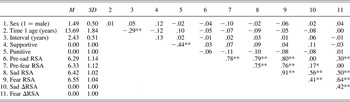
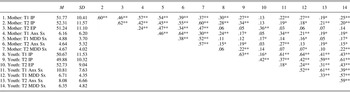
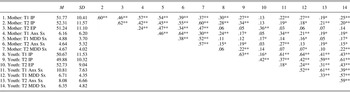
Descriptive statistics and intercorrelations are in Table 1 for the Time 1 predictor and control variables, and in Table 2 for the Time 1 and 2 problem and symptom scores. At Time 1, girls reported more anxiety symptoms, M = 12.64, SD = 8.23, than boys, M = 9.07, SD = 6.60, t (164) = 3.09, p < .01. There were no other significant differences between male and female youth. Age at Time 1 and interval between assessments were unrelated to the other variables.
Descriptive statistics and intercorrelations of predictor and control variables

Note: RSA, Respiratory sinus arrhythmia.
*p < .05. **p < .01.
Descriptive statistics and intercorrelations of T1 and T2 measures of internalizing difficulties
Note: T1, Time 1; IP, internalizing problems; T2, Time 2; EP, externalizing problems; Sx, symptoms; MDD, major depressive disorder.
*p < .05. **p < .01.
To our surprise, there was significant RSA augmentation from the pre-emotion clip baseline periods to both the sad and the fear video clips, paired t (170) = –2.27 and –3.83, p < .05 and .01, respectively. There was considerable individual variability in parasympathetic response to the emotion induction stimuli, however; 41.5% and 39.8% of youths showed at least some RSA suppression to the sad and fear clips, respectively. RSA and ΔRSA values were not significantly correlated with supportive or punitive emotion socialization.
There were modest significant positive correlations between mothers' and youths' reports of corresponding problem and symptom scores at Times 1 and 2 (.16 ≤ r ≤ .36). Within and across reporters, there was evidence of substantial stability and comorbidity of problems.
Predictions of internalizing problems
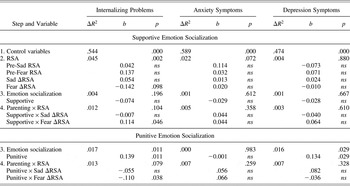
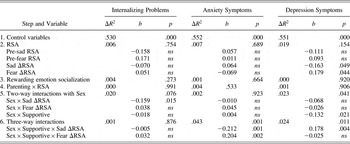
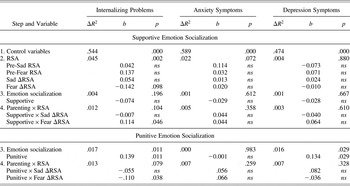
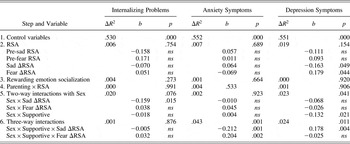
The regression models predicting mother- and youth-reported internalizing problems at Time 2 are presented in Tables 3 and 4, respectively.Footnote 4 All models were significant for both mother and youth reports (all adjusted R 2 > .500, F > 11.00, p < .001). This was largely due to Step 1 of the models having accounted for the stability of internalizing problems from Time 1 to 2 and the comorbidity of internalizing and externalizing problems at Time 2 (all bs significant at p < .001). Recruitment parameters for this sample ensured that comparable numbers of boys and girls with internalizing pathology were represented, so boys and girls did not differ in their likelihood to develop more internalizing problems (all |b| < .06, ns). However, over and above these control variables, maternal emotion socialization and parasympathetic regulation of emotion significantly predicted later internalizing problems.
Regression models predicting mother-reported problems and symptoms
Note: Models including supportive emotion socialization are presented in the top half of the table; Steps 3 and 4 of models including punitive emotion socialization are in the bottom half. Beta values are not presented for control variables or for steps with no significant predictor variables. RSA, Respiratory sinus arrhythmia.
Regression models predicting child-reported problems and symptoms
Note: Beta values are not presented for control variables or for steps with no significant predictor variables. No new effects were identified in the models with punitive emotion socialization, so these models are not presented. RSA, Respiratory sinus arrhythmia.
Mother-reported internalizing problems were significantly predicted by the Supportive Emotion Socialization × Fear ΔRSA interaction in the first model, and by punitive emotion socialization and the Punitive Emotion Socialization × Fear ΔRSA interaction in the second model. There were no significant moderation effects involving sex in Steps 5 or 6 of the models. A follow-up regression model was examined that included both supportive and punitive emotion socialization scores in Step 3, and both interactions between those emotion socialization scores and fear ΔRSA in Step 4. Both steps accounted for significant variance (ΔR 2 = .017 and .016, respectively, both p < .05). The effect of punitive parenting remained significant at p < .05, and both interaction effects approached significance at p < .10, suggesting little overlap in the variance in Time 2 internalizing problems that each predicted.
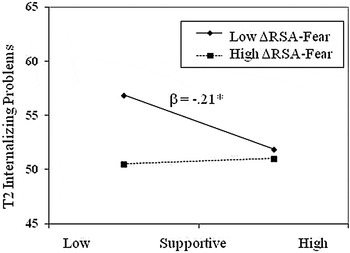
The moderating effect of fear ΔRSA on the prediction of later internalizing problems from earlier supportive emotion socialization is presented in Figure 1. More supportive maternal emotion socialization predicted fewer mother-reported internalizing problems only for youths who showed more RSA suppression to the fear-inducing video clips (b = –0.21, p < .05); this association was nonsignificant for youths who showed more RSA augmentation (b = 0.03).
More supportive emotion socialization predicted fewer mother-reported internalizing problems in youths who showed parasympathetic suppression in response to fear-inducing video clips, but not youths who showed respiratory sinus arrhythmia augmentation.

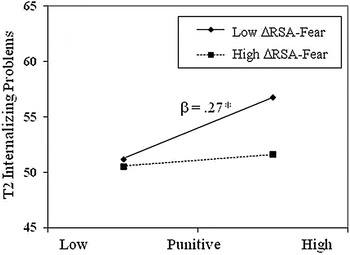
The moderating effect of fear ΔRSA on the association between earlier punitive emotion socialization and later internalizing problems is presented in Figure 2. More punitive maternal emotion socialization predicted more mother-reported internalizing problems for youths who showed more RSA suppression to the fear-inducing video clips (b = 0.27, p < .01), but not those who showed more RSA augmentation (b = 0.01).
More punitive emotion socialization predicted more mother-reported internalizing problems in youths who showed parasympathetic suppression in response to fear-inducing video clips, but not youths who showed respiratory sinus arrhythmia augmentation.

In the models predicting youth-reported internalizing problems, only the Sex × Sad ΔRSA interaction accounted for significant variance beyond the control variables. (This was significant in both the supportive and punitive models.) This was driven by opposing but modest effects: girls with greater RSA suppression to the sadness-inducing video clips tended to report more internalizing problems 2 years later (b = –0.18, p < .06), whereas the opposite tended to be true for boys (b = 0.13, p < .10).
Predictions of anxiety symptoms
The regression models predicting mother- and youth-reported anxiety symptoms at Time 2 are presented in Tables 3 and 4, respectively. All models were significant for both mother and youth reports (all adjusted R 2 > .480, F > 10.00, p < .001). For mother-reported anxiety, only the control variables in Step 1 were significant; neither RSA nor emotion socialization predicted later anxiety symptoms. Mothers tended to report greater increases in anxiety symptoms for girls (b = 0.09, t = 1.76, p < .10), although this was not evident in youth reports (b = –0.03, ns). In the model for youth-reported anxiety with supportive emotion socialization, the two three-way interaction effects of Sex × Supportive × Sad ΔRSA and Sex × Supportive × Fear ΔRSA were significant.
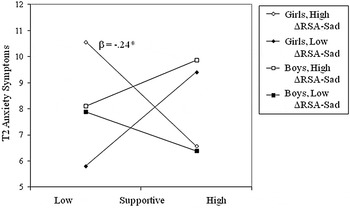
The prediction of Time 2 anxiety symptoms from the Sex × Supportive × Sad ΔRSA interaction is depicted in Figure 3. The effect was driven principally by girls: adolescent girls reported the most anxiety symptoms when, 2 years earlier, they had shown RSA augmentation to the sadness-inducing clips and their mothers had engaged in low levels of supportive emotion socialization (b = –0.24, p < .05). Supportiveness did not significantly predict youth-reported anxiety for girls who had more RSA suppression, boys who showed RSA augmentation, or boys who had RSA suppression (all |b| < 0.18, p > .20).
More supportive emotion socialization predicted fewer youth-reported anxiety symptoms only in adolescent girls who showed parasympathetic augmentation in response to sadness-inducing video clips.

Examination of the Sex × Supportive × Fear ΔRSA interaction predicting Time 2 anxiety symptoms revealed that the effect was marginally stronger for male than for female youths, but none of the effects were robust. Supportive emotion socialization was nonsignificantly predictive of anxiety for boys and girls who showed RSA suppression or RSA augmentation (all |b| < 0.16, all p > .15).
Predictions of depression symptoms
The regression models predicting mother- and youth-reported depression symptoms at Time 2 are presented in Tables 3 and 4, respectively. All models were significant for both mother and youth reports (all adjusted R 2 > .430, F > 9.00, p < .001). Boys and girls did not differ in their likelihood to develop more depression symptoms (all |b| < 0.06, ns). For mother-reported depression, after accounting for the control variables in Step 1, there was only one significant effect. Mothers who were more punitive toward youths' experiences of sadness and fear reported that their adolescents had more depression symptoms 2 years later.
The model predicting youth-reported depression symptoms that included supportive emotion socialization had four significant effects after accounting for the control variables. Youths reported more depression symptoms when they showed greater RSA suppression to the sadness-inducing video clips, and greater RSA augmentation to the fear-inducing video clips. (These effects were retained in the model with punitive emotion socialization.) The Sex × Supportive Emotion Socialization interaction effect also was significant. However, both the sad ΔRSA effect and the Sex × Supportive Emotion Socialization interaction were moderated by a three-way interaction of Sex × Supportive × Sad ΔRSA.
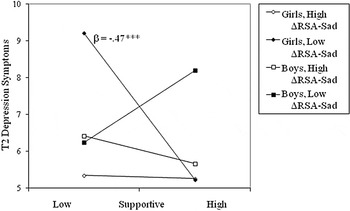
The three-way interaction is depicted in Figure 4. Adolescent girls reported the most depression symptoms when, 2 years earlier, they had manifested RSA suppression to sadness-inducing video clips and their mothers had engaged in low levels of supportive emotion socialization (b = –0.47, p < .001). Supportive emotion socialization did not significantly predict subsequent depression symptoms for girls with RSA augmentation, boys with RSA suppression, or boys with RSA augmentation (all |b| < 0.12, p > .15).
More supportive emotion socialization predicted fewer youth-reported depression symptoms only in adolescent girls who showed parasympathetic suppression in response to sadness-inducing video clips.

Discussion
This study advanced a multilevel, bioecological perspective on emotional processes involved in adolescents' development of internalizing difficulties. Atypical emotional functioning is central to anxious and depressed psychopathologies (Bylsma et al., Reference Bylsma, Morris and Rottenberg2008; Dahl, Silk, & Siegle, Reference Dahl, Silk and Siegle2012), with exaggerated and inappropriate fear and sadness being among their defining features. Parasympathetic regulation of fear and sadness and maternal socialization of these emotions were expected to contribute to the exacerbation or amelioration of internalizing difficulties over time. Many such links were identified, and most of them emerged as dynamic interactions between youths' internal self-regulatory capacities and external support (or lack thereof) for effective regulation. Further, most of the identified links between regulatory processes and socialization experiences and youths' reports of internalizing difficulties were stronger for girls than for boys. Thus, we supported models of developmental psychopathology that emphasize the systemic contributions of factors from multiple domains in the etiologies and courses of emotional problems and disorders (Cicchetti & Toth, Reference Cicchetti and Toth2009), and the particular risk faced by adolescent girls for manifesting anxiety and depression (Zahn-Waxler et al., Reference Zahn-Waxler, Shirtcliff and Marceau2008).
Parents and primary caretakers are primarily responsible for providing an environment in which children have the space and support to develop and successfully move through the developmental tasks of childhood (Bruner, Reference Bruner1975). By serving as a scaffold, the parents will be able to set their own needs aside and address their children's changing developmental needs, including strategies for dealing with strong emotions (Howes, Cicchetti, Toth, & Rogosch, Reference Howes, Cicchetti, Toth and Rogosch2000). The results of this study provide important insights into disruptions that occur in emotion socialization within the mother–adolescent relationship. Specifically, this study extended the findings of prior cross-sectional studies with youths and longitudinal research with younger children (Hunter et al., Reference Hunter, Katz, Schortt, Davis, Leve and Allen2011; Klimes-Dougan et al., Reference Klimes-Dougan, Brand, Zahn-Waxler, Usher, Hastings and Kendziora2007) by showing that maternal punitive and supportive emotion socialization continue to be important for the development of internalizing difficulties in adolescence. Mothers who were observed to be more angry, rejecting, and self-focused while discussing their youths' experiences of fear and sadness reported that their children had more internalizing problems and depression symptoms 2 years later. Mothers reported fewer internalizing problems, and youths reported fewer internalizing difficulties, when mothers had been observed and reported to be warm and sympathetic toward their youths' fear and sadness. It is important to note, though, that few of these links were direct associations between maternal emotion socialization and adolescent adjustment. All but one (between punitive emotion socialization and mother-reported depression symptoms) were moderated by adolescents' gender or parasympathetic regulation of emotion.
Considering the physiological findings, mother-reported youth problems were only predicted by parasympathetic regulation of fear, whereas youth-reported problems were more strongly predicted by parasympathetic regulation of sadness. RSA suppression has been characterized as reflecting greater capacity for emotion regulation (Graziano & Derefinko, Reference Graziano and Derefinko2013). However, it also can be part of the fight-or-flight response (Hastings et al., Reference Hastings, Kahle, Han and Lagatutt2014; Porges, Reference Porges2011), which is consistent with the observation that RSA suppression is normatively associated with fear, but RSA augmentation is normatively associated with sadness (Kreibig, Reference Kriebig2010). We found that greater withdrawal of parasympathetic regulation during fearful video clips (more RSA suppression) tended to predict mothers' reports of more internalizing problems 2 years later, but RSA augmentation to fear predicted youths' reports of more depression symptoms. Conversely, greater RSA suppression during sad video clips predicted more depression, according to youths, as well as more internalizing problems but fewer anxiety symptoms. Finding that both more RSA augmentation to fear and more RSA suppression to sadness predicted youths' depression suggests that developmental risk might have stemmed from atypical parasympathetic regulation of specific emotions, rather than heightened or diminished reactivity per se (Bylsma et al., Reference Bylsma, Morris and Rottenberg2008). However, again, all but one of these links (between RSA augmentation to fear and youth-reported depression) were robust only for girls or when certain kinds of emotion socialization practices were experienced.
Turning to these multilevel patterns, it was only when youths showed stronger RSA suppression to fearful stimuli that maternal supportive responses to fear and sadness predicted fewer mother-reported internalizing problems over time, whereas punitive responses predicted more. Children and adolescents with elevated internalizing problems and anxiety disorders tend to show autonomic hyperreactivity to stressful, challenging, and frightening events (Hastings & Guyer, in press; Hastings, Zahn-Waxler, & Usher, Reference Hastings, Zahn-Waxler and Usher2007; Turner, Biedel, & Epstein, Reference Turner, Beidel and Epstein1991; Weems, Zakem, Costa, Cannon, & Watts, Reference Weems, Zakem, Costa, Cannon and Watts2005). Withdrawal of parasympathetic downregulation potentiates this exaggerated response, because the uninhibited sinoatrial node can drive a faster heart rate and there is less vagal resistance to possible sympathetic activation of cardiac activity (Hastings & Miller, Reference Hastings, Miller, Padilla-Walker and Carlo2014; Porges, Reference Porges2011). It is possible that youths who did not show RSA suppression (i.e., youths who applied the “vagal brake” or maintained greater parasympathetic influence) during the fearful video clips might not have found the clips to be evocative or distressing, perhaps because of the safe and nonthreatening venue in which these clips were viewed. However, we contend that their application of the vagal brake reflected these youths' ability or tendency to more effectively exercise internal self-regulation of fearful arousal, such that they would have had less need for the external assistance of supportive maternal emotion socialization in order to avoid experiencing affective difficulties.
Youths with a stronger parasympathetic fight-or-flight response to frightening stimuli appeared to lack this effective emotional self-regulation, putting them at risk for developing internalizing problems depending on external influences. If they also experienced high levels of punitive maternal responses to their fear and sadness, or low levels of supportive emotion socialization, then they were more likely to have elevated internalizing problems 2 years later. However, if these youths had mothers who were warm and sensitive to their emotions, or who were not hostile and rejecting, they were likely to have no more internalizing problems than average. Thus, it was only when both internal and external risk factors were present that youths manifested increasing internalizing problems over time. Both of these multilevel effects were more consistent with a diathesis–stress model of developmental psychopathology (Hankin & Abela, Reference Hankin and Abela2005) than with a DSE model (Ellis et al., Reference Ellis, Boyce, Belsky, Bakermans-Kranenburg and van IJzendoorn2011), because youths with more RSA suppression to fear were never predicted to have fewer internalizing problems than average, regardless of their experiences of emotion socialization.
For youths' reports of their internalizing difficulties, the multilevel influences were markedly different. They were clearest for parasympathetic regulation of sadness, not fear; they were evident only for supportive emotion socialization, not punitive; they were strongest for symptoms of specific psychiatric disorders, rather than broad problems; and they were robust for girls, rather than all youths. Girls who had shown more RSA suppression to sad stimuli tended to report more internalizing problems, and if their mothers engaged in low levels of supportive emotion socialization, they reported more depression symptoms. Although at first pass this appears to parallel the effect of RSA suppression to fear and supportive emotion socialization together predicting mother-reported internalizing problems, withdrawal of parasympathetic influence to sad versus fearful stimuli might carry different meanings.
As described previously, viewing sad film clips is associated with RSA augmentation (Kreibig, Reference Kriebig2010) that appears to reflect a sympathetic yet calm orientation toward the distress of others (Hastings & Miller, Reference Hastings, Miller, Padilla-Walker and Carlo2014). Similarly, subjective feelings of sadness in response to sad stimuli are typically associated with heart rate deceleration (Hastings et al., Reference Hastings, Nuselovici, Klimes-Dougan, Kendziora, Usher and Ho2009), which suggests greater parasympathetic influence. Whereas RSA suppression to fear reflects an exaggeration of a typical autonomic response, girls who showed RSA suppression to sadness were mounting an atypical autonomic response, more akin to anxious anticipation of sadness or actively crying than to sympathetic sadness (Kreibig, Reference Kriebig2010). It was intriguing that a recent neuroimaging study revealed that unipolar depressed patients showed elevated bilateral amygdala response to sad faces but not fearful faces (Arnone et al., Reference Arnone, McKie, Elliott, Thomas, Downey and Juhasz2012), which also suggests that depression is characterized by strong neurobiological arousal specifically by sad stimuli. The girls in our study might have been experiencing personal distress or aversion to the scenes of others crying over the deaths of loved ones (Eisenberg, Reference Eisenberg and Eisenberg2010). Their reduced parasympathetic regulation reflected poor internal self-regulation of sadness, and when they also lacked external support for managing their sadness effectively through supportive emotion socialization, these girls were set upon a path toward worsening depression.
Conversely, a lack of maternal warm and sensitive emotion socialization tended to predict elevated anxiety symptoms for girls who showed the normative pattern of RSA augmentation to sadness. Thus, receiving low levels of supportive emotion socialization from mothers might put adolescent girls at risk for internalizing difficulties, but the way in which those difficulties are manifested depends upon the girls' pattern of parasympathetic regulation, akin to models of organismic specificity (Wachs & Gandour, Reference Wachs and Gandour1983). One common distinction between anxiety and depression is that the former is characterized by helplessness and the latter by hopelessness (Alloy, Kelly, Mineka, & Clements, Reference Alloy, Kelly, Mineka, Clements, Maser and Cloninger1990; Starr & Davila, Reference Starr and Davila2012). Girls who experienced parasympathetic regulation that supported feeling sympathetic sadness could have been physiologically motivated to assist others in need, but they might have lacked the skills or knowledge for enacting this motivation due to having parental models who did not display compassionate attentiveness to their own distressed emotions. Feeling helpless in the face of emotional arousal could have placed these girls at greater risk for anxiety symptoms.
Both of these moderated effects were more consistent with a diathesis–stress model of risk than a DSE model, because girls with RSA suppression or augmentation to sadness did not have fewer depression or anxiety symptoms than other youths in the context of greater rewarding responses to internalizing emotions. It is possible that the effects were constricted due to a floor effect, because the models could not predict beyond the absence of symptoms toward the presence of positive characteristics (Belsky & Pluess, Reference Belsky and Pluess2009). However, there has been support for diathesis–stress over the DSE model in other recent reports (Nederhof, Belsky, Ormel, & Oldehinkel, Reference Nederhof, Belsky, Ormel and Oldehinkel2012) and evidence for diathesis-stress predicting some developmental outcomes and DSE others (Kochanska, Kim, Barry, & Philibert, Reference Kochanska, Kim, Barry and Philibert2011). The current findings build on these to both reinforce the importance of maintaining “vulnerability” in the lexicon of developmental psychopathology and underscore the complexity and diversity of multilevel effects that are at play. Clearly, further work will be needed to determine (a) which endophenotypes, biomarkers, or genotypes reflect vulnerabilities, or susceptibilities, or resiliencies and advantages; (b) whether these internal factors confer developmental potencies across divergent contexts and experiences; (c) how their combined effects are made manifest across the range of adaptive and maladaptive functioning; and (d) when these effects become evident in the course of development.
The role of gender in these multilevel processes also warrants greater attention from researchers. Unlike many other reports (St. Clair et al., Reference St. Clair, Goodyer, Dunn, Herbert, Jones and Croudace2012; Zahn-Waxler, Crick, Shirtcliff, & Woods, Reference Zahn-Waxler, Crick, Shirtcliff, Woods, Cicchetti and Cohen2006), we did not find evidence that girls in this sample were at greater risk of maintaining or exacerbating internalizing difficulties over adolescence than were boys. This might have been due to the nature of the sample, which was deliberately recruited to overrepresent both girls and boys with elevated emotional and behavioral problems. Moreover, male and female youths did not differ in their patterns of parasympathetic regulation or experiences of maternal emotion socialization. Therefore, rather than differing in their absolute levels of these potential etiological factors, adolescent boys and girls appeared to differ in the degree to which they experienced distress in the presence of multilevel influences (Zahn-Waxler et al., Reference Zahn-Waxler, Shirtcliff and Marceau2008). Whether that distress stemmed directly from these influences, however, or from additional factors not directly examined in this study, is an open question.
Although we examined parasympathetic regulation and emotion socialization as factors shaping the course for internalizing difficulties, it is possible that they conveyed their risk indirectly, by priming youths' responses to other maturational processes or external influences (Zahn-Waxler et al., Reference Zahn-Waxler, Shirtcliff and Marceau2008). Relative to boys, adolescent girls who have trouble effectively regulating their internalizing emotions, and who are not receiving effective support for their emotional experiences at home, might be affected more by the normative yet stressful life events that commonly occur in adolescence (Ge, Lorenz, Conger, & Elder, Reference Ge, Lorenz, Conger and Elder1994; Rudolph & Flynn, Reference Rudolph and Flynn2007). The timing and progress of pubertal maturation is more strongly associated with girls' development of internalizing problems, especially when other risk factors are present (Natsuaki et al., Reference Natsuaki, Klimes-Dougan, Ge, Shirtcliff, Hastings and Zahn-Waxler2009). In addition, girls have greater sensitivity toward social cues, more intimate peer and friend relationships, and greater susceptibility to the depressogenic influence of friends with internalizing difficulties (Giletta et al., Reference Giletta, Scholte, Burk, Engels, Larsen and Prinstein2011; Zahn-Waxler et al., Reference Zahn-Waxler, Shirtcliff and Marceau2008). Girls who are relatively lacking in both internal and external sources of emotion regulation are likely to be particularly prone to such effects. Conversely, although they could be relatively protected against internalizing trajectories, adolescent boys with emotion regulation difficulties might respond to maturational changes, risky peer socialization experiences, or other life events by manifesting their vulnerabilities in different ways, such as externalizing problems and disruptive behavior disorders (Poulin & Boivin, Reference Poulin and Boivin2000; Zahn-Waxler et al., Reference Zahn-Waxler, Shirtcliff and Marceau2008).
As reviewed previously, it is worth noting that there were considerable differences in the predictions of mother-reported versus youth-reported problems and symptoms. The modest agreement between mother and youth reports of youths' levels of internalizing difficulties was similar to prior work indicating that parents and adolescents may focus on different contexts, experiences, and behaviors when they reflect upon youths' adjustment (Achenbach, McConaughy, & Howell, Reference Achenbach, McConaughy and Howell1987; Tackett, Herzhoff, Reardon, & Smack, Reference Tackett, Herzhoff, Reardon and Smack2013). It has been suggested that discrepancies between youth and parent reports of psychopathology reflect challenges in the parent–youth relationship that can exacerbate adolescents' problems, and that resolving such discrepancies could be an important goal of therapeutic intervention (De Los Reyes, Salas, Menzer, & Daruwala Reference De Los Reyes, Salas, Menzer and Daruwala2013; Tackett et al., Reference Tackett, Herzhoff, Reardon and Smack2013). Psychopathology develops and is expressed within salient relationships and settings. Youths are uniquely privy to emotions and experiences they have when alone, with peers, at school, and in other contexts that parents might not see. Conversely, parents might have a perspective on the behavioral expression of youths' inner turmoil that the adolescents themselves fail to realize they are conveying. Thus, in the current analyses, there could be cause for greater confidence not only in the validity of youth reports of the affective symptoms of depression but also in the validity of mother reports of internalizing problems, which would account for the relative strengths of the corresponding predictive models. This would imply clinically that in addition to considering the magnitude of reporter discrepancy, therapists should consider the particular aspect of psychopathology on which a parent and adolescent are disagreeing in determining the accuracy of their reports.
The findings of this study should be evaluated in the context of certain limitations. The sample of families was neither sociodemographically diverse nor recruited to be representative of the broader population, such that our findings might not be easily generalizable to other communities. Although a targeted risk sample, there were few youths who reached clinical criteria for the diagnoses of anxiety or depression problems, and there may be distinct biopsychosocial processes implicated in the extremes of maladjustment. In addition, the focus on the experience, regulation, and socialization of fear and sadness should not be taken to suggest that these are the only emotions contributing to adolescents' internalizing difficulties. Future work should consider the multilevel processes that influence how happiness, irritability, shame, and other affects are involved in youths' emotional well-being.
Acknowledging these limitations, this prospective, longitudinal study is among the first to consider how dynamic parasympathetic regulation and maternal socialization of specific emotions work in tandem to shape adolescents' propensities toward developing internalizing problems and symptoms of anxiety and depression. Clear support for the importance of both physiology and socialization in the etiology of internalizing difficulties was evident. Even more so, these findings highlighted the nuanced sensitivity of the parasympathetic system to affective context, and the particular vulnerabilities faced by adolescent girls when both their familial support for coping with challenging emotions and their self-regulation of emotions are compromised. Building on this multilevel model will be important for advancing our understanding of the development of internalizing difficulties and formulating interventions that are tailored toward the complex and diverse processes that make youths prone to depression and anxiety.