Introduction
Amnestic mild cognitive impairment (aMCI) is considered to be a transitional stage between healthy aging and Alzheimer's disease (AD; Petersen et al., Reference Petersen, Smith, Waring, Ivnik, Tangalos and Kokmen1999). Individuals with aMCI exhibit an objective memory impairment, preserved general cognitive abilities, no or minimal decline in activities of daily living, and no dementia (Petersen, Reference Petersen2004; Winblad et al., Reference Winblad, Palmer, Kivipelto, Jelic, Fratiglioni, Wahlund and Petersen2004). Although the classification of aMCI does not guarantee development of dementia, as some individuals meeting the criteria later perform normally on memory testing, there is a significant risk of progressing to clinical AD (e.g., 80% over 6 years; Petersen et al., Reference Petersen, Smith, Waring, Ivnik, Tangalos and Kokmen1999; Petersen, Reference Petersen2004). Identifying the cognitive tests that are most sensitive for detecting aMCI in conjunction with associated alterations in the underlying neural architecture will facilitate earlier diagnosis of AD and may prove useful in demonstrating the beneficial effects of future disease modifying treatments.
Individuals with aMCI perform poorly on tests of episodic memory, defined as the encoding and conscious retrieval of contextually-specific information, such as an event that occurred at a particular place and time (Tulving, Reference Tulving1983). Performance on episodic memory tasks relies both on relational memory, the ability to integrate unrelated pieces of information, as well as item memory, which provides the basis for knowing that a stimulus has occurred (Yonelinas, Reference Yonelinas2001). Several reports over the last decade suggest that the earliest cognitive deficits in aMCI center on memory tasks that require relational memory (e.g., paired-associate learning, cued-recall, and associative recall). For example, Fowler, Saling, Conway, Semple, and Louis (Reference Fowler, Saling, Conway, Semple and Louis2002) conducted longitudinal neuropsychological assessments in control participants, individuals with “questionable dementia,” and individuals with probable early AD and found that performance on a paired associate learning test best identified the onset of progressive memory decline in the questionably demented individuals, all of whom went on to fulfill NINCDS-ADRDA criteria for probable AD over a 2-year period. In another study, Ivanoiu et al. (Reference Ivanoiu, Adam, Van der Linden, Salmon, Juillerat, Mulligan and Seron2005) evaluated cued-recall performance in individuals with subjective memory complaints, MCI, and mild probable AD and showed that a cued-recall task correctly classified 88% of the MCI participants and was a good predictor of MCI and mild AD status. More recently, Troyer et al. (Reference Troyer, Murphy, Anderson, Hayman-Abello, Craik and Moscovitch2008) used standardized neuropsychological tasks thought to tap relational memory processes and found that tests of associative recall were particularly sensitive to early cognitive change in aMCI. Finally, Anderson and colleagues (Reference Anderson, Ebert, Jennings, Grady, Cabeza and Graham2008) reported age-related reductions in recollection, a mnemonic process that influences performance on relational memory tasks (Hockley and Consoli, Reference Hockley and Consoli1999). Notably, the reductions in recollection were greater among aMCI individuals than cognitively normal subjects. Taken together, these neuropsychological findings suggest that tests of relational memory may be among the most sensitive measures for detecting cognitive changes associated with aMCI.
A prominent neural correlate of aMCI is volume loss in the medial temporal lobe (MTL), particularly the hippocampus and entorhinal cortex (Convit et al., Reference Convit, de Leon, Tarshishi, De Santri, Tsui, Rusinek and George1997; Dickerson et al., Reference Dickerson, Goncharova, Sullivan, Forchetti, Wilson, Bennett and deToledo-Morrell2001; Xu et al., Reference Xu, Jack, O'Brien, Kokmen, Smith, Ivnik and Petersen2000), with increasing atrophy in these structures from normal aging to aMCI to AD (Du et al., Reference Du, Schuff, Amend, Laakso, Hsu, Jagust and Weiner2001; Pennanen et al, Reference Pennanen, Kivipelto, Tuomainen, Hartikainen, Hänninen, Laakso and Soininen2004). Longitudinal studies of aMCI patients have revealed that diminished baseline hippocampal and entorhinal volume is associated with an increased likelihood of progressing to clinical dementia (De Santi et al., Reference De Santi, de Leon, Rusinek, Convit, Tarshish, Roche and Fowler2001; Grundman et al., Reference Grundman, Sencakova, Jack, Petersen, Kim, Schultz and Thal2002; Jack et al., Reference Jack, Petersen, Xu, O'Brien, Smith, Ivnik and Kokmen1999; Kaye et al., Reference Kaye, Moore, Dame, Quinn, Camicioli, Howieson and Sexton2005; Killiany et al., Reference Killiany, Gomez-Isla, Moss, Kikinis, Sandor, Jolesz and Albert2000). Memory decline is the primary cognitive consequence of atrophy in these MTL structures and, in general, hippocampal and entorhinal volumes correlate with performance on memory tasks (Rodrigue and Raz, Reference Rodrigue and Raz2004; Rosen et al., Reference Rosen, Prull, Gabrieli, Stoub, O'Hara, Friedman and deToledo-Morrell2003). Several lines of research suggest that structures within the MTL, particularly the hippocampus, make a critical contribution to relational memory processing, by linking or binding the elements of a to-be-remembered episode (Eichenbaum, Yonelinas, & Ranganath, Reference Eichenbaum, Yonelinas and Ranganath2007). Indeed, Rajah, Kromas, Han, and Pruessner (Reference Rajah, Kromas, Han and Pruessner2010) recently demonstrated that volumetric reductions in anterior hippocampus related to poorer retrieval of spatial and temporal context information with age. As such, relational memory deficits in aMCI likely reflect pathological alterations, at least in part, in the MTL.
Atrophic changes in parietal cortex (PC), particularly in the posterior region of medial parietal cortex, referred to as precuneus, have also been documented in MCI (Buckner et al., Reference Buckner, Snyder, Shannon, LaRossa, Sachs, Fotenos and Mintun2005). Studies of resting glucose metabolism have demonstrated hypometabolism in the inferior parietal lobule, that progresses with the disease and correlates with mental status (e.g., Herholz et al., Reference Herholz, Salmon, Perani, Baron, Holthoff, Frölich and Heiss2002; Minoshima et al., Reference Minoshima, Giordani, Berent, Frey, Foster and Kuhl1997), and is present in individuals at genetic risk for AD (Reiman et al., Reference Reiman, Caselli, Yun, Chen, Bandy, Minoshima and Osborne1996). More recently, fMRI studies using analysis of intrinsic activity correlations have reported functional changes in parietal regions in aMCI (e.g., Celone et al., Reference Celone, Calhoun, Dickerson, Atri, Chua., Miller and Sperling2006; Rombouts, Goekoop, Stam, Barkhof, & Scheltens, Reference Rombouts, Goekoop, Stam, Barkhof and Scheltens2005; Wang et al, Reference Wang, Liang, Wang, Tian, Zhang, Li and Jiang2007), with alteration of neural activity in medial and lateral parietal regions directly related to loss of MTL functional integrity, notably during tasks involving relational encoding (e.g., learning face-name pairs; Celone et al., Reference Celone, Calhoun, Dickerson, Atri, Chua., Miller and Sperling2006).
Although prior fMRI studies have assessed neural activity during the encoding of relational information (e.g., Celone et al., Reference Celone, Calhoun, Dickerson, Atri, Chua., Miller and Sperling2006; Dickerson et al., Reference Dickerson, Salat, Greve, Chua, Rand-Giovannetti, Rentz and Sperling2005; Petrella, Prince, Wang, Hellegers, & Doraiswamy, Reference Petrella, Prince, Wang, Hellegers and Doraiswamy2007), or during retrieval of item information (e.g., Lenzi et al., Reference Lenzi, Serra, Perri, Pantano, Lenzi, Paulesu and Macaluso2011; Machulda et al., Reference Machulda, Senjem, Weigand, Smith, Ivnik, Boeve and Jackie2009; Trivedi, et al., Reference Trivedi, Murphy, Goetz, Shah, Gabrieli, Whitfield-Gabrieli and Stebbins2008), to our knowledge no study has directly compared retrieval of item and relational information in aMCI. Such a comparison offers three advantages. First, successful retrieval of relational information requires recovery of more specific, detailed information than does successful item retrieval which can be based on a general sense of prior occurrence (i.e., familiarity). As such, a direct comparison of the neural underpinnings of item and relational memory in aMCI provides the opportunity to pinpoint whether, and in what manner, alterations in the functional neural architecture are present in aMCI based on the specificity of information retrieved. Although the term “specificity” has been used broadly (see Schacter, Gallo, & Kensinger, Reference Schacter, Gallo and Kensinger2007), here we use the term “specificity” to denote differences in the degree to which specific, detailed information is required at retrieval for successful performance (e.g., retrieval of a novel link formed between unrelated words). Second, a comparison of item and relational memory in aMCI, coupled with event-based fMRI, allows for the analysis of correct memory trials only, eliminating potential confounds due to differences in retrieval success across levels of specificity. Finally, this aspect of the current design, in turn, allowed us to identify those regions recruited by aMCI participants during successful relational retrieval. Given the importance of capitalizing on functionally intact neural regions as targets for treatment and slowing of the disease course (Dickerson & Sperling, Reference Dickerson and Sperling2009; Golde, Reference Golde2006), elucidating the neural regions that may contribute to relational memory is a valuable research endeavor.
Here, we used a paradigm in which encoding stimuli and encoding tasks were held constant, and then subsequently compared successful retrieval of item information and relational information in aMCI individuals and cognitively normal, age- and education-matched participants. In light of prior behavioral reports documenting relational memory deficits in aMCI, as well the neural alterations observed in the MTL and PC in this group, we had three hypotheses. First, we hypothesized that the aMCI group would perform worse on the relational memory task as compared to the CN group. Second, we hypothesized that the aMCI group, as compared to the CTL group, would not recruit regions traditionally shown to be engaged during relational memory (i.e., the MTL and PC). Rather, under conditions of successful relational retrieval, we hypothesized that aMCI participants, as compared to the CN group, would recruit regions outside of the MTL and PC, particularly lateral temporal regions during relational retrieval, due to the nature of the encoding task (i.e., generation of encoding sentences).
Methods
Participants
Twelve cognitively normal (CN) and 12 individuals with aMCI were recruited for this study through the Bryan Alzheimer's Disease Research Center (ADRC) at Duke Medical Center and the University of North Carolina at Chapel Hill (UNC-CH) Memory Disorders Clinic. This study was approved by the UNC-CH and Duke Medical Center Institutional Review Boards. Informed consent was obtained from each participant. All subjects were paid for their participation.
The classification of CN and aMCI was based on the input of two sources: the neurologist's (J.R.B. or D.I.K.) clinical opinion based on their interview and examination of the participants and cognitive test results interpreted by the neuropsychologist (see below).
MCI Subjects
Amnestic MCI was defined with the following criteria: (1) memory complaint corroborated by an informant, (2) not normal for age (as determined by the neurologists’ and neuropsychologists’ clinical judgment), (3) not demented, (4) mild cognitive impairment, (5) essentially normal functional activities, and (6) memory was the only cognitive domain mildly impaired relative to normal comparison.
Subjects
Cognitively normal elderly met the following criteria: (1) no cognitive complaints, (2) no active neurological or psychiatric illness, (3) independently functioning community dwellers, (4) normal neurological and neuropsychological exam, and (5) not taking any medications in doses that would impact cognitive performance.
Exclusion Criteria
Exclusion criteria were: (1) diagnosis other than CN or aMCI, (2) left-handedness, (3) non-native English speaker, (3) dementia, (4) medical contra-indications for MRI, (5) structural abnormalities (e.g., infarctions), and (6) concurrent illnesses interfering with cognitive function other than aMCI (i.e., heart/liver/renal failure, psychiatric disorders, and substance abuse).
Neuropsychological Testing
Neuropsychological testing was completed within 5 months of participation in the study. The battery used is one that has been used in longitudinal studies at the Bryan ADRC (e.g., Tschanz et al., Reference Tschanz, Welsh-Bohmer, Lykestos, Corcoran, Green, Norton and Breitner2006) and includes all the requisite measures of the National Alzheimer's Disease Coordinating Center (NACC; see Hayden et al., Reference Hayden, Jones, Zimmer, Plassman, Browndyke, Pieper and Welsh-Bohmer2011). Narrative memory was assessed by performance on Story A from the Wechsler Memory Scale – Revised (Wechsler, Reference Wechsler1987) Logical Memory Immediate and Delay subtests, as well as by scores on subtests of the Consortium to Establish a Registry for Alzheimer's Disease (CERAD) list learning task (i.e., word list learning, recall intrusions, perseverations, recall, recognition, constructional praxis recall, and constructional praxis recognition; Morris et al., Reference Morris, Heyman, Mohs, Hughes, van Belle, Fillenbaum and Clark1989). Language tests measured object naming (30 item version of the Boston Naming Test, Kaplan, Goodglass, & Weintraub, Reference Kaplan, Goodglass and Weintraub1983), phonemic fluency (Controlled Oral Word Association Test; COWAT), and category fluency (animals, Morris et al., Reference Morris, Heyman, Mohs, Hughes, van Belle, Fillenbaum and Clark1989 and vegetables). Attention and executive tests include the Trail-making test Part A and B (Spreen & Strauss, Reference Spreen and Strauss1991) and both the Digit Span and Digit Symbol subtests from the Wechsler Adult Intelligence Scale – Revised (Wechsler, Reference Wechsler1981). Additional tests included the AD8 (a screening test that assesses memory, orientation, executive functioning, and interest in activities; 2005, Washington University, St. Louis, MO), the Shipley Vocabulary Test (as an estimate of premorbid function and intelligence; Shipley, Reference Shipley1967), the Mini-mental Status Exam (MMSE; Folstein, Folstein, & McHugh, Reference Folstein, Folstein and McHugh1975), the Geriatric Depression Scale, and the Hachinski Ischaemia Questionnaire (Hachinski et al., Reference Hachinski, Iliff, Zilhka, Du Boulay, McAllister, Marshall and Symon1975).
Functional MRI Tasks
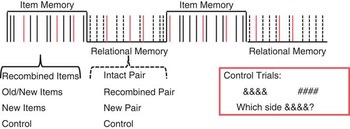
Stimuli were 288 one- to three-syllable unrelated nouns (M Freq = 56.3; SD = 63.5). Following extensive practice outside the scanner, participants received four study/retrieval runs. During the unscanned study phase, participants studied two words (e.g., HIGHWAY CAFÉ) on each of a total of 96 trials, with 24 trials per list. Participants were instructed to covertly create a short sentence that incorporated the two words, ensuring that the word on the left side of the screen was used in the sentence before the word on the right side of the screen (e.g., “The highway was in front of the café”). All participants indicated via button press that they had created and encoded a sentence for each trial. During the scanned retrieval phase, which started immediately following the study phase, participants performed one of two recognition tasks: Relational or Item. In the Relational task, participants saw pairs of words that were previously seen together (Intact Pair – IP), pairs of words that were previously seen but not together (Recombined Pair – RP), and pairs of novel words that were not seen previously (New Pair – NP). Participants were asked to indicate whether the two words were previously seen together; they were instructed to press “1” if they were or “2” if they were not seen together previously. In the Item task, participants saw pairs of words previously seen but not together (Recombined items – RI), pairs consisting of one old word and one new word (Old/New Items – ONI), and pairs consisting of two new words (New Items – NI). Participants were asked to indicate whether both words of a pair were previously seen; they were instructed to press “1” if they were both seen previously at all or “2” if they were not. Four task blocks alternated between relational memory and item memory (Figure 1). Each block consisted of nine trials drawn from each of the task-appropriate experimental conditions types, as well as three control trials during which participants viewed ampersands and number signs, and were instructed to indicate on which side of the screen the ampersands had appeared. Control trials were used to introduce jitter during each scanner run. Trials were randomized within each task block. Starting task and stimulus conditions were counterbalanced across participants.
Event-related task design with alternating blocked task periods of relational retrieval (“together previously?”) and item retrieval (“both old?”). There were four study/retrieval phases. Imaging data was acquired during the retrieval phase only. IP = intact pair; RP = rearranged pair; NP = new pair; RI = rearranged items; OI = old/new items; and NI = new items.

MR Image Acquisition
All imaging data were acquired at the UNC-CH's Biomedical Research Imaging Center on a Siemens 3 Tesla Allegra head-only imaging system equipped for echo planar imaging (EPI; Siemens Medical Systems, Iselin, NJ) using a three-axis gradient head coil. For each participant, an anatomical scan was acquired using a high resolution T1-weighted MPRAGE sequence (repetition time [TR] = 1700 ms; echo time [TE] = 4.38 ms; flip angle = 8°; field of view [FOV] = 280 × 320; 160 slices; matrix = 224 × 256, 1.25 × 1.25 × 1.25 mm resolution). After the anatomical scan, four functional runs were acquired for each participant during the test phase. For the functional runs, imaging was performed using a T2*-weighted EPI sequence (TR = 3000 ms; TE = 30 ms; flip angle = 80°). Each brain volume was composed of 50 slices (FOV = 243 × 243; matrix = 64 × 64, 3 × 3 × 3 mm resolution, slices were oriented along the long axis of the hippocampus, collected interleaved, inferior to superior). For all functional runs, data from the first two volumes were discarded to allow for stabilization of magnetic fields. Stimuli were back-projected onto a screen and viewed on an MR-compatible mirror mounted above the participant's head. Responses were recorded via a response box. Head motion was restricted with a pillow and foam inserts. Subjects requiring vision correction were given MRI-compatible glasses with prescriptions matching their own. The task was presented using MacStim software (CogState Ltd, Melbourne, Australia).
Imaging Analysis
Imaging data were processed using SPM 8 (Wellcome Department of Cognitive Neurology, London) run within Matlab (Matlab Mathwork, Inc., Natick, MA). For preprocessing, fMRI data were slice-time corrected for acquisition order (referenced to the first slice), then realigned and unwarped to correct for motion across runs. Next, the images were spatially normalized by warping each participant's anatomical scan to MNI (Montreal Neurological Institute) defined standardized brain space, and then applying that algorithm to the EPI data. Finally, the EPI images were spatially smoothed with a Gaussian kernel of 8 mm FWHM. The time series were then high pass filtered at 128 s.
Statistical analyses were performed using the general linear model for event-related designs in SPM 8. For each participant, a whole-brain voxel-wise analysis was conducted in which in which instances of a particular event type were modeled through the convolution with a canonical hemodynamic response function. Each retrieval trial (6 s in duration) was modeled as three 2-s TRs. Because our interest centered on neural recruitment during successful retrieval, all memory conditions were modeled for correct decisions only. Effects for each event type were estimated using a subject-specific, fixed effects model. These data were then entered into a second order, random effects analysis. Analyses contrasted activation as a function of recognition type (relational vs. item) using the appropriate trial types. For all random effects analyses, we used combined intensity and cluster size thresholds of p < .005 with a minimum cluster size of 20 contiguous voxels (k ≥ 20) to balance between types I and II error rates (Lieberman & Cunningham, Reference Lieberman and Cunningham2009). Conjunction analyses examined what neural regions were commonly activated by CN and MCI participants during item and relational retrieval. For conjunction analyses, the threshold for each contrast was set at p < .0225 (such that the conjoint probability of the conjunction analysis, using Fisher's estimate was p < .005; Fisher, Reference Fisher1950; Lazar et al., Reference Lazar, Luna, Sweeney and Eddy2002). Finally, we examined regions differentially activated by CN or MCI participants during item and relational retrieval using two-sample t tests. Voxel coordinates are reported in Montreal Neurological Institute (MNI) coordinates and reflect the most significant voxel within the cluster.
Results
Sample Characteristics
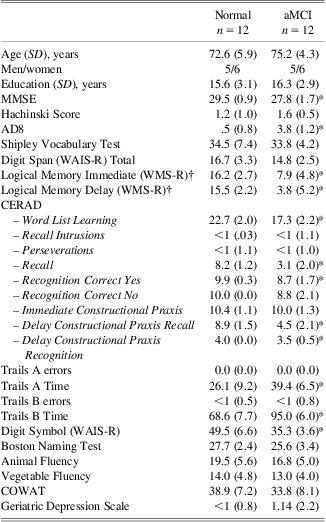
Demographic and neuropsychological data are presented in Table 1. Pairwise t tests comparing CN and aMCI participants across each measure showed no difference in the demographic variables of age and education, vascular risk (Hachinski Score), mood depression, nor any differences on measures of vocabulary, naming, or generative fluency (animals, vegetables, and COWAT). The two groups did differ significantly as expected on global measures of cognition (MMSE and AD8), episodic learning and memory (Logical Memory Immediate and Delayed, CERAD word list learning and recall, and CERAD delayed recall and recognition of constructional praxis figures), as well as on measures of speeded motor performance (Digit Symbol and Trail Making). Such results were consistent with our recruitment of aMCI participants with single-domain memory impairment.Footnote 1
Demographic and mean neuropsychological data

Note. Standard deviations are presented in parentheses. WMS-R = Wechsler Memory Scale-Revised; WAIS-R = Wechsler Adult Intelligence Scale – Revised; sec. = seconds.
*Indicates a significant difference between the two groups at p < .05.
†Scores are for Story A only.
Behavioral Performance During Scanning
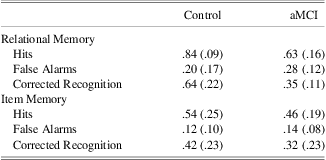
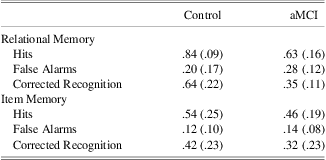
The proportion of studied and unstudied stimuli endorsed as “old” are shown in Table 2. Relational recognition accuracy was calculated as the difference between “old” judgments to intact pairs (hits) and “old” judgments to recombined pairs (false alarms), while item recognition was calculated as the difference in “old” judgments to recombined items (hits) and “old” judgments to new items (false alarms). An analysis of variance (ANOVA) with memory type (item, relational) as a within-subjects factor and group (normal control, aMCI) as a between-subjects factor, revealed a main effect of group (F(1,22) = 10.31; p < .05), indicating that aMCI participants accuracy was lower than that of CN participants, as well as a main effect of memory task (F(1,22) = 5.91; p < .05), indicating that relational retrieval accuracy was higher than item retrieval accuracy. The interaction of memory task × group did not reach significance (F(1,22) = 2.96; p > .05). As such, the fMRI analysis was not confounded with group by task differences.
Behavioral accuracy during retrieval of relational information and item information
Functional Neuroimaging Data
Direct contrasts between item memory and relational memory conditions were conducted to pinpoint alterations in the functional neural architecture based on the specificity of the information retrieved.Footnote 2 The neuroimaging data were analyzed for within-group (CTL or aMCI) differences between relational memory and item memory (i.e., Relational Memory > Item Memory; and vice versa) to specify neural regions differentially activated by each task. Between-group analyses were conducted to identify differential neural activity for each group for each task. Finally, neural regions commonly engaged by CN and aMCI participants were assessed for each task.
Neural regions differentially associated with accurate retrieval of relational information and item information in normal control subjects
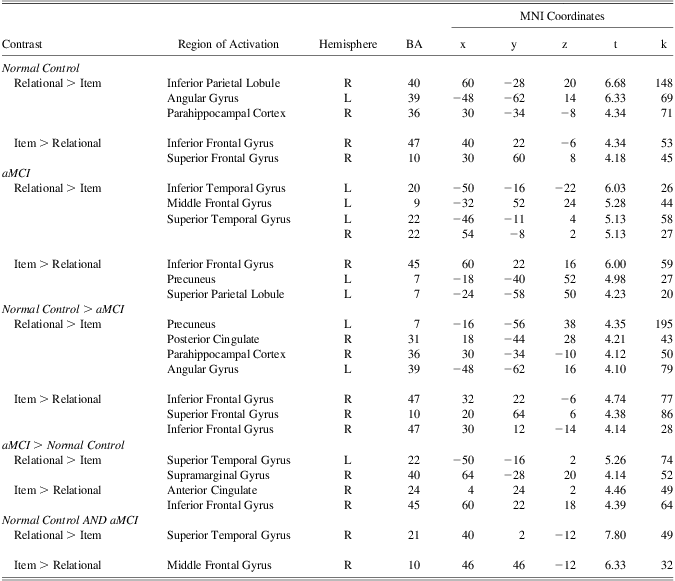
We assessed regions differentially activated by CN participants during relational and item retrieval (see Table 3). First, we contrasted activity for all accurate relational memories compared to all accurate item memories (IP + RP + NP > RI + ONI + NI). This contrast showed activity in left inferior parietal lobule (Brodmann Area, BA 40), left angular gyrus (BA 39), and right parahippocampal cortex (BA 36). The reverse contrasts, comparing activity for all accurate item memories compared to all accurate relational memories (IP + RP + NP < RI + ONI + NI) showed activity in right inferior (BA 47) and right superior frontal (BA 10) regions.
Neural activity during accurate retrieval of relational information and item information in normal control and aMCI participants
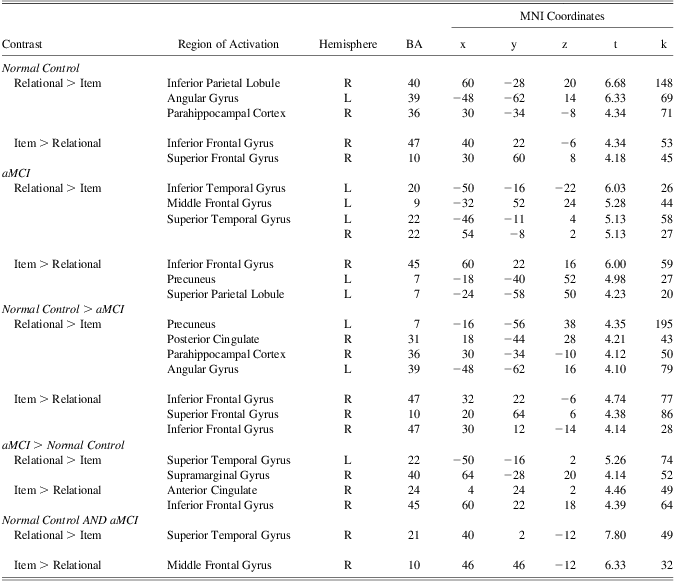
Note. Regions significant at p < .005, k > 20. T = t-value; R = right; L = left; PHC = parahippocampal cortex; BA = approximate Brodmann area based on Montreal Neurological Institute coordinates.
Neural regions differentially associated with accurate retrieval of relational information and item information in aMCI subjects
Next, we examined regions differentially activated by aMCI participants during relational and item retrieval (see Table 3). We contrasted activity during all accurate relational memories compared to activity during all accurate item memories. This contrast showed activity in bilateral superior temporal gyrus (BA 22), left inferior temporal gyrus (BA 20), and left middle frontal gyrus (BA 9). The reverse contrasts, comparing activity for all accurate item memories versus activity for all accurate relational memories showed activity in right inferior frontal gyrus (BA 45), left precuneus, and left superior parietal lobule (BA 7).
Neural regions associated with retrieval of relational information as a function of group
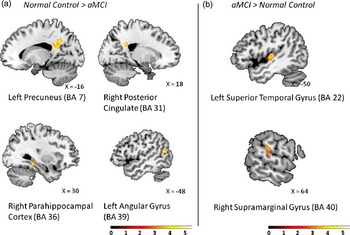
We hypothesized that the aMCI group, as compared to the CTL group, would not recruit regions traditionally shown to be engaged during relational memory (i.e., the MTL and PC). Rather, under conditions of successful relational retrieval, we predicted that aMCI participants, as compared to the CN group, would recruit regions outside of the MTL and PC, particularly lateral temporal regions during relational retrieval. To test this hypothesis, we assessed regions activated by the CN (i.e., CN > aMCI) or the aMCI (i.e., aMCI > CN) group (relative to the other group) for retrieval of relational, as compared to item, information. To do so, we contrasted activity during all accurate relational memories compared to activity during all accurate item memories. The comparison showed that CN (vs. aMCI) activated left precuneus (BA 7), left angular gyrus (BA 39), right posterior cingulate (BA 31), and right parahippocampal cortex (BA 36), while aMCI (vs. CN) activated superior temporal gyrus (BA 22) and supramarginal gyrus (BA 40; see Figure 2).
Neural activity during relational retrieval greater than item retrieval in (a) the normal control group relative to the amnestic mild cognitive impairment (aMCI) group and (b) the aMCI group relative to the normal control group.

Neural regions associated with retrieval of item information as a function of group
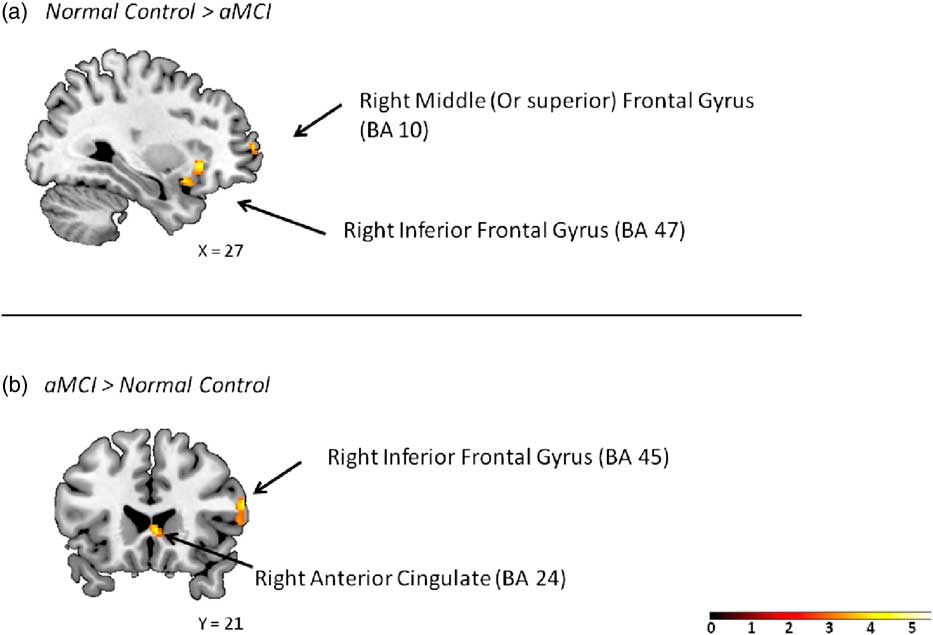
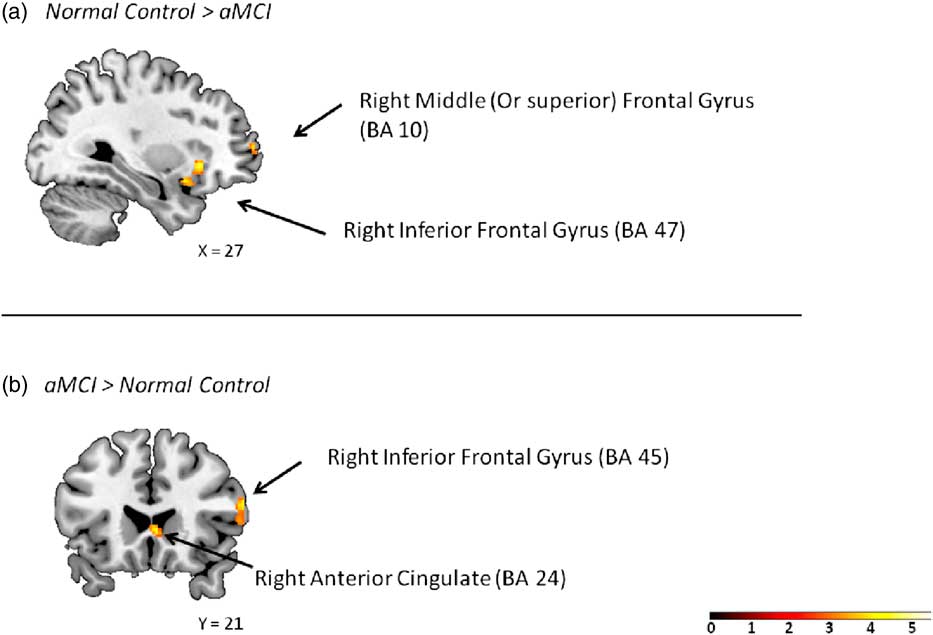
To identify the neural regions associated with item memory as a function of group, we assessed regions activated by the CN (i.e., CN > aMCI) or the aMCI (i.e., aMCI > CN) group (relative to the other group) for retrieval of item, as compared to relational, information. As such, we contrasted activity during accurate item memory compared to activity during accurate relational memory. The comparison showed that CN (vs. aMCI) activated right inferior (BA 47) and superior frontal gyrus (BA 10), while aMCI (versus CN) activated anterior cingulate and inferior frontal gyrus (BA 45; see Figure 3).
Neural activity during item retrieval greater than relational retrieval in (a) the normal control group relative to the amnestic mild cognitive impairment (aMCI) group and (b) the aMCI group relative to the normal control group.
Neural regions commonly engaged by normal controls and aMCI
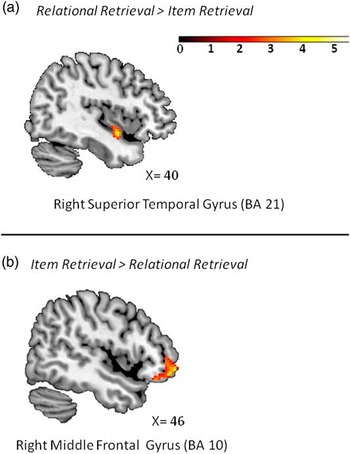
Finally, we examined shared regions of activation across CN and aMCI participants during retrieval of relational, as compared to item, memories (see Figure 4), as well as during retrieval of item, as compared to relational, memories. To do so, we conducted a conjunction analysis to identify regions that were more active during the relational memory than during item memory for both CN and aMCI groups. This analysis revealed activity in superior temporal gyrus (BA 21). Next, we conducted the same type of conjunction analysis to identify regions that were more active during the item memory than during relational memory for both CN and aMCI groups. This analysis showed activity in right anterior frontal gyrus (BA 10).
Neural activity common to both normal control and aMCI groups during (a) relational retrieval relative to item retrieval and (b) item retrieval relative to relational retrieval.

Discusion
We compared the neural underpinnings of item and relational retrieval in aMCI and CN participants, using event-based fMRI, while holding constant the stimuli at encoding and the encoding task for the two retrieval conditions (item and relational). The use of event-related fMRI allowed us to limit the analysis to correct memory trials only, eliminating potential confounds due to differences in retrieval success. Accuracy was numerically lower in the aMCI, relative to the CN, group. However, the group by memory task interaction did not reach significance, indicating that the aMCI group showed no disproportionate impairment in relational memory performance. This result may have arisen from the encoding task used in the current study, in which participants were shown two words and instructed to create a meaningful sentence. Such deep (elaborative) semantic processing, coupled with generative (and likely self-referential) processing, leads to favorable encoding conditions for older adults during retrieval of relational information (Giovanello et al., Reference Giovanello and Schacter2012; Glisky et al., Reference Glisky, Rubin and Davidson2001). It should be noted, however, that the aMCI group did not benefit to the same extent as the control group. Future studies should elucidate the conditions under which aMCI participants do and do not benefit from encoding support during tasks of relational memory. Nonetheless, the group by memory task interaction was not significant in the current study, indicating that the fMRI data were not confounded by differential success rates on the two memory tasks across the two groups.
An examination of the neural regions commonly recruited by CN and aMCI groups showed significant activity in right STG during relational, as compared to item, retrieval, and right anterior frontal gyrus during item, as compared to relational, retrieval. These findings highlight the notion that not all neural regions are functionally affected in aMCI and provide insight into the nature of the cognitive processes that may be commonly used in CN and aMCI participants. For example, activity in right STG has been reported in studies using word stimuli during tasks of semantic retrieval (e.g., Dalla Barba, Parlato, Jobert, Samson, & Pappata, Reference Dalla Barba, Parlato, Jobert, Samson and Pappata1998). Additionally, right superior temporal activity has been observed during reduced attentional allocation (Iidaka, Anderson, Kapur, Cabeza, & Craik, Reference Iidaka, Anderson, Kapur, Cabeza and Craik2000) and during gist-based processing (Dennis, Kim, & Cabeza, Reference Dennis, Kim and Cabeza2008), that is, the retention of the general meaning of a concept or an event (Brainerd & Reyna, Reference Brainerd and Reyna1990). As such, right STG activity in the current study may reflect retrieval of gist-based, semantic information (e.g., partial recovery of the sentences formed at encoding) that aids in successful relational memory retrieval. The activity in anterior frontal cortex was observed in both groups during item, compared to relational, retrieval. Anterior frontal cortex (BA10) has been associated with internally directed attention (Burgess, Simons, Dumontheil, & Gilbert, Reference Burgess, Simons, Dumontheil and Gilbert2005; Simons, Gilbert, Owen, Fletcher, & Burgess, Reference Simons, Gilbert, Owen, Fletcher and Burgess2005; Simons, Owen, Fletcher, & Burgess, Reference Simons, Owen, Fletcher and Burgess2005), as well as with retrieval mode (Düzel et al., Reference Düzel, Cabeza, Picton, Yonelinas, Scheich, Heinze and Tulving1999; Lepage, Ghaffar, Nyberg, & Tulving, Reference Lepage, Ghaffar, Nyberg and Tulving2000; Velanova et al., Reference Velanova, Jacoby, Wheeler, McAvoy, Peterson and Buckner2003), a sustained cognitive set associated with perceiving stimuli as cues to elicit memory (Nyberg et al., Reference Nyberg, Tulving, Habib, Nilsson, Kapur, Houle and McIntosh1995; Tulving, Reference Tulving1983). Thus, recruitment of anterior frontal cortex may reflect a sustained, internally directed retrieval mechanism that is common to both groups. The preservation of such retrieval mechanisms in aMCI could prove useful for intervention or training techniques aimed at capitalizing on intact cognitive processes in these individuals.
In addition to the neural regions commonly activated by the two groups, however, several group differences in brain activity were observed. During accurate relational retrieval, CN adults showed significantly greater activity than aMCI individuals in left precuneus, right posterior cingulate, right parahippocampal cortex, and left angular gyrus. Several of these regions, particularly those located along the midline (i.e., precuneus, posterior cingulate, and parahippocampal cortex) have been characterized as being part of the default mode network (DMN) – defined as a set of functionally connected brain regions that exhibit task-induced deactivation and increase activity at rest (Buckner, Andrews-Hanna, Schacter, Reference Buckner, Andrews-Hanna and Schacter2008; Raichle & Snyder, Reference Raichle and Snyder2007). While the role of the DMN in cognition is unclear, increased activity in midline DMN regions has been reported to predict subsequent successful memory when a subjective, social, or self-referential judgment is made at encoding (Dobbins & Wagner, Reference Dobbins and Wagner2005; Kelley et al., Reference Kelley, Macrae, Wyland, Caglar, Inati and Heatherton2002; Mitchell, Macrae, & Banaji, Reference Mitchell, Macrae and Banaji2004). The current study used an encoding task that required generation of a meaningful sentence that related the two word stimuli appearing on each trial. It is possible that CN adults generated sentences that engendered a higher degree of social or self-referential processing, than did the aMCI group. This suggestion, however, it purely speculative and should be tested empirically by either inclusion of an alternative encoding task or administration of a post-test debriefing questionnaire targeted at social and self-referential processing.
Beyond to the involvement of parahippocampal cortex and precuneus in the DMN, these regions also have been frequently observed during memory retrieval studies (Cabeza & Nyberg, Reference Cabeza and Nyberg2000). Evidence from neuropsychological, neuroimaging, and neurophysiological studies indicate that parahippocampal cortex and precuneus regions contribute to the mnemonic processes of recollection and familiarity. Whereas recollection is a conscious, attention demanding process, in which prior contextual aspects of an experience are retrieved, familiarity, in contrast, is thought to be an unconscious, automatic process that arises when fluent processing of a stimulus is attributed to prior experience with that stimulus. Recollection and familiarity are thought to be functionally distinct and to rely on different neural underpinnings. One influential memory model postulates that the parahippocampal cortex contributes to recollection, possibly via the representation and retrieval of contextual information, with the hippocampus serving to bind such contextual information with other components of an event (for a review, see Eichenbaum et al., Reference Eichenbaum, Yonelinas and Ranganath2007). More recently, the precuneus (located in dorsal parietal cortex) has been implicated during retrieval of familiar, yet low-confident decisions (for a review see Cabeza, Ciaramelli, Olson, & Moscovitch, Reference Cabeza, Ciaramelli, Olson and Moscovitch2008).
Indeed, the role of PC in general has received considerable attention recently, and functionally distinct regions within PC have been proposed to mediate performance during episodic memory retrieval (for reviews, see Cabeza et al., Reference Cabeza, Ciaramelli, Olson and Moscovitch2008; Wagner, Shannon, Kahn, & Buckner, Reference Wagner, Shannon, Kahn and Buckner2005). Traditionally, the PC has been associated with aspects of attention. For example, Corbetta and Shulman (Reference Corbetta and Shulman2002) suggest that the dorsal parietal cortex (DPC) is involved in top-down, voluntary attention, whereas the ventral parietal cortex (VPC) is involved in bottom-up, involuntary attention. Support for this theory comes from studies showing that the DPC is preferentially engaged during the cuing period, when participants are actively and voluntarily searching for a target, whereas the VPC is primarily recruited during target detection (Corbetta, Kincade, Ollinger, McAvoy, & Shulman, Reference Corbetta, Kincade, Ollinger, McAvoy and Shulman2000). This distinction has recently been extrapolated to the domain of memory. Specifically, it has been hypothesized that DPC and VPC differentially contribute to episodic memory retrieval, where DPC contributes top-down attentional processes guided by retrieval goals, and VPC mediates bottom-up attentional processes captured by retrieval output (Cabeza, Reference Cabeza2008; Ciaramelli, Grady, Levine, Ween, & Moscovitch, Reference Ciaramelli, Grady, Levine, Ween and Moscovitch2010). Additionally, recollection has been associated with VPC, while familiarity has been associated with DPC (Wheeler & Buckner, Reference Wheeler and Buckner2004; Yonelinas, Otten, Shaw, & Rugg, Reference Yonelinas, Otten, Shaw and Rugg2005). We observed activity in both VPC (angular gyrus BA 39) and DPC (precuneus, BA7) in the CN group, compared to the aMCI group, during successful relational retrieval. Taken together, the observed activity in parahippocampal cortex, precuneus (DPC), and angular gyrus (VPC) in CN individuals, as compared to aMCI subjects, suggests that the CN group engaged both recollection and familiarity based processing to a greater extent than did aMCI subjects to support successful relational retrieval.
An examination of the regions showing greater activity in aMCI subjects, as compared to the CN group, revealed activity in right supramarginal gyrus (BA 40) and left superior temporal gyrus (STG; BA 22). The role of left STG in language is well-documented, particularly with regard to semantic processing (e.g., Friederici, Makuuchi, & Bahlmann, Reference Friederici, Makuuchi and Bahlmann2009). This finding, coupled with the activity observed in right STG for both CN and aMCI groups, suggests that aMCI subjects may have attempted recovery of encoding sentences which aided in successful relational memory judgments about the words pairs. Indeed, Lenzi et al. (Reference Lenzi, Serra, Perri, Pantano, Lenzi, Paulesu and Macaluso2011) conducted an fMRI investigation of multiple cognitive domains in aMCI and found that right STG was activated in aMCI, compared to CN, individuals, and correlated significantly with neuropsychological scores of Story Recall. Recruitment of right supramarginal gyrus (BA 40), a region in VPC, is noteworthy given the evidence of its role in recollection-based processing. Given the contribution of recollection-based processing to relational memory (Hockley & Consoli, Reference Hockley and Consoli1999), the engagement of this region points to aMCI-related alterations in the neural network engaged during successful retrieval of relational information.
During accurate item retrieval, CN adults showed significantly greater activity than aMCI individuals in right inferior (BA 47) and superior frontal gyri (BA 10), whereas aMCI participants showed significantly greater activity than CN adults in right cingulate (BA 24) and right inferior frontal gyrus (BA 45). Such engagement of frontal regions, in the context of under recruitment of posterior regions (i.e., MTL and PC) during memory retrieval, has been documented in CN subjects and is known as the posterior to anterior shift in aging (PASA; Davis, Dennis, Daselaar, Fleck, & Cabeza, Reference Davis, Dennis, Daselaar, Fleck and Cabeza2008). The current findings indicate that the PASA pattern is also observed in aMCI.
In summary, we directly compared the neural underpinnings of successful relational retrieval in aMCI and CN groups using event-related fMRI. The data showed that the CN, compared to the aMCI, group activated left precuneus (BA 7), left angular gyrus (BA 39), right posterior cingulate (BA 31), and right parahippocampal cortex (BA 36) during relational retrieval. These regions have been implicated in the DMN, as well as during memory retrieval, particularly with regard to the mnemonic processes of recollection and familiarity. Specifically, recruitment of parahippocampal cortex, VPC, and DPC by CN individuals suggests that control participants used multiple regions associated with recollection, as well as regions thought to support familiarity to achieve successful relational retrieval. In contrast, the aMCI group, compared to the CN, group activated superior temporal gyrus (BA 22) and supramarginal gyrus (BA 40) for this comparison, indicating an early shift in the functional neural architecture of relational retrieval in aMCI. These findings may prove useful in future studies aimed at capitalizing on functionally intact neural regions as targets for treatment and slowing of the disease course.
Acknowledgements
This research was supported, in part, by NIH/NIA grants K01-AG028774 (KSG), L30-AG029001 (JNB), and P30-AG028377 (KWB).
The authors report no conflicts of interest.