Introduction
Binge eating disorder (BED) is the most prevalent specific eating disorder in epidemiologic studies in the U.S.Reference Hudson, Hiripi, Pope and Kessler 1 and abroad,Reference Kessler, Berglund and Chiu 2 and is associated strongly with severe obesity. Obesity, a physical problem, is not required for the diagnosis of BED, and many persons with BED are not obese.Reference Hudson, Hiripi, Pope and Kessler 1 , Reference Kessler, Berglund and Chiu 2 BED is distinct from other eating disordersReference Grilo, Crosby and Masheb 3 and forms of disordered eating.Reference Allison, Grilo, Masheb and Stunkard 4 Relative to obese persons without BED, BED is phenomenologically distinct in many ways, including differences in age of onset, severity, and progression of obesity; eating patterns; weight/shape concerns; and dieting frequency, as well as substantially elevated frequencies of co-occurring psychiatric disorders (notably mood, anxiety, impulse-control, and substance-use disorders) and functional impairment.Reference Hudson, Hiripi, Pope and Kessler 1 , Reference Kessler, Berglund and Chiu 2 , Reference Allison, Grilo, Masheb and Stunkard 4 – Reference Grilo, Hrabosky, White, Allison, Stunkard and Masheb 6 Additionally, research suggests that BED is a distinct familial phenotype in obese persons.Reference Hudson, Lalonde and Berry 7
While BED is the most prevalent eating disorder,Reference Hudson, Hiripi, Pope and Kessler 1 only very recently have brain imaging studies investigated individuals with both BED and obesity independently from non-BED obesity. Imaging techniques encompass multiple methodologies that permit the study of brain structure, neurochemistry, and function. Positron emission tomography (PET) uses radiolabelled compounds that may link to metabolic processes or have affinities for specific transporters or receptors of interest in the brain.Reference Kandel, Schwarz and Jessell 8 PET has the advantage of investigating specific molecular entities (for example, specific receptor subtypes and neurochemical release can be assessed over time). Nevertheless the spatial (1–6 mm) and temporal (<1 min) resolutions of PET are limited; additionally, injection of a radioactive isotope is invasive, and the procedure is relatively expensive. Single photon emission computed tomography (SPECT) also tracks physiological and biochemical changes, but does not use short-lived isotopes and therefore is arguably less technically demanding and more widely available, but with poorer spatial and temporal resolution.Reference Kandel, Schwarz and Jessell 8 , Reference Tataranni and DelParigi 9 Magnetic resonance imaging takes advantage of distinctive paramagnetic properties of different tissue types and hemoglobin states, and therefore can provide both structural and functional information without radiation exposure. With advances in acquisition parameters, functional magnetic resonance imaging (fMRI) can have a spatial resolution less than 1 mm and temporal resolution less than 2 seconds—superior to both PET and SPECT imagining. Nonetheless, fMRI relies on the blood oxygen level dependent (BOLD) signal, reflecting the changes in the ratio of deoxygenated to oxygenated hemoglobin in the bloodstream,Reference Kandel, Schwarz and Jessell 8 and therefore remains a proxy measure of neuronal activity in that area. Additionally, fMRI is susceptible to artifacts. For example, minor movements such as chewing or swallowing can distort the image, thereby precluding the study of actual food consumption during scanning. Furthermore, cavities close to brain tissue can also distort signaling, making regions such as the orbitofrontal cortex (a secondary taste cortex), which rests above the sinuses, prone to scanning artifacts.
In sum, these neuroimaging techniques permit the study of unique aspects of brain-behavior differences in vivo, thereby providing brain-based information relating to binge eating and BED. Importantly, these neuroimaging techniques confer the ability to examine patterns of both conscious and non-conscious neural events (particularly as they relate to hedonic processes). While neuroimaging can only provide a snapshot in time and provides limited information on whether alterations represent a cause or a consequence to the disordered behavior, researchers are beginning to creatively use these technologies. For example, advances in analytic techniques for neuroimaging data are providing mechanistic information; functional connectivity analyses are beginning to move beyond examining regional activations and toward understanding how these regions function interactively while tasting foods. Additionally, early studies linking imaging findings to treatment response in BED are identifying potential therapeutic targets.
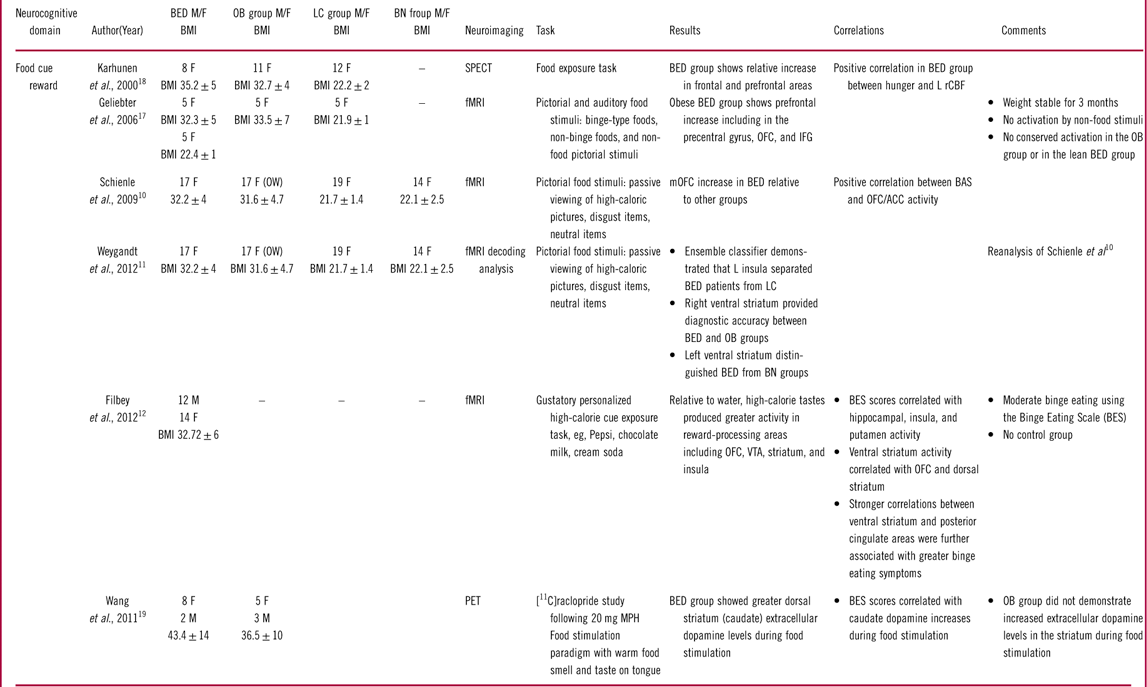
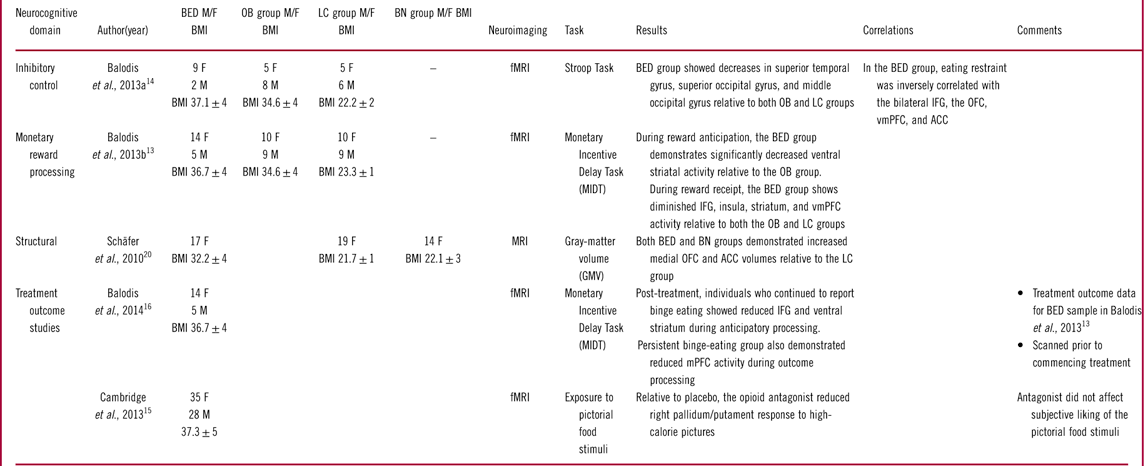
In this way, structural and functional studies have begun to identify biological features differentially associated with BED. Some studies have simultaneously investigated other eating disorders (eg, bulimia nervosa; BN), with results supporting BED as having unique features. The recent growth of neuroimaging publications in this area justifies a critical review of the current state of information in order to guide further research. A literature search was conducted using PubMed for articles published between January 1950 and February 2015 using combinations of the search terms “binge-eating disorder” and “neuroimaging” to find articles. This search produced 29 articles. Inclusion criteria were that articles: (a) focused on an adult population identified with BED, (b) were original studies and peer-reviewed, and (c) were written in English. The abstracts of articles were read to confirm relevant content and inclusion criteria adherence. This search identified 8 studies: 4 of these examined reward processing, either using food-cues,Reference Schienle, Schafer, Hermann and Vaitl 10 , Reference Weygandt, Schaefer, Schienle and Haynes 11 taste cues,Reference Filbey, Myers and Dewitt 12 or generalized (monetary) rewards.Reference Balodis, Kober and Worhunsky 13 Another fMRI study examined cognitive control,Reference Balodis, Molina and Kober 14 and 2 recent studies related imaging to treatment in BED.Reference Cambridge, Ziauddeen and Nathan 15 , Reference Balodis, Grilo and Kober 16 Cross-references of the selected articles were also checked and identified 2 additional food-reward studies,Reference Geliebter, Ladell, Logan, Schneider, Sharafi and Hirsch 17 , Reference Karhunen, Vanninen, Kuikka, Lappalainen, Tiihonen and Uusitupa 18 1 PET study,Reference Wang, Geliebter and Volkow 19 and 1 structural study.Reference Schäfer, Vaitl and Schienle 20 Here, we review this work and seek to synthesize and integrate the findings and further highlight areas of distinction as well as overlap with other disorders. Tables 1 and 2 also summarize the main points and findings of these studies. We also discuss early findings related to clinical considerations and to treatment outcome, and provide some future study directions.
Food cue reward studies in BED

BED=binge eating disorder; OB=non-BED obese; LC=lean control; BN=bulimia nervosa; OW =overweight; rCBF=regional cerebral blood flow; M=male; F=female; SPECT=single photon emission computed tomography; fMRI=functional magnetic resonance imaging; BMI=body mass index; BAS=Behavioral Activation Scale; BES=Binge Eating Scale; MPH=Methylphenidate; IFG=inferior frontal gyrus; OFC=orbitofrontal cortex; vmPFC=ventromedial prefrontal cortex; ACC=anterior cingulate cortex; mPFC=medial prefrontal cortex;, L=left.
Non-food cue studies in BED

BED=binge eating disorder; OB=non-BED obese; LC=lean control; BN=bulimia nervosa; M=male; F=female; fMRI=functional magnetic resonance imaging; BMI=body mass index; IFG=inferior frontal gyrus; OFC=orbitofrontal cortex; vmPFC=ventromedial prefrontal cortex; ACC=anterior cingulate cortex; mPFC=medial prefrontal cortex.
Food-Cue Reward Processing
Understanding the neural underpinnings of hedonic processes is particularly relevant for BED, as the overconsumption of high-fat and high-sugar foods during binges suggests alterations in reward sensitivity in this population. To date, most neuroimaging studies in BED examine food-cue reactivity; neural responses are investigated as individuals are exposed to palatable food stimuli in the scanner (Table 1). The first neuroimaging study in BED applied SPECT in 8 females with BED, and also included 2 control groups: an obese non-BED group and a lean control (LC) group.Reference Karhunen, Vanninen, Kuikka, Lappalainen, Tiihonen and Uusitupa 18 Relative to both of these groups, a food-exposure task produced greater regional cerebral blood flow (rCBF) to frontal and prefrontal regions in the BED group. Additionally, this prefrontal activity was linked to increased hunger feelings in the BED group, but not in the control groups. Consistent with the SPECT findings, an fMRI studyReference Geliebter, Ladell, Logan, Schneider, Sharafi and Hirsch 17 also reported increased prefrontal activation to food stimuli in obese females with BED. This study was also one of the first to distinguish between lean and obese individuals with BED. Notably, lean females with BED did not show any significant prefrontal differences relative to the control groups. While these results were obtained in a very small sample (n=5 per group) and are still preliminary, they nonetheless hint at activation differences related to conjoint obesity and binge-eating status.
A food-cue stimuli presentation during fMRI by Schienle et al Reference Schienle, Schafer, Hermann and Vaitl 10 also reported increased prefrontal activity; food pictures elicited significantly greater medial orbitofrontal cortex (OFC) activity in the BED group. Notably, contrasts were performed relative to both lean and overweight control groups, but also to a bulimia nervosa (BN) group (purging type), with a similar degree of bingeing and disorder duration. Not only did BED individuals report significantly greater reward sensitivity, but this measure correlated positively with medial OFC activity, further supporting the idea of increased sensitivity to food reward in the BED group. The OFC constitutes a secondary taste cortex,Reference Rolls, Yaxley and Sienkiewicz 21 , Reference Baylis, Rolls and Baylis 22 but is also part of an extensive system encoding subjective values of a variety of rewards.Reference Levy and Glimcher 23 Increased OFC recruitment suggests alterations in value representation; this is further supported and linked to correlations with reward sensitivity. Structural differences are also observed: increased gray-matter volume is reported in BED relative to LC groups, particularly in medial OFC and anterior cingulate areas.Reference Schäfer, Vaitl and Schienle 20 Given the importance of the OFC in guiding choice behavior, misrepresentations of value signals could have detrimental effects on decision-making processes.
Few neuroimaging studies to date have examined negative valence processing in BED individuals. However, the Schienle et al study specifically examined the neural substrates in response to disgust pictures; BED individuals showed significantly reduced activity in OFC and insula areas relative to LC participants.Reference Schienle, Schafer, Hermann and Vaitl 10 Although valence ratings did not differ between groups, reduced neural responses in insular and lateral OFC areas suggest, among other possibilities, potential alterations in disgust responsiveness in the BED group.Reference Schienle, Schafer, Hermann and Vaitl 10 Examining responses to negative valence stimuli is particularly relevant to binge-eating syndromes, where responses to aversive qualities of food or satiety signals may be altered. An important future direction will be to clarify how eating restraint relates to appetitive and non-appetitive stimuli.
Findings of OFC alterations in BED are consistent with the role of this brain area in coding for the subjective motivational value of reinforcers, including food (for reviews see Kringelbach,Reference Kringelbach 24 Peters and Buchel,Reference Peters and Buchel 25 and RollsReference Rolls 26 ). Multiple fMRI studies demonstrate how OFC activity increases in response to an appetitive stimulus, and decreases as the stimulus becomes less rewarding or aversive (for example, when eating chocolate beyond satietyReference Small, Zatorre, Dagher, Evans and Jones-Gotman 27 , Reference Breiter, Aharon, Kahneman, Dale and Shizgal 28 ). Some research also differentiates further localization of function within different OFC subregions, with reward value coded in medial areas and negative or punishing stimuli signaled in more lateral areas.Reference Kringelbach and Rolls 29 By processing salience attribution and the relative reward value of a reinforcer, the OFC contributes importantly to decision-making and guiding goal-directed behavior. In this way, alterations in OFC signaling could have significant influences on choice behavior.
Actual consumption of hyperpalatable foods in the scanning environment remains difficult and has not yet been directly examined in a BED population. However, in a recent studyReference Filbey, Myers and Dewitt 12 in compulsive overeaters (as assessed by the Binge-Eating ScaleReference Gormally, Black, Daston and Rardin 30 ), tasting food provides consistent findings with those demonstrated to pictorial food cues. The receipt of high-calorie taste cues (such as chocolate milk) on the tongue also produces greater responses in OFC, striatal, and insula regions in compulsive overeaters relative to tasting water.Reference Filbey, Myers and Dewitt 12 Analyses demonstrated how connectivity between the ventral striatum and other reward areas appeared stronger during high-calorie tastes versus water; moreover, this relationship was stronger with increasing binge-eating scores. As this study did not include a control group, this finding may simply represent the response between palatable versus neutral tastes. Nonetheless, this study represents an important direction in mechanistic investigations related to food-reward processing. Understanding basic associative learning mechanisms underlying food-reward pairing has implications for identifying therapeutic targets. For example, if high-calorie tastes alter connectivity in reward neurocircuitry in some overeaters, interventions might focus on limiting intake of such foods, particularly in those at risk for binge eating or obesity, including children, whose reward neurocircuitry is still developing. With increased knowledge of the underlying neurobiology, pharmacological interventions might target neural systems involved in reward-related learning. More broadly, public health campaigns might educate the public about neurological tendencies and potentially reduce stigma around these conditions.Reference Carnell, Gibson, Benson, Ochner and Geliebter 31
A recent study further applied a classification analysis to data from a 2009 studyReference Schienle, Schafer, Hermann and Vaitl 10 in which BED, obese non-BED (OB), BN, and healthy control (HC) participants viewed food, disgust, and neutral pictures during fMRI. The reanalysis demonstrates how neural correlates during food-cue processing might be used to discriminate between BED, BN, and non-disordered obese groups.Reference Weygandt, Schaefer, Schienle and Haynes 11 Regions of interest (ROIs) included the anterior cingulate cortex (ACC), OFC, amygdala, insula, and striatum. Activity in insular, striatal, ACC, and OFC areas correctly classified participant groups with a decoding accuracy of around 70% in these areas. Of note, the ventral striatum provided the best separation between the BED group and the obese and BN groups, albeit on different sides of the brain. Thus, neural information encoded during food-cue processing may be used to discriminate between clinical conditions, thereby further supporting the diagnostic autonomy between different types of disordered eating, including BED. Notably, clinical condition for the 4 different groups (BED, OB, BN, and HC) could be decoded from reward-processing regions, particularly those implicated in motivational signaling during food-cue processing. This first study applying classification analyses in BED demonstrates a data-driven approach in which brain response patterns may be used not only to study underlying physiological disturbances but also to potentially characterize and diagnose specific psychiatric conditions.
In sum, food-cue studies provide evidence linking positive affective food-cue responses with prefrontal activity, in particular with OFC recruitment. Relationships between heightened responsiveness in the BED group (but not observed in other populations) with hunger and reward sensitivity measures support this area as a motivational marker of eating pathology in this group.
To date only one study has applied PET to examine specific neurotransmitter systems in BED. Wang et al Reference Wang, Geliebter and Volkow 19 conducted a [11C]raclopride scan investigating dopaminergic functioning with a therapeutic dose (20 mg) of methylphenidate (MPH) in obese individuals with and without BED. This drug has previously been shown to increase striatal dopamine (DA) release in HC participants during food stimulation; therefore, MPH may be used to gauge DA alterations during food stimulation across OB and BED participants. A food stimulation task (including both olfactory and gustatory cues) produced significantly increased extracellular DA levels in the caudate nucleus in BED individuals, relative to a non-BED obese group. In the BED group, caudate activity further correlated with higher binge-eating scores, but not body mass index (BMI), which was matched across groups. This result suggests a relationship between DA systems and eating pathology. Given the importance of the dorsal striatum in motivation and habit formation, this relationship between DA levels and binge-eating pathology is suggestive of this neurotransmitter’s role in coding for motivational, rather than consummatory, properties of food reward. This relationship is also consistent with the positive relationship observed between OFC activity and reward sensitivity scores during a food-cue fMRI studyReference Schienle, Schafer, Hermann and Vaitl 10 ; this prefrontal reward–sensitivity relationship with food cues could further reflect ensuing effects from DA striatal activation.Reference Wang, Geliebter and Volkow 19 While ventral striatal activity is attributed a role in reward prediction,Reference Knutson, Adams, Fong and Hommer 32 more dorsal striatal areas are implicated in habit formation and automatic behaviors.Reference Vanderschuren, Di Ciano and Everitt 33 Thus, it would be of interest to examine if a similar relationship occurs in lean BED individuals, or those experiencing escalation in bingeing. Nonetheless, these findings demonstrate how BED and non-BED obese groups may demonstrate distinct patterns of dopaminergic transmission with caudate function related to BED pathophysiology.
Generalized Reward Processing
To date, only one fMRI study has specifically examined non-food reward processing using the monetary incentive delay task (MIDT).Reference Balodis, Kober and Worhunsky 13 Examining cognitive mechanisms beyond food cues represents an important area in BED research; alterations in basic cognitive processing (eg, generalized reward processing) may relate to vulnerability and maintenance factors in BED (see Table 2 for summary). The MIDT employs monetary rewards, rather than food-cue rewards, to parse anticipatory from outcome phases of reward. Understanding anticipatory–outcome distinctions is particularly relevant to obesity research, as anticipatory processing may relate particularly to food intake.Reference Epstein and Leddy 34 On the MIDT, anticipatory processing distinguished obese BED from non-BED obese groups with decreases in the ventral striatum noted in the BED group, versus increased recruitment in the non-BED obese group. Divergent striatal recruitment during reward processing between BED and non-BED obese groups is consistent with ensemble coding findings reported by Weygandt et al,Reference Weygandt, Schaefer, Schienle and Haynes 11 who found that the left ventral striatum provided the best differential diagnostic separation between these 2 groups. These findings lend further support to the idea of the ventral striatum playing an important role in the pathophysiology of the disorder, given the critical role of this brain region in goal-directed behaviors and affective state.Reference Carlezon and Wise 35 – Reference Ito, Robbins and Everitt 37 These results are also consistent with blunted anticipatory processing reported in other disorders, which is characterized by problems of self-regulation, including alcohol dependence,Reference Beck, Schlagenhauf and Wustenberg 38 pathological gambling,Reference Balodis, Kober, Worhunsky, Stevens, Pearlson and Potenza 39 and attention-deficit hyperactivity disorder.Reference Strohle, Stoy and Wrase 40
Outcome processing on the MIDT demonstrated generalized hyporesponsiveness to non-food cues in the BED group; relative to non-BED obese and LC groups, outcome processing produced diminished OFC and insula activation.Reference Balodis, Molina and Kober 14 Similar blunted prefrontal and insular activity has previously been noted during palatable food consumption in BN.Reference Bohon and Stice 41 It is also noteworthy that patients with fronto-temporal dementia, a neurodegenerative disease resulting in atrophy patterns in the striatum, as well as frontal, insular, and temporal cortices, often develop compulsive overeating.Reference Woolley, Gorno-Tempini and Seeley 42
Overall, this first study examining monetary reward processing in BED demonstrated diminished fronto-striatal processing of rewards and losses during both anticipatory and outcome processing, specifically in areas relevant to reward processing and self-regulation. Similar patterns of activation to monetary cues of both wins and losses suggests that fronto-striatal signaling is less valenced in BED, relative to the other comparison groups, although more study of negative valence processing is necessary. Hypofunctioning of frontostriatal circuitry in this population may represent a neural precursor contributing to the development of BED, where an individual may overeat to stimulate a sluggish reward system. Alternatively, patterns of food exposure may lead to changes such as those observed in BED. The differences in OFC and insular areas noted in contrasts between both LC and obese groups suggest alterations in interoceptive awareness, given the important role of these areas in homeostasis and in updating on the motivational state of an organism,Reference Small 43 – Reference Paulus, Rogalsky, Simmons, Feinstein and Stein 45 although this possibility warrants further direct examination.
Taken together, findings suggest in BED heightened activation to food reward in reward neurocircuitry, but a decreased response to generalized (ie, non-food or specifically monetary) reward. Although direct comparison between these 2 types of reinforcers is still necessary, these early studies lend support to the idea that a reduced response to generalized rewards may represent a vulnerability factor to consume palatable foods in an effort to stimulate a reward system.
Inhibitory Control
A better understanding of the neural underpinnings of inhibition is particularly relevant to BED studies, given difficulties in this population in controlling food intake. Although no imaging study has specifically examined inhibitory processing in relation to food cues or intake in BED, one study has examined generalized cognitive control using the Stroop color-word interference task during fMRI.Reference Balodis, Molina and Kober 14 Relative to both a BMI-matched non-BED obese group and a LC group, the BED group showed reduced activity in the OFC, inferior frontal gyrus (IFG), insula, and temporal areas. Activity differences specifically appeared to be driven by the BED group that demonstrated reduced recruitment of these areas during incongruent trials. Measures of eating restraint also demonstrated a differential pattern of correlations with Stroop performance across the 3 experimental groups. Restraint scores in the BED group correlated negatively with OFC, insula, and IFG activity—brain areas heavily implicated in self-regulation, inhibition, and homeostatic regulation. Notably, these areas were also identified during disgust processing in the study by Schienle et al Reference Schienle, Schafer, Hermann and Vaitl 10 ; as such, these regions may contribute importantly to multiple facets of BED.
Conversely, Stroop performance in the non-BED obese group demonstrated a positive correlation between restraint scores and increased IFG and insula recruitment. Opposite correlational patterns across the BED and non-BED obese groups suggest that these groups may differ in both their restraint applications and the neural mechanisms underlying them.Reference Balodis, Molina and Kober 14 Given the role of the IFG, OFC, and insula in self-regulation, these findings intimate that BED individuals may be impaired in recruiting brain areas critical for inhibitory control. A better understanding of neural underpinnings of cognitive control in BED is important, as the choice to diet is cognitively mediated and involves maintaining long-term goals in mind while repeatedly discounting more proximal food cues.
Neuroimaging and BED Treatments
Linking neuroimaging with treatment outcomes in BED provides a means to examine mechanisms of change and recovery processes. A better understanding of BED pathophysiology could potentially guide the development or refinement of therapeutic methods. Applying neuroimaging to identify neurobiological factors linked to treatment response has only just begun in BED. A pilot study that examining generalized reward neurocircuitry recruitment related hypofunctioning frontostriatal areas to treatment outcome.Reference Balodis, Grilo and Kober 16 Prior to commencing treatment, BED participants completed the MIDT, which examines anticipatory–outcome monetary reward processing while undergoing fMRI. Individuals who still reported bingeing following treatment demonstrated reduced striatal and IFG recruitment during anticipatory reward processing,Reference Balodis, Grilo and Kober 16 relative to individuals who had stopped binge eating. This is consistent with other findings that have related reduced striatal response to food cues with weight gain.Reference Bohon and Stice 41 , Reference Pelchat, Johnson, Chan, Valdez and Ragland 46 Importantly, individuals who ceased or persisted in binge eating did not differ in BMI or binge frequency at treatment onset. Therefore, this initial pilot study demonstrates how specific reward processing regions may provide therapeutic targets in the future. For example, IFG recruitment while viewing palatable food cues has previously been linked to sustained weight loss.Reference McCaffery, Haley and Sweet 47 During outcome win processing, individuals who persisted in binge eating also showed reduced medial prefrontal cortex (mPFC) recruitment—an area linked to processing monetary reward outcomes, emotional arousal, and decision-making.Reference Haber and Knutson 36 , Reference Stice, Spoor, Bohon, Veldhuizen and Small 48 – Reference Chambers, Taylor and Potenza 50 Altogether, these findings suggest that reduced reward circuitry recruitment is associated with persistent bingeing in BED. The striatum and prefrontal areas are projection areas for DAReference Fiorillo, Tobler and Schultz 51 , Reference Robbins 52 ; to date, however, no study has specifically examined dopaminergic alterations in relation to BED treatment.
One of the first pharmacological neuroimaging studiesReference Cambridge, Ziauddeen and Nathan 15 examined actions of an opioid antagonist on food-cue responsivity in obese individuals with moderate binge-eating symptoms. While selectively blocking mu-opioid receptors, the antagonist GSK1521498 reduced high-fat and high-sugar food intake.Reference Chamberlain, Mogg and Bradley 53 , Reference Ziauddeen, Chamberlain and Nathan 54 Using a double-blind, placebo-controlled, parallel-group design, this antagonist reduced activity in pallidum-putamen areas as individuals viewed highly palatable food-cues, without affecting subjective liking of the cues. The therapeutic efficacy of this drug may link to motivation-hedonic distinctions previously mentioned; the opioid-receptor antagonist may reduce motivation for food while leaving the subjective reward value of food unaffected. In particular, the pallidum/putamen is highlighted as an opioid hedonic hotspot for reward,Reference Castro and Berridge 55 which highlights the motivation–hedonic relationship. These early neuroimaging studies therefore demonstrate evidence for divergent neural systems related to motivational and hedonic systems, and that targeted treatments may be possible and effective for BED.
Future Directions and Clinical Implications
To date, neuroimaging studies in BED have included multiple control groups, including BMI-matched non-BED obese individuals, non-BED binge-eating groups (eg, BN) with comparable degree of binge-eating frequency and disorder duration, and LC groups. Nonetheless, the majority of neuroimaging studies to date are predominantly in females; therefore, future studies with larger groups could examine potential gender-related differences. Additionally, most studies have only used cross-sectional designs, making it difficult to disentangle causes and consequences. Longitudinal studies are needed to investigate these processes and how specific factors (eg, increasing weight or escalating binge frequencies) may relate to neurobiological features. More generally, it will be important to understand the neural substrates underlying processes as eating behaviors shift from pleasurable to more compulsive. While multiple investigations now demonstrate alterations in IFG areas in BED, few studies have examined the development of aversive states and how negative valence relates to inhibition and restraint in this population. Nonetheless, it is noteworthy that frontostriatal associations with motivational measures often occur in the BED group (eg, reward sensitivity, hunger, or bingeing), rather than in non-BED groups, and support the idea of alterations here as motivational markers of pathology in BED.
The findings highlighted in this review give insight into potential biomarkers in striatal and OFC areas in BED. While dopaminergic projection sites suggest potential clinical targets for this neurotransmitter, pharmacological neuroimaging studies are only just beginning. Anticipatory–hedonic distinctions identified in neuroimaging research already demonstrate how targeting motivational processes may prove to be critical in the treatment of BED and might eventually serve to inform or refine intervention methods. These specific neurobiological alterations may prove central in understanding the mechanisms and guiding targeted treatments for BED.
Disclosures
Dr. Iris Balodis has nothing to disclose. Dr. Grilo has the following disclosures: Shire, consultant/advisor, speaker bureau, consulting fees; Sunovion, consultant/advisor, consulting fees; American Psychological Association, editor, honoraria; Guilford Press, author, book royalty; Taylor & Francis, author, book royalty; NIH-NIDDK, principal investigator, grants to Yale University; NIH-NIDDK, principal investigator, grant K24 DKO70052; CASA Columbia, senior scientist, percent salary; CME Entities, lecturer, honoraria; Academic Entities, lecturer, honoraria. Dr. Potenza has the following disclosures: Shire, consultant, consulting fees; INSYS, consultant, consulting fees; NCRG, researcher, grant to university; NIH, researcher, grants to university; Mohegan Sun Casino, unrestricted gift to university; Gambling Entities, consultant, consulting fees; Legal Entities, consultant, consulting fees; CT DMHAS/The Connection, psychiatric consultant, consulting fees; CT DMHAS, researcher, gambling research support for CMHC; Academic Entities, lecturer, honoraria; Publishers, editor, honoraria and royalties; Grant Agencies, reviewer, payment.