INTRODUCTION
A decade after publishing Masculinities (1995), Connell, together with Messerschmidt (2005), reaffirmed her concept of hegemonic masculinity as the ideological power to dictate parameters of gender normativity. While the original study did not focus on mass media extensively, Connell & Messerschmidt (Reference Connell and Messerschmidt2005:839) acknowledged the potential of commercial productions such as feature films in ‘construct[ing] hegemonic masculine fantasy models’. Indeed, the mass appeal of popular cinema has granted it a unique ability to reify dichotomous ideologies of gender. Qualities and practices associated with human behavior are codified as feminine or masculine, and transmitted, with only the slightest of iterations, from one generation to the next. Eventually, these gendered meanings are subsumed under the umbrella of ‘common sense’ and become ‘normative’. In other words, the most exportable forms of contemporary popular media possess the power to reproduce cultural discourses in support of hegemony and normativity, however antiquated they might be (Johnson & Milani Reference Johnson and Milani2010; Milani Reference Milani2014a; Starr Reference Starr2015; Baker & Levon Reference Baker and Levon2016). Given the power of popular cinema to shape ‘culturally shared ways of thinking, doing, making, evaluating and speaking’ (Kiesling Reference Kiesling2005:696–97), discourse analysts have turned their attention to film as a crucial site for sourcing and sustaining the gender normativity that is found in everyday discourse.
This article contributes to this special issue's focus on gender, sexuality, and normativity by investigating the ways that gender normativity is upheld through racialized representations of sexuality in popular cinema. It casts critical light on the internationally known British-produced James Bond film series—a highly successful, transgenerational cultural site upon which gendered and racial ideologies have taken shape. The Bond brand is represented in various media, including the 1950s and 1960s source novels by the English writer Ian Fleming, the subsequent twenty-six film adaptations (twenty-four ‘official’ films from Eon Productions, and two ‘unofficial’), and many franchised video games. This article considers only the twenty-four ‘official’ films. Taking the East Asian characters in these films as a focal point, it explores how facets of East Asian iconization are summoned as indexes of sexual ‘Otherness’. We build on Irvine & Gal's (Reference Irvine, Gal and Kroskrity2000:37) conceptualization of iconization: ‘linguistic features that index social groups or activities appear to be iconic representations of them, as if a linguistic feature somehow depicted or displayed a social group's inherent nature or essence’. In other words, this article underscores convergences between the theories of Irvine & Gal and Connell (& Messerschmidt), finding that hegemonic masculinities have encoded racial (mis)representations in mainstream media such as the James Bond films and therefore demonstrating how the ‘iconicity of the ideological representation reinforces the implication of necessity’ (Irvine & Gal Reference Irvine, Gal and Kroskrity2000:37–38).
Much existing scholarship has demonstrated the ways that East Asian characters, regardless of gender, are positioned as racial Others (e.g. Funnell Reference Funnell2015; Pua & Hiramoto Reference Pua and Hiramoto2018). This article uses a sociolinguistic approach to emphasize the crucial role played by sexuality in this positioning. The intention is to illustrate, through sociolinguistic analysis, the inextricability of sexuality and race in the production of gender normativity. By following the intersectional sociolinguistics methods shown in the collection of studies in Levon & Mendes's (Reference Levon and Mendes2015) edited volume, a linguistic-discourse approach can allow for precision vis-à-vis the relationship between language and sexuality where, for example, a cultural studies approach does not. Specifically, the analysis reveals that the masculinity valorized in the Bond films is a white masculinity produced in contrast to the purported non-normative heterosexualities of East Asian characters. The dialogues selected for this analysis depict East Asian women as oversexed and East Asian men as undersexed (perhaps even unsexed), making Bond's unmarked white masculinity the normative referent for expressions of heterosexual desire. The article thus provides a strong example of how discourses of gender normativity (and the hegemonic ideologies of masculinity that partner with it) rely on racialized ideologies of sexuality. In the case reviewed here, hegemonic masculinity, as prototypically represented in the character of James Bond, depends on the production of a non-normative East Asian heterosexuality.
RACIAL UNDERPINNINGS OF NON-/NORMATIVE SEXUALITY
Connell (Reference Connell1995:45) emphasized that what mass culture ‘assumes’ to be ‘fixed, true masculinity’ is not ‘inherent in a male body’. But even if the qualities that make male heroes in popular culture exemplars of masculinity are material, one cannot assume that exemplary masculinity is only a question of being the right sex. Instead, we argue, it is a consequence of their maleness and whiteness. As repeatedly seen in blockbuster films in the action genre—e.g. Dances with wolves (1990), The last samurai (2003), Gran Torino (2008), to name a few—white Anglophone men are frequently associated with conqueror-savior narratives, a move that affirms the normative equivalence between white masculinity and hegemonies of power. Indeed, in the fifty years of the film series, Bond has attained folkloric status; he is often described as a superhero in a tuxedo (Arnett Reference Arnett2009; Cooper, Schembri, & Miller Reference Cooper, Schembri and Miller2010; Adamou Reference Adamou, II and Kaklamanidou2011; Lawrence Reference Lawrence, Weiner, Whitfield and Becker2011). Despite the character's strong British identity, Bond's mediation as a modern day superhero points to a broader Anglo-American cultural discourse where superheroes have always embodied ‘the pinnacle of American cultural ideals about masculinity’ (Brown Reference Brown2016:131). Bond, therefore, especially as depicted in the earlier films from the 1960s and 1970s, is recognized as a forbearer of these masculine exemplars.
An exploration of Bond's white masculinity alone, however, is insufficient to uncover the racial underpinnings that govern the reproduction and representation of normative sexuality. Connell & Messerschmidt's (Reference Connell and Messerschmidt2005) concept of hegemonic masculinity recalls Gramsci's (Reference Gramsci1971) formulation of hegemony as requiring, and furthermore, depending on, the consent of those governed by it. The ‘compliance of heterosexual women’ and the complicity of men with so-called ‘subordinated masculinities’ must therefore be taken into account to fully appreciate the enduring power of white masculinity (Connell & Messerschmidt Reference Connell and Messerschmidt2005:832)—hence this article's dual focus on white masculinity's relations to East Asian female and male sexualities. It contributes to the substantial body of work examining how typecasting maps race, gender, and sexuality onto the bodies of nonmale, nonwhite, and non-Anglophone Others (e.g. Alim, Rickford, & Ball Reference Alim, Rickford and Ball2016; Baker & Levon Reference Baker and Levon2016; Burnett & Milani Reference Burnett and Milani2017; Lopez & Bucholtz Reference Lopez and Bucholtz2017). By and large, the Bond films’ cultural representations of geopolitics have persistently adhered to colonial binaries of power, where the non-West exists solely to attest to and reflect the might of the West. For instance, despite being produced three decades apart, From Russia with love (1963) and The world is not enough (1999) both depict Turkey and Azerbaijan as places the powerful white West needs to ‘contain or selectively exploit’ (Dodds Reference Dodds2003:125). There appears to be a vested interest on the part of the Bond films to continually resurrect the perceived exoticism and primitivism of what has historically been called the Orient.
This article advocates exploring representations of East Asian characters through a combination of filmic and linguistic analyses. While Reyes & Lo's (Reference Reyes and Lo2009) edited volume effectively presents Asian-language speakers’ diverse life experiences concerning English and their heritage languages, the studies take a largely ethnographic approach, rarely drawing on media data. In the field of sociolinguistics, there is growing inclusivity toward research on mediated forms of language such as film and television (Androutsopoulos Reference Androutsopoulos2012; Stamou Reference Stamou2014). Recent studies have established that linguistic typecasting is widespread in media productions (Bucholtz Reference Bucholtz2011; Androutsopoulos Reference Androutsopoulos and Coupland2016; Stamou Reference Stamou2018). Within popular Anglophone cinema, in particular Hollywood productions, linguistic performances distinguish major characters from nonmajor ones: the former are consistently portrayed as speakers of English with a standard Anglo-American accent, while the latter speak with any number of nonstandard accents (e.g. Lippi-Green Reference Lippi-Green1997/2011; Higgins & Furukawa Reference Higgins and Furukawa2012; Lawless Reference Lawless2014). Along similar lines, to index British-ness, the Bond character invariably defaults to Standard British English while nonmajor characters, including non-British white characters, tend to be linguistically enregistered through stereotyped uses of nonstandard varieties.
Although correlations between language and heroic identity have been well established in this body of work, correlations between language, heroic identity, and sexuality have received less scholarly attention. Some degree of extrapolation is possible. For instance, it may be reasonably hypothesized that since major characters in Anglophone media adhere to ‘normative’ racial and ethnic groups, they also align with ‘normative’ sexuality. Conversely, nonmajor characters may be portrayed as ‘non-normative’ in sexuality as well as in race and ethnicity. As a parallel, Levon & Mendes's (Reference Levon and Mendes2015) edited volume surveys diverse case studies of racial, gender, and/or sexual minority people with different sociolinguistic backgrounds, including speakers of East Asian languages such as Japanese, Cantonese, and Thai. While the volume's articles discuss gender and sexuality via intersectional sociolinguistics based on ethnographic data, the current article utilizes media-based data in order to highlight the naturalized conventional linguistic strategies behind intersectional sociolinguistics. That is, it seeks to demonstrate, through sociolinguistic means, the clear and enduring portrayal of what Said (Reference Said1978/2003:206) called the ‘feminine penetrability’ of the Orient, wherein racial and ethnonational politics are negotiated in the theatre of sexuality.
The consequences of a naturalized hierarchy between the hegemonic masculinity of the ‘white West’ and the de facto femininity of East Asia become evident in the microsphere of interpersonal relationships between Bond and his East Asian counterparts. From Dr. No (1962), the first film of the Bond series, interactions between East Asia and the white West have been framed via sexual encounters between East Asian women and Bond himself. On this subject specifically, Funnell (Reference Funnell2015) observed little evolution of the films’ East Asian female characters, who remain sexually submissive from Dr. No to Skyfall (2012). The first half of this article explores how this Orientalist model, which has remained fundamentally unchanged from the 1960s, is affirmed linguistically in the Bond films through scripted dialogues that position East Asian women as hypersexual. The analysis shows how linguistic features work together with visual cues and narratological structure to construct East Asian women's sexuality as non-normative.
This exploration raises corollary questions pertaining to hegemonic masculinity—more specifically, to whom hegemonic masculinity is accessible and how normativity is naturalized (see Motschenbacher Reference Motschenbacher, Hall and Barrett2018). If exemplary masculinity is culturally produced and ‘thus integral to the politics of hegemonic masculinity’ (Connell Reference Connell1995:214), its very existence must be predicated on the existence of other, nonexemplary (subordinated) masculinities. In the case of the Bond films, it has been established that all men—regardless of sexuality, race, and ethnicity—are placed in contrast to Bond's hegemonic masculinity. Among them, however, a scale of masculinity emerges along intersections of sexual, racial, and ethnic identity (e.g. Amis Reference Amis1965; Jenkins Reference Jenkins2005; Lusher & Robins Reference Lusher and Robins2009). Indeed, with the resurrection of the film series in the 1990s, it has recently been noted that Bond's brand of hegemonic masculinity has itself been subject to change over the five decades of the film series (e.g. Lindner Reference Lindner2003; Patton Reference Patton, Comentale, Watt and Willman2005). These developments provide support for Connell & Messerschmidt's (Reference Connell and Messerschmidt2005:832) observation that hegemonic masculinity is not ‘normal in the statistical sense [because] only a minority of men might enact it’. The plurality of masculinity as a concept can thus be understood as at once a fundamental feature of hegemonic masculinity and an indication of the hierarchies involved. The second half of this article follows from the abovementioned literature in pursuing how a narrowly defined model of exemplary masculinity may become dominant over others (see also Dowd Reference Dowd2010). Specifically, it uncovers how a Western model of white masculinity is prioritized in the Bond films through dialogue that situates East Asian men as nonsexual. The use of sexuality to construct a comparatively ‘deficient’ East Asian masculinity again points to the way that normativity is sustained through the construction and denigration of non-normative models of both sexuality and race.
DATA: EAST ASIANS IN THE JAMES BOND FILMS
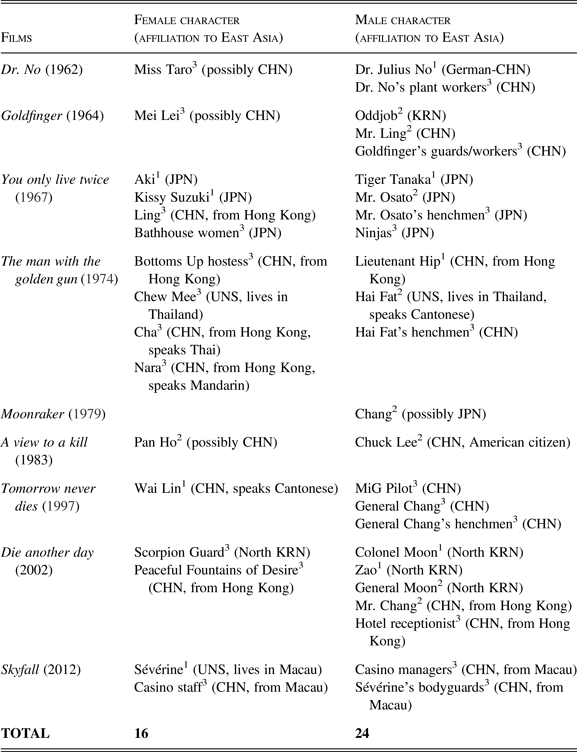
To examine the conflation of race and sexuality, we consider all characters of East Asian affiliation in the Bond film series. Nine of the twenty-four films contain such characters.
Table 1 shows the narrative significance and East Asian affiliation of these characters. Narrative significance is indicated by a superscript number after each name. Major characters who shape their film's narrative arc are marked with a 1; they have a considerable amount of dialogue and appear in multiple scenes. The number 2 designates minor characters; they have less narrative significance than major ones but remain meaningful as individual characters. The number 3 marks side characters, or those with the least narrative significance. Although these characters are sometimes given names, they usually have minimal lines, if any, and/or only appear in one scene. Finally, some of the listed characters are actually groups of individuals, such as Sévérine's bodyguards in Skyfall, because they hold only collective significance.
East Asian characters in the James Bond films. (Superscript numbers after the names mark the narrative significance of the character: 1 = major, 2 = minor, 3 = side. Ancestry and/or affiliation indicated in parenthesis: CHN = Chinese, KRN = Korean, JPN = Japanese, UNS = unspecified.)

The characters’ affiliation to East Asia is noted in parenthesis after each name. While some characters are introduced as having a specific nationality, several are only indirectly associated with East Asia through references to ancestry or cultural heritage. To account for the complexities of nationality, culture, language, and race, Table 1 represents as much relevant information as possible, based on what is available in the films. On this issue, two characters of note are: (i) Chuck Lee of A view to a kill (1983), who is an American agent of Chinese (CHN) descent, noted as ‘CHN, American citizen’, and (ii) Wai Lin of Tomorrow never dies (1997), who is a Chinese agent from Beijing and accordingly noted as ‘CHN’ but also as a Cantonese, instead of Mandarin, speaker. Characters whose affiliation is unspecified but presented through nonlinguistic clues such as ‘ethnic’ attire are recognized as East Asian characters with ‘unspecified’ affiliation (‘UNS’). For example, Sévérine of Skyfall is not explicitly described as belonging to a particular racial or ethnic group, although Bond speculates that she spent her childhood in Macau. So as not to elide the uncertainties of the character's backstory, she is classified as ‘UNS’.Footnote 1 Still, as noted by Funnell (Reference Funnell2015:86), notwithstanding the character's ambiguous backstory or the actor's racial and ethnic identities, ‘her character is clearly presented as an Asian “Other” in the film’. Funnell further pointed out that Sévérine is depicted first as a dragon lady but is ‘quickly disempowered and devolves into a tragic Lotus Blossom’ (86). Through this transition, Sévérine performs two archetypes of East Asian femininity.
THE RACIALIZED HYPER-SEXUALITY OF EAST ASIAN WOMEN
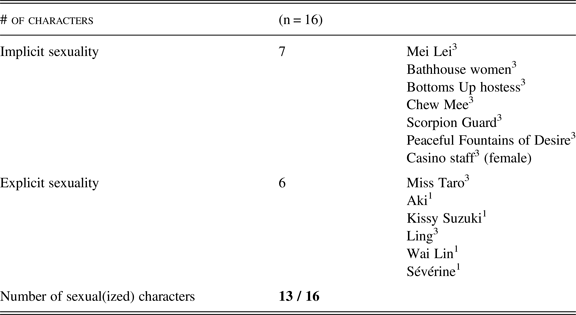
The information in Table 2 highlights a general pattern in the iconization of the racialized sexuality of East Asian female characters. It lists all female characters whose portrayal alludes to their sexuality and further categorizes them by whether their sexuality is presented explicitly (e.g. through physical intimacy with another character, more often than not Bond himself) or implicitly (e.g. no explicit sex scenes but depicted as sexually alluring through attire).
East Asian female characters whose portrayal alludes to their sexuality. (Superscript numbers after the names mark the narrative significance of the character: 1 = major, 2 = minor, 3 = side.)

Out of the thirteen women considered, seven are sexualized implicitly, six explicitly. All thirteen are portrayed as sexually alluring through visual cues such as figure-hugging attire. Admittedly, women of all races show up in the Bond films in various stages of undress; for instance, the white British actor Jill Masterson appears in Goldfinger (1964) covered from head to toe in gold paint and otherwise completely nude. Similarly, in A view to a kill, the Black character May Day (Grace Jones) exudes animalistic sexuality, donning attire that highlights her body as she exhibits superhuman physical ability. But this is less a question of whether all women, regardless of race, are sexualized in the Bond films—which of course they are—and more a question of how and why East Asian women are sexualized in a racially specific way.
Almost four decades ago, Rich (Reference Rich1980) influentially argued that institutions of heterosexuality oppress women by insisting on their adherence to what she called ‘compulsory heterosexuality’. De Lauretis (Reference de Lauretis1994:111), building on this idea, characterized lesbian desire as powerfully antinormative in that heterosexuality is ‘doubly enforced on women’—first, because ‘women can and must feel sexually in relation to men’, and second, because ‘sexual desire belongs to the [male] other’. These ideas regarding normative ontologies of female sexuality can be expanded to account for the Bond film series’ Orientalist imagining of what East Asian femininity looks like. East Asian women exist not only in a state of ‘compulsory heterosexuality’ in relation to men, but also in a state of compulsory hyper-heterosexuality in relation to white men. In the West, Asian femininity has historically been defined in relation to white masculinity, replicating the binary of a masculine West and feminine East. The Asian female is rarely an autonomous figure; her identity is derived from her relationship to the white male subject, which is often an erotic one (the term romantic does not describe the sexual(ized) nature of the relationship). This dependency has been outlined vividly by Heung (Reference Heung and Valdivia1995:90), who discussed Asian women on-screen in North American data as ‘receptacles of projected cultural meaning’. It is also behind Funnell's (Reference Funnell2015:79) characterization of Asian women in the Bond film series as canvases, a term that aptly illustrates the visual nature of the women's heavily mediatized racialized sexuality.
Through five decades, the Bond film series has continued to typecast East Asian women as sexual subordinates by positioning them in service roles of a sexual nature (bar hostesses, concubines, masseuses), clad in ‘ethnic’ dresses and surrounded by Oriental furniture. The seven women who are implicitly, rather than explicitly, sexualized are all side characters (marked with superscript number 3), which points to their relative insignificance to the narratives within which they appear. Nevertheless, they are crucially important for advancing the films’ construction of racial and gendered imagery, particularly through visual cues of wardrobe, makeup, and hairstyle. Consider the seven female side characters.
(i) Mei Lei, a flight attendant wearing a Chinese-style topknot hair-bun and a mandarin-collared, midriff-baring dress
(ii) the bikini-clad women serving in a Japanese-style bathhouse
(iii) a topless hostess who kneels atop tables while serving drinks at the Bottoms Up bar
(iv) Chew Mee, who invites Bond to join her skinnydipping
(v) the female North Korean guard who resembles a dominatrix and uses scorpions to torture Bond
(vi) Peaceful Fountains of Desire, a qipao-clad undercover Chinese agent disguised as a masseuse
(vii) the female casino staff with blonde ‘China doll’ haircuts, dressed in mandarin-collared short dresses.
Adding a racial dimension to the sexually suggestive names often given to Bond Girls (e.g. Pussy Galore, Plenty O'Toole, Holly Goodhead), these East Asian women often bear names that serve as sexual and racial plays on words. For example, as bizarre as it is to be named Peaceful Fountains of Desire, the use of this name for an Asian female masseuse evokes and sexualizes stereotypes of the Orient, enabling a double entendre reading of the phrase ‘fountains of desire’.
Such naming practices are one aspect of the role played by language in these characterizations. The films’ overt visual and narratological signaling of race and sexuality can easily obscure the parallel operation of linguistic performances of race and sexuality. The following five extracts from selected Bond films, presented in chronological order, are representative of the relationship between Bond and the women with whom he shares sexual encounters (marked ‘explicit sexuality’ in Table 2).
Taken from Dr. No, extract (1) depicts an exchange between Bond and a henchwoman, Miss Taro, who has been tasked with seducing Bond by her employer, the villainous Dr. No.
(1) Bond and Miss Taro converse after a sexual encounter at her apartment, which is decorated in an immediately recognizable Oriental style.


For no apparent reason, Miss Taro tells Bond that she can prepare “a Chinese dinner” (line 2). One function of this line could be to ‘clarify’ Miss Taro's racial and ethnic background, as the character is played by a white actor (Zena Marshall) in yellowface, a practice common in Hollywood productions of the 1960s. Whether or not this is indeed the screenwriter's motivation, every aspect of Miss Taro's character is mobilized to underscore her as a racial and sexual Other (see Figure 1). The name, Taro, is not Chinese but Japanese, commonly given to males. The film is not concerned with negotiating differences between Chinese-ness and Japanese-ness so much as approximating ‘East Asian-ness’ through conflation. This, combined with the Oriental decor of her apartment, such as Chinese antique furniture, red Chinese-style lanterns, and bamboo walls, as well as Miss Taro's many qipaos and Asian-style topknot hair-bun, are made collectively legible and given an identity through the line “I'll make you a Chinese dinner here” (line 2).
A studio publicity photo for Dr. No. From left: Eunice Gayson, Zena Marshall, Sean Connery, and Ursula Andress (all rights reserved; AF archive/Alamy Stock Photo, 2018).

As the film series moved along, portrayals of East Asian female sexuality only became more extravagant. Extracts (2) and (3) are from You only live twice, a film in which Bond beds beautiful local women in various Asian cities. Extract (2), a sequence near the opening of the film, follows immediately after a meeting of world leaders where an older white male British government official assures others of their mission's success, telling them, “our man in Hong Kong [Bond] is working on it now”. The sound of a ‘gong’—a familiar leitmotif heralding arrival in the Far East—accompanies the scene's shift to Bond lying on top of Ling in bed.
(2) Bond and Ling lie in bed, conversing after a sexual encounter

Although the role of Ling is played by the Chinese-born British actor Tsai Chin, who is bilingual in Mandarin and English, her pronunciation and grammar are noticeably that of someone unfamiliar with the English language. She speaks with an English as a second language (ESL) accent that includes morphosyntactic features such as “you think we better” instead of ‘you think we're better’ (lines 2), and “I give you very best duck” instead of ‘I'll give you the very best duck’ (line 5). The copula absence (we better), no tense marking (give), and dropping of a determiner with the noun (duck) are common ESL features of Mandarin speakers (Reyes & Lo Reference Reyes and Lo2009). Furthermore, given the highly sexual context and the mise-en-scène of an elaborately ‘Asian’ hotel bedroom awash in red, Ling's reply to Bond assuring him that she can give him the “very best duck” (line 5) is unmistakably a racially specific sexual innuendo (‘Peking Duck’, line 3) and a play on the word fuck.
The film series’ penchant for overtly sexual word play is again displayed when, after Bond's time with Ling in Hong Kong, he travels to Japan and meets Aki, a female agent with the Japanese intelligence service.
(3) Bond is receiving a massage at a Japanese bathhouse. Unbeknownst to him, Aki enters and takes over from his masseuse.

As extract (3) shows, noticeable linguistic features mark Aki's willingness to play the role of sexual conquest. She emphasizes Bond's subjectivity at the expense of her own by using “you” instead of ‘us’ (lines 4, 6, and 7). Her coquettish giggle (line 6) is a typical display of a Japanese woman's amorous self-subjugation to men (often transcribed as ufufu). Moreover, while Aki speaks with a discernibly Japanese accent, she is proficient in English, and the film does not overstate her accent. However, her awkward grammar in lines 6–7—“I think I will enjoy very much serving under you”—coincides with her delivery of the double entendre “serving under”, as Bond's professional and sexual subordinate. All in all, she performs—linguistically—her racial and ethnic identity as a ‘native’ woman ripe for Bond's sexual conquest.
Aki's performance of East Asian female sexuality is foreshadowed by Bond's recalling of his time in Hong Kong (line 1). This explicit mention of Hong Kong compels the audience to note the racial and/or cultural underpinnings of Bond's enjoyment—he is not simply a man being serviced by a woman, but a white man being serviced by an(other) East Asian woman. Aki encourages this contiguity by assuring him that, this time, his pleasure will not be “cut short” and he will “finish” this sensual, if not sexual, encounter. Despite Aki's enthusiasm, her expression of sexual desire should not be mistaken for agency. As de Lauretis (Reference de Lauretis1994:111) wrote, sexual desire ‘belongs to the other’. As with Miss Taro and Ling, East Asian female sexuality is defined in relation to white masculinity; this racialized articulation of heterosexual desire is presented as normative for East Asian women. Aki's role in this scene is not that of a secret agent but of a sexual plaything for Bond, a service that she readily provides and he gladly receives. Rather than ceding only professional authority to Bond, Aki thus cements their hierarchical positions in their sexual relationship as well.
The importance of Aki as a highly skilled and professional woman should not be understated, especially given the narrow range of professions—often in sexual service trades—ascribed to East Asian female characters in the Bond film series and in wider popular media (e.g. China dolls, geishas). Still, it must be noted that professional acumen does not exempt East Asian women from treatments of Oriental fetishism. The essential example here is Wai Lin, a secret agent from Beijing in the 1990s Bond film Tomorrow never dies. Although the character is often held up as the female equivalent of Bond on account of her fighting skills, Wai Lin is an amalgamation of Chinese cultural stereotypes. By capitalizing on Wai Lin's (or rather, actor Michelle Yeoh's) mastery of martial arts, the film reinforces the stereotype that all Chinese people are well versed in martial arts.Footnote 2 The film further conflates East Asian cultures when, late in the film, Wai Lin and Bond are floating in the open sea. She calls out to a fisherman (who wears a Vietnamese-style straw hat) on a boat (bearing a vessel name written in Thai script).
(4) Wai Lin shouts in Cantonese to a fisherman for help.

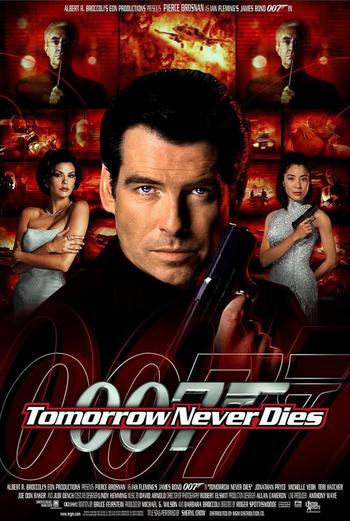
Here, Wai Lin speaks Cantonese despite being from Beijing. This linguistic dissonance is remarkable since Cantonese is more closely associated with Hong Kong, where it is a source of (anti-China) linguistic nationalist pride, as opposed to Mandarin, which is the standardized official language of the People's Republic of China. The ethnopolitical complexities between the two cultural and national identities are elided to encode ‘Chinese-ness’ onto Wai Lin's body. The Bond film producers’ vested interest in portraying Wai Lin as unmistakably Chinese is perceptible even in the publicity posters for Tomorrow never dies, which picture her in a sparkling qipao (known commonly by its Cantonese name cheongsam) that does not appear in the film (see Figure 2). Thus, even when the Bond films do not distort East Asian female sexuality into a non-normative racialized heterosexuality, a fetishistic treatment of race persists in expressions of East Asian-ness (or in this case, Chinese-ness).
Film poster of Tomorrow never dies. The sparking qipao that Wai Lin is featured in does not appear in the film itself and is used in this poster to index Chinese ethnicity (all rights reserved; AF archive/Alamy Stock Photo, 2019).

The fetishism of East Asian women as exotic-erotic objects reaches its apex in Skyfall with the portrayal of Sévérine, the last Bond Girl (to date) with an East Asian affiliation (see Funnell Reference Funnell2015). In Skyfall, Bond visits a Macao casino lavishly decorated with countless pagodas, red lanterns, and dragon motifs. While all of the female guests are dressed in Western-style evening gowns, regardless of race, those in service roles such as waitresses, dealers, and cashiers all wear variations of qipaos and have Chinese bob hairstyles. The female staff's over-the-top China doll stylization again racializes their sexuality.
Despite the amplified visual and narratological performance of race in the film, Sévérine is not marked linguistically as East Asian. Consider extract (5), which presents Bond's first meeting with Sévérine at the casino owned by her villainous lover.
(5) Bond sees through Sévérine's aloof façade at their first meeting

Sévérine does not speak English with the kind of accent that would be expected of somebody who grew up in Macau. And unlike the female casino staff, she is not dressed in a manner that highlights her race. Instead, her association with Macau is indicated in Bond's speculation about her history as a child prostitute (lines 4–5). Through a tattoo of a Chinese character (九 ‘nine’) on her wrist, Sévrine is marked as undeniably and permanently ‘Chinese’. This plot point bears closer scrutiny, prompting questions regarding the Bond film series’ choice to inject a destitute childhood into Sévérine's history. Could she not just as easily have been seduced by Bond's wit and sophistication, as so many other women had been? Indeed, this plot of a child sex-worker-turned-lover is significant because it is congruent with the Bond films’ conception of East Asian female sexuality. The mention of Sévérine being brought into the Macau sex trade as a pubescent child is not merely a marker of race (or of nationality), but an allusion to the subtext of sexual subjugation that is taken as normative to the experience of being an East Asian woman.
As the examples discussed in this section show, the representation of East Asian female sexuality is inextricably entwined with race. For heterosexual East Asian female characters in these films, normative sexuality is expressed only in racialized terms. Oriental fetishism is performed and affirmed through diverse strategies, including incorporating mentions of race into dialogue, ascribing women to stereotypically ‘Asian’ jobs (e.g. masseuses, bathhouse attendants, bar hostesses, underage prostitutes, casino staff), and dressing them in ‘ethnic’ attire. Through five decades of Bond films, from Dr. No to Skyfall, it remains the case that East Asian femininity and female sexuality are invisible unless filtered through the lens of race.
THE RACIALIZED NONSEXUALITY OF EAST ASIAN MEN
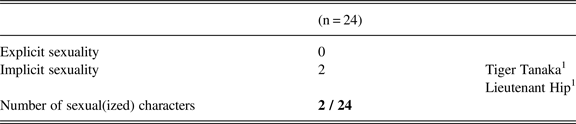
Curiously, while East Asian women are being sexualized on account of their race, something very different happens with their male counterparts. As opposed to the fetishized hyper-heterosexuality of East Asian women, men of East Asian affiliation are shown to express no sexuality at all. Table 3 lists all the East Asian male characters whose portrayal alludes to their sexuality.
East Asian male characters whose portrayal alludes to their sexuality. (Superscript numbers after the names mark the narrative significance of the character: 1 = major.)

Of the twenty-four men considered, twenty-two are depicted as completely nonsexual; only two (Tiger Tanaka and Lieutenant Hip) express sexual desire; this is 8.3%, a stark contrast to the thirteen out of sixteen women, or 81.3%, who are presented as sexual (Table 2). While East Asian women are denied agency in their sexual iconicity, it appears that East Asian men are denied sexuality as well as agency. This alleged asexuality among East Asian men becomes more interesting when considered in relation to their linguistic performances. Of the twenty-four men, eight are ‘minor characters’ and eleven are ‘side characters’ (marked by superscript numbers 2 and 3, respectively, in Table 1), which indicates their relative insignificance to the films’ narratives. As a result, these men have their voices virtually silenced; they may speak one line of dialogue (such as Die another day’s Hong Kong hotel receptionist's “Do you have a credit card?”) or only emit occasional yowls during their fight scenes (e.g. mute henchmen, Goldfinger’s Oddjob, Moonraker’s Chang, and all of the men who appear in groups). Because wit and banter are integral to the Bond brand and its conception of suave masculinity, the muteness of East Asian men functions as a manner of castration. As a rule, rather than an exception, these East Asian men are subordinate to other men, more specifically white men, and speech is not critical to the construction of their characters because hegemonic masculinity is beyond their reach (Pua & Hiramoto Reference Pua and Hiramoto2018).
The evidence becomes more definitive when one considers why Tiger Tanaka and Lieutenant Hip are the only East Asian male characters who do express sexual desire. They are the only ones who are (i) allies of Bond, as opposed to villains, and (ii) major characters, as opposed to minor or side ones. To establish the importance of these intersecting determinants, this article looks at the two scenes where Tiger Tanaka and Lieutenant Hip are each shown to be implicitly sexual.
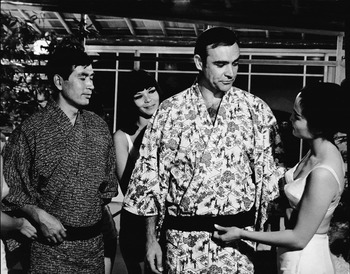
Extract (6) is taken from You only live twice (1967). Tiger Tanaka has invited Bond to relax at a Japanese bathhouse, where a group of women in white bikinis disrobe and bathe the men.
(6) Tiger Tanaka introduces the gendered customs of Japanese bathhouses to Bond.

The language employed by Tiger Tanaka in (6) is reminiscent of Ling's in (2). Both are highly performative and serve to incorporate non-native linguistic attributes into the dialogue, such as the utterances “Bond-san” (line 1) and “sexyful” (line 14). Mentions of the alleged rules of Japanese bathhouses (lines 1–2, 5–6) as well as Tiger Tanaka's self-professed identification as a Japanese man with “beautiful bare skin” (line 10) are prominent insertions of racial markers to constitute Japanese-ness. Yet, there are distinct inconsistencies in his performance, as he uses Anglicized pronunciations for Japanese expressions. For example, in an attempt to highlight Japanese customs of salutation, Tiger Tanaka calls Bond [bond san] or [bond˺ san], even though a more likely and typical Japanese pronunciation would be [bondo saŋ] with an epenthetic vowel [o] after a coda consonant /d/ in ‘Bond’, and a velar [ŋ] instead of an alveolar [n] in ‘san’. Unconventional English pronunciations recur throughout the film in Tanaka's usage of Japanese expressions such as sake [saki] ‘rice wine’, Osato [ozato], and Kobe [kobi] instead of [sakε], [oːsato], and [kobε]. In fact, the dialogue was dubbed by a British voice actor. This phonological mismatch is even more obvious in another scene when Tiger Tanaka speaks in Japanese; the expression Dôshita? ‘What happened?’ is pronounced [doʃiɾa] instead of the conventional Japanese pronunciation [doːʃita], with the initial long vowel and nonflapped /t/ in the last mora.
Equally important in this scene is the enthusiasm with which Tiger Tanaka introduces Bond to his ‘Japanese way of life’. In bringing Bond with him to the bathhouse, Tiger Tanaka ensures that he and Bond share in this decidedly heterosexual experience of male pleasure at the hands of women, specifically Japanese women—whom he takes pains to distinguish from “English girls” (line 8). He advertises Japan as a place where gender hierarchies are rigid on account of culture/race; the line “In Japan, men always come first” (line 5) is a thinly veiled admission of the supremacy of the male sexual experience over that of the Japanese female. Nevertheless, Tiger Tanaka remains fully aware of the distinction between himself, a Japanese man, and Bond, a white English man. By virtue of race, Bond's exemplary masculinity, to return to Connell's (Reference Starr1995) term, is not available to Tiger Tanaka on his own ‘merits’ as an East Asian heterosexual man. For instance, Tiger Tanaka notes that the women find Bond's hairy chest more fascinating than his own smooth chest (lines 9–10). The colonial hierarchy described by Said (Reference Said1978/2003) between the feminine Asian East and the masculine white West operates here in the organization of masculinity and (hetero)sexuality by positioning Bond as exemplary and dominant over Tiger Tanaka, who is subordinate. Tiger Tanaka then mitigates his lower status by dictating when and how such women should serve the two of them, effectively exercising phallicized control over the bodies of Japanese women. What comes of his repeated instructions on how to treat Japanese women is that now both Tiger Tanaka and Bond are confirmed as men, equally heterosexual, with access to an explicitly heterosexual service by fetishized East Asian women. In positioning Japanese women as sexual subordinates, Tiger Tanaka aligns his sexuality with hegemonic Western conceptions of East Asian women and, in doing so, wills upon himself ‘honorary white-ness’ and exemplary masculinity.
A similar alignment is employed in The man with the golden gun (1974) with Lieutenant Hip, the only other East Asian man in these films who possesses a semblance of sexual desire. Unlike the encounter in the Japanese bathhouse, the manifestation of Lieutenant Hip's heterosexuality is brief and almost imperceptible. As Bond's Hong Kong-based ally, he enters a seedy bar suggestively named Bottoms Up, hoping to meet with a liaison. True to its name, Bottoms Up features topless Chinese women who kneel on bar tops, lifting their bottoms as they stretch their arms to serve a predominantly male clientele. As Lieutenant Hip walks in, he spots his liaison, a white man transfixed by the image of the topless hostess and sits with him. The scene unfolds in less than a minute and is practically wordless (except for the hostess's question “beer or ginger ale?”) but is key to understanding how Lieutenant Hip's (Chinese) heterosexual masculinity is constructed relative to that of his white counterpart. While Lieutenant Hip is focused on gaining the attention of his liaison, training his gaze on the white man before moving it momentarily to the hostess, the latter does not take his eyes off the hostess for the entirety of the scene. Their (non)interaction conveys the link between hegemonic masculinity and white-ness. In lieu of Bond's actual presence, heterosexual male desire is transferred not onto Lieutenant Hip, a major character of East Asian descent, but to a less prominent character more akin to Bond in racial representation. Exemplary masculinity, it seems, is constituted more by race than by a character's significance to the film's narrative.
Lieutenant Hip's sexuality only materializes in the moment that he mirrors the gaze of the other and focuses on an(other) East Asian female body. This re-directing of Lieutenant Hip's gaze from the body of his white male counterpart to that of an East Asian female parallels Tiger Tanaka's strategically mediated alignment with Bond. During the scene in (6), Tiger Tanaka's gaze is fixed on Bond's body while Bond, in turn, is captivated by the bikini-clad Japanese bathhouse women serving him (see Figure 3).
A scene from You only live twice. Tiger Tanaka's gaze is fixed on Bond while Bond's is trained on the bikini-clad Japanese bathhouse woman (all rights reserved; Pierluigi/Mondadori Portfolio/Getty Images).

There is thus an invariable alignment of East Asian male heterosexual desire with that of the white West. Overall, even in the absence of Bond, Lieutenant Hip's heterosexual desire is captured in relation to another white man enjoying the spectacle of the fetishized Asian woman. Again, Tiger Tanaka and Lieutenant Hip are the only men affiliated with East Asia whose sexualities are alluded to in these films; East Asian male sexual desire is depicted as either nonexistent or a mere imitation of the ‘real’ heterosexual masculinity of white men. To recall Connell & Messerschmidt (Reference Connell and Messerschmidt2005:832), although hegemonic masculinity is performed by and accessible only to white men, this model of masculinity is seen as normative—as the ‘most honored way of being a man [that] require[s] all other men to position themselves in relation to it’. The heterosexual masculinity presented by Tiger Tanaka and Lieutenant Hip is based on a male-to-male affirmation of normative heterosexuality by association. Although the degree to which this homosociality approaches homoeroticism may be variously interpreted, it nevertheless remains that the Bond films present the heterosexuality of East Asian men as normative only when expressed vis-à-vis the implicit approval of hegemonic masculine (white) bodies.
Even then, not since Lieutenant Hip in 1974 has the Bond film series included a ‘sexual’ East Asian man. Even in more recent films, East Asian men remain nonsexual, a characteristic now seen as normative by way of race. The correlation between race and sexuality for East Asian men is so rigid that in Die another day (2002), Colonel Moon, a North Korean villain, is able to take the MI6 double-agent, Miranda Frost, as a lover only after he undergoes ‘gene-replacement therapy’ to literally alter his race. The procedure changes his physical appearance completely; as a white man, Colonel Moon is Sir Gustave Graves, with brown hair, light skin, blue eyes, and a British accent. This blanket erasure of East Asian male sexuality must be recognized as the exercise of hegemonic masculinity. Removing the capacity for sexual desire effectively ‘others’ an individual, a technique disproportionately applied to villainous characters. As Theodoropoulou (Reference Theodoropoulou2016) contends in her work on the speech styles of Bond villains, castration becomes two-fold—first, a neutering of sexuality, and second, a physical disability or impairment that amplifies sexual impotence. Significantly, in Die another day, while Colonel Moon successfully transforms into a white man and takes a female lover, his right-hand man, Zao, does not complete the procedure and consequently does not transition fully. Zao's ‘Korean’ facial features appear incompatible with his newly whitened skin so that he resembles a man with albinism. Zao, failing to fully assume white-ness, has no association with sexuality or romance.Footnote 3 At the same time, a number of European Bond-film villains marked with similar physical conditions actually do enact heteronormative sexuality, for example, the one-eyed men, Emilio Largo from Thunderball and Le Chiffre from Casino Royale; three-nippled Francisco Scaramanga from The man with the golden gun; the mute henchman Jaws whose teeth are entirely capped with steel; and a former MI6 agent with facial deformation, Raoul Silva from Skyfall. As opposed to their fellow villains of East Asian affiliation, these European men, despite their various physical impairments, are heterosexually (and heteronormatively) involved with women.
CONCLUSION
Despite spanning more than half a century, the film series’ treatment of East Asian sexuality continues to rely heavily on typecasting characters according to racial stereotypes and explicitly coding race in visual and linguistic performances. Beyond its penchant for employing strategies of exoticization, the film series frequently conflates the races and sexualities of its East Asian characters. Because white masculinity is treated as normative, the fact of East Asian ancestry requires that a character's sexuality be ‘the effect to be explained’ (Miller, Taylor, & Buck Reference Miller, Taylor and Buck1991:5); race is thus curiously invoked to explain sexuality. This effectively creates a non-normative racialized heterosexuality. East Asian-ness is perceived only in relation to hegemonic (white) masculinity where long-held colonial and Orientalist hierarchical models of race and sexuality persist. Over time, the Bond films have shown a refusal to unravel (and dispel) the colonial trope of native women as white males’ sexual conquests. The films reinforce East Asian female bodies as sites upon which hegemonic masculine fantasies are played out (Wetherell & Edley Reference Wetherell and Edley1999). Bond thus remains secure in his position as a modern ‘man of the frontier’ whose heterosexual virility is reflected in the colonizability of the Far East and its women. The de-sexualization of East Asian men works to emphasize normative expressions of white masculinity as exemplary. As with East Asian women, it appears that East Asian men function to highlight white hegemonic masculinity. East Asian male sexuality is, by and large, unrepresented and, even on the infrequent occasions of its depiction, is only made explicit through recognition of its subordinate position. In this sense, East Asian male heterosexuality is racialized and rendered non-normative in relation to white male heterosexuality. Perhaps it is possible to consider East Asian (hetero)sexuality as ‘queered’ (in the sense of Milani Reference Milani, Ehrlich, Meyerhoff and Holmes2014b) by rigid ideologies governing the construction of hegemonic masculinity.
Ultimately, this article has demonstrated how hegemonic masculinity informs a normative model of gender by naturalizing heteronormative sexism and the Orientalist relationship between a masculine white West and a feminine Asian East. The construction of East Asian women and men's sexuality as non-normative is integral to the films’ construction of a normative white heterosexuality. By exposing normativity's reliance on stereotypical and oversimplified iconizations, typecastings, and ideologies, this article seeks to broaden understanding of how the sexuality of East Asia is enregistered and negotiated in a globalized popular culture that is heavily informed by models of hegemonic masculinity.