Lactic acid bacteria play an important role in the production of fermented dairy products. Yoghurt is a major fermented dairy product produced mainly using Streptococcus thermophilus and Lactobacillus bulgaricus (Guo et al. Reference Guo, Xin, Dong, Zhang, Wang, Fu and Wang2018). In the Middle East, there are yoghurt by-products such as yayik butter, ghee and Kermanshahi roghan from Turkey, India and western Iran, respectively. The production process of these products is similar with a difference in the final stage. Ghee and roghan are produced by heat and cold clarification of yoghurt, respectively. Kermanshahi roghan, regarded as an animal oil, is the most expensive dairy product in Iran and is exported to several other countries.
In general, the fermentation process is a stressful condition that affects bacterial metabolic pathways. Bacteria tolerate this condition by enzymatic hydrolysis of milk lipids (Tamime & Robinson, Reference Tamime and Robinson2007). Incubation temperature is an important factor that affects the microbial metabolism and fatty acid profile (FAP) (Medeiros et al. Reference Medeiros, de Santa Souza and Correia2015), which is important for the properties of the final products and differs from one product to another (Ekinci et al. Reference Ekinci, Okur, Ertekin and Guzel-Seydim2008). Saturated fatty acids (SFAs) have previously been associated with an increased risk of heart disease although the evidence is inconclusive (de Souza et al. Reference de Souza, Mente, Maroleanu, Cozma, Ha, Kishibe, Uleryk, Budylowski, Schünemann, Beyene and Anand2015), whereas some polyunsaturated fatty acids (PUFAs) and monounsaturated fatty acids (MUFAs) can vary considerably and may be regarded as important parameters to determine the nutritional value of a food (Butler et al. Reference Butler, Stergiadis, Seal, Eyre and Leifert2011). In addition, the osmotic condition of some products such as butter (80–82% fat) is a stressful environment for lactic acid bacteria. Kermanshahi roghan is a butter fat concentrate similar to ghee (less than 0·2% moisture) and there is less information on its FAP as compared with yoghurt FAP.
The aim of this study was to investigate the effect of fermentation temperature (37 and 45 °C) and ratios of S. thermophilus to L. bulgaricus (3 : 1, 1 : 1 and 1 : 3) on Kermanshahi roghan and yoghurt FAP, in order to obtain a product with better FAP.
Materials and methods
Cow milk was collected in cans (2 l) from a small farm in Kermanshah, Iran. The milk was carried to the laboratory at 4 °C, and pasteurized at 95 °C for five minutes in a water-bath (Memmert, Germany).
The bacteria were obtained from yogurt starter culture YC-380 (Chr-Hansen culture CH9, Denmark). S. thermophilus and L. bulgaricus were plated onto M17 and MRS agar (Merck, Munchen, Germany), respectively. Bacterial combination was prepared from the microbial suspensions of 24-h cultures in 5 ml of sterile normal saline (6 × 10⁸ CFU/ml) in different S. thermophilus to L. bulgaricus (St/Lb.1, 3 : 1; St/Lb.2, 1 : 1 and St/Lb.3, 1 : 3) ratios. The suspensions were inoculated into 95 ml milk (5% v/v), and incubated at 37 or 45 °C, until pH reached 4·6, then the samples were stored overnight at 4 °C. For preparation of roghan, yoghurt was diluted with water (1 : 1), churned for six hours, and stored overnight at 4 °C. Subsequently, diluted yoghurt was separated from the cream, and its water was separated at 45 °C for five minutes in a water-bath and thereafter centrifuged at 4000g, 4 °C for ten minutes. The products (roghan) and controls (milk) were prepared in triplicate, and the experiments were replicated on different days.
The yoghurt, roghan and milk samples (250 mg) were homogenized, and its lipid were extracted according to the Folch method (Folch et al. Reference Folch, Lees and Sloane Stanley1957). As much as 10 µl of internal standards (C13:0, 30 mg/ml; Sigma-Aldrich, Buchs, Switzerland) were added to 100 µl of lipid extracted samples, and hydrolyzed with 400 µl NaOH (0·1 m in methanol) at 37 °C for 30 min, thereafter incubated at −20 °C for five minutes. Transesterification was performed using 1 ml of boron trifluoride in methanol (14%, Sigma-Aldrich, Ontario, Canada), and the mixture was heated at 37 °C for 30 min. The samples were transferred at −20 °C for ten minutes to 2·5 ml of saturated sodium chloride (Merck, Munchen, Germany), and 2 ml n-hexane (Sigma-Aldrich, Ontario, Canada) were added. After centrifugation (4000g, 1 min), the samples were frozen for one hour. Finally, the upper layer was taken and the solvent was evaporated under nitrogen in ice until it reached 50 µl.
Analyses of samples were performed in a gas chromatograph (Varian, model 3800CP, Walnut Creek, CA, USA) by a flame-ionization detector. The samples were injected in a fused silica capillary column (Varian CP-SIL 88, 100 m × 0·25 mm internal diameter × 0·2 µm film thickness). Nitrogen was used as carrier gas at a flow rate of 1·5 ml/min and the split ratio was 1 : 70. The injector and detector temperature were set at 270 and 300 °C, respectively. The oven temperature was programmed as follows: 50 °C for one minutes, and increased to 100 °C at a rate of 10 °C/2 min, 175 °C at a rate of 5 °C/3 min, 190 °C at a rate of 5 °C/3 min, 195 °C at a rate of 0·1 °C/5 min, finally 240 °C at a rate of 10 °C/5 min.
One microliter of the samples was injected manually. Identification of the peaks was determined by comparing the retention times of samples with the standards peaks. The relative composition of each fatty acid methyl ester was calculated from the area of each peak and expressed in percentages according to the single point internal standard. Sample fatty acids were divided based on number of carbon atoms, into: SCFAs (C4–C10), SFAs (C12–C20) and unsaturated fatty acids (USFAs) including MUFAs (C18:1t n-7 and C18:1c n-9) and PUFAs (C18:2 n-6 and C18:3 n-3).
Statistical analysis
Data was analyzed using statistical Statistica 5.0 (Statsoft, Tulsa, USA). An analysis of variance (ANOVA) was used to assess the differences between means, with a significance level of P < 0·05. Tukey test was used to determine the possible significant differences (P < 0·05) among multiple values.
Results
The findings revealed that fermentation changed the fatty acid composition of the products.
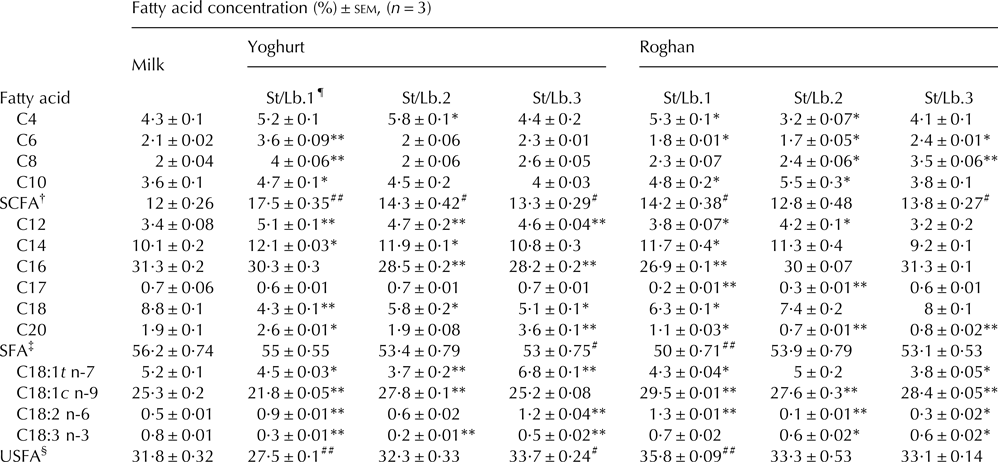
Yoghurt at 37 °C: Table 1 shows that level of SCFAs and USFAs (unlike SFAs) increased in most of the yoghurt as compared to the milk. The yoghurt prepared by St/Lb.1 and St/Lb.3 had significantly highest level of SCFAs (P < 0·001) and USFAs (P < 0·05) as compared to other samples. The results revealed that the yoghurt made by St/Lb.3 had significantly the lowest level of SFAs (P < 0·05) as compared to milk and there was a significant difference in the amount of C16 and C18 (P < 0·001).
Fatty acid profiles of milk, yoghurt and roghan produced at 37 °C

† SCFA: Short-chain fatty acid.
‡ SCF: Saturated fatty acid.
§ USFA: Unsaturated fatty acid.
¶ St/Lb: S. thermophilus to L. bulgaricus, *P < 0·05, **P < 0·001 vs. milk fatty acid, #P < 0·05, ##P < 0·001 vs. milk SCFA, SFA and USFA.
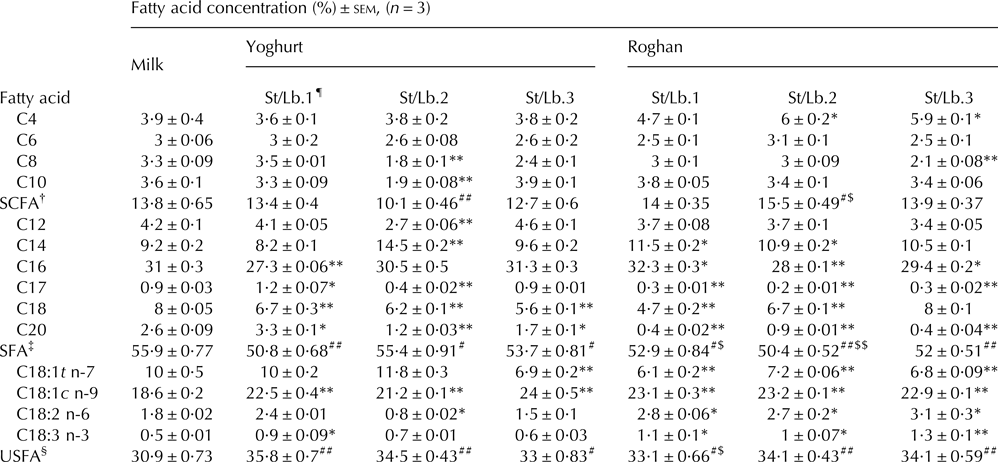
Yoghurt at 45 °C: As illustrated in Table 2, the level of SCFAs and SFAs (unlike USFAs) decreased in all yoghurt as compared to milk. The yoghurt made by St/Lb.2 and St/Lb.1 had the lowest level of SCFAs (P < 0·001) and SFAs (P < 0·001), respectively, as compared to other samples. Table 2 shows that the highest level of USFAs related to yoghurt was prepared by St/Lb.1.
Fatty acid profiles of milk, yoghurt and roghan produced at 45 °C

† SCFA: Short-chain fatty acid.
‡ SCF: Saturated fatty Acid.
§ USFA: Unsaturated fatty acid.
¶ St/Lb: S. thermophilus to L. bulgaricus, *P < 0·05, **P < 0·001 vs. milk fatty acid, #P < 0·05, ##P < 0·001 vs. milk SCFA, SFA and USFA, $P < 0·05, $$P < 0·001 vs. roghan SCFA, SFA and USFA at 37 °C.
Roghan at 37 °C: As shown in Table 1, S. thermophilus (St/Lb.1) plays an important role in roghan FAP changes as compared to milk and other roghan. Level of SCFAs and USFAs increased in all the roghan and a significantly higher proportion of C4, C18:1c n-9 and C18:2 n-6 (P < 0·001) was seen. On the other hand, all of roghan samples SFAs were lower than milk and there were a decrease in the amount of C16–C20 especially in roghan samples that were made by St/Lb.1 (P < 0·001).
Roghan at 45 °C: As shown in Table 2, the level of SCFAs was increased in all roghan samples as compared to the milk and there was a significant difference in the samples were prepared by St/Lb.2 (P < 0·05). Level of USFAs significantly increased in all the roghan. The yoghurt prepared by St/Lb.2 had the highest level of SCFAs (P < 0·05) and USFAs (P < 0·001) as compared to other samples, and there was a significant difference in the amount of C4, C18:1c n-9- C18:3 n-3. Furthermore, SFA levels of all the roghan decreased as compared to the milk and it was related to roghan made by St/Lb.2.
Finally, our results showed that roghan FAP is better than yoghurt FAP at 37 and 45 °C. On the other, roghan products that were produced with the mixing of bacteria at equal ratio of S. thermophilus and L. Bulgaricus (1 : 1), had the best quality FAP.
Discussion
Changes in milk contents after yoghurt production is due to the exposure of bacteria to a variety of environmental stresses (Tamime & Robinson, Reference Tamime and Robinson2007). Herein, the results revealed that there is difference between fatty acid profiles of yoghurt and roghan. The results agree with that of another study (Naydenova et al. Reference Naydenova, Kaishev, Iliev and Mihaylova2014) which showed that levels of SCFAs increased in yoghurt, while SFAs levels decreased at 37 °C. It seems bacterial temperature-dependent esterases and beta-oxidation play an important role in these changes. Furthermore, these enzymes have optimum activity at 25–37 °C and they hydrolyze short-chain carboxylic acids (lower than 12 carbons) which probably contributes to the increased SCFA concentrations (Sayali et al. Reference Sayali, Sadichha and Surekha2013). Studies performed by (Chandan & Kilara (Reference Chandan and Kilara2013) are in agreement with ours, namely that unlike values of yoghurt USFAs, level of SCFAs and SFAs decreased at 45 °C as compared to 37 °C. Furthermore, S. thermophilus (St/Lb.1) plays an important role in these changes. It can be proposed that S. thermophilus growth rates increase and more acid concentration will be obtain in a short time at 45 °C as compared to 37 °C (Mehmood et al. Reference Mehmood, Masud, Abbass and Maqsud2009). On the other hand, bacteria respond to environmental stresses such as medium acidity by changes in membrane fatty acid composition. USFAs are key molecules in the regulation of cellular membrane fluidity (Aguilar & de Mendoza, Reference Aguilar and de Mendoza2006). It may be that, yoghurt FAP are affected by the cellular fatty acid composition.
Roghan is the cream separated from yoghurt stored overnight at 4 °C and there is less information on comparison between roghan and yoghurt FAP. Although both roghan and ghee are yoghurt by-products, the data of this study demonstrated differences between their FAP. Here, the results revealed that unlike SFAs, level of SCFAs and USFAs increased in roghan at 37 and 45 °C. In contrast to a previous report (Mehta, Reference Mehta2013), the current results showed that roghan SFA and USFA were about 52·1 and 33·9%, respectively, whereas based on Mehta's report the value of Dynamix ghee SFA (53·4%) and USFA (17·7%) increased compared to our data. It can be suggested that bacterial death occurs in ghee after heat clarification at about 103 °C (Sserunjogi et al. Reference Sserunjogi, Abrahamsen and Narvhus1998), while bacteria are alive in roghan for long times (in another study, we isolated lactic acid bacteria from the roghan after nine months, data not shown).
In conclusion, our data showed that roghan FAP is better than yoghurt FAP at 37 and 45 °C and combination of bacteria with equal ratio of S. thermophilus and L. bulgaricus (1:1) had the suitable roghan FAP.