1. Introduction
Marginal reversals are a common feature of mafic-ultramafic igneous bodies worldwide. They are commonly characterized by a decrease in the number of crystallizing phases in progressively formed rocks (e.g. Ol+Pl+Cpx, Ol+Pl, Ol) while minerals become gradually more primitive (e.g. olivine Fo40–Fo80 and plagioclase An40–An80 ) inwards from intrusive contacts. Examples include marginal reversals in dykes, sills and layered intrusions, as well as in basaltic pillows and komatiitic lava flows (e.g. Irvine, Reference Irvine and Hargraves1980; Alapieti, Reference Alapieti1982; Raedeke & McCallum, Reference Raedeke and Mccallum1984; Bédard, Reference Bédard and Parson1987; Campbell, Reference Campbell1987; Foland, Gibb & Henderson, Reference Foland, Gibb and Henderson2000; Latypov, Reference Latypov2003a , Reference Latypov b ; Latypov, Chistyakova & Alapieti, Reference Latypov, Chistyakova and Alapieti2007; Aarnes, Podladchikov & Neumann, Reference Aarnes, Podladchikov and Neumann2008; Galerne et al. Reference Galerne, Neumann, Aarnes and Planke2010; Chistyakova & Latypov, Reference Chistyakova and Latypov2009, Reference Chistyakova and Latypov2010; Latypov et al. Reference Latypov, Hanski, Lavrenchuk, Huhma and Havela2011). Such marginal reversals are almost universally developed in magmatic bodies, irrespective of their age, geographical location, size, form and even the composition of parental magmas, strongly indicating that some fundamental processes are involved in their genesis.
Current models for the origin of marginal reversals fall into two major groups. The first group includes models interpreting marginal reversals as a phenomenon of magma chambers that develop as open systems. These models involve crystallization of liquids of different compositions that are produced by wall-rock contamination (e.g. Tyson & Chang, Reference Tyson and Chang1984), multiple (e.g. Gorring & Naslund, Reference Gorring and Naslund1995) or prolonged (e.g. Morse, Reference Morse1981; Latypov et al. Reference Latypov, Hanski, Lavrenchuk, Huhma and Havela2011) magma injections or compositional stratification in magma chambers (e.g. Wilson & Engell-Sørensen, Reference Wilson and Engell-Sørensen1986). In contrast, the hypotheses of a second group explain marginal reversals as a phenomenon of magma chambers that develop as closed systems. These models produce marginal reversals by intra-chamber crystal settling (Moore & Evans, Reference Moore and Evans1967; Fujii, Reference Fujii1974; Lightfoot & Naldrett, Reference Lightfoot and Naldrett1984; Bédard, Reference Bédard and Parson1987; Frenkel' et al. Reference Frenkel', Yaroshevsky, Barmina, Koptev-Dvornikov and Kireev1988, Reference Frenkel', Yaroshevsky, Ariskin, Barmina, Koptev-Dvornikov, Kireev, Bonin, Didier, Le Fort, Propach, Puga and Vistelius1989; Marsh, Reference Marsh1989; Helz, Kirschenbaum & Marinenko, Reference Helz, Kirschenbaum and Marinenko1989; Gisselo, Reference Gisselo2001), flow differentiation (Bhattacharji & Smith, Reference Bhattacharji and Smith1964; Bhattacharji, Reference Bhattacharji and Wyllie1967; Simkin, Reference Simkin and Willie1967; Marsh, Reference Marsh1996; Gibb & Henderson, Reference Gibb and Henderson2005), magma supercooling (Miller & Ripley, Reference Miller, Ripley and Cawthorn1996), compositional convection (Jaupart & Tait, Reference Jaupart and Tait1995; Tait & Jaupart, Reference Tait and Jaupart1996), an upward decrease in amount of intercumulus material (Raedeke & McCallum, Reference Raedeke and Mccallum1984), thermal-gradient-induced migration of interstitial liquid in solidifying rocks (Lundstrom et al. Reference Lundstrom, Boudreau, Huang and Ianno2007; Huang et al. Reference Huang, Lundstrom, Glessner, Ianno, Boudreau, Li, Ferré, Marshak and Defrates2009), postcumulus redistribution of interstitial liquid caused by development of under-pressure zones in solidifying rocks (Aarnes, Podladchikov & Neumann, Reference Aarnes, Podladchikov and Neumann2008; Galerne et al. Reference Galerne, Neumann, Aarnes and Planke2010), Soret effect (e.g. Krivenko, Balikin & Polyakov, Reference Krivenko, Balikin and Polyakov1980; Latypov, Reference Latypov2003a , Reference Latypov b ) and shrinkage-induced redistribution of intercumulus melt from the cumulate pile towards the intrusive contacts (Cherepanov, Sharapov & Krivenko, Reference Cherepanov, Sharapov and Krivenko1982, Reference Cherepanov, Sharapov and Krivenko1983; Petersen, Reference Petersen and Parson1986) (see a review in Latypov, Reference Latypov2003a and Latypov, Chistyakova & Alapieti, Reference Latypov, Chistyakova and Alapieti2007).
To get an insight into this dilemma, we have recently undertaken detailed geochemical studies of marginal reversals of several mafic-ultramafic layered intrusions of the Fennoscandian Shield (e.g. Latypov et al. Reference Latypov, Hanski, Lavrenchuk, Huhma and Havela2011; Egorova & Latypov, Reference Egorova and Latypov2012). These studies have indicated that marginal reversals are most likely formed under conditions of open system behaviour of the magma chamber. More specifically, two different types of marginal reversals evolving under open system conditions, fully-developed and aborted reversals, were identified in the layered intrusions. A fully-developed marginal reversal shows a crystallization sequence and mineral compositional trends that are essentially opposite to those in the overlying Layered Series to which it gradually passes via the crossover maximum. This type appears to experience a complete evolutionary path during formation of the marginal reversals involving a prolonged emplacement of increasingly more primitive magmas. Examples of such marginal reversals are abundant in the literature (e.g. Lightfoot & Naldrett, Reference Lightfoot and Naldrett1984; Latypov, Reference Latypov2003a , Reference Latypov b ; Latypov, Chistyakova & Alapieti, Reference Latypov, Chistyakova and Alapieti2007). An aborted marginal reversal develops when such an evolutionary path is interrupted by a major pulse of more primitive magma parental to the overlying Layered Series. As a result, such a reversal shows an incomplete crystallization sequence and mineral compositional trends, as well as a sharp compositional break with overlying rocks of the Layered Series. Such specific marginal reversals seem to be quite rare in nature. Only two aborted marginal reversals have been described so far. They were discovered at the base of the Koitelainen intrusion, Finland (Latypov et al. Reference Latypov, Hanski, Lavrenchuk, Huhma and Havela2011) and Imandra intrusion, Russia (Egorova & Latypov, Reference Egorova and Latypov2012). This paper presents a third example of an aborted marginal reversal that we have recently discovered at the base of the Caledonian Fongen–Hyllingen Intrusion (FHI), Norway. This reversal provides another important piece of evidence in favour of open system behaviour of the magma chambers during the initial stage of their development.
2. Fongen–Hyllingen layered intrusion
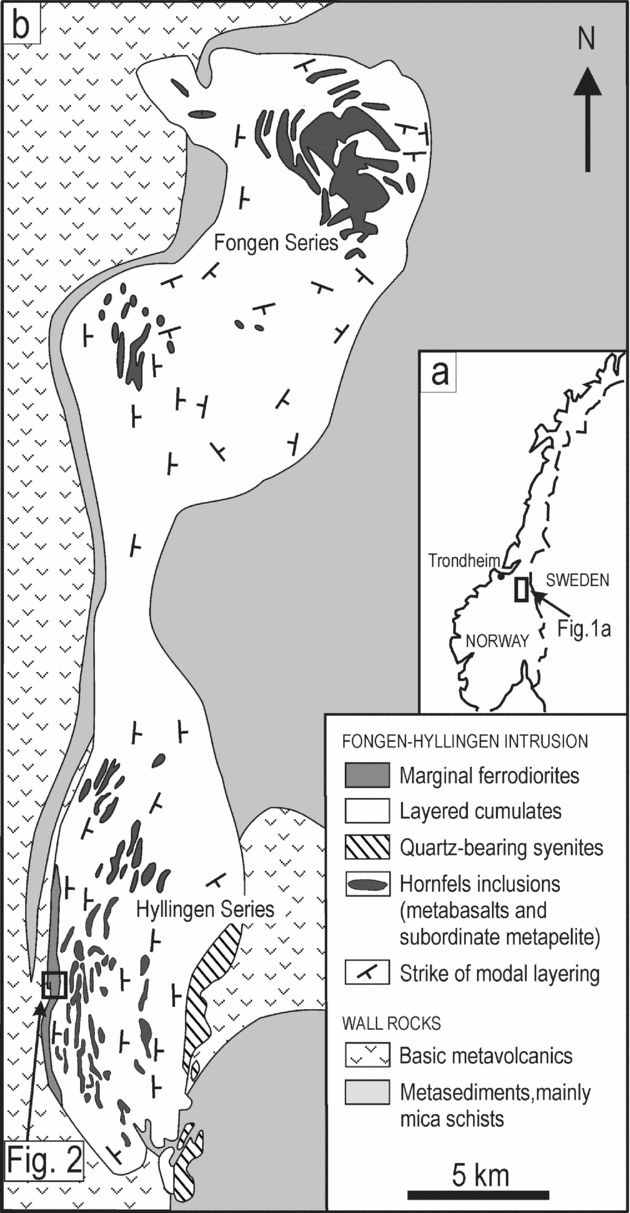
The FHI is the largest mafic intrusion in the central Scandinavian Caledonides located about 60 km southeast of Trondheim, Central Norway (Fig. 1). The FHI occupies an area of about 160 km2 and comprises a ~ 6 km thick sequence of cumulate rocks. The complex is now situated in the uppermost nappe of the Trondheim Nappe Complex in the upper allochthonous unit of the Scandinavian Caledonides. This nappe is believed to have been transported many tens of kilometres to the east so that the present location of the FHI is now far from its original site. The FHI was emplaced synorogenically into folded metapelites and metabasalts during the late stage of the Caledonian orogeny ~ 435 Ma ago (Wilson, Reference Wilson2010). The FHI has a well-developed contact metamorphic aureole. Mineral parageneses in the contact metamorphic aureole indicate that intrusion probably took place at 3.5 kbar (F. Thayssen, unpub. M.Sc. thesis, Univ. Aarhus, 1998). The peak of the regional deformation and metamorphism (the Scandian orogeny) took place after crystallization of the FHI. The FHI is only locally deformed and/or metamorphosed but the primary mineralogy and textures are extensively preserved so that igneous features can be studied in detail. Abundant large, raft-like inclusions are present in the FHI, particularly in the stratigraphically lower part of the Layered Series. Most inclusions are metabasaltic hornfels, but metapelites are locally present, consistent with the lithology of the wall rocks (Wilson & Larsen, Reference Wilson and Larsen1985; Wilson, Reference Wilson2010).
(a) Location of the Fongen–Hyllingen Intrusion (FHI) in the Caledonides of Norway. (b) Simplified geological map of the FHI, its country-rock envelope and the distribution of raft-like inclusions, after Wilson & Sørensen (Reference Wilson, Sørensen and Cawthorn1996). Also shown is the location of the study area.

The FHI is subdivided into two geographical parts, the Fongen Series in the north and the Hyllingen Series in the south, separated by a thin central strongly deformed and metamorphosed area (Fig. 1). There is no chilled margin at the country-rock contacts, but medium- to coarse-grained, non-layered ferrodiorites are commonly present along the base of the intrusion and are referred to as a marginal zone in this paper. The rock sequence above this zone is collectively referred to as the Layered Series. Unlike the marginal zone, modal layering is well developed throughout most of the Layered Series. Individual layers are typically 2–30 cm thick. Metre-scale layers also locally occur and can usually be traced laterally for 20–30 m before they taper out (Wilson, Reference Wilson2010). Cumulate rocks of the Layered Series are dominated by plagioclase-rich olivine gabbros or gabbronorites. With increasing differentiation Fe–Ti oxides, apatite, biotite, zircon, quartz, K-feldspar and allanite successively appear as cumulus phases. Also primary calcic amphibole becomes a cumulus phase in evolved assemblages. The most evolved rocks are quartz-bearing ferrosyenites that occur at the top of the Hyllingen Series where they are in contact with country-rock amphibolites, which compose the local roof. In general, the average composition of the FHI is broadly dioritic but mineral compositions in cumulates cover extremely wide ranges: olivine Fo75–0, plagioclase An67–1, clinopyroxene Mg-number80–0 (Wilson, Reference Wilson2010). A major feature of the FHI is the presence of systematic lateral compositional variations in mineral chemistry, with more evolved compositions along the strike of modal layering (Wilson & Larsen, Reference Wilson and Larsen1985). In a detailed study of vertical and lateral compositional variations in the southern part of the intrusion, Wilson & Larsen (Reference Wilson and Larsen1985) showed that cryptic and phase layering became increasingly discordant with modal layering as one approaches the southern margin.
Extensive information on geology, mineral chemistry, isotope composition and geochronology of the FHI is given by Richard Wilson and his colleagues in a series of papers (Thy & Wilson, Reference Thy and Wilson1980; Wilson, Esbensen & Thy, Reference Wilson, Esbensen and Thy1981; Wilson & Larsen, Reference Wilson and Larsen1982, Reference Wilson and Larsen1985; Wilson, Hansen & Pedersen, Reference Wilson, Hansen and Pedersen1983; Wilson & Engell-Sørensen, Reference Wilson and Engell-Sørensen1986; Wilson et al. Reference Wilson, Menuge, Pedersen, Engell-Sørensen and Parsons1987; Thy, Jakobsen & Wilson, Reference Thy, Jakobsen and Wilson1988; Sørensen & Wilson, Reference Sørensen and Wilson1995; Wilson & Sørensen, Reference Wilson, Sørensen and Cawthorn1996; Meyer & Wilson, Reference Meyer and Wilson1999; Abu el-Rus, Wilson & Sørensen, Reference Abu El-Rus, Wilson and Sørensen2007; Wilson, Reference Wilson2010). One of these publications uses mineral compositional data to get insights into the origin of the marginal zone of the FHI (Wilson & Engell-Sørensen, Reference Wilson and Engell-Sørensen1986). Here we present more extensive mineralogical and geochemical data for one of the most representative profiles that provides some important constraints on the origin of the marginal zone.
3. Samples and methods
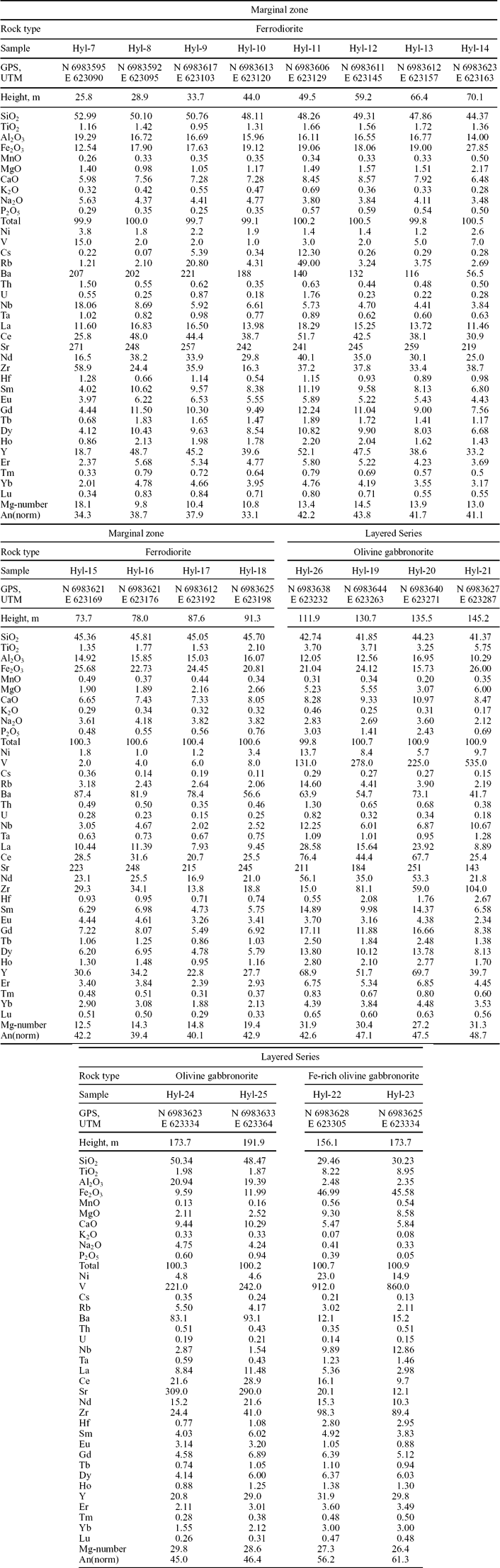
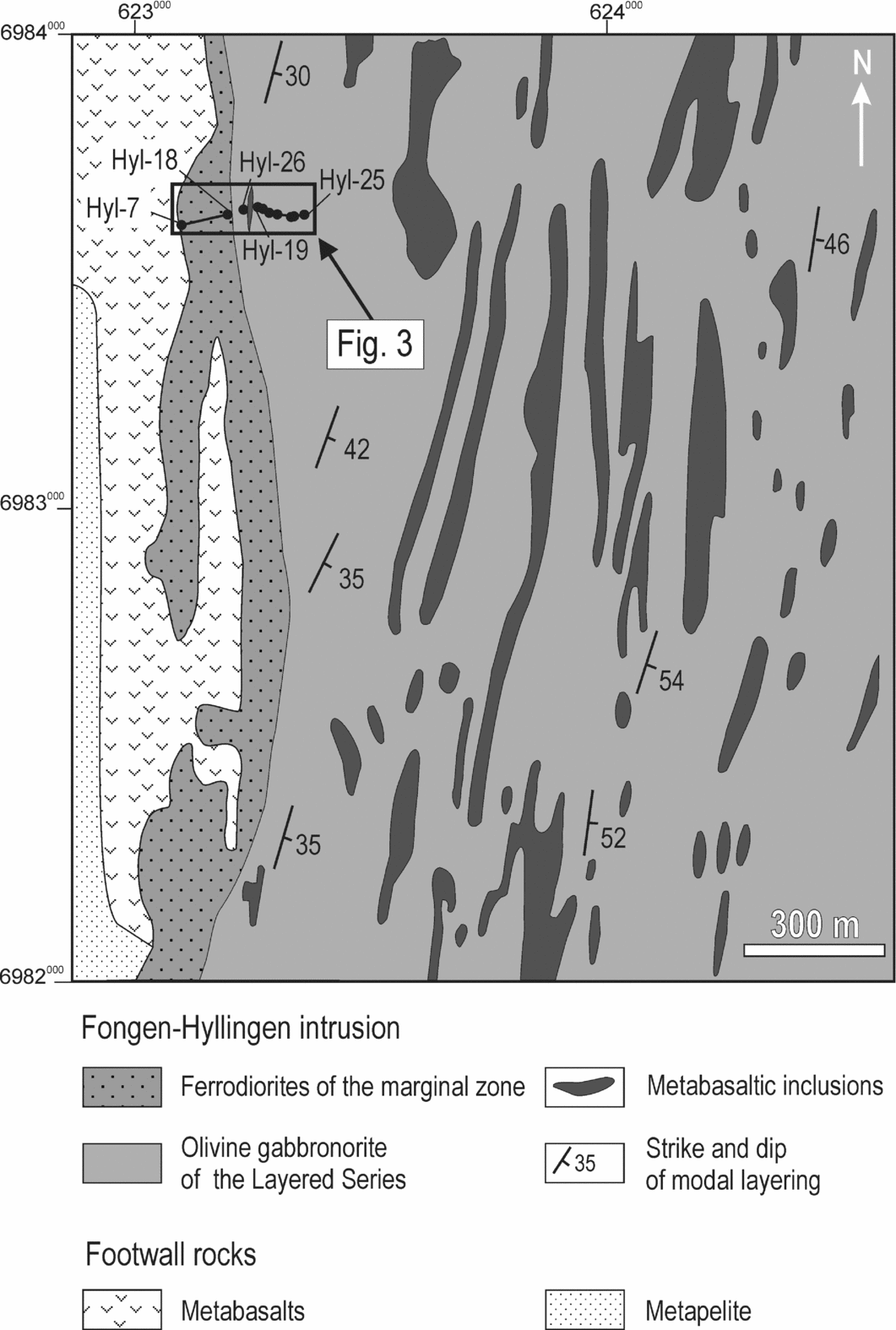
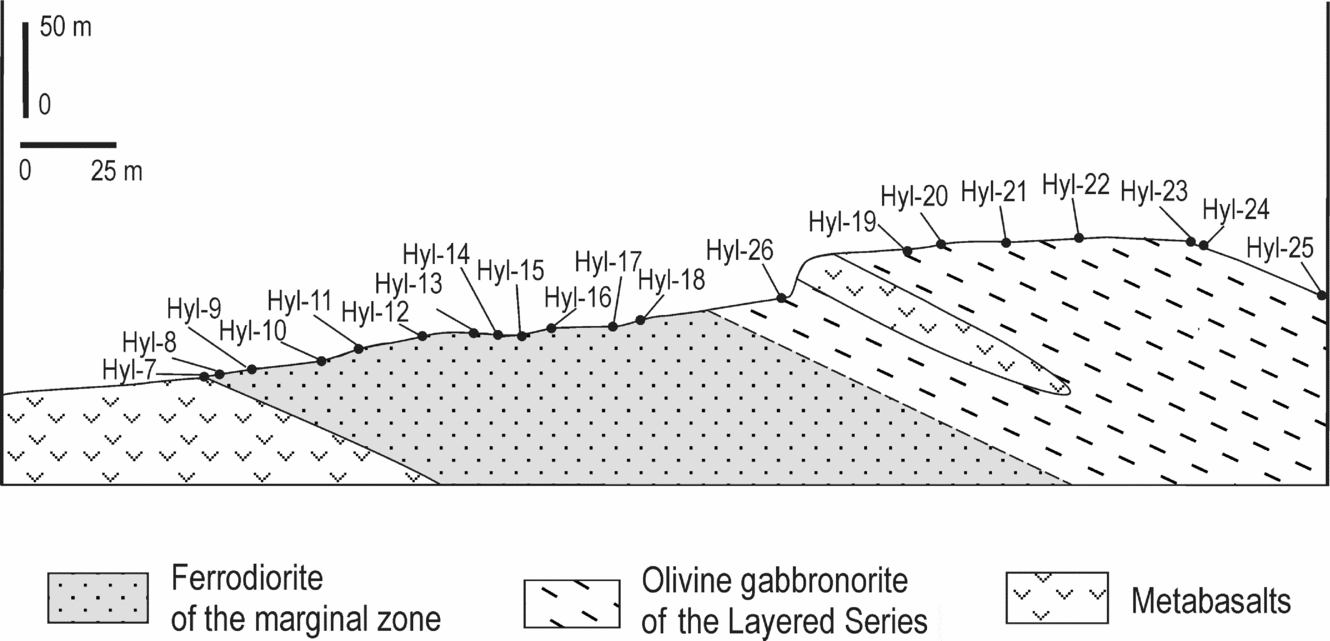
We have carried out detailed geochemical sampling through one profile across the basal part of the FHI (Fig. 2). Twenty-six samples were collected across the section (Fig. 3) and analysed for whole-rock major and trace elements and mineral compositions. Major and trace elements were determined by Genalysis Intertek Laboratory Services in Australia. X-ray fluorescence analyses of pressed pellets were used for determination of major elements and inductively coupled plasma mass spectrometry (ICP-MS) with four acid digests for trace elements. Accuracy of the measurements is within 10% relative for all major elements and 10–20% relative for trace elements. Certified reference materials GTS-2a, OREAS 45P and WGB-1 were used as standards. Selected samples were also re-analysed to confirm anomalous results. Detection limits are 0.01 wt% for all major elements except P2O5 with a detection limit of 0.002 wt%. Trace elements have the following detection limits: 0.1 ppm for Ba, Co, Li, Mo, Sc, Sn, W and Zr; 0.01 ppm for Ag, La, Ce, Sm, Nd, Eu, Dy, Er, Gd, Ho, Tm, Yb, Ta, Th and U; 0.02 ppm for Cd; 0.05 ppm for Cs, Rb, Ga, Ge, Hf, Nb, Sb, Sr and Y; 0.2 ppm for Ni and Cu; 0.005 ppm for Lu, Pr and Tb; 0.5 ppm for Pb; 2 ppm for Cr; and 1 ppm for V. Mineral compositions were determined at the Institute of Geology and Mineralogy, Novosibirsk, Russia using a Camebax Micro electron microprobe. Standard analytical conditions were 15 kV acceleration voltage, 10 nA cup current, 10 μm beam diameter and 10–40 second counting time. Natural and synthetic minerals were used as standards. Table 1 presents whole-rock major, trace and rare earth element (REE) data for samples from the marginal zone and overlying rocks of the Layered Series. A complete list of whole-rock and mineral analyses for all samples is available in the online Supplementary Material at http://journals.cambridge.org/geo.
Major (wt%, XRF) and trace element (ppm, ICP-MS) data for rocks of the marginal zone and Layered Series of the Fongen–Hyllingen Layered Intrusion

An(norm) = 100*An/(An+Ab) mol%; Mg-number = 100*Mg/(Mg+Fe) at%; *Total Fe presented as Fe2O3. GPS coordinates as in Figure 2.
Detailed outcrop map of the study area showing the marginal zone and the lower part of the Layered Series of the FHI and its footwall rocks (simplified from Wilson, Reference Wilson2010). Also shown is the distribution of raft-like metabasalt inclusions. The marginal rocks have a discordance of about 7° with modal layering in the overlying rocks of the Layered Series. Sampling points are indicated on the map and listed in Table 1 and in the online Supplementary Material at http://journals.cambridge.org/geo along with their GPS coordinates. Location of the study area is shown in Figure 1.

Schematic section of the marginal zone and the lower part of the Layered Series of the FHI showing the location of sampling points. Note the presence of a raft-like metabasalt inclusion in the Layered Series. Location of the study area is shown in Figure 2.

4. Field relations and petrography
The 50 to 100 m thick marginal zone occurs along the western contact of the Hyllingen Series of the FHI. The zone is underlain by metabasalts and metapelites and overlain by olivine gabbronorites of the Layered Series (Figs 2, 3). In the study area the marginal zone is well exposed, although its contacts with underlying metabasalts and overlying cumulates of the Layered Series are unfortunately covered. The marginal zone is composed of non-layered, medium-grained ferrodiorites. Unlike the quite homogeneous ferrodiorites, the overlying olivine gabbronorites of the Layered Series tend to show quite distinct modal layering that is caused by alternation of plagioclase-rich and plagioclase-poor layers. The marginal ferrodiorites have a discordance of about 7° with the modal layering in the overlying rocks of the Layered Series. Within these rocks is seated a metabasalt inclusion that is oriented with its long axis N–S. In the lower part of the Layered Series there are several ~ 20–30 cm thick schlieren of massive, medium-grained olivine gabbronorites with an extremely large amount of Fe–Ti oxides. Such rocks do not appear to have been specifically described in this intrusion. All rocks of the marginal zone and part of the Layered Series have experienced post-magmatic alteration. The main effect of this alteration is to convert the primary mafic minerals to secondary amphiboles. Clinopyroxene is usually almost completely replaced by green calcic amphibole. Grunerite mantles or entirely replaces olivine and/or orthopyroxene. Plagioclase and primary brown calcic amphibole usually remain preserved.
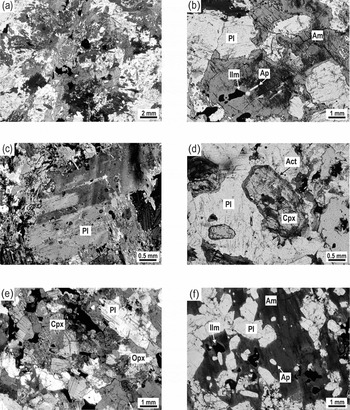
Ferrodiorites of the marginal zone consist of plagioclase (40–50 vol.%), clinopyroxene (10–15 vol.%) and brown calcic amphibole (25–30 vol.%), with the amount of apatite and Fe–Ti oxides reaching about 5 vol.%. Plagioclase, clinopyroxene, apatite and Fe–Ti oxides are cumulus phases (Wilson, Esbensen & Thy, Reference Wilson, Esbensen and Thy1981; Wilson & Sørensen, Reference Wilson, Sørensen and Cawthorn1996; Wilson, Reference Wilson2010). Olivine and orthopyroxene were also apparently present as cumulus phases but are now completely altered. The textures are panidiomorphic to sometimes poikilitic. Plagioclase forms subhedral tabular grains of about 2–4 mm in size with well-developed magmatic zonation (Fig. 4c). Clinopyroxene is preserved in some samples where it forms small euhedral grains of 1–2 mm in size (Fig. 4d). Brown calcic amphibole is the most common fresh mafic mineral of ferrodiorites. It always occurs as an intercumulus phase throughout the entire marginal zone where it forms large, brown oikocrysts containing plagioclase, Fe–Ti oxides and apatite (Fig. 4b).
Photomicrographs of representative rocks from the marginal zone and the Layered Series of the FHI. (a) Ferrodiorite from the lower part of the marginal zone that experienced strong post-magmatic alteration. The primary mafic minerals are converted to secondary green amphiboles (sample Hyl-8). (b) Intercumulus primary brown calcic amphibole in marginal ferrodiorites that forms large oikocrysts containing plagioclase, ilmenite and apatite (sample Hyl-11). (c) Well-preserved subhedral tabular plagioclase with magmatic zonation from the marginal zone (sample Hyl-11). (d) Clinopyroxene grain that is rimmed by secondary green amphibole from the marginal zone (sample Hyl-12). (e) Medium-grained olivine gabbronorite of the Layered Series (Hyl-22). (f) Brown amphibole in olivine gabbronorite of the Layered Series that forms megascopic poikilitic grains containing plagioclase, ilmenite and apatite (sample Hyl-20). Photomicrographs (a), (b), (d) and (f) are in plane polarized light whereas (c) and (e) are in cross-polarized light. Pl – plagioclase; Opx – orthopyroxene; Cpx – clinopyroxene; Ilm – ilmenite, Ap – apatite; Am – calcic amphibole; Act – actinolite.

Olivine gabbronorites of the Layered Series occur as alternating plagioclase-rich and plagioclase-poor layers that are several centimetres thick. The plagioclase-poor layers are composed of plagioclase (25–30 vol.%), orthopyroxene (5–20 vol.%), clinopyroxene (10–15%), brown calcic amphibole (14–20%), apatite (3 vol.%) and Fe–Ti oxides (3 vol.%). Olivine is present in these rocks (5–10 vol.%) and is commonly oxidized to symplectitic intergrowths of magnetite and orthopyroxene. The plagioclase-rich layers consist predominantly of plagioclase (70 vol.%) and less abundant mafic minerals (clinopyroxene and orthopyroxene, 30 vol.%). Cumulus plagioclase, pyroxenes and olivine form grains of anhedral to subhedral shape with a size of about 2–4 mm (Fig. 4e). Brown calcic amphibole forms large crystals that poikilitically include grains of plagioclase, Fe–Ti oxides and euhedral apatite (Fig. 4f). Massive, medium-grained olivine gabbronorites in schlieren are mostly composed of olivine, pyroxenes and ilmenite that are enclosed by large poikilitic crystals of plagioclase.
5. Whole-rock and mineral chemistry
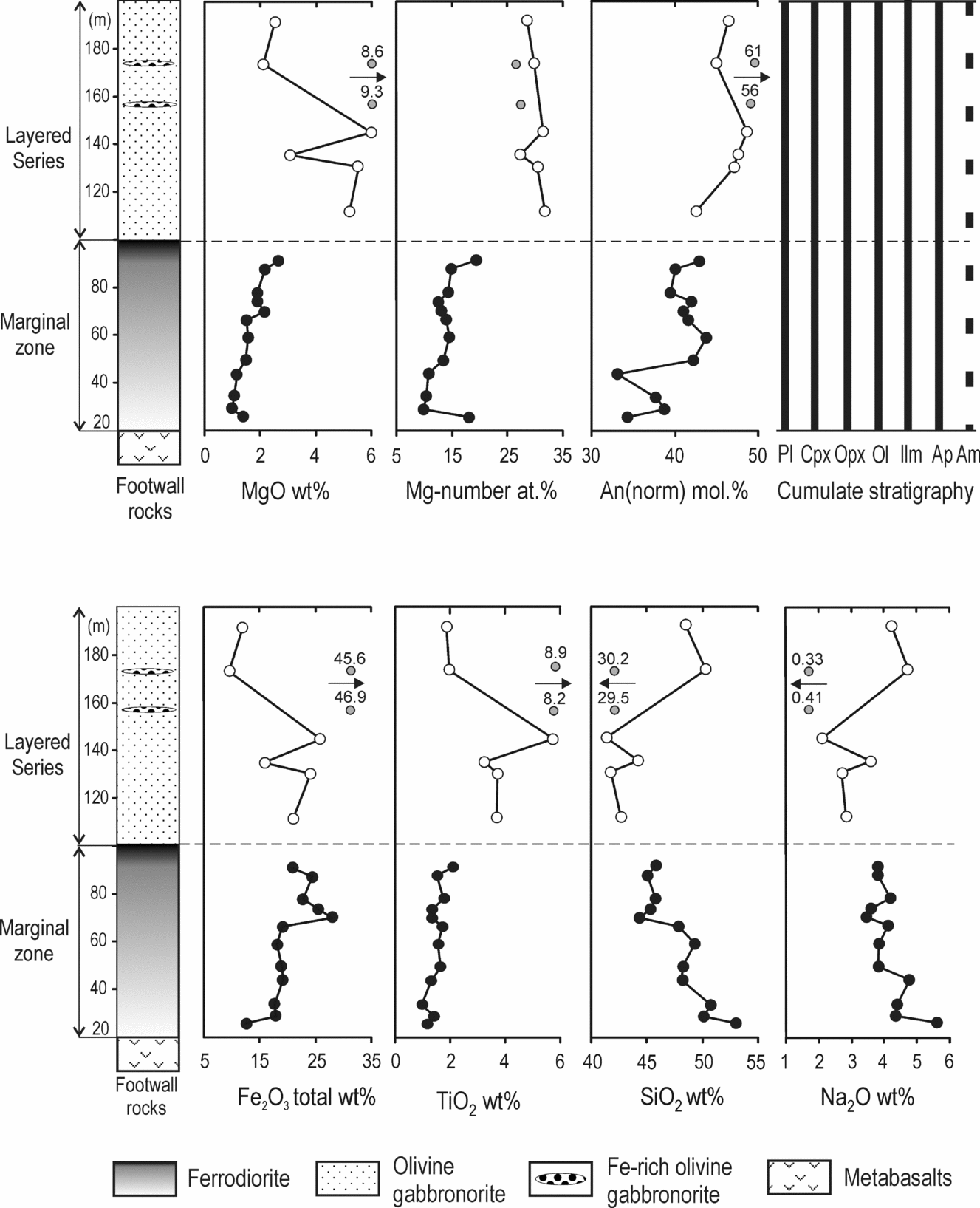
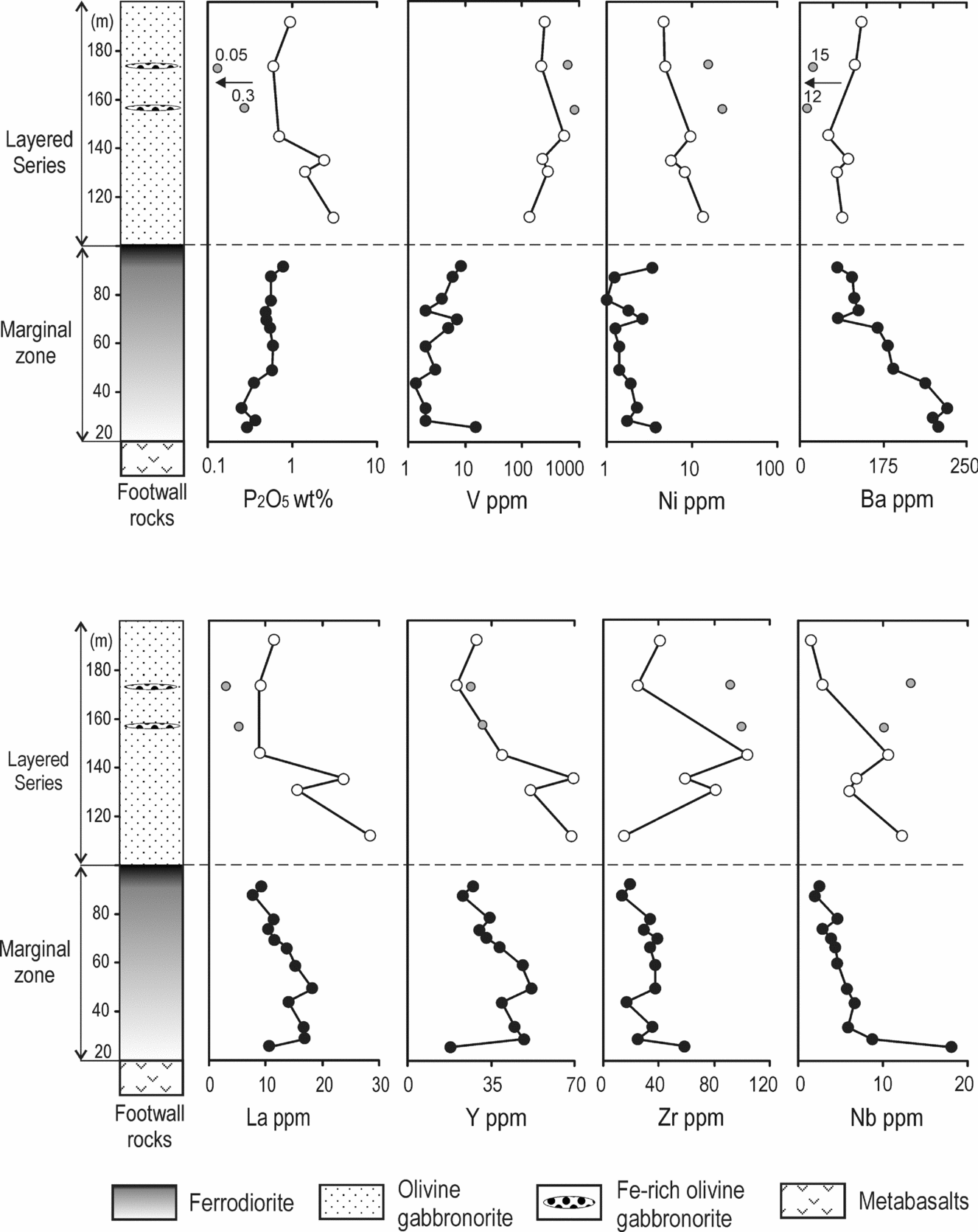
The marginal zone is composed of ferrodiorites that are distinguished by extremely high iron contents (up to 28 wt% Fe2O3total) that appear to be quite uncommon in mafic layered intrusions. For comparison, ferrodiorites of the Skaergaard and Kiglapait intrusions contain only as much as 20–22 wt% Fe2O3total (Wager & Brown, Reference Wager and Brown1968; Morse, Reference Morse1981). The most important feature of the marginal zone is the remarkable reverse compositional trends in terms of whole-rock major and trace elements from the base to the very top (Figs 5, 6). The reverse trends are particularly well exemplified by a significant upward increase in whole-rock MgO (from 1 wt% to 2.66 wt%), Mg-number (from 10 at.% to 19 at.%), normative An (from 33 mol.% to 43 mol.%) and by decreases in SiO2 (from 52 wt% to 45 wt%) and Na2O (from 5.6 wt% to 3.8 wt%) (Fig. 5). Note that similar reverse trends are exhibited by P2O5 (from 0.29 wt% to 0.76 wt%) and TiO2 (from 1.16 wt% to 2.1 wt%), which also behave as compatible components because apatite and ilmenite are cumulus phases in these rocks. Especially noteworthy is the systematic two- to three-fold upward decrease in all incompatible components (Fig. 6). For instance, Nb decreases from 18 ppm to 2.52 ppm, Ba from 220 ppm to 56 ppm, Zr from 58 ppm to 18 ppm and La from 16 ppm to 8 ppm.
Stratigraphic section, cumulate stratigraphy and whole-rock chemical compositions through the marginal zone (filled circles) and the lower part of the Layered Series (open circles) of the FHI in the study area. Note that the marginal zone reveals well-developed reverse fractionation trends in terms of An(norm), Mg-number, MgO, SiO2 and Na2O that are abruptly terminated at the contact with the overlying Layered Series. Compositional points (grey circles) of Fe-rich olivine gabbronorite schlieren are shown not to scale. The thick continuous lines indicate cumulus minerals. Pl – plagioclase; Opx – orthopyroxene; Cpx – clinopyroxene; Ol – olivine; Ilm – ilmenite, Ap – apatite; Am – calcic amphibole. An(norm) = 100*An/(An+Ab); Mg-number = 100*Mg/(Mg+Fe).

Stratigraphic section with whole-rock compositions through the marginal zone (filled circles) and the lower part of the Layered Series (open circles) of the FHI in the study area. Note that the marginal zone reveals well-developed reverse fractionation trends in terms of all geochemical indices that are abruptly terminated at the contact with the overlying Layered Series. Compositional points (grey circles) of Fe–Ti-rich olivine gabbronorite schlieren are shown not to scale.

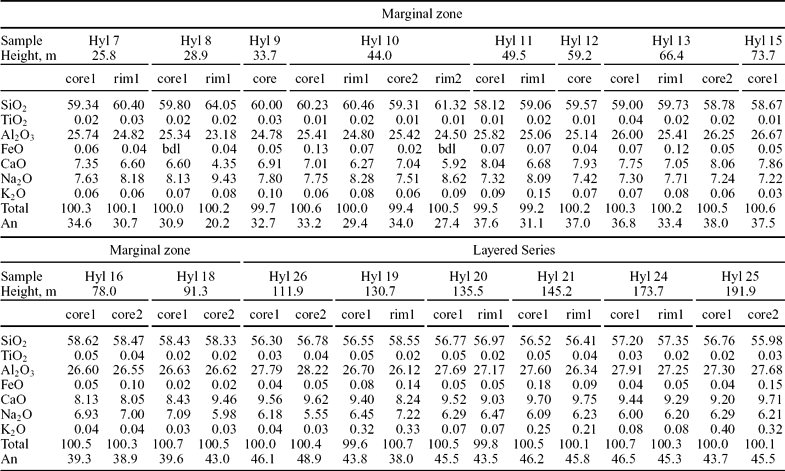
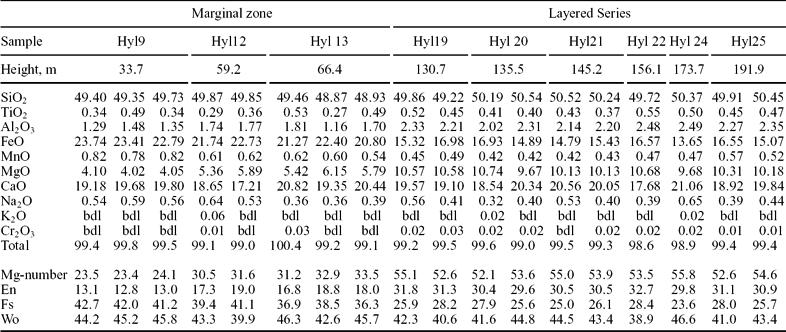
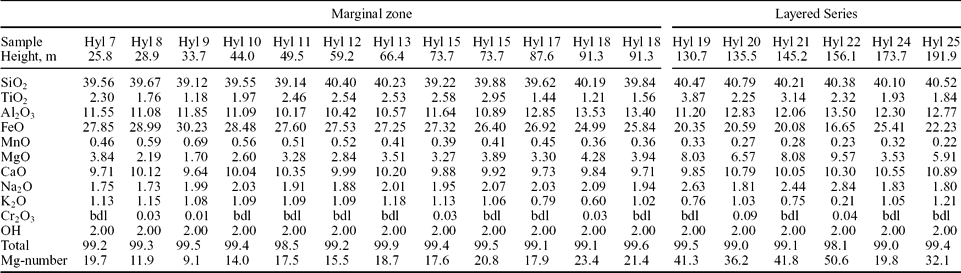
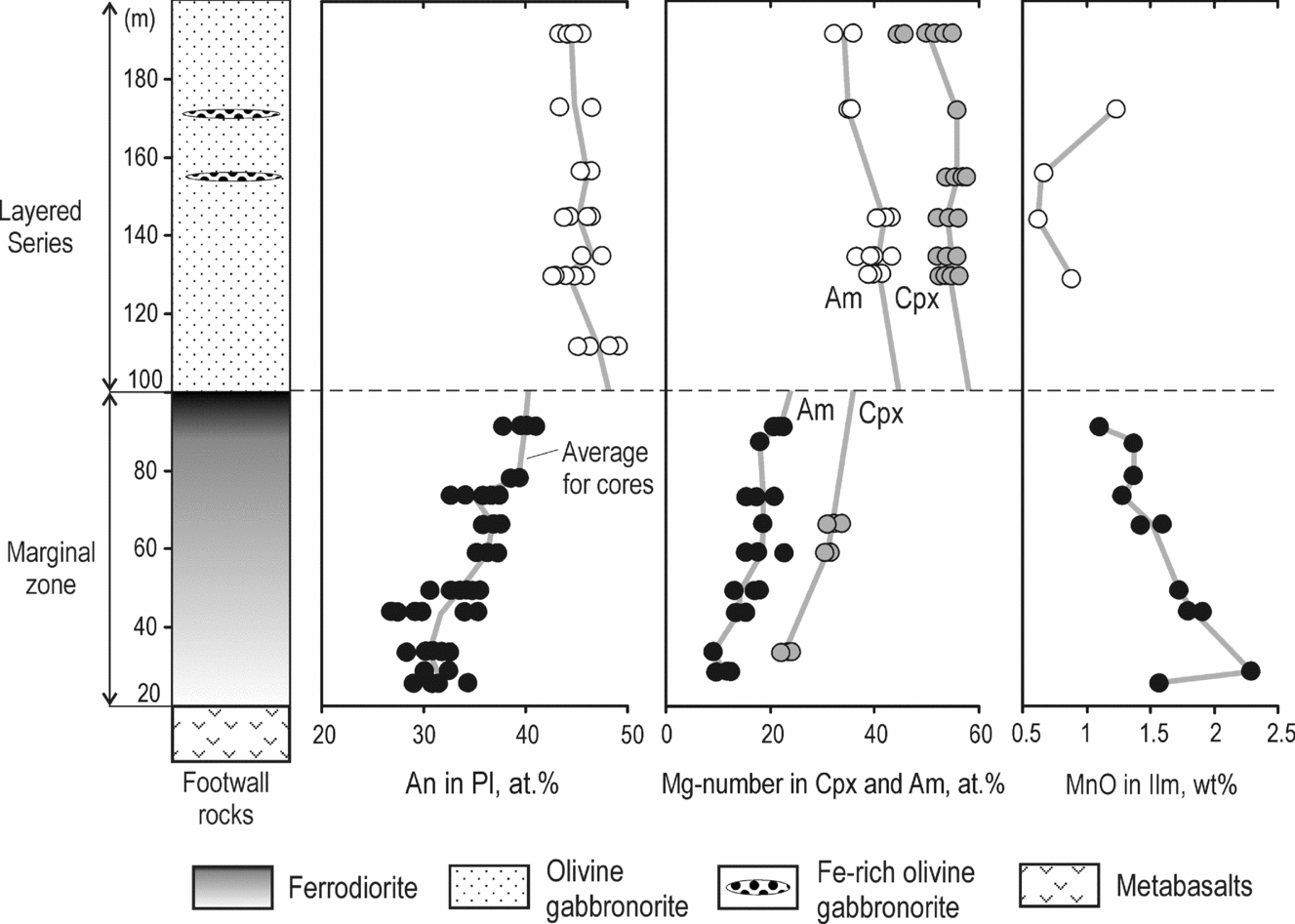
The above tendency is highlighted by reverse trends in composition of rock-forming minerals such as plagioclase, amphibole and clinopyroxene. Microprobe data on these minerals show a systematic upward increase in the An-content of plagioclase (from 30 at.% to 43 at.%) and in Mg-number of calcic amphibole (from 9 at.% to 23.4 at.%) and clinopyroxene (from 23.5 at.% to 33.2 at.%) (Fig. 7; Table 2). It should be emphasized that the plagioclases are normally zoned, with An-rich cores gradually passing into An-poor rims with composition differences of up to 5–10% An. This means that the observed compositional trends in plagioclase are of primary magmatic origin since chemical diffusivity in plagioclase is very low, allowing preservation of original compositions in spite of post-magmatic re-equilibration with interstitial liquid (e.g. Morse, Reference Morse1984). Clinopyroxenes have compositions in the range of En13–18Fs36–43Wo40–46 and are classified as hedenbergite (Morimoto et al. Reference Morimoto1988). Their Al contents increase (from 1.29 wt% to 1.8 wt%) whereas Na2O decreases (from 0.64 wt% to 0.36 wt%) with increasing Mg-number upwards in the section (Fig. 7; Table 3). Brown calcic amphibole ranges from titanian hastingsite through titanian hastingsitic hornblende to ferro-edenitic hornblende (Leake, Reference Leake1978). The composition of this amphibole usually varies within individual samples, particularly in terms of its Mg-number and TiO2, Al2O3 and MnO contents (Table 4). Minor Fe–Ti oxides are represented by ilmenite showing no extensive oxy-solution. The Mn-content of ilmenite systematically decreases from 2.29 to 1.1 wt% from the bottom to the top of the marginal zone (Fig. 7), apparently indicating an upward increase in temperature (Neumann, Reference Neumann1974) and/or a decrease in oxygen fugacity (Czamanske & Mihalik, Reference Czamanske and Mihálik1972).
Representative major element data (wt%) for plagioclase from the marginal zone and Layered Series rocks of the Fongen–Hyllingen Layered Intrusion

An = 100*Ca/(Ca+Na), at%; bdl – below detection limit.
Representative major element data (wt%) for clinopyroxene from the marginal zone and Layered Series rocks of the Fongen–Hyllingen Layered Intrusion

Mg-number = 100*Mg/(Mg+Fe), En = 100*Mg/(Mg+Fe+Ca), Fs = 100*Fe/(Mg+Fe+Ca), Wo = 100*Ca/(Mg+Fe+Ca), at.%
bdl – below detection limit.
Representative major element data (wt%) for amphibole from the marginal zone and Layered Series rocks of the Fongen–Hyllingen Layered Intrusion

Mg-number = 100*Mg / (Mg+Fe), En = 100*Mg/(Mg+Fe+Ca), Fs = 100*Fe/(Mg+Fe+Ca), Wo = 100*Ca/(Mg+Fe+Ca), at.%
bdl – below detection limit.
Stratigraphic section with mineral compositional variations through the marginal zone and the lower part of the Layered Series of the FHI in the study area. Note that the marginal zone reveals well-developed reverse fractionation trends in terms of An-content of plagioclase, Mg-number of clinopyroxene and amphibole, and Mn-content of ilmenite. An = 100*An/(An+Ab); Mg-number = 100*Mg/(Mg+Fe).

Unlike previous studies (Wilson & Engell-Sørensen, Reference Wilson and Engell-Sørensen1986; Wilson et al. Reference Wilson, Menuge, Pedersen, Engell-Sørensen and Parsons1987; Wilson & Sørensen, Reference Wilson, Sørensen and Cawthorn1996), our data demonstrate that the contact between the marginal zone and the Layered Series is marked by an abrupt change in mineral and rock geochemistry (Figs 5–7). This is especially evident from a step-like increase in Mg-number of clinopyroxene and amphibole and An-content of plagioclase in rocks of the Layered Series (Fig. 7). This fact is also strongly supported by a sharp increase in whole-rock Mg-number, MgO, TiO2, P2O5, V and Ni in rocks of the Layered Series. For example, Mg-number and V content increase from 19 at.% and 10 ppm in ferrodiorites to 35 at.% and 100 ppm in olivine gabbronorites of the Layered Series, respectively. The schlieren of olivine gabbronorites that occur in the Layered Series are distinguished by extremely high contents of Fe2O3total and TiO2 (45.6–47 wt% and 8.2–9.0 wt%, respectively). They are strongly depleted in SiO2, Al2O3, Na2O, K2O, large ion lithophile (LIL) elements (Cs, Rb, Ba, Sr) and light REEs (LREEs) and are enriched in siderophile elements (V, Ni, Co, Mn, Cr), high-field-strength elements (HFSEs) (Nb, Ta, Zr, Hf) and heavy REEs (HREEs) relative to the host rocks of the Layered Series (Table 1 and online Supplementary Material at http://journals.cambridge.org/geo). In mafic layered intrusions, Fe-enriched rocks with such geochemical characteristics are commonly attributed to having originated from Fe-rich immiscible liquid (e.g. Veksler et al. Reference Veksler, Dorfman, Borisov, Wirth and Dingwell2007; Holness et al. Reference Holness, Stripp, Humphreys, Veksler, Nielsen and Tegner2011; Jakobsen et al. Reference Jakobsen, Veksler, Tegner and Brooks2011). The only problem is that in our case the schlieren of Fe-rich olivine gabbronorites are very poor in P2O5 (0.05–0.39 wt% versus 0.69–2.41 wt% in host rocks) that is known to concentrate in Fe-rich immiscible liquid (e.g. Philpotts, Reference Philpotts1967; Veksler et al. Reference Veksler, Dorfman, Borisov, Wirth and Dingwell2007). The origin of these interesting rocks represents a separate problem and a detailed discussion is therefore beyond the scope of this paper.
6. Discussion
The origin of the marginal zone of the FHI can be deciphered from its geological and petrological features. Most important among them are the following: (1) the marginal zone and the Layered Series of the intrusion essentially behave as two separate petrological units with about 7° of angular discordance between each other; (2) the marginal zone is composed of non-layered, rather evolved ferrodiorites whereas the Layered Series is made up of well-layered, more primitive olivine gabbronorites; (3) upward reverse trends in terms of both mineral and whole-rock composition are observed in ferrodiorites of the marginal zone; (4) plagioclase is zoned, indicating that their cores preserve original magmatic composition and consequently the mineral reverse fractionation trends are of primary origin; (5) reverse compositional trends of the marginal zone are sharply terminated by the more primitive mineral and rock composition of the Layered Series. The data indicate that the marginal zone of the FHI can be interpreted as a well-developed marginal reversal (Wilson & Engell-Sørensen, Reference Wilson and Engell-Sørensen1986).
We currently distinguish two different types of marginal reversals in mafic sills and layered intrusions (Latypov et al. Reference Latypov, Hanski, Lavrenchuk, Huhma and Havela2011; Egorova & Latypov, Reference Egorova and Latypov2012). The first one is the fully-developed type of marginal reversal, which is most common and reveals rock sequences that become progressively more primitive away from the intrusive contact. This continues until it reaches a crossover maximum that is marked by the most primitive composition of rocks in the entire intrusion (e.g. highest MgO, Mg-number or normative An). At this point the marginal reversal gives way to the Layered Series showing rock sequences that become progressively more evolved upwards. Thus, in terms of compositional trends, a typical marginal reversal represents a condensed mirror image of the overlying Layered Series, with the boundary between these two units running through the crossover maximum (Latypov, Reference Latypov2003a ; Latypov, Chistyakova & Alapieti, Reference Latypov, Chistyakova and Alapieti2007). The second type occurs if this development of the marginal zone through the complete evolutionary path is interrupted by a new large pulse of primitive magma that restarts the crystallization history in the chamber to form the compositionally contrasting Layered Series. As a result, the marginal reversal would stop forming, acquiring such characteristic features as an incomplete crystallization sequence and mineral compositional trends, as well as a sharp compositional break with the overlying rocks of the Layered Series. This type of marginal reversal is classified as an aborted reversal (Latypov et al. Reference Latypov, Hanski, Lavrenchuk, Huhma and Havela2011). In this context, a sharp compositional break between the marginal zone and Layered Series of the FHI (Figs 5–7) allows its interpretation as an aborted marginal reversal. This is the third example of an aborted marginal reversal that has been described so far from the layered intrusions (Latypov et al. Reference Latypov, Hanski, Lavrenchuk, Huhma and Havela2011; Egorova & Latypov, Reference Egorova and Latypov2012).
The origin of such a marginal reversal is difficult to reconcile with the hypotheses implying a closed system development of a basaltic magma chamber. As an illustration, the existence of mineral compositional trends cannot be explained by closed system models that consider marginal reversals as a result of a gradual increase in abundance of intratelluric phenocrysts (e.g. olivine) and/or intra-chamber crystallized cotectic phases inwards from an intrusive contact (e.g. Marsh, Reference Marsh1996; Ariskin & Yaroshevsky, Reference Ariskin and Yaroshevsky2006). In a similar way, the phenomenon cannot be explained by recent models involving migration of interstitial liquid in solidifying rocks in response to an imposed thermal gradient (Lundstrom et al. Reference Lundstrom, Boudreau, Huang and Ianno2007; Huang et al. Reference Huang, Lundstrom, Glessner, Ianno, Boudreau, Li, Ferré, Marshak and Defrates2009), or postcumulus redistribution of interstitial liquid caused by development of under-pressure zones in solidifying rocks (Aarnes, Podladchikov & Neumann, Reference Aarnes, Podladchikov and Neumann2008; Galerne et al. Reference Galerne, Neumann, Aarnes and Planke2010). This is because all these models predict that the primary compositions of minerals (e.g. plagioclase) must either be constant across the entire marginal reversal, or become more evolved inwards. This is not the case with the aborted marginal reversal of the FHI (Fig. 7). Its upward reverse compositional trends cannot therefore be derived from crystallization of a single portion of initial magma under closed system conditions.
The origin of the studied marginal reversal is much more compatible with the hypotheses invoking open system development of a basaltic magma chamber. The upward increase in An-content of plagioclase and an upward increase in Mg-number of mafic minerals (Fig. 7) are indicative of the formation of the marginal reversal by the prolonged emplacement of magmas that became more primitive with time. The emplacement of increasingly more primitive magmas is also strongly supported by the composition of interstitial calcic amphibole that reveals a reverse trend in Mg-number, indicating that intercumulus liquid also becomes more primitive up the section of the marginal zone. This process was followed by emplacement of a much larger portion of more primitive magma that crystallized into the overlying Layered Series with a sharp compositional break with the underlying marginal zone. It should be emphasized that the open system behaviour of the magma chamber is also strongly supported by a significant change in isotopic composition across the marginal reversal: Sr0 decreases upwards from 0.70535 to 0.70466 and rock εNd increases from 1.58 to 3.14 (Sørensen & Wilson, Reference Sørensen and Wilson1995). This sequence of events during the formation of the studied marginal reversal can be reconciled with two principle models invoking the open system development of basaltic magma chambers. These are a model by Wilson & Engell-Sørensen (Reference Wilson and Engell-Sørensen1986) involving a compositionally stratified magma and a so-called ‘three-increase’ model by Latypov et al. (Reference Latypov, Hanski, Lavrenchuk, Huhma and Havela2011).
The first model was developed by Wilson & Engell-Sørensen (Reference Wilson and Engell-Sørensen1986) specifically for the marginal reversal of the FHI. The authors suggested that the origin of this marginal reversal is consistent with crystallization during gradual elevation of compositionally stratified magma up an inclined surface in response to the influx of dense, primitive magma at the base of the chamber. The chamber is envisaged as having a wedge shape that inflates in response to the influx of dense increasingly primitive magma at the base. Evolved buoyant magma first comes into contact with the floor at the leading edge of the expanding wedge where some crystallization occurs. During continued magma expansion, successively more primitive magma comes into contact with the previously formed marginal rocks where the crystallization sequence would be the reverse of that in the parental stratified magma (Wilson & Engell-Sorensen, Reference Wilson and Engell-Sørensen1986). The compositional range of the reversal depends on that of the parental stratified magma. A stratified magma chamber (Fongen) was already present to the north before development of the Hyllingen part, and this is envisaged as having expanded southwards by the process outlined above (Wilson & Engell-Sorensen, Reference Wilson and Engell-Sørensen1986).
A second model has recently been introduced to explain marginal reversals in the Koitelainen and Imandra layered intrusions, Fennoscandian Shield (Latypov et al. Reference Latypov, Hanski, Lavrenchuk, Huhma and Havela2011; Egorova & Latypov, Reference Egorova and Latypov2012). This ‘three-increase model’ implies that rocks of marginal reversals become more primitive inwards in response to (1) an inward increase in the extent of primitivity of successively intruding magmas, (2) an inward increase in the extent of chemical equilibrium between phases with distance from cold country rocks, (3) an inward increase in the proportion of cumulus minerals in progressively forming rocks. In the frame of this model one can propose that the marginal zone of the FHI starts developing during the filling of the magma chamber by evolved magmas, which arrive from the fractionating feeder channel and become more primitive with time. The emplacement of increasingly more primitive magmas is a factor having a major effect on the generation of reverse mineral and rock compositional trends (Fig. 7). A gradual inward decrease in the degree of magma supercooling is a factor that contributes to an inward increase in Mg-number of pyroxenes and An-content of plagioclase in the marginal zone. The last contributing factor is an increase in the proportion of cumulus minerals as a result of a removal of an evolved liquid boundary layer from in situ growing crystals by magma continuously flowing along the base of the intrusion. This process has the strongest effect on an inward depletion of marginal rocks in highly incompatible elements such as Ba, REEs, Y, Zr and Nb (Fig. 6). The systematic nature of the reverse trends indicates that magma emplacement was continuous over a long time without sharp compositional steps.
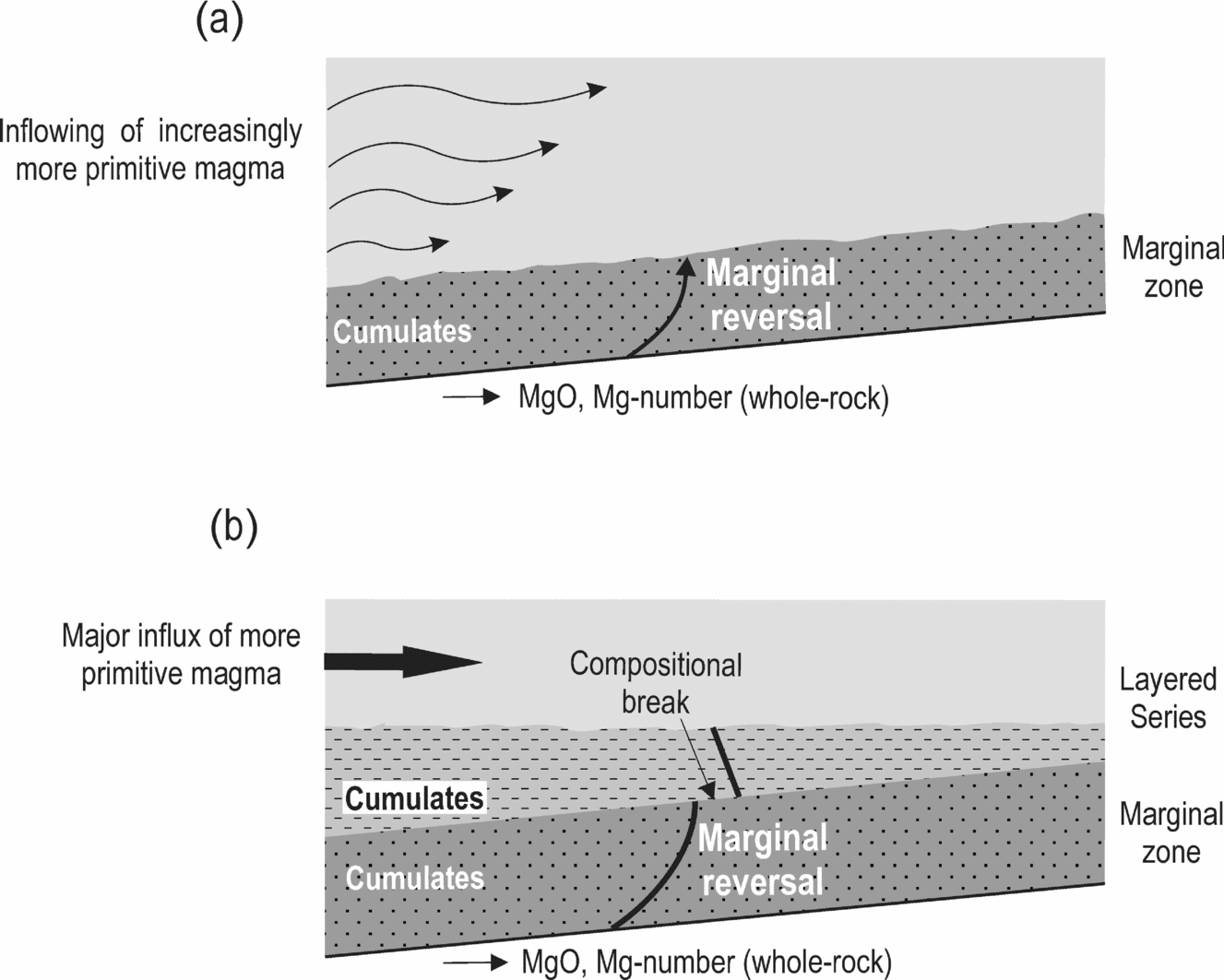
In principle, the above two models suggest equally good explanations for the origin of the marginal reversal of the FHI, since they both invoke filling of the opening chamber with magmas that become more primitive with time, and they both allow the emplacement of a large influx of more primitive magma to form the Layered Series (Fig. 8). The only difference between these models is in the source that these inflowing magmas are derived from: a fractionating feeder channel (Latypov et al. Reference Latypov, Hanski, Lavrenchuk, Huhma and Havela2011) versus a compositionally stratified magma chamber (Wilson & Engell-Sørensen, Reference Wilson and Engell-Sørensen1986). Since compositional features of marginal reversals produced by these two models are almost indistinguishable, no attempt is made here to make a choice between these models. One should note, however, that the model of Wilson & Engell-Sørensen (Reference Wilson and Engell-Sørensen1986) appears to be more preferable for this particular case since it explains not only the reverse trends of the marginal zone but also a discordant relationship between modal and cryptic layering in the intrusion as a whole. In fact, we agree with Wilson & Engell-Sørensen (Reference Wilson and Engell-Sørensen1986) that the Layered Series has most likely been produced from the subsequent major influx of a compositionally stratified magma. This is, however, beyond the scope of this study. At the same time, the model of Latypov et al. (Reference Latypov, Hanski, Lavrenchuk, Huhma and Havela2011) appears to be more universal since it can be applied to a larger number of magmatic bodies of various sizes and shapes. In particular, it is able to explain marginal reversals at the margins of dykes (e.g. Chistyakova & Latypov, Reference Chistyakova and Latypov2009, Reference Chistyakova and Latypov2010) and the bases of mafic sills (e.g. Latypov, Reference Latypov2003a , Reference Latypov b ) and sheet-like layered intrusions (Latypov et al. Reference Latypov, Hanski, Lavrenchuk, Huhma and Havela2011; Egorova & Latypov, Reference Egorova and Latypov2012) where compositionally stratified magma or crystallization along an inclined floor are not evident.
Schematic illustration of the formation of the marginal reversal of the FHI from inflowing magmas that become more primitive in composition with time. A marginal zone crystallizing from such inflowing magmas acquires features of a typical marginal reversal, with rocks and minerals becoming more primitive in composition inwards (a). This is followed by a major influx of a new magma that terminates the development of the marginal reversal and restarts crystallization with more primitive mineral and rock compositions of the Layered Series. This results in the formation of a sharp compositional break between the Layered Series and the underlying rocks of the marginal reversal (b).

7. Conclusions
This study has shown that the marginal zone of the FHI is a typical example of an aborted marginal reversal, a quite rare phenomenon in mafic layered intrusions. From the base upwards this zone is distinguished by pronounced reverse trends in mineral and whole-rock compositions of ferrodiorites that are terminated by a sharp compositional break at the contact with the overlying olivine gabbronorites of the Layered Series. The formation of such an aborted reversal is best explained within the frame of an open system evolution of the magmatic chamber involving progressive emplacement of increasingly more primitive magmas. This process is interpreted to have been interrupted by a major influx of more primitive magma that crystallized into the overlying Layered Series with a sharp compositional break with the underlying marginal zone. The proposed sequence of magma replenishment and rock-forming processes during the formation of the aborted marginal reversal of the FHI may be common for the initial stage in the development of basaltic magma chambers.
Acknowledgements
We are grateful to Richard Wilson for supporting this study and commenting on the contents of the manuscript. Rustam Latypov and Sofya Chistyakova are warmly thanked for assistance with fieldwork. We are indebted to Grant Cawthorn, Tony Morse and an anonymous reviewer for their helpful comments and suggestions, which contributed to improving the manuscript. Editorial input by Phil Leat is acknowledged. The research was supported by a Fellow Research Grant from the Finnish Academy of Science, Finnish Graduate School in Geology and a Grant of the President of the Russian Federation SS-698.2012.5.