Introduction
There are no simple returns in history.Footnote 1
This article is about acts of giving initiated by death, and the gift of death that initiates memory-making acts.Footnote 2 It derives its conceptual and philosophical inspiration from one of Walter Benjamin's many cryptic aphorisms, perhaps his most salutary for me as a professional historian: ‘At any given time, the living see themselves in the mid day of History. They are obliged to prepare a banquet for the past. The historian is the herald who invites the dead to the table.’Footnote 3 While other scholars have interpreted this enigmatic assertion variously, I am compelled to consider the code of hospitality to which the historian—the herald who invites the dead to the table—is obliged as they host what Benjamin calls ‘a banquet for the past’. At a minimum, such an ethic ought to accommodate the demands of the place where the banquet for the past is hosted, and also perhaps take into consideration the other guests who the historian-as-herald summons to the table.Footnote 4 As I write this, I am also mindful of Immanuel Kant's ruminations in the late eighteenth century when he observed, ‘Hospitality (a host's conduct to his guest) means the right of a stranger not to be treated in a hostile manner by another upon his arrival on the other's territory. If it can be done without causing his death, the stranger can be turned away, yet as long as the stranger behaves peacefully where he happens to be, his host may not treat him with hostility.’Footnote 5 Mindful of this imbrication of hostility and hospitality (hence the neologism ‘hostipitality’ he coined), Jacques Derrida insisted almost two centuries later, ‘To be what it “must” be, hospitality must not pay a debt, or be governed by a duty: it is gracious, and “must” not open itself to the guest [invited or visitor], either “conforming to duty” or even, to use the Kantian distinction again, “out of duty.” This unconditional law of hospitality, if such a thing is thinkable, would then be a law without imperative, without order and without duty. A law without law, in short.’Footnote 6
What Derrida ethically named ‘the law of unlimited hospitality (the one that would command that the “new arrival” be offered an unconditional welcome)’Footnote 7 might well, however, clash with the non-negotiable law of professional historical writing—premised on protocols regarding ascertainable facts, demonstrable evidence, causal reasoning, and principled truth-telling, among others—to which I am (as a card-carrying historian) also subject. This law is especially fraught in post-colonial contexts like India where, even after two centuries of its formalization, the discipline of history remains a rather elusive, even imperial, knowledge formation for a majority of its people. As others have shown, in such post-colonial contexts, the debate between history and myth, between ‘professional’ and ‘lay’ writing, between ‘major’ and ‘minor’ histories, and between ‘cloistered’ and ‘public’, pasts is especially consequential but remains unresolved, even after all this time, and especially in our time.Footnote 8 If in such a place and time I hold my banquet for the past and invite the dead to the table, does not the law of unlimited hospitality compel me to seek a ‘moment of freedom from History’,Footnote 9 and be ‘gracious’ as well to other modes of mindful remembering that are not hostile to the ahistorical, indeed even the openly anti-historical? What are the risks in keeping at bay my hostility, as academic historian, to such rememberings, and the challenges? These as well are my questions.
Inviting the dead (back) to the table
Historia abscondita [concealed history]—Every great human being exerts a retroactive force: for his sake all of history is placed in the balance again, and a thousand secrets of the past crawl out of their hiding places—into his sunshine.Footnote 10
My argument in these pages regarding history and hospitality unfolds in this space of uncertainty between these two laws—‘at the frontier between two regimes of law’.Footnote 11 But first, I will introduce you briefly to the dead man whom I have chosen to invite to the table, a man whose very name summons up today in Tamil-speaking India an image of extreme generosity and selfless altruism that for many remains unmatched to this day. His name is Pachaiyappa Mudaliar and he lived and died in the second half of the eighteenth century, yet he has a posthumous presence in the colonial and post-colonial Tamil life-world that far exceeds his significance in his own time, exerting in the process ‘a retroactive force’, to recall Nietzsche. Speaking on 5 January 1963 at the dedication of a large commemorative statue in his honour on the grounds of the college in Madras (today Chennai) that bears his name and that was initially endowed in 1841 by the charitable trust that also bears his name,Footnote 12 the then-president of the Republic of India, S. Radhakrishnan, declared, according to the recall of a member of the audience,
Pachaiyappar was the first Indian to create an endowment for education. Others have since then followed in his footsteps. Pachaiyappar was a deeply religious man, devoted to the cause of learning, and very skilled in commerce and trade. Believing as he did that all his wealth was because of God's grace, he desired that all of it should be given back to the cause of religion and learning. If others follow Pachaiyappar's noble example, we can look forward to a better future.Footnote 13
An important scholar-philosopher in his own right, and a worthy guest to have at any banquet for the past—especially one such as this, given his own connection to the college—the former president was only reiterating a century and more of new ‘truths’ that had accumulated in the Tamil country regarding Pachaiyappa as a man who rose from abject poverty to great riches on account of his skill, talent, and sheer hard work as a colonial ‘dubash’, and who had unstintingly and unselfishly given his all to various causes, especially education.Footnote 14
Such a memorialization of Pachaiyappa began in the aftermath of the formal establishment of the ‘charities’ in his name in 1841 in the wake of a series of decrees of the then Supreme Court of Judicature of Madras. This is the critical event that sets the stage for all narratives to follow, which transform Pachaiyappa from mere man to pioneering philanthropist (vallal), plucking him out of obscurity and memorializing him for posterity. Everything about him that preceded this critical event is rethought in light of this watershed moment, when ‘for his sake all of history is placed in balance again and a thousand secrets of the past crawl out of their hiding place—into his sunshine’, to recall Nietzsche yet again. His posthumous philanthropic persona thus casts a long shadow on what is said—and not—about Pachaiyappa's pre-mortem life and career, so much so it would not be incorrect to say that it is the fate of his fortune after this moment that has been critically constitutive for knowledge in our time of the man in his lifetime. Pachaiyappa as a historical entity is thus entirely a product of what Gerard Richter refers to as ‘the logic’ of afterness,Footnote 15 or what his ur-biographer referred to in Tamil, circa 1853, as ‘uttaracarittiram’, which I deliberately gloss as ‘after-history’.Footnote 16 The posthumous consequences of his gift is what makes Pachaiyappa a knowable subject—a subject even worthy of knowing—hence also the title of this article.
In making this argument, I turn to Walter Benjamin again for his luminous argument in his 1924 essay, ‘The Task of a Translator’, in which he proposed that every text has a life and afterlives. In Jeremy Tambling's reflections on this essay, ‘The text's living on in its original form is posthumous . . . Translation, then, works upon the posthumous, and by doing so releases the text into a new form of existence . . . The afterlife of the text becomes more important than its life . . . the life of the work depends on a posthumous existence.’Footnote 17 For, as Benjamin insisted, ‘the concept of life is given its due only if everything that has a history of its own, and is not merely the setting for history, is credited with life. In the final analysis the range of life must be determined by history rather than by nature.’Footnote 18 Adapting from these insights, I too suggest that Pachaiyappa has a life and afterlives, and that the afterlives are as important as the life originally lived, arguably even more so given their constitutiveness for the lived life. As in acts of translation, Pachaiyappa's pre-mortem life is recurrently released into new forms of existence as it comes to be periodically enlivened in light of the needs of a ‘now’ in which his ‘noble example’ could spur others to similar acts of giving, as President Radhakrishnan reminded his audience in summer 1963.Footnote 19
In turn, the fate of Pachaiyappa's fortune hinged on his untimely death without male heirs on or around 31 March 1794 in Tiruvaiyaru on the outskirts of the town of Tanjavur, and on a rather novel act that he performed a few days earlier when he wrote—in Tamil—his last testament. In themselves these events might not have guaranteed that Pachaiyappa's life would have released the afterlives that it does. It is what transpired after March 1794 that ensures this, for the administration of his will was contested for close to half a century, as a result of which litigation much of his fortune came to be inherited by all manner of beneficiaries whom he had not anticipated or even intended. Ironically, nowhere in his written will did Pachaiyappa specify the use of his fortune for the support of Hindu learning of even the traditional sort, let alone for the founding of modern secular schools and colleges that came to be established in his name in the second half of the nineteenth century and which secured for him the reputation of India's first educational philanthropist. Yet, this is how he is precisely recalled and remembered in the aftermath of the establishment of the charitable trust in his name, as his persona accumulates ‘commemorative density’, conferring upon him a posthumous aura that is quite completely at odds with his willed intention at the time of his death.Footnote 20
Acknowledging this strange twist of events which underscores that, after all, at its heart, modern philanthropy is a strange kindness directed towards strangers the donor may not know or even anticipate, V. Krishnamachariar, a member of the Board of Trustees of Pachaiyappa's Charities—and an early panegyrist—observed in 1892 on the occasion of the fiftieth anniversary of the institution,
It has been sometimes said that it is a curious comment on Pachaiyappa Mudaliar's foundations that from his gifts have sprung into existence institutions which he never contemplated, and that his funds were diverted from the objects to which he intended to apply them in favor of objects which—unquestionably deserving of endowment and good will—are as unquestionably called into existence by a pure fiction of the law. But it is this legal fiction on which the work of the Charity Commission in modern England is mainly based; it is this that has given rise to many a useful institution suited to modern requirements, though they were not contemplated by the founders in years gone by; and above all the Old Supreme Court of Madras could not have sanctioned by their decree of 1841 the application of the surplus funds of the testator to an educational charity unless the general intention of the testator to dedicate a portion of his wealth to the object of native education had been apparent upon the will. And does anybody doubt that if the shrewd and catholic-hearted Pachaiyappa could rise from his ashes and reappear among us at this moment he would be the first to admit the wisdom of the step taken to devote the accumulated surplus of his benefactions to purposes of general education and enlightenment and to regeneration of his countrymen?Footnote 21
Despite Krishnamachariar's confidence in the answer he expects to the rhetorical question that he poses at the very end of this assertion, the fact of the matter is that Pachaiyappa would not have readily recognized either the modern school (still a novelty in his own time in the Tamil country) that was established in his name, nor the key entity through which his pre-mortem life and career was salvaged and his posthumous philanthropy secured: the native charitable trust, an institutional innovation even at the time of its formal founding in 1841. He would indeed have received a posthumous shock, and might not have entirely agreed with the manner of the disposal of his fortune. In fact, I would argue that his death was necessary in order for the trustees charged with managing his bequest and his panegyrists to ensure Pachaiyappa's persona as path-breaking philanthropist. With his departure from the scene of action as a mortal being, his memorialization in terms that matter to later generations proceeds prolifically, and the disposal of his fortune too ebbed away from his control, in spite of the extraordinary effort he made to secure its posthumous fate.
Willing wealth away to strangers, accidentally
Obviously when you die, you lose control in any literal sense. But human law can, and does, open the door to a certain amount of post-mortem control. The dead hand rules, if we let it, from beyond the grave, at least up to a point.Footnote 22
On the threshold between Pachaiyappa's afterlives and his pre-mortem life stands a critical document, his will. This he signed (in Tamil) on 22 March 1794, about nine days before his death, while resident in the temple town of Kumbakonam where he had arrived a few days earlier from nearby Tanjavur. Like the flesh-and-blood Pachaiyappa himself, this pivotal legal instrument has a largely spectral existence in the aftermath of the man's passing.Footnote 23 Even the circumstances of its production are rather hazy. In its opening sentence, after noting the location and date of its creation as per the Tamil calendar, the very fact of its production is mentioned in a matter-of-fact fashion: ‘I have written this will (uyil) while I am in a declining state of health at Kumbakonam.’ There is little to indicate Pachaiyappa's awareness of how unusual it was for someone like him to perform such an act. Vinayaga Murthy, the scribe who wrote the document and who was a named beneficiary, later testified in the Court of Recorder in Madras on 26 April 1799 but did not offer much by way of describing the conditions under which the document was drafted, or even the material—paper or palm leaf—on which it was inscribed.Footnote 24 In the litigious aftermath of Pachaiyappa's death, others affirmed that he was seriously ill at the time of its writing, having been afflicted by palsy a couple years earlier, on account of which ‘his right hand always shook’.Footnote 25 It was likely that his eldest sister Subbammal, his senior wife (and Subbammal's daughter) Iyalammal, and possibly his nephew Muthiah (the son of another sister) may have been physically present when he finalized the document. All of them are named in the document and were beneficiaries. Two other men were present as witnesses, his priest Anna Gurukkal and Ramalingam, the former also a beneficiary. Having written his will and quite aware that he was dying, Pachaiyappa travelled from Kumbakonam to the sacred Shaiva site of Tiruvaiyaru to pass on there on or around 31 March.
Not present on the scene at either moment was the man Pachaiyappa nominated to be the legal administrator for his will, Neydavayal ‘Powney’ Narayana Pillai, although a week before his death, the protégé apparently wrote to his patron, partner, and proxy parent in Madras. In this letter dated 24 March, Pachaiyappa noted his worsening health and instructed his future executor in the event of his death to pay back a thousand pagodas to a business colleague to whom he owed the sum.Footnote 26 It is likely—although we may never know this for certain—that at the same time Pachaiyappa also dispatched his will to Narayana Pillai, for only a few weeks later in mid-May, the latter sought to ‘exhibit’ and ‘prove’ the document in the Mayor's Court (Ecclesiastical) in Madras.Footnote 27 On account of a suit instituted in the Mayor's Court soon after by Pachaiyappa's junior wife Palani Ayee, Narayana Pillai only secured his right to administer a year later in May 1795.Footnote 28 From then until 1841 when the final case was resolved on the very eve of the formal founding of the charities, Narayana Pillai and his heirs and kin were implicated in the posthumous fate of Pachaiyappa's fortune, shaping its contours and ends.
No one, possibly not even Pachaiyappa himself, knew the exact value of his fortune at the time of his death, and indeed, even decades later when the trust was finally created, the real extent of his estate remained a matter of doubt (despite the intense effort made by the colonial bureaucracy in both Madras and Tanjore, his two major centres of operation). Nevertheless, the will stipulated in its closing sentence that Narayana Pillai was ‘to execute the Remainder of the Estate agreeable to the direction of my sister [Subbammal] and Eldest Wife [Iyalammal]’. The will also authorized Narayana Pillai (and his son, Iyah Pillai) to use the interest from one lakh star pagodas (a sizeable sum of money for its time) for the performance of various religious services (civatarmam) in temples across India (‘from Kasi to Rameswaram’) ‘agreeable to [the list] I wrote and gave before’. When Narayana Pillai finally proved the will on 9 May 1795 and secured the probate (jaypapatrika) on 30 May, as per later court records, ‘no List was annexed to the said Will or filed at the time of proving the same’.Footnote 29
From the paper trail generated by the long history of litigation that followed his death, it is clear that Pachaiyappa had indeed created a ‘list’ (or ‘deed’, catanam) dated 12 January 1792 when resident in Madras, and left it for safekeeping with Iyah Pillai, Narayana Pillai's son and the man who succeeded as executor of his will on Narayana Pillai's death in November 1802. Nonetheless, neither father nor son, nor indeed his eldest sister and senior wife—all of whom Pachaiyappa had entrusted with the proper execution of his post-mortem legacy—honoured his willed intentions. Instead, as subsequently became apparent in court proceedings, another list of places ‘drawn out by the said Narrain and Iyah with the concurrence of the said Soobammall and Iyammall long subsequent to the death of the said Patcheapah’ became the beneficiary of his fortune.Footnote 30 A comparison of the places enumerated in this later list—although all Hindu and all religious—with the places (and amounts) originally listed in Pachaiyappa's 1792 deed reveals several key differences. It was, however, the posthumous list generated by his will's caretakers—not the one authorized by Pachaiyappa himself in January 1792—that also ultimately (and ironically) received the blessings of the British in 1826, and formed the basis of the ‘religious charities’ undertaken as well by the public trust set up in 1841.
In 1826, Thomas Strange, appointed in 1800 as the first chief justice of the newly constituted Supreme Court of Judicature at Madras—a position he held until 1816, in the course of which he presided over several of the early cases lodged around Pachaiyappa's estate—declared in a tone that we are very familiar with in the colonial archive, ‘One thing I observe in all the wills made by Hindoos of Madras is that a great proportion of the property is bequeathed to superstitious uses; the proportion is commonly in the ratio of the iniquity with which the property has been acquired, or of the sensuality and corruption to which it has been devoted. Sic hi non ipsis mellificant.’Footnote 31 At the time that Strange made this pronouncement, wills were becoming more common among elite Hindus across India, including the Madras Presidency, although it was only with the passage of the Hindu Wills Act in 1870 (Act XXI of 1870) that the British fully endorsed this new-fangled ‘pernicious anomaly’ that had increasingly begun to intrude into prevailing laws of succession among their subjects, much to the dismay of some them.Footnote 32 With wills increasingly accepted in certain circles as a legitimate legal instrument, native testators could indeed choose to dispose of their worldly possessions in any which way they sought. Nonetheless, even into the twentieth century, legal authorities noted that beneficiaries were usually family members and/or known religious institutions and entities. To this extent, although still relatively novel (but not singular) for its time, the terms of Pachaiyappa's will were not entirely unexpected in the enumeration of its beneficiaries. There were no real strangers unknown to the testator who were specifically named as legatees.
And yet, about 50 years later in 1841 when the trust was formally established and the total funds accumulated were estimated at over seven lakh rupees, over half of Pachaiyappa's estate (amounting to nearly four lakh rupees—the ‘surplus funds’ beyond the one lakh star pagodas stipulated in the will) was dedicated to the new cause of public education of ‘Hindu youths’, young students who were not known to the testator and quite unanticipated by him as beneficiaries of his stipulated largesse. This happened through a series of spectacular legal manoeuvres spearheaded by two advocates-general of the Presidency, Henry Compton (in office, 1822–1827) and especially George Norton (in office, 1828–1853). This is a story that I chart in greater detail elsewhere as I recount Pachaiyappa's posthumous transformation from ‘superstitious’ donor to educational philanthropist (although the colonial state, its rhetoric to the contrary, strategically folded in the testator's pious intentions into its own secularizing project). For now, I emphasize that Pachaiyappa's ‘dead hand’ did not quite rule, despite his intention to do so through the instrument of his will. In fact and ironically, if his dead hand had prevailed as such, it is not likely that he would have attained his posthumous reputation as educational philanthropist, as Norton acknowledged in Madras in October 1846 at the foundation-laying ceremony of an iconic building in the city (also funded from his fortune and also not intended by him) that enshrined Pachaiyappa—in bricks and mortar, no less—as the Tamil country's pioneering modern philanthropist.Footnote 33 In turn, generations of strangers who would otherwise not have heard of Pachaiyappa became familiar with him as beneficiaries of his (accidental) educational philanthropy. Indeed, they come to be known as ‘Pachaiyappa's boys’. Ironically then, and through the interventions of the colonial state, the man who had no male heirs posthumously acquired innumerable sons who carried (on) his name!
The philanthropist and his panegyrists
Panegyric expresses more than eulogy. Eulogy no doubt includes praise of the person, but it does not exclude a certain criticism, a certain blame. Panegyric entails neither blame nor criticism.Footnote 34
It is not just the grand lithic edifice of Pachaiyappa's Hall, but painted and printed pictures, prosaic narratives, and poetic utterances, which too make Pachaiyappa a familiar figure to millions of strangers who learn to recognize him as a great benefactor, perhaps the greatest of them all, who dedicated his life—and on his death, his fortune—to the cause of public education.
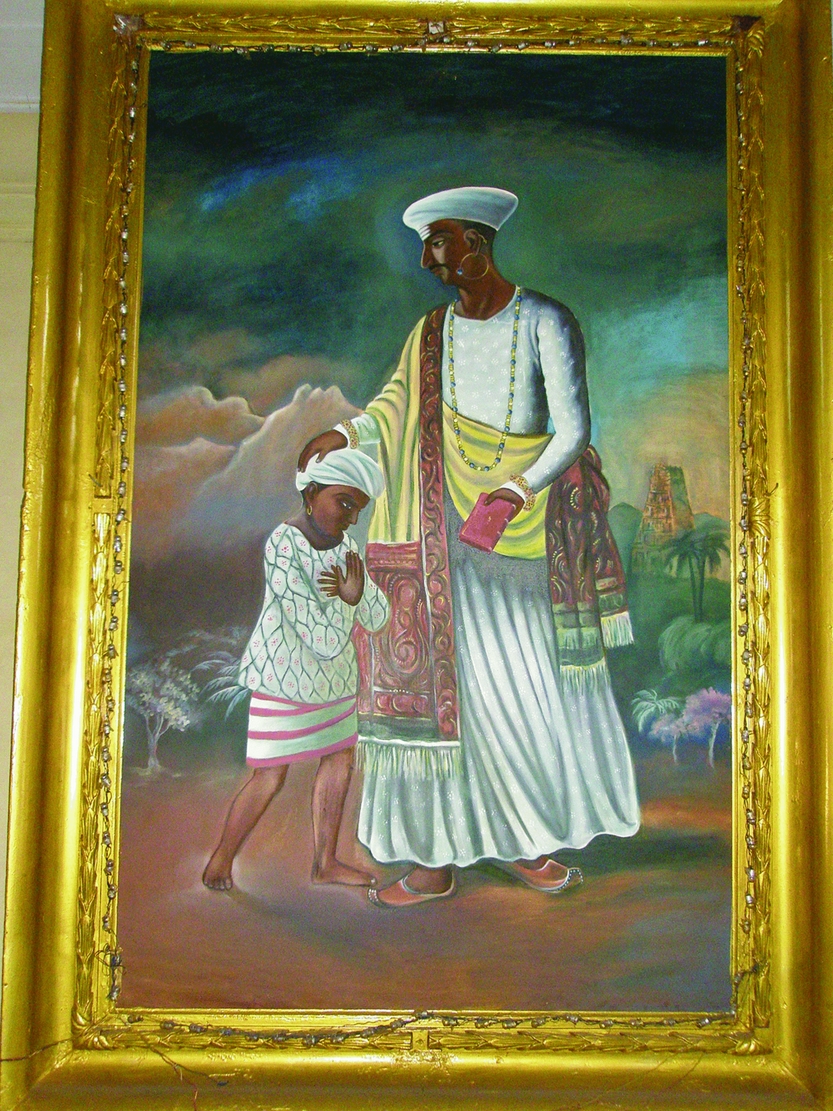
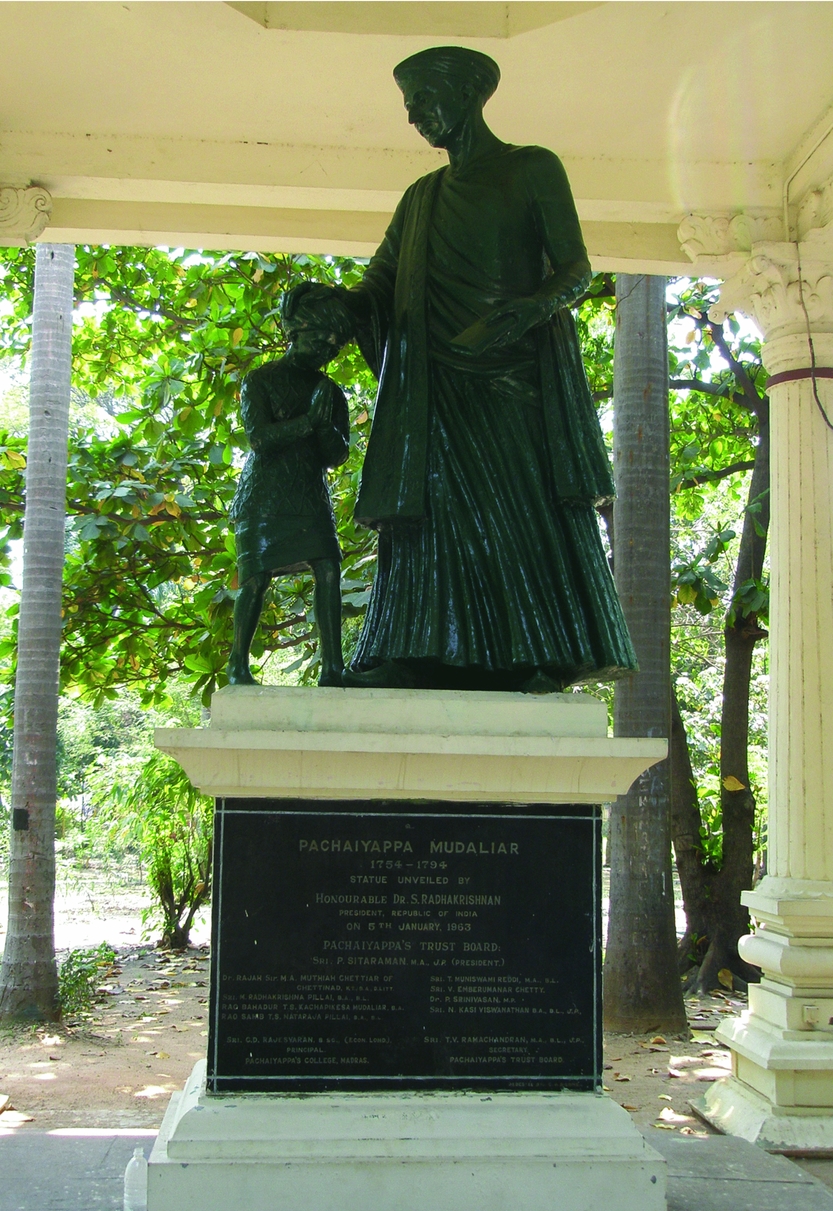
The process of memorializing Pachaiyappa in pictures as educational philanthropist began around 1850 when a large oil painting was displayed in the Hall whose façade was emblazoned with his name in Tamil. Since that time and thanks to the trust, this image—of an older man, book in hand, blessing a young boy—has proliferated as the dominant visual persona of Pachaiyappa (see Figure 1). The painting also provides the template for the metal statue, commissioned in the early 1960s for the grounds of the college where it stands to this day (see Figure 2) and a commemorative postage stamp issued by the Government of India in March 2010. On 24 March 1868, on the occasion of the annual commemoration of the founding of the charities, here is how the trust's then-patron, the Honourable John Bruce Norton, invoked the portrait: ‘And now I cannot more appropriately conclude, than by pointing to another Picture which at present completes that gallery of our Hall; the portrait of Pachaiyappa, our founder from whose benevolence such undreamt-of benefits have proceeded; who is depicted with his hand upon the head of a Hindu youth, happily typical, as it appears to me, of the blessing he has conferred, and will continue to confer upon generation after generation of his fellow countrymen.’Footnote 35
Pachaiyappa Mudaliar, oil on canvas, 6 x 4 feet, Pachaiyappa's College, Chennai. Source: Photograph by Rich Freeman.

Statue of Pachaiyappa Mudaliar, Pachaiyappa's College, Chennai. Source: Photograph by Rich Freeman.

In turn, this iconic portrait was commissioned in the 1840s by the trustees on the basis of a ‘small’ painting (patam) that apparently came into their hands from Pachaiyappa's time as a dubash in the Tanjavur court in the 1780s.Footnote 36 In this earlier image, Pachaiyappa is neither flanked by a young boy nor does he hold a book as a sign of his vidyadana, ‘gift of knowledge’. A contemporary of Pachaiyappa's, Paravasthu Tiruvengada Jiyar—who claimed to know him from his Tanjavur days—also apparently provided eyewitness testimony for the posthumous pictorial look:
According to the evidence furnished by him, Pachaiyappa was tall with long hands reaching down to the knees, an oval face and broad and clear eyes. He was of fair color and his forehead was broad and his nose, classical and aquiline. His dress usually consisted of a white muslin robe and a bright lace shawl thrown over the shoulder, a turban of those days, and a fine coloured cummerbund. The muslin robe that he wore was sometimes adorned with golden star spangles. He wore a number of ornaments on occasions of ceremony, including big ear-rings and emerald ear-drops, bangles set with rubies and diamonds, and valuable necklaces of pearls and precious stone, besides several rings on the fingers.Footnote 37
The man who was most likely responsible for commissioning the now-official painting of Pachaiyappa was Komaleswaranpettai Srinivasa Pillai, the second president of the trust, who also wrote the first biography on him in Tamil (‘in the English manner’) thereby inaugurating the tradition of prosaic panegyrics that continues to this day. The biography was completed around the time of Srinivasa Pillai's passing in 1853 when it might well have been printed as a limited edition work. It was reissued in 1911 with a new preface and a large appendix of praise poetry in honour of Pachaiyappa, and republished as recently as 2015 with a new Foreword. Titled Paccaiyappamutaliar Carittiram, ‘the History of Pachaiyappa Mudaliar’—incidentally also deemed the first example of Tamil prose by some—it has served as the ur-text for all subsequent narratives (in Tamil and English) on the life and career of Pachaiyappa, including by professional historians in India and abroad, and for textbooks prescribed for the Tamil schoolchild to read.Footnote 38
Srinivasa Pillai's biography was based on interviews with Tiruvengada Jiyar and on some letters and documents that apparently came to his hand via the family of Narayana Pillai. Even though he was a Madras notable, with influential connections to the colonial state, he nevertheless did not have access to official records on Pachaiyappa, either in Madras or in Tanjavur, or to the court proceedings on his will, all of which would have revealed ‘facts’ about his pre-mortem life and career that would have been quite at odds with the persona that Srinivasa Pillai sought to assemble for the founder-benefactor of the organization with which he was entrusted. In his biography, Pachaiyappa emerges as a virtuous man imbued with a precocious charitable disposition from his respectable but humble beginning. Despite the great fame he attained as a dubash, Pachaiyappa never ceased to look upon the wealth he amassed as merely a means to be of service to others. Indeed, and drawing on Srinivasa Pillai's work and writing for an English-speaking audience on the occasion of the fiftieth anniversary of the founding of the trust, V. Krishnamachariar noted that Pachaiyappa ‘acted as if he felt with the Indian poet who said that all the wealth acquired by one's perseverance was for the exercise of benevolence’.Footnote 39 From another more recent biography—also commissioned by the trust and gifted to students of the college—we learn that men like Pachaiyappa and others (who inspired by his example, added their wealth to his legacy),
. . . were not born great. Nor were they born with a silver spoon in their mouth. They were not bred to luxury. Nor did they breathe a literary atmosphere. Some of them were plainly illiterate. They could not even sign their names. They were of the earth, earthy. Yet, by dint of hard and sustained work, they acquired wealth, enormous wealth, and they generously willed it for the good and benefit of humanity at large. Such heroic and self-sacrificing actions placed the stamp of greatness on them, shining like a beacon to beckon to our people to follow in their footsteps.Footnote 40
Such panegyrics thus perform a valuable didactic function in instructing their modern audience in the value of accumulating wealth—honestly and through hard work—but, equally importantly, of alienating it in acts of benevolence and kindness. They also enlighten the moneyed on how to live and how to give—indeed, to live for the sake of giving. Not least, the panegyric complex works to accommodate parvenus like Pachaiyappa in a long durée ethic of giving by men who lived solely to give, and in dying, gave even more. He is deemed the worthy successor to three generations of seven mythic Tamil vallals, even exceeding them in his generosity. The archaic logic of the panegyric is thus put in motion to sustain a modern Tamil complex of living, dying, and giving in the age of colonial and industrial capital.
The panegyric complex, as it operated in the aftermath of the institutional creation of the charities in his name in 1841, is carried to its apogee in several poems composed by unknown as well as acclaimed scholar-poets (pulavar) which clear a space to accommodate Pachaiyappa among the more conventional objects of adulation in the Tamil life-world, even as they look ahead to an entirely new kind of patron: a modern educational philanthropist (kalvi vallal).Footnote 41 These poems were typically recited at the annual day celebrations of the school and educational institutions that bear Pachaiyappa's name in Madras, Kancipuram, and other places. In very many cases, they were the compositions of Tamil teachers attached to these establishments. They range from ornate and lengthy compositions to pithy four-line verses. They confer upon Pachaiyappa a status appropriate to other recipients of adulation in the Tamil country, especially kings and deities. Indeed, he is hailed in the same terms habitually used for sovereigns, such as makaracan, makipan komakan, puravalan, turantaran, and so on. He is deemed wealthier than Kubera(n), the lord of riches, and more generous than Karna(n), the paradigmatic figure of benevolence in the Hindu-Indic mythic universe. He is the ‘store house of compassion’ (tayaniti), and one whose benevolence is akin to the kalpavrksha, the wish-fulfilling tree that gives unstintingly. A long poem of 108 four-line verses composed around 1847 by a foremost poet-teacher of his generation, Kancipuram Sabapathy Mudaliar (d. 1870), even cast him in the role of the exemplary virtuous man (and monarch) as envisioned in what is arguably Tamil literary culture's most prized ethical book, the Tirukkural. Others suggest that the goddesses of wealth and learning, Sri and Saraswati, were so enamoured of him that they abandoned their own divine spouses to take up residence with him. More recently, a former student of the college and budding poet, Tanga Palanivel, has likened him—in a long poem he has composed with accompanying illustrations—to a wax candle that melted into nothing in order to make light for others.Footnote 42 His hand (kai) never ceased to give (ikai)—indeed, gave without expectation of return.
Kanakalatha Mukund and Indira Peterson have both shown how the big men of the later eighteenth century—the dubashes who came to historical prominence precisely as a consequence of serving as mediators for the British and French regimes centred on Madras and Pondichery—were rendered subjects of praise poetry that proliferated across the Tamil-speaking region: ‘Invoking the metaphors of classical poetry and deliberately resorting to the most flattering hyperbole, the poets constructed a new identity for the upcoming elite, recreating images and values from a heroic, classic past. In the process the poets ignored completely the dependence that their patrons themselves had on the Europeans, and invested the dubashes with all the stature and authority of royalty. In this representation, sadly, they also missed the genuine achievements and entrepreneurial skills of the elite which made it possible for them to survive in a changed environment.’Footnote 43 Such a characterization also holds for the poems written in praise of Pachaiyappa, although I would add that the panegyric complex in which he comes to be embedded, is also revealing about emergent Tamil attitudes towards accumulation of wealth and its dispersal in the critical age of transition to capitalist modernity.
It is also important to underscore that in the imperative to praise him, Tamil panegyrists were surely encouraged by the colonial state which, in a dramatic reversal after the establishment of the charities in 1841, enjoined upon the trustees the task of disseminating the new truth of Pachaiyappa's ‘enlightened benevolence’ far and wide by planting ‘durable Tablets or Monuments in stone or metal’ in the religious sites endowed by him, and at annual commemorative events. The colonial state itself became if not the panegyrist-in-chief, an active aider and abettor in the new economy of praise and gratitude that coalesced around Pachaiyappa. In speeches made by the British patrons of the trust and other notables into the 1940s, he was invoked in a manner that belied what earlier generations had said and written about men like him.Footnote 44 This refusal to remember only underscores that a constitutive gift event, like Pachaiyappa's, inaugurates massive acts of forgiving and forgetting, even as it proliferates new acts of telling and recall.
Wilful forgetting
Buried under the footprints of memory and history then opens the empire of forgetting, an empire divided against itself, torn between the threat of the definitive effacement of traces and the assurance that the resources of anamnesis are placed in reserve.Footnote 45
As a dubash, Pachaiyappa is embedded in the early colonial archive in an economy of derision and suspicion that offers a startling counterpoint (to those who have access to the archive, and only those, it has to be stressed) to the reciprocal circuits of praise and gratitude in which he comes to be installed after 1841. Pachaiyappa is indeed a classic example of what Alida Metcalf has referred to as ‘transactional mediators’, men without whom European rule could never have survived in the tropics, let alone taken off. Such transactional mediators, she argues, made possible communication, exchange, trade, settlement, and conquest.Footnote 46 These men were the indispensable cogs-in-the-wheel of what has recently been described as ‘the brokered world’.Footnote 47 In 1791 Edmund Burke wrote, ‘the world is governed by go-betweens’,Footnote 48 but in distant British India, by the time of this observation, the native incarnations of such mediators were marked men, for in the imperative to create a racially distinctive white ruling class, they were increasingly vilified and eventually cast out by those in power in the East India Company. Susan Nield-Basu has provided an important account of the Madras dubashes who by the late eighteenth century were deemed ‘a most diabolical race of men’, with acknowledgments of fruitful partnerships and collaborations from earlier times giving way to assertions of corruption, venality, untrustworthiness, and chicanery.Footnote 49 To be ‘dubashed’, in late eighteenth-century parlance, meant to be outwitted—and frequently robbed—by these clever, calculating men. To provide just one illustration of how his peers had come to be perceived by 1794 (the year of Pachaiyappa's death), I quote select verses from a lengthy poem published in the Anglo-Indian newspaper Madras Courier, and titled ‘The Sick Dubash’,
Pachaiyappa, as a subject of discourse in the colonial archive, has to be necessarily read against the grain of such an economy of disdain and distrust. In this discourse, he appears as a rather hazy figure, furtively moving about the corridors of power in princely Tanjavur and colonial Madras. He is a behind-the-scenes wheeler-dealer, stealthy fixer of various inconveniences for sundry Europeans, a foot soldier for his patron Narayana Pillai, and, not least, a rapacious moneylender and broker. In contrast to the wholesome and fulsome portrait that emerged posthumously in the aftermath of 1841, his persona is fragmentary and dispersed in these official documents where his antecedents and rise to power are shady at best. Recalled after 1841 by the Tamil panegyrists as hailing from a respectable high-caste Vellala agricultural family, the son of the hard-working Viswanatha Mudaliar, in the Company's administrative and legal records of the preceding decades he is cast as the illegitimate child—along with his two sisters—of an enterprising woman called Boochi Ammal whose caste origins are unknown. Where later panegyrists lament that he was compelled to marry again when his first wife failed to produce a male heir, witnesses in court offered testimony in 1799 that he virtually kidnapped the hapless Palani Ayee and forced himself upon her. Treated with awe after 1841 as the indispensable assistant to his colonial masters in Tanjore without whom they could have barely accomplished anything, in his correspondence the British Resident sought to assure his Company colleagues that Pachaiyappa was only one among many of his ‘agents’ through whom he did his work (although confessing that he was also borrowing heavily from him). Proclaimed even by some very respectable scholars and historians of our own time as a well-known and celebrated dubash, contemporary records show that this was not the case, although by 1788 he had gained sufficient notoriety and fortune to be worthy of mention by name and deed as one in a network of crafty moneylenders (soucar) whom the raja of Tanjavur depended on for payment of his annual tribute (kist) to the Company. In this capacity, he appears to have acted as an extortionist as well, as reported by the Tanjore Resident to his superiors in Madras.Footnote 51 Indeed Resident Alexander MacLeod wrote with some anger in March 1788 that in exchange for all the monies he loaned at exorbitant rates to the raja of Tanjore, Pachaiyappa had managed to secure a large swathe of tax-free land amounting to 50 ‘valleys’ (veli in Tamil). Pachaiyappa might well have insisted that he was using the proceeds from his ownership ‘for charitable purposes’, but MacLeod argued, ‘My best information leads me to acquaint Sir that Patchapah out of 30,000 cullums of paddy gives about 1000 cullum to the poor, the rest is all his own.’Footnote 52 This is indeed a far cry from Pachaiyappa's unceasing kai—hand—praised by the posthumous panegyrist.
Between moneylending, extortion, kidnapping, and other such dubious acts, Pachaiyappa and two other associates (Chinniah Mudalair and Subba Rao) created such a culture of terror that by December 1790, the newly created Board of Revenue in Madras ordered them out of Tanjore, and Pachaiyappa was only permitted to return—and that too with some reluctance—in mid-1792 after he wrote piteous messages in which he invoked his failing health.Footnote 53 Even after he returned to Tanjavur, the British kept a close eye upon him, although this does not appear to have stopped him from making his most spectacular loan of one lakh star pagodas in September 1793 to the raja in return for which the latter, it was claimed in later testimony, mortgaged the entire fertile region of Kumbakonam.Footnote 54 Later testimonies also suggest that noteworthy though the setting aside of one lakh of pagodas for charitable purposes in his will was, even this lordly sum might well have only been a fraction of Pachaiyappa's total assets at that time. He was far from the virtuous and generous man who lived—and died—in order only to give, according to the logic of the panegyric.
The panegyrists of the later nineteenth and early twentieth centuries who first put in place Pachaiyappa's posthumous persona as a noble and virtuous giver did not have access to these unpublished colonial records that surely intimate otherwise. Such records were jealously guarded by a rapidly consolidating colonial state, which severely restricted access to official documents of the state and the court to natives (professional historians as well as amateur writers) fearing, among other things, ‘that they may furnish material for litigation against Government’.Footnote 55 Not surprisingly, when Srinivasa Pillai wrote the pre-mortem story of Pachaiyappa in the aftermath of the setting up of the charities, he had to take recourse to other sources of information that offered a different set of ‘facts’. Even granting this constraint, and recognizing as well that some early published texts casting aspersions on Pachaiyappa were in the public domain (although perhaps still out of bounds to these early panegyrists),Footnote 56 I would nonetheless suggest that the logic of the panegyric is necessarily grounded in a wilful forgetting triggered by the historically constitutive power of the extraordinary gift. Nietzsche, who I have already invoked from another context, might well have warned ‘if a little charity is not forgotten, it turns into a gnawing worm’,Footnote 57 and Derrida argues that in order to remain a gift it has to be ‘absolutely’ forgotten as such by donor and recipient.Footnote 58 But for those writing posthumously in the wake of the creation of the pioneering trust set up in 1841 for the new noble cause of public education, Pachaiyappa's act of giving was not to be forgotten at all, even while ‘an empire of forgetting’ came to be established around the historical specificities of his pre-mortem life and times.
Hospitality, history, hauntology
My memory again is in the way of your history . . . Your history gets in the way of my memory . . . My memory keeps getting in the way of your history.Footnote 59
Contrary to contemporary theorists who have alerted us to the undecidability of the gift as present or poison, Pachaiyappa's panegyrists are unambiguously certain about the goodness that flowed from his philanthropy, and they reciprocate by forgetting his dubious past and remembering—repeatedly and hyperbolically in a flurry of superlatives —the future of his fortune in whose benevolent shade they recall him into the present as a virtuous vallal. It is at this juncture that I return to Benjamin's aphorism on history and hospitality with which I started this article, to push back against an exposé model of narrating the past in which, from the lofty perch of academic history, I would be required to counter the logic of the panegyric with the archival truth about Pachaiyappa enabled by my access to colonial records from my particular location in time. Having consciously invited Pachaiyappa to the table in the banquet for the past that I have hosted, such an exposé is ethically dubious because it de-legitimizes the manner in which his fellow Tamils have mindfully recalled him since the creation of the public charity in 1841, as well as ignoring the ‘fictions of the law’ on which colonial sovereignty was surely based.Footnote 60 But even more problematically, an exposé approach undermines an important function performed by the panegyric tradition, namely, to remind Tamils today about the importance of giving and being hospitable to the urgent needs of their fellow citizens, especially the indigent and disadvantaged. Indeed, as I noted earlier, from the time of the creation of the trust in his name in 1841, its exemplariness was critical to all concerned—native and colonial. The British paradoxically used his example—vilified though men like Pachaiyappa had been in their own lifetime by them—to urge other natives to give for the cause of public education as he reportedly had, and other Tamil philanthropists to this day invoke his name to liken their causes to his.
What then is the historian's obligation and responsibility in the face of ‘the noble lie’ that has come to prevail and that has been usefully deployed to persuade citizens to lead an exemplary life of hard work, conscientious service, and selfless generosity to their fellow beings? I have suggested that the posthumous reputation secured by Pachaiyappa as a virtuous vallal is a consequence of nearly two centuries of wilful forgetting of the details of his pre-mortem life, on the one hand, and the mindful remembering of the post-mortem fate of his fortune, on the other. Following scholars who have elaborated on ‘the virtues of mendacity’, I too am drawn to the ‘virtuous’ fictions that are embedded in the logic of the panegyric.Footnote 61 In a context when ‘wise’ and ‘good’ giving is a much-needed virtue to be cultivated, cherished, and memorialized, getting one's history wrong might well be ethically efficacious and culturally productive, in order to foster ‘hospitable’ citizenship that has at its core the value of being charitable to the stranger in our midst.
I end this article therefore by asking whether, when ‘my’ history gets in the way of ‘their’ memories, historians like me have to get out of the way in order for the good work of philanthropy to proceed. I ask this as well because as a historian, I too am an inheritor and inevitably write in the aftermath of things that have come to pass and that make demands on me. Here I am mindful of Derrida's argument that inheritance is a form of haunting in which the spectres of the past inhere. In Nicole Anderson's useful reading, ‘Inheritance, then, is not simply objects or goods or concepts handed down from one generation to the next in a teleological line, where objects mean the same thing from one person to another.’ Instead, ‘the boundaries between past, present and future cannot be so easily demarcated, and thus spectres (that which displace the linearity of time) cannot be so easily exorcized’.Footnote 62 The spectre of Pachaiyappa casts a shadow on my work whether I like it or not, making the history I write a hauntology as I open myself to play host to the dead man I have invited to my banquet for the birth of educational philanthropy in modern India.