Introduction
Paediatric cardiac critical care patients account for some of the most complex and highest morbidity and mortality patients in paediatric hospitals worldwide. They have variable and unique haemodynamics and tend to be haemodynamically labile. These and other factors make the management of a patient’s level of sedation and comfort challenging in this setting due to the known pharmacokinetics and pharmacodynamics of the drugs currently available to provide appropriate sedation and analgesia Reference Lucas, Nasr and Ng1,Reference Nasr and DiNardo2,Reference Smith-Parrish, Chaves and Katherine3 As a result, there is wide variation in individual and institutional sedation, and pain management strategies in paediatric cardiac ICU Reference Valentine, Cisco and Javier Lasa4,Reference Achuff, Lemming and Jamie Causey5,Reference Diaz6 Several methods are currently used to determine patients’ state of pain and agitation in cardiac critical care units around the world, including bedside scale-based assessments, artificial intelligence, and machine learningbased sedation and pain assessment Reference Pollak, Bronicki, Achuff and Checchia7 Two of the most used validated bedside assessments are the State Behavioral Scale and Richmond Agitation Sedation Scale which were created to standardise the description of a patient’s level of sedation, allowing clinical team members to reliably assess and communicate sedation goals, and therefore avoid over or under sedation Reference Curley, Harris and Karen Fraser8,Reference Tapia, López-Herce and Ángel9 The goal of this collaborative group is to reduce opioid and benzodiazepine exposure for patients while optimising patient comfort and safety in the cardiac ICU. As the first step, we aim to encourage continuous education and standardisation in sedation practices across cardiac ICU utilising a web-based education video module.
Methods
This Pediatric Cardiac Critical Care Consortium collaborative group has started a multi-phase, multicentre, prospective project with the goal of optimising safety and comfort for CICU patients. To understand and optimizse sedation practices, having appropriate tools to assess and have clear exchange of information between caregivers regarding sedation and comfort was determined to be the first step. Next steps include understanding the cumulative opioid and benzodiazepine exposure of patients and investigating its relationship to clinical outcomes. This report details phase one of the project. Phase one consisted of identifying three centres without established standardizsed sedation practices in the cardiac ICU and helping them implement a validated tool and creating a process map for implementation in other centres. The initial centres were Vanderbilt Children’s Hospital, Children’s Hospital of Colorado, and Lurie Children’s Hospital. Institutional Review Board approval was obtained in all institutions.
A new web-based video module on optimal sedation practices using validated sedation screening tools was created as an educational intervention by this Pediatric Cardiac Critical Care Consortium collaborative group. The new video module was first deployed at the institution of one of the authors as a quality improvement project and seemed to be effective providing education. The module is self-paced and takes approximately 30 minutes to complete. Two versions of the module were created, one for the State Behavioral Scale and a second version for the Richmond Agitation Sedation Scale, which accommodated institutional preference for screening tool implementation. A knowledge test, consisting of ten multiple choice questions (Appendix A), served as a pre- and post-test assessment. The content of the questionnaire included basic demographics, a reminder on the purpose and function of institutional sedation pathways, and a reminder on the use of the institution’s preferred bedside validated assessment score including example cases. The site investigator assigned the video module to the desired target population: bedside nurses, front-line providers (nurse practitioners, fellows, and physician assistants), and critical care physicians. In each pilot institution, there was an in-person presentation, followed by the delivery of a de-identified, unmatched pre-test survey. This was followed by the visualisation of the online video learning module by the target audience. Then, within an average of 30 days after the video module was delivered, participants were requested to complete an identical online post-test survey. Survey scores were reported as an aggregate average score and compared using a t-test. Significance was taken as p < 0.05.
Results
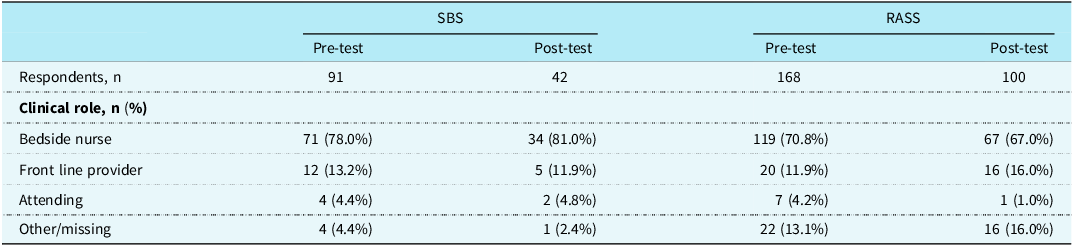
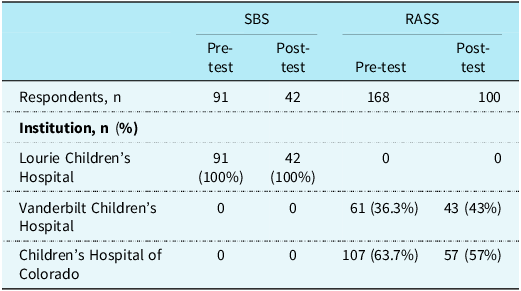
There were 259 pre-tests, and 142 post-tests collected during the video-assisted educational intervention. Most participants were nurses (73,4%), Table 1 describes the demographic characteristics of the cohort during the pre-test session in all institutions. In addition, Table 2 describes the cohort by institution of implementation. There was a significant increase in mean score on the post-test compared to the pre-test for both instruments: from 4 to 4.8/10 for State Behavioral Scale (p = 0.01) and from 4.5 to 4.9 for Richmond Agitation Sedation Scale (p = 0.04). In our cohort, SBS was favoured by Lourie Children’s Hospital who reported a mean increase from 4 to 4.8/10 between pre- and post-test. Furthermore, two institutions preferred the Richmond Agitation Sedation Scale: Children’s Hospital of Colorado who reported a mean score change from 4.5 to 5/10, and Vanderbilt Children’s Hospital that reported a mean score change from 4.5 to 4.7/10. Moreover, 95% of respondents who completed the Richmond Agitation Sedation Scale post-test and 95.2% of those who completed the State Behavioral Scale post-test said the module increased their knowledge of sedation and validated sedation scoring. 81% of respondents who completed the Richmond Agitation Sedation Scale post-test and 88.1% of those who completed the State Behavioral Scale post-test said their practice would change based on the knowledge they learned from the education module.
Study responders by Clinical Role

Study responders by insitution

Discussion
This collaborative group has taken upon the task of characterising and standardising sedation practices in the cardiac ICU. We envision that sedation practices in paediatric cardiac critical care can be similar between institutions but always paying respect to the unique culture each institution has. In this phase one, we report the successful implementation of an educational intervention using a video module in three pilot institutions. Post-tests showed an increase in average score suggesting knowledge acquisition from use of the module. Most participants in phase one reported a knowledge increase following the delivery of the video learning module. The early success of video-based interventions to increase medical knowledge has been previously reported, but the long-term or lifelong changes these interventions can carry remains unknown Reference Dahodwala, Geransar and Julie10 We propose that institutions should establish an ongoing education algorithm regarding best sedation practices and assessment in the cardiac ICU. The use of a self-directed web-based video module can be extremely helpful with ongoing education efforts since it can be repeated multiple times by the bedside clinicians at their own time. Despite the good short-term results that we report with our educational video module, the long-term knowledge impact and the effect increased knowledge can have in improving overall sedation practices in the cardiac ICU remain unknown. Measuring those is central to phase two of this collaborative effort.
Limitations to this study include the small sample size, comparatively small number of respondents on the post-tests, and the non-paired pre and post-test samples. While we hypothesise that the increase in scores from the pre-to-post test was the result of knowledge acquisition for the modules, it may be that change is only related to differences in the two populations. It is also important to note that after completing the module, the average score was below the maximum score of 10 in both groups. Some knowledge gaps remained following completion of the module. This highlights the importance of a multimodal and ongoing educational approach to ensure competency of bedside providers in evaluation and understanding of pain and sedation.
The collaborative has now moved into phase 2 with the main goal to develop an objective measure of the amount of sedation paediatric patients are exposed, during their stay in the paediatric cardiac critical care unit. We aim for this sedation measurement score to be easy to obtain and repeatable between institutions. We believe this will help us to understand highly variable institutional practices regarding sedation and delineate if there is an association between the amount of sedation exposure and outcomes in this population.
Conclusion
We report that our newly developed learning module intervention was effective in increasing short-term knowledge about optimal sedation and sedation scoring. This new video module is now available upon request for interested institutions. Ongoing phase two efforts include evaluation of long-term compliance of State Behavioral Scale and Richmond Agitation Sedation Scale screening and developing an objective score to measure individual cumulative opioid dosing in the cardiac critical care unit across different institutions.
Supplementary material
The supplementary material for this article can be found at https://doi.org/10.1017/S104795112500160X.
Acknowledgements
None.
Financial support
This research received no specific grant from any funding agency, commercial, or not-for-profit sectors.
Competing interests
The authors declare none.