On November 7, 1936, the eighth-century Chinese poet Li Bai descended to a group of Caodai intellectuals assembled at a spirit-writing séance in French colonial Saigon. Holding the handles of a basket-shaped stylus over a table, two mediums transmitted the words of the poet: the time had come for them to be “Enlightened to the true Dao at the end of the cosmic cycle / Those who awaken from the profane world will reach the Dragon Flower Assembly” (Phái Chiếu-Minh 1950, 16).
This verse would be followed by many others, revealed by immortals and sages such as Confucius, Laozi, General Guan Gong, or the Jade Emperor, announcing the realization of the ancient Chinese prophecy of the Dragon Flower Assembly. These tropes, associated with apocalyptic calamities and the inauguration of a new cosmic era, had inspired countless movements over many centuries in the dense thicket of Chinese popular salvationist and sectarian traditions. But the Caodai adepts seemed oblivious to the deep history of this millenarian vision. Instead, they eagerly sought to connect the prophecy to the modern spiritual teachings and ideas that circulated among the francophone colonial intellectuals of Saigon. When a Vietnamese Theosophist editor published the above-mentioned oracle in a 1950 bilingual Vietnamese-French edition, the statement was rendered as “The Gospel of the Spirit of Truth is opened in the prophesied end times, to announce to the Incarnates the coming Judgement of God” (Phái Chiếu-Minh 1950, 16). The “Spirit of Truth” and “the Incarnates” mentioned here are explicit references to the French spiritist reform of Catholicism advocated by Allan Kardec (1804–69) and elaborated in his Le Livre des Esprits (Book of the Spirits, 1857), said to have been revealed in a series of séances in the 1850s (Kardec [Reference Kardec and Blackwell1857] Reference Kardec and Blackwell1996). How did this Caodai group end up using the spiritist idiom to translate its main esoteric scripture? What was it trying to accomplish, and what were the implications? What do these allusions to Western Occultism (theosophy and spiritism) tell us about the religious productions of colonial modernity?
In this article, we will discuss how, through such textual moves, the Cao Dai religion dissimulated its roots in the Chinese sectarian tradition, asserted its preeminence in a new field of modern spiritual universalism that was mediated by French colonialism, and anchored itself in the construction of a Vietnamese national identity. We will also examine the social networks, political structures, and identity-building processes that underpinned these translingual textual practices. We argue that, in contrast to standard narratives of secularization or traditionalism, colonial modernity produces distinct forms of religion that both mirror and invert Western colonial ideals, claiming simultaneously to be national, universal, and superior to the West.
We will examine this theme through the lens of the social processes of textual production and translation. In the past few decades, poststructuralist and postcolonial theory has inspired many studies on the role of translation practices at the points of contact, confrontation, and negotiation between Western colonial-imperial expansion and Asian societies. Moving beyond debates between the ideal of universal equivalency and the incommensurability of different cultural and linguistic worlds, scholars have shifted their focus to the social and political contexts in which translated texts are produced, and how translation, in the context of colonial or imperial modernity, produces shifts in indigenous languages and subjectivities (Howland Reference Howland2003). One strand of scholarship has stressed the role of translation as an integral and central part of the project of colonial domination itself, as local languages are transformed into carriers of European concepts, categories, and logics of governance (Cheyfitz Reference Cheyfitz1991; Niranjana Reference Niranjana1992); while another strand has emphasized the agency of indigenous actors and intellectuals in the process of appropriating Western terms and discourses, generating new and often contested realms of discourse within which indigenous experiences and claims to modernity and nationhood are expressed and articulated (Chandra Reference Chandra2009; Creese Reference Creese2007; Krämer Reference Krämer2014; Liu Reference Liu1995, Reference Liu2004; Sakai Reference Sakai1997). In studies of East Asia, in the wake of Lydia Liu's Translingual Practice (Reference Liu1995), several scholars have traced the circulatory nature of these processes, in which words, translations, and neologisms travel between the “West,” China, Japan, and other East Asian countries (Howland Reference Howland2002; Liu Reference Liu1999). Recent studies have applied these approaches to similar processes in Vietnam (Bradley Reference Bradley2004; Chang Reference Chang2016; Dutton Reference Dutton2015a, Reference Dutton2015b).
In these studies, the subject is usually Western texts and concepts that are being translated into Asian languages and societies; or, as in critical studies of Orientalist discourse, the translation by Westerners of Asian texts into European languages (Girardot Reference Girardot2002; Lardinois Reference Lardinois2007; Said Reference Said1978). Lydia Liu (Reference Liu1995, 26–27) defines translingual practice as a social process “by which new words, meanings, discourses, and modes of representation arise, circulate, and acquire legitimacy within the host language due to, or in spite of the latter's contact/collision with the guest language,” in which the “host” and “guest” languages represent that of the colonized and the colonizer, respectively. In this article, through the case of the Vietnamese Cao Dai religion, we propose to examine translingual practice in the other direction: how did Asian religious leaders and translators invest a European “guest” language with their own cosmologies and discourses? And, even further: how did this translingual process, in a context of colonial modernity, facilitate the eviction of Chinese from its role as the classical hegemonic religious language of a society such as Vietnam, which had been at the periphery of the Sinosphere for millennia before European colonization?
Indeed, it is perhaps in the realm of religion and “spirituality” that we can find the most concerted efforts of Asians to “speak back” to Europeans, in their own idiom, with the intent not only to express indigenous beliefs and ideas in European languages, but also to construct an alternative Oriental vision of spiritual civilization, universal and superior to that of the West, which could transform and redeem the whole world.Footnote 1 Such efforts occurred within circulatory networks in which Asian religious figures and authors, as well as European Orientalist scholars and spiritual adventurers, traveled and communicated between chains of Asian and European capitals, leading to the collaborative and often perennialist-oriented elaboration of discourses on “Asian spiritual traditions.” The modern concepts of “religion,” “world religion,” and “Asian spirituality” are, to a great extent, products of these exchanges. Moving beyond critiques of the “Protestantization” of Asian religions, recent studies by Peter van der Veer (Reference Van der Veer2014) and Prasenjit Duara (Reference Duara2015) have shown how these categories have emerged and been shaped by an “interactional history”—a circulatory and, we might add, “translingual” process in which Asian actors have actively invested these categories and shaped their meanings in different contexts.
The role of Indian, Sri Lankan, and Japanese figures in this process—such as Swami Vivekananda, Nallasvami Pillai, Rammohan Roy, Ravindranath Tagore, Sri Aurobindo, Mohandas Gandhi, Anagarika Dharmapala, Jiddu Krishnamurti and D. T. Suzuki, all of whom gave talks, wrote and published prolifically in English, and thus contributed directly to the shaping of Western discourses on Asian spirituality—has been amply studied and documented. But what of the Sinosphere? Since Duara (Reference Duara2001) wrote about the previously neglected “redemptive societies,” a wave of scholarship has investigated the mass phenomenon of syncretic movements in the first decades of the twentieth century. These movements inherited the Chinese tradition of salvationist sectarianism but tried to articulate a vision of universal spiritual civilization, often employing modern forms of organization, charity, disaster relief, and education (DuBois Reference DuBois2011; Palmer Reference Palmer2011). Some of these groups allied themselves with like-minded movements in Japan and made links between the Chinese practice of spirit-writing and the Shanghai Spiritualist Society's importation of European discourses and practices on scientific forms of communication with the souls of the dead (Huang Reference Huang2007; Schumann Reference Schumann2014). However, in spite of the Chinese redemptive societies’ deep penetration into both popular and elite strata of society, and the cosmopolitan ties of some of their leading members, they hardly ever directly engaged, in European languages, with Western debates and discourses. China's “spiritual” voice was only mediated into Western languages by secularist Chinese intellectuals and Western scholars who shared a common disdain or at least a strong reformist impulse towards all forms of Chinese religiosity. Van der Veer (Reference Van der Veer2014) has argued that this bifurcation between India and China may well be the product of the absence of direct European colonization of China. In this article, we extend his comparative perspective to French Indochina to ask the following questions, taking the Vietnamese Cao Dai religion as our case: how does direct colonization create the conditions of possibility for translingual practice by the colonized in the direction of the colonizer's civilization? And how does colonization shape the destiny of a new religious movement that appears in the context of colonial modernity, compared with analogous movements in the absence of direct colonial rule?
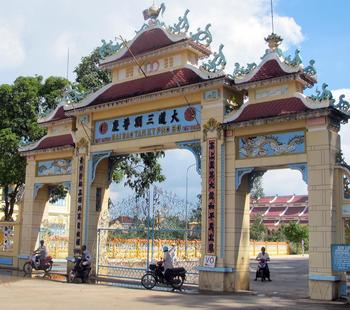
Caodaism or the “Great Way of the Third Cycle of Universal Salvation of the Highest Platform” (Cao Ðài Đại Đạo Tam Kỳ Phổ Độ 高台大道三期普度 Gaotai Dadao Sanqi Pudu; see figure 1)Footnote 2 appeared in the 1920s during French colonial rule and is the third-largest religion in contemporary Vietnam, with growing congregations in diasporic Vietnamese communities around the world (Hoskins Reference Hoskins2015). It emerged from a Chinese religious milieu in Cochin-China (southern Vietnam) that produced groups that—in terms of genealogy, structure, practice, and theological content—can clearly be situated within the wave of “redemptive societies” that appeared in early twentieth-century China (Goossaert and Palmer Reference Goossaert and Palmer2011, 93–108). Simultaneously, Caodaism emerged in a specifically Occultist colonial milieu, generating some practices that are clearly linked to French spiritism, freemasonry, and the Theosophical Society (Jammes Reference Jammes2014, 170–81, 450–63).
The entrance gate to the Cao Ðài Holy See in Tây Ninh, Vietnam, with the Chinese inscription “The Third Cycle of Universal Salvation” (© David A. Palmer, Tây Ninh, 2012).

As the first movement of mass conversion in French Indochina, born during a period of anti-colonial resistance, Caodaism established its own army during the Japanese occupation and the ensuing war of independence, and directly governed a large part of South Vietnam (Jammes Reference Jammes2016). With its own theology and its own flag, Caodaism is a case in point of the “traffic” between the religious and the secular (Duara Reference Duara2015, 195–238). The political aims of the Cao Dai religion gradually gained substance and momentum, to the point where it was ultimately able to offer a genuine project of a religious society, a theocracy that aimed to become the “state religion” (quốc đạo 國道 guodao) of Vietnam. Such national aspirations for independence were combined with a religious language, Caodai prophecies emphasizing that the Vietnamese people were chosen for a special spiritual but universal mission (Hoskins Reference Hoskins2012).
The colonial context of Vietnam produced, in the form of Caodaism, a transformation of the Chinese Xiantiandao 先天道 salvationist tradition (“Prenatal Way” or “Primordial Way,” Tiên Thiên Đạo in Vietnamese) into a new vision of spiritual universalism grounded in Vietnamese national identity and incarnated by an institution that aimed to be both a universal church and a nation-state. This transformation was mediated by two stages of translingual practice. The first was a shift of the language of scriptural revelation from Chinese characters to the newly formed national language of Vietnam, the Romanized quốc ngữ (國語 guoyu)—either by translating prayers and scriptures from Chinese to the new written language or by directly producing Romanized scriptures through spirit-writing. Occurring at a time when the French colonial authorities had recently decreed the abandonment of the Chinese script, setting in motion the cutting off of Vietnam from its former civilizing and tributary center and creating a new space for a modern national identity, this process, in the case of Caodaism, enabled the “occultation” of its Chinese religious matrix. It allowed this new faith to claim a new national point of origin, located in Cochin-China. The second stage was the production or translation of texts into French—a direct engagement with the spiritual discourses of the colonial metropole, signaling a pivot in the imagination of the imperial Other, from China to France and the West. The strategic use of French Occultist language and tropes to translate Caodai cosmology inscribed the religion into a universalist and anti-colonial spiritual discourse.
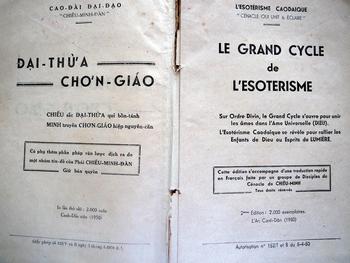
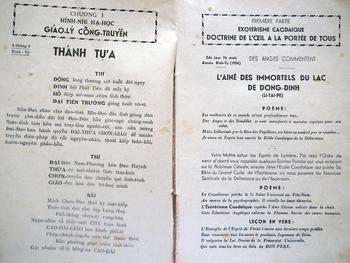
We examine these paradigmatic shifts through a study of the production and translation of the core esoteric scripture of Caodaism, the Đại Thừa Chơn Giáo (大乘真教 Dacheng Zhenjiao), “The True Teachings of the Great Vehicle,” hereafter referred to as ĐTCG. This is a collection of spirit-writing messages attributed to Chinese deities such as the Jade Emperor, Li Bai, Guan Gong, Laozi, and so on, revealed in Vietnamese mostly in 1934–37 and further published in a bilingual French-Vietnamese edition in 1950, under the French title of La Bible du Grand Cycle de l’Ésotérisme—The Bible of the Great Cycle of Esotericism (see figures 2 and 5).
The bilingual Vietnamese-French edition of the Đại Thừa Chơn Giáo (© Jeremy Jammes, 2017).

Here we propose a close examination of the translingual practices (translations, rhetorical strategies, naming practices, and legitimizing processes) that led to the production and usage of the ĐTCG. We begin by first contextualizing the emergence of Caodaism in the Sino-Vietnamese religious milieu of the early twentieth century. We then look at the production of this “Caodai Esoteric Bible” and situate it within the networks of publishing markets and colonial discourses on esoteric spiritualities. We then compare a few representative passages of the scripture in its Chinese, Vietnamese, and French versions. The different versions appear to be quite different emanations from two different traditions: Chinese millenarian salvationism and French Occultism. The Romanized Vietnamese language acts as a screen that allows the Chinese roots of the texts to be “occulted” from the Vietnamese followers, and for them to be recast in the “modern” idiom of French Occultism—with the ultimate aim of situating Caodaism at the center of the new era of esoteric spirituality, the “third and redemptive Alliance” that would see the end of the dominance of Christianity in the West and the Chinese Three Teachings in Vietnam, to be replaced by a new universal synthesis of esoteric spiritual cultivation and exoteric missionizing, philanthropy, and social construction. Finally, we compare how the French colonial context created the linguistic conditions for Caodaism to follow a different path of evolution and identity-building than its “cousins,” the redemptive societies, that flourished in China at the same time. We conclude by discussing how this case can help us to conceptualize the religious productions of colonial modernity in Asia.
The Birth of the Caodai Revelations
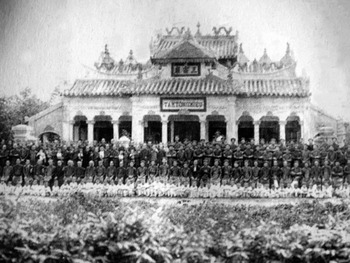
Caodaism emerged out of the Minh Sư (“Enlightened Master,” 明師 Mingshi) sectarian tradition, the largest and oldest of the Minh (明 Ming) societies in Vietnam, which first appeared among the Chinese communities of Cochin-China in the nineteenth century (Huệ Nhẫn 1999). In fact, the Minh societies were a network of spirit-writing groups originating in Guangdong Province, China, carriers of the Xiantiandao salvationist tradition. Characteristics of this tradition include the worship of the Unborn Mother (無生老母 Wusheng Laomu), also known as the Golden Mother of the Jasper Pool (Diêu Trì Kim Mẫu 瑤池金母 Yaochi Jinmu), as the supreme deity; the practice of Daoist inner alchemy, vegetarianism, and philanthropy; and the belief in a three-stage apocalyptic eschatology. Xiantiandao branches spread along Chinese trade networks throughout Southeast Asia during the late Qing (Yau Reference Clart, Scott and Clart2014). Other Chinese Minh societies later appeared in Vietnam in the late nineteenth and early twentieth centuries. These were generally offshoots of the Minh Sư associations, often with higher levels of Vietnamese participation. Between January 1924 and November 1925, perhaps the most urbanized and Vietnamesed Minh society, Minh Lý đạo (明理道 Minglidao; see figure 3), had begun a process of translating religious texts, previously available in Minh Sư circles only in Chinese, into the Romanized modern alphabet of the Vietnamese language.
The Minh Lý đạo’s headquarters, the Temple of the Three Teachings (Tam Tông Miếu) in 1930, now on display in the same temple rebuilt in the 1950s (© Jeremy Jammes, Ho Chi Minh City, 2005).

The story of Caodaism begins in the early 1920s through the spirit-writing activities of Ngô Văn Chiêu (1878–1932), a Vietnamese civil servant working under the authority of the French colonial administration in Cochin-China. For almost two decades, Minh Sư–affiliated Daoist masters guided him in studying commentaries on the Daodejing 道德經 and in his learning of meditation, spirit-writing, and talisman techniques (Huệ Khải 2008, 20–21; Huệ Nhẫn 1999, 22–27).
Broadly speaking, the Caodai texts were produced in a Vietnamese and Sino-Vietnamese milieu of spirit-writing groups, Daoist priests, scholars, intellectuals, and colonial officials. Spirit writing or spirit séances (cơ bút 機筆 jibi) produced a series of texts that are the “scripture” (kinh 經 jing) of the religious group. Sometimes the Caodai séances modified the Daoist technique of “phoenix writing” (phò loan 扶鸞 fuluan)—in which a bird-headed basket is held by one or two mediums to write on a surface (Jordan and Overmyer Reference Jordan and Overmyer1986, 36–88)—to use a Vietnamese alphabetic board and receive messages in Romanized Vietnamese and French. In this case, the technique is clearly inspired by the Ouija board and inscribes Caodaism into the Western spiritist tradition (Aubrée and Jammes Reference Aubrée and Jammes2012).
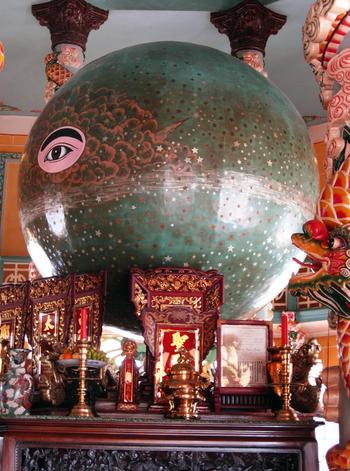
In a séance in 1921, one deity revealed himself to Ngô Văn Chiêu as Master Cao Đài (高臺 Gaotai), “the Master Living at the Highest Platform” (see figure 4). This deity also identified himself as the Jade Emperor (Ngọc Hoàng Thượng Đế 玉皇上帝 Yuhuang Shangdi). Ngô Văn Chiêu was given the mission to reveal and propagate a universal “new Dharma” (tân pháp 新法 xinfa). From then on, the new movement began to spread in the cities and suburbs of Cochin-China. Soon afterwards, in 1926–27, the movement developed its own scriptures, philosophical system, and liturgies based on Confucian, Buddhist, and Daoist sources. Caodai membership expanded rapidly, as both the economic crisis of 1930–31 and the foundation of new Caodai branches attracted the peasantry to the religious solidarity structures offered by the new religion (Werner Reference Werner1981).
The main altar inside the Holy See of Tây Ninh: the ubiquitous Eye of Master Cao Ðài—aka the Jade Emperor—painted on a celestial globe (© Jeremy Jammes, Tây Ninh, 2001).

Ngô Văn Chiêu, who enjoyed solitude, was ambivalent about the massive growth of his religion. He decided in May 1927 to follow a path of cultivation based primarily on meditation and spirit-mediumship. A few years before his death, in 1932, he founded his own branch, the Chiếu Minh Tam Thanh Vô Vi (照明三清無為 zhaoming sanqing wuwei, “Radiant Light of Non-Interference of the Three Purities”). This branch was focused on the meditative and divinatory quest for “non-interference” or “non-action” (vô vi 無為 wuwei), whereas the Tây Ninh “Holy See” was more focused on social activity and “universal salvation” (phổ độ 普度 pudu).
As the new religion increasingly oriented itself towards mass proselytism, it sought to gather religious texts in Vietnamese that would not require learning Chinese, hence targeting the broadest possible audience and reaching out to the peasant community. The missionary branch, the “Holy See” of Tây Ninh, produced a series of new texts to administratively regulate religious, secular, and monastic life, but also turned to the Minh associations, and especially the Minh Lý Dao, to compose the first corpus of prayers and spirit invocations (Jammes Reference Jammes2010b; Smith Reference Smith1970, Reference Smith1971). As mentioned above, the Minh Lý Dao had, at that time, just begun its own project of translating Chinese religious texts into Vietnamese. Through spirit-writing messages and Vietnamese translations of Minh prayers and texts, Caodaism thus adopted the cosmology, theology, and eschatology of the Xiantiandao tradition and adapted it to a decolonization agenda and Sino-Vietnamese culture.
The Đại Thừa Chơn Giáo and the Colonial Occultist Milieu
The ĐTCG is one of the four canonical scriptures of Caodaism, each of which was composed through spirit-writing. The ĐTCG literally means “the True Teachings of the Mahayana,” or “The True Great Vehicle,” and it deals primarily with esoteric practices. It is based on a production of fifty-one messages revealed by deities at the end of 1936. To these texts were added twenty-two-odd messages attributed to the divinized spirits of former disciples and produced at various times between 1926 and 1950. The collection was compiled as a 538-page volume in thematic order with a print run of “2,000 copies, not for sale” in 1950, in a bilingual, Vietnamese-French version (see figure 5). It was published by a company run by Nguyễn Văn Huấn, a famous and active member of the Theosophical Society. The book is referred to by its Caodai French-language editors as the “Bible of the Great Caodaist Esoteric Cycle” (Phái Chiếu-Minh 1950, 15), and, in the Vietnamese version, as “a manual of the pill of immortality” (kinh sách luận về Đơn-Kinh 經書論於丹經 jingshu lunyu danjing) (8–9). These two designations reveal the two distinct idioms in which the teachings are presented in the book: as a Daoist alchemical and meditative manual in the Vietnamese version and as an “Esoteric Bible” in the French version.Footnote 3
Sample pages from the bilingual Vietnamese-French edition of the Đại Thừa Chơn Giáo (© Jeremy Jammes, 2017).

The ĐTCG is not structured as a coherent and organized dogmatic treatise, but rather as a collection of moral guidance and teachings proclaimed by “instructors of the invisible.” The ĐTCG presents itself as an archetype of the omniscient knowledge transmitted by the spirits. The Daoist notion of self-cultivation (tu luyện 修煉 xiulian) through techniques of the body and meditation is one of the core themes of the book. The messages of the spirits elaborate on the traditions of the three teachings of Confucianism, Buddhism, and Daoism (Tam Giáo 三教 sanjiao), while claiming that they have lost their power in this era of the third kalpa. These doctrinal elements directly echo the millenarian themes of the Chinese salvationist sectarian tradition and especially the contents of the seventeenth-century Kinh Long Hoa (龍華經 Longhuajing, The Book of the Dragon Flower). According to this tradition, the human race is subject to a final competition or “Dragon Flower Assembly” (hội Long Hoa 龍華會 longhua hui), in which only the most virtuous will pass the exam, find salvation, and eventually find a place alongside the Golden Mother of the Jade Pond—and the Jade Emperor in the Caodai context (Jordan and Overmyer Reference Jordan and Overmyer1986).
The 1950 edition of the ĐTCG contains both the original Vietnamese text and a remarkable French translation heavily laden with the idioms of French Occultism, itself based on a reappropriation and reinterpretation of the symbols and tropes of Roman Catholicism. The inner cover pages (2–3) of the ĐTCG state that the translation was carried out by “a group of disciples of the Chiếu Minh Cenacle.” The production and publication of this book are the work of a milieu of Caodai editors and exegetists who were very experienced in Vietnamese-French translation. This circle actively participated in “Vietnamizing” the knowledge emanating from Daoist and Chinese poetry spirit-writing séances. In other words, some of these francophone translators must have known classical Chinese to translate Chinese terms and ideas into spoken Romanized Vietnamese and then into French. The Oratory hosted the offices of the “Caodaic Institute. Psychological, philosophical, metaphysical studies” (Institut Caodaïque. Études psychologiques, philosophiques, métaphysiques). This institute (Học viện Cao Đài 學院高台 xueyuan gaotai) aimed to bring studies on Caodaism to the status of a true theological discipline.
The collaborators of the Caodaic Institute engaged in a process of universalization of Caodaism through translation, owing to their access to French esoteric studies in the comparative study of religions, the analysis of symbols and rituals, and the scientistic description of spirit-writing séances. Indeed, the French translations made by the Caodaists can be identified as “Occultist” since they frequently use spiritist and theosophist terminologies, as we will examine below. Following the historian Jean-Pierre Laurant (Reference Laurant1992), we consider “Occultism” as a loosely defined movement that appeared in the nineteenth century in the West and that reinterpreted and recast old religious and esoteric practices and doctrines (supernatural phenomena, traditional spirit-mediumship activities, etc.) through the filters of modern scientific methods and instruments (see also Faivre and Needleman Reference Faivre and Needleman1992; Hanegraaff et al. Reference Hanegraaff, Faivre, von den Broek and Brach2005).
In the Vietnamese colonial context, Occultist groups attempted a (Western) rationalization of (Eastern) religions by uncovering the universal, esoteric truths that are hidden beneath the exoteric, outer forms of these religions. As an example of the penetration of French Occultist literature in the Vietnamese publishing milieu, we can cite the France-Asie journal, published in Saigon, whose esoteric and perennialist language can be compared to the French translations of the ĐTCG. Its founder, René de Berval (1911–87), used the magazine to invert “the postcolonial gaze by taking an Asian perspective” on Western Occultism, “in reaction to the paradigms of modern science” (Bourdeaux Reference Bourdeaux2010, 181).
In the years 1920–30, a flourishing publishing culture played a prominent role in an expanding public sphere of Cochin-Chinese urbanites and religious reformers (McHale Reference McHale2004). Theosophical literature occupied a unique but dynamic position in the global circulation of spiritual ideas at the turn of the twentieth century (Lardinois Reference Lardinois2007, 127). Founded in New York in 1875, the Theosophical Society seeks to penetrate the mysteries of the holy books and oral traditions of the world by filtering them through a syncretistic conceptualization that is simultaneously Christian, Hindu, and Buddhist, claiming that “there is no religion greater than Truth.” The 1920s marked the beginning of the Theosophical Society's establishment in Cochin-China: the Thông thiên học (通天學 tongtianxue), literally “studies of communications with the heavens,” aimed to revitalize and rationalize Buddhist theology and practices (especially millenarian, meditative, and philanthropic traditions). It attracted both French and Vietnamese followers in the colonial milieu of Saigon and Hanoi. The prolific productions of its Vietnamese members—made of translations and commentaries of the verbose founders of the Theosophical Society such as Helena Petrovna Blavatsky, Charles Webster Leadbeater, and Annie Besant—were rationalist insertions into the dialogue between Eastern and Western civilizations and those between religions and science (Jammes Reference Jammes2010a). This theosophical enterprise to build up a “morally edifying science” or a “savant religiosity” (Bourdieu Reference Bourdieu1987, 110) perfectly dovetailed with the intellectual atmosphere of the time.
Spiritist brochures, books, and circles were also circulating in Cochin-China, as well as all of Allan Kardec's doctrines and spirit-mediumship techniques (Aubrée and Jammes Reference Aubrée and Jammes2012; Bourdeaux Reference Bourdeaux2012). Spiritism can be traced to the teachings and practices of Emmanuel Swedenborg (1688–1772) and Franz Mesmer (1734–1815), and to the popular practice of mediumship through “talking tables” (the precursor to the Ouija board) in nineteenth-century France. The spiritist doctrine, codified by Kardec, considers that the spirits of the dead can be contacted through “scientific” methods, that spirits progress through a spirit-hierarchy, and that they can guide humans to higher levels of spiritual and moral understanding. From a sociological perspective, spiritism can be defined as both an anti-materialist movement and a social doctrine bringing together diverse trends of thought (utopian socialism, evolutionism, positivism, etc.) that flourished at the time of nascent socialism. The Kardecist spiritist doctrine reinterpreted Christianity with a scientistic lens. Spiritism proposed a reform of Catholicism and used modern techniques (telegraph, photography, radiography, X-ray, etc.) as vehicles for a new hope in the afterlife. As with Caodaism sixty years later, spiritism is presented by its founder as the third revelation of God on Earth, after Moses and Jesus Christ. The third period opened by spiritism is described by Kardec himself as an “Alliance between science and religion,” a period dedicated to the “Instructions from Spirits” (Kardec [Reference Kardec1864] Reference Kardec1987, 26, 27).
French spiritism is translated into Vietnamese as thần linh học (神靈學 shenlingxue), “study of the spirits” or thông linh học (通靈學 tonglingxue), “study of communications with spirits.” The first Caodaists actually practiced the “turning tables” of French-derived spiritism, which they conceived as more “rational” and “scientific” than the traditional Vietnamese spirit-possession practices (lên đồng 登童 dengtong). However, it was a message received during such a séance that instructed the first members to turn to Chinese-style spirit-writing. French spiritism thus seems to have played a role both as an initial trigger before a switch to the Chinese-style “flying phoenix” and later as a universalist discursive veneer, used to reformulate and explain the teachings and practices in a more legitimate, scientific language and rhetoric. While Occultism was initially focused on European esoteric traditions, Caodaism attempted to fully universalize the Occultist framework by grounding it in the Caodai teachings, placing Caodai theology above all others. Learning Caodai theology was presented to the Vietnamese audience as a necessary stage for Westerners wishing to understand their own Western esoteric tradition. Caodaism promised to harmoniously connect the West and the East in the esoteric and spiritual realm, in contrast to the French colonial system, which had failed in the exoteric and materialistic realm.
A Translingual Study of the ĐTCG
The ĐTCG, when converted into Chinese characters, reads in style, in the metric and structure of its verses, and in content almost like a typical Chinese spirit-writing text.Footnote 4 It is especially resonant with the texts associated with Chinese redemptive societies of the early twentieth century, with its emphasis on both personal spiritual cultivation through Daoist inner alchemy and Confucian morality, and on universal salvation in the context of the sectarian eschatology of the three kalpas. What makes the ĐTCG distinctive is the fact that it was revealed in Romanized Vietnamese, not in Chinese characters—allowing it to cast a veil over the Chinese origin and content of its teachings, a veil that has become thicker with each generation of Vietnamese becoming increasingly unfamiliar with Chinese writing and civilization.
The “occultation” of Chinese was carried a stage further by the French edition, which overlaid an interpretation, based on the categories of European Occultism, onto the entire text. Since many of the early Caodai leaders and believers were educated in French colonial schools, they were often more literate in French than in Chinese or even Vietnamese, and used the French version as a key to penetrate the unintelligible Vietnamese original, itself rooted in classical Chinese verse. The bilingual edition of the ĐTCG was undoubtedly published with this purpose in mind. The French edition helped to legitimize and convert the ĐTCG into both the language of modern rationality (through the idiom of Occultism) and the language of religious hegemony (through the idiom of Christianity). But this process of conversion and transformation overshadowed the Chinese and, especially, the Daoist roots of the text. It also played a significant role in establishing the distinctive Caodai identity of the text. The term “Cao Đài,” indeed, rarely appears in the original, which contains little to distinguish it from the broader genre of Chinese spirit-writing, but is inserted throughout the French translation, together with Christian and Occultist terms. The increased use of the term also serves to emphasize the monotheistic claims of Caodaism, creating and assuming an equivalency between Cao Đài and the Biblical God.
An archetypal example of the conversion of Daoist concepts into Christian terms, with an explicit reference to Master Cao Đài that is absent in the original text, is the first stanza of the message revealed on September 24, 1936, which refers to the process of revelation through spirit-writing (Phái Chiếu-Minh 1950, 16). In the Vietnamese original, the line “Ðại-Tiên-Trưởng giáng hoát vô-vi,” converted word-by-word into Chinese characters, becomes 大仙將降活無為 (daxian jiangluo huo wuwei), which may be rendered into English as “The Great Immortal shall come down, moving in non-action”—a rather generic expression of the process of spirit-writing by Daoist immortals in Chinese religion (the poet Li Bai in this text). But in the French version—“Je viens en Esprit leur ouvrir la Bible Caodaïque de la Délivrance” (I come in the Spirit to open for them the Caodaic Bible of Deliverance)—the Daoist terminology of the original is replaced by Christian tropes in the name of Cao Đài.
In the next stanza (Phái Chiếu-Minh 1950, 16), the vaguely Daoist notion of the “return to one's spiritual nature” (chuyển qui linh tánh 轉歸靈性 zhuangui lingxing) is translated into strongly dualistic Biblical imagery as “fishing out the divine soul entangled in the flesh,” while the generic “true transmission of Dao” (Chơn truyền đạo 真傳道 zhenchuan dao) is rendered as “Caodaic esotericism.” And the expression “holding the divining stylus” (Thừa cơ 乘乩 chengji), which refers to the Chinese spirit-writing instrument, is rendered as “by means of psychography,” with its Western spiritist and modernist connotations of a “writing of the psyche” or “photography of the soul.”
The scripture's teachings devoted to esoteric spiritual practice include a nine-stage method that is titled in French as the “nine Initiations” (message of August 19, 1936; Phái Chiếu-Minh 1950, 384). Converted to Chinese characters, the name of the method, Tam Thừa Cửu Chuyển (三乘九轉 sancheng jiuzhuan), evokes the terminology of Daoist inner alchemy; following contemporary conventions of Daoist studies, scholars have rendered it in English as “Ninefold transformation” (Schipper and Verellen Reference Schipper and Verellen2004, 399) or as “Nine reversals” (Komjathy Reference Komjathy2013, 309); several texts in the Daoist Canon contain the term, including, for example, “The Secret Formulas of the Golden Elixir of the Ninefold Transformation” (九轉金丹秘訣 Jiuzhuan jindan mijue, Daoist Canon TT 263.17; see Schipper and Verellen Reference Schipper and Verellen2004, 849).
Indeed, the description of the method over the following sections clearly refers to inner alchemical practices. But the “prenatal” realm of tiên thiên (先天 xiantian), a core concept in Daoist cosmology and alchemical practice, is translated as “Occult life” (i.e., the hidden life that requires an initiation), while the process of alchemical refinement of the hồn (魂 hun) and phách (魄 po) souls on the path of immortality (tiên 仙 xian) is rendered as “Cleans[ing] the soul and the body of the Elect who aspire to the Bliss of the Angels.”
Further down in the same message (Phái Chiếu-Minh 1950, 386), we find a typical piece of advice on nurturing and transforming the triad of tinh (精 jing), khí (氣 qi), and thần (神 shen) in Daoist inner alchemy—three terms usually rendered in English-language scholarship as Essence, Qi (or vital breath), and Spirit. The Caodai translators chose French terms that reflect an extreme dualism of body and spirit, rendering jing into its most materialized expression as “sperm” and shen into the “Holy Spirit,” a Christian term associated with the absolutely transcendental God.
The dualistic ontology appears again a few verses below on the “first initiation,” in which the “communication between spirit and vital breath” (thần khí giao thông 神氣交通 shenqi jiaotong) is rendered as “union of the Soul and Body,” and the “elimination of worries and malice” (diệt trừ phiền não lòng không 滅除煩惱心空 miechu fannao xinkong) is translated as their “dematerialization.” In the next stanza—“Âm dương thăng giáng điều hòa” (陰陽升降調和 yinyang shengjiang tiaohe, literally “yin and yang rise and fall in coordination”)—we find an intriguing translation of the yin-yang dyad as the “Spiritual and the Temporal,” which “rise and descend according to the rhythm of Providence,” providing a strong Kardec-inflected Catholic flavor to what, in Chinese, is an ordinary statement on the operation of cosmological cycles.
Next we find another pair of verses that express, in typical inner-alchemical terms, some basic processes of alchemical cultivation: while “opening the nine orifices” (khai cửu khiếu 開九竅 kāi jiu qiao) is open to different interpretations, the ĐTCG translates them as the “nine chakras,” drawing on Western Occultist interpretations of Indian tantra. Indeed, the Theosophical Society published extensively on these terms. The book The Chakras by Charles W. Leadbeater (Reference Leadbeater1927), one of the founders of the Theosophical Society, notably provided a series of color drawings of the chakras, which contributed to the popularization of his interpretation in Cochin-China.Footnote 5 We found this theosophical literature in the Minh Lý and Caodai libraries, as well as in various bookshops in Ho Chi Minh City during our fieldwork (2000–2013).
While the Đại Thừa Chơn Giáo can, in its original version, be seen as containing a Daoist spirit-writing text typical of the late nineteenth and early twentieth centuries, its French version reveals the influence of a distinctly Occultist colonial culture, deploying a vocabulary that clearly falls into the same category as French spiritism and theosophy.
A Triple Occultation
Comparing the Chinese and the French versions of the ĐTCG, they would, indeed, appear to be radically different emanations from two different spiritual traditions. The important point, however, is that Caodai translators emphasize the French Occultist reading and not the Chinese and Daoist one. The religious, poetic, and literary idioms of the Vietnamese language are sufficiently close to Chinese, so that Chinese spirit-writing can be channeled (and translated) into spoken Vietnamese using the Romanized script. But, with Chinese characters and the mandarinate examinations abolished in 1919, and modern Vietnamese people trained in French colonial schools being increasingly unable to read them, the Romanized Vietnamese language acts as a screen that allows the Chinese roots of the texts to be occulted from the Vietnamese followers, and for them to be reinterpreted within translation in the “modern” idiom of French Occultism.
What is the discursive strategy at play in this Vietnamese-French translation process? A naive reading might simply conclude that the relation between this French translation and the Vietnamese original text is partial, incomplete, and distorted toward what interests the translators. To be sure, the Kardec-ish (spiritist) and Leadbeater-ish (theosophical) style of the translation certainly implies a distortion of the source text, but the final product might be considered as the mot juste for the intentional transformation of the text by the translators. Following André Lefevere (Reference Lefevere and Venuti2000) in his work on neologisms and “foreignisms,” we can see Caodai translation as an experimental and creative literary practice. The translation cannot be dismissed as “misunderstandings and misconceptions.” On the contrary, the refractions correspond to the different ways the Caodai translators deliberately “rewrote” the text, by manipulating with subtlety the continuities and discontinuities between religious idioms emanating from Chinese, Vietnamese, and French cultural matrices.
By “Westernizing” the text, the Caodai translators deliberately downplayed the values, beliefs, and representations that they saw as holding sway in the Vietnamese and Chinese languages. It appears as if Chineseness or Vietnameseness was seen to be a defect that needed to be removed from the French version. At the same time, the French translation serves the purpose of universalizing it, staking a claim to the universal imaginary propagated by French colonialism. In this sense, the Vietnamese text is intentionally interpreted within the vehicle of the French translation: (1) by revising and taking its distance from the Chinese original; (2) by mimicking spiritist and theosophist writing, rationalizing the Vietnamese text and consolidating the pretention that Caodaism is a “scientific” religion; (3) by Westernizing the Vietnamese text and the identity of the colonized; (4) by facilitating the accessibility, intelligibility, and “relevance” of the originally Chinese or Vietnamese text to a French Occultist or Christian target readership; and (5) by occulting the Daoist text, which is the key to the secret, meditative knowledge.
In a colonial situation, this mimetic behavior was quite ambiguous since, on the one hand, it matched what the colonizers expected and, at the same time, it put an emphasis on the capacity of the colonized to design and define their intellectual independence and spiritual autonomy. The mimetic activity is thus not a passive one (Taussig Reference Taussig1993, xiii). This semantic and mimetic stratagem is highly dynamic in a situation of symbolic domination by colonizers, in which the colonized prefer an indirect contact, a recalibrated relation, and the use of “symbolic ruse” (Augé Reference Augé1982, 284) to a straightforward rejection or a rupture with the colonizer culture. In our understanding of these translingual practices, the spirit-writing ritual can be considered as a “ritualistic deviation” (Augé Reference Augé1982, 16) in the hands of the colonized who reinvested symbolic codes; rationalized spiritual experience and knowledge; spiritualized scientific change; and, finally, explored an alternative to their Self by accepting to become to a certain point the Other, to endorse the spiritual and rational paradigms of the colonizer.
We see here the limits of a structural logic that posits an opposition between the Self and the Other (Vietnam/China or Vietnam/France). On the contrary, it would be fruitful to approach the ĐTCG production as a process that jumbles the ambivalences in the semantic field of each language; manages in a constructive and creative way the incommensurability between Daoist and Catholic cosmologies; and, ultimately, redefines their forms of classification, symbols, categories, and universes of meaning.
When we speak of “occulting the Dao,” we thus refer to three levels of “occultation.” At a first level, the possession of occult or esoteric knowledge serves to buttress claims to spiritual authority within a highly contested religious field. The ĐTCG was produced in a context of competition between the Chiếu Minh branch and the Tây Ninh Holy See, and established the Chiếu Minh's authority as the leading “esoteric” branch of Caodaism, possessing deeper knowledge than the dominant, “exoteric” Tây Ninh institution. The same dynamic is at play in the competition between the Cao Dai religion and the Catholic Church in Vietnam, in which the esoteric teachings claim to contain the mysteries of Christian doctrine. The source of the “occult knowledge,” in this case, is the techniques and symbols of Daoist inner alchemy, the most esoteric form of Daoist practice.
At a second level, the use of occult knowledge as a source of spiritual authority also comes from the control over the access, interpretation, and usage of the occult knowledge itself: since Daoist inner alchemy is incomprehensible to the non-initiate, those who control its transmission also control how it is approached, understood, and used. In this case, the Daoist core is “occulted” by hiding its source. The direct revelation of the text in Vietnamese Romanization, without any reference to specific earlier sources, blocks knowledge of and access to the incredibly rich corpus of Chinese inner alchemical texts and practices, both canonical and popular, that were not very difficult to obtain by the nineteenth and early twentieth centuries in Chinese communities (Goossaert Reference Goossaert, Palmer and Liu2012). To be sure, explicitly Chinese and Daoist symbols and terms can be found in both the Vietnamese and French versions of the ĐTCG, which could be seen as merely universalizing their significance, “expanding the Dao.” In that sense, the only possibility to use the ĐTCG as a manual to practice Daoist alchemy and meditation is in the reversed translation of its verses, from Vietnamese to Chinese, “revealing the Chinese roots of the Dao.” Members of the Chiếu Minh branch who use the ĐTCG as a meditative manual do have an oral, secret transmission of the meaning of the text. But without knowledge of or access to the tradition underlying those printed symbols, they signify little more than generic markers of Caodaism's encompassing and transcending of China's Three Teachings. In China, when redemptive societies and spirit-writing groups produced scriptures based on inner alchemy, it was impossible for them to fully control access to the esoteric knowledge, since it could be found relatively easily in the myriads of other Chinese texts and groups that circulated widely. Caodaism, on the other hand, thanks to its replacing Chinese with the Vietnamese language, could build its distinctive religious identity and control access to its esoteric source.
At a third level, “occultation” refers to the specific use of the tropes of French Occultism, which serve both to rationalize and legitimize Caodaism in a context of colonial modernity and to attract French followers, but, at the same time, to hide the true and Daoist meaning from the non-Vietnamese practitioners. As Jammes found in his field research, this is only transmitted to initiates who follow a specific discipline of body/mind purification and who possess a solid background in Chinese and Sino-Vietnamese characters. Such initiation would eventually pave the way for alchemical knowledge and experience to emerge through the meditative process. The reframing of the text in French Occultist terms thus serves to both attract and lead astray non-Vietnamese followers, while religious authority remains in the hands of the Vietnamese. “Occultation” thus, at several levels, serves to establish and consolidate the spiritual authority of the weak over the powerful: the smaller, esoteric Chiếu Minh branch over the dominant Holy See of Tây Ninh, the Cao Dai religion over the Catholic Church, and the Vietnamese over both the Chinese and French colonizers.
Colonial Modernity and the Creation of a Vietnamese-Centered, Universal Spiritual Civilization
Debates on colonial modernity have stimulated a shift away from traditional/modern dichotomies and culture-bound narratives in Asian historiography (Barlow Reference Barlow1997, Reference Barlow2012; Lee and Cho Reference Lee and Cho2012). Asian colonial modernity is a condition that all Asian societies were thrown into from the moment they were “first compelled by imperialism and capitalism to develop and acquire modernized infrastructures” that are both material and cultural, including law, hygiene, industrial production, urbanism, the printing press, commodities, cultures of leisure, lifestyle, and art (Lee and Cho Reference Lee and Cho2012, 3). This condition is not circumscribed by the boundaries of nation-states, nor is it defined by a dyadic, oppositional relationship between a single Western colonizer and an indigenous colonized. As this article has shown, in Vietnam, as to varying degrees in Korea, Japan, and elsewhere, China has loomed as large as Western powers in efforts to construct ethnic and national identities. Academic debates on colonial modernity have, however, neglected its religious dimensions. An integral part of the colonial infrastructure is international Christian missionary organizations as purveyors not only of concepts and practices of religion but also of ideas and practices of modern education, medicine, civility, charity, and social engagement. Wherever they have gone, however, the churches have stimulated a reaction in the form of new religious movements and organizations that have attempted to transform and repackage indigenous religious cosmologies and practices into equivalents or alternatives to Christian churches. These movements should not be seen as merely nativist or traditionalist reactions, but as productions of colonial modernity itself, which try to capture the dreams and aspirations of a universal modernity—one that would be based, however, on a spirituality rooted in Asia.
Creating modern religious infrastructures out of Asian religious transmissions is not a simple proposition, however. One method that Chinese religious groups adopted to reconcile these tensions was by mapping them onto the traditional distinction between secret “inner” and public “outer” cultivation (nội công 內功 neigong, ngoại công 外功 waigong), which is central to Caodaism as well as to the Xiantiandao tradition and to many redemptive societies. One of the largest Chinese redemptive societies, the Daoyuan 道院 (Court of the Dao), for example, combined internal spiritual cultivation with external social engagement (Duara Reference Duara2001; DuBois Reference DuBois2011). The “inner cultivation” aspect was based on a Daoist inner alchemical text revealed through spirit-writing and secretly transmitted, the “True Scripture of the North Pole of the Supreme One” (太乙北極真經 Taiyi Beiji Zhenjing); on the other hand, the “external practice” was carried out by the Daoyuan's philanthropic wing, the Red Swastika Society (紅卍字會 Hong Wanzi Hui), which modeled itself on the International Red Cross Society (紅十字會 Hong Shizi Hui). Similarly, the Tongshanshe 同善社 (Fellowship United in Goodness) practiced Daoist inner alchemy as its inner, secret method, while it engaged with society through participation in Confucian “national studies” (國學 guoxue) institutes, which were trying to formulate a Chinese, “national” culture and scriptural corpus as a counterpart to Western knowledge (Fan Reference Fan2011). Both the Tongshanshe and the Daoyuan, which attracted millions of followers, thus constructed themselves in mimesis or opposition to a Western Other as it was experienced in the form of Western secular knowledge and humanitarian organizations.
In China, the redemptive societies constructed a Chinese spiritual identity that contrasted with secular nationalism by formulating a genealogy of masters, the Daotong 道統, that integrated the spiritual lineages of Confucianism, Daoism, and Buddhism into a single civilizational narrative that now aspired to universality, as a response to Western civilization—absorbing Christianity and Islam, as well as modern forms of philanthropy and social engagement. The Chinese redemptive societies created a space for maintaining and revitalizing the link with China's spiritual history. Besides their own scriptures revealed through spirit-writing, other Chinese scriptures and morality books circulated widely within their networks, and they organized classes for the study of the Chinese classics. As a result, the Chinese redemptive societies always remained organically linked to the broader, deeper, and older Chinese religious matrix, which ultimately subsumed them. Not surprisingly, today most of the redemptive societies of the early twentieth century have largely blended back into Chinese popular religion (Clart Reference Clart1997; Palmer Reference Palmer2011). The only major one to have sustained its development to this day, Yiguandao 一貫道, also a Xiantiandao offshoot with close genealogical and theological similarities to Caodaism, is an active force in the promotion of Confucianism and the Chinese classics (Billioud and Thoraval Reference Billioud and Thoraval2015).
Caodaism, on the other hand, gave itself the mission of creating a specifically Vietnamese-centered universal civilization, and went farther than its Chinese “cousins” in formulating notions of nationhood and independent religious institutions. But given that Caodaism's religious roots or “DNA” were direct extensions of the Chinese Xiantiandao tradition, Caodaism's formulation of Vietnamese identity was not self-evident. It was the abolition of Chinese characters in Vietnam, the Romanization of Vietnamese writing, and the first phase of Caodai translingual practice—the conversion of the Xiantiandao tradition and its textual production into Romanized Vietnamese—that cut Caodaism off from the pull of its Chinese religious and civilizational matrix. Chinese sources could no longer be directly read by new generations of Vietnamese, contributing to Vietnam's spiritual independence from China.
In the second phase of translingual practice, the Daoist and Xiantiandao heritage was reformulated in French as a universal esotericism. The redemptive societies’ duality of inner/outer cultivation, with Daoist inner alchemy at the core of the inner practice, was converted into the French concepts of “esotericism/exotericism.” Caodaism situated itself squarely within the French religious field, in which the Occultist/Esoteric movements defined themselves in opposition to the “exoteric” Catholic Church, as the true universalists who hold the key to the hidden meaning of Christian doctrine and of all religions. As a depository of “esoteric” knowledge, Caodaism likewise positioned itself in opposition to the hegemony of the Catholic Church in Vietnam, turning Christian idioms and tropes against the Church itself through its claim to possess the occult meanings of Christian symbols. Through this move, however, Caodaism not only aligned itself with the reformed Catholic French Occultist movements, but also claimed spiritual leadership over them through its promulgation of the new revelation of the universal Esoteric Third Alliance. Thus the linguistic and religious fields shaped by colonial modernity in Vietnam created the conditions for the transformation, through Caodaism, of a Chinese tradition into a religion that could claim to be both universal and national: Vietnamese, and not an extension of Chinese civilization.
Acknowledgments
This article is an output of the Chiang Ching-kuo (CCK) Foundation–funded project on “Text and Context: Redemptive Societies in the History of Religions of Modern and Contemporary China,” and the Universiti Brunei Darussalam (UBD)–funded project on “Vietnamese Religious Connectivity: A Multi-Sited, Anthropological and Historical Approach.” We are grateful to the CCK Foundation, to the Hong Kong Institute for the Humanities and Social Sciences at the University of Hong Kong, and to UBD for supporting the research leading to this article.