Implications
This study shows that meloxicam has a pain-relieving effect on piglets after castration. Lidocaine has no lasting pain-relieving effect after castration; it increases tail wagging after castration, an effect that is not seen when meloxicam is also administered. Meloxicam should therefore always be provided when piglets are castrated.
Introduction
In the 1st week of life, most piglets are subjected to several procedures, one of them being castration. These procedures, however, are a subject of societal debate and meet increasing resistance not only because of the physical mutilation and accompanying pain, but also because of the harm to the pigs’ integrity (Lassen et al., Reference Lassen, Sandøe and Forkman2006). Male piglets are primarily castrated to reduce the risk of boar taint in pork. In most countries, surgical castration is still performed without providing pain relief, although substantial evidence is present that this procedure causes pain (for extensive review on castration see: von Borell et al., Reference von Borell, Baumgartner, Giersing, Jäggin, Prunier, Tuyttens and Edwards2009). Castration has been shown to lead to abnormal postures and behavioural changes indicative of pain (Wemelsfelder and van Putten, Reference Wemelsfelder and van Putten1985; McGlone et al., Reference McGlone, Nicholson, Hellman and Herzog1993; Hay et al., Reference Hay, Vulin, Genin, Sales and Prunier2003). Hay et al. (Reference Hay, Vulin, Genin, Sales and Prunier2003) showed that these changes are most pronounced in the first hours following castration, but some remain present in subsequent days, indicating that piglets experience prolonged pain.
Lidocaine is a membrane stabilizer that abolishes the ability of an electrical stimulus to elicit an action potential, and thus prevents pain stimuli to reach the central nervous system (Pugh, Reference Pugh1991). The anaesthesia is temporary, and recovery occurs when lidocaine is absorbed from its site of administration and action. Lidocaine is injected intratesticularly, as well as subcutaneously into the scrotum. It diffuses from the testicles into the spermatic cord and provides anaesthesia within 10 min after administration. The anaesthetic effect lasts for ∼1 h (Ranheim et al., Reference Ranheim, Haga and Ingebrigtsen2005). It has been shown that local anaesthesia, injected into the testicle, can reduce pain responses during and shortly after castration (McGlone et al., Reference McGlone, Nicholson, Hellman and Herzog1993; Haga and Ranheim, Reference Haga and Ranheim2005; Kluivers-Poodt et al., Reference Kluivers-Poodt, Houx, Robben, Koop, Lambooij and Hellebrekers2012). On the basis of heart rate and vocalizations, White et al. (Reference White, DeShazer, Tressler, Borcher, Davey, Waninge, Parkhurst, Milanuk and Clemens1995) reported that castration of 8-day-old piglets with local anaesthesia was less painful compared with castration without anaesthesia. McGlone and Hellman (Reference McGlone and Hellman1988) found that lidocaine reduced the depression in nursing behaviour during the first 30 min following castration in 7-day-old piglets. An undesirable side effect of the local administration of lidocaine might be impaired wound healing.
Post-operative pain relief in piglets generally implies the administration of a non-steroidal antiinflammatory drug (NSAID). Meloxicam is a NSAID of the oxicam class, which inhibits prostaglandin synthesis via relatively selective inhibition of cyclo-oxygenase-2 (COX-2), thus generating analgesic, antipyretic and antiinflammatory properties (Engelhardt et al., Reference Engelhardt, Homma, Schlegel, Utzmann and Schnitzler1995). It is the only NSAID in The Netherlands that is registered for post-operative pain relief in piglets following minor surgery. Keita et al. (Reference Keita, Pagot, Prunier and Guidarini2010) and Hansson et al. (Reference Hansson, Lundeheim, Nyman and Johansson2011) have shown a beneficial effect of meloxicam on behaviour during the 1st day after castration. A prolonged effect of meloxicam on piglet behaviour on successive days has, to our knowledge, not yet been investigated.
The main aim of this study is to investigate the effect of pain relief with lidocaine and/or meloxicam on behaviour and wound healing of piglets during the first 5 days after castration. Growth until weaning was measured to assess the impact of treatments on the performance of piglets.
Material and methods
This study was approved by the Ethical Experimental Committee of Wageningen UR Livestock Research, Lelystad, The Netherlands.
Animals and housing
A total of 144, 2- to 5-day-old, piglets were used in two successive replicates, with six male piglets from each of 12 litters per replicate. Yorkshire × Dutch Landrace sows were moved into farrowing pens ∼1 week before the expected farrowing date. They were fed twice daily, at 0815 and 1545 h. Room temperature was set at 20°C until the first sows gave birth, and was then increased to 23°C. Piglets were weaned at 24 to 28 days of age, with all 12 litters of a replicate weaned at the same day.
Treatments
Within 24 h after birth, litters were standardized to 12 piglets per litter (seven males and five females), and the weight of all piglets was recorded. Six male piglets were selected (cross-fostered piglets were not included), individually marked and randomly assigned to a treatment group. Piglets were 2 to 5 days old at the start of the experiment, no procedures were applied to the piglets before the experiment. Treatments included in the study were: CAST, Castration, LIDO, Castration with lidocaine (Lidocaine HCl 2%, Eurovet, Bladel, The Netherlands; 0.8 ml intratesticularly and 0.2 ml subcutaneously injected on each side), MELO, Castration with meloxicam (Novem 5®, Boehringer Ingelheim, Alkmaar, The Netherlands; 0.4 mg/kg BW injected intramuscularly behind the ear), L + M, castration with lidocaine and meloxicam, SHAM, handling and NONE, no handling. On the day of the experiment, all experimental piglets, except NONE, from one litter were collected and confined in a crate in the pen. LIDO, MELO and L + M piglets received lidocaine and/or meloxicam and time of administration was recorded. All piglets were kept in the crate until the actual procedure was performed, 15 min later. Treatments per litter were carried out in random order. Castrated piglets were restrained during castration using a castration clamp (MS Schippers, Bladel, The Netherlands). The scrotum of the piglet being castrated was disinfected with alcohol (70%). With a scalpel, one horizontal incision was made over both testicles, cutting into the scrotum and tunica vaginalis. The testicles were pushed out, and the spermatic cords were severed with the scalpel. SHAM piglets were handled for the same length of time as castrated piglets. All piglets were weighed, remarked and placed back into the farrowing pen. Then, the piglet belonging to the NONE treatment was caught, weighed, remarked and replaced in the farrowing pen. A veterinarian administered the lidocaine and meloxicam. Castration was performed by a skilled technician. Treatment of the 12 litters in each replicate took place between 1000 and 1130 h.
Behavioural observations
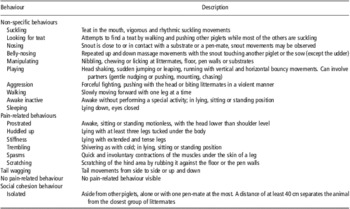
Behavioural observations started within 15 min after the last litter was treated, and were carried out for 5 successive days. The behaviour of each piglet was recorded using scan sampling every 12 min, during two periods in every day; once in the morning and once in the afternoon. Each observation period resulted in a total of 16 scans per experimental piglet and 128 scans for each piglet during the entire experiment. Behaviours were scored according to a modified ethogram described by Hay et al. (Reference Hay, Vulin, Genin, Sales and Prunier2003) (see Table 1).
Description of recorded behaviours (modified after Hay et al., Reference Hay, Vulin, Genin, Sales and Prunier2003)

Observations were recorded using a Psion Workabout and uploaded into ‘Observer’ software (Noldus, Wageningen, The Netherlands). All observations were carried out by the same observer, standing in the control alley of the farrowing unit. The markings of the piglets did not correspond with treatments, thus eliminating observer bias as much as possible. Within each scan, all piglets were scored for each category: non-specific behaviours, pain-related behaviours, tail wagging, absence of pain-related behaviour and isolation. The percentage of scans for each behaviour were calculated for each observation period, as well as for the entire period of the study, and analysed statistically.
Weight gain and wound characteristics
Piglets were weighed at the day of birth, D1 (day of the experiment), D5 and the day of weaning. Individual daily weight gain was calculated for three periods: D1 to D5, D5-weaning and birth-weaning. Calculated individual daily weight gains for each period were used for statistical analyses. Characteristics of the castration wound were noted on D5 and on the day of weaning. Characteristics that were noted were: closing of the wound, presence and aspect of exudate, signs of inflammation (calor, dolor, rubor, tumor).
Statistical analyses
Data were analysed for the effect of lidocaine and meloxicam on behaviour after castration. Statistical analysis was performed by fitting linear mixed models to the data, using the method of residual estimated maximum likelihood of the statistical software Genstat (GenStat, 2002). To stabilize the variance of the behavioural data, arcsine-square root transformation was applied before analysis. To the behavioural data of all observation periods, the following linear mixed model was fitted:
 $$\quad {{{y}_{ijkl}}\, = &\,m\, + \,{{r}_i}\, + \,{{t}_k}\, + \,{{p}_l}\, + \,r{{t}_{ik}}\, + \,r{{p}_{il}}\, + \,t{{p}_{kl}}\, \cr &+ \,r{{l}_{ij}}\, + \,{{a}_{ijk}}\, + \,{{{\epsilon}}_{ijkl}}\quad\quad\quad\quad\quad\quad\quad\quad\ \ \,(1)$$
where yijkl is arcsine-square root transformed behavioural incidence, the fixed model terms are: m the overall constant; ri effect of replicate i; tk effect of treatment k; pl effect of period l; rtik, rpil, tpkl corresponding interactions. The remaining model terms rlij effect of litter j within replicate i and aijk effect of animal with treatment k in litter j of replicate i are assumed random to describe the covariance structure in the repeated measurement data. εijkl is the random error. To the behavioural data of a separate observational period the following linear mixed model was fitted:
 $${{y}_{ijk}}\, = \,m\, + \,{{r}_i}\, + \,{{t}_k}\, + \,r{{t}_{ik}}\, + \,r{{l}_{ij}}\, + \,{{{\epsilon}}_{ijk}}$$
where yijk represents arcsine-square root transformed behavioural incidence or daily weight gain per period. The fixed model terms are: m the overall constant; ri effect of replicate i; tk effect of treatment k; rtik corresponding interaction. rlij effect of litter j within replicate is assumed random to describe the covariance structure in the repeated measurement data. εijk is the random error. Fixed model effects were tested using the corresponding Wald tests. For significant (P < 0.05) treatment effects and period × treatment interaction, differences between pairwise treatment means were tested using t-tests.
Results
Observational data of three piglets were missing; two piglets died in the days before the experiment (both NONE), and one piglet died during the observation week (CAST). Piglets spent <1% of the scans displaying belly-nosing, playing, aggression, prostrated, trembling and scratching. Because of these low incidences, these behaviours could not be analysed in individual observation periods. Pain-related behaviours decreased over time, regardless of treatment, in particular because of a decrease of huddled-up behaviour. The percentage of scans with no pain-related behaviour increased in the course of 5 days for all treatments (see Table 2).
Occurrence of No pain-related behaviour

CAST = castration; LIDO = castration with lidocaine; MELO = castration with meloxicam; L + M = castration with lidocaine and meloxicam; SHAM = handling; NONE = no handling.
Percentage of scans, means ± s.e.m.
abP < 0.05: comparison between experimental treatments within periods.
There was a significant treatment effect on No pain-related behaviour on D1-PM and D2-AM only. MELO and NONE piglets showed significantly (P < 0.05) more No pain-related behaviour than LIDO and CAST (D1-AM only) piglets. MELO was not significantly different from SHAM and NONE. The treatment effect on tail wagging was significant from D1-PM until D3-PM. LIDO piglets showed significantly (P < 0.001) more Tail wagging than the other treatments during that period (see Table 3). Sporadic treatment effects were present for Isolated (D3-PM), awake inactive (D4-PM), walking (D3-AM and D4-PM) and manipulating (D3-AM).
Occurrence of tail wagging

CAST = castration; LIDO = castration with lidocaine; MELO = castration with meloxicam; L + M = castration with lidocaine and meloxicam; SHAM = handling; NONE = no handling.
Percentage of scans, means ± s.e.m.
abcP < 0.001: comparison between experimental treatments within periods.
A treatment effect on growth until weaning was not found, only a replicate effect (P < 0.05) was found for growth until and after castration. Castration wounds healed rapidly in all treatments, only two LIDO piglets still had an open wound with some serous exudate at D5. At the day of weaning, none of the castration wounds showed signs of inflammation. However, in the second replicate, a bilateral thickening of the scrotal area was found in 16 piglets; 6/12 LIDO, 6/12 L + M and 4/12 MELO piglets. In these cases, no characteristic signs of inflammation (calor, rubor, dolor) were present.
Discussion
The results of this study show a lower level of No pain-related behaviour in CAST and LIDO piglets during the 1st day after castration, compared with MELO, SHAM and NONE. This difference between treatments was not found in subsequent days, which is in contrast with other studies (Hay et al., Reference Hay, Vulin, Genin, Sales and Prunier2003; Llamas Moya et al., Reference Llamas Moya, Boyle, Lynch and Arkins2008). In our study, piglets were not subjected to painful procedures before the experiment, whereas in the studies of Hay et al. (Reference Hay, Vulin, Genin, Sales and Prunier2003) and Llamas Moya et al. (Reference Llamas Moya, Boyle, Lynch and Arkins2008) piglets underwent tail docking and iron injection immediately after birth. These early-life experiences, together with other methodological differences, could induce an altered response to pain. Previous injuries can lead to association of handling with acute pain, and thereby increase stress during handling (Prunier et al., Reference Prunier, Bonneau, von Borell, Cinotti, Gunn, Fredriksen, Giersing, Morton, Tuyttens and Velarde2006). They can also induce secondary hyperalgesia and thereby increase the pain reaction to castration (Lavand'homme, Reference Lavand'homme2006). Local anaesthesia with lidocaine has a pain-relieving effect during castration (White et al., Reference White, DeShazer, Tressler, Borcher, Davey, Waninge, Parkhurst, Milanuk and Clemens1995; Haga and Ranheim, Reference Haga and Ranheim2005; Kluivers-Poodt et al., Reference Kluivers-Poodt, Houx, Robben, Koop, Lambooij and Hellebrekers2012); however, our study shows that lidocaine has no longer lasting effect after castration. This is in compliance with the action time of lidocaine of ∼1 h (Ranheim et al., Reference Ranheim, Haga and Ingebrigtsen2005). In our study, LIDO piglets exhibited more tail wagging during 3 days after castration compared with CAST piglets. To our knowledge, this effect has not been described earlier and cannot readily be explained. In piglets that also received meloxicam, tail wagging was not increased during the days after castration. Our study shows, that meloxicam provided pain relief during the afternoon after castration. Castrated piglets treated with meloxicam showed the same level of No pain-related behaviour as piglets that were not castrated (SHAM and NONE), and showed significantly more No pain-related behaviour than castrated piglets (with or without lidocaine). This positive effect of meloxicam on behaviour, during 1 day after castration, confirms the findings of Keita et al. (Reference Keita, Pagot, Prunier and Guidarini2010) and Hansson et al. (Reference Hansson, Lundeheim, Nyman and Johansson2011). They studied behaviour during a few hours to 1 day after castration. Our study shows that the pain-relieving effect of meloxicam lasts for at most 22 to 24 h after the procedure, which is in line with its pharmacological properties.
Pain-related behaviours in our study decreased over time, independently of treatment, mostly because of a decrease of huddled-up behaviour. An age effect in behaviours was also described by Torrey et al. (Reference Torrey, Devillers, Lessard, Farmer and Widowski2009); they found that 1-day-old piglets trembled more compared with 3-day-old piglets. This underlines the importance of including control treatments in a study design.
There was no effect of treatment on growth. This is in line with the findings of Hay et al. (Reference Hay, Vulin, Genin, Sales and Prunier2003) and Kluivers-Poodt et al. (Reference Kluivers-Poodt, Houx, Robben, Koop, Lambooij and Hellebrekers2012) and indicates that growth is not a sensitive indicator of procedural pain in piglets. The speed of wound healing after castration was not influenced by the use of lidocaine or meloxicam. However, a thickening of the scrotum was found in several LIDO, MELO and L + M piglets, as opposed to CAST piglets. This is also reported by Hansson et al. (Reference Hansson, Lundeheim, Nyman and Johansson2011). An explanation for this thickening remains unclear.
Conclusion
Castration leads to a decrease in No pain-related behaviour in the day(s) following castration, compared with control animals. This is not influenced by the use of lidocaine. Our study shows that meloxicam provides pain relief during the day after the procedure, in piglets castrated with and without lidocaine. Therefore, post-operative pain relief with meloxicam should be provided, also when local anaesthesia with lidocaine is applied. When following the 3S approach (Suppress, Substitute, Sooth), as suggested by Guatteo et al. (Reference Guatteo, Levionnois, Fournier, Guémené, Latouche, Leterrier, Mormède, Prunier, Servière, Terlouw and Le Neindre2012), application of meloxicam in castration would meet the demands to sooth the pain, caused by unavoidable painful procedures. This application should be generally accepted, until castration can be either substituted or, preferably, eliminated.
Acknowledgements
The authors gratefully acknowledge the financial support for this project from the Dutch Ministry of Economic Affairs, Agriculture and Innovation, the technical support of the staff of Sterksel Research Centre and Pieter Vereijken for the statistical analyses.