

Several studies analysing stakeholder experiences with disability management (DM) have taught us that return-to-work (RTW) policies matter, and are driving organisations in their efforts to prevent work disability (Amick et al., Reference Amick, Habeck, Hunt, Fossel, Chapin, Keller and Katz2000; Annett, Reference Annett2008; Habeck, Scully, Hunt, & VanTol, Reference Habeck, Scully, Hunt and VanTol1998). Having a formal RTW policy in place is a key component in DM programs, guiding procedures to support gradual RTW (Gensby, Labriola, Irvin, Amick, & Lund, Reference Gensby, Labriola, Irvin, Amick and Lund2013; Williams & Westmorland, 2002).
Given the broad use of RTW policies in organisations, more knowledge on the formation and implications of RTW policies is in demand. When adopting RTW policies, employers may face practical challenges related to the conditions from which policies are developed and evaluated. Practical challenges may arise if policies are created without sufficient participation to ensure consensus and commitment to overall principles and procedures (Shrey, Hursh, Gallina, Slinn, & White, Reference Shrey, Hursh, Gallina, Slinn and White2006; Shrey & Lacerte, Reference Shrey and Lacerte1995), or if policy implementation is inadequate, causing ad hoc solutions that risk overlooking differing organisational and individual needs (Kirsh & McKee, Reference Kirsh and McKee2003; Tjulin, Stiwne, & Ekberg, Reference Tjulin, Stiwne and Ekberg2009; Walters & Haines Reference Walters and Haines1988).
As mainstream DM often focuses on early intervention, controlling time off work and transition back to work, attention to workplace inclusion beyond initial RTW has been limited. Thus, the support of RTW policies when the employee is back at work remains a concern (MacEachen, Clarke, Franche, & Irvin, Reference MacEachen, Clarke, Franche and Irvin2006; Tjulin, MacEachen, & Ekberg Reference Tjulin, MacEachen and Ekberg2010). This calls for new strategies and methods that includes interpersonal experiences and key stakeholders influencing the maintenance of RTW (Loisel et al., Reference Loisel, Buchbinder, Hazard, Keller, Scheel, van Tulder and Webster2005; Pransky, Gatchel, Linton, & Loisel Reference Pransky, Gatchel, Linton and Loisel2005).
Research in organisational participation (Heller, Pusic, Strauss, & Wilpert, Reference Heller, Pusic, Strauss and Wilpert1998), and action research (Nielsen & Svensson, Reference Nielsen and Svensson2006) has broadened our understanding and application of worker participation in change and decision-making processes within working life. Although the issue of stakeholder participation has been widely discussed in DM research (Franche, Baril, Shaw, Nicholas, & Loisel, Reference Franche, Baril, Shaw, Nicholas and Loisel2005; Guzman, Yassi, Baril, & Loisel Reference Guzman, Yassi, Baril and Loisel2008; Shrey Reference Shrey1996), only a few studies have explored RTW policies in organisations using participatory change process methods to document the implications and outcomes that they deliver (McAnaney & Williams, Reference McAnaney and Williams2010; Randall & Buys, Reference Randall and Buys2011). Thus, in order to increase the likelihood of action to improve practice in a sustainable way (Polanyi & Cole, Reference Polanyi, Cole, Sullivan and J2003; Polanyi, McIntosh, & Kosny, Reference Polanyi, McIntosh and Kosny2005),we still need a greater appreciation of participatory research methods to promote a deeper and more widely shared understanding of RTW policy implications in organisations.
This study creates new knowledge on the formation and implications of RTW policies in organisations. Using an action research approach to facilitate a RTW/DM change process in the health care workplace, participatory methods are tested to provide insight into important factors in creating more comprehensive RTW policies. These methods are essentially practice-oriented and thus demand that we adopt a specific focus on the types of actions that can be used to obtain sustainable change. The study builds on the need for participatory research in DM, offering action research as an approach through which other companies and researchers can gain insights that may benefit RTW policy and practice in organisations.
Participatory Knowledge Creation and Action
Action research provides a scientific framework of methods for successfully engaging workplace stakeholders to define needs and attain sustainable change in local working environments and work disability prevention. Since its origins in Kurt Lewin's social–psychological experiments in the 1940s (Lewin, Reference Lewin and Lewin1946/1997), action research has emerged as a critique and alternative framework to more conventional views of social science; an approach, moreover, that seeks to narrow the gap between ideas and practice and open up new connections between research and contextual problem solving (Nowotny, Scott, & Gibbons Reference Nowotny, Scott and Gibbons2001; Reason & Bradbury, Reference Reason, Bradbury and Bradbury2010).
Action research may be defined as a scientific method for research that underlines the connection between understanding and change, between theory and practice, and an active cooperation between researchers and the participants in the production of new knowledge (Svensson & Nielsen, Reference Svensson, Eklund, Randle and Aronsson2006). The normative concerns underlying much of action research are democratisation of knowledge production and democratic social transformation (Greenwood & Levin, Reference Greenwood and Levin2007). This aligns action research with themes that have emerged in discussions about modes of contemporary knowledge production, and thus a problem-based approach, promoting local commitment and contextual knowledge as grounding for robust social change is advocated (Nowotny et al., Reference Nowotny, Scott and Gibbons2001). Conversely, variations between action research approaches occur, ranging from creation of participatory opportunities, as such, to the design of new democratic practices to reform working life (Reason & McArdle, Reference Reason, McArdle and Cummings2008; Svensson & Nielsen, Reference Svensson, Ellstrøm and Brulin2006).
Action research processes are comprised of an action component, supporting some form of organisational development or normative change, while at the same time producing new knowledge from participants’ own perspectives of their needs (Svensson & Nielsen, Reference Svensson, Ellstrøm and Brulin2006). Thus, a cornerstone in action research is the creation of participatory processes, encouraging stakeholders to continuously reflect on their situation to improve common understanding and support action design that enhances participants’ capacity to control their situation within a more sustainable environment (Greenwood & Levin, Reference Greenwood and Levin2007).
Multiple research methods may be used to create knowledge and enhance collaborative social change, taking into account the role of the researcher as an important factor in the production of knowledge (Westlander, Reference Westlander and Nielsen2006). Action research methods do not lend themselves easily to conventional research methodologies that seek to determine cause and effect relationships. Action research may, however, provide innovative approaches to try to understand the richness of human interaction in these intervention processes, providing in-depth insight into complex organisational mechanisms and social problems (Polanyi, Reference Polanyi2001).
Approaching Return-to-Work Policy Through Action Research
Initialising DM to guide RTW processes in organisations involves change in personnel policies and work practices to promote adequate responsiveness and compatibility (Habeck & Hunt, Reference Habeck and Hunt1999; McAnaney & Williams, Reference McAnaney and Williams2010; Tjulin et al., Reference Tjulin, Stiwne and Ekberg2009). Managing this context, employers should recognise that there are different conditions, needs, and experiences that may affect social change and human development in working life (Hvid & Hasle, Reference Hvid and Hasle2003). To drive RTW policy development and change processes, organisations, therefore, rely on knowledge creation from all levels of the organisation through meaningful participation at both strategic and operational levels (Hunt & Habeck, Reference Hunt and Habeck1993; Shrey et al., Reference Shrey, Hursh, Gallina, Slinn and White2006). However, the gap between what companies ought to do and the types of involvement that can be achieved in organisational practice challenge employers to look beyond rhetoric and project cultures, and take action to realise renewable employee participation in RTW policy development and work practices (Shaw & Lindsay, Reference Shaw and Lindsay2008).
Given the potential of a comprehensive DM approach, employees may still face inequality in the managerial conceptualisation and formation of policies offered. Reducing participatory possibilities to dialogue around predefined managerial principles may risk overlooking important employee needs, promoting unilateral and instrumental policy application. This situation calls for critical attention to support the comprehensiveness and continuity of RTW policy in practice. By critical attention we refer to the appropriateness of managerial responses, and to what extent managerial policy and practice are democratically accountable to employee needs (Alvesson & Willmott, Reference Alvesson and Willmott1996; Reed Reference Reed, Alvesson, Bridgman and Willmott2009).
Akabas, Gates, and Galvin (Reference Akabas, Gates and Galvin1992) outline nine principles that may help elucidate the role of RTW policies in organisational settings. The principles may serve as indicators of the resources, dilemmas and aspirations of existing RTW policy frameworks in organisations, and the extent to which policies are able to incorporate complex practical needs:
• The policy creates a starting point, but is not a quick fix, or something that is deduced in the end.
• The policy serves as a constitution enlisting everyone in the return to work mission by establishing the values, rights and responsibilities of the workers and the employer, allowing the employer to take an explicit position that applies equally and systematically to everyone and is available to all.
• The policy sets in place an infrastructure, which outlines organisational response to injured or ill workers, and clarifies procedures from which all other actions are derived.
• The policy organises the workplace by pulling together elements from the different functions and arenas of the workplace organised around the goal of meeting the needs of workers with the needs of the workplace.
• The policy interacts with complex situations ensuring flexible (able to respond to diverse practice solutions) and dynamic (able to respond to changes in external disability policy system) responses.
• The policy provides compatibility acting as an integrated part of the wider personnel policy without contradicting other policy areas.
• The policy represents a tailored standard, which is enacted by a wide range of organisational levels and different departments, and should be open and responsive to input from this variety of functions.
• The policy guides internal communication and information that is accessible to all levels of management and workers, which is communicated for all to understand.
• The policy sets the plan for the future, which may provide a base for longer range plans that need to be further developed.
One might ask whether in practice organisations are able to incorporate these nine RTW policy principles into RTW policies. Consequently, RTW policies should be analysed in a way that captures a concurrent focus on change and continuity, while acknowledging how resource allocation, levels of participation, established knowledge and coalitions of actors challenge interactive and integrative actions in practice.
Using action research we are able to pose questions about the appropriateness of the current formation of RTW policies implemented and practised by employers, thus creating the conditions for mutual learning and alternative action that may broaden mainstream DM in organisations. Through the creation of participatory knowledge sharing and critical thinking, driven by the voices and expertise of re-entering workers, co-workers and supervisors, the balance between rhetoric and practice may be challenged and, therefore, inspire collective understanding and alternative action. Applying an action research approach to DM allows organisations to gain common knowledge and conditions for action, exceeding usual limitations on areas of change, from which RTW is normally viewed and organised.
Action Methodology
This study extends the existing DM knowledge base by linking action research to RTW policy change processes in organisations, analysing the formation and range of RTW policies to support workplace inclusion. The study also endeavors to take advantage of the range of action research perspectives available. To support change processes within organisations, action research may draw on a rich and diverse set of perspectives and practices. As action researchers embrace and navigate among the various perspectives, transparency about the practical application and methodological issues is important (Reason & Bradbury, Reference Reason, Bradbury and Bradbury2010). This study is inspired by action research in the workplace (Pasmore, Reference Pasmore, Reason and Bradbury2010). From this grounding, we combine two action research methods routed in different philosophical perspectives: (a) a chronicle workshop (Limborg & Hvenegaard, Reference Limborg, Hvenegaard and Rasmussen2011) inspired by critical realism and interactive research (Svensson, Eklund, Randle, & Aronsson, Reference Svensson, Eklund, Randle and Aronsson2007; Svensson, Ellstrøm, & Brulin, Reference Svensson, Ellstrøm and Brulin2007); and (b) a future creation workshop (Jungk & Mueller, Reference Jungk and Müllert1996) inspired by critical theory and utopian action research (Nielsen & Nielsen, Reference Nielsen, Nielsen and Svensson2006). Although each perspective and method differs in various epistemological and methodological concerns, both approaches share a participatory focus on social change and knowledge creation. Interactive research offers an interactive learning perspective, creating conditions for joint analysis of organisational practice (Svensson, Eklund, et al., Reference Svensson, Eklund, Randle and Aronsson2007; Svensson, Ellstrøm, et al., Reference Svensson, Ellstrøm and Brulin2007). Critical utopian action research offers a critical transcendent perspective, creating alternative actions for sustainable work conditions (Olsén, Nielsen, & Nielsen, Reference Olsén, Nielsen and Nielsen1993). Seen as complementary parts, the two perspectives can provide a problem-focused, context-specific and future-oriented approach to reform DM in organisations.
We now present a case from the application of our action research approach to the study of an RTW policy change process in the health care workplace. The study is a subset of qualitative findings, covering a two-course experience from an action research change process at a Danish regional hospital. Danish hospitals are administrated by five national regions. In various ways incentives and policy frameworks are provided to hospitals within each region to support and encourage adaption of overall regional guidelines into local policies and practices. Implementation of the region's sickness absence policy framework, therefore, requires that the region's hospitals establish their own local policies, or relevant subpolicies, and ensure that these are implemented to sustain injured or ill workers, so that the duration of sickness absence is reduced.
The first well of experience derives from a qualitative evaluation of an extensive 2-year regional project aimed at reducing sickness absence and improving RTW rates in the Danish health care sector. A hospital, with a staff complement of 600 employees, was chosen as a best case example to gain qualitative process experience and joint learning from project participation. The qualitative evaluation was conducted as a one-day chronicle workshop, illustrating the common history of the evolvement of sickness absence and RTW efforts at the hospital (Gensby, in press). A chronicle workshop contributes by recalling and evoking valuable knowledge from previous developmental processes, and by identifying ‘blind spots’ or parts of pre-existing processes that organisations need to overcome to ease implementation and strengthen change. The structure of the workshop is formed by central issues prioritised as significant by the organisation's own members. This allows mutual explanation, and enables a more in-depth understanding of the policy and practices that prevail in the organisation, as well as its ability to act (Limborg & Hvenegaard, Reference Limborg, Hvenegaard and Rasmussen2011).
In spite of the case hospital's status as a ‘front runner’ in sickness absence and RTW efforts, unsolved problems and criticisms remained prevalent. The project group, action researchers and employees therefore agreed to take the evaluation a step further, continuing the change process in a two-day future creation workshop, building on the experiences of the initial chronicle workshop process, but now creating alternative actions to challenge existing policy and practice. The purpose of the future creation workshop is to develop desirable futures based on utopian ideas. The future creation workshop can help realise common dreams, seek common denominators instead of contradictions, and is based on the participants’ own visions and knowledge. Providing free spaces for critique and utopian thinking are key features in the future creation process. Based on critical statements and experiences from each participant's everyday life, utopian ideas are created, and common action plans are formulated to guide realisation in practice (Jungk & Mueller, Reference Jungk and Müllert1996).
Although the interplay between the action research methods may appear beneficial to the overall process, it was not an unbroken line. First, the action research process was initiated as a result of a project evaluation from a previous change process aimed at reducing sickness absence at the hospital. This meant that we, as action researchers, were part of an existing change process and did not have the opportunity to plan this part of the project beforehand. Second, it became clear that the social inclusion, beyond initial RTW, continued to cause problems for co-workers and re-entering workers at the hospital, despite continued efforts to manage sickness absence and RTW.
On the basis of these findings, researchers and workers agreed to shift course, integrating the context knowledge gained from the chronicle workshop as part of an extended critical change process to qualify alternative actions supporting social inclusion and accommodating work environments. The change process was kept open, however, it required a researcher role to change from being a facilitator of common understanding and explanation to an advocate for local change. The results from the chronicle workshop therefore figured as a contextual point of departure for critical alternative actions.
Knowledge Creation Process
Workshop recruitment was done in a two-stage process. A total of 27 participants representing the five major hospital wards (i.e., medical, surgical, anesthesia, diagnostic, and services) were included in the workshops. The chronicle workshop included 11 participants. Length of service and internal position were key issues of concern for the sampling of participants in the chronicle workshop (Limborg & Hvenegaard, Reference Limborg, Hvenegaard and Rasmussen2011). Accordingly, inclusion criteria for participants reflected a maximum variation principal within a purposive sampling approach (Patton, Reference Patton2002). The sampling approach allowed the workshop to reflect a broad mix of participants and thematic representation from all levels of the organisation. Previous experience with RTW trajectories and internal role and responsibility in the RTW process at the operational level (e.g., departmental supervisors, union representatives and safety representatives), and the strategic level were also accounted for (e.g., human resources, labour management committee, occupational health and safety services, senior management).
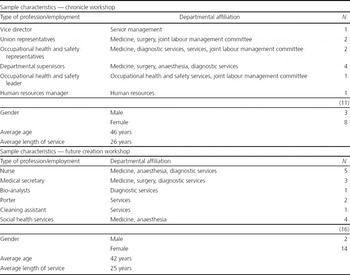
The future creation workshop included 16 participants. Providing free spaces for critical reflection and utopian thinking are key features of the future creation workshop. Thus, homogeneity is a key issue of concern for the sampling of participants in the future creation workshop (Jungk & Mueller, Reference Jungk and Müllert1996). Accordingly, the inclusion criteria for participants was guided by a purposive sampling approach (Patton, Reference Patton2002), targeting workers having a previous or ongoing RTW experience in their work unit from different job functions and departmental affiliations. Participant RTW experiences covered work disability due to back and shoulder pain, stress, migraine and cancer. Workshop participants’ characteristics are presented in Table 1.
Workshop Participant Characteristics

The action research process was driven by the active engagement of the participating workers. Internal resource allocation and recruitment procedures were done in collaboration with a hospital-based project group comprising representatives from the occupational health and safety committee and management. Study information and workshop descriptions were sent to all supervisors in the five major hospital departments, who then forwarded the information to workers and discussed the project in local departmental meetings. Departmental supervisors then identified workers eligible for workshop inclusion. Interested participants were then verified by the project group and cleared according to the daily schedules and work practices. Each workshop was held at the hospital and facilitated by two action researchers. Due to acute medical work duties three participants dropped out during the workshop processes.
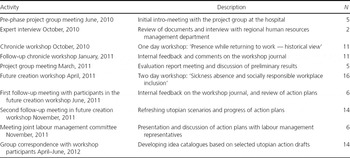
Data from the chronicle workshop was developed in October, 2010. Data from the future creation workshop was developed in April, 2011. During the workshop process an action researcher systematically recorded observations and processed data according to participant input in the various workshop stages. Prior knowledge of internal procedures and RTW policy documents was reviewed through initial meetings between researchers and the project group. Additionally, in-depth interviews with centrally located human resources managers were conducted in October, 2010, in order to obtain direct insights into the context of the overall regional DM and sickness absence strategies. Table 2 provides an overview of the all activities during the action research process.
Action Research Process Stages

Action Research Analysis
Data analysis followed the analytic structure of each workshop methodology. In each workshop, data creation processes were systematically structured and thematically analysed according to the experiences and prioritisation of the workshop participants. For each workshop, data creation processes were thematically documented in a workshop journal, and analysed in two separate courses of experience. A research assistant noted participants’ input and group processes during the workshops. The action researchers wrote the workshop journals, charting and reiterating the experiences gained from the workshops; however, data validity was shared and obtained through an iterative process of regular feedback and joint follow-up meetings between action researchers and workshop participants throughout the action research process. Participants were sent written copies of workshop journals to verify the substance and reflections presented, and follow-up meetings were held to review action plans and keep track on progress. This exercise is illustrative of the ongoing interpretation process that the researcher must undertake when navigating between the empirical field (dialogue with participants) and theoretical abstraction (Westlander, Reference Westlander and Nielsen2006).
Now, we share the findings of a two-course experience that contributed to the knowledge of important factors to create more comprehensive RTW policies. We describe the core activities, participatory processes, mutual learning and actions taken during the action research process. The first course of experience presents the pre-existing development process as a means to understand the interrelated resources and dilemmas that drive current RTW policy and practice. The second course of experience presents alternative actions to create sustainable RTW efforts. This is told through the voices of the participants, but presented by the action researchers.
Findings
The Chronicle Workshop: Facilitating Collective History and Mutual Understanding
The first course of experience is the result of the chronicle workshop, and illustrates how workers and management collectively put their organisations’ RTW policy and practice into historical context. The topic of the chronicle workshop was ‘Presence while returning to work’, which covered the development of sickness absence and RTW efforts at the hospital from 2000 to 2010.
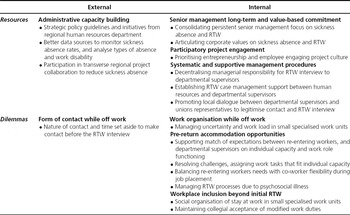
Knowledge creation processes during the chronicle workshop were structured and analysed through a two-step workshop process of exploring facts and history making. The analytic focus was facilitated by a common exploration and systematic ordering of facts, which participants experienced as decisive factors for the development of RTW policies and practices. The facts covered significant events, stakeholders, resources and dilemmas. The patchwork of facts were then ordered in core historical focal points and given headlines, covering a demarcated time interval. This exercise was done in group-based history making sessions in which the participants reflected on the configuration of the history. In practice, the participants created a common understanding of the evolvement of DM and formation of the RTW policy, opening up a more critical approach to existing policy and practice at the hospital. Overall participants described the formation and implications of the RTW policy as part of an organisational maturation process, which they divided into three periods. Each period illustrated how the hospital had gradually moved away from a passive approach, perceiving sickness absence as a private problem, to an active approach, perceiving RTW as a common problem. Based on the central themes and issues experienced and prioritised by the participants during the chronicle workshop, we identified a number of ‘policy procedural resources and dilemmas’. These are presented in a condensed form in Table 3, which is followed by a short summary of the key messages.
Return-to-Work Policy Procedural Resources and Dilemmas

Policy Procedural Resources
The policy procedural resources cover supportive conditions for the development and range of current RTW policy configuration. The policy procedural resources are structured around four core themes: (a) Administrative capacity building, (b) Senior management long-term and value-based commitment, (c) Participatory project engagement, and (d) Systematic and supportive management procedures.
Administrative capacity building
Following an administrative centralisation of health care in five national regions, a new strategic policy level is implemented in the Danish health care sector. During this process participants experience how work disability and sickness absence becomes a prioritised area for all regional health care workplaces that assign policy frameworks and instructions on sickness absence and RTW for local adaption. New transverse project opportunities and knowledge sharing processes to reduce sickness absence and promote RTW also emerge. Participants describe how project participation has created insight into what other health care workplaces are doing, and helped maintain the hospital's own development process with increased awareness of their own policy and procedures. The participants experience how sickness absence and RTW initiatives are more easily maintained in a larger project community, and where individual performance is monitored and displayed. Participants also experience an increased monitoring of absence rates and benchmarking across regional health care workplaces, with statistical summaries developing as an autonomous focus area. The hospital improves its own registration practices and establishes broader data, which progressively creates greater awareness of different types of absence (short-term, scattered and prolonged absence), and associated costs.
Senior management long-term and value-based commitment
The participants describe how changing senior management constellations and subsequent re-structuring of departments has caused ad hoc solutions and inconsistency in DM resource allocation. In particular, participants describe how time consuming it is to adjust the organisation and calibrate between changing management strategies, which has made it difficult to develop extensive RTW policy and practices and anchor initiatives at the department level. The current senior management signals that they are willing and committed to stay and manage the hospital, which enables a long-term focus to prevent work disability. In addition, senior management has motivated a value-based approach to the managerial principles governing RTW processes at the hospital. Participants describe how local departmental discussions have been centered on issues of accountability, and communication, fostering a more active focus on attitudes towards illness and injury as something the workplace may interfere in. The participants describe how ill or injured workers are referred to as a common task, with a common concern for the entire company, albeit with a focus on an individually tailored approach to RTW that does not view all absent workers through the same lens.
Participatory project engagement
With the entry of the new senior management, innovative and novel project activities are promoted. Several development projects are orchestrated by the safety leader and various internal project groups in which workers are intended to play a central role in the development and implementation of project activities. Unlike past indifference, participants describe that they feel they have the required expertise to move forward, supported by an internal managerial willingness to devote time for project engagement, creating space for internal ‘change champions’ to inspire development and knowledge transfer processes within all levels of the organisation.
Systematic and supportive management procedure
A noticeable policy re-orientation is the launch of a more systematic approach to RTW interviews. In the past, RTW interviews were often neglected, skipped or poorly documented. Due to large differences in the management of RTW processes across departments, the hospital decentralises the responsibility for the RTW interview, making departmental supervisors more directly accountable for the management of RTW processes. Following this decentralisation, union representatives become more engaged in the local dialogue on sickness absence and RTW in departmental meetings, and gradually become more aware of when and how RTW interviews are conducted, which are now more openly discussed among union representatives and departmental supervisors. Participants experience how a more open dialogue has supported a gradual change in attitude and created legitimacy around procedures of early contact and individual RTW interviews. Discussions have primarily related to the expectations going into the interview, and how to address complex health situations. However, a union representative is not always present during an RTW interview. Participants describe how prior sickness absence policies have appeared distant from daily problem solving. The current policy is now more actively used as a systematic framework that explicates the role of departmental supervisors and workers, and outlines the procedures guiding contact and the RTW interview. Participants explain how the human resources department plays a more active role establishing RTW policy procedures and local managerial support. The mutual understanding between the human resources department and departmental supervisors is described as an important ‘link’ to manage legal concerns in case-management procedures and ‘deadlocked situations’, wherever the departmental supervisor is located in the organisation.
Policy Procedural Dilemmas
Participants express how visualising what has been achieved has created a sense of pride and energy to manage sickness absence and RTW. Despite the progress and procedural resources obtained, the history reveals several policy procedural dilemmas that still prevail. The policy procedural dilemmas are structured around four core themes: (a) Form of contact while off work, (b) Work organisation while off work, (c) Pre-return accommodation opportunities, and (d) Workplace inclusion beyond initial RTW.
Form of contact while off work
Participants describe the complex nature of workplace contact while off work, where intentions behind the contact may appear problematic to some. Participants notice how many colleagues have been reluctant to make contact to an injured or ill worker due to the nature of the social network around the injured or ill worker at the workplace or sensitivity of health problems. Recent changes in the national disability policy framework have, however, installed a statuary demand for employers to contact workers. This has prompted discussions around the nature and intention of the contact. Participants describe how contact from departmental supervisors within an agreed interval is no longer viewed as an invidious action.
Work organisation while off work
Participants describe how the hospital has devoted increased attention to primary preventive projects to reduce sickness absence with the occupational health and safety committee and safety representatives more actively involved in workplace risk assessment of potentially hazardous work conditions. However occupational health and safety practices appear to be more loosely linked to RTW processes. During long absence periods, hospital departments must do without important professional competencies. In particular, small units and special departments are vulnerable to these situations, since they are not guaranteed supplementary replacement, and experience a lack of staffing to fill in for the specialised working tasks and extra workload. Managing such situations for a long period, while not knowing why a colleague is off work and what the prognosis is for their return, creates uncertainty among co-workers, and is perceived as a continuous challenge.
Pre-return accommodation opportunities
Participants describe how the increased supervisor accountability in RTW processes demands a new form of ‘process capability’, balancing managerial performance measures with situational conditions related to worker needs and work tasks. Supervisor process capacity is particularly needed during the RTW interview to match expectations on individual capacity and work role functioning to modify tasks and accommodate restrictions. Assigning work tasks that suit re-entering workers’ individual capacity continues to be a challenge, as initial accommodation typically requires reduced hours and gradual work resumption, which can be difficult to identify and provide. In particular, common mental problems such as stress or depression are perceived as a major managerial challenge in which longer periods of time can pass before someone intervenes. Participants notice how concerns relating to the often sensitive information on re-entering workers’ health condition makes it difficult to give detailed information to the department/work group. A common experience has been that departments manage these processes in a less consistent and sensitive way.
Workplace inclusion beyond initial RTW
Participants continue to experience social and organisational challenges beyond initial RTW. Although the hospital has succeeded in changing the attitude towards sickness absence, insecurity about limits to co-worker acceptance and psychosocial well being while re-entering workers recover at work still challenge gradual work schemes and job modifications. Participants describe how covering work hours and schedules, beyond reduced working hours, burdens both re-entering workers and co-workers if left unattended. In particular, the uncertainty about the prognosis of work disability and the duration of modified work is stressful in the long run because the work load does not change according to the amount and capacity of workers in modified work. This is most critical for small departments that are dependent on specialised competences. These issues are hard to talk about, but it is often left for workers to deal with themselves. Additionally, there have been examples of jealousy among co-workers if re-entering workers are transferred to other departments with more gentle work tasks. Participants describe how co-worker acceptance is maintained more easily if modified duties or work hours appear transparent and are justified in a way that support mutual understanding and social relations.
The Future Creation Workshop: Creating Desirable Futures Through Action
Based on the policy procedural resources and dilemmas discovered during the chronicle workshop, workers and action researchers agreed to continue the change process, jointly applying the principles from the future creating method in a two-day future creation workshop under the topic ‘Sickness absence and socially responsible workplace inclusion’. Through workshop participation re-entering workers and co-workers engaged in interaction to create alternative scenarios for workplace inclusion to counteract procedural dilemmas faced by current RTW policy and practice. Giving voice to re-entering workers and co-workers allows their experiences about their working life to serve as alternative scenarios for the development of inclusive RTW policies and practices at the hospital.
Knowledge creation processes were organised through specific rules of dialogue and creativity during three workshop phases. In the first phase, the participants were asked to formulate critical statements about their working life, sickness absence and RTW, allowing the participants to become aware of their own criticism. Central analytic themes were based on a thematic ordering of critique into critical statements. Contrasting the critical themes, participants subsequently developed utopian counterstatements. The utopian statements were then discussed and arranged in a selection of utopian drafts that the participants wished to commit themselves to. Using research-based forum theatre, the utopian drafts were visualised to form images of the content and identify what was missing and vulnerable (Husted & Tofteng, Reference Husted and Tofteng2010).
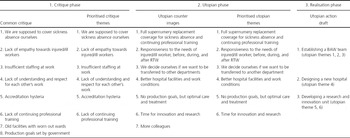
The future creation process ends with a realisation phase in which the participants discuss the utopian drafts and develop action planning on how the utopian drafts can be translated and transferred into daily working life. By discussing the content of the utopian ideas, participants jointly created the analytic focus, followed by a common action planning of needed activities for utopian realisation. The process from critique to utopia, and the content of the underlying critique and future drafts is illustrated in Table 4.
Future Creation Process and Future Drafts

Back-at-Work Team – Interdisciplinary and Cross-Departmental RTW Coordination
The following section presents the ideas behind the utopian action draft Back-at-Work team (BAW team), which is an action draft that both the participants and hospital have decided to commit themselves to. The BAW team is one of three utopian action drafts developed and recorded during the future creation process. The other utopian action drafts ‘Designing a new hospital’, and ‘Developing a research and innovation unit’ produced knowledge and action plans concerning the general work environment, well being and professional development. The presentation of the ideas behind the BAW team is reproduced as an overall picture of the participants’ own knowledge creation, mirroring of the utopian drafts through research-based forum theatre, and subsequent critical remarks to improve action drafts. We primarily focus on the potential of the BAW team for RTW policy and practice, and only briefly sum up the processes forming the utopian draft.
A core critique behind the development of the BAW team is the fact that workers experience that they have to cover each other when colleagues are off work, and manage these situations themselves. This creates tensions among the remaining work group, which are worsened by insufficient staffing, resulting in a feeling of shortage in human resources and difficulties in meeting work demands. This circumstance stimulates a stressful environment in advance, creating turbulence that works against the smooth reintroduction of previously absent workers and sufficient attention to their needs. In many ways workers experience how the stressful environment propagates to RTW processes when back at work. Building on this critique the utopian action draft BAW team was created. The description of the principles, application, work tasks of the BAW team, follow recordings in the action research protocol outlining the participants’ own future draft presentation, and the subsequent discussion during the utopian and realisation phase. The utopian context of the BAW team as presented by the participants is reproduced in the following form:
In the utopian action draft of the BAW team, RTW processes are managed without coercion. There is sufficient hospital staff to manage work tasks, which creates space and a welcoming atmosphere for workers to recover in. Re-entering workers will be met with energy to respect individual health conditions and limitations, and the co-workers will experience that their well being is an integrated part of any accommodating activity; working while gradually regaining functional ability is therefore not a problem. During the RTW process, the re-entering worker will experience how decisions concerning job placement, and job duties, are based on the active participation of the worker, allowing direct influence on accommodation opportunities. The co-workers may also experience how knowledge of the department situation is geared to match changes in work organisation and work tasks. To uphold this situation the hospital management uses the BAW team. The cross-departmental nature of the BAW team makes the team a flexible task force that may ‘fly in’ and prevent failed transactions regarding job accommodation and needs assessment across the different hospital departments. Through active dialogue and regular departmental meetings, knowledge of accommodating departments and RTW cases is recorded, leading to a systematic understanding of each department's conditions and possibilities. The BAW team members will feel that their work is not an extra burden, and they are not overwhelmed by time limitations or financial constraints.
Building on this description, participants and action researchers elaborated on the BAW team in a concise idea catalogue presented to the labour management committee.
The participants describe four core principles guiding the BAW team:
• Voluntary participation of the re-entering worker based on equality in relation to the worker community.
• Follow up and clarification of internal responsibility and coordination in departments involved in RTW processes.
• Perseverance and commitment to worker community and collegial well being.
• Intervention in situations where help is in focus, but is not offered.
The participants describe four areas guiding the practical application of the BAW team:
• The BAW team is offered to workers to help identify and communicate temporary or permanent needs to ensure RTW maintenance and inclusion in the workplace.
• The BAW team is offered to departmental supervisors to support and relieve situations where it can be hard to identify and make decisions concerning accommodation opportunities.
• The BAW team is offered as a interdisciplinary unit with all necessary skills needed to ensure workplace inclusion.
• The BAW team is offered as an equal partner that complements, or may act independently of, sickness absence/RTW interview process.
The participants describe two main tasks of the BAW team:
• The primary task of the BAW team is to serve as an advocate for the re-entering worker. The BAW team would ensure worker participation in replacement decisions regarding location, job function, job duties, work tasks, working hours and use of skills; and in the case of management processes, work with relevant internal stakeholders and public authorities.
• The secondary task of the BAW team is to ensure continuous follow-up on workers progress in modified or transitional work accommodations. This would be ensured through the teams ‘fly in’ ability, allowing interaction and instant counselling with the accommodating departments either on-demand or on a regular basis. Having a cross-departmental focus, the team gains knowledge on well being and work conditions of each accommodating department, creating an overview of special needs (e.g., temporary coverage of staff) to identify conflicts and problematic situations at the earliest stage.
The practical translation and transferring of the BAW team into practice is based on joint discussions, suggested improvements, and action planning generated through the realisation phase of the future creation workshop. Discussions and improvement proposals emphasised how existing accommodation efforts could be developed to promote a focus on humanisation, safety and presence.
The participants proposed a number of action initiatives to improve transferring of the BAW team into practice:
• First the hospital would need to set up a working group to further elaborate on the content, tasks and composition of the team (e.g., amount of time, skills needed, number of members, opportunities to involve the personnel department, and integration of existing activities).
• Second, further conceptualisation would benefit from expert advice within the field of work disability prevention.
• Third, if desired and appropriate for the situation, a BAW team member could be included as an observer and resource during individual RTW interviews.
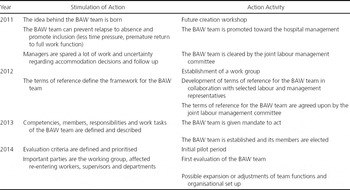
Table 5 details the action planning and list of activities to which the participants choose to commit themselves. The participants suggest that the process of transferring the BAW team into practice could transpire over a 4-year period. The estimated timeframe set by the participants indicates that the realisation of the BAW team will have to face existing power relations and resource issues, which demand negotiation of mandate and require resource allocation within current collaborative decision-making structures.
Back-at-Work Team Action Group Planning

Discussion
Company DM efforts appear more credible if RTW policy, procedural resources and dilemmas are visualised for management and workers to act upon them, creating mutual authorship and accountability about DM change processes in the organisation. However awareness of policy procedural resources and dilemmas are, in and of themselves, insufficient. From this comprehensive action research study we try to understand the implications of RTW policy configuration in practice, subsequently raising questions as to whether it is possible for organisations to move RTW policies in another direction.
From a working life perspective it is interesting to investigate how RTW policies and practices are anchored in systematic managerial frameworks. Based on the first part of our action research process, discovering RTW policy resources and dilemmas, it became clear how policy procedural resources have been carried forward by a strong management approach, focusing on efforts to stimulate a common management identity through decentralisation of responsibility for contact and RTW interviews for returning workers to departmental supervisors with limited attention to the social organisation of accommodating work environments. As such, the hospital has been able to set up systematic managerial RTW policy procedures, which did not necessarily improve the working life of the returning worker and co-workers when back at work.
Applying an action research approach to DM in organisations enables new ways to pinpoint particular aspects of RTW policy change processes, which possess importance from a participatory and sustainable viewpoint. As the action research process encapsulates, a participatory approach is a prerequisite to include knowledge from all levels of the organisation, and create awareness about workplace conditions and actual worker needs, suggesting new innovative solutions to benefit workplace inclusion and practical problem solving among those most directly concerned. This might enable workplace stakeholders to jointly discuss the content and processes of what is referred to as the formal RTW policy, in contrast to the ideal RTW policy principles suggested by Akabas, Gates and Galvin (Reference Akabas, Gates and Galvin1992), and relate this experience to worker-driven proposals and current practical needs.
Our approach to RTW policies makes us aware of the implications and challenges of a DM perspective that is narrowly focused on RTW as a managerial issue. The action research process clearly illustrates how an RTW policy, in itself, is not an expression of genuinely inclusive RTW practices, but it promotes a common management identity that provides transparency around procedures to control and monitor RTW processes, and thus gives legitimacy for supervisors to take action during the RTW process. In response, the action research process visualised a central issue embedded in workplace RTW processes, namely the discomfort created among co-workers when stressful and demanding work tasks challenge personal boundaries and empathy towards re-entering workers. Participants insisted on discussing their working life as an important factor for inclusive RTW practices. Workers find themselves in a strained work environment in which absent colleagues and their subsequent transition back to work influence the general work environment and well being in their department. In particular, small departments are vulnerable to long-term absence and job modifications, as they are more dependent on specialised competences. The mix of missing competences, extra work load put on co-workers, uncertainty of staffing and recovery aspects, and worker self-management in situations that contradict work role functioning with acute work demands are stressful, and it requires extra energy to act inclusively when re-entering workers easily create a feeling of added burdens.
Recent studies confirm how the duration of the required support, and circumstances of the workplace arrangements and social relationships made a difference to co-worker willingness to support a returning worker. Personal boundaries of tolerance and mutual care are challenged if the colleagues have been stressed for a long period of uncertainty without changes in work organisation and work tasks (Tjulin et al. Reference Tjulin, Stiwne and Ekberg2009; Tjulin et al. Reference Tjulin, MacEachen and Ekberg2010). Being able to organise individualised needs on different levels, balancing re-entering worker needs with co-worker flexibility throughout the RTW process still remains a critical focus area for RTW policy and practice (Dunstan & MacEachen, Reference Dunstan and MacEachen2012). A main concern for DM is, therefore, to integrate this kind of knowledge as a significant factor for inclusive organisational policy and practice. The central question then becomes how can organisations develop RTW policies taking advantage of systematic managerial procedures, without losing awareness of procedural dilemmas linked to the social organisation of RTW in local work environments?
Our concept of critique declares that there is an aim for the action research processes we have started. The aim is to target and overcome the prevailing policy procedural dilemmas at the hospital. Our application of action research to DM therefore expands the notion of participation in DM, focusing on development and change processes and the existence of consistent participatory possibilities to influence policy and practice in a way that corresponds with the problems in the social and organisational context. The action research approach was successful in questioning the managerial instrumentality of RTW policies based on inclusion of necessary knowledge from all levels of the organisation. The knowledge needed was present in the organisation, but appeared invisible and decoupled from RTW policy and practice at the hospital. Uncovering existing knowledge of relevance relies on methods that give voice to create new perspectives for action.
Prospectively, organisations should expand their notion of participation in DM and pursue articulation methods that may re-configure what kind of knowledge and actions are needed to support RTW processes and workplace inclusion in a sustainable way. As this action research study shows, organisations are in danger of losing track of work environment issues if there is no platform to address work conditions and incorporate this knowledge in RTW processes. Building on these dilemmas, the participants raised a common critique and action draft based on a need for an alternative structure to capture the coordination and interdisciplinary approach needed to guide the social organisation of stay at work. The utopian idea of a BAW team represents such a structure, which can act as an internal advocate for a comprehensive DM approach that links RTW policies and practices to local work environment conditions, avoiding dead-locked RTW processes. Maybe establishing a fly-in BAW team, or moving to a more regular structure (e.g., RTW committee within organisations) could be a way forward?
In organisational contexts, incremental changes are perhaps more suited to a complex organisational reality in which decision-makers can be gradually inspired by the perspectives the action proposals offer, without having to experience the action research process as a sudden and threatening radical change. Action researchers ought, therefore, to balance their approach to organisational change between a radical and incremental orientation, which may impact the actual organisational commitment to action proposals in practice. Thus, you could question to what degree the BAW team really represents a radical shift in the way RTW policy and practice is usually organised, or if it is a fine tuning of the existing mode?
We would argue that the BAW team does represent something different that exceeds the existing managerial goal orientation. The BAW team induces other interpretations of the social and organisational context in which RTW policy and practices transpire. Transferring the BAW team into practice requires organisational learning and developments that transcend existing strategies to accommodate injured or ill workers not only to return to work, but to being at work in gradual recovery. Hence, there has to be something to return to. This incites organisational developments through reflections and changes, described as Double Loop Learning (Argyris & Schön, Reference Argyris and Schön1996), that might expand stakeholders’ own perception of how to conceive realities and meanings within the organisation. The notion of Double Loop Learning reflects how intervention can guide learning while stressing the difficulties of altering organisational routines.
The BAW team is very close to being feasible, and action researchers may ask themselves how to overcome reified relations and structures and how to guide the organisation through processes of Double Loop Learning. This study exemplifies how action researchers were able to work collaboratively with workers to counteract the limitations and dilemmas of current RTW policy configuration. One of the crucial questions when conducting action research in organisations is how to maintain the good intentions and change process at the end of the workshop. Addressing this issue, participants asked themselves whether the BAW team was a viable action draft following the workshop. Given the ‘free space’ provided through the future creation workshop, intentional actions may easily change or disappear when workers face the limitations of daily working life. Changes need to be both carried out and sustained in new equilibrium. The idea that the organisation needs to unfreeze–move–refreeze (Burnes Reference Burnes2004; Schein Reference Schein1996) frames a model on how to incorporate changes and reflections resulting from Double Loop Learning that might emerge while engaging in an action research process.
Thus, efforts are needed to leave the BAW team as a self-sustaining structure at the hospital. This leaves a huge responsibility on the action researcher to encourage new coalitions or action groups to seek openings in the existing organisational structure that can support continued commitment to action drafts beyond the workshop process (Olsén et al., Reference Olsén, Nielsen and Nielsen1993). During the action research process follow-up meetings were important to refresh the core issues of the action drafts and stimulate commitment among the participants. Although the participatory knowledge creation processes were extensive, they still represent unfinished processes pointing in a certain direction of needed action. For that reason the utopian action draft BAW team is still open to challenge from existing experience and knowledge and therefore vulnerable.
The utopian idea of the BAW team stands out as an example of an independent proposal, specifying roles, procedures and new requirements for coordination to support sustainable RTW processes when back at work. This knowledge was not limited to the workshop space, but was subsequently transferred into other arenas at the hospital in which people with different professions and experiences were invited (i.e., joint labour management committee, hospital management forum, and worker driven innovation group). Also, the action group has chosen an internal ‘change champion’ to coordinate ongoing meetings to keep the BAW team development process going. Because the utopian action drafts are reported at the hospital and figure as content in external knowledge transfer processes there will always be access to these alternative visions in the organisation and for other organisations to learn from.
Viewed in context, the BAW team in itself represents an articulated vision rooted in worker needs and knowledge, expressing how RTW is closely related to practical problem solving in the context of work environments. This raises questions on the overall ideals from which organisations perceive work and working life that opens up discussion on sustainable working life in general, as well as how we give voice to stakeholders that possess such knowledge, but are usually not included in RTW processes.
Conclusion
Creating comprehensive DM is an evolutionary process and not a ‘quick fix’. Hence, RTW policy and practice ought to be understood as a reciprocal relationship with the complexity of worker characteristics and local work environments. Accordingly, RTW policies should grow and take shape, while always remaining responsive to changes in the work group or work organisation, and make efforts to coordinate these changes in relation to the needs of the re-entering worker and co-workers throughout the RTW process. The future creation workshop illustrates that RTW policy procedures that are to encompass the social organisation of stay at work require a developmental procedure at the local level, supporting consistent participatory knowledge sharing and coordination among all levels of the organisation. Judging from our action research process the outcome of RTW policy change processes requires that workers have the possibility and capability to work with the dilemmas they face in practice, and that the surrounding organisational context stimulates possibilities and incentives to take on worker driven proposals to transcend identified RTW policy procedural dilemmas in practice. Efforts to loosen the relatively marginal position of working life when back at work are still needed to further advance DM in organisations.
Acknowledgements
The research in this article was carried out at a regional hospital in the Capital Region of Copenhagen (Denmark). The research has been produced with support from Centre for Working Life Research at Department of Environmental, Social and Spatial Change, Roskilde University (Denmark), and PreSenter, International Research Institute in Stavanger (Norway). The authors would like to thank the workshop participants and employees at the hospital for input and continued engagement during the action research process. The authors would also like to thank Professor Helge Hvid, Roskilde University (Denmark), senior researcher Merete Labriola, The Danish Ramazzini Centre, Department of Occupational Medicine, Regional Hospital Herning, (Denmark), and senior researcher Bryan Cleal, Steno Health Promotion Centre, Steno Diabetes Centre (Denmark) for insightful comments and assistance during the action research process and writing of this article. The authors also thank Centre for Action Research and Democratic Social Change at Roskilde University (Denmark). The first author acknowledges his training at the Work Disability Prevention Canadian Institute for Health Research (CIHR) Strategic Training program, University of Toronto, Dalla Lana School of Public Health (Canada).