Mucopolysaccharidosis type VI (Marateaux–Lamy syndrome) is an inborn error of metabolism in which the deficient activity of the enzyme N-acetylgalactosamine-4-sulphatase (arylsulphatase B) impairs degradation of the glycosaminoglycan dermatan sulphate.Reference Muenzer 1
It is a multi-system disorder with a wide phenotypic spectrum, but cardiovascular involvement always contributes significantly towards morbidity and mortality.Reference Leal, de Paula, Leone and Kim 2 , Reference Mohan, Hay, Cleary, Wraith and Patel 3
Cytoplasmic vacuoles full of dermatan sulphate are observed in endothelial cells, myocyte, and fibroblasts, compromising the structure and function of the endocardium, myocardium, valves, coronary arteries, conduction system, great vessels, lung, and systemic vasculature.Reference Guertl, Noehammer and Hoefler 4
Enzyme replacement therapy with recombinant human arylsulphatase B was considered effective in recent clinical trials.Reference Braulin, Rosenfeld and Kampmann 5 – Reference Fesslova, Corti and Sersale 7 Studies in mucopolysaccharidosis type VI cats showed that overall improvement in the disease condition was most pronounced for animals treated from birth compared with those at a later age.Reference Auclair, Hopwood, Brooks, Lemontt and Crawley 8
The primary objective of this study was to assess the efficacy of early replacement therapy concerning cardiovascular lesions, through the echocardiographic follow-up of sisters who started treatment at quite different ages.
Material and methods
Two sisters with mucopolysaccharidosis type VI, born to consanguineous parents and seen at the Genetic Clinic, were evaluated.
The biochemical diagnosis of mucopolysaccharidosis type VI was based on the demonstration of markedly deficient arylsulphatase B activity in peripheral leucocytes.
The siblings started enzyme replacement therapy with recombinant human arylsulphatase B in 2008: one at 9 years and the other at 1 year and 7 months of age. A dose of 1 mg/kg was prescribed weekly for each sibling throughout the study period.Reference Giugliani, Federhen and Rojas 9
Their echocardiograms and medical records between November, 2001 and September, 2010 were analysed retrospectively. It was possible to assess the siblings’ cardiovascular functional class according to the New York Heart Association at the time of each examination.
Before the echocardiograms, the weight and stature were recorded and the body surface area was calculated by the Dubois and DuboisReference Dubois and Dubois 10 formula. The Z-scores of height for age were obtained, according to the World Health Organization.
All examinations were performed at rest, by the same physician and included the M and two-dimensional modes, in addition to Doppler examination with colour flow mapping. The ultrasound system used was General Electric cardiovascular System Vivid-3 (Milwaukee, Wisconsin, United States of America), equipped with electronic transducers from 2 to 7.5 MHz.
Diastolic and systolic diameters were measured using the M-mode, as also the thickness of the septum and left ventricle posterior wall. Values obtained were compared with the expected average for the body surface area, allowing calculation of the Z-score for each measure.Reference Kampmann, Wiethoff and Wenzel 11 The Z-scores were considered normal between −2 and+2.
Systolic function of the left ventricle was evaluated through the ejection fraction obtained by the Teichholz method and values equal to or above 55% were considered normal.
Systolic pressure of the pulmonary artery was estimated through tricuspid insufficiency. Pulmonary hypertension was diagnosed whenever systolic pressure exceeded 35 mmHg.Reference Carvalho, Almeida and Lopes 12
The severity of mitral and aortic valve stenosis and regurgitation was established according to the recommendations of the American Society of Echocardiography.Reference Zoghbi, Sarano and Foster 13
Comparisons between the sisters’ status were made at around the ages of 2 and 4 years.
Informed consent was obtained from the patients’ parents. The study was approved by the Hospital's Commission for Ethics in Research and was carried out without any subsidy.
Results
Sibling 1
The older sibling was born in February, 1999, after 38 weeks of gestation with no intercurrences. Her birth weight was 3.7 kg and length 52 cm.
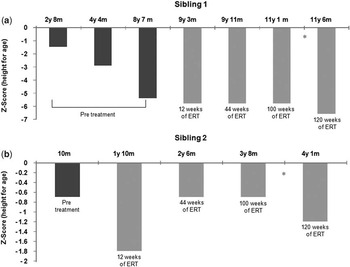
Figure 1A shows the Z-scores of height for age throughout the follow-up.
Z-score of height for age. *Patient had missed five of 20 proposed infusions in that period. y = years; m = months; ERT = enzyme replacement treatment.

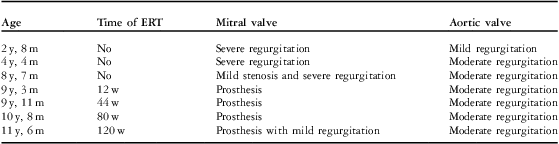
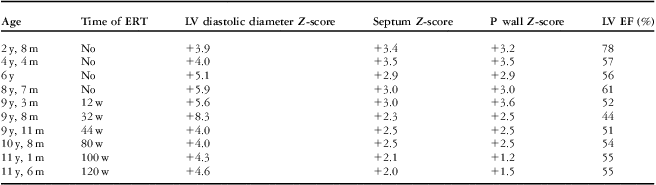
The first symptoms recognised by the family were coarse facial features at 2 years of age. Biochemical diagnosis of mucopolysaccharidosis type VI was made when she was 3. The arylsulphatase B gene mutation was IVS5-8t > g. At that time, she has already developed mitral and aortic lesions, along with a dilated and hypertrophic left ventricle (Tables 1 and 2).
Sibling 1: follow-up of valve disease.

ERT = enzyme replacement therapy; m = months; w = weeks; y = years
Sibling 1: follow-up of left ventricular geometry and systolic function.

EF = ejection fraction; ERT = enzyme replacement therapy; LV = left ventricle; m = months; P wall = posterior wall; w = weeks; y = years
At 7 years of age, arylsulphatase B activity was 4 nmol/mg of protein/h (normal values: 72–176 nmol/mg of protein/h). The urinary levels of glycosaminoglycans were 655 mcg/mg of creatinine (normal values: 44–106 mcg/mg of creatinine).
At 8 years of age, her echocardiogram showed pulmonary hypertension (systolic pressure of 51 mmHg), moderate aortic regurgitation and mitral valve double lesion (Table 1). Her mitral valve was then replaced by a mechanical prosthesis and the aortic valve was surgically repaired.
Sibling 1 finally started enzyme replacement therapy at 9 years of age.
There was an impressive reduction in the left ventricular diastolic diameter from 32 to 44 weeks of enzyme replacement: Z-score of +8.3 to +4 (Table 2).
The left ventricular diameter remained stable from 44 to 100 weeks (Z-score of +4), but an increase was registered from 100 to 120 weeks of treatment (Z-score of +4.3 to +4.6). The height for age Z-score, which had been stable since 12 weeks of replacement therapy, also decreased from –5.8 to –6.7 at 120 weeks (Fig 1A).
The urinary levels of glycosaminoglycans, which were 50 mcg/mg of creatinine after 100 weeks, rose to 118 mcg/mg of creatinine at 120 weeks (normal range: 26–97 mcg/mg of creatinine).
It is interesting to notice that this patient has missed five of the 20 proposed infusions in that last period (115, 116, 117, 118, and 119 weeks, in a row).
Echocardiograms, height measurements, and urinary glycosaminoglycan collection were always performed immediately before infusions.
Left ventricular systolic function was depressed soon after the surgical procedure and normal ejection fraction was only achieved after 100 weeks of therapy (Table 2).
At the last evaluation, the aortic valve regurgitation was stable and pulmonary pressure was considered normal (systolic pressure of 21 mmHg). Septum and posterior wall thickness showed noticeable reduction, with Z-scores of +2 and +1.5, respectively (Table 2).
Despite enzyme replacement, cardiovascular drugs were still necessary to cope with heart failure at the last evaluation: furosemide 2 mg/kg/day, spironolactone 1.25 mg/kg/day, and carvedilol 0.6 mg/kg/day.
She has received 85.4% of the total proposed doses, with no infusion-related adverse events.
Sibling 2
The younger sibling was born in August, 2006, after a normal 37 weeks of gestation. Her birth weight was 3.5 kg and length 49 cm.
Figure 1B shows the Z-scores of height for age thought the follow-up period.
The first symptoms recognised by the family were the coarse facial features and joint stiffness at 7 months, earlier than her sister. The biochemical diagnosis of mucopolysaccharidosis type VI was made soon after clinical suspicion. The arylsulphatase B gene mutation was IVS5-8t > g, identical to her older sister.
In spite of the early diagnosis, enzyme therapy was only available for her at 1 year and 7 months of age.
Before starting enzyme replacement, arylsulphatase B activity was 12 nmol/mg of protein/h (normal values: 72–176 nmol/mg of protein/h). The urinary levels of glycosaminoglycans were 1245 mcg/mg of creatinine (normal values: 133–274 mcg/mg of creatinine).
Before treatment, her echocardiogram showed an enlarged left ventricle with compromised systolic function and mild pulmonary hypertension (systolic pressure of 37 mmHg). There was also a prolapsed posterior mitral leaflet with no signs of regurgitation or stenosis (Tables 3 and 4).
Sibling 2: follow-up of valve disease.

ERT = enzyme replacement therapy; m = months; w = weeks; y = years
Sibling 2: follow-up of left ventricular geometry and systolic function.

EF = ejection fraction; LV = left ventricle; m = months; P wall = posterior wall; w = weeks; y = years
From 12 to 100 weeks of replacement therapy, there was a remarkable reduction in the left ventricular diastolic diameter Z-score (+6.3 to +2.9), and systolic function was recovered (Table 4).
Just like her sister, sibling 2 missed five of the 20 proposed infusions from 100 to 120 weeks of treatment (also from 115 to 119 weeks, in a row). There was a significant increase in the left ventricular diastolic diameter Z-score (+2.9 to +3.5), and the urinary levels of glycosaminoglycans rose from 93 to 156 mcg/mg of creatinine at 120 weeks of treatment (normal range: 67–124 mcg /mg of creatinine).
The height for age Z-score, which had been stable since 44 weeks of replacement therapy, also decreased from –0.7 to –1.23 at 120 weeks (Fig 1B).
Just like her sister, echocardiograms, height measurements, and urinary glycosaminoglycan collection were always performed immediately before infusions.
The final echocardiogram performed at 4 years of age showed mild mitral valve regurgitation and slightly thickened aortic valve, as well as normal pulmonary pressure (systolic pressure of 25 mmHg). In spite of that, replacement therapy did not prevent left ventricular hypertrophy to progress in this particular patient (Tables 3 and 4).
Sibling 2 has received 83.9% of the total proposed doses of recombinant human arylsulphatase B, with no infusion-related adverse events. She has never experienced symptoms of heart failure and no cardiovascular drug has ever been prescribed.
Status of both siblings at around 2 years of age
At the age of 2 years and 8 months, sibling 1 had not received enzyme replacement yet. At a similar age, her sister had been receiving enzyme for almost 44 weeks.
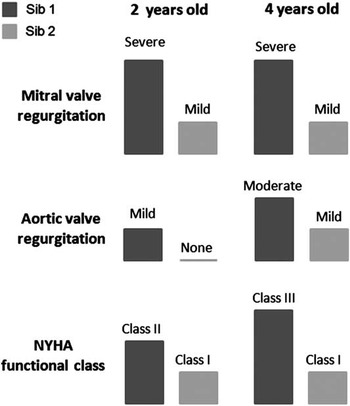
Both of them showed dilated left ventricles, but sibling 1 also had severe mitral regurgitation, mild aortic regurgitation, and a New York Heart Association class II score (Fig 2).
Comparison between sibling 1 and sibling 2 at around 2 and 4 years of age. NYHA = New York Heart Association.

At that time, sibling 2 had mild mitral regurgitation and no aortic valve regurgitation (Fig 2).
Status of both siblings at around 4 years of age
At 4 years and 4 months, sibling 1 had not started replacement therapy yet, whereas her sister had been under treatment for 120 weeks.
Although both of them showed dilated and hypertrophic left ventricles, sibling 1 also had severe mitral regurgitation and moderate aortic regurgitation. Heart failure signs and symptoms were present at minimum efforts (New York Heart Association class III score).
At 4 years and 1 month, sibling 2 had only mild mitral and aortic valve regurgitation and no signs of heart failure at all (Table 3).
Discussion
The present study demonstrates the extent to which enzyme replacement therapy can modify natural history of cardiac abnormalities in mucopolysaccharidosis type VI, in a sibling pair with severe and rapidly progressing form of the disease.
The first evidence of the effect of enzyme replacement in mucopolysaccharidosis type VI cats from birth was reported by Crawley et al.Reference Crawley, Niedzielski, Isaac, Davey, Byers and Hopwood 14 There was near normalisation or complete reversal of lysosomal storage in the heart valves and aorta.
Enzyme replacement therapy with recombinant arylsulphatase B was also considered effective for cardiovascular involvement in recent human cohorts.Reference Braulin, Rosenfeld and Kampmann 5 – Reference Fesslova, Corti and Sersale 7
Mucopolysaccharidosis type VI has a wide spectrum of clinical severity primarily because of the effect of various mutations, some of which permit residual enzyme activity.Reference Neufeld and Muenzer 15 The study of siblings, where same mutations are present and intra-familial variation is small, surely strengthens the importance of the results regarding early enzyme replacement therapy.
McGill et alReference McGill, Inwood and Coman 16 had also investigated siblings who started enzyme replacement at different ages: one at 3.6 years and the other at 8 weeks. They demonstrated a clear benefit of early therapy, as the younger child did not develop cardiac lesions during the follow-up period. However, their siblings apparently had a lesser aggressive phenotype than ours, as the older child before enzyme replacement therapy showed only mild dysplastic mitral valve with trivial incompetence at 3.6 years of age. Almost at the same age, our older sibling had already developed severe mitral regurgitation, as well as symptoms of heart failure.
On the basis of the collected data, it is easy to notice that enzyme replacement had reversed ventricular dilation in sibling 2, as the left ventricular diastolic diameter Z-score was reduced from +6.3 to +2.9 at 100 weeks. In addition, left ventricular ejection fraction was recovered with no other pharmacological intervention (from 46% to 55%). Contradicting Brands et al,Reference Brands, Frohn-Mulder and Hagemans 6 the striking ventricular dilation in sibling 2 before treatment was not explained by severe mitral regurgitation, reassuring myocardial storage of dermatan sulphate as the main cause of ventricular eccentric hypertrophy and dysfunction in type VI patients.
In contrast to Braulin et al,Reference Braulin, Rosenfeld and Kampmann 5 there was no reversal of ventricular hypertrophy in sibling 2, although she had started therapy before 12 years of age. Brands et alReference Brands, Frohn-Mulder and Hagemans 6 followed up patients with mucopolysaccharidosis type VI who had started enzyme therapy between 1.9 and 18.3 years of age. They had also found an increase in the left ventricular mass index Z-score throughout treatment in four of 10 patients. Those findings demonstrate that some lesions already present may even get worse in spite of enzyme replacement. Nevertheless, one can speculate whether the progression of ventricular hypertrophy would have been greater without enzyme therapy.
In spite of the late onset of enzyme therapy, sibling 1 had also experienced partial improvement of cardiomyopathy. Although one can say that mitral valve replacement played a crucial role in her recovering, it is probable that enzyme had also contributed to reverse ventricular remodelling and to the improvement of systolic function. Although she had been receiving optimal doses of anticongestive drugs since surgery, it was not until 100 weeks of enzyme replacement that left ventricular ejection fraction reached normal values. Brands et alReference Braulin, Rosenfeld and Kampmann 5 also documented normalisation of left ventricular shortening fraction after enzyme replacement in their mucopolysaccharidosis type VI patients with systolic dysfunction.Reference Brands, Frohn-Mulder and Hagemans 6
In agreement with Braulin et al,Reference Braulin, Rosenfeld and Kampmann 5 sibling 1 showed progressive mitral valve stenosis, and valve replacement confirmed the severity of this finding. Aortic valve lesion had been stable since sibling 1 has started enzyme replacement, as described by Braulin et alReference Braulin, Rosenfeld and Kampmann 5 in patients younger than 12 years of age. Similarly, Scarpa et alReference Scarpa, Barone and Fiumara 17 followed up nine children (4–10 years of age) for an average time of 2.9 years of enzyme replacement, and most of them (5/9) showed stabilisation of valve lesions.
In the context of a progressive disease that can cause irreversible damages to cardiovascular system, any slowing of the rate of natural decline after the start of enzyme replacement therapy should be considered a beneficial effect of intervention. Thus, the lesser rate of deterioration of the mitral and aortic valves of sibling 2 compared with her sister should be regarded as a partial preventive effect.Reference Braulin, Harmatz and Scarpa 18
In fact, cardiac valves seem to be only slightly accessible to enzyme replacement, as myofibroblasts are supplied with nutrients by diffusion and are not prepared to endocytosis of large molecules such as recombinant human arylsulphatase B.Reference Misfeld and Sievers 19
Finally, the present study has also pointed out that patient's compliance to treatment is essential for its success, as left ventricular dilation registered in the last 20 weeks in both sisters was associated with missed infusions and increased urinary glycosaminoglycans, a sign of tissue storage. Paralleling left ventricular dilation caused by missed infusions, both sisters also showed reduction of height for age Z-scores, another striking evidence of the systemic effects of enzyme replacement therapy for mucopolysaccharidosis type VI.Reference Decker, Yu and Giugliani 20
Conclusion
The present study provides clear evidence that early initiation of enzyme replacement therapy for mucopolysaccharidosis type VI may prevent severe cardiac damage. This therapy promotes reverse ventricular remodelling and slows down the rate of natural valve disease progression.
Precocious diagnosis and treatment before 1 year of age are probably good strategies, as some lesions may not be completely reversible after that.
Moreover, patient's compliance to treatment is essential for its success, as missed infusions are accompanied by urinary glycosaminoglycan increase, which parallels tissue storage and cardiac lesions.