The establishment and maintenance of couple relationships are central tasks in the psychosocial development of young people, with implications for health, well-being and psychological adjustment. When these relationships function well, in addition to being important sources of social, emotional, instrumental or leisure support, they contribute to the construction of youngsters’ identity and the improvement of their social competence (Booth et al., Reference Booth, Crouter and Snyder2015).
Adult attachment theory seems to be a valuable framework to understand romantic relationship functioning (Mikulincer & Shaver, Reference Mikulincer and Shaver2007). For instance, the attachment behavioral system is likely to be triggered by stressful situations such as conflictive interactions between romantic partners (Creasey, Reference Creasey2002), which involve a threat of separation or rejection that activates behaviors aiming to preserve the attachment relationship. These interactions, however, may also active behaviors aimed at increasing distance, especially in highly avoidant partners, who often regard conflicts as a threat to independence because of the perceived pressure to self-disclose or engage in intimate conversations (Paley et al., Reference Paley, Cox, Burchinal and Payne1999).
Bartholomew and Horowitz (Reference Bartholomew and Horowitz1991) tested a model of adult attachment defined in terms of positive versus negative internal models of self and others, that is, mental expectations about self-worth (anxiety) and the supportive availability of others (avoidance) in attachment relationships. The dimension of anxiety represents the degree to which individuals are concerned about being abandoned or rejected by their partner, whereas the dimension of avoidance reflects the degree to which individuals feel comfortable with emotional intimacy and closeness. Individuals labeled as secure adopt a positive view of the self (low anxiety about abandonment) and a positive view of others (low avoidance of intimacy); preoccupied individuals have a negative perception of self (high anxiety) and a positive perception of others (low avoidance); fearful-avoidant individuals hold a negative view both of self and of others (high anxiety and avoidance); and dismissing-avoidant individuals possess a positive sense of self (low anxiety) and a negative perception of others (high avoidance) (Griffin & Bartholomew, Reference Griffin and Bartholomew1994; Hazan & Shaver, Reference Hazan and Shaver1994).
There is evidence to indicate that attachment insecurities are negatively associated —and attachment security positively associated—with relationship satisfaction in both genders (e.g., Banse, Reference Banse2004; Brassard et al., Reference Brassard, Lussier and Shaver2009; Monteoliva & García-Martínez, Reference Monteoliva and García-Martínez2005; Rivera, Reference Rivera2006). However, there are inconsistent findings from Spanish-speaking countries on whether anxiety (e.g., Rivera et al., Reference Rivera, Cruz and Muñoz2011) or avoidance (e.g., Molero et al., Reference Molero, Shaver, Ferrer, Cuadrado and Alonso-Arbiol2011; Monteoliva & García-Martínez, Reference Monteoliva and García-Martínez2005; Ortiz et al., Reference Ortiz, Gómez-Zapiain and Apodaca2002) is more detrimental to satisfaction. According to the review by Mikulincer and Shaver (Reference Mikulincer and Shaver2007), both attachment dimensions roughly equally predict women’s relationship dissatisfaction, whereas avoidance is more consistently linked with men’s dissatisfaction.
Seemingly, two different mechanisms may explain the links between adult attachment style and romantic relationship functioning (Collins et al., Reference Collins, Cooper, Albino and Allard2002): Relationship skills (e.g., partners’ ability to regulate their emotions or to resolve conflicts effectively) and mate selection (e.g., the tendency to partner with secure vs. insecure individuals). As regards the first mechanism, working models of self and others may directly impact relationship outcomes, either facilitating or interfering with them, by shaping social perception, affective response patterns, interpersonal behavior, etc. (Collins et al., Reference Collins, Cooper, Albino and Allard2002). In fact, a growing body of studies has found anxiety and avoidance dimensions (e.g., da Costa & Mosmann, Reference da Costa and Mosmann2020; MacDonald et al., Reference MacDonald, Wood and Fabrigar2019; Paquette et al., Reference Paquette, Rapaport, St-Louis and Vallerand2020; Rholes et al., Reference Rholes, Kohn and Simpson2014; Ricco & Sierra, Reference Ricco and Sierra2017) —or insecure styles such as preoccupied, dismissing, or fearful (Creasey, Reference Creasey2002; Pistole & Arricale, Reference Pistole and Arricale2003)—to be positively associated with skill deficits in conflict management and negatively related to positive problem-solving strategies. Apparently, avoidance is more strongly associated with withdrawal from conflict and anxiety is more highly related to conflict engagement (Pistole & Arricale, Reference Pistole and Arricale2003; Rholes et al., Reference Rholes, Kohn and Simpson2014; Shi, Reference Shi2003). Other studies (Bonache et al., Reference Bonache, González-Méndez and Krahé2019; Ricco & Sierra, Reference Ricco and Sierra2017; Sierau & Herzberg, Reference Sierau and Herzberg2012), nonetheless, have found limited evidence for this correspondence, with both attachment dimensions showing similar negative relations to these two dysfunctional conflict resolution styles.
Furthermore, some studies suggest that individuals who deal with conflicts constructively report more relationship satisfaction than their counterparts who use dysfunctional tactics, such as conflict engagement or withdrawal (e.g., Kurdek, Reference Kurdek1994). Some other data, however, find nonsignificant effects of the use of destructive, avoidant or constructive conflict-resolution strategies on relational quality (Bretz, Reference Bretz2009).
Therefore, findings drawn from prior studies are valuable but still, show some inconsistences. Besides, research in this area presents other limitations that should be considered. First, many studies only examine one member of the relationship dyad (e.g., Boğda & Sendil, Reference Boğda and Sendil2012; Monteoliva et al., Reference Monteoliva and García-Martínez2005; Pistole & Arricale, Reference Pistole and Arricale2003; Quickert & MacDonald, Reference Quickert and MacDonald2020; Rivera et al., Reference Rivera, Cruz and Muñoz2011) instead of both (e.g., Creasey, Reference Creasey2002; Molero et al., Reference Molero, Shaver, Ferrer, Cuadrado and Alonso-Arbiol2011) although conflict-resolution styles and relationship satisfaction are likely to be influenced not only by individuals’ own characteristics and inputs, but also by their partner’s. This is generally due to difficulties associated with sample recruitment (Bretz, Reference Bretz2009) and might thus partly explain the lack of clarity and consistency in results, together with the different data collection instruments and the different age range of participants across studies.
In view of this limitation, researchers (e.g., Flesch, Reference Flesch2017; Molero et al., Reference Molero, Shaver, Ferrer, Cuadrado and Alonso-Arbiol2011; Rholes et al., Reference Rholes, Kohn and Simpson2014; Sierau & Herberg, Reference Sierau and Herzberg2012) are increasingly considering the actor-partner interdependence model —APIM—(Cook & Kenny, Reference Cook and Kenny2005) in their studies, as it accounts for the interdependence of partners’ data and allows predicting actor and partner effects, that is, the effect of each couple member’s self-report both on his or her own behavior and on the partner’s. However, empirical data obtained from this approach is still insufficient. So far, it generally suggests that partners of insecure individuals show a lower level of satisfaction with the relationship than partners of secure individuals (e.g., Banse, Reference Banse2004; Brassard et al., Reference Brassard, Lussier and Shaver2009; Molero et al., Reference Molero, Shaver, Ferrer, Cuadrado and Alonso-Arbiol2011).
Moreover, studies carried out in this field of research are scarce in Spain, and they focus on adult attachment processes and relationship quality (Molero et al., Reference Molero, Shaver, Ferrer, Cuadrado and Alonso-Arbiol2011; Monteoliva & García-Martínez, Reference Monteoliva and García-Martínez2005; Ortiz et al., Reference Ortiz, Gómez-Zapiain and Apodaca2002) -generally with individuals as units of analysis-, thus paying less attention to the associations that are likely to exist between conflict-resolution tactics and these two variables (attachment and satisfaction). In other words, most evidence is based on samples from English-speaking countries, so it cannot be assumed that it is generalizable to the Spanish population (Molero et al., Reference Molero, Shaver, Ferrer, Cuadrado and Alonso-Arbiol2011).
Furthermore, this evidence is generally obtained from small-size samples of individuals (e.g., Bonache et al., Reference Bonache, González-Méndez and Krahé2019; Du Plessis, Reference Du Plessis2006; MacDonald et al., Reference MacDonald, Wood and Fabrigar2019; Pistole & Arricale, Reference Pistole and Arricale2003) or couples (e.g., Bretz, Reference Bretz2009; Creasey, Reference Creasey2002; Guzmán & Contreras, Reference Guzmán and Contreras2012) —in the latter case, samples rarely exceed several hundred—, and participants are often of a wide age range (e.g., da Costa & Mosmann, Reference da Costa and Mosmann2020; Heresi et al., Reference Heresi, Rivera and Huepe2014; Paquette et al., Reference Paquette, Rapaport, St-Louis and Vallerand2020; Quickert & MacDonald, Reference Quickert and MacDonald2020; Scheeren et al., Reference Scheeren, De Andrade, Goulart and Wagner2014), which hinders the extrapolation of results to emerging adults.
Hence, the main objective of this study is to analyze the interrelationships between adult attachment, conflict-resolution style, and relationship quality in a fairly large sample of Spanish young-adult heterosexual couples. More specifically: a) To examine correlations between these three variables, at an individual and a dyadic level; and (b) to analyze whether actor and partner adult attachment, actor and partner conflict-resolution style, and partner relationship quality predict the actors’ relationship quality.
Method
Participants
The sample consisted of 405 heterosexual young couples. Males’ and females’ mean age was 22 (SD = 2.28) and 21 years (SD = 2.12) old, respectively. The maximum age difference between partners was 7 or 6 years, depending on whether he or she was the oldest person, respectively. Generally, both males’ (66%) and females’ (87%) sole occupation was studying, commonly at the university (65% and 86%). The mean length of the relationship was 31 months, and most couples (90%) did not live together.
Procedure
A convenience sample of students and nonstudents of the required age—at least one couple member being 18–25 years—and relationship status parameters —a duration of at least 3 months—was recruited. The study was disseminated via email among juvenile organizations, vocational training centers and universities throughout Spain. In addition, informative posters were posted in places frequented by the population under study (e.g., libraries, gyms, cafeterias, cultural centers) and some members of the research group attended several classes at the University of Salamanca to invite the students to take part. Those interested in participating had to provide via email both their email address and that of their partner, so that they could subsequently receive more detailed information on the study and the link to the survey.
All participants were required to complete an online survey after giving informed consent. They were informed about the confidentiality and anonymity of their responses and requested to respond separately from their partners. The survey took approximately 15 minutes to complete. Responses to all questions were mandatory. Participants indicated their own and their partners’ e-mail addresses and date of birth in order to facilitate the identification of couples. This study received the ethical approval of the Bioethics Committee of the University of Salamanca.
Measures
Sociodemographic variables. Respondents were asked to provide information on their gender, age, relationship duration in years and months, occupation, and studies.
Adult attachment. The 18-item short-form of the Experiences in Close Relationships-Revised (ECR-R; Fraley et al., Reference Fraley, Waller and Brennan2000) questionnaire was used to assess Attachment Anxiety (9 items) and Attachment Avoidance (9 items). This version (Fernández-Fuertes et al., Reference Fernández-Fuertes, Orgaz, Fuertes and Carcedo2011) is adapted to Spanish population and has shown adequate levels of internal consistency for the Anxiety (α = .80) and the Avoidance subscale (α = .86). Cronbach’s alphas for the present sample were .86 and .76, respectively. In this study, participants completed the measures in terms of their experience in the current couple relationship. Items used a 7-point scale (1 = strong disagreement; 7 = strong agreement). Higher scores indicated higher attachment anxiety or avoidance.
Conflict-resolution style. The 16-item respondent version of the Conflict Resolution Styles Inventory (Kurdek, Reference Kurdek1994) was used. Participants assessed on a 5 point scale (1 = never; 5 = always) how frequently they used each of 16 styles to deal with arguments and disagreements. This measure assesses four dimensions or conflict-resolution styles of 4 items each: Positive Problem Solving (e.g., finding alternatives that are acceptable to each of us), Conflict Engagement (e.g., launching personal attacks), Withdrawal (e.g., tuning the other person out), and Compliance (e.g., not defending my position). Reliabilities for the present sample were adequate (α = .68, α = .80, α = .66, and α = .76, respectively).
Relationship quality. Participants’ degree of happiness, satisfaction, and commitment to the relationship was assessed through four 5-point scale questions designed by Conger et al. (Reference Conger, Cui, Bryant and Elder2000). These questions are: “How happy are you, all things considered, with your relationship? (1 = not happy at all, 5 = absolutely happy); “All in all, how satisfied are you with your relationship?” (1 = not at all satisfied, 5 = completely satisfied); “How much do you want your relationship with your partner to continue and be a success?” (1 = I do not want it, 5 = I want it desperately); “How hard are you willing to work to make your relationship a success?” (1 = I would do nothing; 5 = I would do anything). These items have been shown to have acceptable reliability (α = .77) both in prior studies (Conger et al., Reference Conger, Cui, Bryant and Elder2000) and in the present one (α = .75).
Participants´ overall scores for adult attachment and conflict-resolution style were calculated by averaging the items from each domain. Similarly, the four items’ scores were averaged to create a total score for relationship quality.
Data Analysis
Firstly, descriptive statistics were calculated for all variables. Secondly, Pearson correlation coefficients were calculated between adult attachment (the two dimensions), conflict resolution (the four styles), and relationship quality, both at an individual level -considering males and females separately-, and at a dyadic level -between the couple members-. Finally, standard regression models of relationship quality were obtained for males and females separately, in order to examine actor and partner effects. Only those actor factors (attachment dimensions, conflict-resolution styles) and partner factors (attachment dimensions, conflict-resolution styles, and relationship quality) that had previously been shown to correlate significantly with scores on the outcome variables were included in analysis. Age of participants and relationship duration were not controlled for through hierarchical regression analysis because they did not correlate significantly with relationship quality.
All the analyses were conducted with SPSS–23. The level of significance was set at .01. Effect sizes and post-hoc tests were calculated.
Results
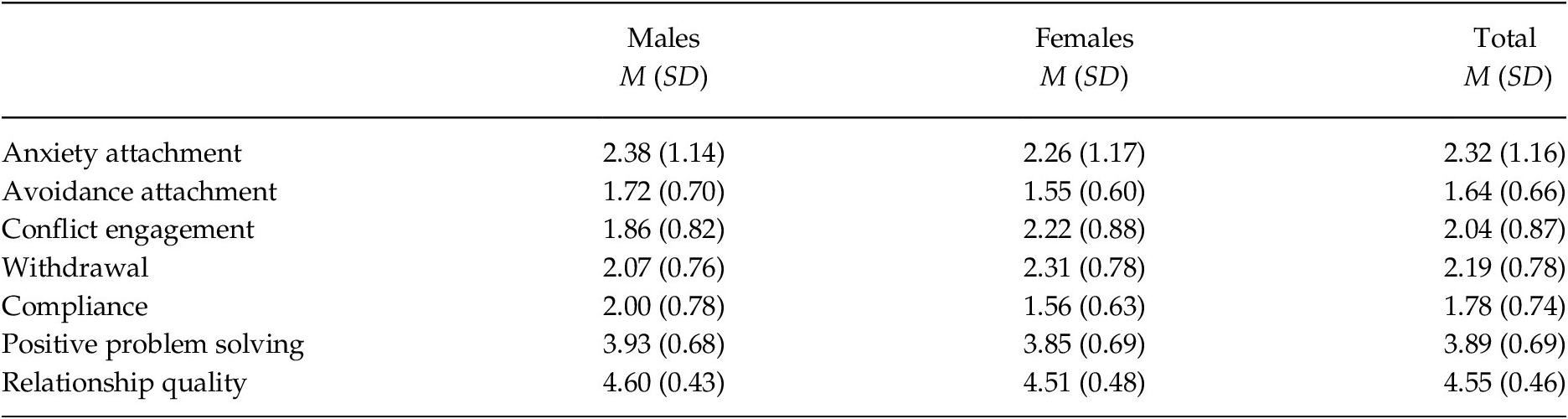
The descriptives of the three variables are presented in Table 1. As regards gender comparisons, there were significant differences in avoidance, t(404) = 4.27, p < .001, ɳ2 = .04, but not in anxiety, t(404) = 1.52, p = .13, with males showing higher scores than females. Likewise, the interaction conflict-resolution style and gender was significant, F(3, 2,550) = 46.30, p < .001, ɳ2 = .05, with significant differences (p < .001) in all styles except for positive problem solving (p = .16): conflict engagement and withdrawal were more frequently used by females, whereas compliance was more frequently used by males. Lastly, significant differences in relationship quality were found, t(404) = 3.30, p = .001, ɳ2 = .04, with males showing higher scores than females.
Total Sample, Males and Females’ Mean Scores and SD on the Variables

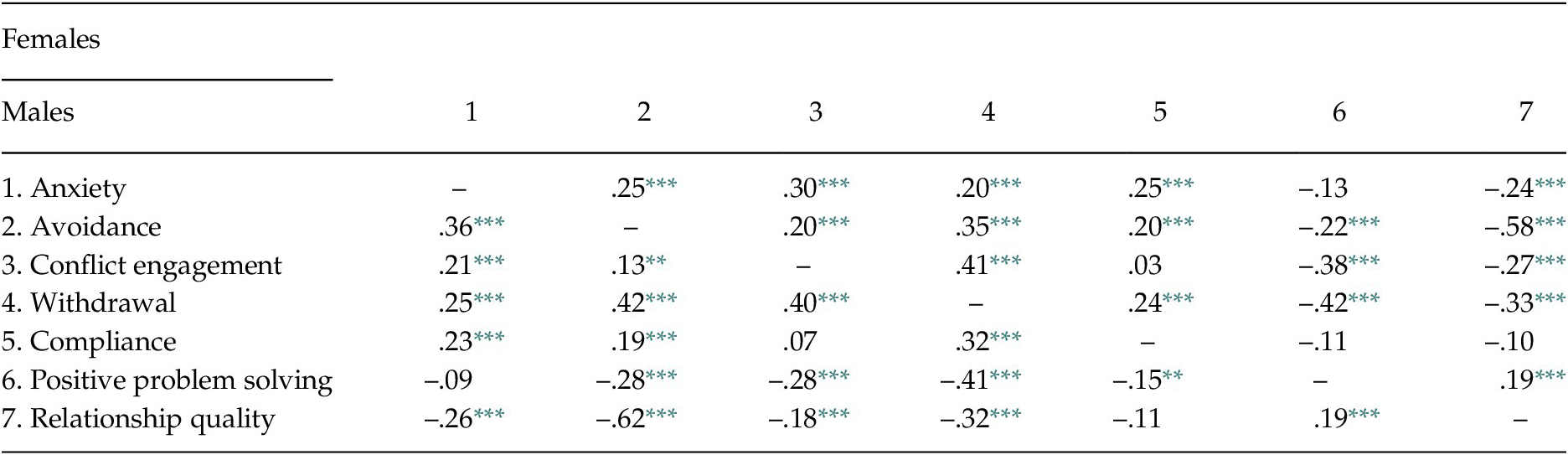
Both for males and females (considered separately), scores on anxiety and avoidance correlated significantly and positively with scores on conflict engagement, withdrawal, and compliance (p < .001). Withdrawal was more highly correlated with avoidance, whereas conflict engagement was more highly correlated with anxiety. Positive problem solving only correlated significantly and negatively with avoidance (p < .001). Relationship quality correlated significantly and negatively with both attachment scores, more extensively with avoidance, and it was also negatively associated with conflict engagement and withdrawal (p < .001); conversely, relationship quality correlated positively with positive problem solving (p < .001) (see Table 2).
Correlations of Participants’ Scores, Considering Males and Females Separately

Note. Males’ coefficients are below the diagonal and females’ are above the diagonal.
** p < .01.
*** p < .001.
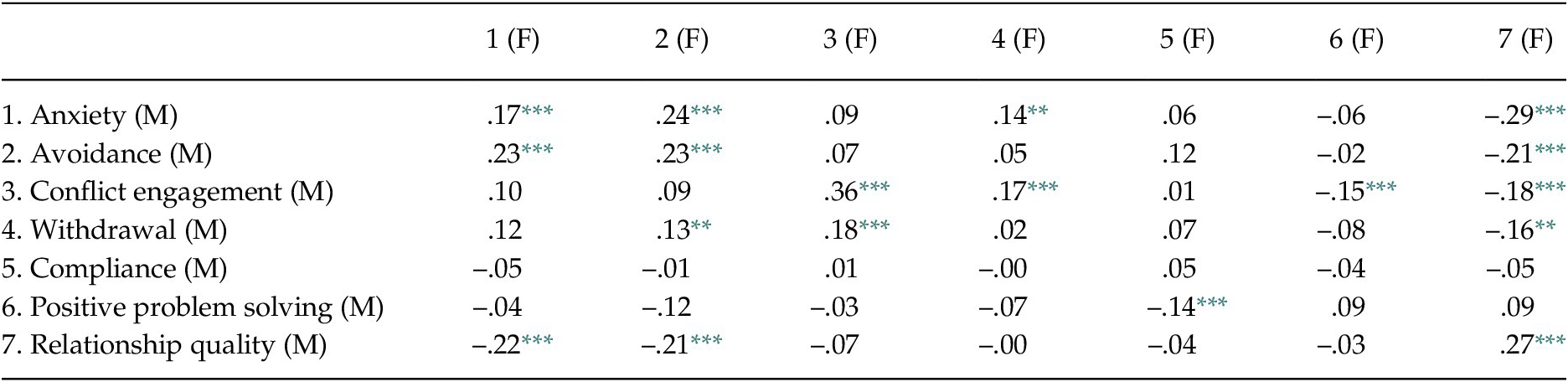
As regards correlations between the members of the couple, anxiety, avoidance, conflict engagement, and relationship quality scores positively correlated with partner’s scores on the same variables (p < .001). For both genders, there was a negative correlation between partners’ score on anxiety and avoidance and the partners’ own score on relationship quality (p < .001). There were also significant and negative but small correlations (p < .001) between females’ relationship quality score and their partners’ conflict engagement and withdrawal scores. With regard to the associations between the conflict-resolution styles used by the couple members, there was a positive correlation between withdrawal scores and the partner’s conflict engagement score, a negative correlation between females’ score on positive problem solving and their partners’ score on conflict engagement, and a negative correlation between males’ score on positive problem solving and their partners’ score on compliance (p < .001). These correlations, however, were low (see Table 3).
Correlations between the Members of the Couple

Note. M = Males; F = Females.
** p < .01.
*** p < .001.
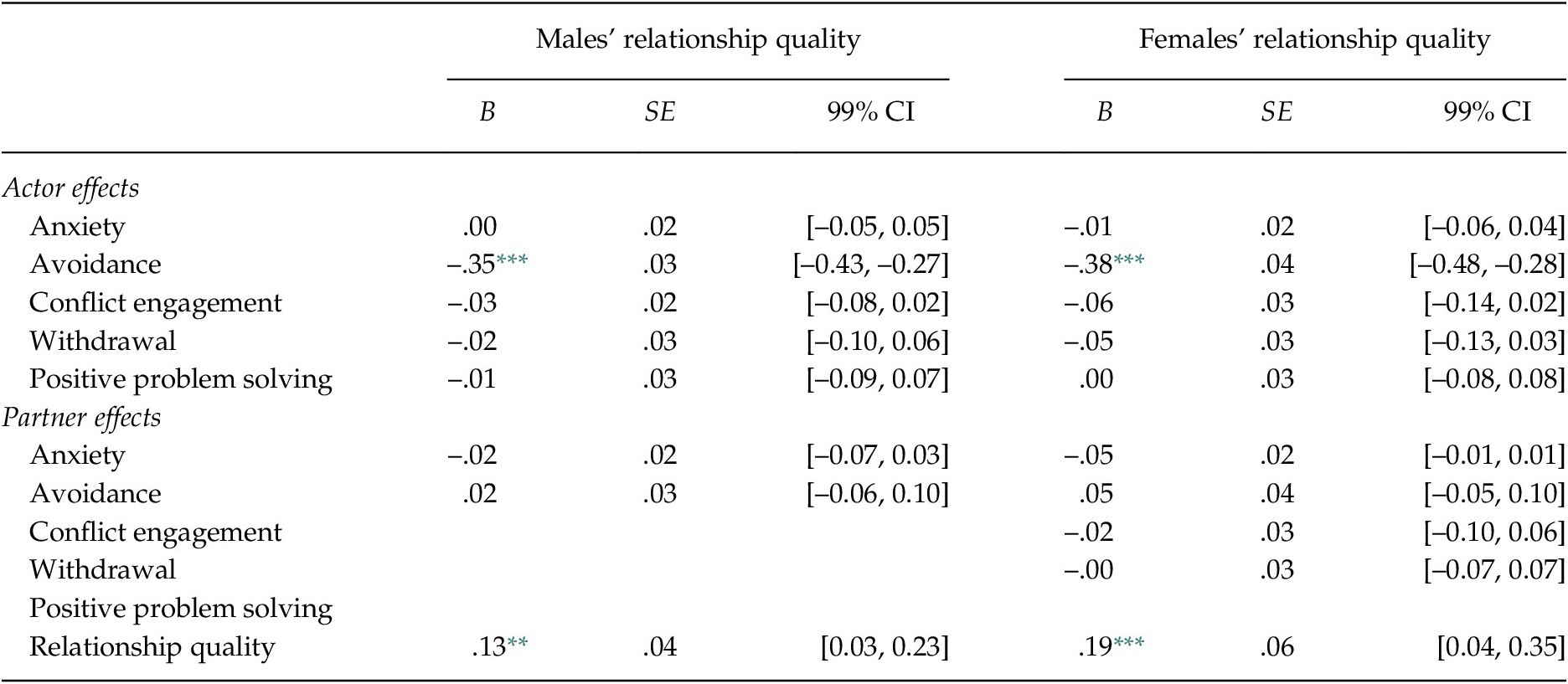
Finally, the regression model of males’ relationship quality, F(8, 404) = 35.65, p < .001, R 2 = .42, indicated that actor avoidance and partner relationship quality were significant predictors, the former with a negative and the latter with a positive value. The regression model of females’ relationship quality, F(10, 394) = 27.21, p < .001, R 2 = .40, showed that actor avoidance was a significant, negative predictor, whereas partner relationship quality was a significant, positive predictor (see Table 4).
Standard Regression Model of Relationship Quality

Note. CI = Confidence interval.
** p < .01.
*** p < .001.
Discussion
As already noted, a relatively small number of studies have addressed to date the links between adult attachment, conflict behavior, and relationship satisfaction —to our knowledge, none of them focusing on youngsters and adopting an APIM approach—, so more research into this field is warranted, particularly in Spain. Consequently, this study contributes to the literature by examining the associations between these three variables in a sample of Spanish young adults, as well as by considering both couple members’ reports, thus assuming the interdependence between the two partners.
With regard to descriptive data by gender, the men in our sample showed a higher level of relationship satisfaction than the women, although the effect size was small. This is consistent with previous data from Spanish-speaking populations (Guzmán & Contreras, Reference Guzmán and Contreras2012; Molero et al., Reference Molero, Shaver, Ferrer, Cuadrado and Alonso-Arbiol2011). Similarly, as in prior studies (Del Giudice, Reference Del Giudice2011; Molero et al., Reference Molero, Shaver, Ferrer, Cuadrado and Alonso-Arbiol2011; Schmitt et al., Reference Schmitt, Alcalay, Allensworth, Allik, Ault, Austers, Bennet, Bianchi, Boholst, Borg, Braeckman, Brainerd, Caral, Caron, Casullo, Cunningham, Daibo, De Backer, De Souza and Wan2003), significant but small gender differences were found in avoidance, with males showing higher levels than females. Regarding conflict resolution, female participants more frequently used conflict engagement and withdrawal in conflictive interactions as compared to males, whereas males were more likely to use compliance. The small effect size, however, supports Shi’s (Reference Shi2003) conclusion that gender is a less powerful factor than adult attachment in shaping conflict-resolution styles.
In this study, both male and female participants´ anxiety and avoidance were positively associated with the use of conflict engagement, compliance, and withdrawal styles in couple conflicts. Concretely, as in previous studies (Pistole & Arricale, Reference Pistole and Arricale2003; Rholes et al., Reference Rholes, Kohn and Simpson2014; Shi, Reference Shi2003), these correlations support that anxious partners tend to pursue or engage in conflict, whereas avoidant partners are inclined to withdraw from them. Beyond this difference, and consistently with prior research (e.g., Boğda & Sendil, Reference Boğda and Sendil2012), it seems that insecure romantic attachment is related to conflict-management styles that are likely to hinder satisfactory conflict resolution. In addition, it is worth noting that positive problem solving is only negatively linked to avoidance in this study, thus confirming prior findings indicating that anxiously attached individuals show fewer deficits in fostering satisfactory conflict resolution (Ricco & Sierra, Reference Ricco and Sierra2017; Shi, Reference Shi2003). This might be due to their desire for closeness and worries about their partner’s affection, or to their awareness of both the relationship-damaging and the intimacy-promoting aspects of couple conflicts (Fishtein et al., Reference Fishtein, Pietromonaco and Feldman1999).
Additionally, correlations —but not regression analysis—add evidence to the conclusion that the negative styles of conflict engagement and withdrawal are detrimental to relationship quality, whereas the functional style of positive problem-solving fosters satisfaction (e.g., Kurdek, Reference Kurdek1994). As in Sierau and Herzberg (Reference Sierau and Herzberg2012), the compliant style does not seem to correlate significantly with this relationship outcome.
Last, consistently with the review by Li and Chan (Reference Li and Chan2012) and with prior findings from Spain (Molero et al., Reference Molero, Shaver, Ferrer, Cuadrado and Alonso-Arbiol2011; Monteoliva & García-Martínez, Reference Monteoliva and García-Martínez2005; Ortiz et al., Reference Ortiz, Gómez-Zapiain and Apodaca2002) and other Spanish-speaking countries (Heresi Milad et al., Reference Heresi, Rivera and Huepe2014), correlations and regression analysis both indicate that avoidance has a stronger negative impact than anxiety on relationship quality, maybe partly because avoidant individuals have a less positive perception of daily supportive events in their relationships —as such actions foster dependence and closeness (Campbell et al., Reference Campbell, Simpson, Boldry and Kashy2005)—, and/or because anxious people are more prone to enjoying relationships when they feel confident about their partner’s availability (Li & Chan, Reference Li and Chan2012). In any case, we found that both attachment dimensions were detrimental to satisfaction and that this was true both for males and females, which contradicts findings indicating gender differences (e.g., Collins & Read, Reference Collins and Read1990; Molero et al., Reference Molero, Shaver, Ferrer, Cuadrado and Alonso-Arbiol2011), and confirms the conclusion that the association between attachment insecurities and relationship quality is weakly moderated by gender (Li & Chan, Reference Li and Chan2012).
With regard to associations between the members of the couple, our data first indicate that both anxiety and avoidance almost equally positively correlate with partner’s anxiety and avoidance, which calls into question the existence of a particular relationship dynamic between partner’s anxiety and actor’s avoidance —and vice versa—, as suggested by Molero et al. (Reference Molero, Shaver, Ferrer, Cuadrado and Alonso-Arbiol2011). Concerning associations between partners’ conflict-resolution styles, the moderate, positive correlations linking withdrawal to partner’s use of conflict engagement support previous findings of a “demand-withdraw pattern” (Kurdek, Reference Kurdek1995), but do not replicate its alleged gender-specific nature, as the magnitude of the association was similar regardless of the gender of the demanding part. It should be noted, however, that the correlation between each partner’s use of conflict engagement was twice the size, which suggests that this style might foster conflict escalation in the relationship.
In this study, correlations between partner’s anxiety and avoidance and the four conflict-resolution styles were nonsignificant or low, similarly to Du Plessis (Reference Du Plessis2006). Conversely, but also consistently with prior research (Banse, Reference Banse2004; Brassard et al., Reference Brassard, Lussier and Shaver2009; Molero et al., Reference Molero, Shaver, Ferrer, Cuadrado and Alonso-Arbiol2011), partner’s attachment insecurities significantly and negatively correlated with relationship quality, although our data do not support that partner avoidance is a stronger risk factor for satisfaction than partner anxiety, as suggested by other authors (Collins et al., Reference Collins, Cooper, Albino and Allard2002; Heresi Milad et al., Reference Heresi, Rivera and Huepe2014; Sierau & Herzberg, Reference Sierau and Herzberg2012). In any case, it must be noted that these associations were not evident in the regression analysis, as occurred in the above-mentioned studies, maybe partly due to differences in methodology (e.g., their samples included adults of a wider age range, and hence, with higher rates of marriage or cohabitation). Likewise, as in Bretz (Reference Bretz2009), the few significant correlations observed between partner’s use of constructive or destructive conflict-resolution styles and relationship quality did not reach significance in the regression analyses, which supports that the attachment processes —included in the models—might be particularly relevant for analyzing these associations (Bretz, Reference Bretz2009). Finally, replicating prior findings (Du Plessis, Reference Du Plessis2006), correlations and regression models both indicate that couple partners’ perceived relationship quality are significantly and positively linked.
This study has several limitations. First, it is based on a sample of Spanish heterosexual couples whose members are mostly university students, so the results may not be generalizable to other types of populations. Future studies in Spain or abroad could thus benefit from examining samples that include a wide number of homosexual couples and/or non-student youngsters. Second, data were collected through self-report measures that are subject to response bias, so the use of other methods such as behavioral observations, daily diaries, or semi-structured interviews are encouraged because of the advantages of method triangulation. Third, this study does not consider possible mediating effects among the variables, so future research should use the structural equation modeling to deepen understanding of the dynamics of dyadic relationships. Fourth, the cross-sectional and correlational nature of the research conducted does not allow us to examine the causality or the direction of influences. Therefore, longitudinal studies are needed to properly analyze the likely bidirectional effects existing between the variables analyzed herein.
According to Shulman and Connolly (Reference Shulman and Connolly2013), young adulthood is a stage characterized by the interplay between romantic experiences and concurrent age-related tasks, thus posing the challenge of coordinating dyadic commitment with individual career paths and life plans/goals. Moreover, this evidences “the dyadic nature of this stage, namely the major role one may play in the fulfillment or collapse of a partner’s aspirations” and the resulting relevance of the “ability to negotiate and handle this interdependence as a couple” in order to achieve a successful transition to a committed long-term partnership (Shulman & Connolly, Reference Shulman and Connolly2013, p. 28).
Overall, our findings reveal individual-level and dyadic-level relationships between adult attachment, conflict resolution, and relationship quality in a fairly large sample of heterosexual young couples, thus shedding light on a relatively unexplored field of research in Spain. These results support prior data from other countries (see Feeney & Fitzgerald, Reference Feeney and Fitzgerald2019) by suggesting that Spanish emerging adults’ attachment insecurities foster the use of dysfunctional styles of conflict resolution, and that both factors decrease levels of relationship quality. Specifically, it appears that being more avoidant and having a less satisfied partner may have a detrimental effect on the level of happiness with the relationship —and vice versa.
Hence, therapists should pay attention to both partners’ adult attachment from a dyadic perspective in order to evaluate whether and how it might affect conflict management and level of satisfaction with the relationship, as well as bear in mind that psychotherapy might provide opportunities to change attachment patterns, as some studies point out (Travis et al., Reference Travis, Bliwise, Binder and Horne-Moyer2001).