Introduction
Necrotising external otitis, also referred to as malignant otitis externa, is a devastating disease that poses diagnostic and therapeutic challenges. It is most frequently seen in elderly patients with diabetes mellitus, and in immunosuppressed patients from all age groups.Reference Ozgen, Oguz and Cila 1 – Reference Loh and Loh 9 Necrotising otitis externa is associated with high morbidity and mortality rates, even in cases with adequate targeted antibiotic therapy and prompt surgical intervention. Adjuvant hyperbaric oxygen therapy has been proven to be a highly effective adjunct in the treatment of advanced necrotising otitis externa.Reference Loh and Loh 9
The infection usually originates in the external auditory canal soft tissue, and spreads through the fissures of Santorini to the surrounding tissues, including the cartilage of the external ear canal and the temporal bone. Spread to the cranial base is also observed in very advanced cases.Reference Slattery and Brackmann 5 – Reference Mardinger, Rosen, Minkow, Tulzinsky, Ophir and Hirshberg 7
Controversy exists regarding the clinical prognostic factors of necrotising otitis externa, which are scarcely addressed in the literature. A recent study showed that the extent of anatomical involvement does not reliably predict outcome. However, those with clival involvement, indicating central skull base osteomyelitis, were noted to fare poorly with conventional treatment.Reference Loh and Loh 9
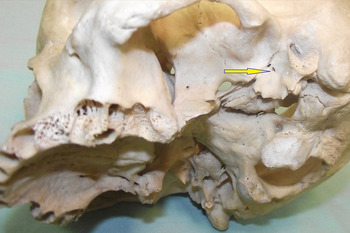
Despite the anatomical proximity, temporomandibular joint (TMJ) involvement is uncommon (up to 14 per cent of cases), and is probably related to the existence of Huschke's foramen (Figure 1).Reference Timon and O'Dwyer 6 – Reference Schweitzer 19 Mardinger et al. have reported that TMJ involvement in necrotising otitis externa is associated with a resistant disease process.Reference Mardinger, Rosen, Minkow, Tulzinsky, Ophir and Hirshberg 7 Our study aimed to determine whether TMJ involvement has any prognostic effect on the course of resistant necrotising otitis externa.
Huschke's foramen (arrow).

Materials and methods
The study was approved by the local Institutional Review Board.
A retrospective study was conducted between January 2010 and December 2011 in an otolaryngology and head and neck surgery department. Twenty-three consecutive patients, in whom medical and surgical treatment conducted at other hospitals in the region had failed, were referred to our department for further evaluation and hyperbaric oxygen therapy (our medical centre is a referral centre for hyperbaric oxygen therapy). All patients underwent a physical examination, including cranial nerve evaluation, 4-hourly temperature measurement, daily visual analogue scale evaluation for pain, and routine blood tests that included a complete blood count and C-reactive protein (CRP). The following variables were recorded: age, gender and microbial culture results.
A gallium scan was performed in all cases as part of the initial evaluation, and other imaging modalities – computed tomography (CT) or magnetic resonance imaging – were used as necessary. Planar whole body and single-photon emission CT gallium scans of the head and neck were obtained at 72 or 96 hours after the intravenous administration of 8 mCi of Ga-67 citrate.
All patients underwent local treatment with surgical debridement of necrotic bone and soft tissue, and swabs and tissue samples were obtained for culture analyses. After consultation with an infectious disease physician, all patients were treated with appropriate spectrum antibiotics. Histopathology results for the surgical specimens were retrieved. Our study included only those patients who were treated daily with adjuvant hyperbaric oxygen therapy.
Chi-square and Fisher's exact tests were used as appropriate to analyse statistically significant differences in the distribution of categorical variables. Student's t-test was performed to determine statistically significant differences in mean continuous parameters between two groups.
Results
Twenty-three patients with necrotising otitis externa (15 men and 8 women, with a mean age of 73.2 years (range, 40–86 years)) were identified during the study period. Co-morbidities included: diabetes mellitus, in 15 patients (65.2 per cent); hypertension, in 13 patients (40.6 per cent); and peripheral vascular disease, in 2 patients (8.6 per cent).
Cranial nerve involvement was found in seven patients (30.4 per cent), six of whom had facial nerve paralysis. One of these patients had, in addition, Xth and XIth cranial nerve paresis. Another patient had IXth and Xth cranial nerve paralysis. None of our patients had intracranial involvement.
The mean white blood cell (WBC) count and CRP level at admission were 7.7 × 10⁹/l (range, 5.1–12.8 × 10⁹/l) and 39.8 mg/l (range, 3.7–101 mg/l), respectively. The WBC counts were elevated above the normal range in only 2 (out of 19) patients, whereas the CRP levels were normal in 1 patient only. Inflammatory markers were examined serially during hospitalisation. The mean WBC count at the time of hospital discharge was 8.3 × 10⁹/l, whereas the mean CRP level at discharge was 40 mg/l. Five patients had a rise in CRP levels during hyperbaric oxygen therapy. One patient had an increase in WBC count during hospitalisation.
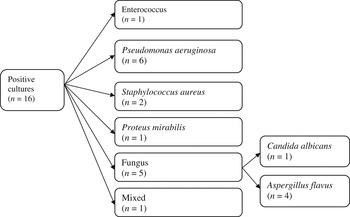
Cultures were obtained in all cases, with a positive microbiological result found in 16 patients (69.7 per cent). Pseudomonas aeruginosa was the most frequently occurring organism and was present in 5 out of 16 cultures (31.3 per cent). Staphylococcus aureus (three patients), Proteus mirabilis (two patients) and enterococcus (one patient) were also cultured. Microbiological studies revealed fungi in seven patients (30.4 per cent), five of whom (17.4 per cent) had aspergillus and two (8.7 per cent) had Candida albicans. One patient had mixed staphylococcal and C albicans growth (Figure 2).
Breakdown of positive cultures.

All patients were evaluated with imaging studies. Ten patients (43.4 per cent) had a positive gallium scan at admission, demonstrating osteomyelitis of the temporal bone or skull base. Mastoid and petrous bones were involved in three and four patients, respectively. Two of these patients had petrous apex involvement. The TMJ was involved in four patients.
Ten patients (43 per cent) underwent surgery, including six patients who underwent mastoidectomy and six who underwent debridement of soft tissue and bone.
Prior to admission to our department, most patients were treated with oral ciprofloxacin and intravenous ceftazidime (2 g, three times a day). These medications were ceased on admission to our department. Cultures were taken from the external ear canal, and antibiotic therapy was started according to the results of microbiological studies and pathogen sensitivities.
All patients were treated with hyperbaric oxygen therapy, administered at 2 atmospheres. Thirteen patients (56 per cent) completed the 40 planned hyperbaric oxygen therapy ‘dives’ (average of 26 sessions, range of 5–40 sessions). In 8 cases, the hyperbaric oxygen therapy was ceased after a mean of 24 sessions because of the exacerbation of pain. In another 2 patients, the treatment was stopped because of oxygen intoxication, after 27 sessions.
Mortality within 90 days of discharge from hospital was considered as death as a consequence of the disease. One patient was transferred to the cardiac intensive care unit because of cardiac insufficiency, and was subsequently lost to follow up. Four patients died within 90 days of discharge.
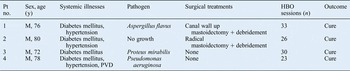
Four patients in our study had TMJ involvement (Table I). All patients with TMJ involvement had a gradual improvement in CRP levels (from 49 to 38 mg/l) and were eventually discharged from hospital (except for one patient who suffered from cardiac insufficiency: the individual was subsequently transferred to the intensive care unit and lost to follow up). Five of the eight patients in the study group without TMJ involvement had a rise in CRP levels (from 22 to 55 mg/l).
Necrotising external otitis patients with temporomandibular joint involvement

Pt no. = patient number; y = years; HBO = hyperbaric oxygen; M = male; PVD = peripheral vascular disease
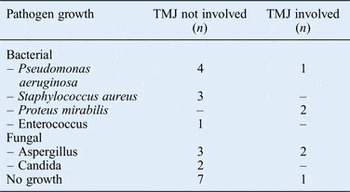
In the group with TMJ involvement, bacteriological studies revealed P aeruginosa in one patient, P mirabilis in two patients and aspergillus in two patients; there was no growth in one patient. In the group without TMJ involvement, P aeruginosa was grown on the cultures of four patients, S aureus was evident in three patients, enterococcus in one patient, aspergillus in three patients and candida in two patients. In seven of those patients, no organisms grew on culture (Table II).
Pathogen growth in each group

TMJ = temporomandibular joint
All patients with TMJ involvement were discharged at the end of the treatment, and were alive and free of disease at 90 days after discharge (except for 1 patient who was lost to follow up). In the study group without TMJ involvement, 4 patients (16 per cent) died within 90 days of discharge, and 3 patients (13 per cent) needed further hospitalisation and treatment.
Discussion
Not all necrotising otitis externa patients respond to therapeutic management, and re-evaluation of their disease, including further imaging, repeat tissue culturing, the addition of more aggressive antifungal and antibacterial agents, and the debridement of necrotic tissue, is mandatory. As this pathology is multifactorial, clinical prognostic factors of necrotising otitis externa are scarcely addressed in the literature. Earlier studies showed that TMJ involvement in necrotising otitis externa is associated with a resistant disease process, often with numerous recurrences of the disease. However, a recent study showed that the extent of anatomical involvement does not reliably predict outcome, although those with clival involvement, indicating central skull base osteomyelitis, were noted to fare poorly with conventional treatment.Reference Loh and Loh 9
Despite the close proximity of the TMJ to the external ear canal, TMJ involvement is reported to be a rare complication. Involvement of the joint might be related to the existence of anatomical communications, such as Huschke's foramen, which is formed by the fusion of two bony prominences in the tympanic rim. This foramen, which was first described by Emil Huschke, usually closes before five years of age.Reference Wang, Bingham, Hawke, Kwok and Li 20 Although it was considered as a rare variant,Reference Ars 21 the latest reported rates of this anatomical variant range between 7.2 and 16 per cent,Reference Faig-Leite and Horta Júnior 22 , Reference Herzog and Fiese 23 and it is more frequent in female skulls (16.2 per cent) than in male skulls (8.3 per cent).
Most publications on TMJ extension are individual case reports, and since 1959 only 22 cases have been published.Reference Mardinger, Rosen, Minkow, Tulzinsky, Ophir and Hirshberg 7 Nevertheless, the studies on series of patients do report interesting rates of TMJ extension in their cohorts. Doroghazi et al. reported 5 patients with TMJ involvement out of 21 patients with necrotising otitis externa (23 per cent).Reference Doroghazi, Nadol, Hyslop, Baker and Axelrod 12 Mendez et al. described TMJ involvement in three out of nine patients.Reference Mendez, Quencer, Post and Stokes 13 Mardinger et al. reported the largest series, with a 14 per cent incidence of TMJ involvement (6 out of 42 patients).Reference Mardinger, Rosen, Minkow, Tulzinsky, Ophir and Hirshberg 7
The above data indicate that TMJ involvement in cases of necrotising otitis externa should be more frequent than is reported. There is an interesting parallelism between the latterly reported frequencies of the presence of Huschke's foramen (7–16 per cent) and the reported rates of TMJ involvement in necrotising otitis externa in larger series that were not published as case reports (14–33 per cent). In our series, 17.2 per cent (4 out of 23) patients had TMJ involvement.
Limited data are available regarding the prognosis of necrotising otitis externa patients with TMJ involvement. Mardinger et al. found that patients with TMJ involvement had a worse prognosis.Reference Mardinger, Rosen, Minkow, Tulzinsky, Ophir and Hirshberg 7 However, most of their patients had multiple recurrences of the disease, indicating that the joint involvement might have occurred at a later stage, regardless of the presence of Huschke's foramen. In our study, we demonstrated a favourable prognosis in patients with TMJ involvement; these patients showed a constant decline in CRP levels throughout their hospitalisation, with no disease recurrence or mortality. As the rates of Huschke's foramen are roughly equivalent to the reported rates of TMJ involvement, we assume that whenever this anatomical variant is present, possible involvement of the joint is feasible. Infections usually progress towards the lower resistance point, and Huschke's foramen is a potential lower resistance point. Therefore, we can safely speculate that the infective process will progress towards Huschke's foramen when it exists, skipping medial components of the temporal bone. We postulate that this might improve prognosis, as venous blood drains from the TMJ through the superficial temporal vein and the maxillary vein caudally towards the neck, and not cranially as does temporal bone venous drainage.
-
• Necrotising otitis externa is associated with high morbidity and mortality, despite targeted antibiotic therapy and prompt surgical intervention
-
• Controversy exists regarding clinical prognostic factors of necrotising otitis externa, which are scarcely addressed
-
• In this study, four patients (17 per cent) had temporomandibular joint (TMJ) involvement
-
• Patients with TMJ involvement had no mortality and improved C-reactive protein levels, and were eventually discharged free of disease
-
• We suggest considering TMJ involvement as a positive prognostic factor in necrotising otitis externa management
We conclude that our necrotising otitis externa patients with TMJ involvement are at an earlier stage of disease, and a better prognosis is expected.
Conclusion
Temporomandibular joint involvement in necrotising otitis externa portends a better prognosis. In this level of evidence of 4 study, patients with TMJ involvement showed a constant decline in CRP levels throughout their hospitalisation, and had a lower rate of mortality and recurrent disease. We suggest considering TMJ involvement as a positive prognostic factor in necrotising otitis externa.