Parents are often surprised when, after hearing an object named, their child produces the label in response to previously unnamed category members. For instance, a child might point to a trout and say fish, when the word fish has only been used in the context of goldfish in the past. Such impressive word learning abilities have also been documented in the laboratory. A number of studies have shown that children map novel labels to an entire category of objects after only a few isolated naming events (e.g. Landau, Smith & Jones, Reference Landau, Smith and Jones1988; Markman, Reference Markman1989; Soja, Carey & Spelke, Reference Soja, Carey and Spelke1991; Waxman & Hall, Reference Waxman and Hall1993). The remarkable ease with which children learn new words is thought to be driven by various attentional biases or constraints that facilitate the process of mapping words to referents. One of the most widely studied constraints in early word learning is the shape-bias, a heuristic by which word learners extend the labels of solid objects to things of similar shape (Imai & Gentner, Reference Imai and Gentner1997; Landau et al., Reference Landau, Smith and Jones1988; Soja, Reference Soja1992; Soja et al., Reference Soja, Carey and Spelke1991).
Smith (Reference Smith, Golinkoff and Hirsh-Pasek2000) has proposed that the shape-bias stems from children's sensitivity to perceptual and linguistic regularities. Critically, the early vocabularies of English-speaking children are dense with labels of objects that belong to shape-based categories (e.g. ‘ball’, ‘car’, ‘dog’; Samuelson & Smith, Reference Samuelson and Smith1999). As a result, children may begin to notice that balls are round, cars are car-shaped and dogs are dog-shaped. After learning some number of shape-based labels, children may draw a second-order generalization by which they then expect labels to refer to objects of the same shape (Smith, Jones, Landau, Gershkoff-Stowe & Samuelson, Reference Samuelson2002). This seemingly sophisticated prediction is actually a product of the perceptual similarities among objects that possess the same label. Thus, the shape-bias is a result of the words that children learn.
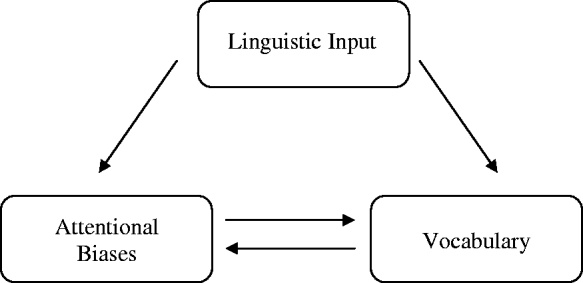
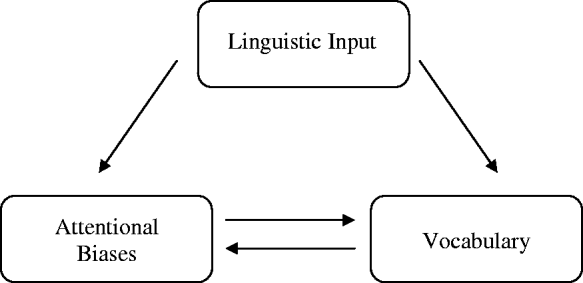
The origin of the shape-bias is further evidenced by the fact that early word learners do not reliably extend new words on the basis of shape until their productive vocabulary contains approximately 100 to 150 words (Gershkoff-Stowe & Smith, Reference Gershkoff-Stowe and Smith2004; Samuelson & Smith, Reference Samuelson and Smith1999). The causal relationship between vocabulary growth and the shape-bias was demonstrated in a study in which children aged 1 ; 5 were trained over a period of seven weeks on names for a series of novel objects that were highly organized by shape (Smith et al., Reference Smith, Jones, Landau, Gershkoff-Stowe and Samuelson2002). At the end of the study, at a time when most children of the same age are not yet systematically extending labels on the basis of shape, children in the study showed evidence of having formed a shape-bias. The data demonstrate that the bias develops from experience with the labels of shape-based categories. Critically, children also experienced significant growth in their productive vocabulary outside the laboratory relative to children in a control group who received no training. These results suggest a bidirectional relationship between the shape-bias and vocabulary growth (see also Jones, Reference Jones2003; Samuelson, Reference Samuelson2002). As illustrated in Figure 1, the shape-bias is not only a product of children's language learning experience, it also contributes to future vocabulary growth.
Relationship between linguistic input, word learning strategies and vocabulary.
In addition to simply hearing many words that label shape-based categories, children learning English are exposed to syntax that differentiates between nouns for objects of the same shape and nouns for things not categorized by shape. Count nouns typically refer to discrete solid objects (e.g. ‘house’, ‘cup’), whereas mass nouns tend to refer to non-solid entities for which shape does not define category membership (e.g. ‘milk’, ‘sand’). In English, the plural can be used with count nouns, but not mass nouns, (e.g. houses but not milks). Although some syntactic markers such as the can accompany any kind of noun, others are reserved for exclusive use with either count nouns (e.g. one, many) or mass nouns (e.g. a little, much). Because some common syntactic phrases regularly co-occur with certain types of nouns, the phrases themselves begin to direct attention to perceptual properties. Count noun phrases push attention to shape, and mass noun phrases push attention to material (Gathercole, Cramer, Somerville & Jansen, Reference Gathercole, Cramer, Somerville and Jansen1995; McPherson, Reference McPherson1991; Samuelson & Smith, Reference Samuelson and Smith1999; Soja, Reference Soja1992).
Not all languages, however, distinguish between count and mass nouns, and those that do may not use the same obligatory system as English. Such differences in the linguistic input result in changes to the word learning output. In Smith's (Reference Smith and MacWhinney1999) words, “Children learning different languages have different attentional biases. They exhibit word learning biases that are smartly specific to the language being learned” (p. 281). Two- and four-year-old children who speak Japanese – a language that does not possess consistent linguistic cues to differentiate count and mass nouns – show no preference for shape in a standard noun generalization task with simply designed objects (Imai & Gentner, Reference Imai and Gentner1997; see also Li, Durham & Carey, Reference Li, Durham and Carey2009). Similar results have been found with other languages that do not include consistent, obligatory markers designating nouns as count or mass, including Korean (Gathercole & Min, Reference Gathercole and Min1997), Mandarin (Subrahmanyam & Chen, Reference Subrahmanyam and Chen2006) and Welsh (Gathercole, Thomas & Evans, Reference Gathercole, Thomas and Evans2000).
In contrast to English, which dichotomizes nouns as count or mass, the boundary between nouns is much more fluid in Spanish. As a ‘natural mass/count’ language, Spanish does not force the speaker to view certain nouns as count and others as mass. The speaker's perspective rather than the language dictates the noun form they choose. Words such as ‘soap’, ‘paper’ and ‘celery’, which are unanimously viewed as mass nouns by English speakers, receive mixed ratings among Spanish speakers (Sera & Goodrich, Reference Sera and Goodrich2010). The flexibility inherent in this kind of system means that there is no clear correspondence between nouns and the types of syntactic frames that co-occur with them. For example, the word for ‘soap’ (jabon) may be presented in either mass or count syntax (i.e. mucho jabón or un jabón, respectively). As a result, syntactic frames do not indicate as clearly whether the referent belongs to a shape-based category or one organized by substance. When Spanish-speaking children hear ‘mucho_____’ it may be followed by a noun that is categorized in English as count or mass, or even an adjective.
Language-specific input drives the development of word learning biases; it does not, however, operate alone. Noun learning is also influenced by regularities in visual input. Regardless of whether a language differentiates between count and mass nouns, solid objects that belong to the same category tend to be similar in overall shape (Biederman, Reference Biederman1985; Rosch, Mervis, Gray, Johnson & Boyes-Braem, Reference Rosch, Mervis, Gray, Johnson and Boyes-Braem1976). The shape-based nature of many object categories is sufficient to establish a shape-bias. Linguistic cues are not necessary, but a regular linguistic distinction between objects for which shape matters and those for which it does not may accelerate the development of the shape-bias.
For children learning English, the shape-bias is likely to surface from the combination of perceptual and linguistic regularities. In contrast, the emergence of the shape-bias among Spanish speakers must rely more heavily on perceptual regularities, with less support from linguistic cues. However, despite ambiguous syntactic markers, Spanish-speaking three-year-olds extend new words on the basis of shape much like their English-learning counterparts, indicating that perceptual correlations are sufficient for the formation of the shape-bias (Gathercole & Min, Reference Gathercole and Min1997). In the present research we ask whether the differences in English and Spanish translate to differences in the initial saliency of object properties (e.g. shape, texture, color). Colunga, Smith and Gasser (Reference Colunga, Smith and Gasser2009) have reported that Spanish-speaking two-year-olds show greater ease in attending to the material of entities compared to English-speaking children of the same age. An unanswered question is whether attention to shape emerges earlier in English-speaking children whose language contains redundant cues that indicate when shape is important.
To investigate the emergence of the shape-bias in Spanish-speaking children, we tested early word learners of English and Spanish using a standard forced-choice shape-bias task. The central question was whether children's primary language would result in differences in their extension of novel names on the basis of shape. A second question was whether differences in the onset of the shape-bias would generalize to differences in the content of children's vocabulary as well. We predicted that Spanish-speaking children would make fewer shape-based responses relative to English-speaking children in the word extension task and would possess fewer words for shape-based categories than English-speaking children.
METHOD
Participants
The participants were sixty-nine children between the ages of two and three years. Thirty-nine children were monolingual English speakers tested in Greenville, SC; ten children were monolingual Spanish speakers tested in Greenville, SC; and twenty children were monolingual Spanish speakers tested in Cuernavaca, Mexico. The mean age was 2 ; 7 (range=1 ; 10–3 ; 4) for English-speaking children and 2 ; 6 (range=1 ; 10–3 ; 4) for Spanish-speaking children. An additional seven children were excluded from data analysis due to failure to complete the session (n=4) or because they were not monolingual (n=3).
Stimuli
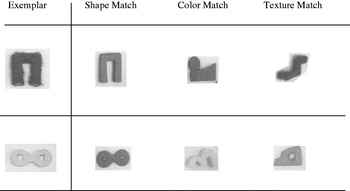
The experimental stimuli consisted of two sets of 3-dimensional objects approximately 8 cm×11 cm in size (see Figure 2). Each set included an exemplar and three test objects. Test objects matched the exemplar on one of three dimensions: color, texture or shape. The exemplars were labeled with novel names designed to mimic feasible phonemic combinations and natural syllabic structures in English and Spanish. The label teema was used for both English and Spanish speakers. For English speakers, the second novel name was dax; for Spanish speakers, it was daso. Familiar objects (e.g. ‘duck’, ‘car’) were also used.
Experimental stimuli sets, each including an exemplar and three test objects.

Design and procedure
The experimental session began with a familiarization trial to acquaint children with the procedure. The experimenter introduced a familiar exemplar and labeled it, saying, for example, “Look, it's a duck”. The experimenter then asked, “Where is another duck? Can you find another duck?” while pushing toward the child a tray with three familiar objects, including a previously unseen member of the named category. Correct responses were praised. Incorrect responses were corrected (e.g. “No, that's the flower. Here's the duck.”). Familiarization trials were repeated with new exemplars until children responded to two trials correctly.
Two experimental trials immediately followed familiarization. In each trial, the experimenter introduced the exemplar and labeled it six times (e.g. “Look, it's a (teema, dax). This is called a (teema, dax).”/“Mira, es un(a) (teema, daso). Esto se llama (teema, daso).”). The child was permitted to handle the exemplar for approximately 15 s and was encouraged to repeat the label. The exemplar was then removed from the child's sight and the three test objects were presented on a tray in a random order. The experimenter asked the child to choose one of the objects, saying, “Where is another (teema, dax)? Can you help me find another (teema, dax)? Give me another (teema, dax).”/“Donde esta otro/a (teema, daso)? Me puedes ayudar a buscar otro/a (teema, daso)? Dame otro/a (teema, daso).” No corrective feedback was given during test trials. The same procedure was then repeated for the second test trial. The order of stimulus sets was counterbalanced. Sessions were videotaped for later coding.
Measures of productive vocabulary size were also collected. Parents completed the MacArthur Short Form Vocabulary Checklist: Level II (Fenson, Pethick, Renda, Cox, Dale & Reznick, Reference Fenson, Pethick, Renda, Cox, Dale and Reznick2000) as an estimate of the size of children's overall productive vocabulary. They were also asked to complete a separate vocabulary list consisting of shape-based nouns. The inventory was created using adult ratings of shape (L. K. Samuelson, personal communication, 19 October 2006; Samuelson & Smith, Reference Samuelson and Smith1999). Nouns for categories judged to be shape-based that did not appear on the Spanish version of the MCDI (Fundación MacArthur Inventario del Desarrollo de Habilidades Comunicativas; Jackson-Maldonado, Bates & Thal, Reference Jackson-Maldonado, Bates and Thal1992) were omitted because they were assumed to be unfamiliar words to beginning Spanish speakers. The entire list of 120 words used in the shape noun inventory is included in the ‘Appendix’. Parallel versions of both vocabulary checklists were translated into Spanish by a fluent Spanish speaker.
RESULTS
A correct response was coded when children selected as their first choice the test object that matched the exemplar on shape. Monolingual Spanish-speaking children tested in the United States and Mexico did not vary in the frequency of correct responses (t(28)=0·34, p=0·74). Subsequent analyses, therefore, do not distinguish between these children. To ensure that English- and Spanish-speaking children understood the task, we compared the number of familiarization trials needed for children to answer correctly twice. No difference was found (t(65)=0·32, p=0·75).
A one-tailed independent samples t-test was performed to test the hypothesis that children whose primary language is English would generalize a novel label based on shape more often than children whose primary language is Spanish. The analysis revealed that English-speaking children selected the shape match significantly more often (M=62·82%) than their Spanish-speaking counterparts (M=41·67%) (t(67)=2·39, p=0·01, d=0·58). A chance analysis confirmed that English-speaking children selected shape matches significantly more often than chance (t(38)=5·21, p<0·01). In contrast, the performance of Spanish-speaking children did not differ from chance (t(29)=1·27, p=0·21).
An analysis of individual performance revealed that twice as many English speakers selected shape matches on both test trials compared to Spanish speakers (41% and 20%, respectively). Thirty-seven percent of Spanish speaking children failed to choose a shape match on either test trial in contrast to only 15% of English speakers. Spanish-speaking children selected shape, color and texture matches at similar levels, as shown in Table 1. In comparison, shape emerged as the predominant response among English-speaking children.
Percent of test objects selected as a function of language

A second hypothesis was that differences in the strength of the shape-bias would correlate with the kinds of words children produced outside the laboratory. Specifically, we predicted that a stronger bias to attend to shape would result in English-speaking children producing more shape-based nouns than Spanish-speaking children. A one-tailed independent t-test confirmed this hypothesis (t(67)=2·00, p=0·03, d=0·48). According to parental report, English-speaking children produced an average of 86·92 (SD=27·27) shape nouns compared to 71·80 (SD=35·63) for Spanish-speaking children. This result was not attributable to differences in the overall size of children's productive vocabulary as measured by a separate inventory. Parents reported that English-speaking children (M=70·28, SD=22·93) and Spanish-speaking children (M=61·29, SD=28·96) said an equivalent number of words (t(65)=1·42, p=0·16).
DISCUSSION
The bias to attend to shape when generalizing names for solid objects is thought to stem from perceptual and linguistic regularities (e.g. Smith, Reference Smith, Golinkoff and Hirsh-Pasek2000). Perceptually, many object categories are naturally structured by shape (Biederman, Reference Biederman1985; Rosch et al., Reference Rosch, Mervis, Gray, Johnson and Boyes-Braem1976). Linguistically, languages vary in the degree to which they possess reliable cues to category structure. In the current research, we focused on Spanish, a language that, compared to English, possesses less restrictive syntax for nouns that label shape-based objects. We expected that such differences in linguistic regularities would translate to differences in children's tendency to generalize novel labels on the basis of shape. The results confirmed our prediction. Between the ages of two and three years, children learning English as their native language applied new labels to objects of the same shape, consistent with previous research (e.g. Imai & Gentner, Reference Imai and Gentner1997; Landau et al., Reference Landau, Smith and Jones1988). Spanish learners, in contrast, were less attentive to shape in the task as evidenced by both aggregate data and analyses of individual children. The second hypothesis – that young Spanish speakers would produce fewer shape-based nouns outside the laboratory than young English speakers – was also supported.
At first glance, the results are at odds with research that has found that Spanish-speaking children possess a shape-bias on a par with that of English-speaking children (e.g. Gathercole & Min, Reference Gathercole and Min1997; Waxman, Senghas & Benveniste, Reference Waxman, Senghas and Benveniste1997). We attribute the differences in our results to the age – and therefore word learning experience – of the children in our sample. We tested novice word learners between the ages of 1 ; 10 and 3 ; 4. Much of the previous research has focused on preschool-age children who have considerably more experience learning words. As demonstrated by these and other studies (e.g. Imai & Gentner, Reference Imai and Gentner1997), perceptual regularities alone will eventually result in the formation of a shape-bias. However, here we investigated young children just beginning to acquire language. Our results suggest that linguistic regularities influence the onset and relative strength of the nascent shape-bias, not the end product.
Although not necessary for the formation of the shape-bias, access to redundant cues is likely to facilitate the insight that certain nouns refer to objects of the same shape. In English, the emergence of the shape-bias is supported by linguistic markers that overlap with visual cues. Count nouns are generally introduced with modifiers such as a or many that are reserved for shape-based categories. These syntactic frames correlate with perceptual input that also indicates solidity. Consequently, linguistic cues to shape are strengthened by perceptual cues, and perceptual cues are fortified by linguistic cues (Billman, Reference Billman and Medin1996; Billman & Knutson, Reference Billman and Knutson1996; Cabrera & Billman, Reference Billman and Medin1996; Yoshida & Smith, Reference Yoshida and Smith2005). The result is that attention to shape is especially robust. For children learning Spanish, linguistic cues do not invariably line up with shape. Because the correlation is inconsistent, perceptual cues may not benefit from the additional strength that comes with redundancy, and it may take longer for Spanish-speaking children to generate a shape-bias.
The absence of a robust shape-bias among beginning Spanish speakers allows them to attend to object properties that children who possess a strong shape-bias have learned to overlook. Children whose native language was Spanish showed no preference for shape, color or texture when extending novel labels in our study. It seems that no single object property has yet emerged as defining object categories. Because they are not yet committed to shape, children learning Spanish may have an advantage when it comes to learning categories that are defined by properties other than shape. Consistent with this idea, Colunga et al. (Reference Colunga, Smith and Gasser2009) found that Spanish-speaking two-year-olds can direct their attention to material more readily than their English-speaking peers. Just as English drives the development of the shape-bias, Spanish may form the basis for other word learning biases. Language-specific biases have been documented, for example, among Korean-speaking children who attend to object function (Gathercole & Min, Reference Gathercole and Min1997) and Japanese-speaking children for whom animacy directs label extension (Yoshida & Smith, Reference Yoshida and Smith2003).
Although we attribute our results to cross-linguistic differences in syntactic structure, we recognize an alternative explanation. In addition to syntactic differences, languages may also vary in the frequency with which shape-based nouns occur in child-directed speech. In English, labels for shape-based categories dominate the nouns that infants hear (Poulin-Dubois, Graham & Sippola, Reference Poulin-Dubois, Graham and Sippola1995; Sandhofer, Smith & Luo, Reference Sandhofer, Smith and Luo2000). The ubiquity of count nouns in the speech of English caregivers offers children extensive opportunities to extract regularities in the input and develop a bias for shape. No analogous research on the content of child-directed Spanish could be located. This gap in the research could address the origins of the shape-bias among Spanish-speaking children. It is possible, for example, that other types of nouns occur with more regularity than count nouns. If this is the case, then both results observed here – the fragility of Spanish-speaking children's shape-bias and the number of shape-based nouns in their vocabulary – could result from noun input alone regardless of syntactic structure. Thus, the verbal input that children receive forms the basis for attentional biases that are tailored to the child's native language. Future research should analyze the content of both the vocabularies of and speech directed to beginning Spanish speakers to determine whether another word class overrides shape-based nouns.
Yet another interpretation of the results is that the performance of the English-speaking children was driven not by an attentional bias to attend to shape, but rather by information in the syntax. For our English-speaking sample, the syntactic frame used in testing had a history of being associated with discrete solid objects, whereas the Spanish syntax was not exclusively paired with any one word type (i.e. it could be followed by count nouns, mass nouns or adjectives). Such differences in syntactic regularity are precisely what are believed to create attentional biases. To disentangle the immediate influence of syntax during testing from the long-term influence of syntax that is believed to be responsible for the shape-bias, future research could test English-speaking children using neutral syntax (e.g. “Where is the _____?” instead of “Where is another _____?”). If children's exposure to syntactic regularities outside the experimental paradigm are truly what matter, then English-speaking children should continue to exhibit a more robust shape-bias than Spanish-speaking children.
As depicted in Figure 1, the relationship between attentional biases and vocabulary is bidirectional. Word learning leads to the formation of attentional biases that then support the acquisition of more words specific to those biases. The interaction makes it difficult to identify causal relationships in naturally occurring systems. Unlike experimental paradigms that manipulate the number of shape nouns that children know (e.g. Smith et al., Reference Smith, Jones, Landau, Gershkoff-Stowe and Samuelson2002), the present research cannot address issues of directionality between attentional biases and vocabulary. Regardless of the source of the shape-bias, however, the presence of the bias should lead to more shape-based nouns being learned. Research has shown that once children have a shape-bias, the speed with which they learn new count nouns increases (Gershkoff-Stowe & Smith, Reference Gershkoff-Stowe and Smith2004; Samuelson, Reference Samuelson2002; Smith et al., Reference Smith, Jones, Landau, Gershkoff-Stowe and Samuelson2002). Consistent with this pattern, we observed predicted differences in the types of words that children say outside the laboratory as a function of their native language. The Spanish-speaking and English-speaking children in our study produced an equivalent number of words overall. However, Spanish-speaking children were reported to produce fewer labels for shape-based categories relative to children learning English.
The interplay between linguistic regularities, attentional biases and vocabulary growth promises to yield insight into the nature of children's early word learning. Some of the most fruitful investigations in this area are likely to come from cross-linguistic studies. Without attention to various languages, the literature risks portraying word learning in a narrow and culturally specific manner. Evidence from cross-linguistic studies may also address the claim that higher cognitive processes stem from basic domain-general mechanisms. If word learning is truly built from the ground up then children should develop word learning strategies that are smartly attuned to the unique regularities of their language.
APPENDIX
Word used in English version of the shape noun vocabulary checklist