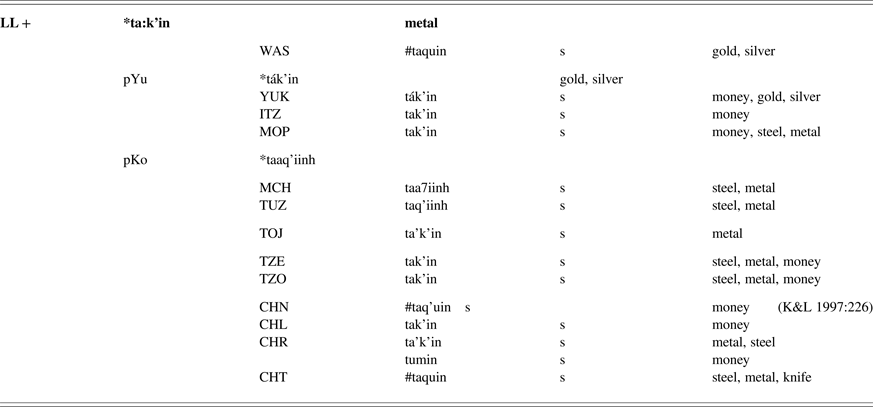
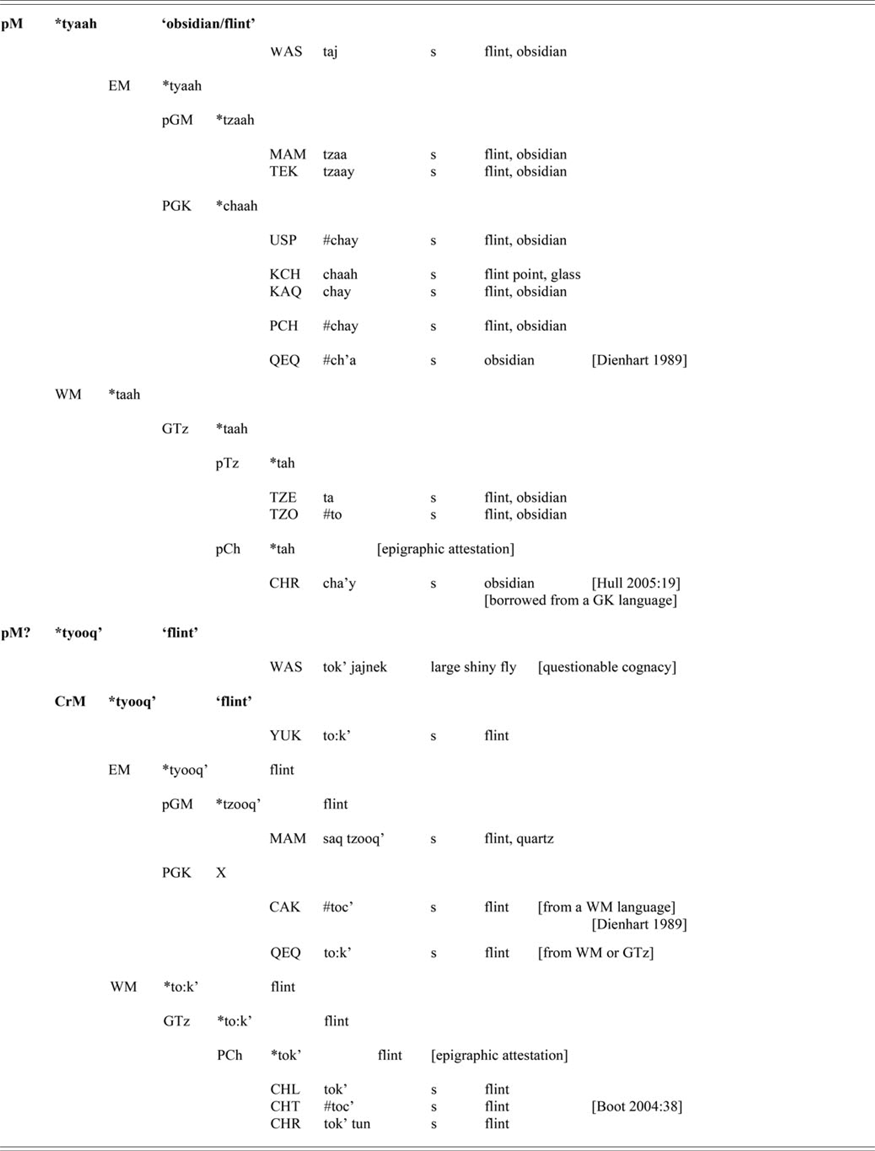
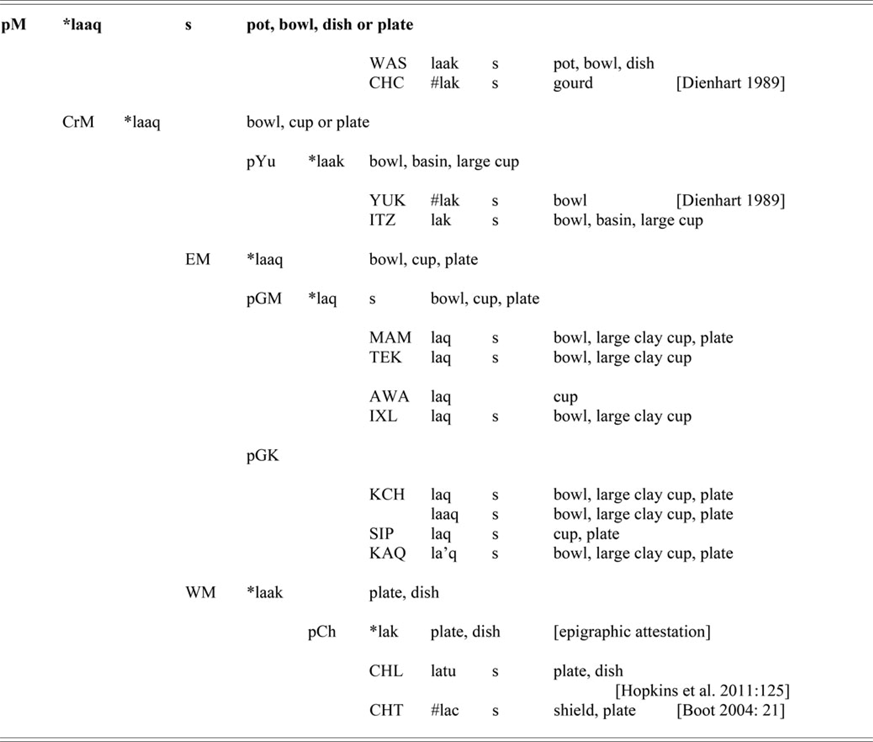
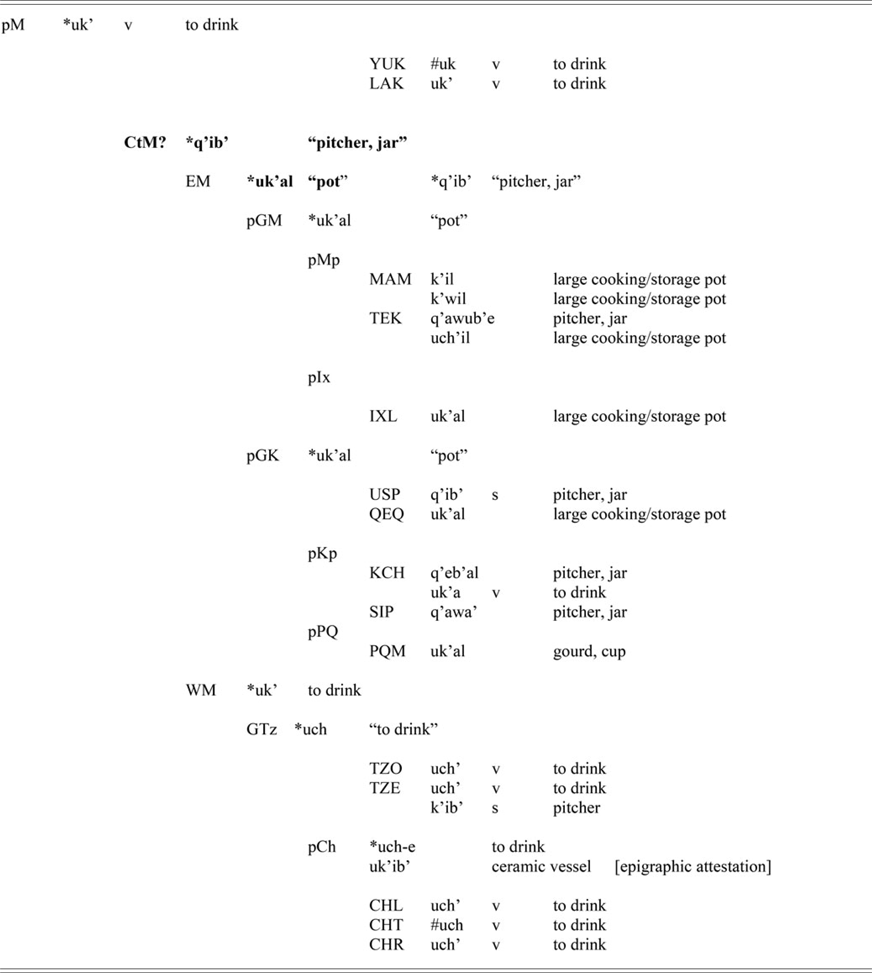
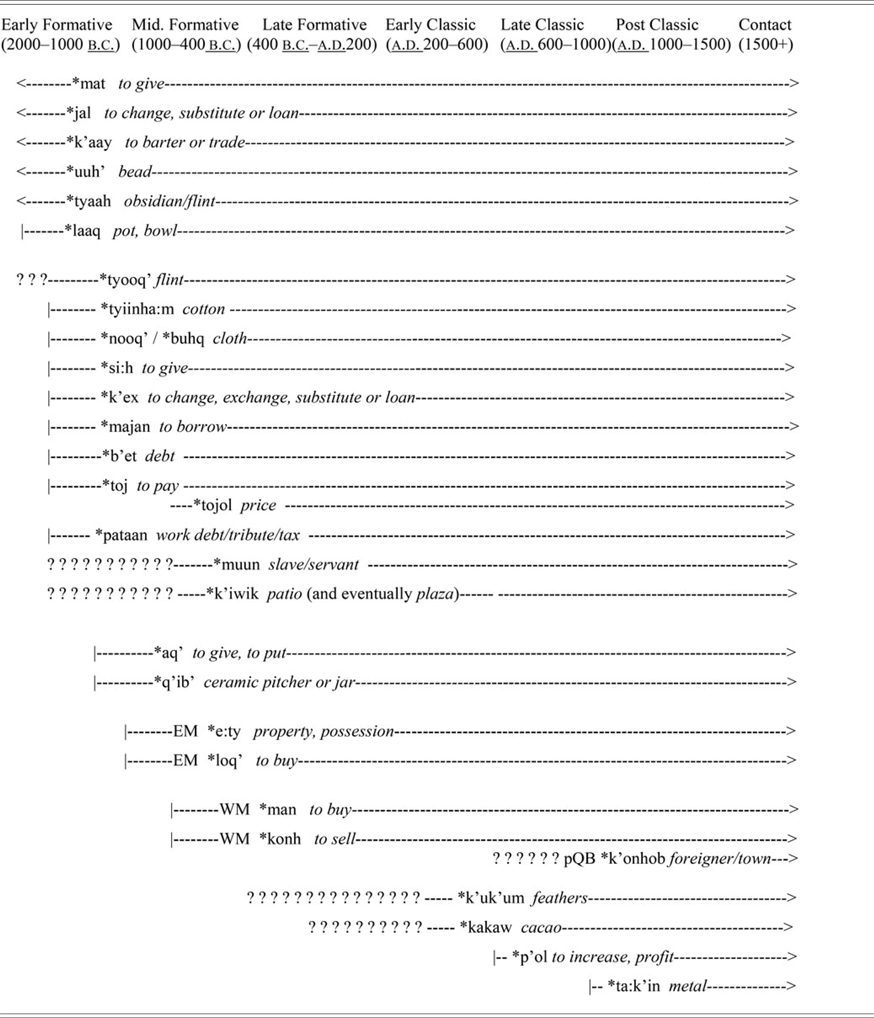
The objective of this article is reconstruction of ancient Maya economic development through an examination of the phonological and semantic history of individual terms related to exchange. It seeks to provide insight into pre-Columbian lifeways by applying the results of etymological analysis to an epigraphic and archaeological chronological framework. Several previous reconstructions of ancient Mesoamerican cultures based upon linguistic data do exist (Brown Reference Brown, Staller and Carrasco2010; Campbell and Kaufman Reference Campbell and Kaufman1976; Dakin and Wichmann Reference Dakin and Wichmann2000; Fowler Reference Fowler1983), including at least one specifically treating pre-Columbian Maya society (Kaufman [Reference Kaufman1976] and to some extent Josserand and Hopkins [2002]). The present study, however, takes a more in-depth look at one particular cultural sphere—namely the evolution of exchange relationships. All branches of the Maya language family are consulted in order to explore the time depth and origins of particular aspects of economic life. Extra attention is given to languages likely to have participated in the archaeological phenomenon that we refer to as Classic Maya civilization.
New avenues of insight into ancient Mesoamerican economic behavior are desperately needed given the problematic nature of investigating modes and mechanisms of exchange archaeologically (Hirth Reference Hirth1998; Hodder and Orton Reference Hodder and Orton1976; Renfrew Reference Renfrew, Sabloff and Lamberg-Karlovsky1975). Despite many decades of research, Mesoamerican exchange practices before the Postclassic period remain a contentious topic shrouded in relative obscurity. Working with little or no evidence, many scholars have simply come to assume the widespread presence of centralized commercial markets from the onset of Mesoamerican village life (Blanton Reference Blanton and Ortiz1983; Kowalewski Reference Kowalewski2003) and/or their primacy in structuring pre-Columbian economies (Sharer Reference Sharer1994:456). Some go so far as to build elaborate models for the very development of social complexity based upon an exchange mechanism for which no great antiquity has been demonstrated (Freidel Reference Freidel and Ashmore1981; Sharer Reference Sharer1994:67–68). Such an approach runs the great risk of simply reinforcing ethnocentric biases in the mindset of archaeologists residing in a culture deeply permeated by a capitalist, market-focused ideology. Indeed, there are well-documented tendencies among modern scholars to either hopelessly mystify the ancient Maya through obsession with the exotic cosmology and ritual present in their art (Marcus Reference Marcus1995), or to overly demystify them by simplistically projecting contemporary worldviews onto their past (Wilk Reference Wilk1985). With this in mind, the present study aims to bring new data to bear on a long-standing empirical problem that continues to defy archaeological investigation—yet is a central issue in the ongoing theoretical debate surrounding the characterization of Classic Maya polities.
HISTORICAL LINGUISTICS AND CULTURAL RECONSTRUCTION
Historical linguistics is the study of the past development of languages and their evolutionary relationships to one another (Crowley Reference Crowley1997; Trask Reference Trask2001). Scholars have recognized since at least the late eighteenth century that certain languages bear relationship to one another in terms of shared or similar vocabulary, morphology, syntax, and sound inventory (de Saussure Reference de Saussure and Baskin1966; Sapir Reference Sapir1921). This came to be understood as a product of common ancestry, or shared descent from a past language no longer in evidence—referred to as a “proto-language.” During the twentieth century, enough basic principles of language change and use became established to begin calling linguistics a science, and today various alternative hypotheses and models concerning the relationship of known languages, the character of proto-languages, mechanisms of change, and many other factors are tested using data collected from extant languages as well as from “dead” languages using ancient texts. Using an analogy with biological species, transmission by descent between related “mother” and “daughter” languages is commonly referred to as “genetic” (Thomason and Kaufman Reference Thomason and Kaufman1988). Genetic transmission contrasts with an alternative means of acquired similarity between languages that holds no good biological analogy, the “borrowing” or “diffusion” of linguistic elements from one language to another.
Historical linguistics relies upon two general approaches to the study of data from extant languages: the comparative method and internal reconstruction. The comparative method is based on the principle that different genetically transmitted forms of the same ancient word, called cognates—recognized on the basis of shared phonological (sound) and semantic (meaning) characteristics in separate but related languages—can be used to reconstruct the “root” term from the past proto-language (Swadesh Reference Swadesh and Hymes1964). These related descendant words, known as reflexes, are descended from the same ancestral root term and will differ internally on the basis of predictable sound correspondences. Sound correspondences between any two related languages will generally be consistent across the lexicon (vocabulary), because sound change is understood to be regular—that is, words are affected solely on the basis of their sound content regardless of semantics or other factors. The only important exception being the environment in which sounds occur or occurred in the past, which creates conditions that may vary from word to word and thereby has the potential to differentially affect sound change.
Once the sound correspondences between theoretically related languages have been mapped out, one proceeds to develop a sequence of sound changes that best explains the distribution of attested forms. Words that have been borrowed can then be distinguished from those transferred genetically on the basis of internal phonology that does not match expected correspondences given the established sequence of sound changes, or otherwise suggested by a general lack of cognates in related languages. Those languages that can be shown to manifest “shared innovations,” or sound changes not common to other languages, can be hypothetically subgrouped together as more closely related (meaning that they share a more recent common ancestor language) than others in the “family.” Through trial and error, and the principle of parsimony maintaining that the explanation involving the fewest number of changes and exceptions that still explains the extant data is the one most likely to have occurred, investigators work scientifically toward a better understanding of the linguistic past. The second principal method of historical linguistics, internal reconstruction, deals primarily with morphological changes to words in a single language on the basis of sounds that get trapped or “frozen” within a word under certain conditions. While its utility is limited in terms of reconstructing language relationships, a considerable number of gaps in knowledge can be filled using internal reconstruction in conjunction with the comparative method.
The application of data derived from historical linguistics to nonlinguistic aspects of past societies is commonly referred to as cultural reconstruction (Crowley Reference Crowley1997; Trask Reference Trask2001). Since the story of how various related and unrelated languages of a region come to attain the similarities and contrasts they bear to one another is, to a great extent, the social history of that geographical area, the study of language change presents a potent avenue of inquiry into a region's prehistory. For instance, the distribution of genetically transmitted lexemes within a language family and reconstruction of their semantic content can suggest the time depth of particular cultural or technological developments. The chronology of divergence between related languages can also be estimated through statistical calculation of the amount of lexical difference between languages, known as lexicostatistics. While lexicostatistical glottochronology is a technique that is far from precise, it does provide a starting point for further investigation. Moreover, its reliability can be greatly improved through validation in ancient texts when these are available as well as through calibration with archaeological findings related to substantive terms in a reconstructed vocabulary. Likewise, the time frame and nature of interaction with foreign populations can be deduced through examination of linguistic borrowings within a language family or from outside languages that have also been subjected to historical analysis.
Evidence of semantic evolution can provide useful insights to historical processes as well, as certain words undergo alterations in meaning by broadening, narrowing, bifurcating, or shifting their meaning altogether (Crowley Reference Crowley1997:151–54). Since the forces that induce semantic shift are fairly well understood—typically entailing metaphor, euphemism, hyperbole, or interference from an unpleasant connotation—insights can sometimes be gained into the cognitive factors affecting the change of a given lexical root. Furthermore, since words represent ideas as well as material goods, historical linguistics has the potential to illuminate aspects of prehistoric behavior that are often obscure to archaeology, such as social structure and mechanisms of exchange.
The above techniques, especially when used in conjunction with archaeological studies, have already proven fruitful in investigating cultural relationships, technological developments, and social processes in many parts of the ancient world (Fagan Reference Fagan1987; Renfrew Reference Renfrew1987), including Mesoamerica (Brown Reference Brown2006, Reference Brown, Staller and Carrasco2010; Campbell and Kaufman Reference Campbell and Kaufman1976; Josserand and Hopkins Reference Josserand, Hopkins, Blos, Cobos and Robertson2002; Kaufman and Justeson Reference Kaufman and Justeson2009; Lacadena and Wichmann Reference Lacadena, Wichmann, Blos, Cobos and Robertson2002). Much broad reconstructive work has previously been done with Mayan languages, particularly at the level of proto-Mayan (Campbell Reference Campbell, Campbell and Mithun1979; Kaufman Reference Kaufman1976) and proto-Cholan (Kaufman and Norman Reference Kaufman, Norman, Campbell and Justeson1984), providing a strong foundation for understanding the relationships between Mayan languages and the sequence of changes within them. The appearance of a comprehensive (albeit preliminary and therefore not exhaustive) etymological dictionary (Kaufman with Justeson Reference Kaufman and Justeson2003) has presented an opportunity to move our understanding of Maya prehistory forward significantly through further reconstructive work.
THE GENETIC RELATIONSHIP OF MAYAN LANGUAGES
The Mayan language family consists of about 32 documented living languages spoken by some two million speakers—mostly concentrated in Guatemala, southern Mexico, and the Yucatan Peninsula—as well as several known languages that are now extinct. One language, Huastec, has diverged geographically at a radical scale and is presently spoken in far northeastern Mexico outside of what we would today call the “Maya area.” Previous semantic analysis of proto-Mayan has suggested a “homeland” for the ancestral proto-Mayan tongue somewhere along the modern border of Mexico and Guatemala within the Cuchumatan highlands (Kaufman Reference Kaufman1976). Examination of the geographical distribution of the language groups in terms of the age-area hypothesis, which maintains that the area containing the greatest number of first-order subgroups is the most likely candidate for the homeland of the proto-language (Crowley Reference Crowley1997), tends to generally support this model. There is, however, at least one alternative proposal that places proto-Mayan in a lowland environment—based upon calculation of the average altitude at which plants within its reconstructed lexicon are found—and would even go so far as to connect it with Gulf Coast Olmec archaeological culture (see Brown Reference Brown, Staller and Carrasco2010).
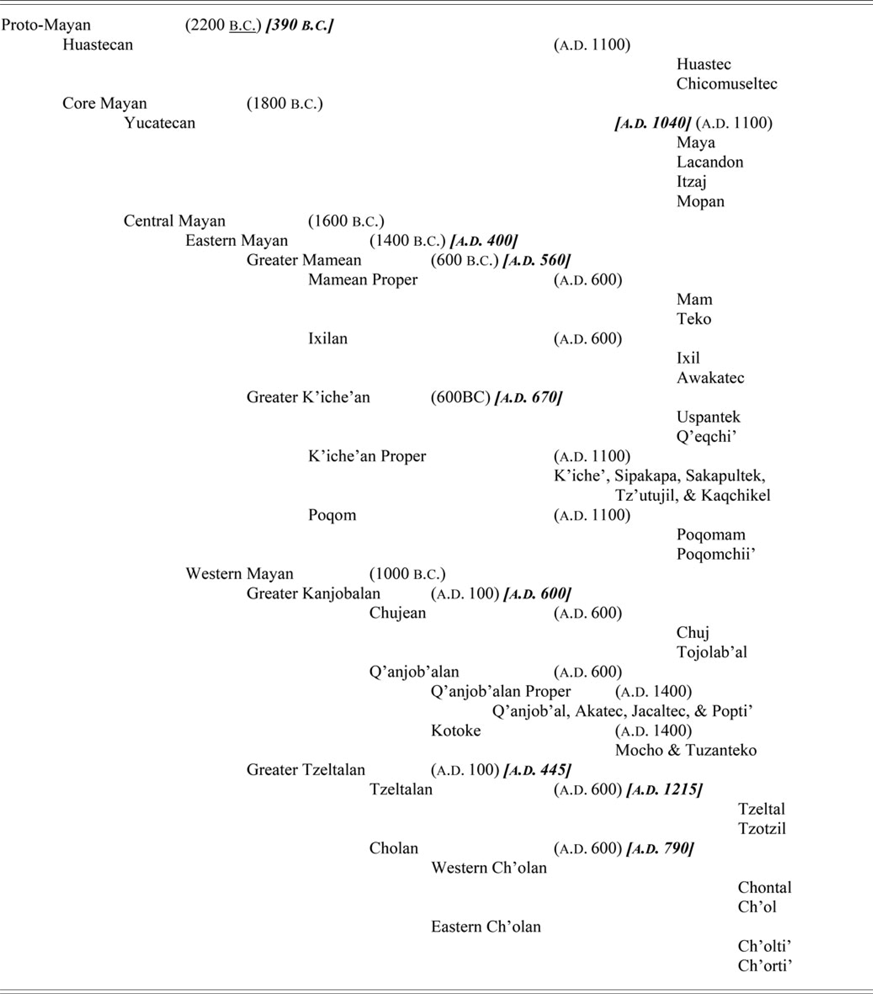
While much is known about the historical relationship among Mayan languages, there is still not complete agreement among linguists on the sequence of their divergence. In one older paradigm, Western Mayan was considered an ancestor to the Huastecan, Yucatecan, and Greater Tzeltalan branches (Campbell Reference Campbell, Campbell and Mithun1979). In this system of classification, Western Mayan was a valid proto-language, but it created a subgrouping of the lowland languages, Yucatecan, and Greater Tzeltalan, that was problematic. In a second, more recent and widely accepted model, Western Mayan as a linguistic subfamily is posited to include the Greater Tzeltalan and Greater Kanjobalan subgroups. In this view, however, Western Mayan is not a salient proto-language in that there are no innovations common to only these languages (Kaufman and Norman Reference Kaufman, Norman, Campbell and Justeson1984). This model also emphasizes a Cholan subgroup, placing Ch'olti’ and Ch'orti’ as descendents of a common proto-Eastern Cholan ancestor. Yet a third proposed arrangement has Huastecan as a late descendant of Greater Tzeltalan, Ch'orti’ as a daughter to Ch'olti, and considers Tojolobal, a language that shares many lexical elements with Tzeltalan languages, but most grammatical elements with Chuj, to be a Tzeltalan language (Robertson Reference Robertson1992). Most of the similarities that Tojolobal bears to Tzeltalan languages can be explained by diffusion, however, and the sound changes that Robertson uses to group Huastecan with the Greater Tzeltalan languages are either demonstrably late or exhibit different conditions than those manifest by Greater Tzeltalan (Kaufman Reference Kaufman1989; Kaufman and Justeson Reference Kaufman, Justeson, Arnold and Pool2008; Mora-Marín Reference Mora-Marín2003:189). For these reasons, and because the present data make the most sense in light of it, Kaufman's model of genetic relationships is utilized here (Table 1).
Genetic relationships of Mayan languages and proto-languages (compiled from McQuown [Reference McQuown1956], Campbell [1979], Kaufman and Norman [Reference Kaufman, Norman, Campbell and Justeson1984], Kaufman with Justeson [Reference Kaufman and Justeson2003]). Chronological estimates for divergence in parentheses (from Kaufman [Reference Kaufman1976, Reference Kaufman2000]) or brackets (from Brown Reference Brown, Staller and Carrasco2010).

Two separate sequences of estimates for the time frame of divergence of the various Mayan languages and their proto-language ancestors are also included within Table 1. These are based upon the lexicostatistical work of Kaufman (Reference Kaufman1976, Reference Kaufman1989, Reference Kaufman2000) on the one hand, and Brown (Reference Brown, Staller and Carrasco2010) on the other. Kaufman's glottochronological divergence estimates have been calibrated to some degree with both archaeological findings and epigraphic data from ancient texts. Brown (Reference Brown, Staller and Carrasco2010:79) relies solely upon a newly developed, more “objective,” lexicostatistical method to derive his dates. In most cases these substantially reduce Kaufmann's estimates for time-depth of divergence. While Brown's dates may be more “objective” as he maintains in the sense that they are untainted by any external considerations, they are based on a more limited number of Mayan languages and do not consider some very relevant archaeological and epigraphic information that tends to refute his chronology. Lexicostatistics in and of themselves have repeatedly been shown to be weak indicators in the absence of outside corroborating and calibrating data. “Objective” does not necessarily mean more accurate, and I stand with Kaufman and Justeson (Reference Kaufman and Justeson2009) in the view that a consideration of the full range of available data yields the best perspective as opposed to over-reliance upon any single source of information. Nonetheless, both sequences are examined for plausibility in the course of this work.
Ancient texts are one valuable method of calibrating glottochronological dates. A fairly good understanding of the language of the Classic Maya script has come through the long and arduous process of decipherment and linguistic reconstruction. By the middle of the last century, Thompson (Reference Thompson1950) had deduced that Cholan and Yucatecan languages were the most relevant to the Classic writing system on the basis of the geographical extent of archaeologically occurring monuments with glyphic inscriptions. In the 1970s, newly established phonetic principles of the script and a better understanding of historical linguistics led Kelley (Reference Kelley1976) to conclude that the writing system indeed relied upon either earlier stages of Yucatecan or Cholan, or perhaps both. As decipherment accelerated in the 1980s, the prominent role of Cholan became increasingly apparent, though with considerable influence from Yucatecan languages (Bricker Reference Bricker1986; Campbell Reference Campbell, Justeson and Campbell1984; Fox and Justeson Reference Fox, Justeson, Justeson and Campbell1984; Schele Reference Schele1982). This bilingualism has perhaps been best explained as evidence of a pre-Cholan speaking (and writing) elite dispersing across the lowlands over an existing Yucatecan substratum at some early point in Maya prehistory (Josserand and Hopkins Reference Josserand, Hopkins, Blos, Cobos and Robertson2002). Today, a considerable amount of linguistic sophistication is available in reading the hieroglyphic texts given the advanced state of decipherment—including subtleties in verbal tense and aspect, and perhaps even vowel complexity (Wichmann Reference Wichmann2004).
The hieroglyphic script is presently understood to have been predominantly a reflection of elite culture, written in a rather conservative “prestige language” that may have differed considerably from the common spoken languages of the communities that produced the texts (Houston et al. Reference Houston, Robertson and Stuart2000; Josserand and Hopkins Reference Josserand, Hopkins, Blos, Cobos and Robertson2002; Justeson and Fox Reference Justeson and Fox1989). But potential substratum interference from Yucatecan languages, as well as subtle dialectical differences within Cholan thought to presage the divergence of Eastern and Western Cholan languages, have been detected within the script by region (Justeson and Fox Reference Justeson and Fox1989; Lacadena and Wichmann Reference Lacadena, Wichmann, Blos, Cobos and Robertson2002). These data also help to pinpoint the stage of divergence that Mayan languages of the lowlands were in during the Classic period. It was proposed not long ago, for instance, that the language of the script was specifically an immediate ancestor to Ch'olti’, an Eastern Cholan language recorded in historical documents of the Colonial period (Houston et al. Reference Houston, Robertson and Stuart2000). This hypothesis is not easily reconcilable with a number of epigraphic facts, including that Classic Mayan texts maintain a /j/-/h/ contrast (Justeson and Fox Reference Justeson and Fox1989; Grube Reference Grube and Wichmann2004) lost in all subsequent Cholan languages, nor with the understood time frame of linguistic divergence in the Maya area established on other bases. A more recent study also tends to rule out the “Classic Ch'olti'an” hypothesis on the grounds that the proposed innovations that it relies upon are actually ancient retentions (Mora-Marín Reference Mora-Marín2009). Even Brown's (Reference Brown, Staller and Carrasco2010) recent lexicostatistical estimates argue against anything like “Ch'olti'an” being in existence early enough to form the basis of the Classic period writing system.
Another important means of calibrating lexicostatistics is via archaeological findings. In theory, the earliest occurrence of durable material objects in the archaeological record should roughly coincide with the appearance of terms for them in spoken language. While the situation is complicated by use of compound terms or adjective constructions to describe physical objects that may not reconstruct if conditions are not just right, as well as by the loss of early root terms that may over time be completely replaced by subsequent ones, this principle can still prove very useful in certain cases. Moreover, our overall understanding of Mesoamerican chronology is fundamentally based upon archaeological knowledge, which makes it the most important guideline for analysis of the past. The portion of Mesoamerican archaeological chronology most relevant to the present study proceeds generally as follows (based upon Coe Reference Coe1999; Sharer Reference Sharer1994; Smith and Masson Reference Smith and Masson2000). At the end of an archaic period in which Native American cultures first became sedentary and adapted to local and regional ecosystems, permanent agricultural villages arose in several parts of Mesoamerica during what is called the Early Formative period (2000–1000 b.c.). During the Middle Formative period (1000–400 b.c.), these villages became more complex and social hierarchy arose in several regions. During the Late Formative period (400 b.c.–a.d. 200), this complexity increased and large population centers with monumental architecture and rudimentary writing systems became fairly common. During the Early Classic period (a.d. 200–600), many of these complex monumental centers coalesced into city-states or even empires in some cases, and the art and writing systems reached a high state of refinement—especially in the Maya area. During the Late Classic period (a.d. 600–1000), populations peaked in the southern lowlands, and most of the large political centers collapsed. Mayan culture nevertheless persevered and reinvented itself during the subsequent Postclassic period (a.d. 1000–1500) as new political cores were established in the northern Yucatan and to the south in the Guatemalan highlands. Several of these political and economic centers lasted up until Spanish contact at the end of the fifteenth century.
Archaeologists have long been interested in the economic structure of these ancient Maya polities (Hammond Reference Hammond and Culbert1991; Masson and Freidel Reference Masson and Freidel2002; Morley Reference Morley1956; Rathje Reference Rathje and Leone1972, Reference Rathje, Sabloff and Lamberg-Karlovsky1975; Sabloff and Rathje Reference Sabloff and Rathje1975b; Thompson Reference Thompson1954). While there have been great advances in determining the range of materials exchanged and the extent to which they moved (Andrews Reference Andrews1983; Fry Reference Fry1979; Hammond Reference Hammond1972; Hester and Shafer Reference Hester, Shafer, Schwartz and Falconer1994; Shafer and Hester Reference Shafer and Hester1991), as well as the technology of manufacture and locus of production (Hester and Shafer Reference Hester and Shafer1984; McKillop Reference McKillop2002; Rands and Bishop Reference Rands, Bishop and Fry1980; Shafer and Hester Reference Shafer and Hester1983), there has not been the same level of success in establishing the mechanisms by which such goods were exchanged. Many, if not most, archaeologists working in the Maya area perceive distinct spheres of exchange in the material record of the Classic period (Foias Reference Foias, Masson and Freidel2002; Hester and Shafer Reference Hester, Shafer, Schwartz and Falconer1994; Rice Reference Rice, Brumfiel and Earle1987; Santone Reference Santone1997; Shafer and Hester Reference Shafer and Hester1991). These appear to be closely associated with two primary exchange mechanisms: autonomous hand-to-hand exchange among commoners and a more centralized prestige-good economy centred upon elites (Scarborough and Valdez Reference Scarborough and Valdez2009; Speal Reference Speal2009). An economic disjunction has long been perceived at the beginning of the Postclassic period, marked by a rise in commercial mercantilism after the widespread collapse of Classic period polities (Sabloff and Rathje Reference Sabloff and Rathje1975a; Tourtellot and Sabloff Reference Tourtellot and Sabloff1972). Some scholars, however, reject this discontinuity and project more decentralized Contact period commercial systems back into the distant past, emphasizing the fundamental importance of market commerce to the political economy from the onset of social hierarchy (Freidel Reference Freidel and Ashmore1981, Freidel et al. Reference Freidel, Reese-Taylor, Mora-Marín, Masson and Freidel2002, Masson and Friedel Reference Masson and Freidel2012).
The great problem for archaeology is, of course, that exchange systems do not preserve in the material record. The response has traditionally been to devise indirect means to infer the presence of certain types of exchange either through patterns of artifact distribution or “configurational” evidence of architecture designed to support certain distribution systems—almost always targeting centralized or “solar” markets (Braswell and Glascock Reference Braswell, Glascock and Glascock2002; Chase and Chase Reference Chase and Chase2001; Dahlin and Ardren Reference Dahlin, Ardren, Masson and Freidel2002; Hirth Reference Hirth1998). Unfortunately, the Maya apparently did not have a formal architectural configuration for marketplaces—or at least none have yet been established. And while “distributional” patterns in artifact remains have garnered much attention, no one has yet validated such a method by actually testing it against demonstrably “non-commercial” assemblages (Smith Reference Smith1999). Other novel approaches have involved chemical testing of soils for patterns in phosphate and mineral content (Dahlin Reference Dahlin2003; Dahlin et al. Reference Dahlin, Jensen, Terry, Wright and Beach2007), yet there is no fundamental reason to believe chemical signals from market refuse are inherently different from any other generalized refuse dump, or midden deposit produced from ceremonial feasting.
As a result, there has been a whole lot of “we found the marketplace” in Maya archaeology, and extremely little of “this is what we learned from the [purported] marketplace.” Studies would be on much stronger footing if they could provide solid external evidence that market commerce was extant in a certain time period and locale, and then move from there to investigating where it might have taken place and with what intensity. Moreover, there has been rather little appreciation of other potentially important mechanisms of exchange, such as appropriative systems of tribute, tax, plunder and slavery, reciprocity and gifting among both commoners and elites, and low-level barter between households outside of a central marketplace (but see Foias Reference Foias, Masson and Freidel2002; McAnany Reference McAnany, Feinman and Nicholas2004; Pohl and Pohl Reference Pohl, Pohl, Brumfiel and Fox1994; Rice Reference Rice, Brumfiel and Earle1987; Spence Reference Spence1996). While there is clearly evidence for highly active, albeit temporally and geographically variable, exchange networks—both regional and long distance—from patterns in various classes of artifact recovered from the Maya area (Hester and Shafer Reference Hester, Shafer, Schwartz and Falconer1994; McKillop Reference McKillop1996; Masson Reference Masson2001), new approaches are desperately needed to investigate the relative importance of various mechanisms of exchange and how these mechanisms interacted and evolved over time. Historical linguistics in the Maya area is in just such a position to contribute, if by nothing more than creating more sophisticated models of diachronic change to be evaluated archaeologically.
ANALYSIS
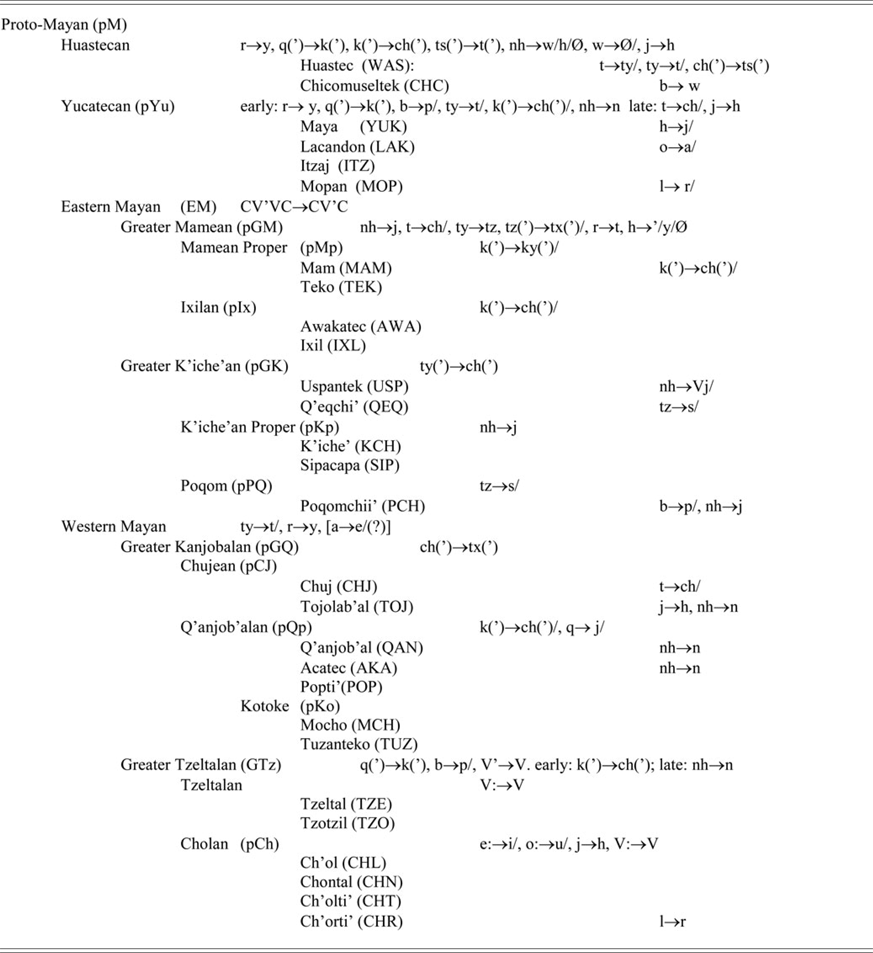
Phonetic innovations found in Maya subgroups and individual languages as they are generally understood to have occurred are presented in Table 2. Because phonological change is the foundation of the comparative method, sound correspondence sets are essential for understanding the classification of individual languages as well as for the detection of lexical borrowing and confirmation of genetic transmission. While there is certainly disagreement among experts on details, the sequence of recognized sound changes in the Mayan languages presented here is based on the works of Campbell (Reference Campbell, Justeson and Campbell1984), Justeson and Fox (Reference Justeson and Fox1989), Kaufman (Reference Kaufman1976), and Kaufman and Norman (Reference Kaufman, Norman, Campbell and Justeson1984)—probably the foremost authorities on the subject.
Key phonetic innovations in respective Mayan languages and subgroups
Though etyma from all Mayan languages are considered in this study, the Cholan and Yucatecan language subgroups are more often emphasized in discussion due to their demonstrated relationship to the writing system and Classic period lowland culture. Considerable attention will also be paid to Greater Tzeltalan as a proto-language due to its postulated importance in Formative period developments. Together, Yucatecan and the Greater Tzeltalan languages (which include the Cholan subgroup) are referred to as the Greater Lowland Maya languages. This diffusion group is not a genetic entity but, instead, reflects the aforementioned sustained contact between Cholan, Tzeltalan, and Yucatecan languages that seems to pertain to Classic lowland Maya culture (Justeson et al. Reference Justeson, Norman, Campbell and Kaufman1985; Kaufman with Justeson Reference Kaufman and Justeson2003). Following Kaufman (Reference Kaufman1989), Core Mayan (CrM) refers to a late proto-Mayan remaining after the initial, early divergence of Huastecan. Central Mayan (CtM) is the entity left after proto-Yucatecan separated from Core Mayan, effectively leaving the ancestor of Eastern Mayan (EM) and Western Mayan (WM) languages.
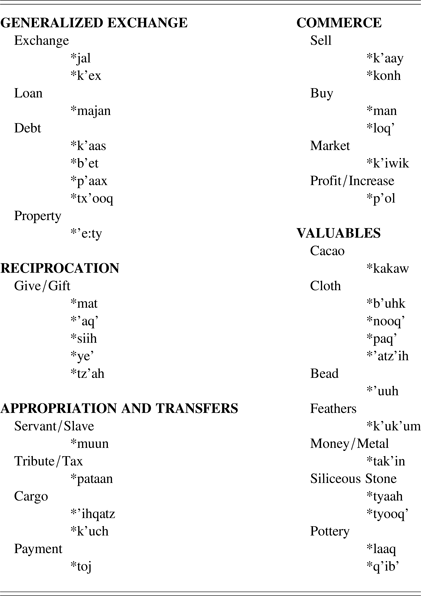
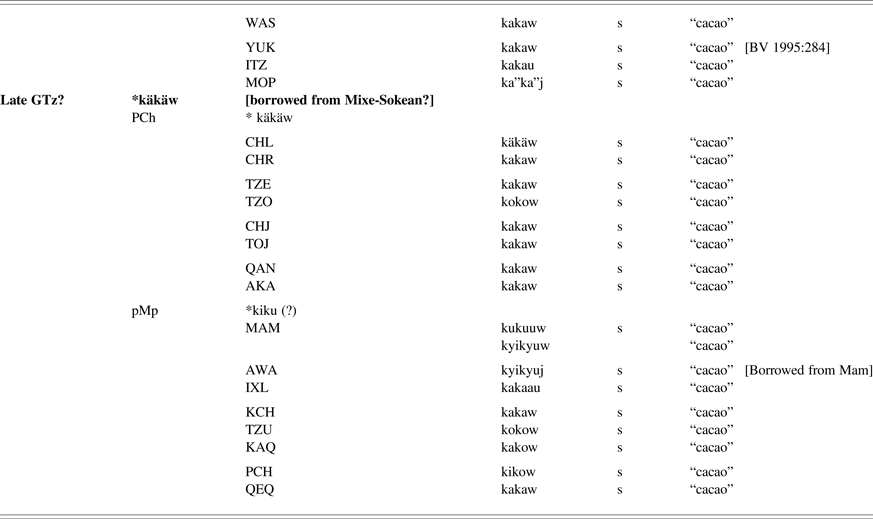
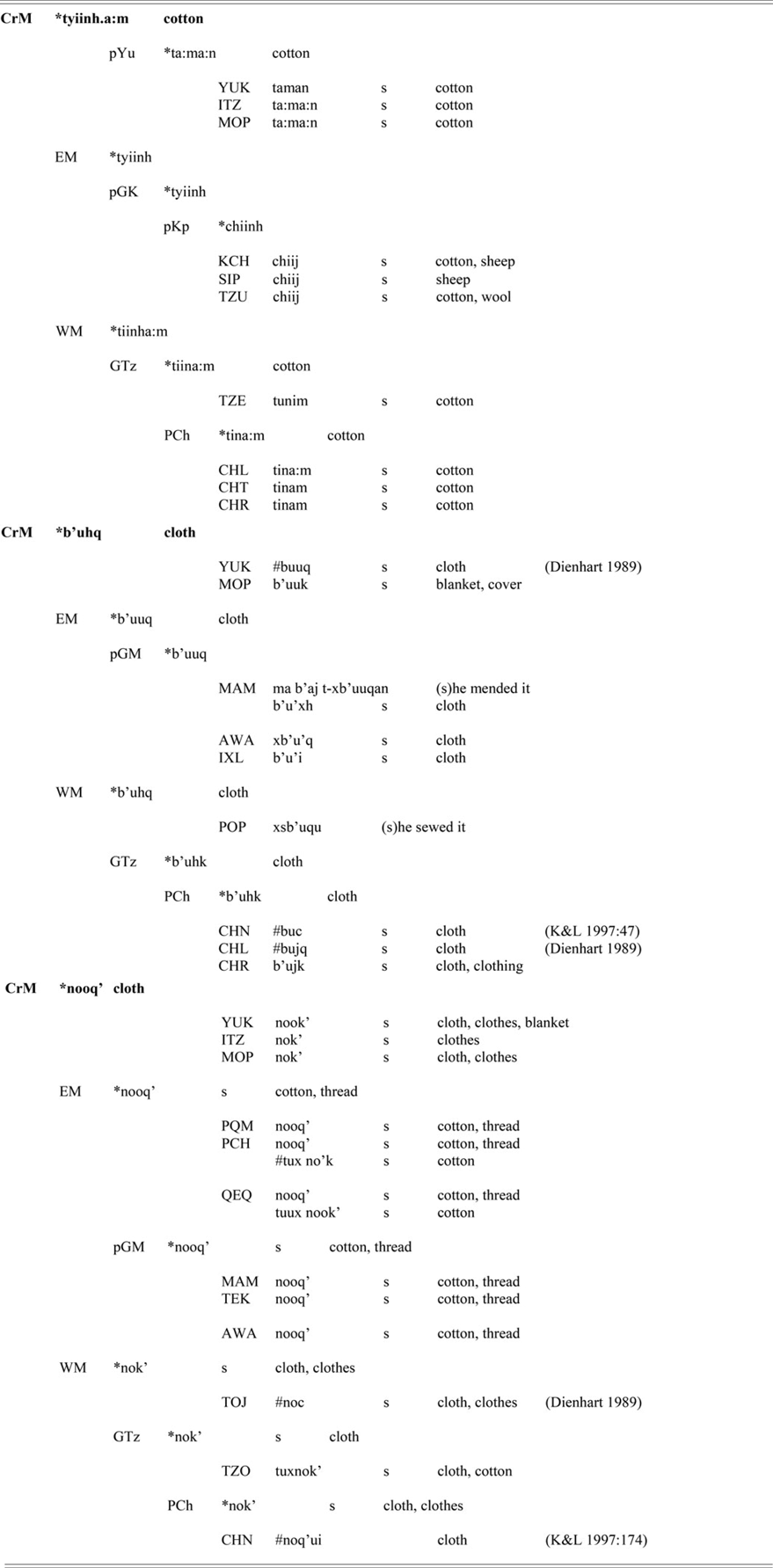
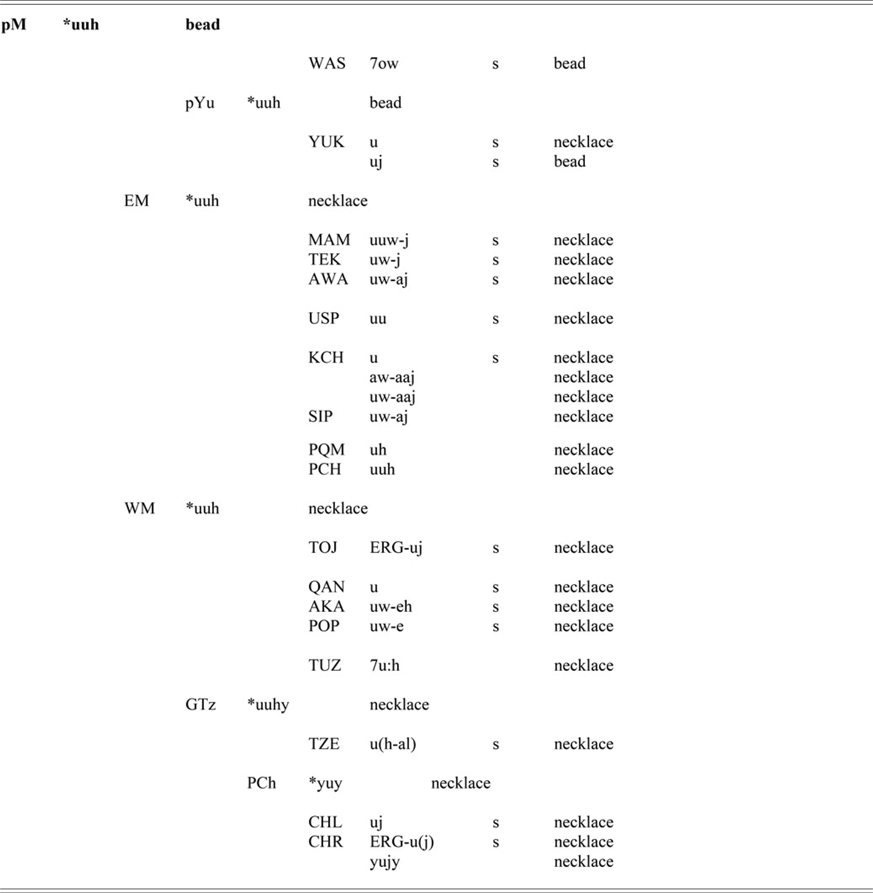
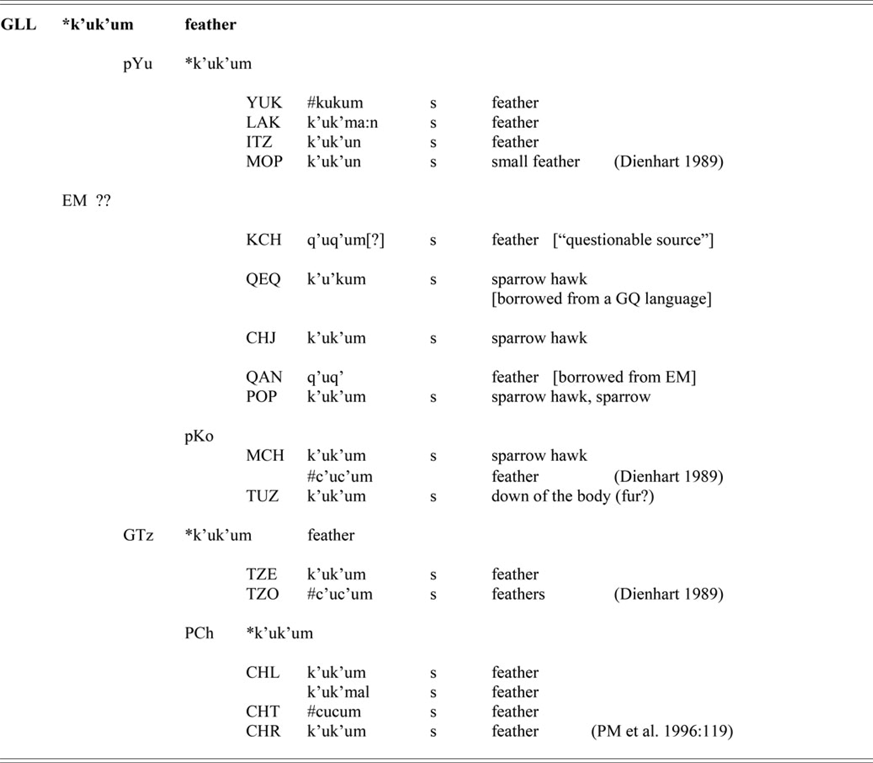
Lexical items were selected for this study on the basis of attested or reconstructed semantic content with some additions made on the basis of use in the ancient hieroglyphic script. While more than 50 lexical roots were examined in the course of research, only 36 were deemed productive enough to present here (Table 3). To better organize discussion, the concepts have been grouped into five broad economic spheres: (1) generalized exchange, (2) reciprocation, (3) appropriation and transfers, (4) commerce, and (5) valuables. While these spheres were devised using long-standing constructs from the anthropological literature on comparative economic systems (Polanyi et al. Reference Polanyi, Arensberg and Pearson1957; Sahlins Reference Sahlins1972), it will become apparent in the course of discussion that emic Mayan perceptions did not and do not always conform well to our etic scholarly classification systems. This will not come as any surprise to the versed anthropologist, and the manner in which they defy our theoretical boundaries is arguably just as interesting as the degree to which they conform.
Lexical roots examined in present study
Data for the study were obtained from Terrence Kaufman's Preliminary Mayan Etymological Dictionary (Reference Kaufman and Justeson2003) unless otherwise noted. Additional supplementary material was acquired from other comparative sources (Dienhart Reference Dienhart1989) as well as from individual dictionaries and descriptive vocabularies of specific languages (Barrera Vásquez Reference Barrera Vásquez1995; Boot Reference Boot2004; Cojtí Marcario et al. Reference Cojtí Marcario, Cutzil and Armando1998; Hopkins et al. Reference Hopkins, Josserand and Guzmán2011; Hull Reference Hull2005; Keller and Luciano Reference Keller1997; Laughlin Reference Laughlin1974, Reference Laughlin1988; Pérez Martínez et al. Reference Pérez Martínez, García, Martínez and López1996; Wisdom Reference Wisdom and Stross1950). These additional sources were employed primarily to counter limitations incurred by the lack of emphasis placed upon some Cholan languages by Kaufman and Justeson—a product of their goal of phonological, as opposed to semantic, reconstruction (John Justeson, personal communication 2004). The present study, however, would probably not be possible using only these other sources, as most dictionaries lack detailed grammatical analyses and use inconsistent orthographies. Dienhart's (Reference Dienhart1989) comparative dictionary, for instance, generally lacks detailed grammatical and semantic data altogether, without which it is difficult to confidently establish genetic relationships.
Generalized Exchange
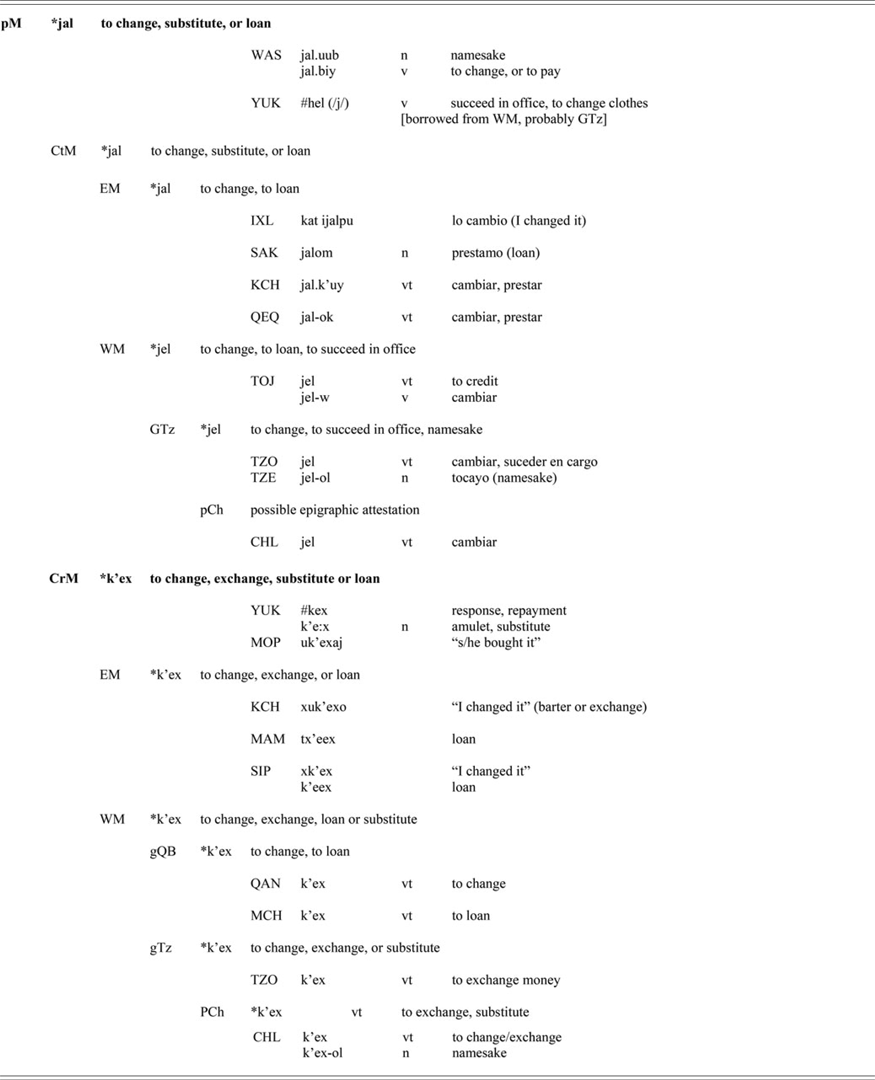
The concept of a very general reciprocal exchange is reconstructable to proto-Mayan culture through the lexical root *jal (Table 4). This term, and by extension the relationships that it represents, can be posited to proto-Mayan based upon survival of its reflexes in both Eastern and Western Mayan language subfamilies as well as Huastec (Kaufman with Justeson Reference Kaufman and Justeson2003:779–780). While temporally established diagnostic sound innovations associated with the phonology of this root are few, its presence in geographically distant Huastec with virtually identical semantic content more or less rules out a late diffusion. Though exact semantics for the early proto-Mayan period are rather hazy, the term may have denoted what one might call a “quasi-economic” sense of obligatory reciprocity carried out through exchange and substitution. Or it may have simply meant “to change,” with examples of a purely economic significance appearing only later among disparate languages by coincidence.
“Exchange”
The connotations of the later reflex /jel/ clearly became much more political than economic among Central Mayan languages. The jal to jel correspondence between Eastern and Western Mayan subfamilies can be explained rather simply by a shared conditional /a/ to /e/ vowel shift in proto-Western Mayan (see Carrasco [2005:Footnote 58] for a possible second example of the same shift, EM *cha / WM *che to say), with the Yucatecan cognate being lost but subsequently borrowed back from a Western Mayan language. The reflex remained *jal in Eastern Mayan and Huastecan. The term /jel/ has been posited in the Classic hieroglyphic script in a number of locations by various epigraphers (Carrasco Reference Carrasco2005:114–118). In most cases, it has been read in contexts related to succession, or changes in rulership, such as in the tablet from the Temple of the Foliated Cross at Palenque describing the accession of Kan B'ahlam (Carrasco Reference Carrasco2005:117) and the array of lintels from Structure 12 at Yaxchilan that lays out the dynastic sequence from that site (Riese Reference Riese, Justeson and Campbell1984). Again, semantics of the root in the very deep past can only be called “quasi-economic” at best.
The parallel root *k'ex can only be reconstructed to Core Mayan based upon occurrences in both Eastern and Western Mayan languages (Kaufman with Justeson Reference Kaufman and Justeson2003:781–782). The lack of an attestation from Huastecan prevents any secure attribution to proto-Mayan. As one can see from Table 4, the root functions semantically in an almost identical manner to *jal and, like *jal, its reflexes have survived in almost every subgroup of the Mayan language family, implying the continued vitality of its semantic content through time. Also like *jal, *k'ex seems to have represented a quasi-economic reciprocal obligation of exchange, trade, and repayment. The nominalized form of this verb is used in several disparate Mayan languages to denote a “substitute” or “namesake” in political position or kinship roles, suggesting ancient use in that manner as well. The manifestation of this “namesake/substitution” relationship, also represented in some languages by *jal, is perhaps best characterized through the relatively common Mayan practice of naming children after their grandparents, whom they are seen as “replacing” in what is viewed by many as an ancient and deep-seated form of ancestor worship (Carlsen and Prectel Reference Carlsen and Prectel1991; Carrasco Reference Carrasco2005:118–121; McAnany Reference McAnany1995).
Using texts and iconography from Classic period art in conjunction with contemporary ethnographic studies, Taube (Reference Taube and Kerr1994) has demonstrated the religious implications of k'ex. It has a long history connoting acts of substitution or exchange through offerings to deities—apparently extending to the realm of human sacrifice on the behalf of Classic period rulers. As Taube (Reference Taube and Kerr1994:671) describes:
Like the substitution performed by Xquic,Footnote 1 the contemporary k'ex ceremonies are a means of tricking and assuaging malignant, underworld beings of death and illness … Just as the new child is brought into the world, something must be given in return to the gods of death and the underworld, to maintain equilibrium.
While one could debate the economic content in these contexts, some of the very same highland Mayan languages (K'iche’, Tzotzil) that use the term for such sacrifices today use it for “barter” or “to exchange money.” The combined ethnographic, iconographic, and linguistic evidence then suggests that, cognitively speaking to the ancient Maya, reciprocation as denoted by *k'ex was a relationship to be maintained not only among humans, but between gods and mortals as well. The term serves as a prime example of how economic behavior is often couched in terms of cosmology and ritual in human societies.
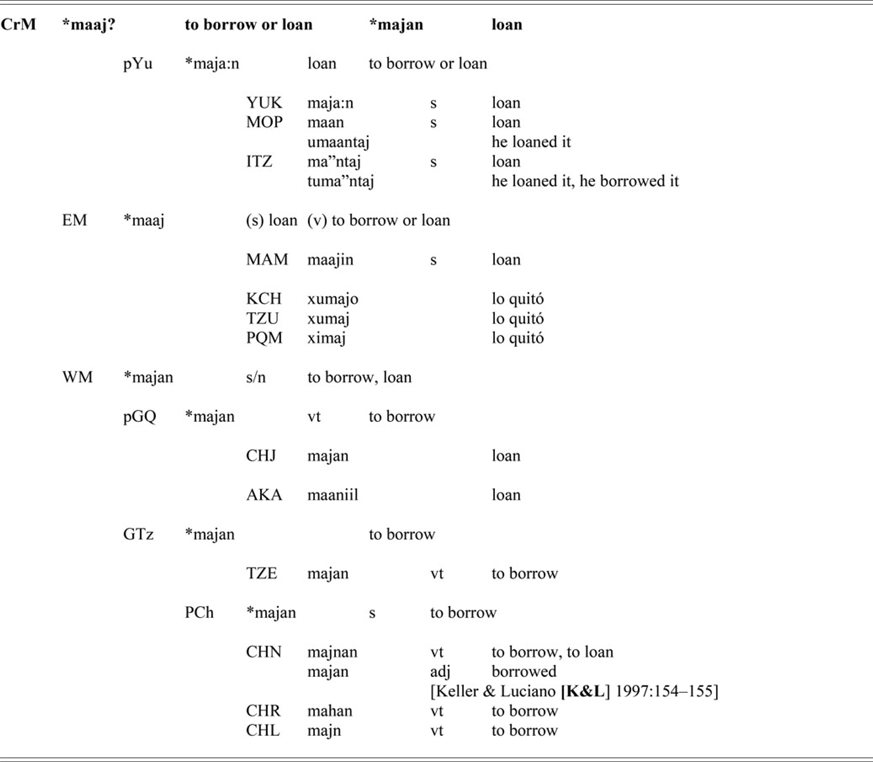
A reconstructable verb for the act of borrowing, *majaan, is attested in Eastern and Western Mayan languages as well as Yucatecan (Kaufman with Justeson Reference Kaufman and Justeson2003:772–773) (Table 5). Based upon this distribution, the root can be attributed to Core Mayan at minimum, thereby establishing an ancient presence of delayed reciprocity. While Kaufman and Justeson would reconstruct the root to proto-Mayan, I hesitate to do so because of its lack of attestation from Huastecan languages. The nominalized form of the original verb root may have been mangled a bit among Greater Lowland languages, where the derived form of *maaj was apparently cognitively reanalyzed by some speakers as a verb itself. The meaning also shifted in K'iche'an languages, though the exact semantics are unclear since the Spanish verb quitar, by which the word is glossed, has several meanings. In these languages, the word was replaced as a term for borrowing by Greater K'iche'an *qaj. Incidentally, a very similar shift occurred in Western Mayan with a verb root for “to sell,” *k'aay, discussed at some length below.
“Loan; to borrow”
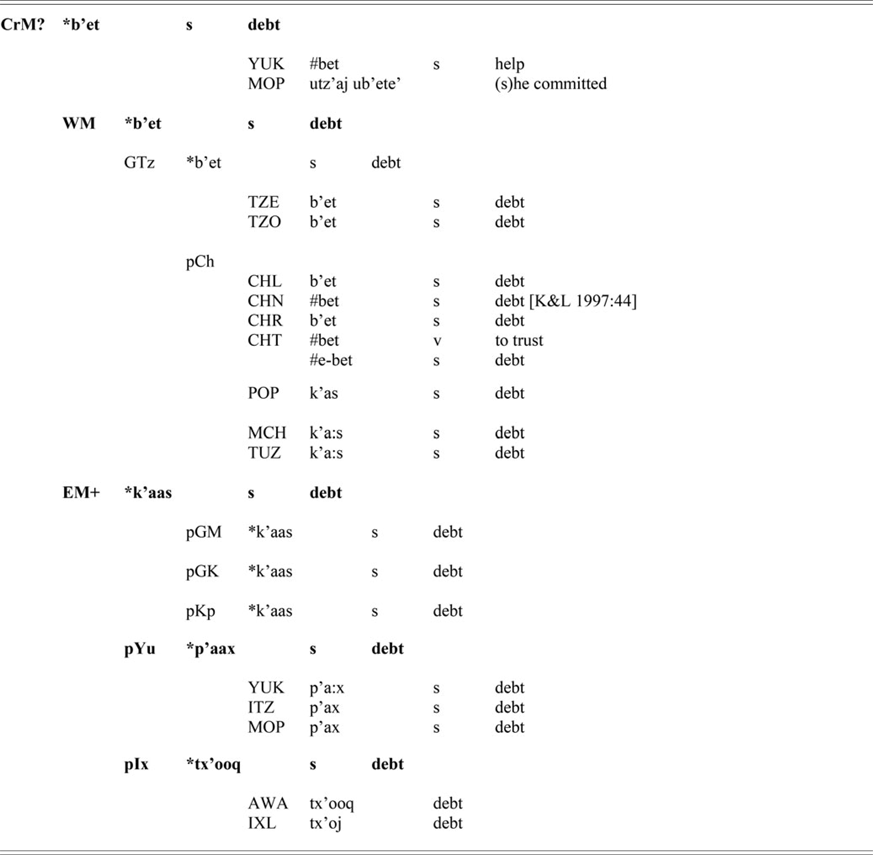
There are at least four additional reconstructable root lexemes for debt obligations in Mayan languages (Kaufman with Justeson Reference Kaufman and Justeson2003:788–789). Independent terms for this relationship go at least as far back as proto-Eastern and proto-Western Mayan (Table 6). Kaufman (with Justeson Reference Kaufman and Justeson2003:788–789) suggests that the root *b'et appeared among Western Mayan languages and subsequently diffused about the lowlands, perhaps as a part of Classic or Formative period culture. The divergent semantics in Yucatecan languages, however, make its borrowing from Greater Tzeltalan less likely and perhaps better explained as a Core Mayan innovation. A nearly perfectly complementary distribution suggests that reflexes of *b'et may have been pushed out of existence via the rise of the root *k'aas in Eastern Mayan languages. Words related to *k'aas were evidently influential enough to subsequently diffuse into some Greater Q'anjob'alan languages. Even later, more localized terms such as *p'aax and *tx'ooq arose among proto-Yucatecans and proto-Ixilans, respectively. The general picture is one of new words for debt obligation appearing periodically and being regionally or locally confined, with older terms often being replaced and lost among certain subgroups.
“Debt”
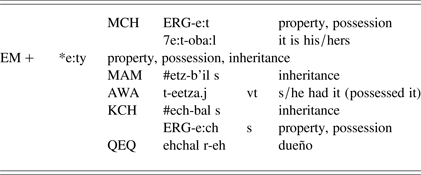
Reconstructable individual terms for inheritance and possession are confined to highland Maya languages (Kaufman with Justeson Reference Kaufman and Justeson2003:759–760) (Table 7). The root *e:ty can be traced back to proto-Eastern Mayan, as /ty/ corresponds with /tz/ and /ch/ in Mamean and Kichean languages, respectively. Multiple frozen forms also demonstrate the antiquity of this etymon in these tongues. The limited geographical reach of the root may imply that complex systems of ownership first appeared in the Guatemalan highlands among Eastern Mayan speakers, but any reaching conclusions are impeded by the fact that there are other methods of signifying possession in Maya languages. For instance, certain Classic period artifacts are known to have been “name-tagged” with text through simple stative use of the ergative pronoun (Houston and Taube Reference Houston and Taube1987). In fact, Stuart (Reference Stuart1995:10–22) has suggested that the earliest motivations for phonetic writing in the Maya area may have been the designation of ownership of portable objects.
“Property”
Reciprocation
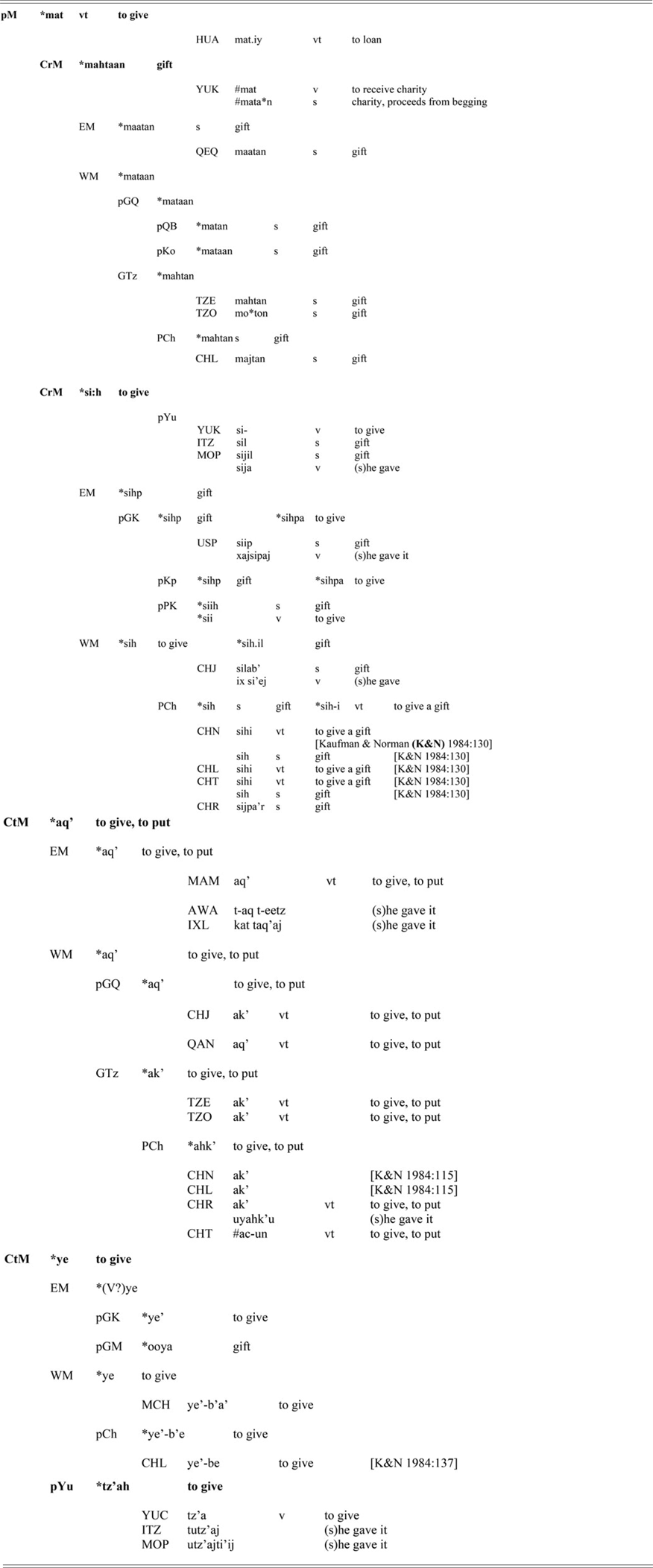
There is no shortage of terms for gifts and giving in the Mayan languages (Kaufman with Justeson Reference Kaufman and Justeson2003:774–778, 785–787) (Table 8). It is no surprise that at least one of these, *mat/*mahtaan, can be quite confidently traced back to proto-Mayan. While there is some question about the original semantics of this root, the substantive form seems to have clearly taken on the significance of “gift” by at least Core Mayan times. I consider this adequate evidence for the original meaning of the verb. The semantics apparently narrowed to contexts of charity, and then subsequently shifted—perhaps as a result of interference with competing terms like *tz'ah—in Yucatecan. A similar situation seems to have developed in Huastecan with *mat narrowing to contexts of giving requiring repayment. In addition, five other reconstructable roots for gifts and giving are found within the Mayan family more or less confined to individual linguistic subgroups, although the fact that there is a lack of congruence within the various subfamilies may suggest that many of the terms coexisted for a long time in many languages.
“Give/gift”
A reflex of Central Mayan *aq’ is found in the Classic script as yak'aw [ya-k'a-wa]. Upon Stela 32 from Naranjo it directly refers to the giving of tribute “bundles” (Stuart Reference Stuart1995:358), demonstrating that cognate terms could be used for the mandatory transfer of goods as well as the voluntary bestowing of gifts. In essence, one gives tribute as one gives a gift—in contrast to English in which we would “pay” tribute or taxes. Both *mahtaan and *siih are also found intermittently in the hieroglyphic corpus. Various forms of *siih have been identified on a number of pre-Columbian artifacts and stone monuments from sites such as Tamarindito, Itzam, and elsewhere. In many cases, the possessed form of the term, usiih (written u-si), was used to signify portable objects as gifts intended for a specific individual of high rank (Mora-Marín Reference Mora-Marín2001:36, 474). In one example, a slate disk mirror back recovered from an archaeological site in distant Costa Rica has been identified as a gift between rulers of the Classic Maya sites of El Zotz and El Peru (Houston Reference Houston2008). Another term for giving, mataan [ma-ta-na], occurs repeatedly as a part of augury phrases in the Late Postclassic/Contact period Madrid Codex almanacs. The presentation of gifts was indubitably a central aspect of diplomatic relations among elites during the Classic period, and all indications are that this method of exchange was of vital political and economic importance from proto-Mayan times forward.
Appropriation and Transfers
Appropriative economic action entails the use of political force or coercion in the movement or transfer of goods or labor (McAnany Reference McAnany, Feinman and Nicholas2004). Customs that fall under this rubric can range from obligatory gifts to taxation and tribute offerings to outright military plunder. Perhaps no other phenomenon better exemplifies the nature of appropriative economies than the direct appropriation of labor—slavery. Unfortunately, very little is known about the nature and extent of this institution among the ancient Maya. Earlier in the last century scholars seemed to find abundant evidence of pre-Columbian slavery in ancient Mayan art, from the stelae of Calakmul (Morley Reference Morley1933) to murals from Chichen Itza (Sharer Reference Sharer1994:503). There are numerous older works that specifically examine the nuances of forced servitude as practiced among Mesoamerican peoples and its contrast with the Old World institution (Izquierdo Reference Izquierdo and Fernández1984), as well as its broader economic ramifications among the diverse indigenous American cultures that adopted it (MacLeod Reference MacLeod1928). But in recent decades there has been virtually no systematic discussion of the possibility that individuals were maintained for use of their labor (but see McAnany [Reference McAnany, Sabloff and Henderson1993] and Sharer [1994:503] for acknowledgement of its probable presence). In fact, it is almost as though the topic has been consciously avoided.
Ethnohistorical documents reveal the more or less ubiquitous presence of indigenous slavery across the Maya area at the time of European contact. Slaves were an important commodity in the markets of Acalan-Tixchel in Tabasco (Scholes and Roys Reference Scholes and Roys1948). Diego de Landa discussed various uses for and means of creating slaves in the Yucatan in his Relación (Tozzer Reference Tozzer1966). The role of female slaves and the ambiguous status of their offspring are addressed in the colonial documents of Cozumel on the Caribbean coast (Roys Reference Roys1943). Among the highland Quiche, slaves were obtained in virtually the same ways described for the lowlands and typically served a period of work service before eventual ritual sacrifice (Carmack Reference Carmack1973, Reference Carmack1981). Warfare, impoverishment, and conviction of certain crimes are all described in primary sources as grounds for enslavement (de Landa Reference de Landa and Gates1978[1566]; de las Casas Reference de las Casas and O'Gorman1967[1561]; López de Cogolludo Reference López de Cogolludo2007[1688]). Unfortunately, very little was written during the Contact period about the labors or uses such persons were put to in daily life, only that many ended their days as sacrificial victims. Perhaps this implies that the uses they were put to were not all that different from what would be expected of European slaves.
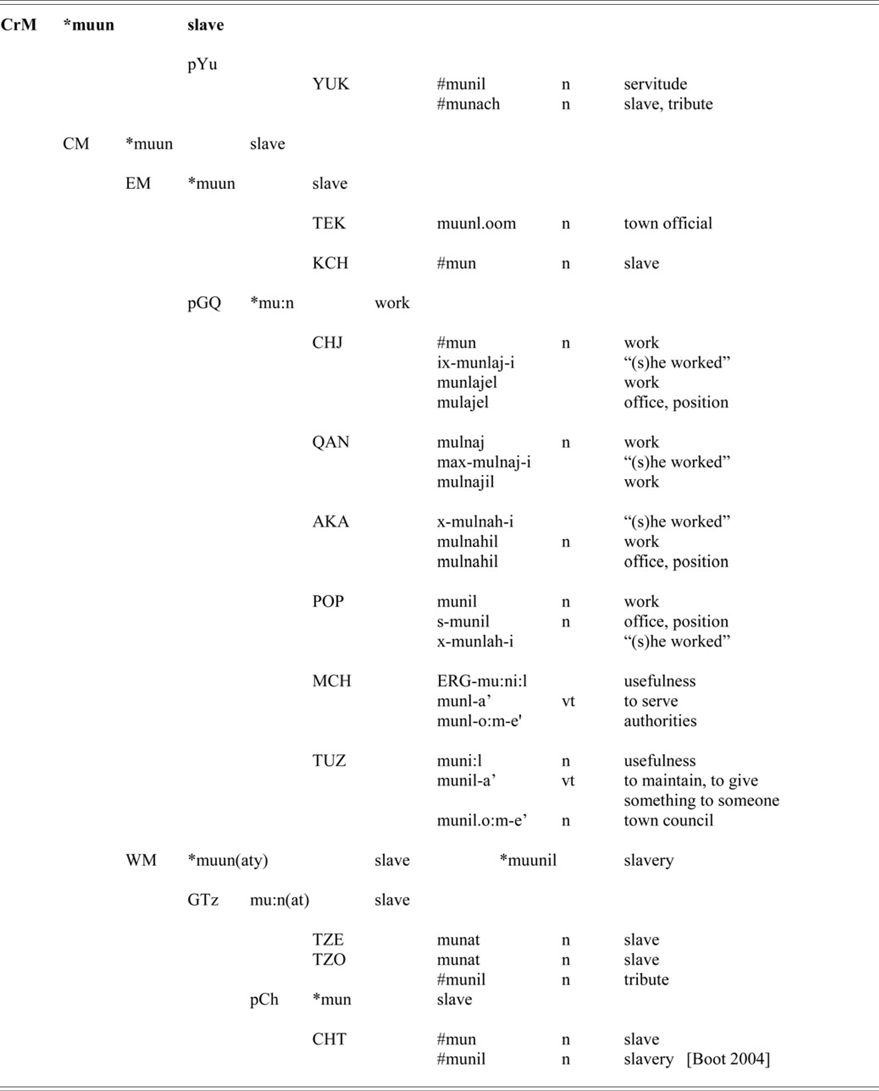
Landa (Reference de Landa and Gates1978[1566]:15) specifically reports that slavery was first introduced into the Yuctatan by the Cocom rulers of Mayapan in Late Postclassic times. This can be rather soundly refuted, however, through etymological analysis of the Mayan root *mun (Table 9). Kaufman (with Justeson Reference Kaufman and Justeson2003:60) reconstructs *muuniil to proto-Mayan, *muun to proto-Central Mayan, and *munaty to the Greater Lowland Language group, all dating to well before the Late Postclassic period. That this root was not diffused across the Maya area at some late date is demonstrated by the /t/ to /ch/ correspondence between Tzeltalan languages and Yucatec, and the preservation of vowel length in Teko and Mocho. While the glosses of many cognates suggest the possibility of original semantics related simply to “work,” closer inspection reveals that these glosses are almost entirely confined to Q'anjobalan languages. This makes it much more likely that the distribution simply represents a semantic narrowing in that branch of the language family. Kaufman's reconstruction of the root to proto-Mayan is rendered questionable by the absence of attestation in Huastecan languages. Core Mayan origins still remain a strong possibility, however, with a likely presence by Central Mayan times considering the wide distribution of cognates. It was certainly present among Western Mayan languages by the period of Greater Lowland Mayan influence given the sound correspondences and a reconstructable presence in both Q'anjobalan and Greater Tzeltalan languages.
“Slave/servant”
There is certainly no shortage of captives depicted and discussed in Classic Mayan glyphic texts. Most scholars of late have tended to assume that these high-ranking figures all purely represent sacrificial victims and there has been little discussion of the possibility that some served as slaves for at least some time before being sacrificed. Nor is the probability entertained that there were considerably more captives of lower social status living out the remainder of their days in servitude. At least one term thought to refer to slaves or servants, habtal, has been read in the Classic script (Boot Reference Boot2009:67). Others, such as baak and winak in their possessed forms, may refer to it more indirectly and metaphorically. It is particularly interesting that at least one Yucatec ethnohistoric dictionary specifically refers to individuals captured in warfare but remaining indefinitely in the service of their captor as slaves as bac-zah (Álvarez Reference Álvarez1997:153). The combined evidence overwhelmingly suggests that slavery had a very ancient presence among Mayan speakers, and its economic importance as a source of labor may well be greatly underestimated.
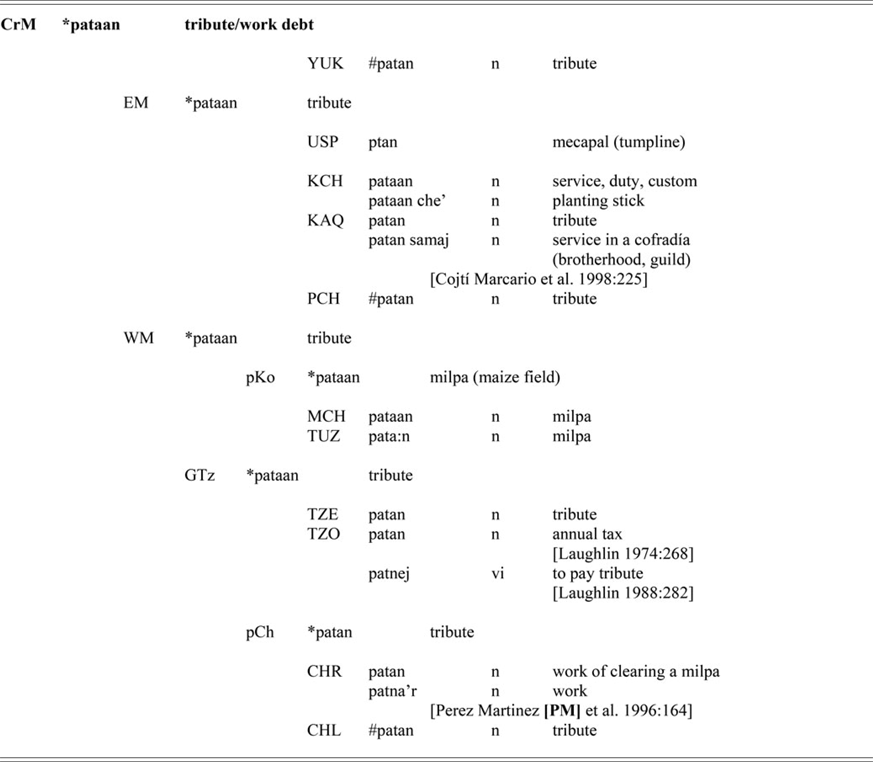
A widely attested term for tax obligations or work debt, *pataan, also shows indications of a Core Mayan origin (Kaufman with Justeson Reference Kaufman and Justeson2003:60) (Table 10), suggesting the presence of vertical economic transfers and/or work obligations to those of higher status by late proto-Mayan times. While the lack of sound innovations associated with the phonology of this term makes it difficult to differentiate genetic transmission from borrowing, the distribution of cognates among Eastern Mayan, Western Mayan, and Yucatec is most typical of words originating among proto-Core Mayan speakers. The elimination of vowel length common to all Greater Tzeltalan languages is clear, proving the existence of this root—and by implication the economic arrangement it signifies—by Classic times at the very least.
“Tribute/tax debt”
The term pataan (phonetically written pa-ta-na) occurs repeatedly on Classic period monuments and ceramic vessels in the context of economic demands placed on subordinate lords by dominant political centers (Stuart Reference Stuart1995:354–356). The iconography presented alongside such phrases suggests that such transfers typically took the form of cloth, feathers, and cacao, and were commonly the result of defeat in warfare. In a number of extant languages, the meaning of *pataan cognates has shifted somewhat, revealing aspects of the economic relationship not apparent in Classic period texts. For instance, the term's repeated semantic association with planting and milpas among disparate language groups may be evidence that agricultural work also formed a significant component of tribute obligations in ancient times. It is perhaps not surprising that most of the Mayan languages that have retained reflexes of *pataan are those known to have been spoken among societies characterized by high levels of social stratification in the past, namely the Yucatecan, Cholan, and K'iche'an languages.
There are those who maintain that *pataan is actually derived of Uto-Aztecan origins and represents Classic period contact between Nahua and Mayan languages (Macri and Looper Reference Macri and Looper2003). They argue this point on the basis of similarity to Uto-Aztecan words for “to trade,” patla in Nahuatl and Pipil, or “to change” *patla in proto-Nahua and *pa:ta for proto-Southern Uto-Aztecan as reconstructed by Dakin (Reference Dakin1982). Yet the similarities appear to be completely superficial, since there is no indication of the complex initial preconsonantal vowel /a:/ in Mayan languages, nor the /l/, and the semantics are decidedly different anyway. Moreover, as discussed above, *pataan otherwise reconstructs quite nicely as a purely Mayan root to proto-Core Mayan, which in any model dates to well before the period of Teotihuacan influence that Macri and Looper (Reference Macri and Looper2003) wish to connect with Nahua contact. Superficial lexical similarities are often coincidental and extremely weak bases for establishing cognacy. There is no reason to believe that the term is of Uto-Aztecan, or Teotihuacano, origin.
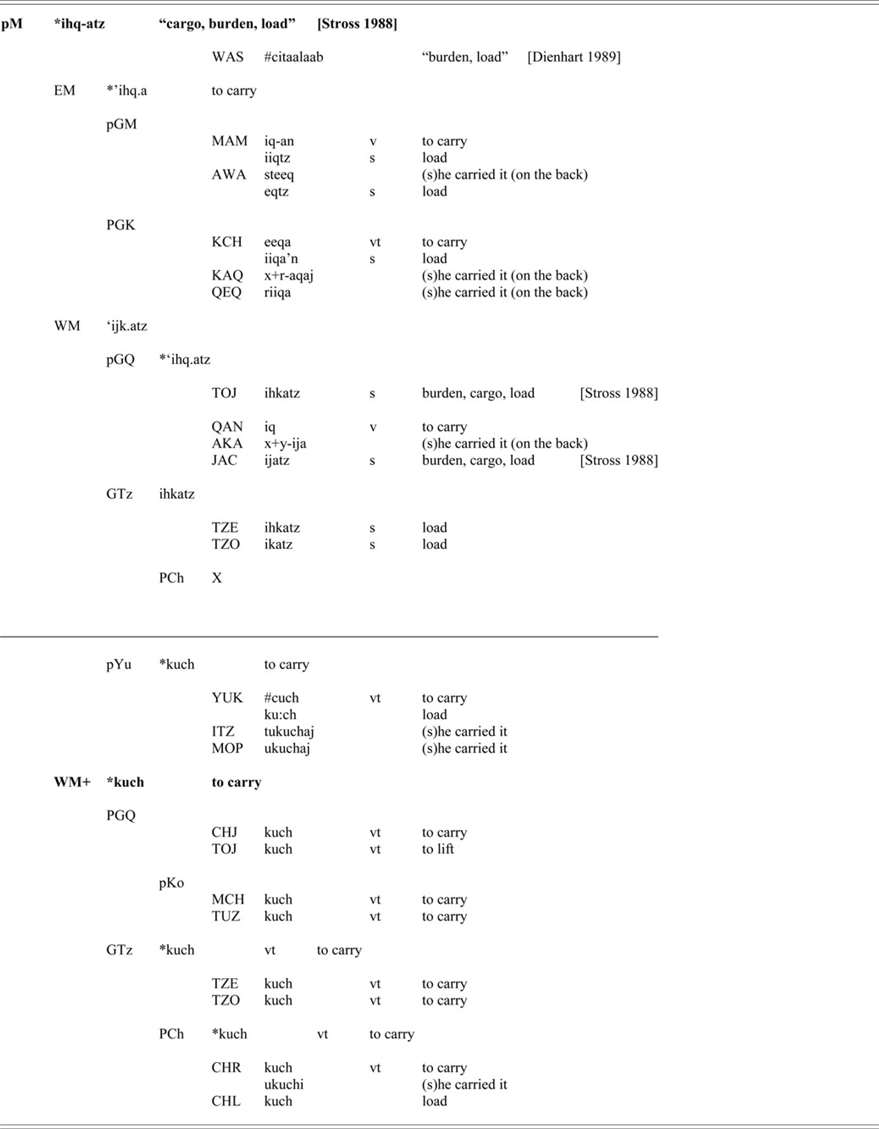
The primary reason for including terms for “carry” and “load” in this study is the use of ihkaatz in the hieroglyphic script in apparent reference to bundles of tribute goods (Stuart Reference Stuart1995). Kaufman (with Justeson Reference Kaufman and Justeson2003:892–893) reconstructs *ihqatz to proto-Central Mayan, as the word has clearly undergone the /q/ → /k/ sound shift in Western Mayan languages (Table 11). Stross (Reference Stross1988), however, finds sufficient evidence to reconstruct it further to proto-Mayan, and Dienhart (Reference Dienhart1989) does indeed produce an attested reflex from Huastec that substantiates such an origin. As mentioned above, ihkaatz is fairly common in Classic period texts—usually found in the phonetically transparent form ‘i-ka-tsi or occasionally the possessed form yi-ka-tsi. The term was originally thought to identify bundles of religious goods used in rituals associated with public office (Stross Reference Stross1988). It is now more commonly recognized as appearing in economic contexts identifying bundles of goods used in payment of tribute or as part of “name-tagging” phrases on portable objects, particularly those made of jade. It must be noted, however, that there is absolutely no linguistic basis for reading ihkaatz as a specific reference to jade (see, for example, Stone and Zender Reference Stone and Zender2011). The evidence for doing so is very circumstantial and comes completely from epigraphic contexts that involve the appearance of a possessed form, yikatz, on personal portable objects (Stuart Reference Stuart, Guernsey and Reilly2007). Although these have hitherto been found almost exclusively on jade artifacts, there is no more reason to believe that yikatz inherently refers to the jade raw material than, for instance, that usiih written upon the disk mirror back discussed previously under terms for gifting refers specifically to the slate raw material of that object. Indeed, if there is any parallel, it would suggest that the mode of acquisition or transfer of the objects, rather than the raw material itself, is the basis of reference of yikatz on jade items. Moreover, jade pendants, especially those in the form of “ceremonial celts,” are typically seen in Maya art dangling in sets from the belt of royalty as noise-making tinklers (Stone and Zender Reference Stone and Zender2011:71). They are in that sense physically heavy, direct material representations of the ruler's “burden of office” (compare with Stross Reference Stross1988). Thus it is preferable to understand ihkaatz as a term pertaining to ceremonial objects obtained through tribute, or perhaps a specific measure of objects so obtained, rather than an exclusive reference to jade itself—even if jade happens to be the most archaeologically visible material exchanged in such a manner.
“Cargo”
The lexical root *kuch similarly denotes a “burden” or “load” and can also function as a verb for “to carry” such objects. While reconstructable only to Western Mayan, its reflexes apparently diffused about the lowlands as a part of Classic (or Formative) period culture (Kaufman with Justeson Reference Kaufman and Justeson2003:889–890). Likewise, kuch is relatively common in the Classic Maya script, written both phonetically [ku-chu] and as a logogram [KUCH], but it seems to have no direct economic implications there—usually functioning instead as a verb for “to carry.” Nonetheless, the word as it occurs ethnohistorically is tightly related to concepts of rulership, office, and responsibility among Ch'ol, Tzotzil speakers and others as a part of what is known as the “cargo system” (Cancian Reference Cancian1965; Vogt Reference Vogt1969). In this sense, *kuch operates somewhat like the root *ihqatz above, and this connection may reflect the inherently economic aspects of cargo-based leadership institutions both ancient and historic. It has long been understood that local religious leaders in many parts of the Maya area see their heightened economic and political status as a burden to be borne for the benefit of the group. To hold a position of leadership often entailed great expenditures, as well as the entitlement to demand offerings from members of the community in order to undertake such expenditures. As kuch frequently occurs in the dedicatory phrases on stone monuments in the Classic script, it may be that it alludes to economic responsibility in those contexts as well.
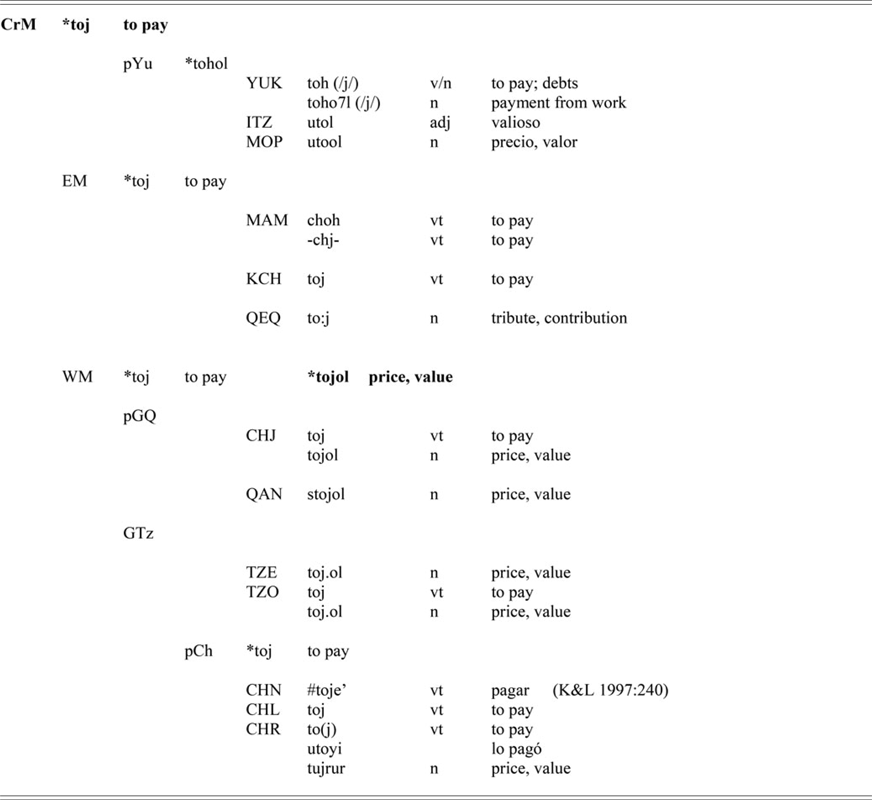
The verbal root *toj, signifying “to pay,” enjoys a widespread attestation in Mayan languages (Kaufman with Justeson Reference Kaufman and Justeson2003:783–784) (Table 12). Given its occurrence in both Eastern and Western Mayan branches as well as Yucatecan, the term can be attributed at minimum to a Core Mayan origin. Kaufman (with Justeson Reference Kaufman and Justeson2003:783) reconstructs it all the way back to proto-Mayan; I do not, given the lack of a Huastecan attestation. A nominalized form, /tojol/, with semantics denoting “price” or “value” comes into evidence somewhat later among the Western and Lowland Mayan language groups. To modern Western sensibilities, the semantics of this root may seem to more appropriately fall into the realm of commercial activity; yet tojol [to-jo-li] is found in painted texts on a number of Classic period polychrome vessels and on carved monuments in contexts generally thought to depict payment of tribute (Reents-Budet Reference Reents-Budet1994; Stuart Reference Stuart1995:359; Stone and Zender Reference Stone and Zender2011). Furthermore, the historically attested use of /to:j/ in Q'eqchi’ referring specifically to tribute payment suggests an ancient retention and demonstrates that the semantics remain compatible with use for vertical transfers of wealth. Use of a cognate in Yucatec to refer to debt obligations suggests noncommercial origins as well.
“To pay; price”
It should be further recognized that unidirectional payments occur near universally among simple human societies and typically arise in contexts of dowry payments and bride price, dispute settlements, and so on (Dalton Reference Dalton, Earle and Ericson1977; Earle Reference Earle2002; Sahlins Reference Sahlins1972). In all likelihood, *tohol arose among Mayan languages to denote just these types of payment. The term is considered here under appropriations and transfers because payments in and of themselves are one-way transfers of wealth, because of the widespread epigraphic acceptance of the term's association with tribute payment in Classic texts, and because the remnant etymological evidence supports noncommercial origins. It is acknowledged that the etymon is not necessarily in and of itself prima facie evidence for tributary relationships.
Commerce
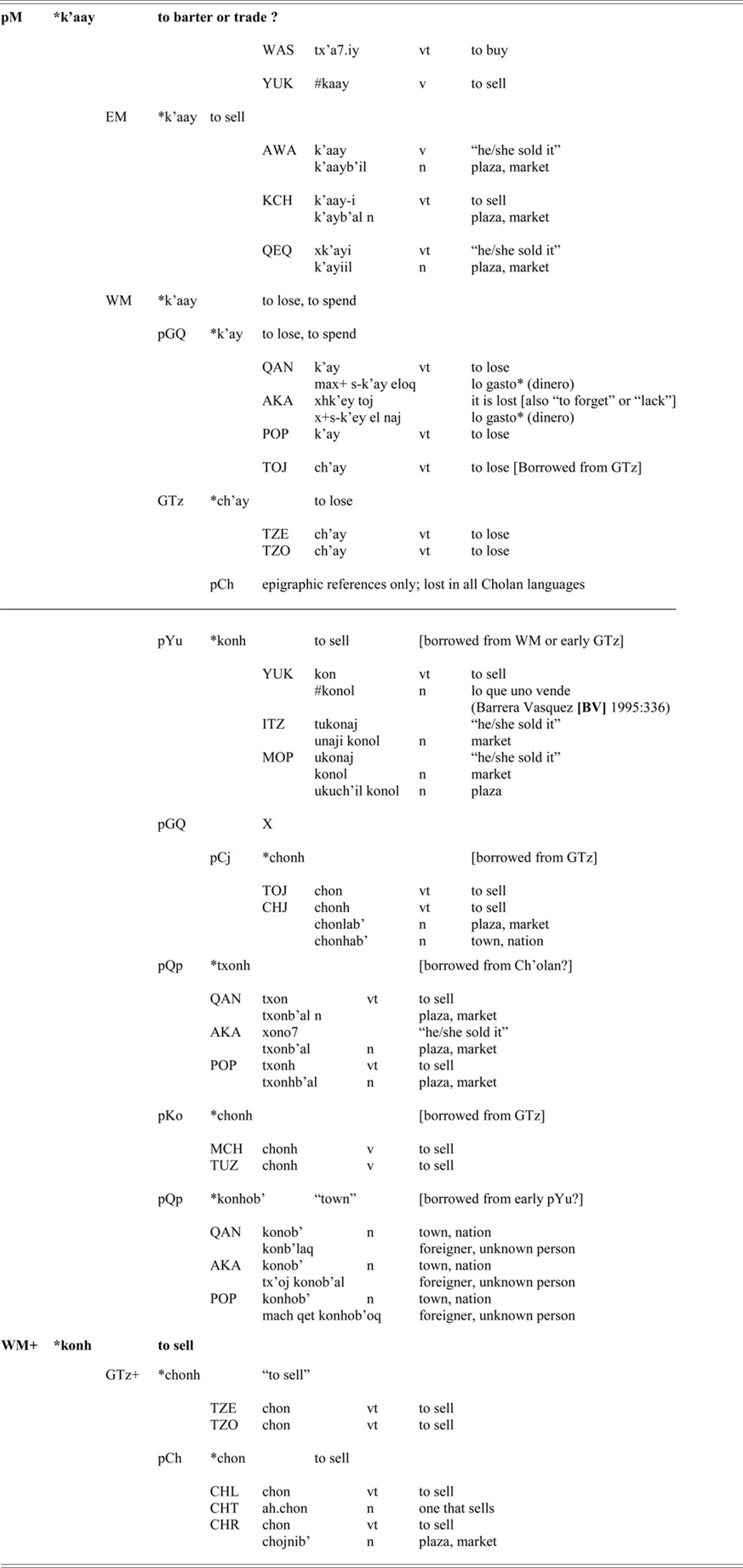
The root *k'aay appears to have been an original proto-Mayan verb for the impersonal, purely economic exchange of goods (Kaufman with Justeson Reference Kaufman and Justeson2003:792–794) (Table 13). In the etymological sequence, the */k/ → /ch/ change in Greater Tzeltalan is apparent, as is the */k/ → /tx/ innovation in Huastecan, providing strong support for proto-Mayan origins. In extant Eastern Mayan languages this word can take on a nominalizing suffix (-b'il or -b'al) to produce a word for “market.” If such a form were reconstructable, it would suggest the presence of such institutions in the Guatemalan highlands from very early times. While the lost /b’/ in Q'eqchi’ gives rise to such a possibility, terms derived through simple inflection do not usually provide satisfactory evidence for the antiquity of such derivation. The concept of a market as a “selling thing” could have easily appeared at a relatively late date and spread through the highlands as a calque, or semantic loan, leaving no evidence of borrowing since the suffixation of each receiving language is typically used (Foley Reference Foley1997:385–386).
“Sell”
Intriguingly, the fact that reflexes of *k'aay came to mean “to buy” in Core Mayan, as opposed to “to sell” in Huastecan, and then eventually shifted to “to lose” in Western Mayan suggests that buying and selling may not have been conceptually distinct in proto-Mayan times—as would have been the case if systems of bartering were the dominant mode of exchange. Thus, the original proto-Mayan root may have essentially meant “to exchange” or “to trade” in the economic sense missing from terms such as *k'ex and *jal discussed previously. The ambiguity and lack of semantic marking associated with *k'aay evidently persevered through the divergence of Eastern and Western Mayan languages. Around that time *k'aay apparently underwent a major semantic shift among the Western Mayan languages, wherein it came to mean “to lose” or “to no longer have.” The use of this root in some Q'anjobalan languages in expressions meaning “to spend” may more accurately reflect its ancient economic connotations in proto-Central Mayan, thereby providing a fairly understandable chain of semantic shift. A much later possible Cholan reflex, ch'ay, appears repeatedly in Classic script in the context of death statements, read something to the effect of “it was lost/spent/extinguished his white/pure blossom/thing/spirit” (Freidel et al. Reference Freidel, Schele and Parker1995:183). The fact that the root both appears in the Cholan-based script and is attested in modern Tzeltalan languages allows us to reconstruct it to Greater Tzeltalan and thereby connect it to proto-Mayan *k'aay through Western Mayan.
The semantic shift of *k'aay/ch'aay to mean “to lose” in Western Mayan languages appears to have been roughly coeval with or to shortly follow the innovation of *konh as a word for “to sell” in Mayan languages (see Table 13). Kaufman (with Justeson Reference Kaufman and Justeson2003:795–796) reconstructs *konh to Western Mayan and explains its presence in Yucatecan languages through diffusion as part of Greater Lowland culture. This is presumably due to its absence from Eastern Mayan languages. The phonology, however, is equally consistent with—and perhaps more parsimoniously explained by—the term having been present in Core Mayan. If the latter were the case, the appearance of *konh with its solidly reconstructable semantics related to selling would mark our earliest linguistic evidence of true “commerce” in Mayan languages. Its absence from Eastern Mayan languages is easily explained by an early loss in that group's proto-language where it would have had to compete with *k'aay, which would have been consolidating its meaning as a term for “to sell.” Kaufman and Justeson's more chronologically conservative Western Mayan attribution, however, does securely establish presence of the root—and therefore the act of “selling”—by about 1000 b.c. in their chronology.
Somewhat later, reflexes of *konh proceeded to diffuse about the Maya area and even beyond, perhaps in association with new, more commercial trade practices or a new disposition toward them. In Greater Tzeltalan, the *k → ch innovation is evident, demonstrating a genetic transmission of the etymon from Western Mayan. In Greater Q'anjob'alan languages, however, the word often begins with an unexpected /ch/ or /tch/ that suggests borrowing. Kaufman (Reference Kaufman1976:110) implicates Greater Tzeltalan languages or, more specifically, Cholan ones as the donor group. The appearance of the /nh/ in the Chujan forms, however, indicates that the *nh → n shift in Greater Tzeltalan had not yet occurred at the time of borrowing. This both allows us to impose a relative chronology of the *k → ch and *nh → n sound shifts in Greater Tzeltalan and confirms that the borrowing was not from a later Cholan or Tzeltalan source. To explain the phonological distribution, Kaufman (with Justeson Reference Kaufman and Justeson2003:795–796) suggests multiple borrowings of cognates of *konh into various Q'anjob'alan languages from both Cholan and pre-Cholan sources.
*Konh also seems to have been borrowed into Xincan, a non-Maya language on the southern periphery of Mesoamerica in the southeastern highlands of Guatemala, as kunu (Campbell Reference Campbell, Justeson and Campbell1984). The source of this loan, given the initial /k/, must have been either the Yucatecan languages or a Western Mayan language from before the Greater Tzeltalan /k/ to /ch/ shift. Campbell (Reference Campbell, Justeson and Campbell1984:8) considers the latter more likely, given the time frame of other similar loan words into Xincan (see *k'iwik below). The full range of evidence is most consistent with either proto-Western Mayan or an early form of Greater Tzeltalan being the donor of *konh to a number of disparate languages, both Mayan and non-Mayan.
Furthermore, at some much-later point a nominalized reflex of *konh, *konhob’ became frozen in proto-Q'anjob'alan as a word for “town.” Close examination shows this to be the *konh “to sell” reflex combined with an instrumental suffix /–ob’/, denoting “a place where one sells things.” This inflection apparently became frozen in the proto-Q'anjob'alan vocabulary and developed into an established word for “town”—which was evidently “the place where one sells things”—even after *konh as a verb for “to sell” was lost in Q'anjob'alan languages. Reflexes of *konh may well have been pushed out of proto-Greater Q'anjob'alan in the process of incorporating a new term for selling, perhaps associated with new commercial practices or attitudes toward them, just as *konh was replaced with *txon from neighboring Greater Tzeltalan in which the initial /k/ sound had long before shifted to /ch/. The fact, however, that there is no indication of such a shift in the Kotoke complex suggests that this was a rather late development in Q'anjob'alan languages, and it can thus only be placed in the Postclassic period according to Kaufman's chronology. The initial /k/ and /-ob/ suffix in fact suggest Yucatecan origins, yet this would have had to have taken place before the root final velar nasal was lost in the *nh → n sound shift in proto-Yucatecan. The situation is obviously complicated, and remains to be fully resolved, but the etymon does seem to suggest towns as “the place where things are sold,” by the onset of the Postclassic period on the southern margin of the Maya lowlands.
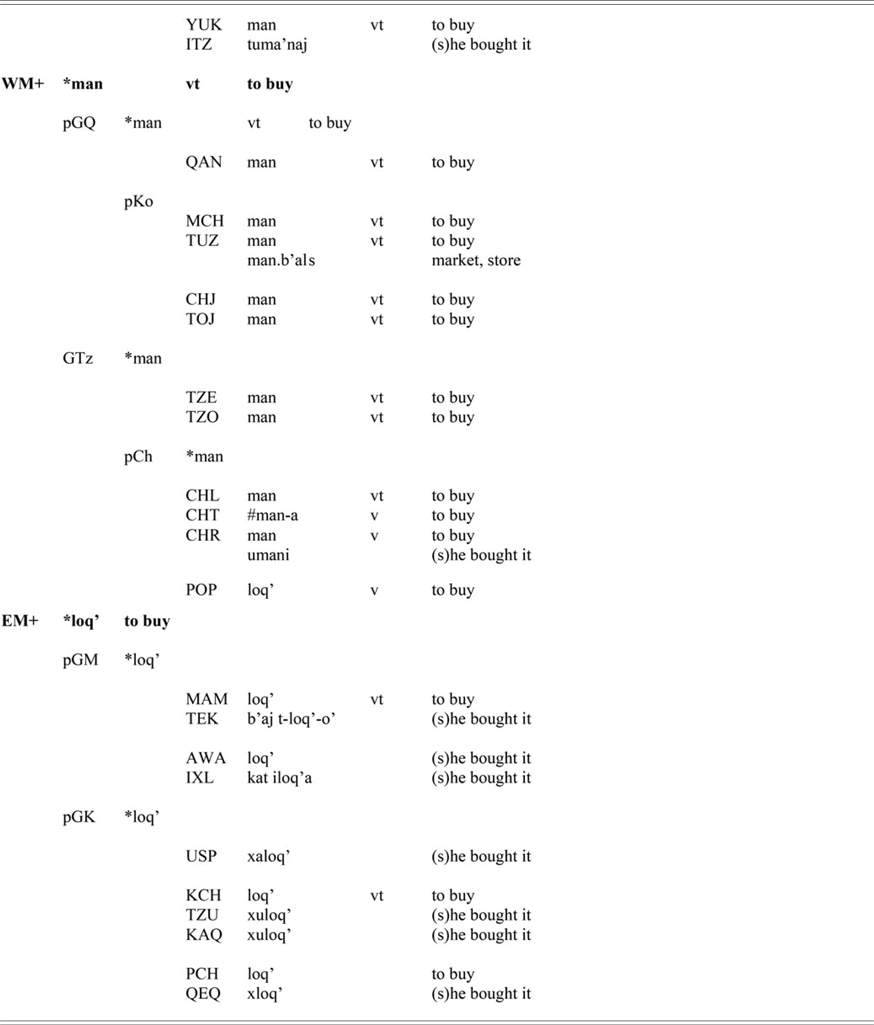
Reconstructable terms for the specific act of buying tend to confirm what was just deduced above about the time frame for the origins of commerce. While the phonology of *man is disappointingly stable with a lack of relevant shared innovations available to differentiate borrowings from genetic transmission, distribution of the reflexes is not inconsistent with Core Mayan origins (Table 14). Its absence from Eastern Mayan languages would have to be explained perhaps by the appearance of *loq’ as a verb for “to buy” in proto-Eastern Mayan, which could have pushed out and replaced a reflex of *man at some point before that language diversified. As with *konh above, however, Kaufman (with Justeson Reference Kaufman and Justeson2003:797–799) more conservatively reconstructs the root only to Western Mayan and explains its Yucatecan attestations through Greater Lowland diffusion. This securely establishes the concept of buying, as distinguished from selling, among Western Mayan speakers.
“Buy”
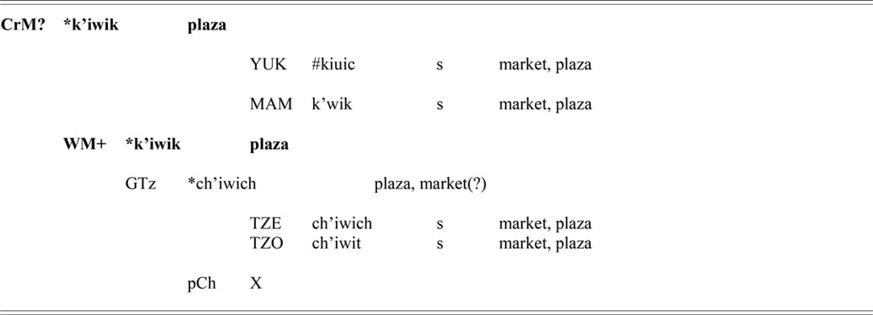
The root *k'iwik, used to signify both markets and architectural plazas in several Mayan languages, is reconstructable at minimum to the period of Greater Lowland fluorescence based upon its distribution among Yucatecan and Tzeltalan subfamilies (Kaufman with Justeson Reference Kaufman and Justeson2003:799) (Table 15). The /k’/ to /ch’/ correspondence between Yucatecan and Cholan-Tzeltalan languages is clear, confirming that the root existed to undergo the *k’ → ch’ transformation in proto-Greater Tzeltalan. The appearance of the cognate k'wik in Mam, an Eastern Mayan language not generally known for accepting loans from the lowland culture complex, may suggest a still deeper reconstruction to Core Mayan. If it was loaned into Mamean from Greater Tzeltalan, this would have had to have taken place before 200 b.c., given the postulated time frame of the *k’ → ch’ transformation (Kaufman and Justeson Reference Kaufman and Justeson2007:199). Otherwise k'wik would have had to have been borrowed from a Yucatecan language—unlikely given the distance and terrain that separates Mam from the northern lowlands. Given that the root has survived in very few and very disparate Mayan languages, the evidence is much more suggestive of an ancient retention than vigorous later diffusion. Moreover, its early borrowing into and survival in some rather distant non-Maya languages, such as Xincan, where it appears as ki:’wi, and possibly Huave, where it occurs as kiap (Campbell Reference Campbell, Justeson and Campbell1984:8), also tend to confirm the root's great antiquity.
“Market”
Reconstructing the original semantic content of *k'iwik is also problematic given that, like virtually all other reconstructable Mayan words for “market,” it is synonymous with architectural “plaza.” That the original etymon in fact signified “plaza” or “patio” rather than “market” is suggested by its meaning in non-Mayan languages. In both Xincan and Huave it is glossed solely as “patio” (Campbell Reference Campbell, Justeson and Campbell1984:8). The term is thought to have diffused into Xincan from Greater Tzeltalan, along with a reflex of *konh “to sell” discussed above, at sometime during the Middle to Late Formative period when Greater Tzeltalan would have been spoken in the Guatemalan highlands in close enough proximity to explain the transfer (Campbell Reference Campbell, Justeson and Campbell1984; Mora-Marín Reference Mora-Marín2005). Widespread semantic adoption of *k'iwik as a term for “market” apparently occurred at some later point and only in the Maya area, after the word had been loaned into Xincan and Huave.
Entertaining the idea that the early semantics of *k'iwik denoted a patio, platform, or plaza allows some potential calibrating with archaeological data. Some of the earliest known artificial platforms in Mesoamerica are actually found on the southwestern margins of the Maya area along the Pacific coast of Guatemala and Mexico. At sites like Paso de la Amada in the Mazatan region of the Soconusco, large, leveled, open platform spaces that might be considered “patios” have been documented in association with perishable structures in Locona phase contexts between 1700 and 1500 b.c. (Lesure Reference Lesure1997). While there is debate as to the significance of these structures and whether or not they were truly associated with large open “plazas” (Clark Reference Clark, Herndon and Joyce2004; Lesure and Blake Reference Lesure and Blake2002), the fact remains that artificially leveled flat open spaces that might be called “patios” were present by the middle of the Early Formative period on the southwest margins of what is today considered “the Maya area.” Thus, a Core Mayan reconstuction of a term for patio could conceivably be supported by archaeological evidence.
If we accept for a moment that Core Mayans were using *k'iwik to denote the same type of platform or patio that appeared during the Locona phase in Soconusco, then we find that the archaeological and linguistic chronologies are in fairly close agreement. Given that glottochronology is a relatively weak dating method, calibration might simply entail pushing Kaufman's dissolution date for Core Mayan (1800 b.c.) forward several hundred years to correlate with the Locona phase (1700–1500 b.c.) archaeological developments. This would of course also imply that Core Mayan speakers were situated somewhere in close enough proximity to the Soconusco in order to be aware of such architectural innovations. Since the Soconusco is a lowland area, the finding could also be seen as supporting Brown's (Reference Brown, Staller and Carrasco2010:92–94) contention that proto-Mayan was a actually lowland language on the margin of the highlands, rather than a highland language on the margin of the lowlands as Kaufman (Reference Kaufman1976) maintains. Perhaps then those lowland proto-Mayan homelands were along the Pacific coast rather than on the northern slopes of the highlands as Brown implies. Indeed, if the Soconusco was all Mixe-Zoquean during the Early and Middle Formative period, as Kaufman's model of Mesoamerican linguistic dispersal maintains, what was a distant western language isolate like Huave on the Pacific coast of the Isthmus of Tehuantepec doing borrowing words for “patio” from Mayan? Should it not have instead been adopting them from Mixe-Zoquean?
Moving on, there is but one reported occurrence of *k'iwik in the hieroglyphic corpus. It evidently occurs on an unprovenienced Late Classic cylindrical vessel fragment in the form of aj = k'i-wi-ki or aj k'iwik (Dahlin et al. Reference Dahlin, Bair, Beach, Moriarty, Terry, Staller and Carrasco2010:196). Through use of the male proclitic aj-, this phrase could be used to signify “he of the market” and therefore possibly a “merchant.” Of course, it could also mean “he of the plaza” and thereby refer to a courtly official in charge of maintaining or organizing use of public space, in the same way, for instance, that aj tz'ib denoted a court scribe (Reents-Budet Reference Reents-Budet, Costin and Wright1998). The remaining glyphic context and accompanying iconography of this vessel were apparently lost, so little of substance can be said about the text. We might note, however, that the form aj k'iwik is decidedly Yucatecan and not the Cholan/Tzeltalan *ch'iwich that we would expect from the southern lowlands of the Classic period. It is also worth noting that this would be the first, and only, recognized instance of a term for “market” in the Classic period Maya corpus.
In fact, despite the immense corpus of Maya hieroglyphic writing—estimated to consist of over 10,000 texts written on stone, clay, and wood (Houston Reference Houston2000)—there is not a single known unequivocal reference to markets or commercial exchange in Classic texts. Nor are there depictions of markets or commercial exchange in Classic period art. The single known possible exception is a recently discovered set of murals from the Chiik Nahb’ plaza group at Calakmul (Carrasco Vargas et al. Reference Carrasco Vargas, López and Martin2009, Martin Reference Martin, Golden, Houston and Skidmore2012). In scenes from these murals, a range of goods—mostly foodstuffs such as atole, tamales, corn, and salt, but also including ceramics and possibly needles—are apparently being offered for sale by individual ‘vendors,’ many if not most of whom are women and children (Hull Reference Hull, Staller and Carrasco2010). Dating to the Late Classic period, the scenes are thought by many to present a Classic Maya marketplace (Hull Reference Hull, Staller and Carrasco2010, Martin Reference Martin, Golden, Houston and Skidmore2012). As there is no clear explanation of the context in the accompanying text, there are alternative interpretations of the work—for example, that it may instead depict a banquet (Boucher and Quiñones Reference Boucher and Quiñones2007). At several locations within the murals, however, there are indications of goods being provided in exchange for the commodities dispensed. The small objects supplied are small and homogenous and could represent cacao beans, which would be an expected currency of the period (see further discussion below). Exchange of one good for another is exactly the type of quid pro quo we would use as a diacritic of commercial activity, and this strongly supports the proposition that market commerce is indeed what was depicted at Chiik Nahb. It is doubly interesting that these murals appear in the general vicinity of a very large plaza that was long ago inferred to be a marketplace archaeologically (Folan Reference Folan1992). It is also worth noting, however, that the layout and architecture of this plaza generally bear little or no resemblance to other archaeologically postulated marketplaces of the Classic period, such as the East Plaza of Tikal (Jones Reference Jones1996). They do, arguably, show some similarity to Terminal- and Post-Classic ‘commercial’ plazas like the Court of the Thousand Columns at Chich'en Itza (Ruppert Reference Ruppert1952).
Though the scenes and texts are badly degraded, the range of goods being exchanged in the Chiik Nahb’ murals, and the commodities emphasized, appears to be rather modest. If there is any emphasis on a particular good or class of good in the murals as a whole, it seems to have been upon foodstuffs and atole—depicted twice in the work at the apparent beginning and end of the text. The most exotic commodity presented is salt, which would probably have been brought in from the coast, though there are ways that even this could have been produced locally. There is also a persistent theme in the murals of consumption of the goods on site rather than, for instance, procurement for removal in the interest of household provisioning. Was this a defining characteristic of early Maya markets? And we can rather confidently say, based upon archaeological evidence for a much broader range of exotic materials available to the Classic Maya, that Landa's (Reference de Landa and Gates1978[1566]:37–38) bold assertion that the full range of goods produced in the land were traded in local markets is not at all borne out for the Classic period in these murals. Aztec Tlatelolco, this was apparently not. If the hyper-commercialist scholars finally have their victory in obtaining some concrete evidence for at least one Classic period marketplace, it has to be bittersweet in the rather modest picture it presents. This is supposed to be the great marketplace at one of the most prominent Classic period political centers? And the cornerstone of it is old women selling atole for on-the-spot consumption? Though such activity may well have served to help redistribute some surplus agricultural production across a small region, it is difficult to see it as the basis of an intensively integrated market economy providing the foundation of Classic peiod polities (see Chase and Chase Reference Chase and Chase1996, Masson and Friedel 2013).
That the historically attested use of all reconstructable terms for commercial “market”—*k'aayb'al, txonb'al, and chonlab’, as well as *k'iwik—is almost invariably synonymous with architectural “plaza” suggests a deep-seated and widespread cognitive association between these two elements among Mayan speakers. Only among some late Yucatecan languages, such as Itzaj and Mopan, does some partial semantic separation and specificity begin to appear. These languages can use the term konol—albeit often requiring some modifiers—to specifically denote a market independent from the plaza in which it is held. The obvious implication, cognitively speaking, is that all plazas were potential markets to the ancient Maya and that markets were inherently expected to be held at some form of plaza. This may actually help to explain the widely recognized absence of archaeological evidence for Classic Maya markets. They may have simply occurred on whatever open plaza space was available and, in most cases, were not formally designated or architecturally designed by the ruling classes.
Moving on to our next etymon, the verb root *p'ol carries the simple meaning of “to increase.” In many glosses, however, it seems to specifically connote an increase associated with commerce in the form of selling or merchandise (Table 16). In that sense, it apparently represented a general Maya conception of “profit,” and such semantics are widespread enough to suggest fair time depth of use. Yet the distribution of the root itself is rather limited, being found in general only among languages of the lowland group (Kaufman with Justeson Reference Kaufman and Justeson2003:797). There is also no solid phonological basis for reconstructing it to any great antiquity; not even to proto-Greater Tzeltalan. The only sound change it can be shown to have undergone is in Ch'orti’, and that is a very late, highly irregular one. Nonetheless, the attestation of cognates in languages as disparate as Tzeltal and Ch'olti’ suggests either a Greater Tzeltalan presence or substantial later diffusion. The fact that it appears in Tojolob'al indicates at least some borrowing and makes later diffusion the preferable explanation. The primary time frame for lowland interaction was, of course, the Classic period. The subset of attesting languages therefore implies a relatively widespread conception of profit associated with commerce in the lowlands of the Late Classic.
“Increase”
Valuables
Perhaps the most familiar ancient Mesoamerican valuable is the cacao bean—widely known to have served as a currency, or commodity money, at the time of Spanish contact (Díaz del Castillo Reference Díaz del Castillo and Garcia1928; Feldman Reference Feldman1985; Hassig Reference Hassig1985; Rojas Reference Rojas1998; Tozzer Reference Tozzer1966). There has already been much discussion and debate over the history of the word for cacao in Mesoamerican languages (Beekman et al. Reference Beekman, Cowgill, Dakin, Hopkins, Rosenswig, Sampeck, Swanton, de Ávila, van Doesburg and Wichmann2010; Dakin and Wichmann Reference Dakin and Wichmann2000; Kaufman and Justeson Reference Kaufman and Justeson2007). To summarize, many of the preeminent linguists working in the region adhere to the established, orthodox view maintaining the word *kakaw diffused about ancient Mesoamerica from a Mixe-Sokean language (Campbell and Kaufman Reference Campbell and Kaufman1976; Justeson et al. Reference Justeson, Norman, Campbell and Kaufman1985; Kaufman and Justeson Reference Kaufman and Justeson2007). Some others, however, subscribe to a more recent proposition that it is proto-Nahua in origin, being a reduplicated innovation on a Southern Yuta-Nawan word for “egg,” *kava (Brown Reference Brown, Staller and Carrasco2010; Dakin and Wichmann Reference Dakin and Wichmann2000; Macri and Looper Reference Macri and Looper2003). The present author considers the Nahua origin hypothesis quite thoroughly refuted. If that language had been involved, at least some of the many Mesoamerican languages that adopted the word would have done so with a word final /t/ to correspond with a proto-Nahua *kakawatl. But this was never the case. When we add to this the facts that the cacao plant would have been utterly foreign from an ecological perspective to the high and dry climate of central Mexico where Southern Yuta-Nawan languages were originally spoken, and that cacao use was already well established in southern Mesoamerica by the Early Formative period (Powis et al. Reference Powis, Hurst, del Carmen Rodríguez, Ortíz C., Blake, Cheetham, Coe and Hodgson2007), no viable reason exists for southern regions to have adopted a term for cacao from Uto-Aztecans. The Nahua hypothesis just seems unbearably far-fetched.
Nevertheless, what is important here for present purposes is the uncontested fact that the preeminent Mesoamerican word for cacao was at some point borrowed into Mayan languages from without. The real question for us then is the time frame of its borrowing and various semantic associations, not its original source. The fact of its non-Maya origin is demonstrated by virtue of the relatively few internal phonological sound changes the word has undergone in any Mayan languages (Kaufman with Justeson Reference Kaufman and Justeson2003:1104–1105) (Table 17). It cannot possibly have been present in proto-Mayan, or historical sound developments would have caused the reflex to occur as chachaw in modern Huastec rather than kakaw. Nor did the word undergo the Late Formative Greater Tzeltalan *k → ch sound shift, despite satisfying the few albeit complex conditions that allowed it to avoid being blocked (Kaufman and Norman Reference Kaufman, Norman, Campbell and Justeson1984:84), or it would likewise occur as chachaw in Cholan and Tzeltalan languages. The earliest changes it can be shown to have undergone are post proto-Cholan, in which complex vowels are simplified in certain Cholan languages like Ch'orti’. There are, however, plenty of depictions of cacao in Maya art and direct references to cacao, written as ka-ka-wa, appearing by Early Classic times in the hieroglyphic script (Stuart Reference Stuart1988, Reference Stuart and Kerr1989). These become particularly common in dedicatory texts written upon cylindrical drinking vessels of the Late Classic. Based upon the combined evidence, one can deduce that the word entered the Maya area somewhere between 200 b.c. and a.d. 400 (Kaufman and Justeson Reference Kaufman and Justeson2007). This roughly conforms with previous linguistic studies suggesting a Late Formative introduction for the word *kakaw into Mayan languages (Justeson et al. Reference Justeson, Norman, Campbell and Kaufman1985).
“Cacao”
Residue analyses, however, have more recently shown cacao to be present archaeologically in the northeast Peten of the lowland Maya area by the late Middle Formative period (600–400 b.c.) (Hurst et al. Reference Hurst, Tarka, Powis, Valdez and Hester2002; Powis et al. Reference Powis, Valdez, Hester, Hurst and Tarka2002). Indeed, the spouted vessels in which such residues were found date back even further in the Ulua Valley of Honduras to the southeast of the Maya area (Henderson and Joyce Reference Henderson, Joyce and McNeil2006). These developments clearly predate the widespread adoption of the term *kakaw in Mayan languages and require explanation. Kaufman and Justeson (Reference Kaufman and Justeson2007:201) have recently proposed that there was an earlier, native Mayan word for wild cacao, *pe:q, which survives only in a few Eastern Mayan languages, such as K'iche’ and Cakchiquel, as a term for cacao. Cognates may exist in several other Mayan languages with shifted meanings that include “skirt” and the quantity “8,000” (Kaufman with Justeson Reference Kaufman and Justeson2003:1105). It is particularly interesting and increasingly suggestive that the earliest presently known archaeological cacao residues have been documented in Early Formative Barra phase contexts from Paso del la Amada on the Soconusco (Powis et al. Reference Powis, Hurst, del Carmen Rodríguez, Ortíz C., Blake, Cheetham, Coe and Hodgson2007), dating to between 1900 and 1700 b.c. Still, there is insufficient linguistic evidence to reconstruct the native Mayan root etymon *pe:q beyond proto-Central Mayan.
It is difficult to reconcile all the conflicting evidence and explain the sequence of linguistic development related to terms for cacao. It is, of course, conceivable that new methods of preparing cacao-based drinks resulted in a relatively late, widespread adoption of a foreign word. There is certainly archaeological evidence for such culinary changes in the rather abrupt disappearance of spouted vessels from ceramic assemblages of the Classic period (Henderson and Joyce Reference Henderson, Joyce and McNeil2006), but it is hard to believe terms for a new drink would universally eclipse old terms for the plant itself. Questions also remain as to whether the appearance of a newly domesticated variety of cacao would sufficiently warrant universal adoption of a completely new term and abandonment of the old one. The most viable explanation may be that the new term *kakaw diffused as part of a widespread recognition of the pods as a useful intercultural commodity unit of exchange above and beyond their use in preparing a flavorful beverage (see Sampeck commentary in Beekman et al. [2010:431]). Increasing familiarity with a foreign term for cacao as a currency could contribute greatly to the demise of an old Mayan word for a generally nonlocal plant used primarily to prepare a drink mostly consumed by a restricted elite.
Like cacao, the use of cloth as an exchange medium was documented both among the Maya and across Mesoamerica at the time of Spanish contact (Feldman Reference Feldman1985; Rojas Reference Rojas1998). Its presentation to elites as payment or gifts is frequently depicted in Classic Maya art (Schele and Mathews Reference Schele and Mathews1998:89–91; Stone and Zender Reference Stone and Zender2011:81). There are numerous terms for cloth in Mayan languages, often shared by different subfamilies with subtle semantic variations (Kaufman with Justeson Reference Kaufman and Justeson2003:1011–1018) (Table 18). While none of the etyma can be confidently reconstructed back to proto-Mayan proper, no fewer than three terms, *tyiinham, *buhq, and *nooq’—plus ancillary terms for things like cotton seed (*tuhx) and spindle whorl (*peteht)—were present among Core Mayan speakers (Kaufman with Justeson Reference Kaufman and Justeson2003:1011–1018). Indeed, substantially more lexical roots for cloth were found and examined for this study than could be presented here. Many details concerning the history of weaving among the Maya could probably be gained by closer examination of all these terms and the relationships between them but, for present purposes, suffice it to say that there is no doubt that the Maya were active producers of cotton cloth by at least the time of Core Mayan dispersal.
“Cloth/cotton”
One reflex of the lexical root *b'uhq can be found in the prophetic texts of the Postclassic codices as bu-ku. The first-person possessed form also occurs in a mythological scene painted upon a Late Classic cylindrical vase (K1398; Hull et al. Reference Hull, Carrasco and Wald2009) treating a thieving rabbit and God L as nibuku [ni-bu-ku], “my clothes” (Hull et al. Reference Hull, Carrasco and Wald2009). Yet another lexical root, /yub/, is found twice in the text of another Classic period vessel (K1728; Stuart Reference Stuart1995), written yu-bu(-te’). The scene on this vessel commemorates some type of “payment” of goods—including cloth—to a lord of Motul de San Jose (Stuart Reference Stuart1995:358–359). The operative verb in the text is a reflex of *tojol, discussed above, providing evidence for cloth being used as a form of payment in ancient times. The title of an attending personage in the scene refers to him as aj yub. As an etymological root *yub is unfortunately a dead end, since it is documented only in Yucatec—in which yubte’ survives as “manta de tribute” or “tribute cloth” (Barrera Vásquez Reference Barrera Vásquez1995). The attendant in the scene might therefore be inferred to be a “keeper of the tribute cloth.”
Both greenstone (jade, jadeite, and serpentine) and marine shell are also known to have served as key valuables in Contact period Mesoamerica (Feldman Reference Feldman1985; Hassig Reference Hassig1985; Rojas Reference Rojas1998; Tozzer Reference Tozzer1966) and are thought by many to have performed similar functions in ancient times (Freidel et al. Reference Freidel, Reese-Taylor, Mora-Marín, Masson and Freidel2002). Workshop areas of marine shell bead production are archaeologically known to date to at least as early as Middle Formative times in several parts of the Maya lowlands (Aizpuruia and McAnany Reference Aizpuruia and McAnany1999; Hohmann Reference Hohmann2002). From a linguistic perspective, separate roots for both land snail and conch as living creatures can be traced back to proto-Mayan in the form of *puur and *pemech, respectively (Kaufman with Justeson Reference Kaufman and Justeson2003:654–657). Proto-Mayan *t'oot’ probably referred to the shell carapace itself, which is our main point of interest here as an exchange commodity. However, the fact that proto-Mayans were aware of the marine-dwelling conch as reflected by *pemech is also important information.
While less is known about the extent and time depth of jade production, certain quarry and production sites are known from the northern margins of the Guatemalan highlands (Kovacevich Reference Kovacevich2006; Rochette Reference Rochette2009). Jade and jadeite objects are not uncommon archaeological finds throughout most of the Maya area, with small beads and ceremonial celts being among the most typical forms encountered. Jade items also figure prominently in Maya art of the Classic period (Freidel et al. Reference Freidel, Reese-Taylor, Mora-Marín, Masson and Freidel2002; Stone and Zender Reference Stone and Zender2011:71; Stuart Reference Stuart, Guernsey and Reilly2007) and were a central part of Olmec cosmology and value systems long before that (Fields Reference Fields1989). Unfortunately, no etyma were found in this study that could specifically illuminate the temporal development of jade use through linguistic reconstruction. This does not mean that ancient Mayans were not aware of the material, nor that they did not speak of it. Rather, it suggests a preference for morphological compounds in reference to the stone in everyday speech. In all likelihood, jade, jadeite, and serpentine were referred to collectively in ancient Mayan languages in much the same way as archaeologists sometimes do in English—as “greenstone,” or yaxtun in Mayan.
There may, however, be a methodological way around the absence of reconstructable terms for jade through terminology for forms into which the material was fashioned, such as decorative beads. One root for the latter, *uuh, can be reconstructed rather soundly to proto-Mayan based upon distribution of its cognates throughout all major subgroups of the Mayan language family (Kaufman with Justeson Reference Kaufman and Justeson2003:1030) (Table 19). Given that shell and greenstone are far and away the most common raw material for beads found archaeologically in the Maya area (Willey Reference Willey1972; Masson Reference Masson, Masson and Freidel2002), there is every reason to believe that the items proto-Mayans were referring to with *uuh included drilled pieces of jade and marine shell. Jade and Spondylus beads certainly figure prominently enough in Maya art of the Formative and Classic periods (Freidel et al. Reference Freidel, Reese-Taylor, Mora-Marín, Masson and Freidel2002; Stuart Reference Stuart1995; Taube Reference Taube and Houston1998), though they are rarely referred to by specific material in texts. Beads are nearly ubiquitous archaeological finds from the lowland Maya area by Middle Formative times, and it is also useful to note recovery of jade beads from disparate Early Formative Locona phase contexts along the Soconusco (Blake et al. Reference Blake, Lesure, Feddema, Hill, Gosser, Clark and Lowe1993; Lesure and Blake Reference Lesure and Blake2002; Rosenswig Reference Rosenswig2010).
“Bead/necklace”
Feathers are yet another type of valuable known from the period of Spanish contact (Feldman Reference Feldman1985; Rojas Reference Rojas1998). The most common and only deeply reconstructable etymon for “feather” in Mayan languages, *k'uk'um, appears to be the instrumentalized form (-Vm) of the noun root for quetzal bird *q'uq’, dating from after the root had undergone the *q’ → k’ phonological change in either a Western Mayan language or proto-Yucatecan. Thus, the term as a pan-Maya word for feathers seems to originate and diffuse relatively late as a Greater Lowland Maya culture word (Kaufman with Justeson Reference Kaufman and Justeson2003:614–615) (Table 20). This does not imply that there was no earlier term for bird feathers in Mayan languages, only that none were so widespread and durable so as to be deeply reconstructable today. Most lexical roots may have simply been lost over the millennia, and it would have been possible to communicate the idea of “feathers” with compound terms and euphemisms that often do not reconstruct using historical methods. Other Mayan words used to denote the external covering of a bird, for instance, such as *xiik, *’ism, and *tzo'tz, reconstruct better as wing, fur and hair, respectively, thus representing the idea of feathers cognitively as the “hair” or “fur” of a bird. What can be said is that only one term, *k'uk'um, apparently acquired sufficient importance at some point to diffuse across the Maya lowlands and that it diffused from either Greater Tzeltalan or Yucatecan languages. This had to have taken place post-Western Mayan dispersal and after Greater Tzeltalan underwent the *q’ → k’ sound change—otherwise it would appear as q'uq'um in Q'anjob'alan languages—yet before the end of the period of Greater Lowland diffusion. Greater Tzeltalan is the most likely innovator given its proximity to the quetzal bird's highland habitat. Thus, Greater Tzeltalan was evidently still close enough to the highlands to recognize *k'uk’ as a word for the quetzal bird and derive a word for feathers from this term. Greater Q'anjob'alan languages subsequently experienced a shift causing *k'uk'um to signify “sparrow hawk” while Q'anjob'al itself at some later point borrowed q'uq’ from an Eastern Mayan language.
“Feather”
Development of a new intercultural term for feathers during the Late Formative or Early Classic would not be terribly surprising, given the rising importance of feathers apparent in Classic period art and ritual (Freidel et al. Reference Freidel, Schele and Parker1995:236–239; Schele and Mathews Reference Schele and Mathews1998; Stuart Reference Stuart1995). They were a commonly depicted element of tribute and prestation packages, often accompanied by stacks of folded cloth and other bundles of goods in painted scenes on cylindrical vases and murals. Feathers are also explicitly referred to in the hieroglyphic script as k'uk'um, written as K'UK’-ma, for instance, on the face of Naranjo Stela 12 in reference to an extraction of wealth following military conquest. The late pervasiveness of *k'uk'um may specifically reflect the increasing importance of quetzal feathers in Mesoamerican exchange systems. In many ways, its wide distribution—yet fairly shallow time depth—bears some resemblance to the etymology of *kakaw. This could be a product of the similar functional roles the two commodities played in pre-Columbian Mayan economies and the similar time frame at which they became necessary components in interregional exchange systems.
The terms that came to be used for “money” in Mayan languages historically are almost without exception a compound of words for “sun” (*q'iin) and “excrement” (*tzaa’)—a colloquialism for “metal” denoting gold and silver in particular. This same semantic compound was apparently diffused throughout Mesoamerica in pre-Columbian times as a calque for shiny, malleable materials—including copper, silver, gold, and even bronze—that were fashioned into precious items such as ornaments, bells, and small nonfunctional axe-heads (Díaz del Castillo Reference Díaz del Castillo and Garcia1928; Feldman Reference Feldman1985; Rojas Reference Rojas1998; Tozzer Reference Tozzer1966). Such metals were much more common in other parts of Mesoamerica than they were in the Maya area, in which they appear archaeologically only in relatively late Terminal and Postclassic period contexts. The linguistic data tend to reaffirm this fact by demonstrating that the *tzaa’ = q'iin compound was borrowed widely into the Maya area at a very late date through one of the lowland languages (Kaufman with Justeson Reference Kaufman and Justeson2003:400) (Table 21). This is reflected in the initial /t/ found in many languages where /ch/ or /tz/ would be found if the words had been transmitted genetically in earlier times. The earliest secure phonological evidence traces it to proto-Yucatecan, generally agreed to have dispersed at around a.d. 1100, from which it may well have diffused about the rest of the Maya area. The appearance of tumin in Ch'orti’ is actually of Spanish derivation (Wisdom Reference Wisdom and Stross1950). It is a corruption of tomin, a term for a small, low denomination Spanish coin that was also borrowed into Nahuatl in central Mexico (Berdan Reference Berdan and Isaac1986:297). From the fact that there are no archaeologically occurring forms of gold or silver currency known from the Maya area prior to Spanish contact, one can deduce that the use of the word for metal in reference to “money” was purely a result of contact with European coinage.
“Money/metal”
Furthermore, no linguistic evidence could be found to indicate that the pre-Columbian Maya had any deep-seated abstract conceptions of “money” as a commercial technology at all. Each form of currency—be it metal, cacao, shell, cloth, or feathers—was simply a valuable commodity that happened to serve exchange purposes, and the notion of “money” as an item that specifically served as object for exchange or unit of value was apparently never lexicalized. Nahuatl, in contrast, had a general inclusive term, tlacoualoni, that meant “el instrumento para comprar” (Rojas Reference Rojas1998:193), making it cognitively analogous to Western terms for money. The presence or absence of true “money”—formalized objects of stable value that stand independent of the variable intrinsic worth of any particular consumable good—has potentially important implications for the degree of commercialism and, by extension, certain structural exchange capacities that should be afforded to an economic system (Dalton Reference Dalton, Earle and Ericson1977; Einzig Reference Einzig1948; Freidel et al. Reference Freidel, Reese-Taylor, Mora-Marín, Masson and Freidel2002; Smith Reference Smith2004; Snell Reference Snell, Sasson, Baines, Beckham and Rubinson1995; Speal Reference Speal2005; Weatherford Reference Weatherford1997). Commodity monies, particularly perishable ones, face limitations, at least in theory, given inherent issues of fungibility, and periodic and geographic scarcity.
While obsidian and chert may not be generally recognized elements of the Mesoamerican complex of pre-Colombian preciosities, archaeological evidence indicates that—above and beyond their use in the manufacture of everyday utilitarian tools—these materials were also widely traded as prestige goods in certain forms among the ancient Maya (Hammond Reference Hammond1972; Hester and Shafer Reference Hester and Shafer1984; Shafer and Hester Reference Shafer and Hester1991). Both obsidian and chert were sometimes fashioned into elaborate eccentrics and finely crafted bifaces that in many cases appear more ceremonial than functional (Hester Reference Hester, Plew, Woods and Pavesic1985; Iannone Reference Iannone1993; Meadows Reference Meadows2001). Obsidian was also precious enough to be occasionally ground into beads. There is strong evidence that these lithic materials circulated in fairly distinct alternative exchange networks of varying geographical reach according to quality of raw material and manufactured form (Braswell and Glascock Reference Braswell, Glascock and Glascock2002; Hester and Shafer Reference Hester, Shafer, Schwartz and Falconer1994; Santone Reference Santone1997; Scarborough and Valdez Reference Scarborough and Valdez2009; Speal Reference Speal2009). Moreover, the durability, high archaeological visibility, and great antiquity of lithic materials exploitation makes it particularly useful in the calibration of linguistic chronology with archaeological data.
Kaufman (with Justeson Reference Kaufman and Justeson2003:442) reconstructs two terms for silicious stone back to proto-Mayan, *tyaah and *tyooq’ (Table 22). We can be fairly confident in attributing the first, *tyaah, to proto-Mayan given its attestation in Eastern and Western Mayan languages and Huastec with the expected proto-Mayan sound correspondences among them. The second, *tyooq’, is somewhat less secure given that its purported cognate in Huastec occurs only as part of the name of an insect with an unclear significance. Still, *tyooq’ can be minimally reconstructed to Core Mayan given its occurrence in Eastern and Western Mayan languages and Yucatec, with the expected /t/ to /tz/ word initial sound correspondence between Mam and Ch'olan tongues. Perhaps the most interesting contrast between *tyaah and *tyooq’ is that reflexes of the former are unmarked in meaning with regard to flint versus obsidian in most Mayan languages. Cognates of the latter, on the other hand, all specifically denote flint.
“Obsidian/flint”
Incidentally, this contrast in meaning is exactly what one might expect from a dispersing language group situated on the margins of the Sierra Madre del Sur along the Soconusco. It implies an earlier unmarked term that would apply to all flakeable silicious stone (though probably based by default on volcanic highland obsidian through familiarity with that material) and a later, more marked word applying specifically to the flint/chert deposits encountered as some speakers began moving into the karstic Maya lowlands. Proto-Core Mayan times would be a logical point for novel, more specific terms for flint to arise given that proto-Huastecan had theoretically just diverged northward toward the Gulf Coast several generations before and Yucatecan was presently in the process of breaking off on a similar path toward the Yucatan. With these splintering linguistic groups expanding the range of Mayan speakers, it is easy to explain a widespread familiarity with both highland and lowland lithic raw materials through both verbal interaction and trade in material goods.
In Classic times, flint became a very common iconographic element in lowland Maya area art (Stone and Zender Reference Stone and Zender2011:83). It frequently appears in the hieroglyphic script as to:k’, written both syllabically as to-k'a and logographically as TOK’. Perhaps its most common glyphic representation is as part of “flint-shield” statements made in reference to warfare (Stone and Zender Reference Stone and Zender2011:83). Both hand-wielded eccentrics and lanceolate bifaces serving as spear points are depicted on numerous stone monuments found from Yaxchilan to Caracol. There are also apparent references to obsidian as tah in the Classic script, in one case directly upon an obsidian core (Freidel et al. Reference Freidel, Reese-Taylor, Mora-Marín, Masson and Freidel2002:58). Cha'y in Ch'orti’, on the other hand, seems to be a late borrowing from a K'iche'an language, possibly reflecting later lithic trade patterns between those populations in Postclassic period or historic times.
Like lithics, ceramics are known to have served as both high-value prestige goods and as common utilitarian items in ancient times. They are likewise included in this analysis predominantly because of their premium value in calibrating archaeological with linguistic chronology. For unlike lithics, which were exploited in Mesoamerica from the most ancient Paleoindian times, ceramics appear at a very specific time and place in the Mesoamerican archaeological record. That point of origin appears to have been the Soconusco region on the Pacific Coast of extreme southern Mexico, just to the southwest of what is generally considered the Maya area today. Until recently, the time frame of innovation was thought to be about 1500 b.c. based on radiocarbon assays (Blake et al. Reference Blake, Clark, Voorhies, Michaels, Love, Pye, Demarest and Arroyo1995).
Kaufman (with Justeson Reference Kaufman and Justeson2003:986) posits ceramic technology to proto-Mayan speakers through reconstruction of the etymon *laq (see also Kaufman and Justeson Reference Kaufman and Justeson2009:230). The etymological data strongly support this conclusion, with the /q/ to /k/ correspondence between Eastern and Western Mayan languages in place and a cognate attested in both Huastecan languages (Table 23). One is given some pause by the fact that several very old Chicomuseltec dictionaries gloss lak as “tol” or “gourd” (Dienhart Reference Dienhart1989). This gives rise to the possibility that the original root *laq referred to a container made from plant matter. Such origins are much less likely, however, given that the semantics in all other attesting languages so consistently indicate specifically ceramic forms. In order for the original root to have signified “gourd container,” the same semantic shift from gourd to ceramic would have had to occur independently in Core Mayan and Huastec at minimum, and at radically different points in time. In Core Mayan it would need to have taken place before the diversification of that proto-language, and then in Huastec at some much later date after Chicomuseltec and Huastec had diverged—quite a coincidence. If we posit that the Core Mayan shift occurred any later, even more separate proto-languages would have had to independently innovate the same change, making it increasingly unlikely with each stage in time. While the original semantics of *laq may have denoted a rather generalized ceramic form, potentially applying to either a pot, bowl, dish, or plate, it seems rather clear from lowland Maya art and text that the reflex lak, written la-ka, referred to a large flaring ceramic dish—and not any shape easily produced from a gourd—at least by Classic period times (Houston et al. Reference Houston, Stuart and Taube1989). One late semantic shift to “gourd” in the single language of Chicomuseltec is easily the most parsimonious explanation for the overall distribution of glosses, and the soundest conclusion is that proto-Mayans did indeed possess ceramic technology referred to with an overarching, fairly general term.
“Bowl/plate/dish”
Kaufman (with Justeson Reference Kaufman and Justeson2003:982–984) also reconstructs various permutations of another term for ceramic vessel, *q'ib’, to Central Mayan (Table 24). In semantics it appears to more specifically denote a tall pitcher or drinking cup. A potentially related term, uk'ib’, is relatively common in the hieroglyphic script. The latter is often found in the dedicatory texts of Classic period cylindrical drinking vessels in its possessed form, yuk'ib’ [yu-k'i-bi and yu-UK’-b'i among others] (Houston et al. Reference Houston, Stuart and Taube1989). It is interesting that neither the epigraphic form nor the attested Tzeltalan cognate k'ib’ present the expected Greater Tzeltalan *k’→ ch’ sound shift. Though there were phonetic conditions that blocked this change, they are not apparent in this context, preceding /i/, and a nongenetic transmission of the root is thereby suggested. That the written form is nonetheless related to *uk, “to drink,” is clearly shown by the depiction of a person drinking in the glyph. The expected Cholan form would be *ch'ib or *ch'ab, in accord with the Tzeltalan cognate uch’ “to drink.” The attested glyphic forms could reflect Yucatecan influence, or perhaps an archaism (a retention, at least in formal, elite speech, of a preshift form) (David Mora-Marín, personal communication 2012).
“Pitcher/jar”
The main obstacle to reconstruction here is that so many Mayan roots signifying cup, jar, or pot are apparently morphologically derived forms of the proto-Mayan verb *uk’ meaning “to drink,” which bear strong phonological similarity and can be analyzed as “drinker” or “drinking thing” in one language or another. The whole convoluted sequence may reflect a long-standing Mayan tradition of calquing by simply referring to ceramic jars, pitchers, and large pots as “drinkers.” The apparent noncorrespondence between proto-Mayan /k’/ in *uk’ and the /q’/ present in many Eastern Mayan forms, however, as well as a /k’/ based term in those same language groups, remains a major problem in confirming a relationship between *q'ib’ and uk'ib’. While it is entirely possible that there were two completely separate roots operating in Mayan languages and that their similarity in semantics and phonology is purely coincidental, it may also be that all these terms are derived from the same ancient root but became convoluted in ways that are not presently understood. What is clear and most relevant to the present study is that, in addition to an original, generalized word for ceramic container in *laaq, Mayan languages had developed at least one additional, more specialized term for ceramic drinking vessels by at least the time of Central Mayan dispersal, and possibly earlier.
If the original proto-Mayan semantics of *laq did then indeed denote ceramic vessels, as the evidence suggests, then Kaufman's standing chronological framework appears to be undermined by his own reconstructive data. As mentioned above, there are no archaeologically known ceramics from the Maya area—or from Mesoamerica as a whole—during the period Kaufman proposes proto-Mayan to have been in existence (prior to 2200 b.c.). The earliest known ceramics in the Maya area proper do not in fact appear until the Swasey phase of the Middle Formative period lowlands around 1000 b.c. or so (Andrews and Hammond Reference Andrews and Hammond1990). The only place in Mesoamerica that ceramic technology is known to have existed anywhere near the time frame that Kaufman proposes proto-Mayan was spoken was along the Soconusco. Incidentally, recent calibration and additional radiocarbon dates from this region have pushed the beginning of the earliest ceramic-bearing Barra phase back to about 1900 b.c. (Clark and Cheetham Reference Clark, Cheetham, Carrión and Cook2005; Rosenswig Reference Rosenswig2008). This falls tantalizingly close to Kaufman's 2200 b.c. proto-Mayan divergence estimate and might be taken not only as a point of chronological calibration, but perhaps as evidence of a cultural connection. Presuming archaeological dating to be the more reliable of the two methods, it only makes sense to adjust the Mayan linguistic dispersal chronology with the earliest known ceramic technology in southern Mesoamerica, which appears at about 1900 b.c. This should remain the case at least until such a time as a more ancient pottery assemblage is discovered in proximity to the Maya area. Perhaps it is also best to reset the estimated proto-language dispersal date forward a century from this point to account for internal familiarization with the new technology within proto-Mayan—thus setting 1800 b.c. as a date for complete separation with Proto-Huastecan.
An alternative, of course, would be to accept Brown's model of a very late proto-Mayan divergence at 400 b.c. and to reject Kaufman's chronology altogether, as well as any correlations between it, the present etymological reconstructions, and the archaeology of the Soconusco as purely coincidental. The appearance of ceramic terminology by 400 b.c. would, in that case, not be an issue at all, nor even very informative, as ceramics would have been present in the Maya area proper for some 600 years. The bigger question, however, would then be why there was only one reconstructable proto-Mayan root for pottery and not a wider range of ceramic vocabulary in evidence from the beginning. Far more devastating to Brown's model, however, is the fact that hierarchical “lowland Maya” archaeological culture was already well established in the central Peten at sites like Nakbe’ by 400 b.c. (Hansen Reference Hansen2002). To accommodate archaeological facts then, Brown's model would either have to argue that the Middle Formative residents of the southern lowlands were not Mayan or that proto-Mayan was spoken from the lowlands of the Yucatan through the Guatemalan highlands during the Late Formative period, for there is early writing clearly in the Maya tradition at Kaminaljuyu by 200 b.c. The real problem then is that the Kaninaljuyu writing appears to employ a Cholan-Tzeltalan (Greater Tzeltalan) base language (Mora-Marín Reference Mora-Marín2005). This is some 600 years before Brown's model even proposes that Eastern Mayan had diverged to leave a Western Mayan proto-language, let alone the appearance of Greater Tzeltalan. Moreover, similar early glyphs are also now known from San Bartolo in the lowland Peten from about the same time period, or perhaps even earlier at 200–300 b.c. (Saturno et al. Reference Saturno, Stuart and Beltran2006). In order to accommodate these facts, Brown would have to argue that Mayan languages evolved from proto-Mayan to Greater Tzeltalan in a span of 200–300 years—quite an incredible rate of change. In sum, Brown's model simply does too much violence to everything that is currently known about Maya prehistory to accept. The linguistic data examined here make no sense in light of it either.
Overall then, the reconstructed linguistic evidence is most supportive of a ceramic bearing Terminal Archaic/Early Formative proto-Mayan population situated in relative proximity to the ocean followed by the fairly proximate subsequent development of specialized drinking technology and knowledge of “patio” architecture. This linguistic picture, in fact, bears remarkable similarity to that inferred from archaeological facts by investigators working with Early Formative assemblages in the Soconusco (Clark Reference Clark1997, Reference Clark, Herndon and Joyce2004; Clark and Blake Reference Clark, Blake, Brumfiel and Fox1994; Lesure Reference Lesure2011). The earliest Barra phase (1900–1700 b.c.) assemblages, the only known ceramic-bearing deposits at this early time in Mesoamerica, are mostly tecomates accompanied by a few bowls. A more elaborate range of vessels with ceremonial serving applications appear in the immediately subsequent Locona phase (1700–1500 b.c.). As described earlier in this article, elevated platforms that might be considered “patios,” and other forms of complex architecture, such as ballcourts and perhaps even rudimentary “plazas,” have also been documented in these same Locona phase contexts (Clark Reference Clark, Herndon and Joyce2004).
Could this assortment of coincidences be evidence that proto-Mayan speakers were among the Early Formative residents of the Soconusco? Mixe-Zoquean is not a particularly good candidate for a Late Archaic language of the region given that proto-Mixe-Zoquean is only thought to have dispersed at about 1500 b.c. or even later, with its origins on the Isthumus of Tehuantepec (Campbell and Kaufman Reference Campbell and Kaufman1976; Wichmann Reference Wichmann1995). Accumulating evidence linking Mixe-Zoquean with Totonacan continues to suggest an even more northerly highland and Gulf Coast starting point as well (Brown Reference Brown, Staller and Carrasco2010). Of course, one cannot rule out some other extinct or unreconstructed language group as responsible for Early Formative developments in the Soconusco. Yet, given the fairly robust agreement of archaeological and linguistic facts and chronology, it is tempting to pursue the possibility that proto-Mayan speakers were residents of the Soconusco, at around 1900–1800 b.c.
The broader implications of this “Over the Mountain” hypothesis would be that Core Mayan speakers eventually made their way off of the Soconusco, into the Guatemalan highlands, and through the Sierra Madre del Sur by the late Middle Formative period. There is, again, archaeological evidence for just such steady northward movement of population off of the Soconusco in the form of settlement densities, which rise sharply at the end of the Early Formative and dissipate abruptly during the mid-Middle Formative period. Rossenswig (Reference Rosenswig and Lesure2011) in particular has adeptly pointed out indications that populations of the Soconusco progressively shifted eastward and northward off the coast, contributing to the growth at inland sites like La Blanca, Takalik Abaj, and Izapa, in turn. These movements seem to have been accompanied by steady increases in social and political complexity and artistic development (Love and Guernsey Reference Love, Guernsey and Lesure2011; Rosenswig Reference Rosenswig, Burger and Rosenswig2012). The possibility that the populations involved were Mayan speaking, and that portions of them eventually spread out across the Peten and Yucatan in turn, remains to be fully explored.
DISCUSSION
While refinement of Mayan linguistic chronology was not an original goal of this study, it became impossible to pursue the implications of the data without undertaking a reexamination of the existing framework. Given that Kaufman's chronology has seen little revision since first being published in 1976, recalibration was probably long overdue anyway. Although Brown's (Reference Brown, Staller and Carrasco2010) latest lexicostatistical calculations for the earliest parts of the sequence still seem way too young, his studies have contributed some interesting new perspectives, and he appears to be correct in that Kaufman's chronology has exaggerated the age of the Mayan language family as we know it—though much less than he proposes. A proto-Mayan dispersal date of 2200 b.c. simply makes no sense for a broadly based agricultural society employing pottery given what is currently known about Mesoamerica and the Maya area archaeologically.
Debate has also been recently reopened as to whether proto-Mayan vocabulary suggests highland or lowland origins (Brown Reference Brown, Staller and Carrasco2010; Kaufman Reference Kaufman1976). Kaufman (Reference Kaufman1976:105) has long maintained that proto-Mayans occupied a “highland on the edge of a lowland” given reconstructable terms for both highland and lowland plant and animal species, claiming that highland speakers generally have better knowledge of lowland creatures and products than vice versa. Brown (Reference Brown, Staller and Carrasco2010) has recently suggested a lowland homeland based upon calculations of “mean average plant altitude.” Which one is correct? Perhaps both are. As it is possible for languages to be spoken over broad areas, especially at relatively low population densities, it is entirely conceivable that the proto-Mayan speaking population straddled both types of ecosystem on a cline—rather than simply one or the other. Perhaps then the most parsimonious explanation of both linguistic and archaeological facts as they are currently known is that the proto-Mayan homeland consisted of both highland and lowland environments, and did so along the Pacific Coast of Mexico and Guatemala where such environments lie in relative proximity to one another and the coastline. The Soconusco is certainly fertile enough to have supported agriculture at the level implied by proto-Mayan vocabulary and was also characterized by strong inland highland connections evidenced by trade in both jade and obsidian. It was precocious enough in material development to correlate with proto-Mayan's apparent audacity in ceramic manufacture and social organization as well. Given the range of evidence found in this study, this hypothesis certainly merits further consideration.
All things considered, a few minor calibrating adjustments made on the basis of the data presented here render a very practicable synthesis of archaeological and linguistic facts deep into the Mayan past. The newly proposed calibrations are presented in Table 25 alongside Kaufman's model for comparison. Satisfactory adjustments that require a minimum of violence to Kaufman's chronology—which is quite sound on most points—were obtained simply by placing the proto-Mayan divergence point just beyond the archaeological appearance of ceramic vessels on the Soconusco. Fairly short periods of dispersal are set for both Core Mayan and Central Mayan since no phonological changes are proposed for either. These also mostly maintain Kaufman's proposed period lengths. A terminal point for Eastern Mayan is arbitrarily pushed back to 1100 b.c. to maintain Kaufman's estimated divergence interval.
Proposed adjustments to divergence chronology
Core Mayan terminology agrees nicely with expansion of Proto-Yucatecan speakers into lowland areas with karstic bedrock in its innovation of *tyooq’ as a specific term for chert. It also implies that those moving out into the northern lowlands at this early date would already have had knowledge of platforms and “patio” architecture possibly represented by an early Core Mayan *k'iwik. The solidly reconstructable presence of *k'iwik as a term for “plaza” in later times also helps to anchor Western Mayan in the chronology through consideration of increasingly widespread adoption of plaza architecture in Mesoamerica after about 1000 b.c. (Diehl Reference Diehl and Benson1981). Western Mayan divergence is therefore placed at about 800 b.c.
Proto-Greater Tzeltalan is presumed to have been relatively long-lived given the large number of phonological developments attributed to it and evidence for its rather far-reaching influence, though one might point out that a number of the loan words sometimes credited to Greater Tzeltalan, such as *konj and *k'iwik, could just as easily have come from Western Mayan. The Greater Tzeltalan divergence point is placed just after the end of the Formative period at around a.d. 300, as there is evidence for a significant degree of social change in the archaeological record at this time likely to correlate with the departure of Tzeltalan populations from the lowlands (Dahlin et al. Reference Dahlin, Quizar and Dahlin1987). This arrangement is also reconcilable both with evidence that diagnostic Greater Tzeltalan sound changes were underway at Kaminaljuyu by 200 b.c. (Mora-Marín Reference Mora-Marín2005) and the notion that the Classic period hieroglyphic script is based upon a conservative “prestige” language with Late Formative origins (Houston et al. Reference Houston, Robertson and Stuart2000; Josserand and Hopkins Reference Josserand, Hopkins, Blos, Cobos and Robertson2002). An a.d. 300 termination point also avoids an unbelievably long lifespan for proto-Cholan, which evidences relatively few sound innovations compared to Greater Tzeltalan.
The divergence estimate for proto-Cholan is quite securely set at about a.d. 1000—the end of the period of southern lowland collapse. Not only is the social upheaval and population movement evidenced both archaeologically and ethnohistorically at this time consistent with rapid linguistic change (Dahlin et al. Reference Dahlin, Quizar and Dahlin1987), but both of the primary phonological changes by which proto-Cholan is defined—namely the loss of the /j/ to /h/ phonemic contrast and the reduction of vowels—appear to be still underway in Terminal Classic texts (Grube Reference Grube and Wichmann2004; Houston et al. Reference Houston, Stuart, Robertson and Wichmann2004). Other scholars have also come to the conclusion that proto-Cholan had not fully diversified by the end of the Classic period on the basis of other, similar linguistic facts (Mora-Marín Reference Mora-Marín2009). The evidence for separate Eastern and Western Cholan proto-languages is weak and probably represents nothing more than dialectical differences at best.
Now that a plausible chronological framework has been established, an assessment of the evolution of Maya economic systems is possible through examination of diachronic developments in the relevant lexicon (Table 26). Estimates of first appearance for the most pertinent individual etyma are loosely placed alongside the archaeological chronology. There is no reason to over-think period boundaries, as neither they nor linguistic divergence estimates are all that precise. Nonetheless, a rather vivid sequence of development emerges from the data.
Summary of key reconstructed economic terms with chronology of appearance
Among proto-Mayan speakers one finds terms characteristic of a textbook “traditional” economy. These people were apparently gifting, bartering and trading, and presenting loans of materials consisting minimally of beads, siliceous stone, and ceramic pots and bowls—the latter probably a very recent technological development. It is already known from other studies that proto-Mayans had a wealth of terminology treating domesticated animals and particularly plants (Brown Reference Brown, Staller and Carrasco2010; Kaufman Reference Kaufman1976:105). Reconstructable lexical roots for “house,” *atyooty or *atyuuty (Kaufman with Justeson Reference Kaufman and Justeson2003:947), and “bed,” *ch'aaq’ (Ibid.:968), likewise suggest a sedentary, agricultural lifestyle.
A range of terms dealing with reciprocal exchange can be reconstructed back to proto-Mayan. Individual reflexes of several of these roots manifest non- or quasi-economic semantics that for the most part eclipse any potentially ancient economic connotations. Reflexes of *k'ex and *jal, for instance, came to mean “to follow in political office,” “to take on the name of another,” or even “to substitute in religious sacrifice.” In their earliest form, however, they may have represented general reciprocal obligations among family, community, and the natural and spirit world. At least one term specifically for gifting, *mat, can be confidently reconstructed to proto-Mayan. Another appears by, at least, Core Mayan times. And two more are present before the demise of Central Mayan at about 1300 b.c. Yet a fifth was apparently innovated much later in proto-Yucatecan. This wealth of prestation terminology demonstrates the continuing vitality of reciprocal behavior among Maya populations from the earliest times onward. Such a finding is unsurprising given the fundamental importance of such exchange among virtually all human societies for establishing and maintaining relationships (Mauss Reference Mauss1969; Sahlins Reference Sahlins1972).
Words for borrowing and loans are likewise numerous and date back to at least Core Mayan times, thus implying the temporally deep practice of delayed reciprocity among the Maya. Though such terms were included in the generalized exchange category here, it should be noted that such notions are far less associated with commercialism and profit than they are in Western cultures and are better seen as forms of reciprocity in ancient economies (Sahlins Reference Sahlins1972). Instituted notions of property and debt can be demonstrated to have appeared among the highland Eastern Mayan languages by about 1100 b.c. or so—an interpolated divergence point based upon the revised chronology. This may or may not reflect Eastern Mayan speakers being somewhat more precocious in economic development. It is equally likely that such appearances are a methodological artifact of the simple coincidence of surviving Eastern Mayan languages diverging earlier than Western ones—thereby providing an earlier basis for reconstruction.
With regard to tribute and tax relationships, there is but a single word root in Mayan languages treating vertical appropriative transfers reconstructable to any real time depth—*pataan. Though the lack of sound innovations associated with the word's phonology precludes secure dating of its origins, its widespread attestation coupled with diversity of nuance support a great antiquity. Clearly present by at least Greater Tzeltalan times, the term more likely originated as early as Core Mayan times, possibly in reference to work debt obligations to a lineage head or family of a prospective bride. Epigraphic evidence indicates that by the Late Classic period it signified economic payments of substantial size to high-ranking elites obtained through domination of neighboring polities. Some of the shifted meanings the root eventually acquired suggest that agricultural work also formed a component of such obligations. Perhaps not unsurprisingly, reflexes of *pataan survived only in regions characterized by greater levels of social stratification in pre-Columbian times.
The widespread epigraphic occurrence in Classic period texts of other terms not inherently connected to tribute payment yet used in such contexts demonstrates the presence of a vibrant complex of language associated with redistributive exchange. The use of roots like *ikats, *aq’, and *tojol in these situations seems to reflect the ideological obfuscation of unbalanced exchange relations through use of metaphor and indirect language from ancient times onward. In any event, there is strong linguistic evidence for the extraction of tribute by a ranking group, even if only in the form of a work debt, by the beginning of the Middle Formative period. Other elements of appropriative economies are reflected in terms such as *muun, which demonstrates some form of slavery or servitude from at least Central Mayan times. Thus, there seems to be a complex of terms congealing around the end of the Early Formative period that institute what would become the “Classic” Maya political economy—a decidedly appropriative one relying heavily upon coercive social power, commonly obfuscated in ritual and religious associations, and characterized by vertical transfers of labor and wealth.
Estimates for the time depth of commerce itself can also be made on the basis of the linguistic data examined here. While trade or barter as a rudimentary form of commercial exchange can be reconstructed to proto-Mayan through *k'aay, it was interesting to note that words clearly distinguishing buying from selling can only be ascertained later and separately, with independent roots in both Eastern and Western Mayan subfamilies. “Pure” commerce then, in the sense of buying and selling as distinct concepts, can only be shown to have developed in the Maya area around the time of Eastern Mayan language divergence at around 1100 b.c. in the revised chronology. Western Mayan was not far behind in such innovations, if they were behind at all, for the fact that Western Mayan speakers were creating their own terms for the same practices suggests that they were coeval in development rather than borrowed from Eastern Mayan speakers. On the basis of reconstructable terminology, the period between 1100 and 800 b.c. seems to have represented a flourescence of commercial terminology, if not the initial appearance of “commerce” itself, in Mayan languages. Such developments are seen in the appearance of *konh, *man, *loq’, and *tojol and changes in *k'aay. It appears then that most Mayas were buying and selling by early in the Middle Formative period.
Ongoing changes associated with the emergence of Greater Lowland economic culture is perhaps reflected in the continuing evolution of *konh among Western Mayan languages. At some point during the Middle to Late Formative, cognates of this term proceeded to diffuse into (or across, given that forms of Greater Tzeltalan were probably still being spoken there) the highlands and beyond, either from Greater Tzeltalan or an earlier proto-Western Mayan source. The pre-existing term for trade, *k'aay then *ch'ay in Greater Tzeltalan, apparently proceeded to shift semantically at that point to mean “to spend” and then “to lose.” This somewhat pejorative connotation may reflect an increasing perception of the old form of exchange, probably barter, as an inferior one. This same period of realigning terms marked by adoption of the root *chon into Greater Q'anjob'alan languages roughly coincides with the middle to late part of the Late Formative period and quite possibly reflects the rise of “market” behavior in conjunction with the rise of sizable settlements and widespread construction of large plazas in which they could be held. The situation surrounding the evolution of *konh was clearly complex, but the bottom line is that there was a complex of cognate words relating selling activity to patios, platforms, or plazas being shared between Greater Tzeltalan languages and their Q'anjob'alan and non-Mayan neighbors around the middle of the Late Formative period.
Among the most important findings of this study involves incontrovertible evidence for pre-Columbian markets, inferred from the linguistic data to have existed in towns on the margins of the Guatemalan highlands familiar to Q'anjob'alan speakers. This development appeared rather late, however, occurring by a.d. 1400 at the very least, though possibly as early as the Late Classic period, based upon the etymology of proto-Q'anjob'alan Proper *konhob. Given that Q'anjob'alan languages and the area in which they are presently spoken (the northern slope of the Guatemalan highlands in the western Department of Huehuetenango) are not otherwise associated with major cultural innovations in ancient times, it seems unlikely that centralized markets originated with this group. It is perhaps more plausible that the “foreigners” and “towns” identified with terms derived from an etymon originally meaning “to sell” were from neighboring lowland, predominantly Ch'olan-speaking areas.
Reflexes of *konh thus came to link selling activity specifically to urban centers during perhaps the Late to Terminal Classic period, revealing the existence of urban communities as commercial centers by at least this point in time. Likewise, the concept of profit from commerce is minimally attributable to the Late Classic period through the term *p'ol. Certain commodities that some might think have comprised the Mesoamerican system of valuables from the dawn of time are now appearing to potentially be rather late additions—such as quetzal feathers gaining in importance during the middle Late Formative period as *k'uk'um and domesticated cacao pods represented by *kakaw becoming an important pan-Mesoamerican medium of exchange perhaps as late as the proto-Classic period. To sum, then, Classic Mayans clearly had a long history of buying and selling. Their terms for ‘market,’ however, were generally lacking in orthodoxy and seem to reveal individualized, perhaps uneven, regional histories. This contrasts strongly with terms for more appropriative aspects of the economy—those more fundamentally tied to the political hierarchy. While the latter are variable in their survival to the current era, the distribution that does remain indicates considerable stability and time depth.
Yet another clue to the true degree of commercialism characterizing the Classic Maya may be the fact that, in contrast to the situation with Nahuatl speakers of Late Postclassic central Mexico, the concept of “money” as an object used purely for commerce cannot be demonstrated to have any antiquity among the ancient Maya. Linguistic evidence suggests that this notion may have arrived with the Spanish and mostly applied to elements of silver and gold in description of metal coinage. Individual commodities, as valuable as they may have been and no matter how frequently exchanged, do not appear to have been grouped by the Maya into a cognitive category specifically marking them as technologies of commerce, or token units of universal value. There are also no reconstructable etyma for “to earn” or “wage” in Maya languages, suggesting that “wage labor” was not a significant part of the pre-Columbian economy.
One final informative fact is that conceptions of the marketplace were apparently almost inextricably linked to architectural plazas in the Maya worldview. Mayan languages, with the sole exception of some Yucatecan tongues of the Postclassic period, do not appear to have distinguished in any regular manner between patios to be used for markets and those to be used for other purposes. The implication may be that market commerce evolved as a byproduct of large, artificially constructed open public spaces. As a corollary, it may be that for the greater part of Mayan linguistic prehistory, any open plaza space was considered a legitimate target for commercial activity. This is, in fact, not at all inconsistent with modern Maya markets in which individual vendors typically spread their wares across multiple plazas, through the streets that connect them, and upon any available sidewalk in a sprawling expanse that appears disorganized and chaotic to the outsider. Classic Maya elites may well have felt burdened at times with keeping throngs of common vendors out of the patio areas they wished to keep sacred or just private. One could even speculate that this would breed an outright hostility toward market commerce among some elite factions.
The broader implication is that the perpetual search for “the marketplace” among the architecture in ancient Maya population centers may continue to be a rather futile endeavor. Ancient Maya commoners probably conducted their commerce anywhere and everywhere they could get away with it, with large patios of the high-ranking being the prime target since elites would have been those with disposable wealth available to exchange for local goods and products. Elites residing within the monumental centers may have had quite various attitudes toward market activity in their midst, ranging from tolerance in recognition of their own material benefit and convenience in times of need to outright hostility to the nuisance and filth of crowds. Market vendors do not seem to have merited much in the way of graphic depiction or textual reference in elite-sponsored art, nor even in graffiti, and were therefore probably of relatively low social status. Perhaps they were viewed as little more than beggars by the high-born. Incidences of the ruling classes taking the time and energy to centralize and control masses of commoner vendors in one mandated location was apparently more of an exception than the rule given the virtual absence of anything that can be called formalized market architecture. It may simply be that there were not all that many large centralized formal markets in ancient times and that the great Classic Maya “market economy,” at least when presented as the driving force of Classic period political economies, is an archaeofiction.
CONCLUSIONS
This article has presented a cultural reconstruction of ancient Maya economic development derived through etymological study of exchange-related terms in Mayan languages. Through application of historical linguistic analysis to an archaeological and epigraphic framework, a number of insights were gained into the course of economic development among the ancient Maya. While many of the findings were presaged long ago by Kaufman (Reference Kaufman1976) and others, the effort has yielded greater detail on a number of points specifically concerning the evolution of alternative exchange mechanisms, produced several semantic and etymological refinements, and permitted some standing linguistic and developmental models to be tested. Along the way, a number of clues were obtained as to the ways in which economic acts may have fit into Mayan worldviews and cognitive outlooks. These revealed a range of exchange modes that likely characterized ancient Maya society, and also suggested a number that probably did not. In addition, a recalibration of Kaufman's temporal framework for Mayan language divergence with archaeological and epigraphic discoveries of recent years has suggested a new chronology—one that places proto-Mayan at about 1800 b.c. on or near the Soconusco. Evidence continues to accumulate contradicting the “Classic-Ch'olti'an” hypothesis, as well as notions of Nahua influence on Mayan languages prior to the Terminal Classic period.
Among the most poignant implications of the results for ancient Maya culture are the antiquity of commerce and its rather extended evolutionary trajectory. Indicators of intense commercialization and centralized markets, however, are few and rather late. Widespread recognition of several central elements of the diverse complex of Contact period Mesoamerican valuables can be traced only to Late Formative times. Evidence of centralized market systems—specifically linking commerce to towns and architectural plazas—appears only around perhaps the midpoint of the Classic period or later. No empirical support from linguistic data was found to support models proclaiming centralized markets as a prime mover in early stages of the development of Mayan civilization. All indications are that commercialism was a byproduct of increasing social complexity and settlement nucleation during Formative times, rather than the cause of it.
What is demonstrated here is a solid, widespread, and earlyforming complex of terms related to a hierarchically based system of economic appropriation. This complex combines and subsumes tax, plunder, servitude, and work debt, often associated with agricultural production, all under a small number of lexical roots. These etyma were apparently supplemented by an array of indirect terms for tribute and slavery that perhaps served to obfuscate the coercive and unbalanced nature of these relationships. Nevertheless, the developmental time frame and cognitive associations of this group of lexical roots suggests a much closer link with the rise of social complexity in the Maya area than do terms associated with market systems. Such findings thereby support views that place appropriative economies far closer to the foundation of Formative period political economy than any type of elite-driven formalized market system. Various forms of reciprocation and gifting are, as might be expected, shown to be of great diversity, complexity, and antiquity reaching back to proto-Mayan times. These relationships were likely the foundation of most long-distance prestige good economies, as well as most local interhousehold utilitarian exchanges, from even before the onset of the Early Formative period.
RESUMEN
Este artículo presenta una reconstrucción cultural del desarrollo económico de los antiguos mayas, derivado de un estudio etimológico de términos asociados al intercambio en distintas lenguas mayas. Se aplican los resultados de análisis lingüísticos históricos a datos arqueológicos y epigráficos, con el propósito de investigar la prehistoria económica maya. Para este estudio se analizaron treinta y seis raíces de palabras. Las esferas cognitivas examinadas incluyen reciprocidad, apropiación y transferencia vertical de bienes y trabajo, comercio y objetos de valor. Una recalibración de los marcos temporales para la divergencia de las lenguas mayas con los datos arqueológicos y epigráficos de los últimos años sugiere una nueva cronología—que coloca al proto-maya alrededor de 1900 d.C. en o cerca de la región de Soconusco.
Una de las implicaciones más significativas de los resultados es la antigüedad del comercio y su extendida trayectoria evolutiva entre los antiguos mayas. No obstante, existen pocas indicaciones antiguas de comercialización intensa. Es hasta muy tardíamente que aparece un término reconstruíble para “ganancia” y no hay evidencia de la existencia de un concepto abstracto precolombino de “dinero.” Evidencia de mercados centralizados generalizados aparecen sólo alrededor de la mitad del periodo clásico. Otro hecho relevante es que con excepción de las algunas lenguas yucatecas del periodo posclásico, los conceptos de mercado se hallan consistentemente asociados a plazas arquitectónicas. Parece que las lenguas mayas antiguas no diferenciaron entre las plazas de mercado y las utilizadas para otros propósitos, lo que sugiere que cualquier espacio abierto a manera de plaza se consideraba apto para llevar a cabo actividades comerciales.
Se demuestra también el uso de un término antiguo, generalizado y persistente para “obligación tributaria.” Este término se ha retenido sobre todo en regiones que caracterizadas por mayores niveles de estratificación social en tiempos antiguos. Los cambios de significado que se han producido en la palabra sugieren que la labor agrícola constituyó un componente significativo de las obligaciones tributarias en el pasado distante. La aparición de otros términos que no se encuentran relacionados semánticamente con prácticas redistributivas en contextos epigráficos que sugieran intercambio de tributo, pueden reflejar cierta ofuscación ideológica en las relaciones de intercambio desbalanceadas, expresada metafóricamente durante el clásico. La temporalidad del desarrollo y las asociaciones cognoscitivas de esta compleja de la terminología de tributo sugieren una relación mucho más cercana con el incremento de la complejidad social en el área maya que contextualizó el desarrollo de las raíces de palabras asociadas con sistemas de mercado. Las primeras señales del comercio organizado aparecen entre 1000 y 750 a.C. en la forma de palabras para “comprar,” “vender” y indirectamente en la raíz para “plaza.”
Como es de esperarse, las distintas formas de reciprocidad e intercambio de regalos presentan gran diversidad, complejidad y antigüedad. Muchos de los términos generalizados para “intercambio” pueden reconstruirse a partir del proto-maya. Éstos se hallan con frecuencia cargados de una semántica más allá de sus connotaciones económicas. Las palabras con un significado relacionado a préstamo y crédito son numerosas, lo cual implica la práctica de una reciprocidad retrasada con una amplia distribución geográfica y gran profundidad temporal. Se ha demostrado que las nociones instituidas de propiedad y deuda aparecen más tarde, posiblemente primero entre las lenguas de las tierras altas orientales, antes de 1000 a.C. La subsecuente aparición de otros términos para denominar los mismos comportamientos parece indicar un desarrollo independiente de éstos, o bien, la modificación conceptual de estas relaciones en otros lugares en tiempos más tardíos, incluyendo en las tierras bajas antes del periodo clásico. Al menos dos palabras relacionadas con “regalar” pueden reconstruirse sin problemas desde el proto-maya. Una parece derivarse del maya oriental, otra más del maya occidental y una quinta aparentemente innovó a partir del proto-yucateco. Esta riqueza terminológica demuestra la diversidad y vitalidad de la reciprocidad entre las poblaciones mayas antiguas.
ACKNOWLEDGMENTS
Many thanks go out to those readers and reviewers who contributed to making this a better paper. Those providing comments and critiques at one stage or another through the research and writing process include Barry Issac, Kerry Hull, Ken Hirth, John Justeson, Michael E. Smith, Marilyn Masson, and two anonymous reviewers, as well as many graduate students at Pennsylvania State University and SUNY-University at Albany. Blanca Maldonado kindly applied her proofreading skills to the Spanish abstract. Nonetheless, all statements and assertions within this work represent my own point of view, and no one else should be held accountable for any errors of fact contained herein. The research was made possible by a Presidential Graduate Fellowship granted by the State University of New York, University at Albany, and the support of the Department of Anthropology at that institution.