Introduction
Canine dirofilariasis is a parasitic zoonotic infection caused by Dirofilaria immitis and Dirofilaria repens nematodes. In Europe, over 1500 cases of human dirofilariasis, due to D. repens, have been described, with most cases reported in Italy (Pampiglione & Rivasi, Reference Pampiglione and Rivasi2000; Cielecka et al., Reference Cielecka, Zarnowska-Prymek, Masny, Salamatin, Wesołowska and Gołąb2012; Genchi & Kramer, Reference Genchi and Kramer2017), which represents the country with the highest prevalence of human dirofilariasis in Europe (Pampiglione & Rivasi, Reference Pampiglione and Rivasi2000; Pampiglione et al., Reference Pampiglione, Rivasi, Angeli, Boldorini, Incensati, Pastormerlo, Pavesi and Ramponi2001, Reference Pampiglione, Rivasi and Gustinelli2009; Simón et al., Reference Simón, Siles-Lucas, Morchón, Gonzàlez-Miguel, Mellado, Carretòn and Montoya-Alonso2012). A strong regional association has been reported between human and canine dirofilariasis (Otranto et al., Reference Otranto, Brianti, Gaglio, Dantas-Torres, Azzaro and Giannetto2011; Baneth et al., Reference Baneth, Bourdeau and Bourdoiseau2012). In dogs, D. repens infection is often considered asymptomatic, although in some cases can cause subcutaneous nodules and dermatological signs (e.g. pruritus, erythema, alopecia, dermatitis) due to circulating microfilariae (Tarello, Reference Tarello2002). These can be found up to 164 days post-infection (Petry et al., Reference Petry, Genchi, Schmidt, Schaper, Lawrenz and Genchi2015), although the prepatent period has been estimated to vary between 189 and 239 days (Webber & Hawking, Reference Webber and Hawking1955).
Often the parasites remain confined in cutaneous nodules in an immature stage form, or they can cause an inflammatory reaction leading to abscesses. In dogs, the most frequent affected areas include the lumbosacral region, hind limbs and perianal area (Tarello, Reference Tarello2002). Less commonly, adults of D. repens have been reported in the pelvic and mesentery cavities, in the eyes and sub-conjunctival tissues (Hermosilla et al., Reference Hermosilla, Pantchev, Dyachenko, Gutmann and Bauer2006; Otranto & Dantas-Torres, Reference Otranto and Dantas-Torres2010; Mircean et al., Reference Mircean, Ionică, Mircean, Györke, Răzvan Codea, Tăbăran, Taulescu and Dumitrache2017; Agapito et al., Reference Agapito, Aziz Na, Wang, Morgan and Wright2018), in the gonads and in the lungs (Demiaszkiewicz et al., Reference Demiaszkiewicz, Karamon and Jasik2013; Ravindran et al., Reference Ravindran, Julie, Swapna, Jerin, Lenka, Nandakumar and Sabu2016; Omeragić et al., Reference Omeragić, Beck, Klarić and Bačić2018; Barlozzari et al., Reference Barlozzari, Felice, Salvato, Conti, De Liberato, Furzi, Gabrielli and Scarpulla2021). Clinical findings can be influenced by the presence of symbiotic bacteria (e.g. Wolbachia spp.) in adult nematodes able to increase the level of pro-inflammatory cytokines and chemokines (Bazzocchi et al., Reference Bazzocchi, Genchi, Paltrinieri, Lecchi, Mortarino and Bandi2003; Brattig et al., Reference Brattig, Racz, Hoerauf and Büttner2011) and induce an impairment of the immune response (Hise et al., Reference Hise, Daehnel and Gillette-Ferguson2007; Attout et al., Reference Attout, Martin, Babayan, Kozek, Bazzocchi, Oudet, Gallagher, Specht and Bain2008).
Dogs represent the best recognized reservoirs for Dirofilaria nematodes, making them the most important source for human transmission of D. repens (Genchi, Reference Genchi2018). In Italy, the overall prevalence of canine cutaneous dirofilariasis is 12.7% (Cringoli et al., Reference Cringoli, Rinaldi, Veneziano and Capelli2001), with a regional prevalence ranging from 1.4% in Apulia (Puccini & Abbenante, Reference Puccini and Abbenante1980), to 2% in Campania (Cringoli et al., Reference Cringoli, Rinaldi, Veneziano and Capelli2001) and 32.6% in Sicily (Cancrini & Scaglione, Reference Cancrini and Scaglione1984).
The Volturno delta plain is a unique geographic location in the Campania region, characterized by an outer delta formed mainly by beach ridges, and an inner plain containing several depressions of drained marsh regions. In the past, this area was the site of swamps and ponds, although during the Spanish vice-kingdom it was subjected to major land reclamation. The deltaic system and the coastal wetlands of the Volturno area represent a mobile geomorphic system that rapidly adjusts to environmental changes. As can be seen with spatial analysis by Geographic Information System (GIS) mapping to the environment, most of these changing are human drived as the presence of more than 500 km of canals detected in this area testimoniate (Ruberti & Vigliotti, Reference Ruberti and Vigliotti2017).
In order to explain the high interesting incidental finding of D. repens microfilaremia reported in the Castel Volturno area, we hypothesize a possible effect of regional climatic conditions able to promote development, activity and seasonal survival of their vectors. Thus, the aim of the present study was to investigate the prevalence of D. repens in the Castel Volturno area in the Campania region, considering also the prevalence of other parasitic diseases (D. immitis, Leishmania infantum/chagasi and Ehrlichia canis) highly prevalent in the same region (Solano-Gallego et al., Reference Solano-Gallego, Trotta, Razia, Furlanello and Caldin2006; Mendoza-Roldan et al., Reference Mendoza-Roldan, Benelli, Panarese, Iatta, Furlanello, Beugnet, Zatelli and Otranto2020). Additionally, we explored the influence of environmental factors on the timing and spatial distribution of cases using GIS and remote sensing datasets.
Materials and methods
Animals
This study enrolled 100 privately owned dogs living in Castel Volturno (Naples, Italy) between December 2018 and April 2020, who presented for a routine healthcare check with no history of vaccination for L. infantum or any previous record of testing positive for D. immitis or D. repens. At enrolment, the following data were recorded: sex, age, weight, presence of other dogs, indoor/outdoor status, use and size of the dogs, antiparasitic treatment and geographical origin. Each dog was subjected to a complete physical and dermatological examination. A complete blood cell count and serum biochemistry evaluations were performed in all dogs that tested positive for D. repens, while an echocardiographic study was conducted for animals testing positive for D. immitis.
Sample collection and parasitological evaluation
Sampling
Individual blood samples (6 mL) were collected from all dogs and placed in tubes with and without anticoagulant. Sera obtained after centrifugation at 3000 rpm for 10 min were used for the immunological analysis.
Microscopic examination of blood samples for detection of circulating microfilariae
Blood samples in ethylenediamine tetra-acetic acid (EDTA) were tested using the modified Knott technique for the detection of blood-circulating microfilariae (Traversa et al., Reference Traversa, Aste, Milillo, Capelli, Pampurini, Tunesi, Santori, Paoletti and Boari2010). Briefly, 1 mL of EDTA blood was mixed with 9 mL of 2% formalin in a 15 mL tube and centrifuged for 5 min at 500 ×g. The supernatant was poured off, and 2 × 10 μl of the sediment transferred to a slide and covered with a coverslip. Morphometric analysis of the microfilariae was conducted with standard diagnostic microscopes at a final magnification of 200–400×. All microfilariae present in the sediment were individually counted and identified based on key morphometric (i.e. length and width) and morphological (i.e. head and tail) characteristics (Lindsay, Reference Lindsay1965; Sloss et al., Reference Sloss, Kemp and Zayac1994).
Detection of D. immitis, Borrelia burgdorferi, Anaplasma phagocytophilum, Anaplasma platys, L. infantum, E. canis and Ehrlichia ewingii circulating antigens
For the detection of vector-borne circulating antigens, serum samples were tested using a canine antigen test kit (Snap® 4Dx Plus test, IDEXX, Westbrook, Maine, USA) according to the manufacturer's instructions.
Serology for L. infantum and E. canis
For the detection of anti-Leishmania and anti-Ehrlichia circulating antibodies, serum samples were tested using specific kits (Leiscan® Leishmania ELISA test, Ecuphar, Milano, Italy and Ehrlichia ELISA 96®, Agrolabo, Scarmagno, Italy) according to the manufacturer's instructions.
DNA Genomic deoxyribonucleic acid (gDNA) isolation, polymerase chain reaction (PCR) amplification and sequencing
DNA was isolated from 200 μL of whole blood in EDTA using the High Pure PCR Template Preparation Kit (Roche Applied Science, Penzberg, Germany) in accordance with the manufacturer's protocol. DNA was then eluted in 50 mL of elution buffer. The processed samples were analysed by three different single-plex end-point PCR assays, specific for D. immitis, D. repens and Wolbachia spp. (table 1). Amplification was performed using a programmable thermocycler (Applied Biosystems, Foster City, California, USA).
Primers used for genetic identification for Dirofilaria immitis, D. repens and Wolbachia spp.

The thermal profile used for D. immitis and D. repens assays was 94°C for 5 min; 35 cycles of 94°C for 30 s, 49°C for 30 s, 72°C for 1 min and a final elongation step at 72°C for 7 min. The Wolbachia spp. assay was performed as follows: 94°C for 5 min; 35 cycles of 94°C for 30 s, 58°C for 30 s, 72°C for 30 s and a final elongation step at 72°C for 7 min. Amplification products were subjected to electrophoresis in a 2.2% flash gel system (Lonza Rockland, Rockland, Maine, USA).
GIS mapping
The present study was conducted in the Campania region of southern Italy. The area along the alluvial deltaic coastal plain of the Volturno River, the largest river in southern Italy, was considered, ranging from latitude 40°54′27″N to 41°02′54″N and longitude 13°54′37″E to 14°04′02″E. In addition to the Volturno River, the study area encompassed the Patria Lake, which is the largest coastal lake in Campania, as well as several natural wetlands and manmade reservoirs. The sites where dogs were sampled fell within an area of approximately 35 km2, all located along the coast within 4 km of the Tyrrhenian Sea. The elevation of the area ranges from 0 to 25 m above sea level, with an average of 5 m above sea level.
Temperature suitability analyses were conducted using data from the Moderate Resolution Imaging Spectroradiometer (MODIS) Land Surface Temperature (LST) and Emissivity eight-day average product that is collected at a 1-km spatial resolution. All images collected from the beginning of January 2018 to the end of April 2020 were downloaded. Each image was projected to the Rete Dinamica Nazionale (Reference Farolfi, Maseroli, Baroni and Cauli2009) Datum, UTM Zone 33 N projection (used on all subsequent spatial data described), clipped to the Campania region and converted to Celsius following the product guidelines (Wan, Reference Wan2007). Single missing pixels were interpolated based on nearest neighbour values, while larger gaps due to cloud cover or other errors were left as ‘No Data’. The ‘Greater than frequency’ tool was then used to calculate the average annual number of times each cell had an LST value greater than 14°C in 2018 and 2019. The temporal variation of the mean eight-day LST values extracted from 1-km buffers of the sampled sites was plotted to identify the amount of time during the study period that the sites were above 14°C. This threshold was selected because this is the temperature at which D. repens development in the extrinsic incubation phase ceases (Pietikäinen et al., Reference Pietikäinen, Nordling and Jokiranta2017).
Statistical analysis
Data were analysed by the logistic regression model, using the D. repens status as a dependent variable (negative = 0; positive = 1). The independent variables (sex, age, weight, presence of other dogs, indoor/outdoor night status, utilization (pet, guard, hunting), antiparasitic treatment and geographical origin) were tested in the multivariate model by the stepwise forward method. At each step, the least significant variable was removed from the model until all remaining variables were significant at P < 0.05. The odds ratios were calculated for the variables included in the final model. Statistical analysis of the dataset was performed using R version software 4.0.0 (R Core Team, 2020; R Foundation, www.r-project.org).
Results
Population characteristics
The median age and body weight were seven years (range: 1–14) and 22 kg (range: 3–70), respectively. There were 50 male (11 neutered) and 50 female (40 spayed) dogs. Most of the enrolled dogs were mixed breed (60%), while pure-breed dogs included German shepherds (8%), English setters (6%), cocker/springer spaniels (3%), Labrador retrievers (3%), Yorkshire terriers (2%), Siberian huskies (2%), rottweilers (2%) and cane corso (2%). Other pure breeds represented only 1% of the examined population (Pyrenean shepherds, Pekingese, pit bull terriers, American Staffordshire terriers, poodles, boxers, bretons, Bracco Italiano, English bulldogs, French bulldogs, chihuahuas, Maremma sheepdogs). Of the study population, 24/100 were small-breed dogs, 42/100 were medium-breed dogs and 34/100 were large-breed dogs. Twenty-six per cent of the dogs did not live with other animals. Most of the dogs (85/100) were identified as companion pets, while one dog was identified as a hunting dog and 14 dogs were identified as guard dogs. Only one dog lived strictly indoors, 53 of them lived outdoors and 46 of the dogs lived both indoors and outdoors. All enrolled dogs were deemed clinically healthy after a clinical examination. Animals that tested positive for D. repens had no changes in any haemato-biochemical parameter (data not shown).
Twelve per cent of the enrolled dogs did not receive any routine parasiticide treatment, while 29% received fipronil or imidacloprid only in the summer season. In the rest of the population (59%), a year-round routine treatment with parasiticides was implemented; the most used medications included imidacloprid–permethrin combination (36.6%), fipronil–methoprene combination (18.6%), imidacloprid–flumethrin combination (13.6%), fluralaner (1.7%), deltamethrin (1/.7%), afoxolaner (1.7%) or sarolaner (1.7%).
When the different variables were analysed to assess if any risk factor could be identified, the model did not show any significant association between each variable and the incidence of D. repens.
Parasitological evaluation
Ten dogs were positive for D. repens (10%) based on the microscopic examination and confirmed upon genetic characterization by PCR-coupled sequencing of the expected amplification products of ~327 bp. One sample was also positive for D. immitis using Knott's method, but negative by PCR analysis. All ten dogs were positive for Wolbachia spp. Finally, of the ten dogs testing positive for D. repens, four (40%) also tested positive for E. canis.
Positive dogs were prevalently male (70%), with a mean age of 7.7 ± 4.1 years and a mean body weight of 26 ± 10 kg. Six out of ten dogs were large-breed dogs, two were medium-breed dogs and two were small-breed dogs. All ten dogs were identified as companion pets and lived prevalently outdoors (70%) or both indoors/outdoors (30%) with other animals (60%). Most of the positive dogs (70%) did not receive any regular parasiticide treatment, whereas 2/10 (20%) dogs received parasiticides treatment only in the summer season (50%), and only one dog received parasiticide regularly (10%). The parasiticides used included imidacloprid–permethrin combination (two dogs) or fluralaner (one dog).
Data obtained from routine haematological blood tests did not show any abnormality (data not reported).
Detection of D. immitis, B. burgdorferi, A. phagocytophilum, A. platys, L. infantum, E. canis and E. ewingii circulating antigens
Canine SNAP 4Dx® was positive for E. canis in 15/100 (15%) and for D. immitis in 4/100 (4%). One dog positive for E. canis also showed a positivity for A. phagocytophilum. The ELISA test did not show any positivity for L. infantum, but revealed that 25/100 (25%) dogs were infected by E. canis. When the Canine SNAP 4Dx® test results were compared to the ELISA tests for E. canis, the results showed 12 inconsistencies between the tests; two samples were positive on the SNAP 4Dx® and negative by ELISA, whereas ten samples were negative on the SNAP 4Dx® and positive by ELISA. Two samples negative for E. canis on the SNAP 4Dx® but positive by ELISA were also positive for D. immitis on the SNAP 4Dx® test; one of these was positive for D. repens (morphological and PCR analysis) but negative for D. immitis.
GIS mapping
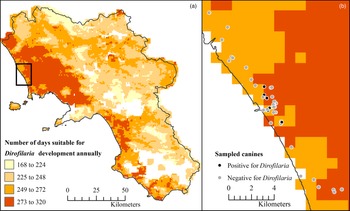
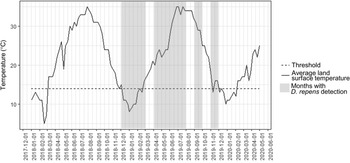
Throughout the Campania region, temperatures were suitable for the development and transmission of D. repens for at least 168 days of the year (fig. 1a), and in the study area where sampling was conducted, temperatures were suitable for at least 249 days of the year (fig. 1b). While these values were calculated as the annual number of eight-day periods with an average LST greater than 14°C, these were converted to number of days for an easier interpretation. The temperatures at the sampled sites ranged from 5°C to 35°C, with most of the D. repens detections coinciding with temperatures above the 14°C threshold (fig. 2).
Average number of days annually above the 14°C threshold, which is associated with suitability for Dirofilaria repens development and transmission throughout Campania (fig. 1a) and in the study area where sampling occurred (fig. 1b) based on LST values from 2018 and 2019. Gaps indicate areas with persistent missing data, likely due to cloud cover, where the number of days could not be reliably calculated.

Temporal variation in temperature derived from MODIS LST values extracted at sampled sites from January 2018 to April 2020. Months when Dirofilaria repens cases were detected are highlighted with vertical grey bars, and the temperature threshold for D. repens development and transmission is indicated with a horizontal dashed line.

Discussion
The present study, which was conducted in a coastal area with wetlands, reveals an increase of prevalence of D. repens in the Campania region (10%), compared with a previous study that was conducted further inland in the same region (2%) (Capuano et al., Reference Capuano, Landolfi, Veneziano and Cringoli1997; Cringoli et al., Reference Cringoli, Rinaldi, Veneziano and Capelli2001). In particular, the authors detected D. repens as a single infection in 3/351 (0.8%) dogs, with microfilariae of Dipetalonema reconditum in 2/351 (0.6%) dogs and with microfilariae of D. immitis in 2/351 (0.6%) dogs (Cringoli et al., Reference Cringoli, Rinaldi, Veneziano and Capelli2001). The difference recorded could be related to an increase in prevalence in this region over the past two decades, differences in the geographic characteristics of the two areas studied or the influence of human activities on the natural environment. The area surveyed in 2001 had a higher elevation and fewer bodies of water and wetlands than the current study area, and local populations of the vector species, Aedes albopictus, had more recently become established in the region at that time (Cancrini et al., Reference Cancrini, Romi, Gabrielli, Toma, Di Paolo and Scaramozzino2003).
When each variable was included in a regression model to assess the presence of risk factors for the incidence of D. repens, a lack of significant association was seen when using a significance level of 5% . Considering the same model, but using a significance level of 1%, the variable ‘use’ became significant (P = 0.0056), making the probability that ‘use’ influences the incidence of dirofilariasis by less than 1%. These results contrast with the general belief that older, male guard dogs with a prevalent outdoor lifestyle are at higher risk of dirofilariasis. Furthermore, the lack of use of a regular flea prevention was not associated with dirofilariasis. However, such results could be skewed since 88% of the dogs (affected and not) were on some form of flea prevention.
The results of this study showed a relatively high prevalence of D. repens in healthy dogs, confirming that subcutaneous dirofilariasis is often an asymptomatic infestation (Sabūnas et al., Reference Sabūnas, Radzijevskaja, Sakalauskas, Petkevicius, Karveliene, Ziliukiene, Lipatova and Paulauskas2019). The reason why this infestation may be predominantly asymptomatic is not completely understood, and is probably due to multiple factors, including preventative medications, degree of the infestation or even the presence of co-infections. In this study, 12% of dogs did not receive a routine parasiticide treatment, while the rest of the population did not receive any heartworm prevention drug potentially effective against D. repens (e.g. moxidectin, milbemycin or ivermectin).
Asymptomatic presentation could also reflect a not ‘mature’ infestation since the time necessary for parasites to develop to the adult stage and become fertile can vary (Ciuca et al., Reference Ciuca, Vismarra, Lebon, Beugnet, Morchon, Rinaldi, Cringoli, Kramer and Genchi2020). Moreover, the clinical presentation could be related to the presence of Wolbachia spp. This endosymbiont bacterium may play a significant role in desensitization of host innate immunity, also assuring the nematodes’ long-term survival (Genchi et al., Reference Genchi, Kramer, Sassera and Bandi2012). According to previous studies, the dogs positive for D. repens also showed a coinfection with other canine vector-borne diseases like E. canis and D. immitis (Pingen et al., Reference Pingen, Lorentz, Magnis, Menn, Schaper and Naucke2009; Kartashev et al., Reference Kartashev, Batashova and Kartashov2011; Pantchev et al., Reference Pantchev, Etzold, Daugschies and Dyachenko2011), with one dog testing positive for D. immitis (1/10) using Knott's method, but negative by PCR analysis. On the contrary, E. canis was the most common (4/10 dogs) coinfection detected in this cohort. This percentage was lower when the Canine SNAP 4Dx® test was considered; when compared with ELISA, the presence of ten false negative results was seen. False negative could be the result of the different cut-off value of the SNAP4Dx®, which requires a higher minimal antibody titre for a positive readout. In addition, in two dogs, the Canine SNAP 4Dx® test showed false positive response for D. immitis (not confirmed by PCR). In these cases, a possible cross-reactivity between the somatic antigens of D. immitis and D. repens could be considered (Ciuca et al., Reference Ciuca, Simòn, Rinaldi, Kramer, Genchi, Cringoli, Acatrinei, Miron and Morchon2018).
Although the Campania region is endemic for L. infantum/chagasi infection, with a prevalence and incidence in canine population of 10–40% and 5%, respectively (Baldi et al., Reference Baldi, Mizzoni and Guarino2004), dogs enrolled in the present study did not show the presence of anti-Leishmania antibodies. In 2000, the risk for human population to become infected by this protozoon was around 0.002%, and 143 cases of human visceral leishmaniasis have been recorded in Italy, with half of them (83 cases) recorded in the Campania region (Medlock et al., Reference Medlock, Hansford, Schaffner, Versteirt, Hendrickx, Zeller and Van Bortel2012). It is possible that the absence of positive reaction to Leishmania testing may be due to local conditions that are unsuitable for the sand fly vectors in the study area (Rossi et al., Reference Rossi, Rinaldi, Musella, Veneziano, Carbone, Gradoni, Cringoli and Maroli2007); however, further surveillance and modelling efforts would likely improve our understanding of fine-scale sand fly distributions in the region.
In contrast, the spatial and temporal analyses indicate that the study area provides temperature conditions that are suitable for the extrinsic incubation of the D. repens parasite throughout much of the year. Urban and suburban areas throughout the Campania region can sustain populations of A. albopictus and the species is capable of overwintering in the region (Cancrini et al., Reference Cancrini, Yanchang, Della Torre and Coluzzi1988; Romi et al., Reference Romi, Severini and Toma2006). Based on the maps of temperature suitability, LSTs in the area where sampling was conducted typically allow development of the parasite within the mosquito vector for 68–87% of the year, meaning that extrinsic incubation is likely only disrupted annually during brief wintertime dips in temperature (Romi et al., Reference Romi, Severini and Toma2006). While some dogs tested were positive for D. repens at times when temperatures were below the 14°C threshold for parasite development within the mosquito vector, these cases were likely previously infected when conditions were warm enough. This observation underscores the need for continued surveillance activities year-round.
In conclusion, this is the first study conducted in the deltaic coastal plain in Italy – a geographic area with typical environmental conditions that seems to play an important role in the incidence of cutaneous dirofilariasis in asymptomatic dogs.
Acknowledgements
The authors are highly thankful to Drs Stefano De Arcangeli and Tommaso Furlanello for providing the necessary facilities and for their experience in biomolecular analysis.
Financial support
This study received funding from the European College of Veterinary Dermatology (ESVD).
Conflicts of interest
None.
Ethical standards
This study was approved by the Ethical Animal Care and Use Committee PG2019/0028159 (date of approval: 19 March 2019) of the Department of Veterinary Medicine and Animal Productions, University ‘Federico II’ of Napoli. The authors assert that all procedures contributing to this work comply with the ethical standards of the relevant national and institutional guides on the care and use of animals.
Author contributions
M.F. and R.M. contributed equally to this work, collected samples, conducted and supervised the laboratory test. D.C. conducted the laboratory test. S.J.M. conducted GIS analysis. M.P.d.C. performed the statistical analysis. A.D.L. and M.F. conducted clinical examinations of the animals. M.F., R.M., D.S., A.D.L., conceived the study design. D.S., A.D.L., and S.J.M. wrote the manuscript. All authors read and approved the final manuscript.