INTRODUCTION
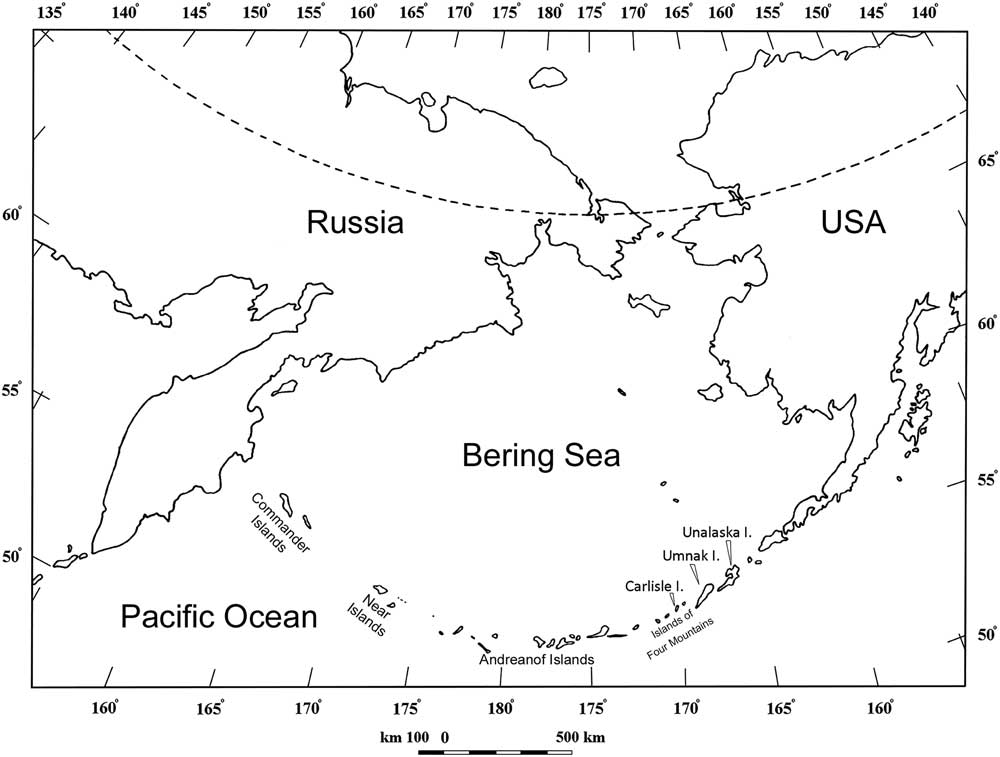
Archaeological and biological evidence currently suggests that Aleut ancestors crossed the exposed Bering Land Bridge to the Alaska Peninsula before turning westward and migrating across the Aleutian chain from east to west (West et al., Reference West, Crawford and Savinetsky2007; Crawford and West, Reference Crawford and West2012). In the north Pacific, the Aleut dispersal was limited to available landfalls; the 1800-km-long Aleutian archipelago forms a curved line of more than 200 islands, divided into six island groups separated by turbulent ocean passes (Fig. 1). Geological evidence indicates the Aleutians were habitable near the beginning of the Holocene; glaciers had started to recede across the archipelago by 11,000 yr (Black, Reference Black1976; Heusser, Reference Heusser1990). Radiocarbon dates from prehistoric sites indicate Aleuts initially settled the Fox Islands circa 9000 yr (Laughlin, Reference Laughlin1975; Davis and Knecht, Reference Davis and Knecht2010; Davis et al., Reference Davis, Rogers and Knecht2016), inhabited the Andreanof Islands by 6000–7000 yr (O’Leary, Reference O’Leary2001; Savinetsky et al., Reference Savinetsky, West, Antipushina, Khasanov, Kiseleva, Krylovich and Pereladov2012), and were in the Near Islands probably by at least 3200 yr (West et al., Reference West, Lefèvre, Corbett and Savinetsky1999; Corbett et al., Reference Corbett, Lefèvre and West2010; Savinetsky et al., Reference Savinetsky, Khasanov, West, Kiseleva and Krylovich2014). Its strategic location between the Fox and the Andreanof Islands suggests that the Four Mountains region was probably settled sometime between 9000 and 7000 yr (and see Krylovich et al., this volume). Transiting Samalga Pass, a 40-km-wide strait that separates the Fox Islands from the Four Mountains, was the first test of Aleut seafaring skills; today, as in the past, unpredictable ocean currents circulate there. In the central Aleutians, landfalls are farther apart and in the far west it is sometimes impossible to see the next coastline between broadly spaced islands. The widest and roughest interisland pass in the Aleutians, 234 km long, separates the Rat Islands from the Near Islands except for one tiny island, Buldir. Thee most occidental Commander Islands, located 363 km west of Attu in the Near Islands, were never prehistorically settled (Hrdlička, Reference Hrdlička1945).
Aleutian map showing locations of major island groups.

Early hypotheses, grounded in more than a century of Aleutian archaeological research, proposed that a single cultural group settled the Aleutian Islands and subsequently developed there in isolation (Jochelson, Reference Jochelson1925; Laughlin, Reference Laughlin1980; Black, Reference Black1983; Hatfield, Reference Hatfield2010). In the 1930s, physical anthropologist Hrdlička (Reference Hrdlička1945) crossed the Aleutian archipelago collecting human skeletons and artifacts for the Smithsonian Institution. He recognized two distinct head shapes in the Native skeletons; a dolichocepalic (longer-headed) type that he assigned to Pre-Aleuts and a brachiocephalic (shorter-headed) form he termed Aleuts. Studying variations in human crania and burial customs, Hrdlička proposed that brachiocephalic Aleuts: (1) initially occupied the eastern Aleutians approximately 1000 yr, (2) probably came from the Alaska Peninsula, and (3) ultimately replaced dolicocephalic pre-Aleuts who had been living in the archipelago since its initial settlement. Laughlin (Reference Laughlin1958, Reference Laughlin1963a, Reference Laughlin1963b) extensively analyzed these human remains, renaming them Paleo- and Neo-Aleut (Laughlin, Reference Laughlin1974, Reference Laughlin1975). Aigner (Reference Aigner1970) and Laughlin (Reference Laughlin1975) contended that differences in Aleutian cranial types represented genetic isolation in western Aleut groups, rather than a migration and replacement event.
Archaeologically, the sites, features, and artifacts do not reveal distinctions between the Paleo-Aleut and Neo-Aleut populations. Although houses and artifact styles change over time and vary along the chain, they are more similar than dissimilar and reflect continuity. Based on intermittent and sparse archaeological research across the chain, archaeologists have documented the following patterns: (1) house features between 9000 and 4000 yr appear as small tent-like depressions and possible post molds in the eastern Aleutians, (2) houses between 4000 and 1000 yr are round, oval, or rectangular and semisubterranean across the chain, but also include stone-lined houses in the eastern Aleutians during the Neoglacial (4000–3000 yr), and (3) houses after 1000 cal yr BP are larger than before and include longhouses and multi-room houses in the eastern Aleutians and large “chief’s” houses in the western Aleutians (Knecht and Davis, Reference Knecht and Davis2001; Veltre and McCartney, Reference Veltre and McCartney2001; Davis and Knecht, Reference Davis and Knecht2010; Corbett, Reference Corbett2011; Gordaoff, Reference Gordaoff2016).
Davis and Knecht (Reference Davis and Knecht2010), comparing material culture from 17 sites situated in Unalaska Bay in the eastern Aleutians, described cultural continuity extending back 9000 yr. Overall, new tool forms, such as small projectile points similar to Arctic Small Tool tradition tools in Margaret Bay level 2, and new house and hearth types appear. Davis and Knecht (Reference Davis and Knecht2010, p. 521) found the “archaeological record demonstrates the continued use of basic lithic, bone, and ground-stone technologies throughout major portions of the entire sequence.” It may be that the appearance of the ulu and, perhaps more importantly, new stone materials like slate around 1000–800 yr can be linked to the arrival of a Neo-Aleut population; however, currently the composite tool kit reflects historical continuity through time (Hatfield, Reference Hatfield2010) and stone and bone tools cannot definitively be associated with the Haplogroups differentiating Paleo-Aleut and Neo-Aleut human remains.
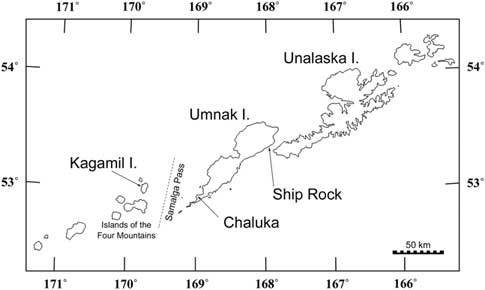
In the past decade, anthropologists at the University of Utah combined mtDNA, radiocarbon, and stable isotope studies in order to examine this peopling event. Testing Hrdlička’s replacement hypothesis, Utah researchers conducted mtDNA and stable isotope analyses on 80 radiocarbon-dated Aleut crania from a prehistoric village and two burial caves in the eastern Aleutians (Coltrain et al., Reference Coltrain, Hayes and O’Rourke2006; Smith et al., Reference Smith, Hayes, Cabana, Huff, Coltrain and O’Rourke2009; Coltrain, Reference Coltrain2010). The samples included 32 (30 Paleo-Aleut and 2 Neo-Aleut) from Chaluka village; 16 (9 Paleo-Aleut and 7 Neo-Aleut) from Ship Rock; and 32 (2 Paleo-Aleut and 30 Neo-Aleut) from Kagamil (Fig. 2).
Map showing locations of Chaluka village, Ship Rock, and Kagamil caves in the eastern Aleutians. Samalga Pass separates Kagamil from Chaluka and Ship Rock (from Misarti and Maschner, Reference Misarti and Maschner2015).

According to the Utah research, skeletons dating older than 1000 yr (i.e., Hrdlička’s Pre-Aleut) represented people with high frequency (72%) of haplogroup A, who ate a comparatively low trophic diet and, for the most part, buried their dead in simple, open-air graves. Some, but not all, skeletons dating later than 1000 cal yr BP possessed higher levels (77%) of haplogroup D, represented people who ate a higher trophic diet, and practiced mortuary customs including cave burials (Raff et al., Reference Raff, Tackney and O’Rourke2010; Byers et al., Reference Byers, Yesner, Broughton and Coltrain2011). In summary, circa 1000 yr, humans with higher levels of haplogroup D, a relatively recent genetic variation in the Aleutians, co-existed with, but did not replace, peoples possessing higher levels of haplogroup A. mtDNA analyses indicated that Aleuts pre-dating 1000 cal yr BP are genetically distinct from later prehistoric and contemporary Aleuts. Both Paleo- and Neo-Aleuts postdating 1,000 cal yr BP, however, are genetically similar to contemporary Aleut populations, who possess high frequencies of haplogroup D with haplogroup A also present (Merriwether et al.,Reference Merriwether, Rothhammer and Ferrell1995; Schurr and Wallace, Reference Schurr and Wallace1999; Rubicz, Reference Rubicz2001; Smith et al., Reference Smith, Hayes, Cabana, Huff, Coltrain and O’Rourke2009). Smith et al. (Reference Smith, Hayes, Cabana, Huff, Coltrain and O’Rourke2009) added that whatever demographic shift occurred influenced eastern Aleutian maternal lineages.
Coltrain’s (Reference Coltrain2010) plotted dates show a demographic transition in Aleut chronology at approximately 1000 cal yr BP; furthermore, Paleo-Aleuts and Neo-Aleuts overlap for at least 450 yr. Coltrain et al. (Reference Coltrain, Hayes and O’Rourke2006, p. 545) reported: [i]ncreased social complexity coincident with the arrival of Neo-Aleut people is also supported by the post-1000 BP appearance of fortified refuge rocks and longhouses, the latter not found west of the Islands of Four Mountains but reminiscent of large, multi-roomed, semi-subterranean residential structures on Kodiak Island and the Alaska Peninsula (Johnson and Wilmerding, Reference Johnson and Wilmerding2001; McCartney and Veltre, Reference McCartney and Veltre2002; Fitzhugh, Reference Fitzhugh2003).” Coltrain et al. (Reference Coltrain, Hayes and O’Rourke2006), citing previous work of Maschner and Reedy-Maschner (Reference Maschner and Reedy-Maschner1998) and Fitzhugh (Reference Fitzhugh2003), proposed that increased social complexity—technological intensification, defensive sites, distinctive mortuary practices, or higher levels of violence on the Alaska Peninsula and Kodiak—possibly indicated Neo-Aleut population emigration from either of these two areas into the Aleutian chain.
Misarti and Maschner (Reference Misarti and Maschner2015) posited that Coltrain (Reference Coltrain2010) incorrectly calibrated the 80 skeletal samples dated by traditional radiocarbon methods. They warned that Coltrain’s use of a correction based on marine shell from Pavlov Harbor on the south side of the western Alaska Peninsula (ΔR 237±50, later revised to 242±50 yr) resulted in skeletal dates that were artificially old. Misarti and Maschner (Reference Misarti and Maschner2015) suggested that other marine corrections had been derived for the North Pacific region; these included calibrations by Dumond and Griffin (Reference Dumond and Griffin2002), who compared dates of Bering Sea bone and shell samples with dates from charcoal, obtaining variations ranging as high as 460±41 to 737±20 yr. These researchers also contended that the dates of the skeletal remains should be consistent with data recovered from the archaeological record. Misarti and Maschner (Reference Misarti and Maschner2015) recalibrated the conventional dates of the 80 burials using an average of ten ∆R values (http://calib.qub.ac.uk/marine/; Reimer et al., Reference Reimer, Baillie and Baird2004) from the North Pacific, Bering Sea, and Bering Straits (∆R of 455±81 yr). Replotting the Chaluka burial dates with those from the Kagamil and Ship Rock caves, Misarti and Maschner (Reference Misarti and Maschner2015, p. 69) found that “the beginnings of the Neo-Aleut is now after 700 BP.” They noted that the later Neo-Aleut transition correlated well with information revealed in the eastern Aleutians archaeological record. Misarti and Maschner (Reference Misarti and Maschner2015) proposed that no population migration occurred into the eastern Aleutians circa 1000 cal yr BP and countered that changing regional interactions including increasing social complexity, altered marriage patterns, and warfare-influenced matrilineal lineages, including an influx of Kodiak women into the eastern Aleutians circa 800–600 yr.
The North Pacific problem: the marine reservoir effect
Timing of changes in culture history depends on accurate radiocarbon dates. In the Aleutians, dating is most robust when samples are derived from terrestrial organic materials transported by humans to prehistoric sites. Aleutian terrestrial dates include: plants burned during volcanic eruptions, bones of terrestrial feeding birds including cackling goose and ptarmigan, or organic artifacts including baskets and mats constructed of grass. Although archaeologists commonly date charcoal or wood, in the Aleutians these originate from driftwood that may have floated in the sea, or been buried, for years or centuries. Some Aleutian dates are incorrect because of the so-called marine reservoir effect. North Pacific waters comprise a reservoir of ancient carbon that rises to the surface during ocean upwelling. Marine mammals, fish, shellfish and many birds derive sustenance from the sea. Subsequently, these animals incorporate this ancient carbon, which makes dated bones and shell appear unusually old (Stuiver and Braziunas, Reference Stuiver and Braziunas1993). In marine settings, apparent radiocarbon age can be partially predicted using the ocean-atmosphere box diffusion model (Oeschger et al., Reference Oeschger, Siegenthaler, Schotterer and Gugelmann1975). Upwelling, sea current patterns, or indented coastlines vary across the North Pacific and can greatly affect the magnitude of the marine age offset. A regional correction factor, designated as ΔR (Stuiver and Braziunas, Reference Stuiver and Braziunas1993), can be estimated by either dating samples of known collection date (usually shells from museum collections) or by comparing radiocarbon ages of coeval marine and terrestrial samples (so-called paired samples).
The number of ∆R value assessments in the North Pacific is limited. McNeely et al. (Reference McNeely, Dyke and Southon2006) reported radiocarbon dates conducted on shells with known collection dates from museum collections. Presented data cover a vast area from the Atlantic coast to British Columbia and were subdivided into 12 regions. In the region related to the present study and designated as Pacific outer coast (McNeely et al., Reference McNeely, Dyke and Southon2006), 31 dates were used for ∆R assessment. The results range from 200±40 to 670±60 yr and demonstrate no clear geographical pattern. Khasanov et al. (Reference Khasanov, Nakamura, Okuno, Gorlova, Krylovich, West, Hatfield and Savinetsky2015) compared radiocarbon ages of coeval marine and terrestrial samples from Adak Island (Central Aleutians Islands) and assessed ∆R value for this part of the Northern Pacific as 545±10 yr. Similar value was obtained for Buldir Island (Central Aleutians Islands; dates originally published by Corbett et al., Reference Corbett, Causey, Clementz, Koch, Doroff, Lefevre and West2008; ∆R calculated by Khasanov et al., Reference Khasanov, Nakamura, Okuno, Gorlova, Krylovich, West, Hatfield and Savinetsky2015). Fitzhugh and Brown (Reference Fitzhugh and Brown2018) conducted paired radiocarbon measurements for the central and northern Kuril Islands. According to their assessment, ∆R value amount to 508±127 yr.
Based on these results, Fitzhugh and Brown (Reference Fitzhugh and Brown2018) hypothesized that the entire North Pacific Subarctic Gyre can be characterized as well-mixed 14C-depleted water basin with ∆R signature of approximately 440±127 yr. This value, however, can be substantially lower in regions with significant input of fresh water, which introduces “new” carbon into the marine environment (see for example Coulthard, et al., Reference Coulthard, Furze, Pieńkowski, Nixon and England2010). The question arises: is the ∆R value of the eastern Aleutians consistent with the current assessments, or is ∆R affected by fresh water from the Alaska mainland?
Few ∆R assessments exist for the eastern Aleutians. Robinson and Thompson (Reference Robinson and Thompson1981) calculated ∆R for Pavlov Harbor (Alaska Peninsula) that yielded a value of 240±50 yr. Dumond and Griffin (Reference Dumond and Griffin2002) measured the marine reservoir offset at Summer Bay (site UNL-092) on Unalaska Island. They did not estimate ΔR values but reported radiocarbon dates obtained from whale bones and charcoal originating from strata of the same age. Dumond and Griffin (Reference Dumond and Griffin2002) calculated dates using whale bones not identified at the species level. Many species of whales are migratory and feed in ocean areas with different characteristics of the carbon cycle. This potentially affects the dating results. Khasanov et al. (Reference Khasanov, Nakamura, Okuno, Gorlova, Krylovich, West, Hatfield and Savinetsky2015) used these data to estimate ∆R and calculated the following values: 250±100, 220±95, and 100±95 yr. All of these values are substantially lower than values obtained for the Kuril Islands (Fitzhugh and Brown, Reference Fitzhugh and Brown2018) and central Aleutians (Khasanov et al., Reference Khasanov, Nakamura, Okuno, Gorlova, Krylovich, West, Hatfield and Savinetsky2015). It is obvious that far more measurements of ∆R value in the eastern Aleutians are needed.
MATERIALS AND METHODS
As part of the Islands of Four Mountains research project, we radiocarbon dated paired marine and terrestrial organisms originating from two excavation units at the Ulyagan archaeological site on Carlisle Island in the Islands of Four Mountains, eastern Aleutians.
Site description
The Ulyagan site represents a village with 93 surface features (small oval features, long houses, and umqans) mapped in 1990 (Cooper, Reference Cooper1991). Our excavations resulted in 32 radiocarbon dates from five units and indicate an occupation history extending 4000 yr (Hatfield et al., this volume). Samples referred to in this paper were taken from Units 4 and 5. Unit 4 was excavated in natural layers to a depth of 200 cm. A shovel probe, continued to 300 cm below ground surface, encountered non-cultural deposits. Midden deposits containing well-preserved organic material (sea urchin shells and vertebrate bones) were located from 60 to 90 cm below ground surface. Between 90 cm and 105 cm, a dark cultural layer contained few bones and invertebrate remains. From 105 to 195 cm, cultural layers intercalated with non-cultural layers. A thin dark cultural layer, interpreted as a house floor, was identified at 198 cm and between 105 and 198 cm; several layers of cultural and non-cultural fill were identified (Hatfield et al., this volume). Unit 5 extended to 120 cm and was divided into three cultural layers. The upper layer, 30–75 cm below surface, was represented by a dense faunal component; a dark dense brown layer, 75–85 cm below surface, contained low concentrations of faunal remains; the lowest layer, 85–120 cm below surface, contained numerous faunal remains.
Sampling
Materials collected during excavations of the Ulyagan site were water-screened through plastic-window, 1.5-mm mesh and faunal remains, along with charcoal fragments, were then handpicked. Khasanov identified each wood fragment using a stereomicroscope and by consulting the InsideWood Working Group (InsideWood, 2004-onwards) database (Wheeler, Reference Wheeler2011). In order to avoid the “old wood” problem associated with driftwood remains, only charred twigs of local shrubs (Empetraceae/Ericaceae species) were used as terrestrial material.
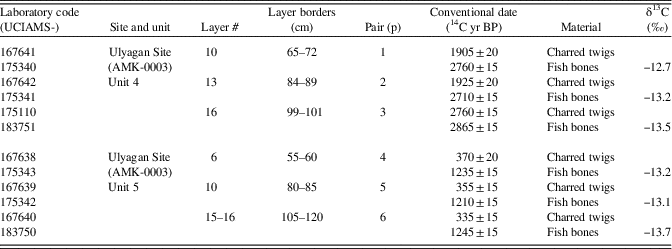
Identification of fish remains were conducted with the reference collection housed in the Laboratory of Historical Ecology (Severtsov Institute of Ecology and Evolution RAS). Uncharred skull bones (praeoperculum) of Irish lord (Hemilepidotus sp.) were used as marine counterpart for each datable pair. This small- or medium-sized fish should be in equilibrium with the local carbon reservoir due to its resident life habit. Three levels from each unit yielded suitable samples comprising six pairs of marine and terrestrial organisms. Individual fish bones and bulk samples of charred twigs were dated. The W.M. Keck Carbon Cycle Accelerator Mass Spectrometry Laboratory, University of California-Irvine, AMS-radiocarbon-dated materials of these pairs. Results are presented in Table 1.
Conventional radiocarbon dates of paired marine and terrestrial organisms from the Islands of Four Mountains, Aleutian Islands, Alaska.

∆R calculations
∆R is defined as the difference between measured and modeled radiocarbon ages of a marine sample (Stuiver and Braziunas, Reference Stuiver and Braziunas1993). The algorithm of ∆R calculation includes four steps: (1) measuring the radiocarbon age of a marine sample; (2) identifying its true age; (3) computing its modeled radiocarbon age corresponding to the true age; and (4) calculating the difference between its measured and modeled radiocarbon ages. In the case of paired dates, the identification of the true age of a marine sample is based on the radiocarbon age of its terrestrial counterpart. According to Stuiver and Braziunas (Reference Stuiver and Braziunas1993), the reservoir deficiency can be calculated without a direct calibration. Model marine conventional 14C ages can be plotted against atmospheric ones. The measured 14C age of the terrestrial sample is then directly converted to a model marine 14C age.
Another approach includes calibration of the terrestrial radiocarbon date. Calibration creates a grid of ages covering that part of the calibration curve, for which age probabilities are greater than chosen threshold value, usually 1 × 10⁻⁵, and calculates the probability of each age from this range. It is possible to compute ∆R value in a series of iterations by choosing one year from a grid of terrestrial ages according to its probability and then looking for the corresponding modeled marine radiocarbon age. With a reasonable number of iterations, a representative series of ∆R value assessments is established. This approach is presented in package “deltar” created by some authors (Khasanov, B.; Khasanov, T.) of this paper in R language (R Core Team, 2015). A detailed description of the calculations and manual can be found at https://cran.r-project.org/web/packages/deltar/index.html.
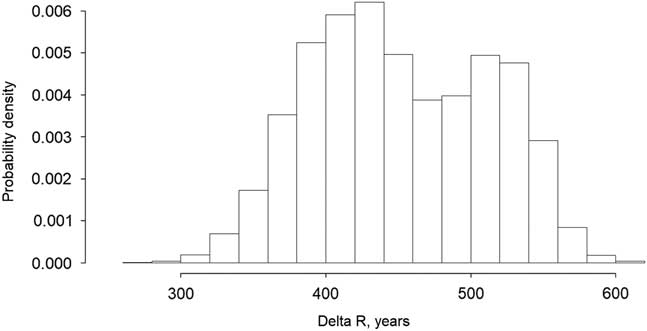
Both approaches give essentially the same results, having been tested on numerous published ∆R assessments conducted on paired dates as well as seashells with known collection date (McNeely et al., Reference McNeely, Dyke and Southon2006; Khasanov et al., Reference Khasanov, Nakamura, Okuno, Gorlova, Krylovich, West, Hatfield and Savinetsky2015; Fitzhugh and Brown, Reference Fitzhugh and Brown2018). All ∆R values used in the current paper were calculated with “deltar” package. ∆R values for pairs p4 and p5 (Table 1), however, have distinct bimodal distributions (Fig. 3) due to calibration-curve shape. Neither assessment of central tendency (mean or median) can be applied in such cases; therefore, ∆R value calculations for these two pairs were based on the Stuiver and Braziunas (Reference Stuiver and Braziunas1993) algorithm.
∆R values distribution for pair p4 (see details in text).

RESULTS
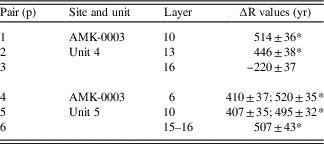
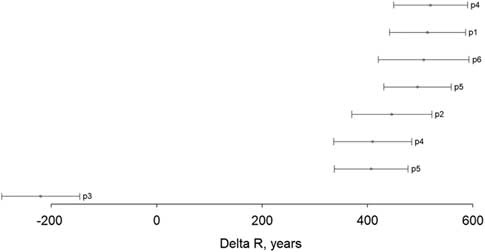
Calculated ∆R values are presented in Table 2 and Figure 4. Mangerud et al. (Reference Mangerud, Bondevik, Gulliksen, Hufthammer and Høisæter2006) proposed to check the internal variability in a group of ∆R values with the chi-square test. Chi-square indicates if this variability is consistent with the standard measurement errors on the individual measurements. If the quantity chi squared / (n−1)≤1, measurement uncertainties explain the variance, then value>1 indicates that the group has additional variance (Mangerud et al., Reference Mangerud, Bondevik, Gulliksen, Hufthammer and Høisæter2006). For all ∆R measurements presented in Table 2, this value is 54.98, which is much more than 1. While the majority of ∆R values is greater than 400 yr, that of pair p3 is much less (−220±37 yr). It is clear that the ∆R value for pair p3 is an outlier; either its marine counterpart is comparatively young or dated terrestrial material is older than the age of the layer. This last assumption seems sounder because of the deepest position of the layer, which contained just a few bones and invertebrate remains (see Materials and Method section). In this particular case, remains of local shrubs from lower horizons could potentially contaminate the sample.
∆R values. Asterisk marks the measurements used for calculation of the mean value.

∆R values of all analyzed pairs. Open circles present median values of the each ∆R assessment, error bars show its 2-sigma intervals.

Pairs p4 and p5 are characterized by two ∆R values each, one close to 410 yr and the other closer to 500 yr. ∆R value of pair p2 lies between (446±38 yr) and ∆R values of pairs p1 and p6 are both close to 500 yr. Thus, the majority of ∆R assessments points to a value close to 500 yr. These measurements are marked with asterisks in Table 2 and their mean is 495±20 yr; statistics proposed by Mangerud et al. (Reference Mangerud, Bondevik, Gulliksen, Hufthammer and Høisæter2006) is 0.63 (χ2=2.51; P=0.642). Further measurements of ∆R value in the eastern Aleutians are required, but our new calculation (495±20 yr) looks realistic, and we used this value for calibration of radiocarbon dates analyzed in this publication.
Using the new ∆R value for the eastern Aleutians, we recalibrated dates from Coltrain et al. (Reference Coltrain, Hayes and O’Rourke2006) and Coltrain (Reference Coltrain2010). These results are presented in supplementary materials (Supplementary Table 1). The new data suggest that the earliest burials at Kagamil in the Islands of Four Mountains appeared at the beginning of the fourteenth century, and the oldest definitive Neo-Aleut burials in the Fox Islands and the Islands of Four Mountains occur in the fifteenth century. New data on the habitation history of the Islands of Four Mountains indicates at least 4000 yr of occupation history and the most recent habitations correspond in age with the burials in the Islands of Four Mountains and the Fox Islands (Hatfield et al., this volume; Krylovich et al., this volume).
DISCUSSION
Beginning circa 9000 years ago, Paleo-Aleuts discovered and settled nearly 1800 km of territory from the Alaska Peninsula to the Near Islands in the far western Aleutians. During their maritime trek, they discovered uninhabited islands and near-shore environments possessing abundant economic and technological resources. By the fourteenth century, Neo-Aleuts were at Chaluka on Umnak Island in the eastern Aleutians. Both Coltrain (Reference Coltrain2010) and Misarti and Maschner (Reference Misarti and Maschner2015) cite rising social complexity, trade, or conflict as possible reasons for this change in mitochondrial DNA in the eastern Aleutians. Variations in biological and physical resources, climatic fluctuations, geological events, and altered social conditions probably periodically played roles in all Aleutian movements.
Using a newly developed ΔR for the eastern Aleutians, our calibrations of conventional dates for Chaluka, Ship Rock, and Kagamil skeletons indicate that Neo-Aleut buried their dead several hundred years later than the 1000 cal yr BP date proposed by Coltrain (Reference Coltrain2010), closer the 700–800 cal yr BP time framework proposed by Misarti and Maschner (Reference Misarti and Maschner2015). In our calibrated sample, the oldest Paleo-Aleut open-air burial occurred over 3000 yr at Chaluka (1277–992 BC). Neo-Aleuts were burying their dead at the same village 2500 yr later at AD 1375 (AD 1305–1446); this date is our earliest human osteological evidence for Paleo-Aleut/Neo-Aleut interactions in the eastern Aleutians. The most recent Paleo-Aleut and Neo-Aleut open-air burials at Chaluka date to approximately the same time, AD 1846 (1721 to present) and AD 1850 (1721 to present) respectively. Our corrected radiocarbon dates of skeletal elements indicate that Paleo-Aleuts and Neo-Aleuts were in contact with each other by the later fourteenth century and continued to periodically bury their dead at this Fox Island village until the mid-nineteenth century. The oldest definitive Neo-Aleut cave burial occurred during the fifteenth century (AD 1335–[1420]–1489) at Ship Rock, approximately a century after Paleo-Aleuts were performing cave burials. Paleo-Aleuts buried one person in the Kagamil cave at AD 1305 (AD 1208–1412) and buried a second there at AD 1595 (AD 1501–1681). Neo-Aleuts first buried their dead in the cave at AD 1470 (AD 1390–1568) and continued to entomb 29 more in this location until AD 1865 (1724 to present). At Kagamil, Neo-Aleuts temporally overlap with Paleo-Aleuts between 1470 and 1595, a total of 125 yr.
Kagamil dates appear to be somewhat at odds with literary accounts. Historic and ethnographic literature records that Aleksei Chirikov, a Russian navigator on Bering’s expedition, first spotted the Four Mountains in AD 1741, when approximately 100 Natives apparently inhabited them; subsequently, the islands were rapidly depopulated (Veniaminov, Reference Veniaminov1984). After particularly severe Russian treatment during the AD 1761–1762 hunting/trapping season, Aleut warriors from the Four Mountains, Umnak, Unalaska, and Akutan Islands killed members of a Russian fur-trading expedition, an action for which the Russians brutally retaliated circa AD 1763–1764 (Laughlin, Reference Laughlin1980; Black, Reference Black1984). Russian Stepan Glotov “destroyed totally, without a remnant, all the villages on the south side of Umnak and the inhabitants of Samalga and the Four Mountains…almost all the men perished…while some of the women died of hunger and the rest were resettled on Umnak” (Veniaminov, Reference Veniaminov1984, p. 251). Coxe (Reference Coxe1780, p.157) described a second massacre of Four Mountain Aleuts by a Russian party, sent to collect tribute in AD 1767, after which only seasonal fur-hunting expeditions occurred in the region. Litke (in Hrdlička, Reference Hrdlička1945, p. 34) reported 12 Natives (possibly from nearby Akun) living in the island group in AD 1825. Thereafter, Aleuts from Atka (Dall, Reference Dall1877; O’Leary, Reference O’Leary1993a) and Unalaska (Swanson, 1982) periodically hunted and trapped in the region. By the time of Veniaminov, a Russian priest and ethnographer (circa AD 1830), the Four Mountains region was no longer permanently occupied. Using a local Aleut named Afenogin as an informant, Bank (Reference Bank1956, p. 231) noted: “Kagamil, he [Afenogin] said, once had many villages. Their people had fought bitterly with the Umnak Aleuts, and in time they were all destroyed except for one Kagamil village that lasted until after the Russians arrived in the islands. As the people from this village died, the survivors mummified the corpses and placed them in nearby dry caves.” Laughlin and Marsh (Reference Laughlin and Marsh1951) suggested that artifacts associated with some mummies probably postdated Russian contact and Laughlin (Reference Laughlin1958, p. 54) noted that people living in Nikolski village on Umnak knew the names of some of the people buried at Kagamil. More recently, Frolich and Laughlin (Reference Frolich and Laughlin2002) and Hunt (Reference Hunt2002) noted remarkable preservation of some Kagamil mummies collected by Hrdlička in the 1930s. These authors suggested that some of these mummies Hrdlička must have been deposited there after the Hennig collection at the same location in the 1870s. Our relatively recent dates for some Kagamil burials indicate that Aleuts continued to inter their dead in the Four Mountains, although they no longer permanently lived there.
Cave burials have been associated with elites, honored families, or accomplished hunters (Hrdlička, Reference Hrdlička1945; Coltrain et al., Reference Coltrain, Hayes and O’Rourke2006; Misarti and Maschner, Reference Misarti and Maschner2015; Johnson, Reference Johnson2016), indicating a complex hierarchical society. Ethnographic writings and the plethora of magnificent grave goods in eastern Aleutian cave sites support this idea (Hrdlička, Reference Hrdlička1945; Black and Liapunova, Reference Black and Liapunova1988; Black, Reference Black2003). Rich accouterments including kayaks, whale bone coverings, finely woven matting, wooden bowls, and feathered offerings suggest burials of high-status individuals or families. Cave burials are found across the Aleutians from the Four Mountains to the Near Islands (Hrdlicka, Reference Hrdlička1945; Bank, Reference Bank1956; West et al., Reference West, Lefèvre, Corbett and Crockford2003), and we suggest that not all cave burials represent elite individuals or families. Our corrected radiocarbon dates indicate that some very recent Neo-Aleut Kagamil burials are historic and could represent peoples who were trapping on Kagamil when they died or were transported to the cave from nearby islands. It is important to remember that organics do not survive in highly acidic volcanic soils unless they are preserved in alkaline shell middens that buffer the soil. We suggest that some Aleutian open-air burials may have been as rich, or nearly as rich, as those in caves, but organic grave goods in open sites did not survive.
Both Coltrain et al. (Reference Coltrain, Hayes and O’Rourke2006) and Misarti and Maschner (Reference Misarti and Maschner2015) cite cultural complexity, increasing population, and escalating conflict as incentives for human movement in Alaska Peninsula, Kodiak, and eastern Aleutians. Post-1000 cal yr BP evidence of fortified refuge rocks, appearance of longhouses (Veltre and McCartney, Reference Veltre and McCartney2001), and skeletal trauma (Keeneyside, Reference Keenleyside2003) testify to increasing complexity and social tensions in the Aleutians during late prehistory. At Russian contact in AD 1741, the ‘Akuugun, a distinct Aleut group, inhabited at least a dozen villages and buried their dead in caves and clefts in the Islands of Four Mountains (O’Leary, Reference O’Leary1993a). Many of the United States Bureau of Indian Affair’s reports for the Islands of Four Mountains (e.g., Cooper, Reference Cooper1991; Turck, Reference Turck1992; O’Leary, Reference O’Leary1993a, Reference O’Leary1993b, Reference O’Leary1993c) described presumably late prehistoric Four Mountains sites that cover acres. These include huge depressions or “longhouses” indicating communal living of large populations, feature umqans and/or burial mounds, and ground slate tools—relatively recent artifacts in the Aleutian inventory. Veltre and McCartney (Reference Veltre and McCartney2001) excavated and radiocarbon dated similar features as protohistoric at Reese Bay on Umnak Island in the Fox Islands; the Reese Bay longhouse was first constructed in the seventeenth century. Midden (i.e., kitchen refuse) deposits associated with a longhouse on Carlisle Island in the Four Mountains provided dates of 190±15 14C yr BP on terrestrial goose bone (Hatfield et al., Reference Hatfield, Bruner, West, Savinetsky, Krylovich, Khasanov and Vasyukov2016; Hatfield et al., this volume). Currently, the time depth for the eastern Aleutians large village/longhouse tradition is unknown, although umqan burial features are believed to be no more than 600 yr old (Aigner and Veltre, Reference Aigner and Veltre1976; Aigner et al., Reference Aigner, Veltre, Fullem and Veltre1976). Accurate dating of longhouse features, umqan burials, and refuge rocks can help temporally refine eastern Aleutian cultural complexity and the Neo-Aleut transition.
CONCLUSIONS
In the east, the Amaknak Phase of Aleutian culture history includes archaeological sites dating between 3000 and 1000 cal yr BP (Hatfield, Reference Hatfield2010; Davis et al., Reference Davis, Rogers and Knecht2016). During this time, eastern Aleuts began using more ground slate tools (ulus), creating sophisticated bone tools, including elaborate harpoon types, and wearing a greater variety of personal adornments, including a wide array of labrets (Knecht and Davis, Reference Knecht and Davis2001; Hatfield, Reference Hatfield2010). Unique, A-shaped burial cairns, known as umqans, appeared and possibly indicate changing social organization and/or belief systems (Aigner et al., Reference Aigner, Veltre, Fullem and Veltre1976; Knecht and Davis, Reference Knecht and Davis2001). After 1000 yr, populations and social complexity increased (Corbett et al., Reference Corbett, Lefevre and Siegel-Causey1997). Longhouses and fortified sites appeared, and ground slate became more common (Knecht and Davis, Reference Knecht and Davis2001; Hatfield, Reference Hatfield2010). According to Holland (Reference Holland1988, Reference Holland2001, Reference Holland2004), the Chulka site in the Krenitzen Island group near the Alaska Peninsula represents a Neo-Aleut settlement featuring brachiocephalic Neo-Aleuts, domesticated dogs morphologically similar to Kodiak types, an abundance of slate (presumably imported from Kodiak), and dates to less than1000 yr old. The Chulka evidence pre-dates Neo-Aleut burials at Chaluka, Ship Rock, and Kagamil, but some of the Chulka dates based on charcoal might be artificially old. However, it seems apparent that Neo-Aleuts (whoever and wherever they were) and Paleo-Aleuts were interacting for many years prior to Neo-Aleut burials in the eastern Aleutians.
The human burials from Chaluka, Ship Rock, and Kagamil provide mtDNA and stable isotopic evidence that genetically distinct humans who apparently ate different foods were interred in the eastern Aleutians by at least AD 1375. It is critical to remember, however, that the skeletons alone provide little information about when Neo-Aleuts first interacted with Paleo-Aleuts and what characterized that interaction. Coltrain (2010) and colleagues (Coltrain et al., 2006) proposed that Neo-Aleuts moved as a population into the eastern Aleutians. Misarti and Maschner (Reference Misarti and Maschner2015, p. 67) deemed that “genetic and isotopic differences found are based not on population movements but on the beginnings of social complexity, differential access to higher status foods, and the acquisition of wives from the Kodiak region to the east.” To muddy the waters, Holland (Reference Holland2001) reported on two villages, Chulka and Saa, on Akun in the Krenitzen Islands just west of the Alaska Peninsula. Based on differences in human head shapes, artifact types, and radiocarbon dates, Paleo-Aleuts inhabited Saa beginning 1155 BC and Neo-Aleuts first inhabited the Chulka village between AD 600–700 and lived there until the late nineteenth century. It is important to remember that the oldest human burial from Chulka was not dated directly, but by charcoal originating from driftwood (Stuckenrath and Mielke, Reference Stuckenrath and Mielke1973). In later prehistory, both Saa and Chulka were occupied at the same time (Holland, Reference Holland2001). Does the evidence from Chulka represent (1) a population movement to Chulka of both males and females bearing a higher percentage of haplogroup D from somewhere else; or (2) the introduction of mtDNA by females bearing a higher percentage of haplogroup D into the Paleo-Aleut group at Chulka sometime prior to AD 600? At Chulka, dog bones were recovered from both prehistoric levels (up to 1000 yr) and historic levels; osteometrics indicate that the Chulka dogs compare most closely with those from Kodiak (Holland, Reference Holland2004). Holland (Reference Holland2001, p. 173) hypothesized that, by at least AD 500, peoples in the eastern Aleutians were extensively interacting with peoples within the Aleutians and “perhaps in a roundabout way with people from Kodiak Island.” Bones of prehistoric domesticated dog bones from the Krenitzen Islands (Holland, Reference Holland2001, Reference Holland2004) and now on Carlisle in the Islands of Four Mountains (Vasyukov et al., this volume) could indicate 1000-yr-old interactions with Kodiak peoples in the far eastern Aleutians and by at least 500 yr in the Islands of Four Mountains. Based on the current evidence, the changes in population genetics and material culture reflect an intermingling of new and old lifeways with slow genetic infringement of Paleo-Aleuts by Neo-Aleuts and the introduction of new tool types, material types, and house forms.
Although our only real evidence of Neo-Aleuts living and dying in the Aleutians is represented by the actual human remains themselves, the Paleo-Aleut to Neo-Aleut transition (Misarti and Maschner, Reference Misarti and Maschner2015) was a slow process evidenced in the archaeological record (dogs, ground slate tools, and conflict) occurring over centuries prior to Neo-Aleut burials in the Fox Islands and Islands of Four Mountains. The message of this paper bears repeating. Timing of changes in culture history depends on accurate radiocarbon dates. Dates on charcoal originating from driftwood that has floated in the sea for many years are inaccurate. Without correction factors, radiocarbon dates on bones of animals with marine based diets are inaccurate. Dating is most robust when samples are derived from terrestrial organic materials: (1) plants burned during volcanic eruptions; (2) terrestrial-feeding birds, including cackling goose and ptarmigan; or (3) artifacts made from local grasses. If remains of Aleutian marine mammals, fish, shellfish, most birds, or humans are dated, these must be calibrated using a correction factor that is accurate for the region being studied. It is time to carefully revisit radiocarbon dates previously derived from the eastern Aleutians in order to study, correctly calibrate, and compare them in order to temporally refine the late prehistory of the eastern Aleutian Islands.
SUPPLEMENTARY MATERIAL
To view supplementary material for this article, please visit https://doi.org/10.1017/qua.2018.91
ACKNOWLEDGMENTS
This research was funded by the National Science Foundation: Grant OPP #1301927; and Grants RFBR No. 15-04-07969 and 18-04-00782. Work was conducted in collaboration with the Aleut Corporation, the Alaska Volcano Observatory, and the Alaska National Maritime Wildlife Refuge. Any opinions, findings, and conclusions or recommendations expressed in this material are those of the author(s) and do not necessarily reflect the views of the National Science Foundation.