Under conditions of colonial subjugation and anti-colonialism, artistic expression and issues of originality often became anxious and highly politicised social matters with public consequences. The socioeconomic transformations of decolonising and postcolonial nations radically altered the public sphere as can be observed in the realm of cultural production. A postcolonial critique, as Robert Young explains, takes a theoretical and political position, which ‘embodies an active concept of intervention within such oppressive circumstances’.Footnote 1 The term postcolonial in this essay is not used as an interventionist concept, however, but signals the conditions brought about after colonialism and imperialism. Subsequent historical circumstances may still be positioned within what Young has described to be ‘imperialism in its later sense of the global system of hegemonic economic power’.Footnote 2
This article argues that sociopolitical events in the late colonial period, often overlooked, were nonetheless significant precursors to the modern art of postcolonial nations. The unique conditions of postwar British Malaya provided fertile grounds for the fermentation of ‘new’ identities, which radically transformed the social, cultural and economic landscape.
British colonial administrators and their families, though a minority, had brought along a system of making and appraising art that was familiar to them, wielding immense influence and authority on its development even as such forms of art became popularised in the colonies over time. Whilst access to such art practices generally remained confined to the more privileged (for example, middle-class European expatriates or the daughters of rich Chinese merchants), there was no stopping talented colonial subjects from developing their talents and skills in similar art forms through emulation or direct study.
The problem, however, was not whether colonial subjects were capable or incapable of making good art, though that appeared at the outset to be the focus of debate; rather, it was a matter of recognising the significance of that art as objects of aesthetic pleasure.Footnote 3 To be able to do so would necessarily identify the persons involved as capable of partaking in such activities of cultivated pleasure that historically were the prerogative of the European upper class. Pierre Bourdieu observes that for an art to imitate art instead of nature, it inevitably contains reference to its own history and demands to be perceived historically, that is ‘it asks to be referred not to an external referent, the represented or designated “reality”, but to the universe of past and present works of art’.Footnote 4 More significantly, the ‘eye’, which seeks to recognise, Bourdieu argues, is ‘the product of history reproduced by education’.Footnote 5 Implicit in the cultivation of one's eye is the cultivation and recognition of ‘high culture’. This process is best exemplified by the way Western upper-middle classes converted economic capital into cultural capital in the nineteenth century as they erected concert halls, art galleries and other ‘temples of culture’.Footnote 6
In nineteenth-century Europe there was a decisive shift towards commercialisation in art, as well as the rise of institutions promoting national art and culture. This shift occurred in Malaya (later, Singapore and the Federation of Malaysia)Footnote 7 in the mid-twentieth century, as observed from the financing and building of cultural centres, museums, art galleries and academies. This included the founding of an arts council and the dispatching of scholars overseas to learn how to contribute to and manage this enlarged cultural infrastructure.
The urgency of establishing a common identity was vividly felt in Singapore, which sought to bridge the gulf separating it from the rest of Malaya. Stirrings of nationalism were triggered in part by Japan's capture and occupation of Singapore in 1942, which reflected the ineptitude of the British as colonisers. Among the Japanese Occupation's effects on society and politics, Malays in particular were encouraged to think of independence from the British, who reasserted their rule over Malaya at the end of the war in 1945. Soon after, however, the British Government began moves to prepare Malaya for self-government.Footnote 8 Singapore was singled out from the Straits Settlements to become a crown colony. Thus the island was excluded from the short-lived postwar Malayan Union scheme and made self-governing in 1959.Footnote 9 But Singapore's relative independence came with the condition of an eventual reunion with the Malayan ‘hinterland’.Footnote 10
The problem of the so-called ‘Malayan situation’, was, as one British official put it, one which concerned ‘three distinct racial groups’: the largely rural Malays were acknowledged as the ‘indigenous race’, and the Chinese and Indians immigrants who were ‘imported as labourers’ or who came to pursue business.Footnote 11 The Chinese formed the core of the Malayan working class; in Singapore they were four-fifths of the population, which explained why the Chinese played a leading role in the political parties.Footnote 12 If a nation is also ‘whatever can get away with establishing its claim to being one’, as historian Rupert Emerson puts it,Footnote 13 art and architecture was to play its role by representing national culture to inculcate a sense of commonality at the height of nation-building. There was an unprecedented fervour to modern art activity in Singapore and Malaya and elsewhere in Southeast Asia throughout the fifties and sixties.Footnote 14 This was not to say that there had been no developments in modern art prior to this period.Footnote 15
There was an increasing recognition of the role of the professional artist as the demand for their creative input and art grew in tandem with the need to refurbish the emerging nations with icons and imagery: art which signified and reflected the change in the socio-political status of these ex-colonies to a local and international audience. This widening public sphere allowed for the organisation of an informal institutional base with the setting up of new art societies, which in turn spurred the growth of exhibition platforms. Such cultural infrastructure provided unprecedented access for all to learn art and become professional artists, concomitantly reinforcing the amateur–professional divide. The following discussion seeks to recover how such art organisations and art academies in Singapore during this period of transition were instrumental in cultivating art professionalism.
Cultivating local professional artists: Art academies and the Singapore Art Society (SAS)
The majority of Singapore's population regarded independence without an official union with its ‘hinterland’ as inconceivable. Nationalist leaders followed ‘Western nationalist rhetoric closely’, adopting the integrationist or assimilationist view,Footnote 16 that is, the British grand design of promoting political amalgamation whilst cultivating a ‘shared cultural identity’, a ‘Malayan culture’.Footnote 17 This political ideology gave Singaporeans and their leaders, including the wider art community, a common goal. For the first time, under the auspices of a new art society, the members of 15 local associations, spanning educational institutions to ethnic arts groups, collaborated to form the Singapore Art Society (SAS) in 1949.
The Society had at least two members of the defunct colonial era Singapore Art Club — Richard Walker and C.G. Jackson, both esteemed and well known within the local art community. Jackson, a trained artist who had lived in Singapore since 1901, was the founder of the YMCA Art Club, and taught young artists such as Lim Cheng Hoe.Footnote 18 Walker, who was appointed the first art master of Government English schools in 1923, was instrumental in the development of art education at the pre-tertiary level and the training of art teachers in Singapore, a task he resumed after his wartime internment.Footnote 19 Walker was among the key founding members of this society; according to him, it was the initiative of Dr Gibson Hill to establish a non-discriminatory society.Footnote 20
The Singapore Art Society grew out of the Stamford Road group, a multicultural group that included artists newly arriving from China and Europe; they met regularly at the British Council's premises in Stamford Road, formerly St Andrew's School, for life classes and painting sessions.Footnote 21 The common aim of the society was to foster the practice and appreciation of art in Singapore; more significantly, it distinguished itself from existing organisations, the vast majority being ethnic-based, by maintaining an open membership rule so that ‘any art lover, regardless of race and creed’ could participate in its activities.Footnote 22
The full council of SAS also included representatives from the major ethnic arts groups and educational institutions in Singapore, such as the British Council, Malay Art Society, Indian Fine Arts, YMCA Art Club and Nanyang University; and prominent arts organisations such as the Society of Chinese Artists (SCA), and the Nanyang Academy of Fine Arts (NAFA).Footnote 23 The remaining founders were either from local institutions or artists in their own right.Footnote 24
The close-knit circle of Chinese émigrés contributed significantly to the nascent modern art world of British Malaya. The Society of Chinese Artists (SCA) was set up by a group of like-minded émigrés from Shanghai and Hangzhou in 1935 to ‘forge close ties’ with their homelands and ‘to lead the way in promoting the arts’.Footnote 25 SCA's members were graduates of art academies in Shanghai (Shanghai Fine Arts College and Xinhua Fine Arts Academy), Japan and Europe, and were ‘conversant in both Chinese and western painting’.Footnote 26 Officially registered in 1936, SCA accepted members from other regional states.Footnote 27
The society has been described as being ‘rather influential in the Malayan art world’, and the ‘nerve centre’ for all communications and activities.Footnote 28 Similar art associations generally kept to their own sociocultural group; there was little (if any) interaction between the Straits Chinese art associations, the colonial art clubs and ethnic-based art societies. The impetus to organise interracial or intercultural activities grew over the years following the establishment of an art academy, and after the Second World War, the institutionalisation of an arts federation council under the rubric of nationalism.
The first formal art school in Malaya to offer tertiary art education was NAFA in Singapore. Yeo Mang Thong asserts that NAFA was founded only with the support of SCA and the Jimei School Overseas Fellowship Association. Lim Hak Tai was selected to run the institute, having earlier founded the Amoy Academy of Fine Arts before moving to Singapore.Footnote 29 ‘High art’ in China had been traditionally practised by the literati and high officials (daguan guiren); thus, those involved in NAFA were determined to extend art learning and art appreciation to the common people (pingming baixing).Footnote 30
When NAFA was first set up in 1938, there were four main faculties — Western Painting, Art Education, Applied Fine Art and Sculpture — the last of which was subsequently replaced by Chinese Art. Due to financial difficulties, there were only three permanent teaching staff: Hak Tai taught water colour and oil painting; Gao Peize, trained in France, taught drawing and sculpture; and Zhong Mingshi taught all classes on decorative arts.Footnote 31 The academy subsequently expanded its curriculum to include Chinese painting and art theory classes. This distinction between so-called ‘Western art’ and ‘Chinese art’ subjects was aligned with the structure also typically found in the new wave of art schools in China such as Xin Hua School of Art and Shanghai Art University.Footnote 32 Although the language of instruction was predominantly Mandarin, the school gradually built up its reputation and over time succeeded in attracting students of all ethnic and cultural groups from around the region.Footnote 33 Nevertheless, Chinese students remained the majority. Although it was uncommon for male and female students to mix, Hak Tai succeeded in appealing to have the proscription on mixed-sex education for students over 12 years lifted so as to attract more students.Footnote 34 More courses were later added — Literature, Music and Woodcuts.Footnote 35
Closed during the war, NAFA was reopened with an invigorated spirit of purpose discernable from its principal's writings about the art school's role and function.Footnote 36 Between 1946 and 1955, Hak Tai recruited a number of established Chinese émigré artists, trained primarily in Beaux Arts-type academies prevalent in China as well in Paris.Footnote 37 Although they worked as art educators, these émigré Chinese artists actively participated in the local exhibitions that were beginning to proliferate as the number of art societies and organisations grow. Redza Piyadasa, among others, observed that modern art activity ‘began in earnest’ with the arrival of these émigré artists.
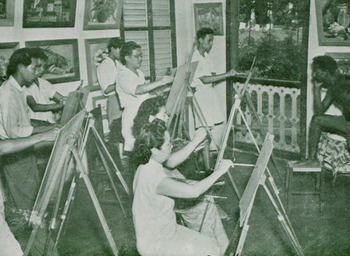
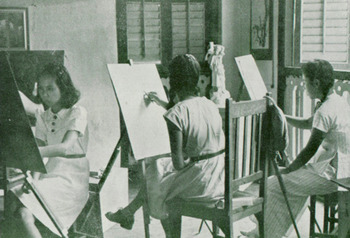
The 1949 NAFA graduation book provides rare glimpses of the academic training the students received (Fig. 1 and Fig. 2). Wynona ‘Noni’ Hope Wright, a New Zealander who first arrived in Malaya as a radio producer before switching to journalism, visited the campus in 1950 and provided an eyewitness account of the school's lively academic culture.Footnote 38 The art academy, which Wright described to be ‘buzzing with activity’, had about 60 students, aged between 16 and 40, with the majority attending morning sessions.Footnote 39 These classes ran for six days a week and the students each paid $10 a month. Upon graduating from the three-year diploma course, the students could qualify to teach by completing a teacher's course. Though little is known about the early graduates, it seems likely that they were absorbed into education or the commercial sector. Wright observed that there was ‘no shortage of jobs’ and most of them became ‘teachers of art at Chinese schools up and down the country’.Footnote 40
Life drawing class at NAFA, 1948/49. (Nanyang Fine Arts Academy 3rd Year Graduation Year Book [南洋美术专科学校复校 3 周年第 3 届毕业纪念刊], Singapore: NAFA, 1949, p. 11.)

Charcoal drawing class at NAFA, 1948/49. (Nanyang Fine Arts Academy 3rd Year Graduation Year Book [南洋美术专科学校复校 3 周年第 3 届毕业纪念刊], Singapore: NAFA, 1949, p. 11.)

NAFA, along with SAS, played an important role in the country's cultural development. Key faculty members were appointed to the selection committees of local exhibitions. Under the SAS's orchestration, changes could be felt in the wider art world as the quantity of exhibitions and art activities increased, while the society's own team and structure became increasingly professional in conduct and expectation.
In her study of British amateur artists and drawing masters, Kim Sloan observes that the term ‘amateur artist’ has acquired a pejorative definition of someone who is not up to professional standards. Further, the lack of interest in exploring this subject is due to a large extent to ‘modern prioritising of professional over amateur’.Footnote 41 She highlights, as an example, how the Society of Painters in Water Colours excluded the work of amateurs from its exhibitions, which marked a substantial break with the earlier close association of amateurs and professionals in Britain.Footnote 42
Such a distinction and so-called ‘break’ became more apparent in Singapore during the 1950s and could be observed from the conduct and guidelines of exhibitions held and organised by SAS. The Society's intention of elevating the artist to a useful profession was unmistakable in Michael Sullivan's essay, published on its tenth anniversary:
The young painter is entitled to a first-class education in his craft, and when he is trained, the patronage of Government, schools, churches and other public bodies, who will commission him to paint portraits, execute portraits, design exhibitions and illustrate books. The idea of an artist as free and unattached, living in a world of his own, is a romantic figment. A society needs his vision […] he must be recognized as a valuable member of the community….Footnote 43
The urgency of recognising the skills and significance of the artist was further augmented by a call to see in the work of ‘Malayan’ painters an answer to the imminent question, ‘What is Malayan culture?’.
Sullivan argued that it was in the minds and imaginations of the Malayan people — artists, writers and musicians — that Malayan culture was created; and this, he stressed, was a recent phenomenon that had occurred in the ‘ten years since Liberation’. Tracing the history of art development in Singapore, Sullivan highlighted only the founding of SCA in 1936, NAFA in 1938 and the postwar YMCA Art Club and Chinese YMCA Art Club for ‘awakening’ and developing an interest in the visual arts.
There was no mention of the colonial art clubs, nor the many ‘amateur’ artistic activities that had taken place before the war, such as the St Andrews Sketching Club, started by Francis Thomas in 1936. Thomas was the first to spearhead the long-running inter-school art exhibitions between Chinese and English-medium schools. Though Brother Joseph McNally provided a more comprehensive account of the art scene in pre-Independence Singapore, citing the importance of weekend sketching clubs in the absence of an art school for artists to obtain training opportunities, he too, did not mention the Singapore Art Club.Footnote 44
Sullivan's account, however brief and preliminary, was nonetheless one attempt to construct a history of Singapore art. Not unlike other similar accounts, it was chronological and focused on the achievements of those perceived to have contributed to a progressive history of art.Footnote 45 Artists, styles, genres and types of art (for example, needlework) that had not contributed to this progress of the arts were excluded.
SAS clearly maintained the distinction between amateur and professional art by distinguishing the work of students (not necessarily formally trained in the arts) and that of the trained and practising artist who might also be working as an art teacher or in an art-related profession. This was apparent from the categorisation of the artists as ‘local artists’, ‘local teachers’ and ‘local art students’, and of art into ‘traditional craft’, ‘religious art’ and ‘contemporary art’.Footnote 46
Yet the work of non-professionals was popular in the Inter-School Art Exhibitions, an annual art competition which was initiated by the St Andrew's Sketching Club in the 1930s before being absorbed into the SAS programme. Exhibitions such as these and Exhibitions on works by local teachers and art students, given their regularity and strong participation, appeared to be popular. Participation was open to all educators, regardless of their specialisation, and to all art students attending a recognised art school or independent art class. At the inaugural 1950 exhibition, Mr L.A. Duckworth from Geylang English Afternoon School, Brother Joseph, Director of St Joseph's Institution, and Mrs A. Gunaratnam from Raffles Girls' School were variously commended for their fine submissions. This exhibition was also well represented by members of the Malay community, with 15 paintings by esteemed Malay painters Suri bin Mohyani and Sulaiman bin Haji Suhaimi as well as traditional craft by the Women Teachers Art Class of the Telok Kurau Malay School and members of the Sepoy Lines Malay School.Footnote 47
The effort expended to ensure culturally diverse and representative art and craft clearly adhered to the Society's mission statement and the wider agenda of creating a common identity vis-à-vis multiculturalism.Footnote 48 In the extensive coverage of this exhibition, clear mention was made not only of the ‘Western’ pieces by the European and local artists, but also of Malay and Chinese embroidery, as indicative of cultural and ethnic diversity and collaboration.Footnote 49
The inter-school exhibitions were reported to be highly popular and successful events. The ninth instalment in 1950 was described as the ‘largest yet held in the Colony’, with a general standard of work which surpassed that seen in previous years.Footnote 50 By continuing to support such popular events, SAS was able to demonstrate their inclusiveness whilst maintaining the amateur–professional divide. The society's flagship annual event, ‘The open exhibition of works by local artists’,Footnote 51 and solo and group shows of local and foreign emerging or established artists, for example, were conceived as a platform to showcase the work of non-amateur artists and to cultivate aesthetic perception and knowledge in the wider Malayan audience.
Initiated on 30 December 1949 and held at the British Council Hall, calls for participation in the Local Art exhibition encouraged all forms of fine art, from oils and pastels to sculpture and modelling, but not the naïve arts such as craft or needlework.Footnote 52 In order to control the quality of the work chosen for the exhibition, it had a selection committee made up of prominent council members, most of whom were either established artists from NAFA or leaders of particular associations.Footnote 53
To promote the art and raise the artists' professionalism, all exhibited work was generally available for sale, with prices listed in the accompanying catalogue. To show the society's inclusiveness, the racial and gender demographics of the participants were made available. It was reported in the fourth annual art exhibition for local artists, for example, that 16 out of the 60 artists represented were women, and 38 (including 3 of the women) were Asian.Footnote 54
Unlike the earlier colonial art club events which restricted participation to Europeans and the social elite, individuals regardless of race, gender or class, could now technically take part provided that their work met the entrance criteria determined by the event's theme and subject. The majority of female contributors who met the requirements for these professional exhibitions were émigré artists, expatriate artists and newly trained art educators in the fine arts. Among them was Kum Yuen Sim, a NAFA-trained artist who participated frequently in SAS's annual Local Artists exhibitions and Malayan Artists' exhibitions at the British Council Centre in Kuala Lumpur.Footnote 55
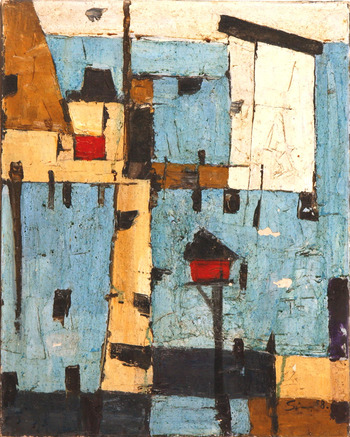
Kum Yuen Sim, Kampung Laut, oil on canvas, 50.4 × 40.4 cm, National Visual Art Gallery Collection, Kuala Lumpur. (Image reproduced with kind permission from the National Visual Art Gallery)

Trained under Cheong Soo Pieng at NAFA, Kum employed the modernist painting techniques prevalent in the work of her Beaux Arts-trained artist-instructor. This was particularly evident in her painting, Kampung Laut (Sea Village), which shows a highly stylised representation of a seascape, depicting a village by the sea. Cheong, who joined the school as a lecturer in Western Art, worked and experimented with different styles and media; his students were observed to have followed suit and were exposed to Impressionist, Fauve, Cubist and Abstract art.Footnote 56 This painting is a fine example of how Kum confidently used cubist techniques to paint local subject matter.
Like most artists of her time, Kum was also an art educator, and taught art at Pei Chun Chinese School.Footnote 57 She was the first local artist chosen by SAS for a series of solo exhibitions intended to promote local Malayan artists.Footnote 58 Underscoring the premise of such one-man shows was the desire to achieve a ‘Malayan culture’; it was reported that the Art Society ‘hoped that by sponsoring such exhibitions, it was contributing to the attainment of the Malayan goal’.Footnote 59
NAFA's faculty thus acted as authorities for professional development in the fine arts. A glaring omission from the selection committee of such exhibitions was the principal of the Singapore Academy of Arts (SAA), Sunyee (1919–2010), whose achievements and accolades were nonetheless comparable to NAFA's faculty. Trained at reputable fine arts institutions — Xin Hua School of Art in Shanghai, the University of Tokyo, and in Paris under Fernand Leger — Sunyee had her first solo exhibition in Singapore in 1954.Footnote 60 Her work received much publicity during the 1950s and 1960s as evident from the frequent local reportage on her paintings and art school.Footnote 61
No other instructor was known to be associated with the Singapore Academy of Arts (SAA), which operated from the China Society's Adult Education Centre.Footnote 62 Sunyee was affiliated with the SAA, as its first principal and instructor, and possible founder, from 1955 until it eventually closed in the 1980s due to ‘a lack of funds and public support’.Footnote 63 However, SAA does not appear to have received the same recognition as NAFA as a fine arts academy even though it did produce a number of promising artists whom Sunyee was credited with grooming.Footnote 64 Neither was SAA involved in the SAS professional exhibitions in any substantial manner.Footnote 65 This was likely because in spite of its name, SAA was likened to an amateur art club, not very different from those of the YMCA and YWCA, which Sunyee also taught at. SAA offered painting classes, in the form of twice weekly evening and weekend classes, and also painting classes that targeted ‘hobby’ painters.Footnote 66 In one article, SAA appealed to local housewives (‘Mrs Singapore Housewife’), encouraging them to pick up this ‘delightful hobby’ whilst their children were at school.Footnote 67 Painting courses were offered at SAA, it seemed, not as part of a pedagogically rigorous structure as required in professional fine arts training, but as evening and weekend classes for the amateur who was interested in oils or Chinese ink painting.
Notwithstanding the amateur–professional divide, during the 1950s and 1960s both established artists who had chosen to stay in Singapore as well as Straits-born and locally trained artists responded to the political rhetoric of the day, contributing to the development of a Malayan culture as professional artists and educators.
Celebrating Malayan art: The ‘amateurs’ of WAG and the ‘professional teachers’ of STTI
In Malaya, while art academies were not established until 1967, artistic activity — training and practice — was far from unstructured or neglected. The 1950s in particular saw an increase in the number of serious art communities in Penang and throughout the peninsula, many of which have been documented.Footnote 68
Penang was an important regional art centre before and after the Second World War, attracting many émigré artists. There were numerous art groups including the Penang Art Teachers' Council (1952), most of whose members were teachers from English-medium schools and the Penang Art Society (1953), as well as the Thursday Art Group (1957).Footnote 69 These groups exercised varying degrees of influence throughout the history of art development in Penang by giving artists much needed platforms to hone their skills, exhibit and build up a network of patrons.
The late Malaysian artist and art historian, Redza Piyadasa, observed that ‘[s]erious artistic activity seems to have suddenly blossomed sometime during the second half of the 50s' with the founding of Wednesday Art Group (WAG) and the Angkatan Pelukis Semenanjung (APS), in 1952 and 1957 respectively, and with the establishment of the National Art Gallery [Balai Seni Lukis Negara] in 1958.Footnote 70 This was preceded by the establishment of the Arts Council in 1955, which became the first public body for fine arts in Malaya and was responsible for the establishment of the National Art Gallery and the development of a National Art Collection.Footnote 71 A private and non-profit organisation, the Arts Council held plays, music recitals and art exhibitions, and was instrumental in raising awareness of Malayan art.Footnote 72
This upsurge of cultural activity in Kuala Lumpur is attributable to the Federation's concerted effort to raise general educational levels as part of the preparations for independence. From 1948 onwards, a number of Malaysians pursued fine arts studies overseas on state scholarships. Tay Hooi Keat was the first Malaysian to go to Britain to study art on such a scholarship, at the Camberwell School of Art in 1948.Footnote 73 He was followed by Syed Ahmad Jamal, who went to the Birmingham School of Architecture in 1950.Footnote 74 Both returned to Malaya to take up positions as art educators and administrators.
In light of the acute absence of teacher training institutions in Malaya, two colleges were established in England: Kirkby (Liverpool) and Brinsford Lodge (Wolverhampton). The first batch of candidates set off in 1952. Among them were Yeoh Jin Leng, Anthony Lau and the late Ismail Zain; both were later instrumental in developing the nascent art world of Malaya/Malaysia.Footnote 75
Yeoh recalled that there were equal numbers of female and male students of all ethnicities at Kirkby College, which aimed to train teachers to become generalists.Footnote 76 Yeoh chose Art as his special subject, which covered disparate craft-based activities at a rudimentary level.Footnote 77 He was introduced to the basics of bookbinding, weaving, pattern-making, drawing and painting, subjects which the teachers could then offer at primary and secondary schools as part of basic art education in general expressive work and craft.Footnote 78
One of his colleagues from Kirkby, Tay Hung Ghee (b.1931), who learnt weaving there, went on to become a specialist teacher of weaving and textiles.Footnote 79 Tay went on to pursue a supplementary one-year course at the Brighton College of Art and Crafts in 1956 on a Federal Scholarship.Footnote 80 There, she met Anthony Lau and Lee Joo-For, who were also awarded Ministry of Education scholarships. Lee continued on to study at Camberwell School of Art and the Royal College of Art before returning to teach. During this time, Tay and Yeoh Jin Leng were both posted to a secondary school in Kuala Terengganu for a few years. All of them eventually crossed paths again as instructors at the Specialist Teachers' Training Institute (STTI) in the 1960s. STTI trained professional teachers in a number of specialist disciplines for a year, and among the art-oriented departments were painting, graphic art, arts and crafts and textile design.
Art development in Malaya was thus shaped by the dual purpose of providing art education to the young nation, and of increasing art appreciation and knowledge in the country. Many of these art teachers later became ‘accidental’ artists. Yeoh explained why he had specially requested to be enrolled in Corsham in Bath when he was later offered a Federal Scholarship to further his studies: ‘I thought of the role that I wanted to play and it was not as an artist but, as an educator, simply because of the needs of the times [and] in Bath … there was a very good art education course’.Footnote 81 However, he was not able to get into Corsham but studied at the Chelsea School of Art instead.Footnote 82
Like Yeoh, who subsequently dedicated twenty years to art education at STTI, Tay Hung Ghee recounted that her ambition until retirement was to do her ‘utmost for Art education in Malaysia’ and it was not until she neared retirement that she felt any ‘urgency for self-development in Art’ and participated in more exhibitions.Footnote 83 Yeoh maintained that under colonial rule, local art was not deemed significant and there were no indigenous artists as such, just artisans, or émigré artists.Footnote 84 In this regard, these artist-teachers who made up the bulk of the professionally trained artists in Malaya played a critical role in developing the artist profession. Their presence at STTI was described as having ‘elevated this institution from one constituted for training teachers to an arena in which contending artistic ideologies and approaches fermented and were propagated’.Footnote 85 An art department was organised and described as ‘the first one in the country’: it offered supplementary instruction for trainee-teachers, and crucially also ‘performed another useful function’, that is, ‘the identification of those with potential, and encouraging them to pursue a career in art and securing necessary means for them to do so’.Footnote 86
From the 1960s there was also a gradual increase in the number of individuals who were given foreign scholarships to pursue fine arts studies.Footnote 87 A number of them, upon their return, were employed by local institutions. Prior to the establishment of art academies on the peninsula, STTI was the only local institute that offered some semblance of a systematic fine arts programme even though it was tailored for teachers to obtain further training in their specialisation. Yeoh explained:
STTI was conceived as an institution, especially by Peter Harris, for the purpose of producing specialist teachers in art for secondary schools. Art teachers with five years teaching experience were selected for one full year intensive course in areas of Theory and Practice of Art Education.Footnote 88
It functioned more like an institution, according to Yeoh, because the lecturers who were appointed to teach were trained in art schools, and were trained as artists and not as art educationists to train teachers in the methodology and philosophy of art education.Footnote 89 Among those who were taught by Yeoh and developed artistic practices are the late Ahmad Haji Hashim, Chew Teng Beng, Ismail Hashim, Ghaffar Ibrahim, Tan Teong Eng, Sugu Kingham and Teng Chok Dee.Footnote 90 Others, also from STTI, were Piyadasa, Mohammed Khalid Yusof, Hashim Hassan, Grace Selvanayagam and Michael Quah.
As these teacher-trainees were being sent abroad for general and specialist training during the 1950s and 1960s, an amateur art group became responsible for the cultivation of a number of Malaysia's pioneering modern artists. Open to anybody regardless of creed, language or age, WAG was founded by the Art Superintendent, Peter Harris, who was also responsible for developing programmes at STTI where he lectured.
WAG claimed to maintain an apolitical but serious approach toward art development, which mostly drew upon Harris's broad pedagogical strengths in creative thinking and drawing. Several members of WAG became prominent Federation painters and exhibited regularly in shows organised by the Federation of Malaya Arts Council and later the National Art Gallery.Footnote 91
Harris was born in Bristol and educated at the West of England College of Art there; he then taught art and crafts at the College Art School in Swindon before he was appointed as Art Superintendent of the Federation of Malaya in 1952. In Kuala Lumpur, Harris was immediately faced with the challenge of designing a suitable art programme at the primary level for a large cohort of overaged students, nationwide, with limited qualified staff.Footnote 92
His time in Malaya was divided across numerous activities and duties — from the procurement of scholarships for training art teachers, to conducting short courses for them and to visiting primary and secondary schools all across the peninsula to address and resolve issues. The problems he encountered were as basic as getting suitable art materials to the school.Footnote 93 Art knowledge in Malaya was at such a perfunctory level that his key objective was to instil creative thinking, basic drawing skills and a general appreciation of aesthetics. Yet, Harris was ever mindful of his role to create ‘a local infrastructure that would be independent of the colonial past’.Footnote 94
By the end of his appointment, before leaving first for England, then Sabah in 1962 to do similar work, Malaya seemed to have a flourishing art scene. Many of the artists exhibiting at the newly established National Art Gallery were his students, formally or otherwise. In particular, WAG, one of several ‘clubs’ where he conducted casual art lessons voluntarily, gained immense fame for generating some ‘outstanding artists’, namely the late Patrick Ng, Cheong Lai Tong, Dzulkifi Buyong and Syed Ahmad Jamal.Footnote 95 Among these, only Jamal was formally trained, though several others were trained at STTI or obtained overseas training after joining WAG; the majority were amateurs or art enthusiasts with little art training or knowledge. It was precisely for such people and art teachers that Harris intended these sessions. Initially held at the Art Room, a wooden shed at the Selangor Education Department, every Wednesday evening, WAG was for ‘anybody with an inclination to paint’; the aim, in his words, was ‘to provide opportunities for members to draw, paint, express and relax into art’.Footnote 96
In the absence of a national art school in Kuala Lumpur, WAG and other art societies apparently provided fertile conditions for the appreciation, experimentation and development of ‘Malayan art’ for creative individuals and art enthusiasts with little formal art training.Footnote 97 Harris had himself remarked that though there were other art clubs at the time, they seemed to be ‘mainly for Europeans and an interest for colonial wives, many with talent but mostly painting almost to rules’.Footnote 98 Harris recalled:
I was aware of the greatness of the background artistic cultures affecting Malaya, as it then was, but their techniques and outlook were completely different. A few understood what I was trying to introduce and we started to meet on Wednesday evenings for discussion and drawing sessions.Footnote 99
It did seem that Harris had very little in terms of pedagogical tools to work with, in the absence of not only a national art school to learn art but also an art gallery to view art.
WAG's activities often included outdoor sketching and painting trips to other parts of Malaya, studio life or still life drawing and appreciation of art from a variety of cultures. Harris described these sessions as ‘fun, exciting, a novel experience’ where they could develop their sketches using different materials and discuss his paintings or his recent acquisitions. It was under conditions such as these that the art classes grew both in terms of size and reputation.
Within four years, this informal art group became an officially registered society and staged its first public exhibition in 1956 at the British Council Hall, which was offered to them at a low rent. The show, which was opened by the Federation Director of Education, seems to have been well received. Harris was ecstatic with the reception, exclaiming: ‘We had massive support and, joy of joys, many works were sold. That of course, was a great incentive. They were professional artists!’Footnote 100 His sentiments would surely have echoed the feelings of the 30 ‘amateur’ exhibitors.
The show was given publicity in the local papers including the Straits Times, which described the artworks as ‘representing a new style in Malayan art’. The report further quoted Harris, ‘Just as there is a tradition in Chinese, Indian, European and Malay art, it is important that the new Malaya has an art of its own.’Footnote 101 ‘Malayanisation’ had become a government policy and Chinese, Indians, Eurasians and Europeans who saw Malaya as their home could apply for common Malayan citizenship. For example, the Malayan Civil Service, which was previously an elite preserve available only to Europeans and Malays, was opened to all federal citizens. An interracial Federation Regiment was created and all races could now lease land; to many Malays, these were ‘alarm signals’.Footnote 102 Though Harris maintained that the group was apolitical in approach, and would avoid all discussions of politics, it was clear that he was not oblivious to the growing sentiments of Malay nationalism taking place in the background or the likely friction that could occur among the various ethnic groups.
That year, the Chinese Communist Party (CCP) had reassessed its policy and from 1957 onwards, encouraged the Overseas Chinese to take local citizenship.Footnote 103 The majority of Chinese in Singapore and Malaya hoped to take up local citizenship and identity without compromising their ancestral identity. The Malays, who believed that they had legitimacy as indigenous people and hence special political rights and privileges, were against the granting of equal rights in a multicultural nation. Hence the concept of a ‘Malayan’ identity was a hotly debated sociopolitical issue. It was perhaps with cautious hope and restrained anxiety that WAG's members presented a collaborative painting, aptly entitled ‘Malayan Fantasy’, as the centrepiece of the exhibition. However, by the time the group prepared and presented their second exhibition the following year, there was already a deep nationalist consciousness that underpinned their approach to art-making with a collective vision:
We came to the conclusion that if our second exhibition were to be really successful, we would have to break away completely from our previous work and start a new style that is essentially Malayan in character. […] In our pictures, you will find the essence of a harsh tropical sun, the depth of a Malayan night […] These things we have always had with us as long as we can remember, only no one has set out to depict them in an intellectual manner. We are only at the first stage of our experimental work in the making of a Malayan style.Footnote 104
Such descriptions of a ‘new’ and ‘experimental’ style fitted well with the prevailing political rhetoric over nationalistic culture in the lead-up to independence.
After Independence was declared on 31 August 1957, Kuala Lumpur served as the capital city of Malaysia, and offered a site in which ‘statecraft could be centrally, synoptically and visibly exemplified’.Footnote 105 The newly built Merdeka Stadium opened that year also witnessed the transfer of power to Tunku Abdul Rahman and his cabinet by a national audience.
More such icons of nationhood were under way, including the National Art Gallery, which opened the following year and wasted little time in building a collection. The Gallery was observed as an ‘establishment [that] serves to sanctify modern art as a legitimate form of artistic expression’ in the country.Footnote 106 It was concerned primarily with the promotion of modern art, and apart from organising exhibitions of national interest, it was also responsible for the collection, documentation and evaluation of modern art productions. Evidently, apart from fulfilling museological functions, institutions such as this sought to ‘reinvest a sense of pride in traditional and contemporary cultural achievements for a newly independent nation’.Footnote 107 As Dolores Wharton observed, the most important exhibitions were those at the National Art Gallery: ‘The Gallery sponsors annual exhibitions which have become an important mark of accreditation for any young artist. Here the nation's art establishment selects or elects the artists for official recognition’.Footnote 108
For their 1958 collection, works by Peter Harris, Patrick Ng and Cheong Lai Tong were acquired. In a short period of time, individuals who had no fine arts training became professional artists, and had their works collected alongside well-established artists such as Georgette Chen and Hoessein Enas. Although there were a number of trained artists returning to Malaya for brief periods to work as art teachers, it was not until the 1960s that more of these artist-teachers from STTI and elsewhere were given greater representation in the national collection.
Cheong publicly credited Harris for giving ‘people like [him]’ the courage to paint seriously when he was interviewed for winning first prize at the National Art Competition in 1968 just before his solo exhibition in Samat Gallery.Footnote 109 This was not his first award. In 1962, Cheong's mural designs for the National Museum, Episodes of Malayan history and Malayan crafts and craftsmen, were selected over those of four other well-known artists: Chen Wen Hsi, Chuah Thean Teng, Mohammad Hoessein Enas and Syed Ahmad Jamal.Footnote 110
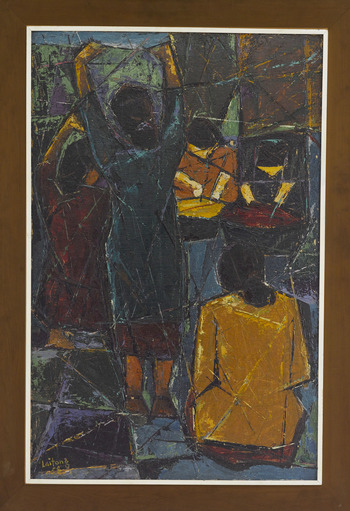
Cheong Lai Tong, Mencelop Batik (Batik Dyeing), oil on board, 1958, 93.2 cm × 60.2 cm, National Visual Art Gallery Collection, Kuala Lumpur. (Image reproduced with kind permission from the National Visual Art Gallery)

Scenes of everyday life in Malaya were also characteristic themes of his early work, such as the two pieces acquired by the National Art Gallery in 1958: Batik Dyeing (1958) portrays a group of sarong-clad Malay women busy at work, while Top Spinners (1958) shows a group of children, some wearing the songkok (traditional Malay headgear), squatting on the ground as they played with wooden tops — a popular local game. Both oil paintings were highly stylised and used bright colours.
These paintings were developed before he embarked on his formal studies at the Skowhegan School of Painting and Sculpture in Maine and the Central School of Arts and Crafts in London respectively in 1960. Cheong's decision to pursue the uncommon profession of an artist was very likely boosted by his early success. Like Cheong, Patrick Ng was sufficiently motivated by his early progress to pursue formal studies at the Hammersmith College of Art and then Wimbledon and Southlands College of Education from 1962 to 1966.Footnote 111
Cheong Lai Tong, Bermain Gasing (Top Spinners), Oil on board, 1958, 53 cm × 64.5 cm, National Visual Art Gallery Collection, Kuala Lumpur. (Image reproduced with kind permission from the National Visual Art Gallery)
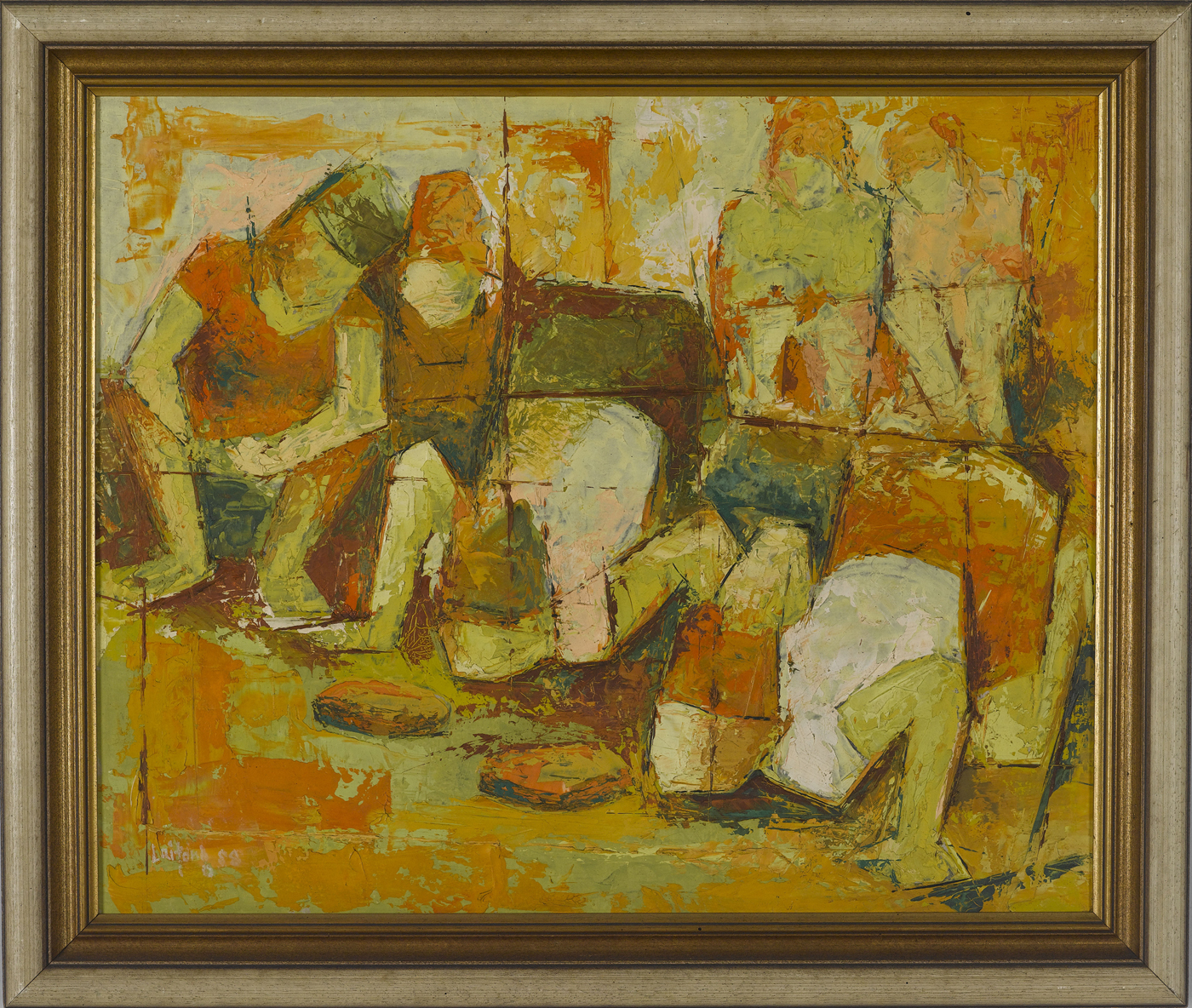
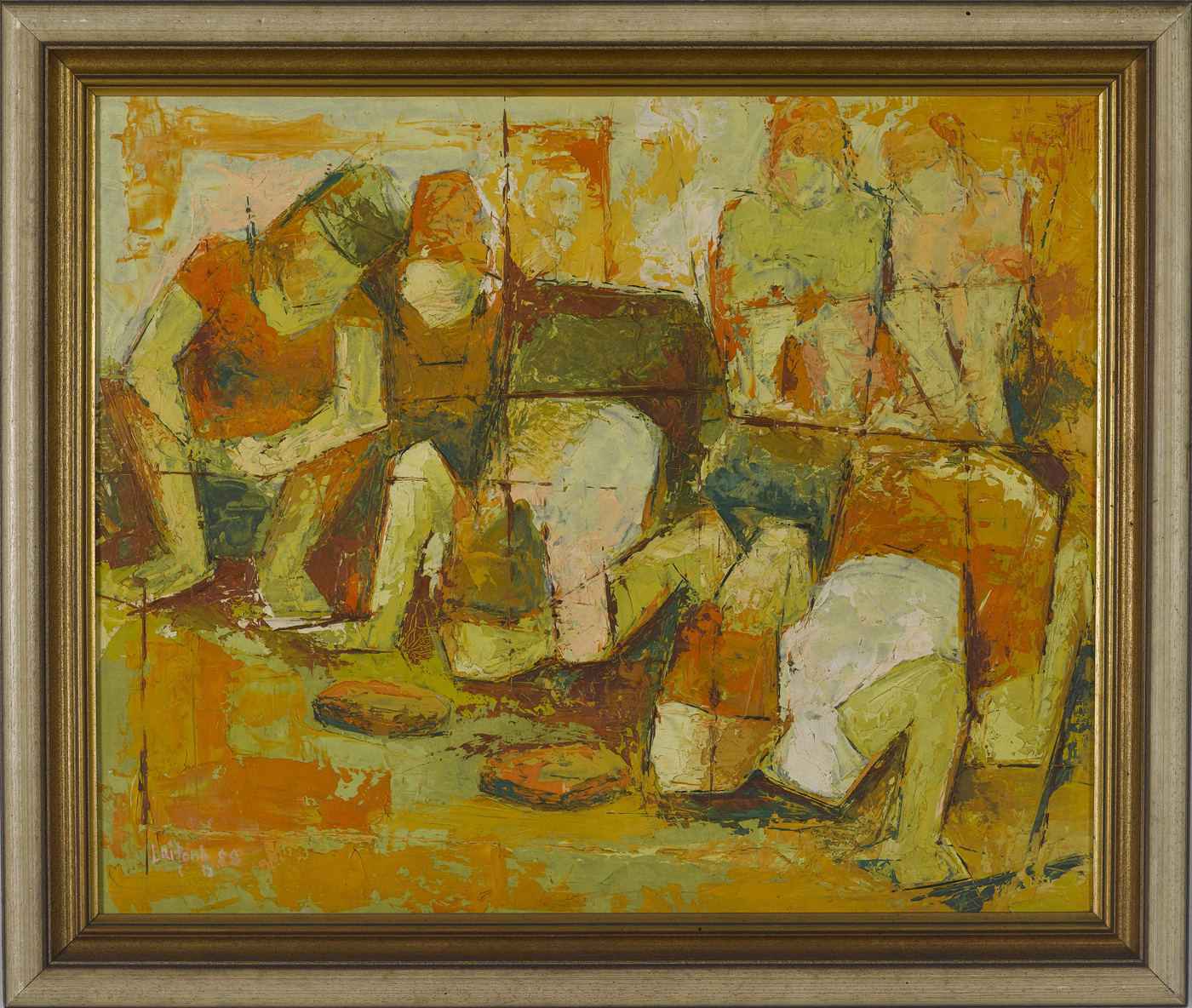
One characteristic of the art produced by the WAG members was the tendency to reflect local subject matter or to represent local sentiments in a highly individualistic manner that did not adhere to any particular style. This ‘heartening’ quality of Malayan art which revealed ‘the willingness of the artists to experiment with new techniques and new ideas’ was also remarked upon by a local critic (Frank Sullivan) who used the pseudonym ‘Chermin’.Footnote 112 Sullivan reviewed their seventh exhibition and gave generous feedback about their subject choice, colour palette and unique approach to painting, describing the works as indicative of ‘fresh hope for Malayan art’.
WAG is recorded in Malaysian modern art discourse for producing pioneering Malaysian artists, male and female, as the state collection clearly attests to. However, few of the group became professional artists. Following WAG's dissolution in 1967, many of its members pursued other professions such as architecture, graphic design and teaching. Those who pursued art-related careers included Sivam Selvaratnam and Renee Kraal. Some worked at art schools as administrators or teachers in their area of specialisation while a few of them did become full-time artists for periods. The artists-lecturers at STTI struggled to manage both art and teaching, with the majority of them exhibiting intermittently and becoming professional artists only after they retired. Yeoh Jin Leng, who taught at STTI for 20 years, maintained that it was an institute for training teachers of art:
[M]ost never set out to be artists per se; some might have had such intentions or ambitions, but in the end, they returned to schools and stuck as teachers. I avoided showing my private world of art but created the situations with projects and outings … For my own work, I do that after 9 to 10 pm in the garage in the backyard.Footnote 113
Concluding remarks
This brief historical survey of art developments during Malaya and Singapore's postwar political transition from being part of the British Empire to independent states is an attempt to recover the conditions that played a significant part in shaping artistic roles, positions and discourses. I have demonstrated how the postwar dissolution of the colonial structure stimulated unique conditions that underscored the development of art education that was in line with the rise of a sense of responsibility for creating a national culture. The establishment of art societies, arts councils and the desire to build a national art collection were conducted as part of the nation-building project, in which a common ‘Malayan’ culture and identity was valiantly being constructed.
Art professionalism, cultivated and promoted under such conditions, was directly supported by the art education system that grew out of private and public institutions. In this enlarged public sphere, which saw unprecedented popular participation, activities conducted by artists were increasingly positioned along an amateur–professional divide. This was not to say that ‘professional’ or ‘amateur’ activities had not existed previously, but that the distinction became seen as necessary in the global arena, and in light of the anxious desire to have a national art that was worthy and comparable to the coloniser's.
This article has sought to re-examine the significance of a period of social, cultural and political transition to the development of modern art in Singapore and Malaya. This background allows us to better appreciate the professional conundrums of individuals such as Yeoh Jin Leng and Kum Yuen Sim, who like other artist-educators, straddled both worlds and professions; or of how the innumerable artists trained overseas and locally, far from ‘disappearing’ from the local art scene over time, continued to contribute their talent and training in other related industries. The role of a ‘professional’ artist, as shown here, was as much a sociopolitical construct that grew out of nationalistic anxieties that played a part in shaping the way art in Malaysia and Singapore was subsequently produced and received.