Introduction
The Fukushima Daiichi Nuclear Power Plant (Daiichi), operated by the Tokyo Electric Power Company (TEPCO), was heavily damaged by a 9.0 magnitude earthquake and a series of tsunamis on 11 March 2011. This resulted in a core meltdown and an explosive release of radioactive materials into the atmosphere.
Several studies of populations affected by the two serious nuclear power plant accidents that occurred at Three Mile Island (TMI) (1979) and Chernobyl (1986) found major impacts on the mental health of survivors. Effects included increased symptoms of depression, anxiety, post-traumatic stress disorder (PTSD), poor self-rated health and medically unexplained symptoms (Bromet, Reference Bromet2014). These impacts may depend on the timing of the assessments, the perceived magnitude of exposure, and the degree of direct involvement with the accident (Slovic, Reference Slovic1987). In the TMI disaster, plant workers were vulnerable to increased job tension, anger, extreme worry, demoralization and somatic complaints (Kasl et al. Reference Kasl, Chisholm and Eskenazi1981). Clean-up workers dispatched to Chernobyl between 1986 and 1990 suffered persistent depression and PTSD, even 18 years after the accident (Loganovsky et al. Reference Loganovsky, Havenaar, Tintle, Guey, Kotov and Bromet2008). However, these studies were cross-sectional (Kasl et al. Reference Kasl, Chisholm and Eskenazi1981; Loganovsky et al. Reference Loganovsky, Havenaar, Tintle, Guey, Kotov and Bromet2008), and to our knowledge, no study has examined the longitudinal impact of disaster-related experiences in relation to psychological states among nuclear power plant workers.
The Fukushima nuclear power plant workers experienced the deadliest earthquake and tsunami to strike this century followed by the nuclear disaster. They worked hard to restore the nuclear power plant even though their lives were at risk from high radiation exposure and life-threatening experiences and are known as the ‘Fukushima 50’ (Hogg, Reference Hogg2011). However, many of these workers were local residents who experienced home evacuations and property loss. Moreover, the workers, being employees of TEPCO, were targeted for public harassment and discrimination against the company's responses to the disaster. It is thus important to understand the medium- and long-term psychological states of these workers and to maintain their mental health over the course of restoration and decommissioning process that may take several decades.
Our earlier study (Tanisho et al. Reference Tanisho, Shigemura, Kubota, Tanigawa, Bromet, Takahashi, Matsuoka, Nishi, Nagamine, Harada, Tanichi, Takahashi, Shimizu, Nomura and Yoshino2016) was designed to assess the short-term effects of disaster exposure on the post-traumatic stress response (PTSR) and general psychological distress (GPD) 1 year after the disaster. By contrast, our present study extended the follow-up and collected repeated measures for the same workers to assess the effects of disaster-related experiences on changes in PTSR and GPD over time.
Method
Full-time TEPCO employees of Fukushima Daiichi and the nearby Daini nuclear power plants (Daiichi: n = 1053; Daini: n = 707) were invited to participate in the Fukushima Nuclear Energy Workers' Support (NEWS) Project Study (a longitudinal health research project of the TEPCO Daiichi and Daini workers), 2–3 months post-disaster (May–June 2011). Of these, 1495 individuals participated (84.9% response rate). Written informed consent was obtained from the individuals upon enrollment. Further details of this study have been described elsewhere (Shigemura et al. Reference Shigemura, Tanigawa, Saito and Nomura2012, Reference Shigemura, Tanigawa, Nishi, Matsuoka, Nomura and Yoshino2014). The present study was approved by the ethics committees of the Juntendo University and the National Defense Medical College.
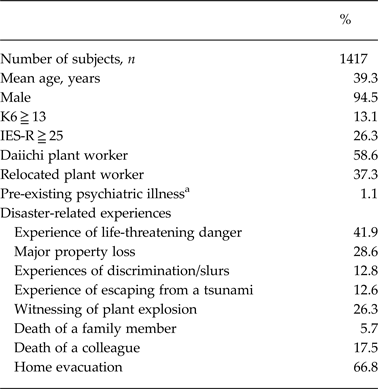
We gathered information about workers' sociodemographics, disaster-related experiences, as well as the levels of psychological distress and post-traumatic stress symptomology using a self-reported questionnaire. Disaster-related experiences (Table 1) were selected based on the stressors often encountered by the Fukushima nuclear plant workers at the first medical interview after the disaster conducted by T.T. (16–19 April 2011) prior to the baseline data collection, and were dichotomously coded as ‘yes’ or ‘no’. ‘Discrimination/slurs’ was also included because it was a major stressor among the nuclear plant workers since they were blamed severely for nuclear contamination and home evacuation as a result of the nuclear disaster.
Descriptive statistics of analysis sample at baseline (2011)

Data are given as percentage unless otherwise indicated.
K6, Japanese version of the Kessler Psychological Distress Scale; IES-R, Japanese version of the Impact of Event Scales-Revised.
a Pre-existing psychiatric illness included depression (n = 7), autonomic imbalance (n = 6), panic disorder (n = 1) and schizophrenia (n = 2).
Psychological states were measured by GPD and PTSR. GPD was assessed using the Japanese version of the Kessler Psychological Distress Scale (K6; Kessler et al. Reference Kessler, Andrews, Colpe, Hiripi, Mroczek, Normand, Walters and Zaslavsky2002). K6 is a self-report scale widely used to screen for the presence of mood and anxiety disorders in the general population as defined by the Diagnostic and Statistical Manual, 4th edition (DSM-IV; American Psychiatric Association, 1994; Kessler et al. Reference Kessler, Green, Gruber, Sampson, Bromet, Cuitan, Furukawa, Gureje, Hinkov, Hu, Lara, Lee, Mneimneh, Myer, Oakley-Browne, Posada-Villa, Sagar, Viana and Zaslavsky2010). The six questionnaire items are responses on feeling nervous, hopeless, restless/fidgety, depressed, that everything was an effort, and worthlessness in the past 30 days. Items are scored on a five-point Likert scale from 0 to 4 and the total score ranges from 0 to 24, with higher scores representing greater psychological distress. Scores of 13 or higher indicate serious mental illness (Kessler et al. Reference Kessler, Green, Gruber, Sampson, Bromet, Cuitan, Furukawa, Gureje, Hinkov, Hu, Lara, Lee, Mneimneh, Myer, Oakley-Browne, Posada-Villa, Sagar, Viana and Zaslavsky2010).
PTSR was assessed using the Japanese version of the Impact of Event Scales-Revised (IES-R; Asukai et al. Reference Asukai, Kato, Kawamura, Kim, Yamamoto, Kishimoto, Miyake and Nishizono-Maher2002). This 22-item instrument measures the psychological impact of potentially traumatic events, specifically the DSM-IV PTSD symptom clusters of intrusion, avoidance/numbing and hyperarousal (American Psychiatric Association, 1994). The latest diagnostic criteria for PTSD, according to the DSM-5 (American Psychiatric Association, 2013), now contains four symptom clusters: the aforementioned three clusters as well as negative alterations in cognition and mood. At the time of the present study, however, the Japanese version of the DSM-5 was unavailable. The IES-R response format is a five-point Likert scale ranging from 0 to 4 and the total score ranges from 0 to 88, with higher scores representing higher PTSR. Past studies suggest that individuals with scores of 25 or higher have significant PTSD symptoms (Asukai et al. Reference Asukai, Kato, Kawamura, Kim, Yamamoto, Kishimoto, Miyake and Nishizono-Maher2002).
Annual assessments of K6 and IES-R were conducted from 2011 to 2014 (2012: May–June, 14–15 months post-disaster; 2013: November, 32 months post-disaster; 2014: November, 44 months post-disaster). In the present study, we included a total of 1417 workers who provided an assessment at baseline (2011). In the analytic sample, 463 (32.7%) provided four waves of K6 or IES-R measurements, 505 (35.6%) provided information at three waves, 344 (24.3%) responded to two waves, and the remaining 105 (7.4%) provided only one set of responses at baseline. Thus, a total of 4160 observations were used in the present analysis. K6 and IES-R had excellent internal consistency reliabilities in each time point as measured by the Cronbach α coefficients for K6: time 1, 0.88; time 2, 0.88; time 3, 0.91; time 4, 0.92; and for IES-R: time 1, 0.95; time 2, 0.95; time 3, 0.95; time 4, 0.96.
We assessed if the workers followed for all time points differed from those followed for fewer time points in the present study. We compared baseline characteristics such as gender, age, GPD, PTSR and disaster-related experiences between workers followed for all time points (n = 463) and workers followed fewer than all time points (n = 954). The workers followed for all time points tended to perceive greater discrimination/slurs (16%) compared with those followed for fewer time points (12%; p for difference = 0.03). There were no other differences in the characteristics between workers followed for all time points and those followed for fewer time points.
Statistical analysis
The linear trend of GPD and PTSR scores over time was tested based on the Wald test for the coefficient associated with time in a mixed-effects longitudinal beta regression model (Hunger et al. Reference Hunger, Doring and Holle2012). The outcomes – GPD and PTSR – were dichotomized into ‘high’ or ‘low’ levels using the threshold values defined above. In an analysis of repeated measures, it is necessary to take into account the within-individual correlation across waves; this was achieved through the use of mixed-effects logistic regression models (Hu et al. Reference Hu, Goldberg, Hedeker, Flay and Pentz1998).
In order to examine the association of each type of disaster-related experience (or stressor) to the probability of scoring high levels on the K6 or IES-R scale, we used the following two models:
Model 1:
 $$\eqalign{{\rm logit}\;(P(y_{ij} = 1) ) & = \beta _0 + \beta _{\rm S} \;{\rm Stressor}_i + \beta _{\rm T} \;{\rm Time}_{ij} \cr & \quad + ({\rm Effect}\;{\rm of}\;{\rm other}\;{\rm covariates}) + b_i}$$
Model 2:
 $$\eqalign{{\rm logit}\;(P(y_{ij} = 1)) &= \beta _0 + \beta _{{\rm S}\;} {\rm Stressor}_i + \beta _{\rm T} \;{\rm Time}_{ij} \cr & \quad + \beta _{{\rm ST}} ({\rm Stressor}_i \times {\rm Time}_{ij} ) \cr & \quad + ({\rm Effect}\;{\rm of}\;{\rm other}\;{\rm covariates}) + b_i}$$
where y ij was a binary outcome variable taking the value 1 if subject i had a high level of GPD (K6 score = 13) or high PTSR (IES-R score = 25) in survey wave j (j = 1,…,4), and 0 if otherwise; Stressor i was a binary variable taking the value 1 if subject i experienced the specific disaster-related event in the present study; Time ij represented the time of completion of the questionnaire measured in years since the disaster (taking values from 0 to 3); and b i was a normally distributed subject-specific random effect. The models were further adjusted for a vector of covariates assessed at baseline (2011), namely, age, gender and job location (Daiichi Nuclear Power Plant v. Daini Nuclear Power Plant). Model 1 assumed that the effect of having been exposed to the disaster-related event on the probability of scoring a high level on either the K6 or the IES-R scales remained constant across time, whereas model 2 allowed this effect to vary linearly (on the logarithmic scale) with time. Model 2 was estimated only if the effect associated with the disaster-related event in model 1 was significant, in which case selection of the best-fitting model was based on the likelihood ratio test. SAS Proc GLIMMIX was used to fit the mixed-effects logistic regression models. Based on the results of the modeling procedure, we estimated multivariate-adjusted odds ratios (ORs) (time-varying if model 2 was selected, and constant over time otherwise).
To adjust for the possibility that healthier workers were more likely to respond to subsequent survey waves, a propensity score was used to model the probability of responding, and inverse probability weights were used to correct for possible selection bias in the analyses using repeated measures over time. This propensity score was calculated from a logistic regression as the probability of not having completed two or more waves of the survey, given all of the relevant variables that were significantly (p < 0.05) associated with the follow-up status at baseline – including gender and various disaster-related experiences. Thus, the primary analysis was repeated after weighting follow-up observations by the inverse probabilities of attaining a follow-up response (Kurth et al. Reference Kurth, Walker, Glynn, Chan, Gaziano, Berger and Robins2005).
Furthermore, gender and pre-existing psychiatric illness may be considered to be possible moderating variables in the association between disaster-related experiences and PTSR and GPD. Thus, we performed two sensitivity analyses: one for restricting the study population to male workers and the other for restricting the study population to workers without pre-existing psychiatric illness.
All analyses were conducted using the SAS statistical package version 9.4 (SAS Institute Inc., USA).
Results
Characteristics of the subjects at baseline are presented in Table 1. The mean age of the study population was 39.3 years. Almost all (94.5%) of the individuals in our subjects were male, and 59% of them were working at the Daiichi Nuclear Power Plant, which was heavily damaged. By 2014, 37.3% (529) of the workers were relocated to either Daiichi, Daini or other sites. Approximately 70% of the workers were assumed to be local residents based on their response to the question regarding home evacuation. The proportion of workers reporting a high level of PTSR was 26.3%, and the proportion of those reporting a high level of GPD was 13.1%. Only 1.1% of workers had pre-existing psychiatric illnesses.
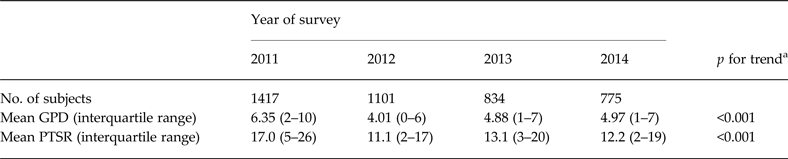
Table 2 shows the trends in GPD and PTSR scores over time. For both measures, we observed a significant decreasing trend [the time slopes from a mixed-effects longitudinal beta regression model were −0.11, 95% confidence interval (CI) 0.14 to −0.08 for GPD and −0.14, 95% CI 0.16 to −0.11 for PTSR].
Trends of GPD and PTSR scores along time

GPD, General psychological distress; PTSR, post-traumatic stress response.
a Values based on the Wald test for the coefficient associated with time in a mixed-effects longitudinal beta regression model (Hunger et al. Reference Hunger, Doring and Holle2012).
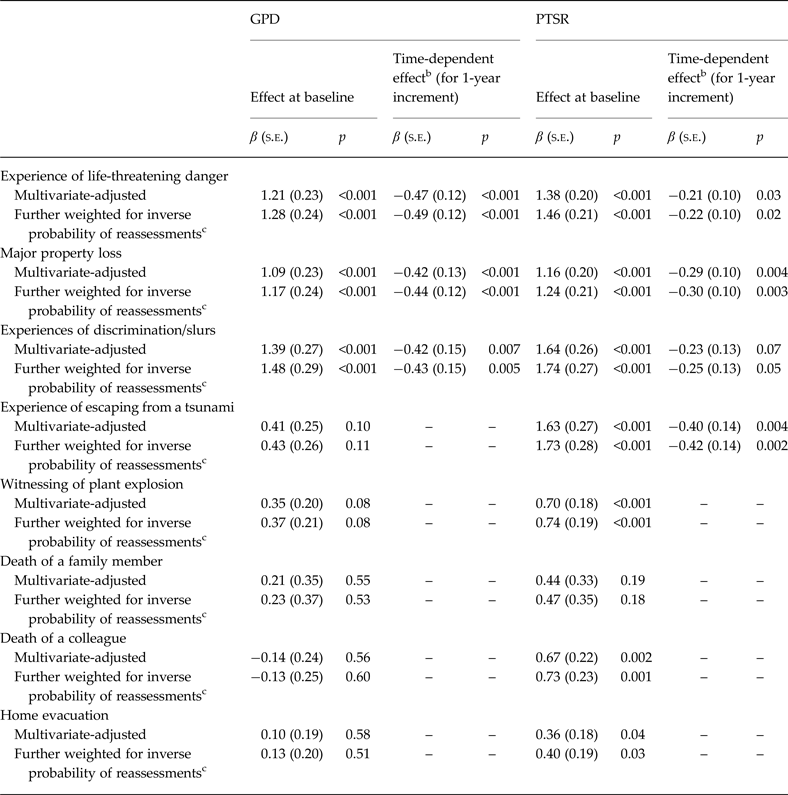
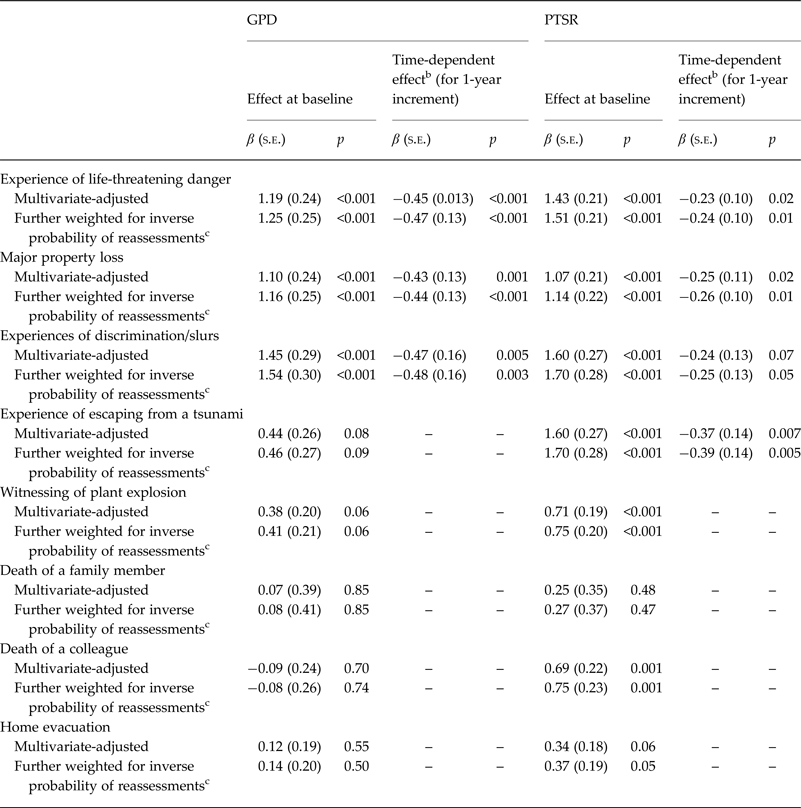
Table 3 shows a summary of the results from the mixed-effects logistic regression models describing the effect of each disaster-related event on the risk of a high level of GPD or PTSR according to the time elapsed since the disaster. Analyses were conducted with and without the use of the inverse probability weights. However, both methods yielded similar results, and we therefore only show the propensity score-adjusted analyses. All disaster-related experiences indicated significant associations with high levels of PTSR, with the exception of death of a family member.
Multivariate-adjusted β estimates for GPD and PTSR associated with each disaster-related experience a

GPD, General psychological distress; PTSR, post-traumatic stress response; s.e., standard error.
a All models were adjusted for baseline age, gender and job location.
b Time-dependent effects were presented only for those disaster-related experiences for which model 2 was the best-fitting model.
c The revisit propensity score was calculated from a logistic regression as the probability of not having two or more surveys (follow-up status), given all relevant factors that were significantly (p < 0.05) associated with follow-up status at baseline including gender and all disaster-related experiences, except family member death(s).
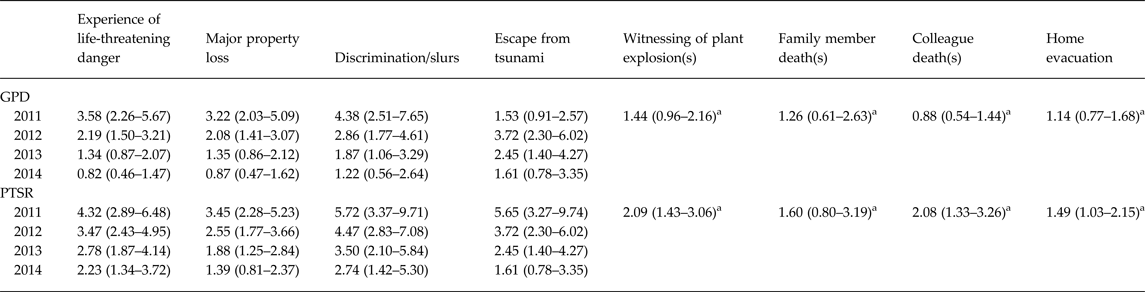
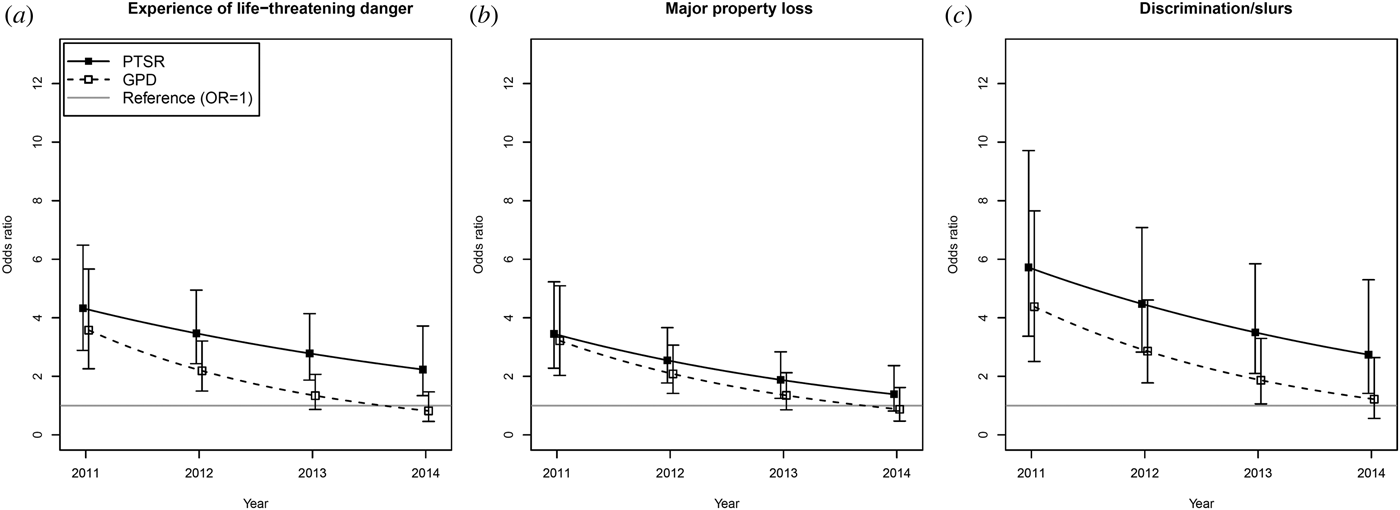
Table 4 and Fig. 1 show that the effects of four disaster-related experiences on PTSR were reduced over time: for the experience of life-threatening danger (Fig. 1a ), the OR decreased from 4.32 (95% CI 2.89–6.48) in 2011 to 2.23 (95% CI 1.34–3.72) by 2014; for major property loss (Fig. 1b ), the OR decreased from 3.45 (95% CI 2.28–5.23) to 1.39 (95% CI 0.81–2.37); for experiences of discrimination (Fig. 1c ), the OR decreased from 5.72 (95% CI 3.37–9.71) to 2.74 (95% CI 1.42–5.30), and for the experience of escaping from a tsunami, the OR decreased from 5.65 (95% CI 3.27–9.74) to 1.61 (95% CI 0.78–3.35). The effects associated with the other three disaster-related experiences were estimated to be constant across time (i.e. no statistically significant interactions between disaster-related experiences and time): 2.09 (95% CI 1.43–3.06) for the witnessing of plant explosion; 2.08 (95% CI 1.33–3.26) for the death of a colleague; and 1.49 (95% CI 1.03–2.15) for home evacuation.
Multivariate-adjusted odds ratios of GPD and PTSR associated with each disaster-related experience by year

Data are given as odds ratio (95% confidence interval).
GPD, General psychological distress; PTSR, post-traumatic stress response.
a The time-dependent effect associated with these disaster-related experiences was not significant; the corresponding odds ratio was thus estimated to be constant across time.
Time-dependent odds ratios (ORs) of the association between selected disaster-related experiences and high levels of post-traumatic stress response (PTSR) or high levels of general psychological distress (GPD). (a) Experience of life-threatening danger; (b) major property loss; (c) discrimination/slurs.

The associations between disaster-related experiences and GPD were less pronounced than for PTSR: 1.53 (95% CI 0.91–2.57) for the experience of escaping from a tsunami; 1.44 (95% CI 0.96–2.16) for the witnessing of plant explosion; 0.88 (95% CI 0.55–1.53) for the death of a colleague; 1.14 (95% CI 0.77–1.68) for home evacuation; and 1.26 (95% CI 0.61–2.63) for the death of a family member. The effects of three disaster-related experiences on GPD reduced over time: for the experience of life-threatening danger (Fig. 1a ), the OR decreased from 3.58 (95% CI 2.26–5.67) in 2011 to 0.82 (95% CI 0.46–1.47) by 2014; from 3.22 (95% CI 2.03–5.09) to 0.87 (95% CI 0.47–1.62) for major property loss (Fig. 1b ); and from 4.38 (95% CI 2.51–7.65) to 1.22 (95% CI 0.56–2.64) for experiences of discrimination (Fig. 1c ).
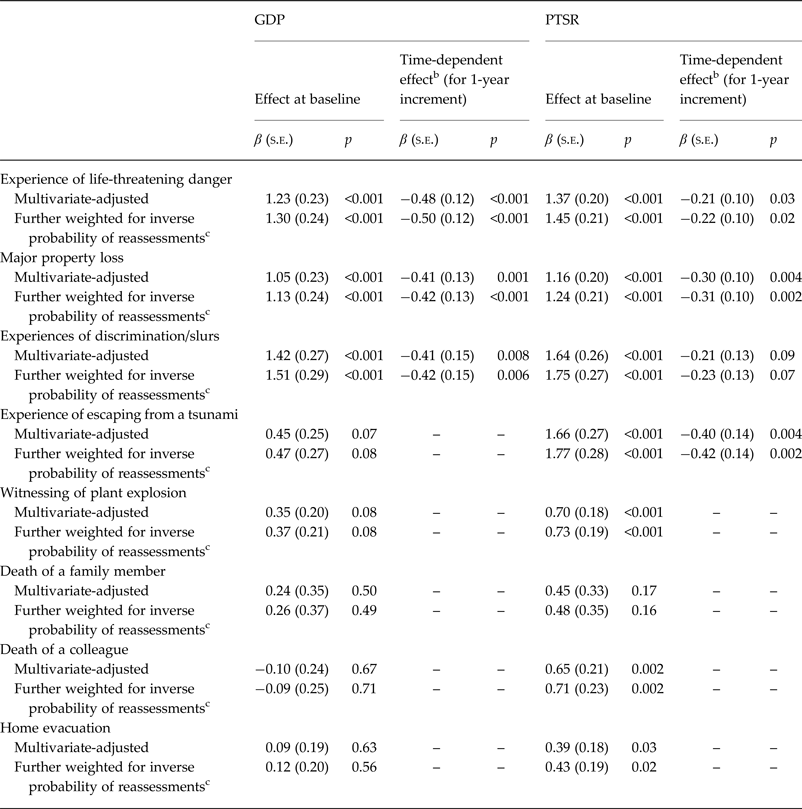
We performed sensitivity analyses by restricting the study population to male workers and by restricting the study population to workers without pre-existing psychiatric illness. These found that the effects of disaster-related events on the GPD and PTSR scores were almost identical (see Appendix Tables A1 and A2).
Discussion
To our knowledge, this is the first study to examine the longitudinal trajectories of the disaster-related experiences of psychological distress and PTSR of the Fukushima nuclear plant workers, who experienced a serious earthquake and tsunami followed by the nuclear disaster. Although we found a declining influence of disaster-related experiences on psychological states over time, in several categories of exposure, the impact on PTSR remained significantly elevated even 3 years after the disaster.
Some categories of disaster-related experiences – such as home evacuation and discrimination as a result of TEPCO's disaster responses – continued long after the disaster. For example, the Fukushima Prefecture government reported that about 62 000 evacuees in Fukushima have remained displaced in temporary housing almost 4 years after the disaster (Fukushima Prefectural Government, 2015), and there is as yet no clear prospect of public housing becoming available due to the level of radioactive contamination. Lazarus (Reference Lazarus2006) proposed stress as a transactional process occurring between events (stressors) that cause changes in the environment and the individual's ability to cope with or manage the stressor. When an individual's resources are depleted, they will tend to adapt using less active and problem-based coping, as well as more passive and emotion-based coping (Benight et al. Reference Benight, Swift, Sanger, Smith and Zeppelin1999). If this is the case, the uncertainty arising from unmet housing needs and property loss may be significant obstacles for coping with the PTSR among affected workers.
The level of radiation exposure (i.e. radiation-associated stressors) was a primary concern for psychological damage among the Chernobyl clean-up workers in Ukraine (Gamache et al. Reference Gamache, Levinson, Reeves, Bidyuk and Brantley2005; Rahu et al. Reference Rahu, Rahu, Tekkel and Bromet2006; Loganovsky et al. Reference Loganovsky, Havenaar, Tintle, Guey, Kotov and Bromet2008). In the aftermath of the Fukushima disaster, the impact of perceived discrimination was particularly severe at first and has persisted over time for PTSR. A similar phenomenon was found for Vietnam War veterans in a previous study: societal rejection and the lack of social support at the time of homecoming due to the anti-war social movement had an adverse effect on PTSD (Fontana & Rosenheck, Reference Fontana and Rosenheck1994). Moreover, repairing the damaged nuclear plant has proven to be far more difficult and costly than anyone could have foreseen. All nuclear plants in Japan have been forced to shut down since the 2011 earthquake and tsunami, and the ruling Liberal Democratic Party of Japan has vowed to restart them again in spite of widespread public protest and criticism. This climate of uncertainty has undoubtedly contributed to a sense of insecurity among nuclear plant workers.
From July 2011 to April 2012, on-site psychiatrists and clinical psychologists provided mental health support such as clinical treatment and continuous counseling to a limited number of workers with severe work-related trauma, distress and grief experiences (Sano et al. Reference Sano, Tanigawa, Shigemura, Satoh, Yoshino, Fujii, Tatsuzawa, Kuwahara, Tachibana and Nomura2012). Of these, 85 workers (6%) had attended more than three visits for treatment and counseling by 2014. Therefore, the effect of participation in such treatments and counseling sessions over time in PTSR and GPD may be small. Nevertheless, our results pointed to the persistence of PTSR in spite of the trend over time towards recovery from GPD associated with disaster-related experiences. Similarly, 10–30% of the rescue and recovery workers (i.e. mostly those in the protective services or the military) continued to have physical and mental disorders even 9 years after the World Trade Center (WTC) attacks (Wisnivesky et al. Reference Wisnivesky, Teitelbaum, Todd, Boffetta, Crane, Crowley, de la Hoz, Dellenbaugh, Harrison, Herbert, Kim, Jeon, Kaplan, Katz, Levin, Luft, Markowitz, Moline, Ozbay, Pietrzak, Shapiro, Sharma, Skloot, Southwick, Stevenson, Udasin, Wallenstein and Landrigan2011). A recent, extended follow-up study has suggested that about 20% of the WTC rescue and recovery workers had persistent chronic and worsening PTSD symptom trajectories over the 12 years post-9/11 (Feder et al. Reference Feder, Mota, Salim, Rodriguez, Singh, Schaffer, Schechter, Cancelmo, Bromet, Katz, Reissman, Ozbay, Kotov, Crane, Harrison, Herbert, Levin, Luft, Moline, Stellman, Udasin, Landrigan, Zvolensky, Yehuda, Southwick and Pietrzak2016). Further, the availability of family and work support has been found to have a buffering effect on PTSD symptom trajectories in the WTC rescue and recovery workers (Pietrzak et al. Reference Pietrzak, Feder, Singh, Schechter, Bromet, Katz, Reissman, Ozbay, Sharma, Crane, Harrison, Herbert, Levin, Luft, Moline, Stellman, Udasin, Landrigan and Southwick2014; Feder et al. Reference Feder, Mota, Salim, Rodriguez, Singh, Schaffer, Schechter, Cancelmo, Bromet, Katz, Reissman, Ozbay, Kotov, Crane, Harrison, Herbert, Levin, Luft, Moline, Stellman, Udasin, Landrigan, Zvolensky, Yehuda, Southwick and Pietrzak2016). However, a meta-analysis reported that the effects of disaster-related exposure from the WTC attacks on PTSD differed by study populations (i.e. protective service workers v. civilians; Liu et al. Reference Liu, Tarigan, Bromet and Kim2014). In the present study, the nuclear plant workers were not highly trained for and had never experienced emergency recovery for a nuclear power plant explosion until the major disaster on 11 March 2011. This disaster destroyed workers' ordinary lives with their family and friends. The psychological states of the nuclear plant workers could be distinct from those of civilians or the rescue and recovery workers of the WTC attacks. Furthermore, the onset and awareness of PTSD symptoms depend on the number of negative life events after a trauma [e.g. WTC attacks (Andrews et al. Reference Andrews, Brewin, Stewart, Philpott and Hejdenberg2009) and combat experience (Adams & Boscarino, Reference Adams and Boscarino2006; Hermes et al. Reference Hermes, Fontana and Rosenheck2015)]. Events such as a relocation to a different job site due to a breach in the limit on radiation exposure (100 mSv) at the original site, and/or ongoing discrimination in the new neighborhood to which the nuclear power plant workers have relocated could make an impact on the persistent risk of PTSD in the present study. These findings emphasize the need for continued monitoring and treatment of the Fukushima nuclear power plant workers who have had unique experiences as a result of the disaster.
We note several limitations of the present study. First, our self-reported data may be less accurate compared with data collected by face-to-face interviews. Second, as in most longitudinal studies, there was an imbalance in the number of repeated measures per subject, largely due to losses in the follow-up (i.e. gender, workers being transferred due to radiation exposure, retirement, and refusal to participate further in the study). However, concerns about how these might affect the findings were mitigated given that similar results were obtained after using an inverse probability of response weighting. The subjects in this study were limited to full-time TEPCO workers. Therefore, it may not be possible to generalize our results to other workers at Fukushima or other nuclear plant workers. Third, female workers were under-represented in the present study, and thus we could not perform gender-specific analyses. Nonetheless, gender was adjusted for in our models. Further, we performed a sensitivity analysis restricting the study population to male workers and found no substantial differences in the effects of disaster-related events on the GPD and PTSR scores. Finally, although we adjusted for various possible confounding factors in the current study, there was a possibility of residual confounding by unmeasured variables such as the intensity of radiation exposure as well as social factors including socio-economic status or marital status.
The strength of our study is its longitudinal design with repeated measures among workers who experienced a large-scale nuclear disaster. All measures were obtained at baseline with a high response rate (84.9%), and at least two or more measures of psychological states were available for most of the subjects (92.6%).
In summary, the effects of disaster-related experiences on psychological states tended to wane over time, but remained significantly high even 3 years after the event. Although clinical interventions for workers' mental health were offered 4–12 months post-disaster, the adverse impacts of their experiences, especially discrimination/slurs, continued to persist over time. Based on these findings, substantial progress needs to be made in the provision of comprehensive support to improve the mental health of nuclear power plant workers. Organizational interventions may be needed that target workers suffering from disaster-related experiences (e.g. addressing the consequences of interpersonal and institutional discrimination).
Acknowledgements
This study was supported by Health and Labour Sciences Research Grants (Research on Occupational Safety and Health H24-001, 25-H24-001 and 26-H24-001) from the Ministry of Health, Labour and Welfare of Japan.
The authors thank all staff members in the Fukushima NEWS Project Study for their painstaking efforts to conduct the baseline survey and follow-up.
A.I., T.T. and I.K. had the original idea and developed the study design. T.T. and J.S. collected the data. A.I. and H.C. performed the statistical analyses. A.I. wrote the first draft of the manuscript. All authors contributed to the critical revision of the manuscript. All authors read and approved the final manuscript.
Declaration of Interest
All authors have completed and submitted the International Committee of Medical Journal Editors (ICMJE) Form for Disclosure of Potential Conflicts of Interest. J.S. voluntarily provided mental health support to Tokyo Electric Company Fukushima Daiichi and Daini nuclear power plant workers according to official requests from Daini and a Japanese government cabinet order to the Ministry of Defense. T.T. is a Daini part-time occupational physician. A.I., I.K., H.C and H.W. reported no conflict of interest disclosures.
Appendix
Study group members
Members of the Fukushima NEWS Project Study are: J. Shigemura, S. Tachibana, S. Sano, T. Kuwahara, Y. Tatsuzawa, Y. Sato, H. Toda, M. Tanichi, S. Nomura, Y. Aihide, N. Harada, K. Shimizu and M. Nagamine (National Defense Medical College, Saitama); T. Tanigawa (Juntendo University Graduate School of Medicine, Tokyo); S. Takahashi and Y. Takahashi (Tsukuba University, Ibaraki); C. Fujii (National Center of Neurology and Psychiatry, Tokyo); T. Yamamoto [Tokyo Electric Company (TEPCO) Fukushima Daini nuclear power plant, Fukushima]; and Y. Kage (TEPCO R&D Center, Kanagawa).
Multivariate-adjusted β estimates for GPD and PTSR associated with each disaster-related experience (excluded female workers) a

Multivariate-adjusted β estimates for GPD and PTSR associated with each disaster-related experience (excluding workers with pre-existing psychiatric illness) a