I. INTRODUCTION
Most of rare earth intermetallic compounds RIn3 (R = rare earth element) crystallize in cubic AuCu3 type structure with a space group of Pm
 $\bar 3$
m (Umehara et al., Reference Umehara, Ebihara, Nagai, Fujimaki, Satoh and Onuki1992; Nagai et al., Reference Nagai, Umehara, Ebihara, Albessard, Sugawara, Yamazaki, Satoh and Onuki1993) and order antiferromagnetically at low temperatures (Kletowski, Reference Kletowski1998). RIn3 have received much interest because of their special characteristics such as crystalline field effects, multi-axial magnetic structures and complicated phase transitions (Bajorek et al., Reference Bajorek, Chelkowska, Chrobak and Kwiecien-Grudziecka2012). Among RIn3 intermetallic compounds, GdIn3 crystallizes in the cubic structure with a lattice parameter of a = 4.6068 Å and exhibits unusual magnetic properties in high fields (Mucha, Reference Mucha2006). This compound orders antiferromagnetically with a Néel temperature of 45 K and undergoes a metamagnetic transition at a high field of 30 T (Kletowski, Reference Kletowski1992; Kletowski et al., Reference Kletowski, Czopnik, Tal and de Boer2000). PrIn3 has a single ground state in the crystalline field and shows nuclear rotation induced antiferromagnetic ordering at an extremely low temperature (0.14 mK) (He and Guo, Reference He and Guo2016; Silva et al., Reference Silva, Peixoto, Mercena, Coelho, Meneses and Duque2016).
In previous studies, both the structure and magnetic properties of RIn3 could be affected by the element substitutions such as Sn for In or another R for the original R. According to Hale et al. (Reference Hale, Gschneidner, Pecharsky and Mudryk2009), the other rare earth substitutions R(R = Y, Ce, Pr, and Dy) for Er in (R x Er1−x )In3 cause the shift of Néel temperature. On the other hand, the magnetic exchange coupling interaction between 4f electrons of rare earth and 3d electrons of transition metals has been widely studied for a long time (Bolyachkin et al., Reference Bolyachkin, Neznakhin, Garaeva, Andreev and Bartashevich2017). In R-T binary intermetallic compounds (R = rare earth; T = 3d transition metal such as Mn, Fe, Co, Ni) have shown various magnetic properties (Bajorek et al., Reference Bajorek, Chrobak, Chełkowska and Ociepka2015), therefore, the binary R-T intermetallic compounds have received much interest of both fundamental and technological points of view (Bajorek et al., Reference Bajorek, Chrobak, Ociepka and Chelkowska2013).
In previous investigations, the magnetic properties of the rare earth-iron intermetallic compounds (R x Fe y ) have been studied using Mossbauer spectrum. Among the several rare earth-iron intermetallics, the cubic Laves phase RFe2 with C15 type structure is hot topic because of their giant magnetostriction and large magnetocrystalline anisotropy (Chelvane et al., Reference Chelvane, Banumathy, Palit, Basumatary, Singh and Pandian2010). The attention has also been focused on the iron-rich amorphous rare-earth-iron alloys (R 1−x Fe x ). Both the environmental model and the charge transfer have been considered to influence the change of Fe moment with a concentration of x (Buschow, Reference Buschow1981; Bajorek et al., Reference Bajorek, Prusik, Wojtyniak and Chełkowska2016; Deng et al., Reference Deng, Li and Xu2006). Based on Sorescu et al. (Reference Sorescu, Diamandescu and Valeanu2006), the hyperfine magnetic structure of the RFe3 (R = Dy, Sm, Y) intermetallics has partially collapsed by Si or Ti substitution for Fe while a quadrupole doublet structure could be formed by doping Al into RFe3. It is well known that the 3d transition metals such as Mn and Co have played important roles in magnetic materials because of their significant contributions to the magnetic moment and anisotropy. The room temperature ferromagnetism has been observed by doping Co into PrIn3 (He and Guo, Reference He and Guo2016). However, there is a very little report on the doping effect of 3d transition metal Fe in RIn3.
In this study, the 3d transition metal diluted alloys RIn3−x T x (R = Gd, Pr; T = Fe, Co, Mn) have been designed for supplying the possible magnetic exchanging interaction between the 4f electrons of rare earth elements and the 3d electrons of transition metals. The magnetic properties are expected to be modulated and form an along periodical magnetic ordering with anisotropy in these dilute magnetic alloys. The authors hope to realize the ferromagnetic transition at room temperature.
II. EXPERIMENTAL DETAILS
According to the nominal compositions of GdIn3−x T x (T = Fe, Co) and PrIn3−x Mn x , the starting alloys were prepared by arc melting under the condition of protecting atmosphere of argon. The purities of raw metals are 99.9% for the rare earth elements and 3d transition metals and 99.99% for In. To ensure the homogeneity of ingots, each sample was re-melted four times and followed by sealing in the evacuated quartz tube to anneal for 2 weeks at 800 °C. Finally, the samples were quenched in water. X-ray diffraction (XRD) intensity data used for crystal structure analysis were collected by a Rigaku automatic diffractometer with rotating anode and a 12 kW X-ray generator. CuKα 1 radiation (λ =1.54056 Å) and a graphic monochromator for diffracted beams were used. A step scanning mode was adopted with a scanning step of 0.02° (2θ) and a sampling time of 2 s in 2θ range from 20.00° to 80.00°. After normalization, the diffraction data were analyzed by using the Rietveld's powder diffraction profile-fitting technique with the DBWS-9411 program to determine the atomic occupations. The field dependence of magnetization at room temperature was measured by a vibrating sample magnetometer (Versalab, 2 Hz) under the applied fields ranging from 0 to 3 kOe at room temperature. The polycrystalline magnetization model was used to simulate the magnetization characteristic curve for studying the essential magnetism during the magnetizing process.
III. RESULTS AND DISCUSSION
A. Gd-In-Co system
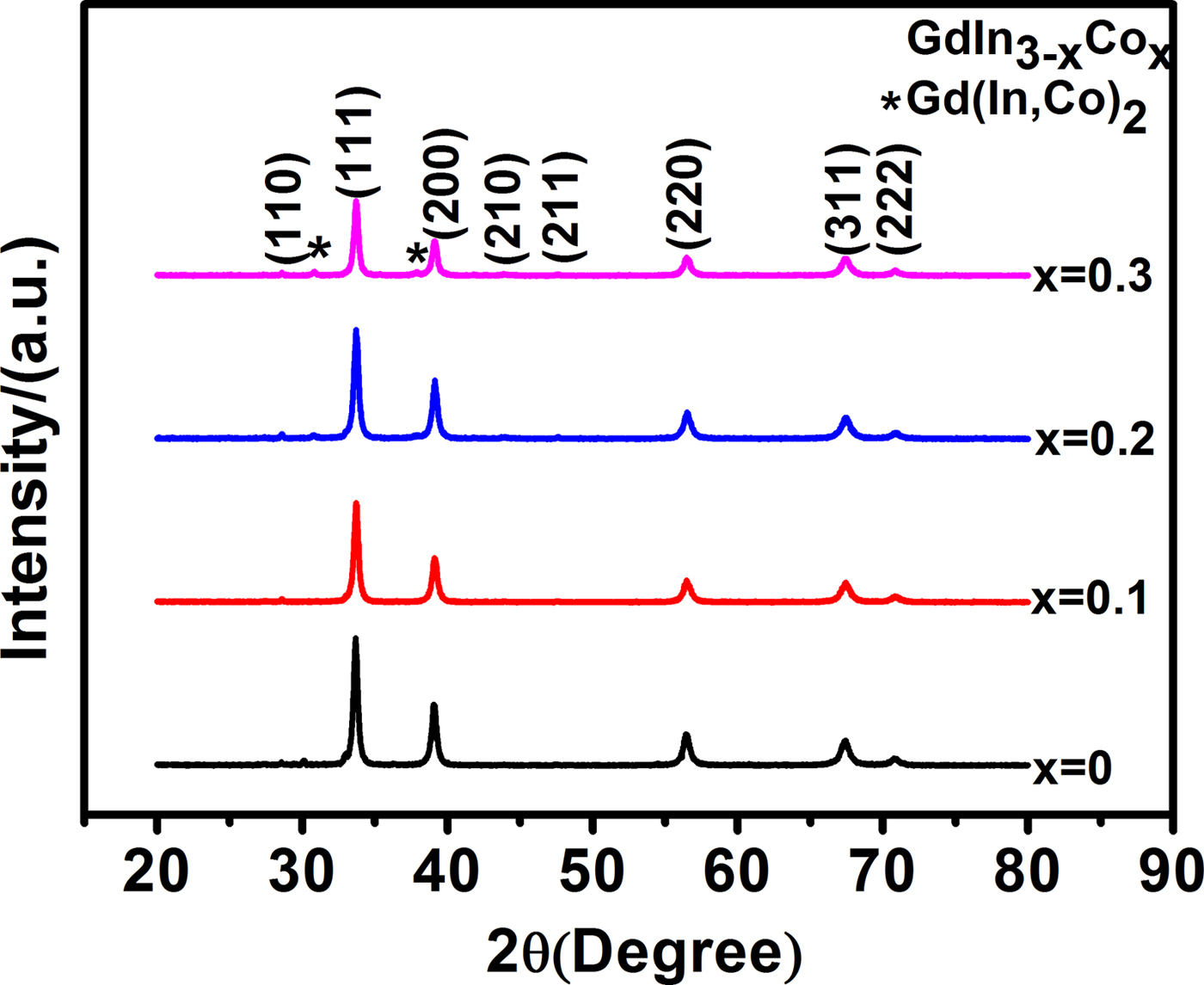
The XRD patterns of GdIn3−x Co x are shown in Figure 1. It shows that the single-phase region is in the range of x < 0.2. The small amount of impurity, which is identified to be Gd(In,Co)2 coexist with the main phase in the doping range of x > 0.2. With the increase of Co content, the diffraction peaks intensities of impurity tend to increase.
(Colour online) The XRD patterns of synthesized GdIn3 and GdIn3−x Co x doped samples.

The characteristic diffraction peaks of phases in GdIn3−x
Co
x
have been indexed with a TREOR program, and their crystal structures have been determined with Rietveld method. The refined XRD patterns for GdIn3−x
Co
x
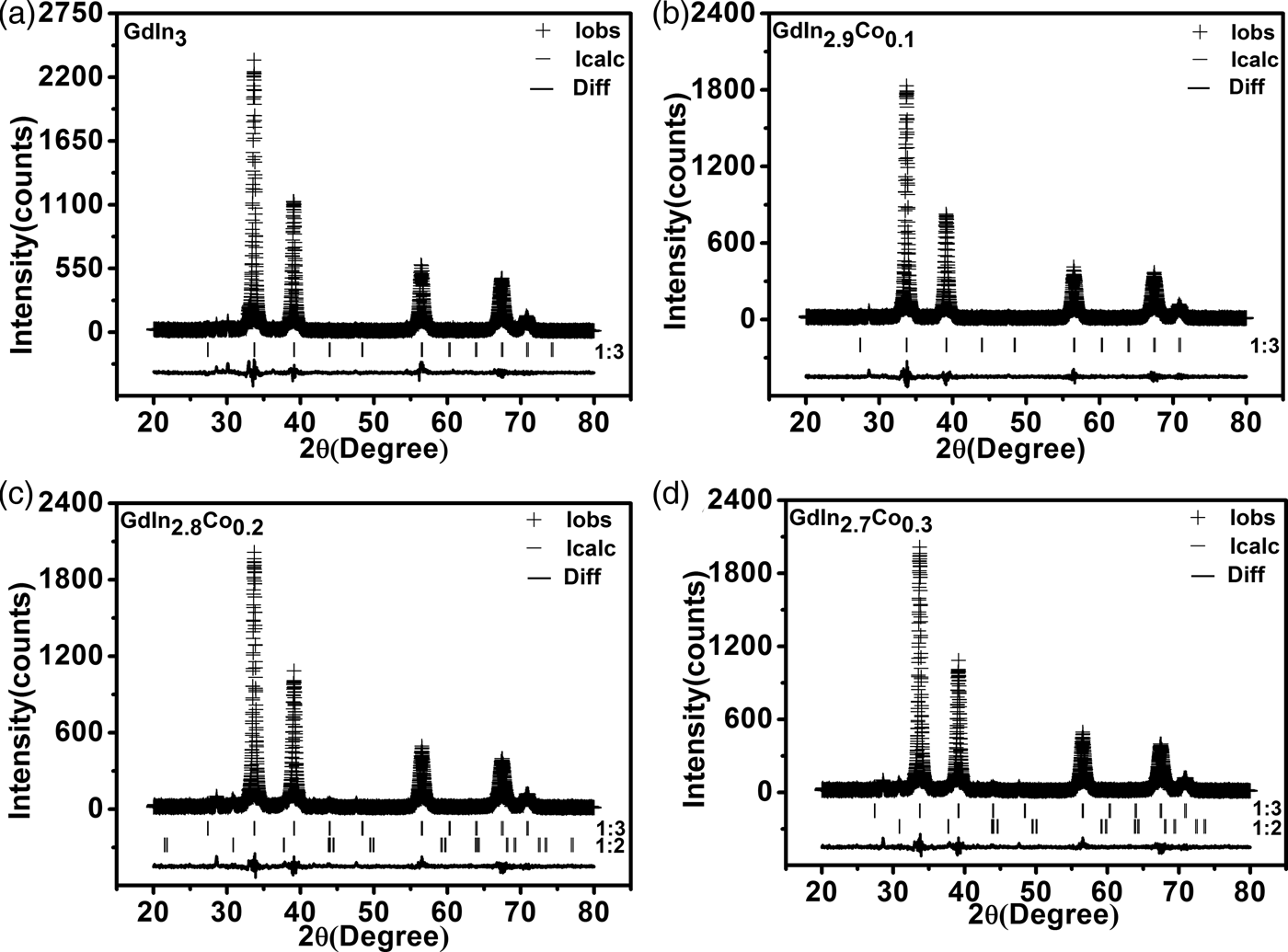
(x = 0–0.3) are shown in Figure 2(a)–(d), where the measured and calculated XRD patterns are marked with the symbol of “+” and solid line, respectively. The lowest trace indicates the differences between the two patterns. The indexed results show that GdIn3−x
Co
x
has the simple cubic structure with a space group of Pm
 $\bar 3$
m and the lattice parameters are a = 4.6052–4.6065 Å. Each unit cell contains one structural unit of GdIn3−x
Co
x
and the refined result shows that the atomic occupation is 1a (0,0,0) crystal position for Gd, 3c(0,0.5,0.5) site for (In,Co). Co atoms partial substitute for In atoms at 3c site.
The refined XRD patterns of GdIn3−x Co x alloys, where x = 0, 0.1, 0.2, 0.3 are shown in (a), (b), (c), and (d).

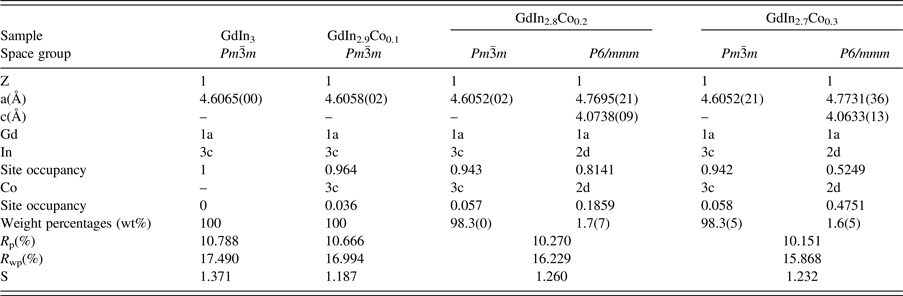
The crystallographic data are presented in Table I. It shows that the structural refinements are acceptable. The content of binary-phase can be determined from the refinement result by the following formula (Guo et al., Reference Guo, Zhang and Wappling2000):
 $$w_i = \displaystyle{{Z_i M_i V_i S_i} \over {\sum Z_i M_i V_i S_i}} $$
where w i is the weight percentage of the ith phase, Z i , M i , V i , and S i represent the number of formula units in a unit cell, molecular weight, cell volume, and scale factor of the ith phase, respectively.
The refined structure parameters of GdIn3−x Co x .

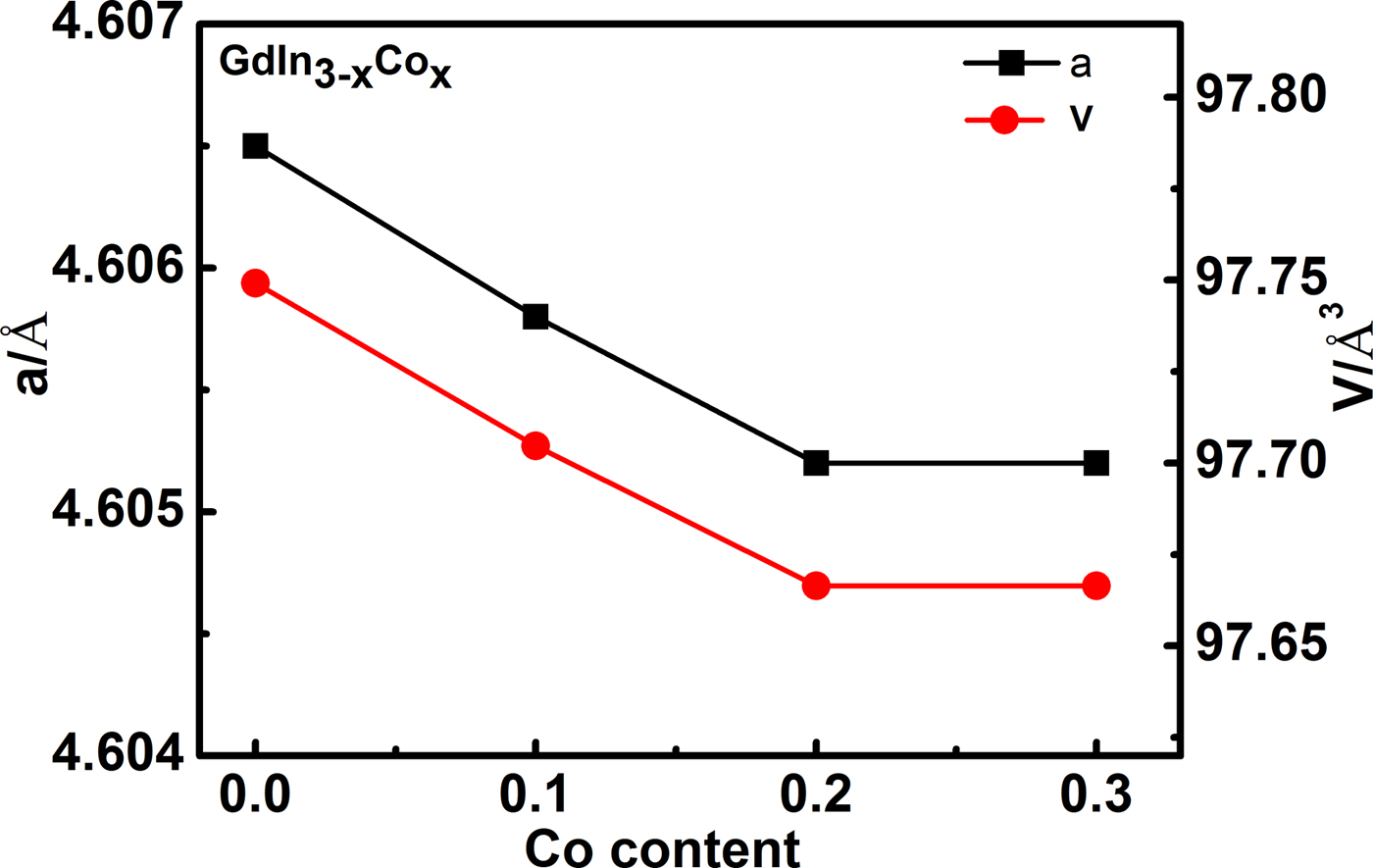
The Co content dependence of lattice parameters of GdIn3−x Co x is shown in Figure 3, it is clearly seen that the lattice parameters monotonically decrease in the regime of x = 0–0.2. The lattice concentration is because of the size effect at In site. Since the radius of Co (1.25 Å) is less than that of In (1.66 Å), the substitution of Co for In induces the decrease of lattice parameters.
(Colour online) Co content dependence of the lattice parameters of GdIn3−x Co x .

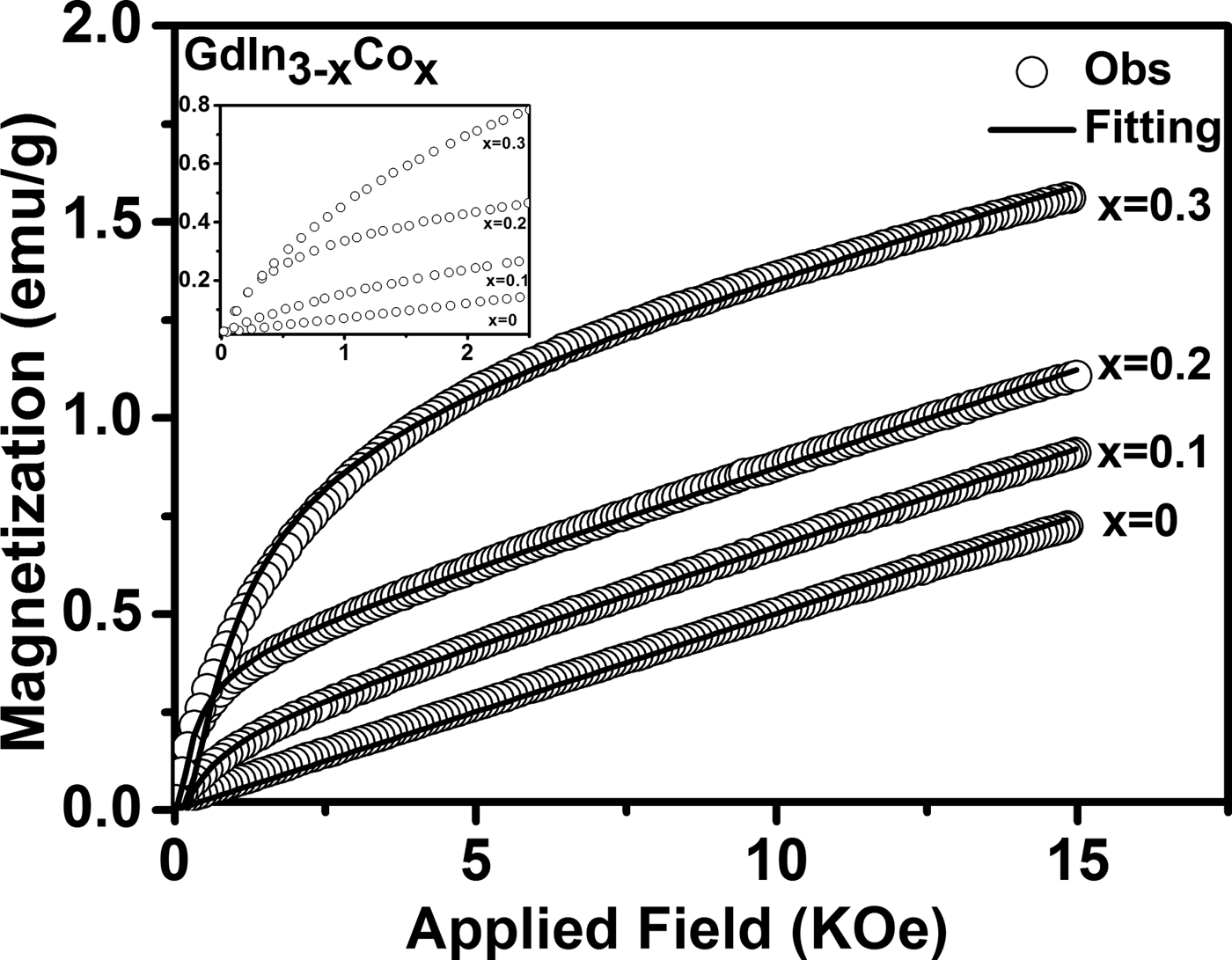
Figure 4 shows the observed and fitted magnetization curves of GdIn3−x Co x at room temperature. With the increasing Co content, GdIn3−x Co x intermetallic compounds show paramagnetic for GdIn3 and mixture of paramagnetic and ferromagnetic for GdIn3−x Co x (x > 0.1). In the paramagnetic region, the magnetizing curve for the GdIn3 follows an equation as
 $$M = \chi H$$
where M, χ, and H are the magnetization, susceptibility, and external field, respectively.
The fitted and observed M-H curves of GdIn3−x Co x at room temperature.

In the mixture of the ferromagnetic and paramagnetic regime, the field dependence of magnetization curves for the GdIn3−x Co x compound follows equation as
 $$M = M_s {\rm Exp}( - a/H) + \chi H $$
where the first and second terms are the contributions to magnetization originating from the ferromagnetic and paramagnetic phases, respectively; M s is the saturation moment; a is a parameter related to the applied external field.
This exponent function equation could be rewritten by Taylor series expansion algorithm as
 $$M = M_s (1 - a_1 /H + a_2 /H^2 - a_3 /H^3 \cdots )$$
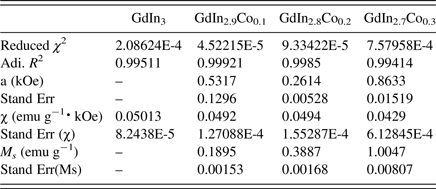
The expansion equation is almost the same as the magnetizing model proposed by Weiss. The bending phenomenon in magnetizing curve can be owing to the contribution from the ferromagnetic phase in the low field region. Based on this model, the magnetism of GdIn3−x Co x could be attributed to the evolution of magnetic phase with Co contents at room temperature. The fitting magnetic parameters are listed in Table II. The Ms are going up with increasing Co contents in GdIn3−x Co x , however, the susceptibility χ is going down.
List of fitting parameters of GdIn3−x Co x .

B. Gd-In-Fe system
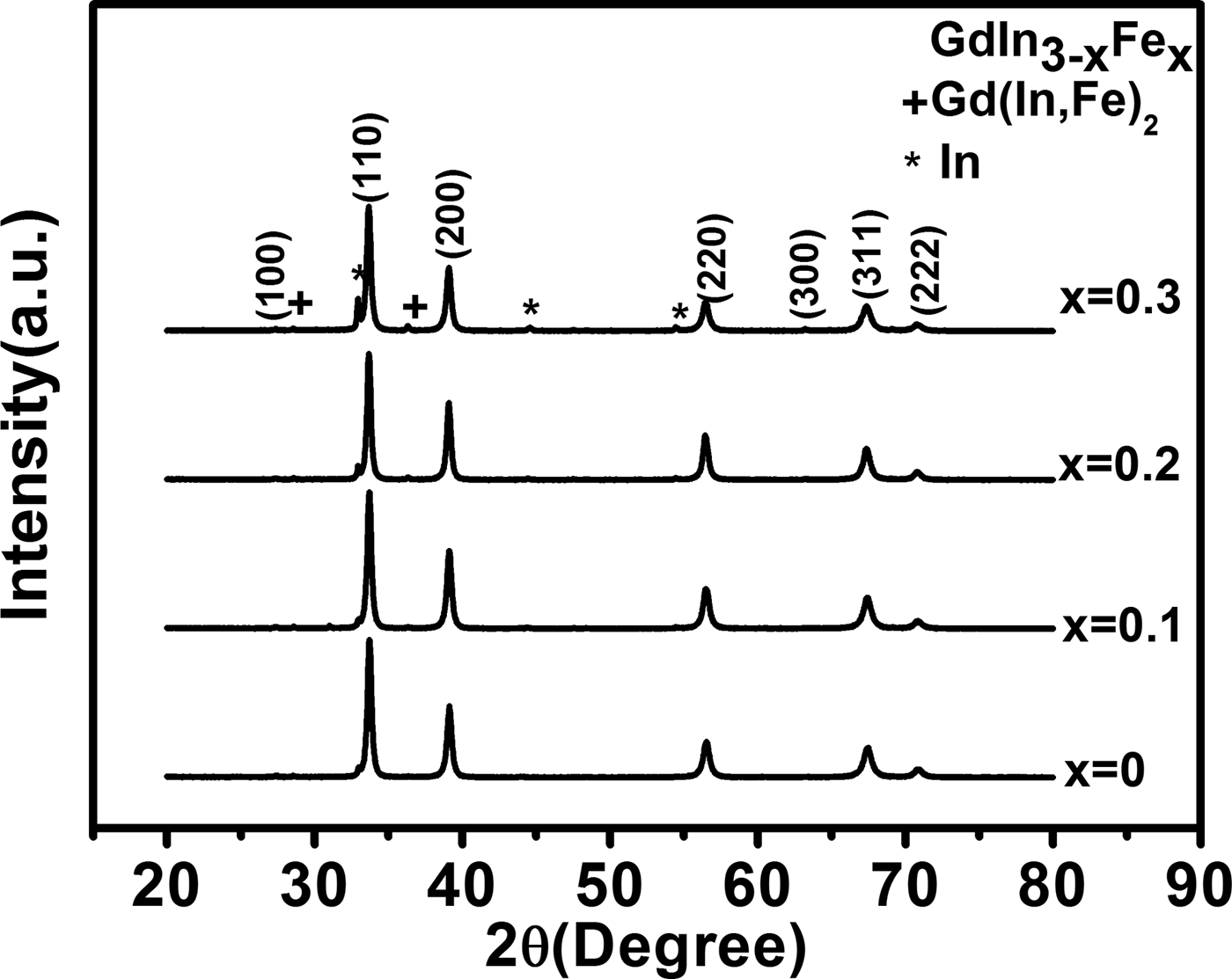
Figure 5 shows the XRD patterns of GdIn3−x Fe x . It shows that Fe doping into GdIn3 causes the decomposition of cubic phase and presence of the impurity phase Gd(In,Fe)2, and In is also separated from the alloy with increasing Fe content. The lattice parameters fluctuate around a = 4.6066 Å in the main phase. The structural refinement shows that Fe seems not to enter the lattice of cubic phase. Since the binary intermetallic compound GdFe2 with cubic structure exists naturally, the impurity phase Gd(In,Fe)2 is more easily formed by Fe doping into GdIn3.
The XRD pattern of synthesized GdIn3 and GdIn3−x Fe x doped samples.

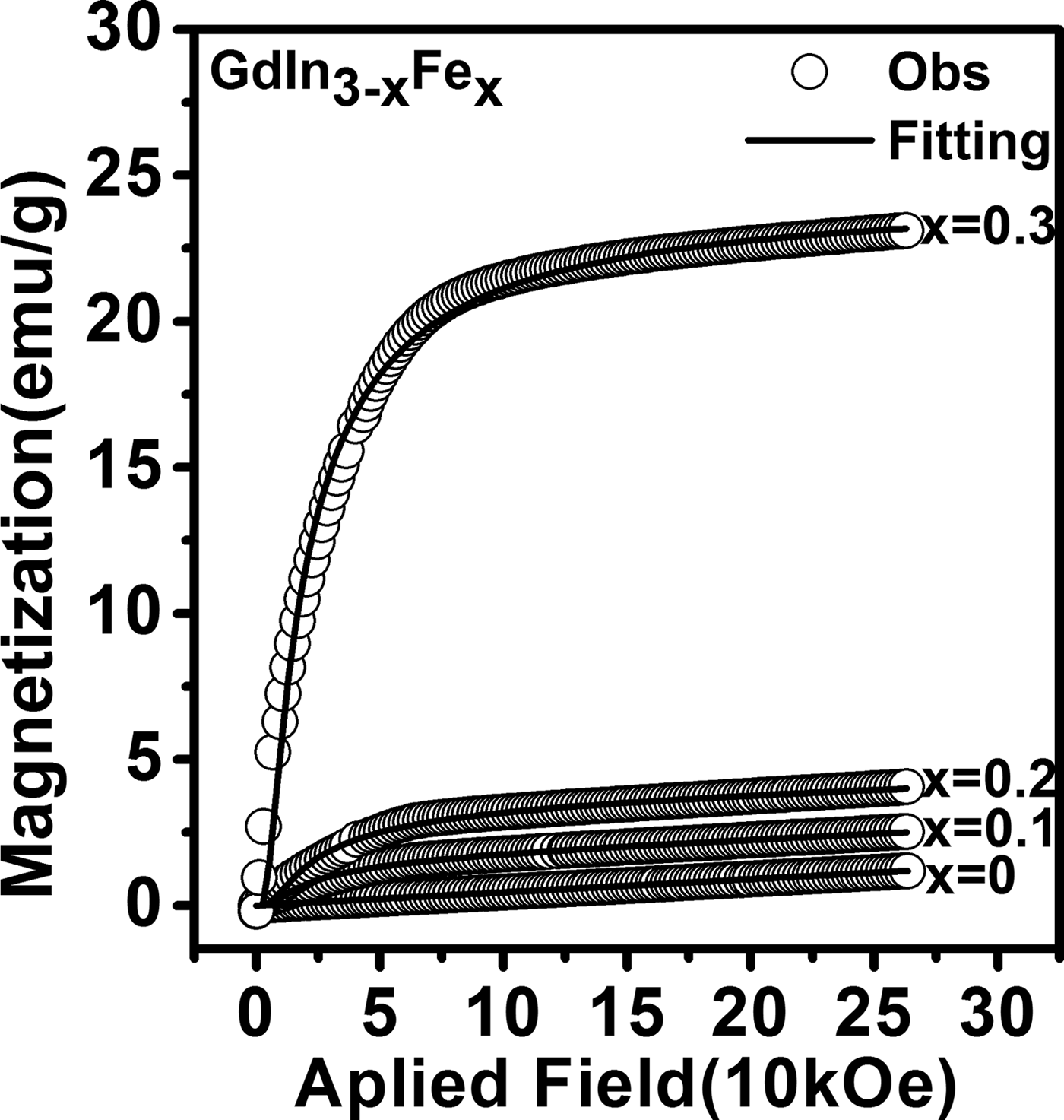
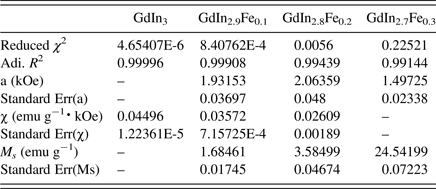
Fe doping into GdIn3−x Fe x alloys causes a magnetic phase transition from the paramagnetic in GdIn3 to ferromagnetic in GdIn3−x Fe x with x = 0.1–0.3. The magnetization curves as shown in Figure 6 follow the paramagnetic model of Eq. (1) for GdIn3 and mixture of the paramagnetic and ferromagnetic model as mentioned in Eq. (2) for GdIn3−x Fe x alloys with x = 0.1–0.3. The fitting parameters are listed in Table III. The susceptibility χ and M s are going up with increasing Fe contents in GdIn3−x Fe x , this implies that the magnetism of GdIn3−x Fe x originates from the impurity phase Gd(In,Fe)2. The presence of magnetic phase might be because of the change of magnetic exchange interaction from the one between the isolated Fe spins with the surrounding conduction electrons in Fe-poor regime, and this change is helpful for the formation of the ferromagnetic phase.
The fitted and observed M-H curves of GdIn3−x Fe x at room temperature.

List of fitting parameters of GdIn3−x Fe x .

C. Pr-In-Mn system
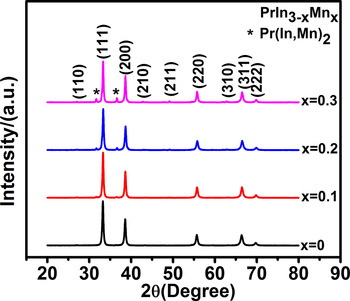
Figure 7 shows the diffraction patterns of PrIn3−x
Mn
x
alloys. It shows that PrIn3−x
Mn
x
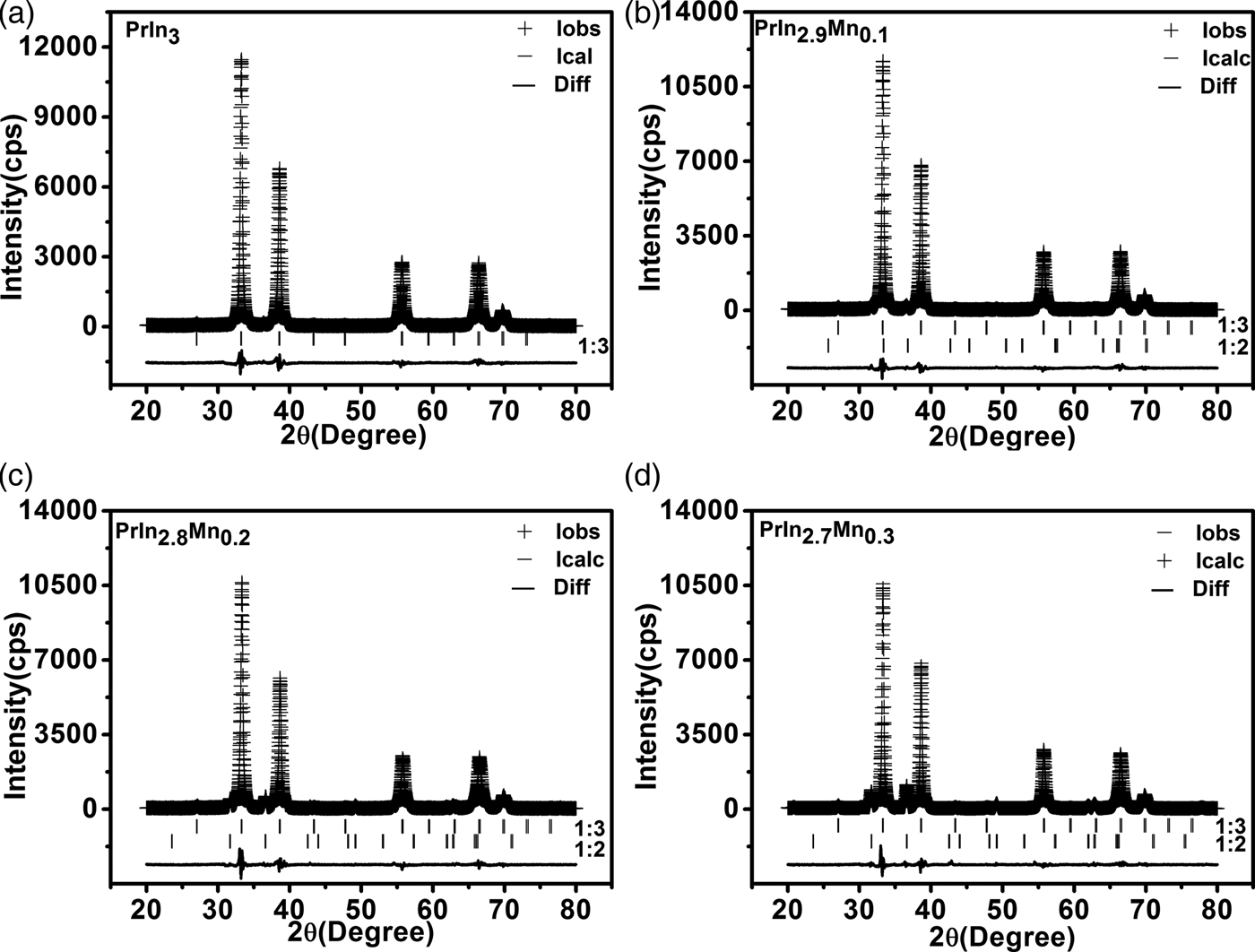
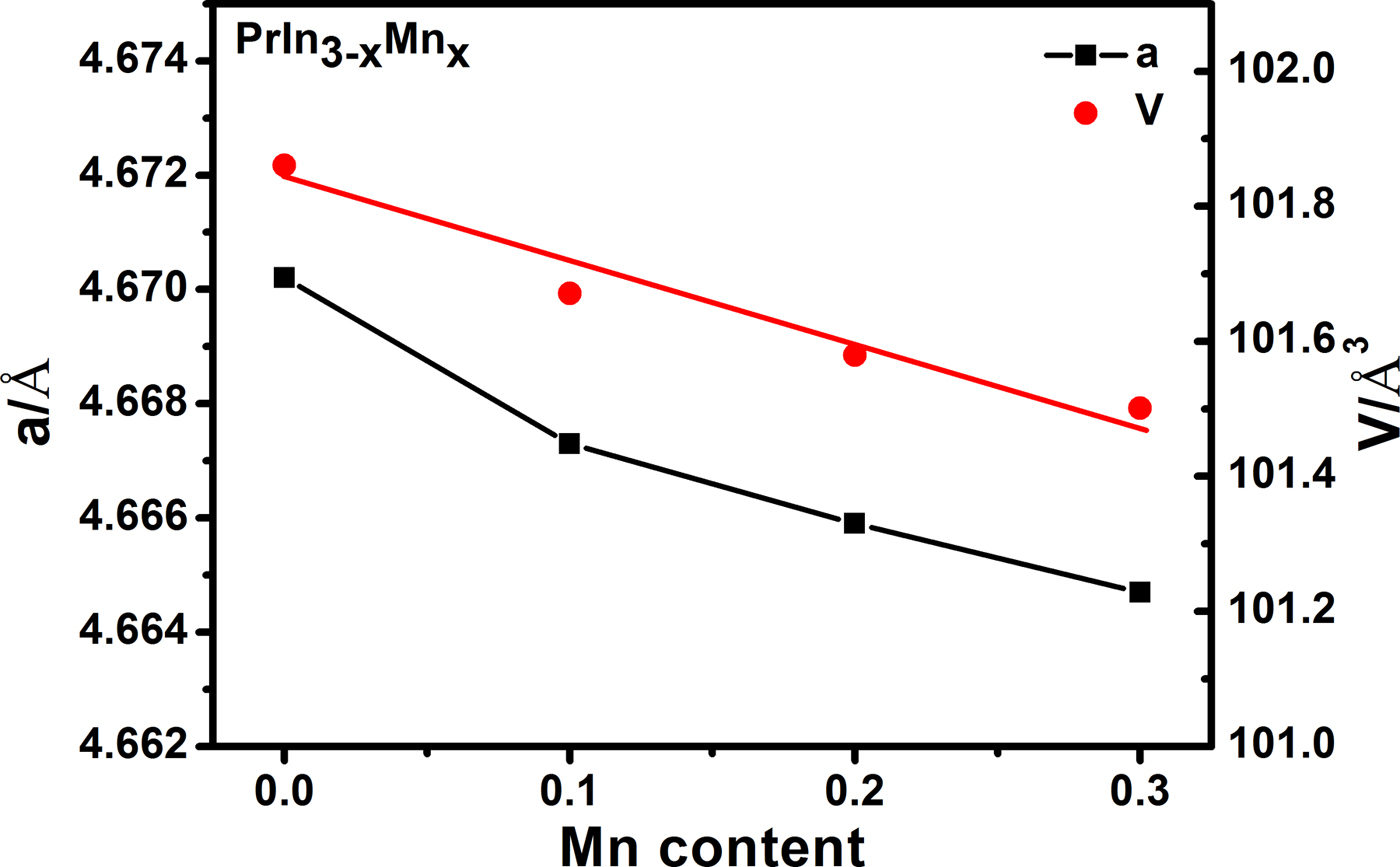
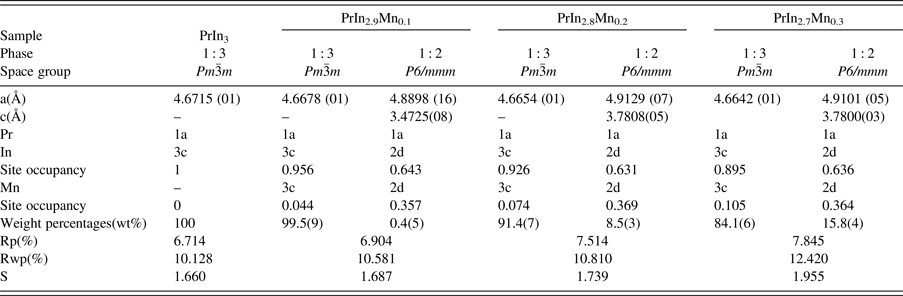
is a single phase with cubic structure in doping ranges of x < 0.1. The small amount of PrIn1.33Mn0.67 as impurity phase coexists with the main phase in the doping change of x ≥ 0.1 (Figure 8). According to the XRD patterns, with the increase of Mn content, the diffraction peaks intensities of impurity tend to increase. The lattice parameters of the main phase with cubic structure monotonically decrease from 4.6715(1) Å to 4.6642(1) Å (Figure 9). The indexed results show that PrIn3−x
Mn
x
has the cubic structure with space group Pm
 $\bar 3$
m and the two crystal positions 1a(0,0,0) and 3c(0,0.5,0.5) are occupied by Pr and In,Mn. The impurity phase, PrIn1.33Mn0.67 has a hexagonal structure with a space group of P6/mmm. Pr locates at 1a(0,0,0) site, and In and Mn locate at 2d(1/3,2/3,1/2) site.
(Colour online) The XRD patterns of synthesized PrIn3 and PrIn3−x Mn x doped samples.

The refined XRD pattern of PrIn3−x Mn x alloys, where x = 0,0.1,0.2,0.3 are shown in (a), (b), (c), and (d).

(Colour online) The Mn content dependence of lattice parameters for PrIn3−x Mn x alloys.

The refined crystallographic data of the phases in PrIn3−x Mn x are presented in Table IV.
The refined structure parameters of PrIn3−x Mn x .

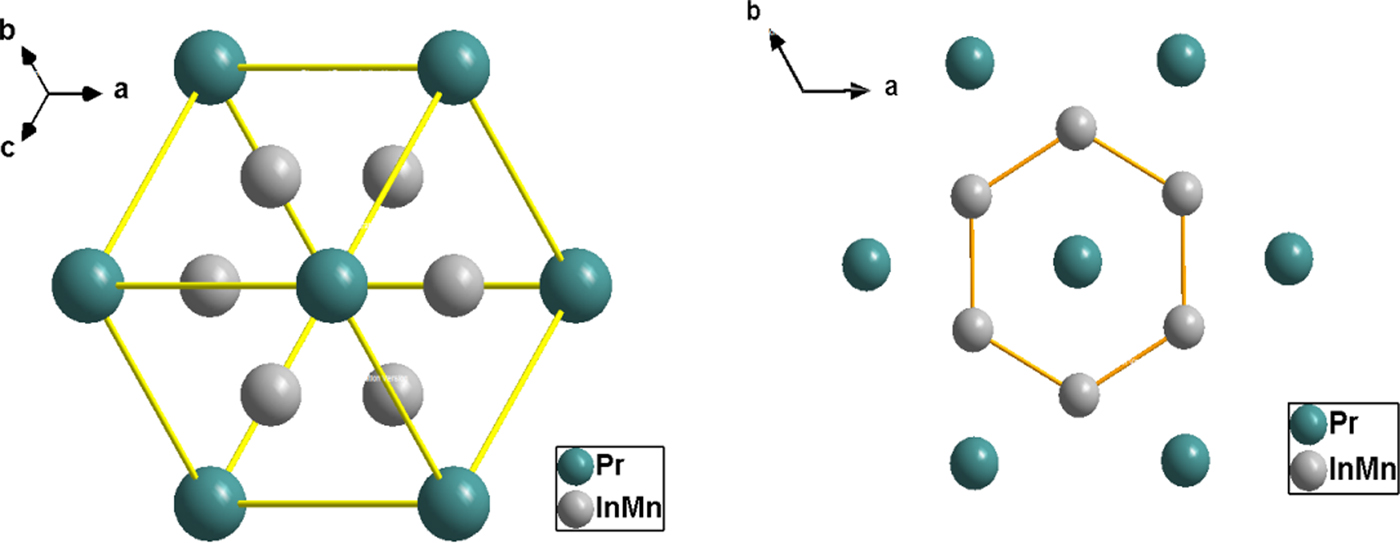
The formation of PrIn1.33Mn0.67 could be attributed to the atomic atoms effect. The atomic radius of Mn is 1.36 Å, which is smaller than those of In (1.66 Å) and Pr (1.82 Å), The lattice skeleton of PrIn1.33Mn0.67 formed because of the effective atomic radius increasing for the substitution for In. Figure 10 shows the projections of units for the two structures. The rotation of M6 (M = In, Mn) hexagonal ring caused the phase transformation from the cubic PrIn3 to hexagonal PrIn1.33Mn0.67. In the phase of PrIn1.33Mn0.67, the M6 hexagonal ring rotates 30° compared with the projection in PrIn3, as shown in Figure 10.
(Colour online) The projections of cubic PrIn3 along [111] direction and hexagonal PrIn1.33Mn0.67 along [001] direction.

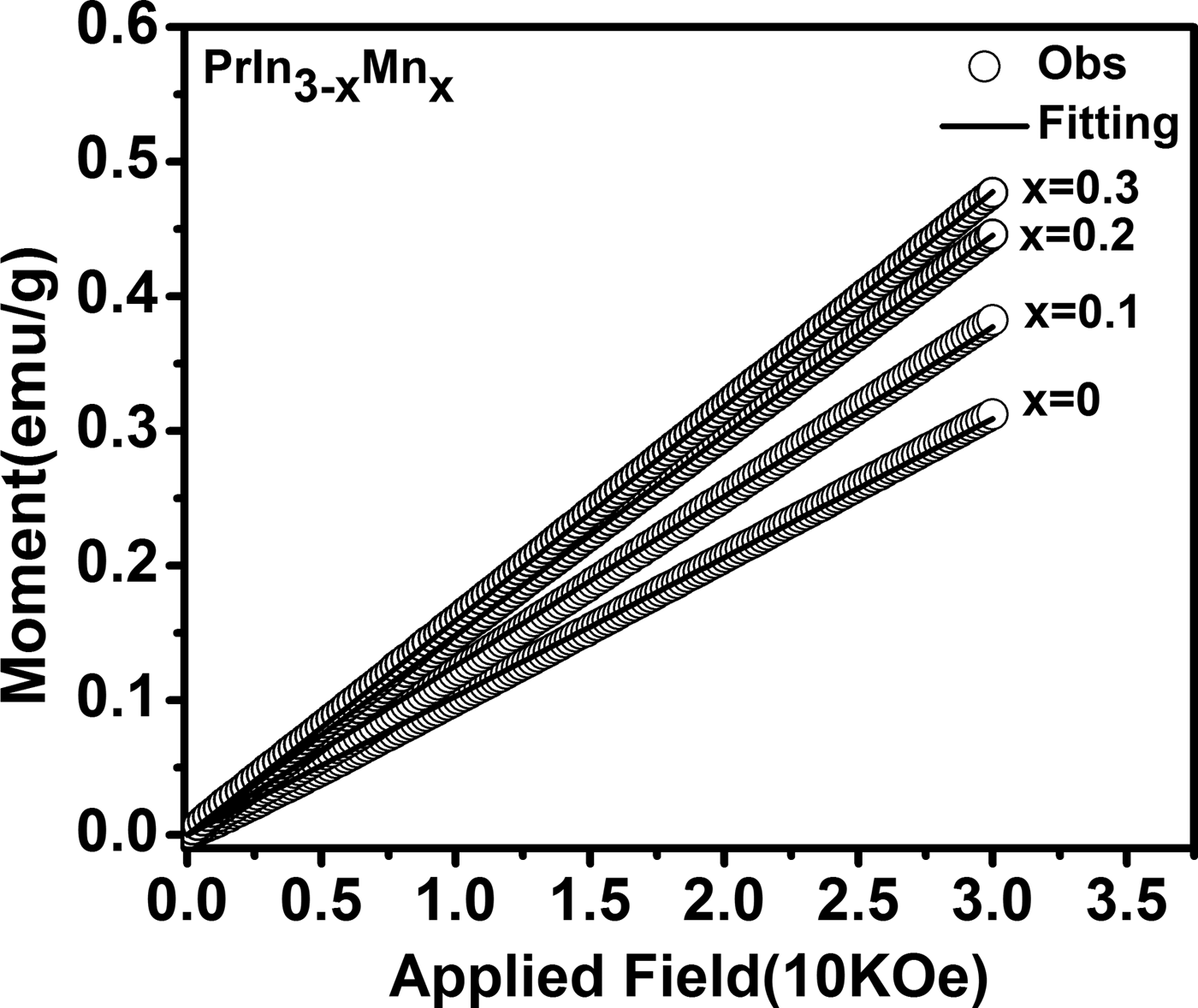
To research the magnetic mechanism generated by Mn doping, the magnetization curve is shown in Figure 11.
The fitted and observed M–H curve of PrIn3−x Mn x at room temperature.

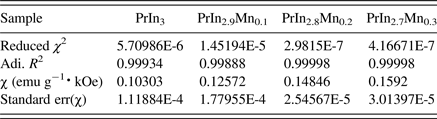
Eq. (1) could be used to fit the magnetization curve of PrIn3−x Mn x and the fitting curve was shown in Figure 11 marked with solid lines. The fitting parameters are listed in Table V.
List of fitting parameters of PrIn3−x Mn x .

The results show that susceptibility χ going up with increasing Mn contents in PrIn3−x Mn x . This implies that the evolution of magnetic phases in PrIn3−x Mn x might result from the exchange interaction change from the one between the isolated Mn spins with the surrounding conduction electrons in Mn-poor regime to the one between Mn–Mn pairs mediated by the conduction electrons in Mn-rich regime.
IV. CONCLUSION
RIn3−x T x crystallizes in cubic AuCu3 type structure with a space group of Pmm. The increase of 3d transition metal content enhances the formation possibility of the second phase RIn2−x T x . The magnetic properties of GdIn3−x T x are sensitive to the 3d transition metal contents. With increasing T contents, the main phase in RIn3−x T x alloys is still the cubic structure. In GdIn3−x Fe x alloys, they show ferromagnetic characteristics at room temperature, which are totally different from those of pure binary GdIn3 (paramagnetic at room temperature). However, PrIn3−x Mn x alloys are still paramagnetic with increasing Mn content.
SUPPLEMENTARY MATERIAL
The supplementary material for this article can be found at https://doi.org/10.1017/S0885715617001142
ACKNOWLEDGEMENTS
This work was supported by the National Natural Science Foundation of China (Grant No.11274110).