‘Up at the top end of Platform 4 in Paddington, where you can step out of the grime of London and go to pleasing places like Bicester and Banbury and Aynho, a number of scientists have shunted in about twenty tons of their throbbing conscience’, opened William Connor, alias Cassandra, in his column in the Daily Mirror on 22 April 1948. ‘In two railway carriages brightly decorated in what might be called the modern teashop-cum-cocktail-bar style, you can, if you pay a shilling, see The Atom Train Exhibition’, he quipped, ‘a cheerful collection of working models and pedagogic diagrams showing how the world can almost certainly blow itself to bits unless we all go mad and use the atom for sensible purposes in medicine, agriculture and industry’.Footnote 1
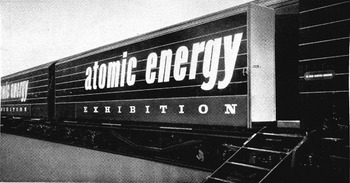
With his cynicism, William Connor not only mocked the Atom Train but the reasons behind the formation of its chief organizing body – the Atomic Scientists' Association (ASA). After the war, many ASA members felt a new responsibility that was emerging from their work on nuclear weapons, at first in the British Tube Alloys programme and later in the Manhattan Project, and which translated into their engagement in the chief organization of the British atomic scientists’ movement, including the preparation of the Atom Train (Figure 1).
The Atom Train (general view). Courtesy of the University of Liverpool's Department of Physics Archives.

As in the United States, the news of Hiroshima produced an ambiguous response from the British public, and atomic scientists found themselves at the centre of considerable public attention.Footnote 2 By 1946, many Britons felt that the negative consequences of nuclear energy would outweigh its benefits in the long run.Footnote 3 ‘This excursion of scientists from the lecture room and the laboratory into the hurly-burly of public life is a strange phenomena [sic] … and one that they do not enjoy, nor one which comes easily’, Sir James Chadwick – both a senior scientist in the development of the atom bomb and an ASA member – commented on the atomic scientists’ new public role at the Atom Train launch, adding, ‘But it is forced upon us by the urgency of the situation.’Footnote 4
The Atom Train formed part of the ASA's public education campaign, which ranked amongst the association's key objectives alongside the promotion of the international control of atomic energy and advising the government on nuclear issues. The ASA based their nuclear education on ‘the scientific approach to study the facts and their meaning without fear’, as Chadwick outlined it, and refrained from offering fixed solutions or imposing views on members of the public.Footnote 5 Instead, the association followed a general understanding in the late 1940s that imagined the public on the whole as ‘informed laymen’ and aimed at providing non-experts with the basic ‘objective’ information on atomic energy so that they could reach their own informed decisions on the subject.Footnote 6
The Atom Train superseded earlier nuclear education campaigns by the government, who published the booklets Statements Relating to the Atomic Bomb (1945) and The Effects of the Atomic Bombs at Hiroshima and Nagasaki (1946), as well as exhibitions. In 1946, the Science Museum in London hosted the Atomic Energy and Uranium exhibition, and Chapman Pincher organized the Daily Express Atomic Age Exhibition the following year.Footnote 7 While these publications and exhibitions focused by and large on nuclear weapons, the ASA intended to present a broader picture of atomic energy, especially its peaceful applications, in the Atom Train.Footnote 8 The exhibition, which represented the ASA's biggest publicity stunt, attracted some 146,000 visitors and travelled across Britain for 168 days. The accompanying catalogue sold 46,000 copies and became, according to Nature, ‘the most popular and widespread publication on atomic energy in Britain’, making the exhibition the most successful educational campaign on atomic energy until then.Footnote 9
The fact that the association depended on support from the British government to hold the exhibition complicated its planning and preparation, as the emerging Cold War and deteriorating nuclear relations with the United States made senior government officials more reluctant to cooperate with the ASA.Footnote 10 Especially Prime Minister Clement Attlee's secret decision in January 1947 to pursue an independent British nuclear weapons programme affected the willingness of government departments to collaborate with the association.Footnote 11 Unlike the Truman administration, the Attlee government followed a strict policy of secrecy by limiting public information on the British nuclear programme to a minimum.Footnote 12
This article argues that the exhibition marked an important moment within post-war British nuclear culture where scientists shared aspects of their nuclear knowledge with the British public and served as what Anthony Giddens terms ‘access points … of connection between lay individuals or collectives and the representatives of abstract systems’.Footnote 13 At the same time, it shows how these scientists, who for the most part adhered to an internationalist agenda and operated within transnational frameworks (not least through their promotion of the international control of nuclear energy), clashed with the national interests of the emerging British security state over nuclear education.Footnote 14
Organizing the Atom Train
Plans for organizing a travelling exhibition dated back to a time prior to the ASA's formation as an independent body. As early as March 1946, members of its predecessor, the Association of Scientific Workers’ Atomic Scientists' Committee, had given serious thought to the project.Footnote 15 Initially, they had hoped to organize it on the back of the Penicillin Train that toured southern Britain for three months in 1945.Footnote 16 Shortly after its foundation, the ASA Council therefore appointed a special Atom Train organizing committee, including F.C. Champion, William G. Marley, Philip B. Moon and Rudolf Peierls, as well as John Curry, Michael Moore and Joseph Rotblat from the University of Liverpool's Physics Department, where the exhibition was also put together.Footnote 17 In July 1946 the ASA's Liverpool branch then also took over the ‘technical organisation’ of the Atom Train from the Birmingham group.Footnote 18
To appeal to ‘informed laymen’, Curry, Moore and Rotblat suggested, ‘The standard should be such that the average citizen will be able to understand it easily and obtain a good idea of the basic physical principles of atomic energy, of the various technical problems involved and of the applications, both beneficial and destructive.’ They proposed that charts, simple experiments and instructional films be used to convey the message most effectively to the public.Footnote 19 Joseph Rotblat supervised the Atom Train's final assembly at Liverpool's Edge Hill train station.Footnote 20
Early on, the ASA realized the necessity of working closely with British government departments to turn the Atom Train into reality.Footnote 21 As the government office in charge of nuclear energy research and development, the Department of Atomic Energy (DAE) of the Ministry of Supply (MoS) assumed the central role amongst the participating government offices. The ASA relied on an established contact and turned to Michael Perrin for assistance, because the former Tube Alloys administrator under whom many ASA members had worked during the war now served as the DAE's deputy controller.Footnote 22
Government departments and railway companies, however, were hesitant to cooperate with the ASA owing to national security interests. Prime Minister Clement Attlee, Foreign Secretary Ernest Bevin and Minister of Defence Albert Victor Alexander objected to such public education campaigns as the Atom Train because they jeopardized their secrecy policy.Footnote 23 The arrest of the atomic spy Alan Nunn May fuelled these concerns. Shortly afterwards, Rudolf Peierls informed Michael Perrin that Lord Portal, the DAE's controller and chairman of the Great Western Railway (GWR), had refused to see the senior ASA officer Marcus Oliphant about the Atom Train. Instead, the GWR had declared they ‘would not have anything to do with such an exhibition because it might involve controversial matters’ and advised other railway companies to follow suit. But the MoS, too, appeared to be unwilling to cooperate with the ASA. Peierls referred to ‘one of the Public Relations men in the Ministry of Supply’ who had told Joseph Rotblat ‘in confidence’ that the ministry was at present considering postponing the exhibition because ‘the Harwell project had nothing to show, as yet, and this might make a bad impression’.Footnote 24
While Perrin subsequently tried to diffuse Peierls's allegations and promised assistance, the Atomic Energy Research Establishment (AERE) at Harwell lay in fact at the centre of interdepartmental disputes over secrecy and publicity.Footnote 25 Because of the government's secrecy policy, ‘Harwell stood for the whole British atomic energy project’, Margaret Gowing observed, which ‘led to misunderstandings about the objective of the project, which was largely military at this time, and about its balance, for the public was ignorant about the large and difficult industrial effort involved’. But the situation was more complicated: since the government had established the AERE before they took the decision to pursue their own nuclear weapons and energy programmes, Harwell's exact mission was initially uncertain.Footnote 26
The ASA thus touched a raw nerve when they asked the MoS for photographs of Harwell to be included in the Atom Train. ‘So long as Press visits to Harwell are not allowed’, stated D.E.H. Peirson, the ASA's DAE liaison, when explaining the reasons for the MoS's rejection of this request, ‘we must expect that the loan of photographs of Harwell to the A.S.A. for their exhibition would bring down upon us the wrath of the Press’.Footnote 27 But because of the ASA's request, long-standing differences in opinion between the MoS and the prime minister over nuclear secrecy now openly surfaced and led to John Wilmot's resignation as minister of supply.Footnote 28
In spite of the Harwell incident, Clement Attlee eventually sanctioned the exhibition because he feared the alienation of atomic scientists from his government. In fact, many senior ASA members were government employees working at nuclear installations such as Harwell. But the prime minister also worried that a cancellation of government support at this advanced planning stage might adversely affect his government's reputation at home and abroad, especially in the United States. After all, the MoS and the ASA had already agreed on the terms of their collaboration in the exhibition before Wilmot's resignation.Footnote 29 And, what is more, since the ASA sent Harry Massey's Atom Train script to the MoS for final approval, the government did in theory have some influence over the exhibition content.Footnote 30
Nevertheless, Attlee remained sceptical of the Atom Train and declined the ASA's invitation to attend it.Footnote 31 Minister of Defence Albert Victor Alexander advised Attlee ‘to plead other pressing engagements’ instead, adding in the same vein that ‘in the present international situation … it would be better if the Prime Minister were to visit Harwell privately’.Footnote 32 Attlee even issued an order to MoS and other government staff to limit their collaboration with the ASA to the agreed contractual minimum. As a consequence, Minister of Supply George Strauss, whom the ASA had asked to open the Atom Train, and the ministers of fuel and power, health, education and transport, as well as other senior government officials, including Sir John Anderson, Sir Wallace Akers and Sir Henry Tizard, declined their invitations to attend the launch. It was only after the Atom Train had received positive publicity that the government lifted this directive in the spring of 1948.Footnote 33 As a result, contributing government agencies now even encouraged their employees to attend the Atom Train.Footnote 34
Under the cooperation between the ASA and the MoS, the ministry loaned £2,000 to the association to cover the cost of preparing the Atom Train and appointed the exhibition manager.Footnote 35 In accordance with this arrangement, the ASA later paid back £1,400 of the grant and kept the remaining profits (about £1,200), which came mostly from the sale of the exhibition brochure.Footnote 36 At one point, the MoS regarded this cooperation as a mutual endeavour, as they briefly thought about holding their own atomic energy exhibition in collaboration with the ASA in the future.Footnote 37
In June 1947, the Treasury approved an additional grant of £4,000 ‘as a guarantee against losses’.Footnote 38 The Railway Executive's initial objection to the Atom Train necessitated this measure, as cancellation of the exhibition at the planning stage would have incurred a great financial risk for the ASA.Footnote 39 Even after the Railway Executive had sanctioned the Atom Train, they insisted on a shortened itinerary, which still bore the risk of a considerable deficit.Footnote 40 In addition, the MoS assisted the association with the negotiation of rail fares, coordination and communication with railways, and the Atom Train's electricity supply.Footnote 41 The ASA then developed the Atom Train's itinerary in cooperation with the Ministry of Transport.Footnote 42
The DAE and the AERE supplied radioactive sources and the majority of the instrumentation aboard the Atom Train, while the MoS's Directorate of Information (DoI) provided support in organizational matters. The Department of Scientific and Industrial Research, the Ministry of Works, the British Museum and the Science Museum, as well as the United States Atomic Energy Commission and the United States Navy Department, also made contributions to the Atom Train. Private corporations, including Metropolitan Vickers Electric Co., British Thomson-Houston Co. Ltd, Gaumont-British Equipments Ltd and Gaumont-British Instructional and the Press Association, supported the exhibition, too.Footnote 43 The DoI's Press Office served as public relations outlet and held a news conference over the exhibition in London.Footnote 44 AERE photographers took publicity shots of the carriages during their final assembly ‘under conditions of extreme difficulty, with workmen hammering and coming and going through the coaches’, as W.G. Bushbridge of Harwell's Photographic Division put it.Footnote 45
The Atom Train officially opened on 6 November 1947 in Liverpool's Central Station with speakers including the city's lord mayor and Chadwick.Footnote 46 Apart from the aforementioned government officials, the list of invitees included the presidents of the Royal Society and the Physical Society, members of the Liverpool City Council and the local establishment, ASA officers and members of the press.Footnote 47 In the light of his personal contributions to the Atom Train, the ASA president Nevill Mott thanked D.E.H. Peirson for ‘the generous help of the Ministry of Supply … and particularly … your continued efforts to make the Exhibition a success’.Footnote 48 Since the limited space available in Liverpool's Central Station only permitted guests and members of the press to attend the Atom Train launch, the ASA Council had briefly considered moving the ceremony to London or Manchester.Footnote 49
In most locations where the Atom Train called, the ASA organized so-called Atomic Energy Weeks in collaboration with the local United Nations (UN) Association chapter and other organizations. Nearby universities usually provided students as tour guides.Footnote 50 The ASA and the MoS issued detailed guidelines for local organizing committees.Footnote 51 These Atomic Energy Weeks included public lectures and meetings, as an ASA press release advertised them, ‘to discuss what the ordinary citizen can do to ensure that atomic power is used for our benefit and not for our destruction’.Footnote 52 Senior scientists such as Sir James Chadwick, Sir John Cockcroft, Marcus Oliphant and Rudolf Peierls delivered public lectures.Footnote 53 But the ASA also used these Atomic Energy Weeks to forge ties with local chambers of commerce.Footnote 54
In addition, the Atomic Energy Weeks saw screenings of short films, including Atomic Physics, The Mighty Atom and a British Paramount News film on the 1946 Bikini atoll atomic tests.Footnote 55 While the ASA Council gladly accepted Gaumont-British Instructional's offer to screen the animated short film Atomic Physics, they declined Metro-Goldwyn-Mayer's proposal to show their feature film The Beginning or the End.Footnote 56 In Scotland, the BBC also promoted the Atom Train through ‘special broadcasts’.Footnote 57 After initial hesitation the support of government agencies and industry ultimately ensured that the Atom Train was comparatively well equipped at a time that was generally characterized by severe shortages and rationing of goods shortly after the war.Footnote 58
Representing nuclear energy on the Atom Train
‘The Atom Train Exhibition has been brought to your town to help you understand the facts about atomic energy’, the accompanying catalogue explained the rationale behind the exhibition to visitors. ‘Everyone knows that this new power can be used for destruction; much less is known as yet of its possibilities for good’. It underlined the ASA's role as an ‘objective’ educator, stressing, ‘One can get a balanced view only by understanding a little of what is behind it.’Footnote 59
Despite these idealistic claims, and while the overwhelming majority of the exhibition focused on peaceful applications of nuclear energy, the organizers framed it within the dichotomy of a bright, peaceful atomic future and nuclear annihilation. Chadwick also emphasized this polarized view in his speech at the Atom Train launch, where he warned that ‘a large part of the civilised world will disappear’ if people fail to fully comprehend the meaning of nuclear power.Footnote 60 This Manichean message corresponded with public opinion at the time.Footnote 61
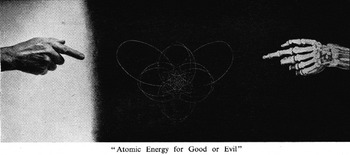
After boarding the Atom Train, visitors confronted a plate that was entitled ‘Atomic Energy for Good or Evil’ (Figure 2). It showed a human and a skeleton hand which both point their index finger from opposite sides at an idealized ringed atom at the centre.Footnote 62 The Liverpool Echo printed a picture of Joseph Rotblat in front of the ‘symbolic mural of the atom and the two alternatives – plenty or starvation, life or death’.Footnote 63 In a similar fashion, the Manchester Guardian argued that the Atom Train
illustrates with full effect the two diametric directions open to nuclear physics – the road to destruction, which is inhabited by the spectre of Hiroshima and Nagasaki, or the road along which industry and the preventive and curative sciences may move slowly, it seems, but quite surely with a common and a constructive purpose.Footnote 64
‘Atomic Energy for Good or Evil’. Taken from Atom Train: Guide to the Travelling Exhibition on Atomic Energy, London: Atomic Scientists' Association, 1947, unpaginated. Courtesy of the University of Liverpool's Department of Physics Archives.

The Atom Train comprised two parts, one in each of the two railroad carriages. While Part One dealt with ‘Fundamental Facts’, Part Two considered ‘Practical Applications’ of atomic energy. Part One detailed the knowledge available to scientists before the discovery of nuclear fission by Otto Hahn and Fritz Strassmann in 1938. It featured six sections that explored the basics of nuclear energy from the atom in the first one to artificial radioactivity in the last.Footnote 65
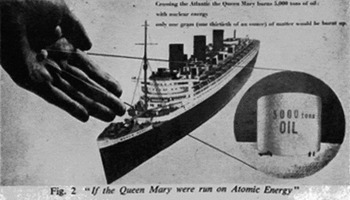
Section one introduced the atom, before the second, entitled ‘Atoms Are Known by Numbers’, went on to explain the nature and structure of different atoms. It contained models of lithium and aluminium atoms to visualize their structure. The subsequent area looked at the behaviour of atoms and used metaphorical language to describe the make-up of all substances, stating, ‘Atoms are the “bricks” – the chemical force is the “cement”.’ It further showed how groups of atoms form molecules that then form compounds and that changes in matter which occurred in the form of explosions or burning led atoms to release energy. A picture of the famous cruise liner Queen Mary and a comparison of the five thousand tons of oil as opposed to one gram of nuclear matter that it needed to cross the Atlantic illustrated atomic energy's tremendous power potential (Figure 3).Footnote 66
‘If the Queen Mary were run on Atomic Energy’. Taken from Atom Train. Courtesy of the University of Liverpool's Department of Physics Archives.

Section four concerned the history and scientific basics of radioactivity, especially alpha, beta and gamma rays, and invited visitors to use a Geiger counter to detect radioactivity from uranium metal, pitchblende and a luminous radium watch dial.Footnote 67 With its hands-on approach, which was a recurring feature in the exhibition, the Atom Train preceded Frank Oppenheimer's famous Exploratorium in San Francisco by some twenty years.Footnote 68 The following area, ‘Atom Smashing’, dealt with the release of nuclear energy. It featured an actual cloud chamber, which is used to make tracks of fast particles visible as lines, and pictures of Cockcroft and Walton's proton accelerator, as well as a van de Graaff generator, which produces electrostatics. The first part's final section then focused on artificial radioactivity. Here, an apparatus demonstrated how silver could be made radioactive through bombardment with slow neutrons.Footnote 69 A final summary of the knowledge available to nuclear scientists in 1938 concluded Part One. The organizers used a diagram of the carbon cycle to explain how ‘All life on earth depends on nuclear energy’ because ‘The Sun is running on Atomic Energy’.Footnote 70
Upon entering the second carriage, visitors accessed Part Two, which was subdivided into three sections. The first segment dealt with ‘The First Practical Release of Atomic Energy’ and provided them with a short historical and technical account of the discovery of nuclear fission. In a demonstration, visitors could witness the detection of fission. The screen of a cathode ray oscillograph showed the electric impulses produced in the fission process, while a loudspeaker converted them into audio signals. Furthermore, a short film introduced the elements uranium and plutonium and described the nature of a chain reaction, which is the underlying principle of both nuclear weapons and reactors.Footnote 71
The subsequent section considered ‘The Atomic Bomb’. Although the ASA devoted limited space to nuclear arms on the Atom Train, this part was highly ambivalent with regard to the exhibition's supposedly ‘objective’ approach and linked back to the opening panel. ‘The Atomic Bomb’ started with an overview of the technical background of nuclear weapons and the processes involved in their manufacture, such as isotope separation used in the production of uranium and carbon piles required for breeding plutonium. To illustrate the latter method, the Atom Train contained a model of a carbon pile and described its individual components, including the moderator, the uranium and cadmium rods, the cooling system and the protective walls. The exhibition also featured pictures of the Trinity test, the world's first nuclear explosion; Hiroshima; Nagasaki; and the second Bikini test – codenamed Baker – which was the world's first underwater nuclear explosion. The organizers had chosen a gloomy interior design for this section. ‘Ceilings and walls here are black’, the Architects’ Journal observed, ‘A special type face, hard and mechanical in character, is used for the captions.’Footnote 72
The fact that the ASA included photographs of mushroom clouds in the exhibition and even reprinted the iconographic image of the Baker test in the catalogue was no coincidence. Not only does the mushroom cloud arguably represent ‘the most impressive of all nuclear symbols’, as Spencer R. Weart puts it, but the Baker test, which the United States conducted in the South Pacific in July 1946, attracted considerable attention in Britain, where the BBC even broadcast it live on radio.Footnote 73
‘The Atomic Bomb’ devoted a good amount of space to the effects of nuclear weapons, in particular the ‘dangerous radiations’ produced by an atomic explosion. ‘Part of it comes out at the instant of the explosion and causes radiation injuries’, the catalogue explained; ‘The radioactivity of the fission products remains after the explosion is over.’Footnote 74 The Atom Train also featured a sample of so-called trinitite – sand fused into a greenish glass-like substance by the heat of the Trinity test. Visitors could even use a detector to measure its radioactivity. To further visualize the impact of nuclear weapons, some pictures of devastated Hiroshima and some ‘charred and blackened tiles’ from houses hit by the atomic bomb on 6 August 1945 were also on display. The organizers estimated the number of fatalities in Hiroshima at 80,000 and put these figures into perspective by comparing them to the 30,000 Londoners who lost their lives in German air raids during the entire war.Footnote 75
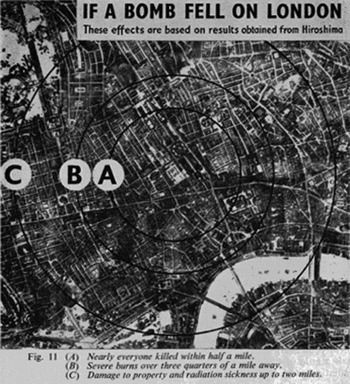
The Atom Train did not stop there; rather, it featured an aerial picture of London with superimposed concentric rings to further illustrate nuclear weapons effects (Figure 4). It detailed the anticipated impact of an atomic attack on the city based on the data obtained from Hiroshima. ‘Within half a mile of the centre most people would be killed by blast, burns or radiation, and many would receive severe burns at a distance of three quarters of a mile’, the accompanying brochure estimated the impact.
Up to two miles distance there would be casualties from radiation sickness, though many of these would recover. Houses are likely to be damaged beyond repair up to a distance of one mile and some damage would be caused as far as two and a half miles away.
The text calculated that a Hiroshima-type attack ‘would render 400,000 people homeless’, stressing, ‘All this damage would be done by a bomb carried by a single raiding plane.’Footnote 76 This information resembled the findings of a published government report by a British team who had visited the cities of Hiroshima and Nagasaki in November 1945.Footnote 77
‘If a Bomb Fell on London’. Taken from Atom Train. Courtesy of the University of Liverpool's Department of Physics Archives.

‘This, in brief, is the story of the atom bomb. It is not easy to make atom bombs, but once they are used, there is no defence against them, except to stop the plane, or rocket or ship that is bringing it’, this section concluded. ‘In the words of the American scientist, Robert J. [sic] Oppenheimer, “the only defence is not to be there”.’Footnote 78 To literally bring the effects of nuclear war home to visitors, the exhibition contained a map of the town where the train was currently calling that specified the impact of an atomic attack on the local area.Footnote 79 Such panels clearly departed from the ASA's ‘objective’ approach to educate ‘informed laymen’ and used fear to warn visitors of the perils of nuclear weaponry. In this, the association followed the model of its American sister organization, the Federation of American Scientists, who had contributed to an influential collection of essays by renowned scientists entitled One World or None (1946) that opened with Philip Morrison's graphic description of a hypothetical nuclear attack on New York City.Footnote 80
The Atom Train's final section, by contrast, saw a return to ‘The Brighter Side’ and dealt with civilian applications of nuclear power. ‘Much light and warm colours are used to create an appropriate atmosphere’, the Architects’ Journal commented on the changing ambience.Footnote 81 ‘If atomic fuels are not going to be wasted for war and destruction, atomic energy can bring great benefits’, the catalogue introduced this section.Footnote 82 ‘The Brighter Side’ opened with a discussion of the prospects of using atomic power to generate electricity. It contained a drawing of what its organizers presumed a nuclear power station might look like. At the same time, the Atom Train was realistic about atomic energy as a source of power and delivered a blow to popular fantasies such as nuclear-powered cars and trains. The exhibition booklet suggested that nuclear energy might replace coal as fuel for engines and in the heavy and plastics industries, concluding, ‘If there is a sufficient supply of uranium, atomic power need not be more expensive than that from coal.’Footnote 83
This part further proposed the cost-effective use of radioisotopes both as radiation source, replacing the more expensive radium, and as tracers which allowed scientists to follow the movement of atoms in a given chemical process. A subsection on ‘Atomic Energy and Medicine’ focused on medical applications for tracers. Furthermore, a short film explained the use of radiosodium in the study of the blood circulation in the human body, while another part looked at radiation treatment for curing diseases like cancer. ‘The Bright Side’ comprised two more subsections. ‘Atomic Energy in Agriculture’ suggested using tracers to learn about plant growth and diseases as well as the concentration and distribution of particular elements in specific parts of plants. Alongside atomic power as energy source, the final subsection – ‘Atomic Energy in Industry’ – stressed the potential applications of radioactive tracers in the study of materials, such as the composition of alloys or the efficiency of chemical reactions, examining corrosion or the exact location of oil batches in oil fields.Footnote 84
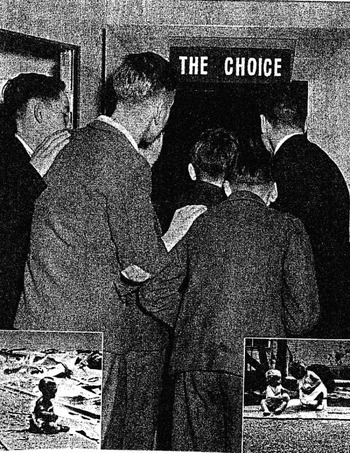
When visitors were about to disembark the Atom Train, they faced a mural, entitled ‘The Choice’. It established a frame with the opening panel ‘Atomic Energy for Good or Evil’ and presented them with their choice between a bright atomic future and nuclear obliteration. To amplify this dichotomy, the panel featured a screen with two continually changing pictures. One image showed happy children peacefully playing, while the second one depicted a crying baby amongst the ruins of Hiroshima (Figure 5).Footnote 85
Boys viewing ‘The Choice’. Courtesy of the University of Liverpool's Department of Physics Archives.

Two texts accompanied the display. Under the title ‘Destruction’, the organizers emphasized that there is ‘no defence against the atomic bomb. There is no secret about the bomb, except certain engineering details’. Warning of the perils of nuclear proliferation, they predicted, ‘In five to ten years, any industrial nation could discover these secrets and make the bomb’, because the plant ‘that can give power also makes the materials for a bomb’. Underneath, a section entitled ‘Construction’ praised the benefits of harnessing the atom for peaceful purposes to prevent war. Instead, the ASA lobbied for one of their key objectives – the international control of nuclear energy – ‘to avoid an arms race and to allow the full, constructive advance of atomic energy research’.Footnote 86 Here, the ASA clearly pushed a political agenda and deviated from their practice of presenting visitors with ‘objective’ facts.Footnote 87
Conclusions
After the Atom Train had come to a halt on 28 May 1948, Joseph Rotblat drew a highly positive conclusion, stressing that ‘we have achieved our main object … of educating an appreciable fraction of the British public in matters of atomic energy’.Footnote 88 Even the minister of supply now congratulated Rotblat that ‘these exhibits were most effective educationally, and their arrangement in the two railway coaches was really a masterpiece of organisation’.Footnote 89
Several factors account for the Atom Train being such a big success. In spite of earlier attempts at nuclear education, the ASA profited from a lack of effective exhibitions on the subject. Upon its launch, the Manchester Guardian complained, ‘if science has succeeded in splitting the atom it has not yet made it generally comprehensible to the ordinary man’.Footnote 90 Especially its focus on civilian applications of nuclear energy made it stand out from other exhibitions. ‘The great majority of people find the exhibition entirely satisfactory and very instructive’, Rotblat summarized the results of a visitor questionnaire.Footnote 91 In addition, the Atom Train's innovative character, through its pragmatic hands-on approach and the ASA's more politicized take on the subject in parts of the exhibition, perhaps added to its popularity. For example, the 1951 Festival of Britain's Exhibition of Industrial Power drew a similarly ambivalent picture of atomic power in its Hall of the Future.Footnote 92
Despite its huge success, and despite the fact that the MoS backed it, the ASA were unable to obtain a four-month extension of the Atom Train's tour of Britain.Footnote 93 Yet interest in the exhibition remained high at home and abroad. The Crusade for World Government proposed to include it in their 1949 World Government Week.Footnote 94 Even before its launch, the British Council had toyed with the idea of sponsoring a tour of the Atom Train through continental Europe.Footnote 95 And in the United States, the American Museum of Atomic Energy in Oak Ridge, Tennessee showed great interest in it, too.Footnote 96 From November to December 1948, the Atom Train even featured in the Lebanese capital of Beirut as part of an exhibition hosted by the UN Educational, Scientific and Cultural Organization (UNESCO).Footnote 97 In the spring of 1949, the Atom Train continued its Middle Eastern tour, calling in Cairo.Footnote 98 Scandinavian government offices and exhibition agencies, too, were keen on bringing the Atom Train to their countries.Footnote 99 The Scandinavian Exhibition Office managed to secure the loan of Atom Train equipment from the ASA in July 1949.Footnote 100 Consequently, there was no equipment left to be sent to Belgium, where the local UNESCO chapter had also hoped to host the exhibition.Footnote 101
The Atom Train's success, however, did not save the ASA from criticism. ‘In the exhibition there is a model called “Chain Reaction”,’ William Connor concluded his cynical column:
Across it there is this label – ‘Temporarily Out Of Order.’ If and when (and it is when rather than if) the man-made crack of doom does arrive, you can be sure of one thing – that the chain reaction will be very much in order.
He added,
But it'll take more than a couple of railway trucks, a printed handbook and some coloured cardboard to justify the scientists so that they can whisper through the deadly radio-active gloom – ‘What else did you expect? Didn't we tell you so?’.Footnote 102
Connor regarded the exhibition as an attempt by atomic scientists to rid themselves of the responsibility that emerged from their work on nuclear arms.
In spite of such criticism, the ASA continued, albeit on a smaller scale, with their public education campaign. But the association never launched a comparable publicity stunt again. Instead, the ASA increasingly faced difficulties in achieving their educational mission. And the Atom Train marked both the association's heyday and a crucial moment in post-war British nuclear culture where scientists attempted to educate Britons about atomic energy and where they interfered with government interests over national security.