

Introduction
The use of synthetic chemical pesticides is being discouraged due to problems such as the development of resistance and pest resurgence, toxicity to humans and other beneficial non-target organisms, and environmental pollution (Ngowi et al., Reference Ngowi, Mbise, Ijani, London and Ajayi2007). The limitations on the use of some pesticides and fumigants in stored products and the increasing public demand for pest-free food products necessitate the development of biorational strategies in pest management (Koul et al., Reference Koul, Walia and Dhaliwal2008).
Semiochemicals can mediate behavioural interactions between organisms in the environment (Price et al., Reference Price, Denno, Eubanks, Finke and Kaplan2011; Farré-Armengol et al., Reference Farré-Armengol, Filella, Llusia and Peñuelas2013). These chemicals mediate intraspecific (pheromones) and interspecific (allelochemical) interactions between organisms. Insects use semiochemicals to find mates, food, and oviposition sites (Burkholder, Reference Burkholder, Ridgeway, Silverstein and Inscoe1990; Foster and Harris, Reference Foster and Harris1997; Phillips, Reference Phillips1997). Plants emit myriads of allelochemicals that insects explore as cues to locate their hosts for feeding and oviposition (Nishida, Reference Nishida2014). The selection of an oviposition site by an adult female insect is critical to the survival of her offspring, because larvae that emerge from the eggs are destined to feed on the selected host. Therefore, female insects are expected to lay their eggs with high precision (Thompson, Reference Thompson1998; Awmack and Leather, Reference Awmack and Leather2002; Scheirs et al., Reference Scheirs, De Bruyn and Verhagen2003). The knowledge of the role of semiochemical cues in insect–host-location behaviour has been explored in developing semiochemical-based management strategies for some insect pests (Phillips et al., Reference Phillips, Jiang, Burkholder, Phillips and Tran1993, Reference Phillips, Phillips, Webster, Tang and Burkholder1996; Sharma and Fadamiro, Reference Sharma and Fadamiro2013).
Cowpea (Vigna unguiculata L. Walp.) is an annual legume that originated in Africa and is widely grown in Africa and Southeast Asia (Abate et al., Reference Abate, Alene, Bergvinson, Shiferaw, Silim, Orr and Asfaw2012). Cowpea is the primary protein-rich staple food and complements cereal grains and starchy tuber-crop-based diets (Duke, Reference Duke and Singh1990). Insect pests have been a major drawback in the production of cowpeas, especially during storage. The cowpea weevil, Callosobruchus maculatus (F.) (Coleoptera: Chrysomelidae), is a pest of many pulses but a significant pest of Vigna spp. (Lale, Reference Lale2002; Rees, Reference Rees2004; Swella and Mushobozy, Reference Swella and Mushobozy2009), and the most important economic pest of cowpea, V. unguiculata (Adedire and Ajayi, Reference Adedire and Ajayi2003). Callosobruchus maculatus exists in dimorphic forms: the sedentary (flightless) and the active (flight) morphs (Utida, Reference Utida1972; Sano-Fujii, Reference Sano-Fujii1984; George and Verma, Reference George and Verma1999). The sedentary morph is highly fecund and attacks seeds during storage. The flight morph exhibits less fecundity and delayed reproduction and disperses from stores to lay eggs on the pods of host plants in the field (Messina and Renwick, Reference Messina and Renwick1985). The dimorphic nature of the flight form enhances dynamic cycling and ability to exploit grain legumes between storage and field environments (Utida, Reference Utida1972; Sano-Fujii, Reference Sano-Fujii1984). Callosobruchus maculatus has remained a severe threat in cowpea-producing countries and is of great importance in Africa. Like other insect pests, the use of synthetic chemicals has been the primary means of control.
Insects rely on their sense of olfaction to locate their hosts (Bernays and Chapman, Reference Bernays and Chapman1994). Progress made so far in the application of chemical ecology towards developing semiochemical-based control strategies has been on sex pheromones (Mullen, Reference Mullen1992; Phillips and Strand, Reference Phillips and Strand1994; Phillips, Reference Phillips1997; Scheirs et al., Reference Scheirs, De Bruyn and Verhagen2003) with a few on kairomones (Crook et al., Reference Crook, Khrimian, Francese, Fraser, Poland, Sawyer and Mastro2008; El-Sayed et al., Reference El-Sayed, Suckling, Byers, Jang and Wearing2009; Nishida, Reference Nishida2014). The discoveries have led to the production of lures, an essential tool for monitoring insect pests (Phillips et al., Reference Phillips, Jiang, Burkholder, Phillips and Tran1993, Reference Phillips, Phillips, Webster, Tang and Burkholder1996; Sharma and Fadamiro, Reference Sharma and Fadamiro2013). However, we are unaware of any specific lure for monitoring C. maculatus or any study on host finding and the chemical cues that guide this pest to its preferred host plant in the field. Manipulation of host finding behaviour has been found more useful in pest management than manipulation of unrelated behaviours (such as mating) because it ensures an adequate protection of produce. Manipulation of non-pestilential behaviour may reduce the resident insect population but still not protect the produce from an influx of more insect pests (Cardè and Minks, Reference Cardè and Minks1995; Foster and Harris, Reference Foster and Harris1997).
Based on earlier reports on the host choice of C. maculatus among legumes, coupled with its field-to-store route of infestation, we hypothesized that semiochemical cues from host legumes might play a significant role in the selection of a preferred host. The current study investigated possible cues for host finding in C. maculatus on three legume plants, namely Ife-brown (IB) and black-eyed (BE) cultivars of V. unguiculata and Pioneer 95Y70 cultivar of soybean (Glycine max (L.)) (SB), to determine factors responsible for preference of C. maculatus for the host legumes, the prerequisite to identifying chemical cues that mediate its host location. These three legumes were chosen because of their economic importance in Africa and beyond. Besides, IB has been found to be susceptible to C. maculatus and often used as a standard in cowpea–C. maculatus susceptibility tests in the International Institute of Tropical Agriculture (IITA) Ibadan, Nigeria (Mbata, Reference Mbata1993). We envisage that the results of this research will provide vital, necessary information on host location cues towards developing semiochemical-based pest management strategies for C. maculatus.
Materials and methods
Plant legumes
The two cultivars of cowpea, i.e. IB and BE, were obtained from African and grocery stores in Atlanta, GA and Auburn, AL, USA, respectively, while the Pioneer 95Y70 cultivar of SB was obtained from EV Smith Research farm in Shorter, AL, USA. Plant legumes were grown under modified greenhouse conditions (27 ± 2 °C and 55 ± 5% RH), as described by Balusu and Fadamiro (Reference Balusu and Fadamiro2011). Seeds were planted in pots in Sunshine potting mixture (Sunshine Mix #8), consisting of 70–80% Canadian sphagnum grower grade peat moss, coarse grade perlite, coarse grade vermiculite, dolomitic limestone (for pH adjustment), gypsum, and wetting agent (SunGro Horticulture, WA). Plants were irrigated once in 3 days and hydro-fertilized twice a week with Scotts Peat-Lite Special Fertilizer (Scotts-Sierra Horticultural Product Company, Marysville, OH, USA), a 20–10–20 water soluble N–P–K fertilizer mixed with micronutrients.
Insects
The culture of flight morph of C. maculatus started from a colony of sedentary morphs that had been maintained for over 100 generations in the insect rearing laboratory of the Department of Entomology and Plant Pathology, Auburn University, USA. Insects were reared as described by George and Verma (Reference George and Verma1999) with some modifications, taking into consideration all the factors inducing the development of flight morphs in C. maculatus as earlier reported (Utida, Reference Utida1972; Sano-Fujii, Reference Sano-Fujii1979; Messina and Renwick, Reference Messina and Renwick1985). The beetles were sexed using the key described by Rees (Reference Rees2004). To obtain eggs that would develop to flight morph of C. maculatus, ~5-day-old beetles were used to start the culture (Sano-Fujii, Reference Sano-Fujii1979). Twenty-five pairs of the beetle were allowed ~48 h to lay eggs on 200 g cowpea seeds in 1 L wide-mouthed Ball® glass Mason jars. The cover of the jars consisted of nylon mesh of 1 mm × 1 mm aperture size held in place with a band on the lids. Insects were reared in a Percival Scientific incubator. The culture was started and maintained at 28 ± 2 °C, 70 ± 5% RH, and 12:12 h photoperiod for ~10 days. The conditions were adjusted to 35 ± 2 °C, 90 ± 5% RH, and 18:12 h photoperiod at ~11 days. To simulate a natural photoperiod, the inside of the incubator was modified to provide light and dark regime by using 122 cm, 40 watt fluorescent auto-tubes positioned at each corner of the incubator. Constant humidity was maintained by placing Petri dishes containing cotton wool saturated with water inside the incubator. Adults of flight morph of C. maculatus were identified using the features described by Utida (Reference Utida1972). The insects were used for the experiments starting from F5 generation.
Glassware
The glassware used in behavioural bioassays and in the collection of volatile compounds were sterilized in a Glass Annealing Oven Model 120S, Volt 208, Hertz 60 (Wilt Industries Inc. RT 8, Lake Pleasant NY, 12108, USA) at 450 °C, to eliminate all organic stains or contaminants that may emit volatiles, thereby contaminating the required plant volatiles.
Behavioural bioassays
The olfactory response of mated ~3–4-day-old female flight morph of C. maculatus to legume plants was tested in two separate experiments using Y-tube and four-choice olfactometers. The Y-tube olfactometer bioassay was conducted to establish attraction of female beetles to each plant legume at green (PGP) and ripened pod (PRP) stages, and to compare attraction to plant without pod (PWP) with ripened pod (RP) under a no-choice condition. Four-choice olfactometer bioassays were conducted to determine the preference of C. maculatus among the three legume PGP and RP stages. Preference of the beetle between green pod (GP) and RPs of the three plant legumes was also determined. Attraction of the beetles to PWP, RPs, and GPs of the most attractive plant legume was compared.
Olfactometer bioassays were set-up as described by Morawo and Fadamiro (Reference Morawo and Fadamiro2014). The four-choice olfactometer consisted of a central chamber (30 cm long × 30 cm wide × 6 cm high) with orifices or ‘arms’ (17 cm long × 7 cm diameter) at the four sides and a central orifice where mixing of the airflow from the arms occurred. The orifices were connected through Teflon glass tube connectors to four glass chambers (22.8 cm diameter × 40.6 cm high) with lids, which housed the test plants. Each glass chamber had an inlet at the bottom and an outlet at the opposite top connected through Teflon tubing and ChemTred (8 mm i.d.) connectors to a flow meter on an air delivery system (ARS Inc., Gainesville, FL). This was, in turn, connected to an air source fitted with charcoal filter. The purified inlet air was pushed at a constant rate of 200 mL/min through the headspace of the test plants and removed by suction via a vacuum pump at the rate of 900 mL/min. The olfactometer apparatus was placed in a cardboard box (82 cm long × 82 cm wide × 61 cm high) lined with white paper and positioned under a fluorescent light source (~100 lux) for uniform lighting. An individual test plant was placed in a glass chamber. A replicate in four-choice tests consisted of a set of three host plants, and the control glass chamber that had no plant.
A Y-tube olfactometer (Analytical Research Systems, Gainesville, FL) was similarly connected except that it had two arms. One arm was connected to a host plant glass chamber and the second arm to a control (no plant). Air was removed by suction through the vacuum pump at the rate of 450 mL/min. Attraction of the beetles to the host plants in both olfactometers was tested in four replicates.
Mated female beetles (~3–4-day-old) were released individually into each olfactometer and allowed 10 min to make a choice among the olfactometer arms. In total, 30 female beetles were tested for each set of plant replicate. Beetles that failed to walk into any of the arms within 10 min were scored as ‘non-responders’, and were excluded in the analyses. Bioassays were conducted at 28 ± 2 o C, 60 ± 5% relative humidity.
Volatile organic compound (VOC) collection and GC analysis
Headspace volatile organic compounds (HS-VOCs) were collected from RP of IB and BE cultivars of cowpea, and SB. HS-VOCs were collected from 25 and 50 pods of cowpea and SB, respectively. The number of pods was chosen following the results of pilot tests conducted earlier. In total, 25 pods of cowpeas and 50 pods of SB produced consistent profiles in which key peaks were detected. The pods of each legume were placed in an airtight glass jar (5 L) (Analytical Research Systems, Inc., Gainesville, FL, USA). A purified (activated charcoal) stream of air at a constant rate of 500 mL/min was passed through the jar at room temperature for 24 h. Headspace volatiles were trapped with a trap containing 50 mg of Super-Q (Altech Associates, Deerfield, IL, USA) and eluted with 200 μL of methylene chloride. The resulting extracts (200 μL) were stored in a freezer (at −20 °C) until use.
Gas chromatography (GC) analysis was conducted to reveal key peaks of constituents of the HS-VOCs collected during pilot tests. As described by Ajayi et al. (Reference Ajayi, Balusu, Morawo, Zebelo and Fadamiro2015), 1 µL of each headspace volatile extract was injected into a Shimadzu GC-17A equipped with a flame ionization detector (FID). The dimension of the capillary column used was as follows: HP-5MS, 0.25 mm i.d., and 0.25 µm film thickness (Agilent Technologies Inc. Santa Clara, CA, USA). Helium was used as the carrier gas at a flow rate of 1 mL/min. The GC oven was programmed as follows: injection was at 40 °C held for 2 min, which increased at the rate of 5 °C/min to 200 °C. The temperature of both injector and detector was set at 200 °C.
Gas chromatography–mass spectrophotometry analysis
Constituents of the HS-VOCs were identified by GC–mass spectrometry (GC–MS) using an Agilent 7890A GC coupled to a 5975C Mass Selective Detector, with an HP-5 MS capillary column (30 m × 0.25 mm i.d., 0.25 μm film thickness). Compounds were identified by comparison of their mass spectra and retention indices (Kováts index) with those of reference substances and by comparison with the NIST mass spectral search software v2.0 using the NIST 05 library (National Institute of Standards and Technology, Gaithersburg, MD, USA). External calibration curves were made with standard solutions of 1-menthol and pentadecane for quantitative measurements, as previously described in Zebelo et al. (Reference Zebelo, Piorkowski, Disi and Fadamiro2014).
Statistical analysis
Data obtained in the Y-tube tests (attraction to individual plant legume) were analysed using a two-sided binomial test. Attraction of C. maculatus to the plant legumes in a four-choice olfactometer was modelled as a binary response count and treatments were compared using logistic regression analysis at 0.05% level of significance. The model adequacy for each set of experiments was confirmed with a likelihood ratio (Wajnberg and Haccou, Reference Wajnberg, Haccou, Wajnberg, Bernstein and van Alphen2008). Slopes were separated using Proc Logistic Contrast in SAS. For data presentation, C. maculatus attraction to plant legumes was represented on charts as percentage and count of beetles that responded in Y-tube and four-choice olfactometers, respectively. Data from GC-MS analysis were analysed by using a one-way ANOVA followed by the Tukey–Kramer HSD multiple comparison test at a significance level of P < 0.05.
Results
Attraction of flight morph of Callosobruchus maculatus to plants of legume cultivars: Y-tube olfactometer bioassays
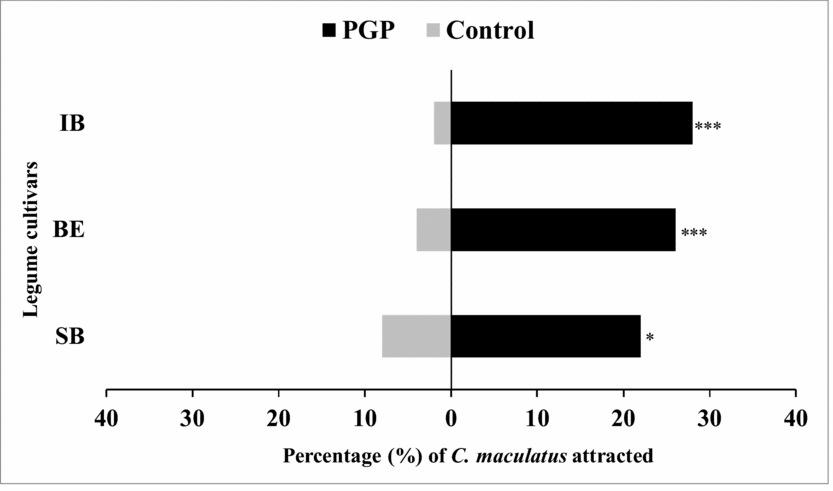
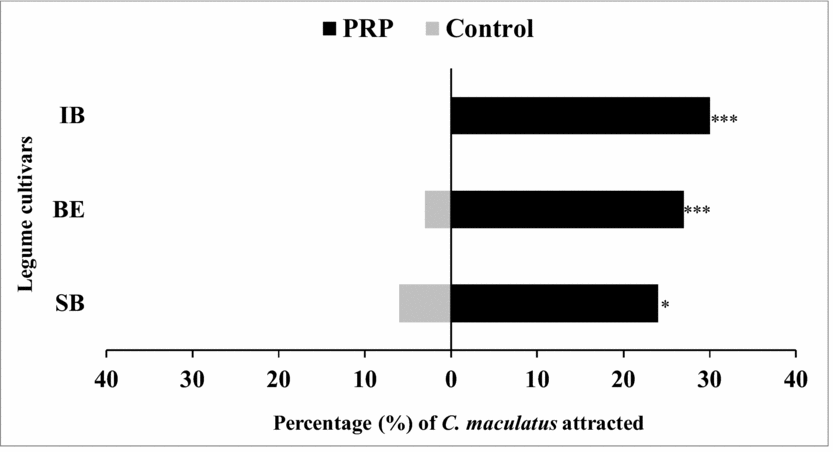
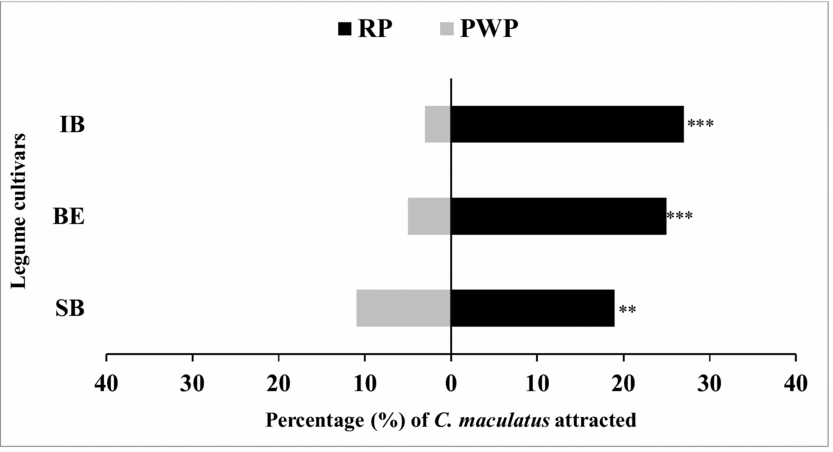
Mated female flight morphs of C. maculatus were more attracted to the three plant legumes at green and RP stages compared to control (no plant) (Figs. 1 and 2). At the GP stage, significantly more: 93% (P = 0.000, binomial test), 87% (P = 0.000, binomial test), and 73% (P = 0.005, binomial test) C. maculatus chose IB, BE, and SB, respectively compared to control (no plant) (Fig. 1). PRP of IB, BE, and SB significantly attracted 100% (P = 0.000, binomial test), 90% (P = 0.000, binomial test), and 80% (P=0.001, binomial test) of beetles, respectively, compared to control (Fig. 2). Significantly, more beetles, 90% (P = 0.000, binomial test) and 83% (P = 0.000, binomial test) preferred RPs IB and BE, respectively, to PWP (Fig. 3). Attraction to RP (63%) and PWP (37%) of SB was not significant.
Attraction of Callosobruchus maculatus adults in a Y-tube olfactometer to plants with green pods (PGP) of Ife brown (IB), black eyed (BE), and soybean (SB) compared to control (no plant) in three separate bioassays (n = 30). *P < 0.05, **P < 0.001, and ***P < 0.0001 (two-sided binomial test; α = 0.05).

Attraction of Callosobruchus maculatus adults in a Y-tube olfactometer to plants with ripened pods (PRP) of Ife brown (IB), black eyed (BE), and soybean (SB) compared to control (no plant) in three separate bioassays (n = 30). *P < 0.05, **P < 0.001, and ***P < 0.0001 (two-sided binomial test; α = 0.05).

Attraction of Callosobruchus maculatus adults in a Y-tube olfactometer to ripened pods (RP) of Ife brown (IB), black eyed (BE), and soybean (SB) compared to plants without pods (PWP) in three separate bioassays (n = 30). **P < 0.001 and ***P < 0.0001 (two-sided binomial test; α = 0.05).

Responses of flight morph of Callosobruchus maculatus to three legume plants: Four-choice olfactometer bioassays
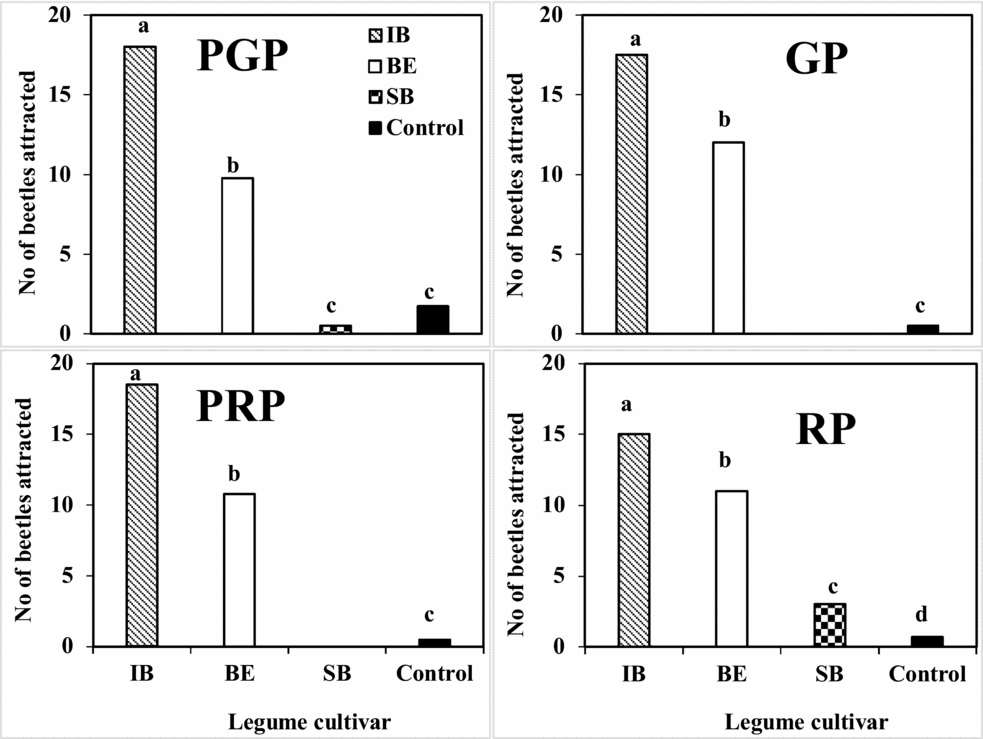
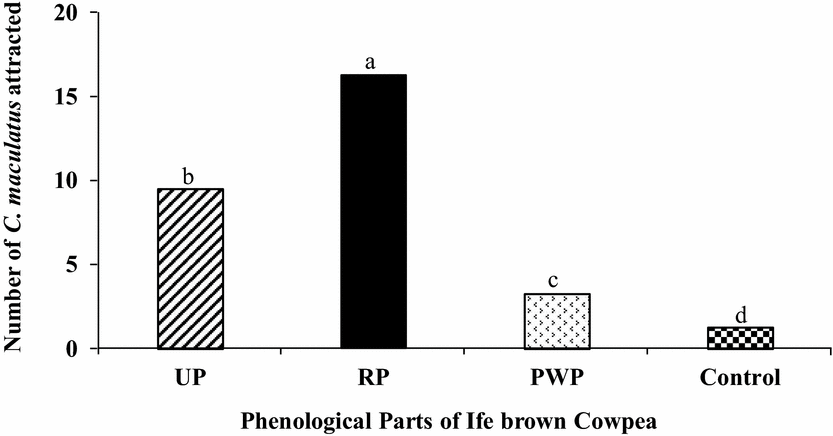
Female C. maculatus showed differential attraction to the three legume plants at all growth stages tested: PGPs (χ 2 = 155.62, df = 3, P < 0.0001), plant with GP (χ 2 = 193.77, df = 3, P < 0.0001), PRP (χ 2 = 177.45, df = 3, P < 0.000), and plant with RP (χ 2 = 109.72, df = 3, P < 0.000) (Fig. 4). Beetles failed to discriminate between SB and controls in PGP (χ 2 = 2.5435, df = 2, P = 0.1107), GP (χ 2 = 0.3244, df = 2, P = 0.5689), and PRP (χ 2 = 0.9216, df = 2, P = 0.3371) (Fig. 4), but showed preference for IB over BE cowpea in PGP (χ 2 = 19.9052, df = 2, P < 0.000), GP (χ 2 = 38.6984, df = 2, P < 0.000), PRP (χ 2 = 42.5351, df = 2, P < 0.0021), and RP (χ 2 = 4.8573, df = 2, P < 0.0275). Beetles showed differential attraction to phenological parts of IB cowpea (χ 2 = 95.45, df = 3, P < 0.000) and were preferentially attracted to RPs (54%) compared to GPs (31.66%) and PWP (10.8%) (Fig. 5).
Responses of Callosobruchus maculatus adults in a four-choice olfactometer to three legume cultivars: Ife brown (IB), black eyed (BE), and soybean (SB). PGP (plant with green pod), PRP (plant with ripened pods), GP (green pods only), and RP (ripened pods only) (n = 30). Bars with different letters are significantly different (Proc. logistic regression; α = 0.05).

Preferential attraction of Callosobruchus maculatus adults to three phenological structures of Ife-brown cowpea plant (UP = unripe pod, RP = ripened pod, and PWP = plant without pod) in a four-choice olfactometer (n = 30). Bars with different letters are significantly different (Proc. Logistic regression; α = 0.05).

GC and GC–MS analyses
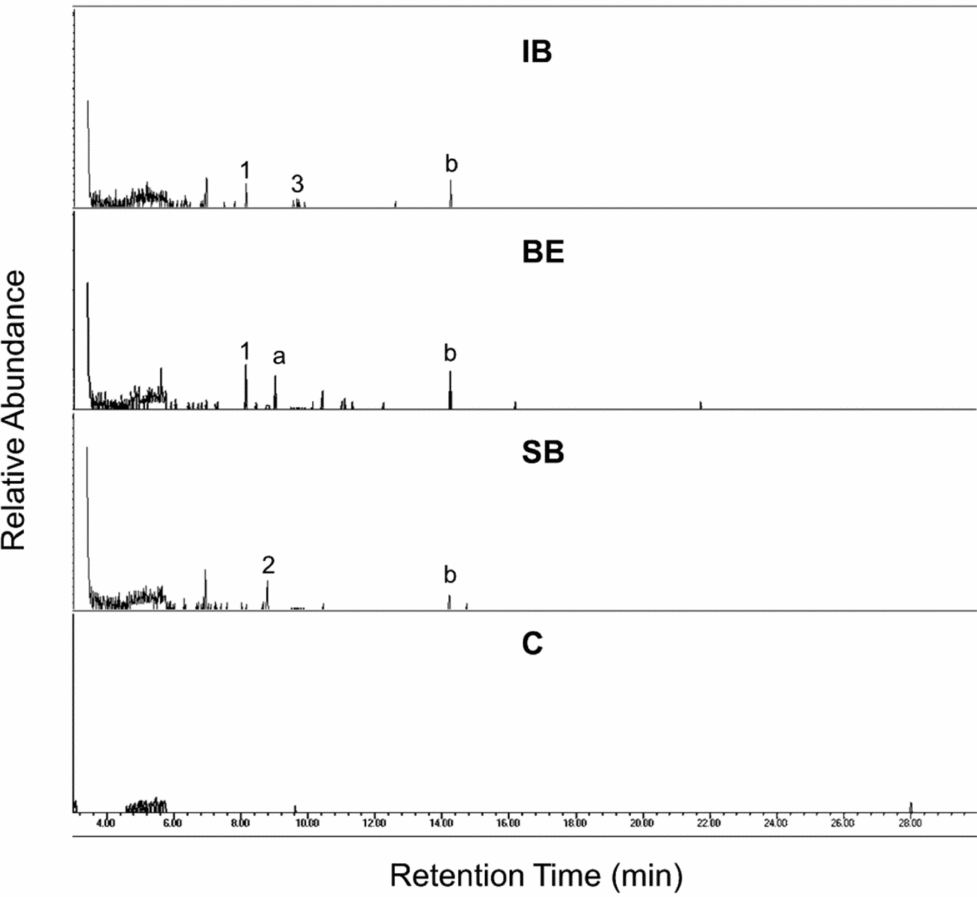
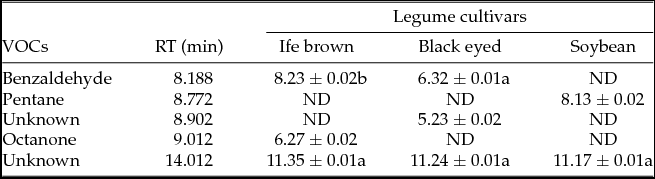
VOC profiles of the test legume cultivars varied qualitatively and quantitatively with five key peaks (compounds) detectable (Fig. 6). All the peaks (five compounds) were detected in IB, while BE cowpea and SB had three peaks and one peak, respectively. Two of these peaks were common in cowpea cultivars IB and BE. Only one of these peaks was detected consistently in the headspace of all the three legume cultivars. GC–MS revealed benzaldehyde in VOCs of IB and BE cowpea cultivars (Table 1). Emission of benzaldehyde was higher (8.23 ng/g of pod) in IB cowpea than in BE cowpea (6.32 ng/g of pod). One compound, octanone, was uniquely detected in BE cowpea. The only compound detected exclusively in SB was pentane.
Typical chromatographs showing components of headspace volatile organic compounds collected from ripened pods of IB (Ife brown), BE (black eyed), SB (soybean), and C (control).

Quantities (mean ± SEM) (ng) of different components of headspace volatiles emitted by ripened pods of three legume cultivars

Means within the same row having different letters are significantly different (P < 0.05).
VOCs, volatile organic compound; RT, retention time; ND, not detected.
Number of replicates per treatment = 3.
Discussion
The three legumes, IB and BE cowpeas, and SB, plants had a significant attraction on C. maculatus in Y-tube (no choice) experiments, but in four-choice tests, the insect discriminated between the legume plants with preference to cowpea plants and a greater attraction to IB cowpea plant. Preference for cowpea plants confirms reports of earlier studies (Utida, Reference Utida1972; Sano-Fujii, Reference Sano-Fujii1984; Messina and Renwick, Reference Messina and Renwick1985) that C. maculatus is a field-to-store pest of cowpea. Several studies list the broad spectrum of insect pests of SB in the field without a mention of C. maculatus (Singh, Reference Singh1990; Kumar et al., Reference Kumar, Sharma and Srivastava2012; Biswas, Reference Biswas2013). The close-to-zero attraction of C. maculatus to SB plant in four-choice tests supports the earlier reports that C. maculatus is not a field pest of SB, and that given a choice, it will not attack SB plant in the field. The active morph of C. maculatus attacks cowpeas in the field starting from pod forming (Zannou et al., Reference Zannou, Glitho, Huignard and Monge2003; Umar and Turaki, Reference Umar and Turaki2014) to ripened stage (Booker, Reference Booker1967; Caswell, Reference Caswell1984; Zannou et al., Reference Zannou, Glitho, Huignard and Monge2003).
Increased attraction of beetles to cowpea plants containing pods compared with cowpea plants with no pod confirms earlier reports (Zannou et al., Reference Zannou, Glitho, Huignard and Monge2003; Umar and Turaki, Reference Umar and Turaki2014) and suggests that semiochemical cues emitted from pods possibly enhance host plant location in C. maculatus. Moreover, the ratio of compounds in host odour changes with phenological stage of different parts of the plant (Vallat and Dorn, Reference Vallat and Dorn2005; Najar-Rodriguez et al., Reference Najar-Rodriguez, Galizia, Stierle and Dorn2010). Hence, the greater attraction of the beetle to RPs in IB cowpea compared to its GPs signalled possible biochemical changes in the VOCs of pods during ripening, which could result in the formation of distinct semiochemical cues. IB cowpea is more susceptible to insect pests than other cowpea cultivars; hence, it is used as a standard (negative control) in susceptibility tests in research (IITA, 1989; Mbata, Reference Mbata1993; Devereau et al., Reference Devereau, Credland, Appleby, Jackai, Jin, Liang, Liang, Tan and Guan1999; Obadofin, Reference Obadofin2014). In agreement with these earlier assertions and a previous study on legume seeds (Ajayi et al., Reference Ajayi, Balusu, Morawo, Zebelo and Fadamiro2015), a higher number of C. maculatus consistently chose IB cowpea. Host location is one of the factors that determine insects’ population build-up on host plants (Visser, Reference Visser1986; Bruce et al., Reference Bruce, Wadhams and Woodcock2005; Webster et al., Reference Webster, Bruce, Dufour, Birkemeyer, Birkett, Hardie and Pickett2008). The odour of IB cowpea is possibly stronger than the odour of BE cowpea and SB. Previous studies (Ajayi et al., Reference Ajayi, Balusu, Morawo, Zebelo and Fadamiro2015) and the present study reveal variations in semiochemical blends of the three legumes with the VOCs of IB having a more significant proportion quantitatively and qualitatively. It could be inferred from this study that the VOCs blend may likely be a factor in susceptibility of IB cowpea to insect pests as it will determine the level of its attraction to insect pests (IITA, 1989; Obadofin, Reference Obadofin2014).
GC–MS revealed that VOCs of IB cowpea had a more significant quantity of biochemical components compared to the VOCs of BE cowpea and SB plants. Benzaldehyde was found in the volatiles of IB and BE cowpea. Earlier studies have confirmed attractivity of benzaldehyde to insects (James, Reference James2005; Huber et al., Reference Huber, Kaiser, Sauter and Schiest2005; Najar-Rodriguez et al., Reference Najar-Rodriguez, Galizia, Stierle and Dorn2010; Kreuzwieser et al., Reference Kreuzwieser, Scheerer, Kruse, Burzlaff, Honsel, Alfarraj, Georgiev, Schnitzler, Ghirardo, Kreuzer, Hedrich and Rennenberg2014). From the observed attraction of C. maculatus to BE cowpea plants in this study, benzaldehyde may likely be a primary cue in the attraction of the beetle to cowpea plants.
Genotype is an essential determinant of components of constitutive VOC in plants (Yuan et al. Reference Yuan, Himanen, Holopainen, Chen and Neal Stewart2009). Variation in gene sequence among different cultivars or ecotypes within species can lead to a variation in chemical composition and products of physiology, and hence results in the diverse array of compounds in volatile emissions (Köllner et al., Reference Köllner, Schnee, Gershenzon and Degenhardt2004). Phenological parts of plants differ in chemical composition with a direct consequence on the quality and quantity of VOCs (Shiojiri and Karban, Reference Shiojiri and Karban2006; Li et al., Reference Li, Ma, Wan, Li, Liu, Sun and Li2016), which may account for the differential attraction of the beetles to phenological parts of IB cowpea.
The differential attraction of C. maculatus to IB and BE cowpea may be a result of interspecific differences in the components of the VOCs of the two cowpea cultivars. Apart from the greater quantity of benzaldehyde in IB volatiles, octanone was found only in IB cowpea volatiles. Earlier studies confirm that octanone, a natural ketone, attracts insect species and it is a vital component of volatile blends that attract many fruit insects (Ashford, Reference Ashford1994; Yu et al., Reference Yu, Chen, Zhang, Shan, Tang and Ding2011). Differences in biochemical compositions of VOCs of plants influence host recognition and acceptance in insects (Bruce et al., Reference Bruce, Wadhams and Woodcock2005; Webster et al., Reference Webster, Bruce, Dufour, Birkemeyer, Birkett, Hardie and Pickett2008). Studies have revealed that VOC blends are more attractive to insects than individual components (Hammack, Reference Hammack2001; Siderhurst and Jang, Reference Siderhurst and Jang2010; Beck et al., Reference Beck, Light and Gee2012; Li et al., Reference Li, Zhu and Qin2012; McCormic et al., Reference McCormic, Unsicker and Gershenzon2012). Benzaldehyde and octanone are volatiles of agricultural importance, functioning in the attraction of pollinators (Birkett et al., Reference Birkett, Chamberlain, Guerrieri, Pickett, Wadhams and Yasuda2003; Huber et al., Reference Huber, Kaiser, Sauter and Schiest2005).
The ratio of compounds in volatile blends of plant species differs both qualitatively and quantitatively (Dötterl et al., Reference Dötterl, Wolfe and Jürgens2005; Jarriault et al., Reference Jarriault, Gadenne, Rospars and Anton2009) even within the same genus as found in the case of IB and BE cowpea in this study. Variations in the ratio and combinations of compounds in blends of host volatiles are critical factors in host finding, recognition, and acceptance in insects (Visser, Reference Visser1986; De Moraes et al., Reference De Moraes, Lewis, Paré, Alborn and Tumlinson1998; Tasin et al., Reference Tasin, Bäckman, Bengtsson, Ioriatti and Witzgall2006). Also, some compounds in a volatile blend could interact synergistically to elicit a greater behavioural or neurophysiological response in insects (Piñero and Dorn, Reference Piñero and Dorn2007; D'Alessandro et al., Reference D'Alessandro, Brunner, von Mérey and Turlings2009). Hence, octanone (found only in the odour of IB cowpea plant), coupled with the greater attraction on beetles to IB compared with BE, signifies a possible synergistic role in the attraction of IB plant to C. maculatus in this study.
Conclusion
The results show the differential attraction of C. maculatus to the test legume plants. RPs were most attractive to C. maculatus. Infestation of cowpea plants in the field by C. maculatus could commence at GP stage, hence facilitating the need for proper monitoring. Further studies are ongoing to ascertain the attraction of flight morph of C. maculatus to benzaldehyde and octanone and the potential of these compounds as a lure for managing C. maculatus in cowpea farms.
Acknowledgements
This research was funded by Schlumberger Foundation, Faculty for the Future, through a fellowship to OEA. The authors thank Rammohan Balusu and Simon Zebelo for laboratory assistance. We also thank Dr Appel for allowing us to rear insects in his incubator.