Introduction
In an attempt to promote/encourage control efforts against neglected tropical diseases, the World Health Assembly resolution WHA 54.19 urged Member States to offer regular treatment to 75–100% of all school-aged children living in areas where schistosomiasis and soil-transmitted helminthiasis are endemic. Following this resolution, a case has been made for the development of national control programmes offering vertical, integrated control of neglected tropical diseases, including schistosomiasis and soil-transmitted helminthiasis, based on the rationale that such an approach would be both logistically and economically more beneficial (Molyneux et al., Reference Molyneux, Hotez and Fenwick2005; Brady et al., Reference Brady, Hooper and Ottesen2006; Hotez et al., Reference Hotez, Molyneux, Fenwick, Ottesen, Ehrlich Sachs and Sachs2006). Subsequently, a US$30 million grant to the Schistosomiasis Control Initiative by the Bill and Melinda Gates Foundation enabled integrated control programmes to be established in six African countries: Uganda, Tanzania, Zambia, Niger, Burkina Faso and Mali (Garba et al., Reference Garba, Toure, Dembele, Bosque-Oliva and Fenwick2006; Kabatereine et al., Reference Kabatereine, Fleming, Nyandindi, Mwanza and Blair2006). Uganda was the first of these countries to implement a national control programme for the integrated treatment-based control of schistosomiasis and soil-transmitted helminthiasis. Control efforts in Uganda began in April 2003 with an initial pilot phase targeted at more than 400,000 school children and high-risk adults, expanding to 0.53 million school children and 0.70 million community members in 2004, and then again to 1.56 million and 1.43 million respectively in 2005 (Kabatereine et al., Reference Kabatereine, Brooker, Koukounari, Kazibwe, Tukahebwa and Fleming2007). Treatment with praziquantel and albendazole was provided locally by school teachers and community drug distributors (CDDs) on a voluntary basis, but was managed centrally by the Vector Control Division (VCD) in the capital Kampala (Kolaczinski et al., Reference Kolaczinski, Kabatereine, Onapa, Ndyomugyenyi, Kakembo and Brooker2007).
Although the programme has undoubtedly been a huge success in terms of providing treatment to millions of school children and community adults at high risk of schistosomiasis (Kabatereine et al., Reference Kabatereine, Brooker, Koukounari, Kazibwe, Tukahebwa and Fleming2007; Zhang et al., Reference Zhang, Koukounari, Kabatereine, Fleming, Kazibwe and Tukahebwa2007), a recent study conducted in Panyimur, north-west Uganda, by Parker et al. (Reference Parker, Allen and Hastings2007) highlights the shortfalls of the approach taken by the Schistosomiasis Control Initiative in Uganda. While drug uptake was initially high in the first year of treatment in 2004, subsequent uptake of drugs (in 2005) was poor. Parker et al. (Reference Parker, Allen and Hastings2007) ascribed the poor uptake of treatment to the inappropriately aimed health education that was provided in conjunction with treatment, which has failed to address local beliefs and practices pertaining to schistosomiasis, as well as to a fear of treatment, to a distrust of those providing treatment and to a lack of empathy, or even prejudice, among health care providers.
That particular study highlighted some of the challenges faced in initiating behaviour change in order to maximize uptake of a biomedical intervention. The situation in Panyimur contrasts sharply with that of the village of Booma, located south of Panyimur on the western shoreline of Lake Albert. This area (like Panyimur) is endemic for Schistosoma mansoni and has been the focus of research efforts since 1996. Treatment of whole communities had taken place before the inception of the Schistosomiasis Control Initiative, as part of a series of multidisciplinary studies (Dunne et al., Reference Dunne, Vennervald, Booth, Joseph, Fitzsimmons and Cahen2006). These studies employed epidemiological, clinical, ultrasound and immunological techniques in order to investigate the effects of praziquantel treatment over time on a highly endemic community. In contrast to Panyimur, much of the day-to-day running of the research project was conducted by paid field assistants recruited from Booma and the surrounding villages, rather than by volunteers; perhaps because of this, medicine uptake and community engagement was very high throughout the course of the research programme.
Despite high levels of compliance and engagement, long-term benefits of treatment have not been uniform in Booma. Patterns of re-infection have varied both by age and sex, and by ethnic background. Since infection with schistosomiasis is reliant on water contact, a longitudinal study of water contact was undertaken after treatment. In that study (Pinot de Moira et al., 2007), men of the indigenous Bagungu ethnic group were observed for prolonged periods at the water, whereas the men of the immigrant Alur ethnic group were observed comparably much less. In contrast, Alur women were observed at the water far more than Bagungu women, who had surprisingly little contact with the water. By developing an ecological model, which allowed for these behavioural factors, as well as environmental factors, it was possible to explain sex- and ethnic-related variations in re-infection up to 12 months following treatment (Pinot de Moira et al., Reference Pinot De, Fulford, Kabatereine, Ouma, Booth and Dunne2010). However, whilst the environmental variables (number of infected snails recorded by site of exposure) were deterministic in nature, water contact data were merely proxy variables for a host of underlying socio-ecological factors. The underlying constraints on human agency that may have shaped the observed patterns of behaviour remain unexplored, and are therefore the focus of this paper.
The World Health Organization recommends that control efforts be incorporated into primary care (World Health Organization, 2002), therefore it is essential that any socio-ecological factors that impede control efforts at the local level are identified. Whereas Parker et al. (Reference Parker, Allen and Hastings2007) identified reasons for poor uptake, this study focuses on the inequalities of benefit that may arise even though a control programme has been deemed a success. This paper reports on an attempt to understand the structural and behavioural constraints that may act on human agency and influence re-infection after praziquantel treatment. Specifically, it explores how biomedical knowledge of schistosomiasis and socioeconomic constraints shaped water contact behaviour in Lake Albert. The results serve to inform policymakers looking to decentralize intervention efforts whilst seeking to employ best practice.
Methods
Study area and population
The main source of income for the inhabitants of Booma is the fishing industry, which means that contact with the lake remains high throughout adulthood. In addition, the lake is the main source of water in the village, and its water is used for both domestic and personal purposes (Pinot de Moira et al., 2007). Alternative sources of water include the River Waki and the River Bubwe, both of which appear free from the intermediate snail host for S. mansoni, Biomphalaria (Francis Kazibwe, personal communication), and two Gravity Flow System taps (free from S. mansoni cercariae), located at the south-west end of the village.
Although up to nine different ethnic groups are resident in Booma, the current study focuses on the two main ethnic groups living in Booma: the Bantu linguistic Bagungu and the Nilotic linguistic Alur, together forming 95% of the population. These two ethnic groups live at geographically distinct ends of the village: the Bagungu live at the south-west end of the village, whilst the Alur live at the north-east end of the village (Pinot de Moira et al., 2007), and there are few inter-ethnic marriages. Whilst the Bagungu are indigenous to the region, the Alur are relatively recent migrants to the area and originate either from the West Nile region of Uganda, or from the Democratic Republic of Congo. In line with this, significantly more Bagungu than Alur were born in Booma (83.7% vs 59.8%, p<0.0001).
Parasitological surveys and anti-helminth drug treatment
Selection of the original Booma study sample has been described in detail elsewhere (Booth et al., Reference Booth, Vennervald, Kabatereine, Kazibwe, Ouma and Kariuki2004; Walter et al., Reference Walter, Fulford, Mcbeath, Joseph, Jones and Kariuki2006). Briefly, a demographic survey of the study village was conducted and a register drawn up of all inhabitants by household. From this a random sample of 290 individuals (27% of the total population) aged between 5 and 66 years and either born in the village or resident for 10 or more years was selected, and of these 278 (96%) were either Alur or Bagungu. Thirteen individuals (of the 278, 5%) refused to participate in the study (six Alur and seven Bagungu), leaving a total study sample of 265.
Starting in July 1998, study members were treated twice, two weeks apart, with 40 mg/kg body weight of praziquantel. Parasitological surveys were conducted prior to treatment in May 1998, and 5 weeks, 12 months, 18 months and 22 months after the second treatment. Pre- and post-treatment stool samples were collected on three consecutive days, and for each stool sample, two 50 mg Kato-Katz (Katz et al., Reference Morgan1972) slides were prepared and examined microscopically. Five-week stool samples were used to detect treatment failure or non-compliance. In all but two (Alur) participants, egg counts were substantially lower 5 weeks after treatment compared with before treatment, indicating that only two individuals failed to comply or respond to treatment.
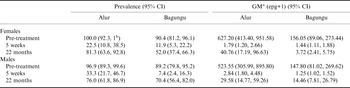
Treatment resulted in substantial reductions in prevalence and geometric mean (GM) egg counts (Table 1). The overall cure rate in Booma was 81.1% and the GM egg count reduction was 95%. A detailed analysis of infection patterns in Booma is given elsewhere (Pinot de Moira et al., Reference Pinot De, Fulford, Kabatereine, Ouma, Booth and Dunne2010). To summarize, prevalence and intensity of re-infection was significantly lower in Bagungu females compared with Alur females (p<0.01, Table 1), whereas there was no significant difference in re-infection between Alur and Bagungu males (p>0.12, Table 1).
Prevalence and intensity of S. mansoni infection before treatment, and at 5 weeks and 22 months post-treatment amongst females and males, by ethnic group

a GM=geometric mean.
b One-sided, 97.5% confidence interval.
Health behaviour survey
A quantitative health behaviour survey was developed in order to examine biomedical knowledge of schistosomiasis and behaviour related to water contact in Lake Albert. The initial aim was to question all participants from the original Booma study sample of either Alur or Bagungu ethnic background. However, due to recent conflicts between the Alur and Bagungu, and the unsettled/transient nature of the population, response rates were poor, making it necessary to extend the original study sample; thus a further random sample of 174 individuals was selected from the original sampling frame.
The survey was conducted in July and August 2005, and sought to obtain information on name, sex, ethnic group, place of birth, duration of residence, school attendance and occupation. Respondents were also questioned about how many times they entered the lake (daily, 2–3 times a week, once a week or less, monthly, less than monthly or never), and for which activities they entered the lake. For each activity, respondents were asked to estimate how often they conducted the activity, at what time of day the activity was usually conducted and at which landing site it was conducted. Fishermen were asked additional questions about the duration and nature of their fishing expeditions. Information was also sought on the uses of fetched lake water and alternative sources of water and its use. To ascertain the level of knowledge of intestinal schistosomiasis among respondents, participants were asked whether they had ever heard of the disease, how they learnt of it, its symptoms, the nature of the intermediate host, and whether they had ever sought treatment. For this section of the survey, the term bilharzia was used, as this was widely used and understood by the community.
Interviewers recruited from Booma and the surrounding villages were trained to avoid bias. The questionnaire was administered orally in the local language (either Alur or Lugungu depending on ethnic background) at respondents' households or wherever they could be located. Due to language barriers, it was not possible to have the same interviewers interviewing both Alur and Bagungu respondents; instead, Alur- and Lugungu-speaking field assistants interviewed Alur and Bagungu respondents respectively. Ideally, the questionnaire would have been translated from English to the local Alur and Lugungu languages and then back-translated to English to ensure no loss of sense or meaning. Unfortunately, however, Lugungu is not a written language, so the questionnaire was constructed in English and translated on the spot into Alur or Lugungu by interviewers, and recorded in English. Individuals were not prompted with possible answers and multiple answers were allowed. To ensure quality was maintained throughout, questionnaires were checked for errors whilst in the field.
The questionnaire was piloted in the neighbouring village of Piida, which is socio-culturally and demographically similar to Booma. The pilot highlighted ambiguities in the questionnaire and possible improvements that could be made; it also enabled interviewers to become familiar with the questionnaire and its structure.
Focus Group Discussions (FGDs)
Focus group discussions were conducted in July and August 2005, in conjunction with the health behaviour survey. Participants were sampled in such a way as to maximize homogeneity within groups, so as to encourage discussion and also facilitate analysis. Discussions explored activities conducted at the lake, fishing practices, changes in water contact behaviour during respondents' lifetimes and between generations, perceptions of the lake and bilharzia, biomedical knowledge of bilharzia and dependency on the male head of household.
Field assistants were trained in how to moderate FGDs and a structured questions approach was adopted in view of their limited experience. Structured focus groups are also more appropriate when there is a pre-existing agenda or aim: this approach ensures all groups discuss the same issues, aiding comparisons between groups (Morgan, Reference Morgan1996). Focus group discussions were pre-piloted in Piida and amended accordingly.
Discussions lasted between 1 and 1.5 hours. In total, eight separate focus groups were conducted (two amongst each of Bagungu males, Bagungu females, Alur males and Alur females), each comprising of between six and twelve individuals. Focus groups were conducted in the relevant local language (either Alur or Lugungu), were recorded in writing by a scribe in English, and also audio-recorded using a high-quality Dictaphone. Immediately following discussions, audio recordings were reviewed and translated into English. Unfortunately, as for the health behaviour survey, language barriers meant it was necessary to have different moderators and scribes for Alur and Bagungu FGDs.
Data management and analysis
Data generated from the health behaviour survey were double-entered and cross-checked using EpiInfo version 6.04d (Centers for Disease Control and Prevention, USA). All statistical analyses were performed using Stata 8.0 (Stata Corporation, Texas, USA).
Variations in activities between ethnic groups in relation to reported frequency were explored by merging the ten reported activities into five categories, namely: (i) domestic (fetching water, washing clothes and washing utensils), (ii) bathing, (iii) recreational (playing), (iv) economic (buying fish, selling fish, cleaning fish, launching boat and fishing), (v) other (cutting reeds). Age-adjusted proportions of total frequency were then calculated for each activity, by ethnic group and sex. The direct method of standardization was applied, with the total population of Booma as the standard population. Because frequencies were skewed, GM frequency was used to explore differences between ethnic groups, and the non-parametric Wilcoxon rank-sum test was used on raw data to test significance. Amongst males, GM reported daily fishing duration was calculated to compare differences between ethnic groups and the Wilcoxon rank-sum test used to test statistical significance. Chi-squared tests were used to compare answers given by Alur and Bagungu respondents to all other questions covering demographic characteristics, uses of fetched lake water and alternatively sourced water, and biomedical knowledge of schistosomiasis; logistic regression analysis was used to adjust for age and sex.
Results and implications
Demographic characteristics
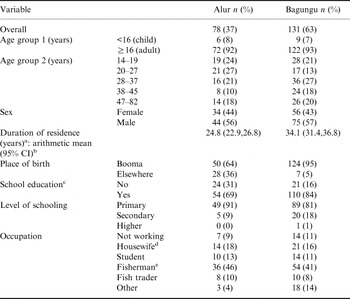
Table 2 displays the demographic characteristics of the respondents for the health behaviour survey. Follow-up rates from the original study population were 55% amongst Alur (68 individuals) and 59% amongst Bagungu (91 individuals), and from the second sample, 47% amongst Alur (41 individuals) and 53% amongst Bagungu (46 individuals). Thirty-seven individuals from the second sample lived in a region of Booma known locally as Wantembo; this area is remote from the main village and approximately 2 km away from the lakeshore. Since previous systematic water contact observations suggest that individuals living in Wantembo have very little contact with the water (Pinot de Moira et al., 2007), these individuals were excluded from the current study; this resulted in a final sample size of 209, consisting of 78 (37%) Alur and 131 (63%) Bagungu. Comparison of the demographic characteristics of the respondents for the health behaviour survey with those of the whole Booma community suggest that the study sample was representative of the Booma community, given the age and duration of residency restrictions that were applied in the original sampling frame (results not shown).
Demographic characteristics of individuals participating in the health behaviour survey

a If born elsewhere.
b 95% CI=95% confidence interval.
c Received or still receiving.
d 100% of housewives were female.
e One (3%) Alur female and two (4%) Bagungu women reported ‘fisherman’ as their occupation.
The health behaviour survey questioned participants on whether they had received some formal education, and if so, to what level. Although this is a fairly crude means of measuring level of education, and fails to convey any information as to the quality of literacy or education, there were clear, significant differences between the two ethnic groups. Significantly more Bagungu than Alur had received formal education (χ2=6.3, p=0.01), and, although not significant, amongst those receiving an education, more Bagungu than Alur had proceeded to secondary or higher education. Free primary education for all school-aged children was made available in Uganda in 1997 (UNICEF/Government of Uganda, 1997), but this has only affected younger members of the Booma study. Stratifying data according to whether individuals were children or adults in 1998 (the year in which the Booma study began) reveals quite an interesting picture. The percentage of children with formal education was not significantly different in the two ethnic groups: 27 (90%) Alur vs 37 (97%) Bagungu children (p=0.20). Amongst the adults, however, 27 (56%) of Alur vs 73 (78%) of Bagungu (p=0.01) had received formal education. More interestingly, this disparity in education status between adults of the two ethnic groups was most significant amongst women. Only four (19%) of Alur women questioned had received a formal education, compared with 21 (57%) of Bagungu women (p=0.01). Although more Bagungu men than Alur men had received an education, this difference was non-significant (24 [86%] educated Alur vs 52 [93%] educated Bagungu, p=0.29).
It is not clear whether these disparities in receiving a formal education are specific to Booma, or whether the Alur population of Uganda have a generally lower prevalence of formal education. It has been reported that the Alur as a whole tend to be viewed as ‘primitive’ (Leopold, Reference Leopold2006), although this may be because they are generally disliked by other ethnic groups (Leopold, Reference Leopold2005). Nevertheless, other sources have commented on the low standards of literacy in the Alur (Southall, Reference Southall1953). It should also be noted that the Alur participating in the current study are not recent migrants: as detailed above, the study was restricted to individuals that were either born in the village or who had been resident for 10 or more years.
Also displayed in Table 2 are the occupations of the two ethnic groups. The groups shared similar occupations; the major occupation of males was fishing (35 [80%] Alur and 52 [69%] of Bagungu men were fishermen), whereas among females, the major occupations were housewife (fourteen [41%] Alur females and 21 [38%] Bagungu females), fish trader (eight [24%] Alur females and nine [16%] Bagungu females] or not working (five [15%] Alur females and ten [18%] Bagungu females).
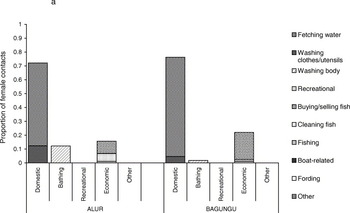
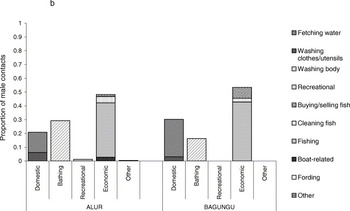
Age-adjusted proportion of all reported contacts involving each of the various activities, amongst females (a) and males (b), by ethnic group. Activities were classified as domestic (fetching water, or washing clothes or utensils), bathing (washing body), recreational (playing, swimming or socializing; only playing was reported), economic (buying/selling fish, cleaning fish, fishing or boat-related) or other (fording, hyacinth picking, cutting reeds).


All Bagungu men participating in the FGDs were fishermen. One Alur man was employed to pull in boats from the lake; all other Alur men were also fishermen, but one man supplemented his income by cutting poles for construction. Bagungu women were a mixture of housewives, fish traders and grass cutters. Alur women were employed in fishing and trading fish.
Reported water contact behaviour
During FGDs, all groups emphasized how essential the lake was to their survival. Many groups described the lake as their ‘garden’: one Alur man stated, ‘our whole life entirely depends upon it’, and similarly one Mugungu woman explained, ‘without the lake we cannot survive’.
Female activities
The activities discussed during the focus groups by Alur and Bagungu women strongly mirrored those observed during the systematic water contact observations (Pinot de Moira et al., 2007). Alur women reported fetching water from the lake, catching small fish for bait, buying and cleaning fish, washing clothes and utensils, bathing and collecting snails to sell to chicken feed manufacturers. In contrast, there was no mention of washing clothes and utensils at the lake amongst Bagungu women, and only one woman said she might bathe at the lake if she were feeling tired. The major activities mentioned by Bagungu women were buying fish and fetching water; cutting grass and cleaning/processing fish were also mentioned.
As is to be expected, there was evidence that individual water contact behaviour had altered since the original observations were made in 1998. Focus groups revealed changing behaviour with age, marriage, biomedical knowledge of schistosomiasis and changes to the lake environment. In addition, the establishment of the Murchison Falls National Park, and the subsequent introduction of laws prohibiting the hunting of wild game, had led to an increase in lake-dwelling wild animals such as crocodiles and hippopotami, and an increased ‘fear’ of the lake. In light of this, it was deemed inappropriate to compare observed and reported contacts directly and instead overall patterns were compared. Figure 1a displays age-adjusted proportion of contacts for each type of activity reported, relative to total reported frequency of contact, amongst females, by ethnic group. In contrast to observed water contact behaviour (Pinot de Moira et al., 2007), boat-related activities were not reported, perhaps because they were not perceived as being ‘contact with the lake’. ‘Fording’ was also not reported, despite being frequently observed during water contact observations, especially amongst Bagungu females. This may be because it is not a distinct activity or because it is no longer possible: an increase in the lake level was alluded to by the Bagungu participants during FGDs and was also visibly evident.
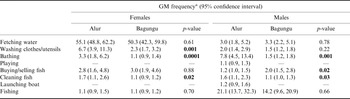
Differences between Alur and Bagungu females' contacts clearly mirrored those apparent from observations (Pinot de Moira et al., 2007) and focus groups (Figure 1a and Table 3). Reported frequency of ‘washing body’, ‘cleaning fish’ and ‘washing clothes and utensils’ was greater in Alur women compared with Bagungu women (z=3.8, p=0.0001; z=2.4, p=0.02; z=3.4, p=0.001, respectively), and the frequency of ‘fetching water’ and ‘buying and selling fish’ was not significantly different between females of these two ethnic groups (z=0.51, p=0.61 and z=−0.2, p=0.88, respectively).
Geometric mean (95% confidence interval) reported frequency of water contact activities, by sex and ethnic group

a Geometric mean (GM) reported monthly number of contacts; 1 was added to each measurement prior to calculating GMs.
For males, excludes two males either not having contact with the lake or unable to recall frequency of contact.
When probed about possible differences in behaviour between Alur and Bagungu women in FGDs, many agreed there were differences. Most Alur women related these differences to the fishing of ‘Ragogi’ (small silver fish), which was practised by many Alur women, and even Alur children. Unfortunately, the fishing of small fish by Alur women was not revealed by questionnaire data: although 36% of Alur women over the age of 14 were observed fishing during water contact observations, only one female (representing 3% of Alur women questioned) reported fishing. This discrepancy in the Alur women's observed and reported fishing may indicate that they view their ‘fishing’ activity as a mere support to the ‘real’ fishing of the men. The involvement of Alur women in fishing is in contrast to Bagungu women, for whom only 5% of women were observed fishing, and one female (representing 2% questioned) reported fishing.
One Alur woman reported: ‘It differs because Alur ladies fish a lot in the lake and spend most of their time in the lake’. Alur women also said they traded more in fish at the lake than Bagungu females, and also used the lake more for transport. Bagungu women were rather more disparaging of Alur women. They also suggested fishing was only conducted by Alur women and not Bagungu women, but also that Alur women wash their clothes in the lake and bathe in the lake, ‘even if they’re educated'. One Bagungu woman claimed that, ‘Alur women even bathe in swamps’. It was suggested Alur women did not care about the risk of bilharzia, that they did not fear the lake, but that Bagungu women did. One woman said: ‘Alur women don't care about bilharzia – they go back and also allow their children to go’. The Bagungu women also claimed that the Alur women would bring their children to the lake when bathing or fishing: ‘They don't care about the young ones – when they go to wash their clothes they also bring their children and place them in the water. It's the same when they're fishing Ragogi.’ Further derogatory remarks included: ‘If the child has a distended abdomen and you tell them the child has bilharzia, they will say “no, the child has been charmed”’ and, ‘They even drink the lake water directly without boiling and also give this to their children’.
It was also suggested by Alur and Bagungu men that Alur women participated more in fishing activities than Bagungu women. A possible explanation for their increased involvement was provided by one Alur woman: ‘We Alur ladies buy clothes for ourselves and it forces us to spend most of our time in the lake, while Bagungu ladies get clothes from their husbands.’ When probed further on their economic dependency on their husband, there did appear a greater dependency amongst Bagungu women, which was also apparent from male focus groups. Although there was a general consensus amongst Bagungu that women did assist their husbands with income generation, there were exceptions; in one female Bagungu focus group it was suggested that Bagungu women sometimes refused to assist, as it was the husband's responsibility to provide for the family. In contrast, many Alur women said they were the main economic providers for the family; a tendency for Alur males to spend money on alcohol rather than the family was also hinted. Other Alur women said that they worked in partnership with their husband to provide for the family. Therefore it seems whereas Bagungu women are either completely or partly reliant on their husbands for economic status, Alur women are either partly reliant on their husbands or economically independent.
Male contacts
Activities mentioned by Alur men during focus groups were primarily fishing and bathing, but cutting reeds and pulling in boats were also mentioned. The predominant activity reported by Bagungu men was fishing; bathing and processing fish were also reported.
Figure 1b displays age-adjusted proportion of contacts for each type of activity reported in the health behaviour survey, relative to total reported frequency of contact, amongst males, by ethnic group. Table 3 tabulates GM reported frequency of water contact activities amongst males, by ethnic group.
Similarly to females, ‘launching boat’ was the only boat-related activity reported by males, and this was under-reported compared to observed boat-related activities (Pinot de Moira et al., 2007); it is likely, however, that many boat-related activities were reported as ‘fishing’. Recreational activities were under-reported, whereas ‘fishing’ was reported more frequently than it was observed amongst Alur males. Again, despite these disparities between observed and reported contacts, similar differences in water contact activities between Alur and Bagungu males emerged from reported and observational data. Reported frequency of ‘bathing’ was greater (z=3.5, p=0.001) and reported frequency of ‘buying and selling fish’ lower (z=−2.3, p=0.02) amongst Alur males than amongst Bagungu males, whilst the reported frequency of ‘washing clothes and utensils’ was not significantly different for Alur and Bagungu males (z=1.2, p=0.22). However, in contrast to observational data, although the frequency of ‘fetching water’ was greater in Bagungu males than Alur males, this difference was not significant (z=−0.3, p=0.78); reported frequency of ‘cleaning fish’ was also significantly greater amongst Alur males than amongst Bagungu males, despite observational data suggesting no difference (z=2.2, p=0.03). More importantly, there was no significant difference in reported frequency of fishing by Alur and Bagungu males (z=0.4, p=0.66).
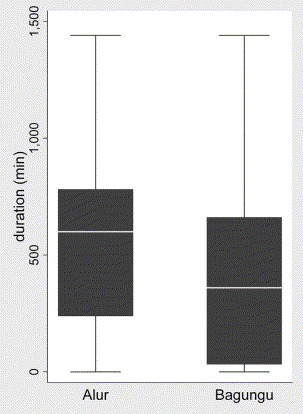
The health behaviour survey asked fishermen to estimate the duration of time they spent out on the water during a typical fishing expedition; in Fig. 2, box plots compare estimated duration of fishing reported by Alur and Bagungu males. Contrary to observational data presented previously (Pinot de Moira et al., 2007), reported time spent fishing was greater for Alur males compared with Bagungu males (GM duration 609.6 min per day [95% CI: 504.7, 736.3] vs 314.3 min per day [95% CI: 228.5, 432.2] for Alur and Bagungu males respectively; z=2.8, p=0.01). This indicates that many Alur males' fishing-related contacts may have gone unobserved during water contact observations, as has been previously suggested (Pinot de Moira et al., 2007). This became more apparent when men were probed about their relative fishing practices during FGDs. It appeared that Alur men would spend longer fishing, sometimes fishing for many days at a time; however, it was also apparent that many of the Alur males' fishing activities were conducted in deeper waters. More Bagungu men than Alur men reported fishing in the lagoon area, whereas, although some Alur men did report using seine nets, which are used in shallower waters to trap small fish, relatively more reported fishing in deeper waters.
Box plots displaying reported duration of fishing activities by ethnic group. Plots display minutes spent fishing per day, which is a function of reported frequency of fishing and duration spent fishing per expedition.

Fishing at night and in deeper waters are both likely to pose less of a risk of infection than fishing during the day or nearer to shore (due to the circadian pattern of cercarial shedding by Biomphalaria snails and evidence that the deeper fishing waters surrounding Booma are not inhabited by Biomphalaria snails; Francis Kazibwe, personal communication). This may explain why levels of re-infection were similar among Alur and Bagungu males (Table 1) and highlights the fact that, for a truly holistic approach to control and research, environmental as well as behavioural elements need to be considered. This is particularly the case in Booma; from malacological studies it is known that there are two Biomphalaria species that transmit S. mansoni at Booma, Lake Albert: B. sudanica and B. stanleyi (Kabatereine et al., Reference Kabatereine, Kariuki, Kazibwe, Kemijumbi, Sturrock, Ornbjerg and Madsen1999; Kazibwe et al., Reference Kazibwe, Makanga, Rubaire-Akiiki, Ouma, Kariuki and Kabatereine2006). These two snails have been shown to be allopatric in their distributions (Kabatereine et al., Reference Kabatereine, Kariuki, Kazibwe, Kemijumbi, Sturrock, Ornbjerg and Madsen1999; Kazibwe et al., Reference Kazibwe, Makanga, Rubaire-Akiiki, Ouma, Kariuki and Kabatereine2006). Biomphalaria stanleyi is also known to be a more permissive host (Kazibwe et al., Reference Kazibwe, Makanga, Rubaire-Akiiki, Ouma, Kariuki and Kabatereine2010). This is important because the Alur and Bagungu live at geographically distinct ends of Booma and observe geographically distinct spatial patterns of water contact. This has been found to influence their exposure to S. mansoni cercariae (Pinot de Moira et al., 2007) and their risk of infection (Pinot de Moira et al., Reference Pinot De, Fulford, Kabatereine, Ouma, Booth and Dunne2010).
Bagungu men admitted that the Alur men earned more money and were ‘more business minded than the Bagungu’. However, like the Bagungu women, Bagungu men were derogatory of Alur men; they suggested Alur men were more likely to be heavily infected with bilharzia because they spent so long in the water. Referring to the research programme, they stated that, ‘they refuse bleeding because they’re not aware of bilharzia'. One Bagungu man described Alur men as ‘primitive’, and went on to say: ‘when their bellies are big they think they’ve gained weight. It's difficult to convince them they have bilharzia. They believe they're charmed.' The tendency of the Bagungu to speak negatively of the Alur may in part relate to the recent ethnic tensions experienced in Booma. Although many of the Alur living in Booma were born in the village, they are not indigenous to the area and originate either from the West Nile region in Uganda, or from the Democratic Republic of Congo (Francis Kazibwe, personal communication). A period of sustained migration by the Alur from the Democratic Republic of Congo led to increasing discomfort among local authorities and populations. As the Alur grew in number, they also gained more power, and some Alur became local chairman. This led to fears amongst the indigenous people, including the Bagungu, that the Alur could eventually dominate in number and challenge their authority. In 2005, local politicians, including the Local Council 3 (LC3) chairman, encouraged the Bagungu to evict the Alur, accusing them of ‘land grabbing’ and becoming over active in local politics. As a result, many Alur were forced to leave Booma; some have now returned after receiving assurances from the central government of their safety.
Fetched water
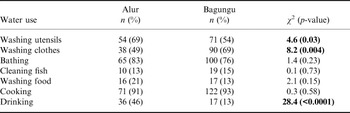
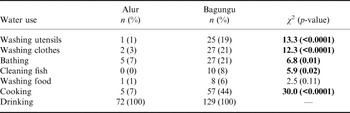
Because fetched water could be an additional source of infection, health behaviour surveys questioned individuals on their uses of fetched water and also alternative sources of water. Table 4 tabulates uses of fetched lake water by ethnic group. A significantly larger proportion of Alur than Bagungu used fetched lake water for washing utensils and as drinking water (p=0.03 and p<0.0001 respectively), whereas significantly more Bagungu used fetched lake water for washing clothes (p=0.004). Since the Booma study began in 1998, Gravity Flow System taps (free from S. mansoni cercariae) have been installed towards the south-west end of the village, where most of the Bagungu are resident. Consequently, taps were a major alternative source of water for the Bagungu, but not the Alur (122 [93%] of Bagungu respondents used taps as an alternative source of water vs five [6%)] Alur; χ 2=154.2, p<0.0001). A major alternative source of water for the Alur was the River Waki (67 [86%] of Alur obtained water from the River Waki vs eleven [8%] Bagungu; χ 2=125.5, p<0.0001). Table 5 displays uses for this alternatively sourced water. A significantly larger proportion of Bagungu than Alur used alternatively sourced water for washing utensils, washing clothes, bathing, cleaning fish and cooking (p≤0.02); in both ethnic groups, 100% of individuals questioned used alternatively sourced water as drinking water.
Uses of fetched lake water amongst the Alur and Bagungu

n=number of respondents who reported using fetched lake water for a given task; percentage of respondents is given in parentheses.
Chi-squared tests were used to compare the Alur and Bagungu people's reported uses of fetched water.
Uses of water obtained from alternative water sources amongst the Alur and Bagungu

n=number of respondents who reported using alternatively sourced water for a given task; percentage of respondents is given in parentheses.
Chi-squared tests were used to compare the Alur and Bagungu people's reported uses of alternatively sourced water.
Biomedical knowledge of schistosomiasis (bilharzia)
The majority of individuals interviewed in the health behaviour survey had heard of bilharzia (n=206, 99% overall; 97% of Alur and 99% of Bagungu). Most individuals had learnt of bilharzia through the research project: 71% of individuals (72% of Alur and 71% of Bagungu) listed the research project as one of their sources of information, and 45% of individuals (53% Alur and 41% Bagungu) listed this as their only source of information. Significantly more Bagungu than Alur had learnt about bilharzia through family and friends (11% Alur vs 24% Bagungu, χ 2=5.7, p=0.02); this remained significant after adjusting for age and sex in a logistic regression analysis (OR=3.2 [95% CI: 1.3, 7.9], p=0.01). Other sources of information included school (19%), the health centre (20%) and the radio (0.5%).
Of the 206 individuals claiming to have heard of bilharzia, 88% (n=181) listed either distended abdomen (80%), diarrhoea (34%), passing of blood in the stools (28%) or persistent stomach pain (12%) as symptoms of bilharzia; other symptoms listed that could also be attributable to schistosomiasis included weight loss (n=74, 36%), bloated stomach (n=2, 1%), itchy skin (n=6, 3%) and fatigue (n=5, 2%). Significantly more Bagungu listed these symptoms than Alur (62 [82%] Alur vs 124 [95%] Bagungu, χ 2=10.4, p=0.001) and this remained significant after adjusting for age and sex (adjusted OR=4.9, p=0.003). Of the 186 listing these attributable symptoms, 87 (47%) individuals also listed incorrect symptoms or symptoms less likely to be attributable to intestinal schistosomiasis such as: sight loss (n=2, 1%), hair loss (n=11, 6%), headache (n=12, 6%), vomiting (n=28, 15%), yellow skin/jaundice (n=40, 22%) and blood in the urine (n=2, 1%). Only 99 (48%) individuals interviewed claiming to have heard of bilharzia described only commonly attributable symptoms. A significantly higher proportion of Bagungu (12 [16%] of Alur vs 45 [35%] of Bagungu, χ 2=8.5, p=0.004; adjusted OR=2.9, p=0.01) and more males than females (15 [17%] of females vs 42 [35%] of males, χ 2=7.7, p=0.01; adjusted OR=2.6, p=0.01), were able to identify snails as the intermediate host.
The results of the health behaviour survey suggest, therefore, that biomedical knowledge of intestinal schistosomiasis in Booma is high, and that this is likely to be as a direct result of the research project. However, these data were collected using a Knowledge, Attitude and Practice (KAP) style approach, which tends to have a narrow focus with regards to knowledge. For this reason, KAP surveys often neglect or overlook other types of knowledge. Other illnesses may be recognized within communities with overlapping or similar signs and symptoms. For example, in Panyimur, Parker et al. (Reference Parker, Allen and Hastings2007) identified a local illness termed awola with symptoms almost identical to the biomedical syndrome ascites. However, treatment of awola with biomedical drugs was strongly discouraged and perceived as dangerous, which may have consequences for drug uptake in schistosomiasis control programmes. Focus group discussions were intended to supplement data obtained from the health behaviour surveys and compensate for their narrow focus. These revealed that prior to the research project, bilharzia was widely known as kodollo (relating to a distended abdomen) and believed to be caused by charms (burogo in Lugungu, awola in Alur), spirits (mizimu in Lugungu, tipo in Alur) or to be inherited in some way (since it affected whole families). Treatment was sought from witch doctors (mufumu in Lugungu, ajoga in Alur) and mainly consisted of herbal remedies, which at most, brought short-term relief of symptoms, but would not prevent people from dying. Unfortunately, FGDs did not explore whether additional local illnesses with similar symptoms to bilharzia existed concurrently with bilharzia. In Panyimur, however, Parker et al. (Reference Parker, Allen and Hastings2007) thought it likely that bilharzia was likely to be an alternative explanation for the symptoms associated with awola rather than one that is held simultaneously. From discussions it was apparent that current beliefs in Booma concerning bilharzia are very much biomedical in their outlook. Although there was evidence for some confusion as to how schistosomiasis is transmitted – for example, individuals from both ethnic groups suggested boiling lake water for drinking could limit transmission and some Alur also suggested eating fresh fish was involved in transmission – discussions generally revealed a high level of awareness of intestinal schistosomiasis. For instance, other methods for limiting transmission mentioned by Alur included boiling bathing water, using running river water rather than lake water, the construction of taps or boreholes, the burying of faeces and the construction of pit latrines. They also requested more drugs, alternative water sources and laws to enforce pit latrines. The Bagungu suggested the provision of gumboots, ‘hip boots’ and gloves, and the construction of pit latrines and boreholes to limit transmission. They also requested more drugs, and in addition the provision of gumboots and gloves. Therefore, whereas the emphasis for limiting transmission was on improving water supplies and sanitation amongst the Alur, there was a greater emphasis on limiting water contact amongst the Bagungu.
Focus group discussions explored whether the increased awareness of schistosomiasis had had any influence on behaviour. All groups agreed that it was impossible to avoid the lake; as one Mugungu woman described it: ‘we fear the lake, but we can't leave it completely; we are forced to return, it's our garden.’ Both ethnic groups, however, described some changes. Some Alur males said they now boiled water for bathing. Alur women said that they tried to fetch water in the morning, and avoided the lake in the afternoon; this suggests that they are correctly aware that the risk of infection increases at certain points in the day. Both Bagungu men and women suggested that many Bagungu men had changed their method of fishing as a result of their increased awareness of bilharzia, and that they now no longer fished on foot but instead used boats. Some Bagungu men also said they had reduced the amount they fished, although for others the greater fear was wild animals, and as a result fished during the day rather than at night. Reductions in the amount of time spent bathing were also mentioned by Bagungu men, and some Bagungu women said they had stopped bathing in the lake after they learnt about bilharzia. Like Alur women, Bagungu women described changes to their fetching patterns: they said they tried to reduce the number of times they fetched water, fetched water ‘quickly’, and avoided the lake in the afternoon, when ‘bilharzia attacks’. Both ethnic groups found the water ‘itchy’, especially in the afternoon; contact with the lake, where possible, was therefore avoided around this time. Some Bagungu identified the source of the itching as ‘bilharzia trying to penetrate the body’; this would be considered within the scientific world as precise knowledge of schistosomiasis.
When asked about whether they tried to educate others about schistosomiasis, all groups said that they tried to educate the children. However, many Alur said the children ‘didn't listen’; there was a strong consensus that Alur children today were less controlled than previous generations, that they did not worry about bilharzia, and that they spent more time bathing and playing; it was also mentioned that Alur children earned money fishing. Bagungu children, in contrast, were said to be more controlled; it was suggested that Bagungu children today had less contact with the lake than previous generations because of increased awareness of bilharzia, the increased number of lake-dwelling wild animals and increased time spent at school.
Discussion
The Ugandan Bilharzia and Worm Control Programme adopted a top-down approach to treat people for schistosomiasis and soil-transmitted helminths in the country. Whilst it cannot be disputed that the programme was successful in terms of delivering treatment to millions of high-risk individuals who would have otherwise gone untreated (Kabatereine et al., Reference Kabatereine, Brooker, Koukounari, Kazibwe, Tukahebwa and Fleming2007; Zhang et al., Reference Zhang, Koukounari, Kabatereine, Fleming, Kazibwe and Tukahebwa2007), serious issues have been raised with respect to whether such an approach is sustainable without contextualizing to local socio-ecological conditions (Parker et al., Reference Parker, Allen and Hastings2007). It has been argued that, to overcome the limitations of a top-down approach, a decentralized approach to control is necessary, which considers determinants of transmission at the micro-level, such as high-risk behaviours, sites of active transmission and perceptions of disease (Barbosa, Reference Barbosa1998). Here, a comprehensive survey was undertaken that encompassed all these factors in an attempt to understand the socio-ecological constraints that may act on human agency to create inequalities of benefit, even where compliance to treatment is uniformly high. Specifically, the study sought to identify the cognitive constraints (i.e. limitations in biomedical knowledge of schistosomiasis) and socio-ecological constraints acting on human agency within and between specific ethnic groups living in Booma, and shaping water contact behaviour/cercarial exposure in this community.
Although both the Alur and Bagungu ethnic groups claimed to have altered their behaviour since becoming biomedically aware of bilharzia, the reported changes to fishing practices by Bagungu men suggests a more concerted effort amongst this group to avoid infection. In addition, Alur women continued to report more contacts involving bathing, the washing of clothes or utensils, and the cleaning of fish than Bagungu women, all activities that could be conducted away from the lake. Reported bathing-related contacts also remained greater among Alur males than Bagungu males. Reported uses of fetched and alternatively sourced water suggest these activities are predominantly conducted at home by the Bagungu. These findings indicate that the differences between the Alur and Bagungu ethnic groups with respect to S. mansoni exposure apparent at the start of the research project are still present and, if the Bagungu males are to be believed, may be increasing. The recent installation of taps at the Bagungu end of the village is likely to have compounded any increasing difference in exposure. It would be interesting to conduct a further water contact observation study to measure and directly compare water contact behaviour, to determine to what extent the research project truly has altered behaviour and whether differences in water contact behaviour between the two ethnic groups are widening.
Both FGDs and the health behaviour survey revealed a number of possible reasons for the observed differences in water contact behaviour between the two ethnic groups. Firstly, although both groups appeared to have a high level of awareness of schistosomiasis, this was greater in the Bagungu. In both ethnic groups there appeared to be some confusion as to the precise source of infection, but the Bagungu laid greater emphasis on avoiding contact with the lake as a means of limiting infection. Possibly related to this, significantly more Bagungu than Alur had received some formal education, which is likely to influence their ability to understand and retain information relating to schistosomiasis (Huang & Manderson, Reference Huang and Manderson2005), and may also suggest a lower socioeconomic status in the Alur. More importantly though, the main disparities in formal education were amongst adult females, with substantially more Bagungu females having received formal education. Numerous studies have linked maternal education to increased child health and survival in developing countries (Cleland & Van Ginneken, Reference Cleland and Van Ginneken1988; de Silva et al., 1996; Wamani et al., Reference Wamani, Tylleskar, Astrom, Tumwine and Peterson2004; Boyle et al., Reference Boyle, Racine, Georgiades, Snelling, Hong and Omariba2006); indeed the important influence women have on the health of their children and the rest of the household is increasingly being recognized (Kloos et al., Reference Kloos, Ouma, Kariuki and Butterworth1986, 1987; Steering Committee for Cooperative Action, 1990; Michelson, Reference Michelson1993; Parker, Reference Parker1993).
The greater educational status of the Bagungu women may also reflect their place in the household and also in society. A woman's autonomy within the household may influence her health, the health of her children and her decision to seek treatment (Vlassoff & Bonilla, Reference Vlassoff and Bonilla1994). During FGDs Bagungu women certainly came across as the more assertive and confident; they would talk freely and a lively discussion was instigated almost immediately. The Alur women, on the other hand, were much more timid and reserved, and were initially unwilling to talk; they would also refuse chairs, and insist on sitting on the ground. The fact that Bagungu women can rely upon their husbands for financial support, whilst the Alur cannot, does imply either a socio-cultural or socioeconomic difference. It seems Alur women fish on foot due to economic necessity. This perhaps puts them at the greatest risk of infection, because, whereas many domestic tasks can be conducted at home and many men use boats for fishing, thus limiting their direct contact, the form of fishing Alur women participate in requires them to stand directly in shallow water, where the risk of infection is greatest. This is reflected in their patterns of re-infection: Alur women had the highest prevalence and intensity of re-infection at each of the three follow-up time points.
The apparent greater efforts made by the Bagungu to avoid infection may also be explained by the Alur's lack of representation in the field team. All three field assistants involved in the original study, as well as the chairman of Booma LC1, were Bagungu. At the start of the study, the community were sensitized to the nature of schistosomiasis and the importance of treatment. This, and drug treatment itself, were conducted by field assistants and community leaders. It was also evident that the field team continued to educate the community after the research team had left. Hence the Alur may have received less information about schistosomiasis than the Bagungu, particularly given the tensions that existed between these two groups and their geographic segregation within the village.
There is a sense that the Bagungu pride themselves on their biomedical knowledge of bilharzia. In comparing their behaviour with the Alur, the Bagungu appear to mirror the views of the Iteso in Eastern Uganda, described by Meinert (Reference Meinert2004). Meinert (Reference Meinert2004) explored how the Iteso experienced and learned about health and sickness, with a specific aim of understanding ‘in what sense children's competence in relation to health was affected by them going to school’. For the Iteso, schooling was viewed as a form of ‘cultural capital’, helping children and their families achieve a ‘good life’, which encompassed good health and other aspects of life such as moralities, aesthetics, bodily strength and learnedness. The Bagungu described the Alur as ‘primitive’; the image they portray of the Alur is one of ‘backwardness’ and ‘ignorance’. Because of the recent conflicts between these two groups, however, the underlying reason for this denigration is unclear. Many of the Alur living in Booma come from the West Nile region of Uganda, an area both physically and economically isolated from the rest of Uganda (Southall, Reference Southall, Hansen and Twaddle1998). People from this region are often described as ‘strong, primitive and potentially violent people’ (Leopold, Reference Leopold2006), but their (wrong) association with Idi Amin's regime has also meant they have suffered much resentment from the rest of the country (Leopold, Reference Leopold2005). However, the Alur themselves describe their children as ‘disobedient’, and generate a picture of unruliness and disobedience; the Bagungu on the other hand portray a very different, more obedient image of their children. In fact these differences were very apparent: whilst there were very few Bagungu children present at Bagungu FGDs, those that were present sat still and quietly; in contrast, Alur FGDs tended to be surrounded by a group of unruly children.
Prior to the research project, beliefs surrounding bilharzia were similar to those described in Panyimur by Parker et al. (Reference Parker, Allen and Hastings2007), and were non-biomedical in content, focused around charms and spirits, with treatment involving local traditional healers and herbal remedies. As in Panyimur, treatment was also initially met with distrust. However, in contrast to Panyimur, much of the day-to-day running of the research project was conducted by paid field assistants recruited from Booma and the surrounding villages, rather than volunteers. Although no systematic health education was provided as part of the research project, the community were instructed about the nature of schistosomiasis and the importance of treatment through a series of meetings with community members, held by field assistants and community leaders. These findings resemble experiences from a Malaria Vaccine Trial conducted in the Gambia (Geissler et al., Reference Geissler, Kelly, Imoukhuede and Pool2008). Although this trial was terminated prematurely due to unpromising results, in operational terms the trial was a success, with very few individuals refusing to participate or dropping out. Its success has in part been ascribed to the field staff living among the trial members in the study villages, which led to a greater trust in the trial and its intentions.
Biomedical knowledge of bilharzia in Booma, its symptoms and the source of infection, is now generally high. Numerous calls were made by participants in FGDs for further chemotherapy, highlighting a willingness to actively seek treatment. This suggests that, with appropriate health education, allowing individuals to more accurately recognize symptoms, a system of passive treatment, whereby individuals are treated with praziquantel upon request (Mehanna et al., Reference Mehanna, Winch, Rizkalla, El-Sayed and Abaza1997; Guo et al., Reference Guo, Cao, Hu, Lin, Li, Zhu and Xu2005), may be sustainable in Booma and other villages of a similar socio-cultural status. There were also calls for more pit latrines and calls to enforce their use; it was recognized that these could be built without assistance from external sources. In the neighbouring village of Bugoigo, by-laws prohibit bathing and the washing of clothes and utensils in the lake. There are also on-the-spot fines for ‘defecating anyhow’, and individuals without pit latrines face imprisonment; there is evidence that these laws are being enforced: the husband of one woman we spoke to was in prison under such charges. On-the-spot fines were also introduced in the neighbouring village of Piida in 2003 following a cholera outbreak.
These findings reinforce the benefits of a decentralized approach to control for neglected tropical disease, as proposed by Barbosa (Reference Barbosa1998), and currently recommended by the World Health Organization (World Health Organization, 2002). Such an approach allows local authorities to plan control strategies in accordance with local needs. This study's findings advocate a community-led approach to control, whereby there is a sense of ‘ownership’ or responsibility for control programmes; this may increase compliance, and therefore the deemed success of a control programme, and potentially allow for a programme of self-treatment. The study also highlights the need to examine the structural constraints and barriers within communities that may limit the long-term benefits of treatment. This is important not only for control programmes, but also for studies investigating the biology of schistosomiasis and other infectious diseases at the community or population level. To this end, the current study developed a relatively simple tool that can be applied in both control and research settings to identify and understand the constraints acting on human agency and impeding the long-term benefits of control programmes or influencing study outcomes.
In this study, differences in biomedical knowledge and socioeconomic constraints acted within and between ethnic groups to create variations in re-infection, despite treatment being successfully administered to the majority of the population and being uniformly efficacious. These inequalities in treatment benefit may have been even more profound had this been a control as opposed to a research setting, as it is likely that levels of compliance would be lower and more variable. The observed variations in re-infection may not have occurred had the Alur been better represented in the field team. Finally, a truly holistic approach to control and research should consider environmental as well as behavioural heterogeneities, and how these interact to influence infection.
Acknowledgments
The authors are grateful for the help and cooperation of the people of Booma during this study, particularly those who participated in the FGDs or responded to the health behaviour survey. They also wish to thank the field assistants Ashuman Babyesiza, Chris Byaleero, Morris Owekali and Perezi Isingoma, who conducted the FGDs and administered the health behaviour survey. They would also like to thank David Ogutu for his invaluable assistance in the field. Additional gratitude is extended to Dr Wenzel Geissler for his advice and useful discussions concerning the qualitative focus group discussion data. The field work component of this study was made possible through the provision of a Garnham Expeditionary Award to the author A. P. from the British Society of Parasitology (BSP). Financial support was also obtained from the Biotechnology and Biological Sciences Research Council (BBSRC), the Wellcome Trust and the British Medical Research Council.