1. INTRODUCTION
On 4 May 2017 I made a recording of a one-million-year-old acoustical phenomenon, the singing of the blackcap. This dating of the phenomenon, which is based on the earliest known fossil of a blackcap (Boev Reference Boev2006), is of course hypothetical, but locating it approximately one million years ago gives at least a hint of the order of magnitude of the timeline. With such a long timeline, my recording activity in 2017 seems to merge with the advent of sound recordings in the 1870s, and also with the whole known cultural history of blackcap song, which reaches back a mere four hundred years. These disparate events, when placed on a one-million-year timeline, can be collapsed into a single ‘moment’ coincident with the emergence of civilised humans. From the blackcap’s point of view, this event would hardly seem to be more than a blip.
However, if we change scale and perspective, and turn our attention to the history of the human listeners of the blackcap’s song in this blip, we encounter an eventful interplay of opinions, with a dramatic turn brought about in the twentieth century by the arrival of the variable-speed tape recorder and the theoretical efforts of a Hungarian ‘ornithomusicologist’, Péter Szőke. After recounting this history in my article, I present Olivier Messiaen as Szőke’s antithesis, and I finally return to my new recording, using it as an aid in drawing final conclusions.
An adult blackcap is approximately fourteen centimetres long, has an average weight of eighteen grams, an elongated appearance, and grey plumage with a cap-like spot on the top of the head – black in males and rusty-brown in females. The bird has many different names in Europe, most of which refer more or less directly to its cap. It acquired its standardised scientific name, following Carl Linnaeus’s binominal system, in 1758: Motacilla atricapilla, that is, black-headed wagtail. However, it was subsequently moved from the genus of wagtails to that of typical warblers, where it remains today, bearing the name Sylvia atricapilla, or black-headed warbler. The bird is indigenous to Europe and breeds in all but the northernmost regions of the continent. It is a year-round resident in Atlantic and southern Europe, while northern populations migrate to Africa for the winter (Shirihai, Gargallo and Helbig Reference Shirihai, Gargallo and Helbig2001: 45–62; Linné Reference Linné1758: 187).
In the vocalisation of the species one can distinguish among a variety of songs and calls: the song males use for attracting females and defending territory (full song), a quieter male song with an unclear function (subsong), a female song, contact calls, alarm calls and food calls of nestlings (Shirihai et al. Reference Shirihai, Gargallo and Helbig2001: 49–50). The present study focuses on how humans have responded to the blackcap’s full song,Footnote 1 of which a recent comprehensive guide on the Sylvia genus gives the following description:
Very rich, musical and beautiful. Usually commences with a chattering segment involving harsh notes of varying length, followed by louder pure fluting tones. … Fluting segment usually most stereotyped, individuals tending to use 1–2 regularly recurring patterns as a finale, such as ‘trooty tooty rooty too’ or ‘tooru rero rara rero’, especially when song descends at end. Local dialects recognizable, such that most birds in one area adopt the same final phrase, which can be clearly different from that in neighbouring areas. Introductory segment commonly involves some mimicry, mostly of passerines … and other warblers … Mean song duration 4.07±2.34 seconds, mean pauses 6.41±2.46 seconds. (Shirihai et al. Reference Shirihai, Gargallo and Helbig2001: 49)
In what follows, I refer to the ‘chattering segment’ and the ‘fluting segment’ as the first section and second section respectively.
2. FROM ROOMS TO THE FIELD
What might be the first known reference to the blackcap’s song is found in The History of Animals by Aristotle from the fourth century bce (Aristotle 2002: bk 9, ch.49B). Aristotle puts forward a theory that the fig-eater (συκαλὶς) and black-head (μελαγκόρυφος) are in fact two seasonal forms of one and the same bird species, differing only in the colour of their plumage (χροιά) and sound (φωνή). Pliny the Elder transmits this theory about the fig-eater (ficedula) and black-head (melancoryphus) in his Natural History, just after an account of nightingales held in captivity for their song in the Italy of his time, the first century ce (Plinius Reference Plinius Secundus1909: bk 10, chs. 43–4).
In his De avium natura of 1555, the Swiss naturalist and philologist Conrad Gessner identifies Aristotle’s black-head as the bird known to him as Schwartzkopff, and whose description perfectly fits the bird that was later to be known as Sylvia atricapilla (Gessner Reference Gessner1555: 357; Springer and Kinzelbach Reference Springer and Kinzelbach2008: 68). Gessner’s French colleague, Pierre Belon, in his L’histoire de la nature des oyseaux, also published in 1555, takes the black-head of the ancient Greeks to be the French pivoine, later known as Pyrrhula pyrrhula, or Eurasian bullfinch (Belon Reference Belon1555: 359). These two books inaugurated long traditions of pro- and anti-blackcap interpretations (Knight and Long Reference Knight and Long1835: 481; Arnott Reference Arnott2007: Melanokoryphos, Sykalis), none of which are worth dwelling on for our purposes; the only thing we learn from Aristotle after all is that the black-head’s song is unlike that of the fig-eater, another bird with more than one modern interpretation.
I found the earliest unambiguous reference to the blackcap’s song in an Italian book on the capture and keeping of songbirds, Il canto de gl’augelli by Antonio Valli da Todi from 1601. Valli writes, ‘Of all the little cagebird it’s the blackcap that has the most joyful nature and the sweetest song’ (Valli Reference Valli da Todi1601: 9). Giovanni Pietro Olina based his Uccelliera of 1622 on Valli’s work, augmenting the section about the blackcap with the following: ‘It is a wonderful thing to see how this little bird possesses, more than any other birds, the ability to recognise its master, giving sign thereof with a certain way of singing when it sees the master approaching to the cage’ (Olina Reference Olina1622: 9).
The experience of sound appears to be a surprisingly organic part of a master–pet relationship, a scheme that is characteristic of the first and larger part of the blackcap’s cultural history. In his 1832 handbook of tamed birds, the German parson and ornithologist Christian Ludwig Brehm published a similar observation, made by his colleague Felix von Gourcy-Droitaumont: ‘All blackcaps, even the ones captured in the wild, become exceptionally tame, and are so attached to their master, that they often begin to greet him with their song from afar … I had such one in eleven, and another one in nine years’ (Brehm Reference Brehm1832: 98).
Christian Ludwig’s son, Alfred Brehm still used this paragraph in 1865, in his famous Illustrirtes Thierleben, with a remark pointing to the enduring popularity of the blackcap as a cagebird (Brehm Reference Brehm1865: 845–6). However, a new and amended Hungarian edition of Brehm’s Animal Life published at the beginning of the 1930s suggests a changing trend: ‘The cautious and correct birder asks for official permission before capturing it’ (Brehm 1929–Reference Brehm33: 186). Descriptions of the blackcap had been entirely relocated from cagebird handbooks to field guides by the second half of the twentieth century. The inhumane and, in some places, illegal practice of exploiting indigenous songbirds still prevailes today, leading to the death of 1.8 million blackcaps annually in the Mediterranean (Brochet et al. Reference Brochet, Van Den Bossche, Jbour, Ndang’ Ang’a, Jones and Abdou2016), but the general view about keeping them as pets seems to have changed fundamentally in Europe.
The experience of sound thus became more synonymous with the hiker–nature relationship, but this scheme was not entirely new to the twentieth century. The influential French naturalist George-Louis Leclerc de Buffon had written the following about the blackcap (‘la fauvette à tête noire’) in 1778, in his expansive treatise about the natural world:
Its voice is effortless, pure and light, and consists of a succession of modulations of small compass, but sweet, flexible, and finely shaded. This song seems to embody the freshness of the places where it makes itself heard; it paints their quietness, it expresses even their happiness; because sensitive hearts do not hear, without a gentle emotion, the strains inspired by nature, to the beings that it [i.e. nature] makes happy. (Buffon Reference de Buffon1778: 128)
One can sum this up by paraphrasing Buffon’s well-known aphorism ‘The style is the man himself’ as ‘The blackcap’s song is the natural environment itself’. The style is not only a feature of the text, but also reveals the author’s way of thinking (Vaillant Reference Vaillant2010). Likewise, the qualities of the blackcap’s song do not only characterise the song itself, but also the environment that, according to Buffon, actively shapes it. Two hundred years later, Hungarian ornithologist Egon Schmidt concludes his encomium of the blackcap’s song by advocating the protection of birds: ‘The forest is dead without birdsong!’ (Schmidt Reference Schmidt1981: 69). Buffon, on the other hand, seems to suggest, ‘The birdsong is dead without the forest.’
3. A LONG-CONTINUED CONTEST
I will return to the question of what ‘sweet emotions’ have to do with the song of this bird, but first I would like to take up another assertion in Buffon’s treatise: ‘[The blackcap’s song] is a little bit similar to that of the nightingale’. The comparison with the common nightingale (Luscinia megarhynchos) became almost compulsory in the eighteenth and nineteenth centuries, and there were places where even the name of the blackcap was based on it: the bird was called the mock nightingale in eighteenth-century Norfolk (Barrington Reference Barrington1773: 282; Bolton Reference Bolton1830: 47), and the priest-nightingale (papfülemüle) in some regions of Hungary in the first decades of the twentieth century (Brehm 1929–Reference Brehm33: 186). The occurrence of mimicry in the first section of the blackcap’s song raises the question of whether the perceived similarity was based on the incidental imitation of actual nightingale motives. Although, such imitation is not necessary, and as the fame of the blackcap’s song is due to the fluting second section, free of mimicry (Schmidt Reference Schmidt1981: 65–9), one must look for other characteristics to explain the tenet of the likeness of the two birdsongs. The prevalence of this tenet is illustrated by the following examples from nineteenth-century Britain, France and Bavaria:
The Blackcap is truly a most delightful warbler, and may be ranked as second in the class of British song-birds. Indeed, in our opinion, its mellow notes are equal if not superior in richness of tone to any in the nightingale’s song. It is true the warble is desultory, but sweetly wild and full of melody. (Syme Reference Syme1823: 115)
Nothing ever delights me more than the song of this bird. He has decidedly more compass and variety than any other English bird, except the nightingale. (Newman Reference Newman1849: 30–1)
Much as I lament that the visits of [the nightingale] are so few and far between, I would not give up the blackcap for him – of all our English warblers, to my taste, the most ravishingly sweet, wild, and wonderful. (Dovaston 1857: 554, quoted in [N. N.], 1857)
The male of this species has a very pleasing and varied song; but in our tract [the department of Gard] they don’t have the habit of keeping it in a cage as they do in several other regions of France, and that’s a pity, because the voice of the blackcap almost equals that of the nightingale in its sweetness. (Crespon Reference Crespon1840: 128)
The cunning and cautious blackcap belongs without a doubt to the most beloved songsters; and especially the inhabitants of [Bavarian] forest villages value it more than the nightingale. Although it does not catch up with the nightingale and the icterine warbler in their strong and eloquent melodies, its voice is in fact even more clear and flute-like, its song is almost more varied, contiguous and stepped, and does not need as much effort as theirs. (Riedel Reference Riedel1833: 176)
These authors were clearly fixated on the comparison of these two birds – but why? It seems that they indiscriminately blended different aspects of evaluation, which resulted in an image that was attractive in its (false) simplicity. The texts tell us on the one hand that the blackcap and the nightingale are amongst the most esteemed songbirds, a capacious set that obviously includes other species as well. On the other hand, the psychoacoustic features of their song show certain similarities – a consideration that puts them into another set, which they again share with some other birds. The two sets of songbirds reflect different aspects of evaluation, and when the authors blend these criteria, they involuntarily construct the intersection of the two sets, and this intersection contains the blackcap and nightingale exclusively.
This scheme does two things: it disproportionately emphasises the similarities, masking the numerous differences, and it sets the two bird species up as if they were in competition, struggling for the first prize. The two illusions are connected and intensify each other: the similarities specify the ‘sport’ of the competition, which in turn makes the community of naturalists focus even more on the similarities. The appearance of a third bird in the last quotation tells much in this regard: the icterine warbler enters the competition and joins the leaders as soon as Wilhelm Riedel adds a second psychoacoustical aspect to the comparison, turning the ‘sport’ into a ‘biathlon’.
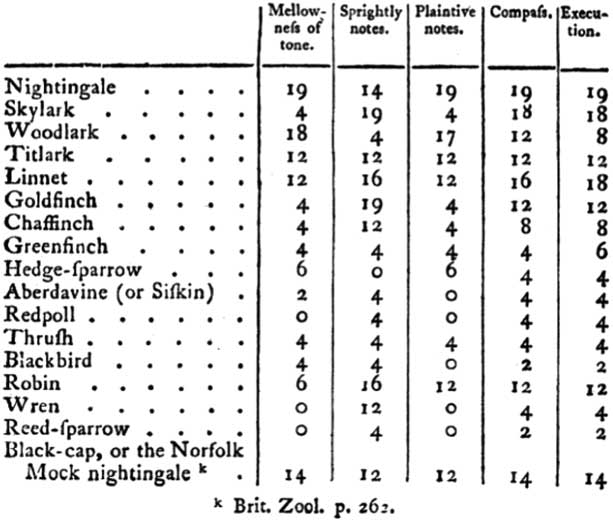
There is an even more spectacular change in the ranking of the exceptionally complex and admittedly subjective comparison made by Daines Barrington, who entered the birds into what we might call a ‘pentathlon’, retaining the sports analogy (Figure 1). The highest score is twenty in each of the five categories.Footnote 2 The overall winner is the nightingale with ninety points, the linnet takes second place with seventy-four points, and the blackcap – listed separately at the bottom of the table – takes only third place with sixty-six points, closely followed by the skylark with sixty-three points. Although the overall result of the blackcap is outstanding, in individual categories he is outdone by birds with lower overall scores: the woodlark is better in the ‘mellowness of tone’ and the goldfinch is better in ‘sprightly notes’ (Barrington Reference Barrington1773: 282).
Daines Barrington’s ‘songbird pentathlon’ (facsimile from Barrington Reference Barrington1773: 282).
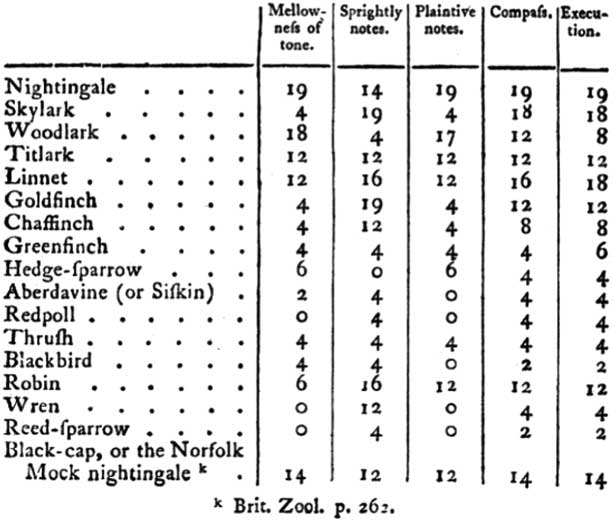
Barrington’s system of comparison is exceptional; field guides and scientific studies from the eighteenth and nineteenth centuries are dominated by the topos of the competition between the blackcap and nightingale. The emphasis on similarities influences the expectations, and thereby also the evaluation. This is neatly illustrated by the case of an American naturalist, John Burroughs, who acquainted himself with the literature of the two birds before he observed the birds first hand during a visit to Great Britain after 1871 (Burroughs Reference Burroughs1884: 143):
I saw, and for the first time heard, the blackcapped warbler. I recognised the note at once by its brightness and strength, and a faint suggestion in it of the nightingale’s; but it was disappointing: I had expected in it a nearer approach to its great rival. It is a ringing, animated strain, but as a whole seemed to me crude, not smoothly and finely modulated. (Burroughs Reference Burroughs1884: 115)
As if provoked by the misleading nature of the topos of rivaling birds that resulted in such a freakish opinion, the British ornithologist William Henry Hudson fervently rejected Burroughs’s statement with all its implications: ‘I should not say that the blackcap’s strain is crude, however wild and irregular it may be; nor that there is in it even a faint suggestion of the nightingale’s’ (Hudson [Reference Hudson1895] 1921: 69). But Hudson too might have had another reason to deny any similarities between the two birds’ songs, even those that could be substantiated. The topos of rivalling birds may have been superseded in his mind by a much older topos, the one of the sorrowful nightingale, which can be traced back to Greek mythology. Philomela, the princess of Athens had been raped and mutilated, and was subsequently turned into a nightingale.Footnote 3 How on earth could one draw parallels between such a bird and the merry little blackcap?
What remains a hypothesis in the case of Hudson, seems to be provable in the case of Ottó Herman, the pioneer of Hungarian bird protection: ‘The song [of the blackcap] is simple, it does not even come near to that of the nightingale, it is not jugging, not sorrowful, not blubbering; but a kind whistling, like that of some merry kiddie; it sounds hence and thence in the bush and spreads cheerfulness on the one who listens’ (Herman [Reference Herman1901] 1908: 68).
The presence of Philomela’s ghost can be felt even more strongly in the background of the following text, written three decades before Herman by another Hungarian ornithologist, Kálmán Lázár. This text also demonstrates the possibility of suggesting kinship and difference at the same time, without any sense of self-contradiction:
The typical warblers are artists in the most noble sense of the word. They like to dwell in scenic landscapes, in vineyards, in cool groves, as the old Greek poets did in their sacred woods. The chief artist among them is the nightingale, the heart of the forest, a winged genius of profound emotions. Its enchanting song is a wonderful mixture of the most gentle emotions, lofty fantasy, ardent yearning and frantic pain, performed in an original and touching way. The blackcap comes near to the nightingale. Although it lacks the artistic inspiration, the wide vocal range and the variation, it is characterized by an extraordinary charm and cheerfulness, and that makes many people prefer it to the nightingale. He is a sensible, good-humoured lyric poet, while the nightingale can be called an elegiac one. (Lázár Reference Lázár1866: 109–13)
For Lázár, the idea of kinship was reinforced by the presumption of an actual kinship: in his time, the common nightingale was also classified into the Sylvia genus. ‘The heart of the forest’ is a figure of speech originating from the 1845 poem Bird sounds (Madárhangok) by Mihály Vörösmarty, in which the nightingale is described as the ‘prima donna’ of the woods, and the only bird among seven others to have a lugubrious song, a clear echo of the old European topos. This tradition was strong enough to influence even Herman at the turn of the twentieth century, despite the 1798 protest of Coleridge (‘A melancholy bird! Oh! idle thought! / In nature there is nothing melancholy.’), and despite the fact that only male nightingales sing.
4. LABELS AND ASSOCIATIONS
Most texts highlight the blackcap’s song as being varied when comparing it to that of the nightingale, however, Lázár writes about the lack of variety. Although it seems to be paradoxical, both observations are apposite. In the song of the nightingale there are, depending on the specimen, between 120 and 260 strophe types that are often remarkably different from each other; however, each strophe usually consists of the rhythmic repetition of identical motives (Hultsch Reference Hultsch1980: 26). By contrast, in the song of the blackcap there are only two distinguishable sections, but these show great internal variety.
The first section often contains diverse imitations, while the nightingale does not imitate other species. Although the overall quality of the second section is always similar, it is built up of a continuous series of whimsically gliding tones that lack the sense of a clear-cut pulse, which, in contrast with the well-separated strophes and rhythmic monotony of the nightingale, gives the impression of inscrutableness. It is only the end of this series of tones that usually features a regularly recurring pattern. This pattern, however, changes from region to region, as has already been mentioned in the introduction.
This nature of the blackcap’s song explains the use of such adjectives as ‘desultory’ and ‘wild’, and also John Dovaston’s opinion: ‘Like a poet of all-genius, he sometimes hardly knows what he is about, and has, regardless of Aristotle and the unities, neither beginning, middle, nor end’ (Dovaston 1857: 554, quoted in N. N., 1857). As to the gliding tones, these can be connected with the ‘whistling kiddie’ simile of Herman, and with the descriptions of two other authors who also liken the song to a human whistle (Newman Reference Newman1849: 30–1; Béldi Reference Béldi1980: 89–90). Besides the apparent analogy with the inevitable and characteristic glides in a human whistle, this simile suggests that the observers seem to detect actual melodies in the blackcap’s song, that is, a series of tones in which they believe they discover tonal relationships.
Some experts even seem to be able to identify the genre of these melodies. For example, Christian Buhle thinks the second section ‘sounds like a short march or fanfare’ (Buhle Reference Buhle1831: 102–3), while Staffan Börjesson 170 years later believed it to be ‘jazzy fanfare’, ‘pure bebop’ worthy of Charlie Parker (Börjesson Reference Börjesson2002: 31). Alwin Voigt writes ‘it’s not seldom that specific motives emerge from the otherwise irregular tone sequence of the second section’, and thinks some of these motives are similar to the leitmotif of the woodbird in the second act of Wagner’s Siegfried (Voigt [Reference Voigt1894] 1933: 61). This collection of similes and associations may appear to be a heap of incongruent results of an acoustic Rorschach test, an experiment in cultural psychology spanning two centuries. In reality, the heap is not so heterogeneous, after all. The leitmotif of the woodbird is actually as close to bebop as the Ring can get, and even if one does not wish to go that far, one can declare that all three musical associations are characterised by energetic or euphoric qualities.
With or without associations of tonal music, the documents discussed so far connect the blackcap’s song with some sort of positive state of being, regardless of whether they attribute this state to the natural environment, to the bird, or to the person listening to the bird. These documents originate mostly from eighteenth- and nineteenth-century Western Europe and Hungary. However, if we turn our attention to the second half of the twentieth century and to latitudes above 50° North, the image changes slightly: the Russian writer Nikolai Nikonov (who lived near Yekaterinburg) and the Swedish ornithologist Lars Svensson both consider the blackcap’s song to be slightly melancholic (Никонов Reference Никонов1973; Mullarney, Svensson and Zetterström Reference Mullarney, Svensson and Zetterström2009: 304).
In the present state of research, I cannot recall any other texts expressing similar sentiments; not even the few other Scandinavian and Russian sources known to me share this opinion. Nevertheless, this variance seems to witness a boundary that might be both a geographical and a temporal one. As the discourse became more matter-of-fact in the second half of the twentieth century, both the urge to compare the nightingale with the blackcap and the image of the sorrowful nightingale have appreciably weakened – two factors that previously polarised the evaluation of the two bird’s song on the sad–happy axis.Footnote 4 Such changes and differences notwithstanding, everyone agrees that the blackcap’s song is beautiful. Or do they?
5. PÉTER SZŐKE’S SOUND MICROSCOPE
Péter Szőke, a man with a background in agricultural cooperatives, became the head of the International Department at the Hungarian Ministry of Agriculture in 1952. In the middle of the 1950s, he was granted paid time off in order to complete work unrelated to his job: a longer essay entitled The dialectics of the inner development of melody (A melódia belső fejlődésének dialektikája) (Serflek, Rosta and Erdei Reference Serflek, Rosta and Erdei1954–5). He was an amateur ethnomusicologist, who in this essay used the songs of some Uralic peoples to illustrate his theory, conceived in the spirit of dialectical materialism, about the universal physical and physiological laws governing the phylogeny and ontogeny of music – laws that are supposed to create an inner unity in the great diversity of musical folklores (Szőke Reference Szőke1959). An example of this approach is the interpretation of similarities between Mari and Hungarian folk music: Szőke explained these with the common biological background of humans, rather than by historical connections between the two ethnic groups (Szőke Reference Szőke1962).
Szőke’s appearance on the scene was met with irritation on the part of Zoltán Kodály, the doyen of Hungarian ethnomusicology, partly because Szőke lacked formal education (Szőke Reference Szőke1962: 231, fn. 11), and also because dialectical materialism was a politically prescribed philosophy, which threatened the autonomy of institutional ethnomusicology (Péteri Reference Péteri2007: 54–5). Szőke, however, did not give up, especially as he had made a discovery in 1957 that seemed to give enormous support to his theory.
He slowed down recordings of different birdsongs with the recent variable-speed tape recorder, a method he called ‘sound microscopy’,Footnote 5 and determined on this basis that there are complex folksong-like motifs and even strophe structures hidden in the song of certain species, which are imperceptible to the naked human ear because of their high tempo and pitch. The ‘laws of music’ appeared to be so universal as to have created similar structures not only in humans, but also in birds, two lifeforms whose sound patterns had been mutually imperceptible, thus excluding the possibility of historical links between the two.
As a result of this discovery, Szőke was transferred to the Hungarian Institute of Ornithology in 1957, which at that time was another department of his current workplace, the Ministry of Agriculture.Footnote 6 The first observations in ‘ornithomusicology’, as Szőke called his new field of research, were published as the appendix of the abovementioned ethnomusicological essay (Szőke Reference Szőke1959, II), followed by several publications in the following three decades that repeated basically the same theories about the analogous philo- and ontogeny of human and avian music, and were richly illustrated with staff notation of slowed-down birdsongs (e.g. Szőke Reference Szőke1982, Reference Szőke1990).
In terms of a definition of ‘music’, Szőke subscribed to essentialism. To put it more accurately, he was an essentialist of the structuralist kind, as the definitive feature of music was the same for him as for Pythagoras (whom he never mentioned): the presence of ‘harmonic or nearly harmonic frequency relations’ (Szőke Reference Szőke1982: 189), that is, those that approach the ratios of small integers.
When put under the sound microscope, there were species whose song (or at least parts of their song) resolved into neat tones with constant frequencies. If these were in approximately harmonic relations, Szőke qualified the song in question as ‘musical’. One such song is that of the North American hermit thrush (Catharus guttatus), the recordings of which were provided to Szőke by the Canadian biologist William W. H. Gunn (who has been recently presented as a forerunner of soundscape composition, see Cameron and Rogalsky Reference Cameron and Rogalsky2017). Szőke called the song of the hermit thrush ‘the highest peak of musical evolution in birds’ (Szőke, Gunn and Filip Reference Szőke, Gunn and Filip1969; Szőke Reference Szőke1982: 72), because the slowed-down recording sounded so much like human music, or more accurately, music as he knew it. At this point, Szőke’s structuralist rigor proves to be a camouflage for anthropocentric projection.
The song of the majority of bird species did not resolve to anything more than glides and noises, not even with the greatest magnification of the sound microscope, that is, the lowest possible transposition, which in Szőke’s practice meant a sound seven octaves lower and 128 times longer in playback time than that of the original (achieved by re-recording the half-speed playback for seven consecutive cycles). On his 1987 LP The Unknown Music of Birds (Az ismeretlen madárzene), examples of such ‘unmusical’ songs, as Szőke called them, are provided by the Eurasian wren (Troglodytes troglodytes), the icterine warbler (Hippolais icterina), the northern cardinal (Cardinalis cardinalis) and the blackcap. Of the four species, only the blackcap warranted a description of its own: ‘The natural song of one of our most famous European “master singers”, in which there lies in reality an unordered and ugly, unmusical sound pattern, as demonstrated by the slow-speed excerpt of its song’ (Szőke 1987; emphasis added). In his review of the LP, Hungarian publicist Bulcsu Bertha wrote:
I’m disappointed in blackcaps. Particularly in our blackcap, who appeared in our garden at Lake Balaton two years ago, and usually gave afternoon concerts from the top of the walnut tree. We appreciated his daring scales more than the blackbird’s whistle or the song of larks and nightingales, but he had fooled us. We learned this from The Unknown Music of Birds, an LP by Dr Péter Szőke. … The microscope shows that there lies an unmusical, unordered sound pattern in the blackcap’s song, it’s in reality a disheveled clamour, a bird-fudge. Fie upon you, dear Sylvia atricapilla. (Bertha Reference Bertha1992: 153–5; emphasis added)
As can be seen, John Burroughs was not the last man to be disappointed by the blackcap because of what he read. The eerie ease with which Szőke declared and Bertha accepted, the sound microscope as the transmitter of reality, a tool that at once debunked an age-old image of reality as void, was not without a predecessor either. With the advent of the compound microscope in the seventeenth century, it became a general conviction that the ‘unarmed’ senses create a false picture of the world (Böhme Reference Böhme2005: 363). What Szőke thought of as a novel scientific pursuit was in fact in many respects a re-enactment of the activity of the most famous seventeenth-century microscopist, Antonie van Leeuwenhoek.
Szőke’s seventeenth-century Dutch colleague – who, incidentally, likewise lacked formal education in science – also considered the microscope to be an instrument for discovering nature’s truths. As Hartmut Böhme points out, ‘due to this “instrumental” bias, [Leeuwenhoek] is susceptible to using the microscope not only as an instrument for seeing. It is also [used] as an instrument for projecting his own imagination, which is then published, attested and proven’ (Böhme Reference Böhme2005: 374). Böhme gives a detailed description of Leeuwenhoek’s theatre, built on projection, tendentious mediatisation, appeal to the spectators’ aesthetic sense and attestation by ‘trustworthy’ witnesses – all of which has its exact counterpart in Szőke’s activity (cf. Szőke Reference Szőke1978: 18).Footnote 7
Another pitfall of microscopic observation that was known already in the seventeenth century and seems to apply to the sound microscope as well, is the loss of context and the loss of coherence between part and whole, which increases with the factor of enlargement (Böhme Reference Böhme2005: 367; Coppola Reference Coppola2013). It is well known that the ability to perceive tonality, conditioned by the interplay of cultural and natural factors, does not require the continual presence of nearly harmonic relationships and constant frequencies. As with most languages, the intonation of spoken Czech is devoid of both, for example. This did not, however, inhibit Leoš Janáček from transcribing thousands of ‘speech melodies’, series of tonal values he felt to be present in spoken Czech phrases (Secora Pearl Reference Secora Pearl2006). The same ability can also endow the blackcap’s gliding song with tonal qualities, given that its tones follow each other rapidly enough. If they are slowed down beyond a critical level, the listener loses the sense of tonal coherence.
‘Science is inhuman. Things seen with a microscope begin to be insignificant’; Henry David Thoreau’s 1859 dictum (Cramer Reference Cramer2007: 396) is both confirmed and contested by Szőke’s work. He called forth unknown, beautiful melodies with his sound microscope from the song of the hermit thrush, giving the song a new significance. But with the same tool, he conjured away the beautiful melodies of the blackcap’s natural song, melodies that had had special significance for centuries.
However, not everyone was disappointed with what had happened to the blackcap’s song in Szőke’s laboratory. As he wrote, ‘In middle-rate slow-down, these birdsongs of non-musical construction, but of subtle structure and colourful character sound so compelling to humans, that the enthusiasts of the so called “new music” (… I’d rather say: “amusical music”) of our age – composers, aesthetes, artists – are primarily interested in the unmusical bird sounds of my collection’ (Szőke Reference Szőke1982: 96–7).Footnote 8 The sound microscope turned the blackcap’s songs into the ‘free music’ of Percy Grainger’s dreams (Grainger [Reference Grainger1938] 1996).
A specialist in ‘new music’, the Swedish composer Bengt Emil Johnson would certainly have been interested in this form of the blackcap’s vocalisations as well. ‘It belongs to my most particular favourites’, he said about the bird’s natural song when he introduced the blackcap as the following month’s ‘interval bird’ (pausfågel) on Swedish Radio in October of 1994 (Johnson Reference Johnson1994), half a year after the death of Péter Szőke, with whom he was presumably not familiar. As the editor in chief of P2, the Swedish Radio’s classical music station (N. N. 2010), Johnson re-introduced in 1994 a thirty-year-old tradition of intermission signals being provided by birds, presenting a different species every month, a practice that went on until 2005 (N. N. 2009).
Besides being a bird enthusiast, Johnson was a renowned poet and a composer of electroacoustic music, two activities that overlapped because of his interest in concrete poetry, making him one of the founding fathers of Swedish text-sound composition (Brunson Reference Brunson2009). Öyvind Fahlström, his fellow in the artists’ group Svisch (Andersson Reference Andersson2016: 143–4), constructed two ‘bird languages’ from phonetic birdsong imitations (Hultberg Reference Hultberg1999), while Johnson himself arranged speech sounds in time and space imitating the structure of birdsongs and the birds’ territorial defence behaviour respectively (Johnson Reference Johnson1976: 32). As the author of the entry ‘Birdsong’ (‘Fågelsång’) in the 1976 dictionary of music Sohlmans musiklexikon, Johnson was the first lexicographer to go beyond the traditional comparison between birdsong and note-based music, drawing attention to the similarities that the natural song of certain birds exhibited with electroacoustic music (Johnson Reference Johnson1976: 31–2). By doing so, Johnson welcomed the blackcap as a musical bird in a community of humans who were not only amazed by the disarray of its gliding tones and the timbres of its chattering and fluting, but also ready to unveil their spectral background, eager to learn the recipe.
6. MESSIAEN’S ORGAN
In his 1994 radio program that introduced the blackcap as the new interval bird, Johnson provided guidance in distinguishing the bird’s song from that of the garden warbler. Among other things, he showed how Olivier Messiaen imitated the two birds in the second and ninth of his Méditations sur le Mystère de la Sainte Trinité.Footnote 9 Although this 1969 organ piece properly illustrates the tempo difference between garden warbler and blackcap (‘Un peu vif’ and ‘Bien modéré’), such imitations with conventional instruments, as Johnson himself pointed out (Johnson Reference Johnson1976: 31), can never be faithful copies of the original, and that is not to be expected from Messiaen either; stylisation is an integral part of artistic creation.Footnote 10
Alvin Voigt used staff notation only in the case of the blackcap motifs that he felt to be more specific (Voigt [Reference Voigt1894] 1933: 61), otherwise representing its tones with freely floating dashes and dots. Messiaen in his Méditations translated each and every tone of the song to a specific note of the chromatic scale. First, he was forced to do so, as his representation – in contrast with that of Voigt – was going to be reproduced on a chromatic musical instrument. Second, he wanted to do so, as he conceived the song in terms of a pronouncedly tonal context, accompanying it with the same C♯–E–F♯–A chord every time. Third, he perceived the result as sufficiently similar to its model, deeming all his birdsong imitations ‘perfectly authentic’ (Fallon Reference Fallon2007: 115). By doing so, he welcomed the blackcap as a musical bird in the community of humans who called something ‘music’ chiefly inasmuch as it could be played back on a chromatic keyboard.Footnote 11
7. THE BIRD AND THE DICHOTOMY
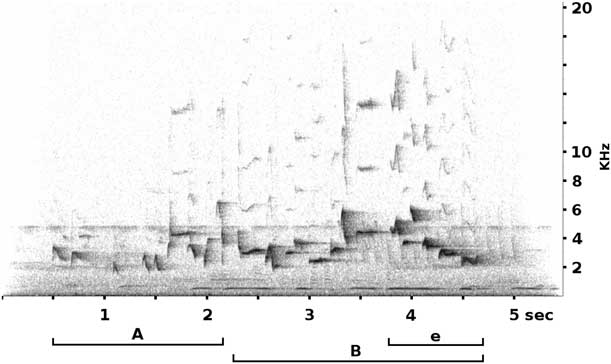
On the one hand, we have the Graingerian ‘free music’ that lacks any sense of tonality, produced by Péter Szőke’s sound microscope. On the other hand, we have melodies that are built up of perfectly straight tones tuned in equal temperament and carrying the most pronounced tonality, produced by Olivier Messiaen’s organ. These are the two extremes in the cultural reality of the blackcap’s song, produced by technical and compositional methods developed in the 1950s. How does the experience of its actual song relate to them today? I had this question in my mind when I was making a recording of a male blackcap’s full song on 4 May 2017 in Mogyoród, near Budapest, Hungary (Sound example 1; Figure 2).
Full song of male blackcap (Sylvia atricapilla). Spectrogram of the author’s recording made in Mogyoród (Hungary), 4 May 2017, 9:16 am. (A=first, chattering section; B=second, fluting section; e=ending motif)
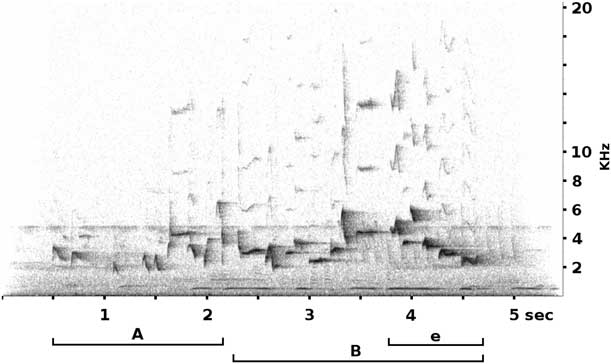
My recording is not as clear as the ones featured in Johnson’s radio programme, made by the Swedish ornithologist Sten Wahlström using a parabolic reflector. One can hear insects around 5000 Hz, and the characteristic ‘- — -’ patterns of a Eurasian collared dove (Streptopelia decaocto) with a fundamental tone around 500 Hz, among other noises (for a bass cut version without the dove, see Sound example 2). But the blackcap’s song, with its fundamental frequencies between 2000 and 6000 Hz, is still strong and distinct, and I have the advantage of knowing its context: the part marked with ‘e’, sounding like a ‘treitary ro toe too’, is a common ending motif of blackcaps living around Mogyoród. The first, chattery section (‘A’) is devoid of imitations in this case, and is followed by a nicely fluting second section (‘B’).
First, let us look at it from the viewpoint of Messiaen’s extreme. Figure 3 can be called a Messiaen-style notation, even if it differs from his scores in its purpose, being instead a tonality-oriented representation of an actual sonic experience rather than a music sheet for stylised instrumental imitation (nevertheless, its synthetic realisation can be heard in Sound example 3). I also indicated a traditional Western metric reading of the song, something from which Messiaen abstained, having a different conception of metre.

I was able to make a tonal interpretation of the whole song without any greater sense of self-delusion, even if the strength of the tonal feel varied during the song depending on the nature of the glides, with a higher level of ambiguity in the chattery first section (p) than in the second section (f, with the ending motif in ff). The fourth to sixth notes of the second section (F♯–A–D) were the ones that had the strongest tonal feel. For a trained Western ear, the song seems to begin in F-lydian, which then turns to D-mixolydian by the second section.
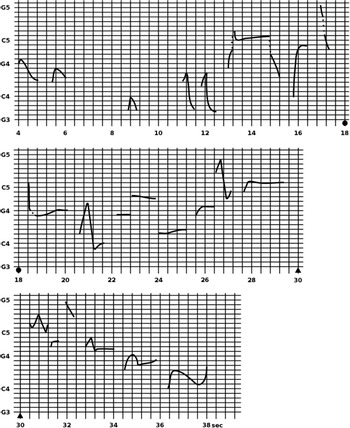
Other blackcap songs seem to suggest different keys – at least as long as they are not put under the sound microscope. A look at the same song from the viewpoint of Szőke’s extreme, a ‘microscopic’ experience with a magnification of 8x (Sound example 6), is reflected in Figure 4. The chattering feeling of the first section is revealed to be the result of some extremely fast glides – some of which are perceived as impulses of narrow-band noise in normal tempo – and the presence of some actual noise produced at moments when the syrinx is changing from one vibratory mode to another.
A graphic representation of how the blackcap song of Figure 2 sounds in a playback eight times slower – and therefore three octaves lower – than the original. Neighbouring lines of the horizontal grid stand for an equally tempered minor second, those of the vertical grid stand for a time interval of 400 ms. The three blocks correspond to the sections of Figure 2 marked A, B (first half) and e. Dynamic and timbral shades are not represented.
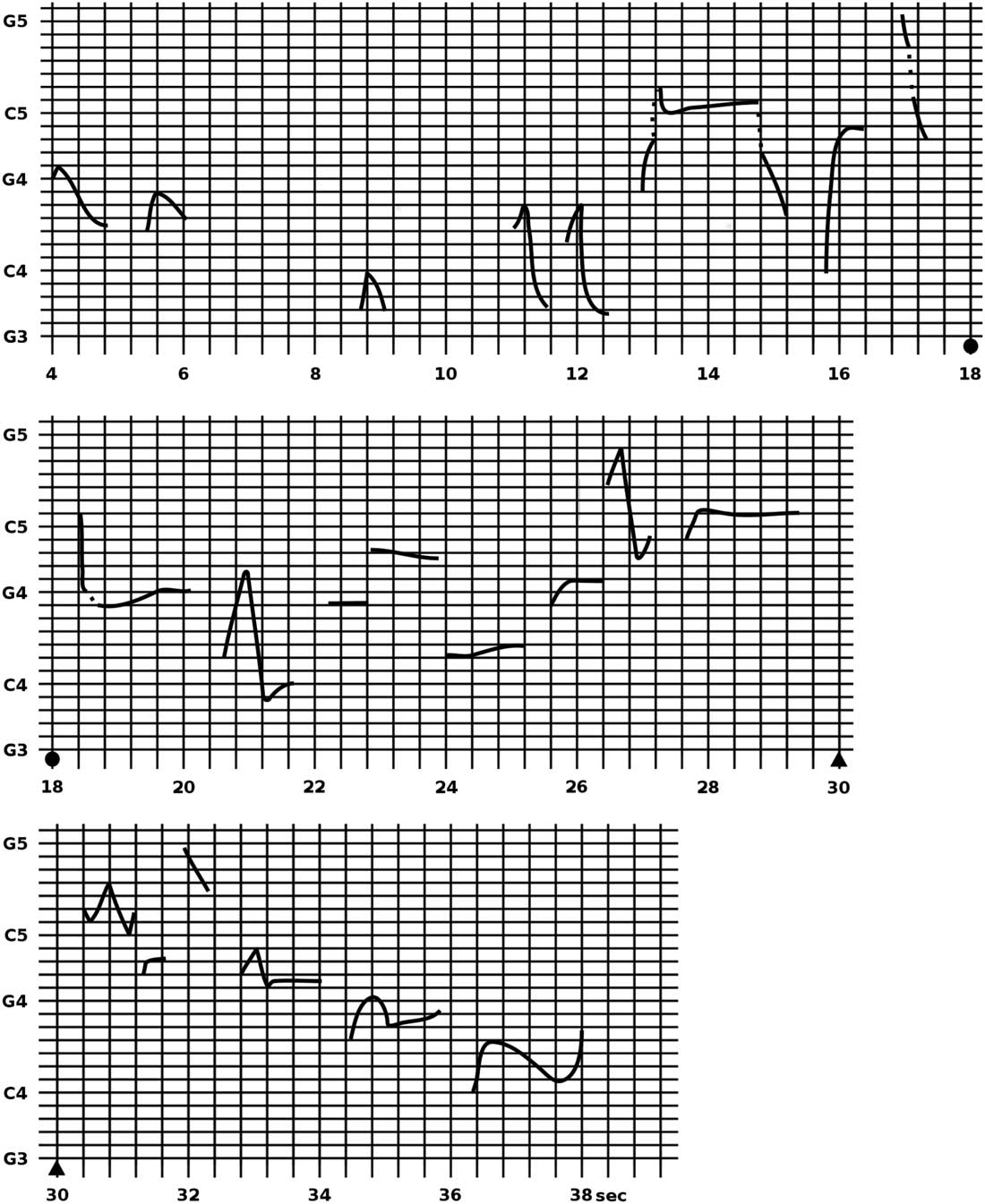
The fourth to sixth notes of the second section still exert a great deal of tonal temptation to the ear, but the other melodic segments have completely disappeared, their notes having been replaced by various sonic curves. Some of these have an ambitus as wide as a sixth or seventh, making one wonder how one can perceive them as single tonal values in normal tempo. Every curve has a different shape, and distinct dynamic and timbral shades. Their series is like a sentence told in an unknown language of sonic ‘gestures’, the latter word used in reference to Denis Smalley’s thoughtful definition (Smalley Reference Smalley1986: 82).
The two cultural realities of the blackcap’s song defined by Messiaen and Szőke’s approaches respectively are matched by two relatively recent terms used in the study of sonic culture. The first approach presents the bird’s song as a ‘note-based’ (or ‘pitch-based’) cultural phenomenon, while the second presents it as a ‘sound-based’ one. Introduced by Leigh Landy ten years ago (Landy Reference Landy2007), this terminology and the underlying dichotomy has also established itself outside the discourse of sonic art, finding its way even into the literature of zoomusicology (Taylor Reference Taylor2017: 161). In the present case, however, it seems to present a dilemma.
If I call the blackcap’s song ‘sound-based’, I neglect the tonal melodies. If I call it ‘note-based’, I neglect an integral feature of the motifs ‘that resemble the wavelike oscillations of the human voice, and fill the ear of nature lovers with exceptionally mellow sounds’ (Rausch Reference Rausch1900: 124–5). As this quote from Mathias Rausch – another expert from the cagebird age – testifies, the slower glides were known and appreciated as such even before the advent of the variable-speed tape recorder.
‘It goes without saying that many works fall between note-based and sound-based only content. In sound-based music, the majority of the content is not based on the traditional note-based paradigm’ (Landy Reference Landy2017: 20). So why should the dichotomy present a dilemma if one can in fact locate things in between the two categories? The dilemma emerges because what Landy implies is a coexistence of different materials, each of which are either note-based or sound-based, while the blackcap’s monophonic song seems to consist of a single kind of material that exhibits both features simultaneously.
I do not mean to imply criticism of Landy’s practical approach, but rather to demonstrate another aspect of its relevance. From the viewpoint informed by the total experience of the blackcap song, by a glimpse of its entire cultural history, and not least by the sound-based–note-based dichotomy, the most essential feature of the song is that it behaves like a quantum particle, capable of bilocation. It is in the middle of the two categories at the same time, rather than falling in between them. It must have been because of this paradoxical feat, the simultaneous invitation to a note-based and a sound-based reading, that the observers found the song to be charming, effortless and sweetly wild.
The two possibilities exert more or less equal attraction on the listener, and constantly challenge the relevance of each other. The paradox of their inseparable nature reminds us that in spite of their imagery derived from construction work, ‘note-based’ and ‘sound-based’ are ultimately not immanent features of acoustic phenomena, but rather reflective of human interpretation. Both of them can be possible, but neither of them is absolutely necessary. Therein lies an additional charm in the blackcap’s song: despite being labelled and interpreted for centuries, it evokes a distant time – let us say one million years ago – when human labels and meanings did not exist, and also points to an ever-present, timeless sphere of human existence in which judgements have not yet come into being.