1 Introduction
The syllabic typology of Arabic vernaculars has attracted various generative approaches over the years. One of the most significant, Kiparsky's (Reference Kiparsky, Féry and van de Vijver2003) semisyllable account of syllables and moras in Arabic, differs from other generative approaches in terms of the amount of data covered, the division of the dialects into three syllable types and the linking of various syllable-related phenomena with syllabification patterns. However, an examination of this account against a wider set of data shows that while the semisyllable account explains much Arabic syllable-related variation, a number of dialects appear to exhibit conflicting dialect phenomena.
I begin by presenting Kiparsky's semisyllable analysis of three different types of dialects in Arabic – those in which morphologically derived CCC clusters are syllabified as CVCC (VC dialects), CCC (C dialects) and CCVC (CV dialects) respectively. This analysis, the first both to account for C dialects in addition to VC and CV dialects and to link VC dialects to C dialects, also explains a large number of syllable-related phenomena in the dialects.
A closer look at some of the data and consideration of new data shows that the analysis cannot cope with all syllabification phenomena for all dialects. Dialects that fail to exhibit predicted phenomena most consistently are those in which derived CCC clusters are typically syllabified as CCVC – Kiparsky's CV dialects. The extent to which the analysis fully accounts for some surface forms in VC dialects is also questioned. Dialect phenomena not readily covered by the semisyllable account most commonly involve long segments – long vowels or geminate consonants.
In this extension to Kiparsky (Reference Kiparsky, Féry and van de Vijver2003), syllables incorporating long segments are distinguished from syllables ending in final consonant clusters in relevant dialects, and accounted for by means of a mora-sharing analysis, a solution that draws on proposals for the analysis of syllables containing, or ending in the first portion of, long segments in a number of languages, including Arabic (Broselow Reference Broselow, Broselow, Eid and McCarthy1992, Broselow et al. Reference Broselow, Huffman, Chen, Hsieh and Eid1995, Reference Broselow, Chen and Huffman1997), Malayalam (Broselow et al. Reference Broselow, Chen and Huffman1997), Bantu languages (Maddieson Reference Maddieson1993, Maddieson & Ladefoged Reference Maddieson, Ladefoged, Huffman and Krakow1993, Hubbard Reference Hubbard1995) and American English (Frazier Reference Frazier2005). As a result of this modification, the three-way typology put forward by Kiparsky for Arabic is extended to a four-way typology.
2 Background and Kiparsky's model
Research on the syllabic typology of Arabic has focused particularly on the difference between dialect types in which epenthesis occurs to the right of the unsyllabified consonant (CCC=CCvC, thus: /gilt-la/ [giltila] ‘I told him’), and those in which epenthesis occurs to the left (CCC=CvCC, thus: /gilt-la/ [gilitla] ‘I told him’). In Selkirk (Reference Selkirk, Borer and Aoun1981), stray consonants are assigned to the onset in the former, and to the rhyme in the latter. In Broselow (Reference Broselow, Broselow, Eid and McCarthy1992), in a similar approach, stray consonants are linked directly to syllable nodes in what she terms onset dialects, and to moras in rhyme dialects. In Itô (Reference Itô1986, Reference Itô1989), developed further by Farwaneh (Reference Farwaneh1995), the difference between the two syllabic types is attributed to the directionality of syllabification – onset dialects syllabify from left to right, and rhyme dialects from right to left. Mester & Padgett (Reference Mester, Padgett, Merchant, Padgett and Walker1994) translate this processual formulation into constraint-based terms by means of alignment constraints. Kiparsky (Reference Kiparsky, Féry and van de Vijver2003) analyses the syllabification patterns of three Arabic dialect types, which he classifies typologically as VC, CV and C dialects: VC dialects split CCC by epenthesis to the left of the unsyllabified consonant (Broselow's rhyme dialects), CV dialects split CCC to the right of the unsyllabified consonant (Broselow's onset dialects) and C dialects maintain the CCC cluster. Thus, the model form /gilt-la/ ‘I/you (masc sg) told him’ is syllabified in a VC dialect as [gilitila], in a CV dialect as [giltla] and in a C dialect as [giltla]. Kiparsky argues that the most basic typological division is between CV dialects on the one hand and VC and C dialects on the other.
(1)


According to Kiparsky, VC and C dialects license unsyllabified consonants as semisyllables, represented prosodically as moras unaffiliated to a syllable node. CV dialects, by contrast, do not license unsyllabified consonants as semisyllables.
From an OT perspective, semisyllables arise when the constraint License(μ), which requires all moras to be licensed by syllables, is outranked by markedness constraints on the form of syllables and feet (Kiparsky Reference Kiparsky, Féry and van de Vijver2003: 151) and, in Arabic, by Reduce, which requires minimising the duration of light (CV) syllables such that short low vowels are raised and short high vowels deleted. The theoretical importance of this position lies in the demonstration of the violability of Strict Layering (Nespor & Vogel Reference Nespor and Irene1986: 7)Footnote 1 in the face of higher-ranked constraints, a claim which has its roots in pre-OT work (Itô & Mester Reference Itô and Armin Mester1992, Vogel Reference Vogel, Hannahs and Davenport1999). OT principles require minimal violations of constraints – thus a mora which cannot be associated with a syllable must be affiliated with the lowest possible superordinate prosodic category. In Arabic, affiliation of an unsyllabified mora with the next highest prosodic category, the foot, would entail violation of the otherwise undominated constraint on foot size (FtBin). The unsyllabified mora must therefore be associated with the next highest prosodic category, the prosodic word, which is not subject to such strict size constraints. Thus, semisyllables in VC and C dialects of Arabic are represented as moras associated directly with the word node, as in the rightmost mora in (2):
(2)
The difference between VC dialects, in which CCC clusters are eventually repaired by epenthesis to the left of the unsyllabified C (to give CVCC), and C dialects, in which no epenthesis takes place, is attributed to the licensing by VC dialects of unsyllabified consonants as semisyllables at the word level, but not at the postlexical level: /gilt-la/ has the lexical representation /giltμla/ but is realised as [gilitμla].
Within Kiparsky's approach, this VC dialect lexical/postlexical discrepancy is interpreted as promotion of the constraint License(μ) in the postlexical phonology. An epenthetic vowel is inserted to the left rather than to the right of the semisyllable because of prosodic faithfulness: it is the minimal modification that brings the word-level moraic (semisyllable) parse into line with the language's surface syllable canon (Kiparsky Reference Kiparsky, Féry and van de Vijver2003: 159). This is illustrated in the tableaux below: at the word level (3a), License(μ) is outranked by Reduce, which minimises the number of light syllables, specifically, because of dominating Align and Max constraints, of non-final light syllables with high vowels (Kiparsky Reference Kiparsky, Féry and van de Vijver2003: 158). At the postlexical level (3b), License(μ) is promoted above Reduce, causing epenthesis of the unmarked vowel (in most dialects, [i]).
- (3)
a. VC dialects: word level
b. VC dialects: postlexical level
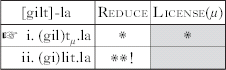
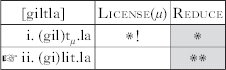
C dialects, by contrast, license semisyllables at both the lexical and the postlexical levels, allowing CCC clusters to surface: License(μ) is not promoted postlexically in C dialects. Kiparsky's analysis is thus a constraint-based version of Lexical Phonology and Morphology, providing evidence for the possibility of distinct constraint systems for the word phonology and the sentence phonology.
The fundamental differences between the three Arabic dialect types can thus be summarised as in (4):
- (4)
a. CV dialects allow semisyllables at no level.
b. VC dialects allow semisyllables at the word level only.
c. C dialects allow semisyllables at both the word level and the sentence level.
This semisyllable analysis of unsyllabified consonants in the dialects, Kiparsky claims, not only accounts for epenthesis patterns in the dialects, but also for the presence and absence of a range of other syllabification phenomena. Listed in the order in which they are introduced in Kiparsky (Reference Kiparsky, Féry and van de Vijver2003: 149–150), these are:
1. -CC clusters. Only CV and C dialects allow final -CC clusters unrestrictedly. Depending on the dialect, VC dialects either permit no -CC clusters, or permit them only with falling sonority (e.g. Upper Egypt south of Asyut, [kalb] ‘dog’, but [katabit] ‘I wrote’ and [baħar] ‘sea’).
2. CC- clusters. Phrase-initial onset CC- clusters are allowed only in VC and C dialects, because syncope is allowed to create initial clusters from CiC>CC only where the first consonant of the resulting cluster can be licensed as a semisyllable. In C dialects, the resulting cluster remains. In VC dialects, by contrast, the clusters are typically broken up by prothesis of a vowel (phonetically preceded by a glottal stop to satisfy Arabic's undominated ranking of Onset), as in: /ħimaar/ ‘donkey’>[ħμmaarμ]>[(ʔi)ħμ.maarμ]; /kilaab/ ‘dogs’>[kμlaabμ]>[(ʔi)kμ.laabμ]. In CV dialects, high vowel deletion does not take place in initial position.
3. Initial geminate clusters. Often arising from assimilation, initial geminate clusters only occur in VC and C dialects. These can be resolved by prothesis in VC dialects in the same way as other onset clusters: /l-landan/ [llandan]∼[ʔillandan] ‘to London’, /l-ʧaaj/ [ʧʧaaj]∼[ʔiʧʧaaj] ‘the tea’.
4. ‘Metathesis’. ‘Metathesis’ of medial -CCiC- to -CiCC- is restricted to VC dialects, as in: /ji-ktib-u/>[jikitbu] ‘they write’. In corresponding cases, C dialects simply drop the vowel ([jiktbu]), and CV dialects always maintain CCiC ([jiktibu]).
5. Pausal glottalisation. Pausal desonorisation and glottalisation of word-final -VCR and -VVR, as in San‘ani [samʔn] ‘ghee’ and [saaʔr] ‘he went’, occurs only in CV dialects. Kiparsky takes desonorisation to be a process which applies to non-moraic consonants. By virtue of being licensed as semisyllables, unsyllabified consonants are moraic in VC and C dialects.
6. Postgeminate high vowel deletion. High vowel deletion after geminate consonants, producing forms such as /j-kallim-u/ [(j)ikal(l)mu] ‘they (masc) speak’, /j-sakkir-u/ [(j)isak(k)ru] ‘they lock’, occurs only in VC and C dialects. Only in these dialects can the resulting superheavy syllable be prosodically licensed [(ji(kal)lμ.mu)].
7. Closed syllable shortening. Only in CV dialects does closed syllable shortening take place to derive, for example, /kaatib-a/ [katba] ‘writing (fem sg)’ and /baab-ha/ [babha] ‘her door’. By contrast, word-internal CVVC syllables surface in all VC and C dialects because the third mora-C is licensed as a semisyllable, as in: [(ˈbaa)bμ.ha] ‘her door’.
8. Opaque epenthesis/stress interaction. The opaque epenthesis/stress interaction noted for many Levantine dialects only occurs in VC dialects, because epenthesis is invisible to lexical processes such as stress and vowel shortening. In CV dialects, epenthetic vowels are always visible to lexical processes, and are stressed under the same conditions as regular vowels: the epenthetic vowel in Cairene [binˈtina] ‘our daughter’ is stressed in the same position as the phonological vowel /a/ in [makˈtaba] ‘library’.
3 Examination of the data
The classification of a dialect as a C, VC or CV dialect is made principally on the position of the epenthetic vowel in phonologically and morphologically derived CCC clusters. In CV dialects, epenthesis occurs to the right of the unsyllabified consonant, as in Cairene /ʔult-lu/ [ʔultilu] ‘I/you (masc sg) told him’. In VC dialects, epenthesis occurs to the left of the unsyllabified consonant, as in Iraqi /gilt-la/ [gilitla]. In C dialects, no epenthesis takes place. Thus, [qiltlu] ‘I/you (masc sg) told him’ surfaces in Moroccan Arabic with a three-consonant cluster. The ranking of License(μ) below constraints that impose syllable and foot well-formedness imposes the syllabification in (5):
(5)
Taking the treatment of morphologically and phonologically derived CCC clusters as the main criterion for determining whether a dialect be categorised as a CV, VC or C dialect, I examined data from a number of Arabic dialects from Yemen, Sudan, Saudi Arabia, Libya, Lebanon, Palestine, Turkey and Egypt. While three of the typological generalisations occur across the board, of the remainder, one or more dialects of the appropriate syllabic typology either fail to exhibit a particular generalisation, or unpredictably exhibit a generalisation of one of the other dialect types. While some dialects, for example Cairene as a CV dialect and Haifa as a VC dialect, exhibit all the predicted characteristics of their respective dialect type, some of the dialects do not. On the basis of epenthesis patterns, some dialects are not unambiguously ascribable to any one category.
The main dialects considered in this paper are the following:
- (6)
a. Group 1: CV dialects Yemen (al-Hudaida, San‘ani, Yaafi‘i, Yariimi, Ibbi), Egypt (Cairene, Middle Egyptian dialects), Saudi Arabia (Meccan)
b. Group 2: VC dialects The Levant (Haifa, Ras-Beirut), Turkey (Çukurova dialects and Kinderib), Yemen (in-NaDhiir), Egypt (il-‘Awāmṛa), Libya (Tripoli)
c. Group 3: Dialects which prominently display both VC- and CVepenthesis patterns Sudan (Shukriyya, Central Urban Sudanese)
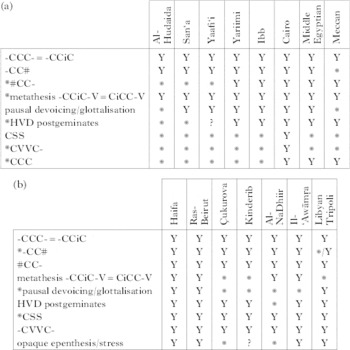
The results of this data examination are summarised in Table I.
Syllabification patterns in Arabic dialects: (a) CV dialect features; (b) VC dialect features.

The dialects of Yemen (San‘ani, al-Hudaida, Yariimi) and Sudan are particularly interesting cases: San‘ani, a dialect in which derived CCC clusters are typically epenthesised as CCVC (e.g. /bint-naa/ [bintanaa] ‘our daughter’, /gult-lih/ [gultalih] ‘I/you (masc sg) told him’, /ahl-haa/ [ahlahaa] ‘her family’), exhibits medial CVVC syllables and vowel deletion after geminates characteristic of VC and C dialects, and some of the word-initial and word-final consonant-clustering characteristics of C dialects. Central Urban Sudanese and the eastern Sudanese dialect, Shukriyya, defy initial categorisation, displaying epenthesis patterns of both the VC and CV types; of the remaining eight features, Central Urban Sudanese exhibits a 3:5 VC/CV feature ratio, and Shukriyya a 4:4 ratio. Due to the theoretical difficulties posed by dialects which defy categorisation, and due to the fact that data from these dialects are not included in Table I, I shall begin by sketching epenthesis patterns in these Sudanese dialects.
3.1 Sudanese dialects: a group 3 class
Central Urban Sudanese allows a limited number of final -CC clusters optionally, including -RC, /-ft/ and /-ks/ (Dickins, in preparation; see below). Many words ending in one of these clusters retain the cluster on suffixation, thus exhibiting CV-epenthesis (e.g. /ʤamb-na/ [ʤambana] ‘beside us’, /bank-na/ [bankana] ‘our bank’). Words ending in -lC may either retain the cluster or epenthesise to the left of the unsyllabified consonant (/kalb-na/ [ˈkalbana]∼[kaˈlibna] ‘our dog’). In other cases, the epenthetic vowel is inserted to the left of the unsyllabified C, though there may be a so-called ‘educated’ variant with epenthesis to the right (e.g. /ism-na/ [iˈsimna]∼[ˈismana] ‘our name’). Other interesting alternations include nouns of the pattern CVCC-a when suffixed: here the initial cluster is either retained, as in [ˈxidmatak] ‘your (masc sg) service’, or broken up, as in [xiˈdimtak] (Mustapha Reference Mustapha1982: 262).
Shukriyya is similar to Central Urban Sudanese, although, according to Reichmuth (Reference Reichmuth1983), VC-epenthesis patterns in noun and verb suffixation are less common than CV-patterns (/kalb-na/ [ˈkalbana], less commonly [kaˈlibna], ‘our dog’, /asg-na/ [ˈasgana], less commonly [aˈsigna], ‘give us something to drink!’; Reichmuth Reference Procházka1983: 93). Reichmuth's other examples of epenthesis in suffixed nouns are all of the CV-type ([milħakum] ‘your (masc pl) salt’, [ɣulbahin] ‘their (fem pl) resentment’; 1983: 71). However, the dialect displays exceptionless ‘metathesis’ of medial -CCiC- to -CiCC- in verb forms with vowel-initial suffixes (e.g. /tamrug-u/[tiˈmurgu]Footnote 2 ‘you go out’; 1983: 101, 26), an otherwise unique characteristic of VC dialects (see §3.2.1), analysed by Reichmuth, as by Kiparsky, as syncope of the high vowel followed by epenthesis (i.e. /tamrug-u/>syncope [tamrgu]>epenthesis [tiˈmurgu]). In this respect, Central Urban Sudanese differs from Shukriyya insofar as it displays alternation – maintenance of -CCiC- as in CV dialects or ‘metathesis’ (e.g. [ˈamsiku]∼[aˈmisku] ‘seize him/it’, [ˈnagfilu]∼[naˈgiflu] ‘we close it’, [ˈasˁburan]∼[aˈsˁubran] ‘be patient (fem pl)’; Mustapha Reference Mustapha1982: 260).
3.2 Cross-dialectal generalisations
In this section, I consider cross-dialectal generalisations that correspond to dialect types almost without exception. I then consider C characteristics shared by some CV and VC dialects, CV characteristics shared by some VC dialects, and VC characteristics shared by some CV dialects.
3.2.1 Generalisations which apply predictably
(i) ‘Metathesis’ of medial -CCiC- to -CiCC- is restricted to VC dialects. Among the group 3 dialects (see §3.1), -CCiC->-CiCC- is characteristic of Shukriyya and an optional variant in Central Urban Sudanese. (ii) ‘Nonfinal CVVC syllables that arise in the word-level phonology surface in all VC- and C-dialects, because these dialects license the third mora -C as a semisyllable [(ˈbaa)bμ.ha] ‘her door’’ (Kiparsky Reference Kiparsky, Féry and van de Vijver2003: 159); ‘shortening of nonfinal CVVC- before word-level endings … occurs only in CV-dialects: /baab-ha/ [babha] ‘her door’’ (Kiparsky Reference Kiparsky, Féry and van de Vijver2003: 150).
All VC dialects exhibit CVVC syllables (e.g. Çukurova [feetħiin] ‘opening (pl)’, Procházka Reference Procházka2002: 82). Non-final CVVC syllables are far more common in CV dialects, however, than Kiparsky's analysis would suggest, occurring in Middle Egyptian dialects (e.g. /bitaaʕit-u/ [bitaaħtu] ‘his’, /ʃaafit-u/ [ʃaaftu] ‘she saw him’; Behnstedt Reference Behnstedt1979: 67, Behnstedt & Woidich Reference Behnstedt1985: map 74), and a number of Yemeni dialects, including al-Hudaida in the Tihama (e.g. [baajkiin] ‘going (masc pl)’; Greenman Reference Greenman1979; [beenhum] ‘between them (masc)’; Rossi Reference Rossi1938), Yaafi‘i (e.g. [raashaa] ‘her head’, [jaa waaldjeh] ‘mother’; Vanhove Reference Vanhove, Haak, de Jong and Versteegh2004), Yariimi (e.g. [ishtarajthin] ‘I bought them’; Diem Reference Diem1973: 134), Ibbi (e.g. [saabʕih]∼[saabiʕih] ‘seventh (fem)’, [ɣaatˁsih] ‘dive’, [raaħluu] ‘(he) went off’; Watson, in press) and, particularly but not exclusively when followed by /h/ of the pronoun suffix, San‘ani (e.g. [bajthaa] ‘her house’ [ʕijjaalhaa] ‘her children’; Watson Reference Watson, van der Hulst and Ritter1999, Reference Watson2002; [ʕmuumhaa] ‘her (paternal) uncles’; Naïm-Sanbar Reference Naïm-Sanbar1994). In Meccan, non-final CVVC syllables occur as a result of syncope (e.g. /kaatib-iin/ [kaatbiin] ‘having written (pl)’ and /ṭaalib-u/ [ṭaalbu] ‘having requested (masc sg) it’; Ingham Reference Ingham1971: 284), and when the CC sequence following the long vowel is an underlying or derived geminate (e.g. /tixiil-na/ [tixiinna] ‘you (masc sg) confuse us’; Ingham Reference Ingham1971: 285).Footnote 3 The group 3 dialects, Central Urban Sudanese and Shukriyya, also display non-final CVVC (e.g. Shukriyya [xaatriin] ‘being on the move (masc pl)’, [saabtoot] ‘young cat’; Reichmuth Reference Reichmuth1983: 69; Central Urban Sudanese [ałła jsaamħak] ‘may God forgive you’, [niħna msaafriin] ‘we are travelling’; Mustapha Reference Mustapha1982: 259).
Shortening of non-final CVVC-before word-level endings (/baab-ha/[babha] ‘her door’, /kaatib-a/ [katba] ‘writing (fem sg)’) is certainly restricted to CV dialects in the present data; however, more specifically, this phenomenon appears to be limited to a single region – Cairo and the central and western dialects of the Nile Delta (Behnstedt & Woidich Reference Behnstedt1985: map 74).Footnote 4
3.2.2 C characteristics shared by some CV and VC dialects
In fast speech, CCC clusters are attested in a number of Yemeni CV dialects of the Central Plateau. These include the dialects of Yaafi‘i, al-Hudaida, Yariim and San‘a. In Yaafi‘i, a dialect spoken in a mountainous areas 200 kilometres northeast of Aden, examples of CCC clusters include [u-jʃqaffhaa bi-r-raas] ‘and he hits her on the head’ (Vanhove Reference Vanhove, Haak, de Jong and Versteegh2004). Al-Hudaida is the main Yemeni town on the Red Sea coast, the ‘wrong’ side of Kiparsky's assumed VC/CV dialect isogloss.Footnote 5 Typical epenthesis patterns, however, place it firmly within the CV dialect set (e.g. [ʤibtalak] ‘I gave you (masc sg)’, [ʕindahaa] ‘with her’, [ʕindamaa] ‘when’; Rossi Reference Rossi1938), as do unrestricted final -CC clusters (e.g. [l-ħabs] ‘the prison’, [taħt] ‘beneath’; Rossi Reference Rossi1938). Examples of CCC clusters from data in Rossi (Reference Rossi1938) and Greenman (Reference Greenman1979) include [ʤibtlak] ‘I gave you (masc sg)’ and [saar tmaddad] ‘he lay down’. The following examples of CCC clusters in Yariimi are from Diem (Reference Diem1973: 132, 134), [harabtli] ‘I ran away’, [saraħtli] ‘I took myself (off)’, [ʤarrhin] ‘he took them (fem)’, and, across words, [kunt raaʕi] ‘I was a farmer’ and [ʕant riʤiʕt] ‘you (masc sg) returned’. CCC clusters in San‘ani include medial clusters in which the first C is a nasal, such as [tˁumtˁsˁa] ‘tomato’ (Goitein Reference Goitein1960: 361) and [bintʕallmih] ‘we learn it’, and initial clusters such as [kftih] ‘gat residue’ and [ʃkmih] ‘party for parturient/bride’. These instances of clustering alternate with vocalised variants – CCVC and, in the case of initial CCC-, CVCC.
Non-fast-speech medial CCC clusters are particularly frequent in San‘ani when a -CC-final noun or verb takes a /h/-initial pronoun suffix (e.g. [wagthaa] ‘her time’, [waħdhaa] ‘on her own’, [waħdhum] ‘on their (masc) own’, [dawwarthum] ‘I looked for them (masc)’). Final -CCC clusters occur in many Yemeni CV dialects, including the dialects of Ibbi and San‘ani, when the negative suffix /-ʃ/ is affixed to the 1st singular or 2nd masculine singular form of the perfect verb (e.g. San‘ani [maa ʃiribtʃ] ‘I/you (masc sg) didn't drink’, [ma bsartʃ] ‘I/you (masc sg) didn't see’; Watson Reference Watson, van der Hulst and Ritter1999; Ibbi [ma bsˁarkʃ] ‘you (masc sg) didn't see’; Watson, in press).
Libyan Tripoli appears to be a VC dialect, insofar as it has restrictions on medial and final consonant clusters (see §3.2.3 below); however, concatenation of a CVCC noun with a consonant-initial suffix does not result in epenthesis, but in the surfacing of non-final CVCC syllables and hence medial CCC clusters. Thus, /xubz-na/ is realised as [xubzna] ‘our bread’, /bint-na/ as [bintna] ‘our daughter’ (Christophe Pereira, personal communication); cf. [kʧebtlek] ‘I wrote to you (masc sg)’ and [kelbkem] ‘your (masc pl) dog’ (Yoda Reference Yoda2005: 124, 120).
3.2.3 CV characteristics shared by some VC dialects
-CC clusters are not restricted to cases of falling sonority in Libyan Tripoli: alongside [təlʤ] ‘snow’ and [kəlb] ‘dog’, there are clusters involving both equal sonority, as in [xubz] ‘bread’, and rising sonority, as in [batˁn] ‘belly’. Clusters are not permitted when the leftmost consonant is a guttural, nor in cases of rising sonority when plain consonants share a place of articulation, as in [wudən] ‘ear’. According to Christophe Pereira (personal communication), all permissible clusters may be broken up by epenthesis, thus [ma-tkəlləmt-əʃ] or [ma-tkəlləmt-ʃ] ‘I didn't speak’; [xubəz] or [xubz] ‘bread’. The use of epenthesised and non-epenthesised forms are not social or geographical variants, although they may well be stylistic variants; both may be used by one and the same speaker.
Desonorisation of word-final -VCR and -VVR in utterance-final position, characteristically also involving glottalisation, ‘seems to be a trait of CV dialects’ (Kiparsky Reference Kiparsky, Féry and van de Vijver2003: 161). A feature of Central Yemeni dialects (Goitein Reference Goitein1960, Behnstedt Reference Behnstedt1985, Werbeck Reference Werbeck2001 for Manaaxa) and dialects of the southwestern Saudi Asir (Yahya Asiri, personal communication), varying degrees of utterance-final desonorisation/glottalisation are attested throughout the region. It is also attested in several dialects in Egypt (Behnstedt & Woidich Reference Behnstedt1985: maps 41–43). For dialects in Yemen and Egypt, Kiparsky suggests that epenthesis and desonorisation are in complementary distribution. While some CV dialects are marked by pausal desonorisation (e.g. /samn/ [samʔn] ‘ghee’), VC dialects in the areas are marked by the breaking up of final -CC clusters (e.g. /samn/ [samin] ‘ghee’). The distribution can be understood if desonorisation is taken to be a process that applies to non-moraic consonants. Thus, it fails to apply in VC dialects because the final consonant is prosodically licensed as a semisyllable, hence moraic, more sonorous than a non-moraic C and more likely to be pre-epenthesised: the non-moraicity of the final -C in CV dialects, by contrast, makes it a viable candidate for desonorisation.
- (7)
a. VC dialects
b. CV dialects
Kiparsky's reasoning here is attractive. However, although pausal glottalisation/desonorisation is most common and most salient in CV dialects, it is not exclusively a CV feature, it is not attested in all CV dialects, it is not restricted to final superheavy syllables, and desonorisation is not restricted to final consonants.Footnote 6 The phenomenon may indeed by better viewed as restricted to certain areas of the Arab world:Footnote 7 several VC dialects in Egypt, Yemen and southeastern Turkey, as well as the group 3 Sudanese dialects, exhibit at least limited pausal glottalisation and/or desonorisation. These include the Egyptian Eastern Sharqiyya dialect of il-‘Awāmṛa, which, in common with a number of Middle Egyptian CV dialects (Behnstedt & Woidich Reference Behnstedt1985: map 43), glottalises /ʕ/ in pause (/ʤaaʕ/ [ʤaaʔħ] ‘he became hungry’ and /riʤiʕ/ [riʤɛʔħ] ‘he returned’; Woidich Reference Woidich1979: 77). In common with the CV dialects of Cairo (Woidich Reference Woidich, and 1980, Reference Woidich2006, Watson Reference Watson2002) and the group 3 Sudanese dialects (Mustapha Reference Mustapha1982, Reichmuth Reference Reichmuth1983),Footnote 8,Footnote 9 the VC dialects of Anatolia (Arnold Reference Arnold1998), Kinderib (Jastrow Reference Jastrow2003) Footnote 10 and the Çukurova dialects of Adana, Mersin and Tarsus devoice final consonants in pause (e.g. Çukurova /ɣarb/ [ɣarp] ‘west’, /ardˁ/ [artˁ] ‘earth’, /balaʕ/ [balaħ] ‘he swallowed’; Procházka Reference Procházka2002: (63).Footnote 11
As an areal feature, pausal desonorisation could be accommodated by strict interpretation of the undominated FinalC constraint, expressed as NoFinalCμ – final consonants are not only weightless, they may also not be linked to a mora directly associated with the word node.
3.2.4 VC characteristics shared by some CV dialects
The dialect of Mecca, clearly a CV dialect from its epenthesis patterns (e.g. /katabt-ha/[katabtaha] ‘I/you (masc sg) wrote it (fem)’, /ʤamb-na/ [ʤambana] ‘beside us’; Ingham Reference Ingham1971), does not allow -CC clusters with rising sonority. Epenthesis splits -CC when the final consonant is /m n r l ɣ/, unless, according to Ingham (Reference Ingham1971: 282), the sequence is [-lm] (e.g. [ħilm] ‘dream’). Examples from Ingham (Reference Ingham1971) include [tamur] ‘dates’ vs. [tamru] ‘his dates’, and [ʔibin] ‘son’ vs. [ʔibnu] ‘his son’.
In fast speech, phrase-initial onset CC-clustering is attested in a number of northern and southern Yemeni CV dialects. Examples from Yaafi‘i include [dri hu] ‘not knowing’, [jɣuul] ‘he says’ (Vanhove Reference Vanhove, Haak, de Jong and Versteegh2004); from al-Hudaida [rkɛb] ‘he rode’, [ftaħ ʕeenak] ‘open your (masc sg) eyes!’, [ftaʤaʕ] ‘he was afraid’ (Rossi Reference Rossi1938); from San‘ani [wlaadaat] ‘births’, [mɣannijaat] ‘singers’ (Naïm-Sanbar Reference Naïm-Sanbar1994), [mrih] ‘woman’; initial clustering is particularly common in this dialect where the rightmost consonant is /h/, and/or a sibilant is involved, as in [ʃhiidajn] ‘the two martyrs’, [ʃhirajn] ‘two months’, [ʃtaa] ‘winter’, [bʃaaʃ] ‘with a cloth’ (Watson Reference Watson2002).Footnote 12 In San‘ani, syncope can also result in initial geminates, as in /mumawwaʤ/ [mmawwaʤ] ‘waved’.
High vowel deletion, resulting in partial degemination, takes place after geminate Cs in form II verbs in al-Hudaida – [jitowwruh] ‘they boil it’ (Rossi Reference Rossi1938: 464), and in San‘ani – /ɣallig-ii/ [ɣal(l)gii] ‘lock (fem sg)!’, /jilabbis-uu/ [jilab(b)suu] ‘they (masc) put on’, /jitˁalliʕ-uu/ [jitˁal(l)ʕuu] ‘they (masc) go up’, /jigajjil-uu/ [jgaj(j)luu] ‘they take part in a gat chew’ (Naïm-Sanbar Reference Naïm-Sanbar1994, Watson Reference Watson, van der Hulst and Ritter1999, Reference Watson2002). High vowel deletion after geminate Cs is not restricted to cases of suffixation in San‘ani: it also occurs when a non-suffixed verb is followed by a vowel-initial word, as in /nisawwig/>[nisaw(w)g al-ħammaam] ‘we mop the bathroom floor’ and /nimassiħ/>[nimas(s)ħ ad-dajmih] ‘we wipe the kitchen’.Footnote 13
Table Ia, given at the beginning of this section, shows Cairene to be the only dialect investigated here which exhibits all eight of the predicted CV phenomena considered. The remaining dialects fail to exhibit between two and six of the eight phenomena. VC dialects exhibit Kiparsky's predicted phenomena more completely than CV dialects; however, Table Ib shows only the Levant dialects of Haifa and Ras-Beyrouth to exhibit all phenomena predicted of VC dialects. The remaining dialects fail to exhibit between one (il-‘Awāmṛa) and three (Libyan Tripoli and Çukurova) of the eight phenomena.
4 Mora sharing
Of the dialects that fail to fully conform to the characteristic phenomena of Kiparsky's dialect types, the most significant are Central Sudanese, Shukriyya and San‘ani. Central Sudanese and Shukriyya are worth excluding at this point. Central Sudan is a plain to which hundreds of different tribes congregated, resulting in dialect convergence which lead to colliding linguistic systems. Of the alternants [ˈkalbana] and [kaˈlibna] ‘our dog’, [ˈkalbana] is now felt to be more prestigious and is apparently the more recent, at least in urban centres (James Dickins, personal communication); it may have originated through analogy to forms such as [ħaggana] ‘ours’ and [bittana] ‘our daughter’, and may be due in part from mimicking the more prestigious Cairene Arabic [kalˈbina] while maintaining the vowel and stress pattern that already existed for Sudanese.
Of the three dialect types drawn up by Kiparsky, the summary tables indicate both that it is apparent CV dialects that diverge most from the semisyllable analysis, and, if fast-speech phenomena are excluded, that most divergent phenomena are those that involve long segments. Apparently conflicting phenomena exhibited by what otherwise appear to be CV dialects are: medial CVVC syllables (San‘ani, al-Hudaida, Yaafi‘i, Yariimi, Ibbi, Middle Egyptian, Meccan), final CVCCC and CVVCC syllables (San‘ani, Ibbi), syncope in CVCiCiVC+V (San‘ani, al-Hudaida), and, in fast speech, medial -CCC- and initial consonant clusters (San‘ani, al-Hudaida, Yariimi, Yaafi‘i). These dialects, I believe, form an intermediate class, falling between C dialects and CV dialects due to the relative dominance of the constraint Reduce. I propose to name dialects falling into this type Cv dialects, distinguished from CV dialects by the lower case ‘v’.
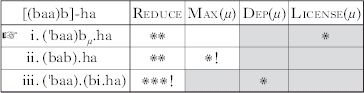
As a first stage in analysing these phenomena in Cv dialects, it is necessary to recognise the prosodic difference between CVVC syllables and CVCC syllables. Even in the most obediently CV dialect, Cairene, CVVC appears in positions where CVCC is not permitted, as in [kaan jiktib risaala] ‘he was writing a letter’ vs. /bint kibiira/ [binti kbiira] ‘a big girl’ (Selkirk Reference Selkirk, Borer and Aoun1981, Watson Reference Watson2002: 71, 108). In Classical Arabic, CVVC, but not CVCC, syllables may occur at the end of a poetic line, and therefore participate in rhyme (Bohas Reference Bohas1975). These differences are also upheld in VC dialects: as seen above, VC dialects allow medial CVVC, whereas medial CVCC is broken up postlexically to CVCiC, e.g. Haifa [waaħdi] ‘one (fem)’ vs. /xubz-na/ [xubizna] ‘our bread’. For VC dialects, a claim that the final C of CVVC is licensed lexically as a semisyllable, but not postlexically, fails: on the basis of postlexical promotion of License(μ), medial CVVC syllables should not surface in VC dialects. In the tableaux in (8), the shortened form *[babha] ‘her door’ is incorrectly predicted to be the realised form.
- (8)
a. VC dialects: word level
b. VC dialects: postlexical level
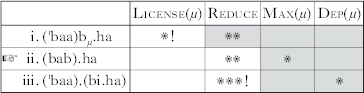
I propose that medial CVVC syllables in VC dialects and the intermediate Cv dialects be accounted for an analysis that recognises an intermediate status for the mora – not an unlicensed mora, but rather a mora that dominates two constituents. Formulated as Adjunction-to-Mora, this was first proposed to account for word-internal CVVC syllables in Arabic dialects by Broselow (Reference Broselow, Broselow, Eid and McCarthy1992) and Broselow et al. (Reference Broselow, Huffman, Chen, Hsieh and Eid1995, Reference Broselow, Chen and Huffman1997), drawing on the degenerate syllable analysis put forward earlier for Egyptian, Lebanese and Iraqi by Aoun (Reference Aoun1979) and Selkirk (Reference Selkirk, Borer and Aoun1981). It also draws on analyses of half-long vowels in certain Bantu languages, such as Maddieson's (Reference Maddieson, Ladefoged, Huffman and Krakow1993) and Maddieson & Ladefoged's (Reference Maddieson, Ladefoged, Huffman and Krakow1993: 276–277) ‘heteromoraic’ and heterosyllabic analysis of the nasal portion of prenasalised stops in Sukuma, and Hubbard's (Reference Hubbard1995) multiple linking of a weak mora to V and C in Runyambo; and, more recently, on Frazier's (Reference Frazier2005) analysis of vowel length in mono- and dimorphemic monosyllabic words in American English.
Adjunction-to-Mora was formulated by Broselow as a rule creating moras dominating two segments (Broselow Reference Broselow, Broselow, Eid and McCarthy1992: 14–15):
(9) Adjunction-to-Mora
Adjunction-to-Mora adjoins a consonant to the mora of a preceding vowel. Thus the CVVC syllable in San’ani /kitaab-na/ [kitaabnaa] ‘our book’ results from the consonant /b/ sharing the rightmost mora of the long vowel /aa/. On the basis that ‘subsyllabic constituents whose elements are widely separated along the sonority scale are less marked than constituents with closer sonority distance’ (Broselow Reference Broselow, Broselow, Eid and McCarthy1992: 15), a syllable-final mora is more likely to dominate VC than CC (or VV), because of the greater sonority distance between V and C. This accounts for the propensity of medial CVVC syllables in dialects – VC dialects and Cv dialects – which do not normally permit the surfacing of medial CVCC syllables. In OT terms, Adjunction-to-Mora is expressed as the violable constraint NoSharedMora (10).
(10) NoSharedMora
Moras should be linked to single segments (Broselow et al. Reference Broselow, Chen and Huffman1997: 65). Assign a * for each segment (beyond one) attached to a mora (if a mora is attached to n segments, the number of violation marks=n-1) (Frazier 2005).
In all dialects, SyllBin, which requires syllables not to exceed two moras, is undominated; however, the way in which trimoraic syllables are avoided differs between dialect types. In Cv and VC dialects, NoSharedMora is ranked low both at lexical and postlexical levels; in true CV dialects, such as Cairene, NoSharedMora is ranked high.
- (11)
a. Cv/VC dialects
b. CV dialects (Cairo type)
Mora sharing also accounts for final CVVCC syllables in Cv dialects, such as San‘ani [maa kaanʃ] ‘he was not’, [maa gaalʃ] ‘he didn't say’. The final consonant is extrasyllabic word-finally, because the undominated constraint FinalC forces final consonants to be weightless (Kiparsky Reference Kiparsky, Féry and van de Vijver2003: 157). Adjunction-to-Mora links the second part of the long vowel and the pre-final consonant:
(12)
In common with VC dialects, San‘ani and Hudaidi allow not only medial CVVC, but also Vowel Deletion after geminates within the phonological word, as in: [nimas(s)ħ al-ħammaam] ‘we wipe the bathroom’ vs. [nimassiħ] ‘we wipe’ and [jitˁal(l)ʕu] ‘they (masc) take (something) up’ vs. [jitˁalliʕ] ‘he takes (something) up’ and Hudaidi [jitowwruh] ‘they boil it’.Footnote 14 In contrast to C dialects, however, they do not allow syncope which would result in non-geminate clusters: thus *[jiktbu]</jiktibu/, indicating that geminate consonants are evaluated differently from non-geminate consonant clusters. The difference between geminates and non-geminate consonant clusters is this – unlike non-geminate consonant clusters, geminates, in common with long vowels, can be reduced by degrees, still maintaining a distinction with simplex consonants.Footnote 15 In certain Arabic dialects, geminates, unlike non-geminate consonants, also pattern phonologically with long vowels: thus, in San‘ani, medial syllables ending in the left leg of a geminate behave like medial CVV syllables, and not like medial CVC syllables, with respect to stress (Watson Reference Watson2002: 103ff). In Classical Arabic, medial CVVC syllables are only attested when the rightmost C is the left leg of a geminate, as in [dˁaalluun] ‘lost (masc pl)’ (Wright Reference Wright1975: 26) and in the form XI verb pattern [ifʕaalla] (Wright Reference Wright1975: 29).
Thus, in some Cv dialects, and possibly also in VC dialects where the geminate is not reduced postlexically to the length of a simplex consonant (as in Upper Egypt; cf. Nishio 1994: 41, cited in Kiparsky Reference Kiparsky, Féry and van de Vijver2003: 150), long consonants share a mora with a preceding vowel, just as long vowels share a mora with a following consonant. This is represented in (13):
(13) Adjunction-to-Mora (C-V)
The notion of a doubly linked consonant sharing a mora with a preceding vowel has reputable precursors. This reflects Maddieson's (Reference Maddieson1993) ‘semi-geminates’ (consonants that are longer than simplex consonants but shorter than geminate consonants), Hubbard's (Reference Hubbard1995) analysis of the nasal element of prenasalised consonants in Runyambo, and Broselow et al.'s (Reference Broselow, Chen and Huffman1997) analysis of geminated in Malayalam, viz.:
(14)
The difference between mora sharing in the Arabic case and that in Runyambo (Hubbard Reference Hubbard1995: 251), Sukuma (Maddieson & Ladefoged Reference Maddieson, Ladefoged, Huffman and Krakow1993: 277) and Malayalam (Broselow et al. Reference Broselow, Chen and Huffman1997: 69) is that the geminate in Arabic is not heterosyllabic: it both shares a mora with the preceding vowel and exclusively occupies a mora within the same syllable. The derivation of San‘ani [nilab(b)sih] ‘we dress him’ from [nilabbis-ih] takes place as below:
(15) Reduce/Adjunction-to-Mora
Mora sharing in the case of long consonants and long vowels (i.e. CVCiCi and CVVC syllables) not only reflects a phonological relationship between long consonants and long vowels, but also a phonetic reality: instrumental work in Broselow et al. (Reference Broselow, Huffman, Chen, Hsieh and Eid1995, Reference Broselow, Chen and Huffman1997) has demonstrated for various dialects of Arabic that the long vowel in a CVVC syllable is significantly shorter than that in a CVV syllable, but longer than the short vowel in a CV or CVC syllable; similarly, the geminate consonant in a CVCiCi syllable is longer than a simplex consonant but lacks the duration of a heterosyllabic geminate, and the pre-geminate vowel lacks the duration of a full short vowel in a CV or CVC syllable.Footnote 16
One additional constraint is needed, however, in order to assign a cost to the strategy of degemination employed postlexically in some dialects. I provisionally term this constraint LinkFaith:Footnote 17
(16) LinkFaith
If the number of syllable positions linked to Si=n, and SiℜSo, then the number of syllable positions linked to So=n.
(17) Cv dialects: word level
In dialects in which postlexical degemination takes place, NoSharedMora is promoted above LinkFaith postlexically, to give as optimal the degeminated output [jilabsuu]:
(18) Cv dialects: postlexical
The recognition of mora sharing as a means of avoiding trimoraicity in Arabic dialects increases the number of Arabic dialect types from three to four:
- (19)
a. C dialects
Semisyllables permitted at both lexical and postlexical levels.
b. Cv dialects
Semisyllables not permitted at either lexical or postlexical level. Mora sharing permitted iff the syllable rhyme contains a long segment.
c. VC dialects
Semisyllables permitted lexically but not postlexically. Mora sharing permitted iff the syllable rhyme contains a long vowel.
d. CV dialects
Semisyllables not permitted at either lexical or postlexical level. Mora sharing permitted word-finally iff the syllable rhyme contains a long vowel.
Not all Arabic dialects necessarily fit into these four dialect types. Evidence from Libyan Tripoli suggests that just as San‘ani-type dialects form an intermediate type between C and CV dialects, so Libyan Tripoli-type dialects may form an intermediate type between C and VC dialects. There are close historical and geographical links between the C dialect areas and Libya, just as there are close historical links between the C dialect areas and Yemen. These links are reflected in shared lexical items (Behnstedt & Woidich 2005: 28–33), and it should be no surprise if they are also reflected in the phonology.
The present study, which has considered new dialect data and re-examined previously discussed data, shows that Kiparsky's semisyllable analysis accounts for most but not all characteristic syllabic differences between Arabic dialect types. I provisionally propose that one characteristic, final glottalisation/devoicing, be excluded from the analysis as an areal rather than a syllabification phenomenon, and perhaps accounted for by an undominated areal constraint NoFinalCμ. Apparently deviant CV dialects are not in fact members of the CV type, but rather fall into a separate Cv syllabification type, affording a special status to long consonants and/or vowels. The revised analysis accepts the superiority of stratified constraint systems over systems in which constraints are evaluated in parallel, but differs from Kiparsky (Reference Kiparsky, Féry and van de Vijver2003) in formally acknowledging the prosodic difference between CVVC/CVCiCi syllables and CVCC syllables. The result is a three-way, as opposed to a two-way, bifurcation of mora-licensing, applicable at both the lexical and the postlexical levels. Moras may be unlicensed, moras may be shared by two segments, or moras must be licensed and cannot be shared.