Introduction
Industrial policy,Footnote 1 broadly defined as “any type of selective intervention or government policy that attempts to alter the structure of production toward sectors that are expected to offer better prospects for economic growth that would occur in the absence of such intervention,”Footnote 2 is once again a top priority on the agenda of policymakers worldwide.
In the European Union (EU), this renewed interest stems from dissatisfaction with low growth and persistent structural imbalances, especially in the aftermath of the 2007–2009 global financial crisis and the Eurozone sovereign debt crisis. Fears of deindustrialization and growing regional imbalances have reinforced the belief that “a common European industrial policy [with] common European funding” can revive Europe’s economic dynamism, resilience, and sustainability.Footnote 3 In recent years, the partial collapse of global supply chains as a result of the COVID-19 pandemic, the economic fallout from the war in Ukraine, and the adoption of the Inflation Reduction Act in the United States have reinforced calls for a common European industrial policy. In the face of economic competition with the United States, China, and India, each pursuing specific growth strategies, industrial policy could represent a useful weapon.Footnote 4
Thus, scholars and policymakers are discussing industrial policy and intervention at the European level, aiming to extend the provision of public goods (from environmental and health protection to defense) and enhance innovation and convergence between the different areas of the EU, while simultaneously protecting and promoting the EU model. The discussions seem to have overcome the traditional antinomy between the pros and cons of industrial policy and are increasingly concerned with the “how” and fostering dialogue with enterprises.Footnote 5 In this context, it is important to revisit the articulated history of the European Economic Community (EEC)/EU industrial policy. This history comprises important measures, untaken paths, European projects, and national resistances; difficult complementarities between areas and firms; confrontations between different economic cultures; and, in our view, the controversial allocation of resources.
Defining the concept of European industrial policy is the primary challenge posed by this kind of research. As Pelkmans suggests, “There is a great deal of confusion about what industrial policy is, only surpassed by the confusion about what European industrial policy might be,” mainly because of its multilevel design and implementation.Footnote 6 Perspectives on appropriate roles for national and supranational actors in driving industrial progress in Europe have changed significantly over the years, in response to the dynamic challenges posed by the global economic scenario and the deeper changes in the economic culture of European ruling classes.Footnote 7
We define European industrial policy as a combination of framework, horizontal, and vertical measures taken by European institutions to facilitate the structural adjustment of European industry and its capacity for efficiency and innovation, while simultaneously promoting the growth and competitiveness of European business globally. In this study, we focus on horizontal and sectoral/specific industrial policies as well as the resources to finance them.
The issue of resources has impacted the analysis of EEC/EU industrial policies and their potential contributions to greater economic and even political integration in Europe. The definition of these resources has often called into question crucial steps toward closer political integration, both desired and feared, as revealed by long-lasting discussions on increasing the EU’s fiscal capacity with its own resources not derived from the contributions of Member States.Footnote 8
Our article aims to explore the evolution of European industrial policy and its funding in its complex multilevel framework, identifying the different actors involved and trying to understand the prospects of European industrial policy in light of past successes and failures. More specifically, we ask whether and to what extent, beyond declarations of intent, the current approach to financing European industrial policy differs from the past in terms of the level of resources, financing mechanisms, and length of time between policy announcement, resource allocation, and implementation. Focusing on these elements allows us to assess the current level of commitment to European industrial policy and determine whether, as some scholars and policymakers have claimed, EU industrial policy could represent a Hamiltonian moment for the Union.Footnote 9
Addressing this crucial issue motivates our research, together with the hope of complementing existing historical accounts of European industrial policy.Footnote 10 We consider fundamental path-dependent aspects, often underestimated by policymakers, as revealed by the same official material produced by European institutions.Footnote 11 We adopt a methodology that combines a historical analysis of relevant archival evidence with authoritative literature on EU industrial policy.
The archival material used originates primarily from the Historical Archives of the European Union (HAEU), which includes written, oral, and multimedia sources. We used internal documents (files, memoranda, papers, and briefings) produced by various European institutions as well as official (treaties and regulations) and private (notes and speeches by the protagonists) documents and interviews. We also used digital sources held at the Virtual Centre for Knowledge on Europe, based in Luxembourg, an interdisciplinary research and documentation center dedicated to European integration studies.
The remainder of this article is organized as follows. Section 2, without claiming to be exhaustive, reviews some relevant contributions to the recent literature on EU industrial policy, aiming to identify the area in which our research lies. Section 3 reviews the emergence of European initiatives in the field of industrial policy from the 1960s until the launch of the “Europe 2020” strategy (2010). Section 4 documents the role of the Juncker Plan (2014) in promoting EU industrial policy and the potential contradiction it embodied between ambitious goals and limited resources. Section 5 seeks to determine whether the launch of the new EU industrial strategy in 2020, followed by the adoption of the Next Generation EU (NGEU)—with its emphasis on technological innovation and the novel combination of horizontal and sectoral measures—can provide a blueprint for establishing an ambitious EU industrial policy with respect to the crucial issue of resources. Section 6 concludes the article.
EU Industrial Policy: Selective Literature Review
Renewed interest in industrial policy at the global level and the revival of EU industrial policy since the mid-2010s have generated substantial new literature. One of the earliest contributions compiles several important contributors to debates on EU industrial policy.Footnote 12Among them, Cimoli, Dosi, and Stiglitz propose an exploratory taxonomy of policy interventions, measures, and institutions related to industrial policy, emphasizing the importance of studying the past in setting policy agenda. They argue that policymakers need to be aware that future capabilities are built on, refined, and modified by existing capabilities. Hence, the goal of policy is to create “good path dependencies.” Pianta recalls that industrial policy guided European expansion from the 1950s to the 1970s, while the new EU industrial policy in the early 2000s was limited to automatic “horizontal” mechanisms, such as generalized tax incentives for R&D. This resulted in a general loss of EU influence on the direction of industrial change, with negative implications for its global role. However, Bradford recently argued that the EU can enact regulations significantly influencing the global business environment.Footnote 13
Reflection on these ideas has led to extensive literature on the deepening and widening of industrial policy initiatives adopted at the EU level. Following Di Carlo and Schmitz,Footnote 14 we identify three approaches: The first one, largely descriptive, assesses the adequacy and effectiveness of EU industrial policy initiatives. Mosconi reflects on the “new” European industrial policy that has emerged since the beginning of the twenty-first century as an “integrated” approach that combines “vertical applications” to distinct economic sectors with the traditional “horizontal approach.” Mosconi emphasizes affording EU technology policy (R&D, human capital) the same importance at the EU level, as is already afforded to competition and trade policies. Ambroziak argues that “a modern industrial policy should focus on research and development activities as well as innovation, which could be applied in both the pre- and postfabrication stages.” Nguyen and Redeker observe a gap between ambitions and results because of the adoption of a policy framework designed to discourage—indeed, prevent—ambitious EU investment-led policies.Footnote 15
The second approach focuses on the transformation of EU institutions, particularly the European Investment Bank (EIB), to meet the needs of establishing a European industrial policy. Clifton et al. discuss recent studies on the EIB as an introduction to the first comprehensive qualitative and quantitative analysis of its lending during 1958–1995. Mertens and Thiemann elaborate on the notion of the “European hidden investment State,” to identify the role of the EIB and other institutions in financing industrial policy initiatives in Europe, thereby overcoming EU fiscal and regulatory constraints. Examining how national development banks have become part of a complex ecosystem, they conclude that the EU has favored the expansion of those actors to support a Europe-wide industrial policy.Footnote 16
The third approach focuses on specific missions of EU industrial policy, such as the smart specialization strategy (e.g., Wigger, Wyns), the green industrial policy agenda analyzed by Tagliapietra and Veuglers, and other measures directed at sectors, such as automotive and steel (e.g., Pichler et al., Klebaner and Ramirez Pérez). According to Prontera and Quitzow, these measures require the use of blended finance to enhance the EU’s “catalytic power” at the global level.Footnote 17
Another strand of literature that intersects with our work revolves around Mazzucato’s concept of an entrepreneurial state. In contrast to the US system, where industrial policy is entrusted to the federal government, with several federal agencies in charge of promoting innovation, in the EEC/EU strong coordination between the strategies defined by each Member State is lacking,Footnote 18 as reflected in the issue of EU resources, which risk being wasted on funding too many uncoordinated initiatives. To address this problem, Mazzucato proposes the notion of a mission-driven innovation policy, which requires not only identifying the sectors in which innovation takes place and the different actors involved (public and private) but also enabling bottom-up experimentation and learning.Footnote 19
A book edited by Defraigne et al. in 2022 compiles essays that address many of the issues and recent strands of research on EU industrial policy from interdisciplinary and intertemporal perspectives.Footnote 20 This aligns with our own approach to analyzing the financing of European industrial policy initiatives and their contribution to European integration between the 1960s and the present day. The introduction to the volume discusses the gradual re-emergence of industrial policy on the EU agenda over the last two decades, the need to review the theoretical and historical arguments underlying industrial policy and its implementation, and the challenges associated with establishing industrial policy at the EU level, including the rivalry of national business elites. As the authors point out, and our reconstruction confirms, phases of acceleration in the implementation of European industrial policy occur when national economic and political elites become convinced that the status quo is no longer sustainable (push factor) and new potential gains associated with deeper integration visibly emerge in economic, strategic, and geopolitical terms (pull factors).
Our literature review provides two main indications. The first relates to the usefulness of studying European industrial policy from an intertemporal perspective, revealing the changes in the concept of European industrial policy, reasons for varying results, and the identities of the main actors who, in different contexts, have promoted or delayed the launch of various measures. The second indication concerns the issue of resources used to finance European industrial policy initiatives, which still awaits systematization and analysis from a long-term intertemporal perspective. We consider our research, which combines an analysis of original archival materials with elements drawn from the different strands of literature, a step in this direction.
EU Industrial Policy: The Uneasy Life of a Controversial Concept
The history of European industrial policy is strictly linked with the history of European economic integration, reflecting the tensions between supranational and intergovernmental dimensions; the different, sometimes conflicting, visions and interests of the Member States; and the perceptions of global challenges and attempts to cope with them. The complex interaction of these elements has shaped a narrative of European industrial policy, underlying its weaknesses and rendering it a very controversial concept.
Going back to the first step of integration, the European Coal and Steel Community (ECSC) was not only a realization of crucial political and social relevance in the history of EuropeFootnote 21 but also a giant design of industrial policy. It was based on both the free circulation of coal and steel (prohibiting discriminatory measures and restrictive practices) and the governance of those sectors being entrusted to a supranational High Authority. Conceived by Jean Monnet, the protagonist of French “planisme” (economic planning),Footnote 22 the ECSC project was steeped in dirigiste culture. It had one key element: the autonomous fiscal capacity of the new Community, based on the power of the High Authority to raise funds by setting levies on coal and steel production and issuing bonds in capital markets to support collective investments and provide loans to enterprises in both sectors.Footnote 23 Therefore, European resources were used to implement specific European industrial policies.
After 1957, with the establishment of the EEC, a significant shift occurred: developmental goals were entrusted to the Common Market, considered a “multiplier” of opportunities for firms of the Member States.Footnote 24 While other policies, such as Common Agricultural Policy (CAP), were clearly defined and destined to be largely funded, the Treaty of Rome did not mention the “industrial policy,” so tacitly entrusted in the hands of the Member States, eager to maintain control according to their own political and path-dependent approaches. The “silence” of the Treaty allowed national governments—within the limits to state aids posed by the Treaty itself—to implement the internal structural adjustments necessary to soften the severities of the process of integration, especially in cases where this had caused trouble to national enterprises. Therefore, it preserved the consensus around the integration process, according to the classic argument by Alan Milward.Footnote 25 To support the realization of such interventions at the national level, the EEC—whose budget was originally limited, based on the contribution of the Member States—was sided by a new financial institution, the EIB. Operating in the market according to profitability criteria, the EIB was tasked with not only supporting European businesses and promoting widespread industrial growth, especially in backward areas, but also fostering convergence among the economies of the Member States.Footnote 26 Therefore, European resources were devoted to national industrial initiatives.
In the 1960s, the growth of the European Common Market necessitated new rules: in 1962, as a result of a compromise between French neo-mercantilist vision and German ordoliberal positions “Regulation 17” was introduced.Footnote 27 It represented a cornerstone of competition policy, progressively becoming a sphere of broad influence on the economies of the Member States centralized by the Commission and, therefore, a field of Europeanization.Footnote 28 In the same years, precisely in 1964, the Medium-Term Economic Policy Committee was established to coordinate national economic policies, with the primary goal of promoting industrial development and boosting convergence among Member States’ economies. Its limited tasks (five-year economic outlooks and proposals for nonbinding economic policies) clearly reveal its irrelevance. Definitely, the Committee would not have represented a European industrial policymaking body.Footnote 29
Therefore, in the late 1960s, European countries felt the need to launch policies to bridge the gap between Europe and the United States in innovative sectors. The so-called “American challenge,” as defined in his bestseller essay by French journalist and politician Jean-Jacques Servan-Schreiber,Footnote 30 had to be fought both in terms of technical and human capital. In the spring of 1970, the Commission presented the Colonna Memorandum, named after the European Commissioner for Industry, outlining the guidelines for a European industrial policy. In addition to the measures for the completion of the Common Market, including the free movement of capital, it aimed to stimulate the development of cutting-edge technologies using Community funds to finance European research programs and encourage a process of industrial concentration to provide European companies dimensions more suited to world competition. Although the project was partly shelved due to disagreements between the Member States, its ambitions were evident; the Memorandum has, thus, been authoritatively defined as “the birth certificate of the Community’s industrial policy.”Footnote 31
In November 1971, an intergovernmental agreement was signed to launch the European Cooperation in Science and Technology, the first European funding program for scientific and technological cooperation. Cooperation agreements for only seven projects in the electronics field were signed in the first twenty years, involving top players such as AEG-Telefunken, Olivetti, Philips, and Siemens, with a total budget of approximately 21 million European Units of Account (EUAs) (1 EUA = $1 US in 1975).Footnote 32 In the same year, the EEC backed three major European players in the computer industry—French Compagnie Internationale pour l’Informatique (CII), German Siemens, and Dutch Philips—in the creation of Unidata, to produce mainframe computers to compete with companies such as IBM or General Electric/Honeywell.Footnote 33 The model of this new cooperation project followed the one inaugurated in 1970 in the aviation sector with the Airbus consortium, destined to become a front-row competitor on the world market, also thanks to a large amount of government aids and EIB loans, the latter granted with the favorable opinion of the European Commission, that emphasized “the Community relevance of the project.”Footnote 34 The EEC support was inspired by the shared conviction that subsidizing a high-tech industry could act as a pacesetter for technological progress and cooperation in other sectors.Footnote 35 Notwithstanding this backing in 1975, the CII preferred an alliance with Honeywell, a strong player in the industry, while Siemens formed a partnership with Hitachi, and the Unidata project fell apart. Its failure revealed not only the resistance of national governments to pooling technologies, discouraging European companies from investing in risky high-tech transnational projects, but also the difficulties of transforming national champions in European heavyweights.Footnote 36
This problem was clearly identified by the Commission, which decided to introduce new resources to overcome mistrust in intra-European collaborations. It promoted a more active role of the EIB in “offering financial facilities for the amalgamation of firms from different Member States” and recommended that a larger amount of capital derived from the issuing of European bonds be placed at the disposal of the enterprises to overcome their reluctance in cross-border investments in technologically advanced fields.Footnote 37 Moreover, to encourage European projects, in 1973—after the plan for industrial and technological policy endorsed by Commissioner Altiero Spinelli, the Commission set up a Business Cooperation Center, nicknamed the “Marriage Bureau,” to arrange contacts between firms. Could it be the nucleus of a European industrial policy body? Indeed, while the original documents revealed many preparatory reports, only 70 contracts were concluded between medium-sized companies. Although massive economic growth has been registered since the establishment of the Community, the limits of the process of business Europeanization have visibly emerged.Footnote 38
Despite the initiatives designed by the Community in the information technology sector lacking effectiveness, in the 1970s, industrial policy was redefined as “a new indispensable priority for the European Community”Footnote 39 in order to face the crisis. The best-known and most relevant intervention was the Davignon Plan, implemented in 1977 by the Commission to restructure the steel sector. Devised by the European Commissioner for the Internal Market, Customs Union, and Industrial Affairs, the Belgian Étienne Davignon, it aimed to rationalize the industry, disadvantaged in competition with Japanese and other third-country producers, and reduce its production capacity by 25%. It introduced production quotas, set minimum prices, and promoted the signing of international agreements to restrict dumping practices. It also authorized the establishment of “crisis cartels” inspired by the German model. It prescribed the closure of companies in unsolvable troubles and supported the remaining ones with subsidies over a period of eight years (1977–1985), following which it halted EEC aid to the sector.Footnote 40 Despite being aware of the ambivalences inherent in industrial policy, Davignon said he was “convinced that it was possible to intervene in a sector in crisis to support the restructuring of companies, which would then have to return to normal market dynamics.”Footnote 41 The Plan confirmed the application of some procedures of the Treaty establishing the ECSC and used large funds from the ECSC. It represented the most relevant “traditional” industrial policy conducted at the European level.Footnote 42
More interventions were implemented in other sectors to address the overcapacity of companies that were unable to reconvert production and cope with the drastic drop in international demand. In the synthetic fiber industry, the EEC adopted a protectionist attitude, setting limits on imports from third world countries, allowing subsidies from national governments, and an agreement among the 11 largest European companies to partition market shares.Footnote 43
To encourage the revival of industrial investment, which had remained stagnant in most member countries, at the end of the 1970s, the Commission expressly introduced new financial tools, such as the New Community Instrument (NCI in 1978), also known as the “Ortoli facility,” named after François-Xavier Ortoli, the French president of the Commission (January 1973–January 1977) and then vice-president with special responsibility for Economic and Financial Affairs (January 1977–January 1985). The NCI enabled the Commission to borrow up to 1 billion EUA on the capital market and, in turn, lend to companies to finance investment projects consistent with Community priorities in the infrastructure and energy sectors.Footnote 44 Therefore, European resources were devoted to realizing European strategies.
The NCI was fed by tobacco duties and operated in close cooperation with the EIB. It constituted one of the most relevant and innovative financial instruments through which the EEC, since the late 1970s, sought to launch a real industrial policy at the Community level. Even if its further improvement was confronted with the reluctance of some Member States to transfer meaningful budgetary sovereignty to the Community level, in more recent debates on the possibility of issuing Eurobonds, economists and politicians have proposed a re-edition of the NCI as a viable solution that would not require the major challenge of amending European treaties.
The 1980s were multifaceted regarding European industrial policy. On the one hand, the Commission pursued efforts to implement new common projects, mainly in high-tech fields. President Jacques Delors clearly stated that national interventions would not be adequate to deal with “the third industrial revolution” and that the Community needed a common strategy in the face of incipient globalization. Measures targeting high-tech cooperation seemed to gain new impetus, but the results of programs promoting R&D, such as ESPRIT, RACE, and EURAM, were limited.Footnote 45 Once again there was a problem of resources: for the second multiannual framework program for research and innovation (1987–1991), the Commissioner for Industry, Information Technology, Science and Research, the German Karl-Heinz Narjes, requested a budget of 10 billion European Currency Unit (ECU), more than double that of the first framework program (4.5 billion ECU), eventually getting only 5.4 billion ECU.Footnote 46
Meanwhile, the Single European Act based the relaunching of the integration process on the achievement of the single market in December 1992, a target also looked favorably upon by major European companies (as Phillips, Fiat, and Solvay), as affirmed by Lord Cockfield, the British Commissioner for the Internal Market.Footnote 47 Since the First Delors Commission (1985–1989) industrial policy has become essentially functional to the goal of the internal market, and the pro-competition logic of deeper market integration has affirmed itself, challenging European sectoral policies.Footnote 48
Simultaneously, the Single European Act also targeted social cohesion and launched a series of actions aimed at filling the divergence in economic development and living standards between the European regions in a phase of enlargement of the Community to new members (Spain, Portugal, and Greece). The extension of the single market and the deepening of the integration process risked encroaching national sovereignty, creating inevitable conflicts between Member States and, thus, posed an obstacle to the integration process. In the late 1980s, the Commission strengthened regional policies and adopted various tools of direct intervention, including structural funds, special programs such as the Mediterranean Integrated Programs, EIB special loans, and specific incentives to redirect production activities to backward areas. Thus, many European resources were dispersed across a plethora of disconnected initiatives that were far from foreshadowing a European industrial policy. Some economists asked if “there exists scope for a European industrial policy…actually a wide-ranging, ill-assorted collection of initiatives.”Footnote 49
In the 1990s, the Commission’s attitude moved decisively toward limiting industrial policies in the cultural background of the neo-liberal turn, which in the public discourse cloaked the different visions coexisting within the CommissionFootnote 50 and in the framework of the globalization process. André Sapir wrote, “Globalization has become the central theme of the European narrative.”Footnote 51 Perhaps John Gillingham’s argument that globalization was more important to EU integration than political designs concocted in Brussels could be considered drastic, unaware that EU promarket measures (liberalization, privatization, and enforcement of competition policy) were also the result of massive intervention from Brussels.Footnote 52 The consolidation of competition policy was the most appropriate formula for European industrial policy.Footnote 53 A report in 1990 by Martin Bangemann, the Commissioner for the Internal Market and Industrial Affairs, is a notable expression of this changed approach. EEC industrial policy must limit itself to paving the way for innovation and creating a suitable environment for the development of businesses, in the absence of barriers, state aids, and any other form of “vertical” economic support capable of altering competitionFootnote 54.
During a phase marked by extensive privatizations and a ban on state aid, the negative reputation of industrial policy surfaced in the debate, both at the national and European levels, revealing a juxtaposition between horizontal (covering multiple industrial sectors) and sectoral approaches.Footnote 55 The choice of the sectors demanded complex negotiations between governments and businesses, exposing governments to be captured by vested interests, according to Philippe Aghion’s definition of “the risky picking winners.”Footnote 56 Industrial measures often distort competition, raising the long-lasting dilemma of reconciling various industrial policy initiatives with the need to preserve a fairly active degree of competition within the European market. To avoid withering away, industrial policy had to change its form in the context of the increasing complexity of state–market relations.
These worries significantly influenced the elaboration of the Maastricht Treaty (1992) as well as of the Treaty on the Functioning of the EU (2009), which again stipulated that industrial policy is a shared competence between the EU and the Member States. Internal market and competition policies provide a framework within which Member States choose and develop their industrial strategies, while the EU retains the role of coordination and support. In the political and institutional contexts designed by these treaties, complications emerged over the levels of policymaking between European, national, and regional institutions and other actors.Footnote 57 Finally, when budgetary standards were strict and global financial markets were complex and overcrowded, the search for resources was particularly difficult. The EU had not reached the point of “putting a gorilla in the Bond Market,” as The New York Times defined the very successful issues of Support to mitigate Unemployment Risks in an Emergency (SURE) EU-bonds in 2020.Footnote 58
The Juncker Plan: Lights and Shadows
The fate of the Lisbon Agenda,Footnote 59 launched in 2000 to combat the stagnation of the EU economy, mirrored all these problems that remained unsolved at the beginning of the twenty-first century. The Agenda was as bombastic in its ambitions (making the EU “the most competitive and dynamic knowledge-based economy in the world capable of sustainable economic growth with more and better jobs and greater social cohesion” by 2010) as it was undefined in its tools. In 2005, halfway through the process, signs of substantial failure began to emerge. The European Commission led by José Barroso (2004–2014) thus conceived Europe 2020 as an ambitious medium-term plan to realize “a smart, sustainable and inclusive Europe.”Footnote 60 The goals of Europe 2020 were similar to those of the Lisbon Strategy, but the new plan was more targeted and better defined the procedures. However, very early on, Europe 2020 revealed some substantial defects. There was great vagueness about the resources allocated to the realization and governance of the various initiatives, due to the multiplicity of directorates-general and agencies involved at the EU level and the various administrative bodies at national and regional levels. Disagreements between the 27 Member States and disappointments from the business community were rampant; therefore, the new Juncker Commission (2014–2019) quietly dismissed this strategy.
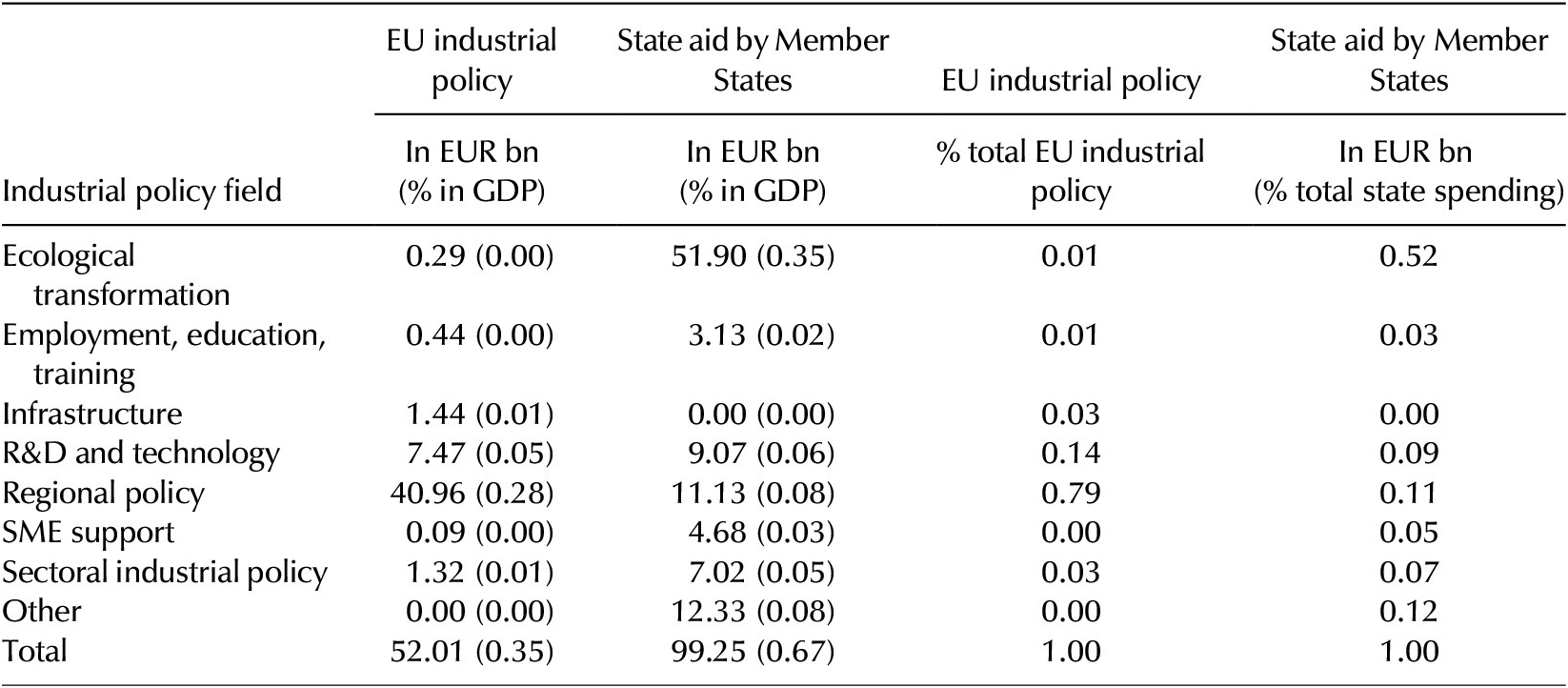
The problematic implementation of Europe 2020 paralleled the adoption of the EU budget for 2014–2020. Financial resources from the EU budget earmarked for industrial policy measures amounted to 0.35% of the EU GDP in 2014–2017 (excluding allocations for the CAP and subsidies for fisheries and forestry) (see Table 1).Footnote 61 In contrast, the industrial policy average expenditure of Member States constituted 0.67% of the GDP over the same period, reflecting the still subsidiary role of the EU in financing industrial policy more than 10 years after its reappearance on the agenda of European institutions.Footnote 62
EU and Member States’ spending on industrial policy, by policy field, 2014–2017 (annual averages)

Source: Elaboration on data provided by Landesmann and Stöllinger, “The European Union’s Industrial Policy.”
In this context, the European Commission’s Investment Plan for Europe, better known as the Juncker Plan, from the name of the President of the Commission, was proposed in 2014 to promote “European industrial renaissance,” with sustainable, inclusive, and green growth, and to steer economies toward “smart specialization.”Footnote 63 Its underlying aim was to address major societal challenges, such as poverty reduction and economic and social inclusion. The Juncker Plan was enforced in July 2015 and included three main elements: (1) the creation of a European Fund for Strategic Investment (EFSI), (2) the creation of a Europe-wide list of investment projects and the strengthening of technical assistance to investors through a dedicated hub, and (3) the improvement of the framework conditions for investment.
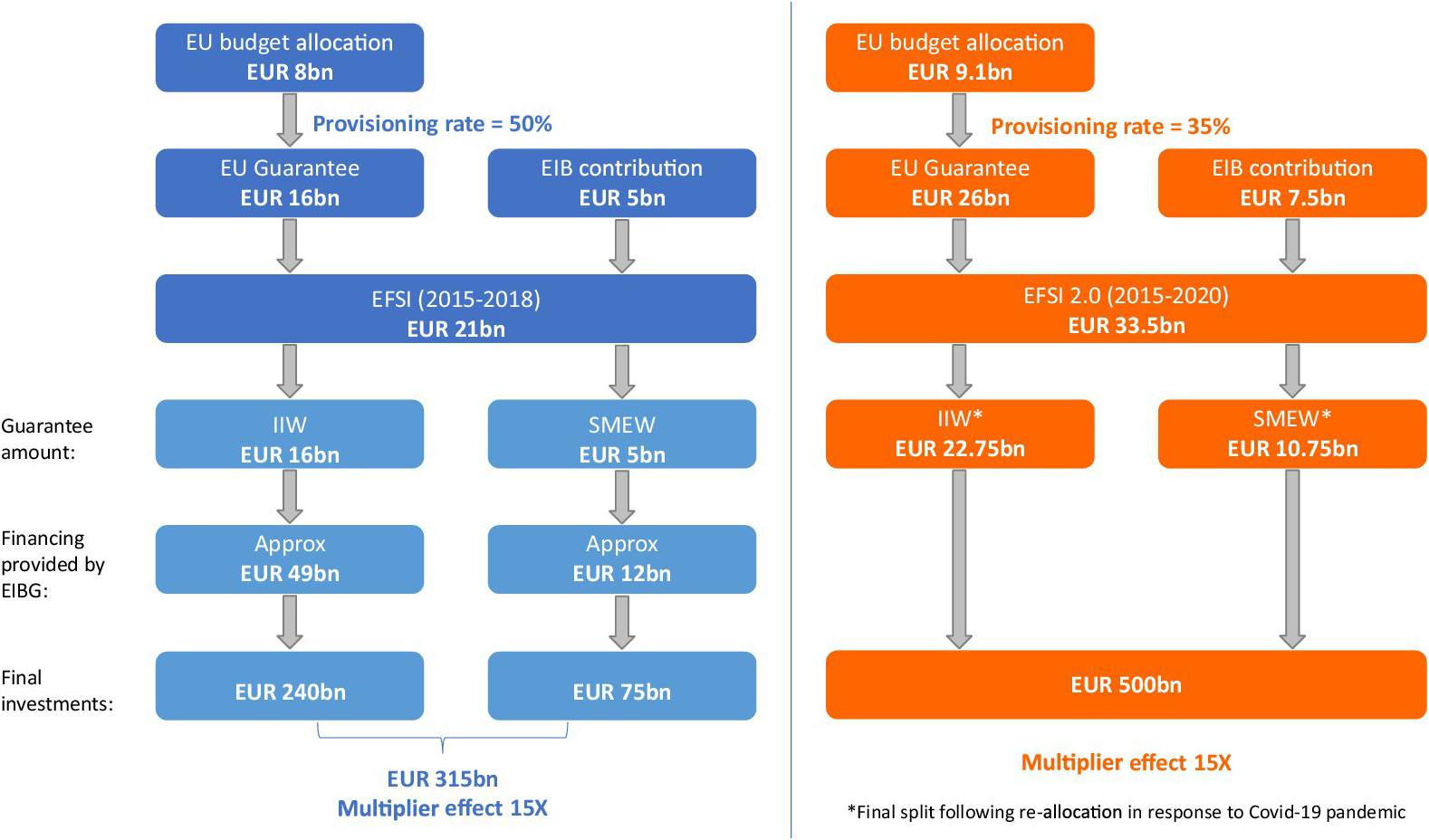
Regarding resources, the endowment of the EFSI amounted to €21 billion, of which €5 billion was from the EIB, €8 billion from the EU budget (taken from already activated programs: Connecting Europe Facility (€3.3 billion), Horizon 2020 (€2.7 billion), and budget margin (€2 billion), and the remaining €8 billion from other funds. Of these funds, €16 billion was allocated to support long-term projects of general interest, while €5 billion was reserved for small- and medium-sized enterprises (SMEs) and mid-cap companies. Assuming a multiplier of 1:15 in both cases (i.e., that every billion of public funds allocated by European institutions would have attracted €15 billion worth of private investment), the expectation at the time of the Plan’s launch was that the €21 billion in public funds would trigger private investment totaling about €315 billion over the three-year period 2015–2017, a target raised to €500 billion with the extension of the Juncker Plan to 2019.
The rationale for using these funds was to close the investment gap left by the financial and economic crises in the EU. The Plan aimed to jumpstart private investments, put liquidity back into circulation, and promote industrial policy initiatives that would complement macroeconomic monetary and fiscal interventions. The EFSI was born out of a desire to restart investments in Europe, shaken by the sovereign debt crisis and weakened by the financial difficulties of many Member States and their respective banking systems. This mechanism was based on an alliance between the European Commission, which offered political guidance and financial guarantees, and the EIB, which offered on-the-ground experience and was considered the guardian of the market-driven approach. This synergy appears to be an enduring positive legacy of the EFSI experience.
The Plan contained some elements of weakness.Footnote 64 The first problem was related to the issue of additionality,Footnote 65 the principle that EU funds can only be disbursed in addition to and not as a substitute for Member States contributions. Questions were also raised about the quality of investment projects supported by the EFSI, not necessarily carrying particularly innovative or useful investment projects from the perspective of the EU’s social objectives. Finally, the second and third lines of action in the Juncker Plan received only limited attention, with no indication of milestones and an associated timeframe.Footnote 66
Over the years, scholars from various fields have critically assessed each of these points.Footnote 67 These critiques mainly focused on the discrepancy between the underlying ambitious strategic vision—the European industrial renaissance—the overall approach, which some have considered old-fashioned and unfocused, and limited new resources, as we highlight a recurring leitmotif when debating European industrial policy. With only about €3.5 billion actually provided for the initial three-year period, and some additional funding from the EIB, many struggled to see what was “strategic” about the fund. The areas eligible for EFSI funding were so broad and diverse that it was difficult to identify a single priority (i.e., energy, transport projects, SME support, R&D, digital economy, agriculture, or social issues).
However, the official evaluation presented a predictable, more optimistic picture, in terms of immediate results and the innovative nature of EFSI, with its ability to address market failures and direct productive resources within a gray area between state and market.Footnote 68 By December 31, 2020, the total project-related investment linked to the EFSI program was €546.5 billion, exceeding the €500 billion target. EFSI-approved funding amounted to €102.8 billion, of which €60.8 billion came from the EIB and €33 billion came from the EIF. Regarding the distribution of total investments in different sectors, the percentages were as follows: SME (34% of the total), R&D (26%), energy (15%), digital (9%), transport (6%), social infrastructure (5%), environment and resource efficiency (4%), and bioeconomy (1%). The estimated impact on employment was +1.8 million jobs until 2022, with a subsequent gradual decrease to 1.2 million. The EFSI has achieved flattering results in SMEs, which are already supported by the European Investment Fund. The critical issues noted at the official level include those related to cohesion constraints, which were introduced as separate EFSI eligibility criterion in 2018.Footnote 69
Net of the actual results, and the debate among critics and supporters, the underlying philosophy that animated the Juncker Plan can be summarized in the principle of “doing more with less.” As a working document points out, the EFSI was conceived when public finances were severely constrained and the EU Multiannual Financial Framework (MFF) was already set for a seven-year period (2014–2020).Footnote 70 With limited budgetary resources, the Commission introduced a budget guarantee scheme, which differs from a classical EU financial instrument because it covers only part of the financial liabilities supported by the budget. An EU guarantee, therefore, creates an unfunded financial liability for the EU budget (e.g., a contingent liability), thus providing greater leverage for the EU budget (see Table 2, which represents the financial structure of EFSI and EFSI 2.0, source indicated in footnote 69).
Financial structure of EFSI and EFSI 2.0

Building on this experience, the InvestEU program was launched in 2021 with the aim to provide and attract long-term funding by mobilizing private investment consistent with the EU policies. In the InvestEU underlying philosophy, private companies innovate and governments must assist them by creating the right environmental conditions without imposing precise missions or directions. This is the mission of the InvestEU Advisory Hub, the “central entry point for project promoters and intermediaries seeking advisory support and technical assistance.”Footnote 71
The transition from the Juncker Plan to the InvestEU program represents an important step, notwithstanding three critical elements: an overreliance on leverage, hampering the efforts to attract new and adequate funding for EU industrial policy; the imbalance between private and public interests that favors safe and profitable investments in consolidated sectors to the detriment of high-risk innovative projects and start-up initiatives; and the possible lack of a clear framework and public coordination among a collection of disparate projects.
The Next Generation EU: A New Perspective?
As our historical reconstruction indicates, the focus on resources and financing instruments is crucial in the context of reflecting on the possibility of activating a European industrial policy that is not only complementary of national initiatives. Thus, the holistic and comprehensive approach of the Juncker Plan was developed by the von der Leyen Commission, focusing on digitizing European industry and building a “European leadership in the low-carbon, circular economy.”Footnote 72
The launch of the New Industrial Strategy for Europe by the European Commission in March 2020 (updated in 2021) marked the first significant step in this direction, combining the European Green Deal (2019) and the Strategy on Shaping Europe’s Digital Future (2020).Footnote 73 When these ambitious programs were underway, the COVID-19 pandemic struck, requiring the adoption of emergency measures. This led to the launch of the NGEU, the most ambitious step toward the implementation of European industrial policy.
As experts of the European Central Bank recall, “NGEU [is] an EU-wide investment and reform program. In the short term, NGEU aims to support the recovery. In the medium term, it is designed to act as a catalyst for the modernization of the EU economies, with positive effects on their growth, resilience and convergence.”Footnote 74 The total volume of the NGEU (€1.8 trillion) could be considered limited compared with crisis-related fiscal policy measures by some Member States. Nevertheless, from the perspective of resources, it is a remarkable EU project, not only due to the joint borrowing Member States have incurred to fund it but also for the relevance of the inter-institutional agreement to repay the debt incurred for the grants from NGEU through new EU budgetary “own resources.” Moreover, the EU outlined a strategy for establishing its presence in the bond market.Footnote 75
Reflecting on the outlook for the European economy postpandemic, some scholars have noted the presence of a few critical financial issues that may affect the provision of the necessary resources to support investment and innovation in the context of a renewed European industrial policy.Footnote 76 In this respect, within the dense debate about the EU’s own resources, it emerged that the system existing before the December 2020 Agreement to accompany the extensive financial efforts of the NGEU was found to make only limited contributions to various strategies and policies to cope with the manifold long-term challenges confronting the EU. Thus, at different levels, the problem of financial tools to realize EU policies targeted at economic growth, including industrial policies, became increasingly evident, as did its political implications.Footnote 77
The challenge of ensuring an adequate and stable flow of financial resources to fund ambitious and innovative EU industrial policy is related to several factors. First, policymakers are convinced that the structural challenges posed by climate change and technological development require public intervention and strong government responses.Footnote 78 Second, the geopolitical framework has changed, and factors such as China’s economic/technological/strategic strengthening at the global stage require new responses. Third, better data and more sophisticated analysis and impact evaluation methods are now available. Hence, today, industrial policy has become a full-fledged part of European public discourse and of the multifaceted and elusive phenomenon of Europeanization.Footnote 79
Recently, the European Commission presented a package of proposals for the revision of the 2021–2027 MFF, totaling over €70 billion. The expenditure items include a proposal to create the Strategic Technologies for Europe Platform, a platform that should reinforce new funds (€10 billion) for existing instruments—such as the Innovation Fund, InvestEU, Horizon Europe, and the European Defense Fund—and direct them to targeted projects in strategic technologies (critical clean tech, biotech, and digital and deep technologies).
This instrument is linked to the dual green and digital transition defined in 2019 by the European Green Deal. The idea is to rationalize and coordinate the plethora of strategic investment instruments through a “one-stop shop” as well to issue a “sovereignty seal” to realize €110 billion additional investments by leveraging private capital.
Strengthening and promoting new European production in strategic sectors where foreign dependence represent a risk to the EU’s security (economic, energy, military, and political) is the new approach employed by Europe’s nascent industrial policy. However, concerns remain about the adequacy of funding for European industrial policy initiatives and resource use. Zuleeg and Lausberg note that “The EU’s current budget and its financing programmes […] are not sufficient to finance the ambitious transition goals. […] Providing sufficient EU level funding should be a top priority for the next Commission starting in 2024.” Other comments concur with this opinion.Footnote 80 However, Moscoso Del Prado points out how “in order to develop a successful European industrial policy in the new geopolitical framework, the experience of NGEU shows that the increase in European dimension funds has to be accompanied by deep changes in the way they are invested, transforming public-private cooperation with the aim of scaling up European technology.”Footnote 81
Conclusion
Our reconstruction reveals the controversies that have historically surrounded the idea and implementation of European industrial policy. On the one hand, this idea was a mainstay of the first steps of integration initiated by the ECSC and resurfaced at certain crucial moments, such as in the 1970s, when the momentum of the Glorious Thirties waned and competition from the United States and Japan grew worldwide. On the other hand, the idea has almost always remained incomplete, being the victim of a difficult balance between aspirations, resources, and results. The main reason for this difficulty lies in the fact that once the initial ambitions were scaled down and the EEC was established, the industrial policy entrusted to the Member States was mainly used to protect their economic spaces and the companies operating in each of them, facilitating the transition to a Common Market while respecting national specificities. Thus, by entrusting the Common Market and trade integration with the task of delivering growth and full employment, industrial policy was neither defined nor perceived as a truly European policy. The reluctance of Member States and of national business elites to relinquish control over national industrial policy and the protection of national firms, as enshrined in the Treaty of Rome, played a major role in preventing the development of a European industrial policy in the 1960s and 1970s. This reluctance has long persisted and is an important path-dependent factor in the development of European industrial policy initiatives.
Simultaneously, awareness of the need for (and benefits of) these initiatives has never completely disappeared, together with the challenge of finding adequate resources to fund them. The second path-dependent factor that emerged from our research was the willingness to maintain space for European industrial policy. When the environment was hostile to the pursuit of these policies, alternatives were found (e.g., through the activities of the EIB), allowing a degree of involvement of European institutions in promoting and financing European industrial policy initiatives, albeit to a limited extent.
The third path-dependent factor is the tendency to spread the limited resources available to fund EU industrial policy initiatives over a multitude of targets and projects, some directed toward social issues with potential for innovation. In this context, poor coordination and conflicting priorities reflecting the multilevel framework of the EU represent major obstacles to the advancement of European industrial policy.
Bearing these elements in mind, and in response to our research question, the current approach to financing EU industrial policy, in particular the NGEU, indeed marks a significant turning point. Some relevant elements suggest this consideration. On the one hand, the sheer volume of resources, together with the decision to issue European bonds jointly guaranteed by the Member States and the Commission, confirms the stronger political commitment underlying the NGEU. On the other hand, a relatively short time exists between the announcement and implementation of the program, together with the involvement of businesses, through the promotion of industrial alliances at the EU level and new business partnerships and models. All these elements suggest that European industrial policy has taken a decisive step forward as a driver of European integration. Simultaneously, the tendency to launch too many initiatives, with the risk it poses in terms of an overloaded agenda and coordination, does not seem to have disappeared.
The question remains as to whether this is a permanent step or whether national interests will prevail. In the current scenario, it is too early to determine whether this is a Hamiltonian moment. However, this step has been taken, and as the history of European industrial policy initiatives and their funding shows, it is a step toward deeper European integration. As Mario Draghi recalled in his 2023 Martin Feldstein Lecture, historical experience reveals that common budgets have rarely been created as an appendage to monetary integration but rather to ensure specific objectives in the common interest.Footnote 82
Competing interest
The authors declare none.