1. Introduction
The Turonian (early Late Cretaceous, 93.9–89.8 Ma; Gradstein et al. Reference Gradstein, Ogg, Schmitz and Ogg2012) represented a critical time of biodiversity turnover among Mesozoic marine amniotes. It chronicled the last appearances of macrophagous pliosauromorphs (Plesiosauri; Schumacher, Reference Schumacher2011), the radiation of aquatic mosasauroid lizards (Mosasauroidea; Bardet et al. Reference Bardet, Houssaye, Rage and Pereda Suberbiola2008) and the divergence of modern cheloniid sea turtles (Chelonioidea; Hirayama, Reference Hirayama, Callaway and Nicholls1997). Unfortunately, fossiliferous deposits of Cenomanian–Turonian age are generally poorly sampled (Benson et al. Reference Benson, Butler, Lindgren and Smith2010). Nonetheless, the Late Cretaceous European Platform, which formed a shallow marine shelf adjacent to the Tethyan oceanic area, has a long history of discoveries from what are now the chalk-marl, limestone and glauconitic sandstone strata of the Czech Republic (see detailed summary below in Section 3), Croatia (e.g. Carroll & Debraga, Reference Carroll and Debraga1992; Debraga & Carroll, Reference Debraga and Carroll1993; Lee & Caldwell, Reference Caldwell2000; Caldwell & Lee, Reference Caldwell and Lee2004; Pierce & Caldwell, Reference Pierce and Caldwell2004; Dutchak & Caldwell, Reference Dutchak and Caldwell2006), Poland (Bardet & Godefroit, Reference Bardet and Godefroit1995), Germany (e.g. Sachs, Reference Sachs2000; Diedrich & Hirayama, Reference Diedrich and Hirayama2003; Karl et al. Reference Karl, Nyhuis and Schöllmann2012), France (e.g. Rage, Reference Rage1989; Bardet & Godefroit, Reference Bardet and Godefroit1995; Bardet et al. Reference Bardet, Pereda Suberbiola and Metais1998, Reference Bardet, Houssaye, Rage and Pereda Suberbiola2008; Houssaye, Reference Houssaye2010) and England (e.g. Collins, Reference Collins1970; Milner, Reference Milner, Owen and Smith1987; Bardet & Godefroit, Reference Bardet and Godefroit1995). Important coeval records are also known from Russia (Welles, Reference Welles1962; Storrs et al. Reference Storrs, Arkhangel'skii, Efimov, Benton, Shishkin, Unwin and Kurochkin2000), Kazakhstan (Averianov, Reference Averianov2001), Japan (Sato et al. Reference Sato, Konishi, Hirayama and Caldwell2012), the Western Interior Seaway of North America (e.g. Welles, Reference Welles1943, Reference Welles1962; Welles & Slaughter, Reference Welles and Slaughter1963; Carpenter, Reference Carpenter1996, Reference Carpenter, Callaway and Nicholls1997; VonLoh & Bell, Reference VonLoh, Bell and Jr1998; Bell & Polcyn, Reference Bell and Polcyn2005; Polcyn & Bell, Reference Polcyn and Bell2005; Schumacher & Everhart, Reference Schumacher and Everhart2005; Albright et al. Reference Albright, Gillette and Titus2007a , b; Schumacher, Reference Schumacher2008, Reference Schumacher2011; McKean, Reference McKean2012; Schumacher et al. Reference Schumacher, Carpenter and Everhart2013), Mexico (Buchy et al. Reference Buchy, Métayer and Frey2005b ; Smith & Buchy, Reference Smith and Buchy2008) and the Gondwanan peripheries of Venezuela (Welles, Reference Welles1962), Colombia (Páramo-Fonseca, Reference Páramo-Fonseca2000), Angola (Antunes, Reference Antunes1964; Lingham-Soliar, Reference Lingham-Soliar1994; Jacobs et al. Reference Jacobs, Mateus, Polcyn, Schulp, Antunes, Morais and Tavares2006; Mateus et al. Reference Mateus, Jacobs, Polcyn, Schulp, Vineyard, Buta Neto and Telles Antunes2009), Morrocco (Bardet et al. Reference Bardet, Pereda Suberbiola and Jalil2003a , b; Buchy et al. Reference Buchy, Métayer and Frey2005a ; Buchy, Reference Buchy2006) and possibly Australia (Kear et al. Reference Kear, Long and Martin2005).
Some of the earliest reports of Turonian marine amniotes derive from the Bohemian Cretaceous Basin (BCB) in the Czech Republic. Reuss (Reference Reuss1855) figured the carapace of a small marine turtle found between Slavĕtín and Pátek in NW Bohemia that was similar to Cimochelys (‘Chelone’) benstedi (Mantell, Reference Mantell1841; synonymized with Rhinochelys Owen, Reference Owen1851 by Collins, Reference Collins1970) from the Middle Chalk of England, and additionally documented teeth of the giant plesiosaurian Aptychodon cretaceus Reuss, Reference Reuss1855 (considered invalid by Welles, Reference Welles1962) from Bílá Hora in the western suburbs of Prague. These specimens were later discussed by Fritsch (Reference Fritsch1878), who also reported teeth attributed to the English Cretaceous pliosauromorph Polyptychodon interruptus Owen, Reference Owen1841 in his landmark monograph on the Cretaceous reptiles and fish of Bohemia. Using the Czech spelling of his name, Frič (Reference Frič1877a ) produced popular reconstructions, and conducted systematic investigations on fossils from what are now known as the Turonian–Coniacian Bílá Hora, Jizera and Teplice formations (Frič, Reference Frič1877b , Reference Frič1879, Reference Frič1889a , Reference Frič b ). Zahálka (Reference Zahálka1895, Reference Zahálka1896) described possible lizard remains found close to the village of Nebužely in N Bohemia; these have since been shown to be a teleost fish (Ekrt, Reference Ekrt2012), however. Bayer (Reference Bayer1896, Reference Bayer1897, Reference Bayer1898) gave an account of tooth-bearing bones referred to P. interruptus, and taxonomically re-evaluated finds from quarries in the Bílá Hora Formation around Prague. Laube (Reference Laube1896) established Pygmaeochelys michelobana Laube, Reference Laube1896 based on a partial turtle carapace from Lower Turonian rocks (Zahálka, Reference Zahálka1897; Čech et al. Reference Čech, Klein, Kříž and Valečka1980) at Měcholupy in NW Bohemia. Sadly, this specimen has since been lost. Jahn (Reference Jahn1904) noted the discovery of a possible mandible of P. interruptus in Cenomanian strata near Hájek in E Bohemia. Fritsch (Reference Fritsch1905a , b) introduced a number of novel taxonomic designations that were later detailed by Fritsch & Bayer (Reference Bayer1905) and catalogued by Bayer (Reference Bayer1905). These included the plesiosaurians Cimoliasaurus bernardi Owen, Reference Owen and Dixon1850 (Pliosauridae indet. sensu Welles, Reference Welles1962; Kear, Reference Kear2002) and C. lissaensis Fritsch, Reference Fritsch1905a (indeterminate Plesiosauria; Bardet & Godefroit, Reference Bardet and Godefroit1995; Kear, Reference Kear2002), the turtle Chelone? regularis Fritsch, Reference Fritsch1905a and supposed mosasauroids Iserosaurus litoralis Fritsch, Reference Fritsch1905a and Hunosaurus fasseli Fritsch, Reference Fritsch1905a (both reassigned to Plesiosauria indet.; Welles, Reference Welles1962; Persson, Reference Persson1963). Fritsch (Reference Fritsch1906) subsequently named Cimoliasaurus vicinus Fritsch, Reference Fritsch1906 (the type material of which could not be relocated for this study) and C. teplicensis Fritsch, Reference Fritsch1906 (both nomina dubia following Bardet & Godefroit, Reference Bardet and Godefroit1995; Kear, Reference Kear2002), and documented new specimens of I. litoralis (Fritsch, Reference Fritsch1910). Shortly after Antonín Jan Frič died in 1913, Bayer (Reference Bayer1914) published a short review of the Bohemian Cretaceous reptiles, in which he concluded that none of Frič's fossils could be recognized as mosasauroids. Furthermore, Edinger (Reference Edinger1934) reidentified a purported endocranial cast of P. interruptus (sensu Fritsch, Reference Fritsch1905b ) excavated at Bílá Hora as a natural sediment infill derived from the skull of a large turtle. Later assessments by Augusta & Soukup (Reference Augusta and Soukup1939) also described plesiosaurian remains, and Zázvorka (Reference Zázvorka1965) announced the discovery of a jaw representing the first definitive Czech mosasauroid; this was found buried in a garden near Dolní Újezd in E Bohemia. Most recently, Ekrt et al. (Reference Ekrt, Košťák, Mazuch, Valíček, Voigt and Wiese2001) and Wiese et al. (Reference Wiese, Čech, Ekrt, Košťák, Mazuch and Voigt2004) figured plesiosaurian bone fragments and a mosasauroid tooth (held in a private collection) from the Teplice Formation at Úpohlavy in NW Bohemia. Ekrt et al. (Reference Ekrt, Radoň and Dvořák2012) also re-evaluated some key historical specimens. As a complement to these studies, this paper provides a contemporary character state synopsis of Bohemian Cretaceous Basin marine amniote fossils from the Czech Republic and discusses both their palaeobiogeographical and biostratigraphical implications.
2. Depositional and lithostratigraphical settings
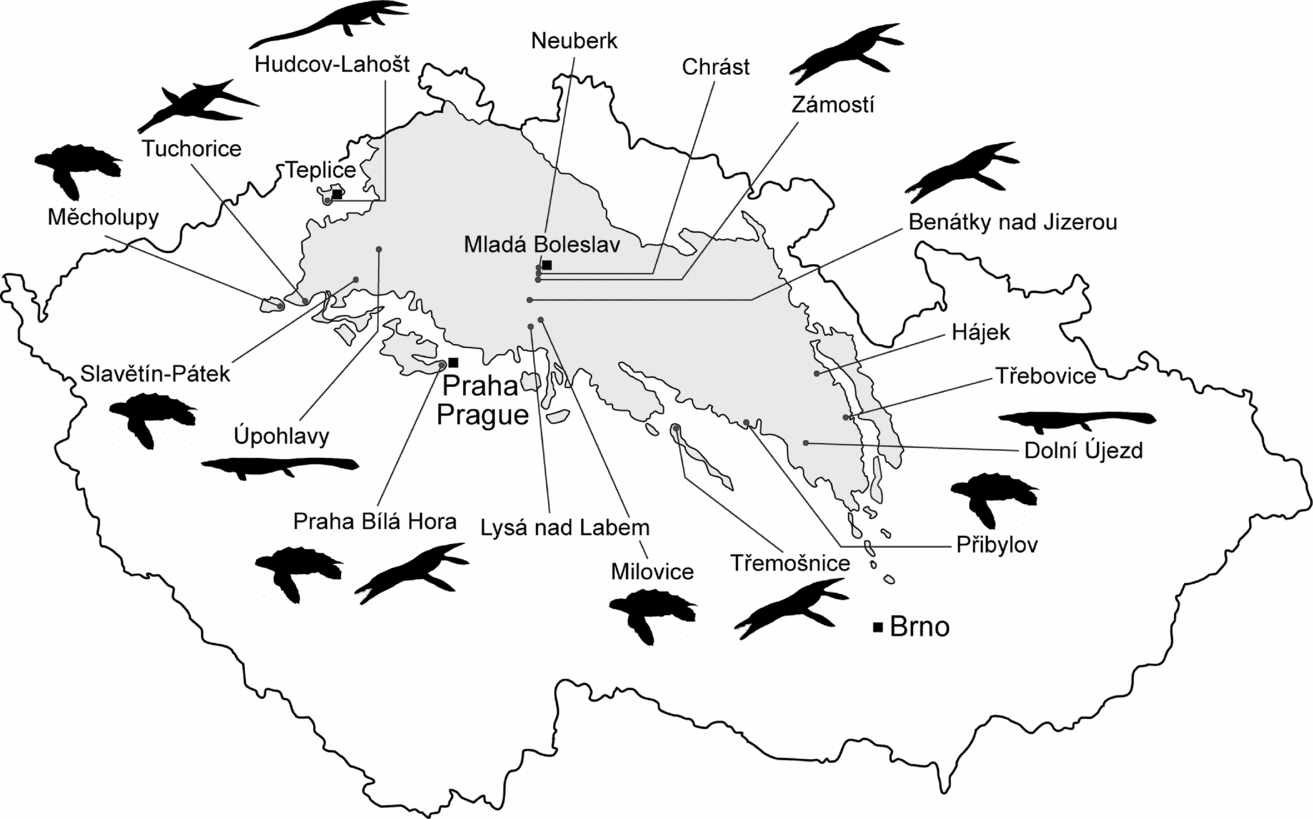
The Bohemian Cretaceous Basin is an intracontinental depositional depression that formed via basement faulting of the Bohemian Massif during the Middle Cretaceous (Uličný, Reference Uličný2001). Its extremities today extend from Brno in E Moravia, across Bohemia to the N and W of Prague and over the German border into S Saxony around Dresden (Fig. 1). Sedimentation within the Bohemian Cretaceous Basin began during the Late Albian or earliest Cenomanian (Valečka & Skoček, Reference Valeča and Skoček1991) with displaced fault zones creating topographical lows adjacent to erosional source areas in the Cretaceous archipelago of the West and East Suedetic Islands and the Central European Island (Čech, Reference Čech2011). Depositional settings were initially continental, as indicated by the sandstone, conglomerate and bioturbated mudstone-siltstone sequences of the Peruc-Korycany Formation (Uličný et al. Reference Uličný, Hladíková, Attrep, Čech, Hradecká and Svobodová1997; Čech et al. Reference Čech, Hradecká, Svobodová and Švábenická2005). These record a transition from fluvial to estuarine and finally shallow littoral conditions (corresponding to the Peruc, Korycany and Pecinov members, respectively) generated by a NW-trending marine transgression through the Early–Late Cenomanian (Valečka & Skoček, Reference Valeča and Skoček1991; Uličný et al. Reference Uličný, Laurin and Čech2009; Čech, Reference Čech2011). A subsequent shift towards open shelf conditions is signified by a profound basin-wide sandstone–glauconitic siltstone facies change across the Cenomanian–Turonian boundary (Valečka & Skoček, Reference Valeča and Skoček1991). This coincides with establishment of a shallow seaway between the Boreal North Sea Basin and the Tethys Ocean (Čech, Reference Čech2011). Transgressive conditions continued through the Early–Middle Turonian as represented by the marlstones and micritic limestones of the Bílá Hora Formation (Uličný et al. Reference Uličný, Hladíková, Attrep, Čech, Hradecká and Svobodová1997; Čech et al. Reference Čech, Hradecká, Svobodová and Švábenická2005). Successive upwardly coarsening, progradational cycles of marlstones through fine-gravelly siliclastic sandstones occur through the sequentially overlying Jizera Formation, and reflect sea-level fluctuations during the Middle–Late Turonian (Valečka & Skoček, Reference Valeča and Skoček1991). These are also distinguished by prominent sedimentological (e.g. Uličný, Reference Uličný2001; Laurin & Uličný, Reference Laurin and Uličný2004; Wiese et al. Reference Wiese, Čech, Ekrt, Košťák, Mazuch and Voigt2004) and biostratigraphical markers (ammonites, belemnites, inoceramid bivalves, calcareous nannoplankton (e.g. Švábenická, Reference Švábenická1999; Svobodová et al. Reference Svobodová, Laurin, Uličný and Wagreich2002; Košták et al. Reference Košťák, Čech, Ekrt, Mazuch, Wiese, Voigt and Wood2004; Wiese et al. Reference Wiese, Čech, Ekrt, Košťák, Mazuch and Voigt2004; Vodrážka et al. Reference Vodrážka, Sklenář, Čech, Laurin and Hradecká2009), which terminate in a marked sandstone–marlstone contact (with condensed phosphatic coprolite-rich horizons) between the Jizera and Upper Turonian – Coniacian Teplice formations. Offshore muds continued to accumulate through the Coniacian and Santonian (yielding a maximum succession thickness of >1000 m; Valečka & Skoček, Reference Valeča and Skoček1991), but subsequent strata have been lost to basinal inversion and erosion during the Cenozoic (Čech, Reference Čech2011).
Diagrammatic map showing the boundaries of the Bohemian Cretaceous Basin within the Czech Republic and the distribution of identifiable marine amniote fossil occurrences (developed from Ekrt et al. Reference Ekrt, Košťák, Mazuch, Valíček, Voigt and Wiese2001).

3. Survey of the marine amniote fossils
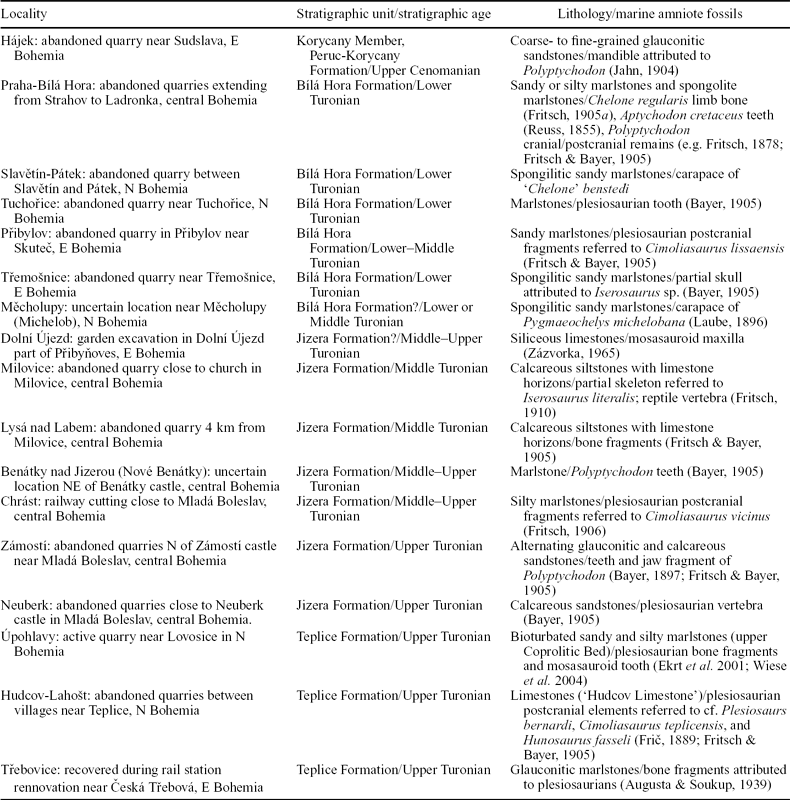
Marine amniote remains have been found at numerous localities throughout the Bohemian Cretaceous Basin (see Fig. 1; Table 1). However, historical accounts indicate that discoveries were rare (Frič, Reference Frič1877b ; Reference Frič1889a ), even when quarrying was at its most intensive during the late nineteenth and early twentieth centuries. The majority of specimens now housed in public collections therefore date from this timeframe, and typically comprise either isolated or occasionally associated elements (e.g. Reuss, Reference Reuss1855; Frič, Reference Frič1889a ; Fritsch, Reference Fritsch1906). The taphonomic disposition of the material is consistent with post-mortem carcass dismemberment under aerobic conditions, such as those that predominated in the Bohemian Cretaceous Basin during the Turonian (Uličný et al. Reference Uličný, Laurin and Čech2009). Individual bones and teeth also usually display extensive surface damage (e.g. fragmentation, corrosion, edge rounding, carbonate dissolution of mineralized tissue remnants) coherent with transport via wave action and currents prior to burial, together with subsequent diagenetic alteration. Although little detailed stratigraphical information exists for many of the museum specimens, more recent excavations at the active Úpohlavy quarry site in NW Bohemia have shown that vertebrate remains, including shark and fish teeth, occur within condensed horizons (e.g. the Upper Coprolite Bed of the Teplice Formation; Ekrt et al. Reference Ekrt, Košťák, Mazuch, Valíček, Voigt and Wiese2001; Wiese et al. Reference Wiese, Čech, Ekrt, Košťák, Mazuch and Voigt2004). Conversely, the serendipitous recovery of many historical marine amniote fossils implies a random distribution, but admittedly this is extrapolated from very poor site data.
Documented marine amniote fossil localities in the Bohemian Cretaceous Basin, Czech Republic.

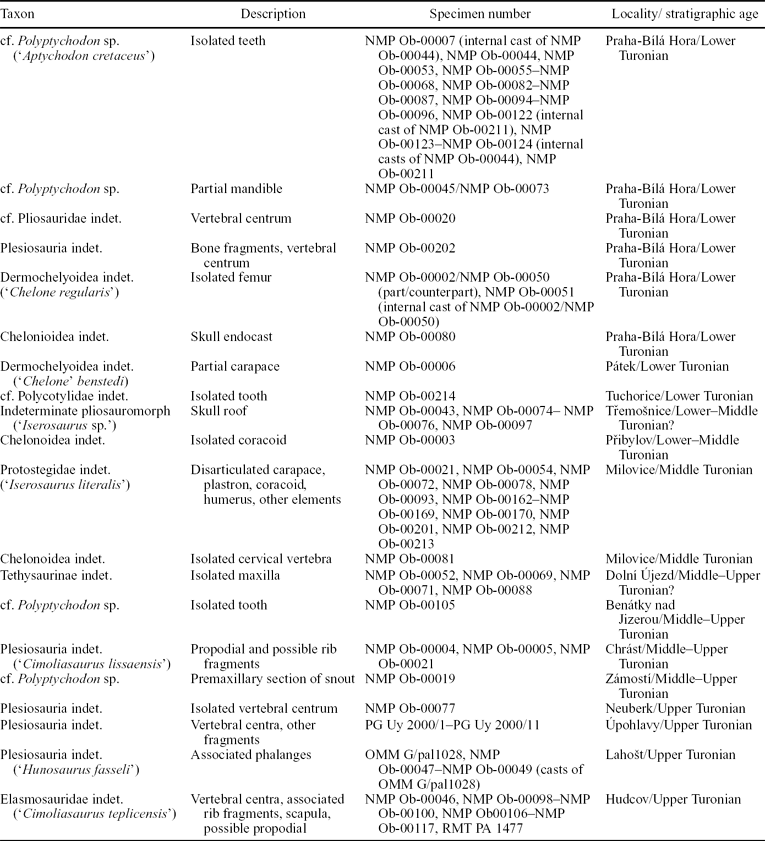
Most documented marine amniote fossils from the Bohemian Cretaceous Basin are accessioned into the Department of Paleontology at the National Museum (NMP) in Prague. Some disruption and damage to these collections took place during WWII; however, almost all of the specimens have since been relocated and were made available for this study (see full specimen list in Table 2). Additional material described in published assessments by Ekrt et al. (Reference Ekrt, Košťák, Mazuch, Valíček, Voigt and Wiese2001) and Wiese et al. (Reference Wiese, Čech, Ekrt, Košťák, Mazuch and Voigt2004) is housed in the Institute of Geology and Palaeontology at Charles University Prague (PG). Original finds reported by Fritsch & Bayer (Reference Bayer1905) have also been ‘rediscovered’ in the Oblastní Museum in Most, NW Bohemia (OMM) and the Regional Museum in Teplice (RMT), NW Bohemia (Ekrt et al. Reference Ekrt, Radoň and Dvořák2012); these were also reassessed in this study.
Inventory of diagnostic Late Cretaceous (Turonian) marine amniote fossils re-assessed for this study.

3.a. Marine turtles
Marine turtle fossils from the Bohemian Cretaceous Basin comprise several incomplete postcranial skeletons as well as a few isolated elements. Karl (Reference Karl2002) and Karl et al. (Reference Karl, Nyhuis and Schöllmann2012) ascribed (without explicit character justifications) the small carapaces of Cimochelys (‘Chelone’) benstedi (Reuss, Reference Reuss1855; NMP Ob-00006 is 72.8 mm long) and Pygmaeochelys michelobana (Laube, Reference Laube1896), found in the Lower Turonian Bílá Hora Formation at Slavĕtín-Pátek and Měcholupy, respectively (stratigraphical correlations established by Zahálka, Reference Zahálka1897; Čech et al. Reference Čech, Klein, Kříž and Valečka1980), to Rhinochelys cantabridgiensis Lydekker, Reference Lydekker1889a , a taxon known primarily from the Cenomanian of England (Collins, Reference Collins1970). This classification followed Collins (Reference Collins1970), who assigned shell material previously designated as Cimochelys benstedi (sensu Zangerl, Reference Zangerl1960) to Rhinochelys (otherwise represented by skull remains) because of phylogenetic and stratigraphical compatability. Moody (Reference Moody1993), Hirayama (Reference Hirayama1994, Reference Hirayama, Callaway and Nicholls1997) and Hooks (Reference Hooks1998) likewise adopted this assumption, but recognized only the monotypic species, R. pulchriceps (Owen, Reference Owen1851), which they placed (using R. pulchriceps + Cimochelys benstedi as a generic hypodigm) within Chelonioidea (true sea turtles) as either a basal representative (Hirayama, Reference Hirayama1994, Reference Hirayama, Callaway and Nicholls1997) or immediate sister taxon to Protostegidae (Hooks, Reference Hooks1998).
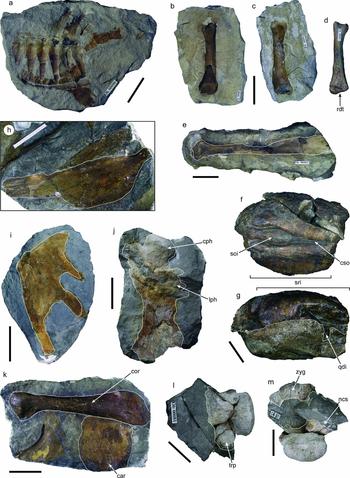
Our reassessment of the Bílá Hora Formation marine turtle fossils confirms referral to Dermochelyoidea (Protostegidae + Dermochelyidae; sensu Hirayama, Reference Hirayama1998; Kear & Lee, Reference Kear and Lee2006), since the partially disarticulated carapace from Slavĕtín-Pátek (NMP Ob-00006) displays reduced distal portions of the costals and narrow, rectangular neurals (Fig. 2a). Exposure of NMP Ob-00006 in internal view additionally reveals insertion of the ribs into distinct groves on the posterior peripherals, a trait shared with derived protostegids (Protostegina; Hooks, Reference Hooks1998) and apparently also the lost holotype of Pygmaeochelys michelobana (Laube, Reference Laube1896, p. 33, figs 1, 4). However, beyond this stratigraphical contemporaneity we find no convincing evidence for specific attribution of the Bohemian Cretaceous Basin turtle material to Rhinochelys.
Diagnostic marine turtle fossils from the Bohemian Cretaceous Basin, Czech Republic. (a) Partial dermochelyoid carapace (NMP Ob-00006) in internal view. Indeterminate dermochelyoid femur preserved as impressions in (b) part (NMP Ob-00002) and (c) counterpart blocks (NMP Ob-00050), with a (d) plaster cast shown in posterior view (NMP Ob-00051). (e) Chelonioid coracoid in lateral view (NMP Ob-00003). Indeterminate chelonioid endocranial cast (NMP Ob-00080) in (f) dorsal and (g) lateral views. Components of a large protostegid skeleton including: (h) a costal (NMP Ob-00165) in internal view; (i) stellate hyo/hypoplastron fragment (NMP Ob-00212); (j) humerus (NMP Ob-00021) in dorsal view; and (k) coracoid and flattened carpal element (NMP Ob-00164). Indeterminate chelonioid cervical vertebra (NMP Ob-00081) in (k) ventral and (l) posterior views. Scale bars represent 30 mm in (a–e, l, m); 50 mm in (f, g, j); 100 mm in (h, i, k). Abbreviations: car – carpal; cor – coracoid; cph – caput humeri; cso – crista supraoccipitalis impression; lph – lateral process distal to humeral head; ncs – neuro-central suture; qdi – quadrate impression; rdt – ridge between distal trochanters; soi – supraoccipital impression; sri – skull roof impression; trp – transverse process; zyg – zygopophysis base.

The partial endocast of a turtle skull (NMP Ob-00080) identified by Edinger (Reference Edinger1934) and listed as Rhinochelys by Karl (Reference Karl2002) and Karl et al. (Reference Karl, Nyhuis and Schöllmann2012) incoporates impressions from the underside of the supraoccipital, the crista supraoccipitalis, and the inner surfaces of the posterior dermocranial elements together with part of the quadrate (Fig. 2f, g). Posterior expansion of the skull roof suggests poor development of the upper temporal emargination, which is a plesiomorphic feature of chelonioids (Joyce, Reference Joyce2007).
A dissarticulated skeleton (individually numbered NMP Ob-00021, NMP Ob-00054, NMP Ob-00072, NMP Ob-00078, NMP Ob-00093, NMP Ob-00162–NMP Ob-00170, NMP Ob-00201, NMP Ob-00212, NMP Ob-00213) from the Middle Turonian (Havlíček et al. Reference Havlíček, Holásek, Hradecká, Jinochová, Klečák, Majer, Manová, Müller, Rudolský, Šalanský and Zelinka2001) Jizera Formation strata at Milovice represents a huge protostegid (humeral length = 298.8 mm). This specimen was originally described as a marine squamate (‘Iserosaurus litoralis’) by Fritsch (Reference Fritsch1905a , b, Reference Fritsch1910) but subsequently referred to ‘Archelon’ cf. copei (Wieland, Reference Wieland1909) by Karl (Reference Karl2002). It displays a number of diagnostic states coherent with referral to Protostegidae: reduced costals (NMP Ob-00165; Fig. 2h); stellate hyo-hypoplastral elements (NMP Ob-00212; Fig. 2i); humerus with lateral process located distal to the caput humeri and enlarged within the anterior portion of the shaft (NMP Ob-00021; Fig. 2j); widely divergent (>110°) scapular processes (evident from the plaster cast ‘femur’ photographed by Fritsch, Reference Fritsch1910, plate 8, fig. 2); an elongate coracoid; and flattened carpal elements (NMP Ob-00164; Fig. 2k; see character distributions in Zangerl, Reference Zangerl1953a ; Hirayama, Reference Hirayama1994, Reference Hirayama, Callaway and Nicholls1997, Reference Hirayama1998; Hooks, Reference Hooks1998; Lehman & Tomlinson, Reference Lehman and Tomlinson2004; Kear & Lee, Reference Kear and Lee2006). Hooks (Reference Hooks1998) variously reassigned the remains of ‘Archelon’ copei to Microstega Hooks, Reference Hooks1998 or Archelon ischyros Wieland, Reference Wieland1896 based on differing degrees of costal reduction – not discernible in the Milovice fossils. The humerus (NMP Ob-00021) from Milovice also lacks reduction of the lateral process to a low ridge, which is a trait otherwise indicative of Archelon Wieland, Reference Wieland1896 (Hooks, Reference Hooks1998); we therefore reject assignment of the Bohemian Cretaceous Basin protostegid to this genus (sensu Karl, Reference Karl2002).
An isolated cervical vertebra (NMP Ob-00081), figured by Fritsch (Reference Fritsch1910, plate 9, figs 1, 2), has also been recovered from Milovice. This latter specimen has a noticably short centrum (36.6/43.3 mm long/wide; Fig. 2l), which resembles those of protostegids (e.g. Zangerl, Reference Zangerl1953a , p. 116, fig. 53; Elliott, Reference Elliott, Callaway and Nicholls1997, p. 251, fig. 4). Conversely, its posterior condyle (Fig. 2m) is dorsoventrally compressed (23.4/36.54 mm high/wide) like those of both cheloniids (Hirayama, Reference Hirayama1994, Reference Hirayama1998) and basal chelonioids such as Toxochelys Cope, Reference Cope1873 (see Zangerl, Reference Zangerl1953b , plate 20B). The ventral surface of the centrum is badly damaged but what might be the broken base of a ventral keel is evident (Fig. 2l). The neurapophysis is disarticulated but preserves remnants of the zygopophyses and the neurocentral suture, which apparently bisected the transverse process as in modern cheloniids (Zangerl, Reference Zangerl1960).
Other turtle remains from the Bílá Hora Formation similarly manifest dermochelyoid affinities. NMP Ob-00002 and NMP Ob-00050 (Fig. 2b, c) from Bílá Hora, named as ‘Chelone regularis’ by Fritsch (Reference Fritsch1905a ), comprise part and counterpart impressions of an isolated femur (not a tibia as suggested by Fritsch Reference Fritsch1905a ), whose proximal articular head is eroded but the distal trochanters (visible in the cast NMP Ob-00051; Fig. 2d) are connected by a bony ridge; this is an unequivocal synapomorphy of dermochelyoids (Hirayama, Reference Hirayama1998). Fritsch (Reference Fritsch1905b , p. 3) additionally reported a neural (‘neuralreihe’; NMP Ob-00001) of ‘Chelone regularis’, but this is probably a fragment from a nautiloid shell. An isolated coracoid (NMP Ob-00003; Fig. 2e) is also known from the Bílá Hora Formation at Přibylov, and cannot be placed beyond Chelonioidea indet.
3.b. Plesiosaurians
Plesiosaurians represent the most numerically common and stratigraphically ubiquitous component of the Bohemian Cretaceous Basin fossil marine amniote fauna. Despite this, diagnostic remains are only known from sediments of Turonian age. The purported mandible of Polyptychodon (NMP Ob-5583) reported by Jahn (Reference Jahn1904) from the Upper Cenomanian Peruc–Korycany Formation appears to be a phosphatic concretionary mass with amorphous internal structure.
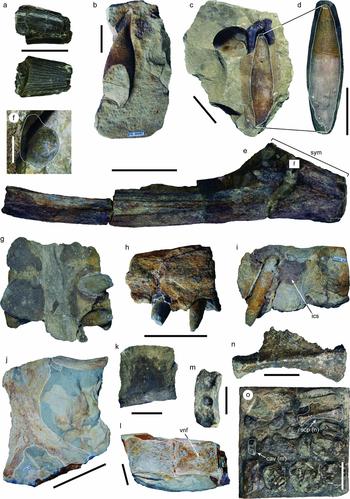
Early Turonian plesiosaurian material from the Bílá Hora Formation at Bílá Hora (age correlated by Čech et al. Reference Čech, Klein, Kříž and Valečka1980) incorporates both isolated teeth and associated skeletal elements. Of particular note is a short curved tooth (NMP Ob-00214; Fig. 3a), preserved partly as an impression (maximum height = 17.1 mm), which displays a circular cross-section and closely spaced (<1 mm apart) enamel ridges restricted to the lingual side of the crown. Similar ‘gracile’ (sensu O'Keefe, Reference O'keefe2001) tooth morphologies with ‘asymmetrically’ distributed (= present on one face of the tooth, sensu O'Keefe, Reference O'keefe2001; Großmann, Reference Großmann2007), fine enamel ridges are observable in many plesiosauroid taxa (Sato, Reference Sato2003; Druckenmiller & Russell, Reference Druckenmiller and Russell2008). The dentitions of Cretaceous polycotylids (e.g. Thililua Bardet, Pereda Suberbiola & Jalil, Reference Bardet, Pereda Suberbiola and Jalil2003a ; Dolichorhynchops tropicensis McKean, Reference McKean2012) and some elasmosaurids (e.g. Eromangasaurus Kear, Reference Kear2005a ) being especially compatible. On the other hand, the majority of elasmosaurids exhibit labio-lingually compressed teeth (e.g Hydrotherosaurus Welles, Reference Welles1943, Callawayasaurus Carpenter, Reference Carpenter1999, Terminonatator Sato, Reference Sato2003, Futabasaurus Sato, Hasegawa & Manabe, 2006; see also character discussion in Druckenmiller & Russell, Reference Druckenmiller and Russell2008) and their overall crown height is usually much larger (up to 40 mm; see Buchy, Reference Buchy2006, p. 9, table 3).
Diagnostic plesiosaurian fossils from the Bohemian Cretaceous Basin, Czech Republic. (a) Possible polycotylid tooth (NMP Ob-00214) in labial (top) and lingual (bottom) views. Remains compatible with the large pliosauromorph Polytychodon. (b) Tooth impression referred to ‘Aptychodon cretaceus’ (NMP Ob-00082). (c) Natural mould (NMP Ob-00211) and (d) plaster cast (NMP Ob-00122) of a ridged enamel crown. (e) Mandible (NMP Ob-00080) in ventral view, with enlargement of (f) tooth impression. Premaxillary section of snout (NMP Ob-00019) in (g) ventral, (h) lateral and (i) posterior views and (j) the parietal-squamosal section of a skull roof (NMP Ob-00043). (k) Pliosaurid-like vertebral centrum (NMP Ob-00020) in ventral view. Elements of an elasmosaurid skeleton: (l) two articulated cervical vertebral exposed in cross-section (NMP Ob-00109); (m) a caudal vertebra in ventral view and (n) scapula in lateral view, both enlarged from (o) a reassembled series of associated blocks (RMT PA 1477). Scale bars represent 10 mm in (a, f); 30 mm in (b–d, l, m); 50 mm in (k, n); 100 mm in (g–j, o); 200 mm in (e). Abbreviations: cav (m) – caudal vertebra shown in (m); ics – internal cranial sinus; scp (n) – scapula shown in (n); sym – symphysis; vnf – ventral nutrient foramina.

Both the Bílá Hora Formation and Middle–Upper Turonian Jizera Formation have yielded remains traditionally attributed to the enigmatic large pliosauromorph (sensu O'Keefe, Reference O'keefe2002) Polyptychodon interruptus (e.g. Fritsch, Reference Fritsch1878, Reference Fritsch1905a ; Bayer, Reference Bayer1896, Reference Bayer1897, Reference Bayer1898; Fritsch & Bayer, Reference Bayer1905). Fritsch (Reference Fritsch1878), additionally referred the isolated teeth of Aptychodon cretaceus (e.g. the natural impression NMP Ob-00082 described by Reuss, Reference Reuss1855; Fig. 3b) to P. interruptus; however, Welles (Reference Welles1962) considered both these taxa to be non-diagnostic. Irrespectively though, their large size (NMP Ob-00082; maximum height of preserved impression = 114 mm), coupled with distinctive crown ornamentation comprising prominent, closely spaced ridges that extend to the apex but bifurcate and become densely packed towards the crown-base, is consistent with dental remnants typically attributed to Polyptychodon from the Cenomanian–Turonian of Europe (Bardet & Godefroit, Reference Bardet and Godefroit1995) and North America (Welles & Slaughter, Reference Welles and Slaughter1963; VonLoh & Bell, Reference VonLoh, Bell and Jr1998). Note that Schumacher (Reference Schumacher2008) and Schumacher et al. (Reference Schumacher, Carpenter and Everhart2013) distinguished the North American Late Cretaceous P. hudsoni Welles & Slaughter, Reference Welles and Slaughter1963, Brachauchenius lucasi Williston, Reference Williston1903 and Megacephalosaurus eulerti Schumacher, Carpenter, & Everhart, Reference Schumacher, Carpenter and Everhart2013 from P. interruptus because they display branching enamel ridges; we likewise employ this convention for the Bohemian Cretaceous Basin specimens since they manifest the same trait.
Polyptychodon-like teeth from the Bílá Hora Formation (see Table 2 for specimen list) are often preserved as impressions with the original mineralized tissues dissolved during diagenesis (e.g. NMP Ob-00211; shown together with a plaster cast NMP Ob-00122; Fig. 3c, d). Regardless, these specimens provide further states that are coherent with published definitions of Polyptychodon (Milner, Reference Milner, Owen and Smith1987; Bardet & Godefroit, Reference Bardet and Godefroit1995): robust recurved crown with a sub-circular basal cross-section (maximum height/diameter of NMP Ob-00082 = 84.8/34 mm). Evaluating the generic validity of Polyptychodon is beyond the scope of this paper. However, the dental features evident in the Bohemian Cretaceous Basin pliosauromorph teeth are essentially plesiomorphic (see character polarizations in O'Keefe, Reference O'keefe2001; T. Sato, unpub. thesis, University of Calgary, 2002; Druckenmiller & Russell, Reference Druckenmiller and Russell2008; Smith & Dyke, Reference Smith and Dyke2008; Ketchum & Benson, Reference Ketchum and Benson2010) and resemble those of other large-skulled Cretaceous taxa such as Brachauchenius Williston, Reference Williston1903 (Schumacher, Reference Schumacher2008) and Kronosaurus Longman, Reference Longman1924 (Kear, Reference Kear2005b ).
Additional dentigerous elements including the symphyseal region of a mandible (NMP Ob-00045, NMP Ob-00073) from Bílá Hora and a premaxillary section of snout (NMP Ob-00019) from the Jizera Formation at Zámostí (Middle–Upper Turonian; Zahálka, Reference Zahálka1903; Čech et al. Reference Čech, Klein, Kříž and Valečka1980) are also consistent with large-skulled Polyptychodon-like pliosauromorphs. The decorticated mandible (NMP Ob-00045, NMP Ob-00073; Fig. 3e) is exposed in ventral aspect (the dorsal surface is obscured by matrix) and preserves a 15 mm deep tooth impression with distinctive branching ridges that extend to the apex (Fig. 3f). Both the anterior and posterior extremities of the mandible have been broken off, as has the left posterior ramus. Nonetheless, the preserved element is still quite large being 644 mm long, but remarkably slender with a maximum height/width of 80.5/181 mm. The symphysis is formed by the splenials and dentaries, which enclose an anterior projection of the angular (continuing anteriorly to within c. 40 mm of the symphyseal contact). There is no evidence of mandibular constriction or ventral keeling as occurs in plesiomorphic pliosauromorphs such as Rhomaleosaurus Seeley, Reference Seeley1874 (see O'Keefe, Reference O'keefe2001; Druckenmiller & Russell, Reference Druckenmiller and Russell2008; Smith & Dyke, Reference Smith and Dyke2008).
Although badly damaged, the Zámostí premaxillae (NMP Ob-00019: Fig. 3g–i) represent a weakly-tapered section of snout. Six alveoli are preserved with three teeth still in situ; maximum tooth height/diameter is 110/36.2 mm. Like the Bílá Hora mandible (NMP Ob-00073) NMP Ob-00019 is slender, being 137.9 mm long but only 95.5/152.5 mm high/wide at the midline, and could perhaps indicate a longirostrine skull (similar to that reconstructed for Brachauchenius by Albright et al. Reference Albright, Gillette and Titus2007a ; Schumacher, Reference Schumacher2008; and Megacephalosaurus by Schumacher et al. Reference Schumacher, Carpenter and Everhart2013). The dorsal surface of NMP Ob-00019 is heavily worn, making it difficult to establish whether the inter-premaxillary suture was elevated into a midline ridge as occurs in many plesiosaurians (e.g. Umoonasaurus Kear, Schroeder & Lee, Reference Kear, Schroeder and Lee2006; Druckenmiller & Russell, Reference Druckenmiller and Russell2008; Smith & Dyke Reference Smith and Dyke2008). Posteriorly, the premaxillae enclose a central cavity (filled with matrix) that might correspond to a cranial sinus.
Other diagnostic plesiosaurian remains from the Bohemian Cretaceous Basin include the parietal-squamosal region of a large skull (NMP Ob-00043; 200.1/158 mm in maximum preserved length/width) listed as ‘Iserosaurus’ (Bayer, Reference Bayer1905) from probable Bílá Hora Formation rocks near Třemošnice (Lower or Middle Turonian; Čech et al. Reference Čech, Klein, Kříž and Valečka1980). NMP Ob-00043 is exposed in dorsal view (Fig. 3j) with some unidentifiable elements, possibly the atlas-axis and components of the basicranium. The bone surfaces are badly damaged; however, the inter-parietal suture and area surrounding the pineal opening are discernable. Most importantly, there is no evidence of a squamosal bulb. This is a distinctive feature of many pliosauroids (e.g. Peloneustes Lydekker, Reference Lydekker1889b ; Andrews, Reference Andrews1913; Ketchum & Benson, Reference Ketchum and Benson2011) but is conspicuously absent in Cretaceous taxa including Leptocleidus Andrews, Reference Andrews1922 (Druckenmiller & Russell, Reference Druckenmiller and Russell2008; Kear & Barrett, Reference Kear and Barrett2011), Brachauchenius (Carpenter, Reference Carpenter1996; Albright et al. Reference Albright, Gillette and Titus2007a ), Megacephalosaurus (Schumacher et al. Reference Schumacher, Carpenter and Everhart2013) and Polyptychodon (Owen, Reference Owen1851; Welles & Slaughter, Reference Welles and Slaughter1963).
Identifiable plesiosaurian postcranial elements include a large dorsal centrum (NMP Ob-00020: maximum length/width/height = 82.8/97.9/65.6 mm; Fig. 3k) from the Bílá Hora Formation at Bílá Hora that lacks ventral nutrient foramina (foramina subcentralia sensu Storrs, Reference Storrs1991). Druckenmiller & Russell (Reference Druckenmiller and Russell2008) suggested that this condition might be unique to Brachauchenius and Kronosaurus.
Ekrt et al. (Reference Ekrt, Radoň and Dvořák2012) gave a brief account of ‘Cimoliasaurus teplicensis’ (Fritsch, Reference Fritsch1906) from the Teplice Formation at Hudcov (Upper Turonian; Wiese et al. Reference Wiese, Čech, Ekrt, Košťák, Mazuch and Voigt2004). This disarticulated skeleton incorporates probable dorsal and caudal centra (Fig. 3m), ribs and an incomplete scapula (Fig. 3n) that have been embedded in a plaster panel mount (RMT PA 1477; Fig. 3o). Some articulated cervical (Fig. 3l) and dorsal vertebral centra (NMP Ob-00098, NMP Ob-00100, NMP Ob-00109) are also known from the same locality. The latter are only visible in cross-section but the cervicals (NMP Ob-00109) are clearly longer than wide (length/width = 46/39 mm) with small, centrally positioned ventral nutrient foramina and platycoelous articular surfaces. Similar states have been used to define Elasmosauridae (Welles, Reference Welles1943, Reference Welles1952; Brown, Reference Brown1981, Reference Brown1993; Bardet et al. Reference Bardet, Godefroit and Sciau1999; O'Keefe, Reference O'keefe2001; T. Sato, unpub. thesis, University of Calgary 2002; Druckenmiller & Russell, Reference Druckenmiller and Russell2008; Vincent et al. Reference Vincent, Bardet, Suberbiola, Bouya, Amaghzazm and Meslouh2011). The scapula of RMT PA 1477 is exposed in lateral view and is missing most of its dorsal blade, but likewise conforms to the general morphology of elasmosaurids (e.g. Hydrotherosaurus: Welles, Reference Welles1943, p. 241, plate 23a; Albertonectes Kubo, Mitchell, Henderson, Reference Kubo, Mitchell and Henderson2012; Kubo et al. Reference Kubo, Mitchell and Henderson2012, p. 563–564, fig. 6B).
3.c. Aquatic squamates
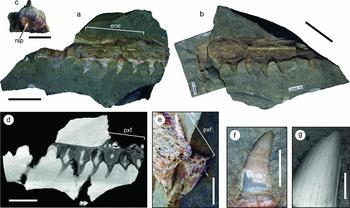
The mosasauroid maxilla described by Zázvorka (Reference Zázvorka1965) was recovered from exposed bedrock during excavations in a garden (J. Hurych, pers. comm. 2012) in the village of Dolní Újezd (part of Přibyňoves) in E Bohemia. The landscape surrounding Dolní Újezd is covered by loessic brown soil, although Middle Turonian Jizera Formation limestones extend in a NW–SE-trending band c. 3 km to the west (Stárková & Opletal, Reference Stárková and Opletal1998; Adamovič et al. Reference Adamovič, Čurda, Manová, Müller, Rudolský, Rýda, Sáňka, Stárková and Šalanský2000). The Dolní Újezd maxilla has been split through its lateral wall to form a part (NMP Ob-00088; Fig. 4a) and counterpart (NMP Ob-00052, NMP Ob-00069; Fig. 4b). A tooth (NMP Ob-00071; Fig. 4c) has also been removed from NMP Ob-00088 to show the expanded bony base of attachment and a posterolingual resorption pit (indicative of mosasauroids; Bell, Reference Bell, Callaway and Nicholls1997; Caldwell & Palci, Reference Caldwell and Palci2007). The maxilla is 181.5/35 mm long/high but lacks its posterior extremity. Its anterodorsal margin is shallowly embayed between the third and sixth tooth positions to accommodate the external bony nasal aperture. The premaxilla suture is just visible anteriorly (Fig. 4d), and is delimited anteriorly by the fourth tooth position as evidenced from CT images (Fig. 4e) generated at the Czech Technical University in Prague. Caldwell (Reference Caldwell1999, Reference Caldwell2000) and Bardet et al. (Reference Bardet, Pereda Suberbiola and Jalil2003b ) used projection of the premaxilla–maxilla suture beyond the fourth maxillary tooth position to define Mosasauridae; a more posterior termination is evident in derived forms (Bell, Reference Bell, Callaway and Nicholls1997). Makádi et al. (Reference Makádi, Caldwell and Ősi2012) also listed restriction of the premaxilla–maxilla contact anterior to the midline of the fourth maxillary tooth position as a diagnostic feature of the primitive mosasauroid clade Tethysaurinae. NMP Ob-00088 preserves nine alveoli with seven pleurodont teeth (c. 15 mm in crown height) in situ. The crowns are posteromedially curved (Fig. 4f) and weakly oval in cross-section. The exposed labial enamel surfaces are smooth with weak unserrated carinae (Fig. 4g), similar to those of tethysaurines such as Tethysaurus Bardet, Pereda Suberbiola & Jalil, Reference Bardet, Pereda Suberbiola and Jalil2003b , Russellosaurus Polcyn & Bell, Reference Polcyn and Bell2005 and Pannoniasaurus Makádi, Caldwell & Ősi, Reference Makádi, Caldwell and Ősi2012.
Diagnostic aquatic squamate fossils from the Bohemian Cretaceous Basin, Czech Republic. Tethysaurine maxilla (NMP Ob-00052, NMP Ob-00069, NMP Ob-00088) split into (a) part and (b) counterpart sections; (c) removed tooth base (NMP Ob-00071); (d) CT generated cross-section image through NMP Ob-00088 revealing extent of the premaxillary contact; (e) anterior view of premaxillary contact; (f) enlargement of the fourth maxillary tooth crown from NMP Ob-00088; and (g) SEM image of the fourth maxillary tooth showing the smooth enamel surface and posterior carina. Scale bars represent 50 mm in (a, b, e); 10 mm in (c, d, f); 4 mm in (g). Abbreviations: ene – embayment for external nasal aperture; pxf – premaxillary facet; rsp – resorption pit.

4. Palaeobiogeographical and biostratigraphical conclusions
Although fragmentary, the Turonian marine amniote remains from the Bohemian Cretaceous Basin contribute an important record of early Late Cretaceous faunal diversity from the northern Tethyan margin. Identifiable higher-level taxa such as protostegid sea turtles (archytypal in pre-Coniacian strata; Hirayama, Reference Hirayama, Callaway and Nicholls1997), possible polycotylid and elasmosaurid plesiosaurs and tethysaurine mosasauroids represent lineages that were widespread during this timeframe, and conform with documented finds from elsewhere along the northern/eastern European platforms (see summarative lists in Welles, Reference Welles1962; Persson, Reference Persson1963; Bardet & Godefroit, Reference Bardet and Godefroit1995; Storrs et al. Reference Storrs, Arkhangel'skii, Efimov, Benton, Shishkin, Unwin and Kurochkin2000; Karl, Reference Karl2002; Bardet et al. Reference Bardet, Houssaye, Rage and Pereda Suberbiola2008) and the contiguous North African rim of the Mediterranean Tethys (e.g. Bardet et al. Reference Bardet, Pereda Suberbiola and Jalil2003a , b; Buchy et al. Reference Buchy, Métayer and Frey2005b ; Buchy, Reference Buchy2006; Tong et al. Reference Tong, Hirayama, Makhoul and Escuillie2006). Ekrt et al. (Reference Ekrt, Čech, Košťák, Mazuch, Voigt and Wiese2008) concluded that Turonian teleost fish assemblages from the Bohemian Cretaceous Basin were compositionally Boreal in character, and reflected a common pelagic distributional range (based on palaeogeographical reconstructions; Ziegler, Reference Ziegler1988) across the northern European shelf sea. Conversely, macroinvertebrate taxa seem to have been mixed, with high-latitude Boreal forms (e.g. allocrioceratid and collignoniceratid ammonites; Weise & Voigt, Reference Wiese and Voigt2002) occurring in conjunction with distinctive Tethyan benthic elements (Kollmann et al. Reference Kollmann, Peza and Čech1998).
The Boreal affinities of Bohemian Cretaceous Basin assemblages become noticeably more pronounced during the Late Turonian, following the onset of marked climatic cooling (Voigt & Wiese, Reference Voigt and Wiese2000). How this event would have affected coeval pelagic marine amniotes is unclear. Certainly though, early mosasauroid radiations seem to have been influenced by water temperature (Jacobs et al. Reference Jacobs, Polcyn, Taylor and Ferguson2005; Bardet et al. Reference Bardet, Houssaye, Rage and Pereda Suberbiola2008), with Turonian tethysaurines in particular displaying a low-mid palaeolatitudinal distribution (from c. 45°N to 30°S latitude; Jacobs et al. Reference Jacobs, Polcyn, Taylor and Ferguson2005) extending from North Africa (Tethysaurus, Morrocco; Bardet et al. Reference Bardet, Pereda Suberbiola and Jalil2003b ), across the palaeo-Atlantic into the Western Interior Seaway of North America (Russellosaurus, Texas; Polcyn & Bell, Reference Polcyn and Bell2005) and southwards to the Gondwanan margin of South America (Yaguarasaurus, Colombia; Páramo-Fonseca, Reference Páramo-Fonseca2000). The recognition of probable tethysaurine mosasauroids from Middle–Upper Turonian sequences in the Bohemian Cretaceous Basin is therefore not surprising; indeed, the group seems to have persisted within the mid-latitude Northern European Platform region up until the Maastrichtian (e.g. Pannoniasaurus, Hungary; Makádi et al. Reference Makádi, Caldwell and Ősi2012).
The co-occurrence of mosasauroids and large-bodied, macrophagous pliosauromorphs (cf. Polyptychodon sp.) in the Middle–Upper Turonian Jizera Formation also emphasizes the compositional similarity of Bohemian Cretaceous Basin assemblages to their mid-latitudinal equivalents in North America (e.g. VonLoh & Bell, Reference VonLoh, Bell and Jr1998). Unfortunately, poor stratigraphical control of the Bohemian Cretaceous Basin fossils limits determination of a clear temporal overlap. Nevertheless, both mosasauroids and large predatory pliosauromorphs are known to have co-existed for a brief interval based on the well-constrained North American records (Schumacher, Reference Schumacher2011). Significantly, the last definitive incidences of Polyptychodon-like fossils in the Northern European Platform are stratigraphically coincident (e.g. Czech Republic, Germany, England: Milner, Reference Milner, Owen and Smith1987; Sachs, Reference Sachs2000), implying a simultaneous global extinction and wholesale replacement of the last plesiosaurian megacarnivores by derived mosasauroids during Late Turonian times.
Acknowledgements
BE generously hosted BPK and GLG during their visits to collections in the Czech Republic. JP undertook the X-ray CT on a VT-400 at the Czech Technical University. Jan Hurych (Dolní Újezd) provided first-hand information about the discovery of the mosasauroid maxilla (NMP Ob-00052, NMP Ob-00069, NMP Ob-00071, NMP Ob-00088) on his family property. Thanks to Sven Sachs (Cologne) for unpublished images and literature on Bohemian Cretaceous Basin vertebrate fossils from Dresden, Germany. Comments from Nathalie Bardet (Muséum National d'Histoire Naturelle) and a second anonymous reviewer improved drafts of this manuscript. The Australian Research Council (LP100100339), a Sylvester-Bradley Award from the Palaeontological Association and Uppsala University provided financial support for BPK; BE acknowledges funding from the Ministry of Culture, Czech Republic (DKRVO 2013/5, National Museum, 00023272); and JF was supported by project RVO68407700.